RIP Tony Harrison – a piece on metre and voice in his poetry

With the sad news of the passing of Tony Harrison, who as a working class poet had a great impact on me during my formative years of writing in the 1980s, I went back to a piece I was commissioned to write for an OUP collection of essays on his writing – both poetic and dramatic – in 1997. The book, Tony Harrison: Loiner, was edited by Sandie Byrne and included articles from Richard Eyre, Melvyn Bragg, Alan Rusbridger, Rick Rylance, and Bernard O’Donoghue. This is the full text of what I contributed: an intense focus on and close analysis of two of Harrison’s key poems, ‘A Cold Coming’ (for Harrison reading this poem click here) and ‘Them & [uz]’ (for the text of this poem click here).

The Drunken Porter Does Poetry: Metre and Voice in the Poems of Tony Harrison

Part I

Harrison’s first full collection, entitled The Loiners after the inhabitants of his native Leeds, was published in 1970 and contained this limerick:

There was a young man from Leeds

Who swallowed a packet of seeds.

A pure white rose grew out of his nose

And his arse was covered in weeds.

Without losing sight of the essential comedy of this snatch, it can be seen as suggestive of aspects of Harrison’s career. For example, the comic inappropriateness of the Leeds boy swallowing seeds becomes the poet’s own ironic image of his classical grammar school education. As a result of this, in a deliberately grotesque image, arises the growth of the white rose of poetry – from the boy’s nose, of course, since Harrison in the same volume gave credence to the idea that the true poet is born without a mouth (1). The bizarrely contrasting weed-covered arse owes less to the intake of seeds (rose seeds wherever transplanted will never yield weeds) than to the harsh conditions Harrison premises in the Loiner’s life, as indicated in an early introduction to his work, where he defines the term as referring to “citizens of Leeds, citizens who bear their loins through the terrors of life, ‘loners'”(2).

Harrison’s now-legendary seed-master on the staff of Leeds Grammar School was the one who humiliated him for reciting Keats in a Yorkshire accent, who felt it more appropriate if the boy played the garrulous, drunken Porter in Macbeth.(3) The truth is that the master’s attitudes determined the kind of poetic rose that grew, in particular its technical facility which Harrison worked at to show his ‘betters’ that Loiners could do it as well as (better than?) they could. Yet this was no sterile technical exercise and Harrison’s success lies in the integrity with which he has remained true to those regions “covered with weeds” and in the fact that his work has always struggled to find ways to unite the weed and the rose. Perhaps the most important of these, as the limerick’s anatomical geography already predicted in 1970, is via the rhythms of his own body.

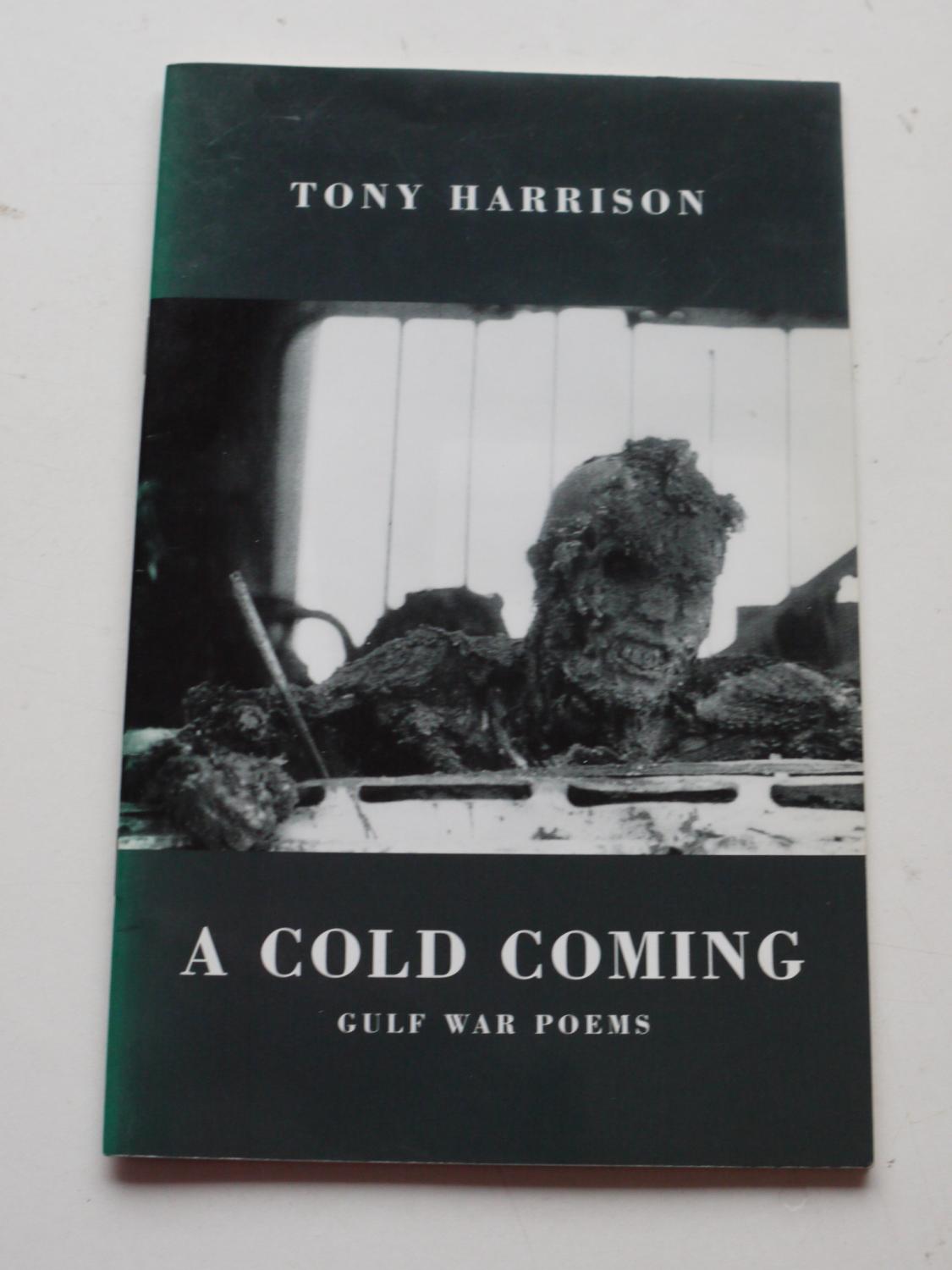
Harrison has declared his commitment to metrical verse because “it’s associated with the heartbeat, with the sexual instinct, with all those physical rhythms which go on despite the moments when you feel suicidal” (4). In conversation with Richard Hoggart, he explains that without the rhythmical formality of poetry he would be less able to confront, without losing hope, the unweeded gardens of death, time and social injustice which form his main concerns. “That rhythmical thing is like a life-support system. It means I feel I can go closer to the fire, deeper into the darkness . . . I know I have this rhythm to carry me to the other side” (5). There are few of Harrison’s poems that go closer to the fire than the second of his Gulf War poems, ‘A Cold Coming’ (6). Its initial stimulus, reproduced on the cover of the original Bloodaxe pamphlet, was a photograph by Kenneth Jarecke in The Observer. The picture graphically showed the charred head of an Iraqi soldier leaning through the windscreen of his burned-out truck which had been hit by Allied Forces in the infamous ‘turkey-shoot’ as Saddam’s forces retreated from Kuwait City. In the poem, Harrison makes the Iraqi himself speak both with a brutal self-recognition (“a skull half roast, half bone”) as well as a scornful envy of three American soldiers who were reported to have banked their sperm for posterity before the war began (hence, with a scatological nod to Eliot, the title of the poem). There are undoubtedly echoes in the Iraqi’s speech of the hooligan alter ego in the poemV’, yet Harrison worries little over any narrow authenticity of voice in this case, and he does triumphantly pull off the balancing act between the reader’s emotional engagement with this fierce personal voice and a more universalising portrayal of  a victim of modern warfare. Furthermore, it is Harrison’s establishment and then variation of the poem’s metrical “life-support system” that enables him to achieve this balance, to complete a poem which weighs in against Adorno’s view that lyric poetry has become an impossibility in the shadow of this century’s brutality.

The poem’s form – rhymed iambic tetrameter couplets – seems in itself chosen with restraint in mind, as if the photographic evidence of the horror lying in front of him led Harrison to opt for a particularly firm rhythmical base “to carry [him] to the other side”. Indeed, the opening five stanzas are remarkable in their regularity with only a brief reversed foot in the fourth line foreshadowing the more erratic energies soon to be released by the Iraqi soldier’s speech:

I saw the charred Iraqi lean

towards me from bomb-blasted screen,

his windscreen wiper like a pen

ready to write down thoughts for men.

The instant the Iraqi’s voice breaks in, the metre is under threat. Each of his first four stanzas opens with trochaic imperatives or questions and at one point he asks if the “gadget” Harrison has (apparently a tape-recorder but a transparent image of poetry itself) has the power to record “words from such scorched vocal chords”. Apart from the drumming of stresses in lines such as this, Harrison deploys sibilance, the alliteration of g’s and d’s, followed by an horrific mumbling of m’s to suggest the charred figure’s effortful speech in the first moments of the encounter. Regularity is re-established the moment the tape-recorder’s mike is held “closer to the crumbling bone” and there is a strong sense of release from the dead man’s initial aggressive buttonholing as his voice (and the verse) now speeds away:

I read the news of three wise men

who left their sperm in nitrogen,

three foes of ours, three wise Marines,

with sample flasks and magazines . . .
In the stanzas that follow, the dead man’s angry, envious sarcasm is controlled within the bounds of the form and it is rather Harrison’s rhymes which provide much of the kick: God/wad, Kuwait/procreate, fate/ejaculate, high tech’s/sex. It is only when the man demands that Harrison/the reader imagines him in a sexual embrace with his wife back home in Baghdad that the metrical propulsion again begins to fail. It is in moments such as this that the difficult emotional work in the poem is to be done. This is our identification with these ghastly remains, with the enemy, and it is as if the difficulty of it brings the verse juddering and gasping to an incomplete line with “the image of me beside my wife / closely clasped creating life . . .”

The difficulty of this moment is further attested to by the way the whole poem turns its back upon it. Harrison inserts a parenthetical section, preoccupied not with the empathic effort the dead Iraqi has asked for but with chilly, ironic deliberations on “the sperm in one ejaculation”. Yet all is not well, since this section stumbles and hesitates metrically as if Harrison himself (or rather the persona he has adopted in the poem) is half-conscious of retreating into safe, calculative and ratiocinative processes. Eventually, a conclusion yields itself up, but it is once again the metrical change of gear into smooth regularity (my italics below) that suggests this is a false, defensive even cynical avoidance of the difficult issues raised by the charred body in the photograph:

Whichever way Death seems outflanked

by one tube of cold bloblings banked.

Poor bloblings, maybe you’ve been blessed

with, of all fates possible, the best

according to Sophocles i.e.

‘the best of fates is not to be’

a philosophy that’s maybe bleak

for any but an ancient Greek . . .

That this is the way to read this passage is confirmed by the renewed aggression of the Iraqi soldier who hears these thoughts and stops the recorder with a thundering of alliterative stresses: “I never thought life futile, fool! // Though all Hell began to drop / I never wanted life to stop”. What follows is the Iraqi soldier’s longest and most impassioned speech, by turns a plea for attention and a sarcastic commentary on the collusion of the media whose behaviour will not “help peace in future ages”. Particular mention is given to the “true to bold-type-setting Sun” and, as can be seen from such a phrase, Harrison once more allows particular moments of anger and high emotion to burst through the fluid metrical surface like jagged rocks. There is also a sudden increase in feminine rhyme endings in this section which serves to give a barely-caged impression, as if the voice is trembling on the verge of bursting its metrical limits and racing across the page. This impression is further reinforced in the series of imperatives – again in the form of snapping trochees at the opening of several stanzas – that form the climax to this section of the poem:

Lie that you saw me and I smiled

to see the soldier hug his child.

Lie and pretend that I excuse

my bombing by B52s.

The final ten stanzas culminate in a fine example of the way in which Harrison manipulates metrical form to good effect. In a kind of atheistic religious insight, the “cold spunk” so carefully preserved becomes a promise, or perhaps an eternal teasing reminder, of the moment when “the World renounces War”. However, emphasis falls far more heavily on the seemingly insatiable hunger of the present for destruction because of the way Harrison rhythmically clogs the penultimate stanza, bringing it almost to a complete halt. The frozen semen is “a bottled Bethlehem of this come- /curdling Cruise/Scud-cursed millennium”. Yet, as we have seen, Harrison understands the need to come through “to the other side” of such horrors and the final stanza does shakily re-establish the form (though the final line opens with two weak stresses and does not close). However, any naive understanding of the poet’s comments about coming through the fire can be firmly dismissed. This is not the place for any sentimental or rational synthetic solution. Simply, we are returned to the charred face whose painful, personal testament this poem has managed to encompass and movingly dramatise but without losing its form, thus ensuring a simultaneous sense of the universality of its art and message:

I went. I pressed REWIND and PLAY

and I heard the charred man say:

Part II
It was Wordsworth whose sense of physical rhythm in his verse was so powerful that he is reported to have often composed at a walk. It should come as no surprise that Harrison has been known to do the same. Though it was Keats’ ‘Ode to a Nightingale’ Harrison ‘mispronounced’ at school, it is actually Wordsworth who is more important to him because both share a belief in poetry as the voice of a man speaking to men. This conception of poetry as speech is a powerful constituent in Harrison’s work and perhaps one not clearly understood. John Lucas, for example, has attacked what he sees as loose metrics in the poem ‘V’ (7) but, to reverse Harrison’s comment that all his writing (theatrical or otherwise) is poetry, all his poetry needs to be read as essentially dramatic and deserves to be tested in the spoken voice as much as in the study. On occasions, Harrison, only half-humourously, draws attention to the fact that two uncles – one a stammerer, the other dumb – had considerable influence on his becoming a poet and it is the struggling into and with voice that such a claim highlights.(8)  I have already mentioned Harrison’s interest in the curious idea that the true poet is born without a mouth. This too, implies the difficult battling for a voice or voices which can be found everywhere in his work and it is in this clamour that I find its dramatic quality. In a public poem like ‘A Cold Coming’, Harrison makes use of the contrasting and conflicting voices by playing them off against a regular form. This is almost always the case, but in what follows I prefer to concentrate less on metrical effects than on the way voices interweave, in this case, in more personal work from The School of Eloquence sequence.

The very title of the pair of sonnets, ‘Them & [uz]’, seems to promise conflict, at best dialogue, and it opens with what could be taken as the howl of inarticulacy. In fact each pair of these opening syllables gestures towards crucial worlds in Harrison’s universe. The αίαι of classical dramatic lament is echoed by the “ay, ay!” of the musical hall comedian cheekily working up an audience. Immediately, the reader is plunged into the unresolved drama of two differing voices, instantly implying the two cultures of the sonnets’ title. The line and a half which follows, sketching Demosthenes practicing eloquence on the beach, is intriguing in that its locus as speech is hard to pin down. It is perhaps intended at this stage (apart from introducing the poems’ central issue) to hover in an Olympian fashion above the ruck of dialogue that follows, implying the heroic stance which will be taken up in the second sonnet.

Line 3 opens again into a dramatic situation with the voice of the narrator (the adult Harrison), repeating his own interrupted recital of Keats in the classroom, while the master’s scornful comments appear fresh, unreported, as if still raw and present, in speech marks. The narratorial comment on this – “He was nicely spoken” – confirms this poem’s tendency to switch voices for its effects, this time its brief sarcasm barely obscuring the unironic comment likely to be made by an aspiring Loiner, or by an ambitious parent. The example of nice speaking given (again in direct quotes in the following line) is the master’s claim to possession, to authority in matters of language and culture and the separated-off reply of the narrator – “I played the Drunken Porter in Macbeth – with its full rhyme and sudden regular iambic pentameter, implies both a causal link between the two lines, painting Harrison  as dispossessed specifically by the master’s attitudes, as well as conveying the tone of resignation in the young schoolboy.

It will be clear that much of the tension and success of the poem has already arisen from the dramatic interchange of voices and the master’s voice asserts itself again in line 7, ironically claiming a kind of monolithic, aristocratic purity to poetry which this poem has already attempted to subvert:

Poetry’s the speech of kings. You’re one of those

Shakespeare gives the comic bits to: prose!”

The following lines contain a curious wavering in the clear interplay of dramatic voices, only part of which is resolved as the poem proceeds. Evidently, the intrusive, even hectoring, parenthesis (at line 9) is the narrator’s questioning of what appears to be the master’s voice’s continuing argument that “All poetry” belongs to Received Pronunciation. Yet the aggression of this attack, with its harsh alliteration and sarcastic question mark, is out of key with the other narratorial comments in part I, though the tone is re-established in part II. In addition, I have some difficulty in accepting the master’s words as appropriate to the situation which – with no break – continues the speech made to the young Harrison. For example, the word “dubbed”, with its implication of the deliberate laying of a second voice over an ‘original’, already hands victory in the argument to Harrison’s claim for the authenticity of ‘dialect’ and, as such, would not be used by the believer in “the speech of kings”. Equally, the apparent plea, “please believe [Λs] / your speech is in the hands of the Receivers”, does not accord with the voice that summarily dismissed the pupil as a “barbarian” 7 lines earlier. In this case, Harrison’s desire for the dramatic has foundered momentarily on that old dramatist’s rock, the necessity for exposition which compromises the integrity of the speaking voice.

The true note of the master returns – interestingly, following one of Harrison’s moveable stanza breaks, as if confirming a shift in voice though the speech actually continues across the break – with “We say [Λs] not [uz], T.W.!” The tone of the responding voice, after the suggestion of a more spirited response in the Keats comment, has returned to the resignation of the brow-beaten pupil. This is reinforced by the more distant comparison of the boy to the ancient Greek of the opening lines, heroically “outshouting seas”, while the young Harrison’s mouth is “all stuffed with glottals, great / lumps to hawk up and spit out”. This first sonnet draws to a close with this tone of frustrated defeat for the boy, yet the drama has one final twist, as the voice of the master, sneering, precise and italicised, has the last word – “E-nun-ci-ate!“. There can be little doubt that the boy must have felt as his father is reported to have done in another sonnet from The School of Eloquence, “like some dull oaf”. (9)

The second part of ‘Them & [uz]’ contrasts dramatically with the first, though the seeds of it lie in the image of heroic Demosthenes and the accusatory tone of the reference to Keats which seemed a little out of place in part I. This second sonnet’s opening expletive aggression strikes a new tone of voice altogether. “So right, yer buggers, then! We’ll occupy / your lousy leasehold Poetry”. The poem’s premise is that it will redress the defeat suffered in part I in an assertive, unopposed manner. Not the master, nor any spokesman for RP is allowed a direct voice, yet the interchange of speech and implied situation can still be found to ensure a dramatic quality to the verse.
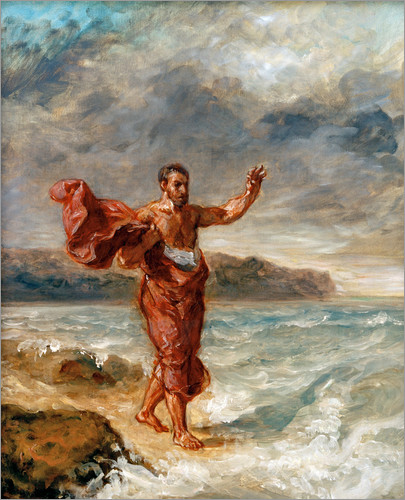
Demosthenes

The passionate and confrontational situation of the opening challenge is clear enough, yet it’s striking how it has taken the autobiographical incident in part I and multiplied it (“yer buggers . . . We’ll occupy”) to present the wider political and cultural context as a future battlefield. Even so, there is no let up in the clamour of voices raised in the poem. Immediately, the narratorial voice shifts to a more reflective, past tense (at line 3) as the rebel reports actions already taken – and with some success, judging from the tone of pride and defiance: “[I] used my name and own voice: [uz] [uz] [uz]”. Even within this one line, the final three syllables are spat out in a vivid reenactment of Harrison’s defiant spoken self-assertion. It is this slippery elision of voice and situation which creates the undoubted excitement of these and many of Harrison’s poems as they try to draw the rapidity and short-hand nature of real speech, its miniature dramas and dramatisations into lyric poetry. A further shift can be found in lines 9 and 10, in that the voice now turns to address a different subject. The addressee is not immediately obvious as the staccato initials in the line are blurted out in what looks like a return to the situation and voice with which this sonnet opened. Only at the end of line 10 does it become clear that the addressee is the poet’s younger self, or the self created as the “dull oaf” by the kind of cultural repression practised by the schoolmaster. The reader is further drawn into the drama of the situation by this momentary uncertainty: RIP RP, RIP T.W. / “I’m Tony Harrison no longer you!”.

The remaining 6 lines are, as a speech act, more difficult to locate. There is an initial ambiguity in that they may continue to address “T.W.”, though the stanza break suggests a change and, anyway, this makes little sense as T.W. is now dead (“RIP T.W.”). In fact, these lines use the second person pronoun in the impersonal sense of ‘one’, addressing non-RP speakers in general, and it is the generalised nature of these lines which disarms the effectiveness of the passage. This is particularly important in line 14, “[uz] can be loving as well as funny”, the tone of which, commentators like John Haffenden have questioned. (10)  The difficulty here is that if Harrison is addressing those who might use [uz] anyway, though there may well be many amongst them for whom the fact that “Wordsworth’s matter / water are full rhymes” is useful ammunition and reassurance, the same cannot be said of the “loving as well as funny” line which might be variously construed as patronising, sentimental or just plain unnecessary. Nevertheless, the poem regains a surer touch in the final lines in its use of the reported ‘voice’ of The Times in renaming the poet “Anthony“. The effect here is both humorous (this, after all the poet’s passionate efforts!) and yet ominous in that the bastions of cultural and linguistic power are recognised as stubborn, conservative forces, still intent on re-defining the poet according to their own agenda, imposing their own voice where there are many.

Harrison’s use of both metre and voice reflect the struggle in much of his work between the passion for articulation, especially of experiences capable of overwhelming verse of less conviction, and the demands of control which preserve the poet’s utterance as art. Harrison’s more recent work – especially that written in America – is more relaxed, meditative, less inhabited by differing and different voices, more easily contained in its forms. There are undoubtedly great successes amongst these (‘A Kumquat for John Keats’, ‘The Mother of the Muses’, part III of ‘Following Pine’) but there are moments when Harrison seems to idle within his technique, perhaps too able to ruminate aloud without the clamour of voices rising around him. It is likely that Harrison’s legacy will eventually be seen as a reassessment of the uses of formal verse and an exploration of the dramatic potential of lyric verse. These elements are rooted ultimately in his attempts to unite the rose of poetry with the weeds of truth and (often painful) experience, by trusting to the measures of his own body and to a language he returns to the mouth.

Footnotes

1. In a note to section III of ‘The White Queen’, Harrison records that “Hieronymus Fracastorius (1483-1553), the author of Syphilis, was born, as perhaps befits a true poet, without a mouth”. Selected Poems, p.30.

2. ‘The Inkwell of Dr. Agrippa’, reproduced in Tony Harrison: Critical Anthology, p.34.

3. See Richard Hoggart, ‘In Conversation with Tony Harrison’, Critical Anthology, p.40.

4. John Haffenden, ‘Interview with Tony Harrison’, Critical Anthology, p.236.

5. Hoggart, Critical Anthology, p.43.

6. The Gaze of the Gorgon, pp.48-54.

7. John Lucas, ‘Speaking for England?’, Critical Anthology, pp.359/60.

8. Selected Poems, p.111.

9. Selected Poems, p.155.

10. Haffenden, Critical Anthology, p.233.

Remembering John Burnside

With yesterday’s announcement of John Burnside’s death, I thought of this review that I wrote in 2006 of his Selected Poems, published by Cape Poetry. His work meant a lot to me around that time and I enjoyed the chance to try to articulate what I found fascinating in it.

John Burnside’s poetry has, for some years now, been offering us a modern egotistical sublime. With Wordsworth, he shares a responsive delight in nature and daunting powers of self-analysis; also similarly, he can slip towards the prolix and portentous and there is something of the same difficulty with projection into another’s experience. But Burnside’s work frequently achieves a moving sublimity without loosening its grip on reality. He is the only contemporary poet who consistently demonstrates the power of a poetic form that is something other than mini fictional narrative, raw confessional, or condensed dramatic monologue. That he is also successful in writing prose makes his achievement all the more impressive.

His work was recognised in the early 1990s despite bucking the trends of secularism, formalism, and plain/street language. His poetry’s brooding intensity lacked laddish brouhaha. The palette was never broad – rural twilights, leaf litter, owls hunting, tracks across snow – but his eye was always on the margins of such things, where the human and the natural met and negotiated. It felt like something spiritual was about to be said or had been articulated and just missed. This was twinned with the powerfully felt absence of fixed personal identity that has remained so deeply engrained in his work. In poems that in many ways were hardly radical, it was this element that made Burnside feel modern. In a self-regarding culture ever more attached to the teats of mobility, individuality, celebrity and fashion, his relentless worrying away at the obscurity of the self, his flirting with its non-existence, struck dissonant but resonating chords.

Burnside’s themes are frequently disturbing. But in a poem like ‘Halloween’ (from The Myth of the Twin, published in 1994) his exquisite ability to conjure up the British countryside proves to be an essential part of the pleasure of reading him. As often, the season is autumn – cold, mostly deserted, snow, rain, “the fernwork of ice and water”. The narrator peels bark from a tree to smell “its ghost” in a characteristic movement from the precisely evoked physical to the almost casually implied spiritual. What the figure in the landscape is trying to do is to “define my place”. Even scraping down in the leaf mould, he finds fungal traces that look “like the first elusive threads / of unmade souls”. Nearby village bells provide “nothing” and the poem typically ends with the figure’s sense of “other versions of myself” on the periphery of vision and these can be taken to imply other futures, untaken pasts, other roles familiarly adopted, even selves beyond the physical – the inconclusiveness is the point.

Burnside has pursued experiments with differing perspectives that were first signalled by the opening and closing poems of The Myth of the Twin. For example, though in the end less successful than its predecessor, Swimming in the Flood (1995)dramatically broadened his poetry’s reach to include the experience of others, often in more extended form and in dramatic monologues. Persecutors and victims inhabit these poems and speak disturbingly of abuse and “the inexplicable / malice of being” (‘Schadenfreude’). This was a turning point in Burnside’s development as what now flooded into the poetry was what had lain buried in the delicacy and tentativeness of the earlier work. In the ‘The Old Gods’ he declares their power is strongest “when anger or fear / is fuzzing the surface, / making us dizzy and whole”. The process of uncovering is shown to be one of healing and this selection includes the sequence called ‘Burning a Woman’ which seems nakedly to speak of the poet’s mother and father. Equally, the ‘Parousia’ sequence (not included in this Selected) ends with what appear to be sceptical reflections on his earlier inquisition beyond the merely physical: “All resurrections are local . . ./ the sign I have waited to see / is happening now / and always”. Here Burnside seems to arrive at a sense of secular miracle (a version of Rilke’s “Hiersein ist herrlich”) less concerned with the reality of religious presence than with the individual’s response to its possibility.

And yet, the dramatic monologues proved something of a cul de sac. With his subsequent work, Burnside has returned to his best subject: himself. Partly what makes the award-winning The Asylum Dance such a magnificent achievement is the development of the fluid poetic form he combines with a second person plural address that achieves the universal without being either hectoring or twee. The influence of William Carlos Williams is obvious, but Burnside extends this beyond a fluent impressionism concerned with the truth of things to encompass a philosophical musing, the lines flickering across the page as if viewed through water. This new selection is too brief to achieve the full sense of his development, but one of the marvels of Burnside’s work is its continuing delivery of extraordinary evocations of the natural world that have become gradually melded with an introspective depth that does not merely offer insight, but sustained meditation. The four long sequences from The Asylum Dance are rightly given space here and constitute a masterpiece in which the poems offer up rich, disturbing, beautiful, precise, profound, and sustained experiences undergone in the act of reading, rather than a lesser poetry’s marshalling of moments of insight and feeling. Burnside’s career already provides ample proof of a fascinating and significant artistic development, and this selection will prove a good starting point for anyone not yet following it.

Judging Poetry Competitions: some notes on the process

I am half way through the process of judging this year’s Segora Poetry Competition. I’ve been lucky enough to judge several such competitions in recent years and in 2015 I published a version of what follows on my blog as a compilation of my thoughts on the judging process. I’m tweaking and re-blogging it here in response to my experience of judging this new competition in 2020. As I have always found, the initial sifting of so many poems can be a slog, but the latter stages are unfailingly fascinating as the best poems – those that set little hooks in you from first reading – gradually rise to the top, their internal coherence emerging, alongside their skills with language, tone and form. So what follows is inevitably a personal take on the business – becoming more so, perhaps, as the process unfolds – but I hope it may cast some light on it for those (of us) tempted to spend hard-earned cash on entering the numerous competitions now running. Follow this link to see more upcoming competitions.

MV5BNzMyZDhiZDUtYWUyMi00ZDQxLWE4NDQtMWFlMjI1YjVjMjZiXkEyXkFqcGdeQXVyNjU0OTQ0OTY@._V1_UX182_CR0,0,182,268_AL_Some films stick in the mind for reasons beyond the cinematic, don’t they? In the 2003 comedy Bruce Almighty, Jim Carey plays the character of God and, along with more obviously useful powers, he has to respond to the prayers of the world. But people are always praying! He rapidly approaches a kind of madness as voices swim around him, clamouring for attention. He takes to reading the prayers in the form of e-mails. He tries to answer them individually but is receiving them faster than he can possibly respond. He decides to set his e-mail account to automatically answer “yes” to all, assuming that this will make everybody happy. Of course, it does not.
Now – a poetry competition judge comparing himself to a character playing God lays him/herself open to some obvious criticism – but I have indeed found the initial phases of judging poetry competitions rather like Jim Carey’s experience. There are so many and such a variety of voices clamouring to be heard and every one of them is heart-felt, recording significant moments in people’s lives. There is a similar sense of responsibility too – the raw nature of much of the writing submitted is impossible to deny. There are moments when I’d like to set my response mechanism to say ‘yes’ to everybody, but the judge’s task has to be how to distinguish submissions as poetry.

What does that mean? The numbers involved are always a bit daunting. Many hundreds of poems have been submitted. Perhaps only 10% of these will demand a further reading after the brutal first sifting. Poems face an early, red stoplight from most judges because the basic poetic elements are not competently done. Here are some of the obvious failings:

  • Competitions are full of pieces where a particular verse form or rhyme pattern tyrannises the sentiment and/or sense. The writer’s submission to this tyranny becomes clear quickly through the contortions imposed on the language to achieve a rhyme.
  • The writer’s choice of language can be devastating to the life of the poem. It just isn’t right to opt for forms of language or abbreviations that died out early in the nineteenth century. Thankfully, this problem seems to be fading as more and more people actually read contemporary poetry books.
  • Choice of diction can also derail an entry if it is doggedly abstract. Sure, there remains much debate about whether it is the narrow English tradition that insists on things rather than ideas – but poems about Fear, Ignorance, Poverty, Eternity and Love which refuse to dip a toe into anything resembling a real life situation are going to find progress hard.
  • A fourth error is using language without being fully conscious of its likely resonance with a reader. A poem using the verb ‘gaslight’ without knowing its current slang meaning or another called ‘Mother’s Pride’ which seems unaware of the loaf of bread, well, they are going to have unanticipated clutter to climb over in any reader’s mind. Louis MacNeice wanted the poet not to be an ivory tower type, but rather “able-bodied, fond of talking, a reader of the newspapers, capable of pity and laughter, informed in economics . . . actively interested in politics”. All a bit Boys Own perhaps, but if this means the poet stays bang up to date with the way words live then he’s right.

download
Rainer Maria Rilke

If you are still thinking of submitting to a competition, it’s worth recalling Wordsworth’s formulation – familiar though it will feel to most – that poetry is built from “emotion recollected in tranquillity”. Poems forged in the heat of the moment (and not revised or reviewed) are seldom without their flaws. And this is the kind of distinction Rainer Maria Rilke makes when he denies poetry is composed of feelings. Its constituents (he says) are rather “experiences” which he clarifies as “memories” though even with these, we “must be able to forget them when they are many and one must have the immense patience to wait until they come again . . . Only when they have turned to blood within us, to glance and gesture, nameless and no longer distinguished from ourselves – only then can it happen that in a most rare hour the first word of a poem arises in their midst and goes forth from them”. On the other hand, such recollection can sometimes create an intellectualised distance that may do harm to a good poem. Who said writing a poem was easy?

41Stephen1books
Stephen Spender

Stephen Spender argued that a poet should try to acquire skill and virtuosity through the study and interpretation of other poetic works in the way Mozart and Beethoven did in playing the music of their predecessors. Spender suggests translating poetry is the best possible exercise in interpretation. But the really important lessons (Spender says) are those of the eye, the ear, the athletic/poetic muscles. A poet can go a long way without a developed heart, but, he says, can get nowhere at all without these skills. The poet must ask continually of his lines: ‘Do they make the reader see, or hear, or feel, this experience which I am trying to re-create?’

Reaching the final stages, the judge will be focusing more on positives and hence more precisely on the sense, the story, the thought and feeling of a poem. Personally, I like poems that focus on small things and, in effect, make arguments for the ways in which they communicate the bigger issues that concern us all. I’m with Thomas Hardy in believing that “he used to notice such things” is one of the greatest of compliments. Edward Thomas’ poem about Spring, ‘But these things also’, likewise echoes this focus on what most people tend to overlook:

The shell of a little snail bleached
In the grass; chip of flint, and mite
Of chalk; and the small birds’ dung
In splashes of purest white . . .

download (1)Perhaps one explanation of why the question ‘what is poetry?’ is so difficult to answer is because it is, to a large extent, an art of the negative, of avoidance. The Daodejing says what is rigid and inflexible is a companion of death; what is flexible is a companion of life. I’d guess there would be general agreement that poetry is an art on the side of life. So poetry must eschew the inflexible; we must avoid the posture. And that’s very hard. In judging a competition, one comes across the Wordsworth-posture, the Ginsberg-posture, alongside those of Hughes, Plath, Duffy, Oswald . . . But we also posture like mad in ‘real life’. We may take up the pose of grief, melancholy, love, liberalism, environmentalism . . . For me, the mark of the absence of posturing is an instability, an openness, an awareness of time (which posture tries to deny) and this is something I look for in a good poem. If a poem strikes an attitude my attention diminishes (even if the attitude is one that wants to show a rejection of attitudinising through the hall of mirrors of ironic distancing). When the poem unearths a pulsing, shifting, live relationship between the self and the other, then I am captivated, recognising something that is both commonly human and uniquely personal.

4756
Philip Pullman

But having said all this, I’d assure potential competition entrants that anything resembling a rule is there to be broken. Philip Pullman has said, “We don’t need a list of rights and wrongs, tables of dos and don’ts: we need books, time, and silence. Thou shalt not is soon forgotten, but Once upon a time lasts forever.” So any poem in any form can work its magic. It will haunt its reader for days; it will make me change the way I think and feel; make me see the world differently. Ultimately, a poem contributes to who the reader is becoming. That is an exciting prospect for the writer. It is an even more exciting one for the judge who settles down to read.

2019 Forward First Collections Reviewed #5 – Stephen Sexton’s ‘If All the World and Love Were Young’

As in the previous four years, I am posting – over the summer – my reviews of the 5 collections chosen for the Forward Prizes Felix Dennis award for best First Collection. This year’s £5000 prize will be decided on Sunday 20th October 2019. Click on this link to access all 5 of my reviews of the 2018 shortlisted books (eventual winner Phoebe Power), here for my reviews of the 2017 shortlisted books (eventual winner Ocean Vuong), here for my reviews of the 2016 shortlisted books (eventual winner Tiphanie Yanique), here for my reviews of the 2015 shortlisted books (eventual winner Mona Arshi).

The full 2019 shortlist is:

Raymond Antrobus – The Perseverance (Penned in the Margins) – reviewed here.

Jay Bernard – Surge (Chatto & Windus) – reviewed here.

David Cain – Truth Street (Smokestack Books) – reviewed here.

Isabel Galleymore – Significant Other (Carcanet) – reviewed here.

Stephen Sexton – If All the World and Love Were Young (Penguin Books)


This year’s Forward First Collection shortlist is astonishingly good but, for its cleverness, its ambition and coherence, its technical mastery and above all for its vulnerability in dealing with the eternal themes of childhood, love and loss, death, time and memory, I hope Stephen Sexton’s book wins the award in October. It’s a curious read in some ways – superficially fast and easy, its technical brilliance well hidden, its narrative quite buried though not really hard to trace, its emotional heft at times blunt and utterly naked, at others complex and many-layered.

Halfway through the book, in ‘Forest of Illusion 2’, Sexton recalls fishing for rainbow trout with some success. The bait is taken and “with a flick / of the wrist [he] hoisted the fish from one world and into the next”. It’s this kind of transition that is the subject of the whole book though the direction of travel is clearer in the recurrent images of young Icarus. The boy who thought he could fly near the sun (filtered through Breughel and then through Auden) is aptly evoked in this poetic bildungsroman of a boy struggling with the traumatic transition from innocence to experience.

The book’s title is the opening line of Sir Walter Ralegh’s ‘The Nymph’s Reply to the Shepherd’ in which the Nymph rejects her suitor’s optimistically seductive blandishments:

Thy gowns, thy shoes, thy beds of Roses,

Thy cap, thy kirtle, and thy posies

Soon break, soon wither, soon forgotten:

In folly ripe, in reason rotten.

But Sexton’s particular withering is not one of romantic love but the loss of a mother to cancer and by the end of the book, the wriggle room implied by Ralegh’s opening word, ‘If’, is significantly altered to the much more brutal ‘when’. This is no hypothetical idyll but an actual, remembered one and the loss of it is unavoidable. The post-conclusion, coda-poem, ‘Yoshi’s House’, turns upon the reader with a compassionate yet clear warning: “some day dear friend [you will find] my sad head upon on your shoulders” (sic).

Sexton has written a genuine, contemporary long poem (not a long assemblage of lyrics). His lines are 16 syllables in length throughout, yielding a prosy, chatty, fluid sort of voice which avoids the risk of drag by keeping the reader on our toes by a relative absence of punctuation and a penchant for eliding two thoughts or images together in one single line. This generates occasional moments of misreading, but it is also the technical reflection of Sexton’s focus on the translation of innocence into the darkening of experience. The heard voice is quick, erudite and briskly allusive; despite being mostly in the present tense, it is not wholly the naïve voice of the child. The other aspect of the whole poem this fluid transitioning relates to is the exploration of the child’s obsession with the fantasy world of his computer games and the way he must slide from one world (on a screen) to the one we call ‘real’.

The computer games are specifically the Nintendo games of the 1990s which give the sections their odd names – Yoshi’s Island, Donut Plains, Vanilla Dome, Valley of Bowser – and account for individual poems’ titles, some of which I have already referred to. The games may be out of date but Sexton’s evident knowledge of them (love of them) means part of the originality of this book is they are fully integrated into the composition of the poems and raise questions about how absorbing such fantasy worlds can be and how the facts of reality are to be negotiated and reconciled successfully (perhaps, particularly by boys who seem so drawn to the former and so easily in denial about the latter).

Sexton’s own story is given in a Note and the poem called ‘Yoshi’s Island 1’. In the summer of 1998, his mother took a photograph of him, back to the camera, squatting before a TV, the family garden just glimpsed out of a window to the left. Here already, the screen world and the outside world through the window are juxtaposed. The boy is keener on the former:

Here spotted mountain and cirrus here sloping plateaux drawn down

carnivorous plants and no sun gold by the cherish underground

fly agaric throbs everywhere with fire plants and dinosaurs.

The vivid, colourful, playful and safe fantasy worlds of Nintendo – its caricatures, its rules – is one of escape:

On Kappa Mountain past the great lake circumscribed with goldenrod

the abandoned palace is full of treasure glowing underground

in granaries and arsenals and economy of losses

and gains the beloved is gone but there is always the story.


The man looking back at his younger self passes judgement: “one of the worlds I live in is as shallow as a pane of glass”. But this shallowness is immediately challenged when the child is told of his mother’s illness, of “cells which split and glitch”. The following poem has thoughts of his (real) father interrupting (if only for one line) in his screen time:

. . . for the first time in some time I thought of our father at home

the Sirocco in from the south turtle doves in the huge wheat fields

‘#1 Iggy’s Castle’ suggests the same thing: in the midst of oceans of lava, fantastical islands and cartoonish incinerations, the boy hears his mother moving about the house, a woman in real pain, “whose feet whose toes / whose hands whose fingers whose ankles whose head she says are on fire”.

Within 20 pages or so, a poem appears which resides wholly in the ‘real’ world of a family visit to the Ulster Hospital and a visit to McDonald’s since his mother “has lost her sense of taste”. The narrative suggests there follows a period of respite. The doctors – in the boy’s mind they come and go as wizard-like Merlins “in blue scrubs” – remove the cancer. Though back at home his mother remains weak and unsteady so the boy concocts a “mess in a tray” for the school bake sale. In awkward self-defence, he acknowledges, “No one is going to like this [. . .] but I have done my best”. His observation obviously has a far wider application in the circumstances, and one of Sexton’s great achievements in the poem – in amongst the allusiveness and technical skill – is to be as open and vulnerable as this. In ‘#5 Roy’s Castle’ he recalls his mother working “her old-fashioned Singer”. Roy Orbison is on the radio. She is making curtains for the room “she’ll in future return to” when she has become ill. The way time collapses in on itself in such a Wordsworthian ‘spot of time’, the way in which “Time present and time past / Are both perhaps present in time future”, is expressed with devastating simplicity: “the sewing machine ticks so fast these small years go by in minutes”.

But the cancer has returned. ‘Choco-Ghost House’ is unique in that we hear Sexton’s mother’s voice, nervously complaining of a “pain in my side like a bird in a holly tree”. Her son, still half inhabiting his fantasy world of wizards and exotic settings, is perhaps now starting to use that experience to get a handle on what is really happening. The doctor – now a “Hippocrates” figure – is described as going about “the magic task / of grinding down a rhino’s horn to infuse with ground down rubies”. Even these sorts of quasi-defensive imaginings are eventually dropped and the bald reportage of a last hospital bedside conversation between mother and child is almost too painful to read. The long syllabic lines here have room for the hesitations and repetitions of such emotionally-charged moments without any ironic distancing:

It’s me I’m here is what I say but I am not since she is not.

Then she says I want to go home once more for one once more one night

and I say you can’t go home now she says I know not now after.

The sequence ends with the longest poem in the book – still barely the length of a page – which recounts the mother’s return home in her coffin. Even here the young boy blurs the arrival of the “wood panelled box” with the arrival of the “sharp-cornered TV” before which he has so often squatted to play his Nintendo games. Penguin’s blurb talks of the poem ultimately suggesting “the necessity of the unreal” but actually we see the child fighting his way free of it. Halfway through this final poem, the revelation comes in a fluid, unpunctuated instant: “I felt my head turn into stone no it wasn’t the old TV”. It’s in this poem that Sexton alludes to the title of his book. Hedged around with the necessary qualifications imposed by the passage of years, by the unreliability of human memory, the cloaking device of powerful emotion, he recalls a childhood safe and secure in the light of his mother’s presence, the flashlight of her camera behind him, before him the vibrant, simple colours of Nintendo:

[. . .] her voice moves around the edge of the world and now I think I

remember what I mean to say which is only to say that once

when all the world and love was young I saw it beautiful glowing

once in the corner of the room once I was sitting in its light.

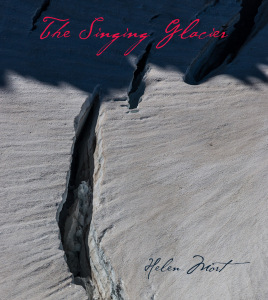
Sounds Like What?: a Review of Helen Mort’s ‘The Singing Glacier’

The new book from the innovative and enterprising Hercules Editions – launched at the LRB Bookshop in London’s Bloomsbury last week – contains poetry by Helen Mort, images by Emma Stibbon, a conversation with composer William Carslake and an essay from Manchester Met academic David Cooper. What holds these diverse components together (within 40 pages) is a trip Mort, Carslake and film-maker Richard Jones made to south-eastern Greenland in 2016. You can see the original Kickstarter post here.

1

So The Singing Glacier project is truly inter-disciplinary and the Hercules book is making available Mort’s poetic contributions to it. Mort’s conversation with Carslake serves to introduce the origins of the project in 2012 when the composer looked down from a plane to see Greenland’s regressing glaciers “like a hand with fingers”. More evocatively, and much closer, he talks of standing beside crevasses and moulins and listening to the sounds emanating from them, “like hearing a Welsh male voice choir singing from this great big hole in the ice!” The Hercules book has photos of Carslake’s notebook, clusters of notes and a few words jotted on the spot. Mort disarmingly says how she envied this seeming directness of acoustic transcription as her role was to come up with words and inevitably much of what she initially wrote down “was just cliché”. She wonders whether cliché is a reasonable response to the vast and alien landscapes they were moving through, sights before which “linguistic originality can almost seem a little arbitrary”. This is not her final conclusion, but her comment does raise one of the fascinating issues in this beautiful little book – what a poet does with the tensions between speech and silence, more abstractly between sound and its absence.

Stibbon_Emma-lr-DRB2015

In a review of Mort’s first book, Division Street, I thought her “love of landscape [was] profound and, like Wordsworth, her hills and skies remain a locus for, as well as an image of, the process of self-exploration”. On that basis she would be a good poet to send to Greenland but – she confesses – she was sometimes reduced to wanting simply to cry and – this hesitantly expressed – it felt “like being in the presence of a god”. These are unmistakable encounters with the sublime and the urge to anthropomorphise such a vast alien landscape is quick to arise, so any efforts at self-exploration might seem worse than arbitrary, positively disrespectful. But how then to engage? ‘In Defence of Cliché’ takes off from Mort’s honestly expressed concerns about inadequate linguistic responses to this landscape:


I write: ice in the fjord as pale as thought

then hear the calving face crash through my language

with a sound (like what?) like cannon fire


moulin-glacier-11[2]

Similarly, the moon fails to be adequately captured by images of “petal, snowball, sleeping moth”. She quotes Hopkins on the way observations of nature can correct our “preoccupation” with the world – again walking the fringes of the divine here – becoming a way in which we learn humility. Mort ends the poem cleverly. Our best word for this sort of experience is “awe” but the word baldly used would not possess enough freshness or fire (thank you Gerard Manley) to carry the weight of feeling. So Mort goes for a down-to-earth metaphor followed by a phrase that manages both to say and not-say it simultaneously:


… we stand like nothing, shaken

from the pockets of our lives, our mouths

stuck on the silent word for awe.
178223-004-FB8F1B4F

The poem, ‘Arctic Fox, August’, is more reminiscent of Mort’s favourite poet, Norman MacCaig. The creature is acutely observed in its colours and hesitant movements around the campsite but the poem ends with a series of rather coercive, descriptive metaphors: “a hunger-striker . . . a gathering memory . . . the habit you thought / you’d kicked”. For me these images circle and knot ever more tightly onto the observing human consciousness, almost doing violence to the creature so well observed at the start. The poem ‘Polynya’ – the word signifies an area of open water surrounded by sea ice – reverses this tendency to humanise the natural by naturalising the human:


Surely the heart

must have polynya

places where it’s never

hardened into ice.


The image of the partially melted heart turns easily into a love poem. Another method Mort adopts to try to respond to the Greenland landscape is through found language. So ‘And Noah’ arose from a conversation with an inhabitant of Kulusuk (though I think Mort said at the LRB launch that much of the detail came from the little museum in that town). The result manages to suggest something of the way of life in this landscape, a work place – the found nature of the phrases enabling the poet to avoid too strong a sense that neither she nor her work are an “imposition”.

2026338

David Cooper’s essay on acoustic geographies and poetry of place takes a more academic look at the multi-media project, suggesting that it –  like a lot of recent geographical creative writing – sets out to challenge the easy domination of the visual sense by accentuating the acoustic or aural. This is partly because sound “reminds us of our own embodied situatedness and inextricable embeddedness within the world”. The eye puts us at the controlling centre; the ear is more often passively assailed from all sides. The eye easily steps back and away; the ear is within the sensed world (I’ve discussed similar ideas of within/without or within/above in relation to Holderlin’s novel Hyperion in another blog post). Mort’s best work in this little book is done when she listens in to these sounds and silences. ‘The Glacier Speaks’ does succumb to the kind of anthropomorphism Mort says she was wary of. But it works well since the voice of the glacier is such a challenging, even taunting, one: “Go on then / says the glacier – / how are you going to score my silences?” The glacier reminds the poet of its silence through noting the kind of sounds which book-end it or by comparing its absence of sound with more familiar moments of silence such as that between lovers, between a mother and a daughter. Here the comparisons work not through similitude but dissimilitude – my silence, the glacier says, is nothing like these. I thought an odd note was struck at the end of this poem when the humans are described as impressed by such silence (“more like a vigil”) yet the glacier suggests they are each “trying / to get back to me”. This is intended, I presume, to evoke human puniness, a Lawrentian “pettiness”, but it also smacks a little of the glacier’s over-anthropomorphised self-regard.

helenmort_2787463k

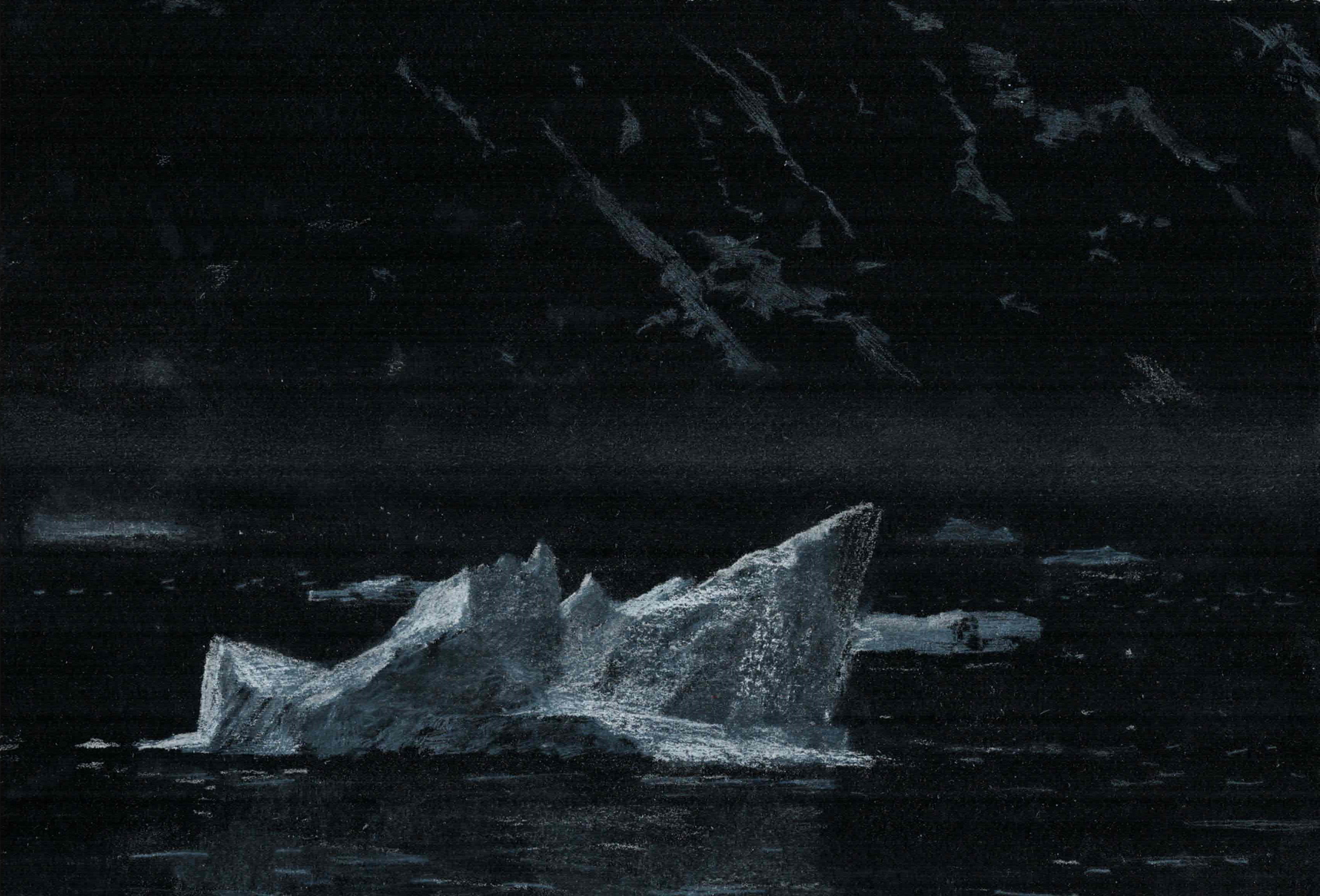
But the poem ‘Glacier Song’ is magnificent. Not the right word I’m sure, but it approaches the Greenland landscape – the Knud Rasmussen glacier in particular – with a right sense of decorum. Silent is what the glacier is again – a “library of absences” – and this is conveyed partly by suggesting that the nearby fjord is more talkative, more full of songs. But Mort then cunningly withdraws this idea: even the chatty fjord is really silent – how much more silent then is the glacier! Later, the Arctic light – remember Cooper’s discussion of the predominance of sight – interrogates the glacier like an airport security check, quizzing and questioning because light always knows better, light always wants the last word. But “The glacier carries on / rehearsing privately”. The final section of this longer poem alights on the distant figure of a woman (the poet?) who, herself, wants to be singing. Here, we feature as the little, forked animal, stuffed full of language bursting to get out, trying to communicate something about glacier climbing, about ptarmigans, the Northern Lights, even about the glacier itself. But the ice remains mum to the last:


The glacier has not slept

for centuries.


The glacier is restless, lithe,

insomniac


articulate


and doesn’t need

a word for itself.


Knud Rasmussen Glacier Greenland


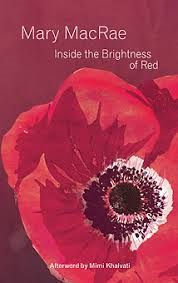
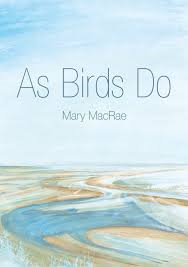
The Poems of Mary MacRae

I knew Mary MacRae as a member of a poetry workshop we both attended in north London. She came to writing poetry late and published just two collections – As Birds Do (2007) and (posthumously) Inside the Brightness of Red (2010) both from Second Light Publications. Her poem ‘Jury’ was short-listed for the Forward single poem prize and was re-published in the Forward anthology, Poems of the Decade (2011). That anthology is now set as an A Level text and it was through teaching from it recently that Mary’s work came back to mind.

untitled

Mary died in 2009 at the age of 67. As a writer she was just beginning to hit her stride. Mimi Khalvati praises her as “a poet of the lyric moment in all its facets” and judges Mary’s ten years of work as an “extraordinarily coherent” body of poems. Khalvati goes on: “Because of the natural ease and grace of her diction, it would be easy to overlook Mary’s versatile formal skills, employed in sonnets, syllabics (à la Marianne Moore), numerous stanzaic forms, but nowhere evidenced more forcefully than in her ‘Glose’ poem, inspired by Marilyn Hacker’s examples, in which she pays homage to Alice Oswald, as in a previous glose to Mary Oliver – a trinity of wonderful lyric poets, in whose company Mary, modest but not lacking in ambition, shyly holds her own.”

In 2009/10 many friends and writers contributed pieces in memory of Mary to the magazine Brittle StarMost of this material can now be found here with prose contributions from Jacqueline Gabbitas, Myra Schneider, Lucy Hamilton and Dilys Wood. I wrote a poem at the time (remembering meetings of the poetry workshop in London) and I have more recently revised it more than a little. I’m posting it here alongside the review I wrote of Mary’s posthumous collection with the idea of making the review more easily available and perhaps encouraging others to seek out Mary’s published work.


Before the rain arrives

i.m. Mary MacRae


Perhaps five or six of us standing there

at the familiar purple door

those afternoons we lost beneath poetry’s

red weather our voices and lines


while the genuine thing built unremarked

beyond the window’s diamond panes

till it was time to depart

then our turning back in the familiar porch


our repeated goodbyes being called

our uncertain bunching

that coheres and delays until one of us

breaks loose and we are each free to disperse—


yet on that day there were raindrops

on the back of a hand on another’s cheek

and though we fiddled with car keys

we fidgeted in trainers and faded jeans


we were an ancient chorus for a moment

crying the single syllable

the drawn-out sound of r—a—i—n

because we were weary of weeks of drought


and now it came and we saw where it fell

the raindrops beginning

to shrill their high-pitched release

from interlaced shadows


from the skirts of clouds

and what none of us knew until we’d seen

one more year was that one of us there

despite our sharp eye for openings


and endings would have to face last things

like the white vanishing of panicked doves

into dark thunderheads—

on these more recent afternoons


just four or five of us here perhaps

in our minds her shrewd observations

her words urging us closer to listen

for the noise rain makes before the rain arrives


maxresdefault


Review:  Mary MacRae, Inside the Brightness of Red (Second Light Publications, 2010), 96pp, £8.95, ISBN 978-0-9546934-8-0

Mary MacRae’s 2007 debut collection was titled As Birds Do. It is true that birds feature variously in that and this, her sadly posthumous new collection, but if we are unaware of the earlier title’s provenance, we might anticipate no more than a delicate, poetic take on the natural world, the kind of thing that fills so many small magazines. But MacRae alludes to the moment in Macbeth, when Lady Macduff and her son contemplate death. The mother asks, “How will you live?” and the son, with a wisdom far beyond his years, replies, “As birds do Mother . . . . With what I get I mean”. MacRae’s poetry is full of such emotionally-charged, vital identifications with natural creatures and, more profoundly, with the sense that what can sustain us in life must be derived from everyday common objects.

book 1

As a title, Inside the Brightness of Red, also flirts a little with poetic affectation, but once inside the book’s covers, it is MacRae’s precise, even astringent, penetration that is so impressive. She reads the world around her and finds spiritual meanings. It is no surprise that R.S. Thomas supplies the epigraph to this new collection: “It is this great absence / that is like a presence, that compels / me to address it without hope / of a reply”. So a poem called ‘Yellow Marsh Iris’ promises to be a naturalist’s observation then startlingly wrong-foots the reader with its opening line (“It’s how I imagine prayer must be”) and proceeds to its seamless business of combining accuracy of observation with an emotional and intellectual narrative. She studies the flower stems crammed into a glass vase:


their stiff stems magnified

by water, criss-crossing

white, pale green, green

in a shadowy coolness


We are reminded that there is a kind of intensity of observation that succeeds in prising open our relationship with the outer world in such a way that while encountering the Other, we more clearly glimpse ourselves. MacRae concludes her process of “looking and looking” at the flowers that has given rise to the sense that “they seem to hold / all words, all meaning, / and what I’m reading / is a selving, a creation.”

MacRae’s visions are almost always peripheral, fleeting, askance. The unfolding of daffodils – which, in a quite different age, Wordsworth could contemplate steadily and then stow away for future use – here can never be more than something


waiting for us somewhere in the wings

like angels,


your darting after-image

between the pear-tree

and the brick wall.

(‘Daffodils’)


In the same vein, MacRae has Bonnard, paint his mistress, Marthe de Meligny, and declare that his sensibility is triggered by “looking askew”. The visionary moment occurs only when “Glimpsed through the half-open door / or the crack of the hinge-gap” (‘Bonnard to Marthe’) and this collection’s editors (Myra Schneider and Dilys Wood) have drawn it to a close with yet another such moment: “Turning back to look through an open door” the narrator sees an ordinary room “utterly transformed, / drained dry and clear, unweighted” (‘Un-Named’).

book 2It may be that this ability to be sustained by scraps and glimpses, the sense that the self is most fully resolved in a lack of egotism, in its encounter with ordinary things, can diminish some of the sting of mortality. In a poem like ‘White’, MacRae manages to celebrate again the ordinariness of familiar things while at the same time sustaining a contentedness (or at least an absence of fear) at the prospect of the self’s vanishing: “You can disappear in a house where / you feel at home; the rooms are spaces / for day-dreams, maps of an interior / turned inside out”. Rather than Macbeth, it is Hamlet’s resolve to “let be” that comes to mind as this calm, accessible, colourful and wonderfully dignified poem concludes:

 

Let

it all go; soon the door of your room


will be locked, leaving only a slight

hint of you still, a ghostly perfume

lingering in the threadbare curtains and sheets.


But MacRae’s contemplation of her own death, most likely, was no such safely distanced envisaging. Dying at 67 years old, she’d had only 10 years of writing poetry, but it had evidently become a vessel into which she could pour her experience without ever abandoning herself to artistic ill-discipline. ‘Prayer’ is almost too painful to read. The narrator is emerging from the “thick dark silt” of anaesthetic to hear someone sobbing and a second voice trying to offer comfort. As her befuddled perceptions clear and the poem’s tight triplet form unfolds, the second voice is understood to be saying “’Don’t cry, Mary, / there’s no need to cry’”. The collection’s title poem can bluntly report that “the cancer’s come back” yet artfully balances such devastating news with the landscape of Oare Marsh in Kent where colours “are so spacious, / and have such depth they’re like lighted rooms // we could go into” (‘Inside the Brightness of Red’).

untitledFor MacRae’s interest in and skill with poetic form, we need look no further than the extraordinary glose on a quatrain from Alice Oswald (the earlier collection contained another on lines from Mary Oliver). For most poets, this form is little more than an exhibitionist high-wire act, but MacRae’s poems are moving and complete. Her use of poetic form here, particularly in some of these last poems, reminds me of Tony Harrison’s conviction that its containment “is like a life-support system. It means I feel I can go closer to the fire, deeper into the darkness . . . I know I have this rhythm to carry me to the other side” (Tony Harrison: Critical Anthology, ed. Astley, Bloodaxe Books, 1991, p.43). Appropriately, in ‘Jar’, she contemplates with admiration an object that has “gone through fire, / risen from ashes and bone-shards / to float, nameless, into our air”. Here, the narrator movingly lays aside the wary scepticism of the Thomas epigraph and rests her cheek on the jar’s warmth to “feel its gravity-pull / as if it proved the afterlife of things”.
This inspiring collection contains a short Afterword by Mimi Khalvati who MacRae frequently praised as a critical figure in her work’s development. Khalvati lauds her as “a poet of the lyric moment in all its facets”. She judges MacRae’s ten years work as an “extraordinarily coherent” body of poems, suggesting that, among the likes of Oswald and Oliver, MacRae’s work is “modest but not lacking in ambition”. For me, her two collections certainly exhibit a modesty before the world of nature that is really a genuine humility, allowing both the physical and spiritual worlds to flower in her work. This was her true ambition, pursued in full self-awareness and one that, before her sad leaving, she had triumphantly fulfilled.


W H Auden’s Thoughts on Robert Frost

In what follows I am mostly summarising Auden’s own discussion of Frost, written in the late 1940s. But I am adding thoughts of my own as well (in the light of teaching Frost) and it would be prudent to make sure you have read Auden’s essay alongside this post.

220px-TheDyersHand

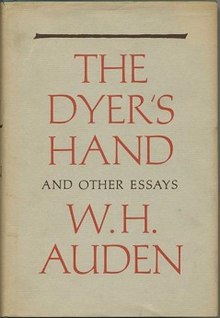
Auden’s essay, ‘Robert Frost’, can be found in The Dyer’s Hand (Faber, 1963) and it starts with a distinction between what a poem says and what the poet says. Keats’ ‘Ode on a Grecian Urn’ ends with the statement that “Beauty is truth, truth beauty”. This is clearly the urn speaking and voicing a predilection for the kind of art “from which the evils and problems of this life”, argues Auden, have been “deliberately excluded” (p. 337). The Urn is such a piece of art, defining its own beauty in the act of excluding the “heart high-sorrowful and cloy’d” (alluded to in its own third stanza). Yet Keats’ main narrative voice does not subscribe to such a view and the possibilities of these ironic distances between poet, narrative speaker and dramatic characters (even if only an old urn) are things we should take into any reading of Robert Frost.

But Frost is not an Urn Poet, seeking beauty at all costs; Auden links such a desire with the figure of Shakespeare’s Ariel.  The Ariel poet wants a poem to be “a verbal earthly paradise, a timeless world of pure play” which gives the reader delight in so far as it contrasts with our true existence in history, with our “insoluble problems and inescapable suffering” (p. 338). Taking an unprepossessing extract from George Peele, Auden characterises the Ariel poem as tending towards anonymous generalities, a verbal contraption such that, if we try to explain what pleasure it gives us, “one finds oneself talking about language, the handling of the rhythm, the pattern of vowels and consonants, the placing of caesuras etc”. Ariel has no passions – his earthly paradise is beautiful but not very earthly in truth, and nothing of consequence can happen there. An anthology edited by Ariel runs the risk of delivering mere narrowness and a monotony (or even absence) of feeling. Auden refers us to Virgil’s Eclogues, and poets like Campion, Herrick and Mallarme (I’d add other assorted Surrealists, Dylan Thomas, John Ashbery). In being turned away from historical reality, there is inevitably a narcissistic quality to Ariel poems (p. 340). Damning with faint praise, Auden notes Ariel’s worst fault is a minor one, a self-regarding triviality.

download

In contrast, Frost is a Prospero Poet. To explain, Auden quotes Dr Johnson: “The only end of writing is to enable the readers better to enjoy life or better to endure it”. The Prospero poem should provide us with “some kind of revelation about our life”; it will act so as to “free us from self-enchantment and deception” (p. 338). In order to do this, the Prospero poet must introduce into the poem “the problematic, the painful, the disorderly, the ugly”, in other words Keats’ “heart high-sorrowful and cloy’d”. Frost’s poems are recognisably of this type and they seem to derive from “an experience which preceded any words and without which the poem could not have come into being”. Rather than Ariel’s narrow focus on the beauty of the constituent verbal elements, these are now regarded as “subordinate in importance to the truth of what [the poem] says” (p. 340). Auden nominates Wordsworth as the English poet who, more than any other, has the least element of Ariel, a preponderance of Prospero. Wordsworth’s earthiness, directness of address and simplicity of language can reach peculiar, bathetic  extremes, as in ‘The Thorn:


This thorn you on your left espy;

And to the left, three yards beyond,

You see a little muddy pond

Of water, never dry,

I’ve measured it from side to side:

‘Tis three feet long, and two feet wide.


Yet, of ‘Mending Wall, Frost has said that he “dropped to an everyday level of diction that even Wordsworth kept above”. In Frost’s poem there are only two words with more than two syllables. This is evidence of Frost’s Prospero-like quality as Auden defines it. But the risk of such simplicity and directness – lodging any validity it possesses in the poem’s relation to truth – is that, in failing, the poet offends not merely against triviality but against truth itself. The poem may be false and a reader might conclude, “This poem should not have been written” (p. 341).

carlwarkwall

Auden is, of course, dealing with extremes here and he admits most poetry presents a blend or tension of Ariel and Prospero qualities. But, considering a poet’s output, it is possible (and useful) to say that he or she is dominated by one or the other. So Auden describes Frost’s Prospero-like language: “The music is always that of the speaking voice, quiet and sensible . . . he rarely employs metaphors . .  yet he manages to make this simple kind of speech express a wide variety of emotion and experience” (p. 342). This achievement is because Frost’s diction is that “of a mature mind, fully awake, and in control of itself; it is not the speech of dream or of uncontrollable passion”.  The reader will often be aware of strong, even violent, emotions lying behind what is actually said, but the saying “is reticent, the poetry has, as it were, an auditory chastity”. So Frost’s poems are quiet on the surface which readers find inviting or, if more superficially read, boring. But the drama is real enough and, once entered into, not uncommonly, in Lionel Trilling’s famous observation, potentially “terrifying”.

download

Auden goes on to make observations about some of Frost’s themes. ‘Two Look at Two’ is a “miraculous exception” in Frost’s general presentation of man’s relationship with Nature since the couple observing the buck and the doe seem to be rewarded with a sympathetic response. It is “As if the earth in one unlooked-for favour / Had made them certain earth returned their love”. In fact, this conclusion may seem less exceptional if we pay attention to the “As if” and – just as in Keats’ Urn – find a difference between the poet’s intention and the Ariel-like urge towards an ideal or paradisal ending to the poem (the couple’s love is returned only in their own rosy-tinted perception). More typically, Frost’s Nature is better represented by the “great buck” of ‘The Most of It’ which emerges from a lake, alien and indifferent to the human desire for “counter-love”.

This sense of cosmic indifference to the human draws from Frost his often expressed admiration of stoic courage, the ability to keep on keeping on. This, Auden points out, is the significance of Frost’s frequently deserted dwellings. In Europe, such an image might suggest “injustice and greed and the nemesis that overtakes human pride”. But in Frost, such ruins are rather “an image of human heroism, of a defence in the narrow pass against hopeless odds” (p. 345). Auden’s point is that Frost’s poetry looks forwards rather than backwards, nostalgia is not a common note; more usual, and more distinctively American, is “the ever-recurrent opportunity of the present moment to make a discovery or a new start” (p. 349). This is why Frost lauds work and labour so much. His highest virtue is the self-respect that comes from taking pride in something achieved.

4cc4cedfc1d4f688bf22242c4ff15fd3

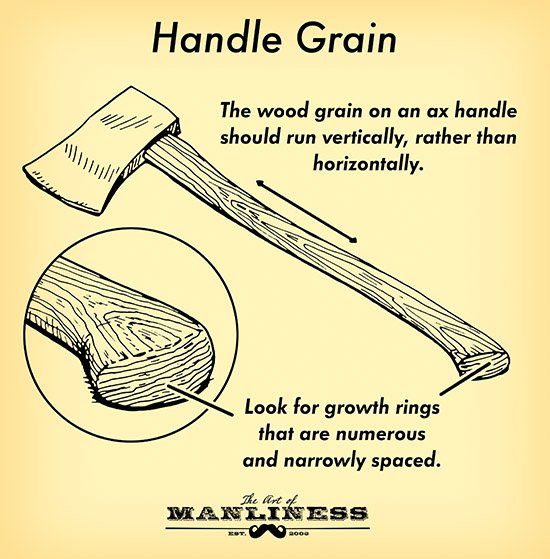
Baptiste – the French-Canadian axe-maker in ‘The Axe-Helve – is such a man and also a Prospero-like artist:


He showed me that the lines of a good helve

Were native to the grain before the knife

Expressed them, and its curves were no false curves

Put on it from without. And there its strength lay [. . .]


An Ariel axe-helve would look beautiful – but be wholly useless for the task. Frost said: “Art should follow the lines in nature [. . .] False art puts curves on things that haven’t any curves”. Unreliably narrated by a stiffly condescending New England Yankee farmer, the poem in fact favours Baptiste’s pragmatic art (which is Frost’s too). The same effect is heard in ‘Mending Wall’ in which the arrogant, mischievous narrative voice makes no headway against his less educated neighbour’s refrain: “Good fences make good neighbours”.

The narrator of ‘The Wood Pile’ is similarly undermined by his own poem. There is an Ariel-like restlessness about him. His curiosity has an aimless, insatiable quality as if the mixed nature of what lies before him is not enough. Having decided to return home, he changes his mind: “No, I will go farther – and we shall see”. What he eventually finds is an image reflective of his own failing: a wood pile, carefully and laboriously constructed and then abandoned in a restless search for novelty. Seemingly un-selfaware, he criticises the man who “lived in turning to fresh tasks” and could “so forget his handiwork”.

5727567383_f719380140_o

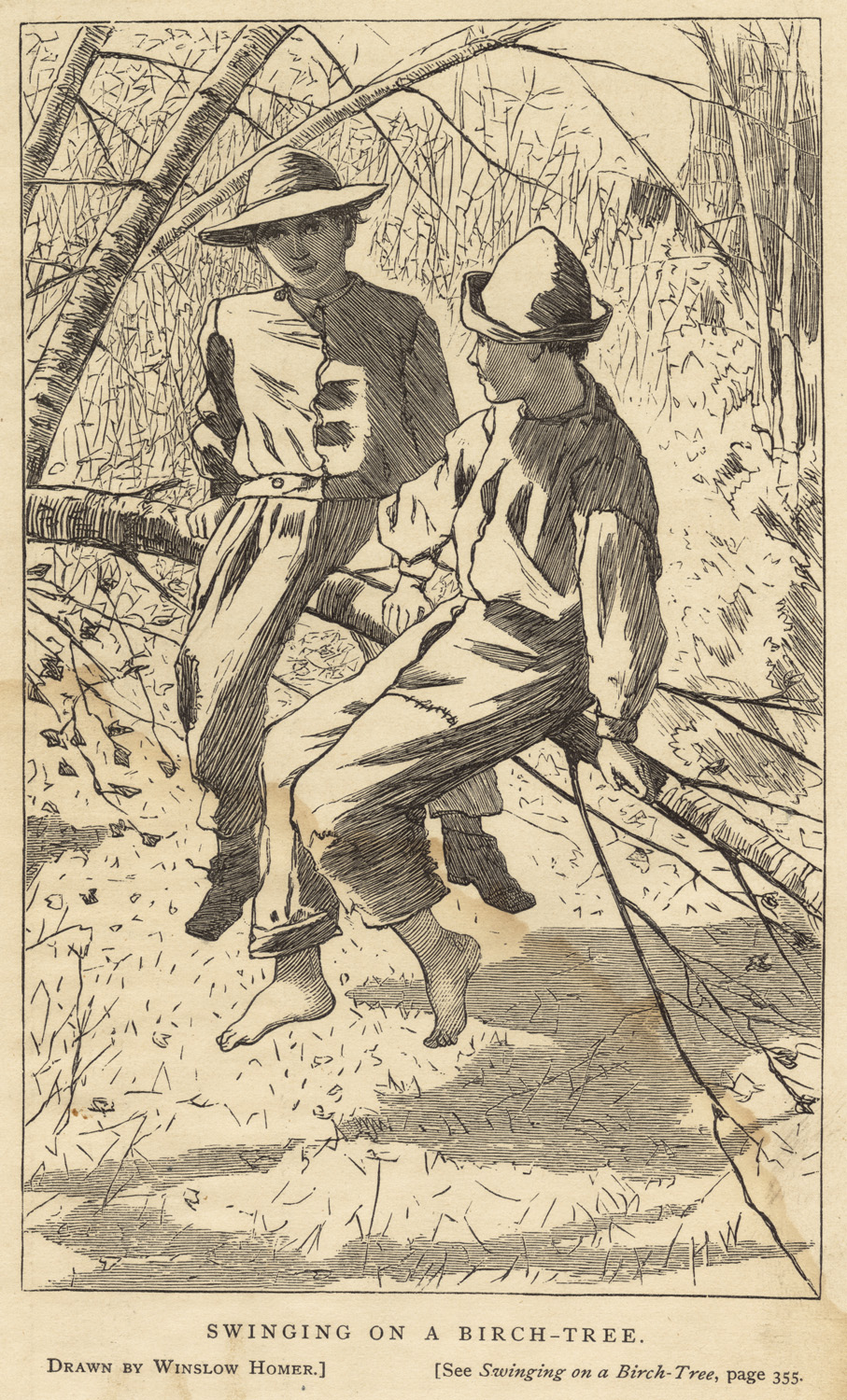
It’s in ‘Birches’ that Frost most clearly engages with the contrasting desires of Ariel and Prospero. Climbing the tree “Toward heaven” is Ariel’s desire to “get away from earth a while”. This is contrasted to the earlier passage in the poem in which “Truth” breaks into the narrative, describing the irreversible damaged an ice storm can do to a birch tree: “they never right themselves”. It is Frost’s choice to take a third way, to be “a swinger of birches”, achieving a balance or sequence of both heavenward and earthward motion. If this sounds like an equal balance, it is misleading since –  as Auden argued – the scale is unmistakably tipped in Frost’s case towards Prospero. I don’t sense any irony in the declaration of ‘Birches’: “Earth’s the right place for love: / I don’t know where it’s likely to go better”.

Edward Thomas and Two of His Friends

Last weekend I was asked to talk briefly about Edward Thomas at an event at the Palmers Green Library in north London. This year is the centenary of his death and I looked at one of my favourite poems, ‘The Sun Used to Shine’. I have written in close detail about it in an earlier blog so I have excised most of my comments about the poem itself from this current post. I hoped to take the audience’s attention to the poem, to Thomas’ life in 1914/17 and then bring them to more contemporary poetry with a couple of my own poems which are thoroughly imbued with Thomas tropes – inspired by his work and life. 


p0222klt[1]
Edward Thomas and Helen Thomas
 

Edward Thomas died at the Battle of Arras on the 9th April 1917. One hundred years and 5 months ago. It has long been thought that he died from a nearby shell blast stopping his heart and his watch, on that Easter Monday. But a couple of years ago, the discovery of a letter from his commanding officer suggested he had been actually ‘shot clean through the chest’. It was perhaps a sanitised version of his death delivered to his wife, Helen, that gave rise to the attractively poetic myth of his ‘clean’ death.

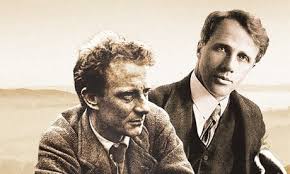
But so much about Thomas has a similar mist of uncertainty about it. He shares with his great friend and poet, Robert Frost, a liking for the word ‘something’ – a thing that is unspecified or unknown, a description or amount being stated but not exactly. This is partly what makes him a modern writer (though his main subject material – the natural world – might make him seem otherwise).

flowermoonPNG[1]

But he’s also modernist in that he can be emotionally reticent, guarded, suspicious. In a letter to his wife a few days before he was killed he wrote: “I know that you must say much because you feel much. But I, you see, must not feel anything. I am just, as it were, tunnelling underground and something (that word again!) sensible in my subconsciousness directs me not to think of the sun [. . .] If I could respond to you as you would like me to [. . . ] I should be unable to go on with this job”. You might think such guardedness was just a war-time effect. But a poem like ‘No one so much as you’ – written in 1916, surely to his wife – says: “My eyes scarce dare meet you”.

His difficulties with loving were certainly related to his bouts of depression. He suffered dark, suicidal periods, infamously taking a revolver with him into the woods intending not to reappear. In the poem ‘Beauty’ he writes:


What does it mean? Tired, angry, and ill at ease,

No man, woman, or child alive could please

Me now. And yet I almost dare to laugh

Because I sit and frame an epitaph –

‘Here lies all that no one loved of him

And that loved no one.’


The poem eventually finds some sense of relief in the natural world. Note here the uncertainty in both what it is in him that seeks happiness and what it is that seems lost to him:


This heart, some fraction of me, happily

Floats through the window even now to a tree

Down in the misting, dim-lit, quiet vale,

Not like a pewit that returns to wail

For something it has lost, but like a dove

That slants unswerving to its home and love.


imagesGNDXGJZ4
Thomas and Frost


Because it’s one of his best, I’m going to look at Thomas’ poem ‘The Sun Used to Shine’ written in May 1916. There is no straining between subject and technique. Its moods shift continually from companionship, to thoughts of war, to an historical sense, to an almost cosmic sense of time. So it travels great distances without departing far from the English countryside that provided Thomas with its beginnings. Nor does it depart far from ordinary language – it has a surface accessibility. It’s held together by a human voice – quiet, questing, informed about nature as well as history, one willing to contemplate existential questions.

[. . .]

alfred-tennyson[1]

By the time the poem was being written, it was more than a year after the Frosts had sailed for New York. Thomas is mourning a lost era as much as a lost friend. Perhaps no surprise that he had Tennyson in mind as he wrote. In Memoriam is Tennyson’s tribute to his lost friend, Arthur Hugh Hallam. In section 89, Thomas found a model and images of friendship, the English landscape, ripe fruit, running water, long walks, long talks – a kind of lost Paradise:


The landscape winking thro’ the heat:


O sound to rout the brood of cares,

The sweep of scythe in morning dew,

The gust that round the garden flew,

And tumbled half the mellowing pears!

[. . .]

Nor less it pleased in livelier moods,

Beyond the bounding hill to stray,

And break the livelong summer day

With banquet in the distant woods;


Whereat we glanced from theme to theme,

Discuss’d the books to love or hate,

Or touch’d the changes of the state,

Or threaded some Socratic dream;

[. . .]

We talk’d: the stream beneath us ran,

The wine-flask lying couch’d in moss,

[. . .]

And brushing ankle-deep in flowers,

We heard behind the woodbine veil

The milk that bubbled in the pail,

And buzzings of the honied hours.

9780905289380[1]

Such similar quiet acknowledgements of landscape, of time present and past, of friendship are some of the themes which draw me to Thomas’ work. Another of his friends was Jesse Berridge. The depth of this friendship is revealed when Berridge writes – this in the Spring of 1947 (fully 30 years after Thomas’ death at Arras) – of dreaming of the poet:

In my dream he was coming down a road, in loose dark clothes, to meet me, with his long purposeful stride and his face alight with pleasure and gaiety. Well I knew that look on his face, and here and now I would give testimony that I did know very many hours in his company, and in by far the greater part of them he was happy, sometimes with an almost bewildering intensity.

Here (if I may) is a poem of my own, drawing on material from Berridge’s memoir of Thomas which I hope captures some of the pleasures the poet shared with Berridge and before that with Frost. The opening detail about the church at Kilve in Somerset, is referred to in Wordsworth’s poem ‘Anecdote for Fathers’ (1798) included in Lyrical Ballads, obviously a favourite with Thomas and Berridge:


These things I remember                               

after Jesse Berridge


That afternoon on the beach at Kilve

we had ascertained

there was no weather-cock on the church

and we were resting in peace

almost in silence when he turned

and told me to listen

to the little melodious twittering

of a tiny bird that swooped and dipped

between where we sat and the roiling ocean—

a meadow pipit he said

the moment was unforgettable then

as he so often made such things

calling attention to this or that aspect

of what I call his vision

as one morning he cut a walking-stick

from the woods then carved

until it had a character of its own

or the knife I’ve owned almost sixty years

its bone handle chafed

and worn by my touch

until the white has begun to show through

for him held a peculiar fascination

till obscurely I began to feel

it possessed of a soul

that nothing but his observation of it

had created and I remember my children

always delighted in his occasional visit

(from The Lovely Disciplines, Seren 2017)

images7ZFS3C20

Thomas and Berridge would often cycle the English countryside together and if you are interested in his extraordinary responses to the landscape I’d recommend In Pursuit of Spring, published in 1914. It was this book that Frost seized on in the summer of 1914 as evidence that Thomas ought to start writing poetry.

There are also personal reasons why I like this book so much – Thomas cycles from the outskirts of London, heading westwards, to the Quantocks. On his way he descends from Salisbury Plain into the Wiltshire where I grew up. Indeed he traces a particular ride along roads I know well. Here he is describing the almost visionary impact of the English countryside:

Motion was extraordinarily easy that afternoon, and I had no doubts that I did well to bicycle instead of walking. [. . .] At the same time I was a great deal nearer to being a disembodied spirit than I can often be. I was not at all tired, so far as I knew. No people or thoughts embarrassed me. I fed through the senses directly, but very temperately, through the eyes chiefly, and was happier than is explicable or seems reasonable. This pleasure of my disembodied spirit (so to call it) was an inhuman and diffused one, such as may be attained by whatever dregs of this our life survive after death. In fact, had I to describe the adventure of this remnant of a man, I should express it [. . .] with no need of help from Dante [. . .] Supposing I were persuaded to provide the afterworld with some of the usual furniture, I could borrow several visible things from that ride through Semington, Melksham, and Staverton.

Later, Thomas takes a detour to another place I know well, the village of Tellisford, its ruined water-mill and bridge by the River Frome. There he meets the Other Man, a figure who pops up in the book and who represents Thomas’ alter ego. I’d like to finish with another of my poems which I hope captures a good deal of the spirit of Edward Thomas in its love of English landscape, its sense of history, its longing for companionship, its loneliness and, in its conclusion, its sense, as ‘The Sun Used to Shine’ says, that “Everything / To faintness like those rumours fades”. The old man is a version of Thomas perhaps, or a version of the Other Man, or a version of myself – or all three at once. You might say one of my projects is to convince you that clarity is a chimera.


Rebuilding Tellisford weir

turn aside to see Tellisford  – Edward Thomas


He refuses shade in midday heat

the old man walking

in his honey-brimmed hat

along the drained weir-shelf


that looks today like stacked loaves

its pallid smooth ranks

of Victorian stones

mapping precisely the Domesday line


where he patrols to and fro

proudly surveying the place he owns

this stretch of England

his plan to restore the workings


of the old watermill

to feed the Grid—and it is for this

he has ordered tons of sludge

to be dredged above the drop


and dozens of loosened stones

to be replaced to give

the mill-race its full head

and today he walks the slippery length


of the dammed weir-shelf

hallooing picnickers

who pull corks from fizzy wines

he cries what marvellous weather


then falls to conversation with a couple

who are celebrating sixty years

in their self-built house

with their three good boys


raised and schooled to distant homes

though today they recline

on trashy garden chairs

on this riverbank as if to watch


the old man in an antique yellow hat

who walks noting progress

on the weir and how could they know

he’s something on his mind


for the next hundred years

how could they know more and more

these days he struggles to endure

the roaring of the fish-shoot


with its silted water

and these stilted conversations

with such ordinary people

their Diet Coke and egg mayonnaise


their crisps for the grandchildren

their Sunday newspapers

let blow and tumble across the meadow

reminding him of himself


how his mind often strays

up the ditch-line to the old drovers’ road

where for fifty years

their cars have pinked and purred


especially at night as they mount

slowly the gravel verge—

O so many love-cars for so many years

drawn to his father’s land


each in pursuit of what the river gives

of moonlight and chance

of the ticking of an engine

as it cools of blonde hair spilling


across dark seats in disarray

he knows the windows rolled to the dusk

the sickly smell of water

the murmur within and talk


when it’s over though he knows well

it is never really over—

and it’s because of this

he will not turn them away


although they holler and soil and litter

still he’d grant them every wish

it’s for this his feet edge now across

the weir-shelf this afternoon


for this he takes his uneasy stand

hands thrust in his pockets

their cars pulling in to the dark hiss

of white gravel everywhere loosening

(from The Lovely Disciplines, Seren 2017)

Featured Image -- 13434

How to Answer the Poetic Influence Question #2

With my new collection just out from Seren Books, I’m happy to have a number of promotional events and readings coming up over the next couple of months. As I discussed in an earlier blog, though I love the business of giving a reading, there’s often a moment that arises that I’m always uneasy about. It’s the question of influence. In that previous blog I followed through, chronologically, those poets who have had a powerful influence over the style and direction of my work. That provides one possible answer to the question ‘what other poets do you consider to have been an influence on your poems?’ Another reply might be to look closely at very recent work to see which poets are present in it as ghosts. This is what I’m doing here.

A Boat..._quicksand cover

In preparing a new book for public reading, I tend to work through every poem making notes on the kind of thing an audience might need/like to know before hearing it (once and once only, in performance). I will often draw attention to the presence of a powerful poet figure that I’m aware of in the vicinity of the poem. So in The Lovely Disciplines, I can see influential roles of substance for Robert Hass (with Czeslaw Milosz), Ivan Lalic, Mary Oliver (with Emerson), Whitman and Edward Thomas.

Before looking at those in a little more detail, there are also two translations/versions from other poets in the collection. One is a version of Boris Pasternak’s poem from the 1950s called ‘In Hospital’. In the process of my versioning, the gender of the main protagonist was switched to female, more in line with most of the poems from the middle section of my book which forms a composite portrait of the passing of my parents’ generation.

Abbaye_de_Valsainte_2
Abbaye de Valsainte

I also include a loose translation of (plus a poem alluding to) the work of the French poet, Yves Bonnefoy, who I referred to in my earlier post on Poetic Influence. My poem ‘Valsaintes’ is named after the rural retreat in Haute-Provence where Bonnefoy lived in the 1960s. In many ways an idyllic place, in the end the renovation and up-keep of what was little more than an ancient ruin proved too much for him and the property was sold. For years afterwards, he harked back to it as a favoured, lost place. Bonnefoy’s ideas about what he calls ‘presence’ continue to fascinate me. My version, called ‘After Bonnefoy’, ends:


let’s bring ourselves one to another


as if each was at last all creatures

and all things all empty ways

all stones all metals and all streams

download
Sir Michael Tippett

Sir Michael Tippett’s 1944 secular oratorio, A Child of Our Time, is explicitly relevant to my poem ‘Listening to Tippett twice’. Tippett also wrote the libretto, inspired by the assassination in 1938 of a German diplomat by a young Jewish refugee and the Nazi government’s reaction to it. This took the form of a violent pogrom against its Jewish population – the infamous Kristallnacht, so called because of the broken glass which littered the streets the following morning. Tippett’s text and music deals with these incidents in the context of the experience of oppressed people more generally and the whole work carries a strongly pacifist message of understanding and the need for reconciliation.

I’m certainly aware of echoes of Wordsworth on a couple of occasions. In ‘The Toll Cottage’ – a dream-poem in which I am being driven by my father – there’s a mangled remembrance of a phrase Wordsworth uses in ‘Tintern Abbey’ – “Once again I see / These hedgerows, hardly hedgerows, little lines / Of sportive wood run wild”. Also ‘The girl who returned to Aix’, a sequence of three sonnets, includes the awkward fact that I cried on first seeing Steven Spielberg’s Close Encounters of the Third Kind. It was that moment when the huge alien spaceship finally appears, rising up from behind a mountain – just as Wordsworth’s mountain, Black Crag, rises up in the boat-stealing episode of The Prelude Book 1.

download
Enough to make a grown man weep

In my poem ‘Nocturne’, I was partly thinking of Whistler’s painting, ‘Nocturne in Black and Gold’ (c. 1875) but I like to think my (love) poem has more light in it than that, set as it is in the same Tuscan landscape as another poem called ‘The renovation near Sansepolcro’. ‘Nocturne’ also makes reference to ‘the poet’s kelson’ and this is Walt Whitman who, in the fifth part of ‘Song of Myself’, refers to love as a kelson of creation. A kelson (or keelson) is the structure running the length of a ship and fastening the timbers or plates of the floor to its keel giving stability and strength.

download

In his book, Time and Materials (2007), introducing the sequence ‘Czeslaw Milosz: In Memoriam’, Robert Hass recounts a discussion he had with Milosz (as his translator) about the different connotations in English of Oh! and O! As it turned out, the one Milosz intended in his poems was the second and this is the one that most interests me too. My poem opens:


Oh! is longer drawn already

beginning the button-down

of understanding

that well-I-never

with its freighting

of verb tense and identity

whereas O! is more sudden

more urgent surely

of the moment rapt

when we are prised open

by desire [. . .]


I wanted the title of my poem, ‘The lovely disciplines’, to feel paradoxical and in my mind it was related to the Serbo-Croat poet, Ivan Lalic. I remember reading his 1981 collection, translated by Francis R. Jones as The Passionate Measure. I remember Lalic explaining he hoped to suggest the fluidity or fluency of emotion as well as the orderliness or measured nature of a dance or verse. I hoped my title would suggest something of the same – a balanced response to experience, both our taking pleasure in it and searching it for order. My poem takes place on a women’s hospital ward.

download

Mary Oliver’s book, Swan, is not her best but I bought it in a secondhand bookshop once and inside discovered an ATM receipt with some cryptic notes on it. This provided the start of ‘As we live’, a poem which takes up Oliver’s sensitivity to nature (which she often gazes at with such precision of feeling as to achieve a visionary intensity) as well as her epigraphs from Rilke’s Duino Elegies and Ralph Waldo Emerson’s essay ‘Beauty’ in The Conduct of Life: “’Tis curious that we only believe as deep as we live”.

Finally, Edward Thomas (Ted Hughes’ “father of us all”) appears explicitly in relation to two poems in my book. Not a million miles from Oliver’s example, it’s his directness and love of what lies before him that I like. I like his sense that, in Robert Frost’s words, this world is the right place for love, combined with his intuitions about the human need to look beyond, perhaps into an inexpressible obscurity. ‘These things I remember’ is almost a found poem on these issues – taking phrases from a memoir written by Thomas’ friend Jesse Berridge (published with letters by Enitharmon Press).

And ‘Rebuilding Tellisford weir’ has an epigraph from Thomas’ 1914 prose book, In Pursuit of Spring. His book recounts his 1913 journey – by bicycle – across southern England from London to the Quantock Hills. I was delighted to discover him passing through the landscape of my childhood: cycling down off Salisbury Plain, through Erlestoke and Edington, Steeple Ashton, North Bradley to stay with friends at Dillybrook Farm just outside Trowbridge, where I lived for 18 years. He writes about waking at night to the sound of falling water. The next day he is persuaded to visit Tellisford and its weir by the mysterious Other Man (a kind of alter ego for Thomas). My poem mixes some of these details with my own memories of visits to Tellisford. I like to think the poem has a lot of Thomas in it: a sense of history, the beauty of nature, strange encounters with others, a sad loneliness, the transience of all things.

maxresdefault
The weir at Tellisford, Wiltshire

How to Answer the Poetic Influence Question #1

A Boat..._quicksand cover

With my new collection just out from Seren Books, I’m happy to have a number of promotional events and readings coming up over the next couple of months. I love the business of giving a reading, but there’s often a moment that arises that makes me uneasy as to how to how to respond. It’s the question of influence; the hand going up to ask: what other poets do you consider to have been an influence on your own poems?

It’s my problem I’m sure, but I’ve always had two ludicrously extreme responses spring to mind on hearing the question. Firstly, to list pretty much every single poet I’ve read in the last 40 years because the truth is every single one has added a grain, a pebble (for better or worse) to the path I walk to write a poem. Alternatively, since I can’t think of one, or even two, clear contenders for powerful influence when I sit down at a blank page or screen, it must be that I have emerged ex nihilo, a peculiar original. The first would be a lengthy reply of little use or interest; the second would seem positively dripping with arrogance (and equally of little use or interest).

Actually, I can think of a third answer: it’s not for the poet to identify influences; it’s a job for a reader. But I wanted to use the next two posts to kick the idea of influence around, to sort out my own ideas and to answer it in two ways. Early in a writing career, the revelation of, or encounter with, a new voice, style, or even subject area can lead to great lurching changes of direction in a poet’s own work. The lurch or swerve becomes progressively less marked the older a poet gets. Put that down to a more confident self belief perhaps, or to a growing inertia, or a more sophisticated process of absorption of such novelty, or sheer bloody mindedness . . .

images

For me, I started in the business convinced that I was composing song lyrics because poetry as such was not a familiar thing – except in occasional English classes at school and I dropped that subject at the age of 16. As I’ve said elsewhere, science was what I did through most of my teens. With too much time on my hands and too little joy to be found elsewhere, in the mid 1970s I began to turn to other sorts of books. From Foyle’s in London, I stole a copy of Everyman’s Selected Poems of Wordsworth. They seemed a bit dull and plodding but reminded me of rural Wiltshire where I grew up. For a few months I copied Wordsworth. Perhaps a year later, after a good dose of Sartre, I was finding my way back to the academic study of literature. It was the poetry (and drama) of T S Eliot that I fell in love with (not Dylan Thomas – the other poet on the curriculum). I still have those early Eliotesque poems somewhere, mostly Prufrock period style, though also a horrifyingly pretentious sequence of poems like a clumsy, anaphora-laden Waste Land.

00014096-390x540

Re-starting my Higher Education took me to Lancaster University, studying Literature and Philosophy (and a few sessions of Creative Writing with poet, David Craig) and Hughes and Larkin were served up and readily ingested. At first, I swerved to the latter’s urban details and personal gloom; later it was the Hughes of Gaudete (recently published, 1977) that I copied, writing a long, quasi-mythic, magic-real, psychodrama about sex and power that I eventually self-published in Oxford. As a post-graduate among the dreaming spires, it was Percy Byshe Shelley who I was working on for several years and, though not a model for poems as such, his ideas about the role of the Imagination and poetry as an “Orphic language” have been important to me ever since.

md7773056273

Among contemporary poets, I’d discovered Heaney (not the rural Ireland stuff so much as his wrestling with private and public responsibilities – Station Island, for example), Peter Redgrove’s fluid take on mind’s encounter with the natural world (The Apple Broadcast) and Ken Smith’s urban-political Americana (oh how I wanted to have written Fox Running). I wrote individual poems modelled on all these writers while absorbing much more deeply the work of the Romantic period – only now did I really find Keats, his poems and letters, Wordsworth still, Coleridge’s Conversation poems especially. What might have been expected – Hardy, Auden, Yeats, Frost, Stevens, Lowell, Bishop, Plath, Dickinson – were all missing or they missed me.


download
Ken Smith


A decade of writing, reading, plus some reviewing too. A couple of my own books published and I’d stumbled my way to Rilke’s New Poems, Elegies and Sonnets, the second and third of which I began to translate and (whether visible on the surface or not) were a great influence on me – the Duino Elegies  for their thoughtful drive from existential mourning to praise, the Sonnets to Orpheus for that same thought (more of the praise) and their use of form. From Whitman I found my way to W S Merwin’s marvellous fluidity (something I was comparing to Paul Eluard’s work too) and from Rilke it seemed a logical (not the right word at all) step towards the 81 texts of the Daodejing which again I felt I had to try to English because it both rhymed with what I already knew and I knew it would develop further what I needed to know.

daodejing

A few years back, an article in PN Review sent me to the work of Yves Bonnefoy. A heart-rate raising sense of another writer who had fought the two-faced dragon of language and seen enough to conclude that at the bottom of its filthy lair gleamed the concept and the concept promises a “strange immortality” but only if we can “forget brutal reality”. One reason (I’m now quoting an earlier blog post on a 1953 essay by Bonnefoy) we do this is that there are “general truths in conceptual thinking and a particular kind of power derived from it. It ‘allows thinking’ of a certain kind; it is linked with ‘the vast power of words’. But any gain is predicated on a significant loss, the abandonment of the actually existing ‘world of things’. Conceptual thinking is ‘systematized’, generalizing, categorizing; it’s in this that its ‘flight’ from the real is found. The only sort of thing that can be held up to counter the concept are specific particularities of human experience: Bonnefoy asks ‘Is there a concept for footsteps in the night, for a cry, for a stone rolling in the brushwood? For the feeling evoked by an empty house? No [. . . ]’”


images
Yves Bonnefoy


Reading Bonnefoy did not send me lurching to right or left but rather nudged, re-calibrated, re-assured me that my own direction of travel was not a wholly isolated one. I don’t write like Bonnefoy – there can be a dull abstraction to his poems which seems to me to contradict his ideas about real presence expressed as specific particularities – but I know what thought underlies my own work has close parallels to his (as far as I understand him). That’s influence, I’d say.

In my next blog, I’ll look at the question of influence from a different angle – what ghosts of other writers can be seen in more recent work?