More than 10 years of blogging on poetry and translation – over 75,000 views in 2025 – now captured and preserved at the UK Web Archive: 'one of the top 10 poetry blogs' (Rogue Strands)
For those who’d like to hear me read my own work in the next few weeks – and those who find themselves close to the venues listed here – I am one of several readers in central London on the Tuesday 1st September (we’ll each be doing about 15 minutes each) and a more extended reading and discussion (with floor reader spots) at The Riverhouse Barn in Walton-on-Thames, hosted by Katie Griffiths on Thursday 17th September.
So first up is as follows…. on Tuesday 1st September @The Sampler event @The King & Queen pub, 1 Foley Street W1W 6DL – entry £5 on the door – with Maggie Harris, Barnaby Harsent, Christopher Horton and Mat Riches.
Secondly, I will reading on Thursday 17th September at 7.30pm at The Riverhouse Barn in Walton-on-Thames, where I will be sharing the bill with the brilliant Charlotte Ansell whose collection Amittere was recently longlisted for the Forward Prize. The evening is organised and hosted by Katie Griffiths. More details on this event can be found here.
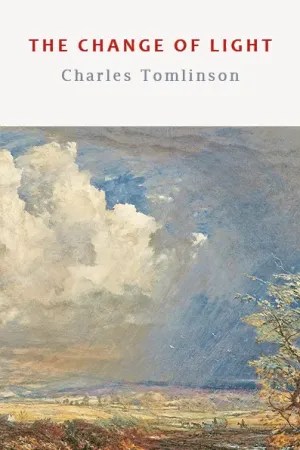
This review of Charles Tomlinson’s The Change of Light, published by Dare-Gale Press in 2025, first appeared in Acumen magazine, commissioned by reviews’ editor, Andrew Geary. Many thanks for the invitation to write about these fine, posthumously published poems.
Beginning to publish poems in the early 1950s, Charles Tomlinson will have been conscious of his outsider status on several fronts. Antipathetic to the still-echoing boom and verbal excess of Dylan Thomas, and sceptical of the narrowed range and palette of the fashionable Movement poets, the young Tomlinson was also developing an interest in European writing, which only became in vogue with Ted Hughes’ founding of Modern Poetry in Translation in 1965. Even further beyond the pale, his Cambridge friendship with Donald Davie stirred a lifelong enthusiasm for American poetry. His interest in things transatlantic yielded several extended visits to the US, and the 1966 collection American Scenes and Other Poems (OUP) which also boasted a section of ‘Mexican Poems’.
Tomlinson died in 2015 and The Change of Light from Dare-Gale Press is a timely reminder of his excellence. In these 22 late, unpublished poems, there are glimpses of his wide-ranging interests with allusions to French poetry, the Greek Islands, the Adriatic Coast, and even to Japan. But we are in a predominantly English landscape here, consisting of woodlands, rivers, trout streams and gardens. The poems are without exception beautiful in their precision, tonal elegance and civility of expression, pursuing, as Tomlinson always did, both the unfolding of abstract ideas as well as a close engagement with landscape and the natural world.
It is the poet’s acuity of observation that is immediately pleasurable for the reader. In ‘Between Seasons’, Tomlinson looks for Spring to arrive while a hawk moves through the garden, ‘on such sharp and silent wings, / It skims more like a knife’. This sort of equivocation between promise and threat is characteristic of the poet. The poem ‘On the Frontier: in March’ also explores the uncertain ‘swaying frontier’ between the seasons, the precarious balance of which is brilliantly conveyed in the sinuosity of Tomlinson’s syntax which runs as one single sentence through 23 lines, before a breath-taking expansion of vision to Planet Earth itself (‘this wandering sphere, / the unpiloted craft’). As this makes clear, Tomlinson’s often alluded to sense of Eden always did encompass what we now call eco-poetry and in ‘Snow’ the paradisal garden is once again deployed for the beauty of the earth, seen ‘with the eyes now / of its first inhabitants’.
The quality of observation in ‘Trout II’ is likewise as freshly peeled as to feel Edenic. The fish’s ‘wirey curvature’ is held as the water’s currents ‘caress, shape, swerve’ past it. The narrator contrasts the ‘Choice’ the creature has to ride the flow with the lack of choice possessed by a rock in the same stream. The trout has an agency, deciding to hang in the water, and is ‘Willing to be no more than weed / That fluctuates beside him like his shadow’, and in so choosing, the fish transforms its environment into ‘aim, discernment, dance’. Tomlinson imagines the creature acting with ‘pleasure’, a pleasure surely also felt by poet and reader, a pleasure derived in part from the trout’s willing abandonment of its body to the water’s flow.
Tomlinson valued chance in both life and creativity (a 1969 poem is called ‘The Chances of Rhyme’) and to take advantage of chance we need to yield up control. He wrote of embracing possibility, achieved only when the ‘self would have to embrace that possibility somewhat self-forgetfully, putting aside the more possessive and violent claims of personality’. This self-forgetfulness, the laying aside of individual personality, is key to Tomlinson’s work (and in passing, it is what makes him a great translator). ‘Raindrops Reconsidered’ contains a pun on the seeing ‘eye (an I)’ which observes best when the ego does not bring with it ‘fable’ or the preconceptions of our daily lives and language. ‘Views’ insists that the genuinely ‘realist’ perception questions the ‘bland misprisions of the day’ so that the everyday world suddenly ‘bursts into wing, flame, flights’, into a perception that is ‘festive’.
This ‘festive’ quality refreshes our acquaintance with the world, but it also opens up vistas in which the diminishment of the self becomes not decrease but an access to something greater. In ‘The Infinite’, sitting on a hillside, beside a hedge, the narrator finds an unnerving tranquillity. The wind in the trees contrasts this, opening up a sense of ‘eternity’ and the individual self vanishes into a wider sphere: ‘In this immensity / my own thoughts drown / and it is sweet to shipwreck in this sea’. For such a poet, the loss of any access to his senses would have been devastating. In 1997, a routine cataract operation went awry and deprived Tomlinson of the sight in his left eye. The loss of binocular vision means judging distances is difficult and Tomlinson here laments the ‘flat projection’ he now has instead of full sight (‘The Accident’).
The poems in The Change of Light would appear to be late work; in ‘Courteous Death’ Tomlinson senses his own mortality. Channelling a little bit of Emily Dickinson, the personification of a surprisingly polite Death advances to greet the poet. In a sudden change of mind, Death offers complete blindness rather than demise. Tomlinson’s ‘one good eye’ refuses (at least for a while). Yet like the rock in ‘Trout II’, there comes a point at which ‘preference has no power’, no choice, though up till now, the poet says, he has expected it to ‘tip the balance / Always in my favour’. But Death allows the poet a little more time, time spent perhaps, in part, on these really fine, pleasing and profound last poems.
I have two reading dates coming up in the next couple of weeks as follows:
Firstly, onThursday, 25th June @ 7.30pm I’m looking forward to reading poems with Kate Noakes and also listening to some jazz as part of the Festival of Chichester. Thanks to Barry Smith for the invitation. Here’s the Festival blurb for the whole event…
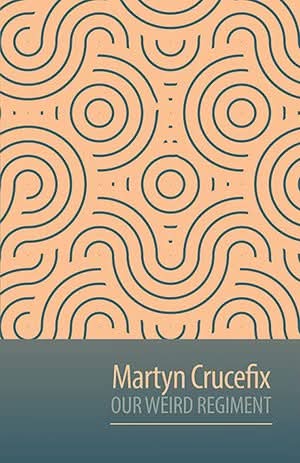
Acclaimed poets Martyn Crucefix and Kate Noakes link with Mike Carey’s Big House Jazz ensemble to entertain and inspire. Plus the launch of Poetry & All That Jazz magazine with South Downs poets. Enjoy a delightful mix of words and music with complementary homemade cake. Based in Arundel and well-known throughout Sussex and the South, the Big House Jazz ensemble will be featuring classic jazz by Count Basie and Duke Ellington plus original tunes. Both prizewinning poets will read from their new collections – Kate Noakes, Sublime Lungs (Two Rivers Press) and Martyn Crucefix: Our Weird Regiment (Shearsman Books).
Details: The Poetry & Jazz Café, Assembly Room, North Street, Chichester, PO19 1LQ. Thursday, June 25, 7.30pm (doors 7pm). Tickets £15
Secondly, on the evening of Tuesday, 7th July @ 7.45pm, I’m making a delightful return visit to Ouse Muse also with my new collection of poems, Our Weird Regiment (Shearsman Books). Thanks to Ian McEwen for the invitation. Ouse Muse events take place in the wonderful Eagle Bookshop, 16-20 St Peters Street, Bedford, MK40 2NN – https://maps.app.goo.gl/cAfo72bLZrSuFhoJ6.
Here’s the bookshop blurb for the evening: Ouse Muse returns, with guest reader Martyn Crucefix, for a poetry open mic night run by local poets and open to anyone with poetry or short prose to share. The night often opens with performances by guest stars before things devolve into literary chaos.
More details here: https://eaglebookshop.co.uk/events/2026/7/7/ouse-muse-july Bookshop doors open at 19:45 for an 8 o’clock start. There’s no need to book, an entrance fee of £5 is paid upon arrival. If you wanted to pick up a book or two from our shelves you can use this entrance ticket as a £5 voucher for the rest of the month.
If you are in the areas, I hope to see you at one or other of these events.
Now published, my translation of the great German poet Jürgen Becker’s 1993 collection, Foxtrot in the Erfurt Stadium. Shearsman Books have done a marvellous job with this book. The poems are introduced by a brilliant essay by Lutz Seiler (also in my translation) and an extract from Becker’s early statement of literary intent, ‘Against the Conservation of the Literary Status Quo’ (1964). I love the choice of cover image: the receding blue remembered hills evoking the way Becker’s poems layer, and intermingle, the past and present of his life and his country’s history so seamlessly. Becker’s work is hugely admired in Europe but almost unknown over here (and in the USA). To celebrate the appearance of the book – and do please go to the Shearsman website and buy one (or a signed copy directly from me) – I’m reproducing below the Preface I wrote for the collection. And below that, one of the poem’s from the book, which happily appeared recently in Poetry Review.
In her Afterword to Jürgen Becker’s monumental 1000-page Gesammelte Gedichte (2022), Marion Poschmann praises the poet as being ‘the writer of his generation who has most consistently exposed himself to the work of remembrance, who approaches the repressed with admirable subtlety and is able to reconcile his personal biography with the great upheavals of history.’ Becker grew up in the German region of Thuringia which, after World War II, was in the Soviet occupation zone, later the GDR. By then, his family had moved to West Germany and, after the fall of the Berlin Wall in 1989, Becker often returned to his childhood landscape.
It is, in part, such biographical happenstance that has made Becker a poet of historical change which, as he says in the poem ‘Dressel’s Garden’, is ‘not yet / a completed process’. The poems achieve their ambitious goals through a layering of time periods, a multiplicity of voices, strands of association and networks of memory. He collages fragments and juxtaposes elements of everyday speech, popular music, neutral description, higher tones, and historical quotation. What holds the poems together are recurring leitmotifs, focal points of personal and historical memory, familiar places, to such a degree that it is ‘possible to read 17 volumes totalling 1000 pages as a single, enormous poem’ (Poschmann).
I first encountered Becker’s work while translating an essay on the poet by Lutz Seiler (published in In Case of Loss (And Other Stories, 2024)). Seiler reads Becker’s work as ‘a process that integrate[s] both immediate and more distant modalities of language, his own voice as well as materials drawn from other sources such as events, photos, maps, as well as interjections from neighbouring rooms, from the mail, the news, weather conditions and whatever else stray[s] within range.’ I am very happy that permissions have been granted to enable Seiler’s brilliant essay to stand as an Introduction to this volume.
Selecting from the 1000-page poem that Poschmann envisages would be difficult indeed, so I have chosen to present the whole of Becker’s crucial 1993 collection, Foxtrot in the Erfurt Stadium. Following the fall of the Berlin Wall in 1989 and reunification the following year, this is the collection in which Becker explores his relationship with his own childhood in Thuringia and the continuing impact of the Second World War and the division of Germany. I have also included a substantial extract from Becker’s important 1963 lecture, ‘Against the Conservation of the Literary Status Quo’, because it suggests clearly the poet’s dissatisfaction with the literary forms of that time and his belief that a form of ‘journalling’ was to be his own way forward. Becker’s baggy, comprehensive, allusive, meditative, brilliantly detailed poems (surely at their best at length) can also be viewed as a response to Czeslaw Milosz’s lines in the 1968 poem ‘Ars Poetica?’: ‘I have always aspired to a more spacious form / that would be free from the claims of poetry or prose’ (tr. Milosz and Lillian Vallee). These then are poems of great historical importance, but my interest in them has also been sustained by the belief that they are extraordinary technical achievements and present an extension of the concept of what makes a poem, an extension too long absent from the English language poetry world.
My heartfelt thanks to Tony Frazer at Shearsman Books for his enthusiasm for Becker’s work and ensuring this book came to be.
I have been very poor with posting on here for a while. For which apologies. But here is an event you might like to attend if you are in the Chesham area this coming Sunday afternoon. It’s part of the Chesham Festival Fringe – and I’m reading with friend and ex-teaching colleague Valerie Jack. Follow the link below for more details. Entry is FREE. My plan is to read some Rilke in translation and some poems from my new Shearsman Books collection.
This review has just appeared on the Everybody’s Reviewing site. Many thanks for giving this new collection such an insightful and concise reading, Gary Day.
There’s something about Martyn Crucefix’s poetry that reminds me of a theremin, an early electronic musical instrument that was played without being touched. Two antenna detected hand movements and translated them into eerie, vocal sounds. So these poems, without quite touching the substantial world, nevertheless register it in all its oddly ephemeral density. “Our Weird Regiment,” the title work of the collection, recounts a visit to a stately home. It is an exquisite poem, mixing up past and present in images of quiet but devastating power. Who are “the weird regiment”? Tourists, the dead, the conformist crowd and more, all forming a splendid enigma.
“Heal Thyself,” a reference to Christ’s remark in Luke 4:23, serves as a preface to the three sections which make up the collection: “Ida Belle,” “Flint” and “Homespun.” The poem articulates themes of, among others, direction, displacement, timing, loss, self-disintegration and self-renewal. The imagery is a mixture of the surreal, the matter of fact, the biblical and more. Metaphysical poets were known for their startling conceits and Crucefix is part of that tradition. In an ICU “the emptying beds / cleared swiftly as a busy table service” (“Olly and Pepper Are Safe”). He is also a brilliant imagist. In the same poem we have “the dazzling fireflies of raised phones” and in “He Made This” “naked willows / will be upholstered in inches of snow.”
No contemporary poet makes more use of allusions than Crucefix. St Augustine, Bede, Easter Island statues, Breughel, Brecht, Henry de Montherlant are just a few examples. They are integral, not decorative, stitching together past and present, amplifying the value of both. Crucefix is a highly intelligent poet acutely attuned to the multiple disintegrations of our time. He offers little in the way of consolation but these poems, these oscillations, are one reason not to despair.
About the reviewer: Gary Day is a retired English lecturer and author of several books including Literary Criticism: A New History and The Story of Drama: Tragedy Comedy and Sacrifice. He is also co-editor of The Wiley Encyclopedia of British Literature 1660-1789. His poetry has been highly commended in a number of competitions, most recently in the Write Out Loud Echoes competition. His poem “Spooky Action at a Distance” won last year’s International Brilliant Poetry Competition. His work has appeared in The High Window, The Seventh Quarry, The Dawn Treader as well as various other magazines.
This review – or a shortened version of it – first appeared in The Times Literary Supplement, 25th December 2025. Many thanks to Camille Ralphs for commissioning it. The Opposite of Seduction: New Poetry in Germanis edited by Alexander Kappe, Nicola Thomas, Jana Maria Weiß and published by Shearsman Books, 2025.
Rebuff, repulsion, lacking allure – it’s a risk to call an anthology of poetry The Opposite of Seduction and perhaps Nicola Thomas’ brief Introduction to this book of new German poetry in translation suspects as much. She concedes, ‘poems here . . . may test the boundaries of Anglophone tastes’. But that depends on your taste and for most readers this anthology will seem a vigorous enjoyable collection of young(ish) voices, most hardly ever heard in English before like Nadja Küchenmeister’s delicate, flowing lyrics of existential uncertainty (tr. Aimee Chor), or Anja Utler’s sole contribution, a re-writing of the Daphne myth, exploiting the white page, a choppy fragmentation, exclamation, and a suitably headlong, hectic delivery. A different note is struck by Uljana Wolf, in her whimsical teasing away at self-awareness, waking at four in the morning, or down on hands and knees with an English-speaking partner, to consider dust bunnies (in German ‘Wollmaus’); ‘our little creatures, how they swap their fluffy, moon-gray names’ (tr. Sophie Seita).
Friederike Mayröcker
Yet despite its brevity, Thomas’ Introduction raises questions it leaves unanswered, rather misrepresents the book’s contents, and shows signs of revisions and deletions (it’s puzzling that her two co-editors do not put their name to it). She suggests the years since the millennium have been ones of great vitality for the ‘German language lyric’ and the resulting achievements have passed unnoticed in English-speaking countries for want of translations gathered in one place. A broad survey of the genre and period would indeed be welcome, but this anthology lays claim to ‘range and variety, something for (almost) everyone’, yet makes definitive choices and has startling exclusions. The editors nominate Friederike Mayröcker, Elke Erb, and Thomas Kling as presiding spirits, spawning a ‘genealogy’ of lyric writing in German. Born in the 1920s, ‘30s and ‘50s respectively, it’s not their age that links these ‘senior figures’ and because poets included in The Opposite of Seduction have birth dates ranging from the 1930s to the 1970s/80s, the idea of inheritance is at best questionable. If ‘range and variety’ is what the editors intended, then where are other ‘senior’ candidates like Nelly Sachs, Bertolt Brecht, Peter Huchel, Paul Celan, Ingeborg Bachmann, Jürgen Becker, Volker Braun, Durs Grünbein?
In fact, the reader is here presented with a particular slant on the lyric: these are poets inclined to collage-form, whose subject is as much language as world, who ‘resist limpet-clinging to past metrics, self-satisfied irony, the self-regarding ego . . . [standing for] resistance to habitual responses . . . without a safety-net for the poet or reader’. Thomas can make it sound as if the English-speaking poetry world has somehow missed out on such millennial developments, but the latter quotation comes from Eric Mottram’s description of writers included in the new british poetry, published over thirty years ago. So any English-speaking reader familiar with Mottram’s anthology of ‘marginalised’ poets will feel at home in (rather than tested by) The Opposite of Seduction.
Elke Erb
As to the poems themselves, we have far more examples of Gedankenlyrik (poems of ideas) than Erlebnislyrik (poems of experience). It’s Mayröcker’s style (closely followed by Kling) of dismantling language, of fragmentation, the avoidance of closure, narrative, or simple affirmation, that is the order of the day. Language is foregrounded, pushed to its limits with capitals (or avoidance of), italicisation, referential leaps, allusions, repetitions, abrupt switches of tone and subject matter. Monika Rinck’s long prose-y lines (punctuated, no capitals) stand out. They carry a stream of consciousness voice with a self-deprecating humour. It’s one of her poems that provides the anthology title; a lament for neglected office pot plants that manages to encompass Psalm 23, dog breeding, coffee grounds and human fallibility: ‘they all say: / i’ll bring some peat tomorrow. the morrow never comes. no one brings peat.’ Iain Galbraith’s brilliant renderings of poems by Peter Waterhouse are also a revelation. His is a voice delivering slightly crazed, swift, pseudo-socratic dialogues as poems, wearing a sly smile, and exploring questions of identity, language and spatial relationships: ‘With regard / to the room the stranger thinks: I could enter myself. Thus / answering the ancient question. What question? The question / of the exceptions to be borne in mind. The question / of borders’.
Technique dominates rather than subject matter, though the selection is organised by subjects such as Heart, Body, Soul, Beast, Season, Machine, Home. Oswald Egger writes lush, musical celebrations of the natural world which in Ian Galbraith’s renderings evoke Hopkins, even Dylan Thomas. Dinçer Güçyeter brings material from the migrant experience (tr. Caroline Wilcox Reul) and Ulrike Almut Sandig creates a genuine split-screen reading experience, playing poem texts off against story board instructions either side of the page (tr. Karen Leeder). Given the breadth of experimentation going on here, there are inevitable failures. These are poets working to free both writer and reader from conventions, to open up novel realms of human experience, a liberation from history. Occasionally, Jan Kuhlbrodt’s nightmare vision of a man hoarding books and newspapers hovers behind some poems, so intent on their own language are they, perhaps in need of a ‘reminder of a reality that knows more than paper’ (tr. Alexander Kappe).
This brief review of my most recent chapbook, Walking Away (Dare-Gale Press, 2025), has been written by Debasish Lahiri and recently appeared on the website Everybody’s Reviewing, Dec 2025. Many thanks to the reviewer for his close reading and enthusiasm about the poems and to Jonathan Taylor who edits the wonderfully lively and interesting site at Everybody’s Reviewing.
Only participles here: their ghosts fill the passing of present and present pasts in Martyn Crucefix’s latest pamphlet Walking Away. One does not need to stand in the mere of biblical lore to realize that the “end” is a process. To be witness to our parents – their touch growing cold upon the warmth of our grasp, often desperate grasp, and their memories slipping like wind through the parapet of our fingers, or sand – is to be in the arc, or archetype, of the end. Crucefix’s poetry talks as much of us who are left behind as of our parents who grow more distant, more alien, without being able to go anywhere.
You hear cars hiss along the road Cars hissing along the road
Only present participles
In writing about his parents, and their misted lens of time, where everything is either disconcertingly different, or befuddlingly the same, Crucefix unravels the tyranny of that continuum called the Present. With the deftest of touches he paints a time, the only time where we can be partakers together, but also a cruel time with no recall or hope for a future recognition.
Mother of your brother and sister Mother of your three sons
The same car speeding away
Reading this collection one can’t but feel that it all stands up or falls apart depending on the miraculous presence or absence of that hand or arm in the precipitate moment when the mind is afraid, limbs waver on the verge of a fumble and a silent swipe at balance comes up with aether. It isn’t merely furniture that has moved. Care-givers move through the house. A flux of children, wives and kin sweep through. The house turns out to be a Care-Home.
Dining chair and coffee table Shifted here and there
Losing you. Your balance too
Walking Away has three shorter poems – “Video Call,” “My Mother’s Care Home Room (as Cleopatra’s monument)” and “In This Quiet One-way West Country Town” – along with the eponymous long sequence of tercets, measuring the calculus of change in human life. Crucefix adapts the Japanese form of the Haiku brilliantly in his long sequence “Walking Away.” This is a sense adaptation of the form, not necessarily a servile conformity to the 5-7-5 syllabic fiat, but a reinterpretation of the dynamic, emphasizing the break (after two lines or one), and corresponding to the idea of the Kireji or the divide in Japanese. Strictly speaking these are more akin to Senryu, poetry that speaks of human life rather than the natural world.
Crucefix reminds us that living is a one-way road (not just in West Country towns). There’s no way back. Living is a walking away from the consolations of Time, an inexorable moving away of people dearest to us, our parents. His poetry stands up, unflinchingly, to this bruise.
About the reviewer: Debasish Lahiri has nine collections of poetry to his credit, the latest being A Certain Penance of Light (2025). Lahiri is the recipient of the Prix-du Merite, Naji Naaman Literary Prize 2019.
John Greening has recently reviewed my new chapbook of poems, Walking Away (Dare-Gale Press, 2025), a review which first appeared on The High Window website.Many thanks to David Cooke at THW and to the reviewer for his kind and perceptive comments about a set of poems for which I feel (an obvious) affection. Mum and Dad would be bemused by it all I think, but pleased to be so remembered.
Martyn Crucefix has come a long way since his remarkable Enitharmon debut, Beneath Tremendous Rain (1990). Learning, no doubt, from poetry he has since translated or adapted – notably Rilke, but also Peter Huchel, Rosalía de Castro and the Daodejing (more familiar as the Tao te Ching) – he has become more and more experimental, more complicatedly troubled. This was especially evident in his 2017 sequence A Convoy and in the beautifully illustrated Cargo of Limbs from Hercules Editions (2019), itself a version of Book Six of the Aeneid.
Walking Away is more straightforward and in some ways a shift towards a major key, though the subject matter might make it appear otherwise. Even the tranquil landscape on the cover reminds us that Crucefix has always had a pastoral streak: he was, after all, brought up in the West Country, which features here a good deal, if elegiacally. The book is dedicated to his parents and it opens with a ‘Video Call’ full of tragi-comic touches (the camera is ‘angled so I catch only the crowns // of grey heads then a giant hand/reaches forward to re-adjust’) and ends with gracefully formal stanzas evoking a ‘provincial market town’ (Trowbridge, perhaps, near the Wiltshire village where Crucefix grew up?).
Fourteen of the pamphlet’s pages are occupied by the remarkable title sequence of four-line poems (drawing on ‘the vivid, condensed power of the haiku form’, as the blurb puts it, but each of a different syllable count) about the decline of the poet’s elderly mother, whose state is addressed more directly in the penultimate poem of the four in Walking Away: ‘My Mother’s Care-home Room (as Cleopatra’s Monument)’. She is portrayed unsparingly with ‘an Easter Island profile / gaunt and beaked’ but becomes a regal presence by the poem’s end as her son keeps his vigil with a final flourish of rhyme:
with all the helpless- ness of a Charmian at the cooling feet of her brave Queen the asp flung down beneath the only chair there has ever been
The title sequence, however, is the book’s great success, a brilliant series of vignettes, like theatre music without the play, set largely, it seems, during a period when the poet’s mother was in her own home. Some of these don’t feel like haiku, but others have that unmistakable, indefinable quality – perhaps to do with awareness of the seasons:
Turning in at your mother’s front gate Eighty years at a stroke
Swifts no longer nesting
Crucefix knows how to find the Imagistic essence of a situation, as the form demands; and his gift for metaphor has always been considerable:
This week’s new dosette box Grey windows not yet broken
Twenty-eight channels nothing on
Once you work out what a ‘dosette box’ is (one of those compartmentalized containers for daily tablets), the image here is potent and at least as good as ‘Petals on a wet, black bough’. For their full effect, these fragments do need each other, and they don’t often need such glossing. Take the next one, only the third in the sequence:
Telephone numerals are big and bold The size of Scrabble pieces
A language you once knew
The brevity is fitting, since that’s often the way one communicates with those in decline; there is tea, a shared remark, more tea, a view of a lawn, knick-knacks on the mantelpiece, a car passing, a nap, a scratching mouse, ‘The clamour of carers / A microwave ping’. And while nothing connects with nothing, we are embraced by an intense emotion and a sense of an approaching end. Walking Away demands to be read.
This review of my recent Dare-Gale Press chapbook, Walking Away, has just appeared on Litter Magazine website. Many thanks to Ian Brinton for his insightful observations on what he calls ‘this important little volume’. Any kind of proximity to Ben Jonson, Vladimir Nabokov and WS Graham is good with me!
‘Language most shewes a man: speake that I may see thee. It springs out of the most retired, and inmost parts of us, and is the Image of the Parent of it, the mind’
Ben Jonson’s prose Discoveries was first printed in 1640 and the shining clarity of what these words offer is central to what we understand about the importance of language. No one person can read the mind of another and it is language that permits us to recognise what is going on in another person’s vision of the world. As Martyn Crucefix bids a farewell to his parents he recognises in the title poem to this deeply-moving sequence that ‘Walking Away’ leaves a world behind:
Chaos of a dissolving township A vacant heathland
I’ve no map to your mind
The twenty pages of poetry in this beautifully produced chapbook are dedicated ‘in memory of my parents’ and open with an epigraph from Masaya Saito’s Snow Bones which had been published by Isobar Press in 2016. Saito’s four narrative haiku sequences had also been dedicated to his parents and far from being lamentations of stasis they were delicate records of movement as the poet prepared to leave a landscape in which much of his past had resided:
In the snow country my parents gone
a pendulum swinging
The print on the white pages of Saito’s volume appears like footsteps in snow and there is a quiet seriousness in the sound of one of the seven different voices as it outlines
A misty night
I exist as footsteps
In Martyn Crucefix’s volume there is a humble awareness of the passing of time which does not resolve itself into an easily achieved sense of regret. If the connection between the Then and the Now wavers with time’s passing and ‘faces split to stained glass / or cubist fragments or fairground mirrors’ those human figures so close to the poet are ‘still talking blithely asking me still / if I can see these crocuses.’ The repeated use of the word ‘still’ conveys both a settled sense of the past being beyond us, unmoving, and the enduring quality of its presence.
The central poem in this sequence is made up of fifty-eight three-line haikus and the ironies of absence and presence are held with a quiet sense of the bowed head:
Something where nothing was Nothing where something stood
Ten thousand nothings
In the riddle of all riddles nothing is an actual something and if you look at zero you will see nothing but if you use it as an eye you will see the world. The circular hollows of nothing may range from an open mouth to the faintly outline dark of the moon and from craters to wounds. As it was suggested by Nabokov ‘Skulls and seeds and all good things are round.’
A large print calendar Days crossed in black have passed
No footprints mark the snow ahead
As W.S. Graham’s ‘Malcolm Mooney’s Land’ puts it ‘footprint on foot / Print, word on word’ is ‘always a record of me in you’ and in ‘Walking Away’ Martyn Crucefix questions his dead parents
Why show me these photographs? You point to strangers
Once upon a time I was there
In the final poem in this important little volume, ‘In This Quiet One-way West Country Town’, the vivid sense of loss is caught as ‘your hand slips mine before I’ve the chance / to say I’m sorry I was not there to help’ and the poet is left
under cloudless skies a gull driven too far inland to return now it’s closing time all across this quiet provincial one-way west country town turning for home before dark
Home is where we live and the footprints left in snow, marks upon the page, remain as a reminder of who we are in relation to how we got there.