Now Published: ‘Foxtrot in the Erfurt Stadium’ by Jürgen Becker

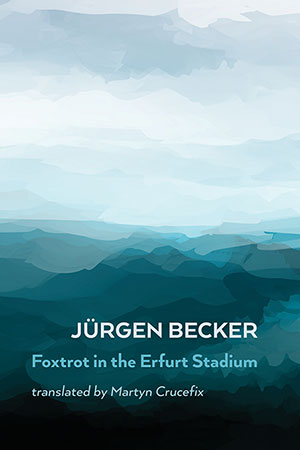
Now published, my translation of the great German poet Jürgen Becker’s 1993 collection, Foxtrot in the Erfurt Stadium. Shearsman Books have done a marvellous job with this book. The poems are introduced by a brilliant essay by Lutz Seiler (also in my translation) and an extract from Becker’s early statement of literary intent, ‘Against the Conservation of the Literary Status Quo’ (1964). I love the choice of cover image: the receding blue remembered hills evoking the way Becker’s poems layer, and intermingle, the past and present of his life and his country’s history so seamlessly. Becker’s work is hugely admired in Europe but almost unknown over here (and in the USA). To celebrate the appearance of the book – and do please go to the Shearsman website and buy one (or a signed copy directly from me) – I’m reproducing below the Preface I wrote for the collection. And below that, one of the poem’s from the book, which happily appeared recently in Poetry Review.

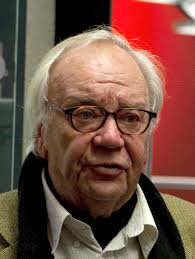
In her Afterword to Jürgen Becker’s monumental 1000-page Gesammelte Gedichte (2022), Marion Poschmann praises the poet as being ‘the writer of his generation who has most consistently exposed himself to the work of remembrance, who approaches the repressed with admirable subtlety and is able to reconcile his personal biography with the great upheavals of history.’  Becker grew up in the German region of Thuringia which, after World War II, was in the Soviet occupation zone, later the GDR. By then, his family had moved to West Germany and, after the fall of the Berlin Wall in 1989, Becker often returned to his childhood landscape.

It is, in part, such biographical happenstance that has made Becker a poet of historical change which, as he says in the poem ‘Dressel’s Garden’, is ‘not yet / a completed process’. The poems achieve their ambitious goals through a layering of time periods, a multiplicity of voices, strands of association and networks of memory. He collages fragments and juxtaposes elements of everyday speech, popular music, neutral description, higher tones, and historical quotation. What holds the poems together are recurring leitmotifs, focal points of personal and historical memory, familiar places, to such a degree that it is ‘possible to read 17 volumes totalling 1000 pages as a single, enormous poem’ (Poschmann).

I first encountered Becker’s work while translating an essay on the poet by Lutz Seiler (published in In Case of Loss (And Other Stories, 2024)). Seiler reads Becker’s work as ‘a process that integrate[s] both immediate and more distant modalities of language, his own voice as well as materials drawn from other sources such as events, photos, maps, as well as interjections from neighbouring rooms, from the mail, the news, weather conditions and whatever else stray[s] within range.’ I am very happy that permissions have been granted to enable Seiler’s brilliant essay to stand as an Introduction to this volume.

Selecting from the 1000-page poem that Poschmann envisages would be difficult indeed, so I have chosen to present the whole of Becker’s crucial 1993 collection, Foxtrot in the Erfurt Stadium. Following the fall of the Berlin Wall in 1989 and reunification the following year, this is the collection in which Becker explores his relationship with his own childhood in Thuringia and the continuing impact of the Second World War and the division of Germany. I have also included a substantial extract from Becker’s important 1963 lecture, ‘Against the Conservation of the Literary Status Quo’, because it suggests clearly the poet’s dissatisfaction with the literary forms of that time and his belief that a form of ‘journalling’ was to be his own way forward. Becker’s baggy, comprehensive, allusive, meditative, brilliantly detailed poems (surely at their best at length) can also be viewed as a response to Czeslaw Milosz’s lines in the 1968 poem ‘Ars Poetica?’: ‘I have always aspired to a more spacious form / that would be free from the claims of poetry or prose’ (tr. Milosz and Lillian Vallee). These then are poems of great historical importance, but my interest in them has also been sustained by the belief that they are extraordinary technical achievements and present an extension of the concept of what makes a poem, an extension too long absent from the English language poetry world.

My heartfelt thanks to Tony Frazer at Shearsman Books for his enthusiasm for Becker’s work and ensuring this book came to be.

Blackbirds, then other voices. It doesn’t stop

in the snow, when along with the snow

comes a piece of news that, this morning,

is absolutely essential. Or how

do you see it? I see the pear tree and how it

(the pear tree) responds to the wind (to the

wind). This morning, once again, the

decision has been taken. War

between magpies and crows, simply this war,

no fuss, just this clear understanding.

Another voice, the next remark; it’s all (again)

a matter of the whole. Are you standing

in the garden? Then you know, tuck tuck, the blackbird

warned at first, you know it, I’ll say it

again, in the war, in the fresh snow, in the wind.

Reading – Sunday 24th May 2.30pm in Chesham

I have been very poor with posting on here for a while. For which apologies. But here is an event you might like to attend if you are in the Chesham area this coming Sunday afternoon. It’s part of the Chesham Festival Fringe – and I’m reading with friend and ex-teaching colleague Valerie Jack. Follow the link below for more details. Entry is FREE. My plan is to read some Rilke in translation and some poems from my new Shearsman Books collection.

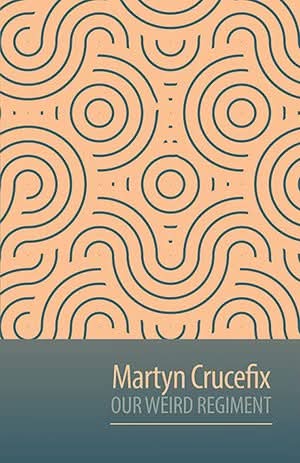
New Review of ‘Our Weird Regiment’

This review has just appeared on the Everybody’s Reviewing site. Many thanks for giving this new collection such an insightful and concise reading, Gary Day.

There’s something about Martyn Crucefix’s poetry that reminds me of a theremin, an early electronic musical instrument that was played without being touched. Two antenna detected hand movements and translated them into eerie, vocal sounds. So these poems, without quite touching the substantial world, nevertheless register it in all its oddly ephemeral density. “Our Weird Regiment,” the title work of the collection, recounts a visit to a stately home. It is an exquisite poem, mixing up past and present in images of quiet but devastating power. Who are “the weird regiment”? Tourists, the dead, the conformist crowd and more, all forming a splendid enigma. 

“Heal Thyself,” a reference to Christ’s remark in Luke 4:23, serves as a preface to the three sections which make up the collection: “Ida Belle,” “Flint” and “Homespun.” The poem articulates themes of, among others, direction, displacement, timing, loss, self-disintegration and self-renewal. The imagery is a mixture of the surreal, the matter of fact, the biblical and more. Metaphysical poets were known for their startling conceits and Crucefix is part of that tradition. In an ICU “the emptying beds / cleared swiftly as a busy table service” (“Olly and Pepper Are Safe”). He is also a brilliant imagist. In the same poem we have “the dazzling fireflies of raised phones” and in “He Made This” “naked willows / will be upholstered in inches of snow.” 

No contemporary poet makes more use of allusions than Crucefix. St Augustine, Bede, Easter Island statues, Breughel, Brecht, Henry de Montherlant are just a few examples. They are integral, not decorative, stitching together past and present, amplifying the value of both. Crucefix is a highly intelligent poet acutely attuned to the multiple disintegrations of our time. He offers little in the way of consolation but these poems, these oscillations, are one reason not to despair. 

About the reviewer: Gary Day is a retired English lecturer and author of several books including Literary Criticism: A New History and The Story of Drama: Tragedy Comedy and Sacrifice. He is also co-editor of The Wiley Encyclopedia of British Literature 1660-1789. His poetry has been highly commended in a number of competitions, most recently in the Write Out Loud Echoes competition. His poem “Spooky Action at a Distance” won last year’s International Brilliant Poetry Competition. His work has appeared in The High WindowThe Seventh QuarryThe Dawn Treader as well as various other magazines. 

Upcoming Dates and ‘Our Weird Regiment’ is now published

I will be contributing to an event in London next week which will mark 100 years since Rilke’s death. I will read from my translations of Rilke as published in Change Your Life (Pushkin Press, 2024).

To quote from the Goethe-Institut’s publicity for the evening: Please join us us for a vibrant evening celebrating Tanzt die Orange —a groundbreaking new anthology that brings Rilke’s poetry into the language of today. Curated by award-winning poets Jan Wagner and Norbert Hummelt, the collection features reinterpretations of Rilke’s verses by 75 leading voices in contemporary German-language poetry.

At this special London event, Wagner and Hummelt will read selections from the anthology and discuss the enduring resonance of Rilke’s work. Co-presenting the event are the acclaimed translators Karen Leeder and Martyn Crucefix, who will guide the conversation and provide English translations of the poems, opening a dialogue between Rilke’s legacy and today’s poetic voices. The event will be presented in both German and English. Tickets £6, £3 concessions and for Goethe-Institut language students & library members. For more information and booking click here.

Venue: Goethe-Institut London Library, 50 Princes Gate, Exhibition Road, London SW7 2PH

Also on the horizon is the launch reading for my new full collection of original poems, Our Weird Regiment (Shearsman Books). This will take place on Tuesday 10th March at 7.30pm at the Swedenborg Hall, 20/21 Bloomsbury Way, London WC1A 2TH. (See map here.) Admission is free.

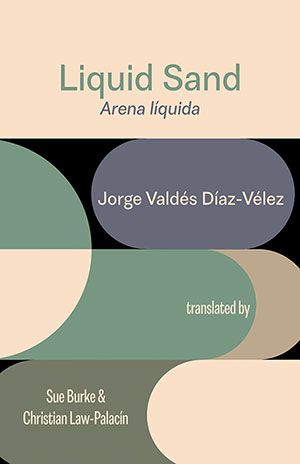
The reading will be hosted by Tony Frazer, publisher of Shearsman Books, as one of Shearsman’s regular programme of launches and readings. I will be reading alongside Jorge Valdés Díaz-Vélez.

Another Review of my recent chapbook ‘Walking Away’

This brief review of my most recent chapbook, Walking Away (Dare-Gale Press, 2025), has been written by Debasish Lahiri and recently appeared on the website Everybody’s Reviewing, Dec 2025. Many thanks to the reviewer for his close reading and enthusiasm about the poems and to Jonathan Taylor who edits the wonderfully lively and interesting site at Everybody’s Reviewing.

Only participles here: their ghosts fill the passing of present and present pasts in Martyn Crucefix’s latest pamphlet Walking Away. One does not need to stand in the mere of biblical lore to realize that the “end” is a process. To be witness to our parents – their touch growing cold upon the warmth of our grasp, often desperate grasp, and their memories slipping like wind through the parapet of our fingers, or sand – is to be in the arc, or archetype, of the end. Crucefix’s poetry talks as much of us who are left behind as of our parents who grow more distant, more alien, without being able to go anywhere. 

           You hear cars hiss along the road
           Cars hissing along the road

           Only present participles

In writing about his parents, and their misted lens of time, where everything is either disconcertingly different, or befuddlingly the same, Crucefix unravels the tyranny of that continuum called the Present. With the deftest of touches he paints a time, the only time where we can be partakers together, but also a cruel time with no recall or hope for a future recognition. 

           Mother of your brother and sister
           Mother of your three sons

           The same car speeding away

Reading this collection one can’t but feel that it all stands up or falls apart depending on the miraculous presence or absence of that hand or arm in the precipitate moment when the mind is afraid, limbs waver on the verge of a fumble and a silent swipe at balance comes up with aether. It isn’t merely furniture that has moved. Care-givers move through the house. A flux of children, wives and kin sweep through. The house turns out to be a Care-Home.

           Dining chair and coffee table 
           Shifted here and there


           Losing you. Your balance too

Walking Away has three shorter poems – “Video Call,” “My Mother’s Care Home Room (as Cleopatra’s monument)” and “In This Quiet One-way West Country Town” – along with the eponymous long sequence of tercets, measuring the calculus of change in human life. Crucefix adapts the Japanese form of the Haiku brilliantly in his long sequence “Walking Away.” This is a sense adaptation of the form, not necessarily a servile conformity to the 5-7-5 syllabic fiat, but a reinterpretation of the dynamic, emphasizing the break (after two lines or one), and corresponding to the idea of the Kireji or the divide in Japanese. Strictly speaking these are more akin to Senryu, poetry that speaks of human life rather than the natural world. 

Crucefix reminds us that living is a one-way road (not just in West Country towns). There’s no way back. Living is a walking away from the consolations of Time, an inexorable moving away of people dearest to us, our parents. His poetry stands up, unflinchingly, to this bruise.

About the reviewer: Debasish Lahiri has nine collections of poetry to his credit, the latest being A Certain Penance of Light (2025). Lahiri is the recipient of the Prix-du Merite, Naji Naaman Literary Prize 2019.

John Greening reviews my new chapbook ‘Walking Away’

John Greening has recently reviewed my new chapbook of poems, Walking Away (Dare-Gale Press, 2025), a review which first appeared on The High Window website. Many thanks to David Cooke at THW and to the reviewer for his kind and perceptive comments about a set of poems for which I feel (an obvious) affection. Mum and Dad would be bemused by it all I think, but pleased to be so remembered.

Martyn Crucefix has come a long way since his remarkable Enitharmon debut, Beneath Tremendous Rain (1990). Learning, no doubt, from poetry he has since translated or adapted – notably Rilke, but also Peter Huchel, Rosalía de Castro and the Daodejing (more familiar as the Tao te Ching) – he has become more and more experimental, more complicatedly troubled. This was especially evident in his 2017 sequence A Convoy and in the beautifully illustrated Cargo of Limbs from Hercules Editions (2019), itself a version of Book Six of the Aeneid. 

Walking Away is more straightforward and in some ways a shift towards a major key, though the subject matter might make it appear otherwise. Even the tranquil landscape on the cover reminds us that Crucefix has always had a pastoral streak: he was, after all, brought up in the West Country, which features here a good deal, if elegiacally.  The book is dedicated to his parents and it opens with a ‘Video Call’ full of tragi-comic touches (the camera is ‘angled so I catch only the crowns // of grey heads then a giant hand/reaches forward to re-adjust’) and ends with gracefully formal stanzas evoking a ‘provincial market town’ (Trowbridge, perhaps, near the Wiltshire village where Crucefix grew up?).

Fourteen of the pamphlet’s pages are occupied by the remarkable title sequence of four-line poems (drawing on ‘the vivid, condensed power of the haiku form’, as the blurb puts it, but each of a different syllable count) about the decline of the poet’s elderly mother, whose state is addressed more directly in the penultimate poem of the four in Walking Away: ‘My Mother’s Care-home Room (as Cleopatra’s Monument)’. She is portrayed unsparingly with ‘an Easter Island profile / gaunt and beaked’ but becomes a regal presence by the poem’s end as her son keeps his vigil with a final flourish of rhyme:

with all the helpless-
ness of a Charmian
at the cooling feet
of her brave Queen
the asp flung down
beneath the only chair
there has ever been

The title sequence, however, is the book’s great success, a brilliant series of vignettes, like theatre music without the play, set largely, it seems, during a period when the poet’s mother was in her own home. Some of these don’t feel like haiku, but others have that unmistakable, indefinable quality – perhaps to do with awareness of the seasons:

Turning in at your mother’s front gate
Eighty years at a stroke

Swifts no longer nesting

Crucefix knows how to find the Imagistic essence of a situation, as the form demands; and his gift for metaphor has always been considerable:

This week’s new dosette box
Grey windows not yet broken

Twenty-eight channels nothing on

Once you work out what a ‘dosette box’ is (one of those compartmentalized containers for daily tablets), the image here is potent and at least as good as ‘Petals on a wet, black bough’. For their full effect, these fragments do need each other, and they don’t often need such glossing. Take the next one, only the third in the sequence:

Telephone numerals are big and bold
The size of Scrabble pieces

A language you once knew

The brevity is fitting, since that’s often the way one communicates with those in decline; there is tea, a shared remark, more tea, a view of a lawn, knick-knacks on the mantelpiece, a car passing, a nap, a scratching mouse, ‘The clamour of carers / A microwave ping’. And while nothing connects with nothing, we are embraced by an intense emotion and a sense of an approaching end.  Walking Away demands to be read.

‘Walking Away’ – reviewed by Ian Brinton

This review of my recent Dare-Gale Press chapbook, Walking Away, has just appeared on Litter Magazine website. Many thanks to Ian Brinton for his insightful observations on what he calls ‘this important little volume’. Any kind of proximity to Ben Jonson, Vladimir Nabokov and WS Graham is good with me!

Language most shewes a man: speake that I may see thee. It springs out of the most retired, and inmost parts of us, and is the Image of the Parent of it, the mind’

Ben Jonson’s prose Discoveries was first printed in 1640 and the shining clarity of what these words offer is central to what we understand about the importance of language. No one person can read the mind of another and it is language that permits us to recognise what is going on in another person’s vision of the world. As Martyn Crucefix bids a farewell to his parents he recognises in the title poem to this deeply-moving sequence that ‘Walking Away’ leaves a world behind:

      Chaos of a dissolving township
      A vacant heathland

      I’ve no map to your mind

The twenty pages of poetry in this beautifully produced chapbook are dedicated ‘in memory of my parents’ and open with an epigraph from Masaya Saito’s Snow Bones which had been published by Isobar Press in 2016. Saito’s four narrative haiku sequences had also been dedicated to his parents and far from being lamentations of stasis they were delicate records of movement as the poet prepared to leave a landscape in which much of his past had resided:

      In the snow country
      my parents gone

      a pendulum swinging

The print on the white pages of Saito’s volume appears like footsteps in snow and there is a quiet seriousness in the sound of one of the seven different voices as it outlines

      A misty night

      I exist
      as footsteps

In Martyn Crucefix’s volume there is a humble awareness of the passing of time which does not resolve itself into an easily achieved sense of regret. If the connection between the Then and the Now wavers with time’s passing and ‘faces split to stained glass / or cubist fragments or fairground mirrors’ those human figures so close to the poet are ‘still talking blithely asking me still / if I can see these crocuses.’ The repeated use of the word ‘still’ conveys both a settled sense of the past being beyond us, unmoving, and the enduring quality of its presence.

The central poem in this sequence is made up of fifty-eight three-line haikus and the ironies of absence and presence are held with a quiet sense of the bowed head:

      Something where nothing was
      Nothing where something stood

      Ten thousand nothings

In the riddle of all riddles nothing is an actual something and if you look at zero you will see nothing but if you use it as an eye you will see the world. The circular hollows of nothing may range from an open mouth to the faintly outline dark of the moon and from craters to wounds. As it was suggested by Nabokov ‘Skulls and seeds and all good things are round.’

      A large print calendar
      Days crossed in black have passed

      No footprints mark the snow ahead

As W.S. Graham’s ‘Malcolm Mooney’s Land’ puts it ‘footprint on foot / Print, word on word’ is ‘always a record of me in you’ and in ‘Walking Away’ Martyn Crucefix questions his dead parents

      Why show me these photographs?
      You point to strangers

      Once upon a time I was there

In the final poem in this important little volume, ‘In This Quiet One-way West Country Town’,  the vivid sense of loss is caught as ‘your hand slips mine before I’ve the chance / to say I’m sorry I was not there to help’ and the poet is left

      under cloudless skies a gull driven too far
      inland to return now it’s closing time
      all across this quiet provincial one-way
      west country town turning for home before dark

Home is where we live and the footprints left in snow, marks upon the page, remain as a reminder of who we are in relation to how we got there.

Fire River Poets – Zoom Reading 6th November 2025

I will be giving a reading for the Fire River Poets based in Taunton, UK, on Thursday 6th November from 19:15 – 22:00.

I will be reading in two 15/20 minute slots and there is an opportunity for floor readers if you sign up in advance.

More details as they have been given to me are here….

Zoom Link: https://us02web.zoom.us/j/87214798048?pwd=FyMb8nRhPvbXN6FTSYS0ESfBbvPLJc.1

Topic: Fire River Poets with Martyn Crucefix
Time: Nov 6, 2025 07:15 PM London
Join Zoom Meeting
https://us02web.zoom.us/j/87214798048?pwd=FyMb8nRhPvbXN6FTSYS0ESfBbvPLJc.1

Meeting ID: 872 1479 8048
Passcode: 644184

One tap mobile
+17193594580,,87214798048#,,,,*644184# US
+19294362866,,87214798048#,,,,*644184# US (New York)

Join instructions
https://us02web.zoom.us/meetings/87214798048/invitations?signature=pF1GzS9GjbZUsAIAKxnp457YL8HF1dF5Tqd86AfXwUg

RIP Tony Harrison – a piece on metre and voice in his poetry

With the sad news of the passing of Tony Harrison, who as a working class poet had a great impact on me during my formative years of writing in the 1980s, I went back to a piece I was commissioned to write for an OUP collection of essays on his writing – both poetic and dramatic – in 1997. The book, Tony Harrison: Loiner, was edited by Sandie Byrne and included articles from Richard Eyre, Melvyn Bragg, Alan Rusbridger, Rick Rylance, and Bernard O’Donoghue. This is the full text of what I contributed: an intense focus on and close analysis of two of Harrison’s key poems, ‘A Cold Coming’ (for Harrison reading this poem click here) and ‘Them & [uz]’ (for the text of this poem click here).

The Drunken Porter Does Poetry: Metre and Voice in the Poems of Tony Harrison

Part I

Harrison’s first full collection, entitled The Loiners after the inhabitants of his native Leeds, was published in 1970 and contained this limerick:

There was a young man from Leeds

Who swallowed a packet of seeds.

A pure white rose grew out of his nose

And his arse was covered in weeds.

Without losing sight of the essential comedy of this snatch, it can be seen as suggestive of aspects of Harrison’s career. For example, the comic inappropriateness of the Leeds boy swallowing seeds becomes the poet’s own ironic image of his classical grammar school education. As a result of this, in a deliberately grotesque image, arises the growth of the white rose of poetry – from the boy’s nose, of course, since Harrison in the same volume gave credence to the idea that the true poet is born without a mouth (1). The bizarrely contrasting weed-covered arse owes less to the intake of seeds (rose seeds wherever transplanted will never yield weeds) than to the harsh conditions Harrison premises in the Loiner’s life, as indicated in an early introduction to his work, where he defines the term as referring to “citizens of Leeds, citizens who bear their loins through the terrors of life, ‘loners'”(2).

Harrison’s now-legendary seed-master on the staff of Leeds Grammar School was the one who humiliated him for reciting Keats in a Yorkshire accent, who felt it more appropriate if the boy played the garrulous, drunken Porter in Macbeth.(3) The truth is that the master’s attitudes determined the kind of poetic rose that grew, in particular its technical facility which Harrison worked at to show his ‘betters’ that Loiners could do it as well as (better than?) they could. Yet this was no sterile technical exercise and Harrison’s success lies in the integrity with which he has remained true to those regions “covered with weeds” and in the fact that his work has always struggled to find ways to unite the weed and the rose. Perhaps the most important of these, as the limerick’s anatomical geography already predicted in 1970, is via the rhythms of his own body.

Harrison has declared his commitment to metrical verse because “it’s associated with the heartbeat, with the sexual instinct, with all those physical rhythms which go on despite the moments when you feel suicidal” (4). In conversation with Richard Hoggart, he explains that without the rhythmical formality of poetry he would be less able to confront, without losing hope, the unweeded gardens of death, time and social injustice which form his main concerns. “That rhythmical thing is like a life-support system. It means I feel I can go closer to the fire, deeper into the darkness . . . I know I have this rhythm to carry me to the other side” (5). There are few of Harrison’s poems that go closer to the fire than the second of his Gulf War poems, ‘A Cold Coming’ (6). Its initial stimulus, reproduced on the cover of the original Bloodaxe pamphlet, was a photograph by Kenneth Jarecke in The Observer. The picture graphically showed the charred head of an Iraqi soldier leaning through the windscreen of his burned-out truck which had been hit by Allied Forces in the infamous ‘turkey-shoot’ as Saddam’s forces retreated from Kuwait City. In the poem, Harrison makes the Iraqi himself speak both with a brutal self-recognition (“a skull half roast, half bone”) as well as a scornful envy of three American soldiers who were reported to have banked their sperm for posterity before the war began (hence, with a scatological nod to Eliot, the title of the poem). There are undoubtedly echoes in the Iraqi’s speech of the hooligan alter ego in the poemV’, yet Harrison worries little over any narrow authenticity of voice in this case, and he does triumphantly pull off the balancing act between the reader’s emotional engagement with this fierce personal voice and a more universalising portrayal of  a victim of modern warfare. Furthermore, it is Harrison’s establishment and then variation of the poem’s metrical “life-support system” that enables him to achieve this balance, to complete a poem which weighs in against Adorno’s view that lyric poetry has become an impossibility in the shadow of this century’s brutality.

The poem’s form – rhymed iambic tetrameter couplets – seems in itself chosen with restraint in mind, as if the photographic evidence of the horror lying in front of him led Harrison to opt for a particularly firm rhythmical base “to carry [him] to the other side”. Indeed, the opening five stanzas are remarkable in their regularity with only a brief reversed foot in the fourth line foreshadowing the more erratic energies soon to be released by the Iraqi soldier’s speech:

I saw the charred Iraqi lean

towards me from bomb-blasted screen,

his windscreen wiper like a pen

ready to write down thoughts for men.

The instant the Iraqi’s voice breaks in, the metre is under threat. Each of his first four stanzas opens with trochaic imperatives or questions and at one point he asks if the “gadget” Harrison has (apparently a tape-recorder but a transparent image of poetry itself) has the power to record “words from such scorched vocal chords”. Apart from the drumming of stresses in lines such as this, Harrison deploys sibilance, the alliteration of g’s and d’s, followed by an horrific mumbling of m’s to suggest the charred figure’s effortful speech in the first moments of the encounter. Regularity is re-established the moment the tape-recorder’s mike is held “closer to the crumbling bone” and there is a strong sense of release from the dead man’s initial aggressive buttonholing as his voice (and the verse) now speeds away:

I read the news of three wise men

who left their sperm in nitrogen,

three foes of ours, three wise Marines,

with sample flasks and magazines . . .

In the stanzas that follow, the dead man’s angry, envious sarcasm is controlled within the bounds of the form and it is rather Harrison’s rhymes which provide much of the kick: God/wad, Kuwait/procreate, fate/ejaculate, high tech’s/sex. It is only when the man demands that Harrison/the reader imagines him in a sexual embrace with his wife back home in Baghdad that the metrical propulsion again begins to fail. It is in moments such as this that the difficult emotional work in the poem is to be done. This is our identification with these ghastly remains, with the enemy, and it is as if the difficulty of it brings the verse juddering and gasping to an incomplete line with “the image of me beside my wife / closely clasped creating life . . .”

The difficulty of this moment is further attested to by the way the whole poem turns its back upon it. Harrison inserts a parenthetical section, preoccupied not with the empathic effort the dead Iraqi has asked for but with chilly, ironic deliberations on “the sperm in one ejaculation”. Yet all is not well, since this section stumbles and hesitates metrically as if Harrison himself (or rather the persona he has adopted in the poem) is half-conscious of retreating into safe, calculative and ratiocinative processes. Eventually, a conclusion yields itself up, but it is once again the metrical change of gear into smooth regularity (my italics below) that suggests this is a false, defensive even cynical avoidance of the difficult issues raised by the charred body in the photograph:

Whichever way Death seems outflanked

by one tube of cold bloblings banked.

Poor bloblings, maybe you’ve been blessed

with, of all fates possible, the best

according to Sophocles i.e.

‘the best of fates is not to be’

a philosophy that’s maybe bleak

for any but an ancient Greek . . .

That this is the way to read this passage is confirmed by the renewed aggression of the Iraqi soldier who hears these thoughts and stops the recorder with a thundering of alliterative stresses: “I never thought life futile, fool! // Though all Hell began to drop / I never wanted life to stop”. What follows is the Iraqi soldier’s longest and most impassioned speech, by turns a plea for attention and a sarcastic commentary on the collusion of the media whose behaviour will not “help peace in future ages”. Particular mention is given to the “true to bold-type-setting Sun” and, as can be seen from such a phrase, Harrison once more allows particular moments of anger and high emotion to burst through the fluid metrical surface like jagged rocks. There is also a sudden increase in feminine rhyme endings in this section which serves to give a barely-caged impression, as if the voice is trembling on the verge of bursting its metrical limits and racing across the page. This impression is further reinforced in the series of imperatives – again in the form of snapping trochees at the opening of several stanzas – that form the climax to this section of the poem:

Lie that you saw me and I smiled

to see the soldier hug his child.

Lie and pretend that I excuse

my bombing by B52s.

The final ten stanzas culminate in a fine example of the way in which Harrison manipulates metrical form to good effect. In a kind of atheistic religious insight, the “cold spunk” so carefully preserved becomes a promise, or perhaps an eternal teasing reminder, of the moment when “the World renounces War”. However, emphasis falls far more heavily on the seemingly insatiable hunger of the present for destruction because of the way Harrison rhythmically clogs the penultimate stanza, bringing it almost to a complete halt. The frozen semen is “a bottled Bethlehem of this come- /curdling Cruise/Scud-cursed millennium”. Yet, as we have seen, Harrison understands the need to come through “to the other side” of such horrors and the final stanza does shakily re-establish the form (though the final line opens with two weak stresses and does not close). However, any naive understanding of the poet’s comments about coming through the fire can be firmly dismissed. This is not the place for any sentimental or rational synthetic solution. Simply, we are returned to the charred face whose painful, personal testament this poem has managed to encompass and movingly dramatise but without losing its form, thus ensuring a simultaneous sense of the universality of its art and message:

I went. I pressed REWIND and PLAY

and I heard the charred man say:

Part II

It was Wordsworth whose sense of physical rhythm in his verse was so powerful that he is reported to have often composed at a walk. It should come as no surprise that Harrison has been known to do the same. Though it was Keats’ ‘Ode to a Nightingale’ Harrison ‘mispronounced’ at school, it is actually Wordsworth who is more important to him because both share a belief in poetry as the voice of a man speaking to men. This conception of poetry as speech is a powerful constituent in Harrison’s work and perhaps one not clearly understood. John Lucas, for example, has attacked what he sees as loose metrics in the poem ‘V’ (7) but, to reverse Harrison’s comment that all his writing (theatrical or otherwise) is poetry, all his poetry needs to be read as essentially dramatic and deserves to be tested in the spoken voice as much as in the study. On occasions, Harrison, only half-humourously, draws attention to the fact that two uncles – one a stammerer, the other dumb – had considerable influence on his becoming a poet and it is the struggling into and with voice that such a claim highlights.(8)  I have already mentioned Harrison’s interest in the curious idea that the true poet is born without a mouth. This too, implies the difficult battling for a voice or voices which can be found everywhere in his work and it is in this clamour that I find its dramatic quality. In a public poem like ‘A Cold Coming’, Harrison makes use of the contrasting and conflicting voices by playing them off against a regular form. This is almost always the case, but in what follows I prefer to concentrate less on metrical effects than on the way voices interweave, in this case, in more personal work from The School of Eloquence sequence.

The very title of the pair of sonnets, ‘Them & [uz]’, seems to promise conflict, at best dialogue, and it opens with what could be taken as the howl of inarticulacy. In fact each pair of these opening syllables gestures towards crucial worlds in Harrison’s universe. The αίαι of classical dramatic lament is echoed by the “ay, ay!” of the musical hall comedian cheekily working up an audience. Immediately, the reader is plunged into the unresolved drama of two differing voices, instantly implying the two cultures of the sonnets’ title. The line and a half which follows, sketching Demosthenes practicing eloquence on the beach, is intriguing in that its locus as speech is hard to pin down. It is perhaps intended at this stage (apart from introducing the poems’ central issue) to hover in an Olympian fashion above the ruck of dialogue that follows, implying the heroic stance which will be taken up in the second sonnet.

Line 3 opens again into a dramatic situation with the voice of the narrator (the adult Harrison), repeating his own interrupted recital of Keats in the classroom, while the master’s scornful comments appear fresh, unreported, as if still raw and present, in speech marks. The narratorial comment on this – “He was nicely spoken” – confirms this poem’s tendency to switch voices for its effects, this time its brief sarcasm barely obscuring the unironic comment likely to be made by an aspiring Loiner, or by an ambitious parent. The example of nice speaking given (again in direct quotes in the following line) is the master’s claim to possession, to authority in matters of language and culture and the separated-off reply of the narrator – “I played the Drunken Porter in Macbeth – with its full rhyme and sudden regular iambic pentameter, implies both a causal link between the two lines, painting Harrison  as dispossessed specifically by the master’s attitudes, as well as conveying the tone of resignation in the young schoolboy.

It will be clear that much of the tension and success of the poem has already arisen from the dramatic interchange of voices and the master’s voice asserts itself again in line 7, ironically claiming a kind of monolithic, aristocratic purity to poetry which this poem has already attempted to subvert:

Poetry’s the speech of kings. You’re one of those

Shakespeare gives the comic bits to: prose!”

The following lines contain a curious wavering in the clear interplay of dramatic voices, only part of which is resolved as the poem proceeds. Evidently, the intrusive, even hectoring, parenthesis (at line 9) is the narrator’s questioning of what appears to be the master’s voice’s continuing argument that “All poetry” belongs to Received Pronunciation. Yet the aggression of this attack, with its harsh alliteration and sarcastic question mark, is out of key with the other narratorial comments in part I, though the tone is re-established in part II. In addition, I have some difficulty in accepting the master’s words as appropriate to the situation which – with no break – continues the speech made to the young Harrison. For example, the word “dubbed”, with its implication of the deliberate laying of a second voice over an ‘original’, already hands victory in the argument to Harrison’s claim for the authenticity of ‘dialect’ and, as such, would not be used by the believer in “the speech of kings”. Equally, the apparent plea, “please believe [Λs] / your speech is in the hands of the Receivers”, does not accord with the voice that summarily dismissed the pupil as a “barbarian” 7 lines earlier. In this case, Harrison’s desire for the dramatic has foundered momentarily on that old dramatist’s rock, the necessity for exposition which compromises the integrity of the speaking voice.

The true note of the master returns – interestingly, following one of Harrison’s moveable stanza breaks, as if confirming a shift in voice though the speech actually continues across the break – with “We say [Λs] not [uz], T.W.!” The tone of the responding voice, after the suggestion of a more spirited response in the Keats comment, has returned to the resignation of the brow-beaten pupil. This is reinforced by the more distant comparison of the boy to the ancient Greek of the opening lines, heroically “outshouting seas”, while the young Harrison’s mouth is “all stuffed with glottals, great / lumps to hawk up and spit out”. This first sonnet draws to a close with this tone of frustrated defeat for the boy, yet the drama has one final twist, as the voice of the master, sneering, precise and italicised, has the last word – “E-nun-ci-ate!“. There can be little doubt that the boy must have felt as his father is reported to have done in another sonnet from The School of Eloquence, “like some dull oaf”. (9)

The second part of ‘Them & [uz]’ contrasts dramatically with the first, though the seeds of it lie in the image of heroic Demosthenes and the accusatory tone of the reference to Keats which seemed a little out of place in part I. This second sonnet’s opening expletive aggression strikes a new tone of voice altogether. “So right, yer buggers, then! We’ll occupy / your lousy leasehold Poetry”. The poem’s premise is that it will redress the defeat suffered in part I in an assertive, unopposed manner. Not the master, nor any spokesman for RP is allowed a direct voice, yet the interchange of speech and implied situation can still be found to ensure a dramatic quality to the verse.

Demosthenes

The passionate and confrontational situation of the opening challenge is clear enough, yet it’s striking how it has taken the autobiographical incident in part I and multiplied it (“yer buggers . . . We’ll occupy”) to present the wider political and cultural context as a future battlefield. Even so, there is no let up in the clamour of voices raised in the poem. Immediately, the narratorial voice shifts to a more reflective, past tense (at line 3) as the rebel reports actions already taken – and with some success, judging from the tone of pride and defiance: “[I] used my name and own voice: [uz] [uz] [uz]”. Even within this one line, the final three syllables are spat out in a vivid reenactment of Harrison’s defiant spoken self-assertion. It is this slippery elision of voice and situation which creates the undoubted excitement of these and many of Harrison’s poems as they try to draw the rapidity and short-hand nature of real speech, its miniature dramas and dramatisations into lyric poetry. A further shift can be found in lines 9 and 10, in that the voice now turns to address a different subject. The addressee is not immediately obvious as the staccato initials in the line are blurted out in what looks like a return to the situation and voice with which this sonnet opened. Only at the end of line 10 does it become clear that the addressee is the poet’s younger self, or the self created as the “dull oaf” by the kind of cultural repression practised by the schoolmaster. The reader is further drawn into the drama of the situation by this momentary uncertainty: RIP RP, RIP T.W. / “I’m Tony Harrison no longer you!”.

The remaining 6 lines are, as a speech act, more difficult to locate. There is an initial ambiguity in that they may continue to address “T.W.”, though the stanza break suggests a change and, anyway, this makes little sense as T.W. is now dead (“RIP T.W.”). In fact, these lines use the second person pronoun in the impersonal sense of ‘one’, addressing non-RP speakers in general, and it is the generalised nature of these lines which disarms the effectiveness of the passage. This is particularly important in line 14, “[uz] can be loving as well as funny”, the tone of which, commentators like John Haffenden have questioned. (10)  The difficulty here is that if Harrison is addressing those who might use [uz] anyway, though there may well be many amongst them for whom the fact that “Wordsworth’s matter / water are full rhymes” is useful ammunition and reassurance, the same cannot be said of the “loving as well as funny” line which might be variously construed as patronising, sentimental or just plain unnecessary. Nevertheless, the poem regains a surer touch in the final lines in its use of the reported ‘voice’ of The Times in renaming the poet “Anthony“. The effect here is both humorous (this, after all the poet’s passionate efforts!) and yet ominous in that the bastions of cultural and linguistic power are recognised as stubborn, conservative forces, still intent on re-defining the poet according to their own agenda, imposing their own voice where there are many.

Harrison’s use of both metre and voice reflect the struggle in much of his work between the passion for articulation, especially of experiences capable of overwhelming verse of less conviction, and the demands of control which preserve the poet’s utterance as art. Harrison’s more recent work – especially that written in America – is more relaxed, meditative, less inhabited by differing and different voices, more easily contained in its forms. There are undoubtedly great successes amongst these (‘A Kumquat for John Keats’, ‘The Mother of the Muses’, part III of ‘Following Pine’) but there are moments when Harrison seems to idle within his technique, perhaps too able to ruminate aloud without the clamour of voices rising around him. It is likely that Harrison’s legacy will eventually be seen as a reassessment of the uses of formal verse and an exploration of the dramatic potential of lyric verse. These elements are rooted ultimately in his attempts to unite the rose of poetry with the weeds of truth and (often painful) experience, by trusting to the measures of his own body and to a language he returns to the mouth.

Footnotes

1. In a note to section III of ‘The White Queen’, Harrison records that “Hieronymus Fracastorius (1483-1553), the author of Syphilis, was born, as perhaps befits a true poet, without a mouth”. Selected Poems, p.30.

2. ‘The Inkwell of Dr. Agrippa’, reproduced in Tony Harrison: Critical Anthology, p.34.

3. See Richard Hoggart, ‘In Conversation with Tony Harrison’, Critical Anthology, p.40.

4. John Haffenden, ‘Interview with Tony Harrison’, Critical Anthology, p.236.

5. Hoggart, Critical Anthology, p.43.

6. The Gaze of the Gorgon, pp.48-54.

7. John Lucas, ‘Speaking for England?’, Critical Anthology, pp.359/60.

8. Selected Poems, p.111.

9. Selected Poems, p.155.

10. Haffenden, Critical Anthology, p.233.

Autumn Reading Dates 2025

A little flock of reading dates – replacing the swifts that have left our skies recently – have gathered themselves into something that almost resembles a brief Autumn Reading Tour. Admittedly, not going too far beyond the Greater London area – but to Maidstone and (briefly) Winchester – but of course I’m very happy to be granted these opportunities to read my work. Live links to these events are provided in the details below. And, as you’ll see from the details below, the chance to read with some really talented, inventive and entertaining poets along the way. In particular, I’ll be launching my new chapbook of poems – Walking Away – published by Paul O’Prey’s excellent Dare-Gale Press. If you are in any of the vicinities mentioned – I’d be delighted to see you there – Martyn

Wednesday 10th September – 8pm @ Highgate Literary & Scientific Institution, 11 South Grove, London N6 6BS – reading w/ Tim Ades and Maggie Brookes-Butt. HLSI Fundraising Event: Tickets £10 https://hlsi.org.uk/whats-on/poetry-please/

Sunday 28th September – 7.30pm @ Torriano Poetry, 99 Torriano Avenue, Kentish Town, London NW5 2RX w/ poet/translators Will Stone & Stephen Watts. Floor Readers welcome: £6 + concs https://torriano.org/whats-on/poetry/torriano-poetry-28-09-2025

Tuesday 7th October – 6.30pm @ Maidstone Literary Festival, Maidstone Museum, Saint Faith’s Street, Maidstone w/ Maggie Brookes-Butt & Nancy Charley. Open mic readers welcome: £8 https://www.maidstonelitfest.org/what-s-on-2025/poetry-open-mic-evening-hosted-by-maggie-brookes%2C-nancy-charley-%26-martyn-crucefix

Sunday 12th October – 2pm @ Winchester Poetry Festival, The Arc, Jewry Street, Winchester SO23 8SB – poetry prize anthology ceremony where I’ll be reading my long-listed poem – the prize winners to be announced on the day! https://www.eventbrite.co.uk/e/winchester-poetry-prize-ceremony-2025-tickets-1431638672809

Saturday 25th October – 1pm @ The Small Publishers Fair, Conway Hall, 25 Red Lion St, London WC1R 4RL reading w/ David Harsent. Free Event. This is a Dare-Gale Press reading, launching my chapbook which they are publishing: Walking Away. Free Event: https://smallpublishersfair.co.uk/

And on the SAME DAY I’ll be second launching the chapbook Walking Away

Saturday 25th October – 7pm @ The Ship Poetry Reading Series, organised by Chris Beckett, 134 New Cavendish St. London W1W 6YB – reading w/ Barbara Cumbers, Jack Cooper, Anthony Joseph, + Fawzia Muradali Kane: £5 https://www.chrisbeckettpoems.com/news.html

Thursday 6th November – 7.30pm ON-LINE ONLY @ Fire River Poets, Taunton, Somerset. Open mic slots are available. Register for this event at: https://fireriverpoets.org.uk/2024/12/november-6th-2025-martyn-crucefix/