Lots of Poetry, Too Little Cake

breakingsmall

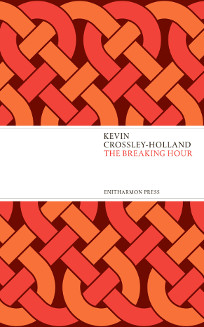
Last Saturday I attended one of the half-yearly poetry events in Palmers Green, north London. These are always very good evenings, these days full of music as well as poetry as the Helios Consort of recorders play before and after the interval. Kevin Crossley-Holland was reading (a superb poet, as well as all his other literary achievements) as was Sarah Westcott (recently published by Pavilion – having just won the Manchester Cathedral Poetry Competition) and Katherine Gallagher, launching her new Arc collection – about which someone called Crucefix has blurbed:

This new collection is bejewelled throughout with haiku-like moments of vivid observation. Her delighted responses – in particular to the natural world – serve to peel away the film of familiarity through which we usually gaze. Yet Gallagher combines such excited observation with a quality of restraint, a respect for what she encounters in a process of self-creation – “from myself into myself” as her epigraph from Rose Auslander puts it. Sequences about her Australian mother and the loss of her brother are imbued with this same gift: life is celebrated in poems that never forget our mortality: “This is time we have underlined, / remembering what we’ve done, where we’re going” (‘Quotidian’).

On the following morning I was taking part in the Bloomsbury Festival, talking about the art of translation with Chris Campbell, Literary Manager, Royal Court Theatre and Gregory Thompson, Creative Entrepreneur in Residence at UCL. Chaired by Geraldine Brodie, Lecturer in Translation Theory and Theatre Translation at UCL, the talk – in the very comfortable, wood-panelled surroundings of the Churchill Room, Goodenough College, London House, Mecklenburgh Square, London – was really wide-ranging from Gregory’s experiences of directing Shakespeare in the Indian sub-continent and the kind of cultural translation that takes place on such occasions to Chris’s translations of drama texts to and from the French and French-Canadian. One issue there is the translation of comic references such as cricket allusions or types of motor cars (I think he suggested a Vauxhall Cavalier equivalent in a French cultural context would be a Renault 21). I thought there was quite a bit of common ground when I was explaining how I fell into translation through the need to stand up and declaim/read/perform translations which I felt did not really convince in English. This is how I began the idea that I might try to translate Rilke’s 9th Duino Elegy many, many years ago – I could not find a version that read well aloud. I still regard that as a key test.

c45407b1ab4103bca137a0808bc8c042

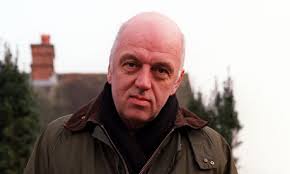
This idea that poetry ought to be read aloud is common enough in most writing workshops but I do wonder how many people really adhere to it. This came up again with my third engagement of the busy weekend – teaching my first session for the Poetry School on ‘music and metre’ on Monday evening. As I explained to the class, formal verse is not especially my thing but it is also an area I have had to teach on various occasions. I kicked off by reading James Fenton’s powerful poem ‘Tiananmen’ – see below – and Auden’s observations about the benefits of form:
images

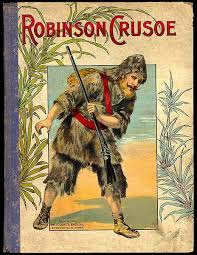
The poet who writes ‘free’ verse is like Robinson Crusoe on his desert island: he must do all his cooking, laundry and darning for himself. In a few exceptional cases, this manly independence produces something original and impressive, but more often the result is squalor – dirty sheets on the unmade bed and empty bottles on the unswept floor.

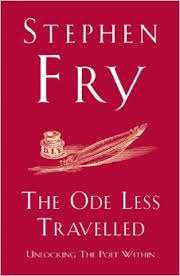
I love the swipe at “manly independence” there. Not very surprisingly, this observation is quoted by Stephen Fry in his The Ode Less Travelled (Hutchinson, 2005) which also suggests modern poetry, because of its abandonment of formal constraints is now “laughably easy” to write. Elsewhere Fry describes most contemporary poetry as suffering from anaemia; it’s a lifeless trickle, rhetorically listless . . . Fry doesn’t mind setting himself up like this – and tucked away in the book you’ll also find his appreciation of Whitman, Anne Carson, Denise Riley and many others.
imgres

I told the class, having spoken to a fair number of poets recently about form, that they’d be surprised (or maybe not) how few published poets would confidently declare their own grasp of metrical matters. On the night, we didn’t get along as fast as I’d anticipated – there was good discussion, especially of the areas of inevitably uncertainty in scanning a poem etc – it’s like jazz?? – so I’m looking forward to picking up the themes again next Monday evening with Tony Harrison, Wordsworth, Stevens, Elizabeth Jennings . . .

Now I’m feeling a bit poetry-ed out. Coffee and cake are required . . . after this:


Tiananmen – James Fenton

Tianamen
Is broad and clean
And you can’t tell
Where the dead have been
And you can’t tell
What happened then
And you can’t speak
Of Tianamen.

You must not speak.
You must not think.
You must not dip
Your brush in ink.
You must not say
What happened then,
What happened there
In Tiananmen.

The cruel men
Are old and deaf
Ready to kill
But short of breath
And they will die
Like other men
And they’ll lie in state
In Tianamen.

They lie in state.
They lie in style.
Another lie’s
Thrown on the pile,
Thrown on the pile
By the cruel men
To cleanse the blood
From Tianamen.

Truth is a secret.
Keep it dark.
Keep it dark.
In our heart of hearts.
Keep it dark
Till you know when
Truth may return
To Tiananmen.

Tiananmen
Is broad and clean
And you can’t tell
Where the dead have been
And you can’t tell
When they’ll come again.
They’ll come again
To Tiananmen.
imgres
James Fenton


The Politics of the ‘Daodejing’

IMG_0217.JPG

I travelled north to Bradford earlier this week to read from my versions of the Daodejing. For the first time a reader of Mandarin was present to read from something approaching the original texts. Bradford artist Yan Wang read beautifully as well as providing the evening with a couple of large banner-scrolls of chapters from the text. The whole evening had been organised by an old friend, Bruce Barnes, a poet and tireless organiser and more recently translator of long-neglected work by Kosuke Shirasu, a Japanese proletarian writer from the 1920/30s. I read Bruce’s ‘interpretations’ of Shirasu’s work (done with the help of Jun Shirasu and published as Out of his struggles (Utistugu Press, Bradford) on the train back to London and it reminded me that I had wanted for a while to organise my thoughts about the political elements in the Daodejing poems. (Poem titles in brackets are those I have given to the individual ‘chapters’ of the text).
img_0215

It’s generally accepted that one of the purposes of the collection of texts called the Daodejing is to instruct about good government. Chapter 46 (Annexation) argues that when government adheres to the Way – the teachings of the Daoist ideas – then its great parades of horses “are put out to grass to fertilise the ground”. It’s when government neglects the Way that its “war horses sire and foal / even on sacred ground”. Such neglect leads to personal and political “unsteadiness” which Chapter 26 (‘Breath-taking Scenes’) identifies as the “loss of all authority”. This is authority in its truest sense because in other poems we read of aggressive, power-grabbing behaviour which is also a way of neglecting Daoist ideas. Chapter 29 (‘What is Fixed’) describes those who grab at “earthly power” who are as liable to smash it as gain any advantage.

One of the key chapters, 67 (‘Three Treasures’) goes so far as to suggest that “only one reluctant to grasp power / is properly capable of government”. One clear attitude in these poems is that busy, hyperactive government – one that “grows brisk full of initiatives” – is an error:


those who hope

to rule by dishing out

press releases

a multiplicity of choices

are the con-men

of the nation

Chapter 65 (‘Blizzard’)

imgres

This distrust of big government is compounded when those with power try to ingratiate themselves with those they rule. With very little modernisation, the Daodejing is suspicious of those politicians who “style themselves ‘man of the people’ / sometimes ‘housewife’ / they like to say ‘we are all in this together’” (Chapter 39). What lies behind such cynical declarations is a real hunger for power as an exercise of ego (not true government). Laozi is very clear that such egoistic motives lead only in one direction for a nation: war.


–those who govern my teacher says

must oppose conquest by force of arms


such methods swiftly rebound

thorn and bramble where troops assemble

Chapter 30 (‘Scorched Earth’)

nuclear_artillery_test_grable_event_-_part_of_operation_upshot-knothole

Leaders (and the Daodejing never really doubts that human society needs leaders of a sort) need to adhere to the Way and encourage their people to do the same. Chapter 37 (‘Dispassion’) puts it succinctly:


—the way enacts nothing yet through it all things are achieved

if the powerful

possessed themselves of it

the ten thousand would be transformed


once transformed if they begin

to demand action

they ought to be constrained

with the uncarved wood quality of namelessness


the unconditional quality of the nameless

evokes dispassion—

hence it is to be still


so the nation pursues its way in peace


This idea of ‘constraint’ begins to sound authoritarian again but elsewhere it appears our political leaders are being advised not to over-encourage our expectations. Chapter 19 (‘Fewer Wishes’) advises that a people’s restlessness ought to be dealt with by offering them “simplicity / to behold give them the uncarved block // give them selflessness give fewer wishes”. In our world of unconfined desire and acquisitiveness (the point of being alive?) this sounds suspect perhaps but is perfectly in line with those who choose to opt out of modern life towards simplicity, fewer possessions etc. The uncarved block is a recurring image representing the fullest presence of life and experience before we begin to hack away at it with our self-centred preconceptions. The three virtues of the Daodejing are to be compassionate, to be frugal and to lack ambition.

daodejing

The point is that Daoist thinking is optimistic about human nature. There is a Rousseauistic quality to its belief in the goodness of mankind as a noble savage who has for too long been corrupted by interference, too many codes of behaviour imposed from above. This is where the poems’ anti-Confucian elements are most obvious. Chapter 18 (Codes of kindness’) argues it’s only when the Way “falls into disuse / codes of kindness thoughts / of morality evolve”. Laozi argues we are better off without such rules of codified behaviour. This is not quite anarchism but certainly a powerfully libertarian thread runs through the work. In one of the most striking images in the whole sequence, Chapter 60 (‘Recipe’) compares true government to the cooking of a “delicate fish”. It requires the gentlest of touches:


no agitation

or any demon

or the fretting

of your own spirit


no shuffle or harm

or sudden injury

but aid and attend

gain advantage


the power to feed

the common purpose

maxresdefault

It’s this delicacy, gentleness, almost passivity of government that leads Laozi to associate this approach with the stereotypically ‘female’. Early on, in Chapter 6 (‘Valley’) we are told the spirit of the Way is “[a] valley without end / it is female it is called mysteriousness”. This translates politically into government playing a largely passive role (as does the good teacher) to show, facilitate, enthuse, give space, watch and approve. Government must be honest, give the tools, give opportunities, do its job well. Its role is to synthesise and connect (not disconnect or sever), shed light (but without dazzling, even inadvertently), use a delicate touch, be tangential. Its actions call forth responses to the fact it acts, plans, demands. Better back off, do not intervene, don’t use imperatives, perhaps use no words at all. It is better to play the female part, be passive, give space, encourage desired behaviours, neglect all else.


Tributaries

chapter 61


—strong nations must play the low ground

to which all contributing waters flow

the point to which all things converge

so their invitations issue from stillness

through quiescence they gather power

let’s call that female and the male cannot

resist he brings his watery tributes

and she gains adherents he procures favour

as she looks to embrace and empower

he finds himself part of a greater thing

in this way becomes part of creation

so both thrive both discovering bliss—

real power is female it rises from beneath

Study of a Kneeling Boy Bending a Bow, for Dorchester House c.1860 by Alfred Stevens 1817-1875

Like the cooked fish, another memorable image is the bending of a bow. As it is bent the top (of society) descends earthwards while what is “nearest the earth is raised up”. This is the ideal process of government in the Daodejing. Only in Chapter 80 (‘The Commonwealth’) does Laozi give something of a portrait of the contentedly ruled society. It is small, hard-working, has basic needs met; it has the capability of greater luxury (and also weapons) but none of these are made use of. This little society is aware of others around it (perhaps run on different lines) but its people are so content they feel no desire to travel.

Idealistic without doubt. But does this even sound attractive? It’s unlikely to – given our absorption into our consumerist society, our expectations that government ought to provide and lead. But we don’t need to look far to see systems breaking down and at the least what the Daodejing offers is an alternative vision of the exercise of power in society. It’s a vision that is over 2000 years old which means it’s either well past its sell-by-date or that it contains some wisdom that we ought not to ignore.

Autosave-File vom d-lab2/3 der AgfaPhoto GmbH
Martyn and Yan Wang reading from the ‘Daodejing’ for Beehive Poets, Bradford

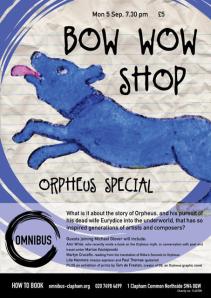
The Bow-Wow Shop’s Aspects of Orpheus

Bow Wow Shop Orpheus Poster_v2

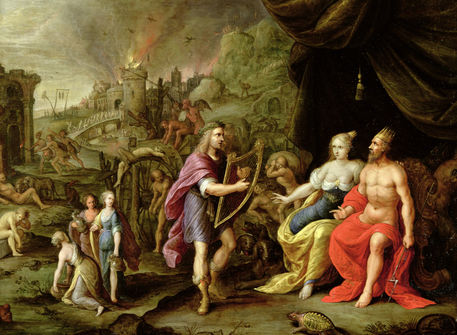
Last week I was pleased to be involved in the first of the on-line journal Bow-Wow Shop’s evening events in Clapham. Its focus was the figure of Orpheus: What is it about the story of Orpheus and his pursuit of his dead wife, Eurydice, into the underworld that has so inspired generations of artists, writers and composers?

Editor of The Bow-Wow Shop, poet and Independent arts and culture journalist, Michael Glover organises and he programmed a terrific mix of material. Ann Wroe’s 2011 book, Orpheus: the song of life (Cape), explores the roots of the Orphic story and traces its many manifestations through Classical to modern times. I was lucky enough to read with her at an event at Lauderdale House a couple of years ago. In Clapham she was in conversation with Marius Kociejowski. I was there on the strength of my 2012 translations of Rilke Sonnets to Orpheus (Enitharmon Press). Providing musical illustrations of the power of the Orpheus story were mezzo-soprano Lita Manners and guitarist Paul Thomas. There was also an exhibition of prints by Tom de Freston, creator of OE, a graphic novel on the Orpheus material.

imgres

Lita and Paul performed extracts for Gluck’s opera Orfeo ed Euridice (1762), songs by Vaughn-Williams and from the 1959 film Black Orpheus. Marius interviewed Ann though she needed little prompting to discuss several aspects of what is a wonderfully original book. Rilke’s inspired writing of the Sonnets to Orpheus (1922) form a thread through the book but she steered clear of that and concentrated more on the first evidence of the myth in the 6th BCE: a painting in black figure on a Greek vase, pictured with a huge lyre that almost seems part of him. Already at that early stage he is called ‘famous’. A 13th century BCE Cretan vase perhaps images him, again with the super-sized lyre (denoting divine powers, his music powerful even over inanimate objects birds, trees). Elsewhere he seems imaged as a bird himself – the power of song and music so strong that he must take on the attributes of a bird-god.

imgres

Perhaps even further back, Ann suggested, the figure is based on fertility myths, perhaps of Indian origin. His wife Eurydice likewise is linked to the figure of Persephone, the whole narrative in its original forms reflecting ideas of the seasons, death and re-birth of the earth, the crops. But there remains something irresolvable about the Orpheus myth – this polyvalent quality is one of the reasons for its productive quality in terms of inspiring artists. We kept recurring to the question: why must Orpheus turn as he is leading Eurydice out of the Underworld? The story contains its own tragedy. Ann suggested one interpretation might be to do with the fact the Eurydice represents the mystery of the natural world, or perhaps of knowledge/speech about the natural world, and that must necessarily remain hidden. Such a thing is the remit of the Gods alone. Orpheus must leave the Underworld empty-handed.

images

I spoke about Rilke in 1921, settling into the Château de Muzot in the Swiss Valais. How he liked to walk in the garden with its orchards and roses in full bloom, a landscape often evoked in the sonnet sequence which eventually arrived. He later declared that in the month of February 1922, he ‘could do nothing but submit, purely and obediently, to the dictation of [an] inner impulse’. In an extraordinary inspirational period, between the 2nd and 5th of that month, most of the 26 sonnets of Part One of Sonnets to Orpheus were written. He then polished off the ten year old sequence of the Duino Elegies. Between the 15th and the 23rd, Rilke went on to complete the 29 poems of Part Two.

Perrcy Bysshe Shelley wrote a longish fragment on the myth in 1820:


His [song]

Is clothed in sweetest sounds and varying words

Of poesy. Unlike all human works,

It never slackens, and through every change

Wisdom and beauty and the power divine

Of mighty poesy together dwell,

Mingling in sweet accord.


Here, as often, Orpheus is an image of the (male) artist/poet as well as being an image of our desire to find or create order or harmony in the world about us.

Rilke’s inspired poems brim with optimism and confidence about the role of poetry. In contrast, but more typical of the growing 20th century gloom, perhaps with intimations of a second world war, 15 years later – Auden’s brief 1937 poem ‘Orpheus’ is mired in uncertainty, asking “What does the song hope for?” Is it to be “bewildered and happy” – a sort of ecstatic but unthinking bliss? Or is it to discover “the knowledge of life”? No answer is given. The poem ends: “What will the wish, what will the dance do?” This is the Auden who doubts the power of poetry – it makes nothing happen – in his Elegy to Yeats.

And more like Auden than Rilke, the 20th century tended to take a more sceptical view of the myth – giving a more powerful voice to the traditionally passive Eurydice – more critical of Orpheus as careless, self-centred, weak. For example, in 1917 – 4 years before Rilke arrived in his chateau, H.D.’s Eurydice was condemning Orpheus:


for your arrogance

and your ruthlessness

I have lost the earth

and the flowers of the earth


Such radical revisions come also from more explicitly feminist poets like the American, Alta:


all the male poets write of orpheus

as if they look back & expect

to find me walking patiently

behind them, they claim I fell into hell

damn them, I say.

I stand in my own pain

& sing my own song

fullsizerender-11-360x348

Carol Ann Duffy’s revision (in her 1999 book The World’s Wife) gives Eurydice both poem title and narrative perspective. Her Orpheus is:


the kind of a man

who follows her round

writing poems, hovers about

while she reads them,

calls her his Muse,

and once sulked for a night and a day

because she remarked on his weakness for abstract nouns.


She saves herself from having to accompany Orpheus back to the upper world by offering to listen to his poem again. Orpheus, seduced and flattered, turns. “I waved once and was gone” she comments.

imgres

In this context Rilke’s take on the myth is (not surprisingly) very traditional and brimming with confidence in the role of the poet and patriarchal sidelining of Eurydice. So Rilke’s interest lies with the world and the underworld, life and death. He is more like Shelley who set his fragmentary poem after the loss of E and it’s coming through that experience that seems to add power to his song. Rilke is interested in the idea of transition. Orpheus tries to recover Eurydice; he moves from life, into death and then back again. This fluidity, the courage and a readiness to renew ourselves, to be risked in the absorption with something other, to be translated from one realm to another, to come and go, to be and not to be is what draws Rilke to the myth.

This is also Don Paterson’s thinking behind his versions of the Sonnets in Orpheus (Faber, 2006). He argues Man is unique in having foreknowledge of his own death, meaning we act as if we are already dead, or historical. This means that we construct life as an authentic and intelligible narrative, a life with meaning, but it is death that drives the plot of our life. This is one of Paterson’s key ideas and he refers to it as our ‘ghost-hood’. So we are like Orpheus: we too have descended to the land of the shades and then returned to the present moment – our condition is therefore existentially transgressive, riven, divided.

It’s the singing of the Orphic artist that addresses and bridges such divisions. This explains Rilke’s interest in the Orpheus myth: its narrative is a metaphor for the longed-for transit or communion between the realms of life and death. He possesses the desired ability to inspire the renovation of human perception that can initiate a more comprehensive, joyful and celebratory experience of life. One of the things most people know of Rilke is his exhortation to praise. Praise is a form of secular prayer for Rilke and it demands a renovation of conventional language through Orpheus’ song – as also noted by Shelley in Prometheus Unbound:


Language is a perpetual Orphic song,

Which rules with Daedal harmony a throng

Of thoughts and forms, which else senseless and shapeless were

imgres

Orpheus’ singing as a way to think about the language of poetry can clearly be seen in Rilke’s celebratory sonnets about the garden at Muzot. Here’s my translation of sonnet I  13:


Pear and plump apple and gooseberry,

banana . . . all of these have something to say

of life and death to the tongue . . . I guess . . .

Read it in the expression on a child’s face


as she tastes them. It comes from far off.

Slowly, does speechlessness fill your mouth?

In place of words, a flood of discovery

from the flesh of fruit, astonished, free.


Try to express what it is we call ‘apple’.

This sweet one with its gathering intensity

rising so quietly – even as you taste it –


becomes transparent, wakeful, ready,

ambiguous, sunny, earthy, native.

O experience, touch, pleasure, prodigal!


Rilke’s vigorous and self-conscious mutations of the sonnet form create a variety of rhyme schemes, line lengths, iambic and dactylic pulses. David Constantine has described this as suitably fitting forms for the figure of Orpheus because he is himself a figure of transition, fluency and mystery.

234203

Forthcoming Bow-Wow Shop events in Clapham will focus on the work of Edward Lear and Gabriel Garcia Lorca.

2016 Forward First Collections Reviewed #5: Harry Giles

This is the fifth and final installment in the series of reviews I have been posting of the collections chosen for the 2016 Forward Prizes Felix Dennis award for best First Collection. The £5000 prize will be decided on 20th September. Click here for all 5 of my reviews of the 2015 shortlisted books (eventual winner Mona Arshi).

The 2016 shortlist is:

Nancy Campbell – Disko Bay (Enitharmon Press) – click here for my review of this book

Ron Carey – Distance (Revival Press) – click here for my review of this book

Harry Giles – Tonguit (Freight Books)

Ruby Robinson – Every Little Sound (Liverpool University Press) – click here for my review of this book

Tiphanie Yanique – Wife (Peepal Tree Press) – click here for my review of this book

imgres

Thanks to Freight Books for providing a copy of Harry Giles’ book for review purposes.

I’d only come across Harry Giles’ work as a Guardian featured poem in June in response to his Forward short-listing. The chosen poem was ‘Piercings’ and suggested Giles was working the same area that Andrew McMillan did so successfully last year. What might be an autobiographical masculine narrative voice recognises a passer-by as an old encounter: “four years since / he hauled me into a lift with / Want to make out?” But the man had then been sporting various body piercings which have since been removed in order to become “employable, less obvious” whereas the narrator has continued making “more holes”, continued to accumulate the badges of a rebelliousness the other has given up on. The final question, “So what do you do now?” is therefore made poignantly redundant, each, surely, reading the tell-tale signs of the other’s body.

But ‘Piercings’ is by far the most conventional poem in Tonguit and Giles is no McMillan, nor does he want to be. On the facing page is a poem made from extracts from One Direction’s Harry Styles’ fanfiction. The title, ‘Slash poem in which Harry Giles meets Harry Styles’, gives a feel for its playfulness though the poem itself does not seem to amount to much. Perhaps it amounts to more if read in the context of Giles’ other manipulations of texts and discourses which have a more obviously seditious intent. The last poem in the collection offers ‘Further Drafts’ of a phrase often used by Alistair Gray: “work as if you live in the early days of a better nation”. Giles works various rhyming turns on the first and last words of this phrase eventually to arrive at “lurk as if you live in the early days of a better sedition”. It’s ‘Harry Styles’, manufactured pop idol and X Factor/Simon Cowell cash cow, that is the real target of Giles’ poem (though it lurks with some seditious intent, it’s still not among his best).

images

Giles is interested in the processing of texts, sampling from George R R Martin’s A Game of Thrones, or creating cut-up texts from information associated with Abu Dhabi’s artificial island and cultural centre, ‘Saadiyat’.  The satirical effects are delivered through simple repetition and disjunction, questioning the original source’s coherence and integrity, where ecological sustainability becomes “a core value integrated into the design approach / in terms of throughout the the the concept design” [sic]. ‘You Don’t Ever Have to Lose’ does something similar with advertising text from IT services company Atos. ‘Your Strengths’ is a more powerful text in its own right, this time using source material from the Department of Work and Pensions Capability Assessment, the UK Citizenship Test and other psychometric tests to make a thunderous barrage of questions ranging from the invasive, absurd, profound, squirm-inducing and piddling to the politically loaded. Giles also works textual legerdemain in ‘Sermon’, based on a speech by David Cameron in which the word “terrorism” is replaced by the word “love”:


We must make it impossible

for lovers to succeed. We need to argue

that love is wrong. To belong here

is to believe in these things.

imgres

This processing of texts, often randomly, often derived from the internet or Google searches, sometimes with editorial influence in the final result is presented as politically subversive. As the Tonguit blurb suggests, it derives from the belief that we are all warped and changed by the language/s that surround us and inhabit us. The hope of the lyric poet working towards his/her own truth is devalued, considered delusional, impossibly bound up in Blake’s socio-psycho-political “mind-forged manacles”. We liberate ourselves by breaking these, unpicking or smashing the dominating discourses around us. And if our deliberate intention is already suspect then we must achieve it randomly, perhaps via a machine. It’s a form of surrealism which profoundly questions our use of language and owes a lot to the Oulipian experiments of Raymond Queneau. Giles’ collection title, Tonguit, productively seems to hover between an urgent imperative to individual vocalisation – tongue it! – and more passive implications about the way other people’s language/s oppress the individual – we have been tongued!

images

The more imperative mood is obvious in ‘Curriculum’ which takes aim at normative education and gives it both barrels:


Mix me a metaphor of noble gases,

economic engines and avant-garde

taxonomies, with Kingdom Phylum Order

gone to bloody Dada. Get down and dirty


with transects, quadrants.


There is a Wildean element to this sort of systematic over-turning though there is no doubt about Giles’ seriousness beneath the often funny, ludic quality of these poems and there is none of Wilde’s self-regarding quality. Harry Giles himself – as a recognisable, recurring, coherent, autobiographical figure – is curiously absent from most of these poems though I don’t doubt the sincerity of a poem like ‘Waffle House Crush’:


I’ll have you smothered n covered

diced n peppered n

capped n lathered n

lustred n smoothed n

spread


Giles’ various linguistic masks don’t hide so much as free him into more liberated forms of expression. I’ve deliberately not yet mentioned his most obvious, deliberately chosen mode of expression: what he calls his own “mongrel and magpie” form of Scots. Dave Coates has pointed out that, as in Kathleen Jamie’s The Bonniest Companie, Giles provides no glosses in the book on his particular Scots, “an implicit assertion of the language’s place within the broader spectrum of Englishes”. Giles’ Scots sets itself deliberately against discourses like those of the DWP and Atos as a declaration of variousness. Nor is he averse to something like a declaration of war:


Let’s be arsonists. Let’s birn the year.

[. . .]

Let’s mak like airtists

n birn the leebrars [libraries] acause we shoudna, n birn

Pairlament acause we shoud.


What follows is an apocalyptic conflagration of all things, down to the “thocht o fire”.

But the sheer vigour of Giles’ intent means his Scots is a lot harder to follow than Jamie’s. In fact, he does provide his readers with a full gloss/translation on his website. I needed this to be honest to deal with a lot of the Scots text, though the ‘translations’ then read as somewhat awkward, watered down versions of a quite different language (rather than a form of English). But it is worth the effort to really appreciate the tour de force of national- and self-assertion that is ‘Brave’. Like some Highland Whitman, making himself and his nation through singing (I’m losing some of the lay-out here):


A sing o google Scotland

o laptop Scotland,

o a Scotland sae dowf on [dulled by] bit-torrentit HBO

drama series n DLC packs fer

paistapocalyptic RPGs

imgres

But also the Scotland “whit chacks the date o Bannockburn on Wikipaedia” and fears “o wan day findin oot / juist hou parochial aw hits cultural references mey be”. ‘The Hairdest Man in Govanhill’ takes all the clichés that phrase might suggest and instead describes a man who “has thay lang white scairs on / baith sides o his mooth fae smiling that damn wide” (my italics). This is of a piece with the Cameron subversion as we hear that the man is “that bluidy haird he’s a hairt tattoed wi Dulux on his bicep n aw hit says is A LUV YE”. There’s a risk of this getting as caricatured as the cliché it intends to subvert but Giles’ Scots is put to terrific seditious intent in ‘Tae a Cooncillor’ – a kind of one-sided flyting in which the local councillor who wants to close down a swimming pool is mocked mercilessly:


Wee glaikit, skybald, fashious bastart,

whit unco warld maks ye wir maister?

Whit glamour has ye risin fest as

projectile boak?

Hit’s time tae gie yer feechie fouster [nasty fester]

an honest soak.


This is committed, bolshie, rebel-script done with great skill and immense energy but Harry Giles is too interested in too much to settle merely for this. I was interested in his Scots (or rather specifically Orcadian) versions of a few chapters of the Laozi’s Daodejing. He astutely titles these ‘Aald rede fir biggin a kintra’ [Old advice for building a country] again recalling Alistair Gray’s dictum. The opacity of the language makes Giles’ versions a hard read but (if I may) here’s his boldly economical version of chapter 53 (some indentations lost here again) followed by my own recently published version:


53

a bit wittins

whan waakan the wey

are a rod tae dree


the wey is snod

an fock cheust fancy the ramse


govrenment divided

sheens growen-up

kists empie

but heidyins’ claes are braa

thay’ve barrie blads

are stecht wi maet

gey rowthie


caa this the darg o reivers

an no the wey


Crooked avenue

chapter 53


—perhaps you have begun well

one step after another along the way


yet you walk in fear of side-tracks

the great way running level and plain


still who can resist those side-tracks

soon as good governance is in place


we’re liable to neglect our business

too soon the tall barns lie empty


sooner wear fashionable clothes heels

daggers for glances glut on food and booze


have more than we can sensibly use—

dawn breaks on some crooked avenue


what was it happened to the way


Tonguit is a bubbling cauldron of a book, willing to take risks that don’t always come off, but guided by a belief in the need to challenge the assumptions and languages of the status quo. Harry Giles is a fascinating figure (go to his website here ) and his characterisation of his Scots as “magpie” is as much applicable to his multifaceted work in theatre, software, twitterbots and visual arts, all forms of “art about protest and protest about art”. Whether contemporary poetry, as in books like this one, will prove sufficiently interesting and flexible for his creativity remains to be seen.

imgres


i.m. Yves Bonnefoy: love the bouquet for its hour

images

The death of Yves Bonnefoy (on 1st July 2016) was marked last week by The Guardian and The New York Times and many others. Anybody who has followed this blog for a while will know that I have found considerable inspiration in Bonnefoy’s poetry and writing about poetry. John Naughton in The Guardian obit sums up the nub of Bonnefoy’s thought: “we tend to replace the reality of things and other people with an image or concept, which deprives us of a more direct and immediate experience he called the experience of “presence”, in which one has a fleeting apprehension of the essential oneness of all being”. That latter phrase will explain how I have stumbled my way in recent years from translating Rilke to versioning the texts of the Daodejing.

imgres

The NYT obit suggests Bonnefoy’s poetry has often been found “highly abstract and often obscure” and to counter this misleading impression I thought I’d post four sonnets from his 2011 collection L’heure presente (The Present Hour) in Beverley Bie Brahic’s pellucid translations. Bonnefoy is thinking of his own father here (who died when the poet was young) but the valedictory tone seemed right for the occasion. Bonnefoy translated a great deal of Shakespeare and (in part – he’s also arguing with Mallarme) the fourth of Bonnefoy’s sonnets is in dialogue with the ideas of Sonnet 63 (“His beauty shall in these black lines be seen, / And they shall live, and he in them still green”). It’s a mark of Bonnefoy’s achievement that even in such an emotional, personal context, he can still articulate ideas about language (“words cut”) and the way in which “the real flower becomes metaphor” by bleeding the temporal and in doing so yields up a great deal of what it means to be real. Instead, we must “love the bouquet for its hour. / Only at this price is beauty an offering”.


A Photograph

This photograph—what a paltry thing!

Crude colour disfigures

The mouth, the eyes. Back then

They used colour to mock life.


But I knew the man whose face

Is caught in this mesh. I see him

Climbing down to the boat. Obol

Already in his hand, as if for death.


Let the wind rise in the image, driving rain

Drench it, deface it! Show us

Under the colour the stairs streaming water!


Who was he? What were his hopes? I hear

Only his footsteps descending in the night,

Clumsily, no one to give him a hand.


Another Photograph

Who is he, astonished, wondering

Whether he should recognise himself in this picture?

Summer, it seems, and a garden

Where five or six people gather.


And when was it, and where, and after what?

What did these people mean to one another?

Did they even care? Indifferent

As their death already required of them.


But this person, who looks at—this other,

Intimidated all the same! Strange flower

This debris of a photograph!


Being crops up here and there. A weed

Struggling between house fronts and the sidewalk.

And some passers-by, already shadows.


A Memory

He seemed very old, almost a child;

He walked slowly, hand clutching

A remnant of muddied fabric.

Eyes closed, though. Oh—isn’t believing


You remember the worst kind of lure,

The hand that takes ours to lead us on?

Still, it struck me he was smiling

When, soon, night enveloped him.


It struck me? No, I must be wrong.

Memory is a broken voice,

We hardly hear it, even from up close.


Yet we listen, and for so long

That sometimes life goes by. And death

Already says no to any metaphor.


I Give You These Lines . . .

I give you these lines, not that your name

Might ever flourish, in this poor soil,

But because trying to remember—

This is cut flowers, which makes some sense.


Some, lost in their dream, say ‘a flower’,

But it’s not knowing how words cut

If they think they denote it in what they name,

Transmuting flower into its idea.


Snipped, the real flower becomes a metaphor,

This sap that trickles out is time

Relinquishing what remains of its dream.


Who wants now and then to have visits

Must love the bouquet for its hour.

Only at this price is beauty an offering.

06bonnefoy-obit-master768

2016 Forward First Collections Reviewed #2: Nancy Campbell

This is the second in the series of reviews I will post over the next two months of the 5 collections chosen for the 2016 Forward Prizes Felix Dennis award for best First Collection. The £5000 prize will be decided on 20th September. Click here for all 5 of my reviews of the 2015 shortlisted books (eventual winner Mona Arshi).

The 2016 shortlist is:

Nancy CampbellDisko Bay (Enitharmon Press)
Ron CareyDistance (Revival Press) – click here for my review of this book
Harry GilesTonguit (Freight Books)
Ruby RobinsonEvery Little Sound (Liverpool University Press)
Tiphanie YaniqueWife (Peepal Tree Press)

disko_bay[1]

Thanks to Enitharmon Press for providing a copy of Nancy Campbell’s book for review purposes.

The concluding poem of Nancy Campbell’s collection Disko Bay is, I think, a good place to begin. In ‘Giving Up on Capitalism’, an unnamed boy makes kayaks and sells them for one, then two kroner (these poems are mostly set in Greenland). He hands his earnings to his mother who buys basics like coffee, sugar, needles, cotton and, more ominously, whisky. If this is the nirvana of capitalist enterprise it hardly gets beyond subsistence level and then only to poisonous effect. On the third occasion he instead decides to construct a kayak for himself: taking the few remaining skins, he “pegged them down deftly / and paddled away”. The point of rejection is simply made, but the simplicity has a mythic, typological impact. The poem’s form is simple, repetitive, like a piece of folklore, an oral transmission perhaps, and – characteristic of the whole collection – the vocabulary is plain to such a degree that the reader is impressed by a paucity or poverty or essentialism (depending on how successful you think it is). Certainly this is a book unlike any other you’ll read this year, drawing on myths and landscapes of the far north (the opening section of the book has poem titles in Greenlandic first, then English). Its impact is often impersonal but Campbell’s knowledge derives from her several residencies in the region and she deploys it in a skilful and poetically knowing fashion.

greenland5

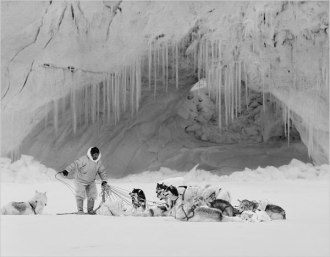
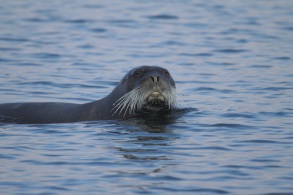
Above all, these poems convey the harshness of scraping a human existence in the Arctic Circle, perhaps most obviously in the section called ‘Ruin Island’. An epigraph quotes the Eskimo, Osarqaq: “Our tales are narratives of human experience, and therefore do not always tell of beautiful things”. Several poems follow the exploits of Qujaavaarssuk, a heroic figure and general strong man, who is reduced to singing a dirge at the troubled fishing grounds and is advised by “a man who is not his father” (a break in traditional forms of transmission here?) that the one thing to be relied upon is that “hunger will come of its own accord”. ‘Hospitality’ in such circumstances may consist of feeding guests “the kidneys of a black seal / as the ice harden[s]”. Qujaavaarssuk’s immediate difficulty is the presence of too much ice (a deliberately ironic comment on the shrinking ice caps of our day): he sees the shadows of seals moving beneath it and sets out “to the ice edge to follow them” but what Campbell is interested in (these are contemporary poems, not slavish myth-reproductions) is the failure of the hunter. In ‘Danger of Snow Blindness’, Qujaavaarssuk returns for the first time “his sled empty, his kamiks [boots] clean”. ‘The Last Seal’ opens:

There was nothing left to feed the dogs.

Qujaavaarssuk shot them, one by one

and fed them to each other.

seal-5

To the contemporary reader, what lies largely unspoken beneath these chilly, often curt, unsentimental chips off a mythic block is, of course, our own awareness the adverse effects of climate change. ‘Ruin Island’ becomes apocalyptic in tone so that the words spoken by a hunter that conclude the sequence, words spoken by Jorsias Ammonsen in a real interview conducted in 2006, are presented as the reply of a hunter “who can no longer hear the question”. In this way, Campbell tragically ironises Ammonsen’s proud, nostalgic, heroic, perhaps hopeless comments:

When we were young

no place seemed too far away for hunting.


We travelled a long way,

too far to come back the same day.

We slept in stone caves

and were cold in winter.


Nothing is too harsh

when you are accustomed to it.

Nancy Campbell 2012

Campbell tries to remain true to the plain directness and dignity of such a voice in most of these poems. The figure of the poet seldom intrudes. When it does she is trying to learn the “soft uvulars” of a new language which seem like “dark flocks of sound I’ll never net, or say”. Difficulties of expression in one language are compounded by problems of communicating across distance to her own homeland: “Since I can’t post a letter this far north, / I’m sending you an Arctic snowstorm”. ‘The Night Hunter’ is typical in its use of a simple lexis – snow, door, harbour, boat, blood, sled, knife – and a repeating form of verse as if the polar climate has sheared away more baroque elaborations of language and form. At first this feels cramping, but as Campbell persists and insists this really is what she intends, the simplicity seems more likely to put us in touch with the elements, the elemental, the bottom line of harsh Arctic existence.

With figures like the hunter Qujaavaarssuk so prominent you might anticipate a macho sort of world but the harsh conditions seem to teach an underlying humility (even to men) and Campbell has a number of female narrators who are clearly no push over. In ‘The Seal People’ a seal hunter’s wife watches the vindictive spirits of killed seals approach by boat and though threatened by them her voice does not falter through three steady quatrains, the verse’s repetitions here expressive of her firm courage. ‘The Hunter’s Wife Becomes the Sun’ is a major poem (its form is a sestina with its obsessive recurrences). Here, a hunter’s wife gives him a tinny Christian memento for protection. The hunter is more concerned with the reality of death and an apocalyptic sense of the world’s end (Campbell’s chosen rhyme words are tin, angel, window, box, candle, darkness). But his wife insists on the need for “light”, transforming herself into a “vast white wake / of stars” which might be considered angels, though the man himself finds it hard to shrug off his pessimism: “At the world’s last window, I light another candle”. The shamanic implications of their exchange are more explicitly played out in three translations of crude Greenlandic Qavak songs, originally collected in the 1950s. They are spoken by a “terrible mother” a “female shaman” and an omniscient “wicked woman”, the latter advising the only way to tackle an enemy is to bite off and employ her clitoris as an arrowhead. Neither the blunt obscenity or implied moral judgement can hide the suggestion that this remote culture clearly understands the importance of the female in ultimate survival.

iceberg-in-disco-bay-greenland_6a7e

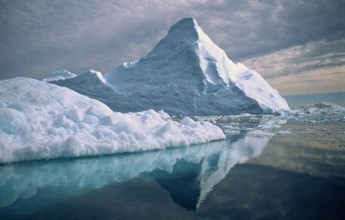
One of the impressive things about Disko Bay is that it is eco-poetry without shed loads of landscape description. Those vindictive seal spirits carry a powerful ecological message in their “round, black eyes” – less for the Greenland hunter and his wife (whose place and role within a traditional, sustainable Arctic ecosystem is be unlikely to unbalance things) but to us with our petrol engines, plastics and carbon complacencies. Another success of the book is its use of myths redolent of Nordic and North American materials without distracting echoes of Ted Hughes’ trickster figure Crow. In ‘Fragment’ a severed raven’s wing in the snow is enough to imply the global problem: “Never to breed, never to scavenge / on scarlet seal hearts by the ice edge”. It is brave of Campbell to delay the more eco-explicit poems to later sections of the book. Part three sets off from the premonition that “the future is full of riddles” and ‘Conversations’ conveys both the mystery and the certainty of climate change: “I don’t think it is one thing / I think it is a combination of things / a combination of everything”. The riddle-subjects appropriately include a tsunami and an iceberg but not the dirty complexities of the ever-hungry, seldom-satisfying capitalism rejected by the boy who constructs a kayak not to be sold but for his own setting out in this fine, unusual book’s concluding poem.

Read more on Nancy Campbell – in discussion with Forward Arts Foundation.


The Soviet Briar: poems of Vladislav Khodasevich

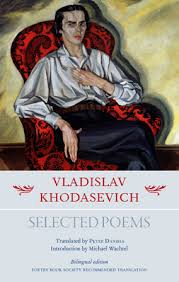
In the light of recent political events in the UK, it seemed important to be thinking about wider perspectives this week – Europe, Revolutions, the role of poetry. The poems of Vladislav Kodasevich came easily to mind and I have wanted to praise Peter Daniels’ translations of them for a while now.

What emerges from Peter Daniels’ Vladislav Khodasevich: Selected Poems (Angel Classics, 2013) is a vivid picture of a poet who was, both by temperament and historical circumstance, very much an individual. From a Lithuanian Polish background, coming to creativity at the fag end of Symbolism, witnessing Russia’s revolutionary year of 1917, going into permanent exile in 1922, Khodasevich (1886-1939) was perhaps inevitably a writer with little sense of belonging, of sure identity. It’s no surprise that he plays with images of doubles, often standing outside himself, then counters such doubts with rather grandiose claims to his poetic vocation.

imgres

The consequent difficulty of pigeon-holing him as a poet is one of the reasons why he is less well-known than his more familiar contemporaries – Mandelshtam, Akhmatova, Tsvetayeva and Pasternak. He is also difficult to pin down because he is “a modernist, but with a classical temperament” (Daniels’ Preface). In a period when others were tearing up rule books (poetical and political) Khodasevich harks back to the “eight little volumes” of Pushkin’s works. Amongst the ruck of Symbolists, Acmeists, Futurists and Cubo-Futurists, Khodasevich’s poems mostly retain traditional forms and he proudly declares: “I grafted the classic rose / to the Soviet briar bush” (‘Petersburg’). Such formalism presents great challenges for the translator, of course, with Khodasevich flaunting his conservative and poetic concerns – “O may my last expiring groan / be wrapped inside an articulate ode!” – and, like many before and since, he argues such formal frameworks are paradoxically the way to find release. (Carol Rumens has discussed some formal aspects of a Daniels/Khodasevich poem for The Guardian). Curiously, his last ever poem was in praise of the iambic tetrameter, the classic metre of the Russian tradition:


Its nature is mysterious,

where spondee sleeps and paeon sings,

one law is held within it – freedom.

Freedom is the law it brings . . .

imgres
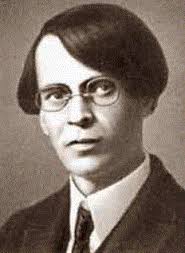
Vladislav Khodasevich

If Khodasevich uneasily straddles a variety of poetic strategies, there is a fascinating parallel to this in his views on self and society. The self is at one moment urged to “be a star that breaks away from the night” but in the next is “grunt[ing] to yourself, / looking for spectacles or keys”. This “usual self” is preoccupied with tarnished spires, the tops of cars, old iron eaves, and in ‘Berlin View’ sits shivering and sneezing in a café, surrounded by “plate-glass” reflections of itself. A couple of years later, at what seems a Dantesque ‘mid-point’ in his life, Khodasevich stares hopelessly into a mirror: “Me, me, me. What a preposterous word! / Can that man there really be me?” This is the Modernist side of the poet, observing from “the gutter”, watching a sordid Parisian cabaret, a dismal demi-monde of “tinselled chaos”. Yet the poem quoted here – ‘The Stars’ – goes on to suggest our gaze may sometimes incline upwards, “from the horizon to the stars” and – at least on occasions – we are aware of a “starry universe in glory / and the primordial loveliness”.

180px-Hodasevich_Berberova
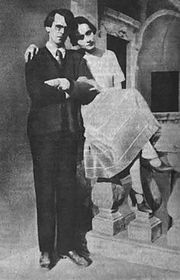
Khodasevich and Nina Berberova, Sorrento, 1926

This suggests Khodasevich was still enough of a Symbolist to see the poet’s role as seeking out such “loveliness”, the transcendent within the quotidian (as Michael Wachtel’s Introduction defines this key Symbolist intent). This accounts for Khodasevich’s repeated images of stars often unseen above us (but still there) and also of the flourishing of seeds in the earth as an image of personal and social growth. The title poem of The Way of the Seed (1920), in rhymed couplets, describes the traditional sower, with seed gleaming golden in his hand, but scattered into “the blackness of the land”. There it finds “its moment for dying, and for growth”. Latterly, the poem suggests this is also the path of the “soul” as well as “my native country, and her people”. This nicely sums up Khodasevich – the progressive conservative, these organic and traditional images of the farmer absorbed into bold ideas of growth and change incorporating both a dying back and re-birth. A similar pattern is reflected in ‘Gold’ – a coin is placed into the mouth of a corpse, buried, and after many years, in the unearthed skull, the coin is found again, rattling: “the gold will flash in the midst of bones, / a tiny sun, the imprint of my soul”.

img_0011a
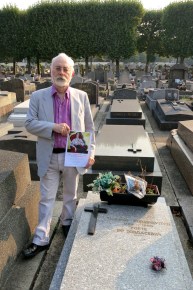
Peter Daniels at Khodasevich’s grave

It is in such longevity, such insightfulness that continues to be true, that Khodasevich finds reasons to celebrate the poetic vocation. Though the names of the dead who fell at the Battle of Khotin (1739) are forgotten, “the Ode upon Khotin” by Lomonosov is still recited. ‘Ballad of the Heavy Lyre’ opens with Khodasevich in the Soviet-run House of the Arts, surveying his life and finding it “worthless, a quagmire”. But eventually verses burst from him till “a galaxy streams at my head” (those stars again) and a heavy lyre is mysteriously thrust into his hands and, in the final line, he understands this is the lyre of Orpheus. Written in 1921, this poem foreshadows Khodasevich’s departure from the Soviet restrictions in the following year with hopes (one imagines) of further freedoms to be enjoyed.

I was especially interested in the seven substantial blank verse poems Khodasevich wrote in a brief period between 1918-20 (David Cooke’s review of the book for London Grip makes the same observation). These in particular bring to mind the modernist-conservatism of Robert Frost (whose two first books were published in 1913 and 1914) and it’s astonishing that Khodasevich did not pursue these successful experiments with a less formal verse that seems an ideal vehicle for his quiet observational voice, his sense of the mystery or beauty that lies beneath the ordinary, his observations of a provisional self often encountering an unstable, uncertain world.

‘An Episode’ appears to record, moment by moment, an out-of-body experience Khodasevich had in 1915 (these blank verse poems are always keen to name times, places, people). At one moment, he sits before a shelf of books, at the next he is gazing at himself as if looking at “a simple, old, old friend”. The transitional moments are evoked through the marvellous image of feeling like a “diver, plunging to the deep, [hearing] / the running about on deck and the shouts / of the sailors”. ‘2nd November’ describes the aftermath of revolution – again the precision of street names, people’s responses as they emerge into the smashed and bullet-scarred streets makes this read as a very contemporary poem indeed. The narrator watches a neighbour, a joiner, building a coffin and painting it: “under the brush / the boards were turning crimson”. But the golden seed in black earth comes to mind again as a child is observed – a “four-year-old, chubby, in a flap-eared hat” – who manages a smile as if listening to Moscow’s “beating heart, / the moving fluids, growth” though for the narrator even Pushkin’s beloved works, on this occasion, fail to alleviate the shock of political change.

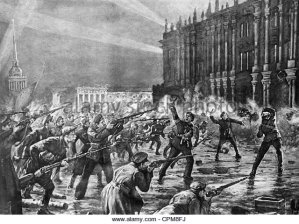
october-revolution-1917-cpm8fj

The unresolved tensions Khodasevich manages to hold together in these blank verse poems create a very modern impression. Another child appears in ‘Midday’, the narrator sitting in the most ordinary street scene, recalling a visit to Venice, fleeting glimpses of those “incandescent stars” once more. ‘An Encounter’ drops the star images for a more conventional image of beauty or inspiration, a “lovely English girl” glimpsed in Venice with its “black gondolas, / the fleeting shadows of pigeons, and the red / flow of the wine”. The extraordinary poem ‘The Monkey’ replaces the stars and the girl with the bizarre image of a tame monkey in a “red skirt”, led on a chain by an itinerant Serbian man (a much inferior translation of this poem by Alex Cigale can by read in The Kenyon Review). After a drink of water from a bowl, the monkey offers “her black and calloused hand” with such “nobility”. It’s the realism of the setting – the heat, the cock crow, the dusty lilacs – that enables Khodasevich to anthropomorphise the animal to such an extent and get away with it. It becomes another epiphanic moment in which the transcendent emerges from the quotidian. Here, a great chain of brotherhood seems implied and this makes the final line all the more devastating: “That was the day of the declaration of war”.

images

The two most Frost-like of these blank verse poems describe respectively a derelict house and a couple of neighbours chopping wood. ‘The House’ leads to reflections on transience, whether for a “palace” or a “shack”, the sudden advent of “war, plague, famine, or civil turmoil”. Such contrasts are again viewed from an Olympian height, an aloofness which has more negative capability about it than unfeeling Modernist cynicism. An old woman appears, scraping a living, and rather than pass judgement on her or her fate, the narrator joins her in stripping useful materials from the ruined house: “in pleasant harmony / we do some of the work of time”. A green moon rises ambiguously over the scene, casting light over a “tumbled” stove.  Khodasevich’s rich embrace and acceptance are also evident in ‘The Music’ as two neighbours chop wood. One suddenly claims to hear music but try as he might the other cannot hear it. In ‘Mending Wall’, Frost’s narrator likewise teased his farmer/neighbour and drew from him an old saying: “Good fences make good neighbours”. Khodasevich’s poem yields only a sense of earthly work well done together, the remoteness of the sky (from which perhaps that music fell), the clouds passing onward as “feathery angels”, or perhaps they are really no more than clouds.

imgres

What Have I Been Reading: October – December 2015

Up-dated December 2015

imgres

Terry Gifford’s Cambridge Companion to Ted Hughes is a fantastic summing up of where Hughes’ reputation now is, including articles by various hands on Hughes and animals, Plath, myth, feminism (it’s complicated) and a clear account of the poet’s fascination with Shakespeare by Jonathan Bate.

imgres

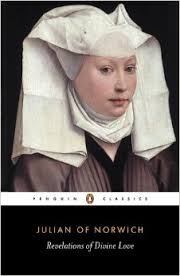
Julian of Norwich: Revelations of Divine Love – a book I’ve intended to read for decades and though I baulk at much of it still  I love her focus on the visions taking place in “an ordinary, household light”, her vivid descriptions and tentative, undogmatic prose. She also boldly talks of Christ as our mother: “Who showed you this? Love. What did he show? Love. Why did he show it to you? For love.”

imgres

Few poets can travel such distances with such ease and brevity as Penelope Shuttle. I saw her read at the recent Second Light Festival in London and picked up her Templar Poetry chapbook, In the Snowy Air. It belies it’s rather Xmas-y title by being rather a hymn to London (with occasional snow showers) including the Shard, the Walbrook, the British Library and even Waitrose in Balham.

imgres

Hands and Wings: Poems for Freedom for Torture has been edited by Dorothy Yamamoto in support of the Freedom from Torture charity and includes work by Gillian Allnutt, Alison Brackenbury, David Constantine, Carrie Etter, Vicki Feaver, Pippa Little and Susan Wicks.


Up-dated November 2015

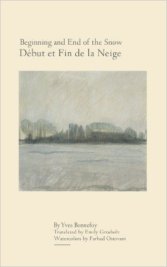
With the cold weather coming, Yves Bonnefoy’s 1991 Beginning and End of Snow(Bucknell University Press, 2012) is an exquisite read in Emily Grosholz’s translation, including an original essay by the poet on ‘Snow in French and English’.

31MuDc9AUxL._SX310_BO1,204,203,200_

I’m convinced Bonnefoy’s response to snow is not a million miles distant from the Daoist idea of the uncarved block and Rudolph G Wagner’s second magnificent volume on Wang Bi’s A Chinese Reading of the Daodejing is full of insights through its literal readings of the 81 chapters. I have been comparing his readings with my own new versions before going to press in the next few weeks.

images

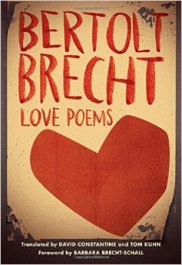
Bertolt Brecht: Love Poems (Norton, 2015) is the first instalment in David Constantine and Tom Kuhn’s project to translate anew Brecht’s complete poems. Ranging from the delicate, literary, erotic and plainly pornographic, here’s yet more evidence (should we need it) of Brecht’s breadth as a poet. The Introduction also reveals that Brecht refused to award any prizes in a poetry competition he was asked to judge – because none of the poems successfully communicated anything of any value to anybody, they were all of no use.

51c3fActf1L._SY344_BO1,204,203,200_

Maggie Butt’s new collection is published by The London Magazine and contains work from the period in which she also published the themed books Ally Pally Prison Camp(Oversteps, 2011) and Sancti-Clandestini – Undercover Saints (Ward-Wood, 2012). Though miscellaneous in nature, it is time that dominates this book – historical time in a variety of European locations and personal time in several moving elegies and acts of remembrance.

imgres

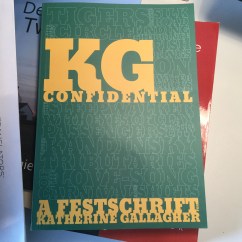
KG Confidential: a festschrift for Katherine Gallagher is a wonderful tribute to one of the great movers and shakers in poetry (in London and in her native Australia and in translation from the French). These tributes of poems or prose include contributions from Liz Berry, Jane Duran, Kate Foley, Mimi Khalvati and Les Murray.

File 22-11-2015, 12 37 53

Up-dated October 2015

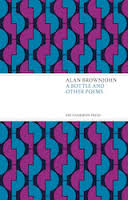
Alan Brownjohn’s new book is full of excellent poems, several of which (a few decades ago) would have been designated ‘secret narratives’. The title poem, ‘A Bottle’, is a strange noir thriller set in some undefined coastal region, an enigma of messages, relationships, landscape and murder. Always surprising; no let up in vigour and inventiveness.

imgres

Kate Foley’s ‘The Don’t Touch Garden’ (Arachne Press) is a treatment of adoption to rival Jackie Kay’s ‘The Adoption Papers’. “Mirror, mirror, on the wall” the old joke says, “I am my mother after all”. But which one? Brilliantly focused and carefully sequenced, these poems provide a thrilling and moving account of the processes by which any of us – adopted or not – become who we are.

imgres

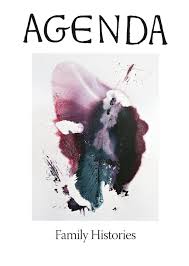
Agenda’s ‘Family Histories’ issue has poems from Tony Curtis, Claire Crowther, Sean Street, Peter McDonald, Sheenagh Pugh, Maitreyabandhu and Danielle Hope, an interview with Robin Robertson and reviews of Abse, Hugo Williams, Sebastian Barker, Bryce, Liardet, McVety and Eilean Ni Chuilleanain.

imgres

The new issue of Stand  has tributes to the late John Silkin from John Matthias and Anne Stevenson. I remember seeing Silkin selling Stand in the late 1970s on the campus at Lancaster University. This issue also has new poems from Muldoon, Mort, Valerie Jack, Sam Gardiner and (even) Martyn Crucefix.

imgres

What Have I Been Reading: July – September 2015

Up-dated September 2015

Don Paterson’s 101 Sonnets is certainly a varied selection of the form (it strikes me it would be a good, coherent text for students to study). The editor is never short of an opinion, ranging from the good sense of “Academics, in particular, have talked an awful lot of rubbish on the subject of rhyme” to the much more questionable “the whole point of [a] poem – that it should lodge itself permanently in our brains”

imgres

That the novelist Ursula K Le Guin should be a fan and translator of Lao Tzu’s 81 ancient poems/chapters known as the Tao Te Ching is perhaps less surprising than the fact that her translation is one of the most enjoyable around (and I’ve been reading plenty of them in preparation for my version’s appearance next Spring).

9781570623950_l

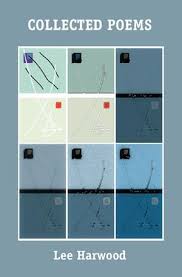
Two chunky collecteds have been pre-occupying me in the last month or so. Lee Harwood’s Collected Poems is – by the nature of his aesthetic perhaps – uneven, but almost every page turns up new ways of writing and reading poetry: an invigorating pleasure.

imgres

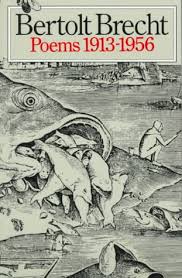
I have blogged on Bertolt Brecht’s Poems 1913-1956 before – in more recent weeks I have been tracking him out of Germany, to Denmark and hence to the USA. Extraordinary how contemporary most of these poems feel, though already 60 plus years old.

imgres

Updated August 2015

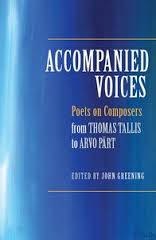
John Greening’s anthology of poems about music, Accompanied Voices (Boydell & Brewer),  is a lovely thing, full of variety, full of poems to be re-acquainted with from Hill, Hughes, Longley and Porter and brand new contemporary work including Stainer, Allnutt, O’Donoghue, Reid, Rumens, Shuttle and Greening’s own little gem on John Field (being walked all over by Chopin).

imgres

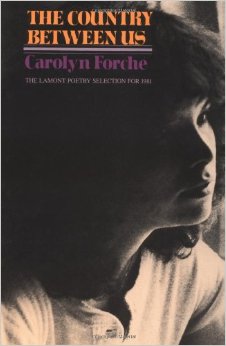
I tweeted a couple of weeks ago that I found Carolyn Forche’s second collection, The Country Between Us (HarperPerennial, 1982) in a Highgate secondhand bookshop and having raced through the poems before going away I’m now keen to get back to them for a more reflective read.

41KocAt6ntL._SY344_BO1,204,203,200_

Tim Liardet’s poem-sequence of self-portraits, The World before Snow (Carcanet) is actually motivated and (to some degree evokes) an illicit trans-Atlantic affair. The poems have the density and intensity of Liardet’s previous work with an even greater fertility and fluency of imagination.

imgres

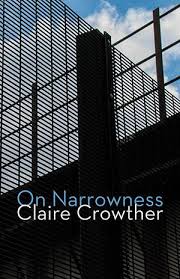
On Narrowness, Claire Crowther’s third collection from Shearsman is a chewy, twisting, sometimes vertiginous read; that’s another way of saying I don’t know what’s going on half the time. But the poems are confident in themselves and leap boldly from one image to another.

images

Up-dated July 2015

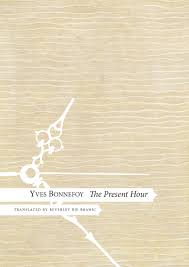
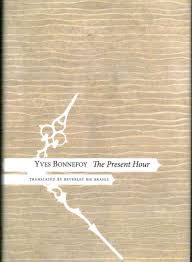
I find Yves Bonnefoy’s writing unfailingly nutritious though sometimes wonder if his ideas are at least as exciting as the classically restrained lexis of his verse. Beverley Bie Brahic’s 2013 translation of The Present Hour (2011) has Bonnefoy in sonnet-shaped Wordsworthian mood recalling his childhood, writing enigmatic prose pieces and a thought-provoking (because not always easy to follow) essay, ‘In a Piece of Broken Mirror’, once again discussing image, dream, reality and language.

imgres

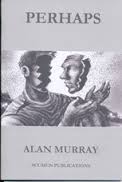
Perhaps is Alan Murray’s Acumen chapbook from 2013 and it quotes Nietzsche’s observation that the word ‘I’ is the point at which our ignorance begins and several poems do press at the boundaries and mysteries of the self. Murray is a philosopher as well as poet and his colloquial, skilfully turned verse sounds Larkinesque in its precision and equivocations. Great to read poems unafraid of complex ideas.

imgres

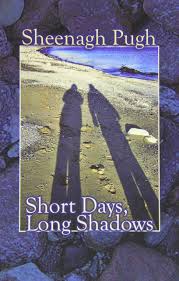
Sheenagh Pugh’s 12th book leaves Cardiff and Wales for the Shetland Islands. Wide skies, rough oceans, bright stars. But I share her obsession with the passage of time and there are some powerful poems here, though I find her historical delvings less enjoyable.

imgres

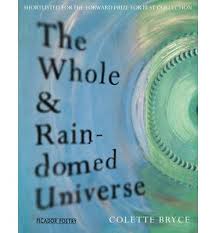
Collette Bryce’s ultra-brief outing (from 2014) into her childhood growing up in Derry during the Troubles is an object lesson in how to focus a collection (just 30 poems). She writes plain, rather withdrawn poems, but this seems right for the material which is therefore allowed to speak for itself.

imgres

What Have I Been Reading: April – June 2015

Up-dated June 2015

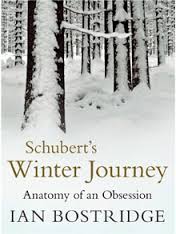
I’ve taken a while getting through the almost 500 pages of Ian Bostridge’s fascinating musical, artistic, poetical, historical, political discussion of Schubert’s Winter Journey.Taking Wilhelm Muller’s poem sequence Die Winterreise, Schubert re-organised it (otherwise changing little) to produce his own Winterreise and, discussing this process and his own performances of the piece over many years, Bostridge touches on Kant, Goethe, Darwin, Friedrich, Alfred Hitchcock, and Aristotle’sMeteorology among others. The Muller text would make an interesting translation project.

imgres

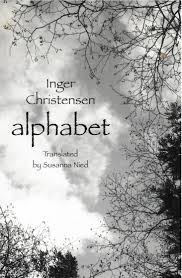
An earlier post about the abecedary form lead several people to ask me whether I’d read Inger Christensen’s 1981 sequence alphabet. Well I have now and it is just stunning. Based on the Fibonacci sequence and moving from A to N in alphabetical sequence too, Christensen writes fluid, Whitmanesque passages, laying aside ‘either/or’ for ‘and’, page after page of which reminds me of Rilke at his most passionate. This is a brilliant translation too by Susanna Nied. Christensen is a writer I need to explore more.

imgres

A few weeks ago I blogged on Lee Harwood’s work which I was also discovering for the first time. Since then I have read Selected Poems published by Shearsman; and I have the Collected Poems waiting for the summer holidays too.

imgres

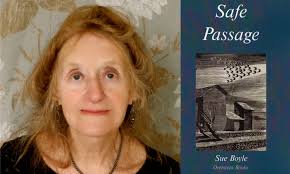
Sue Boyle is a poet I have followed since working with her as a tutor for the Poetry School. She has now published, Safe Passage, a first collection with Oversteps Books and I recommend it (though I confess to also being one of the blurbists on the back cover, where I quote one of her most interesting lines: “in seizing the unexpected lies the art”).

imgres

Updated May 2015

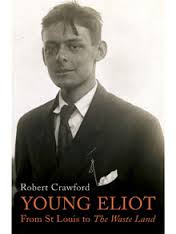
I’m still working through Robert Crawford’s magnificent biography of young Eliot up to The Waste Land. An almost day by day account of his youth, school and college days, Paris, Laforgue, Pound and Vivien Haigh-Wood. Particularly good on Eliot’s philosophical reading and development which I’m loving.

imgres

Mimi Khalvati’s The Weather Wheel consists wholly of 16-line poems – stretched sonnets or irregular ghazals – which seem able to encompass almost any mood, topic or subject matter. Particularly impressive is her desire to draw from the most ordinary of events lines which often soar to the complexly emotional and the (frankly) spiritual.

imgres

I’m also back re-reading Hughes because it looks like we’ll be teaching this from September onwards – surprisingly not something I have done (except one or two isolated poems). I first read many of these poems at Lancaster University in the late 1970s and nowadays many of these early poems read like objects of nature themselves: fixed as in granite, awe-inspiring, part of the mental landscape I have lived in for years.

images

As my most recent blog recounts, I have been also re-reading Transtromer’s work.

2Q==

imgres

Up-dated April 2015

I’ve been reading two impressive contributions to the growing field of eco-poetics. Frances Presley’s halse for hazel is a visually pleasing book from Shearsman (illustrations by Irma Irsara) and the poems encompass geographical, linguistic, political and environmental issues without strain.

imgres

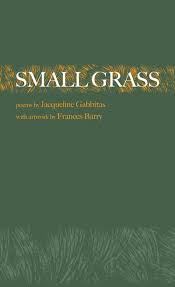
Jacqueline Gabbitas’ Small Grass gives grass a voice and runs with the idea with charm, cleverness and power: “From where I lie, I see man walking, / his legs sheathed in green, // I strop my edges. Soon, they’ll cut through / fabric, the tissue beneath”.

imgres

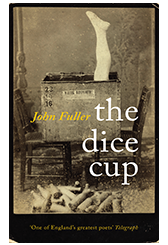
I’ve not always been an enthusiastic reader of John Fuller’s work but the recent The Dice Cup is a book of prose poem sequences full of his characteristic erudition, wit and observation.

thumbnailgenerator

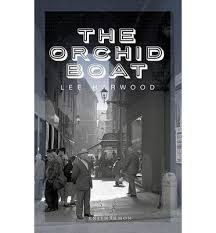
Lee Harwood is a poet who I’ve known of for years without really having read him much. I’d had him down as an English Ashbery/O’Hara and maybe I thought I ought to just go straight to the source. But Enitharmon’s The Orchid Boat is wonderful; full of fluid, sensuous, intelligent poems that twist and turn and take the reader by surprise. Not as flip as O’Hara, not as self-regarding as Ashbery.

imgres 

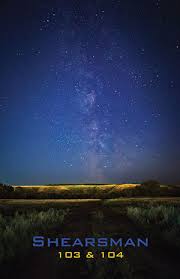
I confess to having a contribution in it but, apart from that, Tony Fraser’s new issue of Shearsman (103/4) is full of delightful things from the likes of Zoe Skoulding , James Byrne, Rupert Loydell and Kate Miller, plus translations of Virgil, Ponge and Jansma.

imgres