Too Short an Arc: Robert Frost’s ‘A Soldier’

I recently posted a discussion about Robert Frost’s brief essay ‘The Figure a Poem Makes’. In this post I’m looking at one of the poems I’ll be teaching next year from the Cambridge International Exam Board’s list of set texts. See page 47 of the Specification. Essays are supposed to offer a close analysis of one (or two poems) while also exploring a student’s wider understanding of what the poet is doing in terms of methods and concerns (techniques and themes).
download

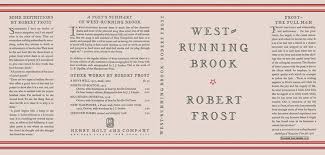
Robert Frost’s seldom discussed sonnet, ‘A Soldier’, was first published in West-Running Brook (1928). The choice of the indefinite article in the title contrasts immediately with a war poem like Rupert Brooke’s ‘The Soldier’ in which some effort is made to capture an individual voice, a specific occasion for grief. In Frost’s poem, the soldier’s death is rather an opportunity for the poet’s characteristic reflections on life’s limits and freedoms, on boundaries, on the relationship between our place on earth and our aspiration to something else.

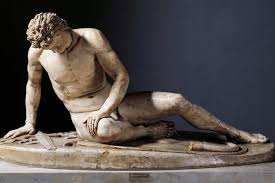
He is that fallen lance that lies as hurled,

That lies unlifted now, come dew, come rust,

But still lies pointed as it plowed the dust.

If we who sight along it round the world,

See nothing worthy to have been its mark,

It is because like men we look too near,

Forgetting that as fitted to the sphere,

Our missiles always make too short an arc.

They fall, they rip the grass, they intersect

The curve of earth, and striking, break their own;

They make us cringe for metal-point on stone.

But this we know, the obstacle that checked

And tripped the body, shot the spirit on

Further than target ever showed or shone.
download

On the page, Frost does not divide the structural elements of this broadly Petrarchan sonnet, but it is useful to think of them for the sake of analysis and I refer to quatrains, octet, sestet and volta where relevant. Here’s me reading the poem with the text differently chunked into units of sense.

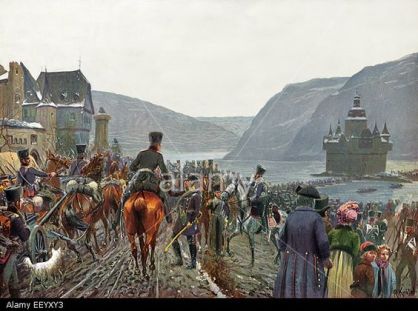
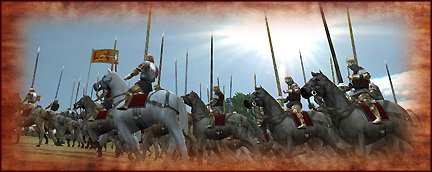
Line 1 immediately treats the dead soldier to a metaphorical (more strictly metonymic) transformation – he becomes his own weapon. But the kind of dehumanisation suggested by the ‘man=lance’ image does not lead to more obvious themes about loss of individuality in war time. Also why Frost chooses such an archaic weapon as a lance is not clear – perhaps he was thinking of a painting, perhaps he wanted to distance the death from more contemporary images of war (the poem first appeared 14 years after the end of WW1), perhaps he felt it would give him more freedom to explore the symbolism of the death without personal, (distracting?) human entanglements. The opening 3 lines of quatrain 1 (Q1) are as follows:

He is that fallen lance that lies as hurled,

That lies unlifted now, come dew, come rust,

But still lies pointed as it plowed the dust.
broken_lance_cav

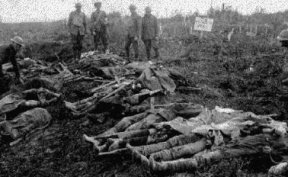
The repetition of the verb “lies” is striking and emphasises the soldier’s passivity in death and the subsequent stillness of the lance. The adjective “fallen” confirms this idea. The end of line 1 seems to mean something like ‘the lance lies just as/in the way it was hurled’. So the throw was a failure, an ineffective effort, as also suggested in line 3 where we are told it has merely “plowed the dust”. The lance’s metaphorical ploughing of the earth further suggests an ineffective, unfertile, unproductive act. Line 2 reinforces these images of passivity, inaction, ineffectuality, as the lance “lies unlifted” over a length of time (duration suggested by the hesitations of the heavier punctuation in line 2) likely to give rise to both “dew” and “rust”. So this is not an image of death and failure in the heat of the battle; it may indeed be long after. Frost seems more than happy to draw the reader’s mind away from what might be the actual condition of the flesh and blood soldier himself by this stage. His dewy, rusty lance, plugged point first into the earth, stands in for him. This is not a poem of personal grief or lament for a warrior’s lost life. That it ought to have a bit more concern for that theme (to be a bit less exploitative) is one of the reasons why we may find reading the poem an uneasy experience.

Line 4 introduces the plural pronoun and – crossing the unmarked boundary between Q1 and Q2 – we are off into more generalised realms of philosophical speculation.

If we who sight along it round the world,

See nothing worthy to have been its mark,

It is because like men we look too near,

Forgetting that as fitted to the sphere,

Our missiles always make too short an arc.

The image of ‘sighting’ along the lance perhaps re-instates more modern methods of warfare (rifles with sights?) but whether ancient or modern, Frost suggests, in looking for a suitable target or “mark”, we fail, we see “nothing worthy”. This is more hyperbolic than factual perhaps, given that we are sighting along the lance and apparently gazing “round the world”. It’s this latter phrase – its easy familiarity enabling Frost to smuggle it past the reader’s guard against inappropriate pretention – that initiates the poem’s elevation from battle-field incident to generalised speculative discussion about human aspiration and limitation.

download

The simile in line 6, comparing the observing “we” to “men” has been noted and criticised by H. A. Maxson (On the Sonnets of Robert Frost (1997)). He objects that the observing “we” are surely “men” (in the sense of human) and so the simile barrenly compares like with like. Maxson suggests Frost intended something like ‘isn’t it just like men’, a sort of frustrated, critical aside (self not excluded) that human beings have very limited powers of observation. Another way of reading the moment may be to emphasis the gender specificity of the reference: is this limit to our sight a specifically male problem?

Of course, it’s not mere shortness of optical sight that is the issue, but a “Forgetting that as fitted to the sphere, / Our missiles always make too short an arc”. The phrase “as fitted to the sphere” works in the same way as “round the world” did earlier. Frost is urging us to forget the battlefield where the poem began; the discussion now is about our place in the world/sphere and how we perceive it or not. Though the use of the word “missiles” does suggest a return to the militaristic, it works as a more generalised allusions to human tools, all carefully “fitted to the sphere” but because of that they/we are unable to contemplate what may lie beyond it. For this reasons our tools, missiles, thought and perceptions all fall short, they “make too short an arc”.
 

download
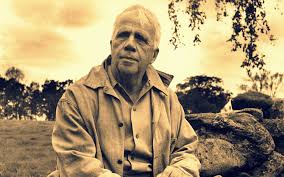
Robert Frost


The arc image reminds us of the interim statement in Frost’s ‘Birches’ that the narrator would “like to get away from the earth awhile”. In ‘A Soldier’ the desire for a similar escape is expressed more indirectly in the constriction and thudding physicality beyond the volta, at the opening of the sestet, descriptive of all lances’ fate when limited by human “sight”:

They fall, they rip the grass, they intersect

The curve of earth, and striking, break their own;

They make us cringe for metal-point on stone.

The short phrases, heavy punctuation and repeated 3rd person pronoun as well as the violence of words like “rip”, “striking” and “break” convey Frost’s sense of the tragic, destructive quality of such limited aspiration and vision. There is a double wounding implied as the lances intersect and puncture the earth itself and in doing so “break their own” (curve, I take it).

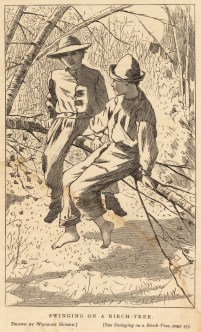
Frost’s use of the word “cringe” in line 10 is interesting. The root of the word is relevantly related to Old English cringan, crincan to ‘bend, yield or fall in battle’. Its modern meaning is to bend one’s head and body in fear or apprehension or in a servile manner or to experience an inward shiver of embarrassment or disgust. So our human failure to see or aspire beyond the earth – represented here by the lance’s metal point striking stone – becomes a defeat of sorts, an act of weakness or servility, at least of embarrassment or disgust at our own inadequacy. It is as if the birch swinger in Frost’s other poem has no other option but to remain in his despondent state, “weary of considerations”:

And life is too much like a pathless wood

Where your face burns and tickles with the cobwebs

Broken across it, and one eye is weeping

From a twig’s having lashed across it open.
5727567383_f719380140_o

It’s at this point the birch swinger expresses the wish to “get away” from earth by climbing the tree and swinging on it. But this is no simple, one-way,  transcendent wishfulness. In ‘Birches’ the narrator always intends to come back to earth and “begin over” because – in two of Frost’s most moving lines – “Earth’s the right place for love: / I don’t know where it’s likely to go better”.

‘A Soldier’ lacks the uplift (for reader) and complicating paradoxes of ‘Birches’. The sonnet dwells long and hard on our limitations, our poor aim and aimlessness, the burns, tickles and cobwebs. But the sestet ends in a declarative mode, not typical of Frost who works more usually via hints and guesses.

But this we know, the obstacle that checked

And tripped the body, shot the spirit on

Further than target ever showed or shone.

The “obstacle” here is the earth, plugging the lance, tripping the soldier himself, a pratfall in the obstinate materiality of the world. But Frost’s plainly concluding tone is now undermined by a more characteristic paradox in what has tripped the soldier’s body is precisely what also shoots his “spirit” beyond the merely everyday. The sonnet’s final line suggests the apparently unworthy “mark” of line 5 (now referred to as a “target”) has indeed been transcended towards something “Further”. Frost’s final phrase, overly pushy and hyperbolic, overly alliterative, the rhyming couplet also raising the poetic stakes a bit too high, strikes me as vacuous, its faux shimmer and shine propelled more by wishful thinking than precision of thought. Of course, what Frost intends to say – something about the generative tensions that exist between matter and spirit – may well be inexpressible but in poems like ‘Birches’, ‘Mowing’ and ‘After Apple-Picking’ he gets closer to it than he does in the confines of this sonnet.
cemetryl

2017 Forward First Collections Reviewed #2 – Maria Apichella

This is the second in the series of reviews I will post over the next two months of the 5 collections chosen for the 2017 Forward Prizes Felix Dennis award for best First Collection. The £5000 prize will be decided on 21st September 2017. Click on these links to access all 5 of my reviews of the 2016 shortlisted books (eventual winner Tiphanie Yanique)  and all 5 of my reviews of the 2015 shortlisted books (eventual winner Mona Arshi).

The 2017 shortlist is:

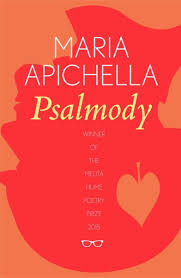
Maria Apichella – Psalmody (Eyewear Publishing)

Richard Georges – Make Us All Islands (Shearsman Books) – reviewed here

Eric Langley – Raking Light (Carcanet)

Nick Makoha – Kingdom of Gravity (Peepal Tree Press)

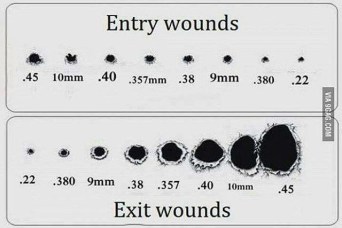
Ocean Vuong – Night Sky with Exit Wounds (Cape Poetry)

download

Many thanks to Eyewear Publishing for providing a copy of Maria Apichella’s book for review purposes.

A psalmody is a collection of psalms – sacred hymns or songs – or the act of singing such songs. In Reflections on the Psalms (1964), C. S. Lewis argued the psalms of the Old Testament are poems: “not doctrinal treatises, nor even sermons [but] lyrics, with all the licenses and all the formalities, the hyperboles, the emotional rather than logical connections, which are proper to lyric poetry”. Maria Apichella’s Psalmody adheres to this to some degree but also comes with a massive dose of narrative and characterization which too often conjures up bad romantic novels. This uneasy cocktail is integral to the whole project. Apichella has said she wanted to “write my own Psalms; that is, poems as authentic prayer [. . .] speech acts which called out to God, the self and the world [. . . ] without being kitsch, or ironic”. She also intended to tell “a contemporary story about the love between an atheist and a Christian”.

download

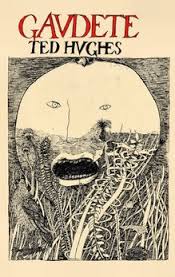
She chooses to do this in a very readable, even racy, form of free verse in the voice of the young Christian woman (like Apichella, she seems to be a post-graduate student, studying the Psalms, at Aberystwyth University). The love interest is David, a Welsh squaddie, home on leave from a vague posting “in flatlands, sand, thudding heat”. The 93 poems make a great play of being rooted in the everyday, most notably through an almost obsessive itemizing of food and cooking, a delight in everyday slang and bathetic details – Lidls, Barclays, the Bus Stop, Aberystwyth in general – while also addressing Apichella’s chosen religious questions. When it works the effect is brave and begins to heal the rift between the material and spiritual that deforms our modern world; when it doesn’t work it’s like watching your Dad dancing. Psalmody sacrifices a lot to appear relevant. Surprisingly, this collection reminded me of Ted Hughes’ Gaudete – also a mix of speedy narrative and spiritual intent. These days most critics don’t rate Hughes’ narrative but they do praise the brief, prayer-like poems (based on Kannadan vacanas) that conclude the book. Apichella’s more psalm-like pieces are scattered throughout the narrative, but are worth searching out (for example, poems 26, 28, 44, 45, 55, 57, 72, 74).

download

So – girl meets boy. Besides gender, the two are set up as complete contrasts. She is a “pale believer”, he’s a “Godless” folk singer; he’s a “narrow-minded atheist”, she’s a “holy-roller”; he likes jazz, she likes the psalms; she likes The Protecting Veil, he still likes jazz (Miles Davis especially). She’s angsty, tense, rather reclusive; he’s calm, kind and talks domineeringly. And couples are like this – and I can see these stereotypes have a larger, symbolic purpose – but the female narrative voice slips so easily into a Mills and Boon mode. David’s face is like “corn-stubble”; he is “chisel / copper / grizzle”; he’s a “pebble of strength” (this when he introduces her to his middle-class mother); he likes his coffee strong, though he’s “soothing / as tea, strong as a leather arm / chair”. The term ‘mansplaining’ might have been invented for David and our heroine often feels “he’s right (about so many things. / More clear and kind than I)”. To give Apichella her due, there are limits to this, especially later on. David is called a “wife” because, though he does fix a dripping tap, he also “roasts chicken / for a saffron paella”. The narrator does begin to challenge David as the relationship develops, but the first half of the book can feel like wading through some very thick, treacle-y, gender stereotyping at times.

download

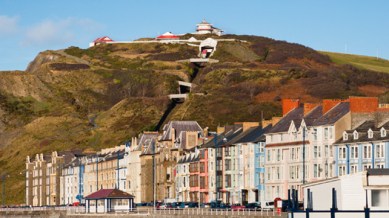
The challenge initially is that David’s bluff, masculine, physical, atheistic presence troubles and changes the female narrator. To begin with, she is clear that her faith defines her. Driving to a party, psalms run through her head, “whispering like a cassette”. Her interest in David is expressed through asking “Does he know the Lord?” As much as he is defined and confined by his military role, she also believes the same about her religious belief: “Love’s the law I obey”. In Poem 10 she describes herself as “a Monastery carved into a granite hill” (she also compares herself to Aberystwyth’s Constitution Hill, another rocky outcrop) and the psalms surface once more: they “bubble / with words free from context, emptied of time and place, / as I wish to be”.


223120003_ConstitutionHill_16x9
Constitution Hill


The self-regarding quality of such comments and their absolutism prepare the reader for change. David arrives in cycling shorts, hairy legs, noisily spilling things, liking raw mushrooms, not following recipes, quoting Dylan Thomas’ “The force that through the green fuse drives the flower”. The two are surprisingly drawn to each other. David besieges her in an unlikely conversation:


Stony one. You are

no monastery.

They are full of men,

mutts, beggars.

If you are,

you must let me in.

I am all these and more”


She explicitly grapples with what is happening as a battle between Eros and Agape, the former initially termed “ridiculous”, the latter is “the anchor / I cannot lose”. Perilously echoing a thousand romantic novels again, she slowly accepts Eros and the body as “good” and ultimately “Holy”, though Eyewear’s blurb’s promise of “vivid eroticism” is hardly accurate; more typical is the comment, “Why will you kiss me but not finish the job?”

A second gap in the text is exactly what sort of religious faith the young woman adheres to. Poems 45 – 47, record her taking David to church, insisting “If David won’t hear me worship / he’ll never know the core of me”. David surprisingly seems embarrassed by the expressiveness of her worship and the occasion distances the lovers from each other. Her personal faith is discussed using the catch-all term “numinous”, glossed as a sense of interconnectedness, of “webbed dimensions”, a filling of “all that can be filled”, a “merging” and perhaps the slow unlocking of the monastery to a stronger erotic sense is consistent with this. But the woman also retains her belief that David himself is in need of religion. For me there’s little in the text to suggest this, other than her insisting that he is “blind”, that he “may be lost”, but more importantly perhaps – and a third gap in the text – is the absence of any discussion of the nature of evil, in contrast to the numinous good, and David’s military connections would surely offer fertile ground for such a debate.

comment_TKZuFWvaDZ8yUgmXPGBqrBcIEcz1PsVz

David returns to his military duties later in the book. What he does is again left vague, if not downright evasive:


[His] job’s all jargon, bullet-

holed paper work.

[. . .] plans to occupy, re-make cities,

countries, traditions, bedrooms.


His own description is “cartographer” or “paper-pusher”. The book ducks the real challenge here. As a woman of faith, the narrator’s issues would surely be more with David’s complicity in war, death and destruction than with whether she takes him to bed, to church or gets him to like the music of John Tavener. Unfortunately, David’s singing and his warrior status have more to do with linking him symbolically with David, the singer of the Psalms, and they create complications for the reader that Apichella does not engage with.

It’s a surprise when the relationship resumes. David returns (vaguely, “Wounded”). I take Poem 88, making a virtue of his bluntness, to be recording his voice:


So,

it turns out

I want you,

after all

the fannying about.


He now seems to accept his need for spiritual guidance: “Your words are direct as a good map”. She accepts him back in the most cryptic line in the book: “David’s an atheist after God’s own heart”. I like the paradox; but I can’t make much sense of it. Apichella’s recurrent and usually grounding food imagery also reaches a strange apogee here. She is imaged as a fallen apple; David a carrot. The powerful, pleading imperatives of the Biblical Psalms are re-deployed here to ask for a greater power to turn them both, to merge them both, into an apple and carrot salad. I kid you not.

Grated-Carrot-and-Apple-Salad-Edited-4

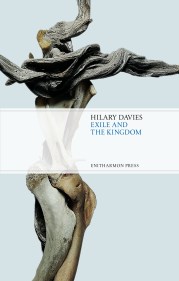
I  have tried hard with this collection. Its intention to interrogate “love and faith in the contemporary world” interests me. The idea of re-writing the Psalms for a modern context is exciting. But the artistic choice of the romantic narrative proves inappropriate and exerts too much of its own stereotyping gravity. Nor do I feel Apichella is wholly in control of the tone, irony and symbolism she uses or takes David’s military role seriously enough. Her ambition is to be applauded but a recent collection like Hilary Davies’ Exile and the Kingdom more successfully tackles many of these issues. (I reviewed Davies’ book in January 2017 and have also posted an interview with her).


9781910392171

Apichella’s narrator concludes by admitting her talents are not in music but her ambition is still to “roar / a song” and her greatest strength is her ability to “respond”. Psalmody is not yet the roar but if really responsive – if Apichella can more convincingly come down off the “granite hill” – I will be eager to read her next collection.

2017 Forward First Collections Reviewed #1: Richard Georges

This is the first in the series of reviews I will post over the next two months of the 5 collections chosen for the 2017 Forward Prizes Felix Dennis award for best First Collection. The £5000 prize will be decided on 21st September 2017. Click on these links to access all 5 of my reviews of the 2016 shortlisted books (eventual winner Tiphanie Yanique) and all 5 of my reviews of the 2015 shortlisted books (eventual winner Mona Arshi).

The 2017 shortlist is:

Maria Apichella – Psalmody (Eyewear Publishing)

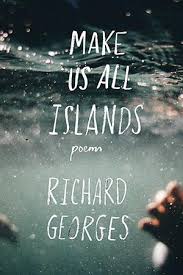
Richard Georges – Make Us All Islands (Shearsman Books)

Eric Langley – Raking Light (Carcanet)

Nick Makoha – Kingdom of Gravity (Peepal Tree Press)

Ocean Vuong – Night Sky with Exit Wounds (Cape Poetry)

images

Many thanks to Shearsman Books for providing a copy of Richard Georges’ book for review purposes.

The seed if not the full, rich fruit of Richard Georges’ Make Us All Islands can be found in Derek Walcott’s 1979 poem ‘The Sea is History’. The mostly unwritten narrative of the Caribbean slave trade, the colonial and post-colonial experience of the transported peoples is the subject of Walcott’s poem: “Where are your monuments, your battles, martyrs? / [. . .] Sirs, / in that grey vault. The sea. The sea / has locked them up. The sea is history”. Born in Trinidad and raised in the British Virgin Islands where he still lives, the sea is also the depository of the brutal struggles and stories of the Caribbean past for Richard Georges, though the ubiquity of the sea in these often painful, often very beautiful poems, means its symbolic burden deepens and broadens to something nigh-existential without losing any of its historical or political power.

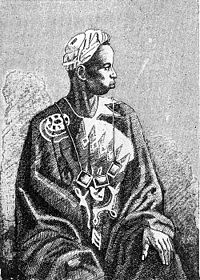
To begin with, Georges makes poetry from some of the very few records that have survived. The words of one transported African – known by the name Abednego – lie at the heart of ‘Griot’. The poem title (pronounced gree-oh) is a West African word for a historian, storyteller, praise singer or poet and, placed at the opening of this book, is both a confident declaration of intent by the poet and an erasure of the Western tradition’s Homeric image of the bard. Rather than heroic military exploits or mythical wanderings, the “cross of the griot” is to “speak for the speechless, / to grip the stem of the bone and coral sceptre, / to be mounted, to sing light into the bleakness”. And the words of Abednego that come down to us turn out to be a dismally familiar, devastating precursor of the 2013 Black Lives Matter movement: “Abednego the griot, the spectre / speaks: In slav’ry days, the black man’s life count for nothing”.


200px-GriotFête
A griot


Poems like ‘Offering’, ‘Birth’ and ‘In the Moment Freedom Comes’ make some of those black lives count through re-deploying details of Spanish or Portuguese slave-ships wrecked or captured in Virgin Island waters. In the latter poem, the woman Ungobo languishes in the hold of the Atrevido until it is attacked by an English ship. But her sense of a liberation into sunlight and salt air seems brief if we give due weight to the concluding image in which the English sailors pluck the slave-ship’s cargo “from the hold like fishermen / clearing their traps”. Many of the figures focused on by Georges are survivors, the kind of “folk” who built the church for the community of liberated Africans in Tortola, Kingstown. Their dramatic survival from the wrecking of the slave-ships is vividly imagined:


Dream them gripping

snarling rocks as black sea claimed the broken hulk

of their prison. Amidst angry sea-spray coral

heads rise in watery light, their minds routeless,

home as far as Babylon


download
Richard Georges


Likewise, George’s post-colonial figures are survivors too, of injustice and straitened economic circumstances. In ‘The Fisherman Measures Life’, the man’s labour and his rickety boat are un-romanticised in the steady-paced, long-lined tercets. This man carries with him a sense of the island’s history, recalling the “griefs” of the slave-ship Donna Paula, but his observations of nature prove no more consoling. Recalling the hunter/hunted imagery of the mid-twentieth century German poet Peter Huchel, the Fisherman watches seabirds chasing fish:


“It is much the same on land,” the fisherman thought.

Shark suited men sweat and chase American cash

like fishhooks, mouths transpierced with incandescent lures.


And in the end, he is as much a part of this brutal economy of hunter and hunted; as he pulls up his fishing pot, “its wooden frame comes to view / the cloudy depths dissolv[ing] in slippery shadows”.

Interestingly, in his recall of the wreck of the Donna Paula, the fisherman sees both “black and white hands” trying to survive. This is more than just a fleeting image in this book. Elsewhere, George carefully considers both “mariner and cargo”(‘The Heavy Anchor’) and this, alongside his concerns for survivors as much as fatalities, begins to transmute the rolling, destructive, slavering image of the sea in poem after poem into an elemental force (while still representative of historical/political forces), becoming one of the conditions of human life more generally. The opening section from ‘Proverb’ puts this succinctly: “God / fashion man / from mud / and put him / right back / when he / done.” This is a sentiment to make even Beckett’s pessimistic view – that we are born astride a grave, the light gleams an instant, then it’s night once more – look sanguine. So the body of rooster lies rotting on a river bank; a stone lies in the water.


The stone smoothed by flood or famine if asked

could tell of slave and tsunami, or of when it was

a rough rock perched on the hillside


and a radiant rooster crowed


In the vivid and fertile Caribbean landscape, time passes and erodes; death dominates. Here are the key words from the tiny lyric ‘Light Sound Land’: deafening, spat, lose, scatter, bending, splinter, lose, bowing, shrinking, din. The sea is usually the agent of these grim conditions and the book’s title – make us all islands – emerges not as a plea, imperative or warning but as a resigned statement of fact, the consequence of the conditions in which we live.

a96fe65fe5dcccda9a7c917fd3a41337--saint-john-virgin-islands

The title phrase appears in ‘At the Waterside’, a brilliant, sustained, survivor’s meditation in 5 parts, drawing together many of the themes in the collection. The sequence has an unusually clear and stable lyric ‘I’, a man who sits watching ferries arrive on the Virgin Islands. Unlike the “white-capped tourists” (but like the Fisherman), the narrator sees the present day through the lens of history or, to be more precise, the general neglect of the island’s history. The authorities prefer to construct “concrete totems where [the island’s] cedars groan”. But for the narrator:


It is here where the Empire unravels, crumbling

in Ozymandian ruin – preserving only

an ancient anger held by hands burnt black in sun.


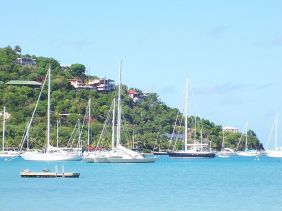
Perhaps it’s the same fisherman here who sails perilously out to Buck Island, to where “sparkling blues betray the reef’s lying rocks”. The narrator twice cryptically insists that “something greater” covers the fisherman. It is partly history (the clouds hang like “ghosts of slaves”) but also (and in a poetic defiance of gravitational logic) it is the ocean itself, the “whipping waters”, an omnipresence in these poems, suggesting that, whether mariner or cargo, all individuals are both authored and erased by the sea.


image_5827ce8864
Buck Island


When you buy this book, I suggest you begin by reading the final poem, ‘Oceans’. Here too the sea is “effervescent” with history – “the bones // of slaves, of sailors” – but it also represents a more existential “abyss consuming even light in its depth”. Here is Richard Georges reading from this poem. The narrator demands to know what language might express it, how it may be securely held. The ocean also lies in the lover’s body: “And so we all remain. Divided. / Like the shores of islands”. To counter-balance such division and alienation, the little poem ‘Draining’ suggests one of humanity’s constituent drives is “a life / desperate to drink / the air outside of / us”. The metaphor is quickly switched; what runs through us is a river intent on returning to the sea. In ‘Mural’, a second ‘griot’ figure in a bar directs the poet to watch a turtle rolling and turning in the ocean. The man in the bar is a seer. Like the Fisherman and like the narrator of ‘At the Waterside’ too, what he sees is the “writhing mural / of hope and history / always carrying on”.

4200i1A7CA06263E1DE88

The stoic instinct to hope emerges in these poems as powerfully as the poet’s instinct to speak. Perhaps surprisingly, what remains with me after reading Make Us All Islands is the great beauty of Richard Georges’ language and verse. Battered by the power of his literal and symbolic ocean he humbly suggests the difficulties of articulation, imagining only a “broken book of poems”. But time and time again, he successfully evokes the light and dark of past and present and he takes on the “cross of the griot”. The rightness of each word and line-break in the poem ‘A Place in the Earth’ is a case in point:


The dumb bodies

lie like leaves

in the dirt.


Death drags

the drying lips back

drawing mouths

into snarls


bracing the teeth

against the whistling

flute of the throat.


The living

philosophise

over the bones


while the yellow love

laughs from the trees

above.

The Meaning of Robert Frost’s ‘The Figure a Poem Makes’

Written in 1939, Robert Frost’s essay is combative, ironic, cryptic, delightful, damning of scholars and, for aspiring poets, encouraging of both a formal awareness and a cavalier attitude. The Figure a Poem Makes talks of the experience of writing rather than reading and the resulting poem is first described negatively (what it is not) then more positively in the famous phrases that it is a “momentary stay against confusion”, that it begins “in delight and ends in wisdom”. Along the way, Frost images the poet as giant, lover and grasshopper. Like most of his comments on poetry, the essay does not develop in a scholarly way, but there is an underlying coherence and in what follows I hope to track it down. You can read Frost’s full text here. I have also posted a discussion of Frost’s poem ‘A Soldier’ and of the poem ‘Two Look at Two’.

download

Paragraphs 1-3

Frost opens in the middle of a battle against what he calls “abstraction”, long accepted as part of philosophic method but now – in the first half of the 20th century – “a new toy” in the hands of poets. This idea occupies the opening 3 paragraphs of the essay. It is the temptation to separate out the constituent elements of a poem and to elevate or prioritise one over all others. Frost’s faux-infantile tone here suggests he will not be offering any approval of this method (“Why can’t we have any one quality of poetry we choose by itself? . . . Our lives for it.”). He floats the idea of focusing only on the sound a poem makes – “sound is the gold in the ore”. He’s thinking of the experiments in sound of a Mallarme, a Tennyson, or a Swinburne, the lush aestheticism of a few years before. It may also be relevant that, in the UK, Dylan Thomas’ early work had appeared in the mid-1930s.


images
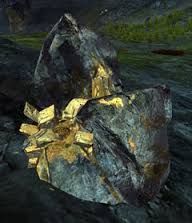
“sound is the gold in the ore”


But Frost’s doubts about such approaches to poetic composition take a surprising form. From the premise that “the object in writing poetry is to make all poems sound as different as possible from each other” he argues that a reliance solely on linguistic and formal elements (“that of vowels, consonants, punctuation, syntax, words, sentences, metre”) is never going to be enough to achieve this aim. If we abstract for use only the sonic and formal elements of poetry, “[a]ll that can be done with words is soon told”. Frost is known for his interest in form (as against other Modernists’ scepticism about it) so it’s with some surprise that we hear him say: “So also with metres – particularly in our language where there are virtually but two, strict iambic and loose iambic. The ancients with many [more varieties of metre] were still poor if they depended on metres for all tune. It is painful to watch our sprung-rhythmists straining at the point of omitting one short from a foot for relief from monotony”.

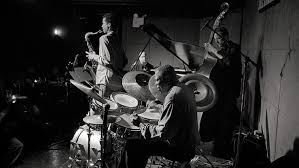
With this Frostian chuckle, it’s clear that only monotony results from this approach and also that the poet can only gain relief from it with “the help of context-meaning-subject matter”. This clumsy, composite term is quickly honed down to the single word “meaning” (later in this essay he uses “theme” and “subject” to refer to the same thing). This is Frost’s argument against the lure of abstraction. The poet – even merely to achieve poems which sound as different as possible from each other – must have something to say, must mean something. The limits of pure sound/form can be breached once meaning is played across the sonic/formal qualities of language. For me this gives rise to images of a jazz soloist improvising across the rhythms of a band. For Frost: “The possibilities for tune from the dramatic tones of meaning struck across the rigidity of a limited metre are endless. And we are back in poetry as merely one more art of having something to say”.

download

The third paragraph opens: “Then there is this wildness whereof it is spoken”. The quasi-Biblical turn of phrase here suggests irony is again at work and it is a second form of abstraction that Frost is mocking. The “wildness” of a poem is the way its component parts are related – or not – to each other. He mocks the kind of “Poem” – note the ironic upper-case – that results from those who seek “to be wild with nothing to be wild about”. Though the sudden switches of focus, the jump-cuts of strong emotion, the leaps and gulfs of epiphanic moments are certainly (Frost implies) part of great poetry, the Modern(ist) abstractionist will want the leaps and jumps “pure”. Frost is again concerned about the lack of “context-meaning-subject matter” in this kind of poetry. He is taking aim at Surrealism with its reliance on irrational leaps, its dislocation of the senses, the shock value of the illogical. For Frost such practices lead only “to undirected associations and kicking ourselves from one chance suggestion to another in all directions as of a hot afternoon in the life of a grasshopper”. To create poetry that has something to say, Frost suggests for the second time that “Theme alone can steady us down [. . .] a subject that shall be fulfilled”.


Paragraphs 4–6

The essay now moves away from the constituents of a poem to the process of its writing, a process Frost sees as organic, instinctive, unpredictable, exploratory, holistic, and – like love – an experience and source of pleasure. This is where he uses the title phrase and the figure of a poem turns out to be ‘the course run’ by the poem, its track or trail or locus. The elliptical sequencing of the next few paragraphs doesn’t help the reader but Frost considers 5 areas: the poem’s origins, its development, its impact on writer and reader, the importance of the poet’s freedom.


SONY DSC

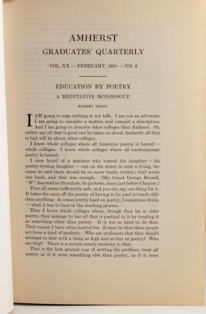
The delight with which a poem begins is “the surprise of remembering something I didn’t know I knew”. I don’t think this need be a literal recalling (on this Frost is not Wordsworth) but an insight or sensing of a connection between things which has a familiarity and feels like a remembrance. (The way in which metaphor is at the root of poetry and, perhaps, all knowledge is a point Frost developed in ‘Education by Poetry’ (1931)). The substance of this initial insight is what constitutes at least the beginnings of the “context-meaning-subject matter” so essential to any successful poem. All poets will recognise such a moment as Frost describes: “I am in a place, in a situation, as if I had materialized from cloud or risen out of the ground. There is a glad recognition of the long lost and the rest follows.” But from such momentary delight and recognition (which will be accompanied by powerful emotions, even tears), Frost makes it clear the process, the figure, of the poem’s making, still lies ahead and is one of surprise and discovery.

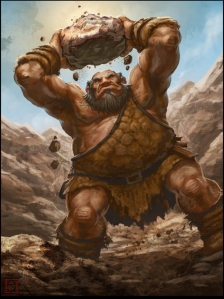
As the poem struggles to exist, the poet must remain alert and watchful to what may help build it as “it inclines to the impulse, it assumes direction with the first line laid down, it runs a course of lucky events”. It is a fundamentally metaphorical process of making connections, often quite unforeseen ones: “The impressions most useful to my purpose seem always those I was unaware of and so made no note of at the time”. In a striking image, Frost suggests we are like giants, drawing on elements of previous experience and hurling them ahead of us as a way of paving a pathway into our own future. We make sense of what we encounter by reference to what we have experienced in the past. It’s in this way that a poem is able to result in “a clarification of life – not necessarily a great clarification, such as [religious] sects and cults are founded on, but in a momentary stay against confusion.” Our pathway ahead is illuminated, even if only briefly, by the ordering and landscaping the poem creates towards future experience by reference to what we already know.

thump_by_vegasmike-d34kud4.jpg

This is why Frost teasingly argues the logic of a good poem is “backward, in retrospect”. What it must not be (and he has his earlier abstractionist targets in mind again) is pre-conceived or imposed before the fact (even if what we pre-impose is the illogical kicking ourselves from one chance suggestion to another). Such willed pre-conception can never yield anything other than a “trick poem”. It is not a prophecy, but rather something “felt”, a feeling figure, an emotional response involving both past and future and it must be “a revelation, or a series of revelations, as much for the poet as for the reader.” The crucial role of emotion is perhaps easily missed. And to allow the role of the passions, Frost insists on the greatest freedom of the poetic materials to move about, to be moved about, to establish relations regardless of time and space, previous relation, and everything but affective affinity. This is Frost’s answer to one of the writer’s constant quandaries: how true to the original experience must I be? For Frost, truth to the emotional response at the inception of the poem (not necessarily the original incident’s emotional charge) is key and that demands artistic independence and freedom. Some distance is required.


Paragraph 7

The essay comes to concentrate finally on the necessary freedoms of the poet. The artist’s freedom is the freedom to raid his own experiences: “All I would keep for myself is the freedom of my material – the condition of body and mind now and then to summons aptly from the vast chaos of all I have lived through.” It’s in this freedom that Frost contrasts scholars/academics and artists. Scholars work from knowledge. But so do artists – this is the point of the early paragraphs of the essay. But the two groups come by their knowledge in quite different ways. Scholars get theirs via a conscientious and thorough-going linearity of purpose. Poets, on the other hand, acquire theirs cavalierly and just as it happens, whether in or out of books. Poets ought to “stick to nothing deliberately, but let what will stick to them like burrs where they walk in the fields”. Poets do not learn by assignment, Frost says, not even by self-assignment.
images

In the course of the figure a new poem may be making, the poet must assert his liberty to work in a dramatically metaphorical way, to be possessed of both “originality” and “initiative” in order to be able to snatch “a thing from some previous order in time and space into a new order with not so much as a ligature clinging to it of the old place where it was organic”.
Frost concludes with another vivid image of the poem making its figure in the course of composition. “Like a piece of ice on a hot stove the poem must ride on its own melting.” The aptness of the image lies partly in the ice’s gradual vanishing (what a poem can offer is only ever “momentary”) and the frictionless quality reflects Frost’s insistence that a poem cannot be “worried into being” through pre-conceived effortfulness. The ice’s movement is generated and facilitated by its own process of melting and the poem too must propel itself (not be propelled by the artist). The resulting figure follows an unpredictable and fresh course, the links it draws from both past and present towards the future offering temporary clarifications of all three for the poet and (something Frost does not explore here) perhaps finally broadcast, available and effective for its readers too.

experimentsd

On the Importance of Considering Nothing #2

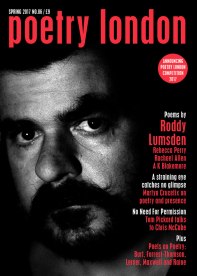
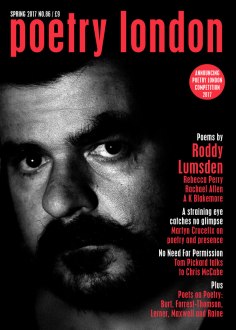
Last week I blogged the first part of a longer essay first published in the Spring 2017 issue of Poetry London. What follows is the second half of it. The whole piece starts and ends with thoughts prompted by my experiences with my father and his growing dementia. Dad has since suffered a series of heart attacks and died on May 24th. I am re-producing the essay unchanged in the hope that it still says something of value about types of ‘confusion’ and in memory of a man who would have had little time for such morbid reflections. Thanks to Tim Dooley who commissioned the essay for Poetry London and published it under the original title: A Straining Eye Catches no Glimpse.

PL-COVER-Spr17-web

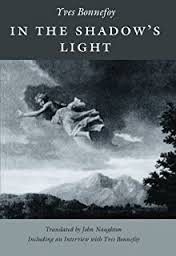
In Part 1, I linked my father’s forgetfulness and confusion with recurrent references to “nothing” in King Lear and to Anne Carson’s concept of “the dementia of the real”. I suggested this was also a correlative of Yves Bonnefoy’s interest in the “state of indifferentiation” he often refers to as “Presence”. For Bonnefoy, Presence contrasts the conceptual/linguistic world through which we most often move and we take to be real.

Part 2

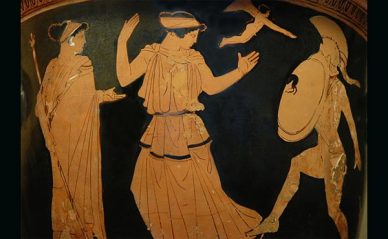
Yves Bonnefoy’s poem ‘Wind and Smoke’ (from The Wandering Life (1993)) has the abduction of Helen as its nominal subject. But he allows the poem to be taken over by dissenting voices, irritably seeking to “explain, to justify, ten years of war”. Such an expense of men, ships and spirit (argues one such “commentator”) must have been for the sake of something more permanent than the merely human figure of Helen. The poem entertains the suggestion that she herself was never abducted, “only an image: a statue”, something of great beauty to be displayed on the terraces of Troy, a fixed image of Helen, blessed with permanence, “always [. . .] this smile”. The poem is concerned then with the limitedness of the conceptual view which finds worth only in things of assured, definable permanence. In contrast, Part One of the poem ends with a proliferation of images of “spilling”, lovers as “clouds” or “lightning” on an “earthly bed”, so fully involved with time that their pleasures in the moment are “already empty, still full”. [i]


search-helen-troy
Helen of Troy (Red Figure Vase)


There’s that paradox again and Bonnefoy’s versions of it articulate the impossibility of capturing Presence because it encompasses and exists in time (and language wishes to stop time):


Every time that a poem,

A statue, even a painted image,

Prefers itself as form, breaks away

From the cloud’s sudden jolts of sparkling light,

Helen vanishes [. . . ][ii]


The “jolts” here are akin to Lily Briscoe’s “jar on the nerves” as our paradigms and preconceptions are challenged. The figure of Helen has become that visionary experience – for Bonnefoy usually of beauty, for Carson more often a violent disturbance – that we intuit exists just beyond the range of our usual instruments. Helen, the poem argues, “was only / That intuition which led Homer to bend / Over sounds that come from lower than his strings / In the clumsy lyre of earthly words”.

Part Two of ‘Wind and Smoke’ concludes with a child, an image of the poet, the last person to see the figure of Helen as Troy burns:


singing,

He had taken in his hands a little water,

The fire came to drink there, but the water

Leaked out from the imperfect cup, just as time

Ruins dreams and yet redeems them.[iii]


download
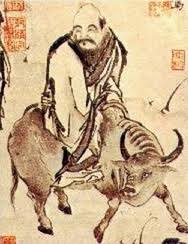
Traditional image of Laozi


This same image of water slipping from our human grasp is recurrent in the Ancient Chinese writings that make up Laozi’s 4th/5th century BCE text, the Daodejing. Since they were published earlier this year, I have been reading my versions of these texts up and down the country and the one thing audiences want to say about them is they contain “wisdom”.[iv] It’s an old-fashioned word but it’s also bound up with the nothing that is really a fuller something we seldom manage to grasp. The Daodejing texts use water as an image of the ineffable One, the plenitude that lies behind all things. They employ water metaphors in such a way that the vehicles are clear and recurrent (ocean, pool, river, stream) but the tenor remains an empty set, never defined. So Chapter 1 deploys water imagery but is clear about the short-comings of all language: “the path I can put a name to / cannot take me the whole way”. Even what can be named can only be grasped through further metaphors: the “nursery where ten thousand things / are raised each in their own way”. What lies behind the phenomenal world can only be gestured towards through figures such as “mould”, “source”, “mystery”. Even then it’s “a riddle set adrift on a mystery”. The original Chinese text shifts its metaphors rapidly in just this way and this is what gives this opening Chapter the peculiar sensation of telling a clear truth that remains beyond our grasp. Chapter 14 puts it this way:


because a straining eye catches no glimpse

it is called elusive


as the ear attends but latches onto nothing

it is called rarefied


since a hand reaches but clasps only thin air

it is called infinitesimal


and these are resistant to further analysis

File 03-03-2016, 09 03 15

The difficulty of grasping this something that seems nothing is revisited in Chapter 4. There, the tenor of the metaphor is reduced to “it”, the context indicating this refers to the Dao itself, the One, that state of wholeness and plenitude towards which the path of the Dao leads. The opening formulation emphasises the Dao’s infinite nature, its resource as “a vessel to be drawn from / one that never needs to be re-filled // the bottomless source of all things”. But the image is revised a few lines later in the form of a question: “is it rather a pool that never runs dry”, yet this follows four other metaphorical formulations of the Dao’s beneficial effects: “fretted edges are smoothed within it / knots untangled all dazzle eased / all blinding clouds of dust slowly cleared”. The poem calmly declares its own ineffectiveness: “we cannot know it as a bodiless image / it must pre-date every beginning”. Even the concept of origin or beginning is not adequate to convey the nature of the Dao. But the fluidity of water – impossible to grasp, capable of taking any shape, a life-giving source – comes close.

That there is wisdom to be gained from such visionary encounters with the mystery of nothing is clear in Chapter 66. It’s no coincidence that these lines can serve as a commentary on Lear, his suffering bringing him low till he realises he has paid too little attention to the “looped and ragged” nature of his own nation:


—how do rivers and seas secure mastery

over the hundreds of lesser streams

through lying lower than they do


so to govern or teach you must stand

and acknowledge you are beneath the people

to guide them put yourself at the rear


md1187823288

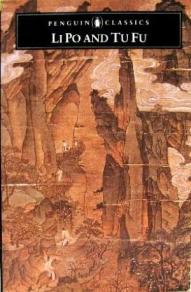
But as Auden suggested and Chinese tradition affirms, such visionary insight cannot be actively sought or taught. This is one of the points of the traditional narrative trope in Chinese poetry of ‘Visiting a Hermit and Not Finding Him’. Don Paterson turned this into a good joke in a poem called ‘On Going to Meet a Zen Master in the Kyushu Mountains and Not Finding Him’.[v] The reader’s eye descends from this lengthy title only to look in vain – it’s a blank page. Perhaps Paterson had been reading the Penguin Classics selection of Li Po and Tu Fu.[vi]  The Li Po selection opens with the poem ‘On Visiting a Taoist Master in the Tai-T’ien Mountains and Not Finding Him’. But such poems were never just an excuse for descriptive nature poetry but related to the frequent ‘spirit-journeys’ that Li Po was fond of writing. We are all like that student in Li Po’s poem, seeking out certainties and facts, a something to depend on when true wisdom gently (or violently) deflects us away from shelter towards a world where we glimpse a more full-blooded, full-bodied, open-minded encounter with what really is.


download
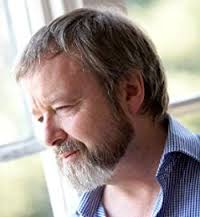
Iain McGilchrist


I have really been talking about two attitudes to knowledge or to put it more carefully, two contrasting “ways of being”.  This is how Iain McGilchrist’s book, The Master and his Emissary (Yale, 2009) expresses it.[vii] McGilchrist argues parts of the human brain deliver quite different kinds of attention to the world. The left brain perceives the world as “static, separable, bounded, but essentially fragmented [. . .] grouped into classes”.[viii] This is the attitude to knowledge and education the anxious student of Li Po’s poem possesses as well as the place where most of us live amongst Carson’s clichés and Bonnefoy’s conceptual language. In contrast, McGilchrist associates the right brain with the perception of “the live, complex, embodied, world of individual, always unique beings, forever in flux, a net of interdependencies, forming and reforming wholes, a world with which we are deeply connected”[ix] yet one at risk of being perceived or judged as a mere confusion, a seeming nothing.

This is the view of the Daoist master whose teaching evokes the as-yet-uncarved block of wood, who teaches best without words. Ordinary language usage, dependent as it is on conceptual thought, is left-brain work – ordering, categorising, re-presenting the minute particulars of the world as they are perceived by the right brain. Li Po’s teacher is surely hiding somewhere beyond the cherry blossom – and this is part of the student’s lesson. Don Paterson’s blank page represents a rather glib, post-modern joke, a scepticism about language in danger of throwing out the interconnected but bewildering “dementia” of the real world along with the suspect tokens and counters of left-brain language: “To say that language holds truth concealed is not to say that language simply serves to conceal truth [. . .] or much worse, that there is no such thing as truth”[x]. Bonnefoy, engaging in his own battles with the early stirrings of French post-modernism, declared: “This world here exists, of that I am certain [. . .] It is simply with us.”[xi] The right brain knows this and it’s from there we want to write poems; the left brain serves to fragment it, utilise it, get it under control, disappear it. And yet . . . there’s no much here suitable for a chat with a forgetful father. His visions are more frightening and may get worse; here, for a while, his son has been imagining ways of seeing that need not be so.

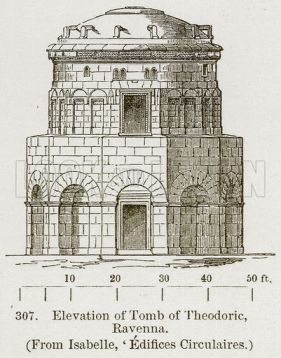
Elevation of Tomb of Theodoric, Ravenna

Notes

[i] tr. Naughton, Naughton and Rudolf, pp. 197-203.

[ii] tr. Naughton, Naughton and Rudolf, p. 201.

[iii] tr. Naughton, Naughton and Rudolf, p. 203.

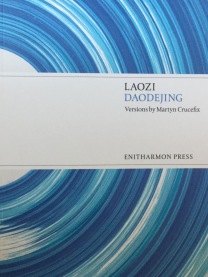
[iv] Laozi, Daodejing, versions by Martyn Crucefix (Enitharmon, 2016). All quotations are from this version.

[v] Don Paterson, God’s Gift to Women (Faber, 1997).

[vi] Li Po and Tu Fu, selected and translated by Arthur Cooper (Penguin Classics, 1973).

[vii] Iain McGilchrist, The Master and His Emissary (Yale UP, 2009), p. 25.

[viii] McGilchrist, p. 31.

[ix] McGilchrist, p. 31.

[x] McGilchrist, p. 6.

[xi] Yves Bonnefoy, The Tombs of Ravenna, tr. John Naughton (1953; PN Review (No. 226, Nov-Dec 2015), p. 62).

On the Importance of Considering Nothing #1

I have not blogged regularly since April 2017  as, having managed to get both my parents settled into a Care Home in Wiltshire, Dad suffered a series of heart attacks and died – fairly quickly and peacefully – on May 24th. Not wholly coincidentally, the Spring 2017 issue of Poetry London published an essay I had written which starts and ends with some thoughts on my experiences with my father and his growing dementia. In the next two blogs, I re-produce this essay unchanged in the hope that it still says something of value about types of ‘confusion’ and in memory of a man who would have had little time for such (in his view morbid and abstruse) reflections. Thanks to Tim Dooley who commissioned the essay for Poetry London and published it under the original title: A Straining Eye Catches no Glimpse.

 PL-COVER-Spr17-web

Part 1

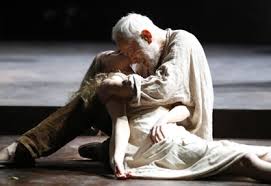
An old king leans over his daughter’s body seeking signs of life, yet he finds “Nothing, nothing, nothing, nothing, nothing”. Given that I teach literature and this is one of Shakespeare’s more famous lines with its repetition and trochaic revision of the iambic pentameter, I’m not proud of mis-remembering this moment in King Lear (the repeated word is, of course, ‘Never’). Yet I know why I mistake it, this year, in these fretful months. Seeing Anthony Sher play the role recently – haranguing a foot-stool, giving toasted cheese to a non-existent mouse – put me in mind of my father, though he’s not quite so far gone. These days he has trouble recognising the house he’s lived in for 60 years; he will refer to his wife as a woman from the village who has come to look after him; he seeks news of his mother (she died in the 1970s). What can this feel like? Years of memories gone; a whirling fantasmagoria that evidently frightens him; a something becoming nothing he makes too little sense of.

download

So it’s not just that the idea of nothing is prominent from the very start of Shakespeare’s play. Cordelia fails to reply flatteringly to Lear’s question about which of his daughters loves him most. The gist of her brutal answer is “Nothing, my lord”. Lear warns her: “Nothing will come of nothing. Speak again”. But she sticks to what she sees as her truth (as against her elder sisters’ oleaginous falsehoods) and pays the consequences. But so does the King. Reduced eventually to a wholly unexpected state of wretched nothingness in the storm scenes and beyond, he learns much from this nothing in pointed contradiction of his earlier warning. It doesn’t stop there; once reunited with Cordelia and faced with the prospect of prison, possible execution, what is remarkable is the King’s acceptance of his fate. Confronting this further reductio, he declares he’ll go and finds a reason to be cheerful: “we will take upon’s the mystery of things”. I’ve always been struck by Shakespeare’s phrasing here. The mystery of things is imaged not as some modernly pedagogic check-list, tabulated and absorbed like a set of principles, rather it’s something to be folded about us – a garment, an investiture, a way of seeing, feeling, not quite of self, not quite other either – and Shakespeare’s point is that Lear’s encounter with nothingness in various guises is what has prepared him for such a re-vision of his place in the world.

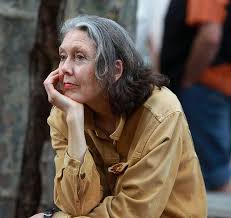
I’m interested in the idea that such a nothing can be worth something. Of course, it’s not exactly nothing, a void, that Cordelia’s father encounters. It is a bewildering set of experiences of which he can make nothing. Lear – I don’t know how far this is like my father – suffers because his previous paradigms are failing: he is shocked into his encounter with the mystery of things or what Anne Carson calls the “dementia of the real”. When my father talks, he yearns for the ordinary reassuring certainties of his old life, as if they would close round him with the feel of a comfortable coat. Carson has explored this reliance we all have on the familiar in her 2013 Poetry Society lecture concerned with ‘Stammering, Stops, Silence: on the Methods and Uses of Untranslation’.[i]  She explores moments when language ceases to perform what we consider its primary function and we are confronted with nothingness in the form of silence. In the fifth book of The Odyssey when Hermes gives Odysseus the herb “MVLU”, Homer intends the name of the plant to be untranslatable since this sort of arcane knowledge belongs only to the gods. In a second example, under interrogation at her trial, Joan of Arc refuses to employ any of the conventional tropes, images or narratives to explain the source of her inspiration. Carson wants to praise Joan’s genius as a “rage against cliché”, the latter defined as our resort to something pre-resolved, pre-shaped, because, in the face of something so unfamiliar that it may seem more like nothing, “it’s easier than trying to make up something new”.


images
Anne Carson


Carson associates this rage to ‘out’ the real with Lily Briscoe’s problems as an artist in Woolf’s To the Lighthouse. She struggles to complete her painting, aware that the issue is to “get hold of something that evaded her”.[ii] She dimly senses “Phrases came. Visions came. Beautiful pictures. Beautiful phrases. But what she wished to get hold of was that very jar on the nerves, the thing itself before it had been made anything”. Unlike Homer and Joan of Arc, the knowledge Lily seeks (undistracted by the divine) is not so much prohibited as, in a profound sense, beyond conception (it is a nothing before it has been made something). For Carson, we each dwell behind the “screens” of cliché for most of our lives, so when the artist pulls them aside the impact of the revelation may well have the force of violence. She suggests artistic freedom and practice lie in such a “gesture of rage”, the smashing of the pre-conceived to find the truth beyond it, her goal remaining the articulation of the nothing she insists is actually the “wide-open pointless meaningless directionless dementia of the real”.

This is the nothing I am interested in: it is no void or vacancy but, paradoxically, a wealth of experience, a “flux of phenomena” about which we cannot think in conventional ways. We cannot name the parts of it, so for convenience, maybe a bit defensively, we prefer to designate it nothing. The artist seeks to articulate such an “experience of what goes beyond words: call it the fleeting perception [. . . ] a state of indifferentiation”. [iii] This is one of the many formulations of the issue by the late Yves Bonnefoy who unrelentingly explored the limits of conceptual thinking in terms similar to Carson’s distrust of cliché: “It is not that I incriminate the concept – which is merely a tool we use to give form to a place where we can dwell. I am merely pointing out a bad tendency [ . . . ] of its discourse to close discussion down, to reduce to the schematic and to produce an ideology existing in negation of our full relation to what is and to whom we are”. He concludes it is a “temptation to stifle dissenting voices” – the kind of voices who see something in nothing. [iv]

images

The always evangelical Bonnefoy terms the mystery encountered in a “state of indifferentiation” as “Presence”. In 1991, Bonnefoy’s temporary residence in the snowy landscapes of Massachusetts gave him a new way of evoking these ideas. In The Beginning and the End of the Snow (1991) he reads a book only to find “Page after page, / Nothing but indecipherable signs, / [. . .] And beneath them the white of an abyss”[v]. Later, the abyss is more explicitly, if paradoxically, identified: “May the great snow be the whole, the nothingness”.[vi] These occasional moments when the screens of cliche and conceptual thought fall are moments of vision as sketched by Auden in his discussion of Shakespeare’s sonnets – they are given, not willed; are persuasively real, yet numinous; they demand a self-extinguishing attentiveness.[vii] The inadequate, provisional, always suspect nature of language to record such moments is clear in these lines from Bonnefoy’s poem ‘The Torches’:


. . . in spite of so much fever in speech,

And so much nostalgia in memory,

May our words no longer seek other words, but neighbour them,

Draw beside them, simply,

And if one has brushed another, if they unite,

This will still be only your light,

Our brevity scattering,

Our writing dissipating, its task finished.[viii]


Rather than the forced disjunctions and the quasi-dementia of Carson’s recommended methods, Bonnefoy is reluctant to abandon the lyric voice, though he still intends to acknowledge the provisional nature of language in relation to Presence. The “fever” and “nostalgia” we suffer is the retrogressive lure of conceptual simplification. Bonnefoy’s imagery suggests a more delicate, tentative relationship between words, a neighbouring, a brushing up against each other (like snowflakes), though even then, if they “unite” or manage to cast “light” on what is, this can only be brief, always subject to dissipation.

(to be continued)

download

Footnotes

[i] Poetry Review, Vol. 103, No. 4 (Winter 2013).

[ii] Virginia Woolf, To the Lighthouse (1927; Penguin Modern Classics, 1992), p. 209.

[iii] Yves Bonnefoy, In the Shadow’s Light, tr. Naughton (Chicago Press, 1991), interview with John Naughton, p. 162.

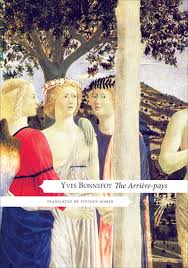
[iv] Yves Bonnefoy, ‘The Place of Grasses’ (2008), in The Arriere-pays, tr. Stephen Romer (Seagull Books, 2012), pp. 176/7.

[v] Yves Bonnefoy, ‘Hopkins Forest’, tr. Naughton in Yves Bonnefoy: New and Selected Poems, eds. Naughton and Rudolf (Carcanet, 1996), p. 181.

[vi] Yves Bonnefoy, ‘The Whole, the Nothingness’, tr. Naughton, Naughton and Rudolf, p. 187.

[vii] W. H. Auden, ‘Introduction to Shakespeare’s Sonnets’ (1964; reprinted in William Shakespeare: The Sonnets and Narrative Poems, ed. William Burto (Everyman, 1992)).

[viii] tr. Naughton, Naughton and Rudolf, p. 177.

Two poems by Martyn Crucefix

I’m afraid I have been unusually silent on the blog for the last few weeks. My last posting was in early April, a review of Jacob Polley’s book, Jackself. Life has been getting in the way of blogging and though I appreciate a lot of people like to read a lot of personal stuff on blogs that’s not really why I write. Suffice to say that I have been preoccupied with organising my parents move into a Care Home and the selling of their house, my house I should say; we moved into it when I was a year old and I left to go to university at 18. I imagine there will be poems emerging from the experience – but they tend to take a long time.

Added to this I was called up to do jury service at the Old Bailey during the last 3 weeks and this proved both fascinating and dull at the same time. The case was strange and disturbing (the defence consisting of the claim that what was done was done as research for a novel, so throwing up questions about the boundaries between fact and fiction). The dullness was, of course, the slowness with which the wheels of the law roll round (in the name of clarity, precision and fairness). The events and characters of the people involved were wholly consuming for the period we were sitting as a jury.

Emerging from that in the last couple of days, the news came that my father has gone back into hospital after a heart attack.

So – with no headspace for poetry really, I’m resorting to re-blogging a couple of poems which very recently appeared on Jo Corcoran’s great website And Other Poems. Both poems will also appear in my new book, The Lovely Disciplines, to be published by Seren Books this summer.

images

Both these poems have had a long gestation. ‘East-running road’ originated with observations about the angles of sunlight on sunflower fields in the north-west of France, slowly becoming concerned with the idea of writing and seeing, which then became associated in my mind with the dedicatee of the poem, the poet Katherine Gallagher. ‘Boy-racer’ is even older in origins. But I do still recall the central image as a real event: on some dusty European road down to a beach, a kid on a motorbike skidding out from a side track, wobbling to regain balance and powering off ahead. The wind ruffling his carefully un-helmeted head . . .

Read the two poems here: Two poems by Martyn Crucefix

7926ca533543e64e15591592aae83fd8

Two-Headed Calf: Review of Jacob Polley’s ‘Jackself’

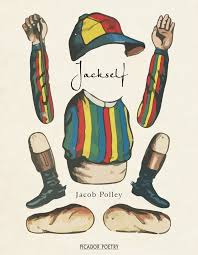
Of those people I spoke to, many poetry readers were surprised and delighted that Jacob Polley’s Jackself recently won the 2016 T.S. Eliot Prize against competition from the likes of Capildeo, Duhig, Oswald and Riley among others. Caught between a desire that prizes go only to the very best work and a wish that poetry’s few rewards be more equitably distributed, I was also delighted as this is a book which is bold and inventive, against the grain and successfully ambitious. (Apologies for some loss of formatting of any quotes that follow).

imgres

The book’s novelistic aspects have been noted in reviews – they are easier to discuss than its poetic achievements. Jackself is a boy growing up in the rural north of England, befriended by Jeremy Wren who, within a few years, commits suicide, leaving Jackself to deal with the grief. As ‘novel’ material, both the opening and close of the book refuse to provide what a reader might be looking for but as poetry it delivers what Heaney characterised as the “superfluity of language’s own resources. It’s a kind of overdoing it. Enough is not enough when it comes to poetry” (Giving Their Word, 2002). Polley’s language is charged, improvisatory and colloquial. It is fluid and rhythmic (more modern, less ballad-like than some reviews have suggested). It has a crusted, superfluous quality to it that reminds me of Shakespeare, or what Hughes has described of Shakespeare’s excess, and Jackself is not thinned out by constant ironising, rather it’s thickened by a weight of language, history and imaginative hard work. It’s very impressive – but needs a few reads before it gives itself up.

It’s best to begin with Jackself’s birth poem, ‘Every Creeping Thing’, the second in the collection (I’ll return to the first, ‘The House that Jack Built’ later). The natural world is important to the boy and this book and his arrival “at the door / of the door of the door” is also a journey “by water mite / by the snail on its slick of light”. There’s a Hughesian feel to some of the poems (Crow’s ‘Examination at the Womb-door’ here?) but Jackself enters a childhood freshly and vividly caught in its exploration by mouth and “curatorial spit”, cat-watching, one-piece suits and sleep that ends by “mak[ing] / the world over again” (‘Jack Sprat’). All seems good and safe though by the sixth birthday party with its “six / goody candles” there is a noting of absence: “no wishing it wouldn’t be / or wasn’t or would better be / no wondering how so hard it hurts” (‘The Goodies’). This seems proleptic of darker questions to come and is also a good example of Polley’s vigorously colloquial style, full of dynamic sound patterning.

images

It’s never easy to determine Jackself’s age in the book (occasionally I felt he was older than his responses suggested). I think Rimbaud suggests the detachment of self-consciousness kicks in around 7 years old so it’s perhaps at that age that Jackself is “afraid like snow he’ll wane or drift / before he can hold /  the road out front” (‘Jackself’s Quality’). He also explores “the lovely lofts / of Lamanby” – his house – showing a reflective, curiosity which is notably not catered for at school. ‘Lessons’ is great poem about the failures of education (I write as a teacher) with Jackself taken away to a corner, impelled to worship, to eat shit school dinners, to be humiliated before his parents. The thumbnail sketch of the Headmaster, Mr Workbench is worthy of Dickens as he “solemnly inclines / his one-thought- / at-a-time head”. Polley captures Jackself’s alternative headspace beautifully:


his mind a corner

of beehives

his fingers a box of matches

his nose the afternoon rain

[. . . ]

his tongue an earwig

before it hatches

imgres

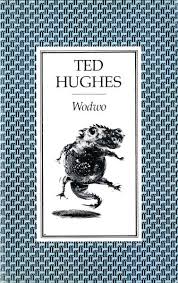
Where Jackself is at home is in the natural world. ‘Applejack’ has strong echoes of Hughes’ ‘Wodwo’ with its instinctual, open-minded, pre-language, exploratory movement:


by hedgehog path

and badger path, Jackself

happens with the clouds

into sunlight

images

The book lights up differently with the appearance of Jeremy Wren, a more wise-cracking, cynical, entrepreneurial and ultimately more troubled young man than Jackself. The pair strike up a double act – they both respond powerfully to the natural world and their dialogues are both funny and poignant. In ‘Les Symbolistes’, getting drunk on “white cider and Malibu”, Jackself let’s slip for the first time an interest in poetry: “A POEM! Wren roars / you’re creepy as a two-headed calf”. This is also one of the early moments when we see Wren’s troubled side – his father beats him. The jigsaw pieces of the boy’s troubles are carefully placed by Polley. He and Jackself meet in a goose shed, as if both on the run from something; ‘It’ asks “tell us what’s wrong, Jeremy Wren”; in ‘Snow Dad’ Wren insists they make a replacement father snow-man but also recalls when he climbed into a chest freezer. He hangs himself in ‘Pact’. He “hangs thinking fuck I’ve left / no note until he’s fucking dead”. Maitreyabandhu has written of not dissimilar events in his sequence ‘Stephen’ in The Crumb Road (Bloodaxe, 2013).

images

Jackself now becomes a study in teenage grief. ‘The Hole’ has Jackself contemplating Wren’s grave (this is one of the poems where the language seems less comfortably matched with the likely age of the boy). One way he tries to deal with the loss is by writing. ‘Jack O’Lantern’ is a deconstructed – or as they say of websites, still in construction – ballad with Jackself trying, then rejecting, lines in a fashion that is both humorous and touching (“no           again . . .  no          again”).

Polley’s achievement is to find a form and voice which can encompass all this . . . stuff. Long and short lines are scattered across the pages, poems often start in media res, often lack an explicit subject, dialogue is unmarked and the reader must sort things out. But this all adds urgency to the telling and a fluidity to the narrative perspectives. Polley’s Jackself often reminded me of David Jones’ protagonist, Private John Ball, from In Parenthesis (1937). The two share a mythic quality, representative but individualised. In ‘The Misery’ Jackself becomes/sees himself as a heroic dragon-slayer and the dragon he wishes to kill is his grief at the death of Wren. The disturbed psychological perspective implied by this is a result of his depression over the suicide of his friend – but the poem manages a marvellous mock-heroic tone:


from his weapon chest,

the sheath knife, Eglantine                      from his wardrobe,

his denim jacket, torch, tool belt, tin camping cup,

rucksack, horned hat and Gore-Tex breastplate

imgres

What he kills in the end is just a rabbit but the ritualistic/symbolic nature of his action has an effect. It takes a while, during which he continues his (often hilarious) dialogues with the dead Wren and finds solace in the natural world but ‘Tithe’ indicates through its page lay-out, its vast white spaces, that Wren vanishes eventually, Jackself moves on.

Hard to end such a book and I confess I didn’t find the ballad-like ‘Jack O’Bedlam’ very satisfying, but perhaps I’m falling foul of the novel reader’s desire for narrative closure (though I thought we’d all grown out of that). This is in contrast to the opening poem of the book, ‘The House that Jack Built’, which I found powerful in its own right as a historical survey of the region in which Jackself’s brief story takes place. Polley writes of the trees being felled and used, re-growing through history, interactions with burgeoning human society, the Industrial Revolution, canal building, eventually to the construction of Lamanby itself. Critics will want to debate its relevance to the sequence of personal biography that follows it and concludes with no explicit ‘picking up’ of the opening poem’s themes. It is a problem; but the depth of history this opening poem implies, its focus on the natural world, its foregrounding of (for want of a better word) folk culture surely gains Polley permission for the way in which he tells Jackself’s tale, for it as a poem. Like Jones’ use of mythic, folkloric and Shakespearean materials in In Parenthesis, Polley raises the small-scale biographical to a type without losing anything of the minute particulars which enable its readers to read Jack as themselves.

‘From Palette to Pen’ – a bit more ekphrasis

My blog post a couple of weeks ago on ekphrastic poems (ie. poems stimulated by visual art) proved to be one of the most popular I’ve ever written. This was in part the ‘how to’ aspect of the blog. In preparing to run a workshop at the Holburne Museum in Bath in February, 2017, I’d been reading a wide variety of poems derived in some fashion from the poet’s encounter with visual art and I tried to categorise the various approaches. I came up with 14: 

  1. Describe – and do no more.
  2. Describe but imagine beyond the frame
  3. Describe but incorporate researched materials
  4. Make Main Figure Speak – the most common approach
  5. Make Minor Figure/s Speak
  6. Make Objects Speak
  7. Make the Artist Speak
  8. Interrogation of the Artist
  9. Interrogation of illustrated Figure/s
  10. Interrogation of Yourself
  11. An Account of Your Encounter with the Art
  12. An Account of Gallery Visitors’ Experience
  13. An Account of Others’ Experience
  14. Come at a Tangent – the ekphrastic experience as after-thought or illustration

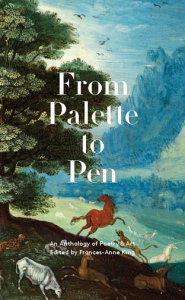
From-Palette-to-Pen-185x300

While at the Holburne Museum I was given their recent anthology of ekphrastic poems, From Palette to Pen, edited by Frances-Anne King in 2016. It contains 20 poems stimulated by art objects in the Holburne and as well as recommending it as a great resource for ekphrastic writing, I thought I’d use it to test my earlier analysis of the form to see if it held water.

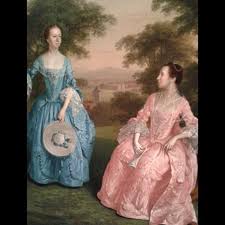
It did pretty well. It goes without saying that all the poems engaged to some degree in method 1 – description of the art object itself. But beyond that, by far the commonest approach was method 4 – making the main figure speak. This was adopted by Anna-May Laugher, Claire Dyer, Carrie Etter, Frances-Anne King, Pascale Petit, Linda Saunders and Lesley Saunders. Petit manages to make Adam speak, remembering his naming of the animals; Claire Dyer makes Rosamund Sargent speak from her own portrait by Allan Ramsay; Lesley Saunders makes one of the sisters, Alicia and Jane Clarke, speak and so betray their “little sisterly difficulties”.

imgres

Another common approach was my method 8, an interrogation of the artist (without getting the artist to actually speak for themselves (method 7)). Jenny Lewis’ poem on a 17th century Rosewater basin began in this way, inquiring “What’s on his mind as he hammers / the silver, makes light flower”. Her poem goes on to incorporate some obvious research into the object too (my method 3) which takes her poem away from a narrow view into the colonial world of “London, the world, New England” in which it was made. David Hale, writing about Jan Asselyn’s ‘Landscape with Drover’ also imagines and interogates the artist’s approach, gazing at his own picture in process:

Ah, the south. He feels the heat of it

on his face and hands, smells dust, dung

and crushed thyme as he sips his coffee,

wonders again what the bull is looking at –

where time and life have gone.

imgres

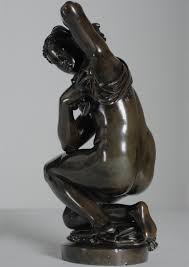
I’d be tempted to widen this category of approach – or even introduce a new one – because several poems in the anthology interrogate the artist specifically about the artistic methods used to create the art object. Sue Boyle does this in detail about the making of Antonio Susini’s bronze figure, ‘Crouching Venus’: “Coated in plaster, lowered into fire, / she must be negated, melted from her mould”. There are also elements of this approach in the poems by Dawn Gorman and Phillip Gross, the latter dwelling as much on the making of a Beadwork Basket as on its illustrations of Charles II and Catherine of Braganza. Gill Learner’s poem also looks over the artist’s shoulder as he glazes a 15th century earthenware dish.

My method 9 – interrogating or engaging with one of the figures in the art work – was used by Caroline Heaton, Wendy Klein and Tim Liardet. Klein and Liardet both directly address figures in the image (for example, “Someone chose the best for you, Mary Bourchier” and “You let the baby grip his fingers”). Heaton’s engagement with Plura’s marble statue of ‘Diana and Endymion’ is a bit less direct, using the third person (rather than a second person address) to think herself into Diana’s state of mind:

Confined to the island

of the self, she laments

the chill of her lunar circuit,

its lonely eminence.

imgres

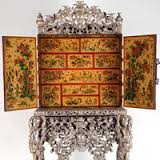
Rosie Jackson approached a piece of furniture, ‘The Witcombe Cabinet’, via a brief description of it but quickly developed thoughts about her own mother and indeed herself which I’d take to be my method 10 – using the art object to interrogate or enquire into one’s own life: “”My mother would have loved it here, / the roped off beauty […] But I ask questions of locked drawers”.

imgres

I think Claire Williamson mostly used method 3 – describe and make use of researched materials – in her poem on Thomas Barker’s painting of ‘Priscilla Jones’. The relationship between the sitter and the artist is the focus here, their romantic engagement and subsequent “passionless” marriage. In fact, I’ve not checked details of the painting/poem and I suppose it maybe that Williamson is making all this up – in which case she’s adopting method 2 – describe and imagine beyond the frame as George Szirtes does in anticipating the adult life of the boy in ‘Garton Orme at the Spinet’.

So the methods used in this anthology are fairly limited – seven of the fourteen I proposed. Those not adopted here are several varieties of ventriloquism (getting minor figures or objects to speak up; getting the artists to speak directly), the kinds of poem that more narratively describe encounters with art objects in a gallery or other location and a more tangential approach.

imgres

Finally, Lawrence Sail’s poem describes a Mantuan School ‘Female Head’ and is probably the ‘purest’ ekphrastic poem in the anthology in that it does little more than describe the image – method 1. However, Sail addresses the woman imaged as “Our lady of the liminal” and as such he breaches the borders (“offstage”) a fair bit, beginning to imagine beyond the frame to some degree (method 2). It’s a lovely poem and deserves quoting in full:

Female Head, about 1525

Our lady of the liminal –

witness at her back the margins of

the unruly forest,

and the focus of all her attention

being offstage.


But the heart of the story is locked

in the ghost of her gaze – its candour,

the early signs

of grief, a drift to the verge

where hope wavers.


And everywhere, time on the make –

in the darkening turquoise of the sky,

the slow swell

of the trees, the craquelure moving up

to infect her soft features.

An Interview with Hilary Davies

In January this year, I posted a review of Hilary Davies’ powerful new collection, Exile and the Kingdom. In what follows, she has been kind enough to answer a few questions which presented themselves as I read the book. In her replies, Davies ranges across poetic influence, the importance to her work of a European perspective, the question of structuring a poetry collection, the relation between the spiritual and the everyday, and the difficulty of writing about grief and loss.

9781910392171

MC: Could you say a little about the significance of the title of the book, Exile and the Kingdom?

HD: Exile and the Kingdom treats of preoccupations that have been with me all my life.  The collection consists of five distinct but interrelated sequences which all have to do with pilgrimage in some way. Our pilgrimage through life is in a very real sense an exile but how we approach it, are changed by it and by those we meet and love is also how we may approach the kingdom.

MC: The book’s five parts have a clear structure and I found myself wondering how that architectural ordering of poems came about and how it related to the chronological sequence of their being written.

HD: Since my first book of poems, The Shanghai Owner of the Bonsai Shop, back in 1991, I have written in all my collections in sequences. This is because I found that discrete lyrics, unconnected to any wider context, were no longer sufficient by themselves to allow me to address the themes I wanted to address. I began to think in terms of a broader architectonic for the poems I wanted to write: each time I have embarked on new subject matter, I have sought a scaffolding, a framework, to give my work the reach I felt my chosen topic needed. Sometimes these have been quite simple, sometimes very complex, requiring a great deal of research in a dizzying variety of areas. This research has been an integral part of the poetic voyage and creative process for me over the years, and I find it exciting and exhilarating.

Exile and the Kingdom is no exception. The eponymous section comes last. It was, however, actually the first to be written.  Finding this particular theme took a long time, over a year; the title, much longer. There were several false starts and considerable frustration. This was in part the normal consequence of having just published my third collection, Imperium. At such moments, there is always a period, first, of satisfaction and repletion, then an insidious feeling of lack of purpose, then increasing anxiety that you may never be able to do it again.

imgres

MC: The use of the liturgical ‘hours’ as the structuring device in the concluding ‘Exile and the Kingdom’ sequence is very powerful. Is this something that formed part of your original thinking about the sequence or a later ‘addition’ that seemed right?

HD: I knew I wanted to write something about the stages in my spiritual life up till then, including my conversion to Catholicism, but couldn’t see how to do it. Slowly, I discovered a structure: the liturgical hours or divine office.  These are amongst the very oldest of Christian prayers, dating back to the time of the apostles and influenced by Jewish practice. They were incorporated, in altered form, into Cranmer’s Book of Common Prayer and are consequently familiar to Anglicans the world over, in, for example, evensong; they are still observed in monastic communities and in both the Eastern and Catholic churches. What was especially interesting to me was their symbolism, which is a dual one. They mark out the day and the night, and are thus associated with different states of the soul, different spiritual aspirations, different signposts on the journey of life. Traditionally, they have also been attached to different texts in the New Testament, something of which I was not aware initially and which became part of the quest, to see how these passages related to events in my own life. They did, of course, as all great religious texts do, because part of their aim is to explain ourselves and the forces that we encounter to us.

MC: The closeness of the spiritual to the everyday seems to be one of the points of the book’s second sequence, ‘Songs from the Lea Valley’ which strikes a very different note, more personal, urban and multicultural.

HD: My home for the last 25 years has been the Lea valley, on the eastern edge of London. It is of huge importance to the history of the city, and yet remains unknown to many inhabitants in spite of being chosen for the site of the Olympic park in 2012.  In order to celebrate it, I began writing occasional lyrics over a period of years, evoking the river, marshlands, the city, those who have lived here and given it its character way back even into the Stone Age.  It is a hugely cosmopolitan place – more languages are spoken in my constituency than anywhere else in Europe – and that spirit of ‘live and let live’, the melting pot of cultures and the vibrant atmosphere it creates, is what I wanted to convey in the poem ‘In Abney Park’. This is a 19th century cemetery in Stoke Newington, now a nature reserve beloved of walkers and mothers with babies. It is peopled with mourning angels, as was the custom of the time, but lies only yards from the bustle of Ermine Street, the great Roman road north to York, along which the trade and armies of empire have been travelling for two millennia.

36680070
Abney Park, Stoke Newington, north London

MC: Throughout the book you make use of two quite distinctive poetic styles. One is a more discursive, even philosophical, free style of unrhymed verse; the other is more formal and lyrical. Are they contrasting or complementary?

HD: The question of styles emerged really from the differing subject matters. The personal poems naturally spoke in a lyric voice, the longer sequences do mirror the fact I am trying to reflect on larger historical and philosophical themes

MC: In that variety of poetic voice, I seem to hear the influence of writers like T.S. Eliot, David Jones, even George Herbert. Which predecessors do you look to when you write, or perhaps which predecessors do you try to circumvent?

HD: I don’t consciously look to any poets when I am writing, which of course is not to say I am not influenced by certain writers, as we all are. But these influences hopefully have become fully digested in a mature style.  I have been influenced by and admire the poetry of Jones, Herbert, Eliot, Donne, Traherne, Vaughan, Yeats, Dickinson, Hopkins, Patrick Kavanaugh, W.S. Graham, David Gascoyne, George Barker.  But also Baudelaire, Apollinaire, Verlaine, Rilke, Jean Follain, Hofmannsthal, Goethe, Lorca. And others no doubt that temporarily escape my mind.  These are for wildly different reasons and sometimes as much for subject matter as prosody.

images

MC: Your love of the landscape and culture of France and Germany comes through powerfully in the book. Do you see yourself as an British poet who travels, or a European poet who lives in the UK?

HD: I first crossed the Channel at the age of fifteen, at a time when Britain was negotiating its entry into the Common Market. In those less blasé times, the land on the other side seemed unimaginably exotic and profoundly exciting. Two years later I went to Germany, West Germany as it then was – a tiny difference in nomenclature that encapsulated the catastrophe of the 20th century.  These visits changed the course of my life: I went on to read French and German at university, and to earn my living teaching these languages and cultures for over thirty years while pursuing my writing as a poet.

This means I am a committed European. I have lived in Paris and spent over 20 summers in France. I have written poems about the 12th century lovers and thinkers, Abelard and Héloïse, and poems set in the great Paleolithic landscapes of the Dordogne and the Vézère: I have charted the spiritual pilgrimage that began for me in Poitiers and the Marais in Paris.

MC: So that sense of connectedness to the European mainland and its cultures has been important to you for a very long time?

HD:  The theme of interconnectedness, of the richness that the admixture of peoples brings, was the major inspiration behind the fourth section of the collection, ‘Rhine Fugue’.  This was an ambitious project which required a great deal of research over 5 years. France and Germany are part of my psyche and part of my heritage as a European.  They have also, as we notoriously know, been for many centuries alternately brothers and enemies, and the Rhine is the great watercourse that both unites and divides them.

The notion of fugue was suggested to me by the fact that Beethoven was born on the banks of the river in Bonn; the contrapuntal nature of this musical form exactly fits the interweaving, recapitulations and reversals of the history of the Rhine.  I wrote the poem in seven overlapping and yet distinctive sections, drawing on my own experiences with the kindness of strangers as a teenager; the Prussian general Blücher’s crossing of the Rhine in the cold dead of night to go and help Wellington at Waterloo; evocations of the benign influence of the river in different French and German locations; the rich Jewish Ashkenazim tradition during the Middle Ages in Worms; William Tyndale’s publication of his world-changing English translation of the New Testament while in exile, also in Worms; Beethoven as a exemplar of man’s attempts to reach the spiritual world through music and, finally, a return to the Rhine as a symbol of the need for cohesion and friendship in Europe, and what happens when we don’t have that.

1f6e1630809227d75ce1fe345fbb9ac4
Blucher crossing the Rhine

When I began this poem, it seemed like a rather private concern of mine that might have little resonance with my readership; in 2017, it has all the urgency of a warning against a not so benign return to the nationalisms and wars of the past,

MC:  This is where we wish poetry had a wider and more powerful reach! You catch that admonitory sense so well in the lines: “O the melancholy of broken-backed bridges! / For razed cities never gave garlands.”  

HD:  At the height of the Second World War, two men from Rhenish backgrounds, Robert Schuman, a Frenchman of German and Luxemburg origin, and Konrad Adenauer, former mayor of Cologne, were both in hiding from the Nazis. Independently, and later together, influenced by the Christian democratic thinking of Jacques Maritain, they conceived of a post-war Europe transformed and redeemed by reconciliation and co-operation. Their vision underlies the European project and the peace that has obtained in Europe for the last 70 years. It is the Europe that I grew up in and which has sustained me poetically and professionally all my life.

MC: Despite a number of ‘in memoriam’ poems, it struck me that this was a book as much about love as grief. Did the book grew organically in that direction or was there something more willed about it?

HD: Yes, the poems were about grief, its extreme and shocking impact, but also about how in the end love overcomes this. But ‘overcomes’ makes it sound trite. It is a much more subtle, protracted and painful process than this in reality, and actually one that goes on for the rest of your life. I know this now because in the summer of 2013, my husband, the poet and editor Sebastian Barker, was diagnosed with inoperable lung cancer and given three months to live.

In fact, he lived another seven; he also lived to see his last and best collection, The Land of Gold (Enitharmon, 2014), reach publication. It contains his farewell to life, to love, his family, to the landscapes he loved in France and Greece. It contains his last and most profound statement about hope and faith, from which he gave a reading in Cambridge two days before he died.  This journey is one he had begun many years earlier but one which I had gone with him, in marriage, poetically and spiritually. His death provoked profound grief and a sudden and violent realignment of everything in my life that had seemed so certain. I have described it as ‘severe growth’: growth that was not sought for nor wanted, but which came upon me just the same.  I am still discovering what this means.  The central sequence of the book is about the loss, confusion, terror and celebration that the death of one we love occasions.  ‘Lympne Hill’ is a memory of looking out over the huge panorama at Lympne on the south coast towards Romney Marsh and the sea, where my husband seemed to touch, just for a moment, heaven. It is my thanksgiving to him.


You turn towards me, burning and happy,

That boy running the clouds over and over

Pell-mell into the hollows, this man

In his years reaching with all his might

Far out on life’s cantilever to touch his soul’s blue.


Whitesands Bay
Whitesands Bay, near St Davids

MC: The final poem of the collection is set at St Davids in Wales. You seem to be responding partly to the bleakness of the landscape. What streams of thought and experience seem to be coalescing there?

HD: That poem came out of a visit I made there at Christmas 2007, not the first by any means, as I am half Welsh. By chance we met a friend there who was visiting her very devout, sweet and Catholic mother, sitting in her ‘ragged kitchen’, and the friend then took us to St. Non’s Chapel, which is right out on a promontory exposed to the sea. Its situation struck me very much. The dusk came down in a very clear sky, with that indigo you get in winter twilight. And I was very conscious of the geology of that part of the world. Some of the oldest rocks in the world are exposed near St. David’s. Pre-Cambrian, pre-life on land, 620 million years old estimated. Hence the reference to the ‘oldlands’ where the human presence is compared to a baby in its mother’s arms.  At Whitesands Bay, near St. David’s, the shales are Cambrian and the rounded domes you see at the top are characteristic of those very old rocks.

I also remember I had Stanley Spencer’s painting of ‘Christ Carrying the Cross’ in mind in writing the line ‘The saints lean from her windows against the night’. And the final line – the concluding line of the whole collection – is from the liturgy of Compline: ‘God grant us a quiet night and a perfect end’. But the whole poem is shot through with liturgical references as is, of course, the whole sequence.


christ-carrying-the-cross-1920[1]
Stanley Spencer, ‘Christ Carrying the Cross’


: