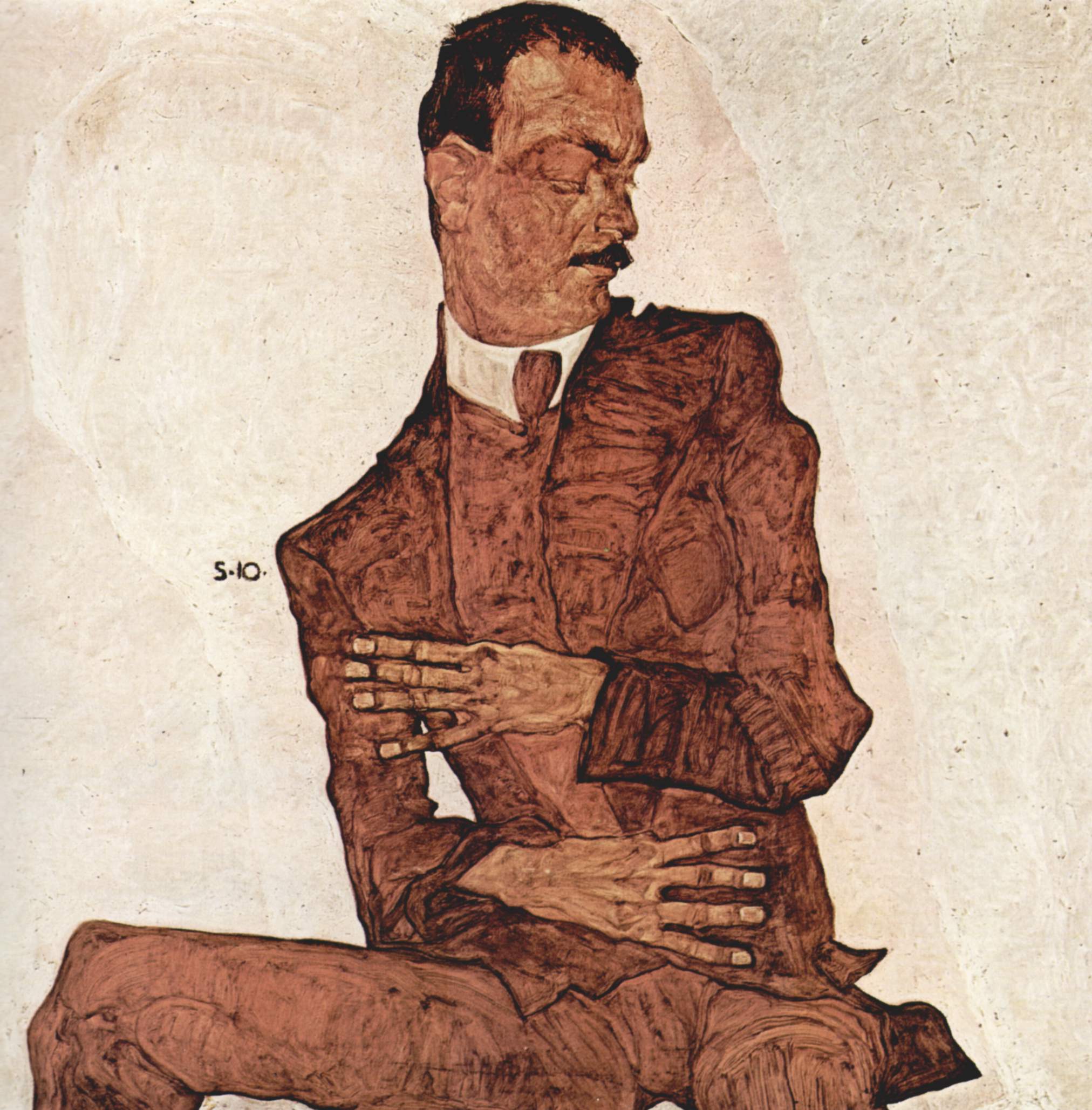
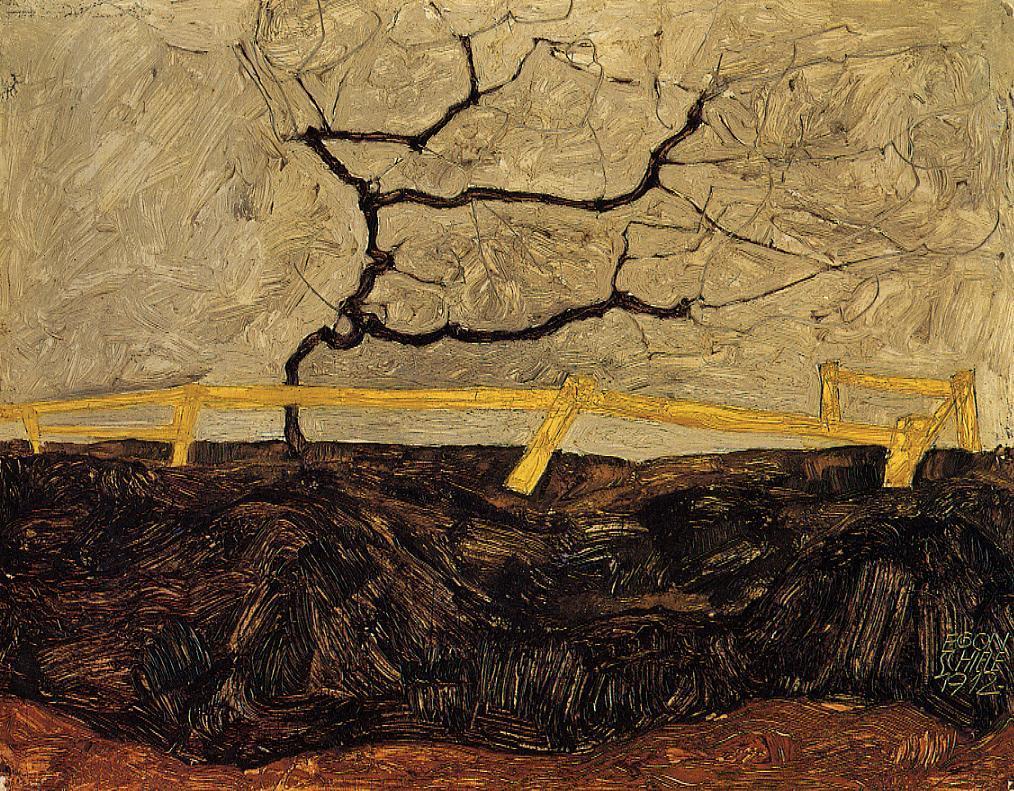
How We Created ‘O. at the Edge of the Gorge’ (Guillemot Press)

These two pieces on the writing and illustrating of my new chapbook, O. at the Edge of the Gorge, first appeared on the Guillemot Press website. Thanks to the Press and Phyllida Bluemel for permission to re-post them here.

The making of O. at the Edge of the Gorge
PART ONE by Martyn Crucefix
IMG_0281

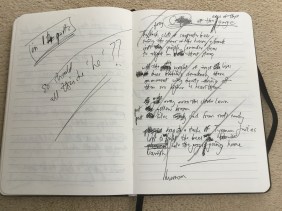
The scraps and scribbles that eventually became O. at the Edge of the Gorge are contained in a notebook dating from March 2014. The first words that made it into the finished sequence record my sighting of “6 white doves / on the boundary wall / looking away”. I’m pretty sure I spotted the birds on the drive to one of the airports north of London as, on the same page, sits a note recording a tannoy announcement calling a customer back to one of the shops in the Duty Free zone: “please return /  to Glorious Britain / for a forgotten item”. These are the sorts of strange happenstances that get thrown down in a writer’s notebook; happily, it was the dove image that stayed with me.

The landscape of the poem is the destination of my flight that day, the Marche in central, eastern Italy. I was staying in a house close to the edge of a deep gorge, looking out to distant hillsides, several hilltop villages, their church spires, clumps of dark trees. The roots of the poems – any poem, of course – spread much deeper than is immediately visible. So earlier in the same notebook, I find I had noted a quotation from Schopenhauer (itself quoted by Dannie Abse in the May 2014 issue of the magazine Acumen): “Envy builds the wall between Thee and Me thicker and stronger; sympathy makes it slight and transparent – nay, sometimes it pulls down the wall altogether and then the distinction between self and not-self vanishes”.

A little earlier, there was another note. This was from a piece by Ed Hirsch in the magazine The Dark Horse. Hirsch quoted Simone Weil’s observation that “absolutely unmixed attention is prayer”. He went on to urge our attention ought be paid to the earth, not looking for something atemporal and divine. We need to cherish the fleeting and the transient, even in its disappearance. This is the particular project of poetry, he argued, and these are recognisably Rilkean ideas that were always likely to attract my interest. I have spent many years translating Rilke’s Duino Elegies and Sonnets to Orpheus. The Orpheus link took a while to re-surface in my mind in relation to the new poems.

One other notebook entry stands out. I seem to have been reading Bruce Bawer’s book, Prophets and Professors (Storyline Press, 1995), and in a chapter on Wallace Stevens he quotes Mallarme: “To name an object is largely to destroy poetic enjoyment, which comes from gradual divination. The ideal is to suggest the object”. It’s not necessary for a writer to fully grasp such scattered sources; they tend to be ripped out of context and appropriated for use. In retrospect, I seemed to be thinking, over a period of weeks, about the relation between self and other, the paying of attention to the transient world and the difficulty of maintaining such attention through the medium of language. All of this re-appears in the poems that make up O. at the Edge of the Gorge.

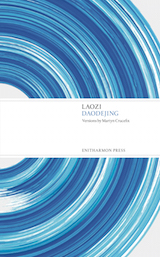
Also by this time – probably July 2014 – there were two strong poetic voices chanting in my head. One was from poems I was trying to translate by Peter Huchel, poems written in the highly censored context of the GDR in the mid 20th century. I find I’d scribbled down “his vision is up-rooted, deracinated in the extreme – a world where meaning has withdrawn (the jugglers have long gone) what’s left is iron, winter, suspicion – spies, the Stasi, meaninglessness – but the natural world persists”. The other voice was from the Ancient Chinese texts of the Daodejing which I had also been versioning for quite a few months previously and were eventually to be published in 2016 by Enitharmon Press.

In complete contrast to Huchel, the Daodejing’s vision is one of ultimate unity and wholeness achieved through such an intense attentiveness as to extinguish the self and all barriers. These two extremes seem to form a key part of the sequence of poems that emerged in the next few weeks, my narrative voice moving from a Huchel-like sense of division and isolation to a more Dao-like sense of potential oneness.

Besides all this, I was playing in the notebook with the idea of ‘off’’. The point was, rather than focusing where the ‘frame’ directs us, we gain more from attending to what lies beyond it; the peripheral, I suppose, in a kind of revolt. I was muttering to myself “locus not focus”. I was thinking of the lovely word ‘pleroma’, a word associated with the Gnostics and referring to the aggregation of all Divine powers – though, as with Ed Hirsch, I was not so much interested in the Divine. Pleroma is the totality of all things; something like the Daoist’s intuition of the One. I think such ideas gave rise – quite unconsciously – to the several swarms, and flocks, the “snufflings the squeals and scratchings” that recur in the poems. These represent the fecund variousness of the (natural) world to which we might be paying more attention.

The hilly landscape and the plunging gorge itself also seem to suggest (at first) a divided vision. The carpenter bees act as intermediaries – at first alien, later to be emulated. As the first rapid drafts of individual poems came, there was a plain lyric voice – an ‘I’ – in a sort of reportage, revelling in the landscape, its creatures, colours and sounds till eventually I had 12 sonnet-like pieces. One of the poems seemed already to allude to the Orpheus myth, the moment when he looks back to Eurydice and she is returned forever to the underworld. His mistake, in this version, was that he was seeking an over-determined, “comprehending grip on earth” as opposed to a more passive openness to the phenomena of the world (which Eurydice seemed now to represent).

At some stage, the narrating ‘I’ was switched to a ‘he’ and the ‘he’ began to feel more and more like a version of Orpheus himself (hence O. at the Edge of the Gorge). The change from first to third person also gave me more distance from the materials. It was on a later visit to read my own work at the Cheltenham Poetry Festival in the Spring of the following year that I heard Angela France reading a crown of sonnets. I blogged about it at the time and coming home it struck me that my sequence ought to take the same highly interconnected form. The 10th of my sonnets – precisely that moment where the Orpheus/Eurydice separation occurred – was expanded into two poems, absorbing some details about a parked car on a hill and others, also focused on transience, from Dante’s Paradiso Book 16. The final sonnet to appear picked up on some notes I’d made long before about seeing a hunting hawk rise up from the roadside clutching a mouse or rat in its talons. By this stage, the gorge, in its representation of the Other, had also come to be associated with life’s most apparent Other, death. The whim, or wish, or risky flight of my narrator to include or encompass the gorge itself became the poems’ hoped for goal.

The making of O. at the Edge of the Gorge
PART TWO by designer and illustrator Phyllida Bluemel

I have a print-out of O at the Edge of the Gorge covered in pencil scribbles and tiny indecipherable thumbnails of visual ideas. Putting images to poetry can be daunting. I find that, armed with a pencil, a close reading of the text and lots of doodling is a good place to start. I thought a lot about the point of illustrating poetry – what the images can bring. I want the illustrations to be in conversation with the poem, rather than just replicating images already present in the words. Starting with an intuitive visual response is a nice way to get the conversation started.image1

For me the poems read like an unforced train of thought – a notebook in the pocket of a traveller, a sun-drenched jotting of linked observations and associations and memories – the kind of meandering thoughts that are particular to a slow and hot afternoon. They are very evocative of place.

I was taken with the formal playfulness of the poems – the crown of sonnets – where emphasis repeats and changes and each poem flows effortlessly into the next. An enacting of Martyn Crucefix’s line “he snaps them sketches then revises again”. It seemed appropriate to echo that in the imagery. The folded and interrupted illustrations bind each poem to the next. I wanted to give myself some of the constraints that the poet had set himself – and nearly every image contains an element of the one before, re-appropriated and carried forward – a visual game of Chinese whispers.

22071074_225079284691665_7698907406985592832_nThe poems move from one image to the next but there are the same preoccupations – the specks and the flocks and movements alongside monuments and geology – contrasting contexts of time, and the sense (especially given the form) of something trying to be ordered or sorted out, but not quite complying – “dicing segments of counted time…” The diagrammatic, map-like – but not-quite scrutable imagery is a response to this – an attempt to make sense of forms and information, or grasp a particular memory and note it down. Not quite successfully. We are left with a string of related thoughts and a measuring or structuring impulse.

The imagery itself takes its leave from the words – an outlined lavender stem becomes a cross-section, a contoured landscape, which in turn ends up as the outline of a branch, twisting into the form of the river at the bottom of the gorge. I had a lot of fun playing with scale and the way in which lines taken from nature mimic each other. This felt right because of the shifts in perspective in the poetry – from the raptor’s eye view, to the ‘snufflings’ and ‘scratchings’ of detail. The buzzard’s diving and ‘zooming-in’ of the landscape. 22158675_355445834881295_4436376972506955776_n(1)

The use of newsprint for the folded pages is as much an act of ‘illustration’ for me as the lines. Maps and diagrams and lines interrupted by folds and the edge of the pages make it feel as if they are part of something else – ephemera or a dog-eared map folded, or a napkin sketch ­ – tucked between the pages of a notebook. I also think it’s OK to want to make a beautiful object for the sake of a beautiful object – the tactility of different paper stocks, the small and pocketable size of the book – all I hope lend themselves to a thoughtful reading of the poem.
How to Answer the Poetic Influence Question #2

With my new collection just out from Seren Books, I’m happy to have a number of promotional events and readings coming up over the next couple of months. As I discussed in an earlier blog, though I love the business of giving a reading, there’s often a moment that arises that I’m always uneasy about. It’s the question of influence. In that previous blog I followed through, chronologically, those poets who have had a powerful influence over the style and direction of my work. That provides one possible answer to the question ‘what other poets do you consider to have been an influence on your poems?’ Another reply might be to look closely at very recent work to see which poets are present in it as ghosts. This is what I’m doing here.

A Boat..._quicksand cover

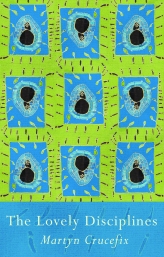
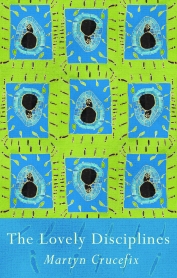
In preparing a new book for public reading, I tend to work through every poem making notes on the kind of thing an audience might need/like to know before hearing it (once and once only, in performance). I will often draw attention to the presence of a powerful poet figure that I’m aware of in the vicinity of the poem. So in The Lovely Disciplines, I can see influential roles of substance for Robert Hass (with Czeslaw Milosz), Ivan Lalic, Mary Oliver (with Emerson), Whitman and Edward Thomas.

Before looking at those in a little more detail, there are also two translations/versions from other poets in the collection. One is a version of Boris Pasternak’s poem from the 1950s called ‘In Hospital’. In the process of my versioning, the gender of the main protagonist was switched to female, more in line with most of the poems from the middle section of my book which forms a composite portrait of the passing of my parents’ generation.

Abbaye_de_Valsainte_2
Abbaye de Valsainte

I also include a loose translation of (plus a poem alluding to) the work of the French poet, Yves Bonnefoy, who I referred to in my earlier post on Poetic Influence. My poem ‘Valsaintes’ is named after the rural retreat in Haute-Provence where Bonnefoy lived in the 1960s. In many ways an idyllic place, in the end the renovation and up-keep of what was little more than an ancient ruin proved too much for him and the property was sold. For years afterwards, he harked back to it as a favoured, lost place. Bonnefoy’s ideas about what he calls ‘presence’ continue to fascinate me. My version, called ‘After Bonnefoy’, ends:


let’s bring ourselves one to another


as if each was at last all creatures

and all things all empty ways

all stones all metals and all streams

download
Sir Michael Tippett

Sir Michael Tippett’s 1944 secular oratorio, A Child of Our Time, is explicitly relevant to my poem ‘Listening to Tippett twice’. Tippett also wrote the libretto, inspired by the assassination in 1938 of a German diplomat by a young Jewish refugee and the Nazi government’s reaction to it. This took the form of a violent pogrom against its Jewish population – the infamous Kristallnacht, so called because of the broken glass which littered the streets the following morning. Tippett’s text and music deals with these incidents in the context of the experience of oppressed people more generally and the whole work carries a strongly pacifist message of understanding and the need for reconciliation.

I’m certainly aware of echoes of Wordsworth on a couple of occasions. In ‘The Toll Cottage’ – a dream-poem in which I am being driven by my father – there’s a mangled remembrance of a phrase Wordsworth uses in ‘Tintern Abbey’ – “Once again I see / These hedgerows, hardly hedgerows, little lines / Of sportive wood run wild”. Also ‘The girl who returned to Aix’, a sequence of three sonnets, includes the awkward fact that I cried on first seeing Steven Spielberg’s Close Encounters of the Third Kind. It was that moment when the huge alien spaceship finally appears, rising up from behind a mountain – just as Wordsworth’s mountain, Black Crag, rises up in the boat-stealing episode of The Prelude Book 1.

download
Enough to make a grown man weep

In my poem ‘Nocturne’, I was partly thinking of Whistler’s painting, ‘Nocturne in Black and Gold’ (c. 1875) but I like to think my (love) poem has more light in it than that, set as it is in the same Tuscan landscape as another poem called ‘The renovation near Sansepolcro’. ‘Nocturne’ also makes reference to ‘the poet’s kelson’ and this is Walt Whitman who, in the fifth part of ‘Song of Myself’, refers to love as a kelson of creation. A kelson (or keelson) is the structure running the length of a ship and fastening the timbers or plates of the floor to its keel giving stability and strength.

download

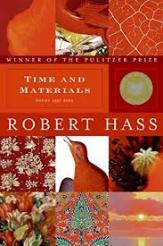
In his book, Time and Materials (2007), introducing the sequence ‘Czeslaw Milosz: In Memoriam’, Robert Hass recounts a discussion he had with Milosz (as his translator) about the different connotations in English of Oh! and O! As it turned out, the one Milosz intended in his poems was the second and this is the one that most interests me too. My poem opens:


Oh! is longer drawn already

beginning the button-down

of understanding

that well-I-never

with its freighting

of verb tense and identity

whereas O! is more sudden

more urgent surely

of the moment rapt

when we are prised open

by desire [. . .]


I wanted the title of my poem, ‘The lovely disciplines’, to feel paradoxical and in my mind it was related to the Serbo-Croat poet, Ivan Lalic. I remember reading his 1981 collection, translated by Francis R. Jones as The Passionate Measure. I remember Lalic explaining he hoped to suggest the fluidity or fluency of emotion as well as the orderliness or measured nature of a dance or verse. I hoped my title would suggest something of the same – a balanced response to experience, both our taking pleasure in it and searching it for order. My poem takes place on a women’s hospital ward.

download

Mary Oliver’s book, Swan, is not her best but I bought it in a secondhand bookshop once and inside discovered an ATM receipt with some cryptic notes on it. This provided the start of ‘As we live’, a poem which takes up Oliver’s sensitivity to nature (which she often gazes at with such precision of feeling as to achieve a visionary intensity) as well as her epigraphs from Rilke’s Duino Elegies and Ralph Waldo Emerson’s essay ‘Beauty’ in The Conduct of Life: “’Tis curious that we only believe as deep as we live”.

Finally, Edward Thomas (Ted Hughes’ “father of us all”) appears explicitly in relation to two poems in my book. Not a million miles from Oliver’s example, it’s his directness and love of what lies before him that I like. I like his sense that, in Robert Frost’s words, this world is the right place for love, combined with his intuitions about the human need to look beyond, perhaps into an inexpressible obscurity. ‘These things I remember’ is almost a found poem on these issues – taking phrases from a memoir written by Thomas’ friend Jesse Berridge (published with letters by Enitharmon Press).

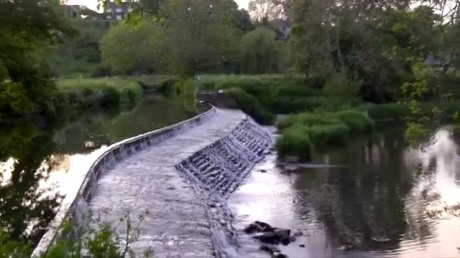
And ‘Rebuilding Tellisford weir’ has an epigraph from Thomas’ 1914 prose book, In Pursuit of Spring. His book recounts his 1913 journey – by bicycle – across southern England from London to the Quantock Hills. I was delighted to discover him passing through the landscape of my childhood: cycling down off Salisbury Plain, through Erlestoke and Edington, Steeple Ashton, North Bradley to stay with friends at Dillybrook Farm just outside Trowbridge, where I lived for 18 years. He writes about waking at night to the sound of falling water. The next day he is persuaded to visit Tellisford and its weir by the mysterious Other Man (a kind of alter ego for Thomas). My poem mixes some of these details with my own memories of visits to Tellisford. I like to think the poem has a lot of Thomas in it: a sense of history, the beauty of nature, strange encounters with others, a sad loneliness, the transience of all things.

maxresdefault
The weir at Tellisford, Wiltshire

How to Answer the Poetic Influence Question #1

A Boat..._quicksand cover

With my new collection just out from Seren Books, I’m happy to have a number of promotional events and readings coming up over the next couple of months. I love the business of giving a reading, but there’s often a moment that arises that makes me uneasy as to how to how to respond. It’s the question of influence; the hand going up to ask: what other poets do you consider to have been an influence on your own poems?

It’s my problem I’m sure, but I’ve always had two ludicrously extreme responses spring to mind on hearing the question. Firstly, to list pretty much every single poet I’ve read in the last 40 years because the truth is every single one has added a grain, a pebble (for better or worse) to the path I walk to write a poem. Alternatively, since I can’t think of one, or even two, clear contenders for powerful influence when I sit down at a blank page or screen, it must be that I have emerged ex nihilo, a peculiar original. The first would be a lengthy reply of little use or interest; the second would seem positively dripping with arrogance (and equally of little use or interest).
Actually, I can think of a third answer: it’s not for the poet to identify influences; it’s a job for a reader. But I wanted to use the next two posts to kick the idea of influence around, to sort out my own ideas and to answer it in two ways. Early in a writing career, the revelation of, or encounter with, a new voice, style, or even subject area can lead to great lurching changes of direction in a poet’s own work. The lurch or swerve becomes progressively less marked the older a poet gets. Put that down to a more confident self belief perhaps, or to a growing inertia, or a more sophisticated process of absorption of such novelty, or sheer bloody mindedness . . .

images

For me, I started in the business convinced that I was composing song lyrics because poetry as such was not a familiar thing – except in occasional English classes at school and I dropped that subject at the age of 16. As I’ve said elsewhere, science was what I did through most of my teens. With too much time on my hands and too little joy to be found elsewhere, in the mid 1970s I began to turn to other sorts of books. From Foyle’s in London, I stole a copy of Everyman’s Selected Poems of Wordsworth. They seemed a bit dull and plodding but reminded me of rural Wiltshire where I grew up. For a few months I copied Wordsworth. Perhaps a year later, after a good dose of Sartre, I was finding my way back to the academic study of literature. It was the poetry (and drama) of T S Eliot that I fell in love with (not Dylan Thomas – the other poet on the curriculum). I still have those early Eliotesque poems somewhere, mostly Prufrock period style, though also a horrifyingly pretentious sequence of poems like a clumsy, anaphora-laden Waste Land.

00014096-390x540

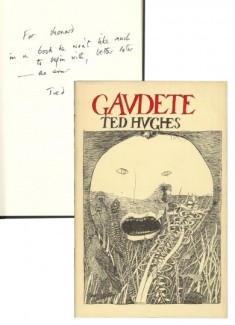
Re-starting my Higher Education took me to Lancaster University, studying Literature and Philosophy (and a few sessions of Creative Writing with poet, David Craig) and Hughes and Larkin were served up and readily ingested. At first, I swerved to the latter’s urban details and personal gloom; later it was the Hughes of Gaudete (recently published, 1977) that I copied, writing a long, quasi-mythic, magic-real, psychodrama about sex and power that I eventually self-published in Oxford. As a post-graduate among the dreaming spires, it was Percy Byshe Shelley who I was working on for several years and, though not a model for poems as such, his ideas about the role of the Imagination and poetry as an “Orphic language” have been important to me ever since.

md7773056273

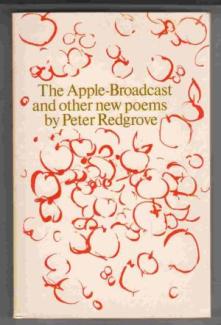
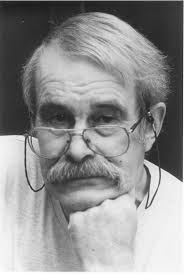
Among contemporary poets, I’d discovered Heaney (not the rural Ireland stuff so much as his wrestling with private and public responsibilities – Station Island, for example), Peter Redgrove’s fluid take on mind’s encounter with the natural world (The Apple Broadcast) and Ken Smith’s urban-political Americana (oh how I wanted to have written Fox Running). I wrote individual poems modelled on all these writers while absorbing much more deeply the work of the Romantic period – only now did I really find Keats, his poems and letters, Wordsworth still, Coleridge’s Conversation poems especially. What might have been expected – Hardy, Auden, Yeats, Frost, Stevens, Lowell, Bishop, Plath, Dickinson – were all missing or they missed me.


download
Ken Smith


A decade of writing, reading, plus some reviewing too. A couple of my own books published and I’d stumbled my way to Rilke’s New Poems, Elegies and Sonnets, the second and third of which I began to translate and (whether visible on the surface or not) were a great influence on me – the Duino Elegies  for their thoughtful drive from existential mourning to praise, the Sonnets to Orpheus for that same thought (more of the praise) and their use of form. From Whitman I found my way to W S Merwin’s marvellous fluidity (something I was comparing to Paul Eluard’s work too) and from Rilke it seemed a logical (not the right word at all) step towards the 81 texts of the Daodejing which again I felt I had to try to English because it both rhymed with what I already knew and I knew it would develop further what I needed to know.

daodejing

A few years back, an article in PN Review sent me to the work of Yves Bonnefoy. A heart-rate raising sense of another writer who had fought the two-faced dragon of language and seen enough to conclude that at the bottom of its filthy lair gleamed the concept and the concept promises a “strange immortality” but only if we can “forget brutal reality”. One reason (I’m now quoting an earlier blog post on a 1953 essay by Bonnefoy) we do this is that there are “general truths in conceptual thinking and a particular kind of power derived from it. It ‘allows thinking’ of a certain kind; it is linked with ‘the vast power of words’. But any gain is predicated on a significant loss, the abandonment of the actually existing ‘world of things’. Conceptual thinking is ‘systematized’, generalizing, categorizing; it’s in this that its ‘flight’ from the real is found. The only sort of thing that can be held up to counter the concept are specific particularities of human experience: Bonnefoy asks ‘Is there a concept for footsteps in the night, for a cry, for a stone rolling in the brushwood? For the feeling evoked by an empty house? No [. . . ]’”


images
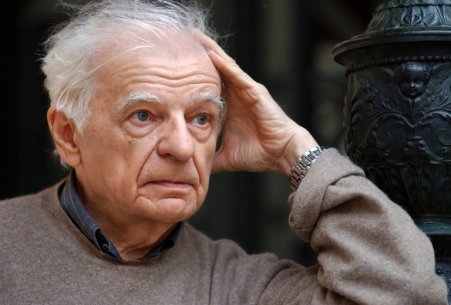
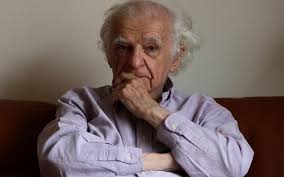
Yves Bonnefoy


Reading Bonnefoy did not send me lurching to right or left but rather nudged, re-calibrated, re-assured me that my own direction of travel was not a wholly isolated one. I don’t write like Bonnefoy – there can be a dull abstraction to his poems which seems to me to contradict his ideas about real presence expressed as specific particularities – but I know what thought underlies my own work has close parallels to his (as far as I understand him). That’s influence, I’d say.

In my next blog, I’ll look at the question of influence from a different angle – what ghosts of other writers can be seen in more recent work?

2017 Forward First Collections Reviewed #4 – Ocean Vuong

This is the fourth in the series of reviews I have been posting over the summer months of the 5 collections chosen for the 2017 Forward Prizes Felix Dennis award for best First Collection. The £5000 prize will be decided on 21st September 2017. Click on these links to access all 5 of my reviews of the 2016 shortlisted books (eventual winner Tiphanie Yanique)  and all 5 of my reviews of the 2015 shortlisted books (eventual winner Mona Arshi).

The 2017 shortlist is:

Maria Apichella – Psalmody (Eyewear Publishing) – reviewed here

Richard Georges – Make Us All Islands (Shearsman Books) – reviewed here

Eric Langley – Raking Light (Carcanet) – reviewed here

Nick Makoha – Kingdom of Gravity (Peepal Tree Press) – reviewed here

Ocean Vuong – Night Sky with Exit Wounds (Cape Poetry)

download

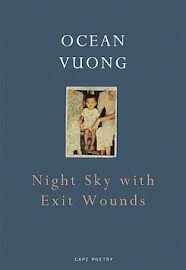
In living with Ocean Vuong’s book over the last week or two I have on occasions mistaken its title for Night Sky with Exile Wounds. It will become obvious why. But it has also been hard to ‘see’ this collection because of the accumulated material – interviews, awards, perhaps hype – that already surrounds it in a way that affects none of the other Forward First Collections this year. Vuong has already appeared on the cover of Poetry London and been interviewed by The New Yorker. He has been nominated as one of Foreign Policy magazine’s 100 Leading Global Thinkers. Such recognition is even more extraordinary given that Vinh Quoc Vuong was born in 1988 on a rice farm outside Saigon and, at the age of two, he and six relatives emigrated to Hartford, Connecticut, where they lived together in a one-bedroom apartment. On learning that ‘ocean’ (in American English) is a body of water that touches many countries – including Vietnam and the United States – his mother renamed her son.

Ocean Vuong is also gay. Hence his exile – the word that kept coming into my mind – is one not only from his birth country and culture but also from the mainstreams of his adopted country. It’s no surprise there are several Ocean Vuongs in this book in terms of subject matter as well as in its use of a variety of poetic forms. This might – reflecting his given name – be an essential, protean, shape-shifting style or it might reveal the kind of casting around in the sea of form and content one might expect from a first collection. I think it is more the latter than the former, though the thrashing and contortion involved in such self creation (we used to refer to ‘self discovery’ – the book title has ‘self portrait’) is now a topic of such ubiquity in Western culture that Vuong’s personal struggles may come to be considered as representative in themselves.

-
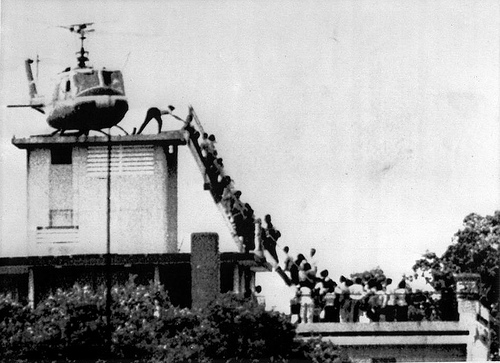
Saigon 1975

Though 13 years before his birth, ‘Aubade with Burning City’ portrays the American withdrawal from Saigon in 1975. Apparently, Armed Forces Radio played ‘White Christmas’ as a sign to commence the withdrawal and the poem assembles a montage of the song lyric, events on the streets of Saigon and a sinister, coercive-sounding male/female dialogue. The result reflects the chaos of such a moment of violent transition (though the ironies of the sentimental song are a bit obvious) and introduces a recurrent thread in Vuong’s work, the uneasy alliance between power and sex. ‘A Little Closer to the Edge’ seems a reminiscence, perhaps of his own conception (Cape’s cover image of the young poet encourages this biographical approach). Among bomb craters and anticipated domestic violence, a young Vietnamese couple are at first “hand in hand”. Then:


He lifts her white cotton skirt, revealing

another hour. His hand. His hands. The syllables


inside them. O father, O foreshadow, press

into her –


For his mother’s part, the narrative voice asks her to show “how ruin makes a home / out of hip bones” and also to “teach me / how to hold a man”.

Vuong-cover-020116-1-1
Vuong with his mother and aunt -refugee camp Philippines, c.1989.

Once in the USA, there are poems that treat both parents with some tenderness. In ‘The Gift’, the son teaches his mother the alphabet. She can hardly get beyond the third letter, the fourth, gone astray, appearing only as


a strand of black hair – unravelled

from the alphabet

& written

on her cheek


Several portrayals of Vuong’s father suggest violence and drinking but in ‘In Newport I Watch my Father Lay his Cheek to a Beached Dolphin’s Wet Back’ he is seen to express concern for the creature, “the wet refugee”, though the poem is fractured by bullets, Huey helicopters, shrapnel and snipers as if to suggest the root of the father’s violence and his inability to express affection for his own family.

91c43df9d7c2bf90139dc2df89bfa134
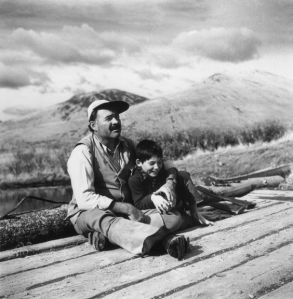
Ernest Hemingway and his son (plus guns)

Or perhaps such things innate to a man? Another major theme in the book is masculinity itself as expressed through father figures and a young gay man growing up. The former is seen in two poems involving guns. ‘The Smallest Measure’ has the father instructing the boy on how to handle a Winchester rifle (it reminds me of a photograph of Hemingway and his son). ‘Always and Forever’ (Vuong’s note tells us this is his father’s favourite Luther Vandross song) has the father substituting himself with a Colt.45 in a shoe box: “Open this when you need me most”, he says. The boy seems to wonder if the gun might deliver a liberation of sorts: “[I] wonder if an entry wound in the night // would make a hole wide as morning”. This image of an aperture being made in darkness – most often through an act of violence – to let in light recurs in these poems. I can’t quite see what is intended here but there are again links to the erotic/violence motif. Later, the gun barrel must “tighten” around the bullet “to make it speak”, making further obscure, but interesting, links to violence and the ability to speak (or write).

aseq

What it is to be a (young, gay) man is explored in the second part of the collection. Andrew McMillan’s physical comes to mind in reading these poems (McMillan interviewed Vuong for Poetry London recently). ‘Because It’s Summer’ is a more conventionally lineated poem in the second person singular (some distancing there) of slipping away from a mother’s control (and expectations) to meet a boy “waiting / in the baseball field behind the dugout”. It’s particularly good at conveying the exciement (on both sides) of a desire, previously played out alone, being mutually gratified: “the boy [. . .] finds you / beautiful because you’re not / a mirror”. ‘Homewrecker’ evokes the energy of erotic discovery as well as the ‘wreckage’ it threatens (to some) in the “father’s tantrum” as much as the “mothers’ / white dresses spilling from our feet”. ‘Seventh Circle of Earth’ is particularly inventive in its form. The poem – set as prose, but with line break slashes included (a baggy, hybrid form Vuong uses elsewhere) – appears as a series of footnotes. The footnote numbers appear scattered across a blank page. The poem deals with the murder, by immolation, of two gay men in Dallas in 2011. The mainstream silence is cleverly played against the passionate love poem only recorded as footnotes.

Elsewhere, Vuong hits less successful notes and styles. There are some dream poems – like ‘Queen under the Hill’ – which don’t always escape the hermetic seal around an individual’s dream world. On other occasions, he wants to use mythic stories to scaffold his own. ‘Telemachus’ is probably the most successful of these (the materials again feeling dream-like to me) as the son pulls his dead (shot dead) father from the ocean. Elsewhere we find allusions to Orpheus and Eurydice (and to Lorca’s ‘Sleepwalking Ballad’ and Rilke’s ‘Archaic Torso of Apollo’). Certainly, Vuong is not fearful of taking on big subjects such as JFK’s assassination (‘Of Thee I Sing’), the murders of Jeffrey Dahmer (‘Into the Breach’) and 9/11 (‘Untitled’).


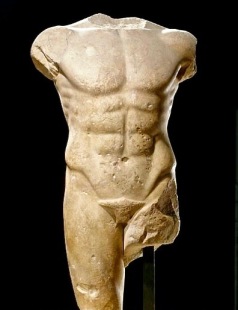
miletus torso_cropped - 1
Archaic Torso of Apollo


But actually I think ‘ordinariness’ and those poems which show the influence of O’Hara and the New York School prove a more fertile direction. In an interview, Vuong has discussed the Rilkean imperative to look, what the young poet calls the “inexhaustibility in gazing”, something with which we might “resist the capitalist mythos of an expendable gaze”. So ‘On Earth We Are Briefly Gorgeous’ (I do hope Vuong thinks, as I do, of Jay Gatsby whenever he uses that last word) the fragments of vivid perception amount to more than the sum of its parts. ‘Notebook Fragments’ – which appears to be precisely what the title says – works better than some more crafted poems in the collection. And ‘Devotion’ – with its concluding placement suggesting Vuong knows how good it is – rises out of the sometimes conflicting biographical currents that by his own admission have buffeted him. It’s a beautiful lyric (the form, tripping, delicate, this time not drawing attention to itself) about oral sex; its debatable claims made with utter conviction:


there’s nothing

more holy than holding

a man’s heartbeat between

your teeth, sharpened

with too much

air


The lilting lineation, the brush-strokes of punctuation, work better here than in some of Vuong’s more Whitman-esque streamings of consciousness. The enviable, insouciance of youth – “& so what” – is thrillingly conveyed. Yet, it turns out,  this is not really about the provocative challenges of a variety of states of exile and  ‘otherness’, but about the need to feel anything “fully”, however transient it may prove to be:


Only to feel

this fully, this

entire, the way snow

touches bare skin – & is,

suddenly, snow

no longer.


Lots of Poetry, Too Little Cake

breakingsmall

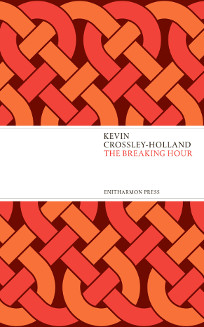
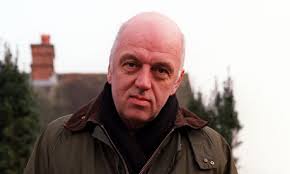
Last Saturday I attended one of the half-yearly poetry events in Palmers Green, north London. These are always very good evenings, these days full of music as well as poetry as the Helios Consort of recorders play before and after the interval. Kevin Crossley-Holland was reading (a superb poet, as well as all his other literary achievements) as was Sarah Westcott (recently published by Pavilion – having just won the Manchester Cathedral Poetry Competition) and Katherine Gallagher, launching her new Arc collection – about which someone called Crucefix has blurbed:

This new collection is bejewelled throughout with haiku-like moments of vivid observation. Her delighted responses – in particular to the natural world – serve to peel away the film of familiarity through which we usually gaze. Yet Gallagher combines such excited observation with a quality of restraint, a respect for what she encounters in a process of self-creation – “from myself into myself” as her epigraph from Rose Auslander puts it. Sequences about her Australian mother and the loss of her brother are imbued with this same gift: life is celebrated in poems that never forget our mortality: “This is time we have underlined, / remembering what we’ve done, where we’re going” (‘Quotidian’).

On the following morning I was taking part in the Bloomsbury Festival, talking about the art of translation with Chris Campbell, Literary Manager, Royal Court Theatre and Gregory Thompson, Creative Entrepreneur in Residence at UCL. Chaired by Geraldine Brodie, Lecturer in Translation Theory and Theatre Translation at UCL, the talk – in the very comfortable, wood-panelled surroundings of the Churchill Room, Goodenough College, London House, Mecklenburgh Square, London – was really wide-ranging from Gregory’s experiences of directing Shakespeare in the Indian sub-continent and the kind of cultural translation that takes place on such occasions to Chris’s translations of drama texts to and from the French and French-Canadian. One issue there is the translation of comic references such as cricket allusions or types of motor cars (I think he suggested a Vauxhall Cavalier equivalent in a French cultural context would be a Renault 21). I thought there was quite a bit of common ground when I was explaining how I fell into translation through the need to stand up and declaim/read/perform translations which I felt did not really convince in English. This is how I began the idea that I might try to translate Rilke’s 9th Duino Elegy many, many years ago – I could not find a version that read well aloud. I still regard that as a key test.

c45407b1ab4103bca137a0808bc8c042

This idea that poetry ought to be read aloud is common enough in most writing workshops but I do wonder how many people really adhere to it. This came up again with my third engagement of the busy weekend – teaching my first session for the Poetry School on ‘music and metre’ on Monday evening. As I explained to the class, formal verse is not especially my thing but it is also an area I have had to teach on various occasions. I kicked off by reading James Fenton’s powerful poem ‘Tiananmen’ – see below – and Auden’s observations about the benefits of form:

images

The poet who writes ‘free’ verse is like Robinson Crusoe on his desert island: he must do all his cooking, laundry and darning for himself. In a few exceptional cases, this manly independence produces something original and impressive, but more often the result is squalor – dirty sheets on the unmade bed and empty bottles on the unswept floor.

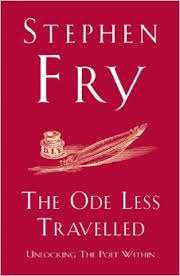
I love the swipe at “manly independence” there. Not very surprisingly, this observation is quoted by Stephen Fry in his The Ode Less Travelled (Hutchinson, 2005) which also suggests modern poetry, because of its abandonment of formal constraints is now “laughably easy” to write. Elsewhere Fry describes most contemporary poetry as suffering from anaemia; it’s a lifeless trickle, rhetorically listless . . . Fry doesn’t mind setting himself up like this – and tucked away in the book you’ll also find his appreciation of Whitman, Anne Carson, Denise Riley and many others.

imgres

I told the class, having spoken to a fair number of poets recently about form, that they’d be surprised (or maybe not) how few published poets would confidently declare their own grasp of metrical matters. On the night, we didn’t get along as fast as I’d anticipated – there was good discussion, especially of the areas of inevitably uncertainty in scanning a poem etc – it’s like jazz?? – so I’m looking forward to picking up the themes again next Monday evening with Tony Harrison, Wordsworth, Stevens, Elizabeth Jennings . . .

Now I’m feeling a bit poetry-ed out. Coffee and cake are required . . . after this:


Tiananmen – James Fenton

Tianamen
Is broad and clean
And you can’t tell
Where the dead have been
And you can’t tell
What happened then
And you can’t speak
Of Tianamen.

You must not speak.
You must not think.
You must not dip
Your brush in ink.
You must not say
What happened then,
What happened there
In Tiananmen.

The cruel men
Are old and deaf
Ready to kill
But short of breath
And they will die
Like other men
And they’ll lie in state
In Tianamen.

They lie in state.
They lie in style.
Another lie’s
Thrown on the pile,
Thrown on the pile
By the cruel men
To cleanse the blood
From Tianamen.

Truth is a secret.
Keep it dark.
Keep it dark.
In our heart of hearts.
Keep it dark
Till you know when
Truth may return
To Tiananmen.

Tiananmen
Is broad and clean
And you can’t tell
Where the dead have been
And you can’t tell
When they’ll come again.
They’ll come again
To Tiananmen.

imgres
James Fenton


The Bow-Wow Shop’s Aspects of Orpheus

Bow Wow Shop Orpheus Poster_v2

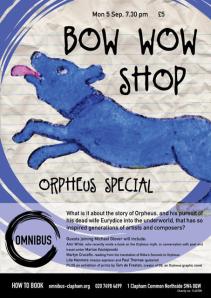
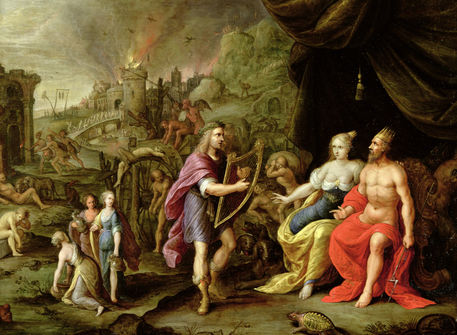
Last week I was pleased to be involved in the first of the on-line journal Bow-Wow Shop’s evening events in Clapham. Its focus was the figure of Orpheus: What is it about the story of Orpheus and his pursuit of his dead wife, Eurydice, into the underworld that has so inspired generations of artists, writers and composers?

Editor of The Bow-Wow Shop, poet and Independent arts and culture journalist, Michael Glover organises and he programmed a terrific mix of material. Ann Wroe’s 2011 book, Orpheus: the song of life (Cape), explores the roots of the Orphic story and traces its many manifestations through Classical to modern times. I was lucky enough to read with her at an event at Lauderdale House a couple of years ago. In Clapham she was in conversation with Marius Kociejowski. I was there on the strength of my 2012 translations of Rilke Sonnets to Orpheus (Enitharmon Press). Providing musical illustrations of the power of the Orpheus story were mezzo-soprano Lita Manners and guitarist Paul Thomas. There was also an exhibition of prints by Tom de Freston, creator of OE, a graphic novel on the Orpheus material.

imgres

Lita and Paul performed extracts for Gluck’s opera Orfeo ed Euridice (1762), songs by Vaughn-Williams and from the 1959 film Black Orpheus. Marius interviewed Ann though she needed little prompting to discuss several aspects of what is a wonderfully original book. Rilke’s inspired writing of the Sonnets to Orpheus (1922) form a thread through the book but she steered clear of that and concentrated more on the first evidence of the myth in the 6th BCE: a painting in black figure on a Greek vase, pictured with a huge lyre that almost seems part of him. Already at that early stage he is called ‘famous’. A 13th century BCE Cretan vase perhaps images him, again with the super-sized lyre (denoting divine powers, his music powerful even over inanimate objects birds, trees). Elsewhere he seems imaged as a bird himself – the power of song and music so strong that he must take on the attributes of a bird-god.

imgres

Perhaps even further back, Ann suggested, the figure is based on fertility myths, perhaps of Indian origin. His wife Eurydice likewise is linked to the figure of Persephone, the whole narrative in its original forms reflecting ideas of the seasons, death and re-birth of the earth, the crops. But there remains something irresolvable about the Orpheus myth – this polyvalent quality is one of the reasons for its productive quality in terms of inspiring artists. We kept recurring to the question: why must Orpheus turn as he is leading Eurydice out of the Underworld? The story contains its own tragedy. Ann suggested one interpretation might be to do with the fact the Eurydice represents the mystery of the natural world, or perhaps of knowledge/speech about the natural world, and that must necessarily remain hidden. Such a thing is the remit of the Gods alone. Orpheus must leave the Underworld empty-handed.

images

I spoke about Rilke in 1921, settling into the Château de Muzot in the Swiss Valais. How he liked to walk in the garden with its orchards and roses in full bloom, a landscape often evoked in the sonnet sequence which eventually arrived. He later declared that in the month of February 1922, he ‘could do nothing but submit, purely and obediently, to the dictation of [an] inner impulse’. In an extraordinary inspirational period, between the 2nd and 5th of that month, most of the 26 sonnets of Part One of Sonnets to Orpheus were written. He then polished off the ten year old sequence of the Duino Elegies. Between the 15th and the 23rd, Rilke went on to complete the 29 poems of Part Two.

Perrcy Bysshe Shelley wrote a longish fragment on the myth in 1820:


His [song]

Is clothed in sweetest sounds and varying words

Of poesy. Unlike all human works,

It never slackens, and through every change

Wisdom and beauty and the power divine

Of mighty poesy together dwell,

Mingling in sweet accord.


Here, as often, Orpheus is an image of the (male) artist/poet as well as being an image of our desire to find or create order or harmony in the world about us.

Rilke’s inspired poems brim with optimism and confidence about the role of poetry. In contrast, but more typical of the growing 20th century gloom, perhaps with intimations of a second world war, 15 years later – Auden’s brief 1937 poem ‘Orpheus’ is mired in uncertainty, asking “What does the song hope for?” Is it to be “bewildered and happy” – a sort of ecstatic but unthinking bliss? Or is it to discover “the knowledge of life”? No answer is given. The poem ends: “What will the wish, what will the dance do?” This is the Auden who doubts the power of poetry – it makes nothing happen – in his Elegy to Yeats.

And more like Auden than Rilke, the 20th century tended to take a more sceptical view of the myth – giving a more powerful voice to the traditionally passive Eurydice – more critical of Orpheus as careless, self-centred, weak. For example, in 1917 – 4 years before Rilke arrived in his chateau, H.D.’s Eurydice was condemning Orpheus:


for your arrogance

and your ruthlessness

I have lost the earth

and the flowers of the earth


Such radical revisions come also from more explicitly feminist poets like the American, Alta:


all the male poets write of orpheus

as if they look back & expect

to find me walking patiently

behind them, they claim I fell into hell

damn them, I say.

I stand in my own pain

& sing my own song

fullsizerender-11-360x348

Carol Ann Duffy’s revision (in her 1999 book The World’s Wife) gives Eurydice both poem title and narrative perspective. Her Orpheus is:


the kind of a man

who follows her round

writing poems, hovers about

while she reads them,

calls her his Muse,

and once sulked for a night and a day

because she remarked on his weakness for abstract nouns.


She saves herself from having to accompany Orpheus back to the upper world by offering to listen to his poem again. Orpheus, seduced and flattered, turns. “I waved once and was gone” she comments.

imgres

In this context Rilke’s take on the myth is (not surprisingly) very traditional and brimming with confidence in the role of the poet and patriarchal sidelining of Eurydice. So Rilke’s interest lies with the world and the underworld, life and death. He is more like Shelley who set his fragmentary poem after the loss of E and it’s coming through that experience that seems to add power to his song. Rilke is interested in the idea of transition. Orpheus tries to recover Eurydice; he moves from life, into death and then back again. This fluidity, the courage and a readiness to renew ourselves, to be risked in the absorption with something other, to be translated from one realm to another, to come and go, to be and not to be is what draws Rilke to the myth.

This is also Don Paterson’s thinking behind his versions of the Sonnets in Orpheus (Faber, 2006). He argues Man is unique in having foreknowledge of his own death, meaning we act as if we are already dead, or historical. This means that we construct life as an authentic and intelligible narrative, a life with meaning, but it is death that drives the plot of our life. This is one of Paterson’s key ideas and he refers to it as our ‘ghost-hood’. So we are like Orpheus: we too have descended to the land of the shades and then returned to the present moment – our condition is therefore existentially transgressive, riven, divided.

It’s the singing of the Orphic artist that addresses and bridges such divisions. This explains Rilke’s interest in the Orpheus myth: its narrative is a metaphor for the longed-for transit or communion between the realms of life and death. He possesses the desired ability to inspire the renovation of human perception that can initiate a more comprehensive, joyful and celebratory experience of life. One of the things most people know of Rilke is his exhortation to praise. Praise is a form of secular prayer for Rilke and it demands a renovation of conventional language through Orpheus’ song – as also noted by Shelley in Prometheus Unbound:


Language is a perpetual Orphic song,

Which rules with Daedal harmony a throng

Of thoughts and forms, which else senseless and shapeless were

imgres

Orpheus’ singing as a way to think about the language of poetry can clearly be seen in Rilke’s celebratory sonnets about the garden at Muzot. Here’s my translation of sonnet I  13:


Pear and plump apple and gooseberry,

banana . . . all of these have something to say

of life and death to the tongue . . . I guess . . .

Read it in the expression on a child’s face


as she tastes them. It comes from far off.

Slowly, does speechlessness fill your mouth?

In place of words, a flood of discovery

from the flesh of fruit, astonished, free.


Try to express what it is we call ‘apple’.

This sweet one with its gathering intensity

rising so quietly – even as you taste it –


becomes transparent, wakeful, ready,

ambiguous, sunny, earthy, native.

O experience, touch, pleasure, prodigal!


Rilke’s vigorous and self-conscious mutations of the sonnet form create a variety of rhyme schemes, line lengths, iambic and dactylic pulses. David Constantine has described this as suitably fitting forms for the figure of Orpheus because he is himself a figure of transition, fluency and mystery.

234203

Forthcoming Bow-Wow Shop events in Clapham will focus on the work of Edward Lear and Gabriel Garcia Lorca.

i.m. Yves Bonnefoy: love the bouquet for its hour

images

The death of Yves Bonnefoy (on 1st July 2016) was marked last week by The Guardian and The New York Times and many others. Anybody who has followed this blog for a while will know that I have found considerable inspiration in Bonnefoy’s poetry and writing about poetry. John Naughton in The Guardian obit sums up the nub of Bonnefoy’s thought: “we tend to replace the reality of things and other people with an image or concept, which deprives us of a more direct and immediate experience he called the experience of “presence”, in which one has a fleeting apprehension of the essential oneness of all being”. That latter phrase will explain how I have stumbled my way in recent years from translating Rilke to versioning the texts of the Daodejing.

imgres

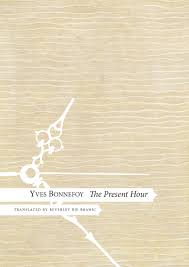
The NYT obit suggests Bonnefoy’s poetry has often been found “highly abstract and often obscure” and to counter this misleading impression I thought I’d post four sonnets from his 2011 collection L’heure presente (The Present Hour) in Beverley Bie Brahic’s pellucid translations. Bonnefoy is thinking of his own father here (who died when the poet was young) but the valedictory tone seemed right for the occasion. Bonnefoy translated a great deal of Shakespeare and (in part – he’s also arguing with Mallarme) the fourth of Bonnefoy’s sonnets is in dialogue with the ideas of Sonnet 63 (“His beauty shall in these black lines be seen, / And they shall live, and he in them still green”). It’s a mark of Bonnefoy’s achievement that even in such an emotional, personal context, he can still articulate ideas about language (“words cut”) and the way in which “the real flower becomes metaphor” by bleeding the temporal and in doing so yields up a great deal of what it means to be real. Instead, we must “love the bouquet for its hour. / Only at this price is beauty an offering”.


A Photograph

This photograph—what a paltry thing!

Crude colour disfigures

The mouth, the eyes. Back then

They used colour to mock life.


But I knew the man whose face

Is caught in this mesh. I see him

Climbing down to the boat. Obol

Already in his hand, as if for death.


Let the wind rise in the image, driving rain

Drench it, deface it! Show us

Under the colour the stairs streaming water!


Who was he? What were his hopes? I hear

Only his footsteps descending in the night,

Clumsily, no one to give him a hand.


Another Photograph

Who is he, astonished, wondering

Whether he should recognise himself in this picture?

Summer, it seems, and a garden

Where five or six people gather.


And when was it, and where, and after what?

What did these people mean to one another?

Did they even care? Indifferent

As their death already required of them.


But this person, who looks at—this other,

Intimidated all the same! Strange flower

This debris of a photograph!


Being crops up here and there. A weed

Struggling between house fronts and the sidewalk.

And some passers-by, already shadows.


A Memory

He seemed very old, almost a child;

He walked slowly, hand clutching

A remnant of muddied fabric.

Eyes closed, though. Oh—isn’t believing


You remember the worst kind of lure,

The hand that takes ours to lead us on?

Still, it struck me he was smiling

When, soon, night enveloped him.


It struck me? No, I must be wrong.

Memory is a broken voice,

We hardly hear it, even from up close.


Yet we listen, and for so long

That sometimes life goes by. And death

Already says no to any metaphor.


I Give You These Lines . . .

I give you these lines, not that your name

Might ever flourish, in this poor soil,

But because trying to remember—

This is cut flowers, which makes some sense.


Some, lost in their dream, say ‘a flower’,

But it’s not knowing how words cut

If they think they denote it in what they name,

Transmuting flower into its idea.


Snipped, the real flower becomes a metaphor,

This sap that trickles out is time

Relinquishing what remains of its dream.


Who wants now and then to have visits

Must love the bouquet for its hour.

Only at this price is beauty an offering.

06bonnefoy-obit-master768

Introduction to Laozi’s ‘Daodejing’ – Part 2

What follows is the second installment taken from the Introduction to my new versions of Laozi’s Daodejing, published by Enitharmon Press. More information and comments on the book can be found here. References to the traditional 81 chapters of this ancient text are accompanied here by the titles I have given them in my versions. The first section (to read it click here) concluded by indicating how the Dao becomes manifest in the individual objects, the actions and creatures of the world we are familiar with.

wings-snakes-satan-artwork-gustave-dore-paradise-lost-john-milton-1030x1280-wallpaper_www-paperhi-com_21

Proceeding to consider how such awareness (more commonly the absence of it) impacts on our personal (and hence political) lives is also a primary concern of the Daodejing. It comes as no surprise that our battle against the tyranny of the self, that intense, intoxicating selfishness that Coleridge calls “the alcohol of egotism” is the key (the phrase is from an unassigned lecture note, date unknown, on Milton’s Satan, specifically concerning his preference to reign in hell rather than serve in heaven. See S. T. Coleridge, Collected Works, ed. Foakes (Princeton UP, 1987), Volume 5, Part 1, p. 427). This is where the untranslatable idea of wu-wei arises. The phrase is intended to characterise actions performed in accordance with, in harmony with the Dao; hence they are driven not by the blinkered and shuttered individual self, but by a more open awareness of the expansive, interconnected reality of the Dao. This is the significance of the recurring idea that the follower of the way should attend not to ‘that’ but to ‘this’. The former implies a divided world (self and other – ‘that’ out there) whereas the latter is a gesture of encompassment of both self and other, the whole, the one. Hence, the narrow intentionality, the forcefulness of the self is withdrawn from actions performed in accordance with wu-wei.

IMG_0125

In translating these ideas, I have used the phrase ‘indirect direction’ to suggest the methods of our dealings with others and the ‘unacted deed’ in an attempt to characterise the pursuit of our own intentions. Both phrases are woefully inadequate, but I hope to convey as plainly as possible the paradoxical nature of these ideas. How they are played out in real human behaviours can be glimpsed through the ‘Three treasures’ (Chapter 67). These treasures are: to be compassionate, to be frugal, to lack personal ambition. In each behaviour, egocentricity is diminished through empathy and there is an inclination towards wise passivity. There is a corresponding reduction in the individual’s personally directed desires (‘Wishes’ (Chapter 3)); we are to act ‘Like water’ (Chapter 8), flowing passively, dispassionately towards lower ground in both personal and political spheres (‘Influence’ (Chapter 66)). We are being urged (to switch the metaphor as the Daodejing deliberately does) to work with the grain of the Dao.

This is what the sage pre-eminently promulgates and performs. I have consistently translated this figure as ‘teacher’, often ‘my teacher’ and (though literary Chinese does not mark gender) there is something unmistakably feminine about her behaviours. This is a point the poems declare insistently. The Dao itself has female qualities (‘Valley’ Chapter 6)) and the teacher also reflects this in her quietness, passivity, sensitivity, lack of overt force (‘Raw material’ (Chapter 27)). Stephen Mitchell’s much praised and popular version of the poems carefully uses ‘she’ at least as often as ‘he’ to refer to the teacher figure. (See Stephen Mitchell, Tao Te Ching: a New English Version (Harper and Row, 1988), p. xi). But I wanted to go further and have consistently feminised, even personalised this figure. Early on in the translation process, I felt a need to make this shadowy figure more manifest, to ground her pedagogic statements for our more liberal, democratic age with its absence of deference. As I set about this, it was clear she had to be female and she soon took on a dual role, both as representative or personification of the Dao itself and as its incarnation in actual human form, a mother figure, a female teacher, a friend.

images

The ways in which these teachings translate into the world of politics are summed up in the terse, witty, metaphor of ‘Recipe’ (Chapter 60). The art of good governance is like the art of cooking a delicate fish: don’t interfere, don’t force it, be watchful, assist, adapt, proceed only with the lightest of touches. Laozi’s politics are impossible to translate to our modern age but given the proviso that he is determined to preserve the simplicity and frugality of people’s lives, many of his sentiments read as politically anarchic, primitivist, conservative, environmentalist. For those of us from a Western tradition, there is a Rousseauistic quality to his thinking, a belief in the goodness of mankind as noble savage who has for too long been corrupted by interference, too many codes of behaviour imposed from above. This is where the poems’ anti-Confucian elements are most obvious (‘Codes of kindness’ (Chapter 18)). Laozi is certainly vigorously anti-war, the pursuit of which he regards as the quintessence of the over-determined masculine self in action in utter disregard of the Dao.

imgres

Historically, translators have approached these poems in many ways. Benjamin Penny’s recent review of the field shows how many early versions were motivated by a Western cultural imperialism, searching out affirmations of its own monotheistic tradition (See Benjamin Penny, Introduction to Laozi: Daodejing, tr. Edmund Ryden (OUP, 2008)). Later attempts were spurred by a contrasting desire to find something different, to revitalise moribund Western values in search of exoticism, anti-rationalism, the non-Christian. Still others, keeping a firm hold on a wide variety of already settled spiritual/religious beliefs, plumbed the frequent ambiguities and lacunae of the Daodejing to re-affirm those beliefs. More recently, scholars and academics have brought an ever-growing understanding of Chinese history and culture to bear on these delicate texts and it is surely impossible to avoid accusations of Westernisation in any English version of the Daodejing. Even Stephen Mitchell – who had “a fourteen-years-long course of Zen training” to draw on – has since been accused of colonial mis-appropriation (See Mitchell, ibid., translator’s Forward. For the vigorous accusation, see Russell Kirkland and his book Taoism: The Enduring Tradition (Routledge, 2004)).

sonnets_to_orpheus

In my case, it was as a long-standing teacher, poet and recent translator of Rainer Maria Rilke that I first came to the text. I found myself in astonishing sympathy with many of the things it has to say about language and poetry and especially about the pedagogic process, both formally and in our everyday interactions. Laozi suggests the teacher’s role is to show, facilitate, enthuse, give space, watch and approve. We must be honest, be ourselves, give the tools, give opportunities, do our job well, but then let go, don’t dwell. We need to be someone to emulate, be quiet, still, attentive, be present, not absent, be mindful, be welcoming. Our role is to synthesise and connect (not disconnect or sever), shed light (but without dazzling, even inadvertently), use a delicate touch, be tangential. Laozi knows that our teacherly interventions – whether physical or verbal – must inevitably alter the material we hope to engage with; we set in motion a swinging pendulum. Our actions call forth responses to the fact we act, plan, demand. Students may re-act to this (against this) simply because we are seen to act. Better back off, do not intervene, don’t use imperatives, perhaps use no words at all. It is better to play the female part, be passive, give space, encourage desired behaviours, neglect all else. Laozi believes students come upon discoveries by themselves. So we must work via indirect direction and the unacted deed. Progress will be seen to happen of its own accord. The deed we desire will remain undone; this is the best way of getting it done.

imgres

Idealistic? Of course, as can be seen most vividly in ‘The commonwealth’ (Chapter 80) which is Laozi’s evocation of the contented society adhering to the ways of the Dao. For Western readers, this poem echoes Gonzalo’s speech in Shakespeare’s The Tempest, in its turn lifted from Montaigne’s essay ‘On Cannibals’ (Montaigne, Essays (1580). Shakespeare read and paraphrased John Florio’s 1603 translation into English). Laozi’s original gift to the gatekeeper is not to be read as a handbook, not an instructional scripture, but as inspiration. Bearing that in mind, we ought correspondingly to resist the temptation to approach it with the dismissive cynicism of an Antonio or Sebastian, Shakespeare’s all-too-modern sounding cynical ‘evil men’. I think we ought to listen to these poems open-mindedly, mindfully. We ought to resist following the crowd so vividly portrayed in ‘Adrift’ (Chapter 20) who always say, “Prithee, no more; thou dost talk nothing to me” (The Tempest, Act 2, scene 1, l.169). When the true teacher stands in our house, no matter how detached, untidy, unimpressive, even muddled she may superficially appear, Laozi is reminding us “there are treasures beneath” (‘In your house’ (Chapter 70)).

daodejing


Jan Wagner: the Poet as Tea-Bag and as Chameleon

imgres

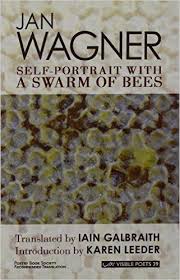
Iain Galbraith’s really skillful translations of the German poet Jan Wagner have just won the Popescu European Poetry Prize. Wagner’s poems brew a formal brilliance (Karen Leeder remarks in her Introduction to Arc’s Self-Portrait with a Swarm of Bees, that “virtuoso” is the compliment most often applied to him) with an intense concentration on really existing things. In the German tradition, of course, such a meticulous and sensual evocation of things (‘die Dinge’) harks back to Rilke’s advice in the ninth of his Duino Elegies (1922):


Perhaps we are here to say: house,

bridge, fountain, gate, jug, fruit tree, window –

at most: column, tower . . .


Rilke’s cycle of poems arrives at this conclusion (“Praise this world to the angel, not some / inexpressible other”) not at all in the spirit of defeat but in a celebratory mood because it is only through honest interaction with the world that we define and refine our sense of ourselves. Equally and dialectically, through, our emotional and artistic responses to the world of things we are able to translate the inanimate and unconscious world into something more significant, lasting, spiritualized.


And these things, which live by passing away,

acknowledge your praise of them, as they vanish,

they look to us to deliver them, we, the most

fleeting of all. They long for us to change them,

utterly, in our invisible hearts – oh, endlessly,

to be within us – whoever, at last, we may be.


It is just this ebb and flow between self and other, each re-defining the other, each growing in response to the other, that Wagner seems intent on recording. But it’s not always an easy process as the poem ‘Mushrooms’ suggests. The narrator must listen for the snap of a twisted stem as if cracking a safe, “hoping for the right combination”. But when the right balance (I’m afraid it has to be this dull-seeming word) is achieved between active exploration and passive sensitivity then two worlds are miraculously joined.

10117b9d-d35e-424f-8aba-89d57234ee71-vision

But we need not get too po-faced about the process. Wagner suggests a tea-bag might help us envisage it. In two haikus, he wryly evokes both facets of such communion in a religious visionary and a rope-dangling, Indiana Jones-type adventurer:


1

draped only in a

sackcloth mantle. the little

hermit in his cave


2

a single thread leads

to the upper world. we shall

give him five minutes

Jan Wagner
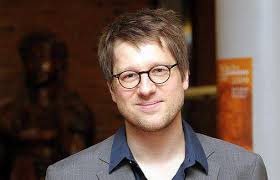
Jan Wagner

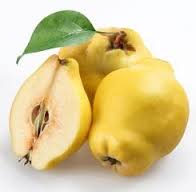
Wagner reflects the often rebarbative nature of the process partly through typographical choices, abandoning capital letters throughout (a far more disturbing move in German, of course, which capitalizes all nouns, all things). It’s also reflected in the choice of fruit in ‘Quince Jelly’. Knobbly and ugly, even ripe quinces are inedible when raw, astringent and tough. Wagner acknowledges the “tough and foreign” quality of the fruit and its taste which makes “our palates baulk”. Yet the human work invested in the transformative domestic process yields great rewards:


quinces, jellied, lined up in bellied jars on

shelves and set aside for the darkness, stored for

harsher days, a cellar of days, in which they

shone, are still shining.

imgres

Such meticulous observation and sensual details held in the form of verse ensure Wagner’s things are always more than themselves and here the quince jelly is a poem, much like Wordsworth’s daffodils, an accumulation of “wealth” to flash upon “that inward eye” in days and years to come.

Wagner also chooses a ‘Chameleon’ to represent the poet. Describing the creature’s curved tail as a “pastoral staff” raises the spiritual stakes with a wonderfully light touch. The animal’s perceptive acuity is likewise explored with its tongue like a “telescope”, snapping up the “constellation” of a dragonfly. Its eye is a “fortress” yet contains a flickering pupil; an indefinable restlessness is suggested by its shed skin like “an outpost or long-discarded theory”. Most tellingly, the chameleon’s independently moving eyes enable Wagner to suggest the balance of both centrifugal and centripetal thrusts of the true perception: the animal gazes “simultaneously at the sky / and the ground, keeping his distance / from both”.

imgres

The title poem of Arc’s selection (taken from 5 collections between 2001-2014) is another portrait of the poet. ‘Self-Portrait with a Swarm of Bees’ has the narrator wearing an ever-accumulating beard of swarming bees. The risks and dangers are part of the point but the poem focuses on the accumulating “weight and spread”, suggesting the swarm extends and adds to the narrator in some intrinsic way. Indeed, he becomes “the stone-still centre of song”. In the next quatrain, the passive singer is converted into an “ancient knight” arming for battle, yet he does not either advance or retreat:


just stands there gleaming, with barely a hint

of wind behind the lustre, lingering breath,

and only vanishing becomes distinct.


This teasing last line (“und wirklich sichtbar erst mit dem verschwinden”) is best understood again through Rilke. Auden affectionately ribbed Rilke as a poet whom “die Dinge bless, / The Santa Claus of loneliness” but it is in the challenge to self confronted through honest encounters with the world of things that we re-make and re-define our sense of self. Here is the idea expressed in Rilke’s Sonnet to Orpheus, 2, 13:


To the used up – to all Nature’s musty and mute,

its brimming storehouse, its inexpressible sum –

joyously add yourself and the account’s done.

 (All translations from Rilke here taken from my translations of  ‘Duino Elegies’ and ‘Sonnets to Orpheus’)

bee-beard

Hear Galbraith read ‘December 1914’ below:


A new translation of Brecht’s ‘Of poor B.B.’

Having posted last week about Brecht’s poem ‘Of poor B.B.’ it felt pretty inevitable that I should have a go at translating it myself. Though it can’t always be the case, most translations are like this – undertaken as a tribute to the original poet and poem, a public declaration that this fascinated me, an attempt to really work out how the text functions and achieves its ends. Disseminating the text to the target language’s reading public is also an aspect of this tribute paid.

249y242_mpt_no22015_coverfront

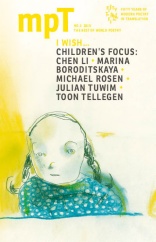
David Constantine, writing in Modern Poetry in Translation (No. 2 2015) about Derek Mahon’s recently published translations (Echo’s Grove (Gallery Press, 2013)) considers the “liberties” Mahon tends to take with such work to produce “almost” original poems in English while allowing their sources to remain audible. Mahon does this by working from “cribs of one kind or another” and Constantine suggests that this has become a very common practice. Indeed, “Mahon practices the belief that you don’t actually need to know well or even at all the languages you translate out of; even – a possible sub-text – that knowing them might be a disadvantage” (MPT, No. pp.111-113). As someone who was remarkably poor at languages at school, this is something I have found myself saying in recent years since going public with a few translations (for example, see post on translating Rilke). I like to think of the source poem as a series of gestures – like a dance performed by the original author – so the translator must try to achieve similar effects but with his/her own body (of language). A crib will guide me to the main movements, even to much of the details, but tone, emotional colour, shades of irony are harder to trans-late and cannot merely be copied. This gesture made by this body, if repeated precisely by my body, will more likely look awkward, or meaningless, or comic when it was intended as serious. I have to achieve the end (as far as I see it and understand its intended impact – you have to rely on the translator for that certainly) by using the resources at my disposal, my physique, my body of language.

egon-schiele4-300x199

In practice, what this means is that once the basic outline and incontrovertible details are in place in a translation, I have to close the source book and try to pump some life into the target text. Ted Hughes imagined a poem without true life in it as limping (Poetry in the Making, p.15); a translation without true life in it is only going to be a halting performance you’d rather not witness, worrying about whether such a gesture was intended or not, ironic or not, you fear the whole is not coherent, a mere series of movements, not a dance at all. I’ve always liked Charles Tomlinson’s formulation of the translation task: in introducing his now 50-year-old translations of Fyodor Tyutchev, he claimed ‘The aim of these translations has been to preserve not the metre, but the movement of each poem – its flight, or track through the mind’ (Versions from Fyodor Tyutchev 1803-1873 (Oxford: OUP, 1960)).

Happily, ‘Of poor B.B.’ is not a text of great complexity. Brecht is usually concerned to communicate clearly and he says in ‘On Rhymeless Verse with Irregular Rhythms’ (Poems 1913-1956, pp. 463-471)) “what was needed was the tone of direct and spontaneous speech”. He mostly wanted to use “everyday speech” and “sobriety of expression” which he felt was “by no means irreconcilable with poetry”. So Brecht is not exactly Rilke or Mallarme for the translator. Looking at Hofmann and Hamburger’s translations (as referred to in last week’s post), most of Brecht’s dance is clearly conveyed with little variation between the two versions. Though Brecht’s lines are pretty irregular he does keep a ballad-like rhyme in lines 2 and 4 of each quatrain and I miss this in Hofmann’s version. Hoffman also (to my mind) overelaborates in a few of his English choices. “Sterbsakrament” (Hamburger has “last sacrament”) becomes “every sacramental perquisite”. Hofmann’s narrator looks at the two women in quatrain 4 “insouciantly” and his pine trees “micturate” (when the point of the contrast with the city asks for something more downright like Hamburger’s “piss”). I don’t think lexical adventures here are quite right for this poem. Also in quatrain 7, Hofmann’s antennae “underwire” the Atlantic. Brecht is referring to transatlantic cables but the allusion to supportive bras seems distracting and gives mankind’s efforts too much power. I read the point as suggesting our technology is dwarfed by the ocean in the remarkable image that our best advances merely entertain (“unterhalten”) or “amuse” (Hamburger) the Atlantic.
Egon_Schiele_060

Regarding the hat donned by the narrator to fit in with city folk, Hofmann’s “top hat” seems a little too up-market, while Hamburger’s “hard hat” conjures up a building site. I have gone for “bowler hat” of a clerk or business man. The sound of the birds in quatrain 6 is important. Hofmann’s “bawl” catches the anti-pastoral tone of the poem but Hamburger is forced by the needs of form to go for “twitter and cheep” (to rhyme with “sleep”). There is also some ambiguity in the final stanza where the narrator hopes to keep his “Virginia” alight in the coming earthquakes of social disruption. The German suggests the cigar will hopefully not go out (“nicht ausgeher”) and the cause: “lassen durch Bitterkeit”. Hofmann renders this as hoping the cigar will not “go bitter on me” whereas Hamburger (again in part for the sake of form) hopes to keep the cigar alight “embittered or no”. Hofmann’s phrase feels too narrowly concerned with the smoking experience but Hamburger’s rather awkward phrase does successfully suggest what I see in the final lines – the narrator’s hope (if not altogether sincerely) that he himself may avoid becoming bitter. My solution tries to hold both literal and transferred metaphorical senses of the bitter cigar equally within the line. I’ve come to think of this as important to the poem as the narrator is blessed with a degree of self awareness as much as he is cursed with a cynical, dismissive hedonism.

images

Of poor B.B.

I, Bertolt Brecht, came from the black forests.
My mother bore me into the city
while I was in her womb. And till my dying day
the chill of the woods will lie there inside me.

In the asphalt city I’m at home. From the beginning
supplied with every last sacrament:
with newspapers – and tobacco – and with brandy.
To the end, suspicious, lazy, content.

I’m amicable with the people I meet. I don
a bowler hat in just the way they do.
I say: they’re animals with a quite peculiar smell.
And I say: so what – I am too.

In the morning, in my vacant rocking chairs,
I sometimes set for myself a couple of women
and carelessly gaze at them and converse with them:
in me you have one here you can’t rely on.

When night falls, I gather men around me;
we address each other as ‘gentlemen’.
They swing their feet onto my table tops.
They say: things will improve for us. I don’t ask when.

Come morning, in dawn’s grey light, pine trees piss
and their vermin, the birds, start to shriek.
At that hour, in the city, I drain a glass and fling
my cigar butt away and, troubled, fall asleep.

We have settled, a superficial crew,
in houses that to our minds will never fall derelict
(we’ve built tower blocks over Manhattan Island
and spindly antennae that tickle the Atlantic).

What will last of cities is what blows through them: wind!
Houses make happy eaters: wolfed in a moment.
We know it – we are temporary
and after us comes nothing really worthy of comment.

In the earthquakes that are to come, I hope I’ll keep
my Virginia lit, not doused, grown bitter.
I, Bertolt Brecht, carried off to the asphalt cities
long ago from the black forests inside my mother.

tr. Martyn Crucefix

bare-tree-behind-a-fence-1912