More than 10 years of blogging on poetry and translation – over 75,000 views in 2025 – now captured and preserved at the UK Web Archive: 'one of the top 10 poetry blogs' (Rogue Strands)
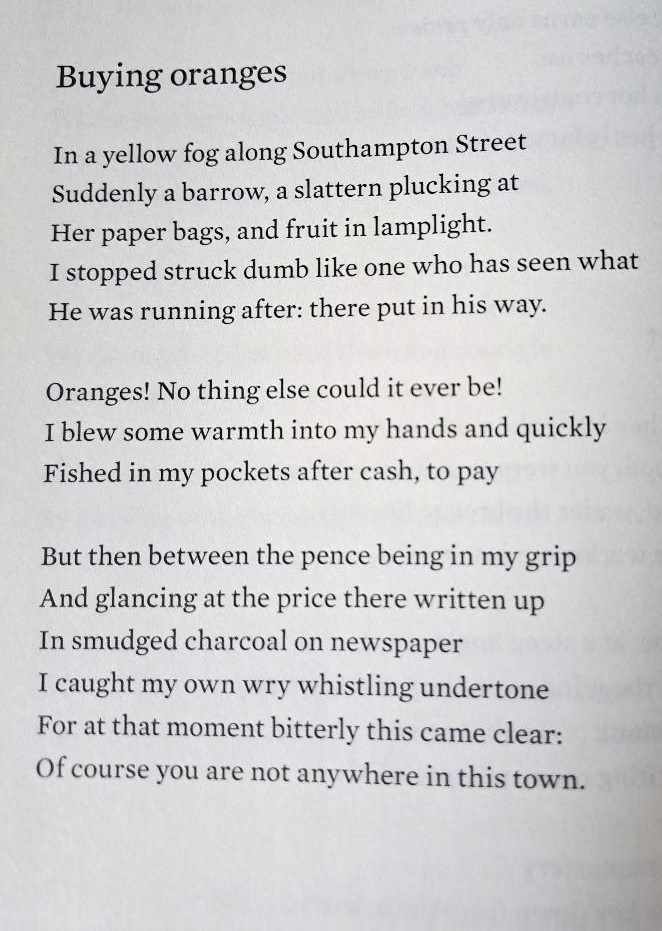
The Brecht-related poem arose after I’d attended a discussion on the German poet/dramatist by David Constantine. One of the poems he presented to those attending (with his translation) was ‘Buying Oranges’. This is one of the poems Brecht wrote for his lover, Margarete Steffin, in the 1930s. Constantine’s translation (from The Collected Poems of Bertolt Brecht (Norton, 2019) goes like this (hear it read by Daisy Lafarge here):
It was the circumstances surrounding my first acquaintance with this poem that led me to write a very loose version of it. I’d booked the event with David Constantine months before, but it happened that my mother sadly (but not unexpectedly) died in her Wiltshire care home the night before. I debated what I should do but decided in the end to attend the talk (I figured there was nothing urgently to be done; Dad had died a year or two before). The world looked different of course. In fact the day was bright and sunny. The event was near Holborn (not far from Southampton Street itself). As you’ll see, I turned oranges into chrysanthemums (my mother’s favourite flowers) and I find now that I lengthened BB’s irregular sonnet to 16 lines. Here’s my version:
ON SOUTHAMPTON STREET after Bertolt Brecht
A mizzling cold fog on Southampton Street then suddenly a market stall with its spectral blooms under a bare bulb preternaturally lit
a sullen frizz-haired girl cutting stems and I’m dumbstruck as one who’s found the thing he looked for here—at arm’s length—chrysanthemums—
nothing but them! I blow on stiff fingers plunge them into a pocket for coins but between fumbling silver and glancing back up to check the price
scrawled on a yellow card it feels as if I interrupt myself—a dull under-voice lifted in bleak remembrance— since last night you’re not here or any place
The second poem appearing on The High Window this week had a much more mundane beginning. Several years ago (how long can some poems take to arrive in their proper form?) I was staring from a window (in a classroom – perhaps I was invigilating a test) and down in the car park below I saw a car valet parking up his van next to a much fancier car. I seem to have watched him pretty carefully if the poem is to be believed (which I’d usually say not to). Gradually, the poem acquired its erotic undertones (the lovers back to back in bed, the intimacy of the hand-washing, the moisture, the smells, the final turning away) which surprised me as I thought the poem was mostly a comment on work, labour (I love poems about processes) and ultimately about class differences (for money, one man cleans another man’s car). The epigraph is, of course, from Donne’s great love poem ‘To His Mistress Going To Bed’ but here is intended to reflect the working man’s thoroughness!
MOBILE CAR VALET ‘Before, behind, between, above, below’
Like a pair of lovers back-to-back bored in bed his white van closes rear bumper to bumper
he opens the doors wide and starts to squeegee the mucky hubs of the big black German
from a sudsy bucket he works the dusty body with a chamois leather inscribing S-shapes
like the briefest foaming of bold graffiti over and round wing mirrors and shining roof rails
then balanced on a tyre sweeps half the roof now the other side and inside across the length
of the dash a pale duster the armrests especially working the driver’s side then a jet-spray
jumps into hissing life spilling gassy whites over the wings and the tyres his best weapon
set back in the van then out with the ancient Henry its scarlet chess piece and snaking black hose
used to scour the seats deep into the footwells and the chamois is back again to buff stray drops
on windows with windolene it smells good to him now the doors slammed the remote locking chirps
as he carries the fob back into the marble foyer like a hatchling his van waits out the length
of one smoke nothing to say to the big German where it glitters alongside already turning away
Please Note: this blog and website are now captured and preserved at the UK Web Archive held at The British Museum. Many thanks to them.
The highlight of last week was attending Durs Grünbein’s reading at The Goethe- Institute, where he was in discussion with his English translator, Karen Leeder. At the beginning of the evening, Grünbein joked that he’d not been in the UK for a few years and this was the first time he’d had to produce his passport (the blessings of Brexit). Interestingly, in the light of last weekend’s German election results, Grünbeinhas often been described as a poet of the reunified Germany, having been born in Dresden and now living with his family in eastern Berlin. Grünbein’s poetry is witty, wry, perceptive, and influenced by a broad range of literary texts and often presents the disillusionment of having grown up in East Germany and explores Germany’s identity in post-Cold War Europe. He has been very vocal in recent years on the issues of immigration and the defence of Ukraine. Helen Vendler commented on the ‘sardonic humour, the savagery, the violent candor—all expressed in lines of cool formal elegance’ and Philip Ottermann, in The Independent, noted ‘Grünbein loves to jump from one register to another—one moment he is the street poet of Berlin, the next … all marble and ancient philosophy’.
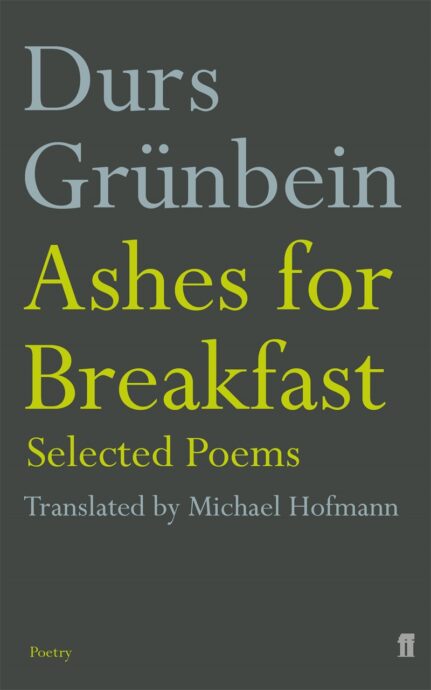
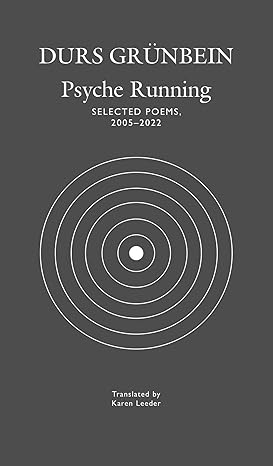
Grünbein’s earlier poems were translated into English by Michael Hofmann and published in Ashes for Breakfast: Selected Poems (Faber, 2005). Karen Leeder has now published Psyche Running, a selection of more recent poems from 2005–2022 (Seagull Books). During the evening, Grünbein commented on the process of those earlier translations as ‘strange’ and the results (as is Hofmann’s wont) as being very free, very sparky, and Leeder suggested there was a particular excitement in the ‘to and fro’ between author and translator to be found in them. She then suggested her approach has been rather different, perhaps a more dutiful one, still needing to make the poems ‘live’ in the target language, but also demanding a fidelity, to capture the original’s form and architecture as closely as possible. The work read during the evening suggests that her translations triumphantly achieve these goals.
Leeder said that his work can have a ‘marble’-like quality, a firm (unbending?) Classicism, and also that he has himself been labelled a ‘poeta doctus’, given the learned, wide-ranging references he incorporates. Grünbein rather demurred at these descriptions and (an idea he repeated a couple of times in slightly different forms) any interesting poem must be the result of two steps, the first poetic, the second, a more critical, a process of reflection (a later formulation suggested the two steps were ‘perceptual’ and ‘conceptual’). These two phases result in the finished poem as ‘a form of knowledge’; Grünbein pointed out that philosophy arose out of poetry in Classical times (not the other way round). The first poem he read, ‘Childhood in the Diorama’, does have a ‘marble’-like quality to it: longish, unrhymed lines in a solid verse paragraph and the child’s preference for the posed scenes of a museum’s diorama, their ‘inert’ quality. But on one occasion, the boy sensed some movement, a ‘draught, perhaps, had blown through the displays’, perhaps suggestive of the child’s development into a more unstable, fluid view of the world.
Other poems read that evening included ‘Nee Wachtel’, ‘Exaltations in Sleep’, and ‘Inspector Kobold’ which is a ‘Martian’ sort of piece describing seahorses, in ‘their whalebone corsets, like ‘tiny ocean Lipizzaners’ (here’s an alternative translation by Michael Eskin). If we are to take Grünbein’s poems as ‘forms of knowledge’ then they certainly range widely through the natural sciences, language, science more generally, astronomy, history and politics. He felt what binds all this together is the one individual life, the single life perspective, poetry as a sort of anthropological study, at which Leeder suggested there was a ‘fragility’ to much of his work, the vulnerability of the single life as much as all life (ecologically?). The poet was happy to agree to this, suggesting ‘marble’ was not at all the right term for his poetry, that there was always something ‘flowing’ about it, multiple angles and perspectives. He once claimed not to be a ‘German’ poet, but simply someone who wrote in the German language. This evening he stood by that statement: his own identity is wrapped up in language use, the mother’s language, used daily for years, and is not a function of birthplace alone (remember Grünbein grew up in East Germany and now lives in the unified Germany).
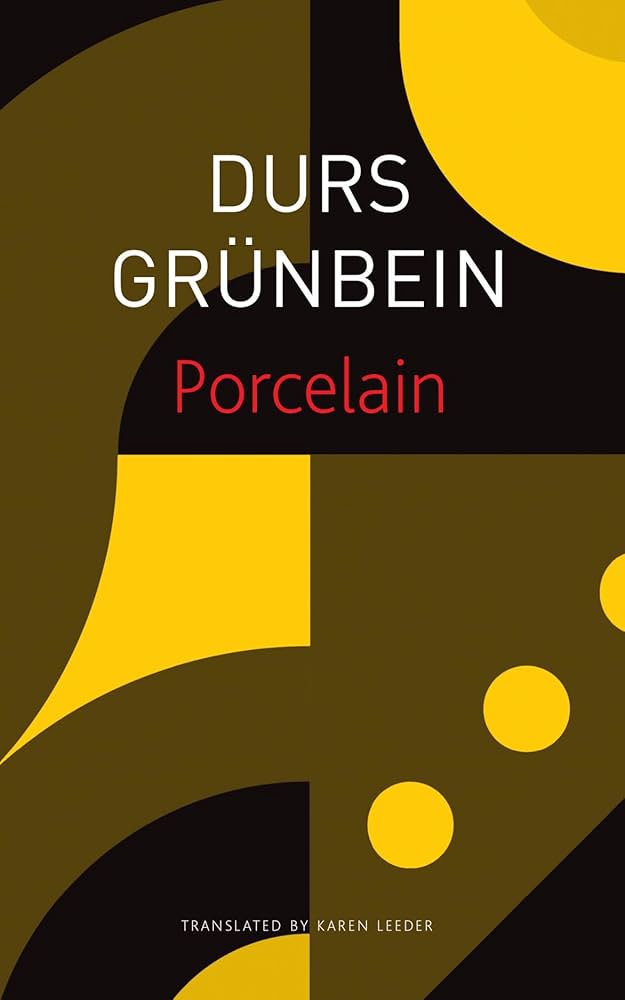
But his birthplace has been undoubtedly important in Porcelain (Seagull, 2020), the long sequence of poems (written slowly, we learned, on the February anniversaries of the Allies’ bombing of his hometown, Dresden). I reviewed this book here, when it was published). Grünbein read 10 poems from this sequence (some poems were read only in German with the English translation projected above), other poems read in both languages. Porcelain is an elegy the poet suggested, a Classical form, longing for what is lost. Poem #7 is one of the most remarkable, another museum visit by the young poet, who’d stare at a cherry stone from the 16th century, carved with 185 tiny heads. The poem comes to regard the curious object as an ‘emblem of the future’ of Dresden, presenting as it seemed to, faces, ‘eyes wide with terror, on every tiny screaming face, / inferno on a needle tip’.
The poet suggested the whole sequence of poems is also a kind of ‘sound system’ containing echoes or samples of other poets’ work, including Paul Celan, with Grünbein’s title (Porce-lain) being a pun on the earlier poet’s name. Leeder added that it should not be read in a narrowly nationalistic fashion, that a lot more (bombed) cities than just Dresden were alluded to by the poem (Coventry, Warsaw, Odessa, Guernica). She asked Grünbein what was it that kept drawing him back to Dresden as a subject matter for poems. He thought it had something to do with the moment when he realised that his own childhood was ‘historical’, in the sense of being intimately connected to major historical events. He recalls seeing truckloads of Russian soldiers passing where he grew up, heading to the nearby Russian military barracks. This produced a sense in the young boy that much in (his) life had been determined before his arrival on the scene. In this sense, his hometown acquired a ‘mythic’ quality.
KL: You mean it was a ‘world place’?
DG: Yes – I realised it was a reference point, worldwide, its splendour and its ruins. From the city of Dresden one can draw out a lot of history, a seed point, or like a jigsaw, that can be slowly pieced together.
Perhaps half a dozen more poems were presented from more recent collections. ‘Flea Market’ is a peerless poem about German history, starting from the bric-a-brac found in such markets – the spoons, brooches, bird cages, tables – and wondering ‘what / do they say, what do they hide’? Quiet allusions to ‘uniforms and daggers of honour’, seque into the next, even more troubling, question: ‘How can one’s thoughts not go astray / faced with the piles of glasses, / and old leather suitcases?’ The poem ‘Lumière’ also alludes to the Holocaust and starts out from descriptions of the Lumière brothers’ 1896 film of a train pulling into a station. The first film-goers were frightened at the image of the train’s approach, ‘but not yet the horror / at all the implacable trains / that have criss-crossed the century, / the endless rows of sealed trucks.’
Asked where his poetry might be heading, Grünbein surprisingly suggested that he felt a more prose-like quality entering his work – not so Classical then! A soberness in some ways – but with flashes of magic, magic spells even. His earlier suggestion that the good poem is a 2-step process – perceptual, conceptual – seems to be still important, though in the final result (I’m guessing Grünbein would agree with this) the two stages must be simultaneously present in the reader’s experience.
I have to say, one of the great pleasures of the evening was the way in which both participants took the poetry seriously and gave it a good outing. This may sound odd for a poetry reading, but often these days, I find too many readings/launches contain too little poetry and rather too much gossiping, drinking and networking (all of which can be excluding for those not in the swim). Can I make a plea for more reading at readings, a little less career-building? Of course, at The Goethe-Institute we were listening to two writers at the very top of their game and what they are creating – in German and in English – is vital, lasting stuff. But, if we are publishing poetry, we should not be shy of reading it (remember, not everyone attending will be able to afford to buy the book and take it home).
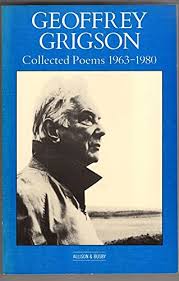
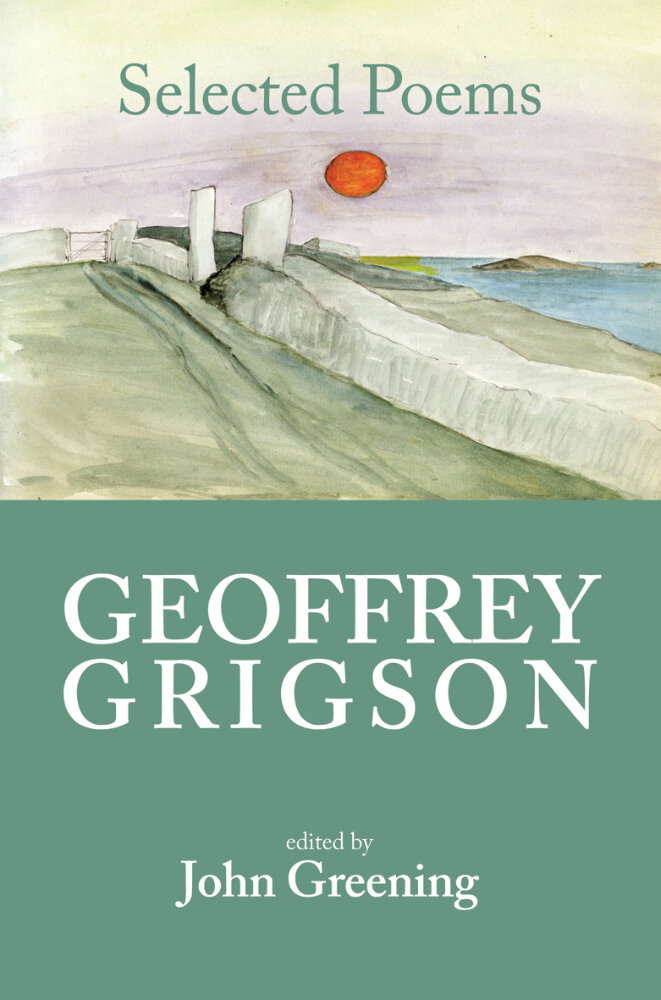
I’ve recently seen announced a celebration of the work of Geoffrey Grigson (1905-1985), scheduled to take place at 7.30pm, on Tuesday March 4th at West Greenwich Library. The event is called ‘In His Own Voice: Geoffrey’s Grigson’s Poetry’ and is being organised by John Greening with contributions from Grigson’s daughter, Caroline, his grandson, Joe Banks, and poets Graham High and Blake Morrison (and archive recordings of the poet himself). The event is free to attend (donations welcome), plus refreshments and books on sale. Texts will be projected on screen. As the event blurb reminds us, Grigson lived and worked through amazing times, culturally and politically, and was a prolific poet, writer, critic and editor. At the centre of English intellectual life, he knew the poetry grandees of his days and greatly admired those of the past. When he was only 27, he founded the bi-monthly journal ‘New Verse’, thus becoming hugely influential in the poetry world. I reviewed John Greening’s selection of Grigson’s work when it came out in 2017, and this seems an opportune moment to re-post it here and on my new Substack.
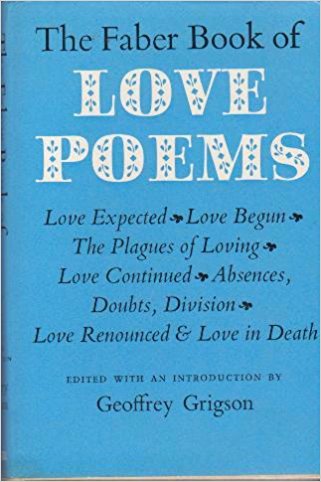
Surely we all have one or two Faber anthologies edited by Geoffrey Grigson on our shelves? Love Poems, Popular Verse, Reflective Verse, Nonsense Verse, Poems and Places, Epigrams and Epitaphs . . . As a critic he often wielded a savage power through his magazine New Verse. And as a big beast on the literary scene of the early 1980s, Hermione Lee interviewed him on Channel 4. But since his death in 1985, he’s better known merely as the husband of Jane Grigson, the celebrated cookery writer. His own poetry has been neglected which made John Greening’s 2017 Selected Poems from Greenwich Exchange a welcome opportunity to re-consider it. I think Grigson’s contrasting themes were established early on. The influence of two great poets (not Eliot, not Yeats) is clear from the start and it may be that the limits of Grigson’s poetic achievement and the absence of much development in his style, are because he never chose one path or fully escaped either.
The influence of Auden was very clear in Grigson’s first collection, Several Observations (1939). ‘Meeting by the Gjulika Meadow’ presents an enigmatic narrative in a “frontier” landscape; a meeting between two men whose conversation is in large part concerned with “the thunder / about Europe”. There are sketched fragments of personal dependencies and guilts but the whole reads as a slice of narrative that has been carefully shorn of its explicatory elements. A poem from 1946 shows Grigson using similar methods but on matters much closer to home; ‘In a Dark Passage’ draws material from the deaths of two of Grigson’s brothers in WW1 and the early death of his first wife, Frances. The situations are still relatively distanced by being told in the third person and the timings of the incidents are compressed to form a litany of heartfelt if rhetorical griefs: “O floes of ice, you float downstream / But do not disappear”.
There is certainly a very dark river running through Grigson’s work. ‘Two A.M.’, from the 1970s, records a wakefulness at night filled – as so often – by nothing but questions: “all emptiness, all gravity, / Ultimacy, nothingness”. He captures vividly the way this kind of mood, at such an hour, insists on expanding exponentially, racing to fill the world’s “Sierras, monadnocks, lakes, prairies, taiga, ice”. On this occasion, there is the possibility of an erotic reply: “At least now, with our bodies close, / Be comforted”. But even that response is absent from ‘Again Discard the Night’ from the 1980 collection, History of Him. Written as a first person narrative this time, the poem pulls no punches in its flinty and unforgiving portrait of old age waking:
… you call, the kettle gathers
And talks, and Are you all right? comes your
Usual cry, and my habit insists, without sound, Reply,
Be bright, wash, shave, dress, and this once,
Again discard the night.
Of course, Grigson’s sense of an ungoverned and likely meaningless universe matched with his frequent backward glances also calls to mind Hardy’s work. One of Grigson’s earliest poems, ‘The Children’, has an 11-line stanza of complex rhyming that Hardy would have been proud of. The children are portrayed as playing in a natural environment and in a state of temporal innocence: “They looked for no clocks, noticed no hours”. But ending each stanza, the triple rhyme words with “hours” are (ambiguously) “sours” and “flowers”. Between the third and fourth stanza, there is the kind leap in time often found in folk song (and Hardy). We have instantaneously passed many years: “The rooms were pulled down, but they always abide / In the minds of the children born in them”. These are the best lines in the poem with the much cooler closing lines rather falling flat:
They see the clocks and notice the hour
And aware that restriction of love turns sour,
They feel the cold wind and consider the flower.
It is certainly Hardy that Grigson is thinking of in ‘In View of the Fleet’. The Fleet is the lagoon behind Chesil Beach in Dorset and the poem borrows phrases from Hardy, empathetically suggesting that each poet’s vision has the same sequential locus: “Things not as firstly well, a sparkling day, and / tolling of a bell”.
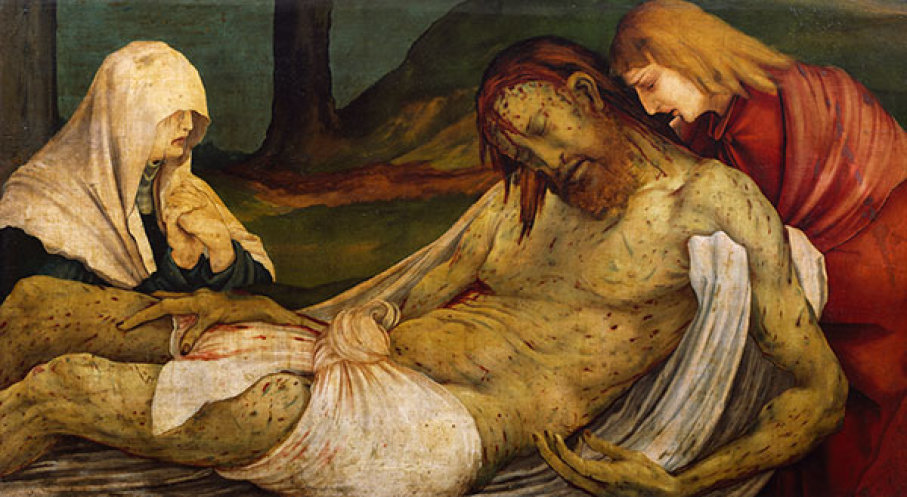
John Greening suggests in his very helpful Introduction that Grigson is also capable of an “extraordinary lyricism” and these are moments when he captures this “sparkling” quality of the natural world. In ‘A New Tree’, helped by the holding up of a child to a window, the narrator sees again with a newly cleansed perception, “a sun / being fiercely / let loose again”. Delight in the natural world recurs in a key poem, ‘Note on Grunewald’. In it, Grigson also expresses the scepticism about literary achievements which must have driven much of his own, often acerbic, critical comments on the work of others. In a man who devoted a lifetime to literary endeavours, it’s hard to take wholly seriously the poem’s assertion that he’d rather live to sniff the “scent of the flowers of lime” than to create lasting “poems”. But the scent is praised in contrast to the art of “Grunewald’s spotted green-rotted Christ”. Grigson sides with (“I join”) Cowper in deciding that death holds no attraction and that he too would choose to “leave this world never”. The perceived dichotomy between a vivid inhabiting of the world of the senses and the ‘rotten’ achievement of artists is by no means Grigson’s final comment on these issues, but the poem certainly expresses unresolved tensions.
As Greening reminds us, Grigson as a critic was a feared and fearsome creature, liable to “dismissiveness and intolerance of shoddy work”. Perhaps, in his own mind, he never quite resolved his assessment of his own poems. A lovely translation from Tu Fu was perhaps chosen because it laments lack of achievement, or at least of recognition: “Writing gives me no name”.* More vigorously, ‘Lecture Note: Elizabethan period’ is an hilarious and outrageous account of a poet’s final work. While the ink was still wet on the page, he dropped dead. The poem fell to the floor only for the maid to drop it in “the jakes”. The final lines laugh cynically, sarcastically, as if this illustrates the fate of most artistic endeavours: “Now irretrievably beshitten, it was, dear sirs, / The one immortal poem he had written”. Yet this is delicate stuff compared to Grigson taking aim with both barrels in ‘Perhaps So’. The premise is that too much is being written:
Too much is told. Banish polymath Steiners
And seventy-seven other British Shiners,
Naturalists, archaeologists, publishers
Of publications in parts,
Norman Mailer
And all long-winded farts . . .
It’s hard to reconcile this voice with that of ‘A New Tree’. Interestingly, Grigson’s address to an ancestor whose name was ‘Nazareth Pitcher’ is critical on the surface, disparaging of Nazareth’s “pride”, suggesting his “lips were too thin”, that he might “be pleased” if he was to witness the parlous state of the world now (1960s). But it’s also difficult to dismiss the feeling that Grigson chose to address Nazareth because he sensed a kinship with this judgemental, sceptical and meanly satirical man.
Having said that, Grigson did admire, if very judiciously. Greening draws attention to an Eliotesque belief in tradition, that the best poems are made by “members of a long narrow community through time”. The word “narrow” here indicates Grigson felt that much of what was truly best was not appreciated by many. In one word perhaps, we see here his motivation to be harsh with what he felt not good enough and his hard work in anthologising what was. There are two tribute poems in Greening’s selection which show Grigson at his complimenting best. ‘A Painter of Our Day’ is about Ben Nicholson and has the feel of a Coleridgean conversation poem. Its tone is confiding, admiring, ranging from observations about playing with children, shared days out, discussions of Nicholson’s work, ageing and the nature of art. Nicholson seems to teach an appreciation of “what is” and an avoidance of nostalgia. But at the same time, he recognises the value of the “reiterated wisdom of perceiving”. That both poet and artist set the bar of achievement very high indeed is suggested by Grigson’s admission that, of their chosen role models, “most have been / Long dead”. I find it hard to pin down a more precisely articulated aesthetic, but these lines are revealing of any artist’s relation to his/her elders:
Suddenly when young or in our first ability
We find them, slowly we find the reasons
For our love, finding ourselves, and what we lack
As well or need the most
Finally, ‘To Wystan Auden’ records the moment Grigson learned of Auden’s death in the “English September” of 1973. His admiration for the younger poet is fulsome. With the appearance of his early work, Auden became “living’s healer, loving’s / Magician”. From the other end of the temporal telescope, we can now see what the young Grigson gleaned from Auden’s poetry:
You were our fixture, our rhythm,
Speaker, bestower, of love for us all
And forgiving, not condemning, extending
To all who would read or would hear
Your endowment of words.
For all Auden’s own protesting about poetry making nothing happen, for Grigson, “time, after you, by you / Is different by your defiance”. One might ungratefully gripe that these are rather vague compliments from one poet to another. But Greening quotes Grigson suggesting that Auden’s achievement was in destroying “a too familiar, too settled monotony in manner and subject”. This is undeniable and this selection shows Grigson following Auden’s lead, yet at the same time, through his life, also being drawn back to a different, more traditional poetic style in the model of Hardy. Here, for example, in his last years, he recalls his childhood in Cornwall:
Staring down from that broken, one-arched bridge,
In that vale of water-mint, saint, lead-mine and midge,
I was amazed by that fat black-and-white water bird
Hunting under the current, not at all disturbed.
How could I tell that what I saw then and there
Would live for me still in my eightieth year?
*As a labouring translator myself, I have long remembered Grigson’s brilliant put-down in his Introduction to the Faber Book of Love Poems (1973). Explaining why he has not included any translations at all, he declares that their “unmeasured, thin-rolled short crust” would prove detrimental to the health of the nation’s poetic taste. Times have changed, thank goodness.
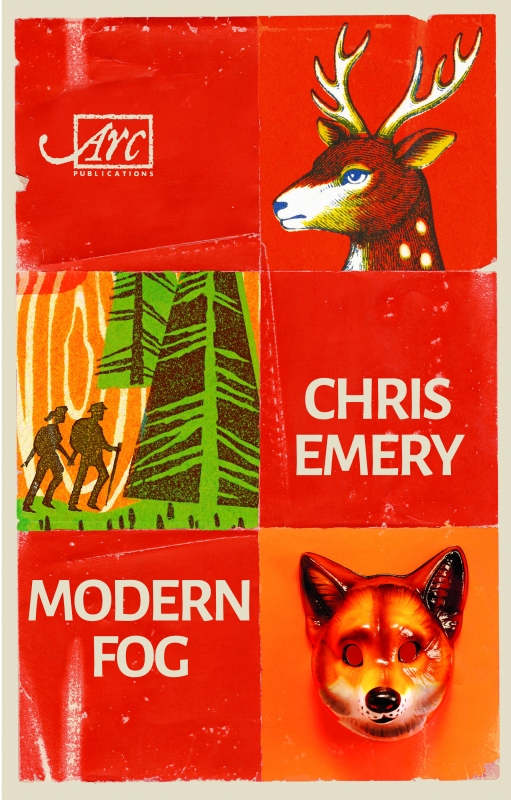
Chris Emery’s most recent collection both presents, and intends to see beyond, the Modern Fog of its title. The poems revel in describing aspects of this world and – in keeping with the images on the book’s cover – the occasions for such descriptions arise from journeys (often walking – the cover shows a hand-holding rambling couple) and the highlights of such journeys are frequently encounters with creatures (the cover has a deer and a fox). So ‘The Path’ leads us past ‘chalk beds’ and ‘clay beds’ and ‘dirt paths’ to excited sightings of a jay and a buzzard. Presenting more of a pause in such a walk, ‘The Day Storm’ is composed largely of the poet’s characteristic ‘noticing’ of blackthorn, blackberry and nettle. But once the eponymous storm has passed, the trees are now found to be ‘gashed . . . / splintered’ and this gives rise to one of Emery’s most interesting observations that, in their damaged state, the trees are in some mysterious way ‘clarified’. More of this later.
There is more than a little of Philip Larkin in Emery’s work – particularly the detail-listing-Larkin of ‘Here’ and ‘To the Sea’. Emery’s ‘All the Routes Home’ offers us an inclusive list of a Roman road, a Viking lane, an unclear path, a Puritan track. The poem ‘The Bay’ might be read as a more condensed version of Larkin’s ‘Here’ as, ‘after hours of hill torture’, the trail walker arrives at a bay, dotted with ruined buildings: ‘the afterthought of winter crofting’. This image of transience, of ultimate human failure, in effect a memento mori, is softened a little with Emery’s insistence that the homesteads ‘still hold their ounce of love’. In contrast to Larkin, and reminiscent of those earlier ‘gashed’ trees (somehow being advantaged by their damage), Emery is reluctant to accept death as an absolute ending and it is in this that the reader will find indications of his religious belief.
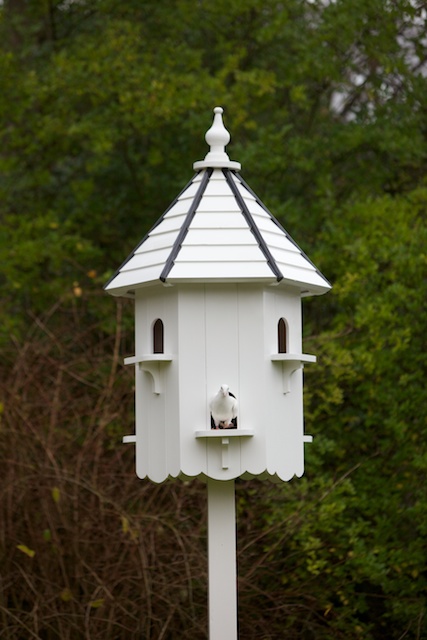
Similar spiritual themes emerge in the many encounters these poems have with creatures. ‘The Buzzard’ is another hill walk on a ‘churchless’ afternoon, but the flight of the bird on its thermal suggests an upward aspiration, a craving that the human observers also ‘hope to crave’. There is a beautiful little poem ostensibly about a dove returning to its dovecot:
Small snatch of air, sole white arc,
crisp handclap, then ritual landing.
All followed by cossetting and fuss
at the stoop. The laughable dance
with lots of nodding and wittering
before the tricky hop up
to the dovecote . . .
The poem is transformed to something unconventionally angelic by being given the title ‘Pentecost’. The more lengthy ‘Day Fox’ vividly captures the ‘living amber’ of the creature against the green of grass, but its death at the roadside is equally clear: ‘his pelt was tar black and slicked back / on the tiny lump of him’. Here again, Emery goes a step or two beyond the plain facts of death as, in the corpse’s decomposition, ‘the world / relaxed into him with all its fiery prayers’. To suggest this is an image of an afterlife is to lack the poem’s own subtlety, but Emery is surely probing Eliot’s idea (not original to TSE) that ‘In order to arrive at what you are not / You must go through the way in which you are not’ (‘East Coker’). The remarkable poem ‘Stags’ does this more explicitly in that the momentary sighting of the creatures is (in the poem itself) now no more than a shaky memory, an ‘absence’ that stands ‘at the edge of what’s never / fully grasped’. But the recall of their passing still has a potency as a ‘store of grace and loss’ and is here declared ‘the last religion of these woods’.
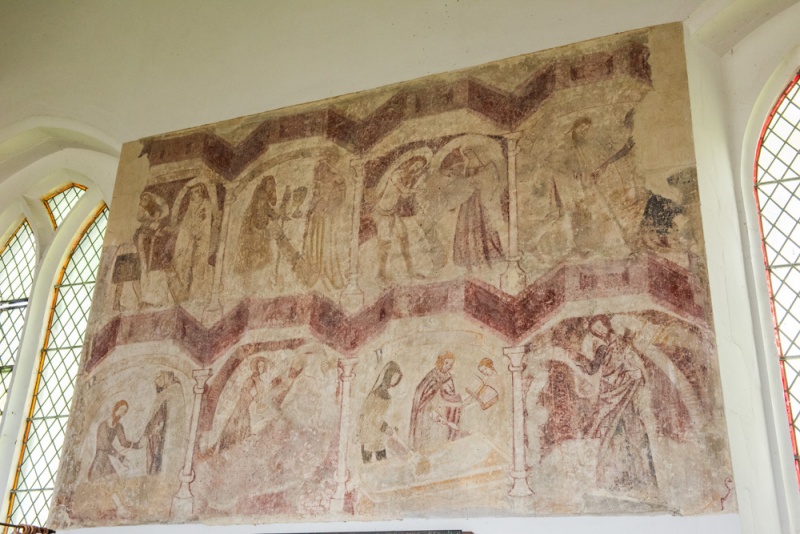
St. Andrew’s, Wickhampton in Norfolk
But Emery is equally at home describing the ‘dreck’ of our modern world. It’s surely more this sort of thing that constitutes the ‘modern fog’ of the book’s title. There is an NCP car park, the final destination perhaps of the couple in ‘Newbies’ who are driving along ‘old roads, lobbed estates seeping / by the rim of each roundabout’. The tacky nature of modern life is also found in ‘Edgeworlds’ which encompasses 4x4s parked up beside a ‘ratty beach’ and coach tours, detergent-smelling corridors and TV reruns. But such scenes function in this book partly as a foil to the (again) Larkinesque ‘churchgoing’ side of Emery’s character. ‘The Wall Paintings’ – a visit to St. Andrew’s, Wickhampton in Norfolk – opens, not with cycle clips, but with the equally evocative ‘thunk of a latch and then your eyes adjust’. And far more monumentally, ‘At St Helen’s, Ranworth’ is a 12-part sequence (each shaped like the church’s tower) more explicitly contemplating the building’s impact on the poet’s religious experience.
I guess I’m more attuned to Emery’s art when he is working up from the roots of the secular and material world, as in ‘One Drive in Winter’, in which the travelling couple go beyond satnav reach, the petrol tank close to empty, beyond any very obviously attractive destination, yet they still discover something worthy of a return, something about themselves, an opportunity to ‘solemnise the marginal and lost’. It may be that the great churches of the Norfolk Broads are themselves part of the category of the ‘marginal and lost’ these days and I do admire Emery’s attempts to bring them back into contemporary poetry, but I find his more slantwise and paradoxically inclined images (evocative of ‘East Coker’s ‘In my end is my beginning’) more accessible emotionally. To give one more example, in ‘The Elders’ – a poem written in memory of Adam Zagajewski – Emery again deploys an image of trees damaged after a storm (this time perhaps more metaphorically damaged by ‘revolution’) and these oak limbs also ‘lie / broken with new life’.
This intriguing collection’s two concluding poems are perhaps variations on this same theme. ‘The Start of It’ is – here’s the paradox again – the beginning of the end prior to the beginning: in this poem we read of frank intimations of mortality, of moments when ‘something abstract stiffens in the grace’ of a life, when we may come to glimpse ‘the formal shape [we] make in time’. In a completely different mode, ‘The Legacy’ eventually reveals itself to be a poem about the gentle removal of an empty wasps’ nest, its ‘featherweight’ and ‘strange paper weather’. In the transformative effect of real poetry, the nest comes to be seen as a human life lived, ‘sad and gorgeously dented’, but from which the creatures that made it have departed to another place: ‘to drone in apple acres / elsewhere darkening / with sweet ruin now.’ Whether we believe in such a place – and the oxymoronic ‘sweet ruin’ casts a shadowy doubt – is, with writing as good as this, hardly the point, appealing as it does, through vivid imagery, confidently written, to a fundamental human longing for continuation in the face of what we think we know of the end of life.
Many thanks to Mat Riches for this fulsome and acute reading of my recent collection from Salt Publishing. The review first appeared onThe High Window – Jan 2024
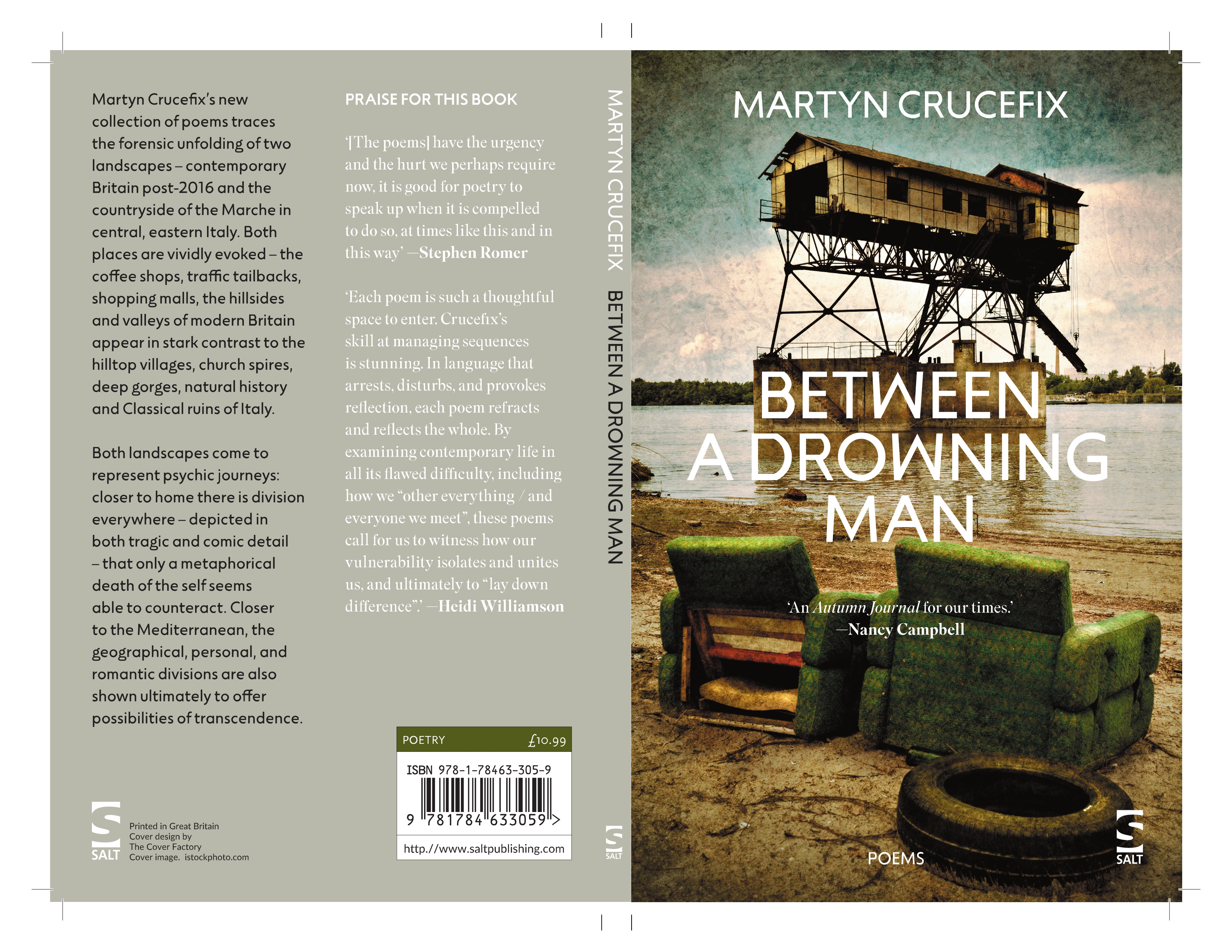
The introduction to the first section of Between a Drowning Man states that it draws on two texts. The first is Hesiod’s Works and Days, and the second of which is described as
the type of poem known as a vacanna originated in the bhakti religious protest movements in 10-12th century India. using plain language, repetition and refrain they were written to praise the god, Siva, though also expressed a great deal of personal anger, puzzlement, even despair about the human condition […]
This helped put everything into context for what followed. One third of the way in I started to think of it as a man shouting at clouds in book form, of someone railing at things in the world that are beyond our control. And maybe it is all of this, but it also much more than this. I think it becomes a lesson in acceptance.
In a post on his own Blog, Crucefix describes these poems as starting to arrive after reading the vacanna poems in 2016, and how the poems began to accumulate after that while ‘staying in Keswick at the time and I vividly remember scribbling down brief pieces at all times of the day and night’ and of having been influenced by Brexit (the bridges are down indeed). However, he also describes in a follow up post that:
I thought of the poetry I was writing as a quite narrowly focused topical intervention, but in the last 4 or 5 years …the poems have come to seem less dependent on their times and more capable of being read as a series of observations – and passionate pleas – for a more generous, open-minded, less extremist, less egotistical UK culture.
And while the Brexit reading is there, these poems speak more to grounding a modern and disconnected world (despite plenty of references to devices for and modes of communication—we’ll come back to that shortly) in timeless themes like love and desire, parenting, ageing, joy in nature, false idols, and much more, and this is just in the first twenty or so pages.
Picking one of those themes at random, we can see how false idols are covered, but also how deftly he weaves in modern references to something that is both timeless, and of its time, and with that very human. In ‘the six pack on the side’ we are told:
the clock is a sinister and impassive god for the ancients rumour was a kind of god …
the god of WiFi when we curse its absence and when did difference become a god
We have always been a narcissistic species that pays attention to gossip (‘rumour was a kind of god’), but while our gods have changed as the centuries have passed, we still curse our gods when they forsake us. Not a bad return for a 19-line poem in my opinion.
In order to achieve the ‘more generous, open-minded, less extremist, less egotistical UK culture’ we can see several pleas for more open lines of communication throughout the poems. Some are located in the specific and familial, as in ‘watch the child’ and its discussion of a child chattering away to herself in a coffee shop with her ‘bright picture book’ juxtaposed with ‘her mother at her cooling latte / at her macchiato / at her cooling skinny medium cappuccino // […] her mother’s ears wired casually // with two scarlet buds.
The child is broadcasting and communicating in a carefree way vs the mother’s more deliberate inward-looking approach, a shutting the world out for some respite. And while this could be a judgmental poem; it’s not. It feels like an invitation to consider both sides, both needs here. The refrain of ‘all the bridges are down’ lands particularly well here, both for the protagonists of the poem, but also for the reader.
However, while some pleas are located in the specific there are some more general ones to be found. In ‘he thought of this time’ one man recounts a litany of disappointments and emotions from his father. The poem draws from Hesiod and his idea of the fifth age where modern man was created by Zeus to be evil, selfish, weary, and burdened with sorrow. It’s a two-footed tackle on humanity from the whistle:
he thought of this time as a fifth age that he’d be better off dead or not yet born working all day he would fear the night had heard of children born prematurely grey and the fraying bond between fathers and sons between mothers and daughters between host and guest between different races
It continues without reprieve about a world where:
[…]the hopeless are advanced and further advancement lavished for no more than just chancing it respect a word more spoken than heard the educated full of corrosive cleverness and compassion the greatest of virtues an ebbing tide you see where it glints on the horizon
At the time of writing, it’s easy to feel like these lines are as contemporary as it’s possible to be, and yet it’s arguable they are evergreen observations about humanity. However, I suspect that’s the point.
We’ve touched upon references to modern-day totems like WiFi, coffee types and headphones already, but this section is filled with them. Further examples include references to Google Maps and ‘five-star online reviews’ in ‘fifteen kilometres of traffic’ and ‘stoke a fire under your silk blouse’ respectively.
This all reaches its zenith in the final poem of the section, ‘this morning round noon’. The poem moves from personal notes about scattering ashes, a son’s birthday (and him being in huge debt at 21, one presumes from being at university) through to:
an American punk band form Nashville posting abuse about a young Buddhist woman refusing anaesthetic
The lines are punctuated by phrases like ‘likesharelike’ or ‘likeclicklike’ or ‘smileyfaceicon’. It’s the diaristic nature of the whole section writ large and transmitting thoughts to the page (albeit the printed page, not the Facebook page) as they occur. As an aside, this running together of words, coupled with the entire book’s distinct and clearly deliberate lack of punctuation (save a few dashes here and there) add to the observational nature of the poems, of thoughts being pulled from the ether. However, this is very much not to say that these poems aren’t considered and crafted—they very much are.
The final line of the poem and section is ‘I say the Pantone chart is one of my favourite things’, and while the poem that proceeds this line could be read as a darker version of the Sound of Music classic, less Raindrops on roses and more ‘I was hit by a car likeshare’, but I prefer to take it as a sign that the poem end on acceptance of nuance, variation and being able to communicate the same needs.
As the first section comes to an end there are two poems where the last line of one resurfaces as the start of the next, and it feels like a teaser for what follows in the second section, O. at the Edge of the Gorge.
This was previously published as a pamphlet by Guillemot Press in 2017 and is a crown of sonnets. After the hectic modernity of the first section, there is much to be said for the relative calm of following a traveller, Orpheus, on a journey through Italian countryside observing ‘Glossy fleet black clods of carpenter bees / swirl at the corner of the house / then sink onto spindly lavender stems / alight on blooms stooped // with the weight of insect lives’.
It’s a beautiful opening and a beautiful image that should perhaps be filmed and used as a fine example of what was briefly known as slow TV and shown on BBC4, but in the second poem he describes ‘astronomical time marked by light’ as the sun descends the gorge and church bells tolling, but:
yet come nightfall a different sense these same sounds sound notes more chilling…
A very real sense of for whom the bell tolls, indeed. As the traveller wends their way round the area, taking notes and sketches of birds, a ‘flock of white doves’, that darkness returns in the form of a buzzard in the eighth sonnet, and gets deeper still in the ninth where he mentions:
like Urbisaglia or some place has seen and survived change of use from sacred temple to church to slaughterhouse and no gully nor hill can stop it
Urbisaglia is an ancient town in Mid-East Italy that became the site of an internment camp during the second world war, and that knowledge adds further weight to the stanza that begins sonnet ten:
The truth is some survive a while most fail to conceive the scale of paperwork to follow change of use from church to temple next to slaughterhouse.
The cruelty of humanity to itself is mirrored in the “bloody festival / of the bird” in sonnet thirteen as it discusses a raptor above the gorge, and the final sonnet off this crown muses on the fragility of life:
All creatures die sooner blind to the hawk— left clutching no more than this as if the hammock he occupies each and all night too as if strung out
[…] not falling yet not ever at ease
‘not ever at ease’ could so easily be a final motif for the whole collection. There is a sense that the learnings of this collection are hard won, but there is a connection to the wider world to be had, and that we can find comfort in travelling through it. The final lines of ‘you are not in search of’ in the first section seem apt as a place to leave it:
you might say this aloud—by way of ritual— there goes one who thought much of life
who found joy in return for a little gratitude.
Mat Riches is ITV’s unofficial poet-in-residence. Recent work has been in Wild Court, The New Statesman, The Friday Poem, Bad Lilies, Frogmore Papers and Finished Creatures. He co-runs Rogue Strands poetry evenings. A pamphlet called Collecting the Data is out via Red Squirrel Press. Twitter @matriches Blog: Wear The Fox Hat
I’m very pleased to announce that Mark McGuinness’ excellent poetry podcast, A Mouthful of Air, which has recently featured poets such as Mona Arshi, Judy Brown, Rishi Dastidar, Ian Duhig, Mimi Khalvati, Clare Pollard, Tom Sastry, and Denise Saul, has recorded a discussion about my new Salt collection, Between a Drowning Man.
Mark’s method is to focus on one particular poem and between us we chose the poem ‘you are not in search of’, on page 57 of the new book, from the latter end of the ‘Works and Days’ sequence. You can listen to the podcast here. It’s about 40 minutes in length and includes a reading of the poem at the beginning and end. There is also a helpful transcription of our discussion.
Here is the poem text – though without the indents which are hard to reproduce here:
Last week, with the imminent arrival of my new book of poems, Between a Drowning Man, I decided it would be useful – for those who would like to know – if I re-blogged a piece I wrote and posted early in 2019 about one of the key sources and inspirations of the new book’s main sequence of poems called ‘Works and Days’. The focus then was on my reading of AK Ramanujan’s collection of vacana poems. But later in the process of completing the full sequence, it was further formed (or reformed or deformed) by rather different pressures derived from a second literary antecedent, the reading of which was itself influenced by the febrile and divided atmosphere surrounding political events in the UK between 2016 and 2019. I mean, of course, Brexit.
At the time, I thought of the poetry I was writing as a quite narrowly focused topical intervention, but in the last 4 or 5 years (partly with the greater clarity with which the Brexit heist can be now seen to have been foisted on the country), the poems have come to seem less dependent on their times and more capable of being read as a series of observations – and passionate pleas – for a more generous, open-minded, less extremist, less egotistical UK culture. It was Hesiod’s pre-Homeric poem, Works and Days, that suddenly felt oddly familiar: in it he is not harking back to an already lost era, nor to past heroic (in our case imperial) events. Instead, Hesiod talks about his own, contemporary workaday world, offering advice to his brother because the pair of them seem to be in some sort of a dispute with each other (a squabble over limited resources – that sounded familiar).
So my developing sequence took over from Hesiod the idea of familial disputes, the importance of the persistence of Hope (in the Pandora’s jar story), the idea that we need to understand that we are living in an Age of Iron (not idealised Gold). Poetry can never be summarised by its own conclusions but the poems seemed to me to be arguing the need to work hard – to have patience – not to buy into fairy tales of a recoverable golden age that probably never existed anyway. If all this sounds interesting, do click on the blog title below to read the whole of my original post. After a bit of New Year 2019 preamble, the discussion of Hesiod begins at paragraph 3.
My first public reading of these poems from my new book will be on the evening of Tuesday 24th October at The Betsey Trotwood in Clerkenwell. I’ll be reading alongside 2 other Salt poets: Elisabeth Sennitt-Clough – ‘My Name is Abilene’ (Shortlisted for the 2023 Forward Prize); and Becky Varley-Winter – ‘Dangerous Enough’ (‘daring, danger and risk in poems that are packed with imagery from the natural world’).
With the arrival of my new book of poems, Between a Drowning Man, imminent, I thought it would be useful to re-blog a piece I wrote and posted early in 2019 about one of the key sources and inspirations of the new book’s main sequence of poems called ‘Works and Days’. It was my fortuitous reading of AK Ramanujan’s collection of vacana poems, early in 2016 (all explained below), that set me off experimenting with a similar clipped, plain, rapid, fluid style with its (refrain like) repetitions. I was staying in Keswick at the time and I vividly remember scribbling down brief pieces at all times of the day and night. Outside, and interfering with the various walking expeditions we had planned, the great storm of the winter of 2015/6 (googling it now, it was Storm Desmond) had taken out many of the ancient bridges in the Cumbrian countryside. Inevitably, this fact found its way into the poems and provided the refrain I used in many of them.
It has been a long haul between that period and the poems’ eventual appearance in this new collection and the whole sequence was further formed (or reformed or deformed) by pressures of a second literary antecedent (I’ll blog about that next week) and by the divisive political events in the UK between 2016 and 2019. Click on the blog title below to read the whole of the original post. My first public reading from the new book will be on the evening of Tuesday 24th October at The Betsey Trotwood in Clerkenwell. I’ll be reading alongside 2 other Salt poets: Elisabeth Sennitt-Clough – ‘My Name is Abilene’ (Shortlisted for the 2023 Forward Prize); and Becky Varley-Winter – ‘Dangerous Enough’ (‘daring, danger and risk in poems that are packed with imagery from the natural world’).
I have been invited to give a 10 minute reading – on Zoom – this coming Friday 25th November @ 1pm alongside Hilary Watson and Sudeep Sen. The event is free to all but you will need to register for a ‘ticket’ (and Zoom link) here. I hope you can make it.
Details about the other two readers are as follows:
Poet, translator, artist, and editor Sudeep Sen studied English literature at the University of Delhi and was an Inlaks Scholar at Columbia University. Sen has published more than a dozen collections of poetry, including The Lunar Visitations (1990), Postmarked India: New and Selected Poems (1997), Lines of Desire (2000), Distracted Geographies (2003), Rain (2005), and Aria (2011), winner of the A.K. Ramanujan Translation Award. Two volumes of new and selected poems and translations were published as Fractals: New & Selected Poems | Translations 1978-2013 (2013) and Fractals: New & Selected Poems | Translations 1980-2015 (2015). Recent collections of poetry include Incarnat | Incarnadine (2017) and, with Setsuko Klossowska de Rola and Homa Arzhangi, Path to Inspiration (2017). The Government of India Ministry of Culture’s awarded him the senior fellowship for “outstanding persons in the field of culture.” Sen divides his time between New Delhi, London, and New York.
Hilary Watson grew up in and around Cardiff. She graduated from the University of Warwick Writers’ Programme with a BA in English Literature and Creative Writing and an MA in Writing. She was a Jerwood/Arvon Mentee 2015/16 with mentor Caroline Bird alongside fellow poets Rachel Long and Emma Simon. She was shortlisted for the Troubadour International Poetry Prize 2019 and the Live Canon Prize in 2015, and has recently been published in a number of UK and Irish magazine such as the Butcher’s Dog, Interpreter’s House, and Impossible Archetype. She works in the third sector and is currently writing her first collection.
I have not quite finalised what I will be reading but probably a couple of poems from my last full collection, The Lovely Disciplines and some more recent poems. No doubt I will plug the recent Christmas poetry anthology that I have co-edited with Michael Glover – also plugged in a recent blog post here. You might be interested to hear that we are planning a London launch for the anthology on Sunday December 4th @ 7pm at the Omnibus Theatre in Clapham. More details (and booking) can be found here. Readers will include Rowan Williams, Nancy Campbell, Hilary Davies and Denise Saul – and there will be plenty of music of a festive variety too.
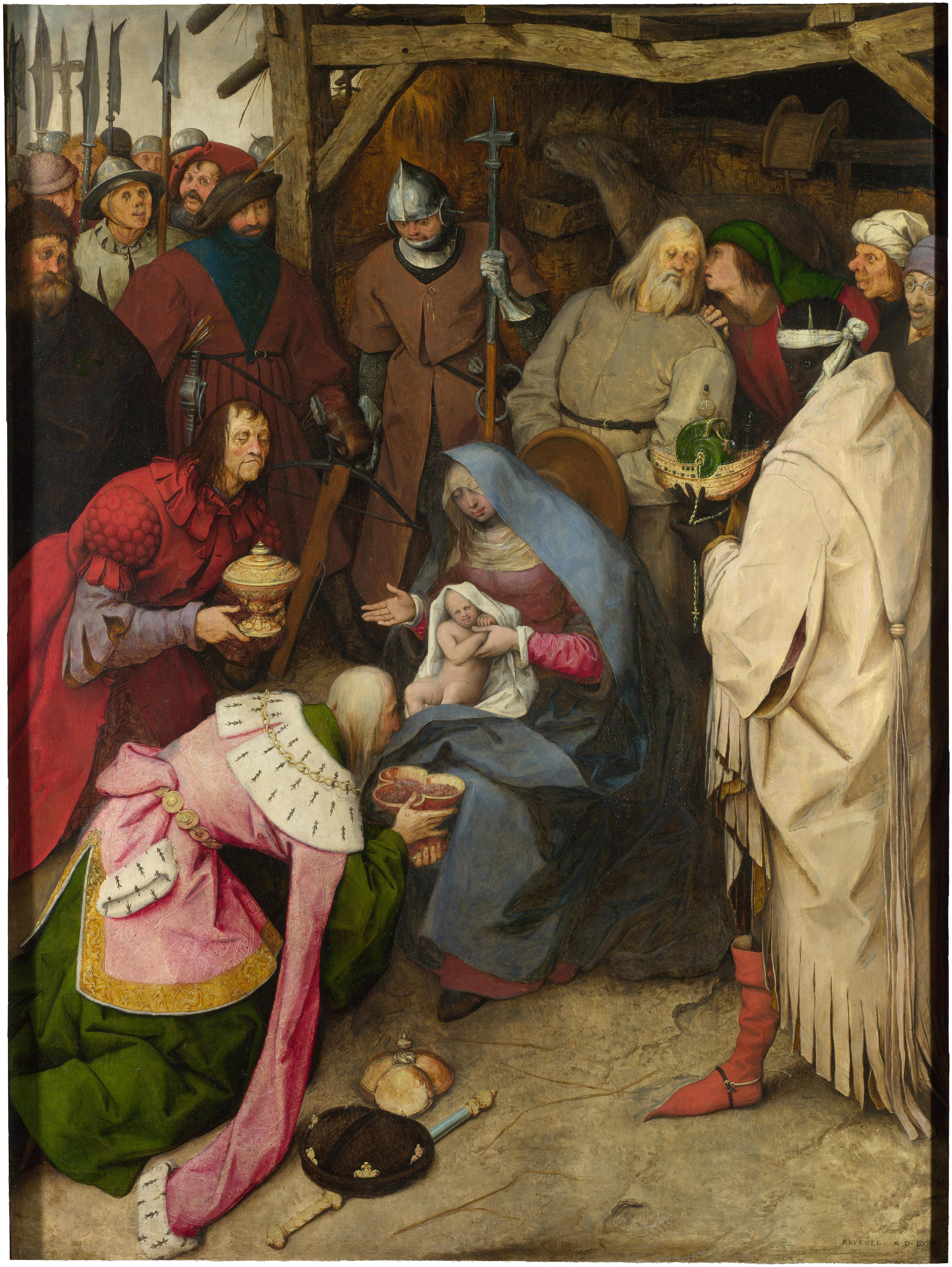
If I have time in the Live Canon reading, I’ll read this poem included in the Christmas anthology which I wrote in repsonse to Breughel’s fascinating painting of the same name (see above). It might be worth knowing that I imagine the voice of the poem to be that of the (blind? short-sighted?) man in the upper right corner of the image. He’s the one wearing the large blue-tinted spectacles:
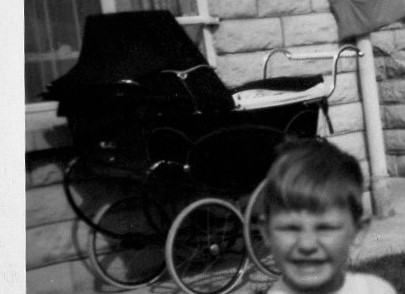
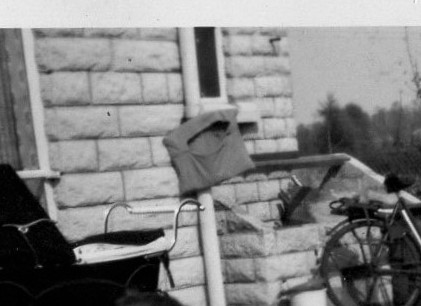
On any criteria, it is a poor photograph. The primary subject – the three young boys in the foreground – are out of focus. The youngest one’s head is just too low for the dated camera’s pre-set focus to find it. Instead, there in the background, but far more sharply defined, is a woman’s bicycle, the chain ring and two slanting elements of the metal frame reflecting the sun brightly. I know the orientation of this house. If the sun is falling this way, the time must be nearing mid-afternoon, the sun is falling on the garden and over back of the house, over the photographer’s right shoulder, into the eyes of the children, each of whom is squinting slightly. Look beneath the large pram under the window, to the left: the shadows of its four spoked wheels and their pale tyres confirm the angle. The black bulk of the pram and the mass of shadow behind and beneath it almost take over the image. It too is in sharper focus than the children.
Roland Barthes’ Camera Lucida suggests our viewing of a photographic image has two aspects. What he termed the studium is associated with any viewer’s knowledge and cultural experience, with a body of information and a general interest: ‘a very wide field of unconcerned desire, of various interest, of inconsequential taste’ (tr. Richard Howard, Vintage Books). It is a mere question of liking, not liking. Here, the studium of the image is open to anyone with a decent knowledge of England in the mid-20th century. The corner of a recently built house (the garden as yet untended, only wire fencing between this and the next house on what looks like a raw housing estate) and the style of bicycle and pram, the clothes the three boys are wearing (what look like home-knitted jumpers – the youngest wrapped up with a knitted hat, buttoning under the chin – so the weather is not warm) are all suggestive of the late 1950s or early 1960s. The youngest boy is also sat in a toy pedal vehicle – the long-nosed bonnet indicative of a racing car – the sun’s angle perhaps catching brightly again what might be headlights at the very bottom of the image.
The outline of this lawn in the back garden remained unchanged throughout my childhood. Its corner – in the image, its apex – falls neatly behind the youngest boy’s head. Perhaps there is some composition here? I’d guess it was my father pressing the white button on the black plastic box of a Kodak camera. Taking such a picture was more the father’s job in those days. His clumsiness in framing the image ought not to be judged too harshly (these were still relatively early days for mass photography) but it stirs in me the thought that he was always a man more at home with objects than words or people. I wish he’d taken the picture again, a little lower, filling the chosen frame with his three children. Forty years later, setting the scene behind the large window in the image, sat around the dining table that (for fully 50 years) looked out onto the back garden, I wrote of him when forgetfulness and confusion troubled him more and more:
Past ninety and still no books to read
your knuckles rap the laid table
x
gestures beside a stumble of words
so much aware of their inadequacy
x
it hurts us both in different ways
since a man without language is no man
x
finding too late the absence of words
builds a prison you’re no longer able
x
to dominate objects as once you did
the world turns in your loosening grip
So, it may be the general studium of this image stirs some mild interest in you – the period, the clothes, the main objects a little like museum pieces. Barthes’ second element in a viewer’s response to a photo, he termed the punctum, some detail (usually only one) that pierces the viewer, that wounds us, a powerful emotional response. The punctum is often not intended by the photographer – some random detail that for a particular viewer has a disproportionate and very personal impact. It is what moves us.
MC and older brother, looking smart for infants school
The fact that this is an image from my own past means there are a number of candidates here for a punctum. Most likely surely is the face of the boy on the left. Under a thick head of hair, a rough-cut fringe, he squints more than the others. His eyes cannot be seen, hidden away in the dark slits beneath the eyebrows. The firm lines on his face slant down from nose to half-opened mouth in a grin that lifts his cheekbones, that might even be the shaping of a word. The long vowel in the word ‘cheese’ perhaps? A version of that face greets me in the mirror even now. In these infant and junior years, my jumpers were knitted by my mother. I seem to be wearing a girlish collar beneath. My right hand is lost beyond the lower edge of the image. My right rests on the racing car, not quite clasping my younger brother’s hand which looks set back a little on the edge of the car. I am the middle child. My younger brother must be little more than a year or two old (born in 1959). My older brother is the one full of animation: right arm around the car, around his little brother, he seems to be exploding into a fit of giggles. But oddly, none of these details quite wounds me…
The bicycle? My mother’s of course. A large wicker basket on the front. Look closely and there on the back is the folding child’s seat I remember sitting in as she pedaled the 2 or 3 miles into town. The vast contraption of the black pram? I don’t have memories of it – even of my brother in it. It remains part of the studium – I remember later discussions about the way pram and child would be left outside for hours on end (sometimes in the front garden of the house where the sun’s absence kept it cool in summer). I think a general thought: such a thing would never be countenanced these days. Even far older children are seldom let out of their parents’ sight.
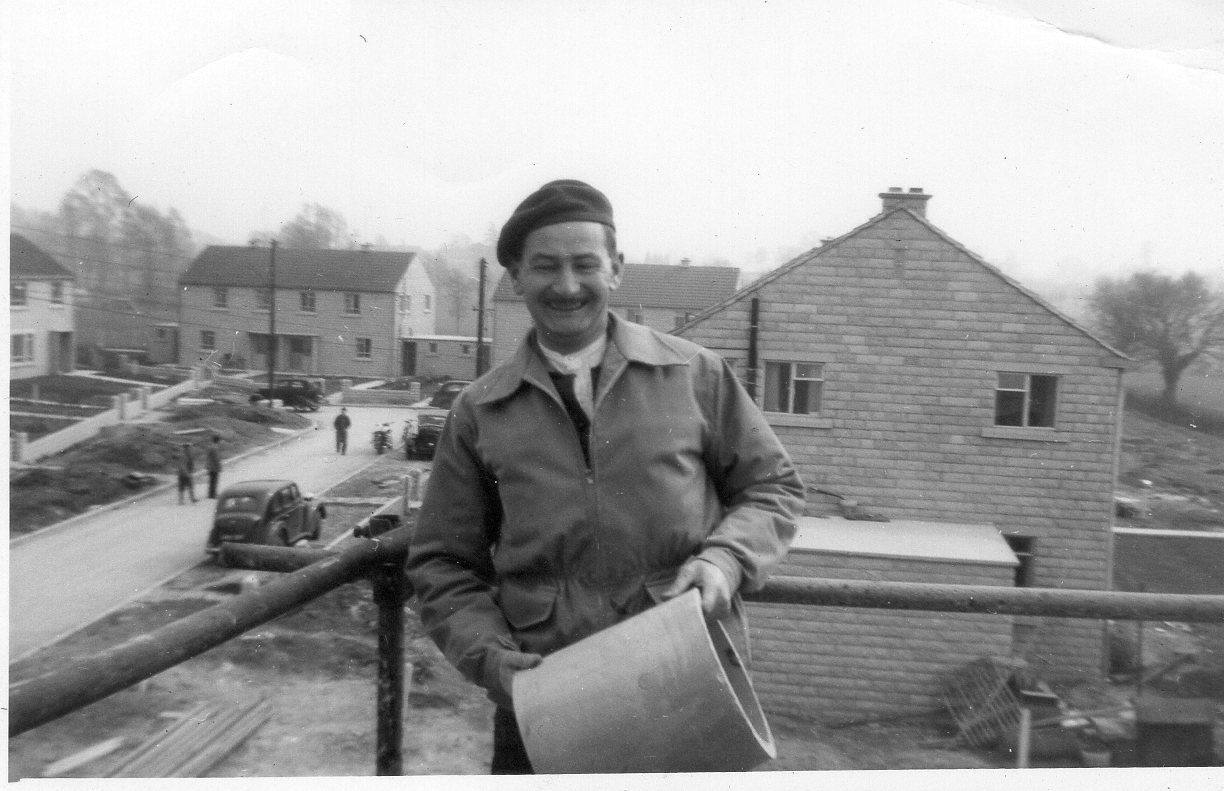
My father helps build one of the estate houses
The house itself? A little tugging of nostalgia here (we eventually sold the house after my parents’ deaths just a few years ago) but mostly I sense information welling up. An estate of 40 such houses on the edge of a Wiltshire town. One of the first ever post-war self-build projects – the 40 men built them with their own hands over 3-4 years in the mid- to late-50s. I have other photos of the house being built. Each dwelling had a little outhouse (ours is middle top of the image; next door’s filling the top right corner). There’s a non-standard coal bunker: it’s what Mum’s bike is propped against. If I remember rightly my paternal grandfather helped build it. I have a vague physical memory of being held by him (over the bunker?). Nothing more, since he died suddenly, I think, before this image was taken.
Oddly – and this is in the nature of the Barthsian punctum – the detail that has particular poignancy (like a dagger, Barthes says) is the shapeless peg bag hanging (where it always hung, it hung there forever) on the bracket attaching the guttering downpipe to the wall. The camera simply records what lies before it. After 100 pages of discussion, Barthes arrives at, what even he confesses is, a less-than-earth-shattering conclusion that a photo’s potency lies in its declaration of ‘this-has-been’, its evidential power. Yet it’s also the case that an image’s power can be contained in what is absent from it or is implied by small details within it. I am pierced by the peg bag because it represents (more than that – it is, it manifests, the touch of) my mother. The only member of the family nowhere here (neither behind nor in front of the lens), she is there in her bicycle, there in the pram (possibly there in the waste bin beside the coal bunker – has it just been washed out? there is a darkening patch of water running on the path?). But most of all in the peg bag. Almost certainly she made it herself. A coat hanger. A few lengths of spare cloth. Some wooden pegs. The washing line ran down the length of the back garden path. There was a long wooden prop with a V cut in the top. In a very early poem, I would see her ‘struggling / to peg out snapping shirtfuls of wind’.
My mother in the 1950s
In Susan Sontag’s On Photography, she writes ‘[w]hen we are afraid, we shoot’. She means when we fear losing what-is-here we preserve it in the museum of the recorded image. Did my father fear losing this moment? He preserved it badly. But he managed to preserve the children (though the ones in this image are now passed on into something quite other; Barthes would say they have died). Nowadays, a father would turn his camera and include himself in it too. What does that say about fear? The peg bag would still be hanging there though. In the image. On my desk here. Scanned to the screen. In my mind, the peg bag continues to hang in its place on the downpipe though other people’s children play on the lawn, other parents sit gazing out of (what we always called) the dining room’s picture window.