June/July Poetry Reading Dates

I have two reading dates coming up in the next couple of weeks as follows:

Firstly, on Thursday, 25th June @ 7.30pm I’m looking forward to reading poems with Kate Noakes and also listening to some jazz as part of the Festival of Chichester. Thanks to Barry Smith for the invitation. Here’s the Festival blurb for the whole event…
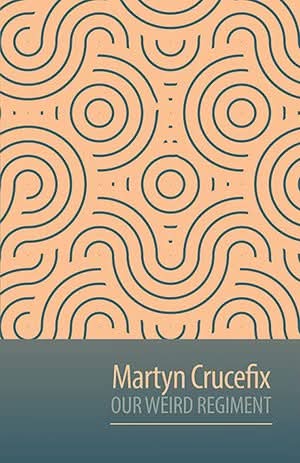
Acclaimed poets Martyn Crucefix and Kate Noakes link with Mike Carey’s Big House Jazz ensemble to entertain and inspire. Plus the launch of Poetry & All That Jazz magazine with South Downs poets. Enjoy a delightful mix of words and music with complementary homemade cake. Based in Arundel and well-known throughout Sussex and the South, the Big House Jazz ensemble will be featuring classic jazz by Count Basie and Duke Ellington plus original tunes. Both prizewinning poets will read from their new collections – Kate Noakes, Sublime Lungs (Two Rivers Press) and Martyn Crucefix: Our Weird Regiment (Shearsman Books).

Details: The Poetry & Jazz Café, Assembly Room, North Street, Chichester, PO19 1LQ. Thursday, June 25, 7.30pm (doors 7pm). Tickets £15

Book Tickets for this event here: Focus Arts – South Downs Poetry Festival event tickets from TicketSource.
Secondly, on the evening of Tuesday, 7th July @ 7.45pm, I’m making a delightful return visit to Ouse Muse also with my new collection of poems, Our Weird Regiment (Shearsman Books). Thanks to Ian McEwen for the invitation. Ouse Muse events take place in the wonderful Eagle Bookshop, 16-20 St Peters Street, Bedford, MK40 2NN – https://maps.app.goo.gl/cAfo72bLZrSuFhoJ6.

Here’s the bookshop blurb for the evening: Ouse Muse returns, with guest reader Martyn Crucefix, for a poetry open mic night run by local poets and open to anyone with poetry or short prose to share. The night often opens with performances by guest stars before things devolve into literary chaos.

More details here: https://eaglebookshop.co.uk/events/2026/7/7/ouse-muse-july Bookshop doors open at 19:45 for an 8 o’clock start. There’s no need to book, an entrance fee of £5 is paid upon arrival. If you wanted to pick up a book or two from our shelves you can use this entrance ticket as a £5 voucher for the rest of the month. 

If you are in the areas, I hope to see you at one or other of these events.
Quickdraw Review: ‘Counting Clouds’ – poems by Peter Robinson, paintings by David Inshaw

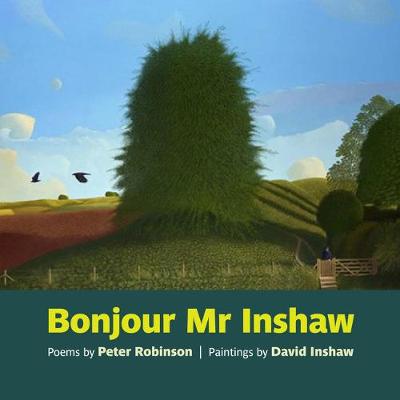
This is how reviews are supposed to work. I recently read James Harpur’s comments on Bonjour Mr Inshaw, published by Two Rivers Press (poems by Peter Robinson, paintings by David Inshaw) in the Spring 2020 issue of Agenda, ‘Pound Reconsidered’. I went out and bought the book.

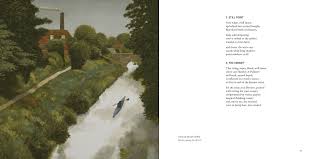
I’ve long thought of writing poems about David Inshaw’s paintings, drawn to what Harpur calls his ability to “invest landscapes with spiritual light and energy, balancing realism with a sense of the mythic, of penetrating a noumenal sphere”. The other personal draw to his work has been that Inshaw’s home (and home ground as an artist) is that part of Wiltshire to the west of where I grew up. Inshaw’s home is in Devizes and many of his paintings are of the landscape just a bit further west, of Silbury Hill, Avebury, the barrows and downs of that area. The drive from the M4 turn-off at Hungerford, on the Bath Road, through Marlborough and the A361 to Devizes has long figured in my personal list of favourite drives (not wholly because it was for years the route to my childhood home in Hilperton, Wiltshire). And now Peter Robinson has beaten me to it with this beautiful book of full colour images and 19 poems, though his approach is not simply ekphrastic (merely descriptive of the images) but often launches out from the pictures into concerns shared by the two artists.

download (1)
Image and Text from ‘Bonjour Mr Inshaw’

Robinson and Inshaw in fact met at Cambridge in the 1970s. That moment is uncertainly recalled in the poem ‘In the Seventies’ (a title borrowed from Thomas Hardy’s poem in Moments of Vision – a sub-theme of this whole book is how both poet and artist respond to Hardy’s work). Various chance meetings over 50 years then occurred including a visit to Devizes in January 2019 during which the project of this book was agreed upon.

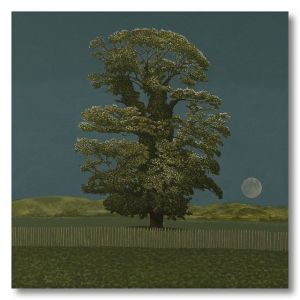
Inshaw’s ‘Tree and Moon’

The word ‘haunted’ seems to have been designed to be applied to Inshaw’s landscapes. There is a hyper-real quality to the painting which makes the viewer re-see our own surroundings but also takes us through the surface. Harpur’s Agenda review suggested a “Platonic vision” but I’d object to losing the surface of the real so readily. Inshaw was a member of the Brotherhood of Ruralists (here is an old BBC documentary on them – a brilliant example of ‘slow’ TV before it had been thought of) and his landscapes are usually peopled and the trees and downs and ancient memorials are therefore always ‘seen’. Inshaw’s work is about time and memory (Hardy again) and the way moments of vision or perception can feel heightened. The poem ‘Haunting Landscapes’ alludes to Inshaw’s ‘Our days were a joy and our paths through flowers’ (another quote from Hardy, his poem ‘After a Journey’). A woman in black stands in a graveyard but has turned as if being called to from beyond the frame (by a memory, a ghost).

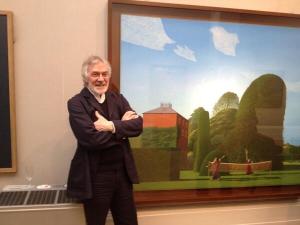
Inshaw in front of ‘The Badminton Game’

As in so many memories, there is a heightened particularity to Inshaw’s paintings. There is a Rilkean focus on what ‘The Kennet’ calls “being here”. Look at Inshaw’s ‘Tree and Moon’, for example, and Robinson’s accompanying poem, ‘At Slader’s Yard’, associates the two artists (and their art forms) in the quality of their ‘noticing’: “I’m a counter of clouds / come over the hills like this one / ‘salmoning’ in a ‘deepening blue’”. Hardy’s poem ‘Afterwards’ describes himself as a “man who . . . noticed things”. Robinson’s concluding poem, ‘After a Visit’, suggests how Inshaw’s precision of observation (“the starkness of those winter branches’ / black against a glowing skyline”) manages to inculcate a sense of something other than mere perception of colour and shape: “it brings back the sense of some design, / and a meaning to this scene”. The root and pattern of design is unclear. The value of such a comprehending vision is heightened by the precise historical context in which many of these poems were written. The divisions and confusions of Brexit and the world of Covid infection and lockdowns keeps breaking through the surface of this book. The parliamentary “palaver”, hypocritically urging us to “come together as a nation” and a certain politician, “pre-disgraced”, indicate that neither poet nor painter look upon the landscape of southern England with their heads in the clouds, nor with any narrowly nostalgic gaze.

Peter Robinson