The next @southstreetarts @Poets_Cafe Online is on 11/6 @ 8 pm with guest @mcrucefix & host me. Amazingly the #openmic is already full, but plenty of audience spots left & it would be wonderful if you could join us. Info: https://t.co/nRby2dZ1uL #poetrycommunity #poetrytwitter pic.twitter.com/eLTq9qA123
— Claire Dyer (@ClaireDyer1) May 28, 2021
Upcoming Zoom Reading by Martyn Crucefix
Oxford Stanza 2
Reading and Open Mic – Zoom Meeting
Date: Monday, May 24th
Time: 7pm
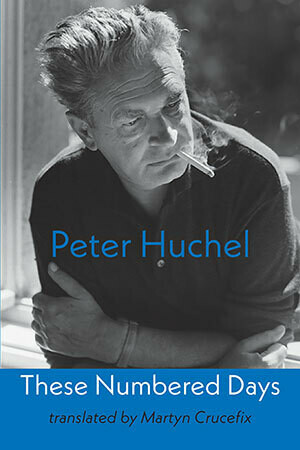
Martyn Crucefix is our headline reader. His recent publications include Cargo of Limbs (Hercules Editions, 2019), These Numbered Days, translations of the poems of Peter Huchel (Shearsman, 2019), which won the Schlegel-Tieck Translation prize 2020, and The Lovely Disciplines (Seren, 2017). O. at the Edge of the Gorge was also published by Guillemot Press in 2017. Martyn has translated the Duino Elegies – shortlisted for the 2007 Popescu Prize for European Poetry Translation – and Sonnets to Orpheus by Rainer Maria Rilke and the Daodejing – a new version in English (Enitharmon, 2016). He is currently a Royal Literary Fund Fellow at The British Library and blogs regularly on poetry, translation and teaching at http://www.martyncrucefix.com
- Main Reader – Martyn will read both original poems and from his Schlegel-Tieck Translation prizewinning book of Peter Huchel’s work.
- Questions and answers
- Interval
- Open mic poets
Join Zoom Meeting
https://us02web.zoom.us/j/84012338448?pwd=R0FCdS8ra3BVUjQrNFBWL1Jick00QT09
Meeting ID: 840 1233 8448
Passcode: 807313
For further information, please contact: kathleenmcphilemy@gmail.com
Peter Huchel in Translation – review
Marvellously thoughtful and well-informed review of my (fairly) recent translations of the poems of Peter Huchel. Also recent winner of the Society of Authors’ Schlegel-Tieck Prize for Translation 2020.
Many thanks to Rebecca DeWald and to Reading in Translation.
Jazz and Upbringing: Marvin Thompson’s ‘Road Trip’ reviewed
Congratulations to Marvin Thompson for winning first prize in this year’s National Poetry Competition. Here is The Guardian’s report of the occasion. He can be heard reading the poem here – and you can read it yourself below. And I thought a good opportunity to re-blog my original review of Marvin’s debut collection.
The Fruit of the Spirit is Love (Galatians 5:22)
Dusk reddened a Dual Heritage neck, hands
and a moustache – its ends curled with wax. Jason Lee?
I stood below his dreadlocks in woodlandand reached up to touch his feet. A whirring fan
greeted my waking eyes, the house sleepy.
I’d dreamt both Dali’s Christ and someone hanged.“… a pineapple on his head…” sang football fans
and a comedian blacked up as Jason Lee,
mocking Rastas. Did Jason beg Jah:“Please keep this from my kids.” Should I tell mine
I filled my lungs with ’90s minstrelsy
and sang, a teen lost in lads’ mag England?Who taught me pro-Black talk was contraband?
The me who cwtched Dad whilst watching Spike Lees
was shoved down basement stairs, feet tied to hands.Embarrassed, should I play my kids Wu-Tang
and other rap that set my rebel free?
One day, when they walk their kids through woodland
will they sing calypsos or ‘Blood of the Lamb’?

 Marvin Thompson’s debut collection from Peepal Tree Press is a PBS Recommendation and deservedly so. All too often we are informed of the arrival of a startling voice, usually a vital one, striking a new note in English poetry. Well, this is the real deal: a superbly skilled practitioner of the art whose work is driven by two seemingly opposing forces. Thompson writes with a disarming sense of autobiographical honesty, often about domestic life, as a father and a son. Yet he can also create fictional characters with detailed and convincing voices and backgrounds. What holds these divergent styles together is his demonstrated conviction that the past (as an individual or as a member of an ethnic or cultural group) interpenetrates the present.
‘Cwmcarn’ is a poem in an apparently simple autobiographical mode, the narrator out camping in Wales with his two children. He has been reading them to sleep…
View original post 1,410 more words
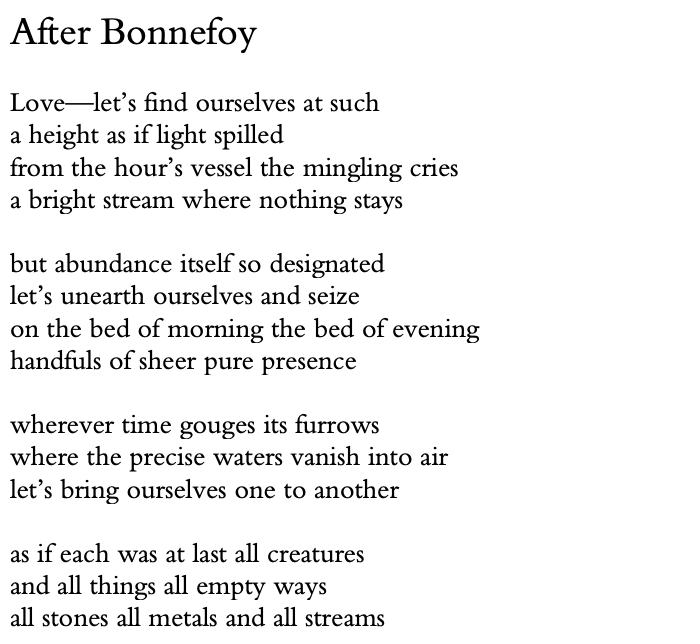
Friday Poem – ‘After Bonnefoy’ by Martyn Crucefix
Just got a marvellous birthday present yesterday – thanks to Shearsman Books The Society of Authors and Suhrkamp Verlag The Schlegel-Tieck Prize for translation from German, an annual award of £3,000 for translations into English of full-length German works – WINNER: Martyn Crucefix for a translation of These Numbered Days by Peter Huchel (Shearsman Books)
On behalf of the judges, Steffan Davies said: ‘‘This is an absolutely superb translation of Huchel’s poems: a clear, outstanding winner even among such strong competition. It reads as poetry throughout, never ‘feeling translated’ and yet always also an accurate capturing of Huchel’s German. The poems are beautiful, economical poetry in themselves. This is translation at its very best: deep, sympathetic comprehension, inspired creativity, confident composition, fine judgement. Congratulations to a very deserving winner.’

This week’s Friday Poem is ‘After Bonnefoy’ by Martyn Crucefix from his collection The Lovely Disciplines.
Everyone at Seren would like to congratulate Martyn on winning the Schlegel-Tieck Prize for Translation 2021 for his translation of These Numbered Days by Peter Huchel, announced yesterday.
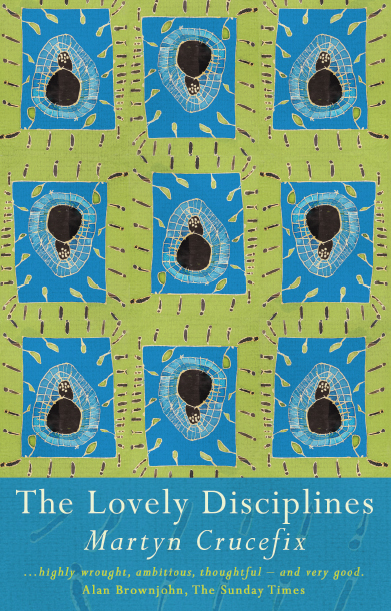
Displaying hischaracteristic flair, craft and intelligence, Crucefix’s poems often begin with the visible, the tangible, the ordinary, yet through each act of attentiveness and the delicate fluidity of the language they re-discover the extraordinary in the everyday.
‘…highly wrought, ambitious, thoughtful – and very good.’ – The Sunday Times
The Lovely Disciplinesis available on the Seren website: £9.99
Create your freeSeren accountand enjoy 20% off every book you buy from us.
Winning Translation in the 2020 Schlegel-Tieck Prize
Just got a marvellous birthday present yesterday – thanks to Shearsman Books. The Society of Authors and Suhrkamp Verlag….
The Schlegel-Tieck Prize for translation from German, an annual award of £3,000 for translations into English of full-length German works – WINNER: Martyn Crucefix for a translation of These Numbered Days by Peter Huchel (Shearsman Books)
On behalf of the judges, Steffan Davies said: ‘‘This is an absolutely superb translation of Huchel’s poems: a clear, outstanding winner even among such strong competition. It reads as poetry throughout, never ‘feeling translated’ and yet always also an accurate capturing of Huchel’s German. The poems are beautiful, economical poetry in themselves. This is translation at its very best: deep, sympathetic comprehension, inspired creativity, confident composition, fine judgement. Congratulations to a very deserving winner.’
Tagay! on Romalyn Ante’s ‘Antiemetic for Homesickness’
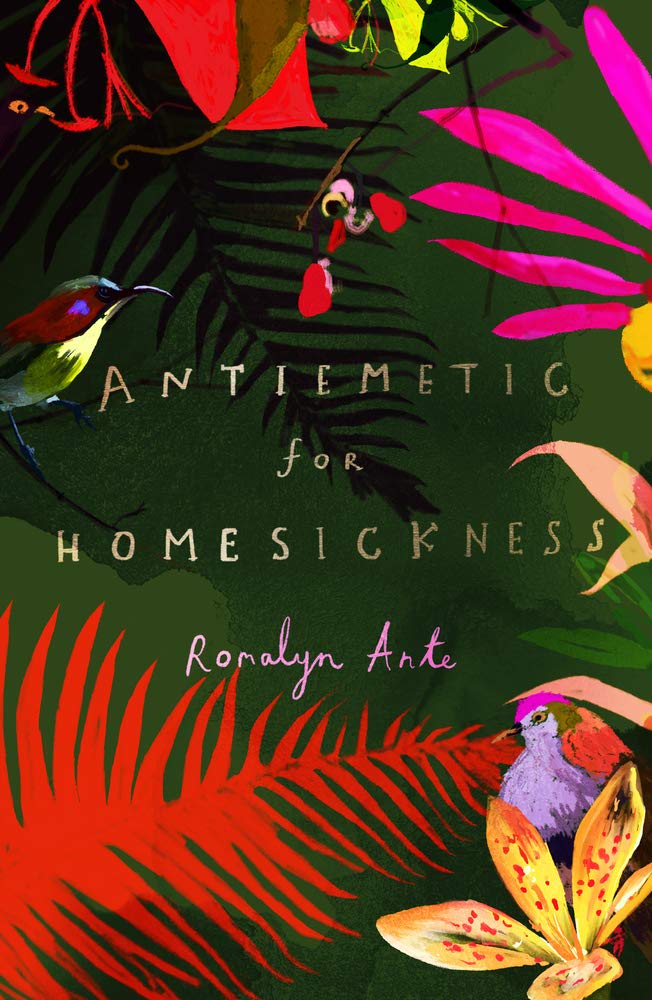 Romalyn Ante was born in Lipa Batangas, in the Philippines, in 1989. For much of her childhood her parents were absent as migrant workers and the family moved to the UK in the mid-2000s where her mother was a nurse in the NHS. Ante herself now also works as a registered nurse and psychotherapist. As a result, this debut collection has multiple perspectives running through it: the child grappling with the parents’ absence, the mother’s exile, the daughter’s later emigration and a broader, political sense of the plight of migrant workers. The economic driving force behind such movements of people is recorded in ‘Mateo’, responding to the Gospel of Matthew’s observation about birds neither sowing nor reaping with this downright response: “But birds have no bills”. So, in poem after poem, the need for money, for a roof, livestock, fruit trees, medical treatment, even for grave plots back home is made evident.
Antiemetic for Homesickness also consequently has two prime locations: the UK appears as snow-bound streets, red buses, the day to day labour of nursing grateful (and often less than grateful) patients, casual racism. But it is the home country that predominates in vivid images of its landscape, people, culture, folk tales, food and frequent fragments of its Tagalog language (there is a glossary of sorts, but I found many phrases not included). So the promise implied by the title poem – a cure for homesickness – is willed, even a delusion, but a necessary one adopted for self-preservation. It’s a great poem. Opening with “A day will come when you won’t miss / the country na nagluwal sa ‘yo” (lit. who gave birth to you), it also closes in the same mood: “You will learn to heal the wounds / of [patients’] lives and the wounds of yours”. But the central stanzas are densely populated by memories of home, the airport goodbyes, the tapes recorded by left-behind children, the recalled intimacies of the left-behind husband, the gatherings and food of the distant place. The antiemetic is proving less than effective.
 This is the material for all Ante’s poems here. ‘The Making of a Smuggler’ opens with “Wherever we travel, we carry / the whole country with us” – lines that recall Moniza Alvi’s, ‘The country at my shoulder’ from 1993. Despite Ante’s personal experiences, these poems often speak in this plural pronoun (a sense of solidarity in experiences shared plus a pained awareness of the plight of unnumbered, unknown migrant workers). The ‘smuggling’ image also suggests an illicit action, a coming under suspicion in the destination country. What is being smuggled across borders under the insensitive noses of its guardians are memories, places: “He can’t cup his ear // with my palm and hear the surfs / of Siargao beach”. If these are thoughts on arrival then ‘Notes inside a Balikbayan Box’ evoke the on-going sense of loss, distance, almost bereavement accumulating through years of working abroad. Such boxes – Ante’s notes explain – are used by Overseas Filipino Workers (OFW) and filled with small gifts to be eventually sent back home, a kind of ‘repatriate box’.
Accordingly, the poem takes the form of a note – “Dear son” – partly accompanying objects such as shoes, video tapes, E45 cream, incontinence pads, perfume but, just as important, offering life-advice and apologies:
I owe you for every Simbang Gabi and PTA meeting
I could not attend. I promise I’ll be there for Christmas.
I know I’ve been saying this for a decade now.

Scattered throughout the collection are short extracts intended to reflect cassette tape recordings – sent in the reverse direction to the Balikbayan Box – by a child to her distant mother. The risks of attempting such a child’s perspective are many and Ante keeps these little more than fragmentary utterances, not authentically child-like. These were some of the less successful moments in the collection, many others of which also arose from such formal experiments. Ante tries out the forms of a drug protocol, a questionnaire, a concrete poem, centred, right or left justified verse, prose passages, assemblages of fragments, typographical variants. Such moments presumably constitute the “dazzling formal dexterity” alluded to in the jacket blurb, but you’d not read Ante for this but for the poems’ “emotional resonance”, also referred to in the blurb.

The plurality of her subjects also gives rise to poems in several voices. ‘Tagay!’ portrays the migrant workers’ embattled situation and their making the best of it through the communal drinking of Lambanog (distilled palm liquor) – the title is something akin to ‘Cheers!’ Each speaker toasts the others present, going on to imagine their personal homecoming: welcoming smiles at Arrivals, the bringing home of Cadbury’s chocolate, the heat of Manila, home-cooked food at last, story-telling, marital sex. Many of the speakers cannot keep their work out of the moment: “Tomorrow we’ll be changing bed covers, / soaking dentures, creaming cracked heels”… but for the moment, “Tagay!” Something similar is attempted in ‘Group Portrait at the Stopover’, in which migrant workers are briefly thrown together at an airport, in 5 short sections swapping gifts and stories of their labours and abuse, preferring not to think “of the next generation that will meet at this gate, / the same old stories that will hum out of younger mouths”.
‘Group Portrait..’ is one of Ante’s poems that explicitly addresses the long-standing global reality of migrant labour and ‘Invisible Women’ does the same. These are the women, world over, who are seldom given credit or even attention, yet are “goddesses of caring and tending”. Ante’s mother is one of them, a woman who “walks to work when the sky is black / and comes out from work when the sky is black” (the studied repetitions here more effective than many other formal innovations). The deification of such women is part of Ante’s point. The costs of such migration are repeatedly made clear in this book, but the admiration for those who leave home to earn money for the benefit of those left at home is also clear. These invisible women (and as often men) are heroic in their determination, their sacrifices and their hard work.
 A poem that returns the reader to the individual is ‘Ode to a Pot Noodle’. Owing something to Neruda’s Odas elementales (1954), the narrator is taking a short break from “fast-paced” hospital duties – a Pot Noodle is all there is time for. In the daze of night and fatigue, images arise (of course) of her distant home, her grandfather, of Philippine food and conversations that, in the time it takes to boil a kettle, vanish as quickly. She addresses those distant people: “this should have been an ode to you. / Forgive me, forgive me”. But the Ode has already been written in the course of Antiemetic for Homesickness. The collection is a testament to the presence of the absent, the persistence of memory, the heroism and suffering of those who we hold at arms’ length, invisible but without whom our modern society – our NHS – would fail to function. In the time of Covid – and after it too – Romalyn Ante’s book is reminding us of debts and inequalities too long unacknowledged.
Gods and Giants: Miriam Nash’s ‘The Nine Mothers of Heimdallr’
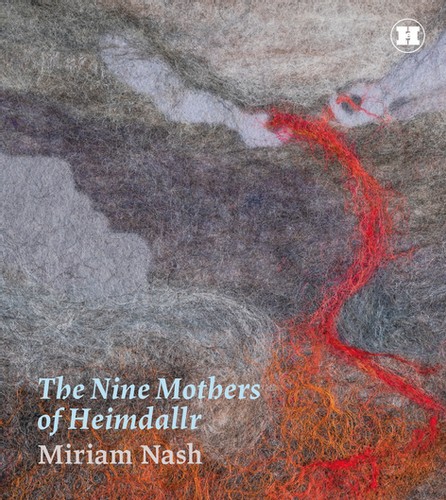 Miriam Nash’s new, 180 line poem is fascinating in the transformation of its sources in Norse myth, its quiet yet firm challenging of racial and gender hierarchies and in its exquisite presentation by Hercules Editions, accompanied as it is by an essay from Jóhanna Katrín Friðriksdóttir and textiles imagery created by Christina Edlund-Plater (in fact, Nash’s mother).
Friðriksdóttir gives those of us not up to speed with the Norse sagas some explanation. It seems the gods were actually not primary but descended from the race of giants. Yet since gaining supremacy, the gods have excluded and denigrated the giants. Generated from a hegemonic point of view (the top people in medieval Icelandic society), these Norse myths (as do most) tend to “justify and naturalise the status quo”, as Friðriksdóttir puts it, and what is being naturalised is a particular view of history, ancestry and masculinity. The anxiety of the Norse myths is a familiar one, tied up with patriarchy and the male control of women. There is a scene of ‘original sin’ in these stories in which the gods, Odin and his brothers, kill Ymir, the first and oldest giant. Out of Ymir’s dismembered body parts, the gods create the earth. This is a Fall from a primordial unitary state; Friðriksdóttir again: “at this juncture, one group becomes two” and conflict becomes the condition of life on earth.
So much for the birth of conflict and violence. The sagas are also notable for the relative absence of the feminine. An exception can be found in obscure references to the god Heimdallr who was born from nine giant mothers (possibly sisters) and it is through ‘writing on’ from these few suggestions that Miriam Nash’s poem develops a richly female addition to the Norse sagas. She challenges the old tales’ defensiveness about race (giant and gods) and gender and offers the modern reader a narrative of nurture, warmth and closeness in contrast to violence and conflict. The battle lines as they are drawn up are pretty obvious and will surprise no-one but Nash’s use of balladic form, of spoken voices and her re-scripting of details from the traditional stories conveys something vital and moving, a new myth for the age of Black Lives Matter and the #MeToo movement with its original purpose of empowering women through empathy.
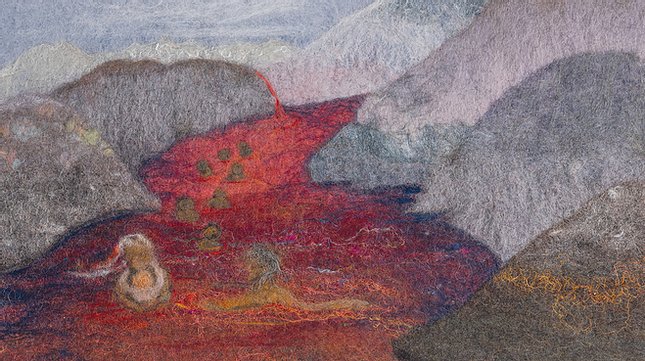 Nash’s poem opens at the heart of an unorthodox family with one of Heimdallr’s mothers speaking tenderly. The whole family have gathered round a campfire, a hearth, in various states of sleep and wakefulness, cooking, sword-sharpening, comforting and acting as a seer. She tells Heimdallr the story of his remote origins in the primordial time when division was not known: “a tale of giants, a tale of gods / in early time, in frost-fire time”. A time of community and peace: “we lived snore-close, heart-close”. Also a time before language (or at least, language as we now have it) and Nash makes Ymir – the representative figure of this lost age – a “mother-father”, represented by the possessive determiner “their”. As in the traditional stories, Ymir creates/finds Buri in a glacier and Odin is Buri’s grandson. It is Odin who first declares division:
Odin said he was a God
Odin said the Gods were old
older than Ymir or giants
older than the ice-fire world.

This is an example of Nash’s form – loose quatrains of usually 4-beat lines, often part-rhymed at lines 2 and 4. And Odin’s declaration – his myth creation, his propaganda, his re-writing of history, his self-aggrandisement – is at the heart of the world’s troubles. Heimdallr asks who made the gods and the answer is that “They made themselves / with stories”. The poem goes on to recount Odin’s slaying of Ymir and the word “blood” recurs over and over again in the following quatrains.
But it is a blood ocean across which the nine mothers of Heimdallr have protectively carried their child. The child instinctively sees the roots of division and does not want to be “a half”, does not want to be merely “a god”. The comforting mother’s voice offers a startling solution (if we live in the fallen world); “Ymir was mother-father, child / Both might be your path”. The possibility is raised of a mode of living in which opposites may be once again reconciled, male/female, god/giant, fire/ice and the passage towards such a life is evidently through the tenderness and supportiveness of the mothers who advise Heimdallr to: “dream of ice-lands and of flame / sleep, snore-close, heart-close to me”.
One being walked – on Ricky Ray’s ‘The Sound of the Earth Singing to Herself’
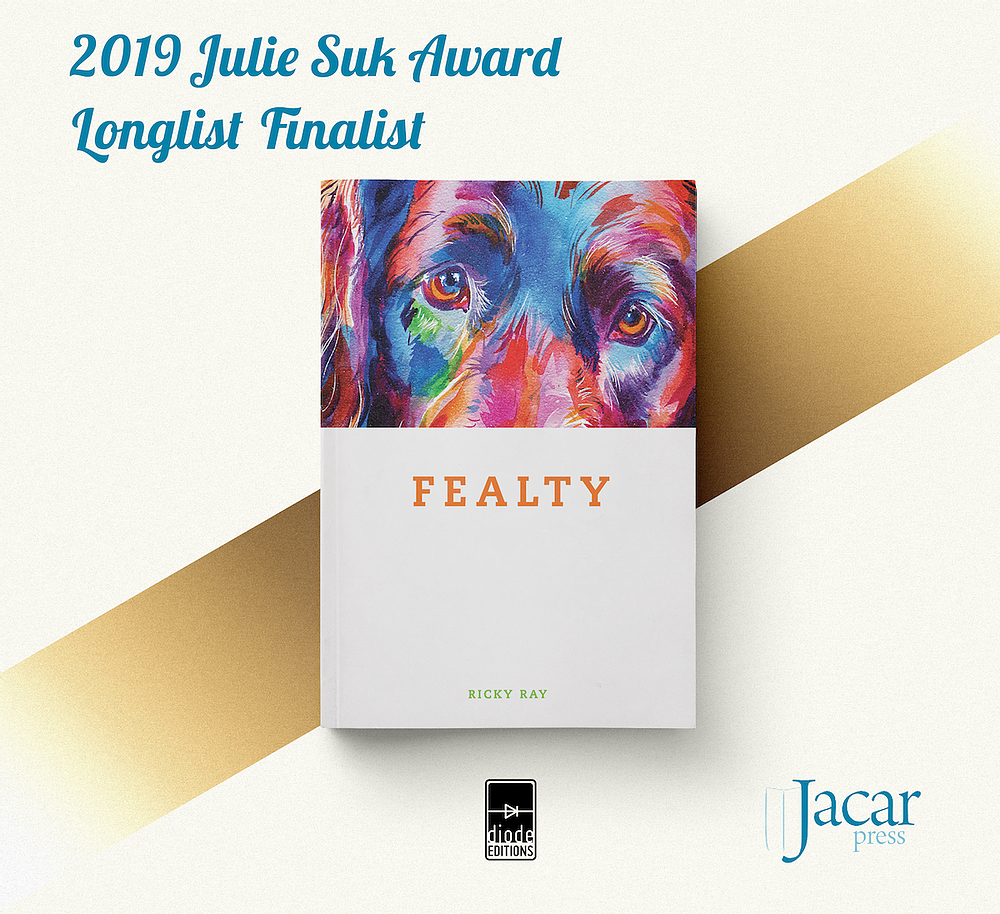
 This is the second of Ricky Ray’s chapbooks to be published in the UK this year (2020) – the other is appearing with Broken Sleep Books under the title, Quiet, Grit, Glory. A full collection, Fealty, also appeared in the UK through Eyewear Publishing in 2018 and it is now republished in the US by Diode Editions. The biographical note from Fly on the Wall Press refers to Ray as “a disabled poet, critic, essayist and founding editor of Rascal: a Journal of Ecology, Literature and Art” – all this suggesting that Ray has several highly ‘categorizable’ aspects to his work, but from the evidence in The Sound of the Earth Singing to Herself, he manages, to the benefit of us all, to elude being pigeon-holed in any neat way. See Ricky Ray reading poetry on the completion of his MFA degree – featuring poems about “dogs, disability, waywardness, childhood, childlessness, ecological consciousness, despair, and the search for hope”.
 If poems can withstand the pressure of readers drawing biographical conclusions, Ray’s upbringing was difficult. ‘Sometimes Vision Withers on the Vine’ portrays a chaotic, poverty-stricken household with erratic running water and power supply because “crack was more alluring than the bills”. The boy’s drug-using father’s drug-using friend burns candles on the palm of his hand, apparently feeling no pain. The vision seen in the light seems to be nothing more than a death’s head, a version of the future in which “nothing happens”. Another poem remembers the putting down of a pet dog: “the news // had blown out all moisture and made of my body / Oklahoma”. This is an amazing image of a sudden expansiveness of the self, or its wiping out, in a state of grief at the loss of a creature the boy regarded as closer to a brother. The father had the dog destroyed, as we say, out of kindness, and the boy/poet comments: “a kindness I never wanted, still don’t”, thereby broaching the subject of his own ‘viability’.
 Ray’s physical disabilities give him relentless pain, the prospect of comfort realistically being merely “pain / that relents / from a knife-twist / to a dog gnawing / an old / bone” (‘What’s Left’). ‘Toward What’ records a good day in which he falls only once and “take[s] three / minutes to ascend six stairs”. Yet there are some days, “my body is so beautiful / I can’t believe I get to live here” (‘(Dis)ability’). It’s somewhere along this existential line, between the confines of a body in pain and the expansive, close to out of body experience, signalled by that Oklahoma image, that Ray’s poems really come into their own. He can celebrate an incarnated, ‘being in the world’, with both a sense of its pleasures and a sense of what it costs to remain here.
Such a celebration is ‘So Long as There is Light, There is Song’. The narrator and his dog, Addie, are in a field, the dog’s pleasurable ease in the world engendering similar feelings in the poet. There’s a Whitmanesque quality to the loafing in the grass, the blessing of ants, of the grass itself, the dawning sense of a life larger than any of the individuals present:
You could call it continuity.
You could call it the field itself. I like to call it what calls.
And I like to live in her song.
 For want of a better label, what is sensed is the Earth, “singing her duet with the sun”, the natural world for sure, but Ray’s language implies a close to sentient being, sensed in the co-habiting of the multitude of separate living things. In considering the ravaging of ‘My Favourite Sweater’ by moths, Ray shows how the human heart might respond to such a sense of “continuity”, in the generosity of his wishing “the moths no ill”:
[I] say to myself it’s all down to pattern, a shifting
pattern, a thread of wool raveling into a thread of moth,
the moth’s wings the stitchwork of the hand that knits us all,
the hand itself a stitch along a seam my mind unravels
 It’s Whitman’s long lines and levelling up of all phenomena that comes to mind as the poem goes on to “thank until I run out of things to thank”. Even in the midst of natural danger – in this case a hurricane – the poet/narrator seems to revel in the ominous signals of the storm’s approach, promising to protect his dog. Like the Oklahoma image earlier, this poem (‘On Hurricanes’) ends in mid-flight, the storm raging, the individual consciousness being smashed and scattered, “like fusion, like retribution—/ bang bang bang”. Yet the final image of peril in the face of nature is also an image of becoming one with it, of realising a kind of incarnation: “the roar of it so loud / I can hear the lion’s mouth around my head”.
If ‘On Hurricanes’ reaches apocalyptic levels, the final poem in this chapbook is calmer, more meditative. ‘A Walk in the Woods’ opens with nature and Ray’s ever-present dog, Addie, being company enough for an individual who, for a variety of alienating reasons, has never felt humanity was “a species I was given to understand”. He identifies more with trees, “which may be a function of how poorly my legs work”. The presence of trees consoles, inspires, as Ray again approaches the trailing hem of the divine: “I see a mind at work. Whose, though?” The questioning is not pursued by the rational mind; rather the experiential pleasure – a drifting in an “amniotic ocean” – is allowed to be all. Instead, of an individual walking through a wood, the poem offers us a sensation not of “one walking” but rather of “one being walked”, a moment we might think of as disembodied from the physical world but is as much incarnated within it and is perhaps the most heightened state of environmental consciousness.
The Outlaw Beyond the Wall: the poetry of Peter Huchel
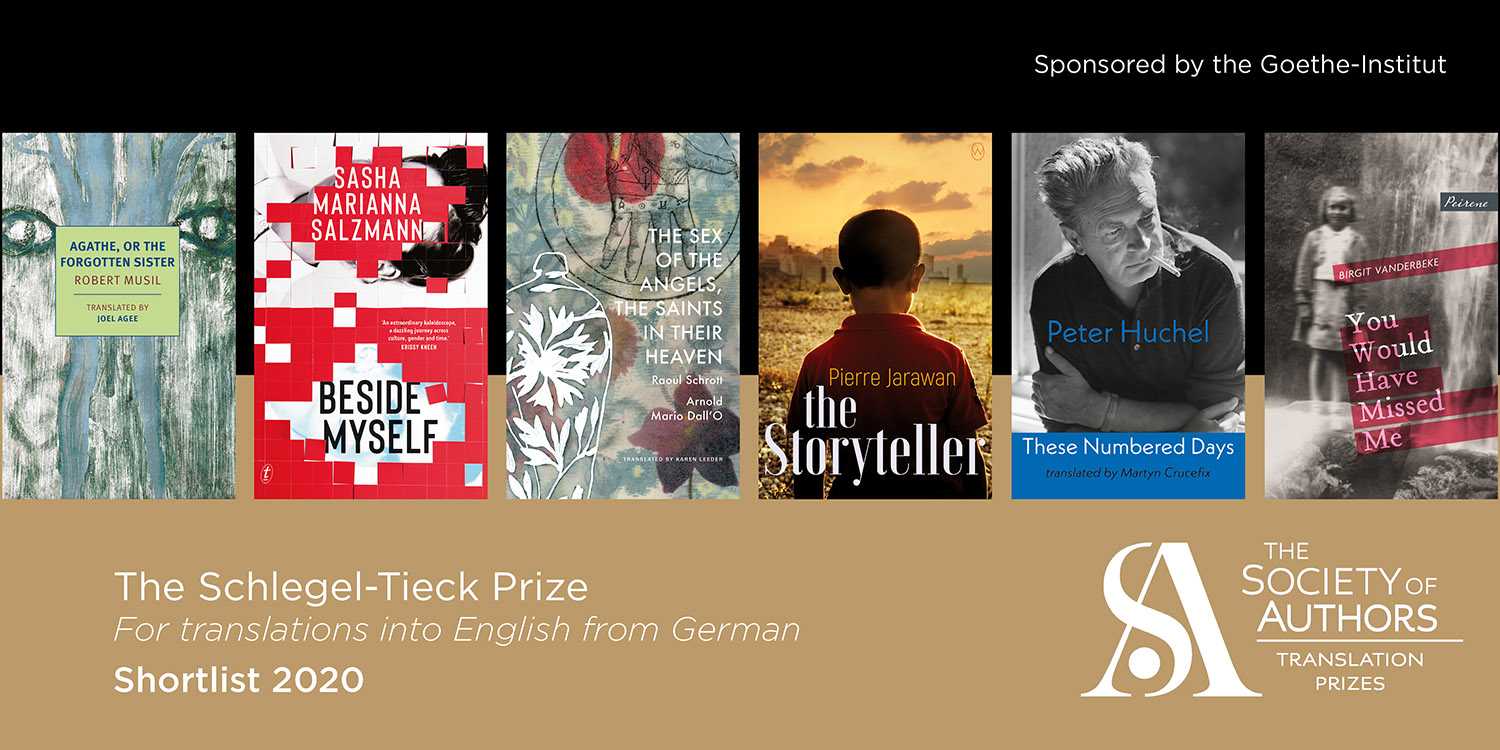
To mark the shortlisting – for the Society of Authors’ Schlegel-Tieck Translation Prize 2020 – of my Peter Huchel translations, published by Shearsman Books, I’m posting here a piece I wrote about Huchel’s poetry which first appeared in Acumen 98 (September 2020). Peter Huchel’s work has its place in the tradition of the greats of twentieth-century German poetry – Rilke, Trakl, Brecht, Benn and Celan – but he is also, as Karen Leeder has argued, a “one off”.[i] Iain Galbraith also lists Huchel among a “handful of essential post-war poets” in German, but his poetry is far less well known than it deserves to be. His presence in English at all is thanks to Michael Hamburger’s 1983 translations published by Anvil[ii]. I came across isolated examples of his work a few years ago and was immediately drawn to his startling observations of the natural world which function often as “metaphors [to] take us deep into the social and historical landscape” of his era (Galbraith again). I believe he is a poet with important things to say to us in our own conflicted times and my translation of Huchel’s best collection, These Numbered Days (1972), was published last year by Shearsman Books. Here, I put Huchel’s work into the context of the great events in Europe in the twentieth century.
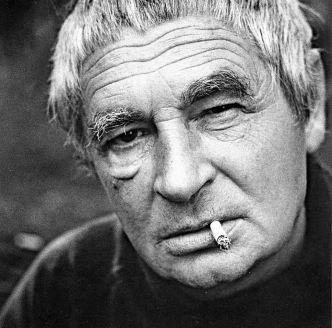
 Huchel’s description of Pe-Lo-Thien, the poet, social critic and sometime exile from the Tang Dynasty, is intended also as a portrait of the poet himself – a dissident figure, an “outlaw, / who lives beyond the wall / with his cranes and cats” (‘Pe-Lo-Thien’). It’s no surprise that the spare, impersonal, often lapidary quality of the poems in These Numbered Days was remarked on by Karl Alfred Wolken as offering the reader something of a Chinese book in German.[iii] The poet himself, carefully scrutinising the natural world – the perception of which constitutes the substance of so many of his poems – tries to descry “Signs, / written by the hand / of a Mandarin” (‘No Answer’). If such allusions suggest a minimalist and tight-lipped quality to Huchel’s poems, this is precisely what might be expected from an artist forced to play, as he did for so many years, the role of inner émigré.
For readers of British and Irish poetry, the term ‘inner émigré’ will be familiar from Seamus Heaney’s use of it in his 1975 poem ‘Exposure’. Discussing the idea, Heaney acknowledged the term’s specific meaning in the 1920/30s in Soviet Russia as referring to a dissident who had not actually gone into exile but remained at home, disaffected from and under the surveillance of the authorities. Heaney saw himself in this light in relation to Northern Ireland. He also associated the idea with the position of George Seferis, concluding that “poetry secures some final place in your being, some little redoubt in your consciousness that will not be taken over by history or the world or disaster”.[iv] This same sense of confinement, wrestling with conscience and the frequent resort to codification which results from such a compromised position is the best way into Huchel’s work as a writer whose life and historical circumstances astonishingly led him to play the role of inner émigré twice over.
He was born Hellmut Huchel in 1903 in Alt-Lichterfelde, now part of Berlin. Due to his mother’s chronic illness, the boy was taken from the city to be raised on his grandfather’s farm at Alt-Langewisch, in the Brandenburg countryside near Potsdam. As an adult, Huchel was fond of quoting St. Augustine on the importance of memory as a “great field or a spacious palace, a storehouse for countless images of all kinds”.[v] Huchel argued that it is “the experiences of childhood, roughly between the ages of five and ten, that exercise a decisive influence in later years”.[vi] But if this period seems to have had something of the idyll about it for the 11 year old boy, it was dramatically shattered by the death of his beloved grandfather and the outbreak of war in Europe in 1914.
 After his country’s defeat, the 17 year old Huchel took part in the conservative Kapp-Putsch against the Weimar Republic in 1920 which was fuelled by a resentment of the German government’s agreeing to the punishing conditions of the Treaty of Versailles. Huchel was wounded in the fighting associated with this failed coup but it was during his recovery in hospital that his sympathies for socialism and Marxism fully developed. His very early poems can be linked to the sort of art fostered by the League of Proletarian Revolutionary Writers. He has said: “What did I care about in those days? I wanted to make visible in the poem a deliberately ignored, suppressed class, the class of the people, the maidservants and coachmen”.[vii]
By 1932 he was working as an editorial assistant for Die Literarische Welt. His first collection of poems was accepted for publication under the title Der Knabenteich (‘The Boy’s Pond’). But with the rise of Hitler, Die Literarische Welt had to cease publication and it is at this moment that Huchel developed the strategy of the ‘inner émigré’. He published very little, eventually deciding to withhold Der Knabenteich. He was deeply troubled that the Nazis liked his work, reading into it as they did a version of the blood and soil nationalism they hoped to foster. So, by 1936 he was refusing permission for any publication and he did not publish any new poems during the rest of Hitler’s rule. Rather, he withdrew to the Brandenburg countryside. His response to tyranny was silence and non-cooperation, though he was eventually drafted in 1941 and ended the war in a Russian prisoner of war camp.
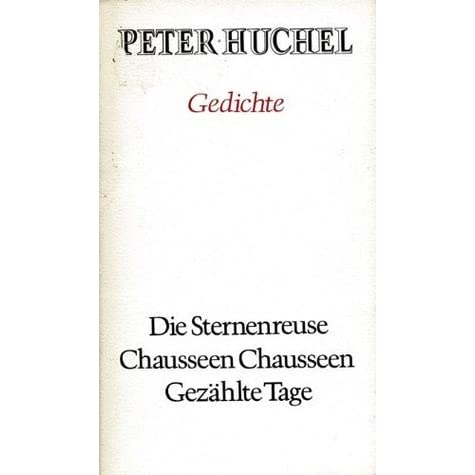 With the fall of the Third Reich, Huchel enthusiastically shared the democratic and socialist optimism of many of his compatriots for the reconstruction of East Germany. His short-lived faith in land reform in the immediate Soviet-Occupied post-war years is consistent with his earlier social concerns. He now began working for East German radio and in 1948 at last published his first collection, Gedichte (‘Poems’). In 1949 he became editor of the influential literary magazine Sinn und Form (‘Sense and Form’). Though Huchel’s poems were applauded both for their craft and socialist undercurrents, they did not satisfy those who were soon demanding much more explicit support for the German Democratic experiment. Huchel’s dark rural landscapes offered equivocal support at best for the governing regime and his instinctively conservative harking back to childhood and the natural world (rather than a modern revolutionary transformation of human society) were judged to fall short of the expected unquestioning celebration of the GDR’s project.
With the poet’s increasing sense of disaffection from the direction of GDR society, Huchel was once more forced to adopt the role of ‘inner émigré’. The tone of his work becomes increasingly sombre and melancholy, his poetic diction grows more clipped and cryptic, his palette narrowing. In his work at the journal Sinn und Form, he was determined to maintain editorial freedom and the publication flaunted an international outlook with contributions from Aragon, Bloch, Brecht (two special issues), Camus, Eluard, Langston Hughes, Thomas Mann, Neruda, Sartre, Yevtushenko and Zweig. Increasingly, he came into conflict with the authorities and was put under immense pressure to conform. He resisted for 13 years – in large part because of the determined support of Brecht. Brecht’s death in 1956 left Huchel exposed and he was asked to resign his editorship. He refused and so compelled the East German government publicly to force his resignation.
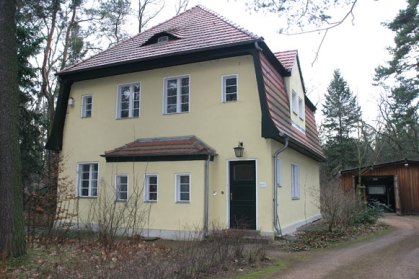
A year after the building of the Berlin Wall in 1961, Huchel was banished at the age of 59 to effective house arrest in Wilhelmshorst. It was at this moment that his second collection of poems, Chausseen, Chausseen (‘Roads, Roads’), appeared. He published it – in bold defiance of the GDR authorities – in the West. It was much praised in the author’s absence. Henry Beissel describes the leanness and density of these new free verse poems: “images are more insistent on turning concreteness into a code; sadness emanates from a sense of the inevitability of loss and from a world bent on self-destruction”.[viii] Huchel’s images from nature are left to speak for themselves; his is often an impersonal poetry of a particularly haunted and pessimistic kind. Yet there is stoical survival too; the poems remain marvellous acts of observation.
The poem ‘Hubertusweg’ vividly portrays this period of his life, from 1962 to 1971, living in isolation, under Stasi surveillance. Gezählte Tage (‘These Numbered Days’) appeared in 1972, the title suggesting the counted days of Huchel’s time under house arrest, his poems recording them, marking them, but also a residual sense of them actually counting towards something, his legacy as a poet, his hoped-for release. Huchel repeatedly applied for an exit visa for himself, his wife and son and in this he was supported by PEN in an internationally orchestrated campaign.
Eventually, in 1971, the Ulbricht government granted his release and he lived first in Rome, then in a borrowed house near Freiburg in West Germany. But like many GDR artists who moved to the West, Huchel was equivocal – to put it mildly – about what he found here. Because the GDR had failed to bring about a truly democratic and socialist society did not mean that he had given up his ideals and the West’s materialism, egotism and faithless profiteering were repellent to him. There is a spiritual emptiness everywhere as in ‘Subiaco’, set in Italy, where Pilate’s bowl stands emptied of water so the taint of guilt cannot be washed away. Huchel’s gloom is partly determined by his own nature, partly by his background, by political persecution and by his divorce from his Brandenburg homeland. The poet bears witness to the inadequate present.
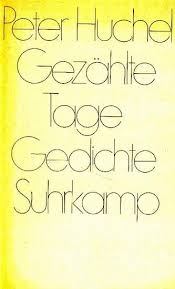 In Huchel’s few remaining years he was lauded in the West but perhaps this was just another form of exile, though one in which he was able to speak and publish. Even so, his final collection, Die Neunte Stunde (‘The Ninth Hour’) which appeared in 1979, is a book almost exclusively of elegy and lament. The ninth hour is the hour of despair, the hour in which Christ died on the Cross, crying out, “My God, my God, why have you forsaken me?” Huchel himself died in 1981, aged 78. Contemporary readers can hear something of his more personal voice – so finely attuned to the natural world, but gifted only a tragically powerless place in history, yet driven to labour and bear witness against the odds – in the words of the unnamed peasant who narrates ‘Middleham Castle’, one of Huchel’s more explicit and terrifying portraits of tyranny:
Familiar with the ways of great forests –
the year streaked with the jays’ colours,
painful brightness of frosted boughs,
the winter hair of deer stuck to bark,
fawns huddled together at evening,
warming themselves in the cloud of their breathing –
up the gorse-clad hill with rope and horses
I haul tree trunks to Middleham Castle.
Martyn Crucefix
London July 2020
[i] Karen Leeder, Introduction to These Numbered Days, Peter Huchel, tr. Martyn Crucefix (Shearsman, 2019).
[ii] The Garden of Theophrastus and other poems, tr. Michael Hamburger (Anvil Press, 2004).
[iii] Karl Alfred Wolken, in a review of Gezählte Tage (Rias Berlin, 1972), see http://www.planetlyrik.de/peter-huchel-gezahlte-tage/2011/10/
[iv] George Morgan, ‘Interview with Seamus Heaney’, Cycnos, Volume 15 No. 2, July, 2008: http://revel.unice.fr/cycnos/index.html?id=1594.
[v] Saint Augustine, Confessions, Book X, viii (Penguin, tr. R.S. Pine-Coffin).
[vi] Huchel’s acceptance speech for the 1974 Literature Prize of the Free Masons, quoted by Henry Beissel, A Thistle in His Mouth: Poems by Peter Huchel (1987), p. 10.
[vii] Quoted and translated by John Flores, Poetry in East Germany (1971), from Eduard Zak, Der Dichter Peter Huchel (1951), p. 124.
[viii] Beissel, p. 16.

