Another Look at Odysseus #3

This is the third instalment of groups of 3 poems selected from my 2010 sequence of poems which takes Homer’s The Odyssey as its starting point. The full sequence of 22 poems first appeared in Hurt (Enitharmon Press). I have written about the development of the sequence in an earlier blog post here. The first 3 poems can be read here. The second three poems can be read here. In these next 3 poems, Penelope finds herself thinking about the island’s volcanic past and about the tourists who come to this modern version of Ithaca. What are they looking for? Odysseus has taken to reading Ibsen (of all writers) and questions his old attitudes to language, purpose, to the ‘things / laid open around him’. Telemachus, meanwhile, can only bitterly see reflections of himself in the island’s schoolchildren, even in the island’s desolate landscape.

from Essays in Island Logic

‘Same sea, same dangers waiting for him / As though he had got nowhere but older’ – W.S. Merwin – ‘Odysseus’

his wife watches a fragment of rock

where her husband
rakes black leaves from the blue water

she watches them ruddy their faces

off-comers holding their breath behind

the Paradise Hotel

words like appointment

second quarter cumulative results

becoming a strange language to them—

their longest meeting poolside at noon

where dolphin-like

they go ducking for silly-coloured stones

the stubbled father

resting one on his belly

floating

as youngsters splash to plunder it

folding up around the black

micro-aerated chunk of volcanic clinker

picked from the wall—

the eye of a shark

once punched well past the cruising height

of in-coming white jets

extruded at such extravagant pressures

superheated shot past

self-determination

the long wait paying off now time settles

to slower rhythms

it sidles

down through the clear blue water

he considers the uses of his mouth

sits down with one of those great writers

who managed to survive
nearer the Arctic Circle

who kept a scorpion under a glass

till he saw it visibly sickening

would fetch soft fruit

for it to sting

poison expelled it would be well again—

what has accumulated within him

over the years

he sees now as incoherence

as a submerged and unmapped ocean bed

invisible from the quayside

and the looked-for cure

to bring it into relation with language

though not mere eloquence this time

rather a purpose

more worthy than the need to persuade

than this blind

preservation of the healthy organism—

what must be loosed in his mouth

he thinks of these days

as some finer sense as stark contradiction

to his old occlusion

what must be loosened and laid open

to the multitude of things

laid open around him

more smile than sting

his son has a vision of the lava flows

after ten years
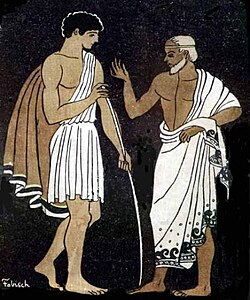
then ten more lost at sea

his son would sometimes catch him fretting

at the school’s new green security gate

watching each year-group

growing restive

fumbling with how to fulfil themselves

children

ignorant of how to work themselves

into their own lives—

like the island’s native rock

blackened and pocked as a fossil sponge

completely unworkable

so the art of sculpture never took root

where tarmac ribbons

cut across fields of lava

razor-edges murderous to shoe leather—

still boys free wheel off the road

at any hour of the day

to stand cooling

in the empty mouths of airless tunnels

no taller than themselves

where lava-flows boiled

each burrowing far beneath hardening crust

threads glowing huge and slug-like

undeflected heads down

single-mindedly

shouldering their way to the sea
How Poems Slowly Get Written – from haiku to abecedary

Bloodaxe poet, editor and tutor, Chrissy Williams, set up and edits PERVERSE poetry. Her site’s strap-line for publication is that she’s looking for “deliberate, obstinate, unreasonable or unacceptable poems, contrary to the accepted or expected standard or practice”. A willful outlier, in other words, looking for experiments and/or orphans. Some of you – if you subscribe to her site or keep an eye on social media – may have seen three pieces I’ve written which PERVERSE published last week. These were the opening three poems from a sequence of twelve and the Note published with them by PERVERSE explains a good deal (I’ll put the poems themselves at the end of this post).

Note: these poems are from a sequence in the form of an abecedary, a calendar of 12 pieces. Carolyn Forche’s ‘On Earth’ first interested me in this form. She associates its inclusiveness (from A-Z) with the pleroma, the fullness of God’s creation, the One. The fullness I have aimed at in this case was the difficult last years of my parents’ lives. Drawing on notes I made between 2016 – 2018, the disjointed nature of this particular totality reflects their growing illness and confusion; but I hope the whole exudes what it was written with, love.

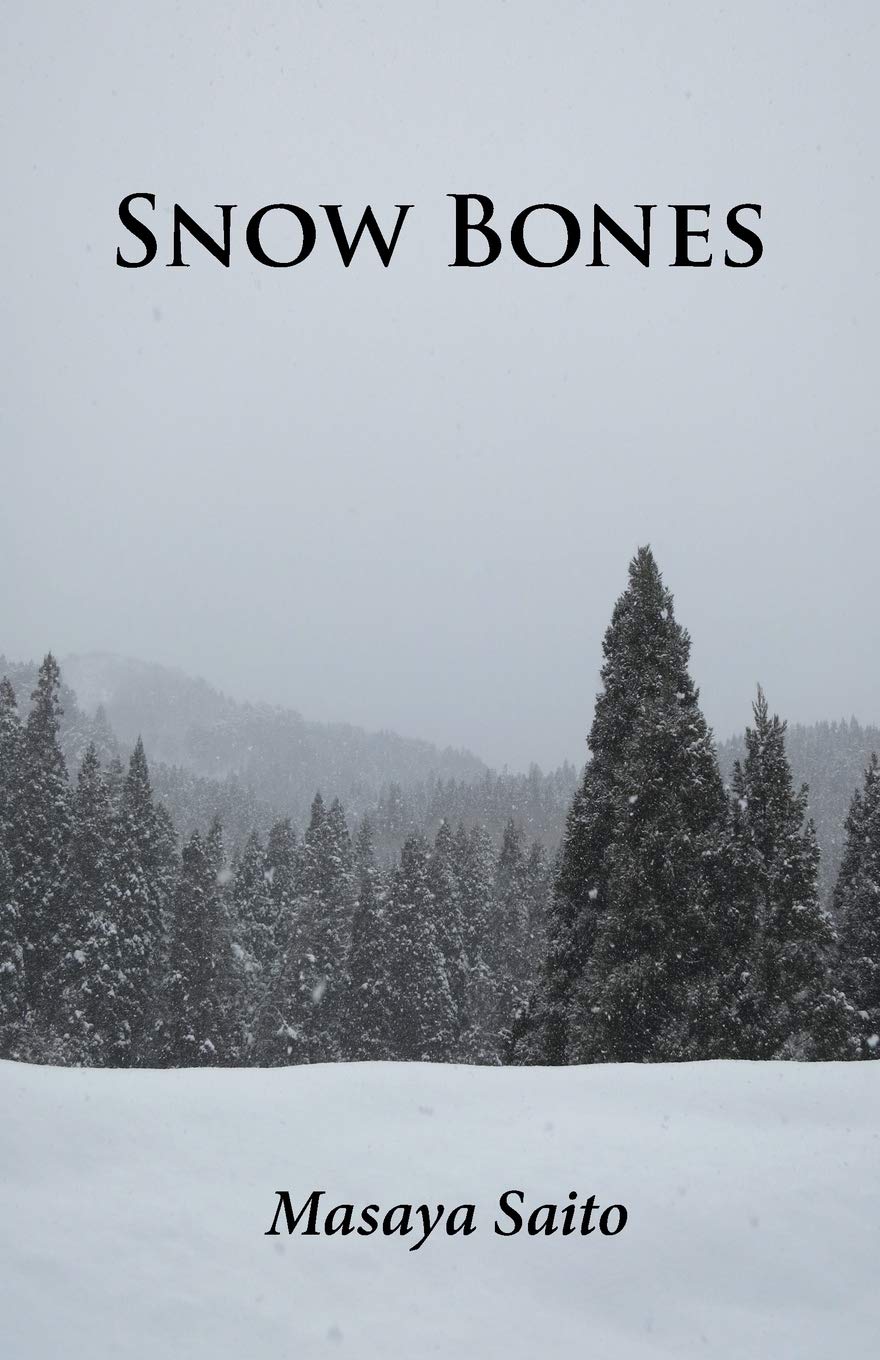
On the theme of ‘how poems come to be written’, today I’m posting images of a couple of the pages from my notebook of the time. You’ll see phrases and images which made it through to the final poems. As can perhaps be seen from the scribbles, what I had originally in mind was something close to the form of haiku. I’d been reading and admiring Masaya Saito’s book of haiku called Snow Bones. This had just been published in 2016 by Paul Rossiter’s Isobar Press (I think maybe I’d bought the book at the Poetry Book Fair that year). Snow Bones consist of four narrative haiku sequences, spoken by several different voices. Saito writes in both English and Japanese (these poems are all in English). Two of these sequences focus on the death and funerals of parents and what I admired was the way in which the compression of the form allowed the poet to express the powerful emotions of love and grief. Between 2016-18, my mother and father were going through a decline in both mental and physical health, eventually moving into a care home, sadly both dying within 18 months of each other. So I had my own powerful feelings to deal with and one of the ways of coping was to try to write about these experiences.

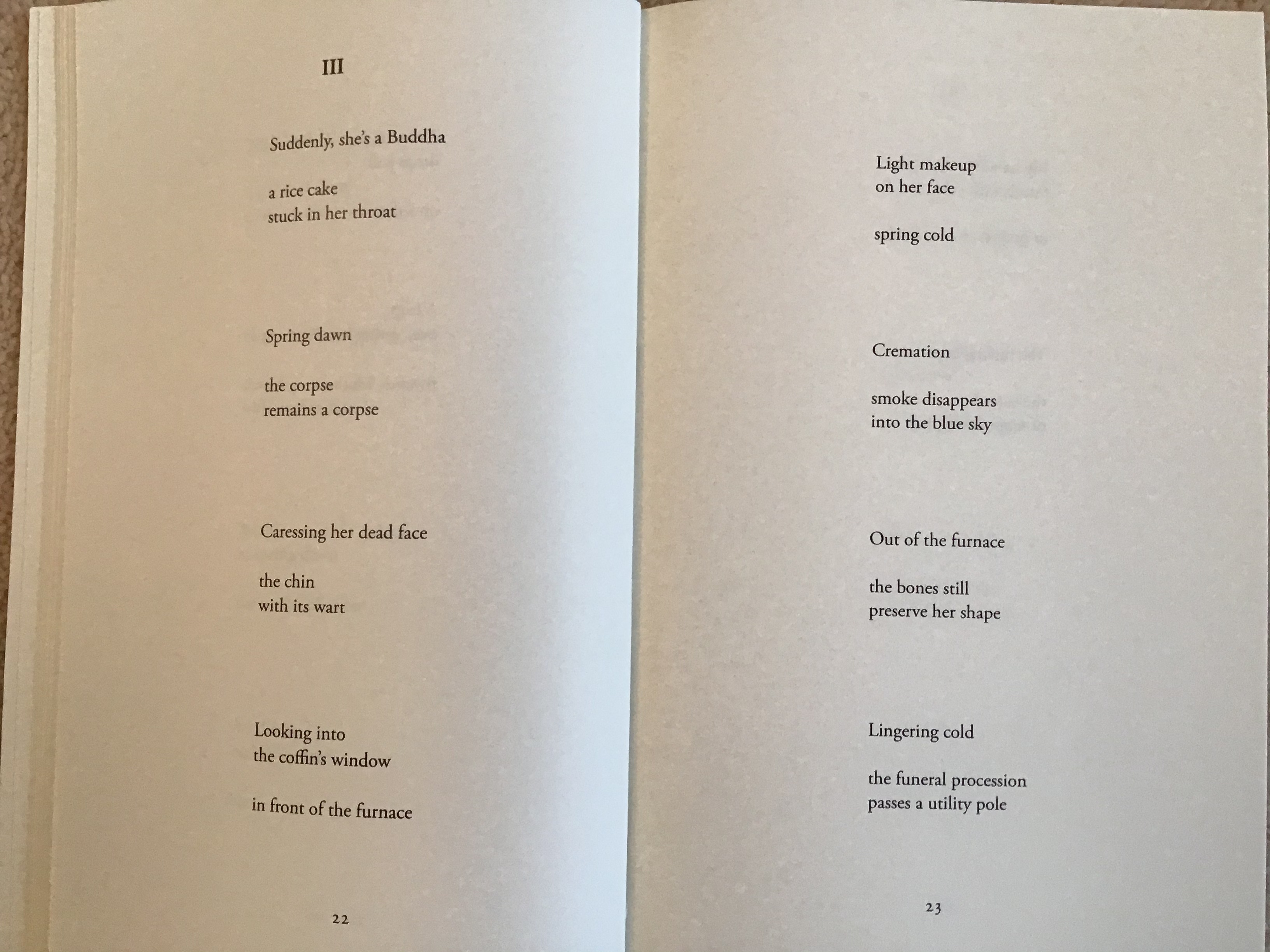
Here’s a couple of pages from Saito’s book. You’ll see he does not approach the haiku form in the rather rigid syllabic way that we often think of it. Also I liked the way in which – of the 3 lines – he always sets one off, either opening or closing. This creates drama and tension even within such a short space.

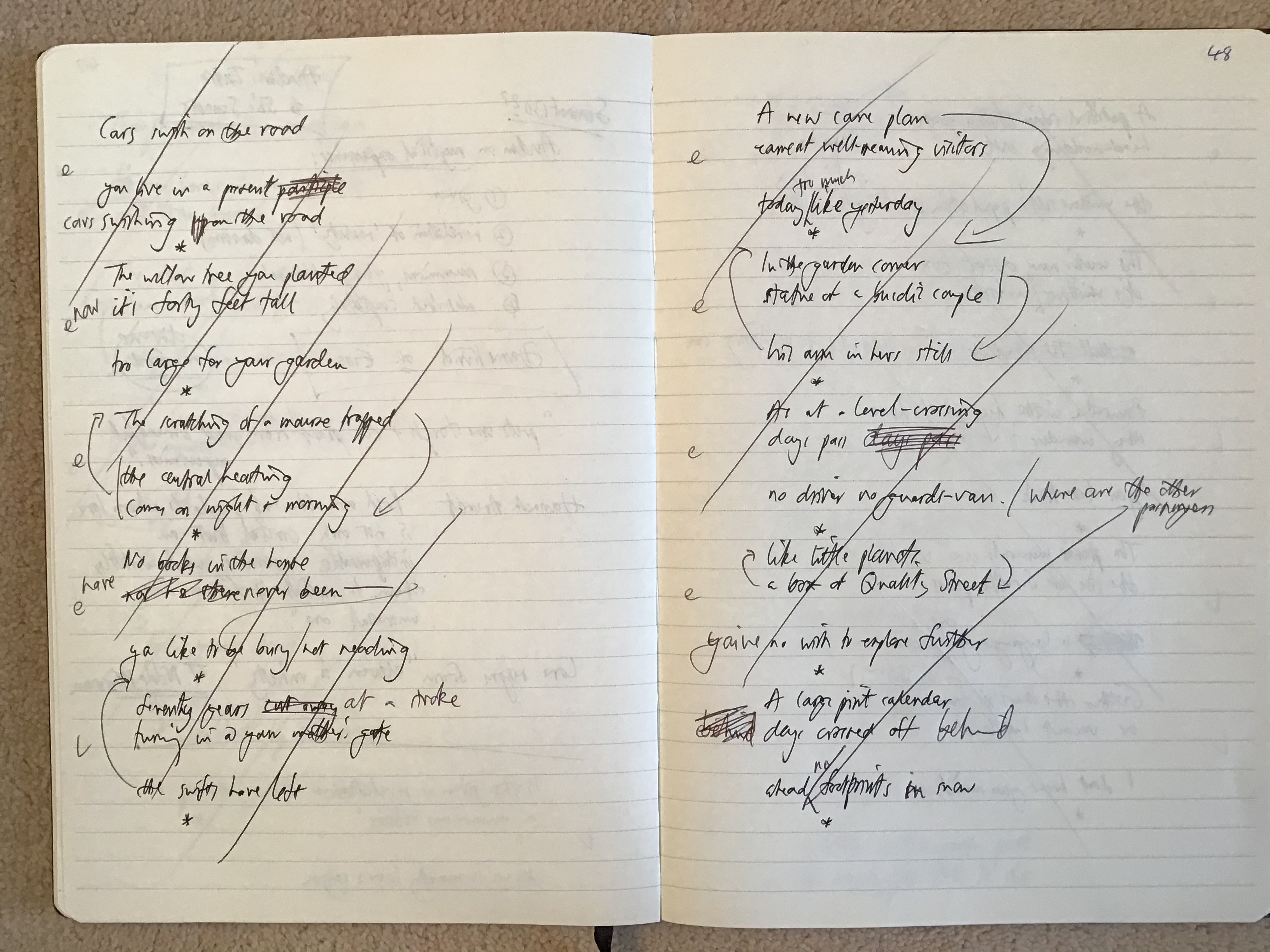
So then here’s a page from my notebook of the time – the crossings out indicate that I have used the text going forward. Initially I tried to maintain my hopes of a haiku sequence. I can see here phrases that made it into the final poem (in such a different form): the box of Quality Street chocolates, the days passing as at a level crossing, the introduction of a new care plan while they were still living at home. I remember taking a dozen or so of these haiku pieces to a writing workshop. The response was polite, even some enthusiasm, but I felt this was in part a response to the personal nature of the subject matter as much as to the success of the choices I’d made as a poet. (These are always very difficult moments in a workshop – depth of involvement on the writer’s part often makes more cool, critical observations hard to bring forward).So I wasn’t sure. The texts stayed in another notebook. This is what happens (for me at least). I’d then often be browsing back through the notebook at those bits of text not yet crossed through as having been advanced to the next stage. I’m re-reading to see if there remains any life in these fragments left in limbo. I kept reading these haiku and thinking there was a lot of good writing, but they had certainly not found their right form.

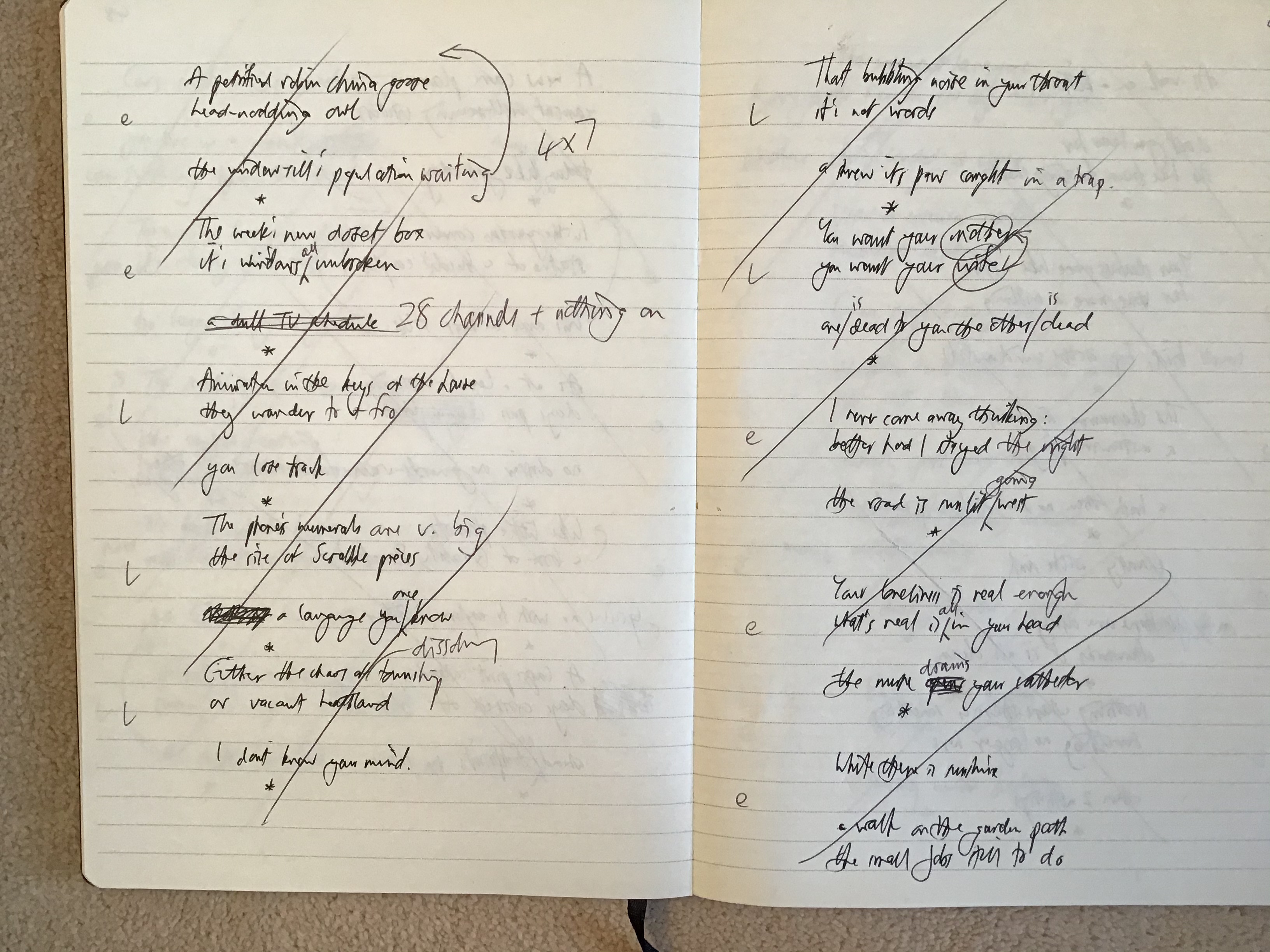
Here’s another image of an original page.

The fourth haiku here I still like:

The phone’s numerals are very big

the size of Scrabble pieces

a language you once knew

In the final poems, the image of a “language” re-emerges rather changed. The sixth haiku poem here has an image of “a shrew its paw caught in a trap” which is itself an echo of a line from the previous page (“The scratching of a mouse trapped”) – the relevance of these recurring images of entrapment is obvious given my parents were pretty well confined to their house by physical weakness and mental uncertainties. Such images surface in the final poems, in the first poem’s opening quatrain, as “a mouse’s paw caught in the trap”.

I don’t remember when the final choice about these poems was made – the one that decided an abecedary form would be appropriate. Those who have followed this blog for a few years will have heard me ruminating on this form before and on my discovery of it via Carolyn Forche. In rational terms, I felt the systematic coherence imposed on phrases by the alphabetical sequence would be effective in an ironic way because most of the fragmented material I had assembled spoke to an incoherence rooted in the way my parents were now living. Is it too much to say that I was hoping to piece things together for Mum and Dad in a way that they were unable to themselves? There are other (more conventional) poems about my parents in my most recent full collection, The Lovely Disciplines.

The re-shaping of the text worked (to my mind). Assembling something like this is a thrilling balance of chance (the sequence of the alphabet) and choice (the poet retains the right to trim and edit phrases). The title I’ve given the sequence comes from the last haiku in the first image above:

A large print calendar

days crossed off behind

ahead no footprints in the snow

I remember buying them a large print calendar so they could follow the days passing more easily. Often – but not always – they’d cross through the days passed. When we cleared the house eventually, the calendar was still hanging up, the crossed off days having stopped at a certain point; the future days left blank and pristine. The walls of the house have not been literally demolished. But it has been sold on to another family and so for me and my brothers the walls might as well have been demolished. The lives lived out there are gone, except for what we can remember (some of which can be written down).

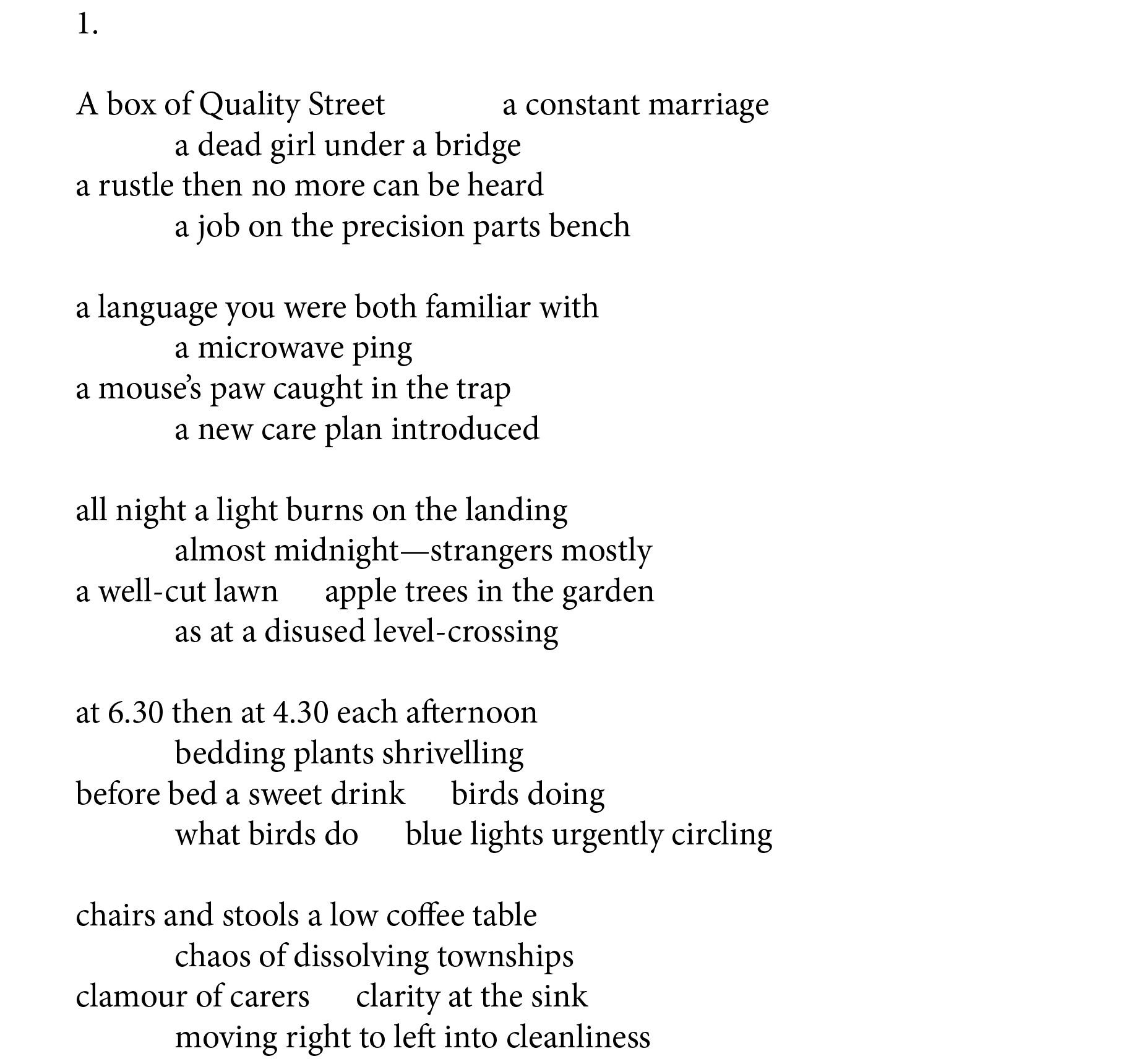
Here are the three poems in the sequence (from A to I) that have so far been published:

from Notes on a calendar (hung on a demolished wall)