Sometime before 2015, I picked up an old copy of a Penguin Classics book called Speaking of Siva. Originally published in 1973, I liked the cover (a wonderfully rhythmic, eleventh century bronze figure of Siva as god of the dance) and flicking through it I liked the look of the brief, irregularly-lined poems inside. I lack a god but feel an appetite for the spiritual and, since my excitement and delight in translating the Daodejing texts for Enitharmon, I am always looking for something to feed that hunger. I found the poems inspiring (I was not the first to do so) and especially early in 2016 I wrote versions and impromptu original poems ‘in the style of’. These were laid aside for a couple of years, but I have recently returned to them – partly under pressure from the historical moment we find ourselves in, living in this most disunited of kingdoms. I hope to publish some of the results soon. Meantime, I was astounded later to discover the influence of this same little book on Ted Hughes. Here’s that story . . .
 One day around 1973/4, Ted Hughes bought or was given A.K. Ramanujan’s just-published Penguin Classics collection of translations entitled, Speaking of Siva. Ramanujan was presenting to the English-speaking world a collection of free verse lyrics written in India around the 10/12th century. Hughes quickly wrote to his friends, Daniel Weissbort and Lucas Myers, urging them to read the book as well. A notebook survives with Hughes’ many creative responses to these still relatively little-known poems. Jonathan Bate has argued that Hughes found these poems attractive because they “squared the circle of being both depersonalised (tapping into the divine, the mythic, the archetypal patterns) and highly personal: “They are uttered, not through a persona or mask, but directly in the person of the poet himself”” (Bate, p. 338 and quoting Ramanujan).
Hughes later wrote to Ekbert Faas that he had first read Ramanujan’s translations after suffering from a chronically sore throat for about a year. He suspected that he might have cancer and “began to write these vacanas as little prayers”. Some of these poems are the only parts of Gaudete (1977) to be selected for Hughes’s Collected Poems (2003). The language of these poems is lean and starkly beautiful often addressing the theme of transformation in violent and graceful modes, often ambiguously autobiographical:
Once I said lightly
Even if the worst happens
We can’t fall off the earth.
And again I said
No matter what fire cooks us
We shall be still in the pan together.
And words twice as stupid.
Truly hell heard me.
She fell into the earth
And I was devoured.
(Gaudete, pp.181/2)
The term ‘vacana’ means something spoken, speech, or a word uttered, as in our phrase ‘my word is my bond’. And vacana poems consist mostly of simple, direct, honest speech – they have no formal metre or rhyme, and very little punctuation – and they present themselves as spontaneous, authentic, plain engagements with the divinity, in deliberate contrast to more established channels of worship. As Ramanujan’s title suggests, they are written to the god Siva and – at least start out from – the ideal of a mystical relationship or process of becoming one with the god or the divine Creative Source.

So they are a form of worship, the devotee speaking directly and truthfully to the god as one might speak to another person – a husband or wife – using natural, colloquial language to express love and devotion, but significantly they also give vent to anger, puzzlement and despair. The poems are full of repetitions, refrains and paradoxes and, although they are spontaneous and passionate and grounded in common everyday experiences and images, there is a spiritual meaning in their worldly metaphors. One common element of repetition is the naming of the God – for Dasimayya this is “O Ramanatha”, for Mahadeviyakka it is “O lord white as jasmine”. Another frequent trope is a concern about the inadequacy of language; no words or image or metaphor can adequately describe the mystery of the god. Above all, vacana poems are intensely personal forms of religious devotion which not only avoid formal creeds, rituals and dogma but frequently criticize such orthodoxy as misguided, superstitious and hypocritical.
So Basavanna’s poem #494 rejects traditional poetic devices for a plain and direct authenticity: “I’ll sing as I love”. Even so, as Ann Skea points out, “he also argues, pleads, demands, questions and berates. He acknowledges that a price must be paid in order that he may be worthy of this union, but he complains that he does not understand why he is treated so badly or know what, exactly, is required of him”. Ramanujan’s Introduction describes the spiritual development of such devotees as moving from devotion, through discipline and knowledge, to enlightenment and ecstasy and, finally, to complete union with the divinity or creative source. In making this ascent, the Indian poet-saints frequently considered themselves as husbands or wives of the god. Ann Skea again: “They dedicated their lives to their god, and became worldly brides or bridegrooms struggling to achieve the spiritual perfection which would allow them to become wholly one with the god. Constantly, they strove for that spiritual union; and worldly unions are seen in their vacanas as unfaithfulness to their spiritual spouse”.

One of these vacana writers was the female poet-saint, Mahadeviyakka who defied social, cultural and gender conventions. For her, especially, ‘marriage’ to Siva meant that any relationship with a human male was adultery. ‘My lord, white as jasmine, is my husband’, she writes (Mahadeviyakka #283). Elsewhere, ‘I cannot take / any man in my arms but my lord’ (Mahadeviyakka #93). In fact, unfaithfulness was a common metaphor in Indian vacanas for the frail individual’s neglect of the divinity for more worldly things. But there are also warnings of the dangers of the commitments involved in becoming the bride or groom of a divine being. If, like a shaman, you have been called and you have accepted that call, there can be no going back. Basavanna gives due warning to those who might not survive: ‘Don’t you take on / this thing called bhakti [devotion]’ (#212). Such are the difficulties of any bridegroom or bride who is utterly devoted to a wife or husband whom he struggles either to please or fully understand. And this, of course, reflects the difficult quest for spiritual enlightenment in a world which makes demands on us and distracts us at every moment.
 Ted Hughes began by modelling poems of his own closely on the work of the poet that Ramanujan places first in the collection, the 12th century Indian poet-saint, Basavanna. Early on Hughes adheres closely to the originals but gradually he distances himself, starting to create more original poems, often employing personal materials, and (as I have said) some of these little poems eventually found their way into the final section of Gaudete. The refrain and invocation that Basavanna uses in the majority of his poems is the address to Siva as “lord of the meeting rivers”. The influence of Robert Graves’ The White Goddess is well known on Hughes and he decided to experiment with addressing his own conception of the divinity – a female divinity – at once his muse and the fundamental animating force in the world, as “Lady of the Hill”.
The linguistic directness and simplicity of the vacana lyrics was clearly important to Hughes. They possessed the “swift, living voice of the oral style . . . a bare, point-blank, life-size poetry that hardly exists in English” which Hughes always admired though did not always write himself. This description comes from Hughes’ comments on Isaac Bashevis Singer in the New York Review of Books (1965). The vacana poems also possessed the rhythms of folk song, traditional folk tales and riddles. Their influence seems to have returned him to the kind of spontaneous inspiration and style of address that he used in the oldest poem that he always reprinted, ‘Song’. In that poem (written when Hughes was just 19 years old), after each of the 5 or 6 line stanzas, the poet cries out, “O my lady”. Hughes reported to Ekbert Faas that this poem was written in a “close and natural” style, one that he had used early in his career but had since “neglected”. It is also close to the directness of style of the Crow poems of 1970.
 But as in the best poetry, such simplicity of language and tone belies the spiritual intentions of the originals and of Hughes’ experimental vacana poems too. As Ann Skea explains, in his turn, Hughes “becomes the spiritual bridegroom of the Lady of the Hill and struggles to be worthy of that union”. Unlike the original Indian poems, Hughes seems to see his Goddess in every human female and they are seen as testing and challenging the poet to further spiritual growth. In the end, just 18 of these experimental poems were chosen to form the Epilogue to Gaudete as the songs sung by the Reverend Nicholas Lumb on his return from the underworld: a man who had seen things and felt the need to communicate those things: “he saw the notebook again, lying on the table, and he remembered the otter and the strange way it had come up out of the lough because a man had whistled. He opened the notebook and began to decipher the words, he found a pen and clean paper and began to copy out the verses”.
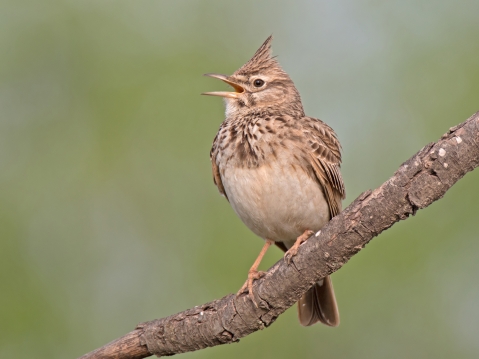
The lark sizzles in my ear
Like a fuse –
A prickling fever
A flush of the swelling earth –
When you touch his grains, who shall stay?
Over the lark’s crested tongue
Under the lark’s crested head
A prophecy
From the core of the blue peace
From the sapphire’s flaw
From the sun’s blinding dust
Perhaps the ‘nakedness’ of the vacana style had some influence on Hughes in the writing of the Moortown poems of 1978, though he was also tempted to return to the more self-protecting use of persona in sequences like Cavebirds (1978) and Adam and the Sacred Nine (1979). Only in the more obscurely published sequences such as Capriccio (1990) and Howls and Whispers (1998), did he again write in this more personal and direct fashion and (as we all now know) he did so once more in the late-published Birthday Letters (1998).


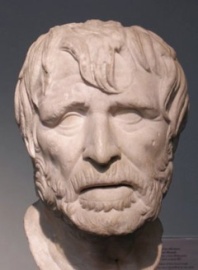 Did you know Hesiod probably pre-dates Homer? Hesiod is aware of the siege of Troy but he makes no reference to Homer’s Iliad. He’s usually placed before Homer in lists of the first poets. The other striking aspect of Works and Days is that (unlike Homer) he is not harking back to already lost eras and heroic actions. Hesiod talks about his own, contemporary workaday world, offering advice to his brother because they seem to be in a dispute with each other. Hesiod’ anti-heroic focus is an antidote to the Gods, the top brass and military heroes of Homer. Most of us live – and prefer to live – in Hesiod’s not Homer’s world.
 He seems to have been a poet-farmer who makes sure we are aware that he has already won a literary competition at a funeral games on the island of Euboea. His prize-winning piece may well have been his earlier
 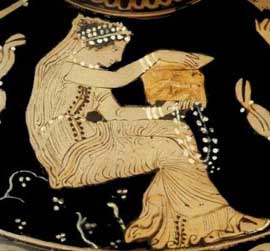 There are further reasons to set to work in the very nature of the cosmos and the human world. Hesiod tells the Pandora story here. Zeus causes the creation of a female figure, Pandora, as a way of avenging Prometheus’ pro-humankind actions (stealing fire from the gods, for example). Her name suggests she is a concoction or committee-created figure from contributions from all the Olympian Gods. She is given a jar which she opens: “ere this the tribes of men lived on earth remote and free from ills and hard toil and heavy sickness [. . .] But the woman took off the great lid of the jar with her hands and scattered all these and her thought caused sorrow and mischief to men” (tr. Evelyn-White). Hesiod’s locating of the root of human sorrow in the actions of a woman echoes the Christian story of the loss of Paradise and it is one of the reasons why Hesiod has been accused of misogyny, though as Stallings suggests, he’s not any more complimentary about the males of the human race.
 It’s certainly the lazy, self-serving, arrogant younger brother who forms the focus of the rest of the poem: “So Perses, you be heedful of what’s right . . . So Perses, mull these matters in your mind . . . Fool Perses, what I say’s for your own good” (tr. Stallings). It’s true that his name gradually fades from the text in the final 500 lines but the torrent of imperatives, offering advice and guidance on a range of practical issues, often sounds like haranguing from a concerned, perhaps slightly pissed off, brother. Much of this material is phenological – when to sow crops, when to harvest, when to shear your sheep. In winter, don’t hang around the blacksmith’s forge where other wasters gather to chat and pass the time. It’s safe to put to sea when the new fig leaves are the size of crow’s feet.
 These are the passages that, around 29BC, inspired Virgil to his own farmer’s manual, the Georgics. Hesiod ends his poem in a rather perfunctory manner, roughly saying he who follows this good advice will become “blessed and rich”. But given Pandora’s jar and the Iron Age we live in, even this seems a mite optimistic. And of course, Perses never gets the chance to speak for himself. But I guess the tensions between his brother’s call for social and religious conformity and Perses’ individualistic disobedience to the demands of the gods and the sense of what is best for a society have gone on to form the basis of the continuing Western literary canon. And does any of this help with Brexit? I conclude (largely with Hesiod) the bleeding obvious: it’s complicated – solutions must be negotiated, don’t hope for some golden age because in a fallen, less-than-ideal, complex society it’s better for the future to be decided in the glacier-slow committee rooms of a plurality of voices than in the stark divisions and dramas of the battlefield. Work hard – have patience – don’t buy into fairy tales of a recoverable golden age.
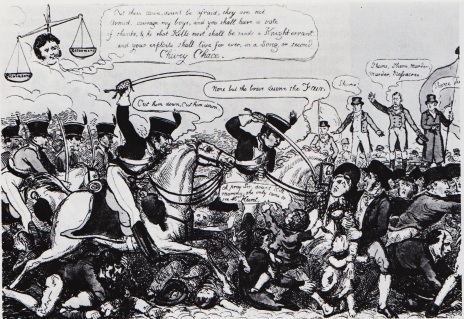
 Earth continues by diagnosing the state of slavery into which England has fallen. This – and the following passage with its more positive analysis of what Freedom means to working people – makes for powerful, relevant, realistic reading in contrast to Shelley’s hard-to-pin-down mechanisms of political change. Slavery is to have to work and be paid only enough to live for another day’s work. It is to work not for oneself but for “tyrants”. It is to see family suffering and dying, to go hungry while the rich man surfeits his dogs. It is to suffer the “forgery” of paper money, to have no control over one’s own destiny. It is – when driven to the point of protest – a more direct reference to events in Manchester – “to see the Tyrant’s crew / Ride over your wives and you”.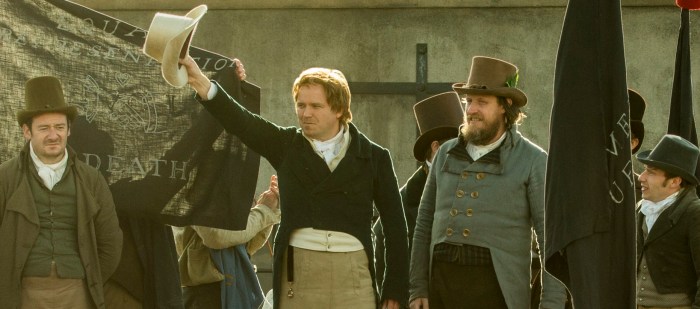
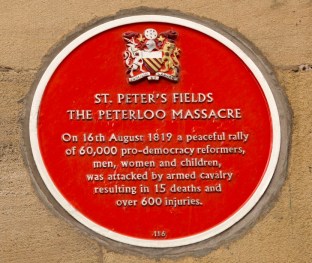
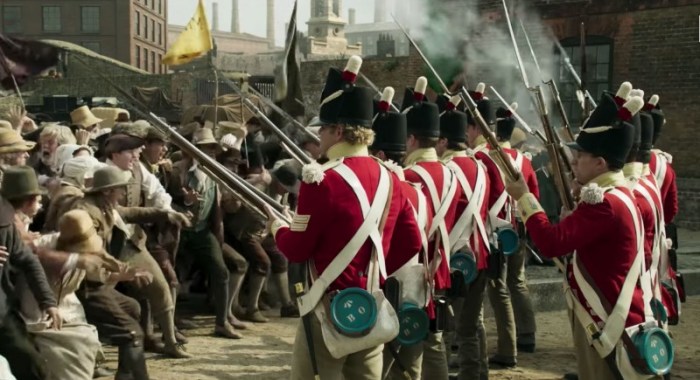
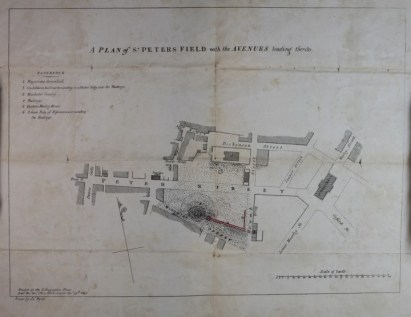 The third reason Shelley gives – via the voice of the earth – also offers only equivocal, indeed very uncomfortable, hope. Offering little or no consolation to the victims and their relations – though a point proven true through many centuries – such massacres by repressive forces will prove an inspiration to those who come after them: “that slaughter to the Nation / Shall steam up like inspiration”. Using another of his images for revolutionary fervour, this steam will eventually result in a volcanic explosion, “heard afar”. Once more in this poem, these reverberations are translated into words to mark “Oppression’s thundered doom”, stirring the people in their on-going fight for justice and liberty. Shelley concludes with the actual words he imagines being uttered – and we have heard them before:
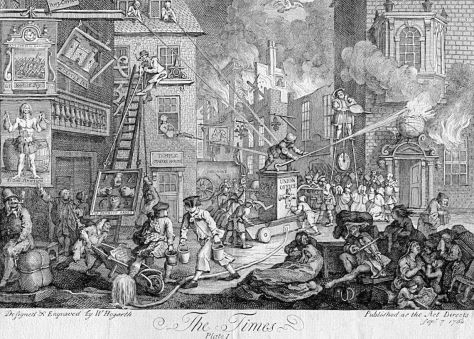
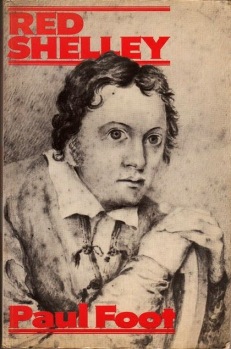 But as Shelley’s sentence crosses the next stanza break – ie. without any clear pause – the seemingly unstoppable parade of bloodshed, inequality, injustice and hypocrisy is strangely interrupted by a counter personification. A crazed-looking young woman (“a maniac maid”) runs out declaring that her name is Hope, though the narrator says “she looked more like Despair”. The perception here is interesting as even Shelley’s narrator has been so infected by the toxic atmosphere spread by Anarchy that the girl (who is soon to bring about a challenge to Anarchy) looks to be insane and more resembles the absence of hope than otherwise. This is one of Shelley’s core political beliefs and had already appeared in the closing lines of Prometheus Unbound. There, Demogorgon urges optimism in the long term conflict with abusive power: “to hope, till Hope creates / From its own wreck the thing it contemplates”. The movement for Reform will – it seems – have to come close to despair, or its own wreck, before the powers of Anarchy are likely to be defeated.
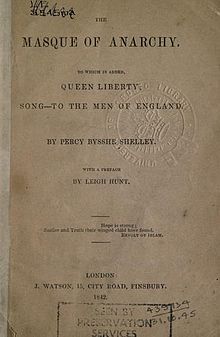 This mist – later called a “Shape” – is one of the mysteries of the poem’s politics. Hope provokes its appearance. At first weak, it gathers in strength. Shelley compares it to clouds that gather “Like tower-crowned giants striding fast, / And glare with lightnings as they fly, /And speak in thunder to the sky”. In the next few stanzas it becomes more soldierly, “arrayed in mail”, compared to the scales of a snake (for Shelley the snake was usually an image of just rebellion not of evil), yet it is also winged. It wears a helmet with the image of the planet Venus on it. It moves softly and swiftly – a sensed but almost unseen presence. And rather than any military action or campaign of civil disobedience, this Shape, conjured by Hope, creates thinking:
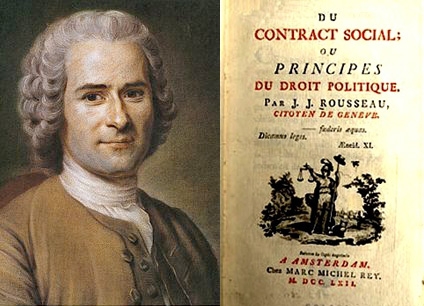 Yet in the calm aftermath of these events, there comes a sense of renovation, a “sense awakening and yet tender / Was heard and felt” and, most importantly, there are further words. This time the speaker is unclear though it is “As if” the earth itself, the mother of English men and women, feeling such bloodshed on her brow, translates this spilt blood into a powerful, irresistible language, “an accent unwithstood”. Shelley repeats “As if” once more, confirming the mystery of this voice, a voice which proceeds now to speak the whole of the remainder of the poem. For Shelley, Poetry in his broad sense is “vitally metaphorical” and the earth’s imagined speeches convey a sense that the cause of liberty is in accordance with the truly understood (surely Rousseauistic) nature of creation.



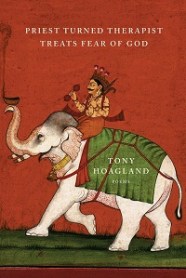

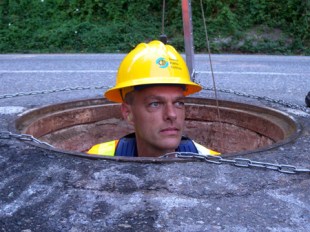 Nevertheless, some uncertain light can be cast on the human condition by ‘The Neglected Art of Description’. A man descending into a man-hole can remind us of “the world // right underneath this one” though Hoagland treats this idea with three doses of ironic distancing. He’s even more confident that the pleasures of perceptual surprise can “help me on my way” (even this, an equivocal sort of progress and destination; no golden goal).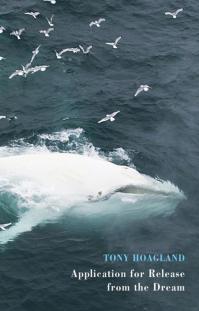
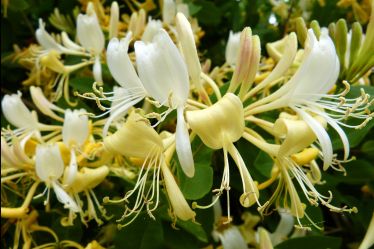
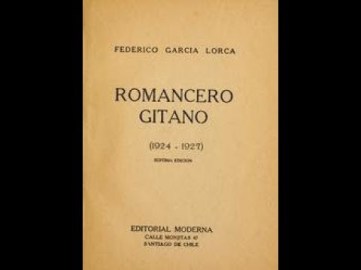
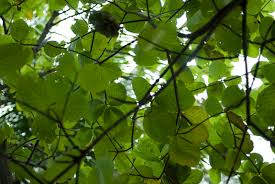
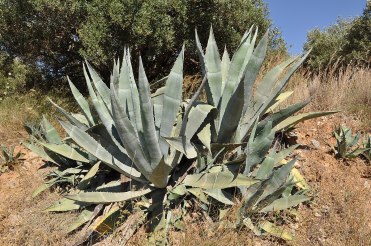 The next section of the poem displays some of Lorca’s startling, surprising images: the “stars of frost”, the “fish of shadows”, the fig-tree’s “sandpaper branches”, the mountain is a “a thieving cat” that “bristles its sour agaves”. These are good examples of Lorca’s technique with metaphor: to place together two things which had always been considered as belonging to two different worlds, and in that fusion and shock to give them both a new reality. But these lines are perhaps really more about raising the narrative tensions in the poem through rhetorical questions such as, “But who will come? And where from?”
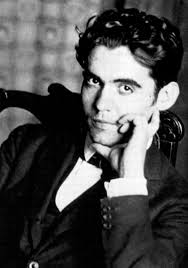 So up they climb. We don’t know why, but the atmosphere here is dripping with ill omen: they are “leaving a trail of blood, / leaving a trail of tears”. Then there is another of Lorca’s images yoking together unlikely items. As they climb to the roof-tiles, there is a trembling or quivering of “tiny tin-plate lanterns” and perhaps it’s this that becomes the sound of a “thousand crystal tambourines / [that] wound the break of day”. Lorca himself chose this image to comment on in his talk. He says if you ask why he wrote it he would tell you: “I saw them, in the hands of angels and trees, but I will not be able to say more; certainly I cannot explain their meaning”. I hear Andre Breton there, or Dali refusing to ‘explain’ the images of the truly surreal work. In each case the interpretative labour is handed over to us.
 Did they know this? It appears not. But who is she? Daughter? Lover? Both? Is this really what the two men find there? For sure, there is some mystery about the chronology because the seeming explanation of the killing is couched as a flashback: “The dark night grew intimate / as a cramped little square. / Drunken Civil Guards / were hammering at the door”. But Lorca often plays fast and loose with verb tenses. Was this earlier? Were they in search of the rebellious youth? But they found his girl-friend? Hanging her on the rooftop? Is the house owner her father? Does he know what has happened? Is this why his house is not his own anymore? Is this why he is no more what he was?
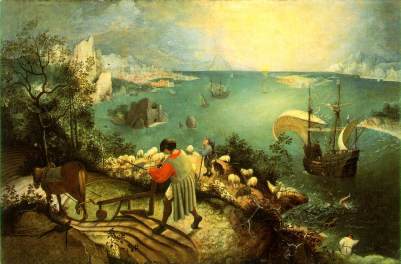 The only certain thing is that the poem does not reply. It ends with a recurrence of that opening yearning – now it’s read as a more obviously grieving voice – though it’s not necessarily to be read as the young man’s voice. It’s the ballad voice, the one I took so long to really grasp in Lorca’s work. It is a voice involved and passionate but with wider geographical, political and historical horizons beyond the individual incident. Like Auden’s ploughman in ‘Musee des Beaux Arts’, glimpsing Icarus’ fall from the sky, yet he must get on with his work, ‘Sleepingwalking Ballad’ returns us in its final lines to the wider world:
 I really didn’t know it at the time, but the song’s words are, of course, by W.B. Yeats. It is his poem ‘The Song of Wandering Aengus’, from The Wind Among the Reeds (1899).
 I have now translated a number of Lorca’s poems and one of the great difficulties is to carry over such metaphorical leaps into English where they risk sounding very silly indeed. Fair enough, the alligator is, on the face of it, obvious enough: its gaping jaws give a good jolt of comic hyperbole to his image. But it’s still surprising in the context of a be-suited, bespectacled lecture hall in Spain. There is an exoticism there on the verge of surrealism and is characteristic of Lorca’s images. This search for novelty in image is clear when he argues later that a real poet must “shoot his arrows at living metaphors and not at the contrived and false ones which surround him”.
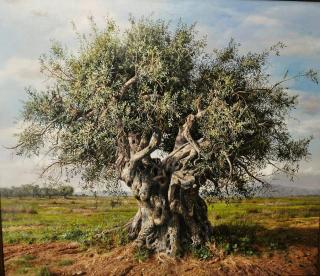
 Just one last detail from this great poem. Juan Antonio de Montilla is killed in the fight and – in one of Lorca’s characteristic jump cut edits (more of that in a minute) suddenly (it seems) the “judge and Civil Guard / come through the olive groves”. Somebody – a participant, one of the old women? – gives them an account of events in the form of exactly one of Lorca’s startling metaphors. This may have been a quarrel over a card game, or a girl, like so many others, but Lorca dizzyingly elevates it into an historical, even epic context: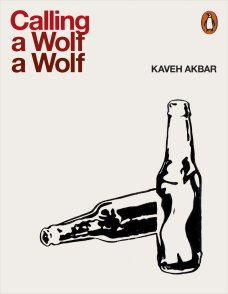
 Akbar doesn’t generally do the more familiar, simply focused poem. There are a few in the book like ‘Learning to Pray’, in scattered unrhymed triplets, in which a young boy (Akbar allows a straight autobiographical reading usually) watches his father pray, “kneeling on a janamaz” or prayer mat. The wish to emulate the admired father is conveyed pin-sharp. A later poem also starts from childhood and (mostly in loose unrhymed couplets) traces the boy’s later maturing in an America “filled with wooden churches / in which I have never been baptized” (‘Personal Inventory: Fearless (Temporis Fila)’). This poem also attracts threads of two of Akbar’s other main themes: his personal addictions and the ubiquitous sense of living in a fallen world.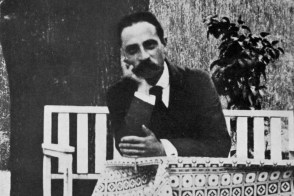
 One of the main elements of this fallen state (again Akbar allows a simple autobiographical interpretation) is the damage caused by his past addictions, especially to alcohol. This is the main hook Penguin hang the book on (a cover of empty beer bottles, for example). Poems styled ‘Portrait of the Alcoholic …’ recur throughout the book, but the first section is most focused on this. A familiar comment from W.H. Auden is used to firmly yoke spirit to bottle: “All sins tend to be addictive, and the terminal point of addiction is damnation”. Many of the poems then have this sense of inebriation, muddling, confusion which Akbar’s style of writing is very at home with. ‘Portrait of the Alcoholic with Home Invader and Housefly’ presents the drinker waking up, seemingly attacked by a home invader with a knife. Memories of keeping a housefly on a string intervene, perhaps because in the fly’s death the young boy confronted the idea of death: “I opened myself to death, the way a fallen tree // opens itself to the wild”. The poem returns to the threatening situation, then to more abstract thoughts of scale, a TV programme and the speaker passively returns to sleep. This is a great poem of the self as both endangered and paranoid, distanced from danger, the blurring of perception, thought and memory.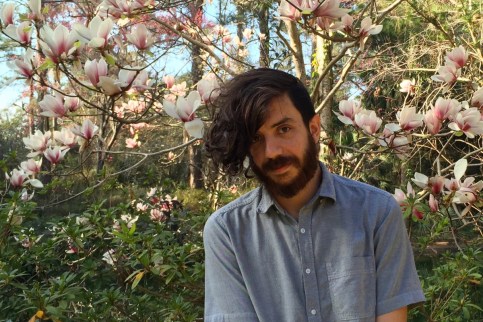
 But when it works, these are marvellous poems – and, for my money, this book would make a worthy winner of the 2018 Felix Dennis Prize. ‘Wild Pear Tree’ – as if in one breath – conveys a wintry scene/mental state, recalls halcyon days (of spring) and ends lamenting the forgetting of an “easy prayer” intended for emergencies: “something something I was not / born here I was not born here I was not”. ‘Exciting the Canvas’ is much more risky in its jig-sawing together of disparate elements – a bit of Rumi, the sea, a child’s drawing, a drunken accident, the Model T Ford, crickets, snakes – but somehow manages to hold it all together to make a snap-shot of a troubled, curious, still-open consciousness. And finally, ‘So Often the Body Becomes a Distraction’, dallies with the Rilkean idea of dying young, alludes to recovery from addiction, then grasshoppers, ice-cubes, personal ambitions and the self-image of “rosejuice and wonderdrunk” (which is merely one side of Akbar’s work). This one ends with the not-infrequent trope of a re-birth from burial in the earth. I like these images, suggesting that, for all the fretting about lost paradise, the absence of God, the self-destructiveness of the individual, whatever redemptive re-birth may be possible is only likely to come from our closeness and attentiveness to things about us, an eschewing of the “self-love” Akbar struggles to free himself from in ‘Prayer’: in a lovely phrase –though I’m still figuring it – he concludes, “it is not God but the flower behind God I treasure”.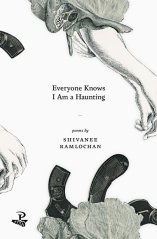
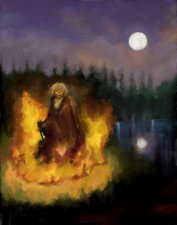

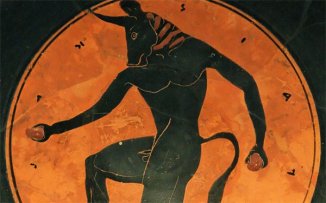 There is a sequence in the middle of the book which offers a clearer view of Ramlochan’s approach. ‘The Red Thread Cycle’, on the face of it, explores the traumatic consequences of rape. How to articulate the event is one theme and there is a magic-real quality which initially seems to add to the horror: “Don’t say Tunapuna Police Station. / Say you found yourself in the cave of the minotaur”. But this shifts quickly instead to reflect how police and authorities fail to take such a literal description seriously, even blaming the woman herself: “Say / he took something he’ll be punished for taking, not something you’re punished for holding / like a red thread between your thighs”. Other poems trace improvised rituals (real and semi-real) to expiate the crime and trace the passage of years. Some moments suggest the lure of suicide with allusions to Virginia Woolf’s death by water, carrying “pockets of white stones”. Seeing the unpunished rapist at large eventually becomes possible: “Nothing drowns you, when you see him again”. The sequence is a lot less chronological than I am making it sound, but what the woman has been doing over the years is, in a striking phrase, “working to train the flinch out of myself”. This has been achieved partly through art. Ramlochan certainly sees such pain as an essential part of the artist’s apprenticeship, that it will “feed your best verse”, and the sequence ends with her reading poems in public as an act of strength and self-affirmation, marking the psychic death of the aggressor: “applause, hands slapping like something hard and holy / is grating out gold halleluiahs / beneath the proscenium of his grave”.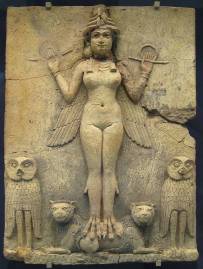

 Martyn Crucefix