Mat Riches reviews ‘Between a Drowning Man’

Many thanks to Mat Riches for this fulsome and acute reading of my recent collection from Salt Publishing. The review first appeared on The High Window – Jan 2024

The introduction to the first section of Between a Drowning Man states that it draws on two texts. The first is Hesiod’s Works and Days, and the second of which is described as

the type of poem known as a vacanna originated in the bhakti religious protest movements in 10-12th century India. using plain language, repetition and refrain they were written to praise the god, Siva, though also expressed a great deal of personal anger, puzzlement, even despair about the human condition […]

This helped put everything into context for what followed. One third of the way in I started to think of it as a man shouting at clouds in book form, of someone railing at things in the world that are beyond our control. And maybe it is all of this, but it also much more than this. I think it becomes a lesson in acceptance.
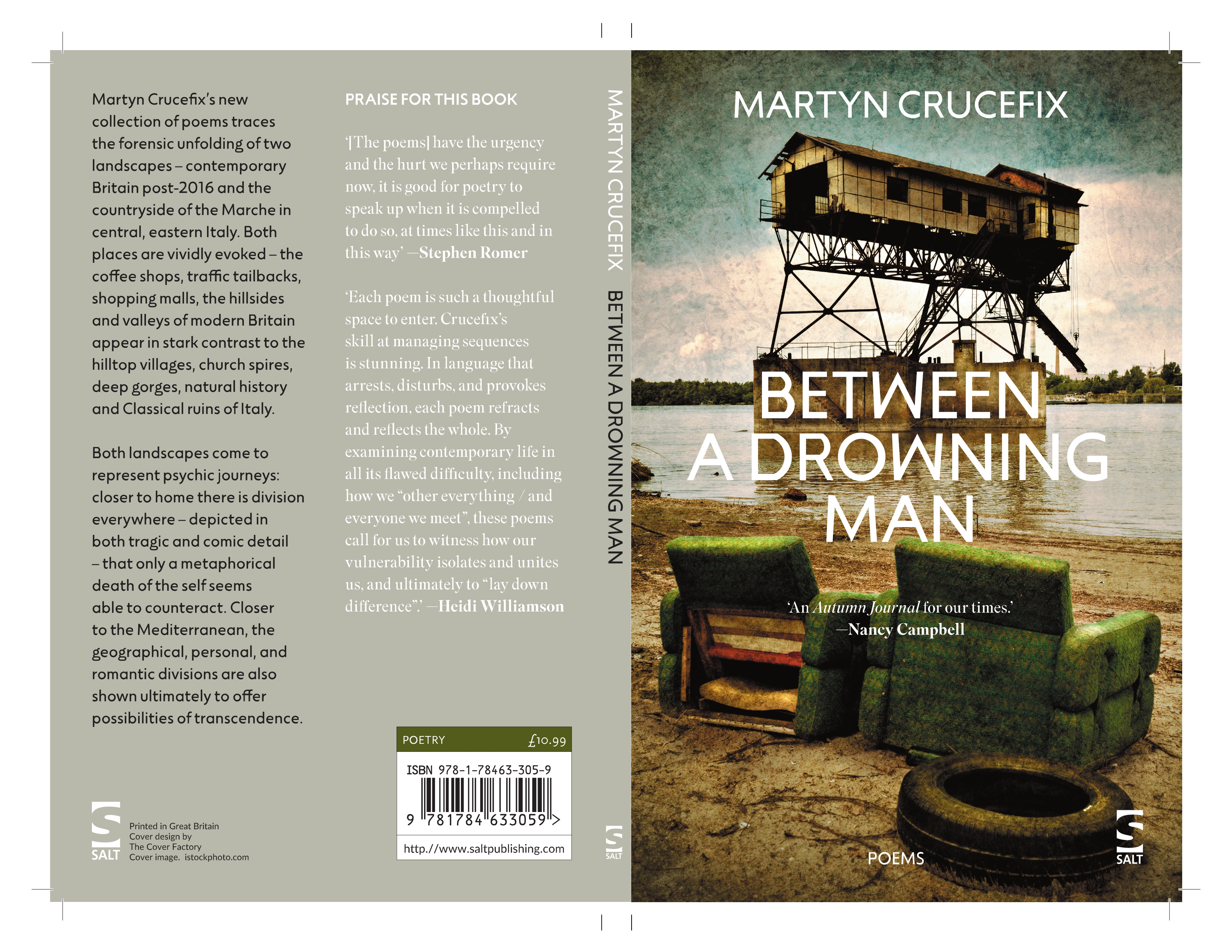
In a post on his own Blog, Crucefix describes these poems as starting to arrive after reading the vacanna poems in 2016, and how the poems began to accumulate after that while ‘staying in Keswick at the time and I vividly remember scribbling down brief pieces at all times of the day and night’ and of having been influenced by Brexit (the bridges are down indeed). However, he also describes in a follow up post that:

I thought of the poetry I was writing as a quite narrowly focused topical intervention, but in the last 4 or 5 years …the poems have come to seem less dependent on their times and more capable of being read as a series of observations – and passionate pleas – for a more generous, open-minded, less extremist, less egotistical UK culture.

And while the Brexit reading is there, these poems speak more to grounding a modern and disconnected world (despite plenty of references to devices for and modes of communication—we’ll come back to that shortly) in timeless themes like love and desire, parenting, ageing, joy in nature, false idols, and much more, and this is just in the first twenty or so pages.

Picking one of those themes at random, we can see how false idols are covered, but also how deftly he weaves in modern references to something that is both timeless, and of its time, and with that very human. In ‘the six pack on the side’ we are told:

the clock is a sinister and impassive god
for the ancients rumour was a kind of god
…

the god of WiFi when we curse its absence
and when did difference become a god

We have always been a narcissistic species that pays attention to gossip (‘rumour was a kind of god’), but while our gods have changed as the centuries have passed, we still curse our gods when they forsake us. Not a bad return for a 19-line poem in my opinion.

In order to achieve the ‘more generous, open-minded, less extremist, less egotistical UK culture’ we can see several pleas for more open lines of communication throughout the poems. Some are located in the specific and familial, as in ‘watch the child’ and its discussion of a child chattering away to herself in a coffee shop with her ‘bright picture book’ juxtaposed with ‘her mother at her cooling latte / at her macchiato / at her cooling skinny medium cappuccino // […] her mother’s ears wired casually // with two scarlet buds.

The child is broadcasting and communicating in a carefree way vs the mother’s more deliberate inward-looking approach, a shutting the world out for some respite. And while this could be a judgmental poem; it’s not. It feels like an invitation to consider both sides, both needs here. The refrain of ‘all the bridges are down’ lands particularly well here, both for the protagonists of the poem, but also for the reader.

However, while some pleas are located in the specific there are some more general ones to be found. In ‘he thought of this time’ one man recounts a litany of disappointments and emotions from his father. The poem draws from Hesiod and his idea of the fifth age where modern man was created by Zeus to be evil, selfish, weary, and burdened with sorrow. It’s a two-footed tackle on humanity from the whistle:

he thought of this time as a fifth age
that he’d be better off dead or not yet born
working all day he would fear the night
had heard of children born prematurely grey
and the fraying bond between fathers
and sons between mothers and daughters
between host and guest between different races

It continues without reprieve about a world where:

[…]the hopeless
are advanced and further advancement
lavished for no more than just chancing it
respect a word more spoken than heard
the educated full of corrosive cleverness
and compassion the greatest of virtues
an ebbing tide you see where it glints
on the horizon

At the time of writing, it’s easy to feel like these lines are as contemporary as it’s possible to be, and yet it’s arguable they are evergreen observations about humanity. However, I suspect that’s the point.

We’ve touched upon references to modern-day totems like WiFi, coffee types and headphones already, but this section is filled with them. Further examples include references to Google Maps and ‘five-star online reviews’ in ‘fifteen kilometres of traffic’ and ‘stoke a fire under your silk blouse’ respectively.

This all reaches its zenith in the final poem of the section, ‘this morning round noon’. The poem moves from personal notes about scattering ashes, a son’s birthday (and him being in huge debt at 21, one presumes from being at university) through to:

an American punk band form Nashville
posting abuse about a young Buddhist woman
refusing anaesthetic

The lines are punctuated by phrases like ‘likesharelike’ or ‘likeclicklike’ or ‘smileyfaceicon’. It’s the diaristic nature of the whole section writ large and transmitting thoughts to the page (albeit the printed page, not the Facebook page) as they occur. As an aside, this running together of words, coupled with the entire book’s distinct and clearly deliberate lack of punctuation (save a few dashes here and there) add to the observational nature of the poems, of thoughts being pulled from the ether. However, this is very much not to say that these poems aren’t considered and crafted—they very much are.

The final line of the poem and section is ‘I say the Pantone chart is one of my favourite things’, and while the poem that proceeds this line could be read as a darker version of the Sound of Music classic, less Raindrops on roses and more ‘I was hit by a car likeshare’, but I prefer to take it as a sign that the poem end on acceptance of nuance, variation and being able to communicate the same needs.

As the first section comes to an end there are two poems where the last line of one resurfaces as the start of the next, and it feels like a teaser for what follows in the second section, O. at the Edge of the Gorge.

This was previously published as a pamphlet by Guillemot Press in 2017 and is a crown of sonnets. After the hectic modernity of the first section, there is much to be said for the relative calm of following a traveller, Orpheus, on a journey through Italian countryside observing ‘Glossy fleet black clods of carpenter bees / swirl at the corner of the house / then sink onto spindly lavender stems / alight on blooms stooped // with the weight of insect lives’.

It’s a beautiful opening and a beautiful image that should perhaps be filmed and used as a fine example of what was briefly known as slow TV and shown on BBC4, but in the second poem he describes ‘astronomical time marked by light’ as the sun descends the gorge and church bells tolling, but:

yet come nightfall a different sense
these same sounds sound notes more chilling…

A very real sense of for whom the bell tolls, indeed. As the traveller wends their way round the area, taking notes and sketches of birds, a ‘flock of white doves’, that darkness returns in the form of a buzzard in the eighth sonnet, and gets deeper still in the ninth where he mentions:

like Urbisaglia or some place has seen
and survived change of use
from sacred temple to church to slaughterhouse
and no gully nor hill can stop it

Urbisaglia is an ancient town in Mid-East Italy that became the site of an internment camp during the second world war, and that knowledge adds further weight to the stanza that begins sonnet ten:

The truth is some survive a while most fail
to conceive the scale of paperwork
to follow change of use from church to temple
next to slaughterhouse.

The cruelty of humanity to itself is mirrored in the “bloody festival / of the bird” in sonnet thirteen as it discusses a raptor above the gorge, and the final sonnet off this crown muses on the fragility of life:

All creatures die sooner blind to the hawk—
left clutching no more than this
as if the hammock he occupies each
and all night too as if strung out

[…]
not falling yet not ever at ease

‘not ever at ease’ could so easily be a final motif for the whole collection. There is a sense that the learnings of this collection are hard won, but there is a connection to the wider world to be had, and that we can find comfort in travelling through it. The final lines of ‘you are not in search of’ in the first section seem apt as a place to leave it:

you might say this aloud—by way of ritual—
there goes one who thought much of life

who found joy in return for a little gratitude.

Mat Riches is ITV’s unofficial poet-in-residence. Recent work has been in Wild Court, The New Statesman, The Friday Poem, Bad Lilies, Frogmore Papers and Finished Creatures. He co-runs Rogue Strands poetry evenings. A pamphlet called Collecting the Data is out via Red Squirrel Press. Twitter @matriches Blog: Wear The Fox Hat
Two new prose poems at Black Nore Review

Many thanks to Ben Banyard for accepting these two recent experiments in prose poetry. Do check out other postings on Ben’s site at Black Nore Review. Click on Martyn Crucefix – two poems below to read the pieces.

Ben’s details are as follows: Ben Banyard lives in Portishead, near Bristol. His three collections to date are Hi-Viz (Yaffle Press, 2021), We Are All Lucky (Indigo Dreams, 2018) and Communing (Indigo Dreams, 2016). He blogs at https://benbanyard.wordpress.com

A new podcast interview – plus a new review of ‘Between a Drowning Man’

I am delighted to announce that Planet Poetry – the long-running, terrific poetry podcast run by Robin Houghton and Peter Kenny have released their new episode which includes an interview with me about my new Salt book. Do listen here: https://planetpoetry.buzzsprout.com/1414696/14024020-bridges-broken-with-martyn-crucefix

Stuart Henson has also written a fine review of Between a Drowning Man, which has recently been posted on the London Grip site. You can read the whole review here:

New podcast discussion on Between a Drowning Man

I’m very pleased to announce that Mark McGuinness’ excellent poetry podcast, A Mouthful of Air, which has recently featured poets such as Mona Arshi, Judy Brown, Rishi Dastidar, Ian Duhig, Mimi Khalvati, Clare Pollard, Tom Sastry, and Denise Saul, has recorded a discussion about my new Salt collection, Between a Drowning Man.

Mark’s method is to focus on one particular poem and between us we chose the poem ‘you are not in search of’, on page 57 of the new book, from the latter end of the ‘Works and Days’ sequence. You can listen to the podcast here. It’s about 40 minutes in length and includes a reading of the poem at the beginning and end. There is also a helpful transcription of our discussion.

Here is the poem text – though without the indents which are hard to reproduce here:

‘you are not in search of’

‘There has to be / A sort of killing’ – Tom Rawling

you are not in search of a gilded meadow

though here’s a place you might hope to find it

the locals point you to Silver Bay

to a curving shingled beach where once

I crouched as if breathless as if I’d followed

a trail of scuffs and disappointments

and the wind swept in as it usually does

and the lake water brimmed and I knew the thrill

of its mongrel plenitude as colours

of thousands of pebbles like bright cobblestones

slid uneasily beneath my feet—

imagine it’s here I want you to leave me

these millions of us aspiring to the condition

of ubiquitous dust on the fiery water

one moment—then dust in the water the next

then there’s barely a handful of dust

compounding with the brightness of water

then near-as-dammit gone—

you might say this aloud—by way of ritual—

there goes one who thought much of life

who found joy in return for a little gratitude

before its frugal bowls of iron and bronze

set out—then vanished—then however you  try

to look me up—whatever device you click

or tap or swipe—I’m neither here nor there

though you might imagine one particle

in some stiff hybrid blade of grass

or some vigorous weed arched towards the sun

though here is as good a place as any

you look for me in vain—the bridges down—

Influences on ‘Between a Drowning Man’ #2

Last week, with the imminent arrival of my new book of poems, Between a Drowning Man, I decided it would be useful – for those who would like to know – if I re-blogged a piece I wrote and posted early in 2019 about one of the key sources and inspirations of the new book’s main sequence of poems called ‘Works and Days’. The focus then was on my reading of AK Ramanujan’s collection of vacana poems. But later in the process of completing the full sequence, it was further formed (or reformed or deformed) by rather different pressures derived from a second literary antecedent, the reading of which was itself influenced by the febrile and divided atmosphere surrounding political events in the UK between 2016 and 2019. I mean, of course, Brexit.

At the time, I thought of the poetry I was writing as a quite narrowly focused topical intervention, but in the last 4 or 5 years (partly with the greater clarity with which the Brexit heist can be now seen to have been foisted on the country), the poems have come to seem less dependent on their times and more capable of being read as a series of observations – and passionate pleas – for a more generous, open-minded, less extremist, less egotistical UK culture. It was Hesiod’s pre-Homeric poem, Works and Days, that suddenly felt oddly familiar: in it he is not harking back to an already lost era, nor to past heroic (in our case imperial) events. Instead, Hesiod talks about his own, contemporary workaday world, offering advice to his brother because the pair of them seem to be in some sort of a dispute with each other (a squabble over limited resources – that sounded familiar).

So my developing sequence took over from Hesiod the idea of familial disputes, the importance of the persistence of Hope (in the Pandora’s jar story), the idea that we need to understand that we are living in an Age of Iron (not idealised Gold). Poetry can never be summarised by its own conclusions but the poems seemed to me to be arguing the need to work hard – to have patience – not to buy into fairy tales of a recoverable golden age that probably never existed anyway. If all this sounds interesting, do click on the blog title below to read the whole of my original post. After a bit of New Year 2019 preamble, the discussion of Hesiod begins at paragraph 3.

My first public reading of these poems from my new book will be on the evening of Tuesday 24th October at The Betsey Trotwood in Clerkenwell. I’ll be reading alongside 2 other Salt poets:  Elisabeth Sennitt-Clough – ‘My Name is Abilene’ (Shortlisted for the 2023 Forward Prize); and Becky Varley-Winter – ‘Dangerous Enough’ (‘daring, danger and risk in poems that are packed with imagery from the natural world’).

Influences on ‘Between a Drowning Man’ #1

With the arrival of my new book of poems, Between a Drowning Man, imminent, I thought it would be useful to re-blog a piece I wrote and posted early in 2019 about one of the key sources and inspirations of the new book’s main sequence of poems called ‘Works and Days’. It was my fortuitous reading of AK Ramanujan’s collection of vacana poems, early in 2016 (all explained below), that set me off experimenting with a similar clipped, plain, rapid, fluid style with its (refrain like) repetitions. I was staying in Keswick at the time and I vividly remember scribbling down brief pieces at all times of the day and night. Outside, and interfering with the various walking expeditions we had planned, the great storm of the winter of 2015/6 (googling it now, it was Storm Desmond) had taken out many of the ancient bridges in the Cumbrian countryside. Inevitably, this fact found its way into the poems and provided the refrain I used in many of them.

It has been a long haul between that period and the poems’ eventual appearance in this new collection and the whole sequence was further formed (or reformed or deformed) by pressures of a second literary antecedent (I’ll blog about that next week) and by the divisive political events in the UK between 2016 and 2019. Click on the blog title below to read the whole of the original post. My first public reading from the new book will be on the evening of Tuesday 24th October at The Betsey Trotwood in Clerkenwell. I’ll be reading alongside 2 other Salt poets:  Elisabeth Sennitt-Clough – ‘My Name is Abilene’ (Shortlisted for the 2023 Forward Prize); and Becky Varley-Winter – ‘Dangerous Enough’ (‘daring, danger and risk in poems that are packed with imagery from the natural world’).

‘My mother’s care home room as Cleopatra’s monument’ – an unpublished poem @ The Poetry Archive

The Poetry Archive has recently been calling for submissions for what they are calling Poetry Archive Now. They are searching for poems written during 2023 as follows:

We want you to have the opportunity to join the Poetry Archive collections by recording yourself reciting or reading your poem out loud and sending it to us to care for and share worldwide. 20 poets will be chosen to join the Poetry Archive Now! WordView 2023 Collection and hundreds more will be curated, archived and shared in our YouTube collections with the millions of people who visit and love the Archive. Poetry offers a vital reflection of the age we live in. We would love you to join our collections to offer inspiration, comfort and the sheer lift-of-spirits which listening to fantastic poetry being read out loud can bring.

One of the few benefits of scrolling through social media – all too conscious of the gloom that can set in when confronted with (what appears to be) every other person/poet in the world having such marvellous successes – is that one comes across these calls for submission. Happily, the poem I videoed and sent in has become one of the ‘hundreds more’ and recently been posted on YouTube. I thought I’d share it here.

Hard to say where the juxtaposition of the last days of my mother’s life and Cleopatra’s final moments (as presented in Shakepeare’s Antony and Cleopatra) came from. But the scene is one I have often taught and found immensely moving. Charmian is one of the Egyptian queen’s handmaidens (friends more like). Cleopatra applies the asp (poisonous snake) to her breast and within a few minutes Charmian does the same:

  • Charmian. O eastern star!
  • Cleopatra. Peace, peace!
    Dost thou not see my baby at my breast,
    That sucks the nurse asleep?
  • Charmian. O, break! O, break!
  • Cleopatra. As sweet as balm, as soft as air, as gentle,—
    O Antony!—Nay, I will take thee too.
    [Applying another asp to her arm]
    What should I stay—

[Dies]

  • Charmian. In this vile world? So, fare thee well.
    Now boast thee, death, in thy possession lies
    A lass unparallel’d. Downy windows, close;
    And golden Phoebus never be beheld
    Of eyes again so royal! Your crown’s awry;
    I’ll mend it, and then play.

The text of my poem appears below the video recording.

My mother’s care home room as Cleopatra’s monument

I sit behind door 16

in a room the size

of my son’s student room

though it is the old

who are sheltered here

and from the only chair

I watch the sun’s rays

through the only window

pierce the canopy

of the tall beech trees

that line the park

alongside this building

sunshine through glass

and over the sill

onto a blue plastic jug

its blue plastic cup

of barely touched water

a single birthday card

from her grandchildren

a Christmas cactus

and her bracelet watch

catches a glint

and a glint on the foil

of today’s medication

these few objects

are telling the time

as the sunlight rakes

beyond the trees

an Easter Island profile

gaunt and beaked

propped up in bed

on the plastic-wrapped

single mattress

the rucked-up sheet

of scroll and shadow

as the sun travels

falling into the west

I keep my vigil

with all the helpless-

ness of Charmian

at the cooling feet

of her Queen

the asp flung down

beneath the only chair

there has ever been

Edward Thomas, Tellisford, and a poem of my own

I have recently been writing a piece for the excellent site, The Friday Poem, or the FRIP as it styles itself, edited by Hilary Menos. I’d had a poem accepted by the FRIP earlier this year and Hilary had asked if I’d like to contribute something in prose, perhaps choosing 3 ‘desert island’ poems. An impossible challenge, of course – only three!!?? – but an interesting exercise to be sure. I’ll say no more about what I submitted to the FRIP before it appears there in the near future, only to say that one of the poems I chose was by Edward Thomas.

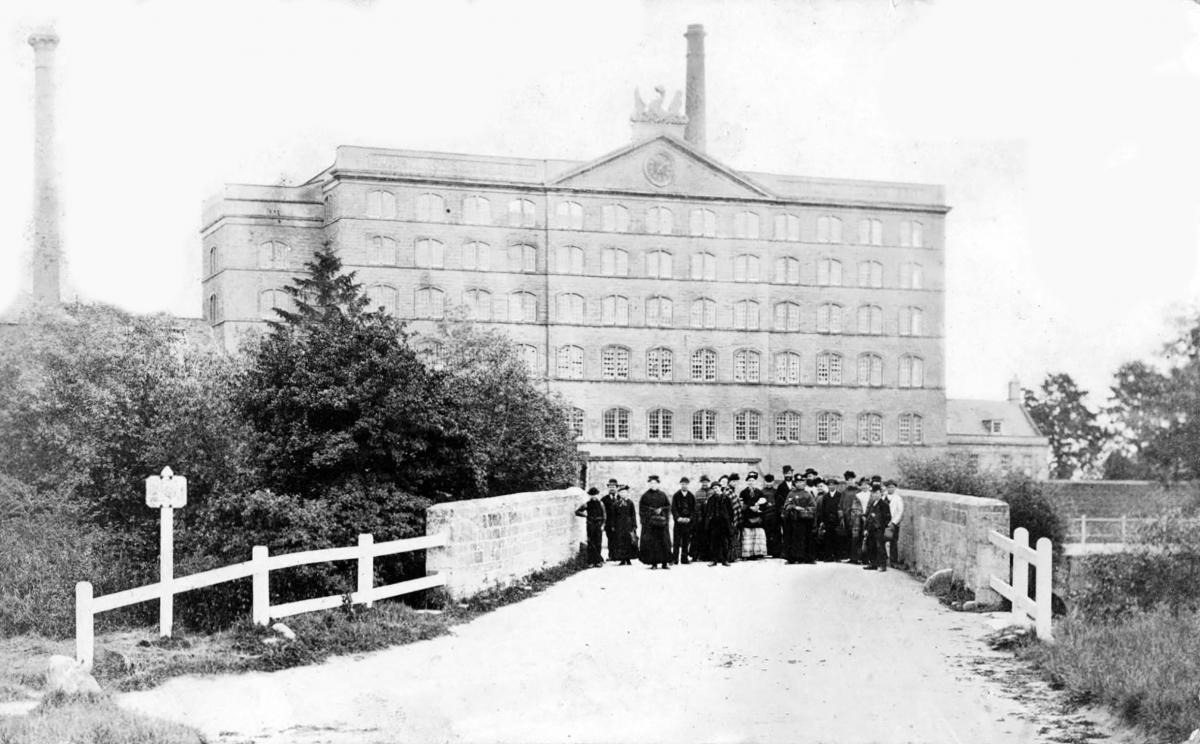
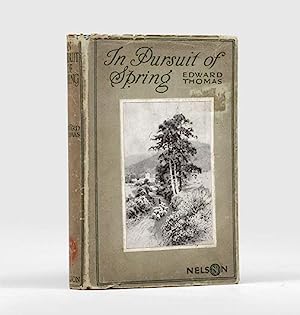
In introducing ET’s poem, I found myself talking about his prose travelogue, In Pursuit of Spring (1914). This book – apart from being wonderfully evocative of a lost, pre-WWI England, as he cycles from London, through the South Country, to end up in the Quantock Hills – has always been special for me because he makes a stopover just outside my hometown of Trowbridge, in Wiltshire. The following day he cycles out of Trowbridge, through Hilperton (the village where I grew up), out to Semington, towards Melksham, then along the meadows at Challimead, to Holt, before passing the Nestle factory at Staverton. The latter, with its River Avon (the Bristol Avon) flowing nearby, was where I used to go fishing with our next-door neighbours. The factory is also where several generations of my own family worked, including my maternal grandparents and my mother. Thomas’s descriptions of the roads and countryside are vivid:

. . . the Phoenix ‘Swiss’ Milk Factory where I crossed the Avon at Staverton . . . is an enormous stone cube, with multitudinous windows all alike, and at the back of it two tall chimneys. The Avon winding at its foot is a beautiful, willowy river. On the opposite side of the road and bridge the river bank rises up steeply, clothed evenly in elms, and crowned by Staverton’s little church which the trees half conceal.

The ‘Milk Factory’ at Staverton and the bridge over the Avon

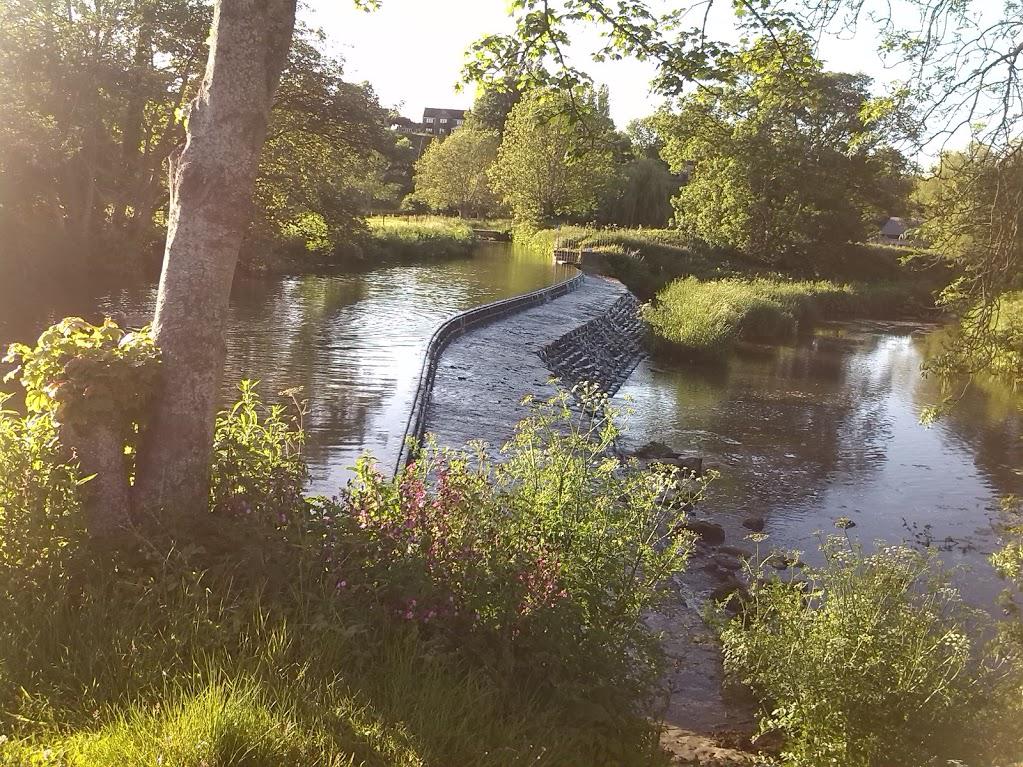
That church is where my grandparents were married. The following day, Thomas sets off again but stops this time at Tellisford. This is a small village to the west of Trowbridge, where a bridge crosses the River Frome. I’d occasionally come fishing here too, and later for the occasional romantic tryst, though more often the trip was for a picnic on the idyllic riverside meadows, listening to the water flowing over the ancient weir. Thomas’s mysterious companion, simply called the ‘Other Man’, describes the scene in 1914:

. . .  a beautiful meadow slopes between the river and the woods above. This grass, which becomes level for a few yards nearest the bank, was the best possible place, said the Other Man, for running in the sun after bathing at the weir – we could see its white wall of foam half a mile higher up the river, which was concealed by alders beyond.

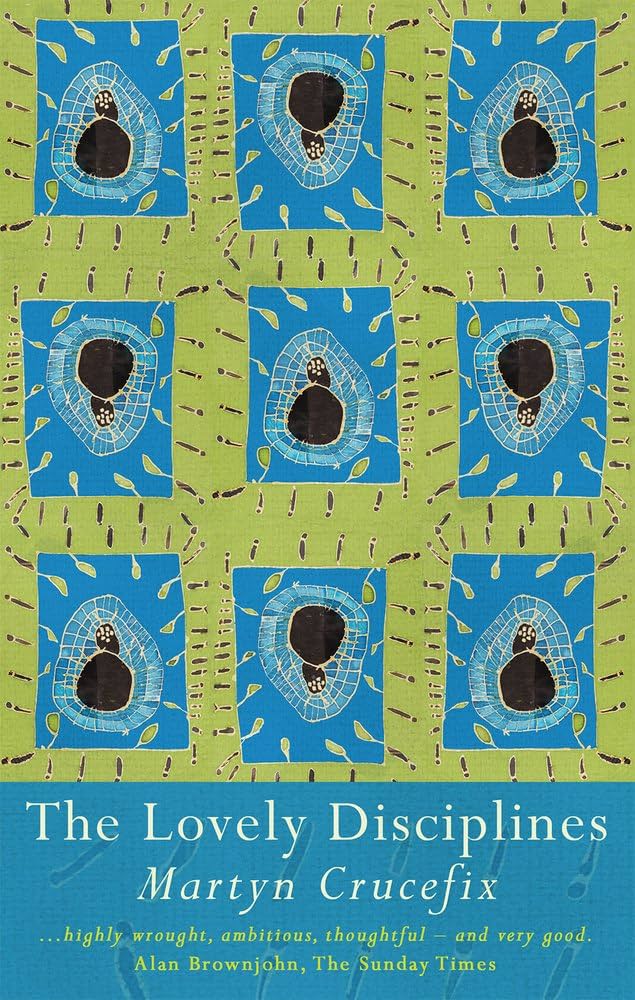
Almost nothing had changed when, years later, my whole family came here for a picnic, perhaps to celebrate my parents wedding anniversary . . .  I remember speaking to a man who lived nearby. He was rebuilding the weir which had fallen into disrepair. Years later again, I wrote a poem about the occasion (later published in my book The Lovely Disciplines (Seren Books, 2017). Called ‘Rebuilding Tellisford weir’, I gave the poem an epigraph from In Pursuit of Spring: ‘turn aside to see Tellisford’. The poem’s opening lines focus on the man’s self-given task, one of both conservation and innovation:

He refuses shade in midday heat

the old man walking

in his honey-brimmed hat

along the drained weir-shelf

x

that looks today like stacked loaves

its pallid smooth ranks

of Victorian stones

mapping precisely the Domesday line

x

where he patrols to and fro

proudly surveying the place he owns

this stretch of England

his plan to restore the workings

x

of the old watermill

to feed the Grid—and it is for this

he has ordered tons of sludge

to be dredged above the drop

x

and dozens of loosened stones

to be replaced to give

the mill-race its full head

and today he walks the slippery length

x

of the dammed weir-shelf

View of Tellisford Weir

For some reason, in my writing of the poem, I wanted to distance my own family’s part in the scene, perhaps because the incident I was recalling was a long while ago. The man hails the picnickers (rather than the other way round, which is I think what happened):

he cries what marvellous weather

x

then falls to conversation with a couple

who are celebrating sixty years

in their self-built house

with their three good boys

x

raised and schooled to distant homes

though today they recline

on trashy garden chairs

on this riverbank as if to watch

x

the old man in an antique yellow hat

who walks noting progress

on the weir

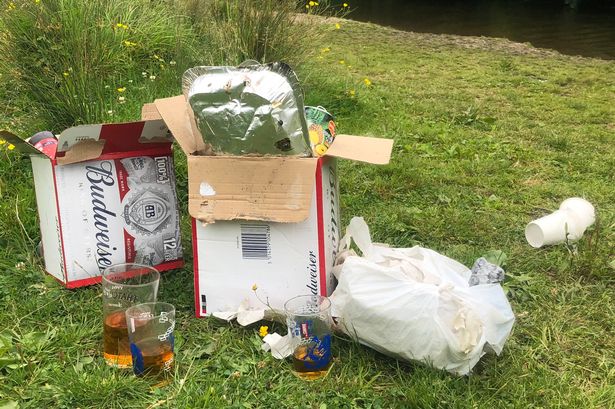
Riverside littering

My own family appear more as careless tourists than anything else. It is the man’s project which gets more attention. And – as the thought develops – it is his own state of mind that seems to interest the poem.

and how could they know

he’s something on his mind

x

for the next hundred years

how could they know more and more

these days he struggles to endure

the roaring of the fish-shoot

x

with its silted water

and these stilted conversations

with such ordinary people

their Diet Coke and egg mayonnaise

x

their crisps for the grandchildren

their Sunday newspapers

let blow and tumble across the meadow

reminding him of himself

x

how his mind often strays

up the ditch-line to the old drovers’ road

where for fifty years

their cars have pinked and purred

x

especially at night as they mount

slowly the gravel verge—

O so many love-cars for so many years

drawn to his father’s land

x

each in pursuit of what the river gives

of moonlight and chance

of the ticking of an engine

as it cools of blonde hair spilling

x

across dark seats in disarray

he knows the windows rolled to the dusk

the sickly smell of water

the murmur within

I rather like the way the poem, by this stage, seems to be moving in and out of various consciousnesses; here the narrative seems to be visiting the minds of the lovers who come to this quiet place for privacy, though the man’s noting of the fact has something of the voyeur about it too. He goes on to imagine – or perhaps he is remembering his own romantic experiences – the ‘talk / when it’s over’:

though he knows well

it is never really over—

and it’s because of this

he will not turn them away

x

although they holler and soil and litter

still he’d grant them every wish

for this his feet edge now across

the weir-shelf this afternoon

x

for this he takes his uneasy stand

hands thrust in his pockets

their cars pulling in to the dark hiss

of white gravel everywhere loosening

ET looking particularly dejected . . .

The final image – syntactically, the last given reason as to why he allows the lovers, as well as the ill-behaved picnickers, to use the riverside that (in the poem at least) he owns – is intended as an image of transience, of impermanence. It’s this knowledge that really drives him in his conservation project, the rebuilding of the weir, the installation of generators to connect to the Grid. His obsession (which is of course really the author’s, my own) is with the passage of time which brings in change and destruction and against which he builds (as the author builds the poem) something to stand against it, a kind of memorialisation which is also an innovation: ‘the talk / when it’s over though he knows well / it is never really over’. Throughout, I wanted to evoke something of Edward Thomas’s own work, partly through my formal choices. In ‘Gone, gone again’, for example, he views an old house:

Outmoded, dignified,

Dark and untenanted,

With grass growing instead

X

Of the footsteps of life,

The friendliness, the strife;

In its beds have lain

Youth, love, age and pain:

X

I am something like that;

Only I am not dead,

Still breathing and interested’

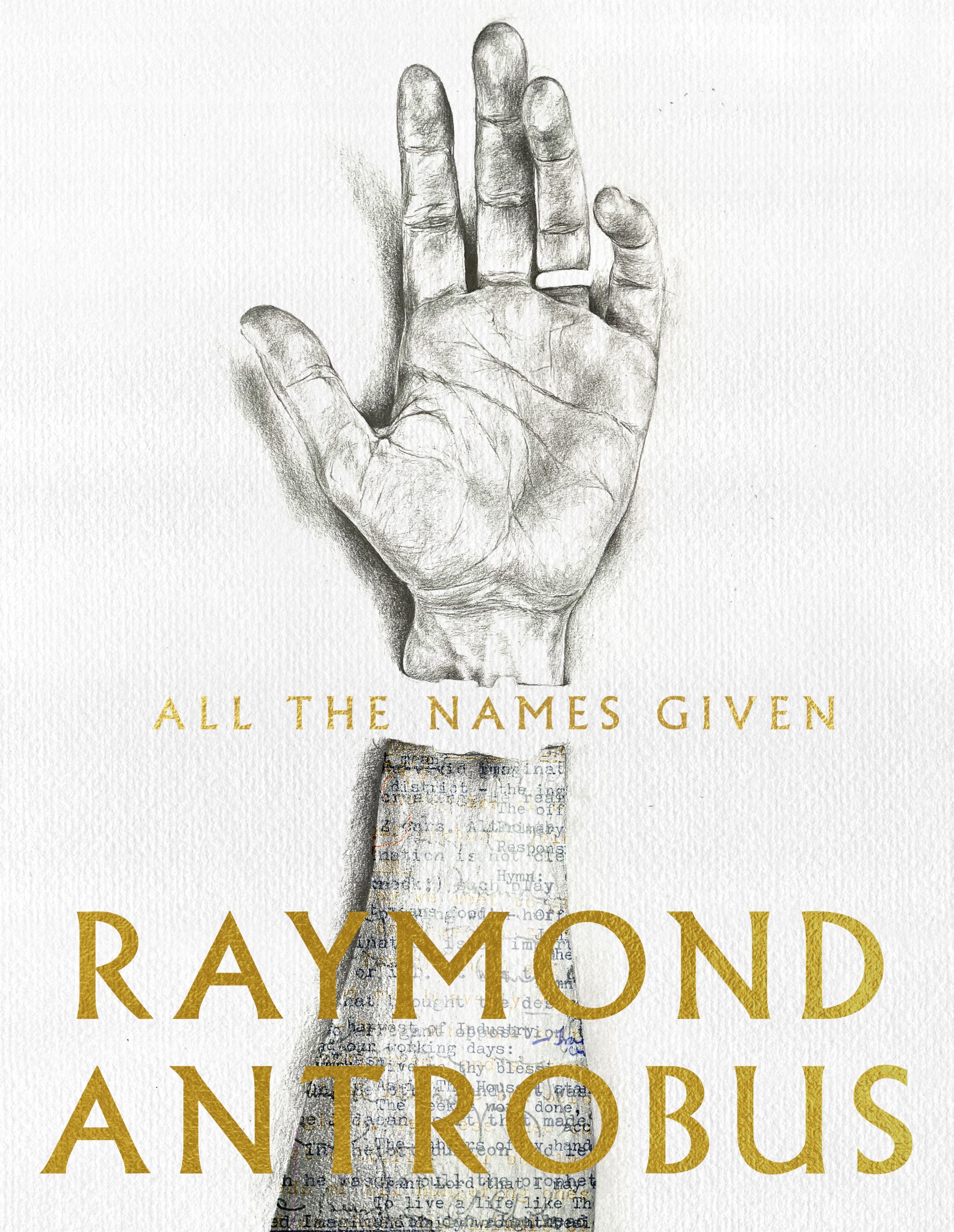
‘The Man Overstanding’ – on Raymond Antrobus’ ‘All The Names Given’

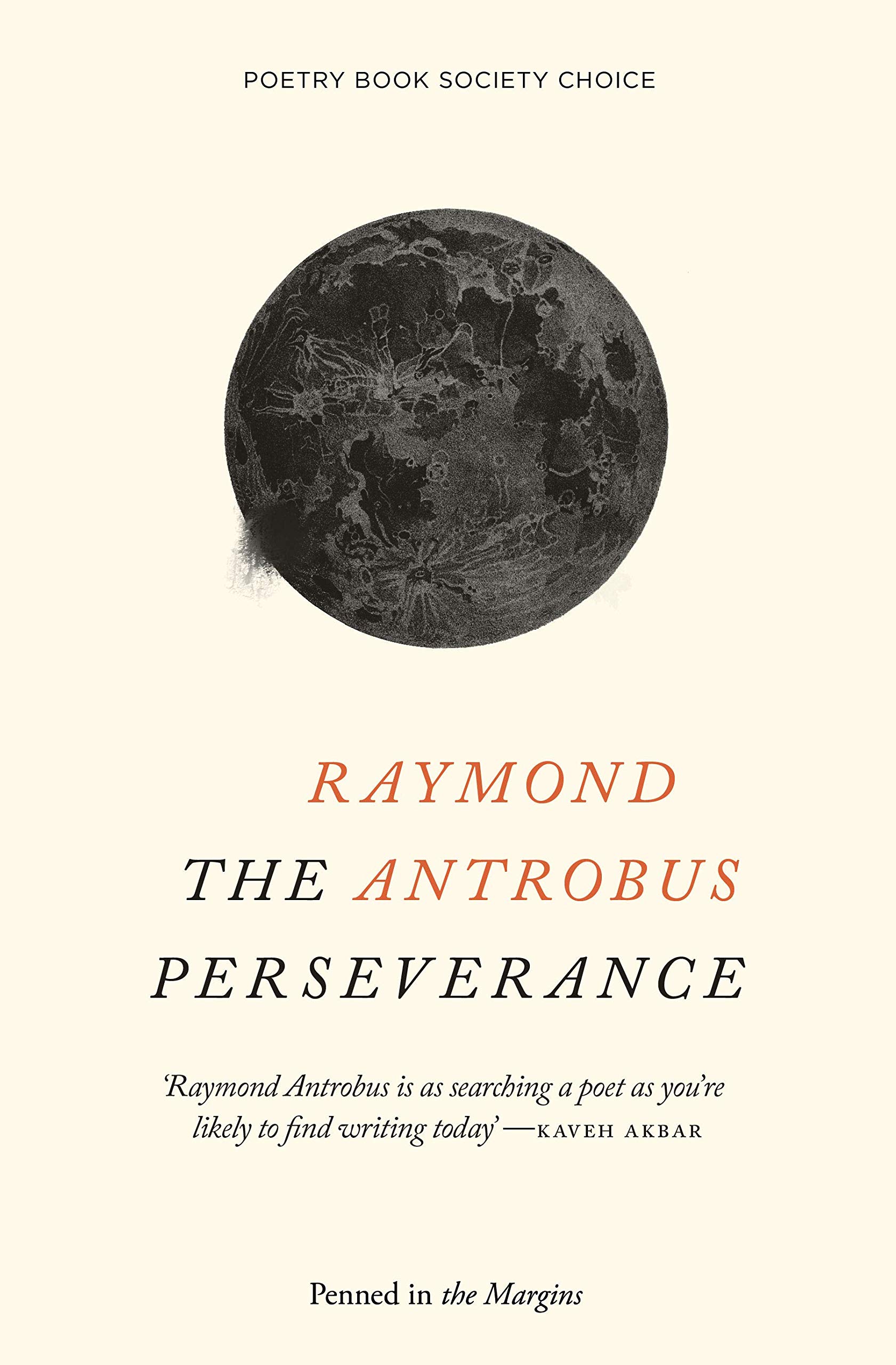
Genuinely acclaimed first books can be hard to follow up. Raymond Antrobus’ The Perseverance (Penned in the Margins, 2018) was a Poetry Book Society Choice and won the Ted Hughes Award and the Rathbone’s Folio Prize in 2019. I reviewed the book that year as one of the five collections shortlisted for the Forward Felix Dennis First Collection Prize. In many ways it was a conventional book of poems – its voice was colloquial, it successfully employed a range of (now) traditional forms (dramatic monologues, prose poem, sestina, ghazal, pantoum), its syntax and punctuation were nothing out of the ordinary. Its subject matter was to a large extent dominated by a son’s difficult relationship with his father, by questions of racial identity and (this is what made it especially distinctive) the experience of a young Deaf man. Besides the latter, what really marked the book out (I argued) was ‘that impossible-to-teach, impossible-to-fake, not especially ultra-modern quality of compassion’. Listen to Raymond Antrobus talking about his first collection here.

Now several years on and literary acclaim, a new publisher (this book is published by Picador Poetry – Penned in the Margins has since sadly ceased operations), a recent marriage and a broadening of perspective (particularly towards the USA) all place Antrobus in a very different environment. He has set aside a lot of the experimentation with recognised forms (which is not to say the new poems do not experiment with poetic form) and the book opens very positively:

Give thanks to the wheels touching tarmac at JFK,

give thanks to the latches, handles, what we squeeze

x

into cabins, the wobbling wings, the arrivals,

departures, the long line at the gates, the nerves held,

x

give thanks to the hand returning the passport [. . .]

In a similar tone, ‘The Acceptance’ concludes with the word ‘Welcome’ being signed. But the 30 lines preceding this hark back to that ‘complicated man’ (a phrase from ‘Dementia’, from The Perseverance), the poet’s father. Though dead for several years now, he continues to haunt his son’s dreams and a number of these new poems. In ‘Every Black Man’, the ‘dark dreadlocked Jamaican father’ meets his prospective, English mother-in-law for the first time. He’s already drunk, there is shouting, he lashes out, she racially insults him: they never meet in the same room again. The father’s ‘heartless sense of humour’ is turned into a slow blues: ‘I think that’s how he handled pain, drink his only tutor’ (‘Heartless Humour Blues’). And the man’s ‘complication’ is reaffirmed in the poem, ‘Arose’, in which, talking to his embarrassed son, the father boasts of the great sex had with the boy’s mother, but then is touchingly remembered, calling out her name: ‘Rose? And he said it like something in him / grew towards the light.’

But All The Names Given also pays more fulsome tribute to Antrobus’ mother. In ‘Her Taste’, despite her conventional, English, religious background, she drops out, joins a circus (literally, I think!), has various relationships, and eventually gets pregnant by Seymour, the ‘complicated man’ from Jamaica, who left her to raise the children. Thirty years on, she’s defiant, independent, ‘holding her head higher at seventy’. We see her leafing through a scrapbook of her past, ‘rolling a spliff on somebody’s balcony’ or again, ‘in church reading Bertrand Russell’s ‘Why I’m Not a Christian’.’ Despite such moments, the maternal portrait does not quite possess the vivid distinctiveness of the paternal one. But, with the benefit of the passing years, Antrobus can now write, ‘On Being A Son’, in which he unreservedly praises Rose in her neediness, her self-sufficiency, her helplessness with IT, her helpfulness in so much else. He concludes, channelling her voice: ‘mother / dyes her hair, / don’t say greying / say sea salt / and cream’.

This greater focus on the mother is partly a redressing of the previous book’s gender imbalance, but it is also at one with Antrobus’ interest in family and heritage as offering clues to his own identity. It turns out the Antrobus name – from his mother’s English side – is anciently English (or far distantly Norse) and associated with Antrobus in Cheshire. ‘Antrobus or Land of Angels’ records a visit (by mother and son) to the place, to face the suspicious looks in The Antrobus Arms, the guard dogs at the Hall:

A farmer appears, asks if we’re descended

from Edmund Antrobus.

x

Sir Edmund Antrobus, (3rd baronet)

slaver, beloved father,

over-seer, owner of plantations

x

in Jamaica, British Guiana and St Kitts.

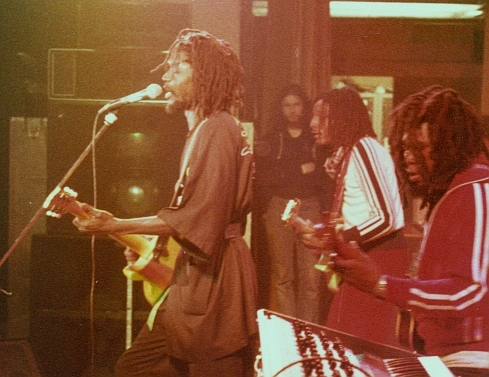
Peter Tosh with Robbie Shakespeare, 1978

The son’s quick denial of the line of descent is a complex moment. Despite carrying the same name, his mother is not truly a descendant. But given His Lordship’s slave-owning history, who is to say whether there is any genetic relation, ironically, through his Jamaican-born father, Seymour. The thought surfaces in ‘Horror Scene as Black English Royal (Captioned)’. Antrobus’ note tells us this poem was sparked by tabloid/CNN speculations in 2019 about the likely ‘blackness’ of the Sussexes’ royal baby. The poem’s narrator looks down at his own hands and sees ‘your great-great-great Grandfather’s owner’s hands’.

Tyrone Givans

So All The Names Given quickly reveals itself to be a book deeply troubled by the kinds of questions raised in the poem ‘Plantation Paint’: ‘Why am I like this? // What am I like? / Who does / it matter to?’ In this second book, Antrobus is still working towards an ‘overstanding’. The idea was alluded to in The Perseverance via a Peter Tosh lyric: ‘love is the man overstanding’. It is a form of understanding that emerges after all untruths have been overcome. The truths, untruths and complications of identity preoccupy the majority of these new poems. Only occasionally does Antrobus set aside such profound (perhaps irresolvable) anxieties. The African/Vietnamese waitress in ‘A Short Speech Written on Receipts’ is a figure who seems to outweigh the poet’s wrangling over his own selfhood, leading him to wonder: ‘Maybe kindness is how / you take down the stalls’. The gates of compassion also open frankly and to great effect in ‘At Every Edge’ and ‘A Paper Shrine’, two brief poems remembering very different students in creative writing classes. Likewise, ‘For Tyrone Givans’, commemorates a young Deaf man (a friend and contemporary of Antrobus) who committed suicide in Pentonville Prison in 2018. Here too, the vector of attention is outwards, towards Tyrone’s mistreatment by the authorities, his suffering and despair, rather than inwards towards the poet’s own ‘complications’:

Tyrone, the last time I saw you alive

I’d dropped my pen

on the staircase

x

didn’t hear it fall but you saw and ran

down to get it, handed it to me

before disappearing, said,

x

you might need this.

This review was originally commisioned and published by The High Window

‘Letter to my Younger Self’ – a third brief Royal Literary Fund talk

As a Royal Literary Fund Fellow based at The British Library in London (though working on-line for the most part), I was asked way back in May 2020 (feels like a different world) to write and record three brief talks. One of these was on ‘Writing and Technology’ which I posted (as text and audio file) on this blog a few months ago. Another commision was to be titled ‘How I Write’ – not an easy subject on which to be clear and succinct but with a little help from WH Auden and Louise Gluck I hope I managed to say something that might be of help to all kinds of writers – poets, novelists and (the target audience of the RLF project) those writing at the varied levels of academe.You can read my blog (and hear me read the essay) here. The third and final essay was an intriguing invitation to write a ‘Letter to My Younger Self’. The recording of that piece has now been released and is available as an audio file on the RLF’s VOX site. You can read the Letter below – or listen to me read it by clicking here – or both at the same time if you’d like. Afterwards I have also posted a poem relevant to that particular biographical moment. An earlier version of this poem first appeared, a long while back, in The London Magazine.

Letter to my Younger Self

Dear Martyn,

You will have just got off the train from London Bridge. It’s 1976. The end of a day studying Medicine which you begin to hate. And now back to Eltham Park, to digs you’ve loathed since you arrived (the well-meaning landlady is no substitute for your mother). Probably you walked past that little music shop somewhere near the station, spending minutes gazing at the red sunburst acoustic guitar in the window. If it doesn’t sound too weird, I can tell you – you’ll buy it and strum on it for 10 years or more. I can also confirm your fear: you fail your first-year exams. The Medical School allows you to leave . . . But listen, that sense of failure and lostness, it will pass.

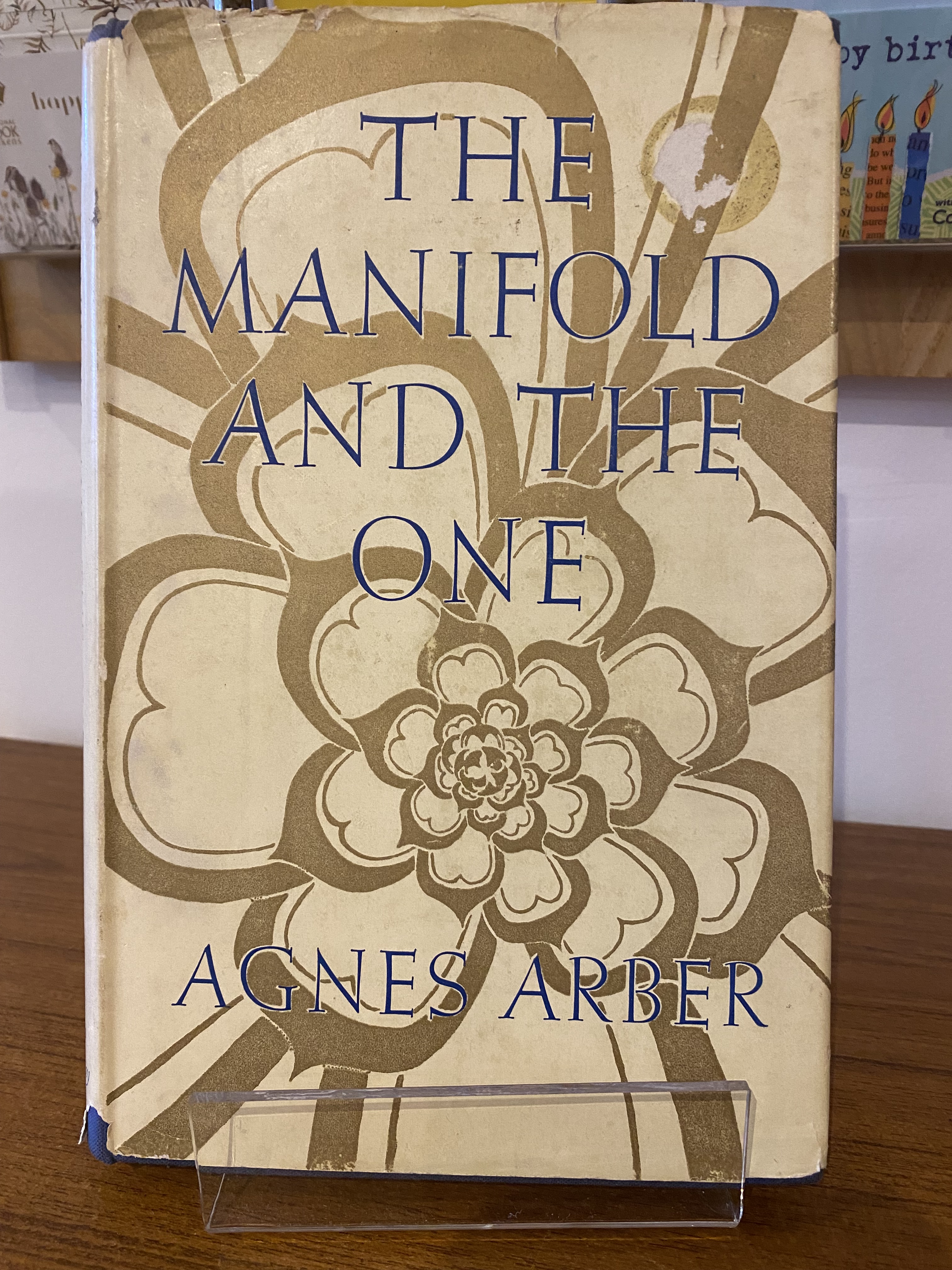
Keep on with the music, though your playing is not up to much and your singing . . . well, the less said. But writing songs will eventually lead somewhere. And the illicit books! You are supposed to be reading the monumental Gray’s Anatomy, textbooks on Pharmacology, Biochemistry, all emptying like sand out of your head. You’ve yet to go into that charity shop and pick up a book called The Manifold and the One by Agnes Arber. You’ll be attracted by the philosophical-sounding title; in your growing unhappiness at Medical School you have a sense of becoming deep. The questions you ask don’t have easy answers. You have a notion this is called philosophy. Amidst the dissections, test tubes and bunsens, you’ll find consolation in Arber’s idea that life is an imperfect struggle of “the awry and the fragmentary”.

And those mawkish song lyrics you are writing? They will become more dense, exchanging singer-songwriting clichés for clichés you clumsily pick up from reading Wordsworth (you love the countryside), Sartre’s Nausea (you know you’re depressed) and Allan Watts’ The Wisdom of Insecurity (you are unsure of who you are). Up ahead, you take a year out to study English A level at an FE College. Your newly chosen philosophy degree gradually morphs into a literature one and with a good dose of Sartrean self-creativity (life being malleable, existence rather than essence) you edit the university’s poetry magazine, write stories, write plays, even act a little (fallen amongst theatricals!).

At some point, the English Romantic writers get a grip on you, taking you to Oxford where you really do conceive of yourself as a poet, get something published, hang out with others who want the same. Then guess what – for a teenager who’d so little to say for himself in class – teaching becomes a way of continuing to study and write while making a living. It suits. It takes us out of ourselves.

Along the way, you write some poems you are proud of. You will suffer the writer’s curse, of course: the recurrent fear of not being able to turn the trick again. But I’m sending you this to say, through all the years ahead, it is words that will infinitely enrich your life. So pick up the pad you doodle on in lectures. Write a line. Write another line. I see you hunched over a dim-lit desk, but no question – yes – you are heading in my direction.

With best wishes,

Martyn

x

How to fail at anatomy

x

This one believed

he maybe had the brains

another that he had

the right demeanour

x

but the Schools denied him

till it was too late

then reprieved him

with the offer of a place

x

that by then he knew

could not be refused

(such anticipation

had struck such roots)

x

so he has no recall

of the moment of choice

before those appalling

digs in Eltham

x

where he had to stow

his dislocated skeleton

under the bed—crammed

one side of his head

x

with tendons muscles

and pharmacol

with biochem and

bright sets of nerves

x

everything spilling out

the other side

into failure—fallen

to wandering streets

x

to stealing Everyman’s

Selected Wordsworth

he was John Stuart Mill

wishing his soul

x

saved though he felt

love etiolating

the girl from home

now a girl from home

x

her kisses like shrugs

at London Bridge

saying go your own way

at least not imposed

x

not merely allowed

and if you want to live

deliberately first

you slit the shroud