More than 10 years of blogging on poetry and translation – over 75,000 views in 2025 – now captured and preserved at the UK Web Archive: 'one of the top 10 poetry blogs' (Rogue Strands)
Just before the Christmas break, I was pleased to be asked by Kathleen McPhilemy to contribute to the January 2023 edition of her on-going series of podcasts, Poetry Worth Hearing.
Kathleen’s own introductory remarks about what the podcast includes are as follows:
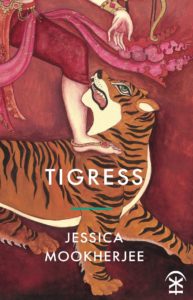
Jessica Mookherjee reading from two recent collections, Tigress and Notes from a Shipwreck (both published by Nine Arches Press), and Martyn Crucefix talking about the poetry he thinks worth reading. We also have new poems from Beth Davyson, Stephen Paul Wren, Pat Winslow, Suzannah Houston and Chris Beckett. To learn more about the poets and the publications mentioned as well as to see the texts of new poems, go to https://www.poetryworthhearing.biz.
You can find the podcast here. Scroll down a little to Episode 11. My discussion starts at around 28 mins in – but do listen to all the contributors.
Helen Kidd
I was especially pleased to hear Pat Winslow’s poem ‘As for the owl’ which carries a dedication to the late, much-missed Helen Kidd. By a strange coincidence, Helen was one of the members of the Old Fire Station Poetry Workshop (led by Tom Rawling by in the 1980s) ) about which I talk in my piece.
I also talk about growing up in rural Wiltshire in a house with few books. My years spent pursuing science – beginning to study medicine at Guys Hospital in London – then my drastic shift to studying Philosophy and English at Lancaster University, where I worked with the Scottish poet, David Craig, on one of the first Creative Writing courses in the UK. At Worcester College, Oxford, in the 1980s I was writing a DPhil thesis on the poet Shelley while also attending poetry workshops with WN Herbert, Peter Forbes, Pauline Stainer, Keith Jebb, Anne Born (and Tom and Helen).
Kathleen also asked me to say something about the poets I go back to and I talk a little (and read from) Walt Whitman, Robert Frost and WS Merwin. Trying to pick contemporary poets to highlight is an impossible task but, on this occasion at least, I speak about Marvin Thompson, Nancy Campbell and John McCullough.
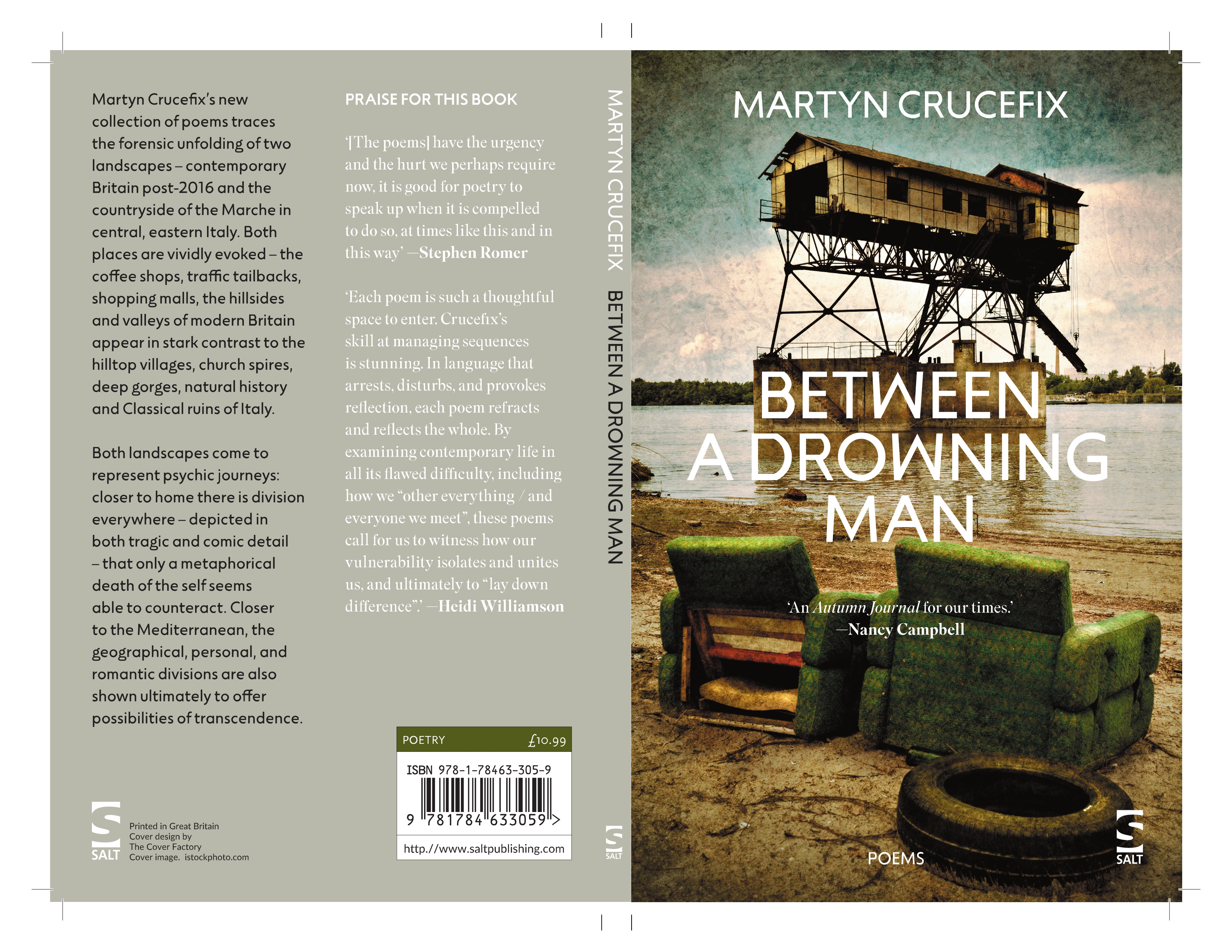
‘An ‘Autumn Journal’ for our times.’ —Nancy Campbell
‘Each poem is such a thoughtful space to enter. Crucefix’s skill at managing sequences is stunning. In language that arrests, disturbs, and provokes reflection, each poem refracts and reflects the whole. By examining contemporary life in all its flawed difficulty, including ‘how we other everything/ and everyone we meet’, these poems call for us to witness how our vulnerability isolates and unites us, and ultimately to ‘lay down difference’. —Heidi Williamson
‘[The poems] have the urgency and the hurt we perhaps require now, it is good for poetry to speak up when it is compelled to do so, at times like this and in this way’ —Stephen Romer
Listen to Martyn discussing the background and the writing of the poems in this new collection in these two podcasts:
BLURB OF THIS BOOK: Martyn Crucefix’s new collection of poems traces the forensic unfolding of two landscapes – contemporary Britain post-2016 and the countryside of the Marche in central, eastern Italy. Both places are vividly evoked – the coffee shops, traffic tailbacks, shopping malls, tourist-dotted hillsides and valleys of modern Britain appear in stark contrast to the hilltop villages, church spires, deep gorges, natural history and Classical ruins of Italy. Both landscapes come to represent psychic journeys: closer to home there is division everywhere – depicted in both tragic and comic detail – that only a metaphorical death of the self seems likely to counteract. Closer to the Mediterranean, the geographical and personal, or romantic, divisions are also shown ultimately to offer possibilities of transcendence.
The poems of the longer sequence, ‘Works and Days’, are startlingly free-wheeling, allusive – brilliantly deploying source materials and inspiration from Hesiod’s original and the 10/12th century Indian vacana poems – all bound together by the repeated refrain of bridges breaking down. The Italian poems, as a crown of sonnets, are more formally controlled, but the repeating of first and last lines of the individual poems likewise serves to suggest the presence of an overarching unity.
In the end, both sequences travel towards death which – while not denying the reality of human mortality, the passage of time – is intended to represent a challenge to the powerful dividing walls between Thee and Me, the liberation of empathetic feeling, even the Daoist erasure of the assumed gulf between self and not-self: ‘these millions of us aspiring to the condition / of ubiquitous dust on the fiery water’.
One of the joys of social media (and there are plenty of aspects of them that are less than joyful) is that occasionally a notification pops up from an unexpected source and when you check it out there is something really worthwhile to be found. This happened the other day – via Instagram. Someone called Matt McGettrick had tagged me. I don’t know Matt, but he is a student on the BA course in TV and Radio Production at the University of Salford.
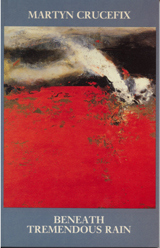
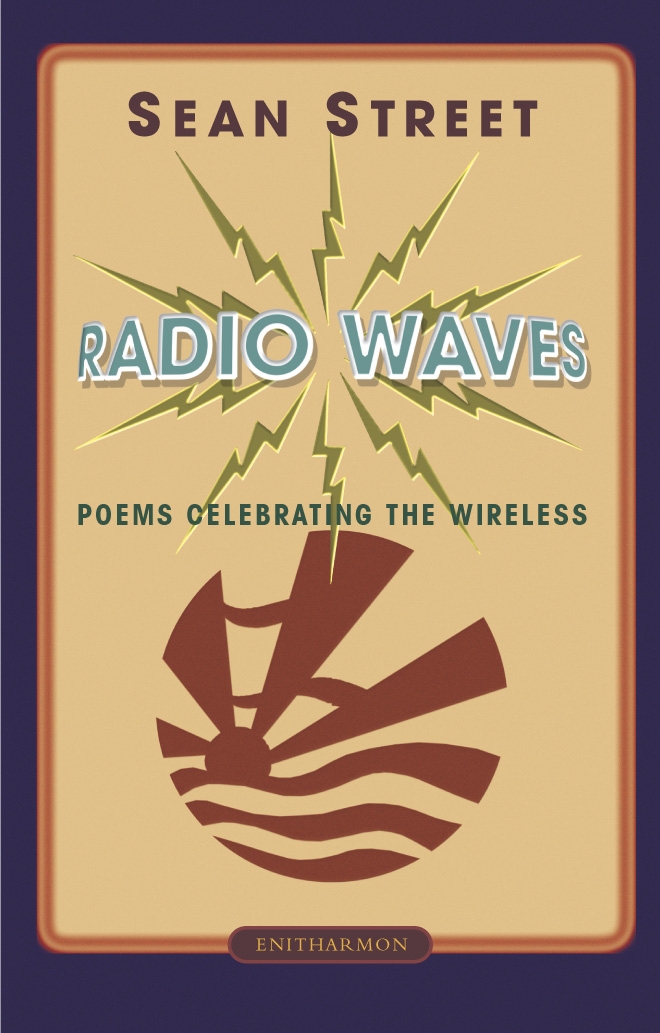
Matt’s instapost said he had recently created a soundscape based on a poem I published in 1990, in my first book from Enitharmon Press, called Beneath Tremendous Rain. It’s unlikely that the poem was found in that book itself, but I remember it was selected more than 10 years later by Sean Street to appear in an anthology called Radio Waves: poems celebrating the wireless (Entharmon, 2004). There, I was happily rubbing shoulders with the likes of Auden, Brecht, MacNeice, Heaney and Carol Ann Duffy. Sean – whose is a poet, broadcaster and recently retired Professor of Radio at Bournemouth University – had divided the anthology up into sections variously titled, Music Radio, Talk Radio, Weather, Listeners and Signals. My piece was in the section called ‘In the Car’.
Here’s that original poem. It’s voiced by a persona – I had no children at this point and had not moved out of the ‘dark’ streets of Manchester to the countryside.
Air-Waves
As I slowed up and shifted downgear,
a dance song thumping from the car radio
was stretched out and smashed to pieces.
x
But we barely noticed that first time –
all eager to see the house, where it stood
beneath the surfing crackle of the pylons.
x
The girls loved the sight of so much sky.
They slipped into new schools with ease
though Sue and I made it home more slowly.
x
And by then, there was Stephen, almost four,
suddenly ill, his rush of growing gone awry,
and the doctor’s face, closed up and dark
x
as the Manchester streets we had left behind.
He could tell me nothing. Inexplicable,
the pattern of disease. A year – maybe two.
x
Driving back across the hills, roadside wires
loop down, are yanked back to the blunted head
of each telegraph pole – and further off,
x
the pylons, hitching up skeins of darkness,
striding up country to a house where this car
and their sheaf of hot wires will converge,
x
where a young man’s voice on the radio
will melt down in a surge of boiling static
as I slow up, shift gear, and stop.
I remember a great deal of concern – this will have been in the late 1980s – about the possible harmful effects of living too close to the electrical fields generated by pylons. There was a particular study in 1979 that did conclude there might be a link between electromagnetic fields and childhood cancer (and this is the kind of scenario I am thinking of in the poem). However, other studies in the 2000s did not find an association or found an association only in homes with very high levels of magnetic forces, which is rare, according to the National Cancer Institute.
There was a personal connection, I remember, as my in-laws lived in a house which nestled in beneath a line of high voltage cables and pylons. But perhaps concerns about cancer-inducing lines of pylons have now gone the way of those early concerns about the dangers of mobile phones. Or has it even been consigned to the slightly cranky end of health concerns along with those people who sabotage 5G masts in the name of suspected links to the on-going pandemic? Even so, though it has dated a little, I’d like to think of the poem as one of my earliest expressions of environmental concern: if the electromagnetic fields do turn out to be perfectly safe, they are here acting as a metaphor for the kind of degradation of the lived-in environment caused by human action for which there is an indisputable and growing body of evidence.
Anyway – all this is simply by way of introducing Matt McGettrick’s excellent piece of work. The reader is Matthew Green. As the author of the original piece, it seems to me that both reading and soundscape engineering do a really fine job of responding sensitively to the text’s meaning, its structure and its rhythms. Have a listen – Matt suggests headphones are a good way to hear his work. It’s just over 5 minutes long.
I have been invited to give a 10 minute reading – on Zoom – this coming Friday 25th November @ 1pm alongside Hilary Watson and Sudeep Sen. The event is free to all but you will need to register for a ‘ticket’ (and Zoom link) here. I hope you can make it.
Details about the other two readers are as follows:
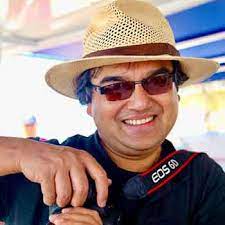
Poet, translator, artist, and editor Sudeep Sen studied English literature at the University of Delhi and was an Inlaks Scholar at Columbia University. Sen has published more than a dozen collections of poetry, including The Lunar Visitations (1990), Postmarked India: New and Selected Poems (1997), Lines of Desire (2000), Distracted Geographies (2003), Rain (2005), and Aria (2011), winner of the A.K. Ramanujan Translation Award. Two volumes of new and selected poems and translations were published as Fractals: New & Selected Poems | Translations 1978-2013 (2013) and Fractals: New & Selected Poems | Translations 1980-2015 (2015). Recent collections of poetry include Incarnat | Incarnadine (2017) and, with Setsuko Klossowska de Rola and Homa Arzhangi, Path to Inspiration (2017). The Government of India Ministry of Culture’s awarded him the senior fellowship for “outstanding persons in the field of culture.” Sen divides his time between New Delhi, London, and New York.
Hilary Watson grew up in and around Cardiff. She graduated from the University of Warwick Writers’ Programme with a BA in English Literature and Creative Writing and an MA in Writing. She was a Jerwood/Arvon Mentee 2015/16 with mentor Caroline Bird alongside fellow poets Rachel Long and Emma Simon. She was shortlisted for the Troubadour International Poetry Prize 2019 and the Live Canon Prize in 2015, and has recently been published in a number of UK and Irish magazine such as the Butcher’s Dog, Interpreter’s House, and Impossible Archetype. She works in the third sector and is currently writing her first collection.
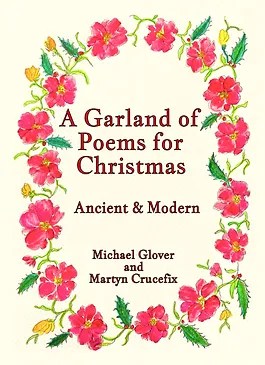
I have not quite finalised what I will be reading but probably a couple of poems from my last full collection, The Lovely Disciplines and some more recent poems. No doubt I will plug the recent Christmas poetry anthology that I have co-edited with Michael Glover – also plugged in a recent blog post here. You might be interested to hear that we are planning a London launch for the anthology on Sunday December 4th @ 7pm at the Omnibus Theatre in Clapham. More details (and booking) can be found here. Readers will include Rowan Williams, Nancy Campbell, Hilary Davies and Denise Saul – and there will be plenty of music of a festive variety too.
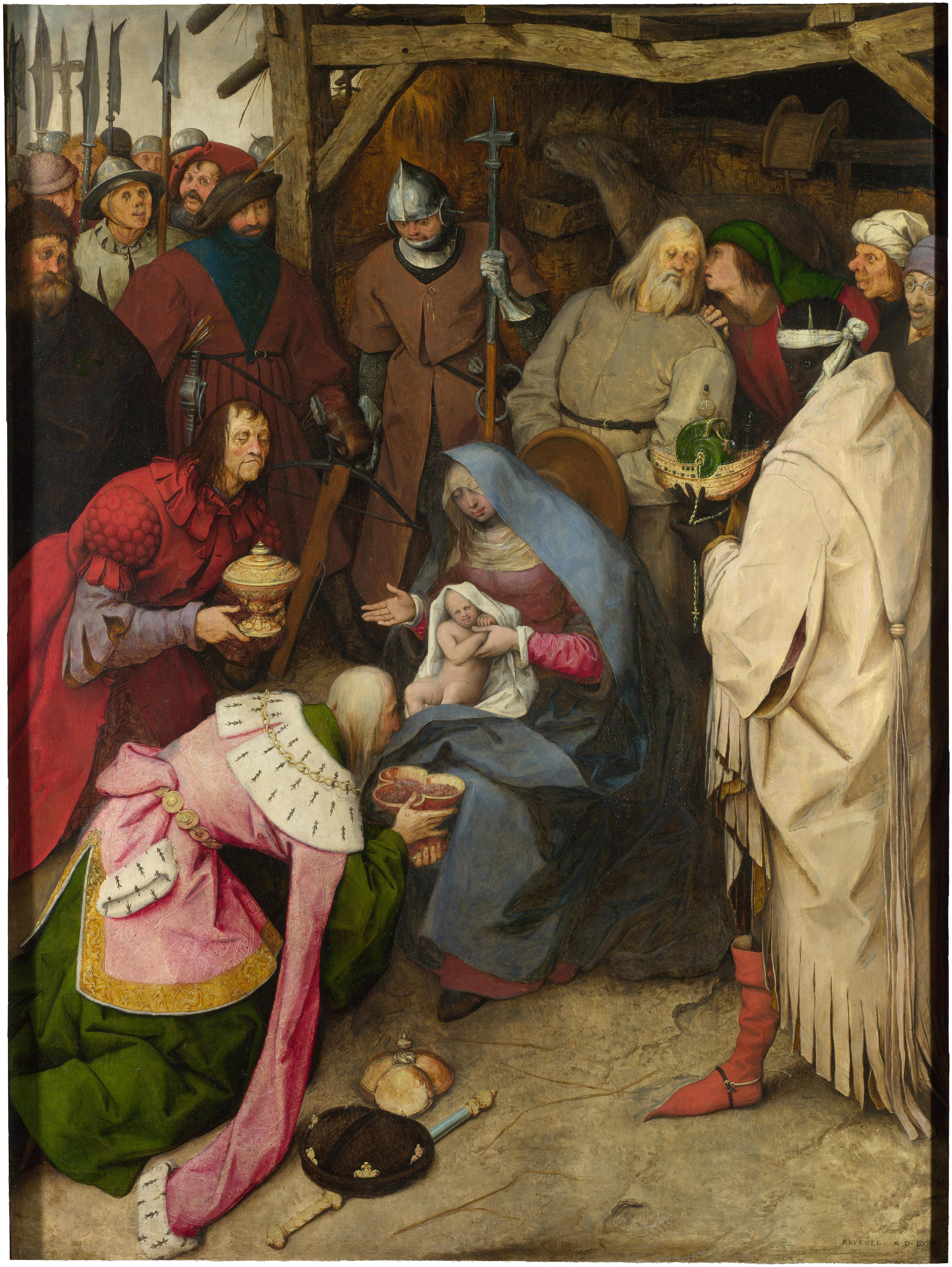
If I have time in the Live Canon reading, I’ll read this poem included in the Christmas anthology which I wrote in repsonse to Breughel’s fascinating painting of the same name (see above). It might be worth knowing that I imagine the voice of the poem to be that of the (blind? short-sighted?) man in the upper right corner of the image. He’s the one wearing the large blue-tinted spectacles:
Perhaps it was in response to – really I mean a way of avoiding – the Tory party leadership campaign over the long hot summer of 2022 (and look how that turned out – and then again turned out…) that Michael Glover and I spent much of our time reading for, researching, inviting and selecting poems for a brand new poetry anthology with a focus on Christmas and the winter solstice. I know this is a bit obvious but – hey! – this might well be the solution to your up-coming Christmas gift buying deliberations – elegant, stimulating, moving, clever and very easy to wrap. That’s this new anthology. What’s not to like?
In fact, it was Michael’s original, bright idea and I was delighted to be asked to collaborate with him. It is the first anthology I have had a hand in editing and the book, in its final form, has two main sections – his bit and mine.
I found it daunting at first – where do you begin? Well, I don’t think I’m giving away any anthology-making secrets by mentioning that this Christmas collection is not the first on the market. I had a couple on my shelves already and the internet provides ready-made selections of possibilities and then less familiar collections like Enitharmon’s excellent Light Unlocked: Christmas Card Poems, eds. Kevin Crossley-Holland & Lawrence Sail (Enitharmon Press, 2005) and the rich seams of Seren’s Christmas in Wales, ed. Dewi Lewis (Seren Books, 1997) provoked thoughts and – with due acknowledgement – suggested some definite items. It was exciting when other contemporary poets were kind enough to agree to offer as yet unpublished work for the anthology – my thanks to Neil Curry, John Greening, Jeremy Hooker, Denise Saul, Joan Michelson, Penelope Shuttle and Marvin Thompson.
Penny Shuttle
For my own part, I pondered aspects of the ‘Christmas’ experience and came up with four loose categories: Mother and Child, Hearth and Home, Far and Near, Light and Sound.
Mother and Child was a fairly obvious place to start, and I was pleased to discover the 15th century poem ‘I syng of a mayden’ with its traditional take on the Nativity but its archaic and hence distanced and defamiliarized language. In contrast, Kevin Crossley-Holland’s plainly beautiful poem, ‘The Heart-in-Waiting’, revises the nativity story into more figurative terms for a contemporary audience: Christ is destined to be born into the human ‘heart-in-waiting’. WB Yeats’ take on the birth of Christ sees it from a quite different point of view: the pregnant mother’s sense of a divine love that ‘strikes a sudden chill into my bones / And bids my hair stand up’
The thought of Hearth and Home, around the time of the winter solstice, was probably a more personal choice, partly a recollection of my own childhood but also of later Christmases with my own two children. In both cases I am lucky enough for these to be happy memories though this section is perhaps also about the great weight of expectation of happiness that the season brings with it. My own background is in West Country – people claim to still hear my old Wiltshire accent sometimes – so William Barnes’ boisterous ‘Chris’mas Invitation’ was a great find:
An’ ev’ry woone shall tell his teale,
An’ ev’ry woone shall zing his zong,
An’ ev’ry woone wull drink his eale
To love an’ frien’ship all night long.
Marvin Thompson
To follow this with Thomas Hardy’s more melancholic ‘The House of Hospitalities’ seemed right – with the latter’s reminiscing of warm logs on the fire, the food and songs of Christmas past, though now (this is Hardy after all) these are little more than ‘forms of old time’. I was very pleased to be able to include Joan Michelson’s touching evocation of Christmas under the 2020 Covid lockdown and Marvin Thompson’s densely allusive poem, ‘That’s the Art Deco Odeon on London’s Holloway Road’ neatly updates the memories of those of us of a certain background and vintage of watching Morecombe and Wise at Christmas with his more recent remembering of the family laughing at Lenny Henry’s character, Deakus.
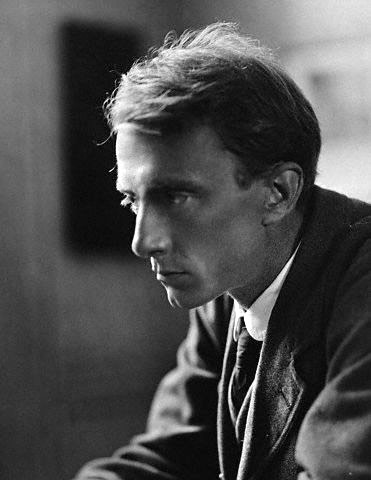
Edward Thomas
The cluster of poems around Far and Near probably sprung out of the previous section – those expectations of the season are not fulfilled for all – loved ones, the rosy-cheeked messages of the time of year or indeed happiness itself may remain at a distance. So Edward Thomas’ gypsy plays ‘Over the hills and far away’ in a darkly troubling and less than traditionally Christian style, as something more ancient, ‘a rascally Bacchanal dance’. Kate Bingham’s, ‘Cento’, cleverly re-deploys phrases so familiar from Christmas hymns and songs and manages to be both questioningly ironic and touchingly empathetic. Beyond the tired commercial and religious cliches, the darkest time of the year, its turning point, makes us think of past and present, but also about other modes of being. Jeremy Hooker’s new poem sequence praises and reflects on the season’s natural world, the blackbird and owl, the snow falling and ‘bringing up / deeper silence / from some place one dreamed of / that was always there’
Francis Kilvert
The carolling, the candles, the Christmas tree lights: the grouping of Light and Sound also seemed to be very appropriate. Everybody, I’m sure, will feel the shock of recognition in John Mole’s brilliant poem about digging out the old Christmas tree lights from last year’s box of decorations: ‘dear tangled friends / With your plaited emerald flex / And familiar chime of chip-chink / Tumbling over my wrist’. The dancing, visionary lights described by the old Wiltshire man, John Bryant (huddled in his bed against the cold ‘like a marmot in its nest’), in a diary entry of 1874 by Francis Kilvert, are, he believes, the souls of ‘just men’. These ‘rhymed’ for me with the chilly stars in Nancy Campbell’s enigmatic new piece, ‘Lights’ as a desire, felt by some people, perhaps more of us in the depths of midwinter, ‘to lose themselves in beauty’. And what better way to end than with Tennyson’s poem from In Memoriam: having fought through grief and loss to come to some more noisily belling, optimistic, celebratory vision for the coming new year:
As a Royal Literary Fund Fellow, I was asked in May 2020 to write and record three brief talks. One of these was on ‘Writing and Technology’ which I posted (as text and audio file) on this blog a few weeks ago. Another commision was to respond to the intriguing invitation to write a ‘Letter to My Younger Self’. The recording of that piece is still in the RLF pipeline, but the third of these short pieces has now been made available as an audio file on the RLF’s VOX site. The given topic of this newly published piece is ‘How I Write’ – not an easy subject on which to be clear and succinct but with a little help from WH Auden and Louise Gluck I hope I have said something here that might be of help to all kinds of writers – poets, novelists and (the target audience of the RLF project) those writing at the varied levels of academe.
Alternatively – or both at the same time if you’d like – you can read it below.
How I Write
Always I have to commit something to paper as soon as possible after the initial inkling of a poem. Most writers use notebooks. Some use audio recorders, others their phones. Though first drafts are always terrible, what I’m doing is laying a path back towards the first emotional impulse, a way for myself to return there. You’ll often find me re-reading notebooks to pick up such trails among barely readable, fragmentary scribbles.
These scraps are what may develop into poems. I like W. H. Auden’s view of the poem as a “verbal contraption”. It reminds me a poem (actually, any piece of writing you are doing) is a purposeful device. It needs to be an effective device and poems look to impact a reader’s feelings. This view downplays one of the commonest stumbling blocks about creative writing, which is that what poets try to do is express their own inner moods. If that’s all I focus on, I’ll pay too little attention to the writing’s receiver, my reader.
Anyway, what I want ‘to express’ is seldom fixed at this stage. It’s important I’m willing to add on – simply write more connected material – even beyond the point at which I might think the job done. That tempting voice claiming early completion may be a lazy demon or a censoring one. It’s my practice at this stage to draft loosely, with as much energy and freedom as possible. If I watch children playing, I see them enjoying an excess of energy, movement, voice, and it’s out of this that real creativity arises – new moves, ideas, developments, reformed, revised, played again, played better. So in writing, spinning off new phrases or metaphors leads not only to decorative grace-notes but often to the still-hidden, true heart of the poem. This is why poets often talk of writing as a process of discovery.
For me, most of these stages still take place using pen and paper. The shift to a screen, a keyboard remains a critical transition. On screen, or on a phone, typed lines acquire an inertial resistance to being changed. On screen, I find my eye starts to narrow down to look at the poem’s physical shape and appearance on a would-be page. Such aspects are important in the long run, but they can prematurely cool the fluidity of the molten drafting process if they dominate too early. Beware the linearity of the screen!
But once it’s there, now I’m thinking ‘economy’. A linguistic cosmetic surgeon, I cut off verbal flab, repetition, redundancy. Crossing out is my most familiar activity. The American poet, Louise Gluck, says that a writer’s only real exercise of will “is negative: we have toward what we write the power of veto”. One of the keys to this is reading aloud. I go the whole hog: standing as if to deliver to an audience. Loud. And. Clear. This helps me listen to rhythm and line breaks. Actually, for any writer of poetry, prose, essays for your course, reading aloud highlights stumbling blocks of all kinds. My sense of the ebb and flow of a poem is always clarified because I distract myself in the physical act of standing and speaking. I experience my words more objectively, more as my potential reader would. Try it. It’s a revelation!
As a Royal Literary Fund Fellow, I was asked in May 2020 to write and record three brief talks. One of these was a ‘Letter to My Younger Self’ and another piece was entitled ‘How I Write’. These two recordings are still in the RLF pipeline, but the third of these has now been made available as an audio file on the RLF’s VOX site. The given topic of this published piece is ‘The Writer and Technology’ – a subject about which I have some experience in relation to the former and not a huge competence in relation to the latter. Nevertheless, I’m not one to duck a challenge.
Alternatively – or both at the same time if you’d like – you can read it below.
Writing and Technology
It frightens me: she gives with one hand and takes away with the other. I become too monogamous. I don’t look up. I google recipes using oregano or the name of the drummer in Coltrane’s 1960s quartet. I love her library of reference all within clicking distance. I email friends, family, writers, publishers (I remember stamps and letterboxes with no fondness). Zoom, Microsoft Teams, FaceTime make it a breeze to stay in touch, offer advice, give poetry readings to people around the globe. I’m never lost; I use Google maps. I post and follow on Twitter, Instagram, FaceBook. All this she gives me.
And most days I crave her distractions, her sensational sweep of sights and sounds, her informational vistas at the swipe or dab of a fingertip. I substitute longer, slower satisfactions with a preference for her novelties. Though I’ve read about how our cultural (and fiscal) economies promote such transitory stabs at contentment in the absence of other satisfactions, still – I can seldom resist. I do glimpse vicious cycles – her short-lived pleasures liable to collapse, disappointing anticipation – yet I play her perfect subject, eyes flicking without rest from screen to screen. I do not look up. Her multitudinousness spawns my passive respect for numbers, speed, spectacle, calculation, all of which barely disguises the non-event. I attend with others – but spend as much time watching a screen as the performance. I still tell my friends: I was there, it was huge, so many people . . .
She makes me fear something’s missing. Addicted to her click bait, I love her machines in their elegant black and silver. They seem to promise to breach the ancient laws of time and space. Yet having acquired the newest devices with which I calculate, communicate, translate, find millions of pages of information, actually, I can’t remember what it was I hoped to do with them.
Sometimes I remember. What she interrupts – with her shows of pleasure, power, riches, praise – is the creative impulse to look up, observe (look out!). Once this ceases – prophetically, the poet Shelley said this back in 1821 – new imagery stops being generated, language withers and dies. Only in my relations with the world (not with her) am I truly warmed. Then I’m the matrix through which the world steps – as the world becomes the matrix through which I step – to rediscover myself not ‘me’ (an atom in an empty universe), but ‘mine’ (living in relation to others, other things).
When I leave her, often there’s the startling beauty or strangeness of scenes that draw me away from my ‘self’. Perhaps for a moment, I’m lost for words. It’s not enough to take a picture, post it up, surround it with talk, comments, likes, shares. Poetry expresses such sensations as record, reminder, model and vicarious experience for its readers. Using form, figurative and musical language, I write to re-present such ineffable, inexpressible moments. The French poet and philosopher, Yves Bonnefoy, says: poetry is not about something but it restores the self to the lucid intensity of the truth of relational experiences.
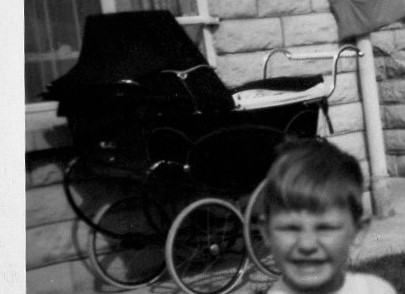
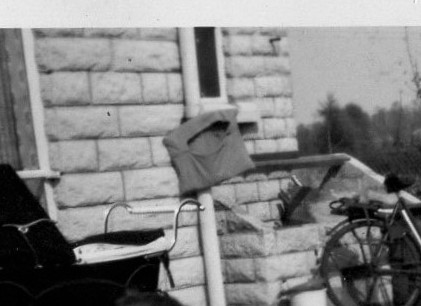
On any criteria, it is a poor photograph. The primary subject – the three young boys in the foreground – are out of focus. The youngest one’s head is just too low for the dated camera’s pre-set focus to find it. Instead, there in the background, but far more sharply defined, is a woman’s bicycle, the chain ring and two slanting elements of the metal frame reflecting the sun brightly. I know the orientation of this house. If the sun is falling this way, the time must be nearing mid-afternoon, the sun is falling on the garden and over back of the house, over the photographer’s right shoulder, into the eyes of the children, each of whom is squinting slightly. Look beneath the large pram under the window, to the left: the shadows of its four spoked wheels and their pale tyres confirm the angle. The black bulk of the pram and the mass of shadow behind and beneath it almost take over the image. It too is in sharper focus than the children.
Roland Barthes’ Camera Lucida suggests our viewing of a photographic image has two aspects. What he termed the studium is associated with any viewer’s knowledge and cultural experience, with a body of information and a general interest: ‘a very wide field of unconcerned desire, of various interest, of inconsequential taste’ (tr. Richard Howard, Vintage Books). It is a mere question of liking, not liking. Here, the studium of the image is open to anyone with a decent knowledge of England in the mid-20th century. The corner of a recently built house (the garden as yet untended, only wire fencing between this and the next house on what looks like a raw housing estate) and the style of bicycle and pram, the clothes the three boys are wearing (what look like home-knitted jumpers – the youngest wrapped up with a knitted hat, buttoning under the chin – so the weather is not warm) are all suggestive of the late 1950s or early 1960s. The youngest boy is also sat in a toy pedal vehicle – the long-nosed bonnet indicative of a racing car – the sun’s angle perhaps catching brightly again what might be headlights at the very bottom of the image.
The outline of this lawn in the back garden remained unchanged throughout my childhood. Its corner – in the image, its apex – falls neatly behind the youngest boy’s head. Perhaps there is some composition here? I’d guess it was my father pressing the white button on the black plastic box of a Kodak camera. Taking such a picture was more the father’s job in those days. His clumsiness in framing the image ought not to be judged too harshly (these were still relatively early days for mass photography) but it stirs in me the thought that he was always a man more at home with objects than words or people. I wish he’d taken the picture again, a little lower, filling the chosen frame with his three children. Forty years later, setting the scene behind the large window in the image, sat around the dining table that (for fully 50 years) looked out onto the back garden, I wrote of him when forgetfulness and confusion troubled him more and more:
Past ninety and still no books to read
your knuckles rap the laid table
x
gestures beside a stumble of words
so much aware of their inadequacy
x
it hurts us both in different ways
since a man without language is no man
x
finding too late the absence of words
builds a prison you’re no longer able
x
to dominate objects as once you did
the world turns in your loosening grip
So, it may be the general studium of this image stirs some mild interest in you – the period, the clothes, the main objects a little like museum pieces. Barthes’ second element in a viewer’s response to a photo, he termed the punctum, some detail (usually only one) that pierces the viewer, that wounds us, a powerful emotional response. The punctum is often not intended by the photographer – some random detail that for a particular viewer has a disproportionate and very personal impact. It is what moves us.
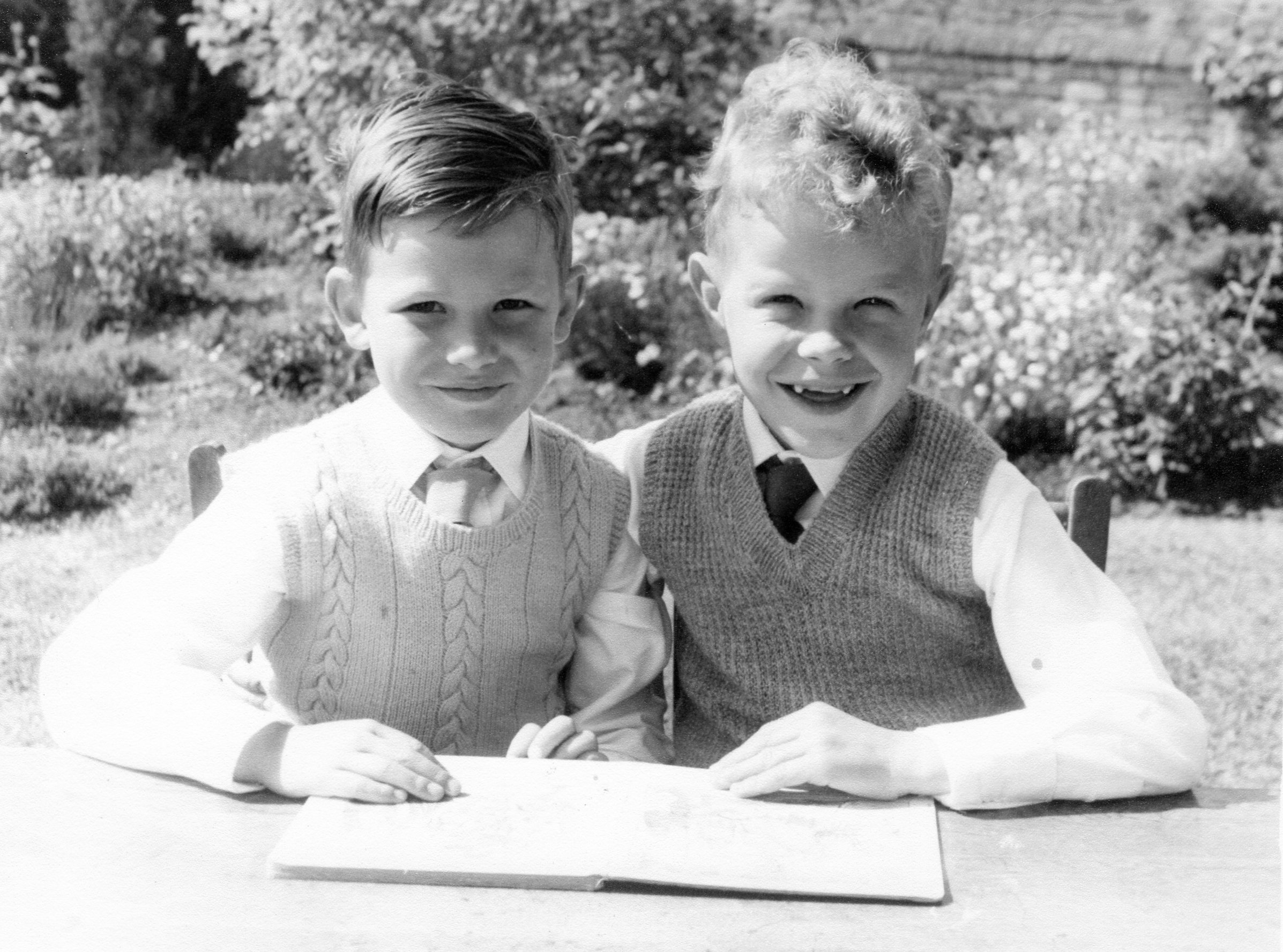
MC and older brother, looking smart for infants school
The fact that this is an image from my own past means there are a number of candidates here for a punctum. Most likely surely is the face of the boy on the left. Under a thick head of hair, a rough-cut fringe, he squints more than the others. His eyes cannot be seen, hidden away in the dark slits beneath the eyebrows. The firm lines on his face slant down from nose to half-opened mouth in a grin that lifts his cheekbones, that might even be the shaping of a word. The long vowel in the word ‘cheese’ perhaps? A version of that face greets me in the mirror even now. In these infant and junior years, my jumpers were knitted by my mother. I seem to be wearing a girlish collar beneath. My right hand is lost beyond the lower edge of the image. My right rests on the racing car, not quite clasping my younger brother’s hand which looks set back a little on the edge of the car. I am the middle child. My younger brother must be little more than a year or two old (born in 1959). My older brother is the one full of animation: right arm around the car, around his little brother, he seems to be exploding into a fit of giggles. But oddly, none of these details quite wounds me…
The bicycle? My mother’s of course. A large wicker basket on the front. Look closely and there on the back is the folding child’s seat I remember sitting in as she pedaled the 2 or 3 miles into town. The vast contraption of the black pram? I don’t have memories of it – even of my brother in it. It remains part of the studium – I remember later discussions about the way pram and child would be left outside for hours on end (sometimes in the front garden of the house where the sun’s absence kept it cool in summer). I think a general thought: such a thing would never be countenanced these days. Even far older children are seldom let out of their parents’ sight.
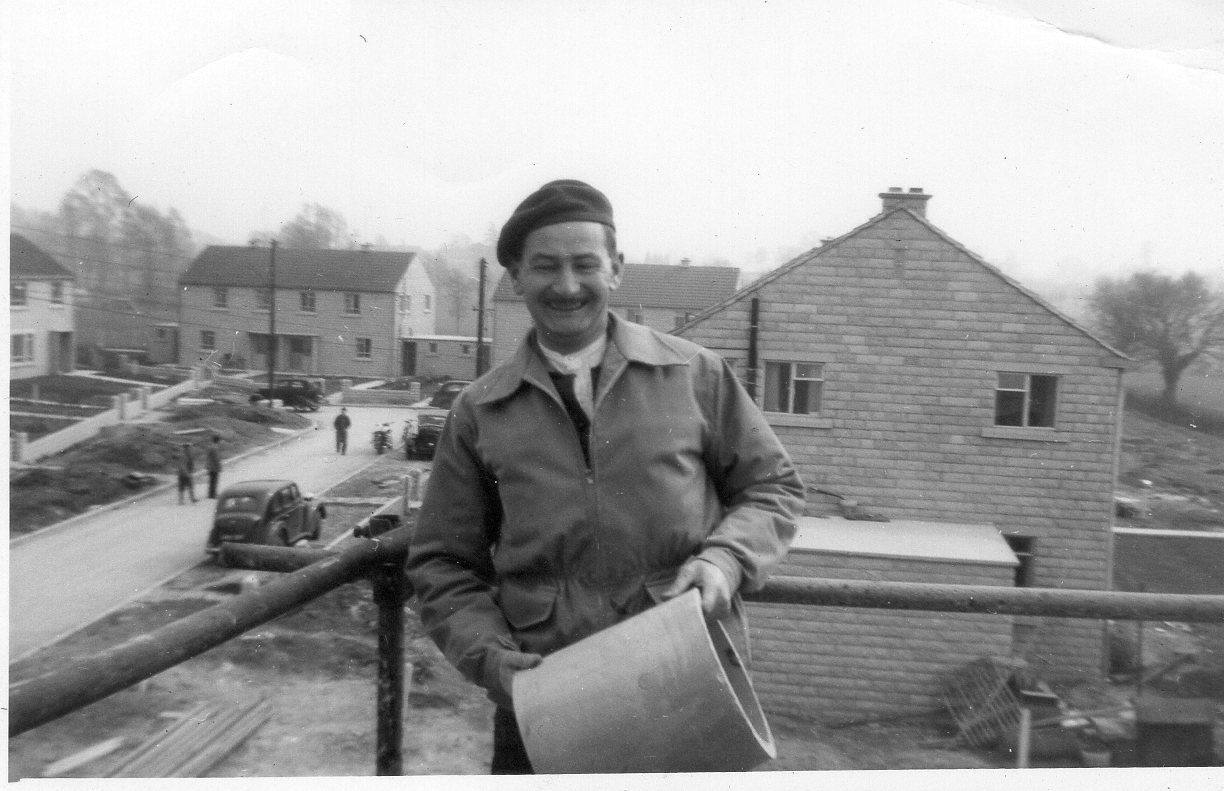
My father helps build one of the estate houses
The house itself? A little tugging of nostalgia here (we eventually sold the house after my parents’ deaths just a few years ago) but mostly I sense information welling up. An estate of 40 such houses on the edge of a Wiltshire town. One of the first ever post-war self-build projects – the 40 men built them with their own hands over 3-4 years in the mid- to late-50s. I have other photos of the house being built. Each dwelling had a little outhouse (ours is middle top of the image; next door’s filling the top right corner). There’s a non-standard coal bunker: it’s what Mum’s bike is propped against. If I remember rightly my paternal grandfather helped build it. I have a vague physical memory of being held by him (over the bunker?). Nothing more, since he died suddenly, I think, before this image was taken.
Oddly – and this is in the nature of the Barthsian punctum – the detail that has particular poignancy (like a dagger, Barthes says) is the shapeless peg bag hanging (where it always hung, it hung there forever) on the bracket attaching the guttering downpipe to the wall. The camera simply records what lies before it. After 100 pages of discussion, Barthes arrives at, what even he confesses is, a less-than-earth-shattering conclusion that a photo’s potency lies in its declaration of ‘this-has-been’, its evidential power. Yet it’s also the case that an image’s power can be contained in what is absent from it or is implied by small details within it. I am pierced by the peg bag because it represents (more than that – it is, it manifests, the touch of) my mother. The only member of the family nowhere here (neither behind nor in front of the lens), she is there in her bicycle, there in the pram (possibly there in the waste bin beside the coal bunker – has it just been washed out? there is a darkening patch of water running on the path?). But most of all in the peg bag. Almost certainly she made it herself. A coat hanger. A few lengths of spare cloth. Some wooden pegs. The washing line ran down the length of the back garden path. There was a long wooden prop with a V cut in the top. In a very early poem, I would see her ‘struggling / to peg out snapping shirtfuls of wind’.
My mother in the 1950s
In Susan Sontag’s On Photography, she writes ‘[w]hen we are afraid, we shoot’. She means when we fear losing what-is-here we preserve it in the museum of the recorded image. Did my father fear losing this moment? He preserved it badly. But he managed to preserve the children (though the ones in this image are now passed on into something quite other; Barthes would say they have died). Nowadays, a father would turn his camera and include himself in it too. What does that say about fear? The peg bag would still be hanging there though. In the image. On my desk here. Scanned to the screen. In my mind, the peg bag continues to hang in its place on the downpipe though other people’s children play on the lawn, other parents sit gazing out of (what we always called) the dining room’s picture window.
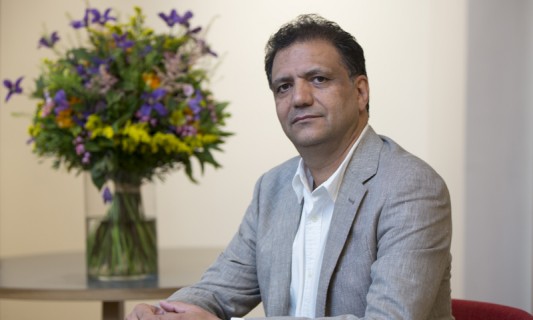
‘I always write that which is not’ says one of Alireza Abiz’s poems, because ‘[t]hat which is is too terrifying / to wear the garment of the word’. To understand what Abiz means here – how can / why should a poet avoid writing of what is real? – we have to understand his historical and political contexts.
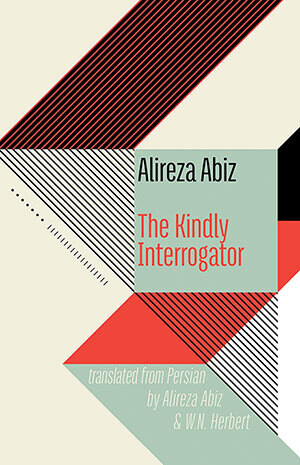
Abiz belongs to the 1990s generation of Iranian writers. The unattributed Introduction to The Kindly Interrogator (Shearsman Books, 2021) provides help for those of us who don’t know much about the development of modern Iranian poetry. It was Nima Yushij who, at the opening of the twentieth century, felt the then-current forms of Persian poetry had become too abstract, subjective and metaphysical. He advocated a more modern, objective approach, a more natural diction and the use of forms closer to what we would regard as blank verse. By the 1960s such freshness and freedom had yielded some of the best modern Persian poets, writing diversely, mostly in free verse. But both before and after the 1979 Revolution (which replaced a millennia old monarchical system with the Islamic Republic), poets continued to engage in political struggles and were often prosecuted by the authorities for their writings. Following 1979, and during the 8 years of war with Iraq, the artistic atmosphere continued to be both difficult and repressive.
The political reforms of the 1990s – Abiz’s period – saw a new optimism and revival in the arts, yet still prosecution and censorship remained a fact of life. Many artists left Iran and – especially after the 2009 uprising – there was a considerable migration into exile. Though currently resident in the UK (he lives in London and has a Creative Writing doctorate from Newcastle University) Abiz does not consider himself an exile as such, though inevitably his perspective has an ex patria quality, looking both dispassionately at Iran’s nature and continuing development, as well as harking back to an affective homeland.
Alireza Abiz
In these translations by the author and WN Herbert, Abiz’s free verse poems are not always reluctant to address realities, but they do tend to deploy (what the Introduction calls) a kind of ‘dialled-down or even buttoned up surrealism’. ‘The Tired Soldier’ is brief and universal. His weariness is symptomatic of a lengthy war, as well as his disillusionment with it. Jackals wail, bugles “cough” like roosters – the real and figurative creatures here close to anthropomorphic portraits of societal/political elements, close to the derangement of the surreal which is also signaled in the soldier’s action which (besides the obvious disrespect for his military service) involves an overturning, a literal inversion (feet to head, head to feet) of the norm:
The tired soldier
hangs his boots around his neck
and pisses in his helmet.
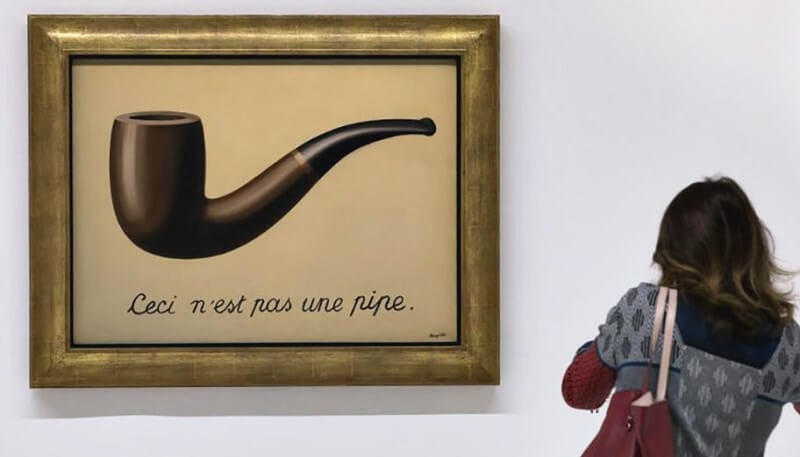
The surreal is inevitably emergent when we cease to trust our senses, or our interpretation of what we think we witness (think of Rene Magritte’s Ceci n’est pas une pipe). A black cat watches the narrator from the veranda. Given a political context in which persecution (even elimination) has become common currency, the narrator seems to fear for his own life:
It’s been a long time since I was a sparrow,
since I was a dove,
even since I was a backyard hen.
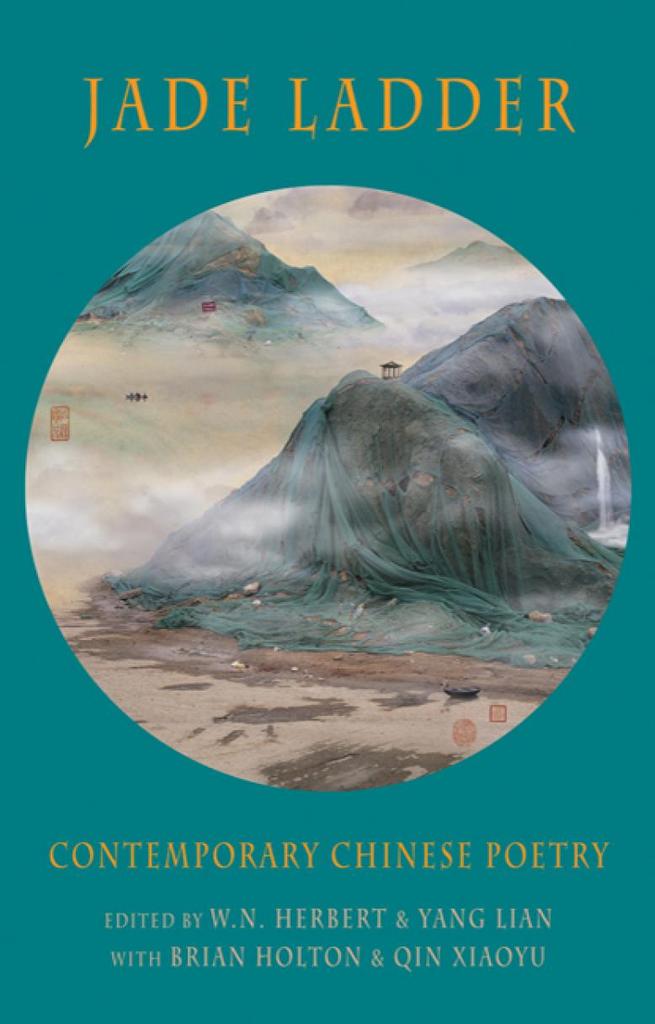
The sense of danger and paranoia here is obvious, but perhaps vague enough, quirkily surreal enough, to elude the censors. The Introduction suggests parallels with the Menglong Shi or so-called ‘Misty Poetry’ generation of writers in China in the 1980s. Then, the ‘Misty’ handle was initially a disparaging one given by officially sanctioned reviewers, suggesting these writers were creating ‘obscure, vague, incomprehensible work’ (for a good account of these issues see Yang Lian’s introductory essay to Jade Ladder: Contemporary Chinese Poetry (Bloodaxe, 2012) edited by WN Herbert and Yang Lian). But their obscurity was only really in comparison to official Chinese poetry of the period full of banal (but never obscure) sloganizing about the virtues of Socialism and the evils of Capitalism. Yang argues the mistiness of the new 1980s Chinese poets was really a return to ‘Sun, Moon, Earth, River, Life, Death, Dream’ – to the territory of Classical Chinese poetry (Li Bai and Du Fu), though often encoded within it were observations about contemporary political life. So also with Abiz’s poetry in which images of ‘doves, rabbits, ghouls, lemons, feasting, wine’ develop and imply their own slant or misty significances.
Inevitably, death and the threat of it is a preoccupation of many of these poems. The mundane incident of a fly buzzing in a kitchen leads to a meditation on conflict, guilt and futility. Looking through a window into ‘The Anatomy Hall’, the narrator sees a surgeon? a mortician? a torturer? leaning over a body on a table. He senses the man’s fear; he glimpses the flash of a knife. Then:
He bends over my head and smiles,
looking at me like a butcher looks at a carcass.
X
On the table in the middle of the hall,
relaxed, I sleep.
The relaxation of the victim comes as an additional surprise, but it gestures towards the sense of complicity that is another of Abiz’s concerns. A lengthy quotation in the Introduction, which I take to be in Abiz’s own words, argues: ‘the corrupting influence of dogmas is so insidious that no-one remains entirely innocent, or, if carried along by the paranoias of ideological purity, should be considered completely guilty’.
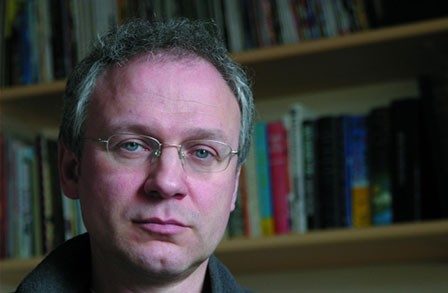
W N Herbert
So in ‘The Informer’ the narrator (in a Kafkaesque sort of world) has been invited to attend a ceremony to select the ‘finest informer’. There appears to be a confident pride in the way he dresses up for the occasion. In the hall, the candidates (those you expect to be on the ‘inside’) are in fact excluded. It turns out, in a detail suggestive of the elusive nature of truth and the levels on levels of surveillance in such a repressive society, that all the seats are to be taken ‘by the officers responsible for informing on the ceremony’. There is a calculated bewilderment to all this as is also revealed in the oxymoronic title of the eponymous poem, ‘The Kindly Interrogator’. Nothing so simple as a caricatured ‘bad cop’ here:
He’s interested in philosophy and free verse.
He admires Churchill and drinks green tea.
He is delicate and bespectacled.
He employs no violence, demands no confession, simply urging the narrator to ‘write the truth’. The narrator’s reply to this epitomises the uncertainties a whole society may come to labour under. He cries, ‘on my life!’. Is this the ‘I will obey’ of capitulation or the ‘kill me first’ of continued resistance? Is this the repressed and persecuted ‘life’ of what is, of what is the case, or an expression of the inalienable freedom of the inner ‘life’? Abiz is very good at exploring such complex moral quandaries and boldly warns those of us, proud and self-satisfied in our liberal democracies, not to imagine ourselves ‘immune from [the] temptation towards unequivocality’. Fenced round with doubt, with a recognition of the need for continual watchfulness, with a suspicion of the surface of things, perhaps these poems never really take off into the kind of liberated insightfulness or expression of freedom gained that the Introduction suggests a reader might find here. Abiz – the ‘melancholic scribbler of these lines’ – is the voice of a haunted and anxious conscience, a thorn in the side of repressive authorities, as much as a monitory voice for those of us easily tempted to take our eye off the ball of moral and political life nearer home.
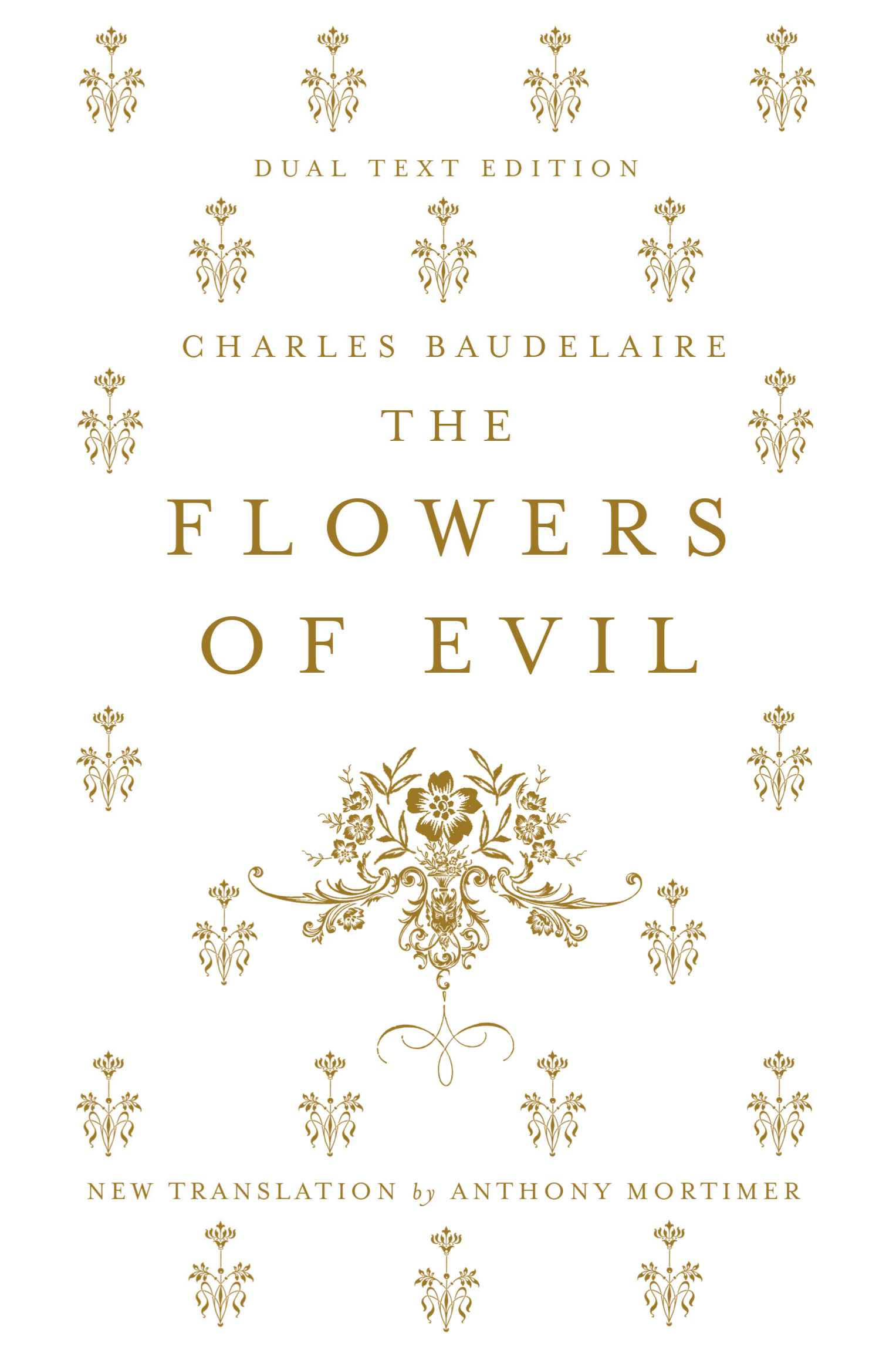
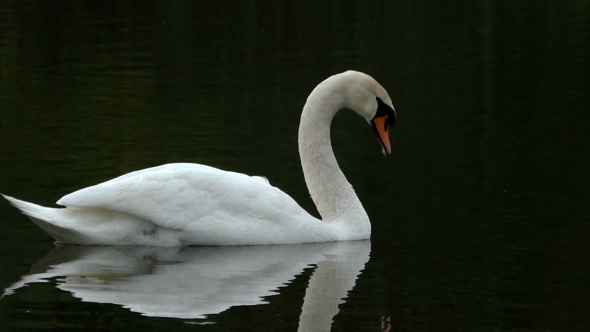
A friend of mine recently asked what I thought of Alice Oswald’s poem, ‘Swan’ – in fact, what did I think it meant. It appears in her 2016 collection Falling Awake (Cape Poetry). I’m not sure I can give a direct answer to her direct question, but it linked up with two other swan poems I have read recently. Baudelaire’s poem appears in The Flowers of Evil and I have been re-reading a couple of translations of that collection because of the French poet’s influence on Rilke. Rilke’s swan poem (included in New Poems) is one of the poems I have been translating for the projected 2023 Pushkin Press book mentioned in my previous two posts. So – by way of an oblique answer to my friend’s question and because these poems and (two of) the poets relate to my current project and out of sheer curiosity – I thought I’d read these three poems alongside each other here.
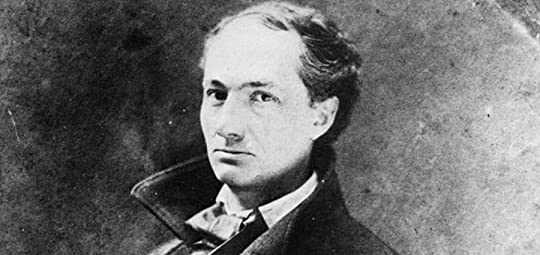
Baudelaire’s ‘Swan’ is the longest of the three, divided into two parts. Written in late 1859 and dedicated to Victor Hugo, Baudelaire described the poem as an attempt to “record rapidly all that a casual occurrence, an image, can offer by way of suggestions, and how the sight of a suffering animal can urge the mind towards all those beings that we love”. His definition of those we love is remarkable broad, as we’ll see. The poem is also remarkable for the range of its components: evocations of the modern city (Paris), the creature itself, anthropomorphism, personal memory, literary references and an imaginative and empathetic ‘lift off’ towards the end. I’m looking at Anthony Mortimer’s translation published by Alma Classics in 2016. Here is an older, clunky, but openly available translation.
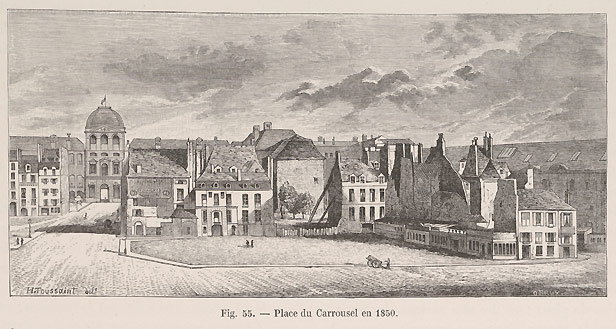
The reader might be taken aback by the opening exclamation: this swan poem opens with ‘Andromache, I think of you!’ In Book 3 of The Aeneid, Andromache, wife of the killed Trojan hero, Hector, is living in exile (‘we, our homeland burned, were carried over / strange seas’ – tr. Mandelbaum) and now weeps for her husband beside a little stream, a paltry reminder (Baudelaire: ‘a poor sad mirror’) of the mighty river, Simoeis, near Troy. She is an image of an abused and displaced exile, a refugee and it is the narrator’s strolling through the Place du Carrousel in Paris that prompts this literary recall. It’s because he himself feels out of place. Between 1853-1870, the Paris Baudelaire had known was in the process of being re-designed and re-built by Georges-Eugene Haussmann. Cityscapes change ‘more swiftly than a mortal heart’ says the narrator and he prefers to recall the old, ramshackle state of the area, where there was once also ‘a menagerie’. One morning, in that previous era, he caught sight of an escaped swan that ‘[d]ragged his white feathers on the dirty road’.
Rapid cutting from literary allusion to gritty realism to anthropomorphism is part of Baudelaire’s boldly making it new. The swan is ‘doomed’ in a literal sense, yet also ‘mythical’, at least for the narrator, who makes the beast speak: ‘Water, when will you rain?’ The intertextual resonances are further extended: the narrator sees the bird ‘sometimes like the man in Ovid’. This is the moment of man’s first creation: ‘given a towering head and commanded to stand / erect, with his face uplifted to gaze on the stars’ (Metamorphoses, tr. David Raeburn). But Baudelaire’s allusion is ironic, confirming the swan’s standing for itself and humankind in 19th century Paris: the swan stretches ‘his writhing neck and hungry head / Towards the cruel sky’s ironic blue’.
Part II of ‘The Swan’ reverts to the changing vista of Paris. As the new is erected, the old buildings ‘turn allegorical’, working as allusions to objects and experiences that no longer exist. The diffuseness and proliferating resonance of the swan image itself suggests that ‘symbolic’ might be a better word than allegorical. Now strolling near the Louvre, thinking still of the swan memory, the narrator reflects on ‘how / All exiles are ridiculous and sublime’. The earlier Andromache reference now makes sense and it resurfaces. It is the ‘incessant longing’ of all exiles that fascinates Baudelaire and from the (passionately felt) literary figure, he turns to a real black woman, ‘thin and consumptive, / Trudging through mud’ (in Paris, I take it) who yearns for her African homeland, obscured by a northern European ‘wall of fog’. The narrator ‘seeks’ exile we are told or, in his alienation from the modern world, he is compelled to seek it in a (mental) forest in which a ‘distant memory winds its full-breathed horn’. Imprecise as the significance of this image is, it evokes a full-throated, rather nostalgic longing for something long past; somewhat ridiculous and yet sublime in its depth of feeling. But the poem’s final lines expand to encompass thoughts of ‘castaway sailors’ and ‘captives, the defeated . . . and of many, many more’. The memory of the swan has focused (and continues to do so) the narrator’s thoughts on the ubiquity of such states of alienation, of actual and psychological exile.
Charles Baudelaire
By comparison, the 12 lines of Rilke’s ‘The Swan’ are astonishingly compact. But, on its smaller scale, Rilke’s poem also opens as obliquely as Baudelaire’s. There are two lines before the creature appears and when it does so it seems to be in a figurative role: as an image of human life, which is itself characterised as a ‘struggling with a task not yet complete’. The contingencies and difficulties of a life lived are compared to the awkward movements of a swan’s movements out of water, weighed down, ponderous, ‘constrained’, as if its legs could not move freely. Baudelaire kept the two sides of his comparison (the swan and the experience of exile) clearly demarcated. Rilke balances the two sides of his comparison more evenly and potentially more confusingly. Is this a poem about a swan that conjures thoughts about life and death, or is it about life and death which now remind the narrator of the movements (in and out of water) of a swan?
Certainly, the initial topic seems to be life (its difficulties) and then in the second stanza, death itself: ‘that sense of our slackening grip / on the earth where we stand every day’. What is bold about this poem is how the final seven lines take off from this introduction of death into a second series of images related to the swan entering the water. But it is a series that does not return from the swan to the probable theme of human life/death. Instead, the poem records, in exquisite detail, the process of the swan entering the water and settling and then swimming away. It has the clarity of an Imagist poem (and I am hoping for that in my translation of it):
so, tentatively, he lowers himself down
x
and onto the waters that welcome him
gently, already, contentedly letting slip,
retreating beneath him, a moving tide,
while he, infinitely still and assured
and ever more majestic, more mature,
is content the more placidly to glide.
The growingly anthropomorphic quality of Rilke’s description (like Baudelaire’s before) implies the swan’s representative role in reflecting human life and in this instance, human death. Or at least, the idealised image of death that Rilke wants to convey: not something to be feared, but a gradual transition, a becoming, a maturing, an integral part of a life’s ‘struggling’. The poem’s playing with our perception of the swan/life divide is part of Rilke’s intention: life, as much as death, is not something Other, detached from the world of things, but something co-existing alongside it, within it. The creature’s placid transition from land to water, life into death, represents a true death for Rilke. This is not something available to all. In an earlier poem from the Book of Hours – in a poem which shows the influence of Baudelaire – Rilke portrays the poor of Paris, ‘wan-faced and petal-white’, frightened of being admitted to the hospitals of the city, knowing death awaits them. But this is a ‘petty death’, the demise of the body with no spiritual dimension; it is not ‘their real death’ which remains ‘hanging green, not yet sweet / like a fruit within that will never ripen’. So Rilke’s swan, as it glides placidly from life into death, is an image of such an ideal transition.
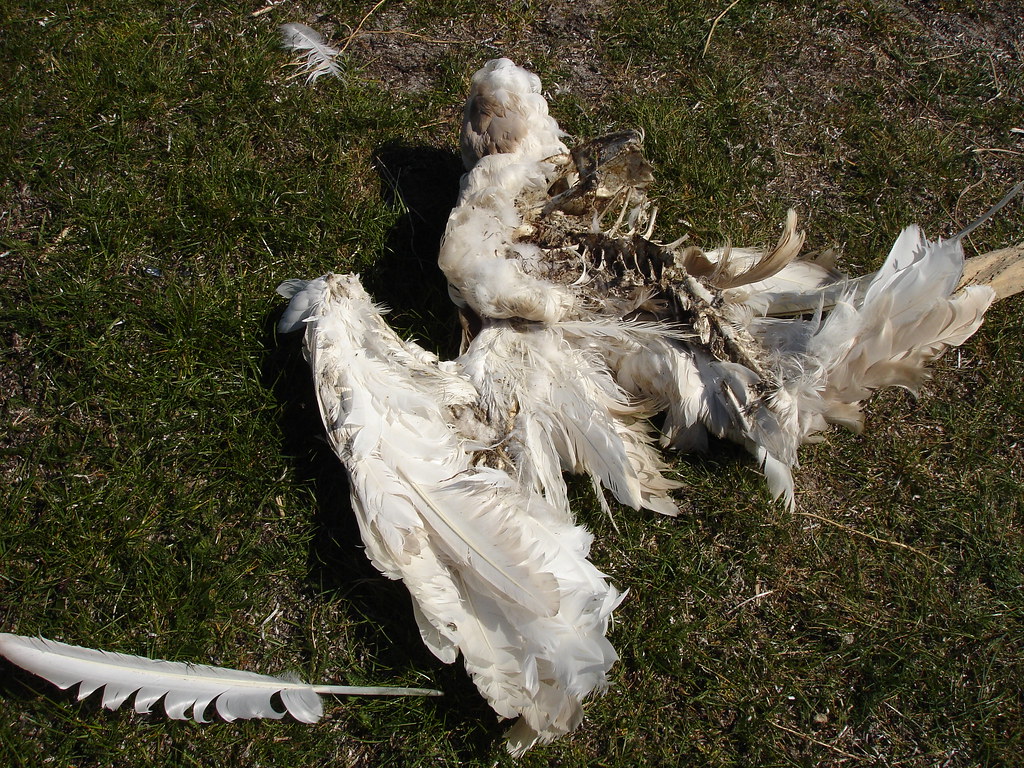
It’s possible Oswald’s poem, ‘Swan’, has Rilke’s in mind as its preoccupation is also with life and death. Compared to the Parisian perambulatory of Baudelaire’s regular ABAB quatrains and the meditative, imagistic, quasi-sonnet form of Rilke, Oswald’s poem wanders freely across the page echoing the disintegration of her already dead and rotting swan. The poem is composed of two elements: narrative description and the imagined voice or thoughts of the dead swan as it rises away (soul-like) from its own corpse. The only real puzzle here is the final speech of the swan.
The opening harks back to the sound world and imagery of Ted Hughes. The harsh assonance of the curt opening phrase (‘A rotted swan’) is an example, as is the following long line with its splashing sibilance and use of a technological image applied to the natural world: the swan is ‘hurrying away from the plane-crash of her wings’. Also like Hughes, Oswald likes to use the space of the page; the phrase ‘one here’, repeated for each of the wings, is placed as if the material of the words indicated the location of the wings set awry. The plane image is picked up again with the metaphor of the swan leaving the ‘cockpit’ of her own flying machine. The dualism of mind/self/spirit/soul versus body is adopted in what seems to be a simple manner.
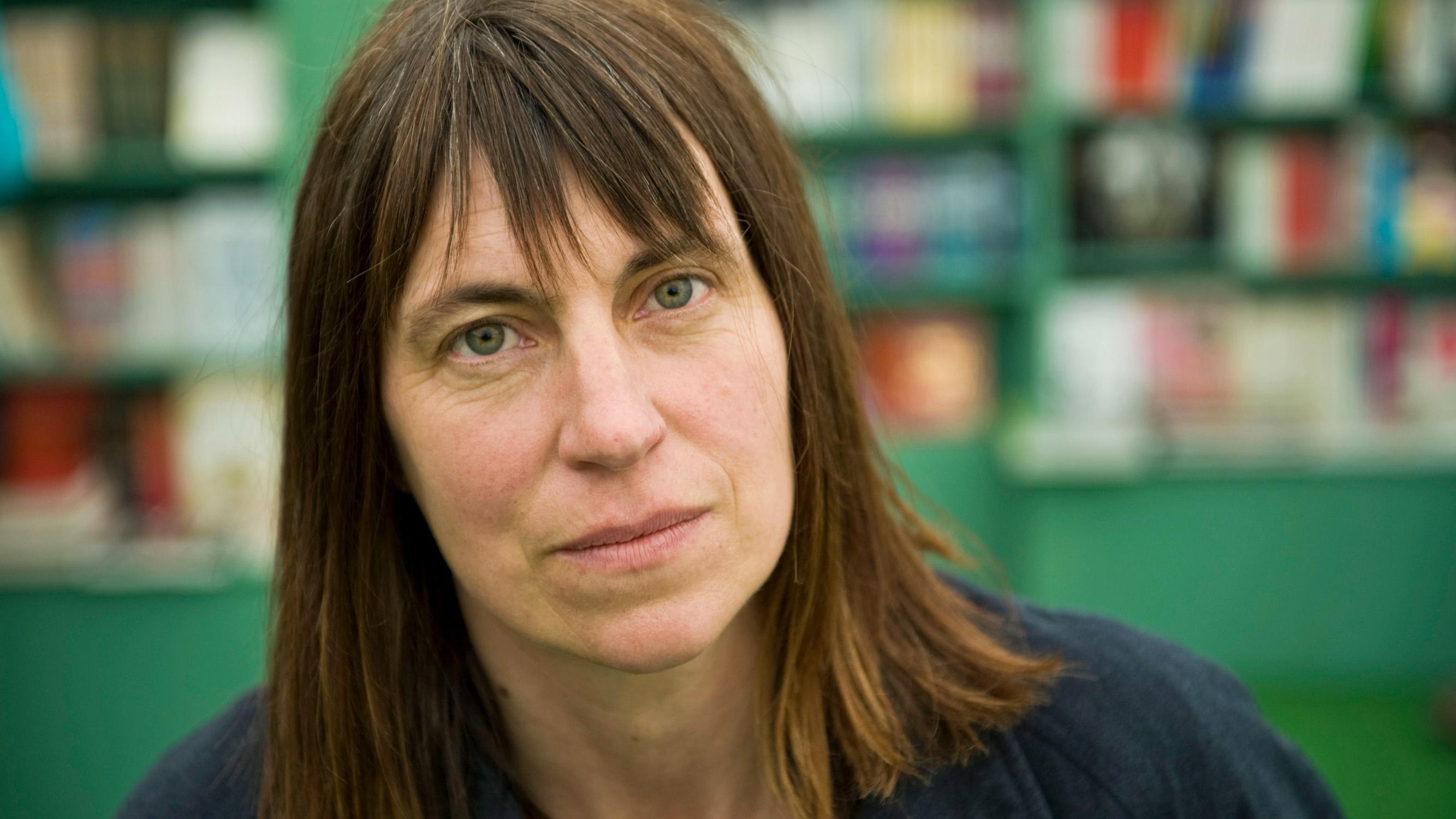
Alice Oswald
Baudelaire’s swan in exile cried for rain in its natural watery homeland. Oswald’s is puzzled by its sudden divorce and alienation from its own body. In its first speech, it does not recognise its wings: ‘those two white clips that connected my strength / to its floatings’. The tone is similar in the second speech: ‘strange / strange’. The swan seems aware here of its own sense of ‘yearning’, experienced in its life, that the body’s ‘fastenings’ (wings? tendons? muscles?) were never able to ‘contain’. As with all these swan poems, the bird is being co-opted to represent humanity; here, our sense of being more than merely physical. The swan sees her own black feet, now ‘poised’ but unused. The corpse is an intricate, marvellous machine, but without whatever is now departing, it appears ‘a waste of detail’. Before the third and final speech, the body and all its ‘tools’ are now abandoned, with all its ‘rusty juices trickling back to the river’.
I think that last phrase is important. This is one of Oswald’s best poems but I’m uneasy with the conventionality of the spirit/body trope. Perhaps what is leaving the body is returning to the environment (an after-life of that sort)? In the final passage, the swan wants to address its own corpse before it ‘thaws’ or rots away. This suggests a desire for some ritual. The perspective of the poem now zooms in on the head, then the eye, which is visible and into its ‘cone of twilight’, the fading gleam within it, and into the cone, almost as if looking into a snow globe. The swan sees a scene there: a bride setting out to her wedding. Is this an image of the renewal of life after death? The ‘trickling back to the river’? But this return journey seems difficult: ‘it is so cold’. I’m not clear if I should be taking this in a narrow way: this individual creature will be extinguished. Or more broadly, the natural cycle of life-death-decomposition-new-life has been compromised (by human actions?). Oswald’s final image is of tolling bells, ringing in the putative wedding venue, bells like ‘iron angels’, insistently, ‘ringing and ringing’. Oswald’s swan is marvellously physical in its demise but its projected commentary on itself feels at times naively anthropomorphic (the death I’m left thinking of is a human death), at others puzzlingly obtuse.