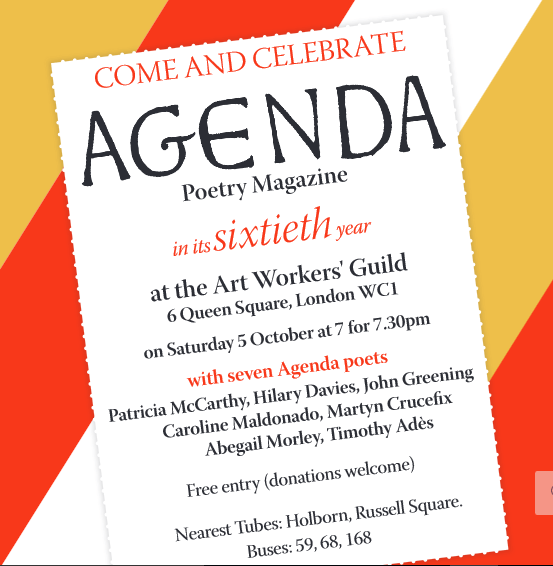
A good cause for celebration – there will be brief readings by the advertised poets
Author: martyn crucefix

2019 Forward First Collections Reviewed #4 – Jay Bernard’s ‘Surge’
As in the previous four years, I am posting – over the summer – my reviews of the 5 collections chosen for the Forward Prizes Felix Dennis award for best First Collection. This year’s £5000 prize will be decided on Sunday 20th October 2019. Click on this link to access all 5 of my reviews of the 2018 shortlisted books (eventual winner Phoebe Power), here for my reviews of the 2017 shortlisted books (eventual winner Ocean Vuong), here for my reviews of the 2016 shortlisted books (eventual winner Tiphanie Yanique), here for my reviews of the 2015 shortlisted books (eventual winner Mona Arshi).
The full 2019 shortlist is:
Raymond Antrobus – The Perseverance (Penned in the Margins) – reviewed here.
Jay Bernard – Surge (Chatto & Windus)
David Cain – Truth Street (Smokestack Books) – reviewed here.
Isabel Galleymore – Significant Other (Carcanet) – reviewed here.
Stephen Sexton – If All the World and Love Were Young (Penguin Books)
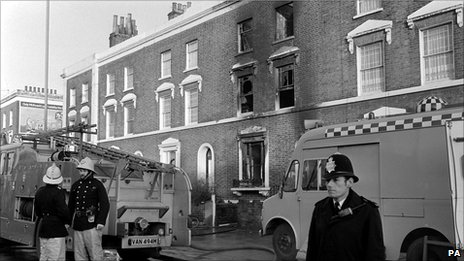
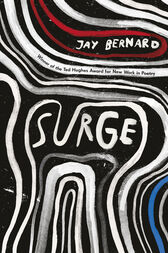 Jay Bernard’s Surge is a slim volume carrying with it a great deal of political as well as publishing history. Its early stirrings seem to have been Bernard’s residency at the George Padmore Institute in north London where they explored documents relating to the New Cross Fire in January 1981. Often dubbed the ‘New Cross Massacre’, thirteen young people died in a fire at a birthday party. The fire may have been racially motivated arson and certainly the authorities’ response to the incident was unconvincing, possibly obstructive. There is a direct line from this incident, through the imposition of SUS laws and ‘stop and search’ in South London and the SWAMP 81 police crackdown and the subsequent, so-called Brixton Riots of April 1981. The Scarman Report in November of that year laid the blame for the riots squarely on the police action. In our contemporary landscape, and especially after the Grenfell Tower fire and the still-unresolved shameful treatment of the Windrush Generation, it’s easy to see why Bernard wanted to write about New Cross.
 But Surge itself has since gone through various forms. There were 10 original poems written quickly in 2016. There was a performance piece (at London’s Roundhouse) in the summer of 2017 (it was this version that won the Ted Hughes Award for New Work in poetry in 2017). But it has taken 3 years for this Chatto book to be finalised. In an interview just last year, Bernard observed that they were still unclear what the “final structure” of the material would be. I’m possessed of no insider knowledge on this, but it looks as if this “final” version took some considerable effort – reading it makes me conscious of the strait-jacket that a conventional slim volume of poetry imposes – and I’m not sure the finalised 50-odd pages of the collection really act as the best foil for what are, without doubt, a series of stunningly powerful poems. The blurb and publicity present the book (as publishers so often do) as wholly focused on the New Cross and Grenfell fires but this isn’t really true and something is lost in including the more miscellaneous pieces, particularly towards the end of the book.
Bernard writes of events in the past by deploying a multiplicity of voices which are given the power to haunt backwards and forwards through historical time. Unusually, their own voice is heard in ‘Ark’. They are here searching through an archive of documents of “flaking Letraset and amber glue” that also (punningly) acts as an ‘ark’ to bring the dead back to the present. What preoccupies the narrator is how and where to “file / the damp smoke and young bones” of the New Cross victims. The conclusion seems to be they cannot be securely and finally located anywhere while the country still experiences “the burning house, the child made ash, the brick in the back / of the neck, the shit in the letter box and piss up the side of it”.
 Bernard’s poetic voice is at its best when making full use of the licence of free forms, broken grammar, infrequent punctuation, the colloquial voice and often incantatory patois. So a voice in ‘Harbour’ wanders across the page, hesitantly, uncertainly, till images of heat, choking and breaking glass make it clear this is someone caught in the New Cross Fire. Another voice in ‘Clearing’ watches, in the aftermath of the blaze, as an officer collect body parts (including the voice’s own body): “from the bag I watch his face turn away”. The cryptically titled ‘+’ and ‘–’ shift to broken, dialogic prose as a father is asked to identify his dead son through the clothes he was wearing. Then the son’s voice cries out for and watches his father come to the morgue to identify his body. This skilful voice throwing is a vivid way of portraying a variety of individuals and their grief. ‘Kitchen’ offers a calmer voice re-visiting her mother’s house, the details and familiarity evoking simple things that have been lost in the death of the child:
I have held this house
in my arms and let it sob
on the bathroom floor, heard it in
the background of a call,
heard it speak a kind of love –
A vigorously rhythmic patois voice is used in ‘Songbook’, recycling the horrific narrative again as a young boy and girl dance happily until:
Me seh di heat ah di night ah come up thru di floor
Black smoke ah rise tho dem nevah did know
[. . .]
Gyal fall back inside an we no see her no more
No bright green dress up pon di third floor
Bernard acknowledges their debt here to Linton Kwesi Johnson’s earlier poem about the New Cross Fire; you must listen to Bernard give a mesmerising performance of their own great poem here.
 I’m guessing most of the poems I have referred to so far come from the early work of 2016. Other really strong pieces focus on events after the Fire itself. ‘Duppy’ is a sustained description – information slowly drip-fed – of a funeral or memorial meeting and it again becomes clear that the narrative voice is one of the dead: “No-one will tell me what happened to my body”. The title of the poem is a Jamaican word of African origin meaning spirit or ghost. ‘Stone’ is perhaps a rare recurrence of the author’s more autobiographical voice and in its scattered form and absence of punctuation reveals a tactful and beautiful lyrical gift as the narrator visits Fordham Park to sit beside the New Cross Fire’s memorial stone. ‘Songbook II’ is another chanted, hypnotic tribute to one of the mothers of the dead and is probably one of the poems Ali Smith is thinking of when she associates Bernard’s work with that of W.H. Auden.
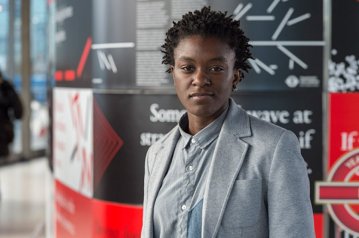 But when the device of haunting and haunted voices is abandoned, Bernard’s work drifts quickly towards the literal and succumbs to the pressure to record events and places (the downside of the archival instinct). A tribute to Naomi Hersi, a black trans-woman found murdered in 2018, sadly doesn’t get much beyond plain location, a kind of reportage and admission that it is difficult to articulate feelings (‘Pem-People’). There are interesting pieces which read as autobiography – a childhood holiday in Jamaica, joining a Pride march, a sexual encounter in Camberwell, but on their own behalf Bernard seems curiously to have lost their eagle eye for the selection of telling details and tone and tension flatten out:
The bus heaves past Loughborough, to Camberwell,
to the green, buzzing with students drunk on Friday,
drunk on art and trendy and young: wine bottle young,
rollie-young, tight, flat-chested young. I follow you down,
I follow you up to the stairs of your flat [. . .]
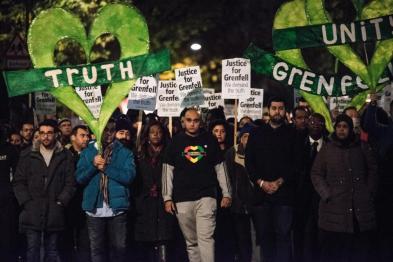 The mirroring architectonic of the collection emerges with the poems written about the Grenfell Tower fire. So we have ‘Ark II’, two pools of prose broken by slashes which seem to be fed by too many tributary streams: the silent marches in Ladbroke grove, the Michael Smithyman murder and abandoned investigation, Smithyman’s transition to Michelle, and the burning of the Grenfell Tower effigy, the video of which emerged in 2018.
In an earlier blog post I was thinking about “the (in)adequacy of a certain English poetic voice to confront the scale of ecological issues, or as a vehicle for expressing certain cultural differences, or as a way of exploring the kind of tragic and grievous event represented by the Grenfell fire and its aftermath”. I think Bernard offers answers to this sort of question in their New Cross Fire poems but the challenge of Grenfell (is it the lack of historical distance?) does not yield the same sort of success. The final poem in the book, ‘Flowers’ is a case in point. Each quatrain carries a rhetorical question, creating a formal rather than urgent or passionate impression, and the valid question is will “anybody speak of” the kinds of issues raised elsewhere in the book. Yet the canonic imagery invokes the speech of flowers, the transition from summer into winter (done much more effectively in ‘Stone’). In the context of a live reading, in the context of the horror, the grief, the injustices, the historical perspectives raised so very successfully elsewhere in Surge, I’m sure this sort of poem has an impact. But in the cold light of day, Bernard’s voice here sounds confined by expectations they ought to be ignoring and ends by giving a rather awkward performance – especially when it’s compared to the fluid, passionate, skilful, clever, eloquence of something like ‘Songbook’.
2019 Forward First Collections Reviewed #3 – Raymond Antrobus’ ‘The Perseverance’
As in the previous four years, I am posting – over the summer – my reviews of the 5 collections chosen for the Forward Prizes Felix Dennis award for best First Collection. This year’s £5000 prize will be decided on Sunday 20th October 2019. Click on this link to access all 5 of my reviews of the 2018 shortlisted books (eventual winner Phoebe Power), here for my reviews of the 2017 shortlisted books (eventual winner Ocean Vuong), here for my reviews of the 2016 shortlisted books (eventual winner Tiphanie Yanique), here for my reviews of the 2015 shortlisted books (eventual winner Mona Arshi).
The full 2019 shortlist is:
Raymond Antrobus – The Perseverance (Penned in the Margins)
Jay Bernard – Surge (Chatto & Windus)
David Cain – Truth Street (Smokestack Books) – reviewed here.
Isabel Galleymore – Significant Other (Carcanet) – reviewed here.
Stephen Sexton – If All the World and Love Were Young (Penguin Books)
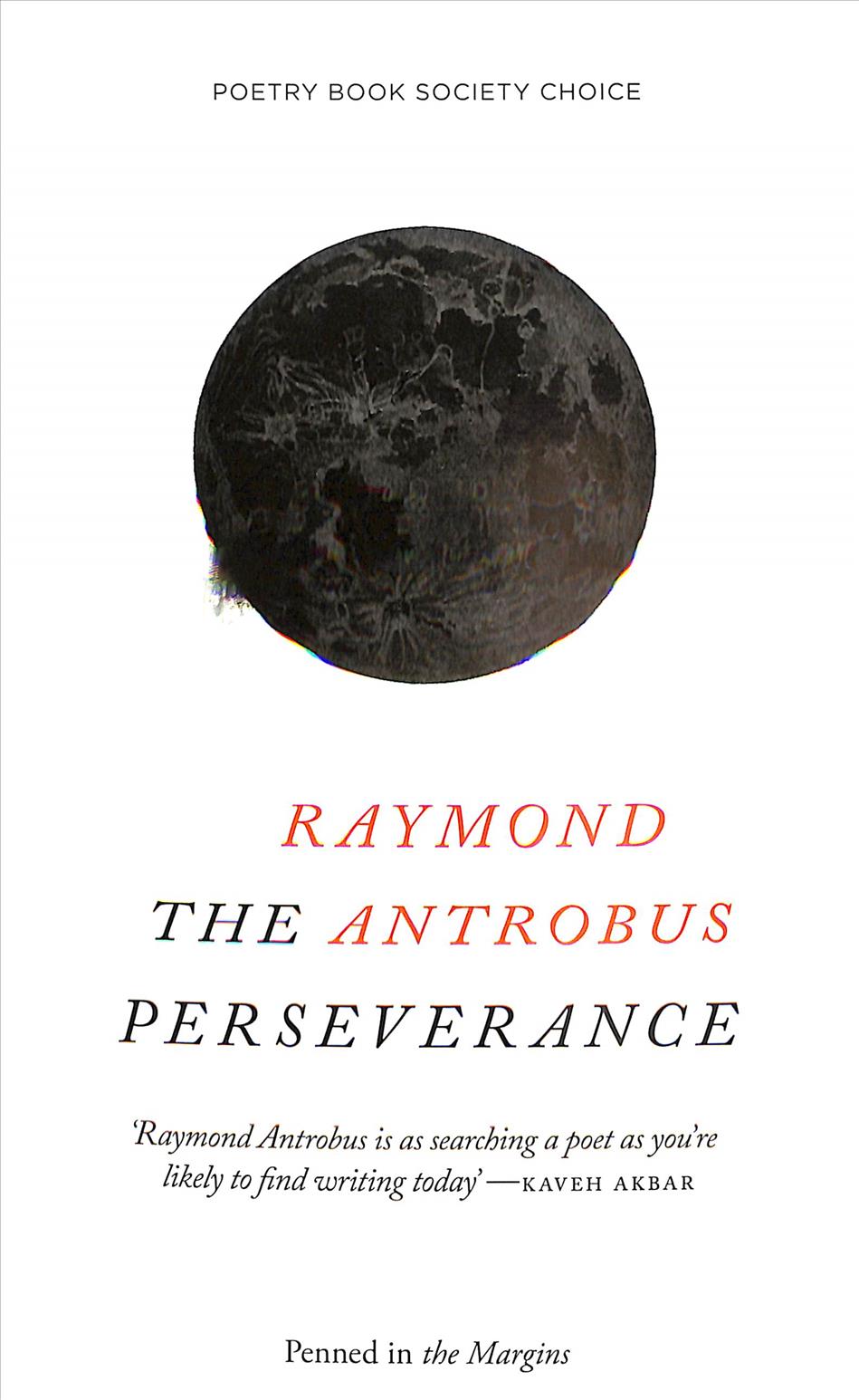
Raymond Antrobus’ The Perseverance has already received a great deal of coverage since being chosen as a Poetry Book Society Choice in September 2018. It is a collection that has achieved the difficult task of transcending the acclamation of the poetry world to a much more widespread appreciation, such as winning the Rathbone’s Folio Prize 2019 (awarded to “the best work of literature of the year, regardless of form”). In many ways it is a conventional book of poems – its voice is colloquial, it successfully employs a range of (now) traditional forms (dramatic monologues, prose poem, sestina, ghazal, pantoum), its forms, syntax and punctuation are nothing out of the ordinary (compared to the work of Danez Smith, for example, a comparison that Antrobus invites). Its subject matter is to a large extent dominated by a son’s relationship with his father, by questions of racial identity and (this is what is especially distinctive) the experience of a young Deaf man. Besides the latter, what really marks the book out as special is that impossible-to-teach, impossible-to-fake, not especially ultra-modern quality of compassion.
I think the portrait of the “complicated man”, Raymond Antrobus’ father, is remarkable. This is a warts and all portrayal as can be seen in the title poem, a sestina, in which the boy’s seemingly endless and repeated waiting for his father to come out of the pub called ‘The Perseverance’ is reflected in the repetitions of the poetic form. The neglect of the child (and of the mother of his child) is made perfectly clear; one of the repeating rhyme words is ‘disappear’. But another is ‘perseverance’ itself which sets up sweetly ironic resonances in relation to the experiences of both father and child. But a third rhyme word is ‘laughter’ which transmutes in significance as the poem develops. At first it is the distant din from the inside of the pub. It grows into a sort of paternal life-view: “There is no such thing as too much laughter”. In the end, after the loss of the father, it is what the son remembers, rather than the neglect: “I am still outside THE PERSEVERANCE, listening for the laughter”.

Antrobus’ epigraph to ‘The Perseverance’ quotes from ‘Where you gonna run’, a lyric by Peter Tosh: “Love is the man overstanding”. The latter word means a form of understanding that emerges after all untruths have been overcome. The poems scattered through this collection make it clear that a full overstanding of his “complicated” father took a while. The disciplining of his child often took the form of “a fist”. When Raymond knocked loose wires from his father’s sound system, the response was a beating. Yet, “every birthday he bought me / a dictionary”. His father could recite “Wordsworth and Coleridge”. He never called his son deaf, but rather “limited”, and he would read with him in the evenings (more of that later). But then he might regale his son with tales of his extensive sexual experiences, “three children with three different women”. In the end, as so often, the child ends nursing the infantilised father who is suffering from dementia. The father’s mind is filled with the past, his own growing up in Jamaica, his first kiss, his later, difficult life in England. ‘Dementia’ deploys a second person address to the condition itself:
you simplified a complicated man,
swallowed his past
until your breath was
warm as Caribbean
concrete —

In the final poem in the book, Antrobus again uses a traditional form – a pantoum this time – to evoke some of the moments of closeness between father and son as they read together. In ‘Happy Birthday Moon’ the father’s attentive, gentle, encouraging side is memorialised as is the Deaf child’s desire to please his father:
Dad makes the Moon say something new every night
and we hear each other, really hear each other.
As Dad reads aloud, I follow his finger across the page.

Much earlier in the book, Antrobus writes of clearing his father’s flat after his death. On an old cassette tape, stowed away for years, the poet now listens to a recording of his own two-year-old voice, repeating his surname: “Antrob, Antrob, Antrob”. The final syllable is missing because the child could not hear it. At the time of the recording, no-one in the family suspected there was an issue. Years later, Antrobus sits “listening to the space of deafness”. Other sections of this early sequence, ‘Echo’, document the Deaf child’s experiences of slow diagnosis (“since deafness / did not run in the family”) and the tests that finally revealed the truth. These are important poems for the hearing world to read; the lazy inaccuracies and limitations of our imaginations always need re-invigorating with the truth of lived experience. The first section of ‘Echo’ takes us straight into the experience of “ear amps”, of “misty hearing aid tubes”, of doorbells that do not ring but pulsate with light.
Antrobus’ subject is only partly the frustrations of Deafness (capital D refers to those who are born Deaf – hence a state of identity, a cultural difference – as opposed to small d which refers to those who become deaf, having acquired spoken language, whose relationship with deafness is more as disability, as medical condition). One poem uses the repeated refrain “What?” Another, with courageous humour, records every day mis-hearings such as muddling “do you want a pancake” with “you look melancholic”. But it is more often the capability of the d/Deaf that Antrobus wants to proclaim: whether the doorbell is heard or seen, “I am able to answer”.
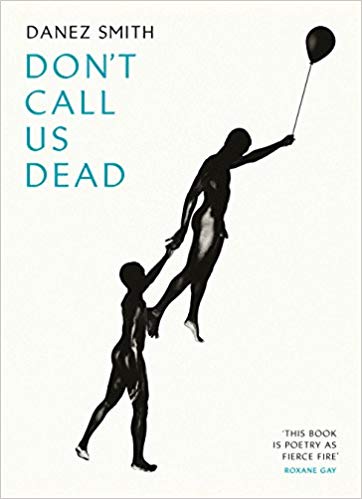 Inevitably, there is anger to be expressed. We feel the heat of this especially in ‘Dear Hearing World’ which, as Antrobus’ note confirms, contains “riffs and remixes of lines” from ‘dear white america’, a poem by Danez Smith included in Don’t Call Us Dead (Chatto, 2017). Smith’s example – a prose poem full of frustrated anger and a desperate wishfulness for better race relations in the USA – seems to liberate Antrobus’ voice. He wishes – or rather demands – better treatment for the d/Deaf: “I want . . . I want . . . I call you out. . . I am sick of. . .” The hearing world is castigated for its mistreatment of the d/Deaf: “You taught me I was inferior to standard English expression – / I was a broken speaker, you were never a broken interpreter”. Antrobus also takes aim at some high profile figures for their attitudes to d/Deafness. I remember being asked (and refusing) to teach Ted Hughes’ poem ‘Deaf School’ (collected in Moortown (Faber, 1979)). Antrobus here reprints and redacts the whole poem, following it with an excoriating commentary on Hughes’ patronising and presumptuous comments. Elsewhere Charles Dickens and Alexander Graham Bell come in for criticism.
Of course, such blinkered prejudices about d/Deafness and race remain rife as ‘Miami Airport’, a fragmented account of an interrogation at the US border, makes clear. With Palestinian poet, Mahmoud Darwish, the British-Jamaican poet, Antrobus, would say, “I am from there, I am from here”. Born to an English mother, his father always tried to keep his Jamaican heritage alive. But even his appearance speaks two stories as in ‘Ode to my Hair’: “do you rise like wild wheat / or a dark field of frightened strings?” And the subtly shifting meanings of repetition in the ghazal form of ‘Jamaican British’ cleverly brings out the liminal spaces imposed on individuals who share Antrobus’ ancestry.
 But despite the many issues raised in this book, it is not in the end to be praised for its campaigning zeal. In the wonderfully titled ‘After Being Called a Fucking Foreigner in London Fields’, Antrobus confesses, “I’m all heart, / no technique”. He’s talking about fist fights here, but it’s certainly not true of his poetry. There is plenty of technique and skill on show, but it is put to the service of the “heart”. Not in a sentimental way at all – these poems can tell brutal truths – but in the compassion, the love, that most of the poems exude. There are plenty of essays and definitions of identity around these days and there is rightfully plenty of blame-work, but Antrobus finds it in himself to forgive. Instead of punching his abuser in London Fields, he “write[s] until everything goes / quiet” and in ‘Closure’, addressing someone who knifed him years ago, he finds the strength to say, “There is no knife I want to open you with. Keep all your blood”. This is a first collection that barely puts a foot wrong and thoroughly deserves the praise that has already been heaped upon it.
Michael Rosen talks to Raymond Antrobus on BBC Radio 4
2019 Forward First Collections Reviewed #2 – Isabel Galleymore’s ‘Significant Other’
As in the previous four years, I am posting – over the summer – my reviews of the 5 collections chosen for the Forward Prizes Felix Dennis award for best First Collection. This year’s £5000 prize will be decided on Sunday 20th October 2019. Click on this link to access all 5 of my reviews of the 2018 shortlisted books (eventual winner Phoebe Power), here for my reviews of the 2017 shortlisted books (eventual winner Ocean Vuong), here for my reviews of the 2016 shortlisted books (eventual winner Tiphanie Yanique), here for my reviews of the 2015 shortlisted books (eventual winner Mona Arshi).
The full 2019 shortlist is:
Raymond Antrobus – The Perseverance (Penned in the Margins)
Jay Bernard – Surge (Chatto & Windus)
David Cain – Truth Street (Smokestack Books) – reviewed here.
Isabel Galleymore – Significant Other (Carcanet)
Stephen Sexton – If All the World and Love Were Young (Penguin Books)
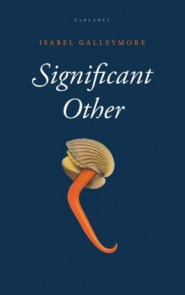 Isabel Galleymore’s Significant Other cuts incisively and deliciously against several fashionable poetic grains in being committed yet dispassionate, quietly concise not shrill, impersonal rather than nakedly biographical. In Carcanet’s blurb, Rachael Boast praises the book for its “simplicity, empathy and sheer Blakean joy”; in truth, it needs to be praised for far tougher virtues such as its probing intelligence, its metaphorical brilliance, its lover’s relational sense of angst. Galleymore certainly possesses an astounding gift for figurative language. It’s tempting to allude to Craig Raine’s Martianism in this context, though Galleymore interrogates the metaphorical process in far more important and interesting ways.
Her main subject is the natural world and our relationship with it and the book is studded with a number of bravura pieces which – as Ted Hughes put it in Poetry in the Making (Faber, 1967) – manage to ‘capture’ something of creaturely lives. But rather than foxes and hawks, Galleymore writes about starfish, mussels, slipper limpets, goose barnacles, seahorses, whelks, frogs, spiny cockles and crabs. As Hughes’ versions of the natural world – even a harebell or snowdrop – tended towards violence, Galleymore’s creatures tend toward sensuality and – even when the behaviour is predatory – the descriptions have a sexual quality to them. So the starfish’s attack on a mussel rises to a climax when
[. . . ] the mussel’s jaw
drops a single millimetre. Into this cleft
she’ll press the shopping bag of her stomach
and turn the mollusc into broth.

There is indeed a sort of empathy here but, at its best, this kind of metaphorical language – the shopping bag, the broth – is accurately based on precise observation of actual behaviours.
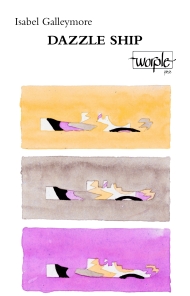 But Galleymore also sees dangers. In her 2014 Worple Press pamphlet, Dazzle Ship, the poem ‘Forest’ sought to limit such likening of one thing to another: “It shouldn’t go further / than this flirt and rumour”. The consequence of this failure of (for want of a better word) tact is itself imaged in the sloth that mistakes her own limb for “an algae-furred branch” and plummets “through the tangle / of the forest canopy // holding only onto herself”. ‘Forest’ is not included in Significant Other, but a closely related image occurs in ‘Once’. This little poem tracks human relations with nature from our early fears of “being eaten”, through the beginnings of farming, the awakening of metaphors comparing ourselves to Nature, towards the Romantic notion of being “at one”. Yet often there is a bullying, colonising quality to such a sense of oneness – we co-opt Nature into our world on our own terms. In ‘Once’, we are “at one and lost / as the woman wrapped in her lover’s arms / who accidentally kisses herself”. Such ludicrous, solipsistic love-making echoes the sloth’s mistake and downfall.
Several commentators have picked out ‘Choosing’ as a significant poem in this book, most seem to take its statement about loving all “eight million differently constructed hearts” (the number of species currently living on earth) as a genuine example of environmental good practice. But there is irony at work here when the poem goes on to indicate the difficulty of achieving such a multiplicity of loves, using incomplete statements, awkward repetitions and – as Galleymore often does – the language of human lovers to express it. So:
To say nothing will come between us,
to stay benignly intimate was –
sometimes not calling was easier –
sometimes I’d forget to touch you
and you, and you [. . .]”
And these inevitable failures to live up to such ideally multivalent webs of relationships lead to “breakups” (in the lover’s parlance) which I take to mean extinctions (biologically speaking):
like the others it seemed you’d just popped out
for a pint of milk and now
nothing’s conjured hearing your name
So Galleymore sees figurative language not only in poetic terms, but also as its shapes all human knowledge. ‘Uprising’ (also in Dazzle Ship only) compares the fluffy seed-head of a dandelion to a microphone, ready to transmit “a hundred / smaller scaffoldings // of a thought or an idea”. But such likening of one thing to another (when taken beyond flirt and rumour) like any human relationship is at risk of an unbalanced power dynamic. ‘Seahorse’ is unusual in this collection, opening as it does in the human world, in a restaurant, a man speaking for the woman he’s with, his presumption described as “shocking”. Yet the narrator seems complicit in such a relationship too:
like a hand shaping itself inside another’s
the way my hand tucks into his
like a difference pretending it’s not.
Like two separate identities, one pretending not to be really separate at all. Or not being allowed to regard itself as separate at all. This is close to metaphor as a form of gaslighting.

In several poems, Nature is the exploited, submissive partner but in ‘No Inclination’ it is shown fighting back. The metaphors we have long used to domesticate and describe the natural world are shown to be breaking down:
[. . .] a surprising number of gales
didn’t know what it was to howl.
The woebegone voice of the willow
confirmed it had no reason to weep.
It is our presumptuous, mansplaining tendency not to see Nature for what it is – but only in our own invented metaphors for it – that contributes to our planet’s endangerment. Our assumption of the benign, life-giving smile of the sun (Telly Tubbies anyone?) is not something we can rely on for much longer (record UK temperatures anyone?):
It couldn’t be denied: that fiery mass
possessed no inclination to smile.
Household after household poured
whiskey-cokes to toast the news,
the ice melting fast in their drinks.
 In ‘Significant Other’ itself, a cloud may be likened to a tortoise but the cocktail of power and presumption is complex; the relationship is not reciprocal. As the tortoise owner once erroneously anthropomorphised her pet, so in later life she mistook her lover’s sexual fidelity. The truth is not always as we wish it or as our metaphors construct it. At the close of the poem, the tortoise continues in its own “tortoisey” way, resisting any further efforts to colonise it, to humanise it. It is and remains significantly Other. And in this cool-toned, often fascinating book, Galleymore knows the Other needs to be allowed its distance, allowed its dynamic, changeable difference, its wealth of richness in being different, whether that Other is a lover or the natural world itself:
‘I Keep You’
at a difference:
a thought I won’t allow myself
to think for thinking
it’s a matter of time
till you, a cargo
ship of foreign goods,
cross my kitchen table
like a butter dish.

2019 Forward First Collections Reviewed #1 – David Cain’s ‘Truth Street’
As in the previous four years, I am posting – over the summer – my reviews of the 5 collections chosen for the Forward Prizes Felix Dennis award for best First Collection. This year’s £5000 prize will be decided on Sunday 20th October 2019. Click on this link to access all 5 of my reviews of the 2018 shortlisted books (eventual winner Phoebe Power), here for my reviews of the 2017 shortlisted books (eventual winner Ocean Vuong), here for my reviews of the 2016 shortlisted books (eventual winner Tiphanie Yanique), here for my reviews of the 2015 shortlisted books (eventual winner Mona Arshi).
The full 2019 shortlist is:
Raymond Antrobus – The Perseverance (Penned in the Margins)
Jay Bernard – Surge (Chatto & Windus)
David Cain – Truth Street (Smokestack Books)
Isabel Galleymore – Significant Other (Carcanet)
Stephen Sexton – If All the World and Love Were Young (Penguin Books)
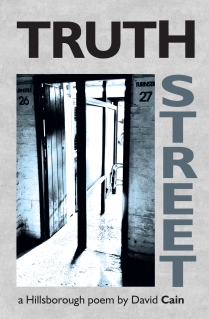
David Cain’s first book confronts its readers with questions about how we might witness traumatic events, about truth (and its distortion by the authorities and the media), about the language and forms of poetry. On 15 April 1989, during the opening minutes of the FA Cup semi-final between Nottingham Forest and Liverpool, 96 men, women and children died in what remains the most serious tragedy in UK sporting history: the Hillsborough Stadium disaster. Thousands more suffered physical injury and long-term psychological harm. For almost thirty years the survivors and the families of the dead had to campaign against the police, government and media who blamed the supporters for the tragedy. Eventually, in 2016 a second inquest ruled that the supporters were unlawfully killed due to failures of the police and ambulance services.
David Cain’s Hillsborough poem is dedicated to the 96 people who died and is wholly composed from testimonies heard at the inquest. Cain has said: “My ambition throughout has been for the work to listen to the resonances held in the collective memory of that fateful day, hear the poetry found in the hearts of the people who lived through this terrible experience, and try to weave these testimonies into a singular voice. Focusing on everyday life and language, grammar uncorrected, every line of the poem is drawn from over two hundred and sixty days of formal evidence.”
 Cain also cites the work of Charles Reznikioff and Svetlana Alexievich as models. The former, an Objectivist poet, developed work from court records and explored the experiences of immigrants, black people and the urban and rural poor in the United States in the late nineteenth and early twentieth centuries (Testimony, 1965). He went on to use a similar technique in Holocaust (1975), based on court testimony about Nazi death camps during World War II. Similarly, Svetlana Alexievich’s books trace the emotional history of the Soviet and post-Soviet experience through carefully constructed collages of interviews. Her work owes much to the ideas of Belarusian writer, Ales Adamovich, who felt that the best way to describe the horrors of the 20th century was not by creating fiction but through recording the testimonies of witnesses.
The colloquial plainness of the language (for the most part) of the Hillsborough testimonial material is clear from the start as the scene is set:
There was men, women, children.
There was lots of families there.
They were very happy.
Lots of people eating chips, milling around.
Many of the pieces have this same staccato rhythm, often end-stopped and Cain always lays out the lines with double spacing between. This works well. It gives the sometimes bland and cliched language a bit of the white space of poetry, giving the reader extra time and I think what we do with that time is add in our knowledge of the testimonial nature of what we are reading. These are not ‘composed’ words in the usual sense (about which we might quibble) but witness statements. Here are other lines before the tragedy unfolds:
I sat there reading my programme, mooching about.
Watching the world go by.
It was all happy.
It was a nice sunny day.
It’s an established cliché of (Romantic) poetic theory that people tend to reach for/create figurative language under pressure of emotional experience and that such moments make for powerful writing. In Cain’s edited versions this is borne out on some occasions. As the swelling crowd gathers outside the stadium, people are already being crushed against walls:
I ended up face blank stuck against the brick wall
A bit like rubbing yourself against a piece of solid sandpaper.
horrible sharp
nothing nice or rounded or polished
In another piece, the crowds now funnelling into the ground through the opened exit gates are described as “like sand into an egg timer”. Moments later, another witness struggled to describe fans now pouring onto the already crowded terrace:
The scene reminded me of pictures on television in the nature programmes.
Molten lava
Molten lava flowing down a hillside from an active volcano.
like a wave.
In this latter case, what is moving is less the image itself but the evident struggle to find a fitting comparison. The testimonies here tend to reach for cliché rather than startling figurative language but it is in the nature of the witnessing act that these are still deeply moving accounts in our awareness of their truth. (How often have we been told as writers that our self-conscious wish for novelty or reaching after effect is damaging to our work).

As the men, women and children are suddenly crushed into the barriers by the press of fans behind, any thoughts we might be having about modes of expression evaporate. Unnamed voices bear witness to events. A son tries to protect his father being crushed against the railings, cradling him against the pressure. But a surge means his arms buckle, he’s twisted to one side, no longer able to shield his father: “That is the last time I had my father alive”. Another voice ends up in the small gym beneath the stadium which is being used as a make-shift sanctuary for the dead and injured. Also there is a young St John’s Ambulance volunteer, “A young lass, 14 or 15, longish blonde hair”. The poor girl, while in shock herself, is trying to help those around her and the narrative voice is equally full of compassion for the girl: “I just put my arm round her and said, // ‘You’re a kid. // You should not be seeing this.’”
As much as the horror of broken bones, suffocation and trampled bodies, it’s these powerful acts of compassion – the wish to protect, to help, to shelter others and, when people are found to be already dead, to show them some respect –which are built through the sequence. They are contrasted with witness accounts of the slow, insensitive, sometimes appalling responses of the authorities. Though there are a few reports of “Police and fans alike” trying to help, these are outweighed by incompetence, lack of training and worse. The fans being crushed in the caged areas ought to have been released, the gates onto the pitch opened, but:
We hadn’t any instructions.
We turned and we tried to find out who’s got a key.
We were saying to the sergeant,
‘Who’s got a key?
Who’s got a key?’
For critical minutes, police regarded the event as a pitch invasion. Fans kicking down pitch-side billboards to use as improvised stretchers were threatened with arrest for vandalism. Later, as families were being asked to identify the dead, they were pulled back from any physical contact with the bodies: “’Sorry, he’s the property of the coroner now. // You can’t touch him’”.

While we probably feel for almost all those thrown into an utterly unprecedented situation – the poorly trained individual’s recourse to rigid protocols – Truth Street squarely blames the media and the higher ranks of police. The role of The Sun newspaper’s subsequent reporting is well known. One witness is haunted by the thought that his actions on the day – taking out a dead man’s wallet to lay it on him so that he can be identified – might have been misconstrued, or photographed, as him “looting the dead”. Later, the press pack burst into a room where relatives “are trying to find out what’s happening to [their] loved ones”. They want their scoop.
Equally shocking are the testimonies which show the police inquiry trying to establish a narrative of drunkenness and disorder amongst the fans. Even as a dead relative is identifying a body, “The very first question asked was what had I had to drink today”. Another statement-taking pursues the same line: “did I have owt to drink? // did I see any fighting? // did I see anybody drunk?” And as we now know, this line of inquiry, this cover-up, was sanctioned from the top. The section ‘Norman Bettison’ is an account given to the inquiry in which the then Chief Inspector admitted to being asked “to pull together the South Yorkshire Police evidence for the inquiry // and we’re going to try and concoct a story that all of the Liverpool fans were drunk”. This internal review group tried to control media coverage, producing a 30 minute film narrated by Bettison himself that was shown to MP’s, which reiterated the claims of drunk, violent and ticketless fans breaking down the turnstiles, causing the disaster.
 In fact – as Cain’s sequence shows – what was being covered up was the original decision of Chief Superintendent David Duckenfield to open the exit gates at 2.47pm. One of his officers spoke to the inquiry: “I was quite shocked // It was totally unprecedented. // It was something you just didn’t do”. This was what caused the inflow of fans – “like sand into an egg timer”. Only at the second inquiry, did Duckenfield revise his earlier false statements: “I didn’t say, // ‘I have authorised the opening of the gates’”.
Cain’s book ends with a roll call of the dead, giving their names and ages. He titles it, ‘Hold your head up high’ and is a good a way of concluding as any. But, immensely moving though the sequence is, I’m left with the desire for more. Such is the nature of this form of testimonial or witness account – there can be no natural ending point to such traumatic events. This is also why the opening of Truth Street feels very awkward – a scene is being set in the way (fiction) writer’s do. Reznikoff’s Testimony eventually grew to 500 pages over two volumes. Cain’s powerful work has been cut to the standard size of a volume of poetry. But its power is undeniable; in reviving, memorialising and bearing witness to individual Hillsborough voices, this book is a unique contribution to contemporary British poetry.
Two Ekphrastic Collections – David Pollard and Seamus Cashman
My earlier postings on ekphrastic poetry – poems inspired by visual art – have proved astonishingly popular and, when Agenda magazine asked me to review two collections with exclusively ekphrastic intentions, I leaped at the chance. I’m posting this now because the reviews have just appeared in the latest Agenda, a journal well-worth subscribing to. As will become clear, in what follows I am more persuaded by Seamus Cashman’s book, The Sistine Gaze (Salmon Poetry, 2015) than David Pollard’s Three Artists (Lapwing Publications, 2017). But both provide much food for thought on the relationship between poetry and the visual arts and evidently there are a lot of us fascinated by this sort of writing.
 David Pollard’s book is divided into three sections, one each on Parmigianino, Rembrandt and Caravaggio. Initially, Pollard presents a set of 15 self-declared “meditations” on a single work of art – Parmigianino’s ‘Self Portrait in a Convex Mirror’ (c. 1524). This is a bold move, given that John Ashbery did the same thing in 1974 and Pollard does explore ideas also found in Ashbery’s poem. Both writers are intrigued by a self-portrait painted onto a half-spherical, contoured surface to simulate a mirror such as was once used by barbers. The viewer gazes at an image of a mirror in which is reflected an image of the artist’s youthful and girlish face. It’s this sense of doubling images – an obvious questioning of what is real – that Pollard begins with. “You are a double-dealer” he declares, addressing the artist directly, though the language is quickly thickened and abstracted into a less than easy, philosophical, meditative style. It is the paradoxes that draw the poet: “you allow the doublings / inherent in your task to hide themselves / in open show, display art that / understands itself too well”. Indeed, this seems to be something of a definition of art for Pollard. “Let us be clear”, he says definitively, though the irony lies in the fact that such art asks questions about clarity precisely to destabilise it.
 The 15 meditations are in free verse, the line endings often destabilising the sense, and they are lightly punctuated when I could have done with more conventional punctuation given the complex, involuted style. Pollard also likes to double up phrases, his second attempt often shifting ground or seeming propelled more by sound than sense. This is what the blurb calls Pollard’s “dense and febrile language” and it is fully self-conscious. In meditation 15, he observes that the artist’s paint is really “composed of almost nothing like words / that in their vanishings leave somewhat / of their meaning” – a ‘somewhat’ that falls well short of anything definitive. Of course, this again echoes Ashbery and appeals to our (post-)modern sensibility. Pollard images such a sense of loss with “a rustle of leaves among the winds / of autumn blowing in circles / back into seasons of the turning world”. He does not possess Ashbery’s originality of image, as here deploying the cliched autumnal leaves and then echoing Eliot’s “still point of the turning world”. Indeed, many poems are frequently allusive (particularly of Shakespearean phrases, Keats coming a close second) and for me this does not really work, the phrases striking as undigested shorthand for things that ought to be more freshly said.
The Rembrandt poems have a similar tone and style, not surprisingly when most of the focus is again on the mirroring and self-reflection of his self-portraits: “Skin and paint are different stuffs / as he was a different species from himself / reflected”. Perhaps there is less playfulness here than in Parmigianino’s trompe l’oeuil image, more of an obvious darkness in the dusky, obscure backgrounds: “These images were born in thoughts of his departing / and in the horror of identity, of selves, of ruins”. Yet there is more variety of tone to be found in these poems as Pollard develops Rembrandt’s social context, his painting of pictures to please Amsterdam’s wealthy burghers and corporations, images of their self-importance for which they “paid him well”. Yet the artist himself was more interested in other, more liminal figures:
And just beyond the door, always ajar,
there in the street canal side,
in a swift moment are his old hags
and poverty and Christ, the Jews
in fur and black passed down the ages,
too many beggars and those copulating dogs
and then again wives and washerwomen

The final Caravaggio section of this book makes different ekphrastic choices. Pollard allows the ageing artist a direct voice in one poem, then considers 7 individual images in separate poems, then concludes again with something close to a ‘meditation’. Hearing Caravaggio speak (in ‘Porto Ercole’) is a refreshing change to Pollard’s own rather too-consistent, sometimes haranguing voice. The artist is sailing to Rome, hoping to escape a death sentence, fretting about what he has achieved: “I am only spine and marrow of regret / and last prayers flail along my throat / and my weak blood is darker / than those holy tenebrae I drew art from”. Elsewhere we hear of the artist’s earlier life, hawking more conventional images on Rome’s street corners. Those familiar with Caravaggio will know what to expect: the play of light out of thick slabs of shadow and “[p]lain speech not mannered rhetoric”. Such a visual ‘plain speech’ is well described in ‘The Entombment’ with Christ’s “liminal grey flesh / full of the pure weight of the physicality of loss”. Also, in ‘The Rising of Lazarus’, it is suggested that Caravaggio employed grave robbers to “drag a grave” for a real, decaying corpse since “he only painted from grit and real”. The language here has some energy, but I doubt its precision in such choices as “drag” and “grit” – the former tries too hard, the latter not hard enough. Pollard’s liking for abstraction can also be harmful as in these final lines on Caravaggio, which leave me puzzling, though not in any good way:
Thus it can show only how
the insignificance of objects
waits for it, accepts it,
and then drowns in its almost too late a dusk
and ochre of our being
hewn out of nothing more than the liquidity
that holds invisibility at bay against oblivion.

In contrast to Pollard, Seamus Cashman lets us partake of the very moment when his single long poem began. Re-visiting the Sistine Chapel, we are told his eyes fall on a painted figure in a white, pseudo-architectural, triangular frame – a woman in a green jacket. He goes on: “Her eyes hold mine, and the word ‘gaze’ slips into my mind. As I stare she seems to invite me to converse”. The resulting ‘conversation’ is the extraordinarily ambitious poem that follows, drawing on Michelangelo’s work on the ceiling of the Chapel (completed in 1512) and the altar wall (completed 1541). This admittedly touristic, but originating moment is poetically recast in Cashman’s Prologue as an epiphanic encounter: “This face centres a still point, draws me up and in. She is waiting. I attend”.
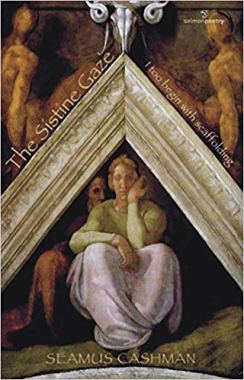 In fact, the woman is hardly given a voice and the substance of the sequence is dominated by the (male) artist’s reflections on his years-long task. He’s most often found “between this scaffold floor and ceiling”, complaining about his “craned neck”, pouring plaster, crushing pigments, enumerating at great length the qualities and shades of the paint he employs (Cashman risking an odd parody of a Dulux colour chart at times – “Variety is my clarity, / purity my colour power”). Later, we hear him complaining the plaster will not dry in the cold winter months. We even hear the artist reflecting on his own features, the famous “long white beard and beak-like nose”. These period and technical details work well, but Cashman’s Michelangelo sometimes also shades interestingly into a more future-aware voice, melding – I think – with the poet’s own voice. So he remarks: “Getting lost is not a condition men like me endure or venture on today. / All GPS and mobile interlinks enmesh our every step”. Later, a list of “everything there is” sweepingly includes “chair, man, woman; laptop or confession box”.
At one point, Michelangelo recalls working on a great marble block that fell and shattered, “bartering monumentalities / that break backs”. And I do worry that the sheer ambition of this project has led to awkward monumentalities in the texture of Cashman’s verse. He surrounds his poems with thickets of rubric. So on page 31, the reader is told that she is about to begin Book 1, called ‘Creation’, this being Part II, called ‘In the Mirror of Creation’s Dust’ and that this book consists of Verses 65-117 and that, firstly, comes Movement 9 (which runs from verses 65-67) and that the opening passage has been given the title ‘Convinced we are awake’. This gives the whole thing a clunky, pseudo-scriptural quality which (on my reading) doesn’t really fit with Cashman’s overall purpose and its enumerative, even obsessive titling and sub-titling certainly and frequently derailed this reader’s imaginative and emotional engagement with the poems. I suspect this decision arose as a response to the sheer fecundity, the multifarious nature, of Michelangelo’s Sistine work. It may also account for Cashman’s frequently rather grandiose register, his occasional drifts into archaism, the ubiquity of rhetorical gestures like lists of three (or even four) and the self-conscious habit of using nouns as verbs (thigh, sex, tray, story).
But as a result, Cashman’s verse has a Whitmanesque quality (the long lines) and can bring to mind Blake’s Prophetic Books; it has dashes of Hopkins’ alliterative energy. At one point the voice wants “to sing. I want to sing the body tune, / the rhythms of blood, the living heart” but I found myself wishing for a little less such effortful transcendence and a more Traherne-like, child-like, simplicity of diction which is still capable of conveying what Michelangelo declares, at a late stage, that “our instinct is infinity”. This might also sit more comfortably with Cashman’s Michelangelo’s intentions which seem to be to give “hope to some pilgrim searching my cabinet for direction and new ritual”. I think we are meant to see Cashman himself as this “pilgrim”, a latter-man, having lost his Catholic beliefs, but visiting the Chapel in search of a new vision.
Certainly, the Michelangelo-voice does not seem to be speaking of his works in a confined 16th century fashion as art in praise of God. More like a modern poet, he says “all we need / are words of admiration drafted with compassion for the flesh and bone we are”. Later, reflecting on the nature of the human self, he describes it as a “mobile installation, unfixed and indeterminate [. . .] emotion in the making”. Many verses in the poem celebrate the sexuality of “Eve ‘n Adam—penetration – vulva open to erection; risen nipples; hanging scrotum; nosing cheeks / all the open flesh and pleasured nerve-ends”. And alongside this, the poem works towards a modern – or perhaps it’s a Blakean – godless vision of human life where “heaven is adoration of knowledge, and god is who we know ourselves to be”.
Curious and bold then, that Cashman ekphrastically takes on the Sistine Chapel and then writes God out of the picture. Nor does he shrink from the shelf-clearing consequences for our conventional spiritual understanding. The idea of the “Soul” is now little more than a “word. It frightens children and old painter sculptors weakened by the weight of brush and mallet. Soul. / Nothing knows its place”. Likewise, The Sistine Gaze concludes its frequent lauding of human sexuality with a recognition of the plain fact of its opposite, death: “this finality, expired into a nothingness we each possess. Dead is dead”. Even the genius-artist himself is finally and ironically “absorbed in the great womb of chaos he created / leaving us to falter, wonder, and pass on / for we know nothing”. These lines are some of the concluding moments of the book and they possess a lighter touch than the majority of it. Cashman here allows the white space around his printed words to work its magic more effectively, creating a rhythm and a chain-link of tensions which add to the reader’s experience. For all its intended monumentality and dizzying ambition (which has led the poet to erect too much scaffolding around his poems), this quiet end-piece is for me the most affecting moment of the whole book: “our end is an endless breath / to fill – to vitalise / and imperceptibly / to let go— / never to know”.
A Workshop with John Keats
If you ask them, most teachers are very happy, occasionally, to replace their usual mask with the one of an eager student. I don’t often get to participate in writing workshops as a consumer, but when I do it’s always fascinating. For the last one I took part in, I chose it because of its intriguing promise to use Shakespeare’s work as its starting point. Last weekend I was drawn to Amy E. Weldon’s workshop at Keats House which promised to do the same with Keats’ work.

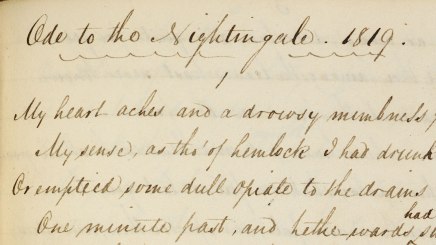
This event was part of Keats House’s bicentenary celebrations and a dozen of us gathered in the atmospheric Chester Room on a sunny day (Keats gazing down at us from Joseph Severn’s painting on the wall). Amy Weldon – a Professor of English at Luther College, USA, whose book on creative writing has recently been published by Bloomsbury – was very good at reminding us of the presence of ‘Brother John’ in the surrounding fabric of the house and its beautiful gardens, where he wrote his ‘Ode to a Nightingale’. Probably no-one there – teachers, journalists, writers of poetry and teen fiction, autodidacts – really needed it, but she also kicked off with an enthusiastic reminder of the importance of “books and ideas”. And it was a number of Keats’ own ideas – as expressed in his letters – that we discussed first of all.
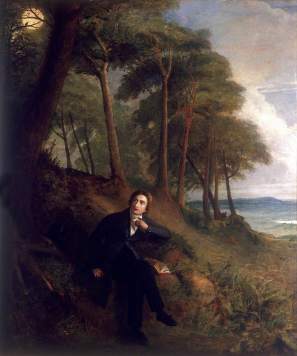
I’ve written elsewhere on this blog about the importance of Keats’ ideas for my own work and it powerfully struck me again, joining Amy and the other workshoppers in considering them, how coherent they are, despite being expressed and developed in scrawled letter form over a period of 2 or 3 years. From his ‘taking part’ in the sparrow’s existence, or that of the stoat or field-mouse, to the belief that poetry ought not to startle or amaze with itself (but with its subject), to his understanding that “extensive knowledge” is what gives a writer the kind of shoulders that are sufficiently “fledged” to enable creative flight, to his brilliant, improvised description of the gathering of such knowledge in the letter written in Spring 1819. The latter is the vale of soul-making letter to his brother George in which our identity (Keats’ word is ‘Soul’) is accumulated/created through the heart’s emotional encounters with the world. Without such encounters – the sparrow, the stoat and field-mouse, and this is what he means by extensive knowledge, we must extend ourselves in such encounters with the Other – we are not able to suck an Identity from experience and – like children who die tragically young – we have had “no time to learn of, and be altered by, the heart”.
Such encounters – vigorously and passionately advocated by the workshop leader – formed the basis for the creative side of the rest of the day. We were sent outside to roam around the garden in search of sensory images, in particular, the May-time flowers in their blooming colours and scents, the birdsong, the noise of traffic or quiet conversations of other visitors, the smooth or veined surface of leaves, the rough gravel paths. On the day, I didn’t taste anything myself – perhaps others successfully used all five senses! We jotted as if our lives depended on it – the task made easier by Amy’s insistence on the messiness of writers’ notebooks, on the provisional nature of whatever it was we were writing.
Amy’s approach on this occasion was to direct us towards fairly openly/widely-defined tasks – as in this first one – rather than setting out a framework within which to work. Such frameworks might be formal or linguistic (repetitions, the use of particular words and so on) or models derived from other writers and can often lead workshop participants towards experimenting, bumping us out of our usual modes, forms and tones. Nevertheless, we all returned from the task with plenty of notes and – for those who attend such events – Amy’s suggestions as to next steps were familiar enough. Circle the “interesting” moments in what you have written down (interesting here is wholly self-defined). Find and remove editorial (directive) words like ‘beautiful’. These latter tend to be adjectives and adverbs and, if not removed, they were to be replaced with more directly sensory words – so not ‘beautiful’ but ‘lime green’. Another suggestion – which I found very difficult to put into practice – was to remove all words of more than one syllable. But you can see the direction of travel here: the valuing of plainness and the directness of sensory experience over anything close to judgment or the writer looking to ‘persuade’ the reader.
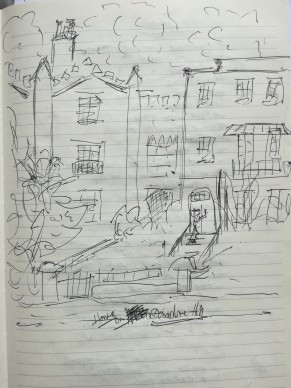
During lunchtime – apart from feeding and drinking – our tasks were to make a list of ten things we “noticed” and to actually make an attempt to draw one thing. In each case – Amy was always clear on this – anything was to be grist for the mill, so we had to resist bringing in censorship or evaluation: two people wearing identical hats; the type of cakes on sale down the road; overheard comments from passers-by; what they were promoting at Keats Pharmacy near the station. I drew a house on Devonshire Hill. Very badly.
Once we’d gathered again, Amy quoted John Ruskin on the value of drawing, I think to the effect that even writers ought to try to draw as in doing so they begin to see more “brutally” or clearly. I can’t find the actual quote itself but, having drawn my house on Devonshire Hill, I can testify that he’s right. It makes you look first – language comes second. However dismal the results, I’ll try drawing again. We also shared some of our ten observations – though interestingly neither the observations nor the drawings were developed any further on this occasion.

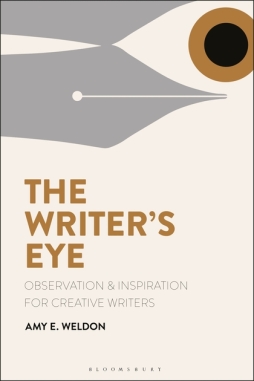
Instead we read an extract from Amy’s book, The Writer’s Eye. The extract suggested that an ‘image’ is a mental picture (probably from the past) that releases emotions into your mind in the same way as a bunch of mint leaves from a garden releases flavour and colour when steeped in water (good image). These sorts of mental images can be starting points for poems or stories – much more so than (the common colloquialism of) starting with an ‘idea’. The latter tend to be dead, whereas the ‘image’ is by definition enlivened with emotions. So our next task was to find such an image in ourselves and to write on it (again our instructions were open as opposed to delimited or framed). Later we had the chance to re-cast what we had written – perhaps re-starting from ‘interesting’ things we had again circled ourselves.
There had so far been no reading round of anything we’d written (apart from some of the 10 things observed over lunchtime). Eventually, we were put into pairs to give some feedback on the final piece written, now read aloud. Amy’s instructions here were interesting. The listener was only to offer two types of comment. The more positive one was in the form of ‘More like this’. And to express reservations, rather than ‘I don’t like this’ or ‘I don’t get this’, we were to say simply, ‘This stops me’. I thought both these formulations worked well and I would use them again.

It was a good day and I’m sure we all came away with several pages of material to work on. One of Amy’s stories stuck in my mind and, though about a prose writer, is applicable to poetry too. A friend of hers goes to a burger joint. Over the grill, with his back to the customers, the owner is flipping burgers, not looking round. The friend gives his order. Still the guy goes on flipping burgers, not looking round, not responding. After a moment or two, the friend orders again, verbatim, just to be clear what he wants, perhaps just a little louder. Still without turning round, the owner says simply: ‘Yuh said that already’. The writer friend, I presume, did get his burger, but he also came away with the guy’s phrase as a memorable maxim for those of us who write, then out of our anxiety to communicate, to be understood, write it again: ‘Yuh said that already’. Time to pick up your editing pen . . .
‘The Water’s Music’ as poem and Slow Radio
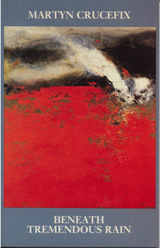
I was taken by surprise last week when BBC Radio Three contacted me to let me know that a line of poetry from a piece I’d published in Beneath Tremendous Rain back in 1990 has been used as the starting point for a Slow Radio programme, broadcast on the 17th May 2019, but available here for a month or so.
The connection was radio producer, Julian May, who I have worked with on several BBC radio programmes over the years. If you follow the link above, you’ll see Julian was responding to the opening two lines of the sequence of four poems which I will post in full below. His aim was to create a piece – ‘The Water’s Music’ – from recordings of the natural world.
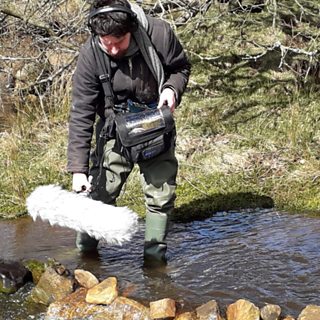
Do listen to the programme – it’s just 30 minutes in length and the first half of it consists of Julian and the sound artist and musician, Tim Shaw, splashing about in a Northumbrian burn to record the astonishing variety of sounds produced by it. This is all a little bit bonkers, of course, but the sense of the great outdoors, the evocation of the water’s flow – beside, across, above and below – is marvellous, and does what Slow Radio often does, opening out the listeners’ sensibility in a playful, vivid and open-ended fashion.
The final, edited piece begins at 15.30 if you wanted to listen to that bit alone. I found it curiously moving that a thought – and a form of words I had in mind so many years back – has now been given aural form. The ‘music’ is also brilliantly in keeping with the poem. As you’ll see below, the epigraph is a quote from Marc Chagall, putting a premium on fluidity as opposed to precision and the idea that the artist/writer’s role is to approach something which is really inexpressible is a core belief that has remained with me over the years. The culmination of this view of art (I can now see) is my version of the great Ancient Chinese classic text the Daodejing which I published with Enitharmon in 2016.
As expressed in the poem, water still remains a god for me – I can never pass a fishmonger’s stall without stopping to gaze at the “wealth of silver”. The interesting graveyard inscription in the second poem (“Your ship, my love, is now mored / hed and starn for a fuldiew”) seems to be there to represent the fixity that all the images of water are in contrast to. Its words still affect me greatly: the lover’s desire for the permanence of what is quintessentially human being gradually eroded by the rain and the years. I will have had Thomas Hardy partly in mind, I’m sure, although the inscription I think is probably one I saw in Ireland many years ago.

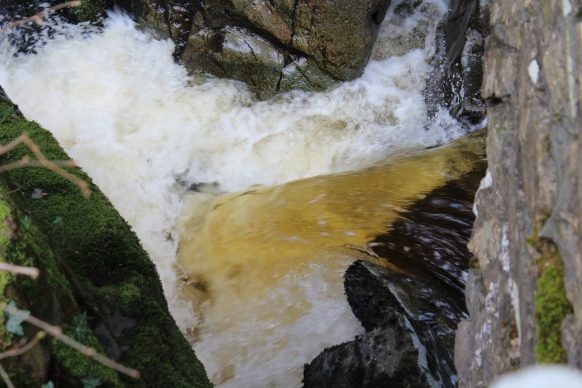
The third poem contains memories of the Canary Islands – the island of Gomera, much more of a tourist haunt now than it was back then – and of the English Lakes in the fictional waterfall of Swirl Force, surely a version of the (again much-visited) Aira Force, beside Ullswater Lake (the same lake that recently featured in the concluding poems of my blog-posted but as yet unpublished sequence ‘Works and Days of Division).
I’m now amazed at how ‘Daoist’ the fourth and closing poem seems. It is a shock – largely in the sense that perhaps one keeps on re-writing the same poem for a lifetime. The concluding lines certainly express a great deal about how I’ve viewed poetry in the ensuing years – a grasping towards something which I know will always remain elusive; but achieved only through language – that monument to the human wish for and effort to achieve greater control and precision – can something of the fluidity of what is real be evoked: “I carry something of water / that in my hands must leak away – see / its silver threads ceaselessly falling.”
Here’s the poem in full:
Water Music
Divine fluidity, now that is truly precise – Marc Chagall
1.
I am a potter whose habitation
is beside the water’s music.
Its glittering’s, its clear truckling’s
endless fascination for me
might be the pull of like to like,
the riptides and rivers of my
almost nothing but water body.
Someone has said it’s the lure
of oblivion, pressing me to bow
and snort the sharp stunning solid
of water into my head,
that with a brief flickering
of its long-fixed content
would scour my mind clean forever.
Perhaps. Or something still
unevolved, still amphibian, wanting
to be rid of this self-consciousness
that cripples me – to shiver
a moment with mother-of-pearl,
folding of currents, sands, slime,
the swordfight of refracted rays.
At least I know my fascination
for the fishmonger’s wealth of silver,
that he is a diversion I often make,
though I cannot catch
any message his charges bring.
2.
Water has always been a god.
I fell in love with it as a boy,
would sit close by with the dusk,
determined to hook from it specimens
and secrets, calling to it
with words I’d let no adult hear.
Its glassy voices broke out
though too obscurely for a reply.
On the flaming beach at Thalassa,
where the crumbling glint of waves
marks the sea’s edge, I once
wanted to meet it open-mouthed,
though not driven by any love
of the cold confines of the drowned.
I hoped that I might simply
receive the unbounded horizon.
At the graveyard there is a stone
set by a girl for her dead sailor:
Your ship, my love, is now mored
hed and starn for a fuldiew.
Below, the etched ship is lashed hard
to the quay – all else has grown
too old and faint to be understood.
The rain is rubbing her words away.
3.
Then it’s everywhere with beauty,
at one with the darkness and moonlight
of the old poets for it transports us.
But I’ve seen it bending an iron bar.
The quiet cowl of October’s fog confuses,
comes to question the formulations
we keep – like the traveler who told me:
the hills of Gomera disappear for days
till the rain washes its own window clear.
At Swirl Force, under whitening hammers
of waterfall, everything is broken loose
and then the clouds’ anchors are weighed
and the dance starts up over the water:
every swollen-cheeked changeling face
stares at itself and floats away
with its glimpse on the heart of things.
4.
In my coercive dreams, there I am
pouring water into every available bowl
and setting them down as finished works.
I will have things as I want them,
though it is clear from whatever place
the water comes the bowls suffice –
though set to the river, their contents
fly to its night, are lost completely.
The river takes all that comes.
The river gives all that there is.
For I am a potter whose habitation
is beside the water’s music, who is
driven to his creations just as
the river is to its own. When I clasp
the rounded belly of a brimming bowl
I carry something of water
that in my hands must leak away – see
its silver threads ceaselessly falling.
‘Sis, you gotta let go’: on Mona Arshi’s ‘Dear Big Gods’
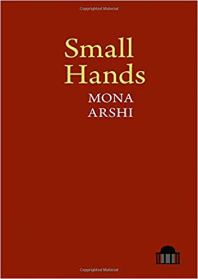
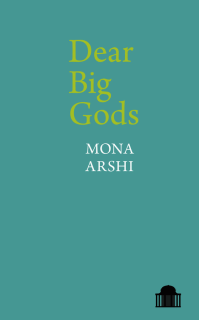 In a recent launch reading for her second collection, Dear Big Gods (Pavilion Poetry/Liverpool University Press, 2019), Mona Arshi suggested it was a book she wrote only reluctantly. Her first book, Small Hands (2015), had at its centre a number of poems in memory of her brother, Deepak, who died unexpectedly in 2012. On her own admission, these new poems continue to be imbued with this grief and – though poets surely always write the book that needs to be written – there is a sense that the development of the new work has been stalled by such powerful feelings. My 2015 review of Small Hands saw Arshi as “an intriguing writer, potentially a unique voice if she can achieve the right distance between herself and her powerful formative influences”. The influences I had in mind then were literary rather than personal, but I find the lack of distance travelled between the earlier and this more recent work rather disappointing.
In fact, Deepak’s death is the explicit subject on only a few occasions. The poem ‘When your Brother Steps into your Piccadilly, West Bound Train Carriage’ isn’t much longer than its own title but it evokes that familiar sense of (mis-)seeing our dead in a public place. The emotions remain raw, from the accusatory “how-the-fuck-could-you?” to the final “I am sorry, I’m so sorry”. A dream or daydream meeting is also the basis for ‘A Pear from the Afterlife’ in which the brother’s affectionate tone advises, “Sis, you gotta let go / of this idea of definitive knowledge”. ‘Five Year Update’ is by far the most extended of these reflections on the brother’s passing, written in very long raking lines (rotated 45 degrees to stretch vertically on the page). “I hope it’s fine to contact you”, it opens and goes on to recall the moment the news of his death was received (see also ‘Phone Call on a Train Journey’ from Small Hands), remembers their childhood together and the sister’s continuing life: “I’ve gone down one lump not two, I still don’t swim and yes I still can’t / take a photograph”.
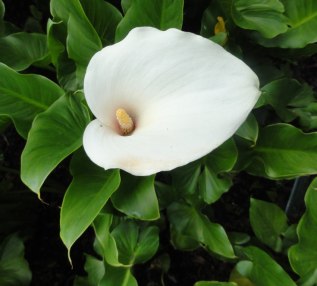 As the blurb suggests, these poems are indeed “lyrical and exact exploration[s] of the aftershocks of grief”. But ‘Everywhere’ adopts a little more distance and develops the kind of floating and delicate lyricism that Arshi does so well. The absent brother/uncle is still alluded to: “We tell the children, we should not / look for him. He is everywhere”. As that final phrase suggests, the rawness of the grief is being transmuted into a sense of otherness, beyond the quotidian and material. It’s when Arshi takes her brother’s advice and lets go of “definitive knowledge” that her poems promise so much. ‘Little Prayer’ might be spoken by the dead or the living, left abandoned, but either way it argues a stoical resistance: “I am still here // hunkered down”. In a more conventional mode, ‘The Lilies’ develops the objective correlative of the flowers suffering from blight as an image of a spoliation that hurts and reminds, yet is allowed to persist: “I let them live on / beauty-drained / in their altar beds”.
Like so many first books, Small Hands experimented with various poetical forms. This book also – a bit wilfully – tries out tanka, poems in two columns, right justification, centre justification, ghazals, inter-cut texts, prose poems, a sestina, an Emily Dickinson parody and responses to Lorca and The Mahabharata. They don’t all work equally well and Arshi perhaps senses this in lines like these:
My little bastard verses
tiny polyglot faces
how light you are
how virtually weightless
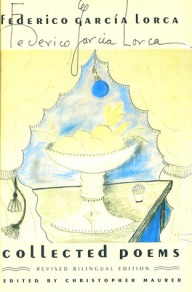
The irony may be that this sort of form and reach actually does show Arshi at her best. The sequence of tiny poems modelled on Lorca’s ‘Mirror Suite’ (1921-1923) is fascinating. Jerome Rothenburg, discussing Lorca’s poems, describes them as possessing “a coolness & (sometimes) quirkiness, a playfulness of mind & music that I found instantly attractive”. These same qualities – as with Lorca, a version of surrealism, a firm but gentle turning aside from “definitive knowledge” – I enjoy in Arshi’s work as she explores states of the heart and realms of knowledge not ordinarily encountered or encompassed. Dear Big Gods contains other such Lorca-esque sequences such as ‘Autumn Epistles’, ‘Grief Holds a Cup of Tea’ and ‘Let the Parts of the Flower Speak’ and these are far more interesting than the poems drawn from The Mahabharata or the experiments in prose.
 Arshi’s continuing love affair with ghazals also seems to me to be an aspect of this same search for a form that holds both the connected and the stand-alone in a creative tension. ‘Ghazal: Darkness’ is very successful with the second line of each couplet returning to the refrain word, “darkness”, while the connective tissue of the poem allows a roaming through woods, soil, mushrooms and a mother’s praise of her daughters. Poems based on – or at least with the qualities of – dreams also stand out. The doctor in ‘Delivery Room’ asks the mother in the midst of her contractions, “Do you prefer the geometric or lyrical approach?” In ‘The Sisters’ the narrator dreams of “all the sisters I never had” and within 10 lines Arshi has expressed complex yearnings about loneliness and protectiveness in relation to siblings and self.
Given the traumatic disruption of her own, it’s no surprise that Arshi’s most frequently visited subject area is family relationships. I’ve referred to several of these poems already and ‘Gloaming’ floats freely through the fears of losing a child, the care of an ageing father, a mother “entering/leaving through a narrow lintel” and the recall of the “thick soup of our childhood”. The soup works well both as literal food stuff and as metaphor for the nourishing, warming milieu of an up-bringing, though the girl who looks up at the end of the poem is already exploring questions of identity. She asks, “where are you from, what country are we in?” Given Arshi’s own background – born to Punjabi Sikh parents in West London – such questions have obvious autobiographical and political relevance, though I sense Arshi herself is also asking questions of a more spiritual nature.
 So, in ‘My Third Eye’, the narrator is “more perplexed than annoyed” that her own third eye – the mystical and esoteric belief in a speculative, spiritual perception – has not yet “opened”. The poem’s mode and tone is comic for the most part; there is a childish impatience in the voice, asking “Am I not as worthy as the buffalo, the ferryman, / the cook and the Dalit?”. But in the final lines, the holy man she visits is given more gravitas. He touches the narrator’s head “and with that my eyes suddenly watered, widened and / he sent me on my way as I was forever open open open”. The book also closes with the title poem, ‘Dear Big Gods’, which takes the form of a prayer: “all you have to do / is show yourself”, it pleads. The delicate probing of Arshi’s best poems, their stretching of perception and openness to unusual states of emotion are driven by this sort of spiritual quest. Personal tragedy has no doubt fed this creative drive but – as the poet seems to be aware – such grief is only an aspect of her vision and not the whole of it.
 Martyn Crucefix