‘Muzzle’ – a new poem for the New Year

Happy New Year to all of you. We are hoping for the best aren’t we? Come rain, shine or named storm, the poems go on, saying something at least for the individual, the social, for careful consideration of the world out there, the world in here, and the languages we use. I’m posting a poem which has just appeared on New Year’s Day at the excellent Modron Magazine, its strap line is ‘Writing on Nature and the Ecological Crisis’. Glyn F Edwards also interviewed me about the making of the poem and I’ll post the text of that below, along with the link to Modron. Do go and take a good look at what other work they have put up in this new Issue 5. And then subscribe to them. My poem is weirdly formatted – so here is an image of it, lacking its title which is: ‘Muzzle’
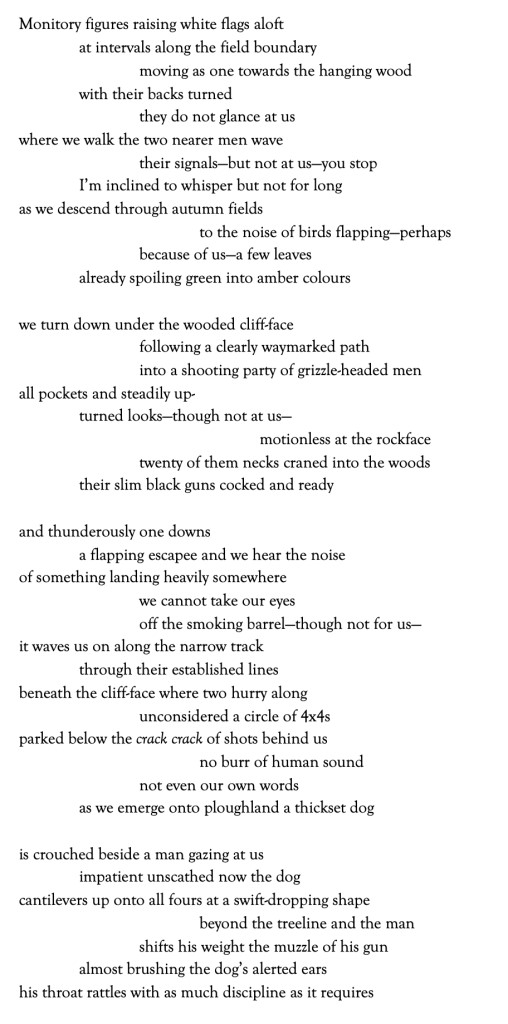
On the Writing of ‘Muzzle’

MC: It’s so interesting to be encouraged to look back at the process of writing a poem. I seldom do it (I suspect I’m not alone), forever rushing on to the next ‘best’ thing (we think, we hope). In looking back at ‘Muzzle’ (I find I have the very first draft and several subsequent ones) two things strike me: that it took so long to get to a ‘finish’, and that I’d forgotten how important the context of the poem was to what it might be expressing.

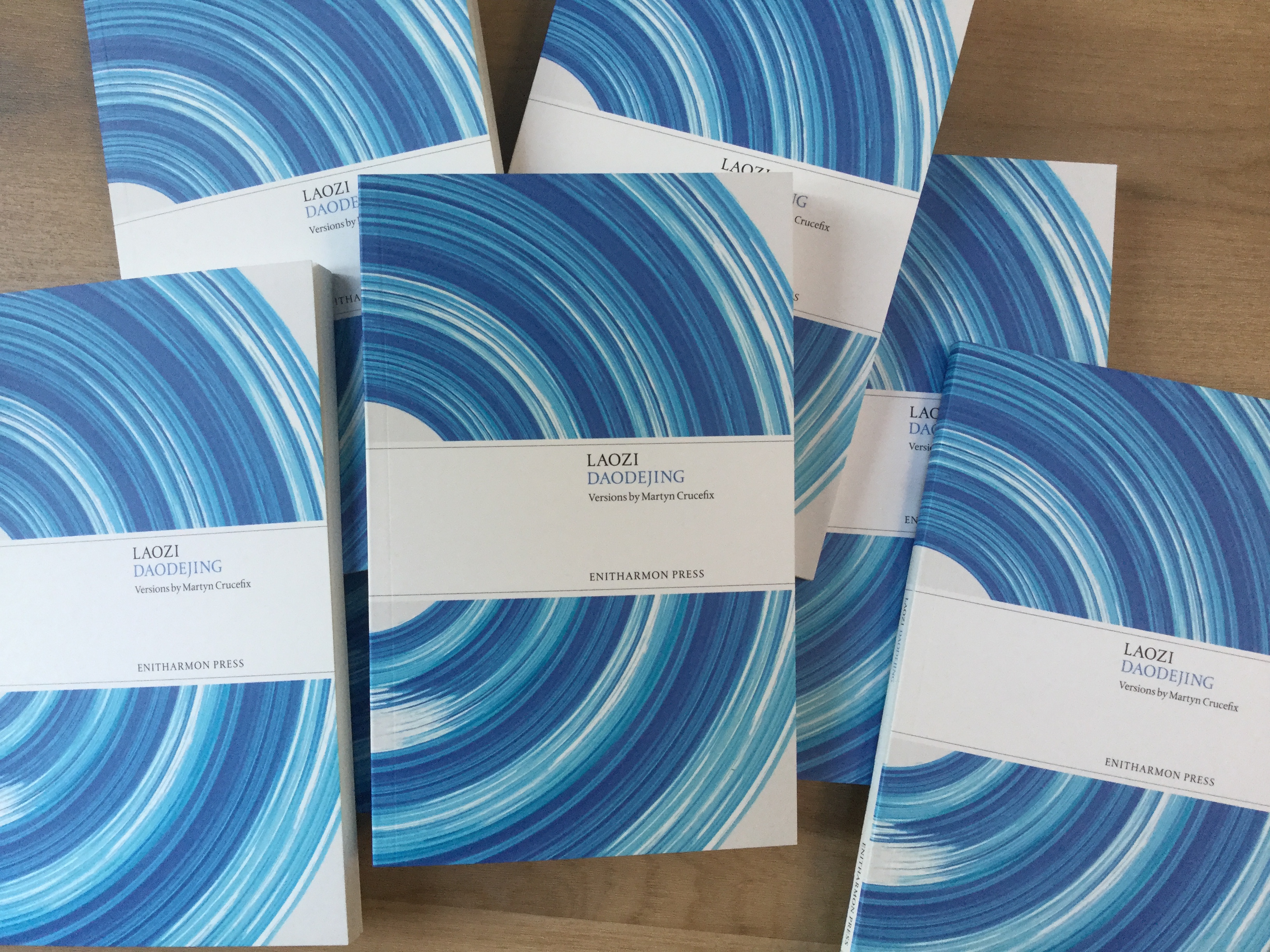
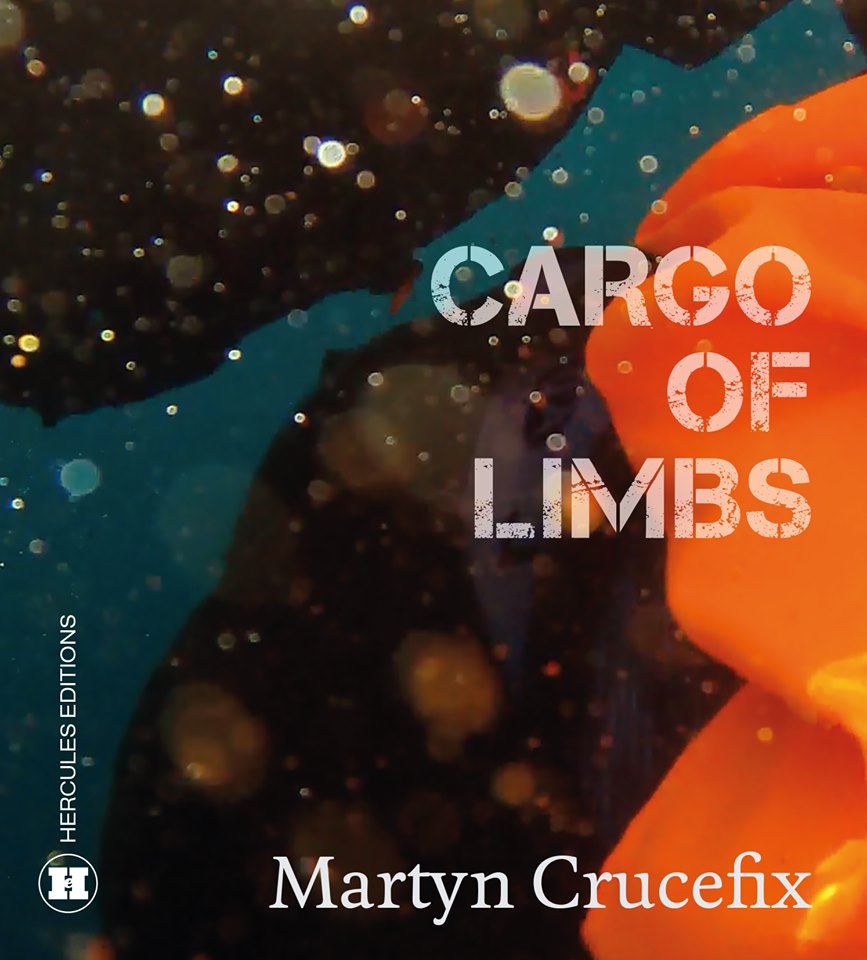
The first draft was scribbled in a notebook in the autumn of 2016. Earlier in the same notebook, I was sketching out thoughts on my, then, just-published version of the classic Chinese poems, the Daodejing (Enitharmon, 2016), preparing for readings I was to give from the book. Elsewhere there are fragments about my parents’ growing difficulties at home and (later) in their care home, plus some quite late drafts of the longish poem about the plight of refugees in the Mediterranean which was published as Cargo of Limbs (Hercules, 2019), and even first drafts of the poems which have eventually come to make up my most recent collection, Between a Drowning Man (Salt, 2023). Remember, the Brexit referendum took place in June 2016 and if there is an idea that links all these differing creative endeavours (including ‘Muzzle’) it is the idea of ‘division’.

Q1 – Only with the word ‘dog’ at the end of the third stanza does the reader gain a semantic connection to the ‘Muzzle’ in the title of the poem. Of course, Chekhov’s gun was ‘cocked’ all along, and the ‘muzzle’ becomes the open end of a weapon where a bullet escapes. Can you explain a little more of the rationale for this subtle title? 

MC: To my surprise, I find, the first draft has no ‘muzzle’ mentioned in it at all. But the shape and a lot of the substance of the finished poem is already there: the flag-waving men during an idyllic autumn walk (on the Sussex Downs, as far as I remember), the shooting party, even the man and his dog at the end of the poem. The muzzle of a ‘smoking gun’ is clearly implied but the final dog’s muzzle does not make an appearance till quite late (I mean 2020 or so!). In fact, in the first draft I clearly don’t know how to end the poem. There, the walking couple emerge from the wood ‘unscathed’, the dog in the field grows tense, and there’s a sense of the man’s day being ‘interrupted’ by the couple. But these final 5 lines are crossed through. In the later draft, the dog now ‘cantilevers up’ onto all fours (the mechanisation of the creature is part of the male group’s malign influence in my mind) – but still no muzzle as such. That only comes via a reference to the man’s gun and, with its proximity to the dog’s head and ears, there is a transference of the word/idea to the dog itself. I’m pretty sure it wasn’t till this point that I thought of calling the poem ‘Muzzle’ and that I also wanted the word to apply to the walking couple who have been (by the experience, by their apprehension, if not their genuine fear) muted or muzzled themselves. The idea was actually there early on; the first draft briefly sketched in, ‘no human voice we do not talk’.

Q2 – The refrain ‘not at us’ is repeated, and echoes again in ‘not for us’ – amongst the ‘white flags’, and the reassurances of safety, there appears a growing threat to the speaker. The reader is left with the feeling that somehow this danger extends beyond the shooting party, and beyond bloodsports. Did you seek for the poem to act as a wider allegorical foreboding, and, if so, would you elaborate on the metaphor? 

MC: Yes, the ‘not at us’ phrase or versions of it are already in the first draft, indeed on four occasions. This is one of the main sources of the idea of ‘division’ in the poem. It’s a simple ‘us’ and ‘them’ situation. The white flags – I think these would simply be the shooting-party’s beaters’ flags being waved to move the birds across the field into the woods, or possibly they are genuinely ‘monitory’ (meaning simply to warn or admonish), but in being white they also have (ironic) resonances of surrender (these guys were not going to surrender anything). The repeating phrase emphasises the gulf between the two elements of the encounter and particularly the sense (clear on the actual occasion) that those holding guns did not seem much concerned that unsuspecting, endangered walkers might be near at hand. We felt ignored; they seemed not to look at us. Being England, there is a strong class element here, which does not map easily onto the question of the voting intentions by class in the Brexit referendum, but factions on all sides seemed not to be paying much attention to any other. The devastating Tory defeat of 2024 should be regarded as reflecting much of this: eventually the country at large felt those in government were simply not paying any attention ‘to us’. I’ve always been pleased with the adjective ‘established’ to describe the shooting-party’s positioning, their being arrayed as the ‘establishment’. The finished poem ends ambivalently. The walking couple escape the shooting-party but are faced with another threatening situation: the gun, the dog. The ‘guard-like’ posture now puts me in mind of prison camp patrols the world over and I’d be happy for readers to get there too: there is a policing of freedoms going on here, a sliding scale from rural pastimes, to political enforcement, to genocidal pograms.

Q3 – ‘Muzzle’ zigzags, indents, retraces its steps. Some stanzas loop longer, and when the final sestet ends abruptly, without full stop, the reader becomes aware of the absence of punctuation throughout. You have a very idiosyncratic approach to presenting and punctuating the poem – could you share your intentions in this poem, and elaborate on whether these ally or counter your conventional style?

MC: The final form of the poem – which you describe so well – came very late. Most often my poems ‘find’ their own form – they don’t begin with any sense of the shape they will eventually take. The 2020 draft was coming out in tercets and I remember liking the ‘walking pace’, step by step, which that shape suggested. But in the end I wanted the poem to be more radical, to suggest a sense of freedom (in contrast to what is felt by the couple during the incident), a freedom to roam as it were, for lines to wander across the page and back again, while also acknowledging that this meandering might well yield some uneasiness in the reader (where’s he going?!). Both freedom and anxiety would be appropriate here. The form and the absence of punctuation (the latter I have been working with for several years now) are intended to generate some ambiguity. For example, I’m hoping for a fluidity in the opening lines, with the putative subject or focus being the flag-waving men, eliding to the walking couple – the ‘you’, then the ‘I’ – the birds, the leaves turning, finally to the ‘grizzle-headed men’. Within this fluency, a bit later, I want several adjectives to be hovering between subjects. The word ‘unconsidered’ floats between the lack of consideration given to the couple and the waiting circle of parked cars. Similarly, ‘impatient unscathed’ buzzes between the couple (again) and the waiting man and dog. This culminates in the rattling throat in the final line which (I want) to be as much about the man as the dog itself and so the ‘discipline’ demanded of the situation ought to be seen as human as much as canine. I guess I’m trying for fertile ambiguities, trying to suggest two things at once. The opening of the Daodejing says: ‘the path I can put a name to / cannot take me the whole way’ (my version).

Q4 – The shooting party negatively influences their surroundings, their presence ‘Hanging’ and ‘spoiling’ the woods, and the walk of the speaker. How much familiarity do you have with these ‘grizzle-headed men’, and do any occasions, such as the one in ‘Muzzle’ stand out as memorable, or significant? 

MC: As you suggest, I have allowed the shooting-party to be, and remain, those wearing the black hats. More often than not I feel the need, the wish, to revisit such emphatic designations: what’s to be said ‘on the other hand’ (ever the wishy-washy liberal). The jaw-dropping presumption of the shooters in the original incident (the poem says pretty much exactly what happened), coupled with the generally felt anger and dividedness of the UK at the time (and since) goes to explain why I have not done so here. Do I know people like this? I guess not. A remote acquaintance likes to share his stories of attending such exciting shooting-parties, but it’s hard even to find the language to create much common ground. Perhaps I am just too urban, metropolitan even. About hunting wild animals, Rilke says, ‘to kill is one form of our restless grief’ (Sonnets to Orpheus, II, 11; my translation). Nothing I witnessed on that day in 2016 served to convince me otherwise; the taking out of another living thing for no useful purpose seems to require an arrogant presumption that I cannot get my head around and I find rather terrifying; the ‘monitory’ urgency in the final poem is as much concerned with how this sort of attitude plays out in the political, even in the military, sphere as it is with ‘blood sports’ more narrowly defined.

December 2024

Here’s the direct link to Modron – https://modronmagazine.com/a-poem-and-interview-with-martin-crucefix/
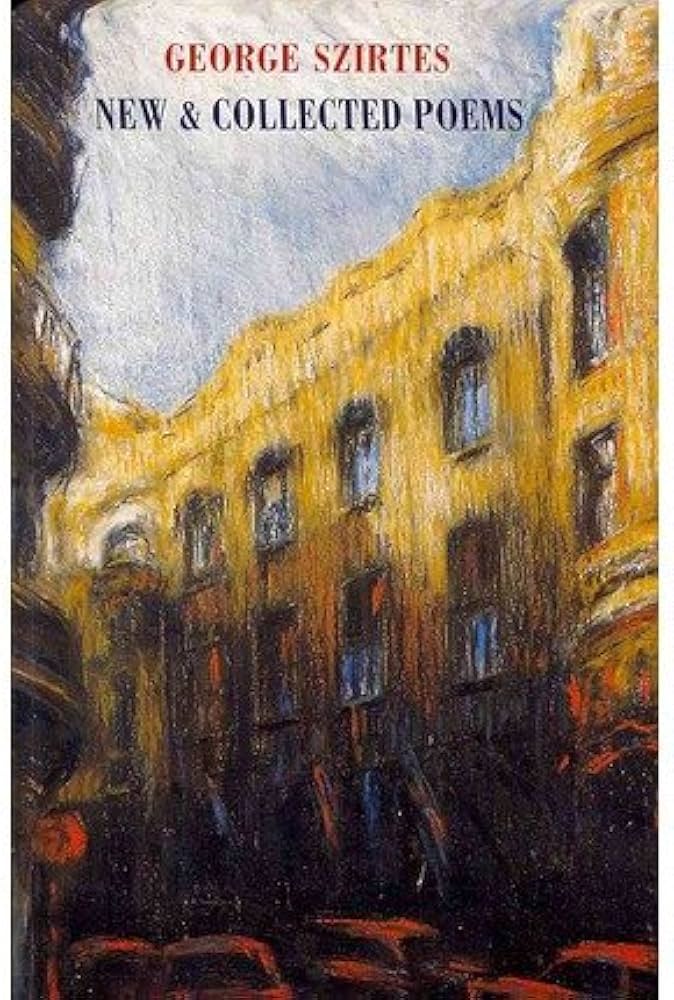
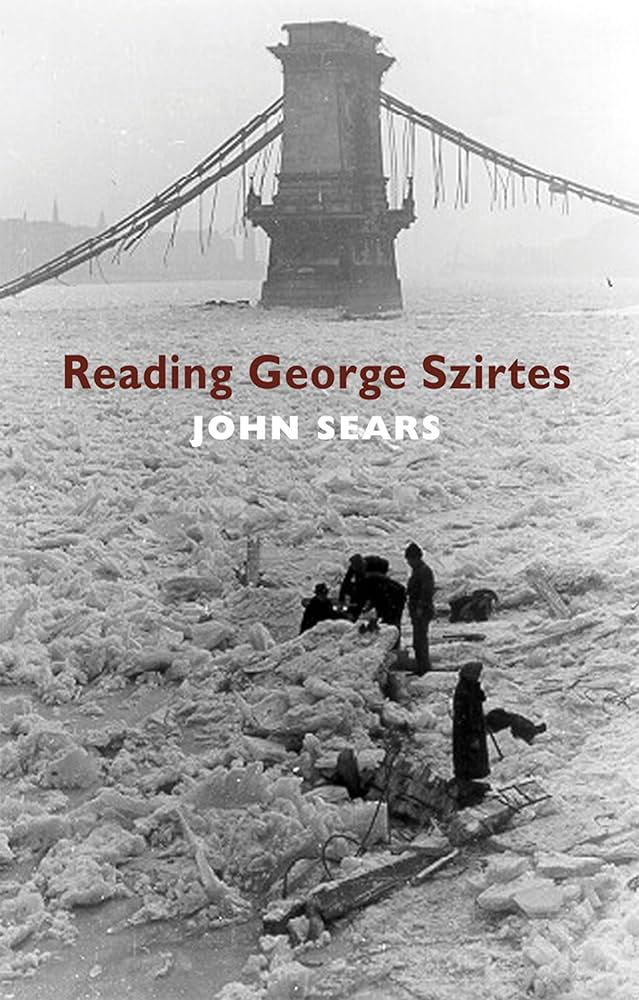

George Szirtes’ King’s Gold Medal for Poetry

This week’s announcement of the award of the King’s Gold Medal for Poetry to George Szirtes gives me the opportunity to re-post a long and detailed review I wrote (for Poetry London) of the two books that Bloodaxe Books published to celebrate Szirtes’ 60th birthday. These were the New and Collected Poems and a critical book about his work, Reading George Szirtes, written by John Sears. Though Szirtes has continued to publish a good deal since the late 2000s, this review still seems to me to have something useful to say about the development and poetical achievement of this outstanding writer and might be of interest to those not yet familiar with his work. (For WordPress readers, I am experimenting with posting also on Substack. Do subscribe here if you’d like to read in that format: https://open.substack.com/pub/mcrucefix/)

This 500-page New and Collected Poems demonstrates the breadth and depth of George Szirtes’ achievements and will bring his work to even wider notice, casting the poet as a recording angel. His lines of literary influence run from Eliot’s phrase-making and metaphysics, through Auden’s formalism and politics, to earlier contemporaries like Peter Porter and Martin Bell (at the Leeds College of Art and Design). There are distinct phases to Szirtes’ oeuvre, but his work tends to a density of fragmented detail, bound by a allegiance to visible form, shot through with explicit theorising about perception, language, time, memory, self, the art itself. This is a heady and immensely ambitious mix – not one likely to appeal to popular tastes, but there is no-one more dedicated to poetry, to playing the long game, to bringing a uniquely European perspective to the theme of our age, the search for personal identity.

Szirtes’ career illustrates what Pasternak discusses in An Essay in Autobiography (Harvill, 1990). Though our experience of the world is necessarily subjective, there is a sufficient underlying matrix that remains “the common property of man” – the hard-wiring implicit in being human. Superimposed on this is the softer wiring derived from upbringing, environment and education, and the self is ultimately a function of these base matrices in progressive interaction with individual decision-making in the flow of experience. So the objective world is processed through the individual’s particular matrices – his/her sets of harmonies and disharmonies – and must emerge coloured, spun, texturised as it were, accordingly. From this, Pasternak argues that when an individual dies he leaves behind his own unique “share of this . . . the share contained in him in his lifetime . . . in this ultimate, subjective and yet universal area of the soul”. This, of course, is where “art finds its . . . field of action and its main content . . . the joy of living experienced by [the artist] is immortal and can be felt by others through his work . . . in a form approximating to that of his original, intimately personal experience”. Art can be defined as the expression of experience playing across the matrices of the self, saying not this is me, but this is, this was, mine.

It is the raw imagery of stasis and movement that emerges in Szirtes’ early work as being truly his and it blooms into the maturity of the late 1980s. In short lyrical pieces the point of stasis is associated with the preservative of art in the spit ball gobbed by a foreign worker in ‘Anthropomorphosis’ which is caught and “suspended” by the poem. The afternoon rearranges itself around it and even the narrator “hung there / Encapsulated in that quick pearled light”. Versions of this encapsulation abound: girls creating a silver foil tree find themselves absorbed into a Keatsian “cold pastoral”. Such freeze-frame moments anticipate Szirtes’ sustained meditations on photography but early on, images of snow and frost suggest the ambivalent status of such suspension. In ‘The Car’ a snowfall is both beautiful and sepulchral: “Fantastic Gaudi-like structures hung / Under the mudguard . . . . / Wonderful, cried the girls under the snow”. A girl who is observed sewing causes consternation (“I do not like you to be quite so still”) caught in a stasis that can “eat away a life” that can “freeze the creases of a finished garment” (‘A Girl Sewing‘).
In contrast, it is movement in the shape of the passage of time that spurs many other early poems and the artist’s power is limited to “measure breath in a small space” (‘Group Portrait with Pets’). The enigmatic title poem of the first collection seems to teeter elegantly along the knife-edge of the sense of threat to domesticity and the desire to secure in a “cage” and convert to “metaphors” (‘The Slant Door’). It seems for time there is “no use, no cure” (‘Silver Age’) and Szirtes senses this especially in the domestic sphere. ‘House in Sunlight’ casts the busy sun as the agent of transience threatening the house itself and the life within it:

Whoever lives here knows what they are about –

Forms appear suddenly in mirrors and photographs,

We do not think however that they are entirely at home.

At night the doors are locked. We lock them now.

John Sears’ book is a comprehensive academic review of Szirtes’ career, tracing the development of both key themes and formal experimentation. He suggests Martin Booth’s 1985 critique of Szirtes’ early work as “withdrawn and laidback” was influential on the poet. Booth suggested that Szirtes might try writing about “his childhood” (Sears, p. 61). If true, we have reason to be thankful to Booth, but there are signs that Szirtes was moving in this direction already. He travelled to Hungary in 1984 and was casting his gaze beyond these shores towards people who “lie in complete unity / In graves as large as Europe and as lonely” (‘Assassins’). The title poem of Short Wave (1984) deploys its central image to suggest the deciphering of voices that are obscure yet seem suggestive of “all Europe in her song”. The self-deprecating picture of Szirtes “listening / and turning dials, eavesdropping” is something to be treasured given the explosive impact these deciphered voices will eventually have on his work.

Several members of Szirtes’ family were caught up in the Holocaust and later in the Soviet invasion of Hungary in 1956, escaping to the UK. Much of this was known to Szirtes only sketchily and he set himself the task of recovering what seemed lost. It is because Szirtes’ underlying matrices as an individual – stasis and movement, preservation and loss – mapped so powerfully onto his family’s own history and this history encompassed important European historical events that his work becomes in the late Eighties so much more complex, ambitious and important. History had determined his nature as a poet; his nature as a poet primed him to be able to encompass the burden of his own history.

So the title poem of The Photographer in Winter (1986) attempts the imaginative recovery of Szirtes’ mother from the Budapest of the 1940s and 50s. She was herself a photographer and her son traces her movements with “thoroughness and objectivity” as far as he can. Both as an artist and poet, Szirtes declares he has been “trained / To notice things” (the deliberate echo of Hardy’s ‘Afterwards’ is but one example of Szirtes’ very frequent intertextual allusions). But the recovery process seems often subject to disintegration, “trying to focus through this swirl / And cascade of snow”. At times the tone is more optimistic, like the final section of ‘The Swimmers’ in which a drowning girl survives the “icy Danube”. Elsewhere, intervening time destroys so much, and the later sequence ‘Metro’ (1988) uses the image of the Budapest underground system for “everything that is past, the hidden half”. His choice here of the deliberately curtailed thirteen-line sonnet is a characteristic recognition in formal terms that the search must remain incomplete.

The balance between one man’s search for his background and the conversion of this to poetry is a difficult one and if the marvelous sequence ‘The Courtyards’ is counted as one of the great successes, for me ‘Metro’ itself tips too far away from the memorial towards the monumental. There are occasions when Szirtes’ desire to recover and pay respects to his own history impels him to erect such elaborately formal accumulations of images that the reader may feel excluded, even if always impressed. The later ‘Transylvana’ is another occasion when the act of imaginative recovery can seem propelled for its own sake and despite the glittering formal achievement – terza rima in this case – the piling of detail on detail can become wearisome.

But Szirtes’ openness to theoretical thinking has always propelled his work forward and often derives more from his training in the visual rather than the literary arts. Blind Field (1994) draws on Barthes’ idea that in photography all that is not portrayed in an image may be implied by the presence of a “punctum” or detail within it. As Sears suggests (this is the sort of idea he is very good at elucidating) this bears some relation to Eliot’s objective correlative but is seen by Szirtes as a solution to the paradox that art stills the life it presents: “Out of this single moment a window opens” (‘Window’). This sense of the ballooning fluidity of experience, past and present, is one thing that marks his work as Modern and Post-Modern and it’s no surprise to see Szirtes countering Larkin’s belief that the passage of years makes us “smaller and clearer” arguing we grow “blurrier, vaster, ever more unfocused” (‘On a Young Lady’s Photograph Album’). It’s this slipperiness of personal identity that is Szirtes’ true theme and the one that elevates his work above the merely personal into a body of work addressing urgent contemporary concerns. As the poem ‘Soil’ puts it “there is nowhere to go / but home, which is nowhere to be found . . . / the very ground / on which you stand but cannot visit / or know”.

Everywhere these days, the recovery/re-construction of our own identities seems to be a pressing issue and the three sonnet sequences in Portrait of My Father in an English Landscape (1998) triumphantly present and simultaneously enact this process. Sears describes Szirtes’ form here as a “deliberately baroque form of the Hungarian sonnet sequence” or sonnets redouble (Sears, p. 145) in which the final line of each sonnet is repeated (approximately) as the opening line of the next and the final (fifteenth) sonnet is composed of approximations of each preceding sonnet’s closing line. Yet this is not an arid exercise in form as the recurrences and accumulations enact precisely what Szirtes believes is the process of the construction of the self – largely via language into a “lexical demesne” – in this case said to be “part Hungary, part England” (‘The Looking-Glass Dictionary’).

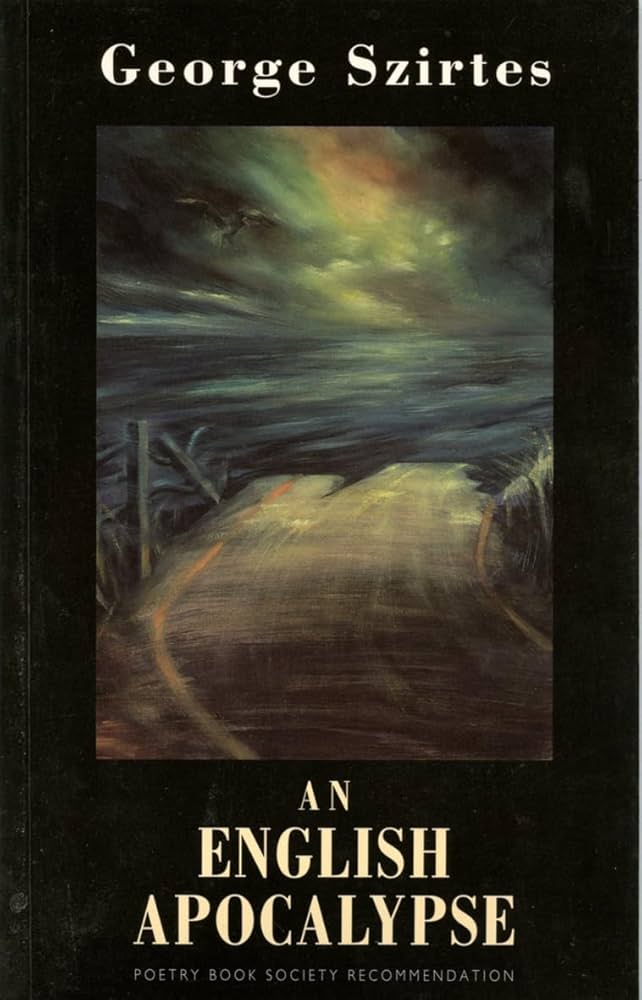
Retaining his love of the titled sequences, sections and subsections which had helped him draw a bead on his family’s obscured past – a tendency which produces the most typographically diverse and complex contents pages I’ve ever seen – from the late 1990s Szirtes’ work turns a firmly European gaze on the UK. An English Apocalypse ranges through Great Yarmouth, Keighley, Orgreave, Preston North End. all-in-wrestling and antisemitic violence towards images of “a tense / empire that could fall” (‘All In’), towards something “crumbling – a people possibly” (‘Dog-Latin’) and specific individuals “speaking the innate vernacular // of the trapped. He’s shit. Scum” (‘Offence’). Despite the success of Reel (2004), the new poems in this 2001 compilation, portraying an outmoded and disconnected England, are one of the high points of Szirtes’ career so far and they culminate in the extraordinary sequence of imagined apocalypses by meteor, power cut, deluge and suicide that caught the flip side of millennial euphoria and seem now years ahead of their time.

Apart from the sceptical cinematic pun Reel/real, the title of Szirtes’ 2004 T.S. Eliot prize-winning collection is an allusion to the predominance of the rolling, unravelling impact of his majestic terza rima. By this stage, there is a greater ease to the looping to and fro, the past and present, which Szirtes encompasses in this form.

Here I find bits of my heart. In these

Dark corridors and courtyards something true

Survives in such obsessive images

As understand the curtains of the soul

Drawing together in the frozen breeze.

(‘Reel’)

‘Sheringham’ also reinforces Szirtes’ familiar cumulative techniques remarking on the “boiled down particulars that regularly come / knocking at the skull”. Sonnets too continue to be a favoured form, though in the beautiful meditation on the aging processes, ‘Turquoise’, the neatly closing couplet of the “Shakespearian ending” is both employed and simultaneously questioned.

Indeed, echoes of the Bard’s obsessive negotiations with “swift-footed Time” (XIX) re-emerge as one of the most striking features of Szirtes’ more recent poems. A pizza can be enjoyed – but not to the exclusion of the river nearby, an unavoidable “emblem of time” (‘In the Pizza Parlour’). Szirtes is re-visiting the concerns of younger days from more slant-lit uplands. Now images of dust recur, here in the woman’s “dust-laden hair” while elsewhere birds are “swimming through dust” (‘Winter Wings’) and – in one of Szirtes’ most beautiful sonnets – a woman regards herself in the mirror, contemplating the impact of the passing years and gazing at her face “drowned in a cloud of dust: / How beautiful, she thought, and how unjust” (‘The Breasts’).

On Revisiting Blockley

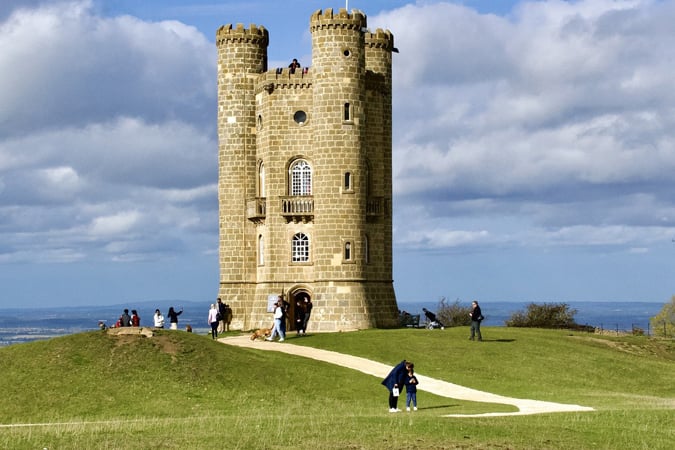
A rather more personal post than usual, though a poem (an older one of my own) is attached to it. Last week, I spent a few days with family in the beautiful village of Blockley, in the Cotswolds. The weather was very good for late November and we walked a couple of times – from Broadway up the muddy hill to the folly of Broadway Tower (once frequented by William Morris apparently) and around Hailes Abbey (now a ruin, local lore has it that Thomas Cromwell watched the destruction of the Abbey from a nearby hilltop). Blockley itself is near Moreton-in-Marsh, a place almost destroyed by the volume of traffic flowing through it (even in November), where The Bell Inn was once a favourite of JRR Tolkein, and is supposedly the model for The Prancing Pony in The Lord of the Rings. But Blockley, for me at least, had another powerful ghost haunting it.

As a couple, with young children, we stayed in the village over 20 years ago, in one of the original silk weavers cottages built along Park Road, which looks down over the village and valley. The house was owned by a colleague of mine at the time, Laurence Bowkett. He taught Classics and Latin and often spent the summer vacations away on archaeological digs of various kinds. That must have been the situation then as he’d allowed us to use the house in his absence. His early death, within a year or two of this, was a shock to us all. He had no family of his own and I don’t know what happened to the house later. So, fast forward to 2024, and here we are staying in Blockley again, only partly by coincidence. We have always had good memories of the place and (again, partly by an AirB&B chance) we ended up renting an almost identical cottage in the very same terrace above the village. Indeed, maybe it was the same cottage – I couldn’t remember enough of the details. The layout was certainly the same – the front door in off the road, straight into a little front room, a chilly basement kitchen and upstairs two small bedrooms.

Laurence’s was not the first death of a contemporary I knew well, but it greatly affected me and I tried to express something of this in the poem – an elegy – I wrote for him later. It is called ‘The umbrella and the bay tree’ and it mixes memories of him, his enthusiasms (he had a lot of those – all his students loved him for it), with details from my own family life at the time. It opens with an imagined scene, all his teaching colleagues gathered (as we often did then) in the local pub, remembering him in his absence. The ‘laral gods’ – the Lares – are Classical Roman guardian deities. The laurus nobilis refers to a little bay tree I bought after our first stay in Blockley as a thank you gift . . .

By seven-thirty, you are with us all

tonight in the gloom of The Washington,

though we omit you from every round.

Powerless as laral gods who gave you

no protection, even laurus nobilis,

the bay tree I bought you, proved no use.

Our children were at Infant and Junior School at the time and – to be honest – I can’t now remember if the details the poem goes on to mention are truth or fiction. But Laurence was the kind of guy who’d keep his own books in scrupulous order (as he did with his extensive collection of Marvel comics) so the library setting has always felt right . . .

Today, I searched 570 and 790,

in the Dewey decimal classification

your fingers ran through a thousand times,

for the facts of death and irrepressible life,

as if I looked for you now and you then.

You taught shard-life and careful fieldwork,

the near-dead language of not giving in.

You offered the heroic a modern face,

though death proved the more determined.

You understood lives alter what they touch:

a house, a street, a flowering tree,

for those who know us are not struck dumb,

a library unread the moment we die.

They roar like a lantern with our life inside.

The idea of lives of the dead altering the lives of those they have touched in life is familiar enough, though I was working on my translations of Rainer Maria Rilke around this time and I’m sure his influence is in here. It is not just the remembering of a friend who has passed away, but also that our own perceptions of ‘a house, a street, a flowering tree’, for want of a better word, spiritualises the material object, giving it a life, a light, an existence, beyond the ordinary. The resurrection of the bugs stomped by my daughter in what follows is probably an allusion to the early primitive computer games the kids used to play in which a failed – hence fatal – leap from a high building would result only in a brief ‘death’ and their 1st person avatar would soon revive and carry on in pursuit of adventure.

In Hornsey Central at 570

this morning, I found books to undermine

my daughter’s smiling confidence

that bugs she crushes beneath her shoe

lie dead a while, then revive good as new.

At 790, I leafed through life and death

in Ancient Egypt for her older brother:

how they wash their dead in water and oil,

then bind them in linen smeared with gum

and priests wrap lucky charms inside

in hope that none will break the seal

till the dead themselves in time of need.

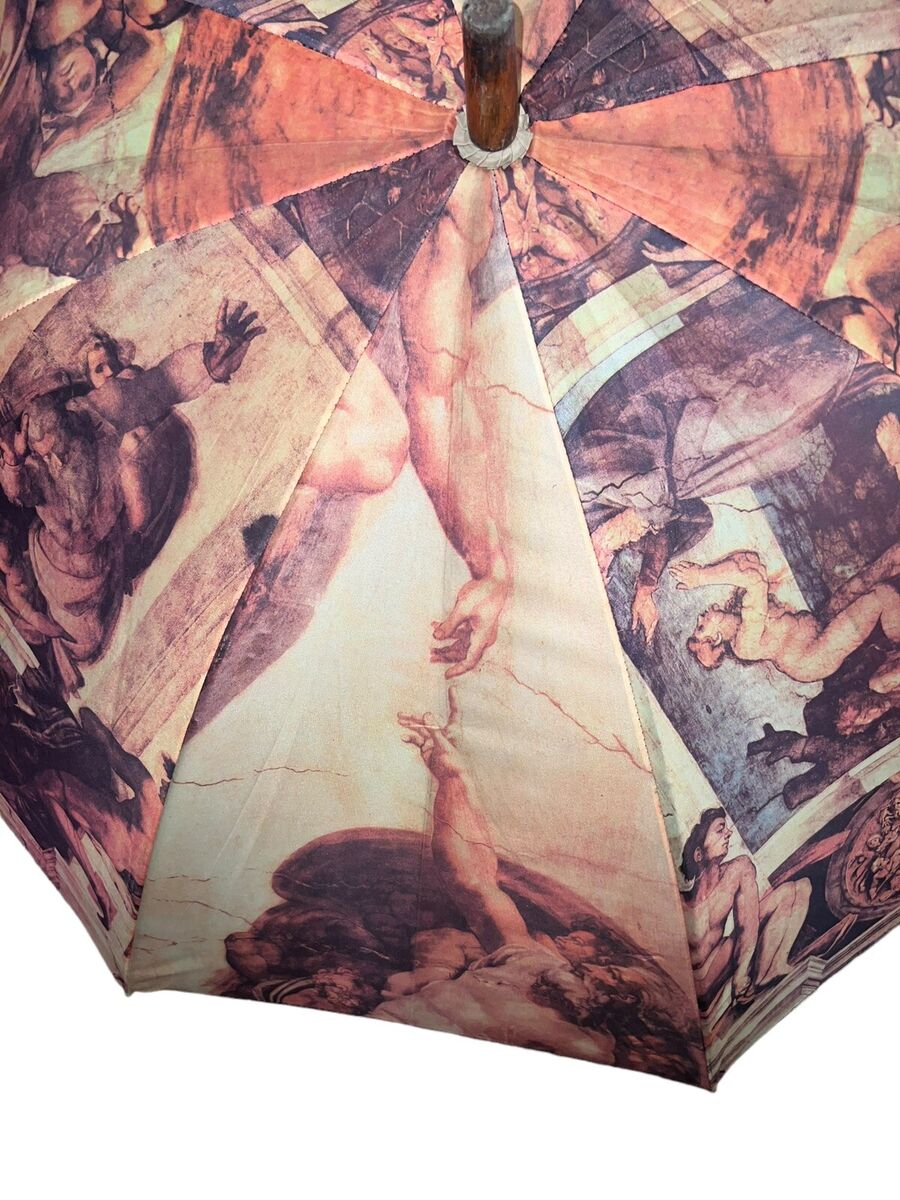
The ‘lucky charms’ idea naturally led the poem on to what I myself might place in a good friend’s sarcophagus and gave rise to a list of his multifarious likes and loves, concluding with the heartfelt wish that his (prematurely unhirsute) head might – even in death (though he had no religious belief as far as I know) – remain somehow protected. The image on the underside of Laurence’s umbrella is a truth!

Then I’ll wrap Homer for you, Wolves black-

and-gold, your Micra, Marvel, Blockley

and booze, moist, sweet cake for the road,

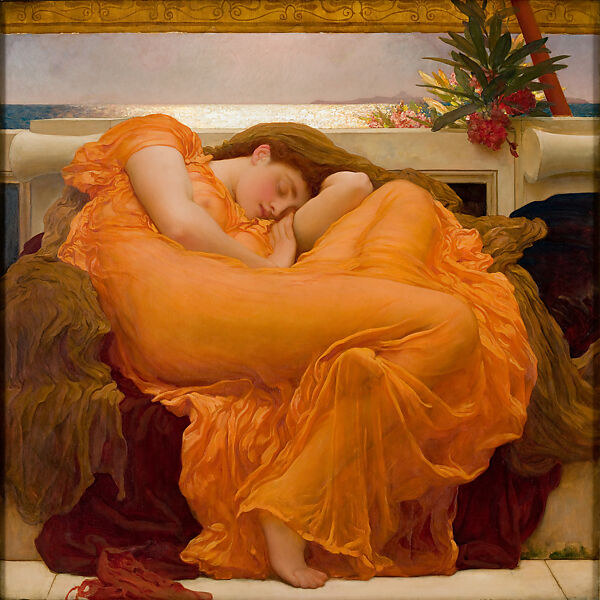
Frederick Leighton, Sir Frankie Howerd,

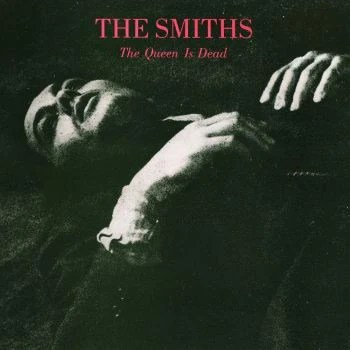
Wisden, The Smiths and that Italian umbrella

you flourished one day and thundered open –

behold! the Sistine roof appeared

to keep your bald head from the hissing rain.

‘The umbrella and the bay tree’ was originally published in An English Nazareth (Enitharmon Press, 2004).

New Review of ‘Between a Drowning Man’ – from Shanta Acharya

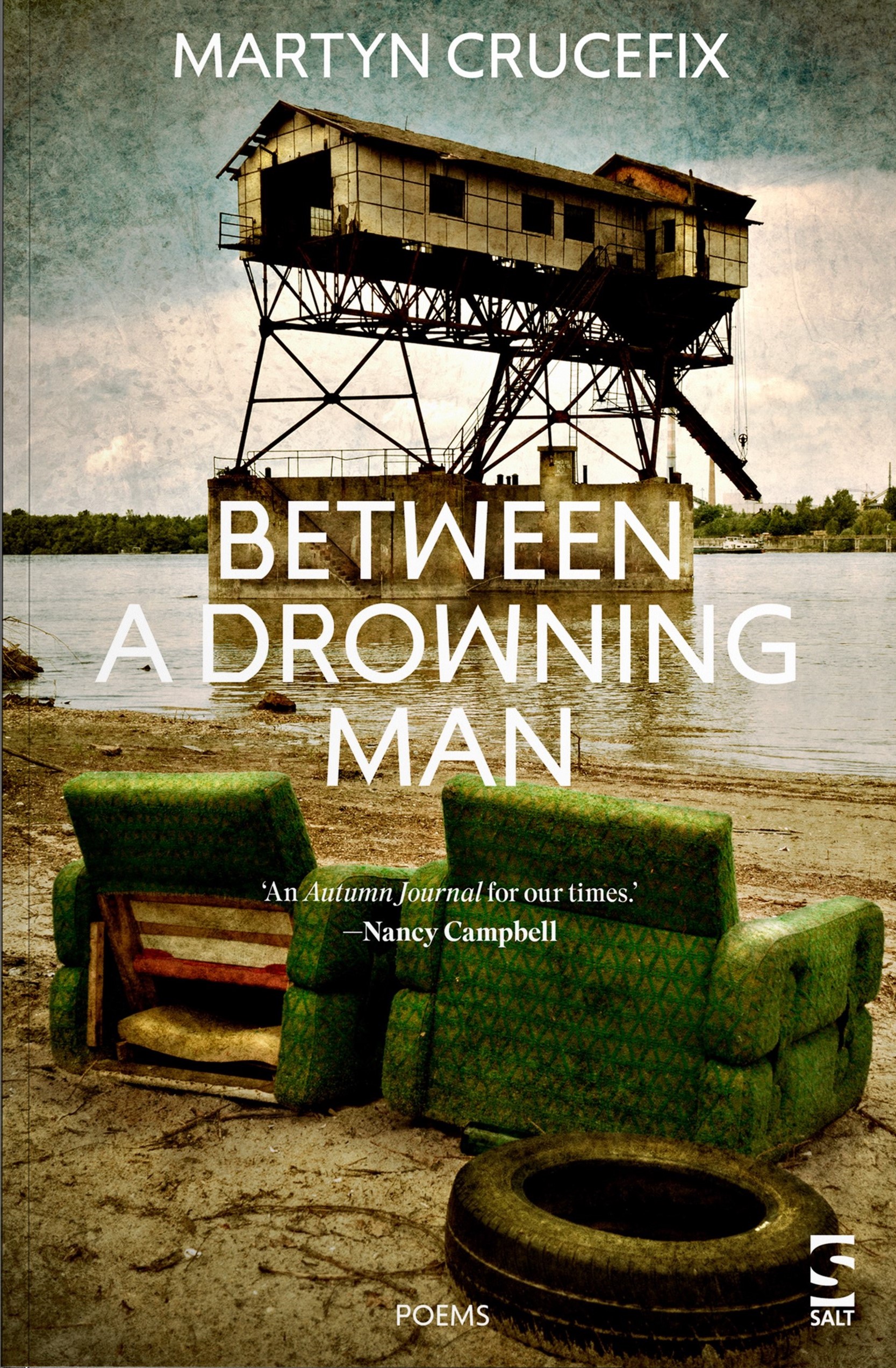
We all know that reviews of poetry books can take a long time to filter through whatever system they do come through. But then they always come as a pleasant surprise (if that’s not making too many assumptions about their likely contents). Any way – almost 12 months after the appearance of my most recent full collection, Between a Drowning Man (Salt, 2023), the ever-lively site, Everybody’s Reviewing, has just posted a detailed and insightful commentary on the book by poet and novelist, Shanta Acharya.

Amongst other things, the review comments: ‘A poet, translator, reviewer and poetry blogger, Martyn Crucefix has won prizes for his poetry and translation. As a translator of Rilke’s Duino Elegies, The Sonnets to Orpheus, Laozi’s Daodejing, Huchel’s These Numbered Days, among others, Crucefix has been building bridges for those who want to cross the divide between cultures, countries, ways of seeing the world and each other. Words are bridges, language itself a bridge – yet we inhabit an increasingly complex world where loneliness and isolation are on the rise. In ‘fifteen kilometres of traffic’ an acceptance of this isolation is disconcerting: ‘you make a choice you go your own way … / because all the bridges are down.’ His understanding of the central role language plays in our lives, that creation of bridges between humans, is a fundamental aspect of his work’.

Here’s a link to the full review

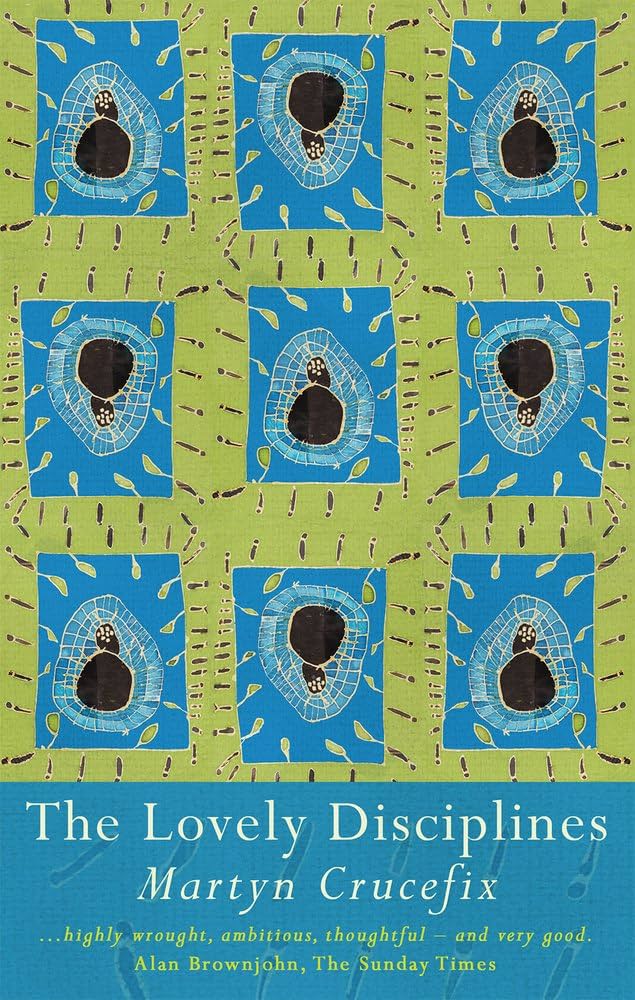
And coincidentally, Seren Books have also just recently posted a rather older poem of mine in their Poem of the Week slot. This is from my 2017 collection with Seren, The Lovely Disciplines. It’s about visiting the opticians for a check-up – though also about the desire (my desire) for clarity and absoluteness (if there is such a word), a desire, of course, never to be fulfilled. Read the full poem here.

Ian Brinton reviews ‘Between a Drowning Man’

Here is Ian Brinton‘s recent review of my new Salt collection, Between a Drowning Man. It was first published by Litter Magazine in January 2024.

The invitation at the opening of these two remarkable sequences of poems by Martyn Crucefix emphasises both ‘difference’ and ‘ambiguity’, an ‘othering’ which hones attention rather than dulling it.

Divided into two sections, Works and Days (forty-nine poems) and O, at the Edge of the Gorge (fourteen poems) the two landscapes bring into focus a post-2016 Britain and the countryside of the Marche in central, eastern Italy. The leitmotif which threads its pathway, its recurring echo, through the first section is of ‘all the bridges’ being ‘down’ and the epigraph to section two is a quotation from Canto 16 of Dante’s Paradiso in which cities pass out of existence through warfare or disease and that which may have seemed permanent is continuously in movement. That second section of poems is a sequence of sonnets and in the final one the hawk’s resting place in the ‘shivering of poplars’ sways so that he is neither falling nor at ease

with these thinnest of airs beneath him

these shapes of loose knotted mesh

these whisperings that cradle him on a whim

That ‘othering’ prompts the poet to see the differences that are ‘like crimes woven into the weft’ and, in a way that William Blake would have recognised in his ‘A Poison Tree’, envy can be ‘buried long years in the black heart / of expressed admiration’ and ‘sunshine’ can be ‘really the withering of night’ which is ‘poured into soil where wheat grows’. And so it is—‘in and around and over and above’ because ‘all the bridges are down’. 

In April 2007 Jeremy Prynne wrote some notes for students about poems and translation:

Translation is for sure a noble art, making bridges for readers who want to cross the divide between their own culture and those cultures which are situated in other parts of the world; and yet a material bridge is passive and inert, without any life of its own, whereas a poetic translator must try to make a living construction with its own energy and powers of expression, to convey the active experience of a foreign original text.

As a translator of real distinction (Rilke’s Duino Elegies and The Sonnets to Orpheus) Crucefix has for many years made these living constructions offering readers a gateway into new experiences whether it be through the world of Laozi’s Daodejing (Enitharmon Press, 2016) or through these new poems which offer echoes both of Hesiod’s Work and Days and the poems known as a vacanna which originated in the bhakti religious protest movements in 10-12th century India. His understanding of the central role language plays in our lives, that creation of bridges between humans, was one of the deeply moving and memorable moments in his collection from Seren in 2017, The Lovely Disciplines. There the poem ‘Words and things’ presented an elderly individual who discovered ‘too late this absence of words’ which now ‘builds a prison’ and Crucefix recognised that ‘a man without language is no man’: as the world of objects becomes too difficult to dominate he can only have knowledge of a world which ‘turns in your loosening grip’. The echo of Yeats’s ‘The Second Coming’ is surely no accidental one!

Translations are bridges, language is a bridge, and the distressing recognition of isolation within numbers is the dominant image in ‘fifteen kilometres of traffic’ from the first section of this new book:

fifteen kilometres of traffic wait before us

behind us the infinite tail

we are offered Google Map options

yet those trumpeted ten minute economies

are nothing till they can be proved

you make a choice you go your own way –

this has been better said before of course –

you cannot take the other way

and remain a unitary being on two paths

or perhaps sane – all roads crawl north

because multiple millions of cars crawl north

because all the bridges are down

Those ten minute trumpetings bring the world of Orwell’s 1984 to my mind as loud announcements of positive news seem to possess a tinny emptiness to the understanding of the isolated human who exists in a world of no bridges.

However, in contrast to this wave of uniformity one reads moments of ‘othering’ in the second section of this book as in ‘sharpening gusts along the valley floor’ a scrap of air was birthed

whirling inches above a littered drain

in a back street of some hilltop town

like Urbisaglia or some place that has seen

and has survived change of use

from sacred temple to church to slaughterhouse

and no gully nor hill can stop it

In this moving world ‘great swathes of air’ gather strength to flex ‘all things to a scurrying to keep up / and the truth is some will and some will fail’.

In a poem titled ‘can you imagine’ (for my children) from the first section of Between a Drowning Man the power of language to translate the invisible onto the page is presented with an unerring eye focussed upon reality. In a world in which he no longer shares the companionship of others the poet is carried safely because although ‘you find the bridges between us fallen down’ and although ‘you mourn’ you can still ‘imagine’. That sense of continuity held in the imagination is far from the image of Alan Kurdi, the three-year-old Syrian boy drowned on the beach near Bodrum, Turkey, in 2015 whose death was recorded by Crucefix’s earlier book, Cargo of Limbs, from Hercules Editions in 2019. The boy’s family had fled from the war engulfing Syria in the hope of joining relatives in the safety of Canada and became ‘part of the historic movement of refugees from the Middle East to Europe at that time’:

In the early hours of September 2nd, the family crowded onto a small inflatable boat on a Turkish beach. After only a few minutes, the dinghy capsized. Alan, his older brother, Ghalib, and his mother, Rihanna, were all drowned. They joined more than 3,600 other refugees who died in the eastern Mediterranean that year.

In this new book that ‘whim’ of a resting place for the hawk, those ‘whisperings’ prompt the bird, the poet, ‘to call it yet more steady perhaps’:

this whim—this wish—this risky flight

in the fleeting black wake of the carpenter bees

Stand-to-Arms: David Jones’ ‘In Parenthesis’ (1937)

31kdwrvzonl-_sy344_bo1204203200_

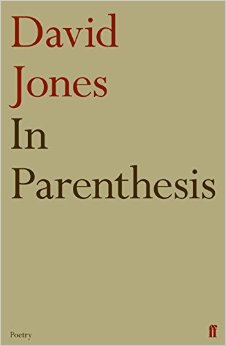
There’s an extraordinary moment in the final pages of David Jones’ magnificent poem-novella, In Parenthesis (1937), when his hero, John Ball, dying at the Battle of the Somme in 1916, imagines the tourist industry that has since grown up around the World War One battlefields. In his last moments, he abandons his rifle: “leave it for a Cook’s tourist to the Devastated Areas”. Jones’ footnote acknowledges the risk of this sounding anachronistic but insists he remembers such discussions among the soldiers, how holiday-makers will later be photographed “on our parapets”. It’s the unexpected sense of territorial ownership that makes him angry (not the sense of injustice at different lives unfolding so differently): he compares it to strangers “occupying a house you live in, and which has, for you, particular associations”.

entrance-to-a-sandbag-dugout

This searing, revelatory sense of the documentary – what it was like to be there – is just one of the reasons to read Jones’ book. Another extended footnote considers the multiple usage of the hessian material of sandbags. In their intended role “they constituted, filled with earth, the walls, ceiling, and even floor surface of half our world”. But it was also “utilized as a wrapping for food; for a protection to the working parts of a rifle, and cover for bayonet against rust. The firm, smooth contour of a steel-helmet was often deprived of its tell-tale brightness [. . .] by means of a piece of stitched-on sack-cloth. The sand bag could be cut open and cast over the shoulders against the weather or tied round the legs against the mud or spread as a linen cloth on the fire-step for a meal, or used in extremity as a towel or dish-cloth; could be bound firmly as an improvised bandage or sewn together as a shroud for the dead”. Such human and humane improvisation in the midst of nightmare reminds us that Jones did not intend In Parenthesis to be a “War Book”, but rather one about a “good kind of peace”. He himself gives us another reason to read his book in these contemporary times that we consider so ‘difficult’: “We find ourselves privates in foot regiments. We search how we may see formal goodness in a life singularly inimical, hateful, to us”.

51navnxu-nl-_sx331_bo1204203200_

For those interested in poetic techniques, Jones mixes prose and verse as naturally as walking and running. He is fiercely allusive throughout, particularly drawing on Shakespeare, Malory, The Mabinogion, The Song of Roland, other Welsh and Anglo-Saxon poems, Romantic and Classical poetry. TS Eliot tends to use his intertextual or allusive techniques forensically to dissect our Modern condition, how far we fall short of heroism, how far we are from spiritual pilgrimage, how sordid and smutty our lives have become. Curiously, Jones achieves something opposite, managing to elevate his fallible, cursing Tommies to some sort of reflection of the heroism of the past. The fields of northern France are compared to Malory’s Le Morte d’Arthur in ways that establish rather than sever the links between myth and legend and the twentieth century. Bursts of shrapnel are associated with “the Thunder God” as discussed in Fraser’s The Golden Bough; the death of soldiers is rhymed with the myth of the king buried to protect and make the land fruitful. Jones’ interest in and identification with the ordinary soldiers is also expressed through his use of their words, in vivid, direct, often (knowingly) hilarious forms of demotic which put Eliot’s awkward efforts at doing the ordinary people’s voices into the shade.

antic-dispositionhenry-v-12

For a certain type of soldier, Jones tells us, trench life in 1916 with the “infantry in tin-hats, with ground-sheets over their shoulders, with sharpened pine-stakes in their hands”, brought Shakespeare’s Henry V “pretty constantly to the mind”. It’s from that play that one of the recurring phrases in In Parenthesis is drawn. In Part 3, Lance-Corporal Lewis sings as he walks, yet he sings softly, “because of the Disciplines of War”. Jones’ soldiers treat the idea with both respect and sarcasm on differing occasions though it’s striking that in the midst of battle, as things begin to turn against them:


Captain Cadwaladr restores

the Excellent Disciplines of the Wars.

3118806_orig

The book invites the reader in with knockabout drill on the parade ground at home to begin with. Then a long march to the port of embarkation, the troops looking smart as they march through town but once beyond civilian observation “with a depressing raggedness of movement and rankling of tempers they covered another mile between dismal sheds, high and tarred”. Proleptic of what lies ahead, they get lost among the port buildings, eventually waiting for departure to France in a “spacious shed [. . .] open at either end, windy and comfortless”.

Part 2 has the men marching through France, Jones capturing their first naïve witnessing of war’s destruction where a shell has fallen on the road they are pursuing: “men were busy here shovelling rubble into a great torn upheaval in the paving. A splintered tree scattered its winter limbs, spilled its life low on the ground. They stepped over its branches and went on”. One of the great themes of In Parenthesis ironically is the presence of Nature, often offering some consolation, some mythic pattern of life, death and re-birth to the soldiers, as well as (here) being subject to the destructions of human warfare. The natural processes of time, night and day, the seasons turning – also offer some consolation. Here is the magnificent opening to Part 4, John Ball seeing dawn break over the trenches:

standto

So thus he sorrowed till it was day and heard the foules sing, then somewhat he was comforted.


Stand-to.

Stand-to-arms.

Stealthily, imperceptibly stript back, thinning

night wraps

unshrouding, unsheafing—

and insubstantial barriers dissolve.

This blind night-negative yields uncertain flux.

At your wrist the phosphorescent dial describes the equal seconds.


The flux yields up a measurable body; bleached forms emerge and stand.


Where their faces turned, grey wealed earth bared almost of last clung weeds of night weft—

behind them the stars still shined.


The final seventh Part breaks more consistently into verse. Jones seldom uses line breaks to create the swaying rhythmic units of lyric verse but more usually for disjunction. His free verse recreates the soldier’s eye swinging from one thing to another, often in panic and confusion, the sudden bursting of danger from left field, from shells above, mines below. It allows him also to recreate the thrilling illogic of the stream of consciousness of his fighting men. Private Ball survives longer than many but is eventually wounded.


[. . .] it came as if a rigid beam of great weight flailed about his calves, caught from behind by ballista-baulk let fly or aft-beam slewed to clout gunnel-walker

below below below.


When golden vanities make about,

you’ve got no legs to stand on.


He thought it disproportionate in its violence considering the fragility of us.


He crawls away, encumbered by the weight of his rifle which he eventually leaves behind. An Ophelia-like figure, the Queen of the Woods, cuts garlands for the dying soldiers, whispering quietly to each of them, according respect (when the real circumstances of their deaths received anything but) elevating their passing to ritual. (Here is a brief animation and reading of this moment). That Jones can achieve this mythic sense, simultaneously dwelling on the clumsy encumbrance of Private Ball’s rifle, and allowing his fleeting thoughts about the future Cook’s tourists is a breath-taking moment of literary achievement. The whole is “a work of genius” (TS Eliot) and “a masterpiece” (WH Auden). For Adam Thorpe it “towers above any other prose or verse memorial of that war (indeed, of any war)”; for Thomas Dilworth it is “probably the greatest work of British Modernism written between the wars”.


david_jones_artist_poet
David Jones


I have been reading little other than In Parenthesis for the last few weeks. The narrative precision clarifies with each re-reading, as does the characterisation, the recurring motifs become more significant, the gem-like passages of exquisite poetry leap out. I have come to it very late; a reason for some regret but it is the best thing I have read in years. Perhaps the title put me off. It sounds arid and a bit tricksy. Jones suggests the parenthesis was the war itself (perhaps again indicating his real concern with how we live our peace), though he also cryptically adds “because our curious type of existence here is altogether in parenthesis”. The whole work concludes with lines taken from The Song of Roland: “the man who does not know this has not understood anything”.


The Politics of the ‘Daodejing’

IMG_0217.JPG

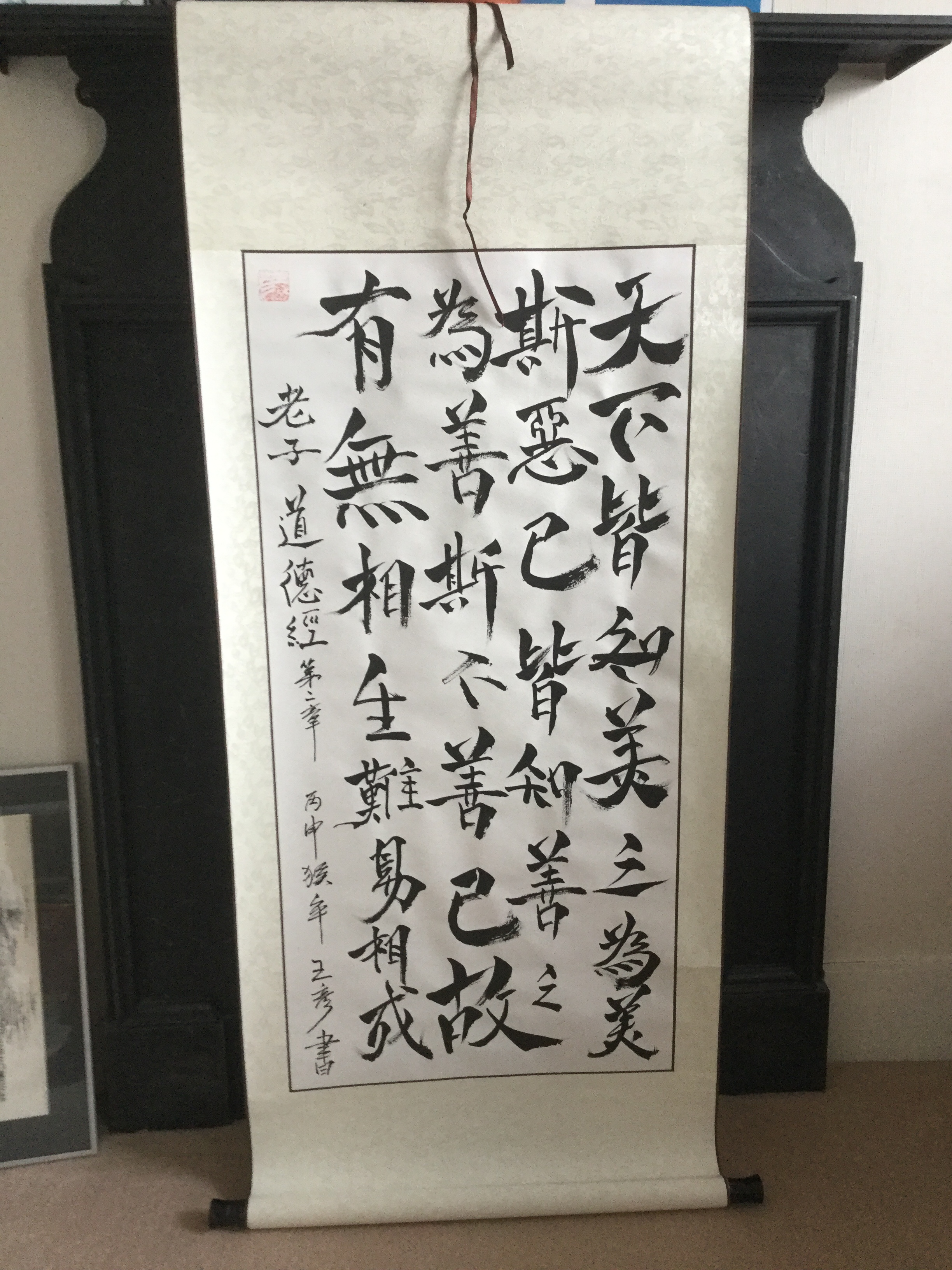
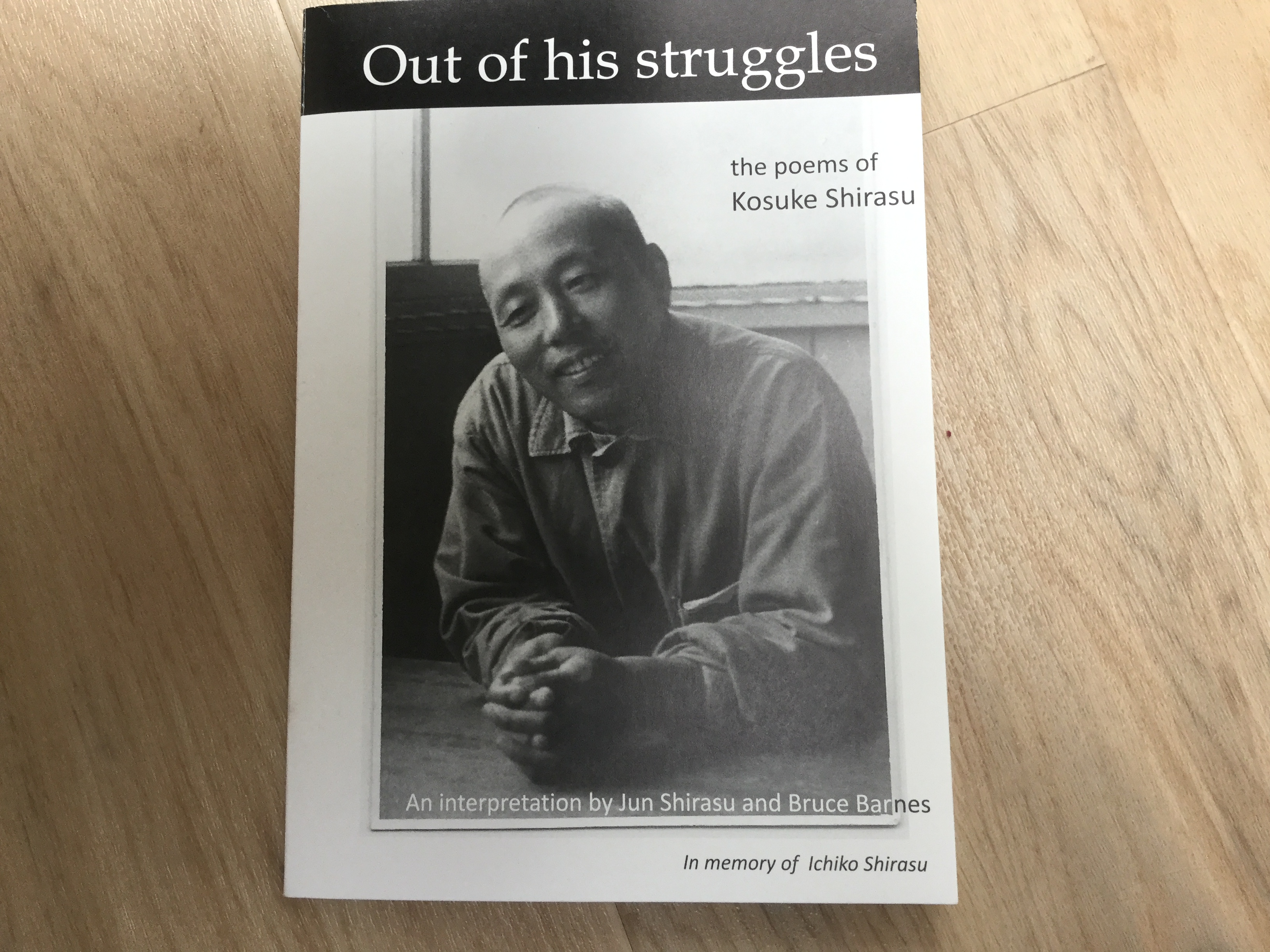
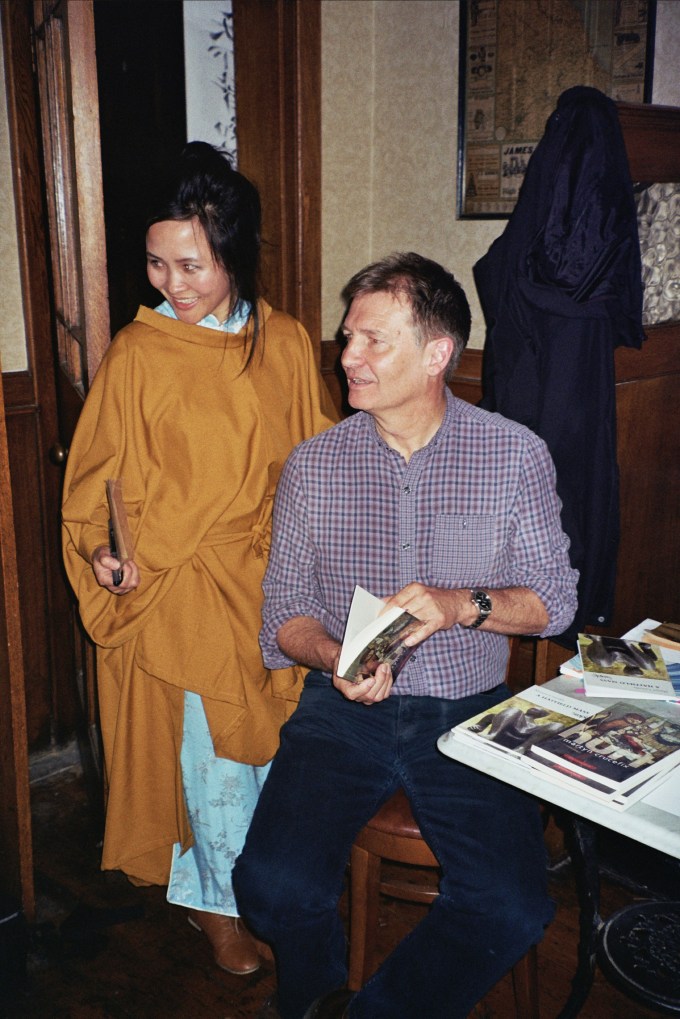
I travelled north to Bradford earlier this week to read from my versions of the Daodejing. For the first time a reader of Mandarin was present to read from something approaching the original texts. Bradford artist Yan Wang read beautifully as well as providing the evening with a couple of large banner-scrolls of chapters from the text. The whole evening had been organised by an old friend, Bruce Barnes, a poet and tireless organiser and more recently translator of long-neglected work by Kosuke Shirasu, a Japanese proletarian writer from the 1920/30s. I read Bruce’s ‘interpretations’ of Shirasu’s work (done with the help of Jun Shirasu and published as Out of his struggles (Utistugu Press, Bradford) on the train back to London and it reminded me that I had wanted for a while to organise my thoughts about the political elements in the Daodejing poems. (Poem titles in brackets are those I have given to the individual ‘chapters’ of the text).

img_0215

It’s generally accepted that one of the purposes of the collection of texts called the Daodejing is to instruct about good government. Chapter 46 (Annexation) argues that when government adheres to the Way – the teachings of the Daoist ideas – then its great parades of horses “are put out to grass to fertilise the ground”. It’s when government neglects the Way that its “war horses sire and foal / even on sacred ground”. Such neglect leads to personal and political “unsteadiness” which Chapter 26 (‘Breath-taking Scenes’) identifies as the “loss of all authority”. This is authority in its truest sense because in other poems we read of aggressive, power-grabbing behaviour which is also a way of neglecting Daoist ideas. Chapter 29 (‘What is Fixed’) describes those who grab at “earthly power” who are as liable to smash it as gain any advantage.

One of the key chapters, 67 (‘Three Treasures’) goes so far as to suggest that “only one reluctant to grasp power / is properly capable of government”. One clear attitude in these poems is that busy, hyperactive government – one that “grows brisk full of initiatives” – is an error:


those who hope

to rule by dishing out

press releases

a multiplicity of choices

are the con-men

of the nation

Chapter 65 (‘Blizzard’)

imgres

This distrust of big government is compounded when those with power try to ingratiate themselves with those they rule. With very little modernisation, the Daodejing is suspicious of those politicians who “style themselves ‘man of the people’ / sometimes ‘housewife’ / they like to say ‘we are all in this together’” (Chapter 39). What lies behind such cynical declarations is a real hunger for power as an exercise of ego (not true government). Laozi is very clear that such egoistic motives lead only in one direction for a nation: war.


–those who govern my teacher says

must oppose conquest by force of arms


such methods swiftly rebound

thorn and bramble where troops assemble

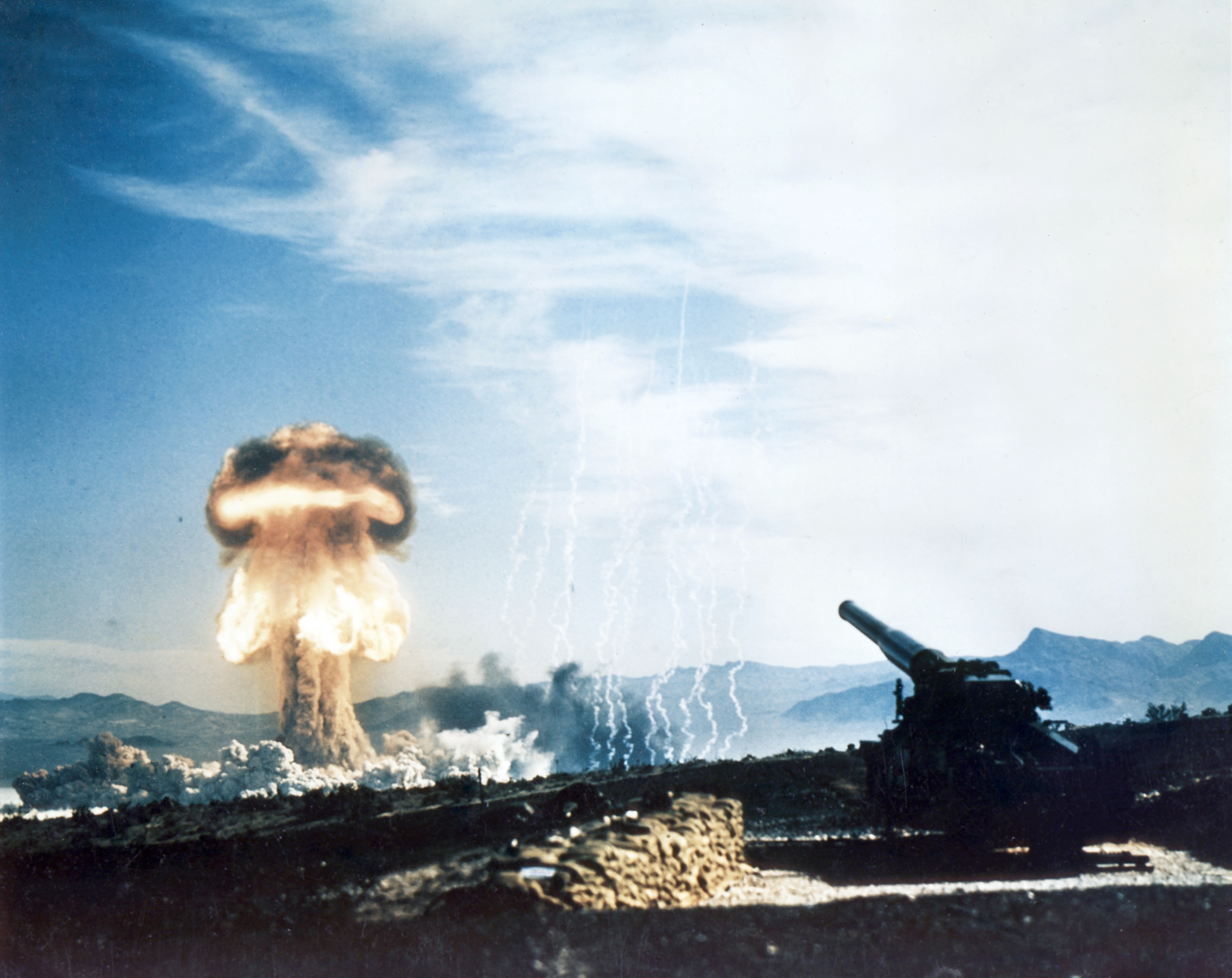
Chapter 30 (‘Scorched Earth’)

nuclear_artillery_test_grable_event_-_part_of_operation_upshot-knothole

Leaders (and the Daodejing never really doubts that human society needs leaders of a sort) need to adhere to the Way and encourage their people to do the same. Chapter 37 (‘Dispassion’) puts it succinctly:


—the way enacts nothing yet through it all things are achieved

if the powerful

possessed themselves of it

the ten thousand would be transformed


once transformed if they begin

to demand action

they ought to be constrained

with the uncarved wood quality of namelessness


the unconditional quality of the nameless

evokes dispassion—

hence it is to be still


so the nation pursues its way in peace


This idea of ‘constraint’ begins to sound authoritarian again but elsewhere it appears our political leaders are being advised not to over-encourage our expectations. Chapter 19 (‘Fewer Wishes’) advises that a people’s restlessness ought to be dealt with by offering them “simplicity / to behold give them the uncarved block // give them selflessness give fewer wishes”. In our world of unconfined desire and acquisitiveness (the point of being alive?) this sounds suspect perhaps but is perfectly in line with those who choose to opt out of modern life towards simplicity, fewer possessions etc. The uncarved block is a recurring image representing the fullest presence of life and experience before we begin to hack away at it with our self-centred preconceptions. The three virtues of the Daodejing are to be compassionate, to be frugal and to lack ambition.

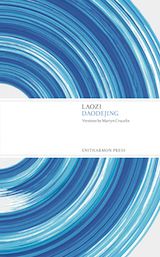
daodejing

The point is that Daoist thinking is optimistic about human nature. There is a Rousseauistic quality to its belief in the goodness of mankind as a noble savage who has for too long been corrupted by interference, too many codes of behaviour imposed from above. This is where the poems’ anti-Confucian elements are most obvious. Chapter 18 (Codes of kindness’) argues it’s only when the Way “falls into disuse / codes of kindness thoughts / of morality evolve”. Laozi argues we are better off without such rules of codified behaviour. This is not quite anarchism but certainly a powerfully libertarian thread runs through the work. In one of the most striking images in the whole sequence, Chapter 60 (‘Recipe’) compares true government to the cooking of a “delicate fish”. It requires the gentlest of touches:


no agitation

or any demon

or the fretting

of your own spirit


no shuffle or harm

or sudden injury

but aid and attend

gain advantage


the power to feed

the common purpose

maxresdefault

It’s this delicacy, gentleness, almost passivity of government that leads Laozi to associate this approach with the stereotypically ‘female’. Early on, in Chapter 6 (‘Valley’) we are told the spirit of the Way is “[a] valley without end / it is female it is called mysteriousness”. This translates politically into government playing a largely passive role (as does the good teacher) to show, facilitate, enthuse, give space, watch and approve. Government must be honest, give the tools, give opportunities, do its job well. Its role is to synthesise and connect (not disconnect or sever), shed light (but without dazzling, even inadvertently), use a delicate touch, be tangential. Its actions call forth responses to the fact it acts, plans, demands. Better back off, do not intervene, don’t use imperatives, perhaps use no words at all. It is better to play the female part, be passive, give space, encourage desired behaviours, neglect all else.


Tributaries

chapter 61


—strong nations must play the low ground

to which all contributing waters flow

the point to which all things converge

so their invitations issue from stillness

through quiescence they gather power

let’s call that female and the male cannot

resist he brings his watery tributes

and she gains adherents he procures favour

as she looks to embrace and empower

he finds himself part of a greater thing

in this way becomes part of creation

so both thrive both discovering bliss—

real power is female it rises from beneath

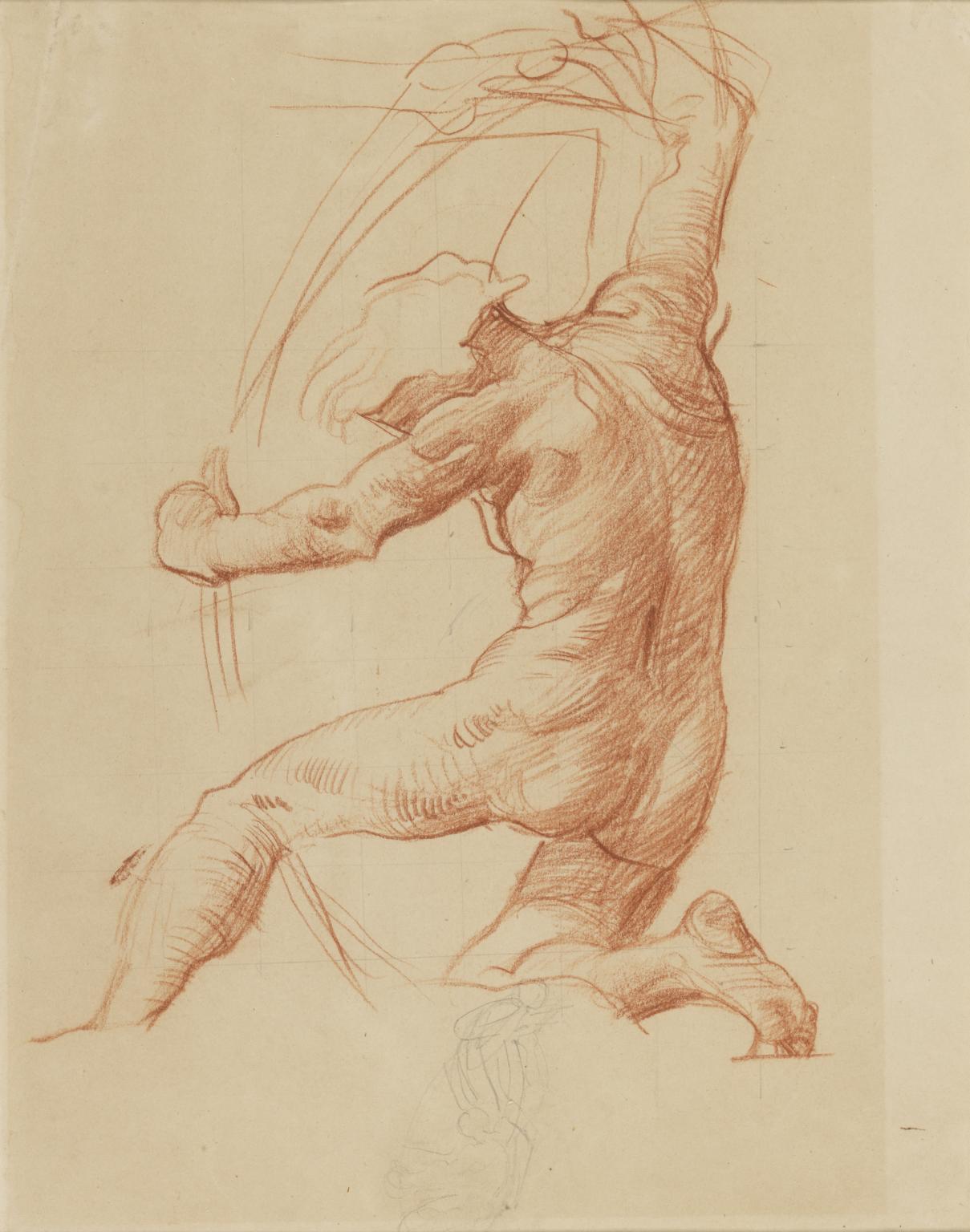
Study of a Kneeling Boy Bending a Bow, for Dorchester House c.1860 by Alfred Stevens 1817-1875

Like the cooked fish, another memorable image is the bending of a bow. As it is bent the top (of society) descends earthwards while what is “nearest the earth is raised up”. This is the ideal process of government in the Daodejing. Only in Chapter 80 (‘The Commonwealth’) does Laozi give something of a portrait of the contentedly ruled society. It is small, hard-working, has basic needs met; it has the capability of greater luxury (and also weapons) but none of these are made use of. This little society is aware of others around it (perhaps run on different lines) but its people are so content they feel no desire to travel.

Idealistic without doubt. But does this even sound attractive? It’s unlikely to – given our absorption into our consumerist society, our expectations that government ought to provide and lead. But we don’t need to look far to see systems breaking down and at the least what the Daodejing offers is an alternative vision of the exercise of power in society. It’s a vision that is over 2000 years old which means it’s either well past its sell-by-date or that it contains some wisdom that we ought not to ignore.

Autosave-File vom d-lab2/3 der AgfaPhoto GmbH
Martyn and Yan Wang reading from the ‘Daodejing’ for Beehive Poets, Bradford

Tony Harrison’s ‘Them and [uz]’

Last week I posted on Tony Harrison’s ‘A Cold Coming’. The following discussion of another extraordinary Tony Harrison poem originally appeared in book form in Tony Harrison: Loiner (Clarendon Press, 1997), edited by Sandie Byrne.

imgres

‘Them and [uz]’ – listen to Harrison read this poem here.

for Professors Richard Hoggart & Leon Cortez

I

αίαι, ay, ay! … stutterer Demosthenes

gob full of pebbles outshouting seas –


4 words only of mi ‘art aches and … ‘Mine’s broken,

you barbarian, T.W.!’ He was nicely spoken.

‘Can’t have our glorious heritage done to death!’


I played the Drunken Porter in Macbeth.


‘Poetry’s the speech of kings. You’re one of those

Shakespeare gives the comic bits to: prose!

All poetry (even Cockney Keats?) you see

‘s been dubbed by [Λs] into RP,

Received Pronunciation, please believe [Λs]

your speech is in the hands of the Receivers.’


‘We say [Λs] not [uz], T.W.!’ That shut my trap.

I doffed my flat a’s (as in ‘flat cap’)

my mouth all stuffed with glottals, great

lumps to hawk up and spit out… E-nun-ci-ate!


II

So right, ye buggers, then! We’ll occupy

your lousy leasehold Poetry.


I chewed up Littererchewer and spat the bones

into the lap of dozing Daniel Jones,

dropped the initials I’d been harried as

and used my name and own voice: [uz] [uz] [uz],

ended sentences with by, with, from,

and spoke the language that I spoke at home.

RIP, RP, RIP T.W.

I’m Tony Harrison no longer you!


You can tell the Receivers where to go

(and not aspirate it) once you know

Wordsworth’s matter/water are full rhymes,

[uz] can be loving as well as funny.


My first mention in the Times

automatically made Tony Anthony!

Read about the drafting of this poem – in the Tony Harrison Archive at Leeds University.

url

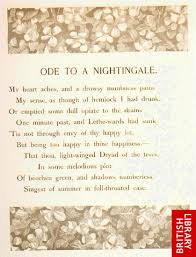
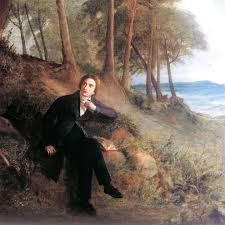
Though it was Keats’ ‘Ode to a Nightingale’ Harrison ‘mispronounced’ at school, it is actually Wordsworth who is more important to him because both share a belief in poetry as the voice of a man speaking to men. This conception of poetry as speech is a powerful constituent in Harrison’s work and perhaps one not clearly understood. John Lucas, for example, has attacked what he sees as loose metrics in the poem ‘V’ but, to reverse Harrison’s comment that all his writing (theatrical or otherwise) is poetry, all his poetry needs to be read as essentially dramatic and deserves to be tested in the spoken voice as much as in the study. Harrison’s interest in the curious idea that the true poet is born without a mouth implies the difficult battling for a voice or voices which can be found everywhere in his work and it is in this clamour that I find its dramatic quality. In a public poem like ‘A Cold Coming’, Harrison makes use of the contrasting and conflicting voices by playing them off against a regular form. This is almost always the case, but in what follows I prefer to concentrate less on metrical effects than on the way voices interweave.

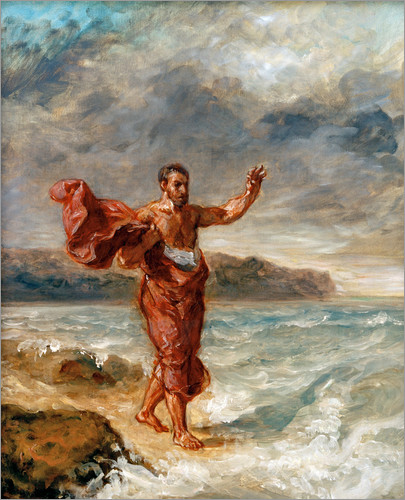
The very title of the pair of sonnets, ‘Them & [uz]’, seems to promise conflict, at best dialogue, and it opens with what could be taken as the howl of inarticulacy. In fact each pair of these opening syllables gestures towards crucial worlds in Harrison’s universe. The ‘αίαι’ of classical dramatic lament is echoed by the “ay, ay!” of the musical hall comedian cheekily working up an audience. Immediately, the reader is plunged into the unresolved drama of two differing voices, instantly implying the two cultures of the sonnets’ title. The line and a half which follows, sketching Demosthenes practicing eloquence on the beach, is intriguing in that its locus as speech is hard to pin down. It is perhaps intended at this stage (apart from introducing the poems’ central issue) to hover in an Olympian fashion above the ruck of dialogue that follows, implying the heroic stance which will be taken up in the second sonnet.

poster-demostheness-spricht-meeresfluten-310780

Line 3 opens again into a dramatic situation with the voice of the narrator (the adult Harrison), repeating his own interrupted recital of Keats in the classroom, while the master’s scornful comments appear fresh, unreported, as if still raw and present, in speech marks. The narratorial comment on this – “He was nicely spoken” – confirms this poem’s tendency to switch voices for its effects, this time its brief sarcasm barely obscuring the unironic comment likely to be made by an aspiring Loiner, or by an ambitious parent. The example of nice speaking given (again in direct quotes in the following line) is the master’s claim to possession, to authority in matters of language and culture and the separated-off reply of the narrator – “I played the Drunken Porter in Macbeth – with its full rhyme and sudden regular iambic pentameter, implies both a causal link between the two lines, painting Harrison as dispossessed specifically by the master’s attitudes, as well as conveying the tone of resignation in the young schoolboy.

images

Much of the tension and success of the poem has already arisen from the dramatic interchange of voices and the master’s voice asserts itself again in line 7 ironically claiming a kind of monolithic, aristocratic purity to poetry which this poem has already attempted to subvert:


Poetry’s the speech of kings. You’re one of those

Shakespeare gives the comic bits to: prose!”


The following lines contain a curious wavering in the clear interplay of dramatic voices, only part of which is resolved as the poem proceeds. Evidently, the intrusive, even hectoring, parenthesis (at line 9) is the narrator’s questioning of what appears to be the master’s voice’s continuing argument that “All poetry” belongs to Received Pronunciation. Yet the aggression of this attack, with its harsh alliteration and sarcastic question mark, is out of key with the other narratorial comments in part I, though the tone is re-established in part II. In addition, I have some difficulty in accepting the master’s words as appropriate to the situation which – with no break – continues the speech made to the young Harrison. For example, the word “dubbed”, with its implication of the deliberate laying of a second voice over an ‘original’, already hands victory in the argument to Harrison’s claim for the authenticity of ‘dialect’ and, as such, would not be used by the believer in “the speech of kings”. Equally, the apparent plea, “please believe [ s] / your speech is in the hands of the Receivers”, does not accord with the voice that summarily dismissed the pupil as a “barbarian” 7 lines earlier. In this case, Harrison’s desire for the dramatic has foundered momentarily on that old dramatist’s rock, the necessity for exposition which compromises the integrity of the speaking voice.

imgres

The true note of the master returns – interestingly, following one of Harrison’s movable stanza breaks, as if confirming a shift in voice though the speech actually continues across the break – with “We say [Λs] not [uz], T.W.!” The tone of the responding voice, after the suggestion of a more spirited response in the Keats comment, has returned to the resignation of the brow-beaten pupil. This is reinforced by the more distant comparison of the boy to the ancient Greek of the opening lines, heroically “outshouting seas”, while the young Harrison’s mouth is “all stuffed with glottals, great / lumps to hawk up and spit out”. This first sonnet draws to a close with this tone of frustrated defeat for the boy, yet the drama has one final twist, as the voice of the master, sneering, precise and italicised, has the last word – “E-nun-ci-ate!“. There can be little doubt that the boy must have felt as his father is reported to have done in another sonnet from The School of Eloquence, “like some dull oaf”.

The second part of ‘Them & [uz]’ contrasts dramatically with the first, though the seeds of it lie in the image of heroic Demosthenes and the accusatory tone of the reference to Keats which seemed a little out of place in part I. This second sonnet’s opening expletive aggression strikes a new tone of voice altogether. “So right, yer buggers, then! We’ll occupy / your lousy leasehold Poetry”. The poem’s premise is that it will redress the defeat suffered in part I in an assertive, unopposed manner. Not the master, nor any spokesman for RP is allowed a direct voice, yet the interchange of speech and implied situation can still be found to ensure a dramatic quality to the verse.

The passionate and confrontational situation of the opening challenge is clear enough, yet it’s striking how it has taken the autobiographical incident in part I and multiplied it (“yer buggers . . . We’ll occupy”) to present the wider political and cultural context as a future battlefield. Even so, there is no let up in the clamour of voices raised in the poem. Immediately, the narratorial voice shifts to a more reflective, past tense (at line 3) as the rebel reports actions already taken – and with some success, judging from the tone of pride and defiance: “[I] used my name and own voice: [uz] [uz] [uz]”. Even within this one line, the final three stressed syllables are spat out in a vivid reenactment of Harrison’s defiant spoken self-assertion. It is this slippery elision of voice and situation which creates the undoubted excitement of these and many of Harrison’s poems as they try to draw the rapidity and short-hand nature of real speech, its miniature dramas and dramatisations into lyric poetry. A further shift can be found in lines 9 and 10, in that the voice now turns to address a different subject. The addressee is not immediately obvious as the staccato initials in the line are blurted out in what looks like a return to the situation and voice with which this sonnet opened. Only at the end of line 10 does it become clear that the addressee is the poet’s younger self, or the self created as the “dull oaf” by the kind of cultural repression practised by the schoolmaster. The reader is further drawn into the drama of the situation by this momentary uncertainty: RIP RP, RIP T.W. / “I’m Tony Harrison no longer you!”.

images

The remaining 6 lines are, as a speech act, more difficult to locate. There is an initial ambiguity in that they may continue to address “T.W.”, though the stanza break suggests a change and, anyway, this makes little sense as T.W. is now dead (“RIP T.W.”). In fact, these lines use the second person pronoun in the impersonal sense of ‘one’, addressing non-RP speakers in general, and it is the generalised nature of these lines which disarms the effectiveness of the passage. This is particularly important in line 14, “[uz] can be loving as well as funny”, the tone of which, commentators like John Haffenden have questioned. The difficulty here is that if Harrison is addressing those who might use [uz] anyway, though there may well be many amongst them for whom the fact that “Wordsworth’s matter / water are full rhymes” is useful ammunition and reassurance, the same cannot be said of the “loving as well as funny” line which might variously be construed as patronising, sentimental or just plain unnecessary. Nevertheless, the poem regains a more sure touch in the final lines in its use of the reported ‘voice’ of The Times in renaming the poet “Anthony“. The effect here is both humorous (this, after all the poet’s passionate efforts!) and yet ominous in that the bastions of cultural and linguistic power are recognised as stubborn, conservative forces, still intent on re-defining the poet according to their own agenda, imposing their own hegemonic voice where there might be many.

The Death of Philip Levine

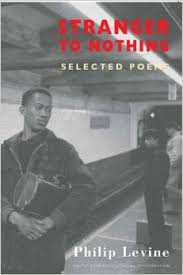
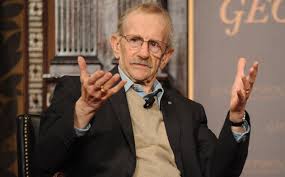
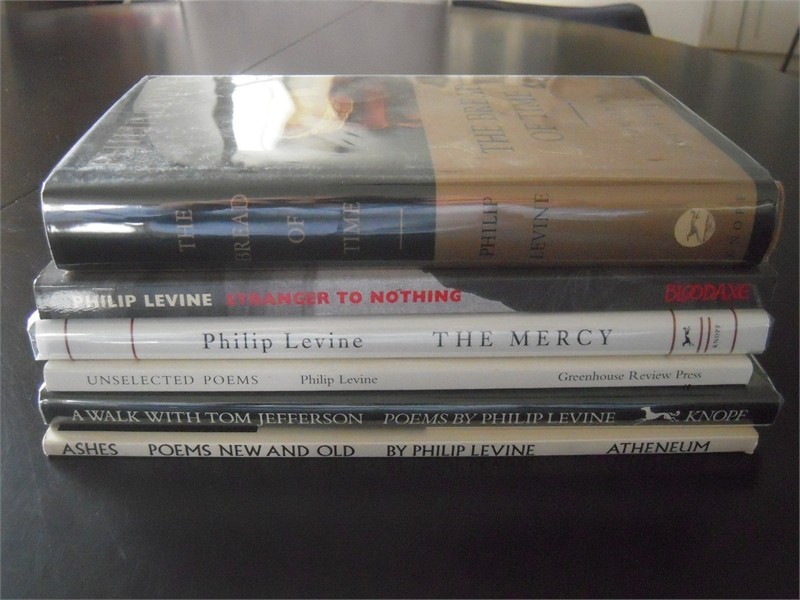
The death of Philip Levine, one of the greats of modern American poetry, was announced yesterday. Bloodaxe published his selected poems, Stranger to Nothing, in 2006: http://www.bloodaxebooks.com/titlepage.asp?isbn=1852247371. Astonishingly, this was his first UK publication since Secker produced an earlier Selected Poems in 1984. Not as well known as he should have been in this country, there has been a good deal more attention given to him in very recent years.

imgres

I’m ashamed to say I only came across him when Poetry London asked me to review Stranger to Nothing alongside Dan Chiasson’s Natural History and Other Poems (Bloodaxe, 2006). It was on the strength of the review that Anne-Marie Fyfe asked me to contribute to a Troubadour Poetry event in London celebrating Levine’s work. Sadly Levine was unable to attend on the evening due to illness and I had the honour of reading some of his work in his stead. For what they are worth, I’ll append the notes I made to myself on the poems I selected to read that evening at the end of this blog. Happily, I think I remember Anne-Marie later reporting back that Levine approved of my brief selection.

Some time later, Naomi Jaffa discussed his life and work with him at Aldeburgh in 2009. The Poetry Channel’s blurb for the recording of that conversation gives a flavour of Levine as follows: A giant of American poetry and now the newly appointed US Poet Laureate, Philip Levine memorably appeared at Aldeburgh in 2009 where he enjoyed a 45-minute conversation with Naomi Jaffa, The Poetry Trust director. In this absorbing, funny and wide-ranging interview, Levine covers growing up as a Jew in anti-semitic Detroit, working for General Motors, finding his voice as a poet, life at college with teachers Lowell and Berryman, his fascination with Lorca and Spain, his love of jazz (and loathing of Wagner), and which four writers he could bear to be stuck in a lift with: listen to that here: http://thepoetrytrust.libsyn.com/philip-levine-s-journeys

And as tribute to a truly great poet here is my September 2006 review of Stranger to Nothing:

On the face of it, the contrast between Dan Chiasson and Philip Levine could hardly be more striking. Bloodaxe have produced a fascinating selection from a poet whose relative absence from discussions of US poetry on this side of the Atlantic is a huge loss. Born in 1928 in Detroit, the son of Russian-Jewish immigrants, the first poems included here were not published until 1963. Like Raymond Carver, to whom he bears some resemblance, Levine spent many years labouring in industry  and much of his later poetry recalls these experiences and the people with whom he worked. Whereas Chiasson is urbane and metropolitan, Levine is urban and industrial. Though encompassing a long writing career, this is not a selection that reveals very much in the way of artistic development; Levine’s characteristic style and tone seems to have come to him fully formed and he has seen little need to alter it. One reason must be the premium he clearly places upon being true to his materials – and in particular the experience of the American working people he portrays.

imgres

Accordingly, there are poems in which Levine doubts the value of the imagination in its tendency to romanticise real experience. ‘Salt and Oils’ from the mid-eighties moves rapidly through moments in a life, but then concludes:

“These were not

the labours of Hercules, these were not

of meat or moment to anyone but me

or destined for story or to learn from

or to make me fit to take the hand

of a toad or a toad princess”

With very different results this might be seen as another attempt to achieve the “transparent eyeball” that Chiasson refers to. Things are what they are and it is in this sense that the collection title works. The phrase comes from an early poem in which a visit to a graveyard leads the narrator to contemplate the realities of life so that “in time one comes / to be a stranger to nothing”. This is also typical of Levine’s style – a loosely constructed, colloquial blank verse, driven along powerfully by the syntax across lengthy sentences that work by slow accumulation rather than the local explosions of linguistic surprises.

But if the fantasies of imagination are dismissed, Levine holds firmly to its role in the re-creation of the past. Often precisely dated, he vividly and lovingly portrays scenes and people from his past. A truck-driving uncle from “black Detroit” is sketched through telling detail – his “two hands kneading / each other at the sink” – and this summoning up into a type of art remote from the original life is, Levine seems to suggest, a kind of redemption or dignifying, so that the Uncle can at last “rise / above Belle Isle and the Straits, / your clear eye / rid of our rooms forever”. Throughout this book, lives are invoked in this fashion in finely-judged poems that neither underplay the poverty and misery within them, nor uncomfortably rose-tint the strength and humour such individuals need to survive.

dscn2747

Perhaps for some, there will be something too fatalistic in these portraits of working-class America. Ought there not to have been more overt political agitation? But Levine works the vein of the individual, the idiosyncratically human and, I’m sure, for him that represents political position enough. In the very recent poem ‘Our Reds’, he again memorialises three characters from school days (1930s/40s?) and their promotion of Communist doctrine. Though the poem indeed acknowledges that what the future brought was “an America no one wanted” it is to “bless” the three that the poem intends: “bless / their certainties, their fiery voices / we so easily resisted . . . their faith in us, especially / that faith, that hideous innocence”. It is perhaps only in moments that working lives are felt redeemed as in the stunning ‘An Ordinary Morning’ with its plain recounting of workers arriving in the city on a bus. The driver and a passenger strike up a song – “O heavy hangs the head” – and as dawn breaks the other passengers wake, momentarily allowed the nobility that their exterior lives seem to deny:

“the brakes

gasp and take hold, and we are

the living, newly arrived

in Detroit, city of dreams,

each on his black throne”

Levine has said that the tradition of poetry he inherited in the 1940s was “utterly lacking” in the kind of people and experiences he had grown up with. His intention was to add to US poetry “what wasn’t there” before. To have done this so consistently – to record the plight and resilience of the poor and inarticulate in America without breaking into the angry simplicities of blame or party politics or caricature is a monumental achievement. This is a collection that deserves to become a significant feature in the twenty-first century landscape of UK poetry.

And here are my notes from the Troubadour event (page numbers here refer to the Bloodaxe edition of Stranger to Nothing):

Reading Philip Levine’s poetry I was immediately put in mind of Carver’s admiration for Chekhov – he quotes Chekhov’s letter again and again in which he says “you don’t have to write about extraordinary people who accomplish extraordinary and memorable deeds”. Also like Carver, Levine worked in industry for many years – born in 1928, his first book didn’t appear till 1963. Both seem fully paid up members of the working classes – Carver said he could never write down to his own people. ‘Saturday Sweeping’ – p 26

I like the way Levine’s poems seem to meander organically from one thing to another – without a hint of irrelevance. He also plays great tricks with chronology – memory of his working years often playing such a large part in his current thinking and writing. ‘Sweet Will’ – p 84

images

Levine – like Carver – would sign up to Pound’s dictum that the only worthwhile morality in writing is “fundamental accuracy of statement”. But there is another current in Levine which can take him towards the surreal. This poem reminds me of Ken Smith’s ‘Fox Running’ (both 1981). ‘The Fox’ – p 68

In later Levine, the political anger is often transmuted into a kind of less deceived tenderness – an amazed sense of good fortune. ‘Philosophy Lesson’ – p 150

Levine often writes of visits to Europe – particularly Spain – and the Civil War clearly stimulated his imagination. Here though – I take it – he is also commenting on one of the great American poets who came to Europe – one I guess temperamentally very contrasting to Levine and I think this has to be intended partly as literary critical comment. ‘The Trade’ – p 127

Levine is also unfashionably willing to walk naked – emotionally. Some will think he sails the wrong side of sentimentality but I’d disagree.’Starlight’ – p 55

Working on Rilke for so long in recent years – I see him everywhere. In the Elegies he claims that even the street girls – prostitutes – are momentarily aware of the visionary possibilities his poems are concerned with. But here – lastly – is Levine working from a position of a good deal of factual knowledge and communicating the same thing – moments of vision without the religious baggage. ‘An Ordinary Morning’ – p 86

A Holocaust poem – my Dad’s desert war and one of the Magi

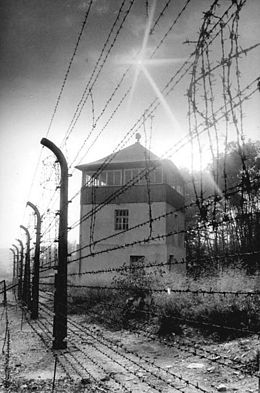
Last week, the 27 January 2015 marked the seventieth anniversary of the liberation of the Auschwitz concentration camp. I have only once tried to address the subject – in a poem dedicated to my father who served in WW2 in the RAF, mostly in the deserts of Egypt (he was with 80 Squadron: http://en.wikipedia.org/wiki/No._80_Squadron_RAF).

He was an engineer by trade and – as far as I know – saw no hand to hand combat. His brief was to maintain the Hawker Hurricanes that were a major component of Allied air power in North Africa. The poem records his only war injury: badly burned legs from jumping too quickly onto the nose of an aircraft after it had landed, straddling its still blisteringly hot twin exhausts. In the 1960s, he’d tell us about this while we sat at the dining table gluing together Airfix models of Hurries (as he calls them), Spits and Lancs.

77feb45061370833dbb98ad79d7f5150

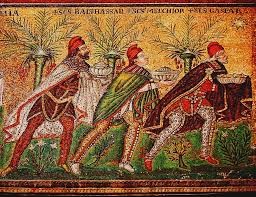
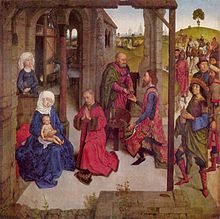
The poem was finally published in 1994 in On Whistler Mountain (see https://martyncrucefix.com/publications/on-whistler-mountain/) It opens with a less than complimentary picture of my father’s unreconstructed political and racial views which I wanted to link to the birth of Christ and the Holocaust. Ironically, given his attitude to people of colour, my father dreams in the poem that he is one of the Magi, Caspar, often depicted as a King from the Indian sub-continent. The poem’s narrative folds over to encompass both the first stirrings of Caspar’s dream about the birth of Christ as well as his last days which I imagine him spending in northern Europe.

Being a King of sorts, my-father-as-Caspar imagines the birth of a conventional king, one of conventional powers, but the child’s family turns out to be of no “consequence”. The child he finds in Bethlehem (I was thinking of course of T S Eliot’s ‘Journey of the Magi’) seems little more than a “futile gesture”. More dreams – which the poem takes as shorthand/short-cuts to the life of the imagination – then drive Caspar north to settle in northern Europe, himself facing racist attitudes among the native peoples there.

 200px-Hurricanes_80_Squadron_RAF_128173

My father’s imagined bafflement before this strange dream in which he plays the role of a non-white king is – I’m sure now – partly his son’s liberal conscience obliquely criticizing his politics. My poem leaves Caspar to die in the northern forests, himself bewildered by what his own dreams have driven him to. The Christ child he dismissed years earlier, continues to visit him in dreams where he goes weeping over that “precise, god-forsaken ground”. The visionary child sees into the future, is a prescient witness to his own Jewish people rounded up by the Nazis’ similarly repellent attitudes to power and racial difference, finally entering “incinerators smoking in the German forest”. Of course, Auschwitz itself and many other camps were not built on German soil, but it was important to use the ‘G’ word at the end of the poem. In the strict pursuit of truth, I was imagining Caspar’s long-house on German soil in the locality of Dachau or Buchenwald, the name of the latter translating as ‘beech forest’.

A Long-House in the Forest

for my father

1.

His war happened in the blazing Middle East.

When he was young, far from the mud of Europe

and the wired camps, his thighs were burned

by too much bravado, sitting astride

the exhausts of a Hurricane that hadn’t cooled.

He picked up the language. Never liked Arabs.

Any dark skin’s still a nigger to this day.

So he votes for the Right, though he’s careless

of politics and takes it as read: we all

long for power and we all need to be led.

imgres

2.

In his dream, he is Caspar. He has chosen

to wait in the draughty long-house, watching

the yard collect its ragged slush of leaves.

He knows the corn-bins are flooded and rotten.

He knows this month is the anniversary

of nights when Caspar rolled in distress, youth,

dream illumination – an excited showing

of power’s open hearth, its air-gulping fire –

his sleep filled with the birth of a king

whose strong arm would invigorate the world.

At once, Caspar instructed a journey. His gift

for this new king, of course, was gold.

220px-Dieric_Bouts_004

3.

A wretched child asleep on that year’s straw.

Neither mother nor father people of consequence,

but simple Jews – trouble-making, deluded.

This was nothing worth his understanding.

(He knows Caspar is a man of wisdom and books).

What could be the need for this powerless figure?

Why this pot-bellied brat? This futile gesture?

Shepherds stood with doting faces for the boy.

He turned his back, dropped the derisory gift.

4.

Without wishing, Caspar gleaned what became

of the lad from travellers’ unlikely tales.

How he saw no reason to cloak humility.

Nor saw the need to make a show of strength.

No surprise the authorities destroyed him.

And on that day, Caspar, his dream-self,

was driven by dreams again, north this time,

to the Black Sea, fighting the Danube inland,

to this blond-haired, beer-drunk, long-limbed place,

whose people mistake him for a piece of Hell

with his blackened face and barbarian tongue.

5.

Sitting by the squadron’s crest, a photograph

of the kids, he sees no reason to dream himself

black and ignorant, plagued by dreams. But he is

Caspar, has chosen the long-house and struggles

at night – not with dreams of the hot south,

of home, courtyards, frescoes and fountains-

but with a dream that has no place yet, though

he searches for it, now that same, futile boy

in the straw has grown his only dream-guide

and weeps over this precise, god-forsaken ground.

He finds it ruled by those whose failure is to see

no need for an icon of the weak, the needful.

Here, the boy’s deluded people prove no trouble at all,

filing from wooden huts ranged like inland galleys,

to incinerators smoking in the German forest.

260px-Bundesarchiv_Bild_183-1983-0825-303,_Gedenkstätte_Buchenwald,_Wachturm,_Stacheldrahtzaun