Review of ‘My Secret Life’ by Krisztina Tóth, tr. George Szirtes

This review first appeared in Acumen Poetry Magazine in the autumn of 2025. Many thanks to the reviews editor, Andrew Geary, for commissioning it.

As a female writer, talented in a variety of genres, living in a difficult political climate, Hungarian born Krisztina Tóth shares a good deal with Huch (my review of Tim Adès translation of Huch’s final book was posted here). Coming to the fore around the revolutionary year, 1989, Tóth has written poetry, children’s books, fiction, drama and musicals. My Secret Life (Bloodaxe Books, 2025) is her first sole author publication in English, ably translated and introduced by George Szirtes, presenting an overview of her poetry from 2001 to the present. Szirtes tells us that Tóth is no longer living in Hungary because of unbearable frictions with the Orbán regime. Like Huch she is drawn to poetry as personal expression, often to the formal elements of the art, both perhaps offering a redoubt against values she finds unacceptable. If there is little redemption to be found in her poems, there is some consolation to be had through the twin imperatives she expresses, to remain compassionate and to persist in trying to articulate human experience. Neither goal is easy.

Szirtes argues Tóth’s style is conversational, plain, precise, offering ‘a kind of kitchen-sink realism’. The personal also features and in these self-selected poems we get glimpses of a barely affectionate mother, a father who dies young, children, lovers, and a difficult grandmother. It’s not clear if these are genuinely autobiographical portraits and, anyway, they are most often absorbed into Tóth’s emblematic writing. An example would be ‘Barrier’ in which a couple are crossing a bridge, seemingly discussing ending their relationship. With the river below and trams thundering past, ‘the pavement was juddering’ and the poem is really about this instability in relationships as much as the (social/political) world, concluding there were ‘certain matters that couldn’t be finalised’. Such uncertainty drives roots even into the self: ‘I’m somebody else today or simply elsewhere’ (‘Send me a Smile’). Tóth uses the image of the ‘professional tourist’ in one of the major poems included here. With little background given, the narrator visits town after town, apparently hoping to be joined by a ‘you’ who never appears. Obviously a ‘stranger’, she wanders aimlessly, haplessly, buys a few things, the poem inconclusively ending with an image of a used toothbrush, ‘like an angry old punk, / its face turned to the tiles, / its white bristles stiff with paste’ (‘Tourist’).

Alienation, expressed through a profound sense of homelessness, is Tóth’s real subject. With the irony turned up to 11, the poem ‘Homeward’ ends quizzically, ‘But where’s home?’ In such a world view, the ability to remain compassionate is important to the poet, however hard it may be. The painfully brilliant ‘Dog’ presents a couple driving at night, seeing a badly injured dog at the roadside, and the woman wants the man to stop. I think they do, but the poem’s focus is on the powerful impetus to help versus the powerful sense that whatever can be done will prove futile. More weirdly, in ‘Duration’, the narrator finds a Mermaid Barbie doll stuck in the ground outside her flat. The childhood associations, the vulnerability of the frail figure, seem to compel action, but ‘what’?

Should I pull the thing out of the ground so it

sheds earth every night, because however often

we wash it, or wrap it in a tissue or leave it

on the radiator we’ll only have to bin it in the end?

Tóth’s wry, highly original lament, on deciding not to buy a universal plug adaptor, perhaps suggests what is being wished for in many of these poems. It is a way for a feeling human being to feel more at home in a world of suffering: ‘how to adapt the world / and its gizmos to the pounding of so many hearts’.

‘Song of the Secret Life’ pulls together many of these strands with the life as much the inner life of the self (the heart) as the life kept hidden in an unsympathetic personal or political environment. In the case of an artist, it is also the creative life, and as much ‘an utter mystery, a puzzle undone’, to the writer herself. But in order ‘to survive it needs telling’ and – like Huch’s creative figure in ‘The Poet’ – even if current conditions do not welcome such efforts, the individual must continue to write, to use language, to affirm the validity of the individual viewpoint. This is the burden of the magnificently hypnotic long concluding poem, ‘Rainy Summer’, in which the long-lined, rhymed couplets, express an unrelenting haunting of the speaker by ‘a sentence’. The latter phrase opens many of the lines, and it goes talking, throbbing, pulsing, dancing and rushing through the poem itself, though as much as the sentence might prove to be some sort of ‘home’ we are never told what it expresses. This is largely because it is a ‘rhythmic unit without words’, it is ‘the bodiless body of language’, it is the ‘speech that knows no speech’, it is ‘a sentence that contained you, gone yet here, some of each’.

Szirtes’ emphasis on the political backdrop to Tóth’s poems might lead us to expect more obvious political engagement and subject matter. That’s not what we get here, though no doubt her surroundings have determined many aspects of the work. Hers is a profound voice, finding in the menace, alienation, and instability around her emblems of more universally shared experiences of rootlessness, troubled self-questioning, of sensibilities that find the world as it is a painful and difficult place to navigate, of the pull of pity and compassion versus an overwhelming sense of the futility of individual action. ‘Sleeper’ addresses what might be a transmigrating soul or spirit, a ‘little pulse box’, asking question after question about where it has been, what it has seen, the mysterious passage from life to death, or vice versa: ‘what’s it like to step into such cold, unlit fiefdoms, / does anything remain’? Tóth’s poems ask such questions and like the best modern poems offer us equivocal answers only, consolatory but not redemptive.

Here is the whole of one poem included here:

Where – Kristina Toth, tr. George Szirtes

Not there, on the tight bend of the paved highway,

where cars are occasionally prone to skidding,

chiefly in winter, though no one dies there,

not there where streets are greener and leafier

where lawns are mowed and there’s a dog in the garden

and the head of the family gets home late at night,

nor there in front of the school where every morning

a man is waiting regular as clockwork,

nor inside the gates on the concrete playground,

nor in the neglected, dehydrated meadow

where a discarded dog-end hits the ground and glows

for a moment, it doesn’t begin there

but at the edge of the forest, in rotting humus

where somebody once was buried alive,

that’s where the poem begins.

Autumn Reading Dates 2025

A little flock of reading dates – replacing the swifts that have left our skies recently – have gathered themselves into something that almost resembles a brief Autumn Reading Tour. Admittedly, not going too far beyond the Greater London area – but to Maidstone and (briefly) Winchester – but of course I’m very happy to be granted these opportunities to read my work. Live links to these events are provided in the details below. And, as you’ll see from the details below, the chance to read with some really talented, inventive and entertaining poets along the way. In particular, I’ll be launching my new chapbook of poems – Walking Away – published by Paul O’Prey’s excellent Dare-Gale Press. If you are in any of the vicinities mentioned – I’d be delighted to see you there – Martyn

Wednesday 10th September – 8pm @ Highgate Literary & Scientific Institution, 11 South Grove, London N6 6BS – reading w/ Tim Ades and Maggie Brookes-Butt. HLSI Fundraising Event: Tickets £10 https://hlsi.org.uk/whats-on/poetry-please/

Sunday 28th September – 7.30pm @ Torriano Poetry, 99 Torriano Avenue, Kentish Town, London NW5 2RX w/ poet/translators Will Stone & Stephen Watts. Floor Readers welcome: £6 + concs https://torriano.org/whats-on/poetry/torriano-poetry-28-09-2025

Tuesday 7th October – 6.30pm @ Maidstone Literary Festival, Maidstone Museum, Saint Faith’s Street, Maidstone w/ Maggie Brookes-Butt & Nancy Charley. Open mic readers welcome: £8 https://www.maidstonelitfest.org/what-s-on-2025/poetry-open-mic-evening-hosted-by-maggie-brookes%2C-nancy-charley-%26-martyn-crucefix

Sunday 12th October – 2pm @ Winchester Poetry Festival, The Arc, Jewry Street, Winchester SO23 8SB – poetry prize anthology ceremony where I’ll be reading my long-listed poem – the prize winners to be announced on the day! https://www.eventbrite.co.uk/e/winchester-poetry-prize-ceremony-2025-tickets-1431638672809

Saturday 25th October – 1pm @ The Small Publishers Fair, Conway Hall, 25 Red Lion St, London WC1R 4RL reading w/ David Harsent. Free Event. This is a Dare-Gale Press reading, launching my chapbook which they are publishing: Walking Away. Free Event: https://smallpublishersfair.co.uk/

And on the SAME DAY I’ll be second launching the chapbook Walking Away

Saturday 25th October – 7pm @ The Ship Poetry Reading Series, organised by Chris Beckett, 134 New Cavendish St. London W1W 6YB – reading w/ Barbara Cumbers, Jack Cooper, Anthony Joseph, + Fawzia Muradali Kane: £5 https://www.chrisbeckettpoems.com/news.html

Thursday 6th November – 7.30pm ON-LINE ONLY @ Fire River Poets, Taunton, Somerset. Open mic slots are available. Register for this event at: https://fireriverpoets.org.uk/2024/12/november-6th-2025-martyn-crucefix/

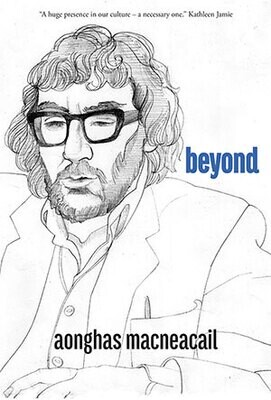
Aonghas MacNeacail’s English Language Poems Reviewed

An edited (shorter) version of this review first appeared in Poetry Salzberg Review in June 2025. Many thanks to the editor, Wolfgang Görtschacher, for commissioning the writing of it.

It is as a poet writing in Gaelic that MacNeacail – who died in 2022 – is most well-known, though he would himself provide translations of his work into English, what, in the poem ‘last night’, he refers to as Gaelic’s ‘sister tongue’. There were also poems written in Scots and these variants give an insight into what Colin Bramwell here calls ‘the language situation in Scotland’ within which MacNeacail worked all his life. For a number of years, MacNeacail lived and wrote under the anglicised name Angus Nicolson, but always considered himself a tri-lingualist and antagonistic to the kind of divisiveness such a ‘situation’ might give rise to. His natural inclination was democratic, pacifist, anti-authoritarian, and modernist. Now, the collection, beyond (eds. Colin Bramwell with Gerda Stevenson (Shearsman Books, 2024)) gives readers a selection of poems written in English by Aonghas MacNeacail over the past 30 years. One of the implications of the book’s title is his deeply held wish to look ‘beyond’ division, not to anything transcendental (MacNeacail’s focus was always this world, not some other), but to the next term in an on-going dialectical process. One of the little gems from ‘the notebook’, included here, imagines a cup of knowledge, the liquor within, also knowledge, a grain is added and stirred, and the grain then consumes the liquor and continues to ‘grow, root, sprout / find elbows, crack the cup // find clay’.

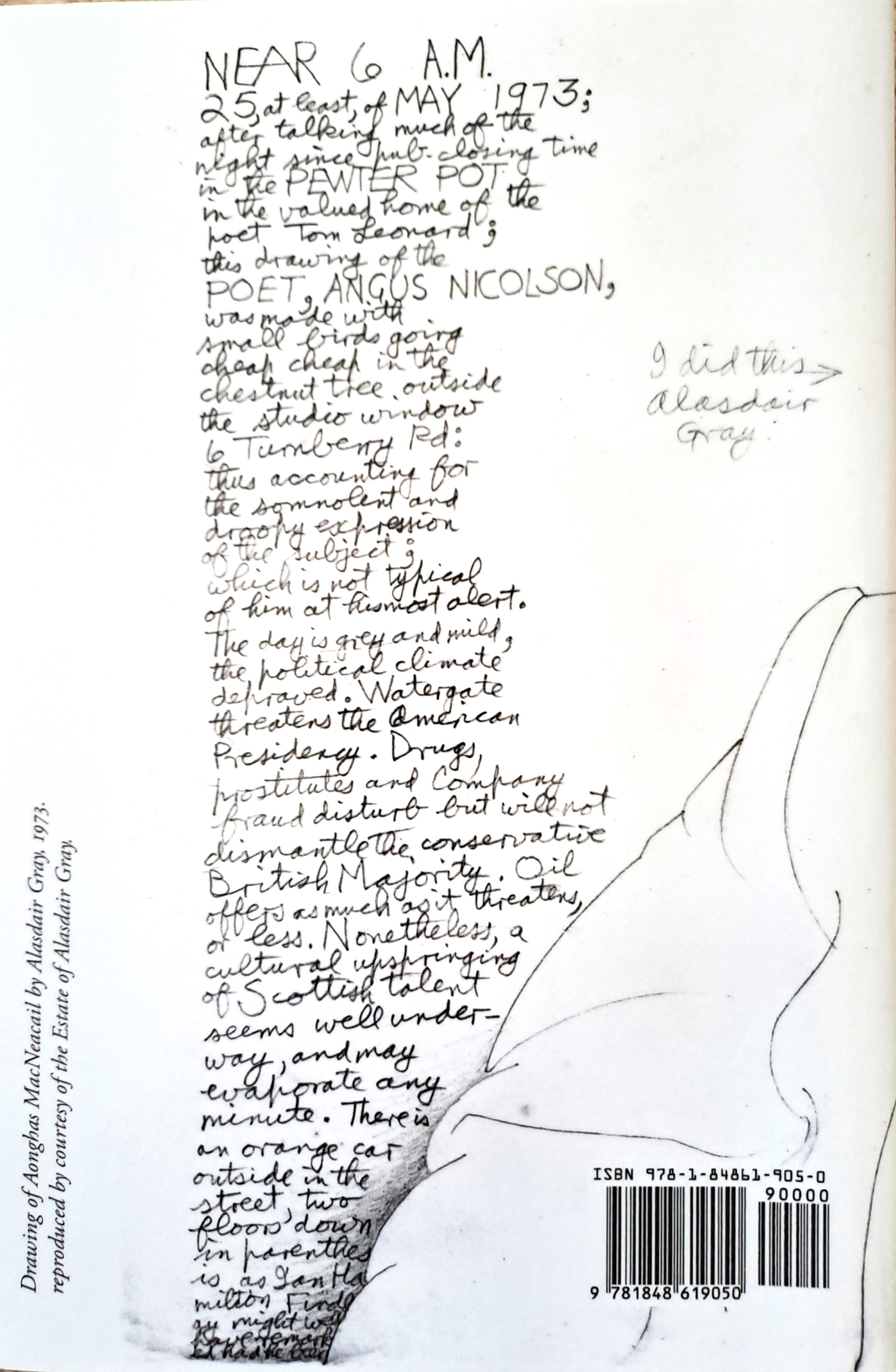
MacNeacail’s modernism took its key lessons from the likes of William Carlos Williams, Olson, and Creeley and most of the poems here have that fluid, unpunctuated (hence pointed by the breath), often short lined, often indented formal shape we associate with the Black Mountain. He was a member of one of Phillip Hobsbaum’s fertile ‘groups’ (along with Liz Lochhead, Alasdair Gray and Tom Leonard) and the advice given was to go back to his roots, to ‘write about what you know’. In part, this took MacNeacail back to his childhood, growing up in Uig, on the Isle of Skye, speaking only Gaelic. It also made it clear what he wanted to escape from: Gerda Stevenson describes this as ‘the confines of the proscriptive Free Church of Scotland’. Several childhood poems, illustrate the stifling force of religion, on his mother, for example, ‘strapped down tightly / by a darkly warding book thick with orders that drove / and hedged her way’ (‘missing’). The church governed education too, the teacher little more than a ‘stern presence’, who demanded ‘psalms / from memory’ (‘crofter, not’).

The teacher’s ‘granite eye’ also features in ‘forbidden fruit’ where the contrast is between education’s confining ‘barbed-wire’ and the invitations of the natural world (of Skye), specifically the allure of ‘the biggest [. . .] sweetest’ nut hanging on a branch over a waterfall. The poem ‘had adam not eaten the apple’ feels like a later piece, with a more self-confident, liberated MacNeacail declaring ‘the thing is / not to always / spell the word correctly’ and imagining god’s demands for eternal perfection leading him to waken every morning, complaining ‘another fucking immaculate day’. A longer poem like ‘gaudy jane’ gives a sense of MacNeacail’s unshackling from restrictions. The figure addressed is part woman, part a realm of liberation, a window onto ‘wild excursions’, towards ‘dancing voices, laughing feet’, she is a glass of whisky, a doorway into nature, to sensuality, and a way to access the ‘little gods of mischief and delight’. Celebrations of the natural landscapes of Skye (and elsewhere) in fact become one of the characteristics of MacNeacail’s writing. Snowfall over hills is as if ‘god’s apron / settles on our field and makes / a tranquil bowl’ (‘snowhere’). In ‘a rainbow’, the natural phenomenon is enjoyed and admired, ‘so real // high up on that pentland slope’, its natural beauty preferred to any fanciful talk of pots of gold, its fleetingness an image of imagination and memory. MacNeacail’s ‘primula scottica at yesnaby’ celebrates the rare wildflower’s fragile beauty, its hardy nature, till it also becomes an image of Scotland itself: ‘the air it breathes is stiff with brine / this whit of life      still flowers / every tiny purple radiance is lambent / in the blood of time’. 

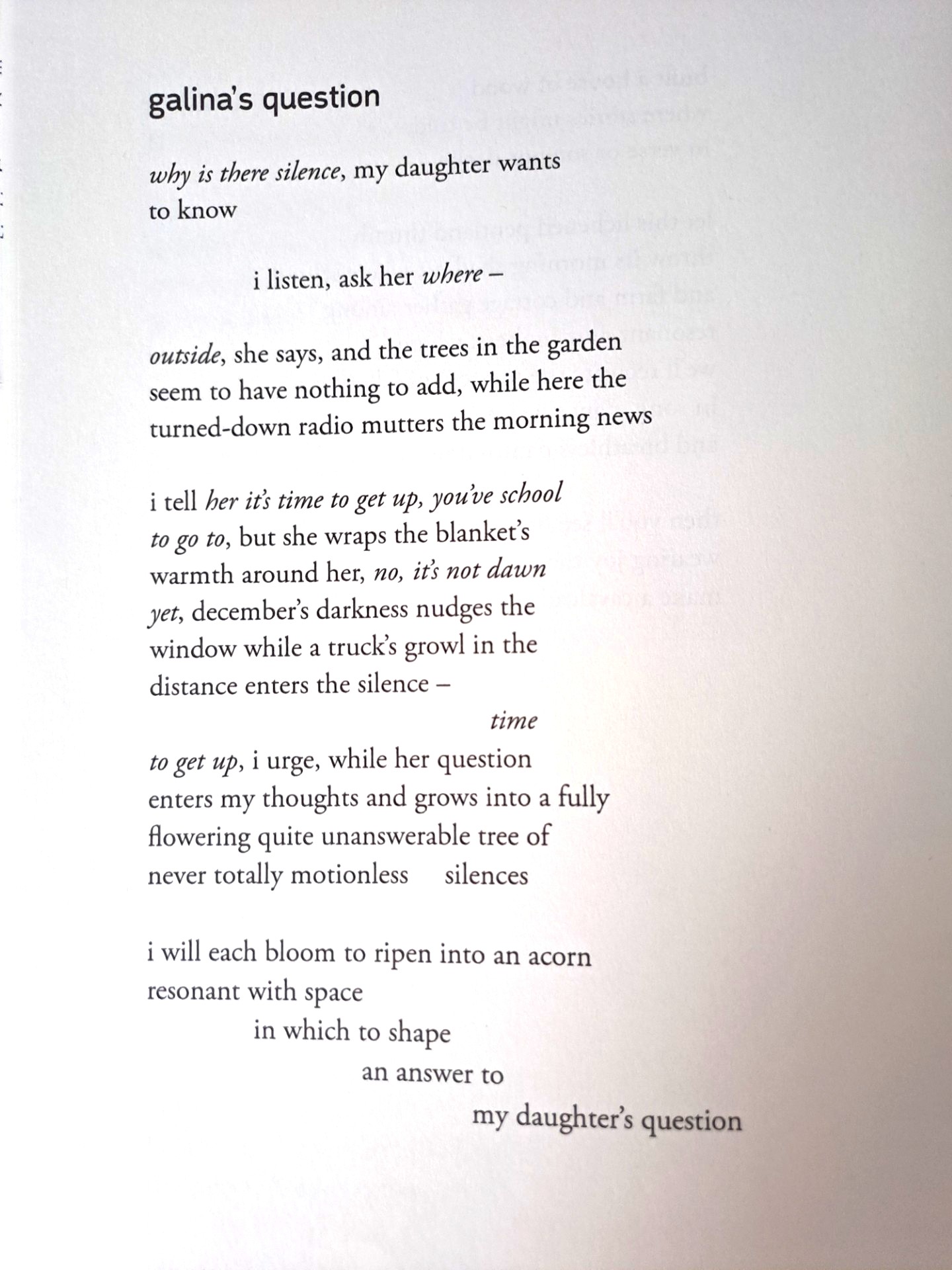
MacNeacail’s love of Nature is matched only by his writing on the varieties of human love, erotic, romantic, filial, parental, between friends. I can’t think of any other poet who’d compose 80 lines (both touching and hilarious) in praise of ‘some of my best friends’. A poem like ‘love in the moonlight’ is unashamedly romantic in its contrasting of the moon’s ‘pallor’ with the loved one’s ‘sun- / wrapped noons, bright mornings / and the way your evenings / dance into a fiery dusk’. There are several delicate poems featuring MacNeacail’s daughter, Galina, and – reminiscent of Courbet’s ‘The Origin of the World’ painting – ‘the curious eternal’ is a marvellous erotically-charged paean to a loved one, ‘after all those years / the mystery / of flesh, secretions, pulse and breathing patterns’. MacNeacail’s English poems exude a human warmth that, to judge from comments from friends and colleagues, was true to the man himself. They are driven by his wish to communicate – in whatever language, in truth – and his slipping free from Christianity’s ‘one book’, that would ‘consign all art and ingenuity / to black irrelevance’ (‘this land is your land’), allowed him to celebrate the flawed, the not perfectly straight, the interrupted conversations, that constitute being human with a passion and modesty. These lines from ‘the notebook’, are a characteristic, and invaluable, vade mecum: ‘no matter / how little / you say / it may / be worth / the saying, if it / touches the edge / of a shadow / that can / (possibly) / be thinned / by the breath / of words’.

Three Poems by Jürgen Becker

Following on from the publication in January 2025 of my translation of ‘Dressel’s Garden’, one of Jürgen Becker’s longer poems (which recently appeared on the USA site Asymptote Journal), three more poems by this fascinating German poet have just appeared in Shearsman magazine and our hope is (permissions permitting etc) that Shearsman Books will be publishing a full collection of his work in the near future. All these poems are taken from Becker’s crucial 1993 collection, Foxtrot in the Erfurt Stadium. The newly published poems are relatively brief so I thought I’d post two them here with a little bit of literary and historical context. (I’ll comment in a later post on the longest of the three poems now published by Shearsman).

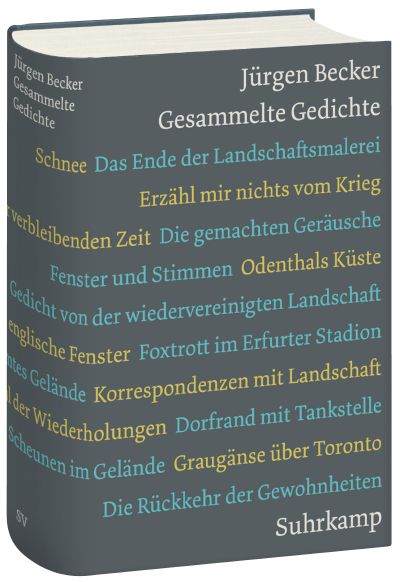
In her Afterword to Jürgen Becker’s monumental 1000-page Collected Poems (2022), Marion Poschmann praises the poet as being ‘the writer of his generation who has most consistently exposed himself to the work of remembrance, who approaches the repressed with admirable subtlety and is able to reconcile his personal biography with the great upheavals of history.’ Likewise, in their adjudication, the 2014 Büchner Prize jury highlighted the way ‘Becker’s writing is interwoven with the times, with what is observed and what is remembered, what is personal and what is historical.’ Jürgen Becker’s own personal journey began on July 10, 1932, on Strundener Strasse, in Cologne. In August 1939, shortly before the outbreak of the war, his father was transferred from his place of work in Cologne to Erfurt in Central Germany. This was the beginning of the seven-year-old Becker’s experience of war and a post-war childhood in Thuringia. In 1947, the family left Erfurt and returned to West Germany. Becker has said about this period that there was never any thought of wanting to travel to the Eastern zone, let alone to the GDR, to see the places and landscapes where he’d spent his childhood years: ‘For a long time, I oriented myself solely towards western horizons; I lived, so to speak, with my back to the GDR; my childhood was separated by a border, seemingly closed’. (More of borders in a moment).

Becker’s interest in ‘events’ – political and historical – can clearly be seen in the short poem ‘Reporter’. Its subject never seems to become outdated (as I write this, Turkey is enforcing a crackdown on reporting – see the arrest and deportation of BBC reporter, Mark Lowen, very recently). Becker’s poem is not set in any particular time period, though the allusion to a ‘vast thing, fading away’ suggests an epoch of great change, one political system fading, another on the rise. I love the journalist’s reported observation that he ‘can only leave / when nothing else happens’. In Becker’s writing, there is always something else arising (history does not stop happening – as we see in this particularly fast-moving historical moment). I take the implication of the final 4 words to suggest that the reporter may well be ‘removed’ by the authorities from whatever the situation currently is (against his wishes by the sound of it) and that we will all become the poorer for that, more poorly informed, less capable of distinguishing the truth of things: ‘He will be missed’.

He barely looks at the camera; it almost seems

as if he’s talking to himself, a correspondence

with something on the unseen table, perhaps

with the pencil, the cigarette.

A slight tremor in the hands … who knows; anyway,

very likeable, nothing specific, more a murmur,

what can you say … cold weather and glimpses

along a street which is illuminated a little

by the snowfall; a leftover flag being stirred

by a wind machine. A vast thing, fading away

slowly … it has already disappeared, even before

a decree. He repeats it: he can only leave

when nothing else happens. He will be missed.

The second poem, ‘Meanwhile in the Ore Mountains’, bears strong similarities in that the specific time period (though not the setting) is left deliberately vague, though so many of the details in the poem possess a terrific (terrifying?) resonance for our own times. As to place, the Ore Mountains lie along the Czech-German border and borders are important in this poem. As I mentioned above, Becker was born in the eastern region of Germany, but from age 7, he was brought up in West Germany, and after the fall of the Wall in 1990, he’d often return to his (eastern) childhood landscape. The resulting blending of a child’s and adult’s vision is what gives rise to Becker’s characteristic poetic mode: a flickering between past and present, often without clear signalling, the past frequently haunted by the disturbing changes that happened in Germany in the 1930s. I’ll post the original German of this poem as well, as in what follows I’ll make a few observations about translation.

Though relatively brief, this poem is just one sentence, woven together with the conjunction ‘wie’ (translated here both as ‘how’ and ‘the way’). The weave is dense and as I’ve suggested it’s not really possible to tell whether what is observed – the children, the oil spill, the tree stump (resembling a body) – are contemporaneous or from different eras. My translation keeps these possibilities open: borders here are felt to be temporal, as well as geographical. The German word ‘Avantgarde’ has artistic as well as political implications, but my choice of ‘vanguard’ also brings out the militaristic connotations which are reinforced by the ‘spitzen, grünen Lanzen’ (‘sharp, green spears’) which are then swiftly transformed into a bunch of sprouting snowdrops. These flowers of Spring are interestingly referred to as a ‘Konvention’ and I retained the English equivalent, intending to suggest both a performance (something conventional, perhaps not genuine), as well as a political gathering or agreement (like the Convention on Human Rights). The ambiguity felt very relevant (and once again topical).

The final vivid, visual images – a TV screen observed through a window, a script on the screen, a woman talking, but she is inaudible to the observer – sum up Becker’s concerns about the media, political and historical change, borders real and imagined, exclusion, and the need to ask questions of those in power. Issues as real today as when the poem was written in the early 1990s.

Sitting still, watching how the afternoon below

waits for the dusk, the way snipers vanish

behind the remains of a wall and children run

after a white, armoured vehicle, the way a line

of hills, which marks a boundary, divides

the nothingness of snow from the nothingness of sky,

and along the frontier, one this side, another

along the other, fly the only two crows

to be found in this treeless landscape, the way

the iridescent pattern of an oil spill develops

with darkening edges, the way a tree stump

in the field becomes the shape of a body with

severed arms and legs, how, under the cherry,

the vanguard shows with sharp, green spears,

which later, over the next few days, assumes

the convention of snowdrops, how dark windows

are lit by screens, and on each screen appears,

at first, lettering, and then the face of

a woman who is soundlessly moving her lips.

Zwischendurch im Erzgebirge

Still sitzen und sehen, wie unten der Nachmittag

die Dämmerung erwartet, wie Scharfschützen hinter

einem Mauerrest verschwinden und Kinder

einem weißen gepanzerten Fahrzeug nachlaufen, wie

eine Hügellinie, die eine Grenzlinie ist, das Nichts

des Schnees vom Nichts des Himmels trennt, und

entlang der Grenze, die eine diesseits, die andere

jenseits, fliegen die beiden einzigen Krähen, die

es in dieser baumlosen Landschaft gibt, wie

das changierende Muster eines Ölteppichs entsteht

mit dunkler werdenden Rändern, wie auf der Wiese

ein Baumstumpf die Form eines Körpers annimmt mit

abgeschlagenen Armen und Beinen, wie unterm Kirschbaum

sich die Avantgarde zeigt, mit spitzen, grünen Lanzen,

die später, in den nächsten Tagen, die Konvention

der Schneeglöckchen annimmt, wie in dunklen Fenstern

Bildschirme aufleuchten und auf jedem Bildschirm

zuerst eine Schrift und dann das Gesicht einer Frau

erscheint, die lautlos die Lippen bewegt.

RIP Michael Longley

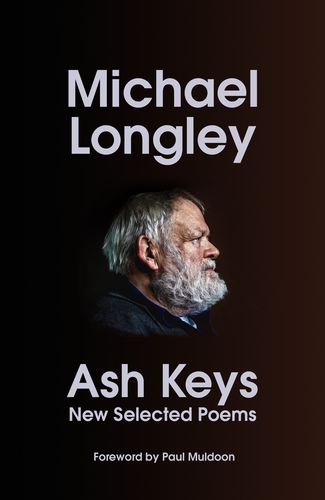
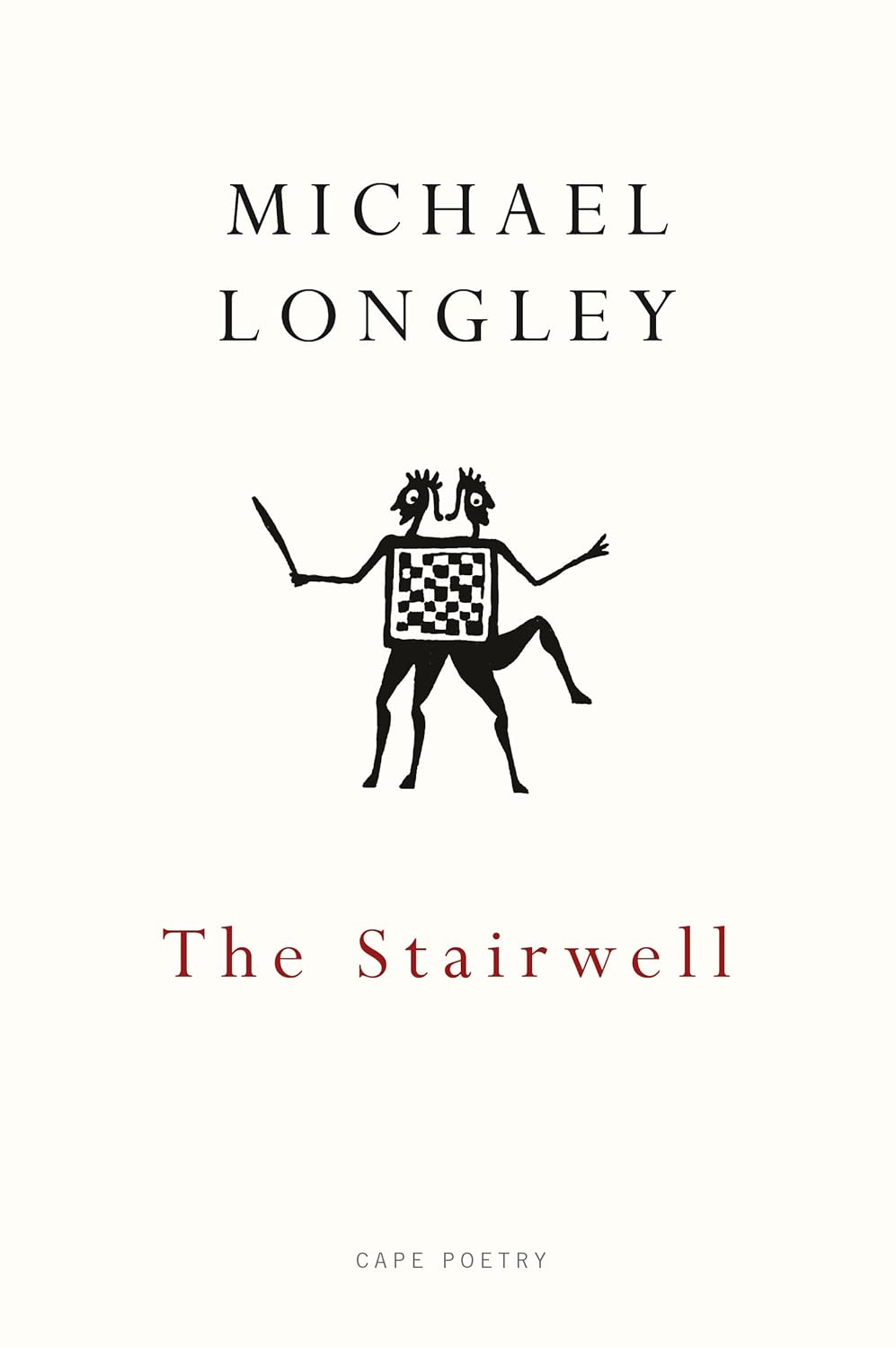
Social media – at least the bit of it that arrives on my screens – is alive this morning with many expressions of sadness at the announcement of the death of Michael Longley. I heard him read just a few months ago to launch his most recent new selected poems, Ash Keys, at the LRB Bookshop in London. He insisted then on trying to stand to read his poems, though his breathlessness and physical wobbling often made him have to take his seat again; but the humour and mischievous twinkle were as powerful as ever. Over the years, I have to admit it took me a while to really come to appreciate his work; I think I did not really ‘get’ the force of his brevity, his precision. If you have not seen it yet, do watch the brilliant, moving, inspiring BBC programme about him, his life and work here. I’m posting below my review of his 2014 collection, The Stairwell (the review originally published in Poetry London) and I hope it manages to say something useful to both new and older readers of this wonderful poet. Here he is reading ‘Remembering Carrigskeewaun’ on The Poetry Archive.

Keeper, custodian, traditionalist whose work is stringent, formalist, always elegant: critical judgments on Michael Longley’s work fence him round too closely, running the risk of misleading, even discouraging, new readers. It’s true, as a member of Philip Hobsbaum’s Group in Belfast in the 1960s, Longley’s poems were criticized for their elegance of form, rhetorical grace and verbal eloquence, though he found something of a kindred spirit in Derek Mahon. Longley wrote poems that were “polished, metrical and rhymed; oblique rather than head-on; imagistic and symbolic rather than rawly factual; rhetorical rather than documentary” (The Honest Ulsterman, November, 1976). But Seamus Heaney’s different aesthetic was Hobsbaum’s star turn and quickly became a national, then international preference. Attitudes solidified around Longley although (perhaps in the cause of self-definition) this was not something he resisted, casting himself and Mahon in the 1973 poem ‘Letters’ as “poetic conservatives”.

‘Epithalamium’, the poem that since 1969 has opened Longley’s selections and collecteds reinforces the caricature and in ‘Emily Dickinson’ he sees the need to dress “with care for the act of poetry”. But Longley’s long standing admiration of Edward Thomas was not for nothing and he shared a desire to dismiss Swinburnian “musical jargon that [. . . ] is not and never could be speech” so that in The Echo Gate (1979) he is experimenting, on the one hand with the plainly Frostian ‘Mayo Monologues’, and on the other with short, imagistic pieces in which the authorial voice seems to have taken a vow of non-intervention. ‘Thaw’ reads, in its entirety:

Snow curls into the coalhouse, flecks the coal.

We burn the snow as well in bad weather

As though to spring-clean that darkening hole.

The thaw’s a blackbird with one white feather.

This is a mode that Longley has continued to explore in accordance with another (surprisingly) early statement of poetic intent. The poet’s duty is to “celebrate life in all its aspects, to commemorate normal human activities. Art is itself a normal human activity. The more normal it appears in the eyes of the artist and his audience, the more potent a force it becomes” (Longley, ed. Causeway: The Arts in Ulster, 1971).

Subsequent collections have become concerned to list, to name, as it were ‘merely’ to record experience for its own sake, often in vivid short poems which run the risk of seeming inconsequence, though Longley has never lost his unerring eye and ear for the poetic line. Nor has he ever seriously questioned the adequacy of language (within conventional bounds) to represent experience. It’s in these ways that his work is conservative but his poems’ intention to encompass and witness is far more radical. To witness – whether it is the song of a wren near Longley’s beloved Carrigskeewaun, a Belfast bombing, or the camp at Terezin – is to acknowledge that we are bound together by what happens. From Gorse Fires (1991) to The Weather in Japan (2000) Longley comes to sound like Eliot’s Tereisias who, as the pages turn, has “seen and foresuffered all”. The beauty of nature, the horrors of mankind, birth and death, the present and the distant past are all absorbed into his steady gaze, a steady voice, intent on an anatomy of connection.

One such connection is the way Longley has been re-visiting the Iliad and Odyssey for years now, producing vivid, contemporary accounts of key scenes. Priam’s visit to Achilles tent in Book 24 of the Iliad famously became Longley’s poem ‘Ceasefire’, appearing in The Irish Times in 1994 when the IRA were considering a ceasefire themselves. The poem forges links and connections between enemies and across millennia. As ‘All of these people’ puts it, “the opposite of war / Is not so much peace as civilization” and civilization needs to be founded on a right relationship with even the smallest of things. Among many poems that articulate an ars poetica, ‘The Waterfall’ envisages the best place to read his own collected works as “this half-hearted waterfall / That allows each pebbly basin its separate say”. It is such civilized allowance, rather than the much-vaunted preservation of a tradition, that is the mark of Longley’s aesthetic, moral and political outlook.

His new collection, The Stairwell, is much obsessed with death though its inevitable reality has already been embraced by the poet’s allowance. An Exploded View (1973) already contained ‘Three Posthumous Pieces’ and twenty years later, ‘Detour’ mapped out his own funeral procession. Here, Longley has been “thinking about the music for my funeral” (‘The Stairwell’) and much of the book has the feeling of an ageing figure readying to depart. Longley himself refers to his “unassuming nunc dimittis” (‘Birth-Bed’) and the only ceremonial he anticipates is to be provided by robins, wrens, blackbirds: “I’ll leave the window open for my soul-birds” (‘Deathbed’). The counterweight to civilized allowance, even in the approach of death, is modesty and humility. If gifts are to be handed on to the future then they ought to include a little poem about a wren: “Its cotton-wool soul, / Wire skeleton [. . . ] / Its tumultuous / Aria in C” (‘Another Wren’).

Such unassuming gifts to future generations are balanced, in the civilized society Longley seeks out, by the commemoration of the past. This is something his poems continue to do with his re-imagining of his father’s experiences in the Great War and this new collection contains more of these poems; his father at ‘High Wood’ among “unburied dead”, befriending the future Hollywood star, Ronald Colman, or taking an ironic “breather before Passchendaele” (‘Second Lieutenant Tooke’). Whether looking forwards or backwards, the true gift lies in the specific, not the generalized. ‘Insomnia’ recalls Helen Thomas calming and consoling the mad Ivor Gurney, by guiding his “lonely finger down the lanes” of her husband’s map of Gloucestershire. Longley looks for this too. Here is the whole of ‘Wild Raspberries’:

Following the ponies’ hoof-prints

And your own muddy track, I find

Sweet pink nipples, wild raspberries,

A surprise among the brambles.

Having translated a poem by Mikhail Lermontov, Longley goes on to wonder what his “understated” neighbours around Carrigskeewaun would make of such “grandiloquence” (‘After Mikhail Lermontov’). It’s in the avoidance of a hyper-inflated language and tone that Longley’s re-makings of Homer are so good. The new book contains a fair sampling of these too, many of them in the second half which forms an extended elegy, commemorating Longley’s twin brother, Peter. The Homeric paralleling works less well in this context, though the unrhymed double sonnet, ‘The Apparition’, in which the ghost of Patroclus pleads to be buried by Achilles, addressing him as his “dear brother” is powerful. But I’m reminded of Heaney’s Station Island (1984) in which he revised and regretted his earlier use of “the lovely blinds of the Purgatorio” in writing a poem about the murder of Colum McCartney in Field Work (1979). Longley’s Homeric material casts such a strong shadow and the vital life of Peter is insufficiently conveyed, except in a few recollections of their shared childhood, tree-climbing, bows and arrows, boxing, visiting the zoo. Nevertheless, Longley’s determination to commemorate his twin, with whom he shared “our gloomy womb-tangle” (‘The Feet’), re-confirms human closeness, allowance, the giving of space to others, to nature, is what has driven this poet’s work for more than forty years. 

Impressions of the TS Eliot Prize Readings 2025

I’ve always enjoyed Ladybird spotting the ways poets present themselves in a reading situation. Last night’s TS Eliot prize readings at the Festival Hall was a grand opportunity for such a pursuit. Ten readers in a row. Here are a few jotted down impressions, gleaned from the on-line version of the show. Before you crucify me for such poor, ill-informed critical judgements, I do hereby declare I have only thoroughly read two of the contenders, so these are very much impressions of ‘what happened on the night’. I’ll leave mentioning my favourite and my predicted winner (not the same poet) to the end. The award will be announced this evening (Monday 13th January 2025).

The housekeeping…. This year, the shortlist was chosen by judges Mimi Khalvati (Chair), Hannah Sullivan and Anthony Joseph. The TS Eliot Prize (it says on their website) is among the world’s most celebrated awards. Inaugurated in 1993 to celebrate the Poetry Book Society’s 40th birthday and to honour its founding poet, the prize is now awarded by the TS Eliot Foundation. The evening was introduced by Ian McMillan.

In the order the shortlist for this year’s prize was presented last night:

Katrina Porteous Rhizodont (Bloodaxe Books) – KP was described as a northern lighthouse by Ian McMillan – finding the universal in the local – the north east of England – Holy Island – this is poetry full of its concrete ‘subject’ – details and actuality, a powerful wish to communicate (the book is full of explanatory Notes) – here, the coal beginning (to be formed) again – Our Billie – a local girl, forms the backbone of one poem  – some unfortunate ‘down with the kids’ moments, referencing Insta and emojis – KP reads in a bobbing, fidgeting sort of way – does stillness evoke more power? – ‘The children STARE at their phones’ – particular words picked out for heavy emphasis – a bit over insistent on their significance – a robot explores the moon surface now – an interest in new technology – but then, the Antarctic without ice – the book title, rhizodont, is a fish transitioning onto land a very long time ago – the delivery here surely too mimetic – snarly, is that how a fish sounds? But passionately held views without a doubt.

Rachel Mann Eleanor Among the Saints (Carcanet Press) – McMillan suggested that Mann takes up liturgical language and re-invents it (for a modern audience?) – Eleanor the central figure is a trans woman of the 14th century – at one point she’s in conversation with Julian of Norwich and Margery Kemp, so lots of hazelnut references – but thank goodness I didn’t hear ‘all shall be well’ – the delivery a slow emphatic one, I actually wrote ‘from the pulpit’ before I noticed (I think) the dog collar – am I right? – lots of first person voice going on here – often in an ecstatic (religious) mode, a few grand arm gestures – the language often moving towards Hopkins (why not?) – masculinity? –embroidering a priest, sanctus, sanctus, then love – the murdering of a trans girl, drawing a bead on contemporary relevance – in 1394 Eleanor was arrested – the dark shades worn by RM curiously out of keeping with the verse lines.

Carl Phillips Scattered Snows, to the North (Carcanet Press) – from the US –‘quiet’ being the word here – rather sweetly alluded to his sponsors for the evening – Lemsip – welcome to England – the lines being read in the cadence of a breath, a dying fall – suggestive here of an interior communion, very delicate, exploration of an emotional life – McMillan suggested this is where time and intimacy meet – what do they say to each other I wonder? – a taking off of  clothes – then he also takes his clothes off – colours and a bell – a concern (as technique and subject matter) for precision, for what is true? (how unfashionable in the US) – snows in the title poem, Phillips manages to take us to Roman history and love without us getting lost along the way – quietly persuasive and good company – a forest journey – things almost said – a vulnerability to this writer (someone else posted this idea) I’ll borrow it.

Gustav Parker Hibbett High Jump as Icarus Story (Banshee Press) – opening with allusions to Ovid for the Icarus link – reaching for the sunlight (not the best of phrases) – but athletics as a metaphor it seems at first – sliding into athletics for real – practising high jumps with a friend – in a world where they are regarded as ‘interchangeable’ because of ethnicity – the dark body hanging – the poems delivered head down, reading from the page, a whispering voice, not coming from the throat or diaphragm, so intimate as to be rather too in-turned – these are plain narratives, lots of ‘stuff’ – one later poem is longer, more sustained and the insistence on these real details begins to transform the poem into something a bit more visionary – jumping 6’ 8” – Noah, all he wanted was the stars – black boys doing anything – the USA and Mexico – to customise paradigms if they don’t fit.

Karen McCarthy Woolf Top Doll (Dialogue Books) – this turns out to be a verse novel so rather hard to convey a clear impression of it – Hugette a female recluse who lived with lots of dolls – KMW read several dramatic monologues this evening – Maman being spoken by a French doll – a rag doll speaking as if a military general, denying that he is a ‘gollywog’ – big pause on that – these are probably funny in many ways – but with their points to be made – but Woolf is acting them out with neck, eyes and eyebrows – male dolls, deep-voiced, female, light, a dancer doll flighty voiced – Ballerina Barbie is all en pointe and pirouette (arms being waved on stage) – yes, fictional and imaginative recreation, but this begins to feel like a sort of ventriloquism in the delivery – the mask is evident – being acted out – I can’t hear the verse of this verse novel – a Japanese doll to finish off with – cherry blossom, bento, the moon. My review of KMW’s earlier collection An Aviary of Small Birds.

Interval

Helen Farish The Penny Dropping (Bloodaxe Books) – a book-long retrospective on an old ended relationship – trying to say what is perhaps inarticulate – joy and ache – biographical narrative as universal – McMillan suggests the relationship is merely a ‘hook’ rather than the ‘focus’ that it surely is? – the delivery is slow and fluting, very deliberate and clear almost as if Farish is finding the words (for the first time) as she goes – effective I think – again poetry with a lot of subject stuff – lists of local colour, places, events, food and drink – things we loved, a list – though spoken of as ‘a’ relationship this feels really quite narrowly autobiographical – driving the M40 discussing having (not having) children – a bit toe-curling, some allusions to film Pretty Woman with Gere and Roberts – who is it says ‘we were made for each other’ these days – a valentine card? – nice recipe at the end, pasta and red wine – but surely a candle was on the table too?

Peter Gizzi Fierce Elegy (Penguin Poetry) – also from the US – the delivery here a steady pulsing (these are short lines, I think, and Gizzi seems to be breathing and voicing that – a rich, resonant voice (the kind you’re born with) – a terrific flow and a shifting from concrete to abstract – the moon and then ‘kinda real, kinda not’ – the ingenious light – a letting out of inner weather – a rather self-conscious making of fine phrases and with the ‘self’ as the primary subject (not the outer) there are passages of pure lyricism – risks even allusions to the Muse, a lyre, but bedded in American colloquial – neatly done – forests, shapes, landscapes all becoming the inner life, representing it – shapes become the beloved – without reading more I’m none the wiser as to what is elegiac here or fierce – but interesting poems.

Hannah Copley Lapwing (Pavilion Poetry) – McMillan suggesting Copley’s book pushes language to the state of music – do we expect Mallarme? – not at all – the lapwing gives the chance for some birdsong – but lapwing does not speak but is rather spoken about – another bird, a daughter… Peet? – all the folksy names for a lapwing, of course – the bird is found to be missing – a mosaic, otherwise know as – the bird becoming person – a poem about addiction – our creaturely behaviours – the difficulty of caring for someone (some bird) – raggedy, slugs, let him disintegrate, love – Copley also reads in cadences that fall every time, not quite clear whether these are the lines of verse or her grammatical units – the lapwing figure is anthropomorphised or a human being is birdified – a nice balancing act mostly – though some less so – a family tree and (very human) grief – something to feather – ready to give – think I’d have liked more musicality.

Gboyega Odubanjo Adam (Faber & Faber) – Odubanjoof course not present after his tragic, untimely death – this his first and only collection – Adam the name given to the torso of a boy pulled from the Thames some years back – a couple of recordings of the author were played – poems read by Joe Carrick-Varty and Gabriel Akamo – the latter the much better reader – a memorial set of poems to the disappeared, the dispossessed – the dead boy’s imagined journey through Germany to the UK – thank you to the woman, the people, the police – this language is more like music – a montage-like, even Whitmanesque feel to the rolling cadences, a riffing and use of repetition, the material rising towards the mythic – blow trumpet as if apocalyptic – chorus, musical bridge transition, outro – a burned CD, its track-listing – a weird fairy tale about water – frog and scorpion, two sisters, ocean and sun in a dialogue – gosh – yes this is good work.

Raymond Antrobus: Signs, Music (Picador Poetry) – this was introduced as a book about fatherhood and masculinity – wasn’t that the 1990s? – a subject for all time – the pleasures (and anxiety) about bathing with your own child – coded with scripture – the son doesn’t pee, but it would have been OK if he did – this is poetry with a lot of ‘I’ – but surreal little flights and often incantatory, an enjoyable allowance of the musical nature of language – I broke up with, I broke up with – anaphora-driven here – the buying of a second hand noise – but I said nothing is where it ends – the intrigue of what remains silent – poems are being performed but not acted out – though there’s a bit of surf-board business, arms keeping balance, as the poem is read – teaching his son BSL – for music – another swaying, conducting sort of motion – yes – very engaging – ‘poetry is music from the place we were born’ (though that’s a very constricting definition). I reviewed two of RA’s earlier collections – The Perseverance and All the Names Given.

On the night, my favourite was Carl Phillips (despite his sore throat). But Gboyega Odubanjo’s work was also powerful in ways that I cannot articulate and for that reason – but also for reasons external to the poetry – I think he will be posthumously awarded the TS Eliot Prize 2025.

Late Addendum (11pm Monday 13th January) – and the winner was Peter Gizzi Fierce Elegy (Penguin Poetry)

‘Midsummer at High Laver’: a return to an old poem of mine

We were out in Essex recently. My daughter is planning to get married and she wanted to look at wedding venues! I know. Things you do. I’ll give nothing away but just to say the trip was a success – the happy day will be in 18 months time. But while checking google maps as to how to get to the venue, I noticed that we were going to be driving near the village of High Laver. All sorts of bells clanged as a friend of mine used to rent a house up near there and we visited him many years ago. The house was a classic English cottage, must have been 16/17th century; nothing in it was straight, wood paneling everywhere, and he told stories of ghostly presences, things moving about in the night. I remember him opening an old wooden chest – something out of Wolf Hall, I now think – and inside was a fine old vinyl record player. Nice mix of old and new. The landscape was Essex-flat in the main, large fields. It must have been summertime – water irrigators were spraying the fields, and the fields seemed to be full of potato plants coming into flower.

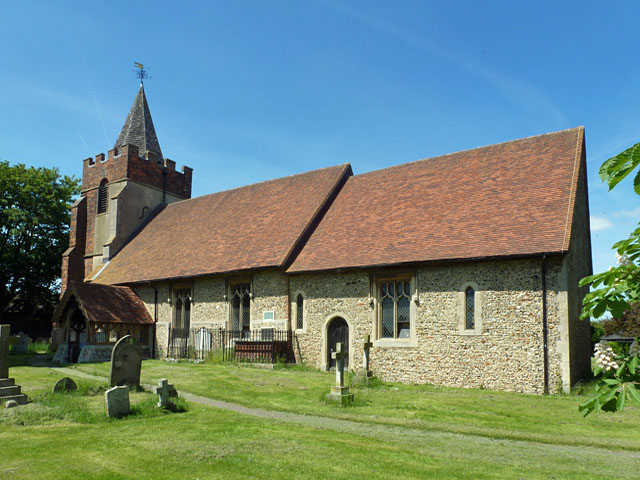
There was a party in the evening – of which I remember nothing – but at some point, we drove to High Laver itself, to All Saints’ Church. I imagine this was just a local ‘sight’, though it may well have been that I initiated the trip as I knew who was buried in the churchyard. Wikipedia tells me: High Laver is a village and civil parish in the Epping Forest district of the county of Essex, England. The parish is noted for its association with the philosopher John Locke. Yes – I may well have been fan-hunting an old philosopher’s grave. But this was not long after I’d completed my doctorate on the philosophy and poetry of PB Shelley and Locke’s influence on PBS formed a major chapter. Wiki again: one of the most influential of Enlightenment thinkers and commonly known as the ‘father of liberalism’, Locke was one of the first of the British empiricists in the tradition of Francis Bacon. His ideas include social contract theory and significant contributions to epistemology and political philosophy.

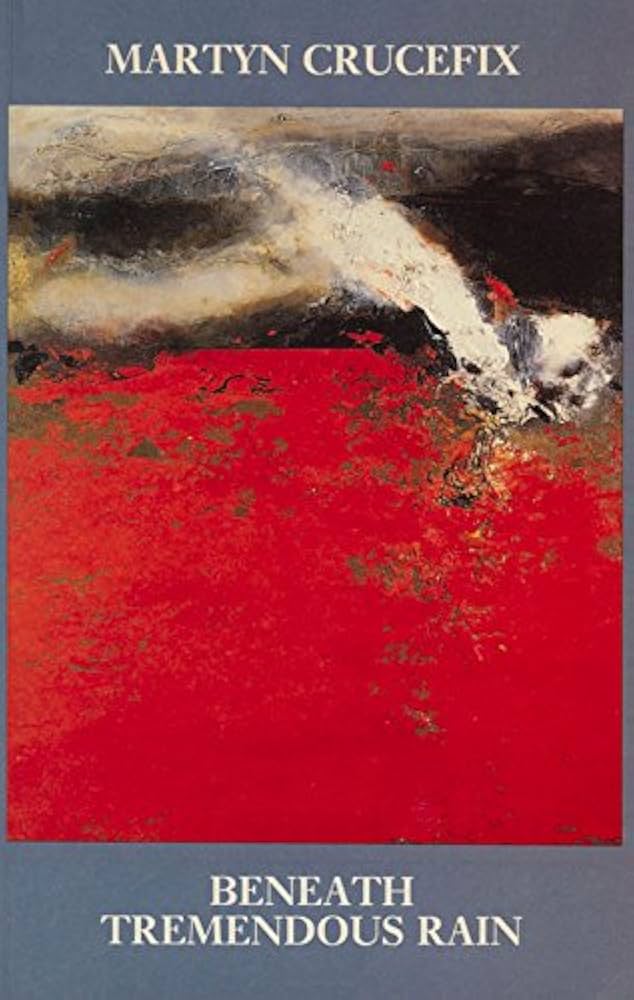
The poem – a sequence of 5 short lyrics – that came from this visit was eventually published in my first book, Beneath Tremendous Rain (1990). I don’t remember the truth of the chronology, but the poem suggests I’d been to my parents’ home in Wiltshire, perhaps immediately before. Remember, I was coming out of years of Higher Education, probably wondering what (if anything) I was now fit for, ceasing (at last) being a child, becoming an adult, looking back and forwards into my own and my parents’ futures. So the ‘journey’ motif with which the poem opens is both literally geographical and autobiographical – the long summer roads of childhood…

I’ve beaten roads dusty with summer to be here.

Left the two of them, hands held, then waving

before the groomed hedge. Both looked older

again, walking Wiltshire fields, where slopes

have browned and stained poppy-red in places

like a bloody graze across sun-burned knees:

a hurt from those days quickly soothed by Mum;

bragged up later to a great exploit for Dad.

The two of them . . .

I remember I was pleased with the image of the Wiltshire fields (to be contrasted a bit later with the fields of Essex) and I know I was thinking/seeing in my mind a particular field beside the A4 from Silbury Hill to Marlborough on my regular route from Wiltshire to London: the dry field browning, the red poppies drifted through it: a graze on a sunburned knee. The drive to Essex goes on in the poem….

                                        Absentminded,

my body alone has felt the pedals, held the wheel

as I’ve unearthed older and younger days

as precisely as those thumb-nail steps carved

in the solid encyclopedia I homeworked from,

perched at a desk on the edge of my bed.

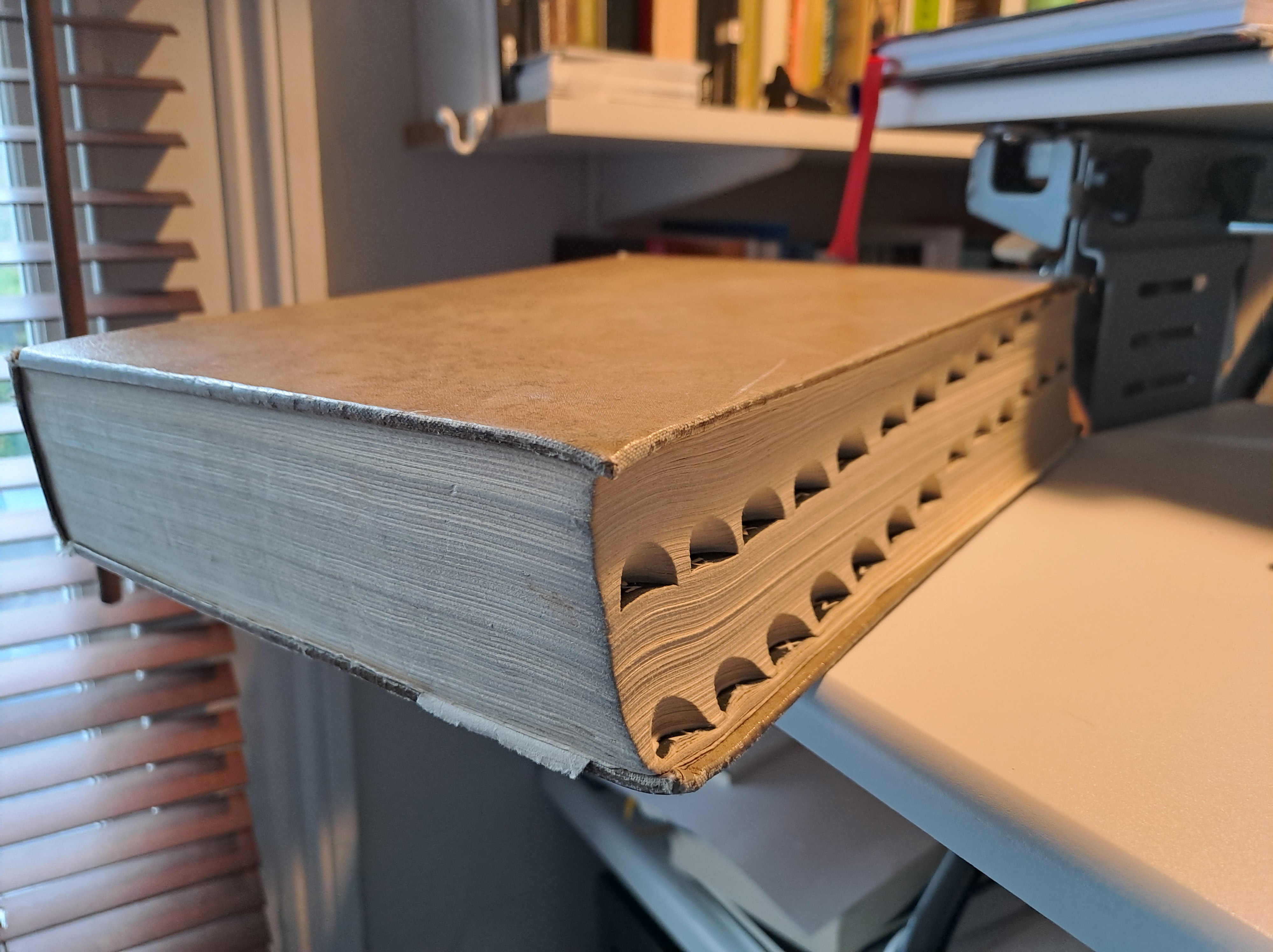
The process of psychological recovery – the unearthing – of past youth: hence both ‘older and younger days’. As a schoolkid, I’d take homework upstairs, exactly as described here, unfold a little card table (green baize), sit on my bed, and work. The dictionary, I still have it. The Universal English Dictionary, edited by Henry Cecil Wyld, in the Thirteenth Impression of 1960. It smells musty, but still somehow of home. Is there a technical name for the thumb-nail steps for each letter of the alphabet? It is the precision of these steps and the idea of dictionary definitions that enter the poem here in the shape of my childhood and teenage faith in reason and empirical accuracy as a way forward (till I was 19 I thought I was going to be a scientist). The second part of the poem runs:

I bolted knowledge then.

The cuckoo, beak biggest part of itself.

A schoolboy stealing coinage from lucid books,

laying instalments on a life of smart logic.

The irony being applied to my younger self, my self-(over-)confidence, is a bit obvious I guess in the choice of ‘bolted’, the cuckoo image, the thieving image, ‘lucid’ and ‘smart’ as easy adjectives, and the hire purchase image of ‘instalments’. The contrast is made immediately in the poem via natural images of earth and stars (the potato flowers):

Now I drive through the fecundity of earth,

through these hectares of flowering potato,

white constellations adrift on undulating green,

with the conviction that this is a watershed:

so much of the talk at home is of death;

how do I brazen that out with an argument?

My old subject: time. Against which there can be no argument. What does the reasonable man say to time and death?

The third part of the poem re-states this same idea through a rather caricatured version of John Locke (the ‘stodgy book’ is his Essay Concerning Human Understanding (1689) which I’d waded through for my thesis). Time and death are restated also via images of the graveyard at High Laver, trying to make sense of my inclination to visit graveyards, finally accepting that the impetus for this is of the ‘heart’ not of the head.

I’ve come to where jet-sprays of irrigation

relieve the cracked fields of hot midsummer.

I’ve come in self-conscious homage to High Laver,

burial place of that logical father,

whose stodgy book of rational commonsense,

sprung the tradition I’ve clung to long enough.

A laburnum sapling creaks in its rubber thong

at a stake, where I stalk the graveyard to find

the oldest stone . . . Always I’ve done this,

yet surreptitiously, plotting false explanations

for myself as it’s the heart that says this

is a powerful place, where generations

of local good and ill in swathes

have gone down like centuries of grass.

In the fourth part of the poem, I am caught off-guard on what began as a ‘reasoned’ piece of literary tourism by an access of powerful emotion in relation to the lives and (feared) deaths of my own parents: ‘there’s more than I feared / of the two of them’.

But I forget what I’m here for.

Stood beside this body volume of displaced earth,

piled weeks ago beneath the trees –

on that last day some stranger’s beloved mother

had more flowers than she ever dreamed of.

The blown wreathes outstare me.

In a blink aside there’s more than I feared

of the two of them, wrapped against coming cold:

Dad, hands stuffed in his pockets,

standing off on his own; Mum, struggling

to peg out snapping shirtfuls of wind.

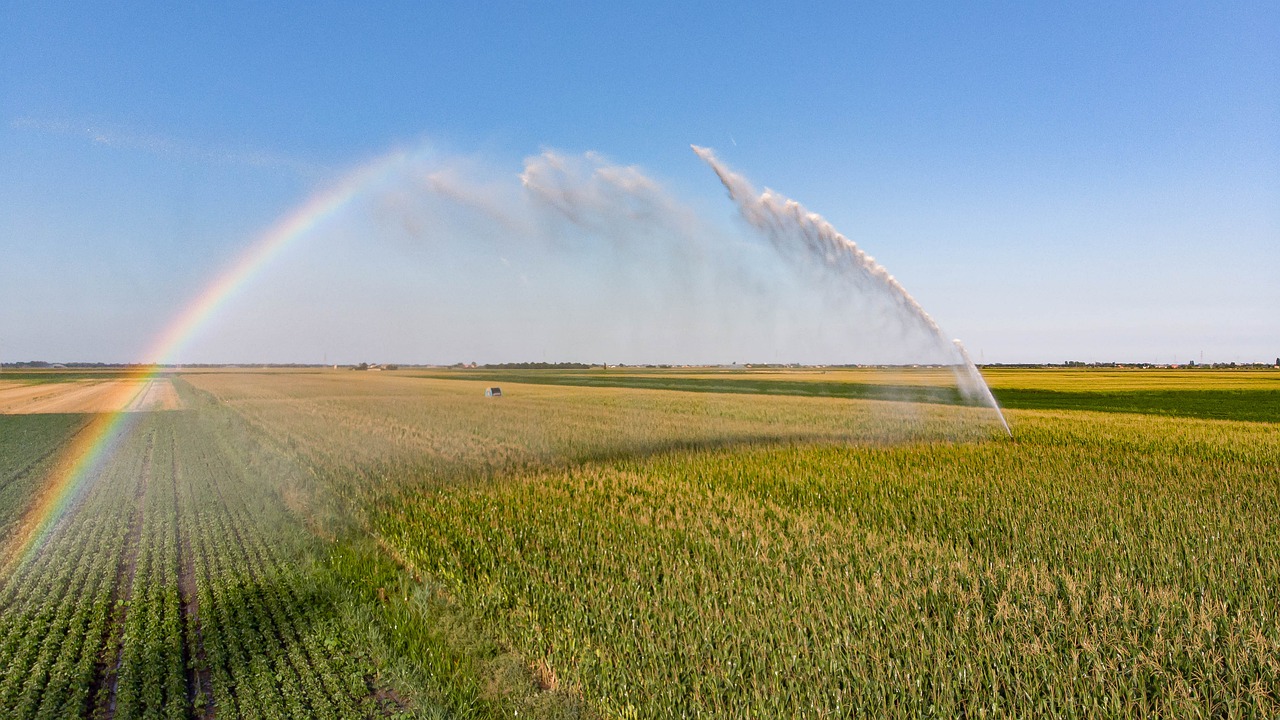
The sequence ends with more ‘straight’ description of the rural landscape of Essex. I remember labouring hard over the image of the water irrigation system which directs its spray (often 40 feet into the air) in one direction and then (through some mechanism I don’t know about) it flips and begins spraying in a quite different direction. I knew this was the ‘objective correlative’ of what felt like a significant shifting of my own outlook; simply, a recognition of the importance of the ‘heart’, though ‘judder’ ‘slam’ and ‘sudden’ suggest a near traumatic shift at that. Nor did I want the ending of the poem to be too gloomy, and those white-flowering potato plants return in the final phrase to suggest the psychic shift I’m trying to explore will have a fertility of its own (even if yet unseen) personally and artistically.

I watch the flailing mare’s-tail, the jet-stream

spray of the irrigator beside the church.

Its white angle above the potato fields

seems to crumple to a vaporous nothing, yet

a judder slams sudden clouds of fizzing spray.

It’s drenching some different sector of the field,

this drained, tearful, flowering place.

‘Muzzle’ – a new poem for the New Year

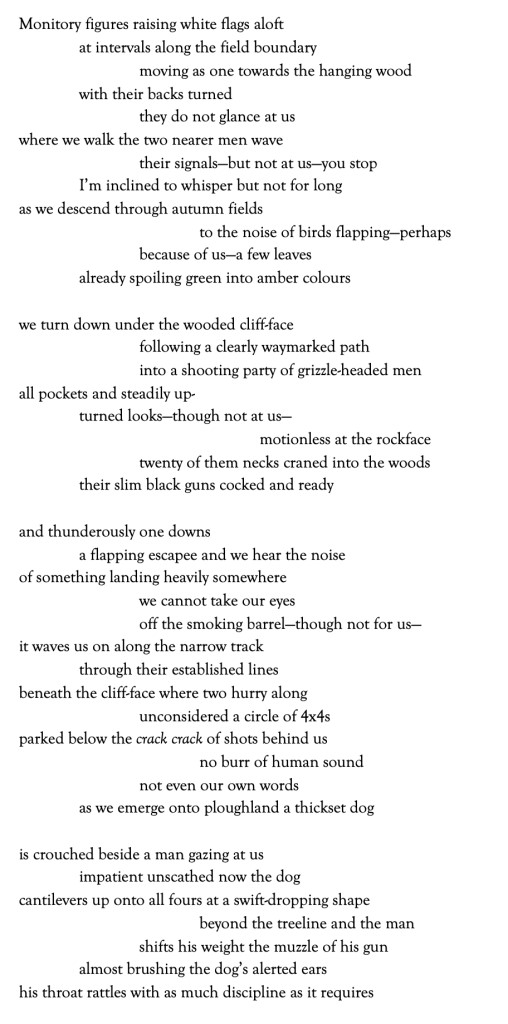
Happy New Year to all of you. We are hoping for the best aren’t we? Come rain, shine or named storm, the poems go on, saying something at least for the individual, the social, for careful consideration of the world out there, the world in here, and the languages we use. I’m posting a poem which has just appeared on New Year’s Day at the excellent Modron Magazine, its strap line is ‘Writing on Nature and the Ecological Crisis’. Glyn F Edwards also interviewed me about the making of the poem and I’ll post the text of that below, along with the link to Modron. Do go and take a good look at what other work they have put up in this new Issue 5. And then subscribe to them. My poem is weirdly formatted – so here is an image of it, lacking its title which is: ‘Muzzle’

On the Writing of ‘Muzzle’

MC: It’s so interesting to be encouraged to look back at the process of writing a poem. I seldom do it (I suspect I’m not alone), forever rushing on to the next ‘best’ thing (we think, we hope). In looking back at ‘Muzzle’ (I find I have the very first draft and several subsequent ones) two things strike me: that it took so long to get to a ‘finish’, and that I’d forgotten how important the context of the poem was to what it might be expressing.

The first draft was scribbled in a notebook in the autumn of 2016. Earlier in the same notebook, I was sketching out thoughts on my, then, just-published version of the classic Chinese poems, the Daodejing (Enitharmon, 2016), preparing for readings I was to give from the book. Elsewhere there are fragments about my parents’ growing difficulties at home and (later) in their care home, plus some quite late drafts of the longish poem about the plight of refugees in the Mediterranean which was published as Cargo of Limbs (Hercules, 2019), and even first drafts of the poems which have eventually come to make up my most recent collection, Between a Drowning Man (Salt, 2023). Remember, the Brexit referendum took place in June 2016 and if there is an idea that links all these differing creative endeavours (including ‘Muzzle’) it is the idea of ‘division’.

Q1 – Only with the word ‘dog’ at the end of the third stanza does the reader gain a semantic connection to the ‘Muzzle’ in the title of the poem. Of course, Chekhov’s gun was ‘cocked’ all along, and the ‘muzzle’ becomes the open end of a weapon where a bullet escapes. Can you explain a little more of the rationale for this subtle title? 

MC: To my surprise, I find, the first draft has no ‘muzzle’ mentioned in it at all. But the shape and a lot of the substance of the finished poem is already there: the flag-waving men during an idyllic autumn walk (on the Sussex Downs, as far as I remember), the shooting party, even the man and his dog at the end of the poem. The muzzle of a ‘smoking gun’ is clearly implied but the final dog’s muzzle does not make an appearance till quite late (I mean 2020 or so!). In fact, in the first draft I clearly don’t know how to end the poem. There, the walking couple emerge from the wood ‘unscathed’, the dog in the field grows tense, and there’s a sense of the man’s day being ‘interrupted’ by the couple. But these final 5 lines are crossed through. In the later draft, the dog now ‘cantilevers up’ onto all fours (the mechanisation of the creature is part of the male group’s malign influence in my mind) – but still no muzzle as such. That only comes via a reference to the man’s gun and, with its proximity to the dog’s head and ears, there is a transference of the word/idea to the dog itself. I’m pretty sure it wasn’t till this point that I thought of calling the poem ‘Muzzle’ and that I also wanted the word to apply to the walking couple who have been (by the experience, by their apprehension, if not their genuine fear) muted or muzzled themselves. The idea was actually there early on; the first draft briefly sketched in, ‘no human voice we do not talk’.

Q2 – The refrain ‘not at us’ is repeated, and echoes again in ‘not for us’ – amongst the ‘white flags’, and the reassurances of safety, there appears a growing threat to the speaker. The reader is left with the feeling that somehow this danger extends beyond the shooting party, and beyond bloodsports. Did you seek for the poem to act as a wider allegorical foreboding, and, if so, would you elaborate on the metaphor? 

MC: Yes, the ‘not at us’ phrase or versions of it are already in the first draft, indeed on four occasions. This is one of the main sources of the idea of ‘division’ in the poem. It’s a simple ‘us’ and ‘them’ situation. The white flags – I think these would simply be the shooting-party’s beaters’ flags being waved to move the birds across the field into the woods, or possibly they are genuinely ‘monitory’ (meaning simply to warn or admonish), but in being white they also have (ironic) resonances of surrender (these guys were not going to surrender anything). The repeating phrase emphasises the gulf between the two elements of the encounter and particularly the sense (clear on the actual occasion) that those holding guns did not seem much concerned that unsuspecting, endangered walkers might be near at hand. We felt ignored; they seemed not to look at us. Being England, there is a strong class element here, which does not map easily onto the question of the voting intentions by class in the Brexit referendum, but factions on all sides seemed not to be paying much attention to any other. The devastating Tory defeat of 2024 should be regarded as reflecting much of this: eventually the country at large felt those in government were simply not paying any attention ‘to us’. I’ve always been pleased with the adjective ‘established’ to describe the shooting-party’s positioning, their being arrayed as the ‘establishment’. The finished poem ends ambivalently. The walking couple escape the shooting-party but are faced with another threatening situation: the gun, the dog. The ‘guard-like’ posture now puts me in mind of prison camp patrols the world over and I’d be happy for readers to get there too: there is a policing of freedoms going on here, a sliding scale from rural pastimes, to political enforcement, to genocidal pograms.

Q3 – ‘Muzzle’ zigzags, indents, retraces its steps. Some stanzas loop longer, and when the final sestet ends abruptly, without full stop, the reader becomes aware of the absence of punctuation throughout. You have a very idiosyncratic approach to presenting and punctuating the poem – could you share your intentions in this poem, and elaborate on whether these ally or counter your conventional style?

MC: The final form of the poem – which you describe so well – came very late. Most often my poems ‘find’ their own form – they don’t begin with any sense of the shape they will eventually take. The 2020 draft was coming out in tercets and I remember liking the ‘walking pace’, step by step, which that shape suggested. But in the end I wanted the poem to be more radical, to suggest a sense of freedom (in contrast to what is felt by the couple during the incident), a freedom to roam as it were, for lines to wander across the page and back again, while also acknowledging that this meandering might well yield some uneasiness in the reader (where’s he going?!). Both freedom and anxiety would be appropriate here. The form and the absence of punctuation (the latter I have been working with for several years now) are intended to generate some ambiguity. For example, I’m hoping for a fluidity in the opening lines, with the putative subject or focus being the flag-waving men, eliding to the walking couple – the ‘you’, then the ‘I’ – the birds, the leaves turning, finally to the ‘grizzle-headed men’. Within this fluency, a bit later, I want several adjectives to be hovering between subjects. The word ‘unconsidered’ floats between the lack of consideration given to the couple and the waiting circle of parked cars. Similarly, ‘impatient unscathed’ buzzes between the couple (again) and the waiting man and dog. This culminates in the rattling throat in the final line which (I want) to be as much about the man as the dog itself and so the ‘discipline’ demanded of the situation ought to be seen as human as much as canine. I guess I’m trying for fertile ambiguities, trying to suggest two things at once. The opening of the Daodejing says: ‘the path I can put a name to / cannot take me the whole way’ (my version).

Q4 – The shooting party negatively influences their surroundings, their presence ‘Hanging’ and ‘spoiling’ the woods, and the walk of the speaker. How much familiarity do you have with these ‘grizzle-headed men’, and do any occasions, such as the one in ‘Muzzle’ stand out as memorable, or significant? 

MC: As you suggest, I have allowed the shooting-party to be, and remain, those wearing the black hats. More often than not I feel the need, the wish, to revisit such emphatic designations: what’s to be said ‘on the other hand’ (ever the wishy-washy liberal). The jaw-dropping presumption of the shooters in the original incident (the poem says pretty much exactly what happened), coupled with the generally felt anger and dividedness of the UK at the time (and since) goes to explain why I have not done so here. Do I know people like this? I guess not. A remote acquaintance likes to share his stories of attending such exciting shooting-parties, but it’s hard even to find the language to create much common ground. Perhaps I am just too urban, metropolitan even. About hunting wild animals, Rilke says, ‘to kill is one form of our restless grief’ (Sonnets to Orpheus, II, 11; my translation). Nothing I witnessed on that day in 2016 served to convince me otherwise; the taking out of another living thing for no useful purpose seems to require an arrogant presumption that I cannot get my head around and I find rather terrifying; the ‘monitory’ urgency in the final poem is as much concerned with how this sort of attitude plays out in the political, even in the military, sphere as it is with ‘blood sports’ more narrowly defined.

December 2024

Here’s the direct link to Modron – https://modronmagazine.com/a-poem-and-interview-with-martin-crucefix/


George Szirtes’ King’s Gold Medal for Poetry

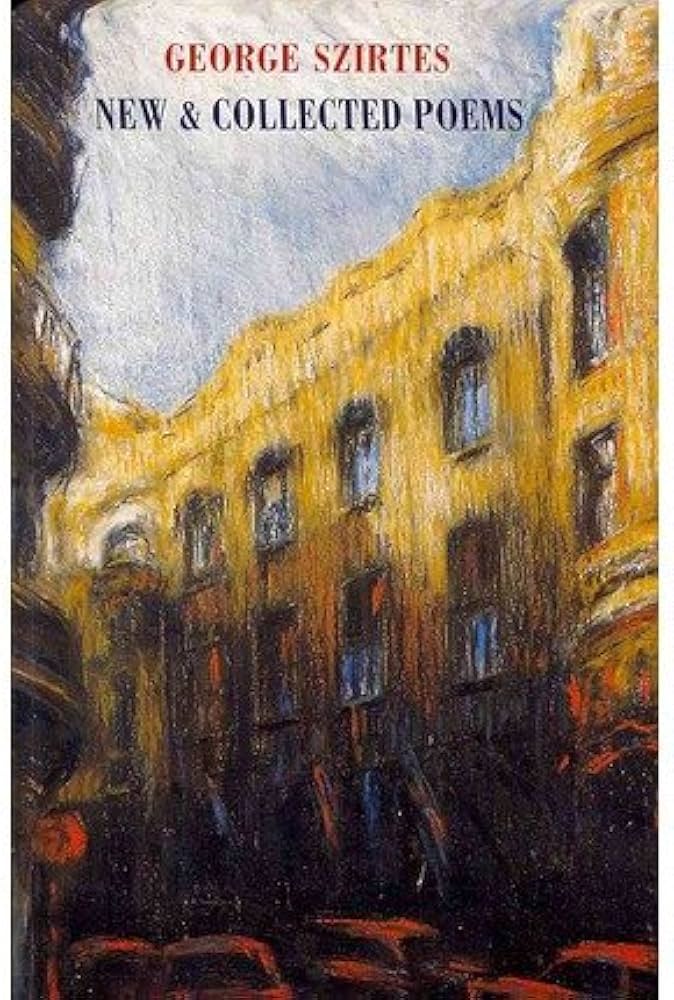
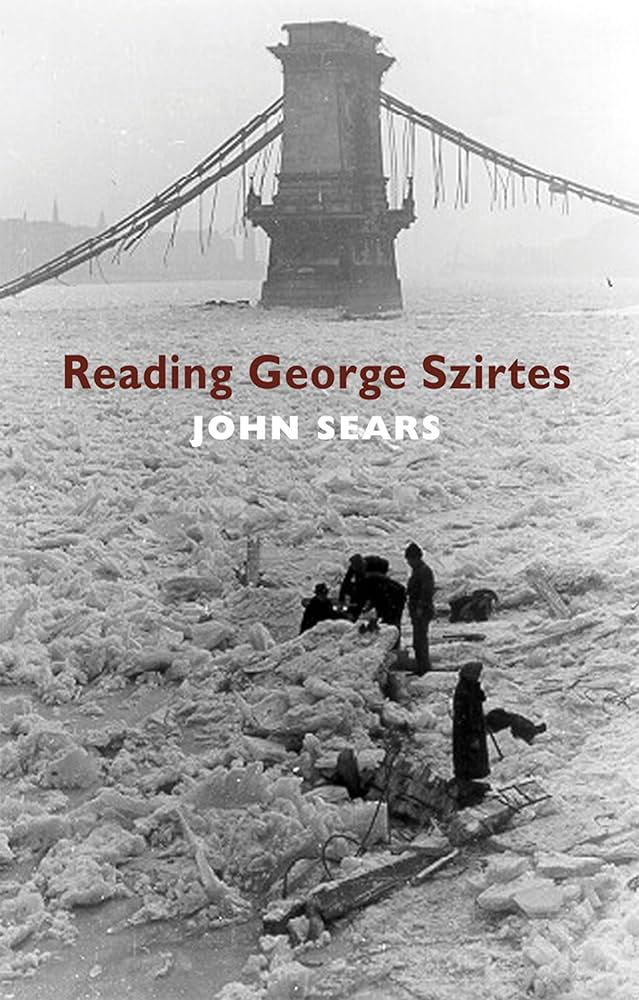
This week’s announcement of the award of the King’s Gold Medal for Poetry to George Szirtes gives me the opportunity to re-post a long and detailed review I wrote (for Poetry London) of the two books that Bloodaxe Books published to celebrate Szirtes’ 60th birthday. These were the New and Collected Poems and a critical book about his work, Reading George Szirtes, written by John Sears. Though Szirtes has continued to publish a good deal since the late 2000s, this review still seems to me to have something useful to say about the development and poetical achievement of this outstanding writer and might be of interest to those not yet familiar with his work. (For WordPress readers, I am experimenting with posting also on Substack. Do subscribe here if you’d like to read in that format: https://open.substack.com/pub/mcrucefix/)

This 500-page New and Collected Poems demonstrates the breadth and depth of George Szirtes’ achievements and will bring his work to even wider notice, casting the poet as a recording angel. His lines of literary influence run from Eliot’s phrase-making and metaphysics, through Auden’s formalism and politics, to earlier contemporaries like Peter Porter and Martin Bell (at the Leeds College of Art and Design). There are distinct phases to Szirtes’ oeuvre, but his work tends to a density of fragmented detail, bound by a allegiance to visible form, shot through with explicit theorising about perception, language, time, memory, self, the art itself. This is a heady and immensely ambitious mix – not one likely to appeal to popular tastes, but there is no-one more dedicated to poetry, to playing the long game, to bringing a uniquely European perspective to the theme of our age, the search for personal identity.

Szirtes’ career illustrates what Pasternak discusses in An Essay in Autobiography (Harvill, 1990). Though our experience of the world is necessarily subjective, there is a sufficient underlying matrix that remains “the common property of man” – the hard-wiring implicit in being human. Superimposed on this is the softer wiring derived from upbringing, environment and education, and the self is ultimately a function of these base matrices in progressive interaction with individual decision-making in the flow of experience. So the objective world is processed through the individual’s particular matrices – his/her sets of harmonies and disharmonies – and must emerge coloured, spun, texturised as it were, accordingly. From this, Pasternak argues that when an individual dies he leaves behind his own unique “share of this . . . the share contained in him in his lifetime . . . in this ultimate, subjective and yet universal area of the soul”. This, of course, is where “art finds its . . . field of action and its main content . . . the joy of living experienced by [the artist] is immortal and can be felt by others through his work . . . in a form approximating to that of his original, intimately personal experience”. Art can be defined as the expression of experience playing across the matrices of the self, saying not this is me, but this is, this was, mine.

It is the raw imagery of stasis and movement that emerges in Szirtes’ early work as being truly his and it blooms into the maturity of the late 1980s. In short lyrical pieces the point of stasis is associated with the preservative of art in the spit ball gobbed by a foreign worker in ‘Anthropomorphosis’ which is caught and “suspended” by the poem. The afternoon rearranges itself around it and even the narrator “hung there / Encapsulated in that quick pearled light”. Versions of this encapsulation abound: girls creating a silver foil tree find themselves absorbed into a Keatsian “cold pastoral”. Such freeze-frame moments anticipate Szirtes’ sustained meditations on photography but early on, images of snow and frost suggest the ambivalent status of such suspension. In ‘The Car’ a snowfall is both beautiful and sepulchral: “Fantastic Gaudi-like structures hung / Under the mudguard . . . . / Wonderful, cried the girls under the snow”. A girl who is observed sewing causes consternation (“I do not like you to be quite so still”) caught in a stasis that can “eat away a life” that can “freeze the creases of a finished garment” (‘A Girl Sewing‘).

In contrast, it is movement in the shape of the passage of time that spurs many other early poems and the artist’s power is limited to “measure breath in a small space” (‘Group Portrait with Pets’). The enigmatic title poem of the first collection seems to teeter elegantly along the knife-edge of the sense of threat to domesticity and the desire to secure in a “cage” and convert to “metaphors” (‘The Slant Door’). It seems for time there is “no use, no cure” (‘Silver Age’) and Szirtes senses this especially in the domestic sphere. ‘House in Sunlight’ casts the busy sun as the agent of transience threatening the house itself and the life within it:

Whoever lives here knows what they are about –

Forms appear suddenly in mirrors and photographs,

We do not think however that they are entirely at home.

At night the doors are locked. We lock them now.

John Sears’ book is a comprehensive academic review of Szirtes’ career, tracing the development of both key themes and formal experimentation. He suggests Martin Booth’s 1985 critique of Szirtes’ early work as “withdrawn and laidback” was influential on the poet. Booth suggested that Szirtes might try writing about “his childhood” (Sears, p. 61). If true, we have reason to be thankful to Booth, but there are signs that Szirtes was moving in this direction already. He travelled to Hungary in 1984 and was casting his gaze beyond these shores towards people who “lie in complete unity / In graves as large as Europe and as lonely” (‘Assassins’). The title poem of Short Wave (1984) deploys its central image to suggest the deciphering of voices that are obscure yet seem suggestive of “all Europe in her song”. The self-deprecating picture of Szirtes “listening / and turning dials, eavesdropping” is something to be treasured given the explosive impact these deciphered voices will eventually have on his work.

Several members of Szirtes’ family were caught up in the Holocaust and later in the Soviet invasion of Hungary in 1956, escaping to the UK. Much of this was known to Szirtes only sketchily and he set himself the task of recovering what seemed lost. It is because Szirtes’ underlying matrices as an individual – stasis and movement, preservation and loss – mapped so powerfully onto his family’s own history and this history encompassed important European historical events that his work becomes in the late Eighties so much more complex, ambitious and important. History had determined his nature as a poet; his nature as a poet primed him to be able to encompass the burden of his own history.

So the title poem of The Photographer in Winter (1986) attempts the imaginative recovery of Szirtes’ mother from the Budapest of the 1940s and 50s. She was herself a photographer and her son traces her movements with “thoroughness and objectivity” as far as he can. Both as an artist and poet, Szirtes declares he has been “trained / To notice things” (the deliberate echo of Hardy’s ‘Afterwards’ is but one example of Szirtes’ very frequent intertextual allusions). But the recovery process seems often subject to disintegration, “trying to focus through this swirl / And cascade of snow”. At times the tone is more optimistic, like the final section of ‘The Swimmers’ in which a drowning girl survives the “icy Danube”. Elsewhere, intervening time destroys so much, and the later sequence ‘Metro’ (1988) uses the image of the Budapest underground system for “everything that is past, the hidden half”. His choice here of the deliberately curtailed thirteen-line sonnet is a characteristic recognition in formal terms that the search must remain incomplete.

The balance between one man’s search for his background and the conversion of this to poetry is a difficult one and if the marvelous sequence ‘The Courtyards’ is counted as one of the great successes, for me ‘Metro’ itself tips too far away from the memorial towards the monumental. There are occasions when Szirtes’ desire to recover and pay respects to his own history impels him to erect such elaborately formal accumulations of images that the reader may feel excluded, even if always impressed. The later ‘Transylvana’ is another occasion when the act of imaginative recovery can seem propelled for its own sake and despite the glittering formal achievement – terza rima in this case – the piling of detail on detail can become wearisome.

But Szirtes’ openness to theoretical thinking has always propelled his work forward and often derives more from his training in the visual rather than the literary arts. Blind Field (1994) draws on Barthes’ idea that in photography all that is not portrayed in an image may be implied by the presence of a “punctum” or detail within it. As Sears suggests (this is the sort of idea he is very good at elucidating) this bears some relation to Eliot’s objective correlative but is seen by Szirtes as a solution to the paradox that art stills the life it presents: “Out of this single moment a window opens” (‘Window’). This sense of the ballooning fluidity of experience, past and present, is one thing that marks his work as Modern and Post-Modern and it’s no surprise to see Szirtes countering Larkin’s belief that the passage of years makes us “smaller and clearer” arguing we grow “blurrier, vaster, ever more unfocused” (‘On a Young Lady’s Photograph Album’). It’s this slipperiness of personal identity that is Szirtes’ true theme and the one that elevates his work above the merely personal into a body of work addressing urgent contemporary concerns. As the poem ‘Soil’ puts it “there is nowhere to go / but home, which is nowhere to be found . . . / the very ground / on which you stand but cannot visit / or know”.

Everywhere these days, the recovery/re-construction of our own identities seems to be a pressing issue and the three sonnet sequences in Portrait of My Father in an English Landscape (1998) triumphantly present and simultaneously enact this process. Sears describes Szirtes’ form here as a “deliberately baroque form of the Hungarian sonnet sequence” or sonnets redouble (Sears, p. 145) in which the final line of each sonnet is repeated (approximately) as the opening line of the next and the final (fifteenth) sonnet is composed of approximations of each preceding sonnet’s closing line. Yet this is not an arid exercise in form as the recurrences and accumulations enact precisely what Szirtes believes is the process of the construction of the self – largely via language into a “lexical demesne” – in this case said to be “part Hungary, part England” (‘The Looking-Glass Dictionary’).

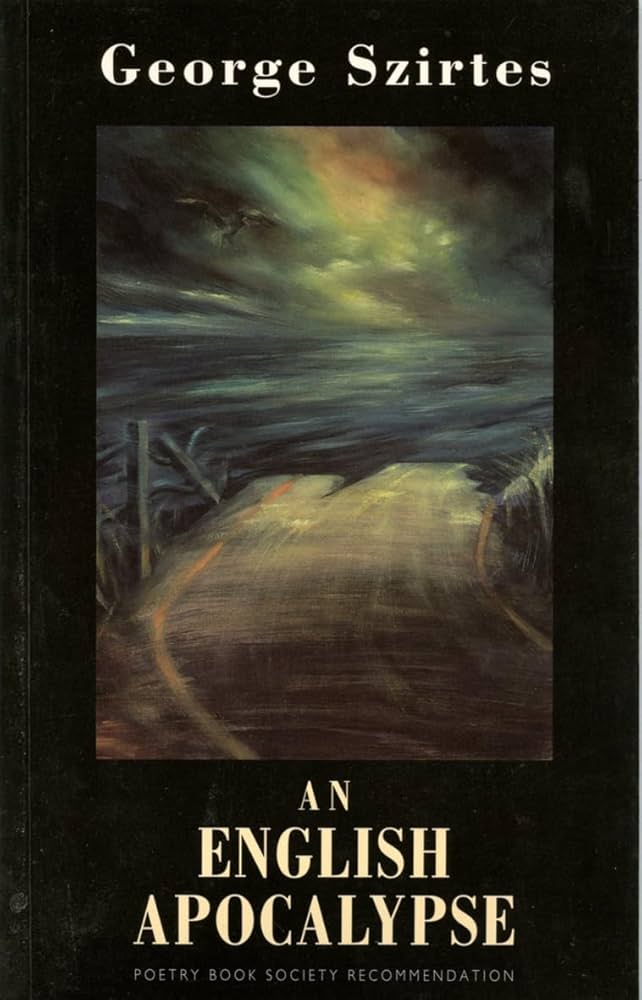
Retaining his love of the titled sequences, sections and subsections which had helped him draw a bead on his family’s obscured past – a tendency which produces the most typographically diverse and complex contents pages I’ve ever seen – from the late 1990s Szirtes’ work turns a firmly European gaze on the UK. An English Apocalypse ranges through Great Yarmouth, Keighley, Orgreave, Preston North End. all-in-wrestling and antisemitic violence towards images of “a tense / empire that could fall” (‘All In’), towards something “crumbling – a people possibly” (‘Dog-Latin’) and specific individuals “speaking the innate vernacular // of the trapped. He’s shit. Scum” (‘Offence’). Despite the success of Reel (2004), the new poems in this 2001 compilation, portraying an outmoded and disconnected England, are one of the high points of Szirtes’ career so far and they culminate in the extraordinary sequence of imagined apocalypses by meteor, power cut, deluge and suicide that caught the flip side of millennial euphoria and seem now years ahead of their time.

Apart from the sceptical cinematic pun Reel/real, the title of Szirtes’ 2004 T.S. Eliot prize-winning collection is an allusion to the predominance of the rolling, unravelling impact of his majestic terza rima. By this stage, there is a greater ease to the looping to and fro, the past and present, which Szirtes encompasses in this form.

Here I find bits of my heart. In these

Dark corridors and courtyards something true

Survives in such obsessive images

As understand the curtains of the soul

Drawing together in the frozen breeze.

(‘Reel’)

‘Sheringham’ also reinforces Szirtes’ familiar cumulative techniques remarking on the “boiled down particulars that regularly come / knocking at the skull”. Sonnets too continue to be a favoured form, though in the beautiful meditation on the aging processes, ‘Turquoise’, the neatly closing couplet of the “Shakespearian ending” is both employed and simultaneously questioned.

Indeed, echoes of the Bard’s obsessive negotiations with “swift-footed Time” (XIX) re-emerge as one of the most striking features of Szirtes’ more recent poems. A pizza can be enjoyed – but not to the exclusion of the river nearby, an unavoidable “emblem of time” (‘In the Pizza Parlour’). Szirtes is re-visiting the concerns of younger days from more slant-lit uplands. Now images of dust recur, here in the woman’s “dust-laden hair” while elsewhere birds are “swimming through dust” (‘Winter Wings’) and – in one of Szirtes’ most beautiful sonnets – a woman regards herself in the mirror, contemplating the impact of the passing years and gazing at her face “drowned in a cloud of dust: / How beautiful, she thought, and how unjust” (‘The Breasts’).

On Revisiting Blockley

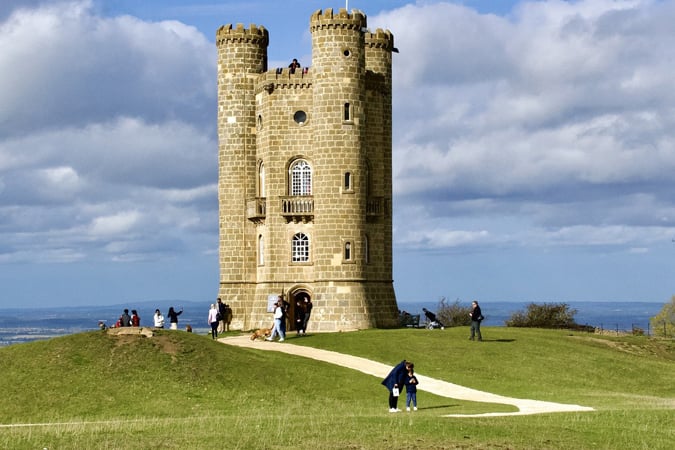
A rather more personal post than usual, though a poem (an older one of my own) is attached to it. Last week, I spent a few days with family in the beautiful village of Blockley, in the Cotswolds. The weather was very good for late November and we walked a couple of times – from Broadway up the muddy hill to the folly of Broadway Tower (once frequented by William Morris apparently) and around Hailes Abbey (now a ruin, local lore has it that Thomas Cromwell watched the destruction of the Abbey from a nearby hilltop). Blockley itself is near Moreton-in-Marsh, a place almost destroyed by the volume of traffic flowing through it (even in November), where The Bell Inn was once a favourite of JRR Tolkein, and is supposedly the model for The Prancing Pony in The Lord of the Rings. But Blockley, for me at least, had another powerful ghost haunting it.

As a couple, with young children, we stayed in the village over 20 years ago, in one of the original silk weavers cottages built along Park Road, which looks down over the village and valley. The house was owned by a colleague of mine at the time, Laurence Bowkett. He taught Classics and Latin and often spent the summer vacations away on archaeological digs of various kinds. That must have been the situation then as he’d allowed us to use the house in his absence. His early death, within a year or two of this, was a shock to us all. He had no family of his own and I don’t know what happened to the house later. So, fast forward to 2024, and here we are staying in Blockley again, only partly by coincidence. We have always had good memories of the place and (again, partly by an AirB&B chance) we ended up renting an almost identical cottage in the very same terrace above the village. Indeed, maybe it was the same cottage – I couldn’t remember enough of the details. The layout was certainly the same – the front door in off the road, straight into a little front room, a chilly basement kitchen and upstairs two small bedrooms.

Laurence’s was not the first death of a contemporary I knew well, but it greatly affected me and I tried to express something of this in the poem – an elegy – I wrote for him later. It is called ‘The umbrella and the bay tree’ and it mixes memories of him, his enthusiasms (he had a lot of those – all his students loved him for it), with details from my own family life at the time. It opens with an imagined scene, all his teaching colleagues gathered (as we often did then) in the local pub, remembering him in his absence. The ‘laral gods’ – the Lares – are Classical Roman guardian deities. The laurus nobilis refers to a little bay tree I bought after our first stay in Blockley as a thank you gift . . .

By seven-thirty, you are with us all

tonight in the gloom of The Washington,

though we omit you from every round.

Powerless as laral gods who gave you

no protection, even laurus nobilis,

the bay tree I bought you, proved no use.

Our children were at Infant and Junior School at the time and – to be honest – I can’t now remember if the details the poem goes on to mention are truth or fiction. But Laurence was the kind of guy who’d keep his own books in scrupulous order (as he did with his extensive collection of Marvel comics) so the library setting has always felt right . . .

Today, I searched 570 and 790,

in the Dewey decimal classification

your fingers ran through a thousand times,

for the facts of death and irrepressible life,

as if I looked for you now and you then.

You taught shard-life and careful fieldwork,

the near-dead language of not giving in.

You offered the heroic a modern face,

though death proved the more determined.

You understood lives alter what they touch:

a house, a street, a flowering tree,

for those who know us are not struck dumb,

a library unread the moment we die.

They roar like a lantern with our life inside.

The idea of lives of the dead altering the lives of those they have touched in life is familiar enough, though I was working on my translations of Rainer Maria Rilke around this time and I’m sure his influence is in here. It is not just the remembering of a friend who has passed away, but also that our own perceptions of ‘a house, a street, a flowering tree’, for want of a better word, spiritualises the material object, giving it a life, a light, an existence, beyond the ordinary. The resurrection of the bugs stomped by my daughter in what follows is probably an allusion to the early primitive computer games the kids used to play in which a failed – hence fatal – leap from a high building would result only in a brief ‘death’ and their 1st person avatar would soon revive and carry on in pursuit of adventure.

In Hornsey Central at 570

this morning, I found books to undermine

my daughter’s smiling confidence

that bugs she crushes beneath her shoe

lie dead a while, then revive good as new.

At 790, I leafed through life and death

in Ancient Egypt for her older brother:

how they wash their dead in water and oil,

then bind them in linen smeared with gum

and priests wrap lucky charms inside

in hope that none will break the seal

till the dead themselves in time of need.

The ‘lucky charms’ idea naturally led the poem on to what I myself might place in a good friend’s sarcophagus and gave rise to a list of his multifarious likes and loves, concluding with the heartfelt wish that his (prematurely unhirsute) head might – even in death (though he had no religious belief as far as I know) – remain somehow protected. The image on the underside of Laurence’s umbrella is a truth!

Then I’ll wrap Homer for you, Wolves black-

and-gold, your Micra, Marvel, Blockley

and booze, moist, sweet cake for the road,

Frederick Leighton, Sir Frankie Howerd,

Wisden, The Smiths and that Italian umbrella

you flourished one day and thundered open –

behold! the Sistine roof appeared

to keep your bald head from the hissing rain.

‘The umbrella and the bay tree’ was originally published in An English Nazareth (Enitharmon Press, 2004).