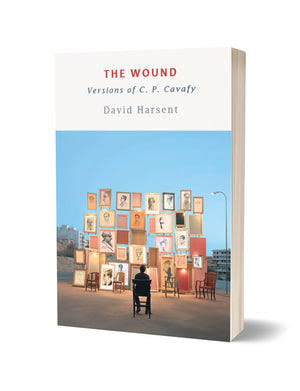
Review of David Harsent’s ‘The Wound: Versions of C.P. Cavafy’ (2025)

This review of David Harsent’s ‘The Wound’ – a chapbook which gives us the first sighting of Harsent’s versions of C.P. Cavafy – published in 2025 by Dare-Gale Press, was originally published in Acumen magazine. It was commissioned by reviews’ editor, Andrew Geary, for which many thanks. It has been fascinating to explore these versions and to begin the process of comparing them with other translations that are widely available.

Seamus Heaney once observed that the poems of Constantine Cavafy ‘survive translation better than most’. He thought this was because of the sheer interest of his subject matter(s) and the largely relaxed colloquialism of his voice (see Heaney’s Foreword to C.P. Cavafy: The Canon (tr. Stratis Haviaras; Hermes Publishing, 2004). In fact, over the years since his death in 1933, I’m not sure either of these aspects have necessarily proved quite so ‘easy’ to bring into effective English because of our changing sexual mores over the decades and the inevitable shifts in what a reader may register as colloquial language. In The Wound: Versions of C.P. Cavafy, David Harsent presents a small selection of his solutions to such issues.
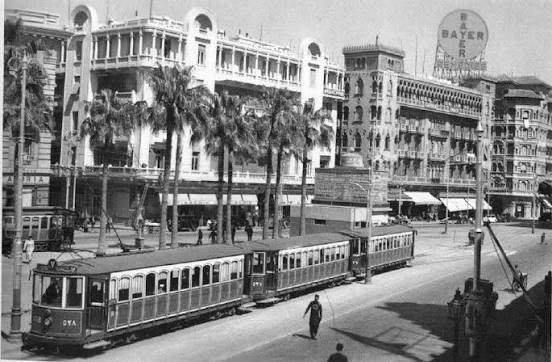
Alexandria in Cavafy’s time

Cavafy was born in Alexandria in 1863. His family spent some of the 1870s in England, but the poet had returned by 1885 and rarely left the city after that. He’s perhaps best known for the poem ‘Ithaca’ (not included in Harsent’s selection here) in which the journey to the mythical island is presented as one of exploration, enrichment and experience. Such an attitude to ‘venturing’ is one of the things Heaney must have been thinking of with his comment about the relatability of Cavafy’s subject matter, our common wish for excitement, for the thrill of the voyage. The sort of content Heaney has in mind also includes ‘homoerotic amours in exotic settings, the dooms of tyrants, the . . . destinies of sophists and drifters and soothsayers’ and all conveyed in a calm, clear-sighted language, seldom figurative, never ‘over-elevated’.

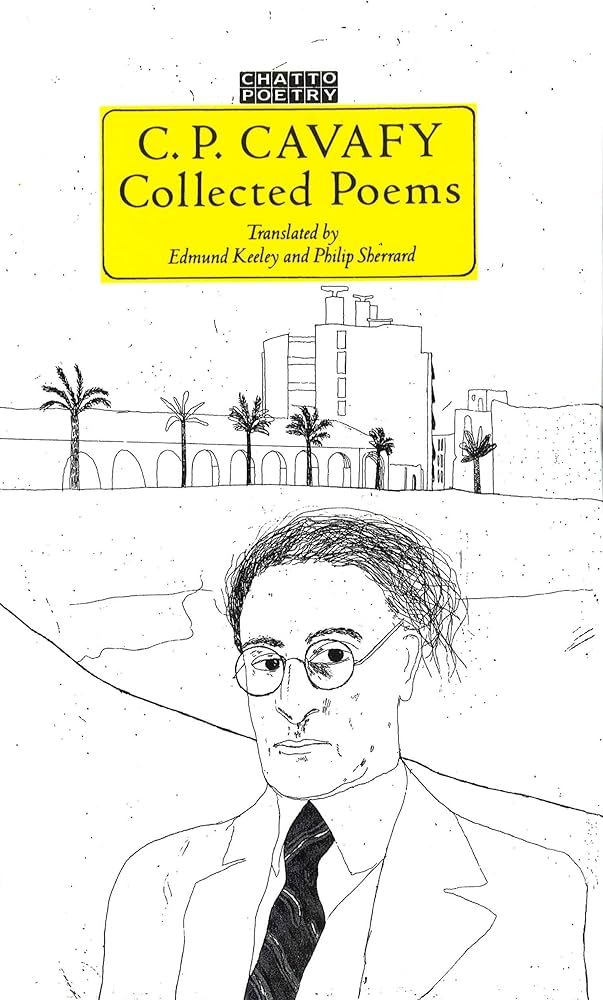
David Harsent is especially good at capturing Cavafy’s voice and the colloquialism of the language, though these are certainly versions in the sense that there is some modernising of references, changes made to titles, some transposing and editing of the originals, and significant changes to the flow of Cavafy’s phrasing. There is also a curtailing of Cavafy’s range; as Harsent’s opening note advises: ‘I have chosen, most often, poems of love and loss’. Harsent chooses urban, contemporary scenes, almost wholly focused on homoerotic experiences (current or remembered). Of course, in Cavafy’s Alexandria such relationships would have had to remain hidden, illicit, even a matter of shame. In ‘What’s Hidden’, the final poem here, the liberalising shift in attitudes towards gay love in the future is predicted: ‘One day, / when times and laws and minds have changed, / someone who thinks and feels and loves like me / will live as I do now, but without fear.’ It is this fear, Harsent suggests, that is the ‘weight of sorrow’ carried in so many of these poems. Earlier translators, like Edmund Keeley and Philip Sharrard (1975) and Haviaras (2004), tend to translate Cavafy’s allusions to the ‘illicit’ quality of such encounters, but today this strikes a false note given that we no longer consider them in this light. Interestingly, Harsent has silently removed most of these judgemental allusions from the poems.
You can tell Harsent is a fine poet in these versions. For example, ‘At the Tobacconist’s Window’ is vivid and thrillingly erotic in comparison to the Keeley/Sherrard version, though it may be that Harsent is unwontedly dialling up Cavafy’s deliberately plain statements. Here, there is an immediate entry into the scene (‘A small crowd at the brightly-lit window’) and the reference to the two men is accentuated by repetition (‘these two, these among many’). The men’s eyes meet ‘by chance’ in most other translations, but Harsent writes their ‘eyes, as if meant to, snag softly’. In fact, this works really well, raising the excitement and tension of the possible encounter and the gentle feminine rhyme in ‘softly’ is repeated 6 times in a 10-line poem, building an undulating sense of erotic possibility. The word ‘snag’ falls more harshly and this rough/tender sense is echoed in the closing line when the two men ‘fall on each other, but gently’. By the end of the poem, Harsent’s two men have driven off together and parked up somewhere more private. In Cavafy’s original, of course, they take a closed, or covered, carriage.

Another example of the changes Harsent makes can be seen in the beautiful poem, ‘The Mirror in the Hallway’, in which a delivery boy brings a package to a big house, stands in the hallway and looks into a mirror. Cavafy’s original starts slowly – supplying context, I suppose – with the size of the house, the mirror and its age (eighty years old). Only then does the delivery boy appear. Harsent begins with the ‘beautiful’ boy who, in the original is described as an ‘amateur athlete’ (surely to increase his physical allure). Harsent goes for, ‘on Sundays / he played park football’, which is wonderfully modern, but perhaps doesn’t make him quite so attractive! Left alone, the boy looks at himself in the mirror. Not in the original, Harsent repeats the phrase ‘looked at himself’ in adjacent lines, again dialling up the intensity, but is this what Cavafy would have wanted? This poem ends in the original text with a (perhaps clunky) personification of the mirror which, despite its eighty years of existence, is now ‘bursting with pleasure’ (tr. Haviaras) at having had such a ‘beauty’ before it. Harsent streamlines the moment, though he punctuates into three sentences, interrupting the original’s single flow of one. He does retain the personification, but has the mirror bask, after the event, in its own erotic pleasure:
The mirror looked back. In eighty years

it had seen a thousand faces and shrugged them off.

It held that matchless beauty

long minutes after the boy had gone.

It is fascinating to look closely at Harsent’s decisions in his versioning of these poems. If the criterion of judgement is that a poem should come vividly off the page, then he is succeeding here, though as I have indicated, these are not faithful to the originals in the way that some might require of a translation. But such fidelity might well have been subject to a dose of Cavafy-esque scorn. John Kittmer’s comment on this beautifully produced chapbook, enthusiastically praises the modern poet’s engagement with the Greek originals as ‘examples of exchange, cross-over, transposition, modulation, sensitive homage and daring challenge’. I’d second that emotion and look forward to seeing more of these Cavafy-Harsent poems.
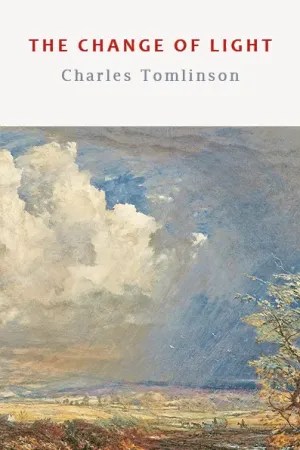
Review of Charles Tomlinson’s ‘The Change of Light’ (2025)

This review of Charles Tomlinson’s The Change of Light, published by Dare-Gale Press in 2025, first appeared in Acumen magazine, commissioned by reviews’ editor, Andrew Geary. Many thanks for the invitation to write about these fine, posthumously published poems.

Beginning to publish poems in the early 1950s, Charles Tomlinson will have been conscious of his outsider status on several fronts. Antipathetic to the still-echoing boom and verbal excess of Dylan Thomas, and sceptical of the narrowed range and palette of the fashionable Movement poets, the young Tomlinson was also developing an interest in European writing, which only became in vogue with Ted Hughes’ founding of Modern Poetry in Translation in 1965. Even further beyond the pale, his Cambridge friendship with Donald Davie stirred a lifelong enthusiasm for American poetry. His interest in things transatlantic yielded several extended visits to the US, and the 1966 collection American Scenes and Other Poems (OUP) which also boasted a section of ‘Mexican Poems’.

Tomlinson died in 2015 and The Change of Light from Dare-Gale Press is a timely reminder of his excellence. In these 22 late, unpublished poems, there are glimpses of his wide-ranging interests with allusions to French poetry, the Greek Islands, the Adriatic Coast, and even to Japan. But we are in a predominantly English landscape here, consisting of woodlands, rivers, trout streams and gardens. The poems are without exception beautiful in their precision, tonal elegance and civility of expression, pursuing, as Tomlinson always did, both the unfolding of abstract ideas as well as a close engagement with landscape and the natural world.

It is the poet’s acuity of observation that is immediately pleasurable for the reader. In ‘Between Seasons’, Tomlinson looks for Spring to arrive while a hawk moves through the garden, ‘on such sharp and silent wings, / It skims more like a knife’. This sort of equivocation between promise and threat is characteristic of the poet. The poem ‘On the Frontier: in March’ also explores the uncertain ‘swaying frontier’ between the seasons, the precarious balance of which is brilliantly conveyed in the sinuosity of Tomlinson’s syntax which runs as one single sentence through 23 lines, before a breath-taking expansion of vision to Planet Earth itself (‘this wandering sphere, / the unpiloted craft’). As this makes clear, Tomlinson’s often alluded to sense of Eden always did encompass what we now call eco-poetry and in ‘Snow’ the paradisal garden is once again deployed for the beauty of the earth, seen ‘with the eyes now / of its first inhabitants’.

The quality of observation in ‘Trout II’ is likewise as freshly peeled as to feel Edenic. The fish’s ‘wirey curvature’ is held as the water’s currents ‘caress, shape, swerve’ past it. The narrator contrasts the ‘Choice’ the creature has to ride the flow with the lack of choice possessed by a rock in the same stream. The trout has an agency, deciding to hang in the water, and is ‘Willing to be no more than weed / That fluctuates beside him like his shadow’, and in so choosing, the fish transforms its environment into ‘aim, discernment, dance’. Tomlinson imagines the creature acting with ‘pleasure’, a pleasure surely also felt by poet and reader, a pleasure derived in part from the trout’s willing abandonment of its body to the water’s flow.

Tomlinson valued chance in both life and creativity (a 1969 poem is called ‘The Chances of Rhyme’) and to take advantage of chance we need to yield up control. He wrote of embracing possibility, achieved only when the ‘self would have to embrace that possibility somewhat self-forgetfully, putting aside the more possessive and violent claims of personality’. This self-forgetfulness, the laying aside of individual personality, is key to Tomlinson’s work (and in passing, it is what makes him a great translator). ‘Raindrops Reconsidered’ contains a pun on the seeing ‘eye (an I)’ which observes best when the ego does not bring with it ‘fable’ or the preconceptions of our daily lives and language. ‘Views’ insists that the genuinely ‘realist’ perception questions the ‘bland misprisions of the day’ so that the everyday world suddenly ‘bursts into wing, flame, flights’, into a perception that is ‘festive’.

This ‘festive’ quality refreshes our acquaintance with the world, but it also opens up vistas in which the diminishment of the self becomes not decrease but an access to something greater. In ‘The Infinite’, sitting on a hillside, beside a hedge, the narrator finds an unnerving tranquillity. The wind in the trees contrasts this, opening up a sense of ‘eternity’ and the individual self vanishes into a wider sphere: ‘In this immensity / my own thoughts drown / and it is sweet to shipwreck in this sea’. For such a poet, the loss of any access to his senses would have been devastating. In 1997, a routine cataract operation went awry and deprived Tomlinson of the sight in his left eye. The loss of binocular vision means judging distances is difficult and Tomlinson here laments the ‘flat projection’ he now has instead of full sight (‘The Accident’).

The poems in The Change of Light would appear to be late work; in ‘Courteous Death’ Tomlinson senses his own mortality. Channelling a little bit of Emily Dickinson, the personification of a surprisingly polite Death advances to greet the poet. In a sudden change of mind, Death offers complete blindness rather than demise. Tomlinson’s ‘one good eye’ refuses (at least for a while). Yet like the rock in ‘Trout II’, there comes a point at which ‘preference has no power’, no choice, though up till now, the poet says, he has expected it to ‘tip the balance / Always in my favour’. But Death allows the poet a little more time, time spent perhaps, in part, on these really fine, pleasing and profound last poems.

Review of ‘My Secret Life’ by Krisztina Tóth, tr. George Szirtes

This review first appeared in Acumen Poetry Magazine in the autumn of 2025. Many thanks to the reviews editor, Andrew Geary, for commissioning it.

As a female writer, talented in a variety of genres, living in a difficult political climate, Hungarian born Krisztina Tóth shares a good deal with Huch (my review of Tim Adès translation of Huch’s final book was posted here). Coming to the fore around the revolutionary year, 1989, Tóth has written poetry, children’s books, fiction, drama and musicals. My Secret Life (Bloodaxe Books, 2025) is her first sole author publication in English, ably translated and introduced by George Szirtes, presenting an overview of her poetry from 2001 to the present. Szirtes tells us that Tóth is no longer living in Hungary because of unbearable frictions with the Orbán regime. Like Huch she is drawn to poetry as personal expression, often to the formal elements of the art, both perhaps offering a redoubt against values she finds unacceptable. If there is little redemption to be found in her poems, there is some consolation to be had through the twin imperatives she expresses, to remain compassionate and to persist in trying to articulate human experience. Neither goal is easy.

Szirtes argues Tóth’s style is conversational, plain, precise, offering ‘a kind of kitchen-sink realism’. The personal also features and in these self-selected poems we get glimpses of a barely affectionate mother, a father who dies young, children, lovers, and a difficult grandmother. It’s not clear if these are genuinely autobiographical portraits and, anyway, they are most often absorbed into Tóth’s emblematic writing. An example would be ‘Barrier’ in which a couple are crossing a bridge, seemingly discussing ending their relationship. With the river below and trams thundering past, ‘the pavement was juddering’ and the poem is really about this instability in relationships as much as the (social/political) world, concluding there were ‘certain matters that couldn’t be finalised’. Such uncertainty drives roots even into the self: ‘I’m somebody else today or simply elsewhere’ (‘Send me a Smile’). Tóth uses the image of the ‘professional tourist’ in one of the major poems included here. With little background given, the narrator visits town after town, apparently hoping to be joined by a ‘you’ who never appears. Obviously a ‘stranger’, she wanders aimlessly, haplessly, buys a few things, the poem inconclusively ending with an image of a used toothbrush, ‘like an angry old punk, / its face turned to the tiles, / its white bristles stiff with paste’ (‘Tourist’).

Alienation, expressed through a profound sense of homelessness, is Tóth’s real subject. With the irony turned up to 11, the poem ‘Homeward’ ends quizzically, ‘But where’s home?’ In such a world view, the ability to remain compassionate is important to the poet, however hard it may be. The painfully brilliant ‘Dog’ presents a couple driving at night, seeing a badly injured dog at the roadside, and the woman wants the man to stop. I think they do, but the poem’s focus is on the powerful impetus to help versus the powerful sense that whatever can be done will prove futile. More weirdly, in ‘Duration’, the narrator finds a Mermaid Barbie doll stuck in the ground outside her flat. The childhood associations, the vulnerability of the frail figure, seem to compel action, but ‘what’?

Should I pull the thing out of the ground so it

sheds earth every night, because however often

we wash it, or wrap it in a tissue or leave it

on the radiator we’ll only have to bin it in the end?

Tóth’s wry, highly original lament, on deciding not to buy a universal plug adaptor, perhaps suggests what is being wished for in many of these poems. It is a way for a feeling human being to feel more at home in a world of suffering: ‘how to adapt the world / and its gizmos to the pounding of so many hearts’.

‘Song of the Secret Life’ pulls together many of these strands with the life as much the inner life of the self (the heart) as the life kept hidden in an unsympathetic personal or political environment. In the case of an artist, it is also the creative life, and as much ‘an utter mystery, a puzzle undone’, to the writer herself. But in order ‘to survive it needs telling’ and – like Huch’s creative figure in ‘The Poet’ – even if current conditions do not welcome such efforts, the individual must continue to write, to use language, to affirm the validity of the individual viewpoint. This is the burden of the magnificently hypnotic long concluding poem, ‘Rainy Summer’, in which the long-lined, rhymed couplets, express an unrelenting haunting of the speaker by ‘a sentence’. The latter phrase opens many of the lines, and it goes talking, throbbing, pulsing, dancing and rushing through the poem itself, though as much as the sentence might prove to be some sort of ‘home’ we are never told what it expresses. This is largely because it is a ‘rhythmic unit without words’, it is ‘the bodiless body of language’, it is the ‘speech that knows no speech’, it is ‘a sentence that contained you, gone yet here, some of each’.

Szirtes’ emphasis on the political backdrop to Tóth’s poems might lead us to expect more obvious political engagement and subject matter. That’s not what we get here, though no doubt her surroundings have determined many aspects of the work. Hers is a profound voice, finding in the menace, alienation, and instability around her emblems of more universally shared experiences of rootlessness, troubled self-questioning, of sensibilities that find the world as it is a painful and difficult place to navigate, of the pull of pity and compassion versus an overwhelming sense of the futility of individual action. ‘Sleeper’ addresses what might be a transmigrating soul or spirit, a ‘little pulse box’, asking question after question about where it has been, what it has seen, the mysterious passage from life to death, or vice versa: ‘what’s it like to step into such cold, unlit fiefdoms, / does anything remain’? Tóth’s poems ask such questions and like the best modern poems offer us equivocal answers only, consolatory but not redemptive.

Here is the whole of one poem included here:

Where – Kristina Toth, tr. George Szirtes

Not there, on the tight bend of the paved highway,

where cars are occasionally prone to skidding,

chiefly in winter, though no one dies there,

not there where streets are greener and leafier

where lawns are mowed and there’s a dog in the garden

and the head of the family gets home late at night,

nor there in front of the school where every morning

a man is waiting regular as clockwork,

nor inside the gates on the concrete playground,

nor in the neglected, dehydrated meadow

where a discarded dog-end hits the ground and glows

for a moment, it doesn’t begin there

but at the edge of the forest, in rotting humus

where somebody once was buried alive,

that’s where the poem begins.

Review of ‘Autumn Fire’ by Ricarda Huch, tr. Timothy Adès

This review is an extended version of the one which first appeared in Acumen Poetry Magazine in the autumn of 2025. Many thanks to the reviews editor, Andrew Geary, for commissioning it.

Considered by Thomas Mann as ‘the first lady of German letters’ and as the first woman to receive the prestigious Goethe Award (1931), Ricarda Huch (1864-1947) was a literary superstar of her time, yet remains little known in English. She was an historian who published novels, philosophy, drama and poetry. With the rise of Hitler, she made her rejection of Nazi doctrine clear, remaining in Germany as an ‘inner émigré’, but surviving the war years. Autumn Fire (Poetry Salzberg, 2024) is her last collection, published in 1944, and powerfully reflects her lifelong fascination with the Romantic movement. As Karen Leeder’s scene-setting Introduction explains, this is evidenced in the poems’ formal choices as well as imagery, ‘a repertoire of sprites, flowers, scents, birdsong, gardens, moons, fairy tales, and love’. An English poetry reader would initially place this work in parallel to the least challenging of the Georgian poets of 1914.

There is frequently a faux medievalism at work, as in ‘The trees of autumn murmur’ which tells the story of a Prince who wanders into the woods and is bewitched by ‘fairies wild’ to live a sad, unloving, unhappy life. Other poems remind us of Hardy’s folkloric, time-obsessed lyrics in similarly challenging stanza forms:

On far-off floors the dancers face the middle,

The hems swing stiffly to the threshers’ drum.

Accordion and bass and fiddle

Ethereal hum.

                                                (‘Autumn’)

Also from the stock Romantic image bank comes the isolated, tortured figure of the poet who, as spring days arrive, remains unmoved by them because mysteriously ‘troubled’ and when called upon to sing his songs (this is Huch’s own masculine gendering), finds that his creative efforts are ‘unwelcome’ to society at large (‘Morning of twittering birds’).

However, a closer reading of Huch’s poems clarifies their curiously hybrid effects, as in ‘The Old Minstrel’ in which the violent early years of the twentieth century come forward dressed in medieval garb. The narrative voice encourages the minstrel to sing and play his harp: ‘songs of golden treasure, / Times of playfulness and pleasure’. But the final lines of the poem are spoken (we must assume) by the minstrel who warns that what may come from him demands powerful trigger warnings:

Woe betide ye when I call

Forth my lions, every string,

Dumb in dusty ambuscade,

Torpid now, glistening

Thick with matted blood!

Huch boldly leaves the poem there, without any return to a possibly moderating, narrative voice. ‘The Heroes’ Tomb’ also makes use of familiar images (a tomb, a blustery November day, an old man, a passing shepherd, a youngster asking questions) to address a distanced ‘wicked war’. This poem similarly ends bloodily (though note, we are still in the era of swords rather than machine guns), as those who are inclined to stoop and listen at the tomb, can ‘make out far below the clash of swords, / And tell the drip, drip, drip, and hear the sound. / Can it be blood?’

Such lines contrast the lark’s song, the perfumed jasmine, the poplars and lime trees inhabiting so many of these pages and Huch herself seems to shuttle between a religious-based optimism and a much more modern sounding despair. In ‘Moonlit Night’, an owl flies through a wood and takes a mouse as prey. The moon seems to be portrayed as looking on, wholly indifferent, as it picks its way through the branches, ‘twinkle-toed and light’. Only the form and language here makes the poem feel less than genuinely Modern. As for the owl, it becomes proleptic of technological advances in air warfare as she sweeps off through the wood, ‘the murderess, / whose claws the victim hold, / airborne above black treetops’ emptiness’. Another predator image later provides the reader with a further shock. In ‘My heart, my lion, grasps its prey’, the latter is identified as ‘the hated’. And the passionate nature of Huch’s antagonism – though the object of her hate is never named – is startling, and she uses repetition, shortened lines and rhyme to make her point:

My heart hates yet the hated,

My heart holds fast its prey,

That none may palter or gainsay,

No liar gild the worst,

Nor lift the curse from the accursed.

Almost inevitably you feel, the elements of modern warfare seep into Huch’s poems. In the midst of another Hardyesque stanzaic poem, between the ‘honey-brown’ buds on the trees and the lark’s ‘music-making’, more familiar ‘war poem’ sounds provide the base notes: ‘The earth shakes with battle, the air with shellfire heaves’ (‘War Winter’). The ABAB quatrains of ‘The Young Fallen’ mourn those taken by war by first evoking the innocence of their childhoods, schooldays, their unfulfilled worldly ambitions. Then ‘War came’. And though much of the detail and imagery could be applied to wars fought anytime in the last few centuries, there are moments when the realities of the mid-twentieth century cannot be denied. The young men’s hands are a focus, as they ‘Not long ago reached out for toys and fun. / Those hands, conversant with the tools of murder, / Control the howitzer and grip the gun’.

In fact, Huch was living in Jena when the city was bombed by the Allies and ‘The Flying Death’ comes closer than any other poem in conveying her experiences of modern warfare. Though the Flying Death is an old-fashioned personification, its modus operandi is up to date: ‘The chimney reels, the roof-beams groan, / By distant thunder he is known’. Even as the air bombardment is imaged as approaching on ‘iron steeds’, its impact is plainly conveyed as ‘A whistling, hissing din, and more, / A jarring shriek is heard, a roar, / As if the earth would burst.’ This Poetry Salzberg publication unfortunately does not give the reader the original German, but Timothy Adès’ translations are quite brilliant in their preservation of form and rhyme, while at the same time conveying both the sweetness and the violence in Huch’s curious, powerful, under-appreciated poetry.

Excerpts from Autumn Fire, tr. Timothy Adès

Stralsund

The old grey town that blue sea girds:
The swell of rust-red sails,
The squawking, tumbling salt-sea birds,
The flash of clean fish-scales.

On this church wall the pounding wave
And tempest waste their fire:
Though organ-thunder shakes the nave,
No foe hurls down the spire.

The clouds with tender beating wing
Caress its head, that dreams
Of fierce-fought battles reddening
Its foot with gory streams.

The dead are sleeping, stone by stone,
The sounding bells request:
Eternal memory, my son,
Be thine, eternal rest!
 

Music

Melodies heal up our every smart;
Happiness,
Lost to us, they redress;
They are balsam to our ailing heart.

From the earth where we without respite
Toil enslaved,
As on wings of blessed angels saved
They transport us to a land of light.

Sound, sound forth, ye songs of mystery!
Worlds fly far;
Earth sinks down, our red and bloodstained star;
Love distils its essence from on high.