Review of ‘Autumn Fire’ by Ricarda Huch, tr. Timothy Adès

This review is an extended version of the one which first appeared in Acumen Poetry Magazine in the autumn of 2025. Many thanks to the reviews editor, Andrew Geary, for commissioning it.

Considered by Thomas Mann as ‘the first lady of German letters’ and as the first woman to receive the prestigious Goethe Award (1931), Ricarda Huch (1864-1947) was a literary superstar of her time, yet remains little known in English. She was an historian who published novels, philosophy, drama and poetry. With the rise of Hitler, she made her rejection of Nazi doctrine clear, remaining in Germany as an ‘inner émigré’, but surviving the war years. Autumn Fire (Poetry Salzberg, 2024) is her last collection, published in 1944, and powerfully reflects her lifelong fascination with the Romantic movement. As Karen Leeder’s scene-setting Introduction explains, this is evidenced in the poems’ formal choices as well as imagery, ‘a repertoire of sprites, flowers, scents, birdsong, gardens, moons, fairy tales, and love’. An English poetry reader would initially place this work in parallel to the least challenging of the Georgian poets of 1914.

There is frequently a faux medievalism at work, as in ‘The trees of autumn murmur’ which tells the story of a Prince who wanders into the woods and is bewitched by ‘fairies wild’ to live a sad, unloving, unhappy life. Other poems remind us of Hardy’s folkloric, time-obsessed lyrics in similarly challenging stanza forms:

On far-off floors the dancers face the middle,

The hems swing stiffly to the threshers’ drum.

Accordion and bass and fiddle

Ethereal hum.

                                                (‘Autumn’)

Also from the stock Romantic image bank comes the isolated, tortured figure of the poet who, as spring days arrive, remains unmoved by them because mysteriously ‘troubled’ and when called upon to sing his songs (this is Huch’s own masculine gendering), finds that his creative efforts are ‘unwelcome’ to society at large (‘Morning of twittering birds’).

However, a closer reading of Huch’s poems clarifies their curiously hybrid effects, as in ‘The Old Minstrel’ in which the violent early years of the twentieth century come forward dressed in medieval garb. The narrative voice encourages the minstrel to sing and play his harp: ‘songs of golden treasure, / Times of playfulness and pleasure’. But the final lines of the poem are spoken (we must assume) by the minstrel who warns that what may come from him demands powerful trigger warnings:

Woe betide ye when I call

Forth my lions, every string,

Dumb in dusty ambuscade,

Torpid now, glistening

Thick with matted blood!

Huch boldly leaves the poem there, without any return to a possibly moderating, narrative voice. ‘The Heroes’ Tomb’ also makes use of familiar images (a tomb, a blustery November day, an old man, a passing shepherd, a youngster asking questions) to address a distanced ‘wicked war’. This poem similarly ends bloodily (though note, we are still in the era of swords rather than machine guns), as those who are inclined to stoop and listen at the tomb, can ‘make out far below the clash of swords, / And tell the drip, drip, drip, and hear the sound. / Can it be blood?’

Such lines contrast the lark’s song, the perfumed jasmine, the poplars and lime trees inhabiting so many of these pages and Huch herself seems to shuttle between a religious-based optimism and a much more modern sounding despair. In ‘Moonlit Night’, an owl flies through a wood and takes a mouse as prey. The moon seems to be portrayed as looking on, wholly indifferent, as it picks its way through the branches, ‘twinkle-toed and light’. Only the form and language here makes the poem feel less than genuinely Modern. As for the owl, it becomes proleptic of technological advances in air warfare as she sweeps off through the wood, ‘the murderess, / whose claws the victim hold, / airborne above black treetops’ emptiness’. Another predator image later provides the reader with a further shock. In ‘My heart, my lion, grasps its prey’, the latter is identified as ‘the hated’. And the passionate nature of Huch’s antagonism – though the object of her hate is never named – is startling, and she uses repetition, shortened lines and rhyme to make her point:

My heart hates yet the hated,

My heart holds fast its prey,

That none may palter or gainsay,

No liar gild the worst,

Nor lift the curse from the accursed.

Almost inevitably you feel, the elements of modern warfare seep into Huch’s poems. In the midst of another Hardyesque stanzaic poem, between the ‘honey-brown’ buds on the trees and the lark’s ‘music-making’, more familiar ‘war poem’ sounds provide the base notes: ‘The earth shakes with battle, the air with shellfire heaves’ (‘War Winter’). The ABAB quatrains of ‘The Young Fallen’ mourn those taken by war by first evoking the innocence of their childhoods, schooldays, their unfulfilled worldly ambitions. Then ‘War came’. And though much of the detail and imagery could be applied to wars fought anytime in the last few centuries, there are moments when the realities of the mid-twentieth century cannot be denied. The young men’s hands are a focus, as they ‘Not long ago reached out for toys and fun. / Those hands, conversant with the tools of murder, / Control the howitzer and grip the gun’.

In fact, Huch was living in Jena when the city was bombed by the Allies and ‘The Flying Death’ comes closer than any other poem in conveying her experiences of modern warfare. Though the Flying Death is an old-fashioned personification, its modus operandi is up to date: ‘The chimney reels, the roof-beams groan, / By distant thunder he is known’. Even as the air bombardment is imaged as approaching on ‘iron steeds’, its impact is plainly conveyed as ‘A whistling, hissing din, and more, / A jarring shriek is heard, a roar, / As if the earth would burst.’ This Poetry Salzberg publication unfortunately does not give the reader the original German, but Timothy Adès’ translations are quite brilliant in their preservation of form and rhyme, while at the same time conveying both the sweetness and the violence in Huch’s curious, powerful, under-appreciated poetry.

Excerpts from Autumn Fire, tr. Timothy Adès

Stralsund

The old grey town that blue sea girds:
The swell of rust-red sails,
The squawking, tumbling salt-sea birds,
The flash of clean fish-scales.

On this church wall the pounding wave
And tempest waste their fire:
Though organ-thunder shakes the nave,
No foe hurls down the spire.

The clouds with tender beating wing
Caress its head, that dreams
Of fierce-fought battles reddening
Its foot with gory streams.

The dead are sleeping, stone by stone,
The sounding bells request:
Eternal memory, my son,
Be thine, eternal rest!
 

Music

Melodies heal up our every smart;
Happiness,
Lost to us, they redress;
They are balsam to our ailing heart.

From the earth where we without respite
Toil enslaved,
As on wings of blessed angels saved
They transport us to a land of light.

Sound, sound forth, ye songs of mystery!
Worlds fly far;
Earth sinks down, our red and bloodstained star;
Love distils its essence from on high.
Impressions of the TS Eliot Prize Readings 2025

I’ve always enjoyed Ladybird spotting the ways poets present themselves in a reading situation. Last night’s TS Eliot prize readings at the Festival Hall was a grand opportunity for such a pursuit. Ten readers in a row. Here are a few jotted down impressions, gleaned from the on-line version of the show. Before you crucify me for such poor, ill-informed critical judgements, I do hereby declare I have only thoroughly read two of the contenders, so these are very much impressions of ‘what happened on the night’. I’ll leave mentioning my favourite and my predicted winner (not the same poet) to the end. The award will be announced this evening (Monday 13th January 2025).

The housekeeping…. This year, the shortlist was chosen by judges Mimi Khalvati (Chair), Hannah Sullivan and Anthony Joseph. The TS Eliot Prize (it says on their website) is among the world’s most celebrated awards. Inaugurated in 1993 to celebrate the Poetry Book Society’s 40th birthday and to honour its founding poet, the prize is now awarded by the TS Eliot Foundation. The evening was introduced by Ian McMillan.

In the order the shortlist for this year’s prize was presented last night:

Katrina Porteous Rhizodont (Bloodaxe Books) – KP was described as a northern lighthouse by Ian McMillan – finding the universal in the local – the north east of England – Holy Island – this is poetry full of its concrete ‘subject’ – details and actuality, a powerful wish to communicate (the book is full of explanatory Notes) – here, the coal beginning (to be formed) again – Our Billie – a local girl, forms the backbone of one poem  – some unfortunate ‘down with the kids’ moments, referencing Insta and emojis – KP reads in a bobbing, fidgeting sort of way – does stillness evoke more power? – ‘The children STARE at their phones’ – particular words picked out for heavy emphasis – a bit over insistent on their significance – a robot explores the moon surface now – an interest in new technology – but then, the Antarctic without ice – the book title, rhizodont, is a fish transitioning onto land a very long time ago – the delivery here surely too mimetic – snarly, is that how a fish sounds? But passionately held views without a doubt.

Rachel Mann Eleanor Among the Saints (Carcanet Press) – McMillan suggested that Mann takes up liturgical language and re-invents it (for a modern audience?) – Eleanor the central figure is a trans woman of the 14th century – at one point she’s in conversation with Julian of Norwich and Margery Kemp, so lots of hazelnut references – but thank goodness I didn’t hear ‘all shall be well’ – the delivery a slow emphatic one, I actually wrote ‘from the pulpit’ before I noticed (I think) the dog collar – am I right? – lots of first person voice going on here – often in an ecstatic (religious) mode, a few grand arm gestures – the language often moving towards Hopkins (why not?) – masculinity? –embroidering a priest, sanctus, sanctus, then love – the murdering of a trans girl, drawing a bead on contemporary relevance – in 1394 Eleanor was arrested – the dark shades worn by RM curiously out of keeping with the verse lines.

Carl Phillips Scattered Snows, to the North (Carcanet Press) – from the US –‘quiet’ being the word here – rather sweetly alluded to his sponsors for the evening – Lemsip – welcome to England – the lines being read in the cadence of a breath, a dying fall – suggestive here of an interior communion, very delicate, exploration of an emotional life – McMillan suggested this is where time and intimacy meet – what do they say to each other I wonder? – a taking off of  clothes – then he also takes his clothes off – colours and a bell – a concern (as technique and subject matter) for precision, for what is true? (how unfashionable in the US) – snows in the title poem, Phillips manages to take us to Roman history and love without us getting lost along the way – quietly persuasive and good company – a forest journey – things almost said – a vulnerability to this writer (someone else posted this idea) I’ll borrow it.

Gustav Parker Hibbett High Jump as Icarus Story (Banshee Press) – opening with allusions to Ovid for the Icarus link – reaching for the sunlight (not the best of phrases) – but athletics as a metaphor it seems at first – sliding into athletics for real – practising high jumps with a friend – in a world where they are regarded as ‘interchangeable’ because of ethnicity – the dark body hanging – the poems delivered head down, reading from the page, a whispering voice, not coming from the throat or diaphragm, so intimate as to be rather too in-turned – these are plain narratives, lots of ‘stuff’ – one later poem is longer, more sustained and the insistence on these real details begins to transform the poem into something a bit more visionary – jumping 6’ 8” – Noah, all he wanted was the stars – black boys doing anything – the USA and Mexico – to customise paradigms if they don’t fit.

Karen McCarthy Woolf Top Doll (Dialogue Books) – this turns out to be a verse novel so rather hard to convey a clear impression of it – Hugette a female recluse who lived with lots of dolls – KMW read several dramatic monologues this evening – Maman being spoken by a French doll – a rag doll speaking as if a military general, denying that he is a ‘gollywog’ – big pause on that – these are probably funny in many ways – but with their points to be made – but Woolf is acting them out with neck, eyes and eyebrows – male dolls, deep-voiced, female, light, a dancer doll flighty voiced – Ballerina Barbie is all en pointe and pirouette (arms being waved on stage) – yes, fictional and imaginative recreation, but this begins to feel like a sort of ventriloquism in the delivery – the mask is evident – being acted out – I can’t hear the verse of this verse novel – a Japanese doll to finish off with – cherry blossom, bento, the moon. My review of KMW’s earlier collection An Aviary of Small Birds.

Interval

Helen Farish The Penny Dropping (Bloodaxe Books) – a book-long retrospective on an old ended relationship – trying to say what is perhaps inarticulate – joy and ache – biographical narrative as universal – McMillan suggests the relationship is merely a ‘hook’ rather than the ‘focus’ that it surely is? – the delivery is slow and fluting, very deliberate and clear almost as if Farish is finding the words (for the first time) as she goes – effective I think – again poetry with a lot of subject stuff – lists of local colour, places, events, food and drink – things we loved, a list – though spoken of as ‘a’ relationship this feels really quite narrowly autobiographical – driving the M40 discussing having (not having) children – a bit toe-curling, some allusions to film Pretty Woman with Gere and Roberts – who is it says ‘we were made for each other’ these days – a valentine card? – nice recipe at the end, pasta and red wine – but surely a candle was on the table too?

Peter Gizzi Fierce Elegy (Penguin Poetry) – also from the US – the delivery here a steady pulsing (these are short lines, I think, and Gizzi seems to be breathing and voicing that – a rich, resonant voice (the kind you’re born with) – a terrific flow and a shifting from concrete to abstract – the moon and then ‘kinda real, kinda not’ – the ingenious light – a letting out of inner weather – a rather self-conscious making of fine phrases and with the ‘self’ as the primary subject (not the outer) there are passages of pure lyricism – risks even allusions to the Muse, a lyre, but bedded in American colloquial – neatly done – forests, shapes, landscapes all becoming the inner life, representing it – shapes become the beloved – without reading more I’m none the wiser as to what is elegiac here or fierce – but interesting poems.

Hannah Copley Lapwing (Pavilion Poetry) – McMillan suggesting Copley’s book pushes language to the state of music – do we expect Mallarme? – not at all – the lapwing gives the chance for some birdsong – but lapwing does not speak but is rather spoken about – another bird, a daughter… Peet? – all the folksy names for a lapwing, of course – the bird is found to be missing – a mosaic, otherwise know as – the bird becoming person – a poem about addiction – our creaturely behaviours – the difficulty of caring for someone (some bird) – raggedy, slugs, let him disintegrate, love – Copley also reads in cadences that fall every time, not quite clear whether these are the lines of verse or her grammatical units – the lapwing figure is anthropomorphised or a human being is birdified – a nice balancing act mostly – though some less so – a family tree and (very human) grief – something to feather – ready to give – think I’d have liked more musicality.

Gboyega Odubanjo Adam (Faber & Faber) – Odubanjoof course not present after his tragic, untimely death – this his first and only collection – Adam the name given to the torso of a boy pulled from the Thames some years back – a couple of recordings of the author were played – poems read by Joe Carrick-Varty and Gabriel Akamo – the latter the much better reader – a memorial set of poems to the disappeared, the dispossessed – the dead boy’s imagined journey through Germany to the UK – thank you to the woman, the people, the police – this language is more like music – a montage-like, even Whitmanesque feel to the rolling cadences, a riffing and use of repetition, the material rising towards the mythic – blow trumpet as if apocalyptic – chorus, musical bridge transition, outro – a burned CD, its track-listing – a weird fairy tale about water – frog and scorpion, two sisters, ocean and sun in a dialogue – gosh – yes this is good work.

Raymond Antrobus: Signs, Music (Picador Poetry) – this was introduced as a book about fatherhood and masculinity – wasn’t that the 1990s? – a subject for all time – the pleasures (and anxiety) about bathing with your own child – coded with scripture – the son doesn’t pee, but it would have been OK if he did – this is poetry with a lot of ‘I’ – but surreal little flights and often incantatory, an enjoyable allowance of the musical nature of language – I broke up with, I broke up with – anaphora-driven here – the buying of a second hand noise – but I said nothing is where it ends – the intrigue of what remains silent – poems are being performed but not acted out – though there’s a bit of surf-board business, arms keeping balance, as the poem is read – teaching his son BSL – for music – another swaying, conducting sort of motion – yes – very engaging – ‘poetry is music from the place we were born’ (though that’s a very constricting definition). I reviewed two of RA’s earlier collections – The Perseverance and All the Names Given.

On the night, my favourite was Carl Phillips (despite his sore throat). But Gboyega Odubanjo’s work was also powerful in ways that I cannot articulate and for that reason – but also for reasons external to the poetry – I think he will be posthumously awarded the TS Eliot Prize 2025.

Late Addendum (11pm Monday 13th January) – and the winner was Peter Gizzi Fierce Elegy (Penguin Poetry)

Reading Rilke’s poems – 6pm this Saturday in Bristol

I will be giving a reading from this year’s Pushkin Press publication, Change Your Life: Essential Poems of Rainer Maria Rilke. The reading is being organised, and taking place at Heron Books in Bristol as follows:

Heron Books Unit 5, The Clifton Arcade
Bristol, BS8 4AA United Kingdom + Google Map

Join us for Poetry In Herons with Martyn Crucefix

Join us in the Arcade after hours for our monthly poetry series. 6pm, Saturday 17th August. We will be celebrating the publication of Martyn’s translation of Rainer Maria Rilke’s poetry, Change Your Life

You can buy tickets in advance online or in the shop. For more details and booking click here
Tickets are £4 or free with the purchase of Change Your Life. All tickets include a glass of something sparkling on arrival.

Tickets are fully redeemable against buying the books on the night.
Book orders will be ready for you to pick up and get signed at the event.

And here’s a taster poem – an unusual one from Rilke which perhaps we read these days with an ecopoetic slant – a translation of a poem in German by Rainer Maria Rilke (from New Poems II; The Other Part (1908)

to thrive, content that they lived anywhere,

sharing a sense of kinship, they found signs

of their peers in the ocean’s fluid empire,

which the old sea god, with dripping tritons,

would sometimes stir to tempest and flood;

for there surfaced the creature that showed

itself to be far more than the dumb,

dull-witted breed of fish: blood of their blood,

and distantly inclined to the human.

A school of them, rolling, leaping, appeared,

seeming conscious of the glittering sea:

joyful, trusting, warm-blooded, they wreathed

the sea voyage with their brave assembly

and would sport round the ship’s prow with ease,

as if tracing the curved outlines of a vase,

heedless, blessed, never fearing injury,

now enraptured, breaching, speeding along

and diving deep as if to exchange places

with the waves that calmly bore the trireme on.

And the sailors took these newly discovered

friends into their lives of lonely hazard

and they contrived for these companions—

and believed it true—a world of gratitude,

in which they loved gods and music and gardens

and the year’s silent, deep constellations.

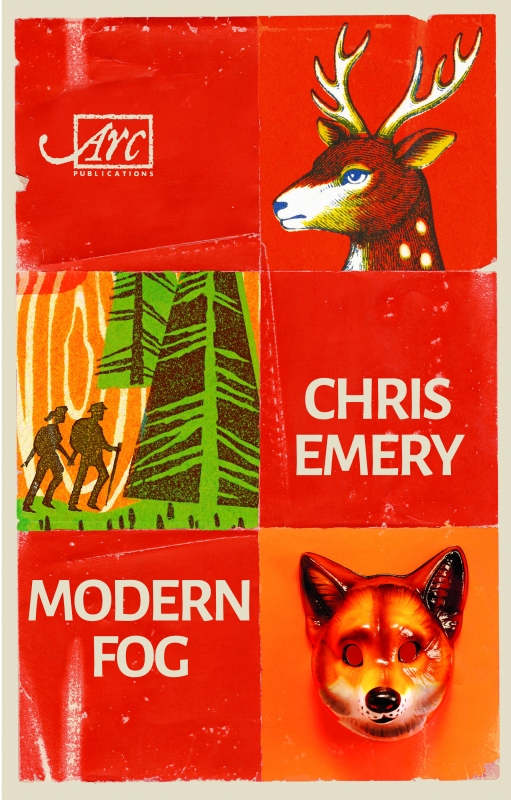
Review of ‘Modern Fog’ by Chris Emery (Arc Publications, 2024)

Chris Emery’s most recent collection both presents, and intends to see beyond, the Modern Fog of its title. The poems revel in describing aspects of this world and – in keeping with the images on the book’s cover – the occasions for such descriptions arise from journeys (often walking – the cover shows a hand-holding rambling couple) and the highlights of such journeys are frequently encounters with creatures (the cover has a deer and a fox). So ‘The Path’ leads us past ‘chalk beds’ and ‘clay beds’ and ‘dirt paths’ to excited sightings of a jay and a buzzard. Presenting more of a pause in such a walk, ‘The Day Storm’ is composed largely of the poet’s characteristic ‘noticing’ of blackthorn, blackberry and nettle. But once the eponymous storm has passed, the trees are now found to be ‘gashed . . . / splintered’ and this gives rise to one of Emery’s most interesting observations that, in their damaged state, the trees are in some mysterious way ‘clarified’. More of this later.

There is more than a little of Philip Larkin in Emery’s work – particularly the detail-listing-Larkin of ‘Here’ and ‘To the Sea’. Emery’s ‘All the Routes Home’ offers us an inclusive list of a Roman road, a Viking lane, an unclear path, a Puritan track. The poem ‘The Bay’ might be read as a more condensed version of Larkin’s ‘Here’ as, ‘after hours of hill torture’, the trail walker arrives at a bay, dotted with ruined buildings: ‘the afterthought of winter crofting’. This image of transience, of ultimate human failure, in effect a memento mori, is softened a little with Emery’s insistence that the homesteads ‘still hold their ounce of love’. In contrast to Larkin, and reminiscent of those earlier ‘gashed’ trees (somehow being advantaged by their damage), Emery is reluctant to accept death as an absolute ending and it is in this that the reader will find indications of his religious belief.

Similar spiritual themes emerge in the many encounters these poems have with creatures. ‘The Buzzard’ is another hill walk on a ‘churchless’ afternoon, but the flight of the bird on its thermal suggests an upward aspiration, a craving that the human observers also ‘hope to crave’. There is a beautiful little poem ostensibly about a dove returning to its dovecot:  

Small snatch of air, sole white arc,

crisp handclap, then ritual landing.

All followed by cossetting and fuss

at the stoop. The laughable dance

with lots of nodding and wittering

before the tricky hop up

to the dovecote . . .

The poem is transformed to something unconventionally angelic by being given the title ‘Pentecost’. The more lengthy ‘Day Fox’ vividly captures the ‘living amber’ of the creature against the green of grass, but its death at the roadside is equally clear: ‘his pelt was tar black and slicked back / on the tiny lump of him’. Here again, Emery goes a step or two beyond the plain facts of death as, in the corpse’s decomposition, ‘the world / relaxed into him with all its fiery prayers’. To suggest this is an image of an afterlife is to lack the poem’s own subtlety, but Emery is surely probing Eliot’s idea (not original to TSE) that ‘In order to arrive at what you are not / You must go through the way in which you are not’ (‘East Coker’). The remarkable poem ‘Stags’ does this more explicitly in that the momentary sighting of the creatures is (in the poem itself) now no more than a shaky memory, an ‘absence’ that stands ‘at the edge of what’s never / fully grasped’. But the recall of their passing still has a potency as a ‘store of grace and loss’ and is here declared ‘the last religion of these woods’.

St. Andrew’s, Wickhampton in Norfolk

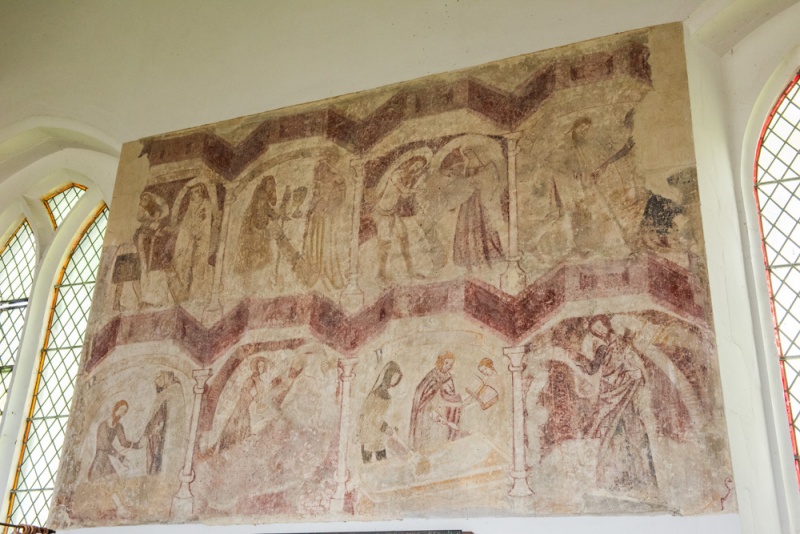
But Emery is equally at home describing the ‘dreck’ of our modern world. It’s surely more this sort of thing that constitutes the ‘modern fog’ of the book’s title. There is an NCP car park, the final destination perhaps of the couple in ‘Newbies’ who are driving along ‘old roads, lobbed estates seeping / by the rim of each roundabout’. The tacky nature of modern life is also found in ‘Edgeworlds’ which encompasses 4x4s parked up beside a ‘ratty beach’ and coach tours, detergent-smelling corridors and TV reruns. But such scenes function in this book partly as a foil to the (again) Larkinesque ‘churchgoing’ side of Emery’s character. ‘The Wall Paintings’ – a visit to St. Andrew’s, Wickhampton in Norfolk – opens, not with cycle clips, but with the equally evocative ‘thunk of a latch and then your eyes adjust’. And far more monumentally, ‘At St Helen’s, Ranworth’ is a 12-part sequence (each shaped like the church’s tower) more explicitly contemplating the building’s impact on the poet’s religious experience.

I guess I’m more attuned to Emery’s art when he is working up from the roots of the secular and material world, as in ‘One Drive in Winter’, in which the travelling couple go beyond satnav reach, the petrol tank close to empty, beyond any very obviously attractive destination, yet they still discover something worthy of a return, something about themselves, an opportunity to ‘solemnise the marginal and lost’. It may be that the great churches of the Norfolk Broads are themselves part of the category of the ‘marginal and lost’ these days and I do admire Emery’s attempts to bring them back into contemporary poetry, but I find his more slantwise and paradoxically inclined images (evocative of ‘East Coker’s ‘In my end is my beginning’) more accessible emotionally. To give one more example, in ‘The Elders’ – a poem written in memory of Adam Zagajewski – Emery again deploys an image of trees damaged after a storm (this time perhaps more metaphorically damaged by ‘revolution’) and these oak limbs also ‘lie / broken with new life’.

This intriguing collection’s two concluding poems are perhaps variations on this same theme. ‘The Start of It’ is – here’s the paradox again – the beginning of the end prior to the beginning: in this poem we read of frank intimations of mortality, of moments when ‘something abstract stiffens in the grace’ of a life, when we may come to glimpse ‘the formal shape [we] make in time’. In a completely different mode, ‘The Legacy’ eventually reveals itself to be a poem about the gentle removal of an empty wasps’ nest, its ‘featherweight’ and ‘strange paper weather’. In the transformative effect of real poetry, the nest comes to be seen as a human life lived, ‘sad and gorgeously dented’, but from which the creatures that made it have departed to another place: ‘to drone in apple acres / elsewhere darkening / with sweet ruin now.’ Whether we believe in such a place – and the oxymoronic ‘sweet ruin’ casts a shadowy doubt – is, with writing as good as this, hardly the point, appealing as it does, through vivid imagery, confidently written, to a fundamental human longing for continuation in the face of what we think we know of the end of life.

Remembering John Burnside

With yesterday’s announcement of John Burnside’s death, I thought of this review that I wrote in 2006 of his Selected Poems, published by Cape Poetry. His work meant a lot to me around that time and I enjoyed the chance to try to articulate what I found fascinating in it.

John Burnside’s poetry has, for some years now, been offering us a modern egotistical sublime. With Wordsworth, he shares a responsive delight in nature and daunting powers of self-analysis; also similarly, he can slip towards the prolix and portentous and there is something of the same difficulty with projection into another’s experience. But Burnside’s work frequently achieves a moving sublimity without loosening its grip on reality. He is the only contemporary poet who consistently demonstrates the power of a poetic form that is something other than mini fictional narrative, raw confessional, or condensed dramatic monologue. That he is also successful in writing prose makes his achievement all the more impressive.

His work was recognised in the early 1990s despite bucking the trends of secularism, formalism, and plain/street language. His poetry’s brooding intensity lacked laddish brouhaha. The palette was never broad – rural twilights, leaf litter, owls hunting, tracks across snow – but his eye was always on the margins of such things, where the human and the natural met and negotiated. It felt like something spiritual was about to be said or had been articulated and just missed. This was twinned with the powerfully felt absence of fixed personal identity that has remained so deeply engrained in his work. In poems that in many ways were hardly radical, it was this element that made Burnside feel modern. In a self-regarding culture ever more attached to the teats of mobility, individuality, celebrity and fashion, his relentless worrying away at the obscurity of the self, his flirting with its non-existence, struck dissonant but resonating chords.

Burnside’s themes are frequently disturbing. But in a poem like ‘Halloween’ (from The Myth of the Twin, published in 1994) his exquisite ability to conjure up the British countryside proves to be an essential part of the pleasure of reading him. As often, the season is autumn – cold, mostly deserted, snow, rain, “the fernwork of ice and water”. The narrator peels bark from a tree to smell “its ghost” in a characteristic movement from the precisely evoked physical to the almost casually implied spiritual. What the figure in the landscape is trying to do is to “define my place”. Even scraping down in the leaf mould, he finds fungal traces that look “like the first elusive threads / of unmade souls”. Nearby village bells provide “nothing” and the poem typically ends with the figure’s sense of “other versions of myself” on the periphery of vision and these can be taken to imply other futures, untaken pasts, other roles familiarly adopted, even selves beyond the physical – the inconclusiveness is the point.

Burnside has pursued experiments with differing perspectives that were first signalled by the opening and closing poems of The Myth of the Twin. For example, though in the end less successful than its predecessor, Swimming in the Flood (1995)dramatically broadened his poetry’s reach to include the experience of others, often in more extended form and in dramatic monologues. Persecutors and victims inhabit these poems and speak disturbingly of abuse and “the inexplicable / malice of being” (‘Schadenfreude’). This was a turning point in Burnside’s development as what now flooded into the poetry was what had lain buried in the delicacy and tentativeness of the earlier work. In the ‘The Old Gods’ he declares their power is strongest “when anger or fear / is fuzzing the surface, / making us dizzy and whole”. The process of uncovering is shown to be one of healing and this selection includes the sequence called ‘Burning a Woman’ which seems nakedly to speak of the poet’s mother and father. Equally, the ‘Parousia’ sequence (not included in this Selected) ends with what appear to be sceptical reflections on his earlier inquisition beyond the merely physical: “All resurrections are local . . ./ the sign I have waited to see / is happening now / and always”. Here Burnside seems to arrive at a sense of secular miracle (a version of Rilke’s “Hiersein ist herrlich”) less concerned with the reality of religious presence than with the individual’s response to its possibility.

And yet, the dramatic monologues proved something of a cul de sac. With his subsequent work, Burnside has returned to his best subject: himself. Partly what makes the award-winning The Asylum Dance such a magnificent achievement is the development of the fluid poetic form he combines with a second person plural address that achieves the universal without being either hectoring or twee. The influence of William Carlos Williams is obvious, but Burnside extends this beyond a fluent impressionism concerned with the truth of things to encompass a philosophical musing, the lines flickering across the page as if viewed through water. This new selection is too brief to achieve the full sense of his development, but one of the marvels of Burnside’s work is its continuing delivery of extraordinary evocations of the natural world that have become gradually melded with an introspective depth that does not merely offer insight, but sustained meditation. The four long sequences from The Asylum Dance are rightly given space here and constitute a masterpiece in which the poems offer up rich, disturbing, beautiful, precise, profound, and sustained experiences undergone in the act of reading, rather than a lesser poetry’s marshalling of moments of insight and feeling. Burnside’s career already provides ample proof of a fascinating and significant artistic development, and this selection will prove a good starting point for anyone not yet following it.

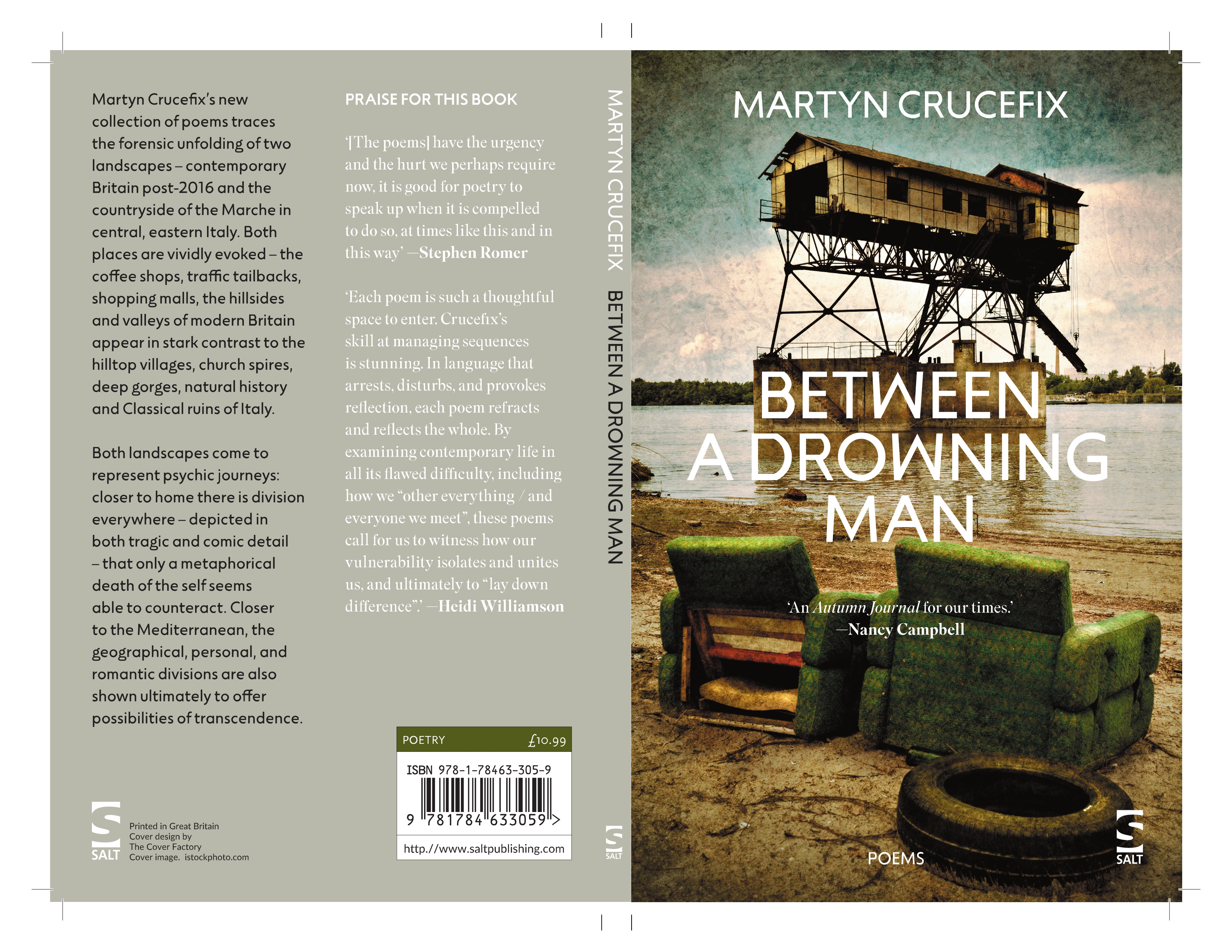
Mat Riches reviews ‘Between a Drowning Man’

Many thanks to Mat Riches for this fulsome and acute reading of my recent collection from Salt Publishing. The review first appeared on The High Window – Jan 2024

The introduction to the first section of Between a Drowning Man states that it draws on two texts. The first is Hesiod’s Works and Days, and the second of which is described as

the type of poem known as a vacanna originated in the bhakti religious protest movements in 10-12th century India. using plain language, repetition and refrain they were written to praise the god, Siva, though also expressed a great deal of personal anger, puzzlement, even despair about the human condition […]

This helped put everything into context for what followed. One third of the way in I started to think of it as a man shouting at clouds in book form, of someone railing at things in the world that are beyond our control. And maybe it is all of this, but it also much more than this. I think it becomes a lesson in acceptance.

In a post on his own Blog, Crucefix describes these poems as starting to arrive after reading the vacanna poems in 2016, and how the poems began to accumulate after that while ‘staying in Keswick at the time and I vividly remember scribbling down brief pieces at all times of the day and night’ and of having been influenced by Brexit (the bridges are down indeed). However, he also describes in a follow up post that:

I thought of the poetry I was writing as a quite narrowly focused topical intervention, but in the last 4 or 5 years …the poems have come to seem less dependent on their times and more capable of being read as a series of observations – and passionate pleas – for a more generous, open-minded, less extremist, less egotistical UK culture.

And while the Brexit reading is there, these poems speak more to grounding a modern and disconnected world (despite plenty of references to devices for and modes of communication—we’ll come back to that shortly) in timeless themes like love and desire, parenting, ageing, joy in nature, false idols, and much more, and this is just in the first twenty or so pages.

Picking one of those themes at random, we can see how false idols are covered, but also how deftly he weaves in modern references to something that is both timeless, and of its time, and with that very human. In ‘the six pack on the side’ we are told:

the clock is a sinister and impassive god
for the ancients rumour was a kind of god

the god of WiFi when we curse its absence
and when did difference become a god

We have always been a narcissistic species that pays attention to gossip (‘rumour was a kind of god’), but while our gods have changed as the centuries have passed, we still curse our gods when they forsake us. Not a bad return for a 19-line poem in my opinion.

In order to achieve the ‘more generous, open-minded, less extremist, less egotistical UK culture’ we can see several pleas for more open lines of communication throughout the poems. Some are located in the specific and familial, as in ‘watch the child’ and its discussion of a child chattering away to herself in a coffee shop with her ‘bright picture book’ juxtaposed with ‘her mother at her cooling latte / at her macchiato / at her cooling skinny medium cappuccino // […] her mother’s ears wired casually // with two scarlet buds.

The child is broadcasting and communicating in a carefree way vs the mother’s more deliberate inward-looking approach, a shutting the world out for some respite. And while this could be a judgmental poem; it’s not. It feels like an invitation to consider both sides, both needs here. The refrain of ‘all the bridges are down’ lands particularly well here, both for the protagonists of the poem, but also for the reader.

However, while some pleas are located in the specific there are some more general ones to be found. In ‘he thought of this time’ one man recounts a litany of disappointments and emotions from his father. The poem draws from Hesiod and his idea of the fifth age where modern man was created by Zeus to be evil, selfish, weary, and burdened with sorrow. It’s a two-footed tackle on humanity from the whistle:

he thought of this time as a fifth age
that he’d be better off dead or not yet born
working all day he would fear the night
had heard of children born prematurely grey
and the fraying bond between fathers
and sons between mothers and daughters
between host and guest between different races

It continues without reprieve about a world where:

[…]the hopeless
are advanced and further advancement
lavished for no more than just chancing it
respect a word more spoken than heard
the educated full of corrosive cleverness
and compassion the greatest of virtues
an ebbing tide you see where it glints
on the horizon

At the time of writing, it’s easy to feel like these lines are as contemporary as it’s possible to be, and yet it’s arguable they are evergreen observations about humanity. However, I suspect that’s the point.

We’ve touched upon references to modern-day totems like WiFi, coffee types and headphones already, but this section is filled with them. Further examples include references to Google Maps and ‘five-star online reviews’ in ‘fifteen kilometres of traffic’ and ‘stoke a fire under your silk blouse’ respectively.

This all reaches its zenith in the final poem of the section, ‘this morning round noon’. The poem moves from personal notes about scattering ashes, a son’s birthday (and him being in huge debt at 21, one presumes from being at university) through to:

an American punk band form Nashville
posting abuse about a young Buddhist woman
refusing anaesthetic

The lines are punctuated by phrases like ‘likesharelike’ or ‘likeclicklike’ or ‘smileyfaceicon’. It’s the diaristic nature of the whole section writ large and transmitting thoughts to the page (albeit the printed page, not the Facebook page) as they occur. As an aside, this running together of words, coupled with the entire book’s distinct and clearly deliberate lack of punctuation (save a few dashes here and there) add to the observational nature of the poems, of thoughts being pulled from the ether. However, this is very much not to say that these poems aren’t considered and crafted—they very much are.

The final line of the poem and section is ‘I say the Pantone chart is one of my favourite things’, and while the poem that proceeds this line could be read as a darker version of the Sound of Music classic, less Raindrops on roses and more ‘I was hit by a car likeshare’, but I prefer to take it as a sign that the poem end on acceptance of nuance, variation and being able to communicate the same needs.

As the first section comes to an end there are two poems where the last line of one resurfaces as the start of the next, and it feels like a teaser for what follows in the second section, O. at the Edge of the Gorge.

This was previously published as a pamphlet by Guillemot Press in 2017 and is a crown of sonnets. After the hectic modernity of the first section, there is much to be said for the relative calm of following a traveller, Orpheus, on a journey through Italian countryside observing ‘Glossy fleet black clods of carpenter bees / swirl at the corner of the house / then sink onto spindly lavender stems / alight on blooms stooped // with the weight of insect lives’.

It’s a beautiful opening and a beautiful image that should perhaps be filmed and used as a fine example of what was briefly known as slow TV and shown on BBC4, but in the second poem he describes ‘astronomical time marked by light’ as the sun descends the gorge and church bells tolling, but:

yet come nightfall a different sense
these same sounds sound notes more chilling…

A very real sense of for whom the bell tolls, indeed. As the traveller wends their way round the area, taking notes and sketches of birds, a ‘flock of white doves’, that darkness returns in the form of a buzzard in the eighth sonnet, and gets deeper still in the ninth where he mentions:

like Urbisaglia or some place has seen
and survived change of use
from sacred temple to church to slaughterhouse
and no gully nor hill can stop it

Urbisaglia is an ancient town in Mid-East Italy that became the site of an internment camp during the second world war, and that knowledge adds further weight to the stanza that begins sonnet ten:

The truth is some survive a while most fail
to conceive the scale of paperwork
to follow change of use from church to temple
next to slaughterhouse.

The cruelty of humanity to itself is mirrored in the “bloody festival / of the bird” in sonnet thirteen as it discusses a raptor above the gorge, and the final sonnet off this crown muses on the fragility of life:

All creatures die sooner blind to the hawk—
left clutching no more than this
as if the hammock he occupies each
and all night too as if strung out

[…]
not falling yet not ever at ease

‘not ever at ease’ could so easily be a final motif for the whole collection. There is a sense that the learnings of this collection are hard won, but there is a connection to the wider world to be had, and that we can find comfort in travelling through it. The final lines of ‘you are not in search of’ in the first section seem apt as a place to leave it:

you might say this aloud—by way of ritual—
there goes one who thought much of life

who found joy in return for a little gratitude.

Mat Riches is ITV’s unofficial poet-in-residence. Recent work has been in Wild Court, The New Statesman, The Friday Poem, Bad Lilies, Frogmore Papers and Finished Creatures. He co-runs Rogue Strands poetry evenings. A pamphlet called Collecting the Data is out via Red Squirrel Press. Twitter @matriches Blog: Wear The Fox Hat

A new podcast interview – plus a new review of ‘Between a Drowning Man’

I am delighted to announce that Planet Poetry – the long-running, terrific poetry podcast run by Robin Houghton and Peter Kenny have released their new episode which includes an interview with me about my new Salt book. Do listen here: https://planetpoetry.buzzsprout.com/1414696/14024020-bridges-broken-with-martyn-crucefix

Stuart Henson has also written a fine review of Between a Drowning Man, which has recently been posted on the London Grip site. You can read the whole review here:

New podcast discussion on Between a Drowning Man

I’m very pleased to announce that Mark McGuinness’ excellent poetry podcast, A Mouthful of Air, which has recently featured poets such as Mona Arshi, Judy Brown, Rishi Dastidar, Ian Duhig, Mimi Khalvati, Clare Pollard, Tom Sastry, and Denise Saul, has recorded a discussion about my new Salt collection, Between a Drowning Man.

Mark’s method is to focus on one particular poem and between us we chose the poem ‘you are not in search of’, on page 57 of the new book, from the latter end of the ‘Works and Days’ sequence. You can listen to the podcast here. It’s about 40 minutes in length and includes a reading of the poem at the beginning and end. There is also a helpful transcription of our discussion.

Here is the poem text – though without the indents which are hard to reproduce here:

‘you are not in search of’

There has to be / A sort of killing – Tom Rawling

you are not in search of a gilded meadow

though here’s a place you might hope to find it

the locals point you to Silver Bay

to a curving shingled beach where once

I crouched as if breathless as if I’d followed

a trail of scuffs and disappointments

and the wind swept in as it usually does

and the lake water brimmed and I knew the thrill

of its mongrel plenitude as colours

of thousands of pebbles like bright cobblestones

slid uneasily beneath my feet—

imagine it’s here I want you to leave me

these millions of us aspiring to the condition

of ubiquitous dust on the fiery water

one moment—then dust in the water the next

then there’s barely a handful of dust

compounding with the brightness of water

then near-as-dammit gone—

you might say this aloud—by way of ritual—

there goes one who thought much of life

who found joy in return for a little gratitude

before its frugal bowls of iron and bronze

set out—then vanished—then however you  try

to look me up—whatever device you click

or tap or swipe—I’m neither here nor there

though you might imagine one particle

in some stiff hybrid blade of grass

or some vigorous weed arched towards the sun

though here is as good a place as any

you look for me in vain—the bridges down—

Goethe’s poetry – some new translations by John Greening

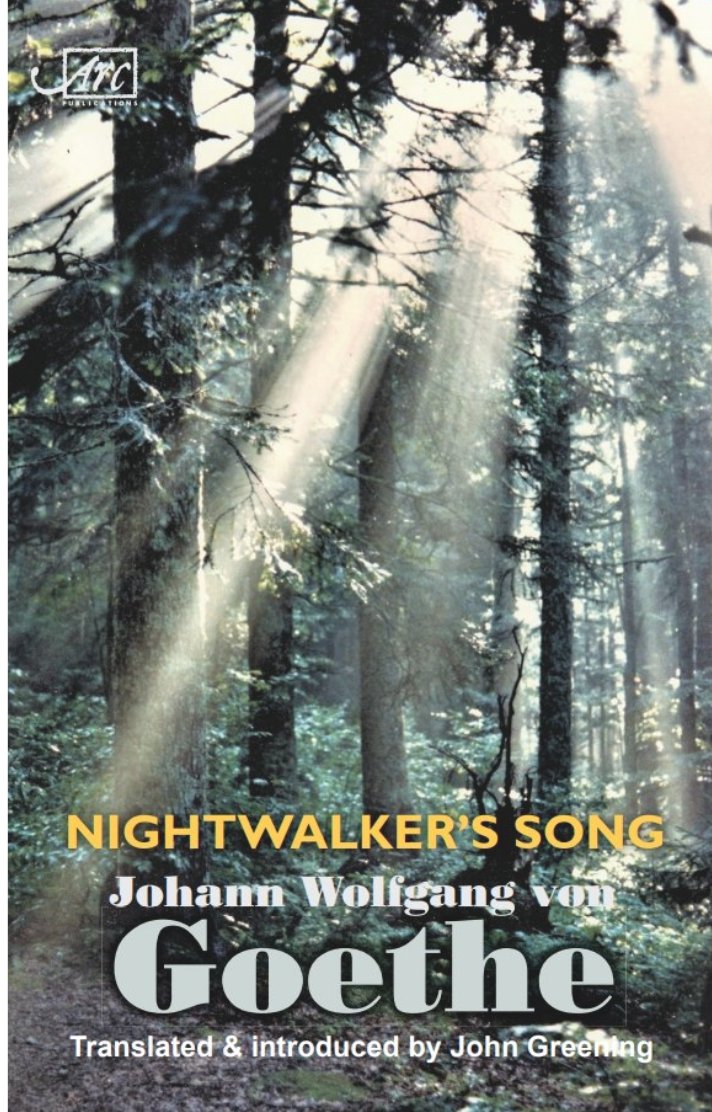
In this blog post, I am discussing John Greening’s new translations of a small selection (9 poems in all) from the works of Johann Wolfgang von Goethe. With the original German texts provided on facing pages, these translations are published as Nightwalker’s Song, by Arc Publications (2022). This review was originally commisioned and published by Acumen poetry magazine early in 2023. By the way, Acumen will be presenting a free to attend on-line celebration of its latest issue on Friday September 1st at 18.30 BST. It will include a brief reading of new work by yours truly, Gill McEvoy, Anthony Lawrence , Sarah Wimbush, Simon Richey, Dinah Livingstone, Michael Wilkinson, Jill Boucher, Jeremy Page, and others.

John Greening’s recent, self-confessedly ‘tightly-focused’ little selection from Goethe’s vast output is, in part, a campaigning publication. In his Introduction, Greening notes the difficulties surrounding the great German poet’s presence in English: the sheer volume of work, the range of that work, the man’s polymathic achievements (as poet, playwright, novelist, scientist, statesman, theatre director, critic), the long life untidily straddling all neat, period pigeon-holing. Christopher Reid has called him ‘the most forbidding of the great European poets’, but perhaps the English have come to see him as a mere jack-of-all-trades? And where do we turn to read and enjoy the poetry? Michael Hamburger’s and Christopher Middleton’s translations look more and more dated. David Luke’s Penguin Selected (1964; versified in 2005)is the most reliable source. But tellingly, as Greening says, one does not find young, contemporary poets offering individual translations of Goethe in their latest slim volume in the way we do with poems by Rilke or Hölderlin.

John Greening

So here Greening sets out a selection box of various Goethes to encourage other translators: we find nature poetry, romance, the artist as rebel, meditations on fate, erotic love poems, a rollicking ballad, dramatic monologue and a very fine sonnet. I like Greening’s determination not to lose the singing. Here, he has ‘shadowed’ the original metres and retained rhyme schemes, though he sensibly makes more use of pararhyme than Goethe’s full rhyming. While not approaching Lowellesque ‘imitations’, Greening has also sought a ‘contemporary texture’ by venturing to ‘modernise an image or an idea if it helped the poem adapt to a different age’. For example, in ‘Harz Mountains, Winter Journey’ (‘Harzreise im Winter’) Goethe’s buzzard has become the more familiar image, in southern England at least, of a red kite. The carriage or wagon (‘Wagen’) driven by Fortune becomes a car in a ‘motorcade’ and another vehicle is imagined ‘winking on to / the slip-road’. There’s also an enjoyable touch of Auden in Greening’s updating of ‘crumbling cliffs / and disused airfields’ (Middleton has ‘On impassable tracks / Through the void countryside’).

Walt Disney’s Sorcerer’s Apprentice

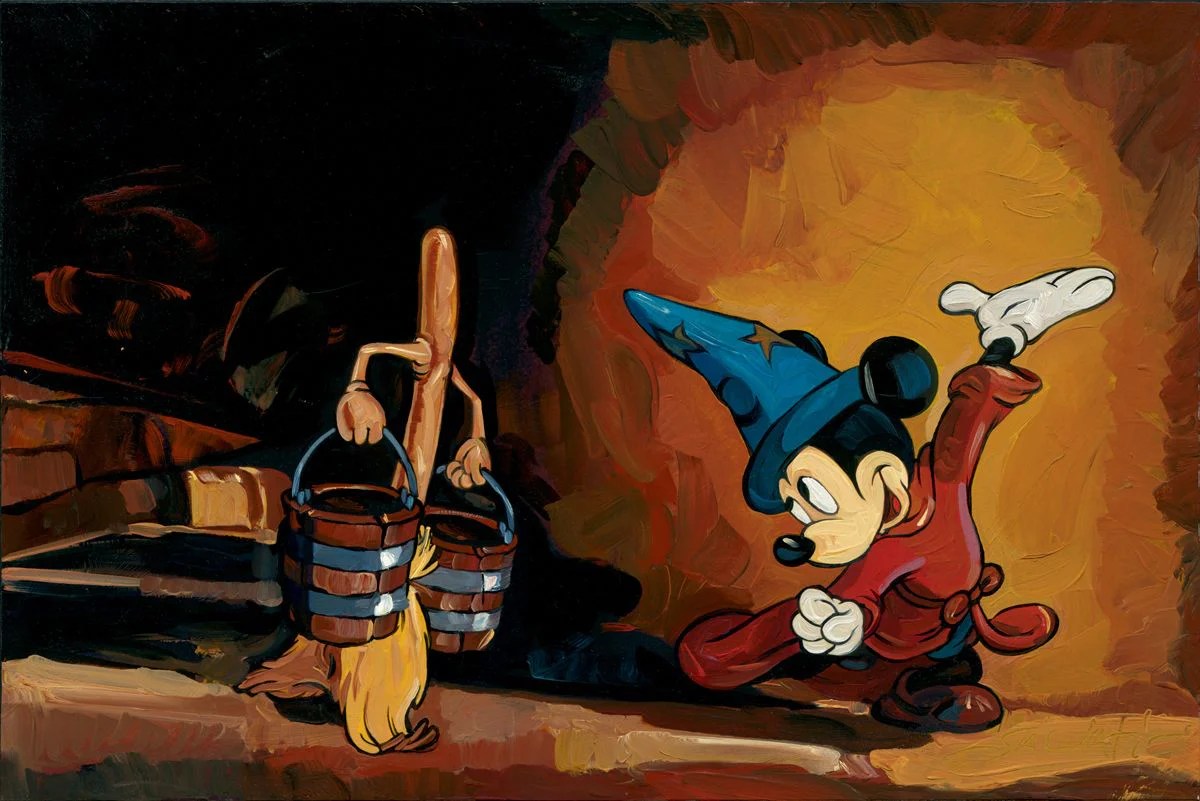
Greening’s skills in versification are well known and he deploys them all – and you can hear him enjoying himself – in ‘The Sorcerer’s Apprentice’: ‘Broomstick – up, it’s show time, haul your / glad rags on, so grey and grimy. / Seems you’ve seen long service, all you’re / fit for now is to obey me’. Though grace notes and fillers slow Goethe’s headlong verse (the opening line in German is simply ‘Und nun komm, du alter Besen!’ – ‘And now come on, you old broom!’), Greening’s rhyming is delightful and the modernising phrases (show time, glad rags) drive the poem along with a colloquial energy which is absolutely right.

Goethe’s ‘Prometheus’ – published in 1789, the year of revolution in France – is a growling dramatic monologue in which the rebel Titan (who stole fire from the gods to give to humankind) sneers and mocks the authority figure, Zeus. He belittles the top god in the opening lines by comparing him to a boy, thoughtlessly knocking the heads off thistles. Greening catches the mocking tone in the series of rhetorical questions later in the poem: ‘Honour you? For what? / Have you ever offered to lift / this agony?’ Prometheus ends – following one version of his story – by explaining he is creating the human race in his own image, ‘a new range’ translates Greening, neatly updating once more, ‘programmed / to suffer and to weep, or whoop and punch the air – / but who, like me, won’t care / about you’. In comparison, Luke’s version sounds rather fusty and less bolshie: ‘A race that shall suffer and weep / And know joy and delight too, / And heed you no more / Than I do!’

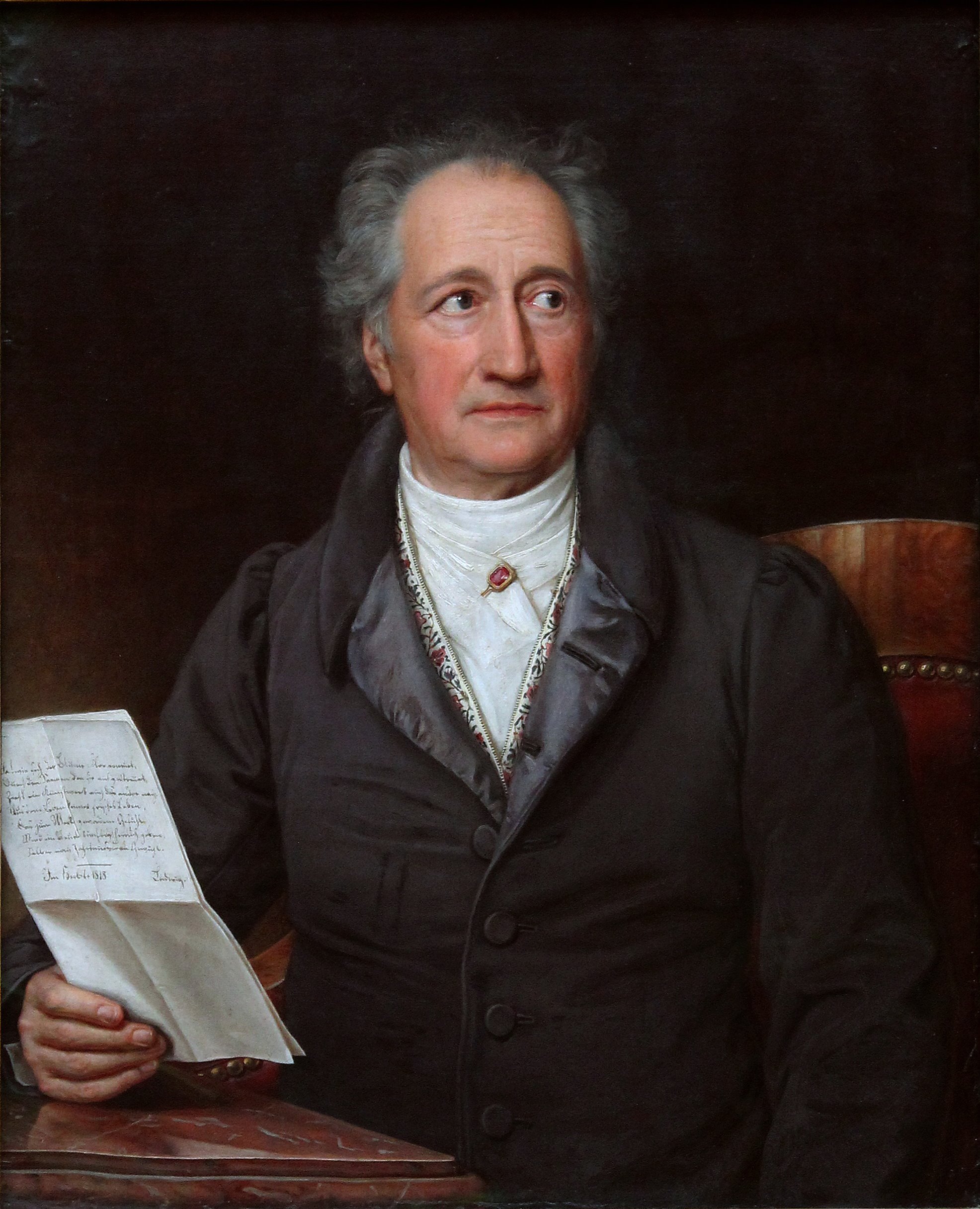
Johann Wolfgang von Goethe

Goethe is a great love poet. ‘Welcome and Farewell’ (‘Willkommen und Abschied‘) has a man approaching on horseback (Greening does not motorise on this occasion) through a moonlit landscape and the lover is spied at last: ‘how / I’d dreamt of (not deserved) all this’. The moment of union passes unspoken between stanzas three and four. As if instantaneously, now ‘the sun had risen’ and the parting must take place: ‘And yet, to have been loved – to love, / ye gods, such utter happiness’. It’s curious that Greening retains the rather archaic ‘ye gods’. One still hears the phrase, of course, but with more irony than I would have imagined here. The fifth of Goethe’s ‘Roman Elegies’ is a fabulous erotic piece. Written during the poet’s travels to Italy in the late 1780s, the narrator is studying classical culture by day and his female lover’s body by night. The latter nourishes the former: ‘I find I appreciate marble all the better for it, / and see with a feeling eye, feel with a seeing hand’. As he goes on, ‘compare and contrast’, I find Greening a little cool here. There is a selection of translations by D M Black (Love as Landscape Painter, from FRAS Publications in 2006) which generates more heat:

Yet how is it not learning, to scan that delectable bosom,

  Or when I slither my hands pleasantly over her hips?

Then I understand marble; then I discover connections,

  See with a feeling eye, feel with a seeing hand.

Faustus (by Eugene Delacroix)

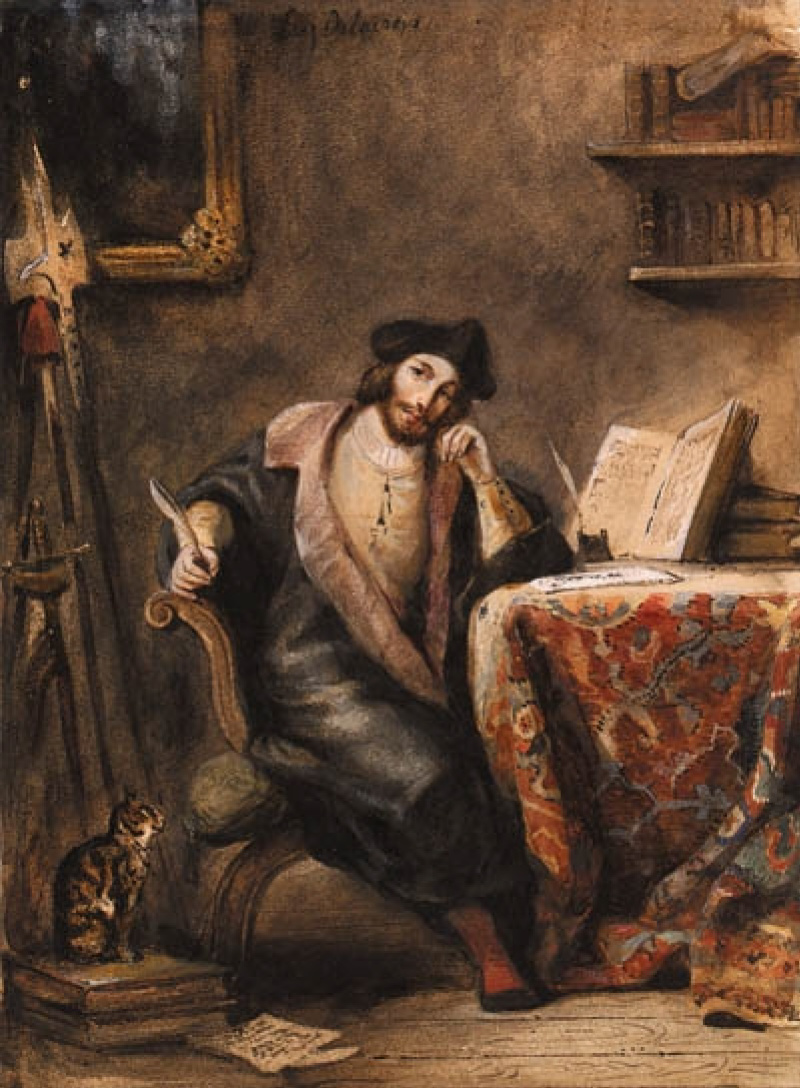
Goethe’s Faust is represented here by the scholar’s opening speech to Part One (versioned, as it were, by Christopher Marlowe in the opening soliloquy of his Doctor Faustus). Greening excels in the handling of rhyme and line length, even compared to David Constantine’s 2005 Penguin translation. Perhaps most impressive of all is the sonnet ‘Nature and Art’ (‘Natur und Kunst’). Greening has the motor car in mind again in his updating of Goethe’s exploration of how the artist must labour incessantly to achieve the preparedness, the readiness to respond to Nature, to what is natural. Reading these lines, you feel Greening is translating as a skilled and experienced artist himself, triumphantly bringing a poem written in 1800 bang up to date:

It’s just a case of working long and late.

So once we’ve spent, let’s say, ten thousand hours

on steering, footwork, shifting through the gears,

it may be then some natural move feels right.

x

Creative though you be, you’ll strive in vain

to reach perfection if you’ve no technique,

however wired and woke your gifts may be.

x

You want a masterpiece? You’ll need to strain

those sinews, set your limits, drill and hack.

The rules are all we have to set us free.

For anyone yet to make the leap into Goethe-world, this little book is a terrific way into the great German writer’s work and such a reader will find Greening’s Introduction and his prefatory remarks to each of the chosen poems very helpful indeed. I recommend this collection.

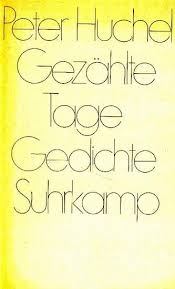
New review of my translation of Peter Huchel’s ‘These Numbered Days’

When Shearsman Books published my translations from the German of Peter Huchel’s 1972 collection These Numbered Days (Gezählte Tage), we were still in the early days of Covid restrictions and so launch events and so on were very difficult. I was pleased when the book was recognised in 2020 by winning the Schlegel-Tieck Prize for translation from German awarded by the Society of Authors. The judges were Steffan Davies and Dora Osbourne. Yet the wheels of reviewing such books turn very slowly. And I am pleased once more with the appearance of a lengthy review of the book by Frank Beck which has recently appeared in the excellent journal, The Manhattan Review, edited by Philip Fried. So, with due acknowledgements, I am reproducing Frank’s review here. Do check out his work and visit The Manhattan Review, an excellent US journal with a liking for pubishing reviews and work from the UK.

These Numbered Days (Gezählte Tage) by Peter Huchel, translated from the German by Martyn Crucefix and introduced by Karen Leeder. Emersons Green, Bristol, UK: Shearsman Books, 2019. 129 pp. $18.00 (paperback).

When poets look to the stars, often they are hoping to place their human worries in a wider context, in search of consolation. But what if they find, instead, that their concerns are reflected somehow in the sky overhead? Think of the famous fragment from Sappho: alone and unhappy, she watches the moon and the Pleiades descend together, like lovers lying down in bed. Readers may feel that something similar is happening in these lines from German poet Peter Huchel, as translated by British poet Martyn Crucefix:

                        Bent already by the night
                        into his icy harness,
                        Hercules drags
                        the star’s chain-harrow
                        up the northern sky. (p. 23)

            When have we felt so much heft in the distant stars? We might well wonder what weight Huchel himself was bearing when he wrote this last stanza of his poem, “Under the Constellation of Hercules” (Unterm Sternbild des Hercules).

            But first, let’s see how closely the English translation corresponds to the German stanza. Crucefix replicates Huchel’s pattern of three-beat lines, varied in line 3 with a two-beat phrase. He also makes use of the ready echoes some of Huchel’s words have in English: bent for gebeugt and icy for eisige. He creates a harsh music with chain-harrow, as does the clutter of consonants in Huchel’s Kettenegge. And Crucefix ties the stanza together with the r-sounds running through each of his five lines.

            Of course, acoustics aren’t everything: this closing stanza owes much of its power to the two, less portentous preceding stanzas, in which the speaker describes a small, rural settlement, “no larger/than the circle/a buzzard traces/in the evening sky.” All we are shown of the place is a rough stone wall, “glittering water,” and the smoke from a fire, “cut through with voices,/none of which you know.” This sense of elemental conflict prepares us for the star-hauling of the final lines: even in the heavens, it seems, the grinding struggles of the universe go on.

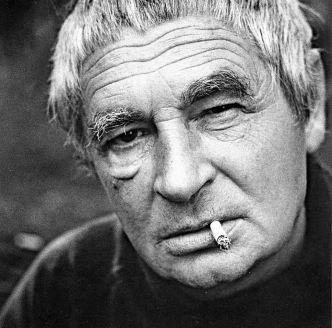
            In the German-speaking world, Peter Huchel is widely considered one of the finest 20th-century poets. He composed many of his poems out loud, rather than on paper, so their resonant language often seems, in the words of one critic, “as natural as air or breath.” Huchel is also admired for the way he endured years of harassment and confinement at the hands of the East German government. His reputation was consolidated in 1984, when Huchel’s poetry and prose were collected in two volumes, meticulously annotated by Axel Vieregg, a German scholar in New Zealand who had spent decades studying the poet’s work.

            English translations of Huchel’s poems have been difficult to find, although selections of them were compiled and translated by Michael Hamburger and Canadian poet Henry Beissel. (This despite Joseph Brodsky’s enthusiastic endorsement of Huchel’s poetry in The Wilson Quarterly in 1994, accompanied by translations by Joel Spector and a full-scale biography by British scholar Stephen Parker, in 1998.)

            These Numbered Days brings us graceful English versions of all 63 poems in Huchel’s 1972 collection, Gezählte Tage, the fourth of his five verse collections, published between 1948 and 1979. The translated poems appear side-by-side with the German originals. An introduction by Karen Leeder helps orient the English-speaking reader in Huchel’s world, while connecting his work with the most urgent issues of today. Crucefix’s fidelity to both the meaning and the manner of Huchel’s poems won his book the prestigious Schlegel-Tieck Prize for German Translation in 2020. 

            Huchel was born Hellmut Huchel in 1903 (the “u” is pronounced like the double vowel in moon), the son of a civil servant and his wife, from Lichterfelde, a Berlin suburb. Hellmut spent much of his youth on his grandfather’s farm in the nearby Brandenburg countryside, where he developed a feeling of deep kinship with the natural world. After studying literature and philosophy briefly, he lived in Paris for two years, then traveled extensively in Hungary, Romania, and Turkey.

            In 1931, at the age of 28, Huchel returned to Berlin, first earning his living as an editor and then by writing plays for radio. He changed his first name to Peter and began to publish his poems in Die literarische Welt and other leading German journals. Those early lyrics often draw on his memories of country life, as in “Havelnacht,” which describes a night on the Havel River in Brandenburg. Here are the poem’s last two stanzas (my translation):

                        Scents of so many past years
                        lean gently here, into the water.
                        As we go quietly along,
                        the night’s brew blows through us.

                        The greened stars are floating
                        as they drip from the oars.
                        And the wind cradles our lives,
                        as it cradles willow and crane.

            As beguiling as these images are, the poem’s effectiveness depends largely on its delicately deployed A/B/A/B rhyme scheme, which I have not tried to replicate. (The German poem might remind an English-speaker of Yeats.) Already, Huchel had acquired the technical mastery that the Swiss critic Paul Schorno would later describe as “certainty of what is being said through certainty of form.”

            In 1941 Huchel was drafted into the Luftwaffe, where he served until being taken prisoner by the Russians. This led to his working for Radio Berlin in the Russian-occupied sector after the war; eventually he became its cultural director. In 1949, when the Federal Republic of Germany was established in western Germany and the German Democratic Republic in the east, Huchel was named editor-in-chief of the GDR’s new literary magazine, Sinn und Form (Sense and Form). Under his direction, it came to play an important role in East German culture and even earned an international reputation.

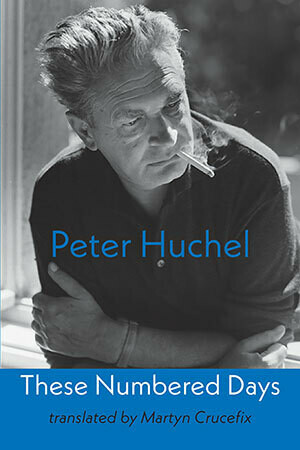
Peter Huchel

            However, Huchel’s interest in the diverse contemporary poetry flourishing abroad in those years was fundamentally at odds with Communist Party ideology, and he repeatedly came into conflict with party officials. In 1962, as East Berlin was sealed off from the West by a wall, Huchel was dismissed as editor of Sinn und Form. He was forbidden to publish in East Germany or to travel, and, along with his wife, Monica, a translator of Russian, and their son Stefan, was placed under round-the-clock surveillance at their home in Wilhelmshorst, near Potsdam.

            The poems in These Numbered Days were written during the subsequent nine years, as Huchel remained under virtual house arrest. (Several of them were published in West Germany during the poet’s confinement; others appeared in English-language journals in Henry Beissel’s translations.)

            In these poems, the rich, rhyming music of Huchel’s early poems is replaced by a spare but flexible flow of language that can contract to a beat or two or relax into longer lines. One of the book’s finest poems considers how the work of “The Dipper” (Die Wasseramsel), a small bird that feeds along the banks of rushing streams, resembles the poetry Huchel now wants to create:

                       If I could plunge
                        brighter downwards
                        into the flowing darkness

                        about me to fish out a word

                        like this dipper
                        beside the alder boughs
                        picks its food

                        from the stony river bed.

                        Gold-panner, fisherman,
                        relinquish all your gear.
                        The shy bird

                        looks to work without a sound. (p. 45)

            Few poems in the collection deal with the Huchels’ troubles overtly. When they do, the tone is wry, refusing to reward oppression with anger. Even as the house around him deteriorates, presumably because repairs are not permitted, the poet declares, “I will not write/the names of my enemies/on the spongy wall” (“Weeds”). One has the sense of a man and his poetry being tested and determined not to fail. That includes trying to heed the advice offered to Huchel in a song by his friend, Wolf Biermann: “Do not become embittered/in this embittered time.”

            Huchel’s few visitors in Wilhelmshorst had to subject themselves to police surveillance, with all the attendant risk in such a police state, or to approach in secret, under cover of darkness, as Huchel describes in “Weeds”:

                        Guests are always welcome,
                        those who love weeds,
                        those who do not shy away from stony paths
                        over-grown with grass.
                        No one comes.

                        The coalmen come —
                        from their filthy baskets they pour
                        the lumpen black grief
                        of earth into my cellar. (p. 123)

            Huchel is still the keen observer of nature he was in his earlier books, but the natural world that once buoyed and nourished him now often mirrors his constricted situation, as in “Exile”:

                        Come evening, friends close in,
                        the shadows of hills.
                        Slowly they press across the threshold,
                        darkening the salt,
                        darkening the bread
                        and with my silence they strike up a conversation.

                        Outside in the maple
                        the wind stirs:
                        my sister, the rainwater
                        in the chalky trough,
                        imprisoned,
                        gazes up at the clouds. (p. 27)

            Yet such confessions —  even any use of personal pronouns — are scarce in these poems. Sometimes main verbs disappear, and the lines rely on gerunds and participles to move them forward. What is always present is Huchel’s patient watchfulness, often refracted through history and myth, as in his image of Hercules climbing the winter sky. With all roads around one blocked, the mind’s pathways become more important than ever, and allusions abound here. These poems reach out to the poet Alcaeus (a contemporary of Sappho), Tang dynasty writer Pe-Lo-Thien, Shakespeare, Kierkegaard, Virginia Woolf and other writers past and present.

             Another connection that sustains Huchel, though more fleetingly, is his memory of happier times, especially his travels in the Mediterranean, as in “Dolphins”:

                        Gazing out across the sea
                        in white sunlight
                        I saw them leap
                        above the salty
                        weight of the water —
                        dolphins,

                        my secret brothers,
                        carrying my messages to Byzantium. (p. 91)

            Such flashes of joy are tempered by the narrow confines of the Huchels’ lives. In “Hubertusweg” (the name of their street), the poet wonders about the policeman standing guard outside his house in the rain (“What’s in it for him . . .  ?”) and then considers the vulnerability of each person before a totalitarian state (“The state’s a blade;/the people thistles.”) Yet even totalitarian states have a life-span. Huchel sees his son reading a cuneiform text about “the peaceful campaign” of the Bronze Age ruler, King Keret, and his poem concludes:

                        On the seventh day,
                        as the God IL proclaimed,
                        a hot wind blew and drank the wells dry,
                        the dogs howled,
                        the donkeys cried out with thirst.
                        And without the use of a battering ram the city surrendered.                                              (p. 121)

            In 1971, in response to efforts by Heinrich Böll, Arthur Miller, Henry Beissel and others, the GDR allowed Peter Huchel and his family to emigrate to West Germany. He continued to write there until his death, in 1981. Eight years later, the Berlin Wall fell without a shot’s being fired, and Germany was soon reunited. The Huchels’ house in Wilhemshorst, where these poems were written, is now a writer’s center, sponsored by the state and local governments.

            Today the once-divided city of Berlin is one of the most vibrant places in the world. Huchel’s poetry is still in print and still read, and, at number 10, Hanseatenweg, near the Tiergarten, Sinn and Form keeps producing new bimonthly issues, very much along the editorial lines Huchel had in mind. Thus far this year, alongside work by and about German-language writers, the journal offered its readers articles about Jorge Luis Borges, Clarice Lispector, Marcel Proust, Marina Tsvetaeva, and Adam Zagajewski.

—Reviewer Frank Beck is a writer and translator and serves as a trustee for Elgar Works, which publishes the scores of Edward Elgar. His recent thoughts on poetry and music can be found at WWW.DIEHOREN.COM.