How to Answer the Poetic Influence Question #1

A Boat..._quicksand cover

With my new collection just out from Seren Books, I’m happy to have a number of promotional events and readings coming up over the next couple of months. I love the business of giving a reading, but there’s often a moment that arises that makes me uneasy as to how to how to respond. It’s the question of influence; the hand going up to ask: what other poets do you consider to have been an influence on your own poems?

It’s my problem I’m sure, but I’ve always had two ludicrously extreme responses spring to mind on hearing the question. Firstly, to list pretty much every single poet I’ve read in the last 40 years because the truth is every single one has added a grain, a pebble (for better or worse) to the path I walk to write a poem. Alternatively, since I can’t think of one, or even two, clear contenders for powerful influence when I sit down at a blank page or screen, it must be that I have emerged ex nihilo, a peculiar original. The first would be a lengthy reply of little use or interest; the second would seem positively dripping with arrogance (and equally of little use or interest).

Actually, I can think of a third answer: it’s not for the poet to identify influences; it’s a job for a reader. But I wanted to use the next two posts to kick the idea of influence around, to sort out my own ideas and to answer it in two ways. Early in a writing career, the revelation of, or encounter with, a new voice, style, or even subject area can lead to great lurching changes of direction in a poet’s own work. The lurch or swerve becomes progressively less marked the older a poet gets. Put that down to a more confident self belief perhaps, or to a growing inertia, or a more sophisticated process of absorption of such novelty, or sheer bloody mindedness . . .
images

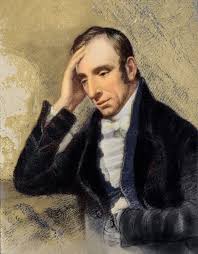
For me, I started in the business convinced that I was composing song lyrics because poetry as such was not a familiar thing – except in occasional English classes at school and I dropped that subject at the age of 16. As I’ve said elsewhere, science was what I did through most of my teens. With too much time on my hands and too little joy to be found elsewhere, in the mid 1970s I began to turn to other sorts of books. From Foyle’s in London, I stole a copy of Everyman’s Selected Poems of Wordsworth. They seemed a bit dull and plodding but reminded me of rural Wiltshire where I grew up. For a few months I copied Wordsworth. Perhaps a year later, after a good dose of Sartre, I was finding my way back to the academic study of literature. It was the poetry (and drama) of T S Eliot that I fell in love with (not Dylan Thomas – the other poet on the curriculum). I still have those early Eliotesque poems somewhere, mostly Prufrock period style, though also a horrifyingly pretentious sequence of poems like a clumsy, anaphora-laden Waste Land.
00014096-390x540

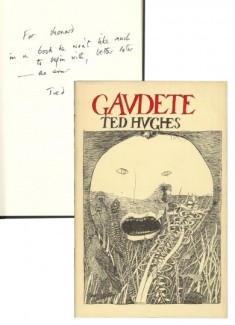
Re-starting my Higher Education took me to Lancaster University, studying Literature and Philosophy (and a few sessions of Creative Writing with poet, David Craig) and Hughes and Larkin were served up and readily ingested. At first, I swerved to the latter’s urban details and personal gloom; later it was the Hughes of Gaudete (recently published, 1977) that I copied, writing a long, quasi-mythic, magic-real, psychodrama about sex and power that I eventually self-published in Oxford. As a post-graduate among the dreaming spires, it was Percy Byshe Shelley who I was working on for several years and, though not a model for poems as such, his ideas about the role of the Imagination and poetry as an “Orphic language” have been important to me ever since.
md7773056273

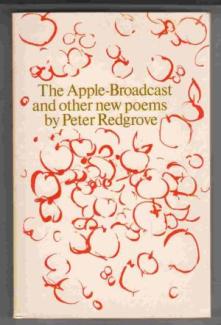
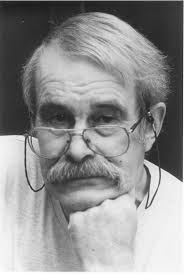
Among contemporary poets, I’d discovered Heaney (not the rural Ireland stuff so much as his wrestling with private and public responsibilities – Station Island, for example), Peter Redgrove’s fluid take on mind’s encounter with the natural world (The Apple Broadcast) and Ken Smith’s urban-political Americana (oh how I wanted to have written Fox Running). I wrote individual poems modelled on all these writers while absorbing much more deeply the work of the Romantic period – only now did I really find Keats, his poems and letters, Wordsworth still, Coleridge’s Conversation poems especially. What might have been expected – Hardy, Auden, Yeats, Frost, Stevens, Lowell, Bishop, Plath, Dickinson – were all missing or they missed me.
 

download
Ken Smith


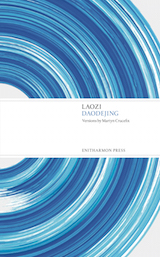
A decade of writing, reading, plus some reviewing too. A couple of my own books published and I’d stumbled my way to Rilke’s New Poems, Elegies and Sonnets, the second and third of which I began to translate and (whether visible on the surface or not) were a great influence on me – the Duino Elegies  for their thoughtful drive from existential mourning to praise, the Sonnets to Orpheus for that same thought (more of the praise) and their use of form. From Whitman I found my way to W S Merwin’s marvellous fluidity (something I was comparing to Paul Eluard’s work too) and from Rilke it seemed a logical (not the right word at all) step towards the 81 texts of the Daodejing which again I felt I had to try to English because it both rhymed with what I already knew and I knew it would develop further what I needed to know.
daodejing

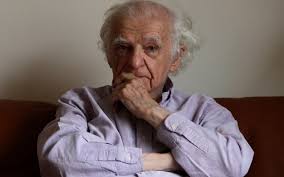
A few years back, an article in PN Review sent me to the work of Yves Bonnefoy. A heart-rate raising sense of another writer who had fought the two-faced dragon of language and seen enough to conclude that at the bottom of its filthy lair gleamed the concept and the concept promises a “strange immortality” but only if we can “forget brutal reality”. One reason (I’m now quoting an earlier blog post on a 1953 essay by Bonnefoy) we do this is that there are “general truths in conceptual thinking and a particular kind of power derived from it. It ‘allows thinking’ of a certain kind; it is linked with ‘the vast power of words’. But any gain is predicated on a significant loss, the abandonment of the actually existing ‘world of things’. Conceptual thinking is ‘systematized’, generalizing, categorizing; it’s in this that its ‘flight’ from the real is found. The only sort of thing that can be held up to counter the concept are specific particularities of human experience: Bonnefoy asks ‘Is there a concept for footsteps in the night, for a cry, for a stone rolling in the brushwood? For the feeling evoked by an empty house? No [. . . ]’”
 

images
Yves Bonnefoy


Reading Bonnefoy did not send me lurching to right or left but rather nudged, re-calibrated, re-assured me that my own direction of travel was not a wholly isolated one. I don’t write like Bonnefoy – there can be a dull abstraction to his poems which seems to me to contradict his ideas about real presence expressed as specific particularities – but I know what thought underlies my own work has close parallels to his (as far as I understand him). That’s influence, I’d say.

In my next blog, I’ll look at the question of influence from a different angle – what ghosts of other writers can be seen in more recent work?
My Grief Observed – May 2017

This week, I sat down to write a thinking piece about C S Lewis’ brief memoir about his wife’s death, A Grief Observed (published under the pseudonym N W Clerk by Faber in 1961), when this happened instead.

Agriefobservedcover

My father died – I’m shocked at the passage of time – just over 8 weeks ago. At the age of 97, it was hardly unexpected though to be honest I had anticipated my mother (age 95 this month and seemingly physically far more frail) to be the first to leave the world. Though hardly unexpected it was still a surprise. It happened late at night – I’d travelled back to London thinking he was stable enough. By the time I’d returned the next day to the Care Home in Wiltshire, the undertaker had already taken him away. There were so many distractions, things to sort out, though we’d already sold the family home and his affairs were as simple as can be for a man with two savings accounts, a couple of State benefits and an utterly derisory works pension.

I did decide to visit him in the undertakers’ so-called chapel of rest. I’m not sure this was about saying goodbye – though circumstances had meant I hadn’t done this in any conscious way. The assistant took me into a little hallway where a door stood open, some classical music playing. A wooden chair and a table with a vase of flowers were all to be seen in the hallway. I have no recall of the music or the type of flowers. I was taken aback when she explained that some people prefer simply to sit outside the ‘chapel’ rather than go in to view the body. I felt reassured somehow that such a reluctance was not something I was feeling and it would be a sort of cowardice if I did. I felt brave, or just a bit braver. I was doing this for Dad. Though her observation then made me re-consider. Maybe I was really anxious, even fearful, about seeing him. I sat in the chair outside for a few minutes to see how it felt.

img054
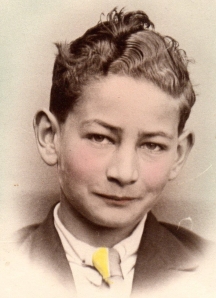
Hilperton, 1954

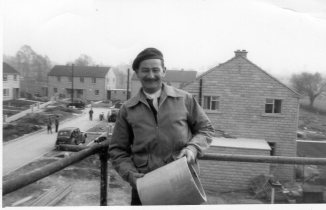
It felt pointless. I was here to see him and to have done with it. I edged round the open door. The coffin was deliberately around the corner, out of sight until you got well into the room. It filled an alcove, supported at waist height, I supposed, on some sort of trestle. I’m enough my Dad’s son to think of such things. Later on, after I’d sat a while in the chapel I started looking – as he would have done – at the structure of it. It was just a plain room, almost certainly separated off from an original larger room. There was an RSJ across the width of it. Perhaps there was another such ‘chapel’ next door. Semi-detached. Like the house Dad had lived in. In fact, the one he’d help build in the mid-1950s. I was taken there at the age of one. I left there to go to university at the age of 18. We’d sold it for more than we’d expected about a month earlier. Semi-detached.

img069
? 1929

They’d put a crucifix on the wall above the coffin. Or rather, the cross was a fixture on the wall. Other coffins in series had lain beneath it. Dad always had a dislike of religion. I never could get to the bottom of why. Born in 1920 you’d have thought it would have been just part of the landscape he grew up in. Was it rammed down his throat to the point of the need to vomit it back up again? Was there something in his war years that made him see through it so vigorously that – even into his 90s – he never found a way back? His wife was quietly non-conformist, mostly Methodist. I’m sure she would have attended church in these more recent years (her younger sister regularly did). I’m sure she stayed away because of his hatred of it. Now here he lay under a crucifix in an inappropriately ‘holy’ setting with such tasteful lighting. Hurrumph, he might have said. Words were not his thing. I never showed him this little poem:
 

Words and things


Past ninety and still no books to read

your knuckles rap the laid table


gestures beside a stumble of words

so much aware of their inadequacy


it hurts us both in different ways

since a man without language is no man


finding too late this absence of words

builds a prison you’re no longer able


to dominate objects as once you did

the world turns in your loosening grip


I still feel a bit guilty about having written it. Agenda published it originally. It’s just appeared in my new book. But no – he never saw it. I made sure of that.

img073
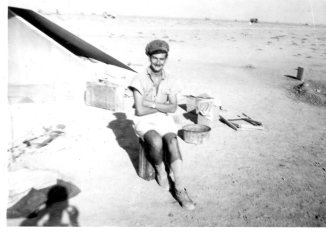
North Africa

I looked at him in his box. My brother and I had decided not to dress him in his own clothes. His only suit was so old and shabby and he had little else that we thought was suitable (why did we agonise over it – I was the only person who knew him to see him in this state anyway). Oh for his old suit! He was dressed in a sky blue silk number, a ludicrous ruff about the neck: a sort of choir boy outfit. My main impression was of the newness of the cloth of the robe, its strong vibrant colour against the chilly greyness of what must lie underneath if his hands were anything to go by.

Then at last, I looked directly into his face. I’d been reading Lampedusa’s The Leopard and at the end of the novel, the dying Prince, Don Fabrizio, looks at himself in the mirror and wonders why “God did not want anyone to die with their own face on?” The last time I’d seen Dad was after he’d been brought out of hospital, back to the Care Home where he lay sleeping for hours on a mattress on the floor (to stop him rolling off and injuring himself). He puffed and blew a good deal, eyes shut. He rummaged his legs to and fro, tying the bed sheet in knots. But he never woke. In those hours, it seemed to be him. I sat beside him with my mother. I held his cold hand and repeatedly told him we were there, we were there for him, he was OK, he was not in hospital (god how he hated hospitals!).

But the face looking up out of the coffin seemed to be somebody else. Hard to tell what was plain natural death, what was the undertaker’s art, what the lighting, what my weird state of mind. All the clichés about the waxy, smooth look of the dead are true. His Crucefix nose – always fairly prominent – launched from his sunken cheeks and bony brow skywards. His chin – which in life was always weak and receding – also thrust forward and up in the most unnatural way. What had they done? What had they packed his jaw with to achieve this cartoon effect? His mouth with its pencil thin lips (plenty of times I thought them mean lips) was shut very tightly. I wondered if it was sewn shut? I wondered if they had left his dentures in? His eyelids – which in those last few hours of puffing and blowing, had often been leaking open, a segment of watery eye visible though no inner sight seemed ever to have registered – his eyelids now were also tightly bound. Closed down. Closed down long before the undertaker’s craft took hold. Now physically closed down to reflect the inner closing down that had taken place in my absence.

img049
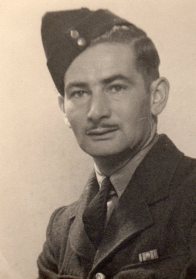
?1939

As I stood beside the coffin and looked down, I had the powerful sense that he was not there. Not merely that this did not resemble the man I knew but more than that – he, in himself, was not there. He had departed the physical form that lay there more or less recognisable. I don’t think he was elsewhere. I’ve been with him on that bit of religion for decades now. But I still felt some relief. On his behalf perhaps. Recently he had been more muddled and fearful, obsessive about some things, angry about others. Life seemed to have very few pleasures left; lots of panicky moments, angry self-hatred, suspicions of people, distrust, downright fright. He was no longer living in that horrid morass. That must be some relief.

He was not there. But the hands, propped also choir boy style on his chest, clutching incongruously a white rose, were definitely still his. Emerging out of the stupid silky blue sleeves, the long bony hands were still familiar. How they used to float vaguely, not elegantly, but sometimes delicately, trying to add whatever was always lacking from his words, wafting to and fro following the right and left turns to the municipal dump, to the only local shop not closed down, to the bus stop (their life-line into town).

I never once touched him. I thought of the coldness. The lack of give, of elasticity. I didn’t think he’d mind. We seldom touched in life. But I did talk to him. I said I was there. I said goodbye. Those two things over and over again. My eyes and throat filled as I tried to say them aloud.

In the end there was no more to do. He was not there. I was in a room with a box and some kitschy lighting. I sidled back out round the door. I looked back in, feeling, of all things coquettish, as if I might surprise him about to move, to sit up and grin, it was all a joke. No. He was not there. He was not coming back. Not this way.

I went out through the hallway, past the flowers again, the music receding, out into the front room of the undertaker’s shop. The assistant was not around. I gathered my bags and left. The daylight was white. Two men were slumped nearby drinking from tin cans. They looked up at me. I suppose they had seen the door I’d come out of. Perhaps I had death all over me. The High Street seemed tissue-thin, like a poor stage-set. Everybody else actors. I walked down it, then back up, unsure where to go. In the end, I sat in a pub for an hour over two pints of bitter. My train was not till around 6pm. I passed the time googling an old girl-friend’s name.

IMG_0972 (2)
April 2017


2017 Forward First Collections Reviewed #3 – Nick Makoha

This is the third in the series of reviews I will post over the next two months of the 5 collections chosen for the 2017 Forward Prizes Felix Dennis award for best First Collection. The £5000 prize will be decided on 21st September 2017. Click on these links to access all 5 of my reviews of the 2016 shortlisted books (eventual winner Tiphanie Yanique)  and all 5 of my reviews of the 2015 shortlisted books (eventual winner Mona Arshi).

The 2017 shortlist is:

Maria Apichella – Psalmody (Eyewear Publishing) – reviewed here

Richard Georges – Make Us All Islands (Shearsman Books) – reviewed here

Eric Langley – Raking Light (Carcanet)

Nick Makoha – Kingdom of Gravity (Peepal Tree Press)

Ocean Vuong – Night Sky with Exit Wounds (Cape Poetry)

download

Many thanks to Peepal Tree Press for providing a copy of Nick Makoha’s book for review purposes.

Poetry is an art of the relative, but the ability to write about contemporary events beyond one’s personal sphere always strikes me as an absolute and rare talent. Yet it always turns out the poet’s individual circumstances contribute to such escapes from the personal and this is so with Nick Makoha who has talked of writing in exile from Uganda. He fled civil war and the rule of Idi Amin as a five-year old boy in 1979. Many of the poems in Kingdom of Gravity are shocking (and so powerful in particular ways as art) and their obsessive subject is power without justice in post-colonial Africa.

There are moments when early Auden seems a useful comparison. Each poem creates its own world of suspicion and unease, often of violence. Each poem is spoken by a human subject – I thought of Glyn Maxwell’s phrase “the presence of a human creature” (On Poetry, Oberon Books, 2012). This is maintained even though the materials of the poems are journalistic, clogged with stuff, hawked up, hacked off incidents that most of us are only familiar with from news, TV and film. The forms are often shaped but roughly so; Makoha’s voices often make use of anaphora/repetition and tend to the epigrammatic. Such patterning is mostly ironic because if there is one thing this collection expresses it is a sense of exile and disconnect, a loss of all moral compass. The construction of the book seems to encourage this sense of disconnect. Three poems evoking Uganda’s 1979 turning point (after Amin’s 8 year rule) are scattered across 2 of the 5 sections of the book. Each of the 5 sections are introduced by poems linked with airports and travel, distance, arrivals, departures – exile again – and these set the tone.

idiamin

The figure of Amin – and those in the ensuing years who have resembled him – recurs. The book is full of father figures, often distorted, corrupt, vicious, God-like, their hands covered in blood. A crocodile is considered in one poem, the creature imagined as Idi Amin’s teacher:


Wrath the only nature of God you taught him.

What of mercy, peace and Uganda?


Our bodies still rest in your jaws.


The book’s opening lyric, ‘Highlife’, praises the power that comes with “Presidency” and these include the power to throttle another man, to spare a life, to change perception by force, to be acknowledged as “God”. Such big men always promise much to gain adherents but in promoting themselves they soon threaten far more than they deliver:


This man is a firm knot in our chest. A landlord draped

in Savile Row suits, who uses our towns as a race track.


Mark the length of his shadow; where it reaches,

men fall.

(‘Big Nation’)

2016_01_22_75683

The book’s title poem is like this. Re-writing Shelley’s ‘Ozymandias’ and Auden’s 1939 ‘Epitaph on a Tyrant’ from the inside, Makoha speaks as a man wanting to create a world wholly in his own image: “What makes a man name a city after himself, / asking bricks to be bones”. His conviction is that he has been spoken to by “an oracle”; he claims to be searching for “a place to call home” but ominously is equally “in search of fire”. The kingdom of gravity is the condition of “having the world at your feet” and Makoha’s analysis of tyranny looks deceptively open-ended, asking if once the world is believed to be fully known, a reflection of the power-hungry self, then “how will you be sure that nothing is lost?” Such absolute control is an impossibility, of course, and for the tyrant the only solution is a call to arms: “Smear your bodies in red oil. Tonight we split the darkness. / We will be remembered as the wild cats // who smeared their bodies in blood” (‘From the King’).

As this makes clear, tyrants need followers. They are well represented in the book – both as victims and as the breeding ground for the next wave of tyranny. ‘Watchmen’ seems voiced by a man in whose calculations his wife, children, contraband, money, beer and a prostitute all seem interchangeable counters in his mind’s equations. Hard to follow what happens next – the border between fact and fantasy is uncertain – but a powerful male figure rips a sheep to pieces, offers it to other men if they become his “true bloods”. There are plenty of takers:


Some say he had promised land, others positions,

and yet others gold. The truth is we all wanted

to be kings with wives and cars.

There is a drone in our voices.


The night’s coolness has not yet gone.

The apparition snatches a Kalashnikov from a shepherd’s fist

and slips into the river. What’s weird is we all break rank

and like a swarm follow singing his incantations

and like a swarm follow singing his incantations.

AKM

The willing yielding up of individuality implied in the choice of the word “drone” is driven home in the final lines which repeat Frost’s repeating trick in ‘Stopping by Woods on a Snowy Evening’ but turn his swooning/determined ambiguity into an unambiguous, threatening, weaponised, overwhelming “swarm” of humanity.

The speaker’s sense that something “weird” is happening, the potentially redemptive sense of the growth of evil is reflected in a few other poems such as ‘The Liberation’ where someone who “used to be a boy” now moves “like smoke across the red dirt towards the second terminal”. In this case, such drastic shifts in human behaviour are considered “a costume” to be worn when the earth “erupts” but the potential reversal of the process implied by this metaphor elsewhere looks like liberal wishful thinking. ‘Candidate A’ seems voiced by a tyrant selection committee, enumerating an individual’s qualities, making him suitable for elevation to “His Excellency, Field Marshall, / Effendi etcetera”. Love of his own reflection, unprovoked violence, rejection of the rules, an appetite for acclaim and acquisitiveness replaced by “immediate gratification” mark out this fanatic among the ranks for a bright future though ultimately he’s to be used by whomever is speaking: “in his effort to be remembered, we will make our mark”.

download

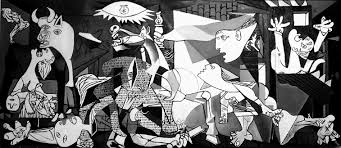
I was reading this book partly while visiting Guernica in the Basque region of Spain. In the commemorative museum, I was struck by a quotation from Gandhi: there is no way to peace; peace is the way. As in Picasso’s painting of the bombing of the town in 1937, Makoha’s poems give us more of the horror of when things break down, but also remind us that peace is more than just the absence of war. Poems like ‘Resurrection Man’, ‘The Dark’ and ‘How to Make Blood’ ask great determination of the reader and also ask us where we stand as we read them. The poet’s stance is driven by a form of survivor guilt. His escape to the UK meant an equivocal freedom:


My own country rebukes me. I hold the world on my back.


Look for me in translation. In my own language you will go unanswered.

My Ugandan passports are a quiet place of ruin.


One of the airport poems, set at Charles De Gaulle, Paris, perhaps speaks in something like Makoha’s own voice. It is about the impossibility of telling a story fully. He has no problems with endings – the difficulty is that “I have lost where I began”. The condition of the exile is always liminal, not living fully in either of two places. In Makoha’s case this gives him the space to contribute to English poetry a dark, knotty, often difficult kind of music, plainly relevant in its response to some of the horrors of the contemporary world. The book’s cover has been well-chosen by Peepal Tree Press: a grey scale image of a child standing beside an utterly devastated tree trunk. Hands by her side, she seems to be waiting for something to happen. Something else to happen.

download
Charles De Gaulle, Paris

On the Importance of Considering Nothing #2

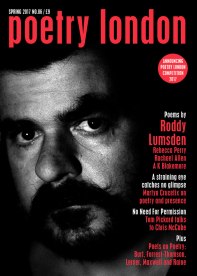
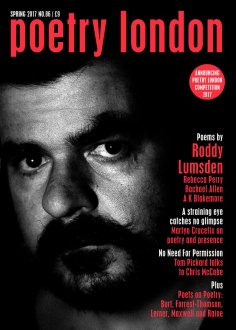
Last week I blogged the first part of a longer essay first published in the Spring 2017 issue of Poetry London. What follows is the second half of it. The whole piece starts and ends with thoughts prompted by my experiences with my father and his growing dementia. Dad has since suffered a series of heart attacks and died on May 24th. I am re-producing the essay unchanged in the hope that it still says something of value about types of ‘confusion’ and in memory of a man who would have had little time for such morbid reflections. Thanks to Tim Dooley who commissioned the essay for Poetry London and published it under the original title: A Straining Eye Catches no Glimpse.

PL-COVER-Spr17-web

In Part 1, I linked my father’s forgetfulness and confusion with recurrent references to “nothing” in King Lear and to Anne Carson’s concept of “the dementia of the real”. I suggested this was also a correlative of Yves Bonnefoy’s interest in the “state of indifferentiation” he often refers to as “Presence”. For Bonnefoy, Presence contrasts the conceptual/linguistic world through which we most often move and we take to be real.

Part 2

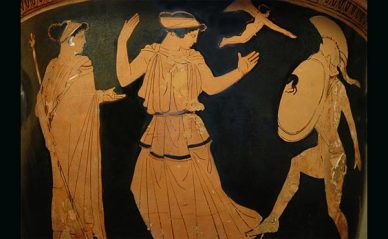
Yves Bonnefoy’s poem ‘Wind and Smoke’ (from The Wandering Life (1993)) has the abduction of Helen as its nominal subject. But he allows the poem to be taken over by dissenting voices, irritably seeking to “explain, to justify, ten years of war”. Such an expense of men, ships and spirit (argues one such “commentator”) must have been for the sake of something more permanent than the merely human figure of Helen. The poem entertains the suggestion that she herself was never abducted, “only an image: a statue”, something of great beauty to be displayed on the terraces of Troy, a fixed image of Helen, blessed with permanence, “always [. . .] this smile”. The poem is concerned then with the limitedness of the conceptual view which finds worth only in things of assured, definable permanence. In contrast, Part One of the poem ends with a proliferation of images of “spilling”, lovers as “clouds” or “lightning” on an “earthly bed”, so fully involved with time that their pleasures in the moment are “already empty, still full”. [i]


search-helen-troy
Helen of Troy (Red Figure Vase)


There’s that paradox again and Bonnefoy’s versions of it articulate the impossibility of capturing Presence because it encompasses and exists in time (and language wishes to stop time):


Every time that a poem,

A statue, even a painted image,

Prefers itself as form, breaks away

From the cloud’s sudden jolts of sparkling light,

Helen vanishes [. . . ][ii]


The “jolts” here are akin to Lily Briscoe’s “jar on the nerves” as our paradigms and preconceptions are challenged. The figure of Helen has become that visionary experience – for Bonnefoy usually of beauty, for Carson more often a violent disturbance – that we intuit exists just beyond the range of our usual instruments. Helen, the poem argues, “was only / That intuition which led Homer to bend / Over sounds that come from lower than his strings / In the clumsy lyre of earthly words”.

Part Two of ‘Wind and Smoke’ concludes with a child, an image of the poet, the last person to see the figure of Helen as Troy burns:


singing,

He had taken in his hands a little water,

The fire came to drink there, but the water

Leaked out from the imperfect cup, just as time

Ruins dreams and yet redeems them.[iii]


download
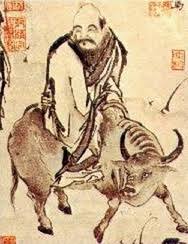
Traditional image of Laozi


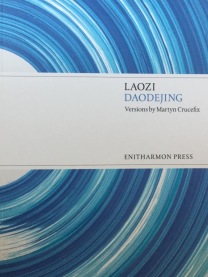
This same image of water slipping from our human grasp is recurrent in the Ancient Chinese writings that make up Laozi’s 4th/5th century BCE text, the Daodejing. Since they were published earlier this year, I have been reading my versions of these texts up and down the country and the one thing audiences want to say about them is they contain “wisdom”.[iv] It’s an old-fashioned word but it’s also bound up with the nothing that is really a fuller something we seldom manage to grasp. The Daodejing texts use water as an image of the ineffable One, the plenitude that lies behind all things. They employ water metaphors in such a way that the vehicles are clear and recurrent (ocean, pool, river, stream) but the tenor remains an empty set, never defined. So Chapter 1 deploys water imagery but is clear about the short-comings of all language: “the path I can put a name to / cannot take me the whole way”. Even what can be named can only be grasped through further metaphors: the “nursery where ten thousand things / are raised each in their own way”. What lies behind the phenomenal world can only be gestured towards through figures such as “mould”, “source”, “mystery”. Even then it’s “a riddle set adrift on a mystery”. The original Chinese text shifts its metaphors rapidly in just this way and this is what gives this opening Chapter the peculiar sensation of telling a clear truth that remains beyond our grasp. Chapter 14 puts it this way:


because a straining eye catches no glimpse

it is called elusive


as the ear attends but latches onto nothing

it is called rarefied


since a hand reaches but clasps only thin air

it is called infinitesimal


and these are resistant to further analysis

File 03-03-2016, 09 03 15

The difficulty of grasping this something that seems nothing is revisited in Chapter 4. There, the tenor of the metaphor is reduced to “it”, the context indicating this refers to the Dao itself, the One, that state of wholeness and plenitude towards which the path of the Dao leads. The opening formulation emphasises the Dao’s infinite nature, its resource as “a vessel to be drawn from / one that never needs to be re-filled // the bottomless source of all things”. But the image is revised a few lines later in the form of a question: “is it rather a pool that never runs dry”, yet this follows four other metaphorical formulations of the Dao’s beneficial effects: “fretted edges are smoothed within it / knots untangled all dazzle eased / all blinding clouds of dust slowly cleared”. The poem calmly declares its own ineffectiveness: “we cannot know it as a bodiless image / it must pre-date every beginning”. Even the concept of origin or beginning is not adequate to convey the nature of the Dao. But the fluidity of water – impossible to grasp, capable of taking any shape, a life-giving source – comes close.

That there is wisdom to be gained from such visionary encounters with the mystery of nothing is clear in Chapter 66. It’s no coincidence that these lines can serve as a commentary on Lear, his suffering bringing him low till he realises he has paid too little attention to the “looped and ragged” nature of his own nation:


—how do rivers and seas secure mastery

over the hundreds of lesser streams

through lying lower than they do


so to govern or teach you must stand

and acknowledge you are beneath the people

to guide them put yourself at the rear


md1187823288

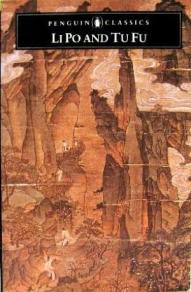
But as Auden suggested and Chinese tradition affirms, such visionary insight cannot be actively sought or taught. This is one of the points of the traditional narrative trope in Chinese poetry of ‘Visiting a Hermit and Not Finding Him’. Don Paterson turned this into a good joke in a poem called ‘On Going to Meet a Zen Master in the Kyushu Mountains and Not Finding Him’.[v] The reader’s eye descends from this lengthy title only to look in vain – it’s a blank page. Perhaps Paterson had been reading the Penguin Classics selection of Li Po and Tu Fu.[vi]  The Li Po selection opens with the poem ‘On Visiting a Taoist Master in the Tai-T’ien Mountains and Not Finding Him’. But such poems were never just an excuse for descriptive nature poetry but related to the frequent ‘spirit-journeys’ that Li Po was fond of writing. We are all like that student in Li Po’s poem, seeking out certainties and facts, a something to depend on when true wisdom gently (or violently) deflects us away from shelter towards a world where we glimpse a more full-blooded, full-bodied, open-minded encounter with what really is.


download
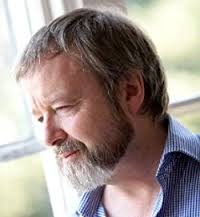
Iain McGilchrist


I have really been talking about two attitudes to knowledge or to put it more carefully, two contrasting “ways of being”.  This is how Iain McGilchrist’s book, The Master and his Emissary (Yale, 2009) expresses it.[vii] McGilchrist argues parts of the human brain deliver quite different kinds of attention to the world. The left brain perceives the world as “static, separable, bounded, but essentially fragmented [. . .] grouped into classes”.[viii] This is the attitude to knowledge and education the anxious student of Li Po’s poem possesses as well as the place where most of us live amongst Carson’s clichés and Bonnefoy’s conceptual language. In contrast, McGilchrist associates the right brain with the perception of “the live, complex, embodied, world of individual, always unique beings, forever in flux, a net of interdependencies, forming and reforming wholes, a world with which we are deeply connected”[ix] yet one at risk of being perceived or judged as a mere confusion, a seeming nothing.

This is the view of the Daoist master whose teaching evokes the as-yet-uncarved block of wood, who teaches best without words. Ordinary language usage, dependent as it is on conceptual thought, is left-brain work – ordering, categorising, re-presenting the minute particulars of the world as they are perceived by the right brain. Li Po’s teacher is surely hiding somewhere beyond the cherry blossom – and this is part of the student’s lesson. Don Paterson’s blank page represents a rather glib, post-modern joke, a scepticism about language in danger of throwing out the interconnected but bewildering “dementia” of the real world along with the suspect tokens and counters of left-brain language: “To say that language holds truth concealed is not to say that language simply serves to conceal truth [. . .] or much worse, that there is no such thing as truth”[x]. Bonnefoy, engaging in his own battles with the early stirrings of French post-modernism, declared: “This world here exists, of that I am certain [. . .] It is simply with us.”[xi] The right brain knows this and it’s from there we want to write poems; the left brain serves to fragment it, utilise it, get it under control, disappear it. And yet . . . there’s no much here suitable for a chat with a forgetful father. His visions are more frightening and may get worse; here, for a while, his son has been imagining ways of seeing that need not be so.

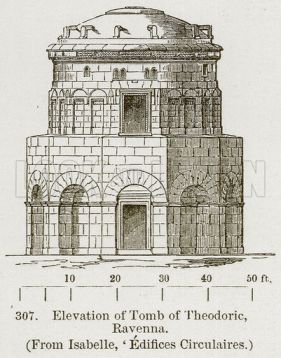
Elevation of Tomb of Theodoric, Ravenna

Notes

[i] tr. Naughton, Naughton and Rudolf, pp. 197-203.

[ii] tr. Naughton, Naughton and Rudolf, p. 201.

[iii] tr. Naughton, Naughton and Rudolf, p. 203.

[iv] Laozi, Daodejing, versions by Martyn Crucefix (Enitharmon, 2016). All quotations are from this version.

[v] Don Paterson, God’s Gift to Women (Faber, 1997).

[vi] Li Po and Tu Fu, selected and translated by Arthur Cooper (Penguin Classics, 1973).

[vii] Iain McGilchrist, The Master and His Emissary (Yale UP, 2009), p. 25.

[viii] McGilchrist, p. 31.

[ix] McGilchrist, p. 31.

[x] McGilchrist, p. 6.

[xi] Yves Bonnefoy, The Tombs of Ravenna, tr. John Naughton (1953; PN Review (No. 226, Nov-Dec 2015), p. 62).

On the Importance of Considering Nothing #1

I have not blogged regularly since April 2017  as, having managed to get both my parents settled into a Care Home in Wiltshire, Dad suffered a series of heart attacks and died – fairly quickly and peacefully – on May 24th. Not wholly coincidentally, the Spring 2017 issue of Poetry London published an essay I had written which starts and ends with some thoughts on my experiences with my father and his growing dementia. In the next two blogs, I re-produce this essay unchanged in the hope that it still says something of value about types of ‘confusion’ and in memory of a man who would have had little time for such (in his view morbid and abstruse) reflections. Thanks to Tim Dooley who commissioned the essay for Poetry London and published it under the original title: A Straining Eye Catches no Glimpse.

 PL-COVER-Spr17-web

Part 1

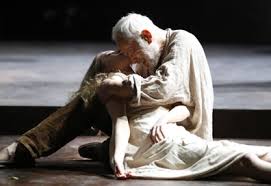
An old king leans over his daughter’s body seeking signs of life, yet he finds “Nothing, nothing, nothing, nothing, nothing”. Given that I teach literature and this is one of Shakespeare’s more famous lines with its repetition and trochaic revision of the iambic pentameter, I’m not proud of mis-remembering this moment in King Lear (the repeated word is, of course, ‘Never’). Yet I know why I mistake it, this year, in these fretful months. Seeing Anthony Sher play the role recently – haranguing a foot-stool, giving toasted cheese to a non-existent mouse – put me in mind of my father, though he’s not quite so far gone. These days he has trouble recognising the house he’s lived in for 60 years; he will refer to his wife as a woman from the village who has come to look after him; he seeks news of his mother (she died in the 1970s). What can this feel like? Years of memories gone; a whirling fantasmagoria that evidently frightens him; a something becoming nothing he makes too little sense of.

download

So it’s not just that the idea of nothing is prominent from the very start of Shakespeare’s play. Cordelia fails to reply flatteringly to Lear’s question about which of his daughters loves him most. The gist of her brutal answer is “Nothing, my lord”. Lear warns her: “Nothing will come of nothing. Speak again”. But she sticks to what she sees as her truth (as against her elder sisters’ oleaginous falsehoods) and pays the consequences. But so does the King. Reduced eventually to a wholly unexpected state of wretched nothingness in the storm scenes and beyond, he learns much from this nothing in pointed contradiction of his earlier warning. It doesn’t stop there; once reunited with Cordelia and faced with the prospect of prison, possible execution, what is remarkable is the King’s acceptance of his fate. Confronting this further reductio, he declares he’ll go and finds a reason to be cheerful: “we will take upon’s the mystery of things”. I’ve always been struck by Shakespeare’s phrasing here. The mystery of things is imaged not as some modernly pedagogic check-list, tabulated and absorbed like a set of principles, rather it’s something to be folded about us – a garment, an investiture, a way of seeing, feeling, not quite of self, not quite other either – and Shakespeare’s point is that Lear’s encounter with nothingness in various guises is what has prepared him for such a re-vision of his place in the world.

I’m interested in the idea that such a nothing can be worth something. Of course, it’s not exactly nothing, a void, that Cordelia’s father encounters. It is a bewildering set of experiences of which he can make nothing. Lear – I don’t know how far this is like my father – suffers because his previous paradigms are failing: he is shocked into his encounter with the mystery of things or what Anne Carson calls the “dementia of the real”. When my father talks, he yearns for the ordinary reassuring certainties of his old life, as if they would close round him with the feel of a comfortable coat. Carson has explored this reliance we all have on the familiar in her 2013 Poetry Society lecture concerned with ‘Stammering, Stops, Silence: on the Methods and Uses of Untranslation’.[i]  She explores moments when language ceases to perform what we consider its primary function and we are confronted with nothingness in the form of silence. In the fifth book of The Odyssey when Hermes gives Odysseus the herb “MVLU”, Homer intends the name of the plant to be untranslatable since this sort of arcane knowledge belongs only to the gods. In a second example, under interrogation at her trial, Joan of Arc refuses to employ any of the conventional tropes, images or narratives to explain the source of her inspiration. Carson wants to praise Joan’s genius as a “rage against cliché”, the latter defined as our resort to something pre-resolved, pre-shaped, because, in the face of something so unfamiliar that it may seem more like nothing, “it’s easier than trying to make up something new”.


images
Anne Carson


Carson associates this rage to ‘out’ the real with Lily Briscoe’s problems as an artist in Woolf’s To the Lighthouse. She struggles to complete her painting, aware that the issue is to “get hold of something that evaded her”.[ii] She dimly senses “Phrases came. Visions came. Beautiful pictures. Beautiful phrases. But what she wished to get hold of was that very jar on the nerves, the thing itself before it had been made anything”. Unlike Homer and Joan of Arc, the knowledge Lily seeks (undistracted by the divine) is not so much prohibited as, in a profound sense, beyond conception (it is a nothing before it has been made something). For Carson, we each dwell behind the “screens” of cliché for most of our lives, so when the artist pulls them aside the impact of the revelation may well have the force of violence. She suggests artistic freedom and practice lie in such a “gesture of rage”, the smashing of the pre-conceived to find the truth beyond it, her goal remaining the articulation of the nothing she insists is actually the “wide-open pointless meaningless directionless dementia of the real”.

This is the nothing I am interested in: it is no void or vacancy but, paradoxically, a wealth of experience, a “flux of phenomena” about which we cannot think in conventional ways. We cannot name the parts of it, so for convenience, maybe a bit defensively, we prefer to designate it nothing. The artist seeks to articulate such an “experience of what goes beyond words: call it the fleeting perception [. . . ] a state of indifferentiation”. [iii] This is one of the many formulations of the issue by the late Yves Bonnefoy who unrelentingly explored the limits of conceptual thinking in terms similar to Carson’s distrust of cliché: “It is not that I incriminate the concept – which is merely a tool we use to give form to a place where we can dwell. I am merely pointing out a bad tendency [ . . . ] of its discourse to close discussion down, to reduce to the schematic and to produce an ideology existing in negation of our full relation to what is and to whom we are”. He concludes it is a “temptation to stifle dissenting voices” – the kind of voices who see something in nothing. [iv]

images

The always evangelical Bonnefoy terms the mystery encountered in a “state of indifferentiation” as “Presence”. In 1991, Bonnefoy’s temporary residence in the snowy landscapes of Massachusetts gave him a new way of evoking these ideas. In The Beginning and the End of the Snow (1991) he reads a book only to find “Page after page, / Nothing but indecipherable signs, / [. . .] And beneath them the white of an abyss”[v]. Later, the abyss is more explicitly, if paradoxically, identified: “May the great snow be the whole, the nothingness”.[vi] These occasional moments when the screens of cliche and conceptual thought fall are moments of vision as sketched by Auden in his discussion of Shakespeare’s sonnets – they are given, not willed; are persuasively real, yet numinous; they demand a self-extinguishing attentiveness.[vii] The inadequate, provisional, always suspect nature of language to record such moments is clear in these lines from Bonnefoy’s poem ‘The Torches’:


. . . in spite of so much fever in speech,

And so much nostalgia in memory,

May our words no longer seek other words, but neighbour them,

Draw beside them, simply,

And if one has brushed another, if they unite,

This will still be only your light,

Our brevity scattering,

Our writing dissipating, its task finished.[viii]


Rather than the forced disjunctions and the quasi-dementia of Carson’s recommended methods, Bonnefoy is reluctant to abandon the lyric voice, though he still intends to acknowledge the provisional nature of language in relation to Presence. The “fever” and “nostalgia” we suffer is the retrogressive lure of conceptual simplification. Bonnefoy’s imagery suggests a more delicate, tentative relationship between words, a neighbouring, a brushing up against each other (like snowflakes), though even then, if they “unite” or manage to cast “light” on what is, this can only be brief, always subject to dissipation.

(to be continued)

download

Footnotes

[i] Poetry Review, Vol. 103, No. 4 (Winter 2013).

[ii] Virginia Woolf, To the Lighthouse (1927; Penguin Modern Classics, 1992), p. 209.

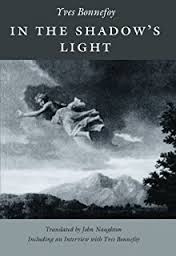
[iii] Yves Bonnefoy, In the Shadow’s Light, tr. Naughton (Chicago Press, 1991), interview with John Naughton, p. 162.

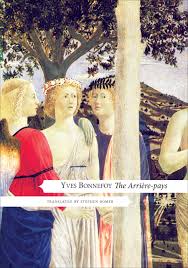
[iv] Yves Bonnefoy, ‘The Place of Grasses’ (2008), in The Arriere-pays, tr. Stephen Romer (Seagull Books, 2012), pp. 176/7.

[v] Yves Bonnefoy, ‘Hopkins Forest’, tr. Naughton in Yves Bonnefoy: New and Selected Poems, eds. Naughton and Rudolf (Carcanet, 1996), p. 181.

[vi] Yves Bonnefoy, ‘The Whole, the Nothingness’, tr. Naughton, Naughton and Rudolf, p. 187.

[vii] W. H. Auden, ‘Introduction to Shakespeare’s Sonnets’ (1964; reprinted in William Shakespeare: The Sonnets and Narrative Poems, ed. William Burto (Everyman, 1992)).

[viii] tr. Naughton, Naughton and Rudolf, p. 177.

Two poems by Martyn Crucefix

I’m afraid I have been unusually silent on the blog for the last few weeks. My last posting was in early April, a review of Jacob Polley’s book, Jackself. Life has been getting in the way of blogging and though I appreciate a lot of people like to read a lot of personal stuff on blogs that’s not really why I write. Suffice to say that I have been preoccupied with organising my parents move into a Care Home and the selling of their house, my house I should say; we moved into it when I was a year old and I left to go to university at 18. I imagine there will be poems emerging from the experience – but they tend to take a long time.

Added to this I was called up to do jury service at the Old Bailey during the last 3 weeks and this proved both fascinating and dull at the same time. The case was strange and disturbing (the defence consisting of the claim that what was done was done as research for a novel, so throwing up questions about the boundaries between fact and fiction). The dullness was, of course, the slowness with which the wheels of the law roll round (in the name of clarity, precision and fairness). The events and characters of the people involved were wholly consuming for the period we were sitting as a jury.

Emerging from that in the last couple of days, the news came that my father has gone back into hospital after a heart attack.

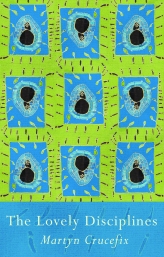
So – with no headspace for poetry really, I’m resorting to re-blogging a couple of poems which very recently appeared on Jo Corcoran’s great website And Other Poems. Both poems will also appear in my new book, The Lovely Disciplines, to be published by Seren Books this summer.

images

Both these poems have had a long gestation. ‘East-running road’ originated with observations about the angles of sunlight on sunflower fields in the north-west of France, slowly becoming concerned with the idea of writing and seeing, which then became associated in my mind with the dedicatee of the poem, the poet Katherine Gallagher. ‘Boy-racer’ is even older in origins. But I do still recall the central image as a real event: on some dusty European road down to a beach, a kid on a motorbike skidding out from a side track, wobbling to regain balance and powering off ahead. The wind ruffling his carefully un-helmeted head . . .

Read the two poems here: Two poems by Martyn Crucefix

7926ca533543e64e15591592aae83fd8

‘From Palette to Pen’ – a bit more ekphrasis

My blog post a couple of weeks ago on ekphrastic poems (ie. poems stimulated by visual art) proved to be one of the most popular I’ve ever written. This was in part the ‘how to’ aspect of the blog. In preparing to run a workshop at the Holburne Museum in Bath in February, 2017, I’d been reading a wide variety of poems derived in some fashion from the poet’s encounter with visual art and I tried to categorise the various approaches. I came up with 14: 

  1. Describe – and do no more.
  2. Describe but imagine beyond the frame
  3. Describe but incorporate researched materials
  4. Make Main Figure Speak – the most common approach
  5. Make Minor Figure/s Speak
  6. Make Objects Speak
  7. Make the Artist Speak
  8. Interrogation of the Artist
  9. Interrogation of illustrated Figure/s
  10. Interrogation of Yourself
  11. An Account of Your Encounter with the Art
  12. An Account of Gallery Visitors’ Experience
  13. An Account of Others’ Experience
  14. Come at a Tangent – the ekphrastic experience as after-thought or illustration

From-Palette-to-Pen-185x300

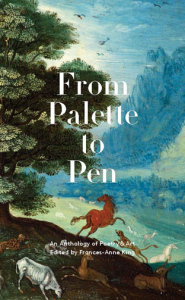
While at the Holburne Museum I was given their recent anthology of ekphrastic poems, From Palette to Pen, edited by Frances-Anne King in 2016. It contains 20 poems stimulated by art objects in the Holburne and as well as recommending it as a great resource for ekphrastic writing, I thought I’d use it to test my earlier analysis of the form to see if it held water.

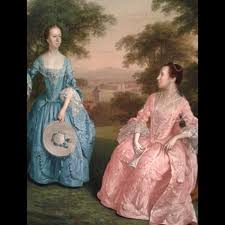
It did pretty well. It goes without saying that all the poems engaged to some degree in method 1 – description of the art object itself. But beyond that, by far the commonest approach was method 4 – making the main figure speak. This was adopted by Anna-May Laugher, Claire Dyer, Carrie Etter, Frances-Anne King, Pascale Petit, Linda Saunders and Lesley Saunders. Petit manages to make Adam speak, remembering his naming of the animals; Claire Dyer makes Rosamund Sargent speak from her own portrait by Allan Ramsay; Lesley Saunders makes one of the sisters, Alicia and Jane Clarke, speak and so betray their “little sisterly difficulties”.

imgres

Another common approach was my method 8, an interrogation of the artist (without getting the artist to actually speak for themselves (method 7)). Jenny Lewis’ poem on a 17th century Rosewater basin began in this way, inquiring “What’s on his mind as he hammers / the silver, makes light flower”. Her poem goes on to incorporate some obvious research into the object too (my method 3) which takes her poem away from a narrow view into the colonial world of “London, the world, New England” in which it was made. David Hale, writing about Jan Asselyn’s ‘Landscape with Drover’ also imagines and interogates the artist’s approach, gazing at his own picture in process:

Ah, the south. He feels the heat of it

on his face and hands, smells dust, dung

and crushed thyme as he sips his coffee,

wonders again what the bull is looking at –

where time and life have gone.

imgres

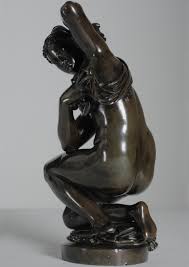
I’d be tempted to widen this category of approach – or even introduce a new one – because several poems in the anthology interrogate the artist specifically about the artistic methods used to create the art object. Sue Boyle does this in detail about the making of Antonio Susini’s bronze figure, ‘Crouching Venus’: “Coated in plaster, lowered into fire, / she must be negated, melted from her mould”. There are also elements of this approach in the poems by Dawn Gorman and Phillip Gross, the latter dwelling as much on the making of a Beadwork Basket as on its illustrations of Charles II and Catherine of Braganza. Gill Learner’s poem also looks over the artist’s shoulder as he glazes a 15th century earthenware dish.

My method 9 – interrogating or engaging with one of the figures in the art work – was used by Caroline Heaton, Wendy Klein and Tim Liardet. Klein and Liardet both directly address figures in the image (for example, “Someone chose the best for you, Mary Bourchier” and “You let the baby grip his fingers”). Heaton’s engagement with Plura’s marble statue of ‘Diana and Endymion’ is a bit less direct, using the third person (rather than a second person address) to think herself into Diana’s state of mind:

Confined to the island

of the self, she laments

the chill of her lunar circuit,

its lonely eminence.

imgres

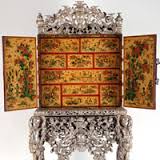
Rosie Jackson approached a piece of furniture, ‘The Witcombe Cabinet’, via a brief description of it but quickly developed thoughts about her own mother and indeed herself which I’d take to be my method 10 – using the art object to interrogate or enquire into one’s own life: “”My mother would have loved it here, / the roped off beauty […] But I ask questions of locked drawers”.

imgres

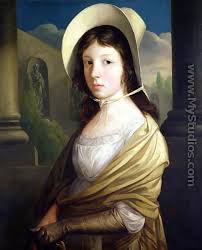
I think Claire Williamson mostly used method 3 – describe and make use of researched materials – in her poem on Thomas Barker’s painting of ‘Priscilla Jones’. The relationship between the sitter and the artist is the focus here, their romantic engagement and subsequent “passionless” marriage. In fact, I’ve not checked details of the painting/poem and I suppose it maybe that Williamson is making all this up – in which case she’s adopting method 2 – describe and imagine beyond the frame as George Szirtes does in anticipating the adult life of the boy in ‘Garton Orme at the Spinet’.

So the methods used in this anthology are fairly limited – seven of the fourteen I proposed. Those not adopted here are several varieties of ventriloquism (getting minor figures or objects to speak up; getting the artists to speak directly), the kinds of poem that more narratively describe encounters with art objects in a gallery or other location and a more tangential approach.

imgres

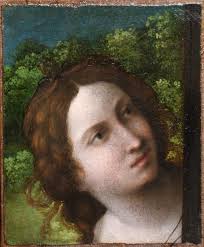
Finally, Lawrence Sail’s poem describes a Mantuan School ‘Female Head’ and is probably the ‘purest’ ekphrastic poem in the anthology in that it does little more than describe the image – method 1. However, Sail addresses the woman imaged as “Our lady of the liminal” and as such he breaches the borders (“offstage”) a fair bit, beginning to imagine beyond the frame to some degree (method 2). It’s a lovely poem and deserves quoting in full:

Female Head, about 1525

Our lady of the liminal –

witness at her back the margins of

the unruly forest,

and the focus of all her attention

being offstage.


But the heart of the story is locked

in the ghost of her gaze – its candour,

the early signs

of grief, a drift to the verge

where hope wavers.


And everywhere, time on the make –

in the darkening turquoise of the sky,

the slow swell

of the trees, the craquelure moving up

to infect her soft features.

Unquiet to Unbusy – Coleridge, Hartley Coleridge and ‘Frost at Midnight’

This week I was invited to another of Michael Glover’s wonderful Bowwowshop soirees at the Omnibus Arts Centre in Clapham. The focus was on the work of Coleridge. Tom Lowenstein read from From Culbone Wood – in Xanadu (Shearsman Books). There was also fiddle music and an aria from Mozart and parts of ‘The Ancient Mariner’ performed as a sea shanty (it really worked!). What follows is the text of my contribution (at some length, I’m afraid). By the way, Hartley Coleridge must be in the air at the moment as this blog post has just been put up by Alan Price.

I have been asked to read ‘Frost at Midnight’ – the 1798 poem in which the young father watches his sleeping child, thinks of his own past and foresees for the boy a bright future. The suggestion was also to focus on the more human side of Coleridge, less on the unique genius, the flood of ideas and knowledge, more on what we must all share with him: quiet moments of reflection, how we are made by our past, our hopes for the future, how blood is thicker than water.

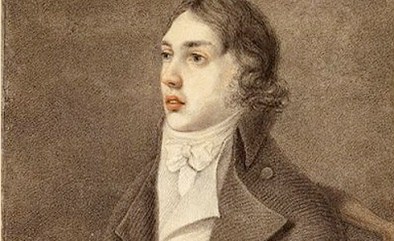
So – in 1824, the young Thomas Carlyle visited Coleridge in Highgate, where he was now staying with Dr Gillman. The poet was 52 years old. Carlyle describes  – “ a fat, flabby, incurvated personage, at once short, rotund, and relaxed, with a watery mouth, a snuffy nose, a pair of strange, brown, timid, yet earnest looking eyes, a high tapering brow, and a great bush of grey hair” He seemed a good soul (thought Carlyle), “full of religion, and affection and poetry and animal magnetism”.  Perhaps his observations had already been influenced by William Hazlitt’s earlier description, noting the poet’s nose, “the rudder of his face, the index of his will, [how it] was small, feeble, nothing – like what he had done”. Carlyle also concluded with that thought, “he wants will. He has no resolution”.

samuel-taylor-coleridge-448

Given what Coleridge had been through in his life, Carlyle’s portrait is really one of a survivor against the odds. A couple of years earlier, Coleridge was contemplating the four greatest sorrows of his life. He noted: his failed marriage with Sara Fricker, his wife of almost 30 years, the mother of his 3 children; the bitter quarrel with Wordsworth; the relationship, that perhaps never even got going, with Sara Hutchinson – Asra. Coleridge’s fourth sorrow was a much more recent wound, still raw, on-going when Carlyle met him in 1824. It bears on my main subject, Coleridge’s poem about his first born son, Hartley.

To explain, I’ll go back a few years  . . . In a life that Richard Holmes in his wonderful biography has described as full of “black storms and glittering sunlit spells”, the year 1819 was a great, sunlit moment. The 23 year old Hartley had just secured a Probationary Fellowship at Oriel College, Oxford. His father and mother were overjoyed, a feeling they shared – so an unusual moment. Coleridge could reasonably conclude that the boy he had always loved best had perhaps not been harmed or disabled by his peculiar brand of absentee fathering, the difficult marriage of his parents, his father’s often public financial, literary and opium-related humiliations.

But storm always follows sunlight for Coleridge. In June 1820, Hartley – the little child who, 22 years earlier, had slept so peacefully on a frosty night in Stowey in Somerset – Hartley was accused of drunkenness, of “sottishness, a love of low company, and general inattention to the College rules”. In a moment of ghastly, public humiliation, his Fellowship was not to be renewed. Hartley himself seems not to have dared to inform either parent; he vanished for days on end and try as Coleridge might the College would not relent.

Flock-of-Starlings

It was a disaster. Ann Gillman remembers Coleridge being “convulsed with agony” over it – surely in part because the accusation of intemperance and drunkenness reflected his own long-established, unshakeable addictive behaviours. The sins of the fathers, is what Coleridge must have been thinking.

And really, if we look back at Hartley’s life the disaster was not so unexpected. With the benefit of hindsight, we can trace events, poignantly, in reverse. During his third year at Oxford, in 1817, Hartley had come to visit Highgate and among the promising signs Coleridge fretted about his son’s unsystematic approach to life, there was some drunkenness, an evident loneliness.  On a return visit to Stowey, the clever college boy had tried to enamour himself with the local girls but they recoiled from his strangeness, melancholy, his dark shaggy beard. They called him the Black Dwarf.

At the age of 18, in 1815, he’d visited his father in Calne, Wiltshire, first ever summer vacation with his father. They celebrated the victory at Waterloo but Hartley was fascinated by the travelling players, by itinerants. He seemed solitary, a bit restless. People again remarked on his odd manners, his scrawny black beard. At 15, Hartley’s mother was optimistically thinking he might make a lawyer, with his “Gift of the Gab”. They were living in the Lake District and Hartley was a great local favourite, though Sara thought “a little spoilt” – in adult company he was not only permitted to speak, he was expected to speak.

At 13 he was brilliant – but quarrelsome. At the age of 10, planning a visit to his West Country relations, Coleridge wrote him a letter – a Polonius sort of letter – on how to behave. His son, he pointed out possessed a “self-gratifying fancy”, his spirits always at “high tide and flood”. The father recognised a tendency that swept away all “unpleasant and painful thoughts”. There were refusals to accept discipline; there was stealing food, snatching at things, standing in half-open doorways. Too often, the boy used his cleverness for lies, fantasies, false excuses. Coleridge urged on his son no procrastination, no self-delusion.

Even as a young child, Hartley had once asked his father what it would be like if there were Nothing! – just darkness and coldness. Apparently, he’d be thinking of it all day. The boy was 5. He often found playmates more a burden than a delight. A year earlier, celebrating moving from baby clothes into trousers, Coleridge already mourned the child’s old, joyous ways of playing. His activity now seemed governed by a more self-conscious “eager & solemn gladness”.

imgres

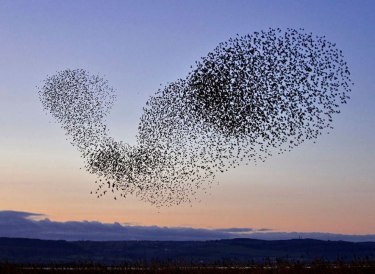
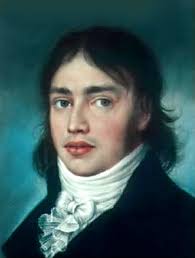
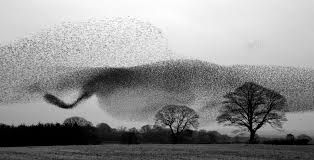
I imagine him watching the boy – the young father as he was described by Dorothy Wordsworth in 1797. She thought Coleridge then plain looking, pale and thin, a wide mouth, thick lips, not very good teeth. He had longish, loose-growing, half-curling rough black hair, his eyes large and full, not dark but grey, fine dark eyebrows, an overhanging forehead. And this is the man who, around this time, watched a massive starling flock in flight. He described it “like smoke, mist, or any thing misty without volition – now a circular area inclined in an Arc – now a Globe – now from complete Orb into an Ellipse and Oblong [. . . ] & still it expands & condenses, some moments glimmering & shivering, dim and shadowy, now thickening, deepening, blackening”.

imgres

This image haunted him for the rest of his life. It became more and more clear he had been fascinated by a self-image, a counter image of uncertainty, a lack of volition and determination, a swirling, aimless life quite unlike the one he had imagined for himself and his first born son in ‘Frost at Midnight’. In the poem Coleridge finds another self-image – the thin carbon film accumulated on a fire grate. Superstition told that this ‘stranger’ as it was called, foretold some new arrival. Coleridge remembers thinking of it as a sign of good things to come in his own unhappy school days at Christ’s Hospital in London.

In lieu of my reading of ‘Frost at Midnight’, here it is read by Richard Burton with accompanying text.

images

Such hopes were not to be. After the Oriel College disaster, Hartley was urged into school-mastering but he was never very good at classroom control. The boys must have found him odd, melancholy, solitary – apparently suicidal at times.

By 1829 – now fully 5 years after Carlyle had visited Coleridge in Highgate that time – Hartley had drifted out of teaching, was just wandering aimlessly through the Lake District, living with farmers, writing a few sonnets while the aging father fretted vainly in Gillman’s Highgate garden. In 1825, Coleridge made a self-portrait in sonnet form. In the poem ‘Work Without Hope’ he is the “sole unbusy thing”, uncreative, not having built anything to last, nor preparing to build. In the octave, amaranth is the mythical flower awarded to successful poets.

Work without Hope

All Nature seems at work. Slugs leave their lair—

The bees are stirring—birds are on the wing—

And Winter slumbering in the open air,

Wears on his smiling face a dream of Spring!

And I the while, the sole unbusy thing,

Nor honey make, nor pair, nor build, nor sing.

Yet well I ken the banks where amaranths blow,

Have traced the fount whence streams of nectar flow.

Bloom, O ye amaranths! bloom for whom ye may,

For me ye bloom not! Glide, rich streams, away!

With lips unbrightened, wreathless brow, I stroll:

And would you learn the spells that drowse my soul?

Work without Hope draws nectar in a sieve,

And Hope without an object cannot live.

If we humanise Coleridge – if we turn aside from the work achieved, half-achieved, the fragments and Notebooks – perhaps we see too much of tragedy: the great potential, a life unfulfilled. After all this is the man who watched Hartley play and understood that for children the means is the end; he knew beauty is the intuition of the one in the many and therefore the first-born of beauty is the geometrical shape, the triangle; he thought of the sonnet as a sigh, something we let escape us, a single thought; he understood the poet must possess the ear of a wild Arab listening in the silent desert, the eye of a North American Indian tracker, the touch of a blind man feeling the face of a darling child; he thought poets were those who knew where the riddle of the universe remained unsolved; he thought a punchy, crisp style of writing lacked the cement of thought, the hooks and eyes of memory; he thought altruism required a generosity to oneself, without which we live in a despotism of the present moment.

tumblr_lw9ofoo8l21qf4hl5o1_500
Hartley Coleridge

And perhaps there was a little honey at the last. In 1833, Hartley published the poems he had been working on and dedicated them to his father. He offered them in thanks for what Coleridge, for all his flaws and personal failings – had given him. It’s the note for us, who love English literature, to strike too: gratitude. Hartley’s sonnet, like a sigh, poignantly alludes to and quotes ‘Frost at Midnight’ on his father’s early hopes for the boy whose own life went awry.

Father, and Bard revered! to whom I owe,

Whate’er it be, my little art of numbers,

Thou, in thy night-watch o’er my cradled slumbers,

Didst meditate the verse that lives to show,

(And long shall live, when all alike are low)

Thy prayer how ardent, and thy hope so strong,

That I should learn of Nature’s self the song,

The lore which none but Nature’s pupils know.

The prayer was heard: I ‘wander’d like a breeze’,

By mountain brooks and solitary meres,

And gather’d there the shapes and phantasies

Which, mixt with passions of my sadder years,

Compose this book. If good therein there be,

That good, my sire, I dedicate to thee.

William Carlos Williams’ Brueghel Poems

Last week I travelled down to the Holburne Museum in Bath to take a look at their Brueghel dynasty exhibition – this is where I am running a poetry workshop this coming weekend (25th Feb – it’s waiting list only now I believe). So after last week’s blog post about the varieties of ekphrastic poetry, my mind is still on the same topic. Unsurprisingly I have been looking at William Carlos Williams’ late ekphrastic poems in Pictures from Brueghel (1962). I think the reasons why Williams was so drawn to these images 50 years ago remain the reasons why Brueghel’s star continues to rise in popularity (not just among ekphrastically-inclined writers) in our century.

pieter_bruegel_the_elder_-_wedding_dance_in_the_open_air_-_wga03505

We like Pieter Brueghel the Elder’s work because it gives an impression of conveying a plain, unvarnished truth and this was done by self-consciously reacting against Romanist and more conventional, stylised Renaissance models. This gives many of the images a democratic or at least a demotic feel (something Melvyn Bragg and his guests pursued in the In Our Time edition on Brueghel’s painting ‘The Fight Between Carnival and Lent’). We also respond to Brueghel’s gentle caricaturing of human figures which seems to be done at least as much out of amused sympathy as satire. We are intrigued as well by Brueghel’s tendency to literal eccentricity, to displace the expected centre of his canvas, most notably in Biblical subjects where the Nativity or the journey to the Cross is subsumed – hard to spot – in a larger, village scene. In other images, there seems almost to be no clear centre of focus (in pictures on children’s games or Netherlandish proverbs, for example). For Williams, a 20th century poet interested in breaking with tradition (linguistically and formally), on fully recording the modern world as it is, and with a clear democratic (American) focus, Brueghel’s work makes an obvious rhyme.

Most of Williams’ poems about Brueghel’s pictures simply describe what is to be seen. There is a fidelity to the fidelity of what Brueghel does. The closing lines of ‘Children’s Games’ praises the way “Brueghel saw it all / and with his grim // humor faithfully / recorded / it”. ‘The Wedding Dance in the Open Air’ describes plainly the “riotously gay rabble of / peasants”, the poem intent mostly on conveying the sheer energy and vitality of the scene, climaxing in the “Oya!” cry which comes as much from the mouths of the peasants as from the admiring poet. What adds interest to this poem is the opening statement that such a fizzing and spilling of energy is “Disciplined by the artist / to go round / & round”.

512px-pieter_bruegel_the_elder-_the_corn_harvest_august

‘The Corn Harvest’ is likewise largely descriptive of the particular canvas though the role of the artist as ‘organiser’ is noted at the outset. The poem ‘Peasant Wedding’ repeats this descriptive method, varied only by the poet’s opening imperative address to one of the figures: “Pour the wine bridegroom”. The tension in this poem is less between artist and his boisterous subjects but between the boisterous wedding guests and the bride who sits “awkwardly silent”. Williams’ frequent thoughts about the nature of the artist surface most clearly in ‘Self-Portrait’ (a Williams’ mistake – in fact a painting not by or of Brueghel at all).  Starting again from plain description, the poem comes to focus on the artist’s eyes (“he must have / driven them hard”) and the poem deduces/speculates on the artistic commitment this implies: “no time for any- / thing but his painting”.

icarus

In ‘Landscape with the Fall of Icarus’, Williams looks at the same painting that Auden did some 20 years earlier. Williams’ take is very much like Auden’s and both are finely attuned to Brueghel’s image which characteristically displaces the centre of interest (the falling boy’s body). For Williams, the event occurs “unsignificantly” and the splash goes “quite unnoticed” or as W H Auden put it more memorably as the Second World War got under way: “everything turns away / Quite leisurely from the disaster”.

anbetung_der_konige_bruegel_1564_-_cropped

‘The Hunters in the Snow’ mixes plain description with an interrogation of the artist’s choices as “organiser” of the image, his placing of objects to left or right, background or foreground. Williams again expresses his admiration for Brueghel’s concern “with it all”, for the older artist’s inclusive, comprehensive engagement with the world; this from the poet who wrote of wheelbarrows and cold plums. This insistence on art’s encompassing what is there (more than what we’d like to be there) emerges again in ‘The Adoration of the Kings’ (Williams also wrote about this image in Paterson (1958)). Here. Williams uses a bit of art history to point out Brueghel’s divergence from “the Italian masters”. Brueghel’s mind is said to be “alert” and “dissatisfied with / what it is asked to”. Rather than a slavish adherence to tradition, Brueghel is a “chronicler”, in particular in the eccentric portrayal of Joseph, chatting distractedly in the background, and Mary, eyes downcast, self-deprecating, almost hidden from view.

1024px-pieter_bruegel_the_elder_-_the_parable_of_the_blind_leading_the_blind_-_wga3511

The best of these poems is ‘The Parable of the Blind’. Using his usual devices of description of the image and comments on the artist’s judgment (its colours and diagonal arrangement of figures), the punch of the poem arises from an imaginative reading into the image. Some of the blind men’s faces are raised skywards, Williams says ironically, “as towards the light”, yet in reality they follow one another “stick in / hand triumphant to disaster”. It’s a “horrible but superb” picture” says the poem and perhaps Williams’ sense of the horror lies in the fact Brueghel has portrayed this moment (one of many that seem to have proverbial roots) with a fidelity that, on this occasion, accentuates the grimness far more than any possible humour: it’s an unusually cruel image.

14 Ways to Write an Ekphrastic Poem

Update (June 2019): I have written more on ekphrastic choices in a recent review published in Agenda Poetry.

Ekphrastic poems (ie. poems stimulated by visual art) are on my mind a great deal as I have been planning the all-day workshop I have been asked to run at the Holburne Museum in Bath on the 25th February, 2017. This particular exhibition, ‘Breughel: Defining a Dynasty’, opens on the 11th February and was in the news recently as it will include, among many others, a newly-rediscovered painting by Peter Breughel. I’ve been reading a variety of poems derived in some fashion from the poet’s encounter with visual art and I wondered if there was a way of categorising the various approaches. There are probably many – but these 14 ways (in 5 subgroups) are what I have come up with and they might usefully serve as a way to kick-start ekphrastic poems of your own. Try one a day for the next fortnight!

Through Description

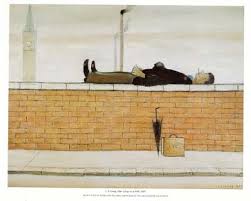
  1. Describe – and do no more. This is always the poet’s initial desire, to put into words what has caught our attention visually (and because attention has been visually caught there is something about this image or object that chimes with the writer’s subconscious). In terms of the poet’s intention, the wish to describe may be sufficient (the subconscious may do the rest). Examples might be Michael Longley’s ‘Man Lying on a Wall’ (from Lowry’s paiting of the same name) or William Carlos William’s ‘The Dance’ (from Breughel the Elder’s ‘Peasant Dance’).

imgres

  1. Describe but imagine beyond the frame – Derek Mahon’s ‘Girls on the Bridge’ (after Munch’s painting of the same name) does this, beginning with description of the scene but then wonders where the road leads away to in space, asks what the next day will bring (in time) and concludes with allusions to Munch’s more famous image ‘The Scream’: “bad dreams / You hardly know will scatter / The punctual increment of your lives”.

imgres

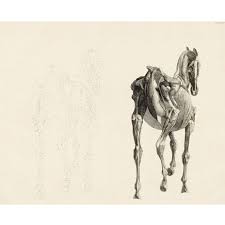
  1. Describe but incorporate researched materials – an easy option in the world of Google where the artist’s life or love life, the political context etc are easily accessed. Edward Lucie-Smith does this in ‘On Looking at Stubbs’ ‘Anatomy of the Horse’’, working with the gossip of local people in the Lincolnshire village where Stubbs worked at preparing the horse’s carcass: ‘His calm knife peeling putrid flesh from bone”.

imgres

Through Ventriloquism

  1. Make Main Figure Speak – the most common approach as famously done in Carol Ann Duffy’s ‘Standing Female Nude’ (from Georges Braque’s ‘Bather’). Thomas Hardy makes the Elgin Marbles speak in ‘Christmas in the Elgin Room’.


  1. Make Minor Figure/s Speak – UA Fanthorpe’s ‘Not my Best Side (Uccello’s ‘St George and the Dragon’) might be considered a hat-trick of the category above but her decision to make all 3 characters in the painting speak, casting side-lights to and fro, means I put it here. Delmore Schwartz’s ‘Seurat’s Sunday Afternoon along the Seine’ – while more free indirect speech than ventriloquism – has a similar effect, visiting each of the characters in Seurat’s picture and allowing their perspective to be aired.

imgres

  1. Make Objects Speak – this is an obvious category though I’m a bit short on illustrations of it. BC Leale’s ‘Sketch by Constable’ almost does it by concentrating attention on a tiny dog sketched in the corner of an image of Flatford Mill. Ann Ridler also comes close by largely ignoring the foreground figures and focusing on the landscape only in ‘Backgrounds to Italian Paintings’.


  1. Make the Artist Speak – writing about Van Gogh’s ‘Portrait of the Artist’s Mother’, Robert Fagles makes the artist speak, denouncing photography and preferring the expressive qualities of paint: “Of the life hereafter I know nothing, mother, / but when I paint you what I feel is yellow, / lemon yellow, the halo of rose”.


Through Interrogation

  1. Of the Artist – Vicki Feaver’s ‘Oi yoi yoi’ (on Roger Hilton’s image of the same name) starts with description but quickly begins talking directly to Hilton (“You were more interested / in her swinging baroque tits”). Interestingly, ekphrastic poems need not always stand in awe of the work; looking at Francis Bacon’s ‘Study for Portrait on Folding Bed’, Thomas Blackburn has a long one-sided conversation with the artist, charting a growing disenchantment with Bacon’s work, accusing him of “uttering, with superb, pretentious / Platitudes of rut, that you have said and said”.

 imgres

  1. Of the Figure/s – I have always admired Gerda Mayer’s poem, ‘Sir Brooke Boothby’ (after Joseph Wright’s image), in which she addresses with Sir Brooke about his languid pose, his copy of Rousseau, his intense scrutiny of the observer. Peter Porter’s many poems about art objects are hard to categorise but ‘Looking at a Melozzo da Forli’ (an image of the Annunciation) interrogates both image and the figure of Mary herself.

imgres

  1. Of Yourself – probably all ekphrasis is a sort of self-interrogation but some poems make this more clear. The address often takes the form of admissions of ignorance or obtuseness in the face of the image or the asking of rhetorical questions. Robert Wallace on ‘Giacometti’s Dog’ once again begins in description but asks questions about the fascination of the image, eventually concluding “We’ll stand in line all day / to see one man / love anything enough”.


Through Giving an Account

  1. Of Your Encounter – Wallace’s poem spills across these artificial categories and might be placed here, among poems where the poet explicitly records details of his/her encounter with the work of art. Yeats famously does this in ‘The Municipal Gallery Revisited’, looking at images of Augusta Gregory and John Synge. David Wright (who lost his hearing at the age of seven) movingly describes his visit to Rome to see Maderno’s sculpture of St Cecilia (patron saint of music) in his poem ‘By the Effigy of St Cecilia’.

imgres

  1. Of Gallery Visitors – poets often comment on the behaviour or experiences (imagined) of gallery visitors (and even the gallery attendants!). Gillian Clarke does this in ‘The Rothko Room’: “In this, / the last room after hours in the gallery, / a mesh diffuses London’s light and sound. / The Indian keeper nods to sleep, marooned / in a trapezium of black on red”.


  1. Of Others – admittedly a catch-all category this one, but sometimes (especially when the works of art appear in churches) the poet can be interested in speculating about the responses of more ‘ordinary’ people. Thom Gunn does this toward the end of ‘In Santa Maria del Popolo’ where Caravaggio’s ‘Conversion of St Paul’ is displayed. Having recorded his own response to the image he ends by staring at the old Roman women who come to kneel before it: “each head closeted // In tiny fists holds comfort as it can. / Their poor arms are too tired for more than this / – For the large gesture of solitary man, / Resisting, by embracing, nothingness”.

 imgres

Come At a Tangent

  1. Finally, the ekphrastic moment can be presented as if an after-thought, or illustration of a poem already half composed. There are famous examples of this, especially Auden’s ‘ Musee des Beaux Arts’ which spends most of its length contemplating in very general terms the way old paintings present suffering. Only towards the end does Auden refer to Breughel’s ‘Fall of Icarus’ which he describes in some detail to suggest how “everything turns away / Quite leisurely from the disaster”. RS Thomas’ ‘Threshold’ does something similar, only concluding with allusions to Michaelangelo’s painting of Adam in the Sistine Chapel. And Seamus Heaney’s ‘Summer 1969’ records a visit to Madrid as the Troubles boiled in Northern Ireland, and only latterly does the poem focus on Goya’s ‘Panic’: “Saturn / Jewelled in the blood of his own children, / Gigantic Chaos turning his brute hips / Over the world.imgres