More than 10 years of blogging on poetry and translation – over 39,000 views in 2024 – now captured and preserved at the UK Web Archive: 'one of the top 10 poetry blogs' (Rogue Strands)
An edited (shorter) version of this review first appeared in Poetry Salzberg Review in June 2025. Many thanks to the editor, Wolfgang Görtschacher, for commissioning the writing of it.
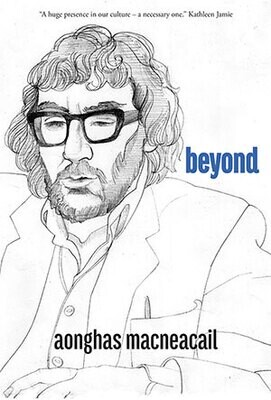
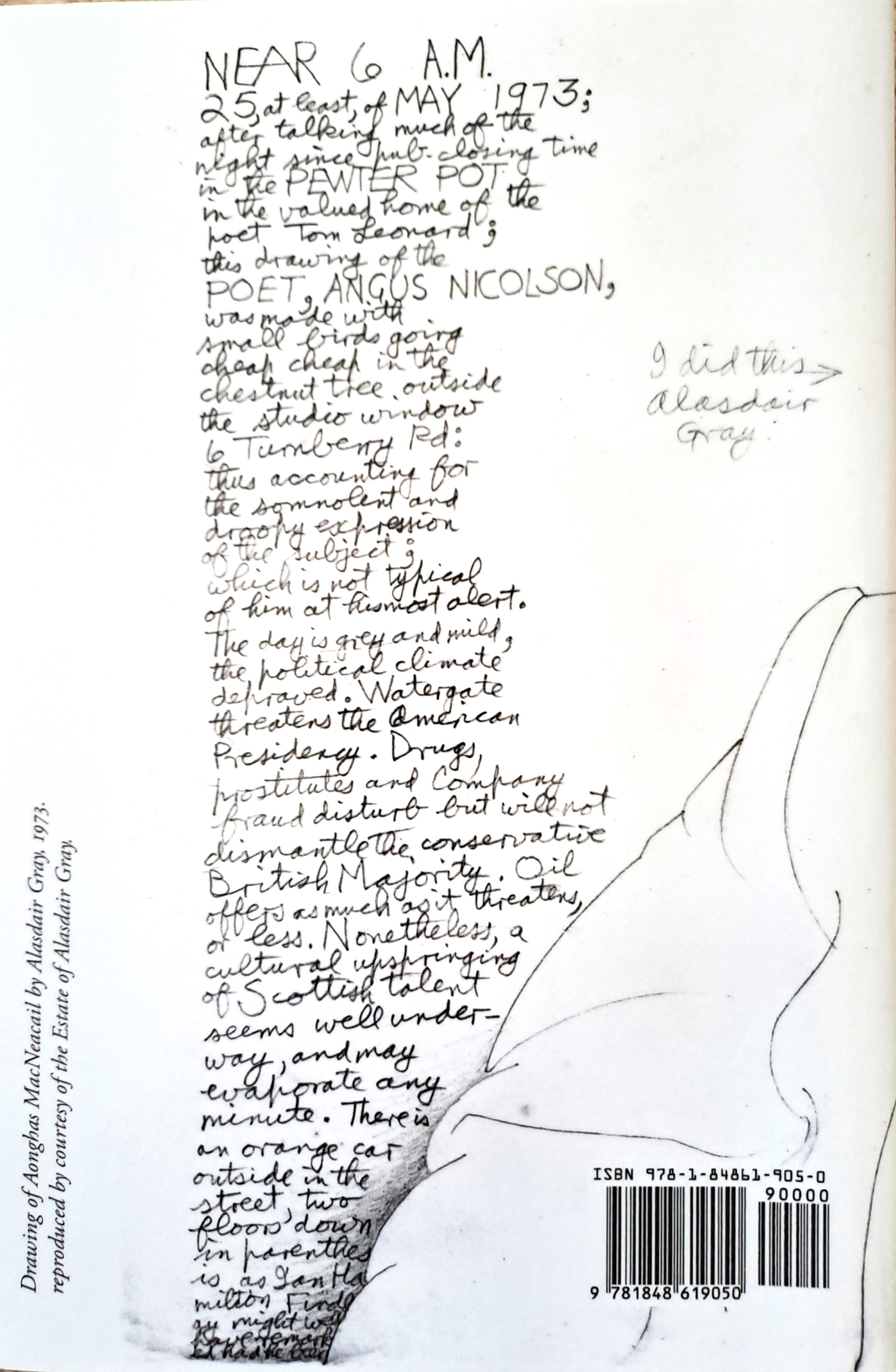
It is as a poet writing in Gaelic that MacNeacail – who died in 2022 – is most well-known, though he would himself provide translations of his work into English, what, in the poem ‘last night’, he refers to as Gaelic’s ‘sister tongue’. There were also poems written in Scots and these variants give an insight into what Colin Bramwell here calls ‘the language situation in Scotland’ within which MacNeacail worked all his life. For a number of years, MacNeacail lived and wrote under the anglicised name Angus Nicolson, but always considered himself a tri-lingualist and antagonistic to the kind of divisiveness such a ‘situation’ might give rise to. His natural inclination was democratic, pacifist, anti-authoritarian, and modernist. Now, the collection, beyond (eds. Colin Bramwell with Gerda Stevenson (Shearsman Books, 2024)) gives readers a selection of poems written in English by Aonghas MacNeacail over the past 30 years. One of the implications of the book’s title is his deeply held wish to look ‘beyond’ division, not to anything transcendental (MacNeacail’s focus was always this world, not some other), but to the next term in an on-going dialectical process. One of the little gems from ‘the notebook’, included here, imagines a cup of knowledge, the liquor within, also knowledge, a grain is added and stirred, and the grain then consumes the liquor and continues to ‘grow, root, sprout / find elbows, crack the cup // find clay’.
MacNeacail’s modernism took its key lessons from the likes of William Carlos Williams, Olson, and Creeley and most of the poems here have that fluid, unpunctuated (hence pointed by the breath), often short lined, often indented formal shape we associate with the Black Mountain. He was a member of one of Phillip Hobsbaum’s fertile ‘groups’ (along with Liz Lochhead, Alasdair Gray and Tom Leonard) and the advice given was to go back to his roots, to ‘write about what you know’. In part, this took MacNeacail back to his childhood, growing up in Uig, on the Isle of Skye, speaking only Gaelic. It also made it clear what he wanted to escape from: Gerda Stevenson describes this as ‘the confines of the proscriptive Free Church of Scotland’. Several childhood poems, illustrate the stifling force of religion, on his mother, for example, ‘strapped down tightly / by a darkly warding book thick with orders that drove / and hedged her way’ (‘missing’). The church governed education too, the teacher little more than a ‘stern presence’, who demanded ‘psalms / from memory’ (‘crofter, not’).
The teacher’s ‘granite eye’ also features in ‘forbidden fruit’ where the contrast is between education’s confining ‘barbed-wire’ and the invitations of the natural world (of Skye), specifically the allure of ‘the biggest [. . .] sweetest’ nut hanging on a branch over a waterfall. The poem ‘had adam not eaten the apple’ feels like a later piece, with a more self-confident, liberated MacNeacail declaring ‘the thing is / not to always / spell the word correctly’ and imagining god’s demands for eternal perfection leading him to waken every morning, complaining ‘another fucking immaculate day’. A longer poem like ‘gaudy jane’ gives a sense of MacNeacail’s unshackling from restrictions. The figure addressed is part woman, part a realm of liberation, a window onto ‘wild excursions’, towards ‘dancing voices, laughing feet’, she is a glass of whisky, a doorway into nature, to sensuality, and a way to access the ‘little gods of mischief and delight’. Celebrations of the natural landscapes of Skye (and elsewhere) in fact become one of the characteristics of MacNeacail’s writing. Snowfall over hills is as if ‘god’s apron / settles on our field and makes / a tranquil bowl’ (‘snowhere’). In ‘a rainbow’, the natural phenomenon is enjoyed and admired, ‘so real // high up on that pentland slope’, its natural beauty preferred to any fanciful talk of pots of gold, its fleetingness an image of imagination and memory. MacNeacail’s ‘primula scottica at yesnaby’ celebrates the rare wildflower’s fragile beauty, its hardy nature, till it also becomes an image of Scotland itself: ‘the air it breathes is stiff with brine / this whit of life still flowers / every tiny purple radiance is lambent / in the blood of time’.
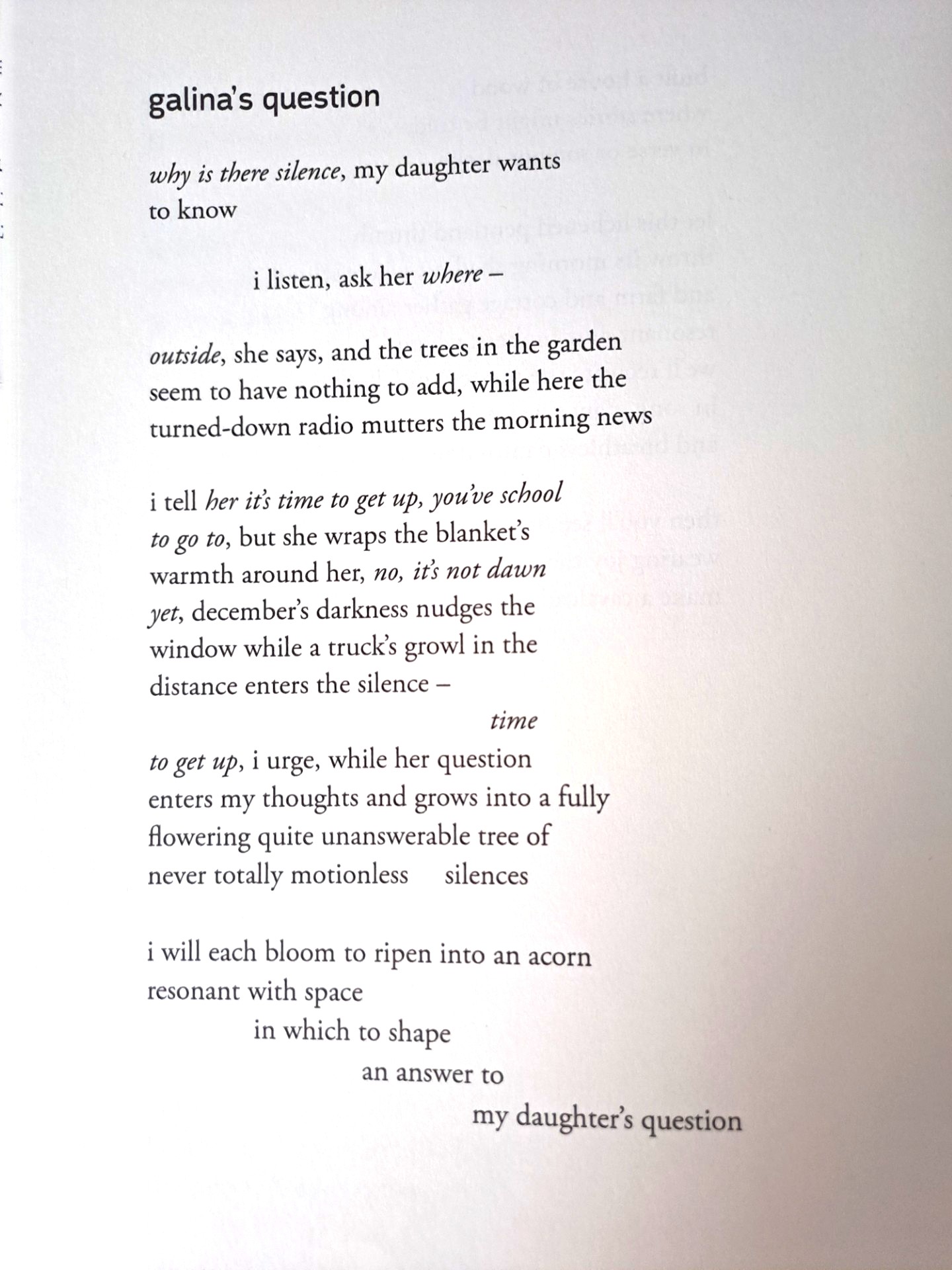
MacNeacail’s love of Nature is matched only by his writing on the varieties of human love, erotic, romantic, filial, parental, between friends. I can’t think of any other poet who’d compose 80 lines (both touching and hilarious) in praise of ‘some of my best friends’. A poem like ‘love in the moonlight’ is unashamedly romantic in its contrasting of the moon’s ‘pallor’ with the loved one’s ‘sun- / wrapped noons, bright mornings / and the way your evenings / dance into a fiery dusk’. There are several delicate poems featuring MacNeacail’s daughter, Galina, and – reminiscent of Courbet’s ‘The Origin of the World’ painting – ‘the curious eternal’ is a marvellous erotically-charged paean to a loved one, ‘after all those years / the mystery / of flesh, secretions, pulse and breathing patterns’. MacNeacail’s English poems exude a human warmth that, to judge from comments from friends and colleagues, was true to the man himself. They are driven by his wish to communicate – in whatever language, in truth – and his slipping free from Christianity’s ‘one book’, that would ‘consign all art and ingenuity / to black irrelevance’ (‘this land is your land’), allowed him to celebrate the flawed, the not perfectly straight, the interrupted conversations, that constitute being human with a passion and modesty. These lines from ‘the notebook’, are a characteristic, and invaluable, vade mecum: ‘no matter / how little / you say / it may / be worth / the saying, if it / touches the edge / of a shadow / that can / (possibly) / be thinned / by the breath / of words’.
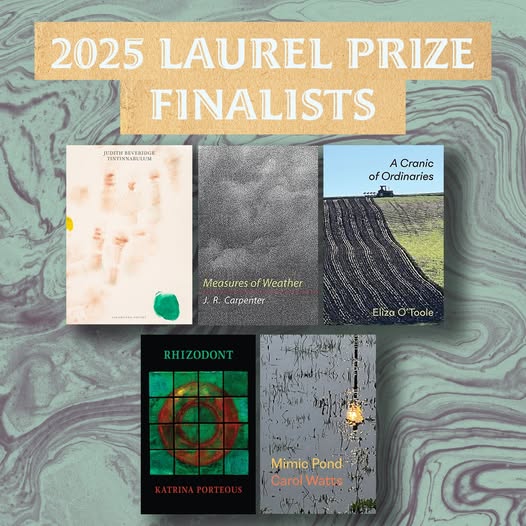
The shortlist for the eco-poetry/nature poetry Laurel Prize 2025 has just been announced. The finalists – judged this year by the poets Kathleen Jamie (Chair), Daljit Nagra, and the former leader & co-leader, Green Party of England and Wales Caroline Lucas – are (in alphabetical order):
Judith Beveridge Tintinnabulum (Giramondo Publishing) JR Carpenter Measures of Weather (Shearsman Books)Carol Watts Eliza O’Toole A Cranic of Ordinaries (Shearsman Books) Katrina Porteous Rhizodont (Bloodaxe Books) Carol Watts Mimic Pond (Shearsman Books)
It turns out I have reviewed two of these collections – one of them I have been bending the ears of anyone who will listen about how very very good it is. I reviewed Katrina Porteous’s Rhizodont (Bloodaxe Books) for Poetry Salzberg Review fairly recently and posted an extended version of the review here. I concluded that ‘The people and landscapes of ‘Carboniferous’ are far more successful as poems to be read and enjoyed, while ‘Invisible Everywhere’ is a bold, well-intentioned experiment that fails’.
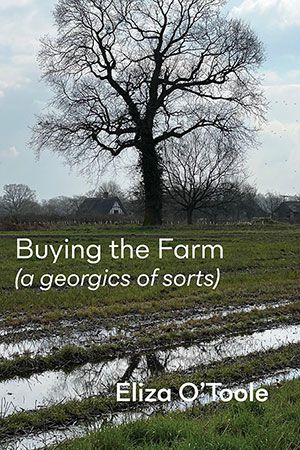
It is Eliza O’Toole’s A Cranic of Ordinaries (Shearsman Books) that I have been telling everybody about. Interestingly – and demonstrating the great enthusiasm the publisher shares for this poet – Shearsman have just published her NEXT collection: Buying the Farm (a georgics of sorts). The nominated collection was published in 2024.
I reviewed it in brief for The Times Literary Supplement recently, as follows:
The premise of Eliza O’Toole’s superb debut collection, A Cranic of Ordinaries, is unpromising: a year’s cycle of diaristic pieces in which the poet walks her dog through the Stour valley. But the result is a sublime form of ecopoetry which is visionary, yet creaturely and incarnate, and to achieve this O’Toole channels two great nineteenth century writers. Gerard Manley Hopkins’ ‘Hurrahing in Harvest’ joys in the things of Nature which are always ‘here and but the beholder / Wanting’. When self and natural world do communicate, Hopkins named that flash of true relationship ‘instress’. O’Toole’s ‘Stour Owls’ records just such a moment, listening to the calls of a female tawny owl, the ‘slight pin-thin / hoot’ of the male, followed by a tense silence: ‘then the low slow of the barn owl as the / white slide of her glide brushes the air we / both hold & then breathe’ (12).
O’Toole also adopts Emerson’s idea of the ‘transparent eyeball’, seeing all, yet being itself ‘nothing’. The excision of the self’s perspective is systematically pursued. Seldom is the landscape ‘seen’ but is rather subject to plain statement: ‘It was a machine-gun of a morning’ (11), ‘a vixen-piss of a morning’ (13), ‘a muck spread of a morning’ (34). O’Toole has an extraordinarily observant eye, but this repeated trope counters any taint of the constructed picturesque, the human-centring of vanishing points and perspective. The observer grows ‘part or parcel’ of the world. Such a vision makes demands on language because in truth, ‘It is necessary / to write what cannot be written’ (94), and this yields one of the most exciting aspects of this collection as the poet deploys varieties of plain-speaking, scientific, ancient, and esoteric vocabularies as well as a Hopkinsesque ‘unruly syntax’. She describes ‘young buds. Just starting from / the line of life, phloem sap climbing, / a shoot apical meristem and post / zygotic. It was bud-set’ (26).
O’Toole’s choices about form are also bold, almost all the poems being both right and left justified, creating blocks (windows?) opening on each page. The realm the reader is invited into (not told about, not shown) is one where the manifold particularities of the natural world are also and at once a whole. O’Toole’s dog digs a hole: ‘In / the hole and out of it, the soil was / whole. There was a unity and no lack. / In the hole was soil. It was a / comprehensive various entirety; it / was a universe of relatings’. (38) In such ways O’Toole’s ordinaries are made ‘strange’ (33) and the toxic divide between modern humanity and the natural is momentarily, repeatedly, bridged.
Here’s one of the poems from A Cranic of Ordinaries. Apologies are due for formatting accuracy as – as we all know – WordPress is rubbish at dealing with poetry. But you’ll get the idea…..
Perpetual gravity – Box Tombs at Wiston
(the quality of appearing to recede, essential to the landscape tradition)
Now illegible, the children of John
Whitmore and Susanna his wife,
Sarah aged 11 Months,
Robert aged 2 Years,
Rebeckah aged 11 Months,
Elizabeth aged …. Weeks,
Lucy aged 1 Week,
Susanna aged 20 Years,
Thomas Aged 6 Years.
John Whitmore departed this life Jany
the ….6th 1746 Aged (6)6. He was a
good husband loving father faithful
friend and a Good Christian. Susanna
Whitmore died / Jany. 25 1789 Aged
(?8)6. To dwell until all the world
inscribed when it was still possible to
die. To lie slightly foxed, mortared in
a brick box irregularly repaired, alive
with stone-devouring lichen and
littered with dry lime, leaves and
frass. Fin* pees antimony and sees off
the squirrel, wards off unbelievers we
have no need for having no place
amongst toppling tombs. A litany
indescribable, a conjugation beyond
reach, an accent mark over a vowel,
an entire landscape made grave. It
was October, the same fields were
ditched, furrowed, carved, still dug
over and still the Stour was flowing. In
the picture’s distant plain, the sun
like other yellows, was still fading.
Generally, a history remains unsure.
*O’Toole’s dog
The Laurel Prize awards £5,000 for the winner of the prize and £1,000 for the other four finalists – so congratulations are due to all of them. The winner will be announced at the Laurel Prize Ceremony which is taking place on Friday 19 September at 5.30pm (BST), and will be aired via a free live-stream. This year’s ceremony is a part of BBC Contains Strong Language which takes place in Bradford from 18-21 September.
An edited (shorter) version of this review first appeared in Poetry Salzberg Review in June 2025. Many thanks to the editor, Wolfgang Görtschacher, for commissioning the writing of it.
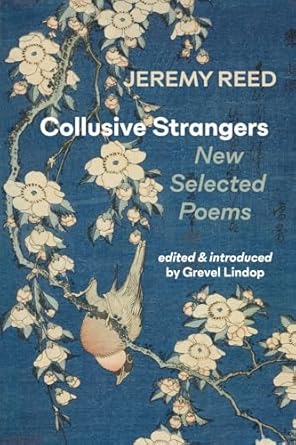
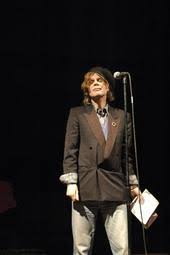
As the editor, Grevel Lindop, says in his Introduction to Collusive Strangers: New Selected Poems (Shearsman Books, 2024), the literary world has not taken enough notice of the remarkable oeuvre of Jeremy Reed. Many of his recent collections have appeared without much, if any, critical notice, so it’s to be hoped that this substantial new selection, from 1979 -2016, will bring this misfit-poet’s work back to more general attention. The problem is that the protean Reed fits no pigeonhole, plus the fact that he’s been astonishingly prolific. Intensity of perception and a phenomenal dynamism of language and creativity are his hallmarks, and he matches the best in nature poetry (Clare and Hughes), the decadent, urban flaneur (Baudelaire), then writes as Symbolist and Surrealist (Gascoyne), pursues sci-fi, focuses on pop and fashion, next becomes a portraitist and moving elegist. Even given these 300 pages, Reed – a sometime Peter Pan now into his 70’s – continues to be elusive. Compared to the prolific poet/novelist John Burnside, the difference is clear: we all knew what the brilliant, much-missed John was up to. With Reed, we are endlessly being caught by surprise.
Even Reed’s earliest work arrived fully formed. In the late 1970s and early 1980s, the urban, neurasthenic wanderer appears in ‘Claustrophobia (Kings Cross)’, the narrator’s need being ‘so strong it might involve the police’. In contrast, ‘Dwight’s Brother’ is an early stanzaic, sci-fi piece, a character from the future obsessed with Manson’s and Nixon’s careers, and ‘the monomania that burns planets’. And the magnificent ‘John Clare’s Journal’ ventriloquises the nature poet’s concerns for the natural world of Helpston, his stumbling literary repute, and fear for the future of his children, ‘laid / out as corpses’. Reed’s ambition is clear from the start, and in a poem like ‘Visit to George Barker’ he evidently empathises with the older poet’s withdrawal and seclusion, his writing contemporaries being harshly judged for a lack of ambition as ‘poets whose very aim is minimal / gesture, earning [Barker’s] dismissal’.
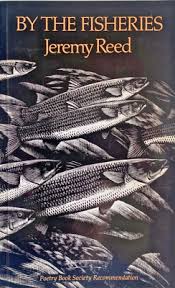
My own first acquaintance with Reed’s writing was in the two volumes from Cape in 1984/5, By the Fisheries and Nero, when James Lasdun edited him. These particularly highlighted the Nature poems, for example ‘Conger’ which outdid Ted Hughes: ‘They’ll shave a finger off with precision, / clean as a horse bite, or close round a hand / and leave it as taut gristle strung on bone.’ In a quieter poem, the narrator is fishing in a harbour, near a ‘desalination plant’, the tautly strung reactions of a shoal of mullet seemingly reflected in the fisherman’s own alertness and nerves (‘By the Fisheries’). ‘Spider Fire’ plays brilliantly with perspectives as every sort of tiny beast and insect flees a wildfire, while the narrator, at a distance, observes ‘a black hoop / ironed into the shire’. Though the first-person pronoun recurs in many poems, Reed is usually not much interested in self-revelation. One wonders, if he was/had been, he might be more widely appreciated, because it’s not that he can’t do it. ‘Visiting Hours’, for example, is enough to make a grown wo/man weep as the narrator visits his father in hospital, economical with the truth that this is ‘terminal’, the child compelled to play the father, the father, ‘like a diver gone on down // to find an exit that was always there, / but never used’. In characteristic ABCB quatrains, ‘Changes’ perhaps records the poet’s re-visiting Jersey and a brother, or boyhood friend, who stayed behind as a farmer, both recognising ‘our youth survives, the present is a gap’. And Lindop includes two remarkable poems from the Nineties collection, in which we seem to get close to Reed’s own autobiographical difficulties, when personal survival seems ‘to be the question’ (‘Samaritans’), and, in ‘Prayer’, Reed addresses a divinity of an uncertain variety, pleading for illumination, for help, a hearing, a pointing of a way out, from guilt, dread, self-injury, poverty, ‘the unappeasable, involuntary / inheritance of lucklessness’.
But Reed deals with topics, rather than ‘issues’, and his work is descriptive in character, never preachy or judgemental, so he seldom offers us his ‘views’. The work is driven by his ‘curiosity’, which both ‘holds us to life and feeds us to the flame’ (‘Moth-Trapper’). His praise of the artist, in ‘Cezanne’, is revealing of his fascination for the ‘ordinary’ and for the shared knowledge that ‘the beautiful / is inherent in all that lives, / and once externalised in its true form, / remains as that’. Over and over again, Reed captures – hence externalises – the true form of things in the colourful, vigorous, unblinking poems selected here. And as the millennium approached, Reed extended his range even further towards ‘all that lives’. There are uncharacteristic political poems (Tony Blair is a particular target), but Reed also writes of the experience of AIDS, and with a Baudelairean dwelling on sexuality, in poems like ‘Transsexual’ and ‘Brothels’, and is drawn closer to popular culture, its fashions, music, and iconic figures. But many of the poems on Madonna, Billie Holiday, Elvis and The Rolling Stones drift to looser forms of summary and the decade from 1993 to the early 2000s contains less brilliant work, though 2006’s Orange Sunshine with its evocations of 1960s London marks a return to form.
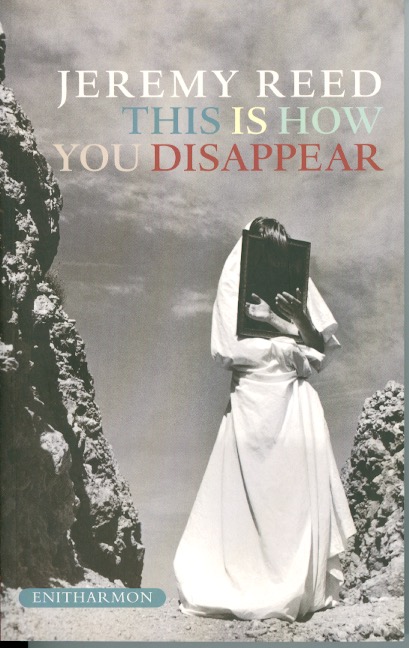
Reed as elegist, as in This Is How You Disappear (Enitharmon Press, 2007), was perhaps unexpected, but poems like ‘Paula Stratton’ and ‘John Berger’ (not the art critic) must rate amongst the finest in that genre produced in the last 100 years. The honesty, attention to detail, the empathy extended to his subjects (Stratton was a drug addict; Berger a difficult Jersey friend and Nazi-collaborator), and the apparent ease and beauty of the writing, mean these poems ought to have been anthologised everywhere. The elegiac note is hardly surprising as Reed moves through his seventh decade and poems about socks, potted plants, tea, honey, and cupcakes seem to mark shifts in focus though Reed remains true to his repeated maxim that ‘everything I see [is] poetry’ (‘London Flowers’). The poems retain the vigour and speed that he admires in Plath’s work: ‘her fast ball imagery / on speed-trajectories [. . .] her plugged-in dare-all energies’ (‘Re-reading Sylvia Plath’). As he puts it in an extract from ‘White Bear and Francis Bacon’, Reed has remained true to his early ambitions ‘to kick poetry into near sci-fi / [. . .] like dirty-bombing the dictionary into my face’ and there are thrills to be had by any reader on every one of these 300 pages in which Reed makes so many contemporary poets look sluggish, mired in virtue signalling, lumbering in form, and monotone compared to his vivid technicolours.
Here is the whole of ‘Elegy for a Polka Dot Shirt’ from Orange Sunshine (2006):
Unreconstructed 60s ostentation snowed on blue labelled Jacques Fath, tailored fit, fished from Retro on a simmmery cloud hung-over August day, bought for pop connotations – high collar with flouncy points, cotton married to the skin. Medium size: 38 cm: structured for a defined waist sexless to the vanity of ownership. Affordable at £15, the item begged me to retrieve its showy staginess. Outside, airless haze, W11 backpacking crowds random like footage spilled into a documentary.
Later I tore a fragile seam tracking towards left underarm, the fissure sounding like hot oil pronouncing itself in a pan. The tear backtracked through history to the anonymous wearer, who bought sensation, sold it on into a chain, the onion skin thinning from use; the scar re-sewn, but evident, a little glitch caught in the fabric like a blues lament, the singer head-bowed on a stool, cooking up trouble, while the club tug at his vulnerability and modulate applause from hot to cool.
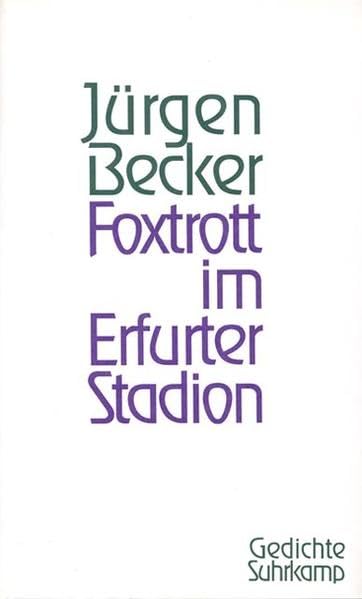
Following on from the publication in January 2025 of my translation of ‘Dressel’s Garden’, one of Jürgen Becker’s longer poems (which recently appeared on the USA site Asymptote Journal), three more poems by this fascinating German poet have just appeared in Shearsman magazine and our hope is (permissions permitting etc) that Shearsman Books will be publishing a full collection of his work in the near future. All these poems are taken from Becker’s crucial 1993 collection, Foxtrot in the Erfurt Stadium. The newly published poems are relatively brief so I thought I’d post two them here with a little bit of literary and historical context. (I’ll comment in a later post on the longest of the three poems now published by Shearsman).
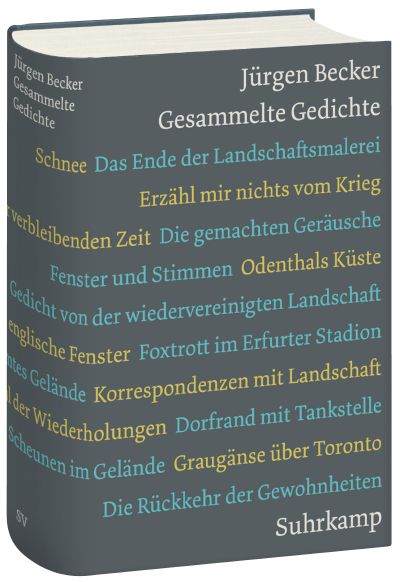
In her Afterword to Jürgen Becker’s monumental 1000-page Collected Poems (2022), Marion Poschmann praises the poet as being ‘the writer of his generation who has most consistently exposed himself to the work of remembrance, who approaches the repressed with admirable subtlety and is able to reconcile his personal biography with the great upheavals of history.’ Likewise, in their adjudication, the 2014 Büchner Prize jury highlighted the way ‘Becker’s writing is interwoven with the times, with what is observed and what is remembered, what is personal and what is historical.’ Jürgen Becker’s own personal journey began on July 10, 1932, on Strundener Strasse, in Cologne. In August 1939, shortly before the outbreak of the war, his father was transferred from his place of work in Cologne to Erfurt in Central Germany. This was the beginning of the seven-year-old Becker’s experience of war and a post-war childhood in Thuringia. In 1947, the family left Erfurt and returned to West Germany. Becker has said about this period that there was never any thought of wanting to travel to the Eastern zone, let alone to the GDR, to see the places and landscapes where he’d spent his childhood years: ‘For a long time, I oriented myself solely towards western horizons; I lived, so to speak, with my back to the GDR; my childhood was separated by a border, seemingly closed’. (More of borders in a moment).
Becker’s interest in ‘events’ – political and historical – can clearly be seen in the short poem ‘Reporter’. Its subject never seems to become outdated (as I write this, Turkey is enforcing a crackdown on reporting – see the arrest and deportation of BBC reporter, Mark Lowen, very recently). Becker’s poem is not set in any particular time period, though the allusion to a ‘vast thing, fading away’ suggests an epoch of great change, one political system fading, another on the rise. I love the journalist’s reported observation that he ‘can only leave / when nothing else happens’. In Becker’s writing, there is always something else arising (history does not stop happening – as we see in this particularly fast-moving historical moment). I take the implication of the final 4 words to suggest that the reporter may well be ‘removed’ by the authorities from whatever the situation currently is (against his wishes by the sound of it) and that we will all become the poorer for that, more poorly informed, less capable of distinguishing the truth of things: ‘He will be missed’.
The second poem, ‘Meanwhile in the Ore Mountains’, bears strong similarities in that the specific time period (though not the setting) is left deliberately vague, though so many of the details in the poem possess a terrific (terrifying?) resonance for our own times. As to place, the Ore Mountains lie along the Czech-German border and borders are important in this poem. As I mentioned above, Becker was born in the eastern region of Germany, but from age 7, he was brought up in West Germany, and after the fall of the Wall in 1990, he’d often return to his (eastern) childhood landscape. The resulting blending of a child’s and adult’s vision is what gives rise to Becker’s characteristic poetic mode: a flickering between past and present, often without clear signalling, the past frequently haunted by the disturbing changes that happened in Germany in the 1930s. I’ll post the original German of this poem as well, as in what follows I’ll make a few observations about translation.
Though relatively brief, this poem is just one sentence, woven together with the conjunction ‘wie’ (translated here both as ‘how’ and ‘the way’). The weave is dense and as I’ve suggested it’s not really possible to tell whether what is observed – the children, the oil spill, the tree stump (resembling a body) – are contemporaneous or from different eras. My translation keeps these possibilities open: borders here are felt to be temporal, as well as geographical. The German word ‘Avantgarde’ has artistic as well as political implications, but my choice of ‘vanguard’ also brings out the militaristic connotations which are reinforced by the ‘spitzen, grünen Lanzen’ (‘sharp, green spears’) which are then swiftly transformed into a bunch of sprouting snowdrops. These flowers of Spring are interestingly referred to as a ‘Konvention’ and I retained the English equivalent, intending to suggest both a performance (something conventional, perhaps not genuine), as well as a political gathering or agreement (like the Convention on Human Rights). The ambiguity felt very relevant (and once again topical).
The final vivid, visual images – a TV screen observed through a window, a script on the screen, a woman talking, but she is inaudible to the observer – sum up Becker’s concerns about the media, political and historical change, borders real and imagined, exclusion, and the need to ask questions of those in power. Issues as real today as when the poem was written in the early 1990s.
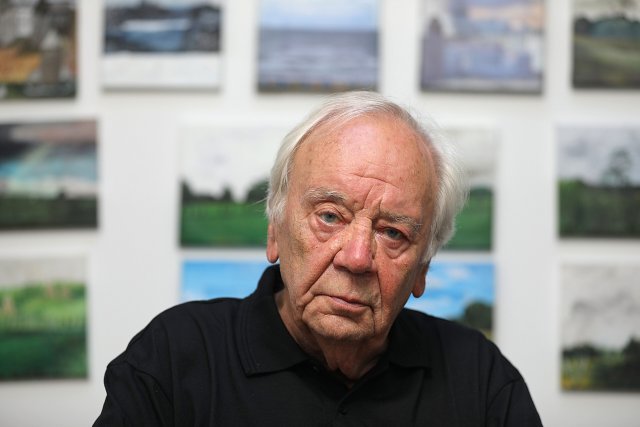
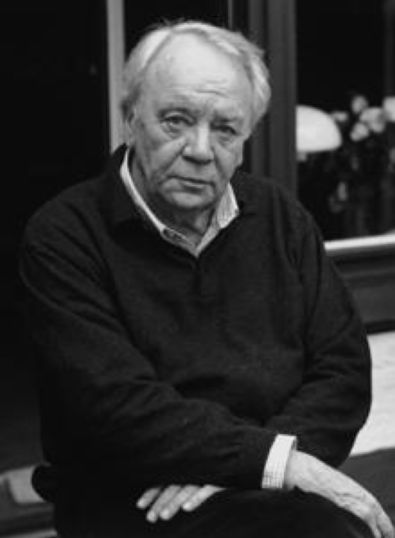
The sad news that Jürgen Becker (1932-2024) died recently at the age of 92 was particularly poignant as I have been translating his work for the past 3 years. I first read about his poetry in an essay I was translating by Lutz Seiler (published in In Case of Loss (And Other Stories, 2024)). There, Seiler characterises Becker’s work as ‘a process that integrate[s] both immediate and more distant modalities of language, his own voice as well as materials drawn from other sources such as events, photos, maps as well as interjections from neighbouring rooms, from the mail, the news, weather conditions and whatever else stray[s] within range’ (my translation). History, politics, the importance of recording ‘small things’, an extraordinarly porous kind of poetry – these were the aspects that drew me to his work (as a writer of my own poems as much as translator).
Becker’s ‘typical’ poem works at length, resembling a stream-of-consciousness, but better thought of as a kind of collage or montage. His effects are slow-burning, allusive, even elusive, and I don’t think his work is likely to top any UK chart of popular poetry any time soon. But his revered status in Germany is remarkable and I have actually had a couple of successes recently with my translations: a Highly Commended in the 2024 Stephen Spender Trust Translation Competition, judged by Taher Adel and Jennifer Wong (with the poem ‘Meanwhile in the Ore Mountains’), and one of Becker’s longer poems in translation being published (‘Travel film; re-runs’ – see below).
Becker grew up in the German region of Thuringia which, after World War II, was in the Soviet occupation zone, later the GDR. By then, his family had moved to West Germany and, after the fall of the Berlin Wall in 1990, the writer often returned to his childhood landscape. I have concentrated my translation efforts on Becker’s 1993 poems in Foxtrot in the Erfurt Stadium, published by Suhrkamp. The full translation is due to be published by Shearsman Books in 2025. The Spender Trust Competition poem is a short piece which I can quote in full. The Competition requires entrants to say a few words about the poem and the translation process. Here is a video of the Intro and Reading of the poem for the prize event, and (alongside) the text that I originally submitted:
Commentary – The Ore Mountains lie along the Czech-German border. Borders are important in this poem. Born in the East German region, brought up in West Germany, after the fall of the Wall in 1990, Becker often returned to his childhood landscape. Though relatively brief, this poem is just one sentence, woven together with the conjunction ‘wie’ (translated here both as ‘how’ and ‘the way’). The weave is dense and it’s not possible to tell whether what is observed – the children, the oil spill, the tree stump (resembling a body) – are contemporaneous or from different eras. My translation keeps these possibilities open: borders here are temporal, as well as geographical. The German word ‘Avantgarde’ has artistic as well as political implications, but my choice of ‘vanguard’ also brings out the militaristic connotations which are reinforced by the ‘spitzen, grünen Lanzen’ (‘sharp, green spears’) which are swiftly transformed into a bunch of sprouting snowdrops. These flowers of Spring are referred to as a ‘Konvention’ and I retained the English equivalent, intending to suggest both a performance (something conventional, perhaps not genuine), as well as a political gathering or agreement (like the Convention on Human Rights). The ambiguity felt relevant. The final vivid, visual images – a TV screen seen through a window, a script on the screen, a woman talking, but inaudible to the observer – sum up Becker’s concerns about the media, political and historical change, borders real and imagined, exclusion, and the need to ask questions of those in power. Issues as real today as when the poem was written.
the nothingness of snow from the nothingness of sky,
and along the frontier, one this side, another
along the other, fly the only two crows
to be found in this treeless landscape, the way
the iridescent pattern of an oil spill develops
with darkening edges, the way a tree stump
in the field becomes the shape of a body with
severed arms and legs, how, under the cherry,
the vanguard shows with sharp, green spears,
which later, over the next few days, assumes
the convention of snowdrops, how dark windows
are lit by screens, and on each screen appears,
at first, lettering, and then the face of
a woman who is soundlessly moving her lips.
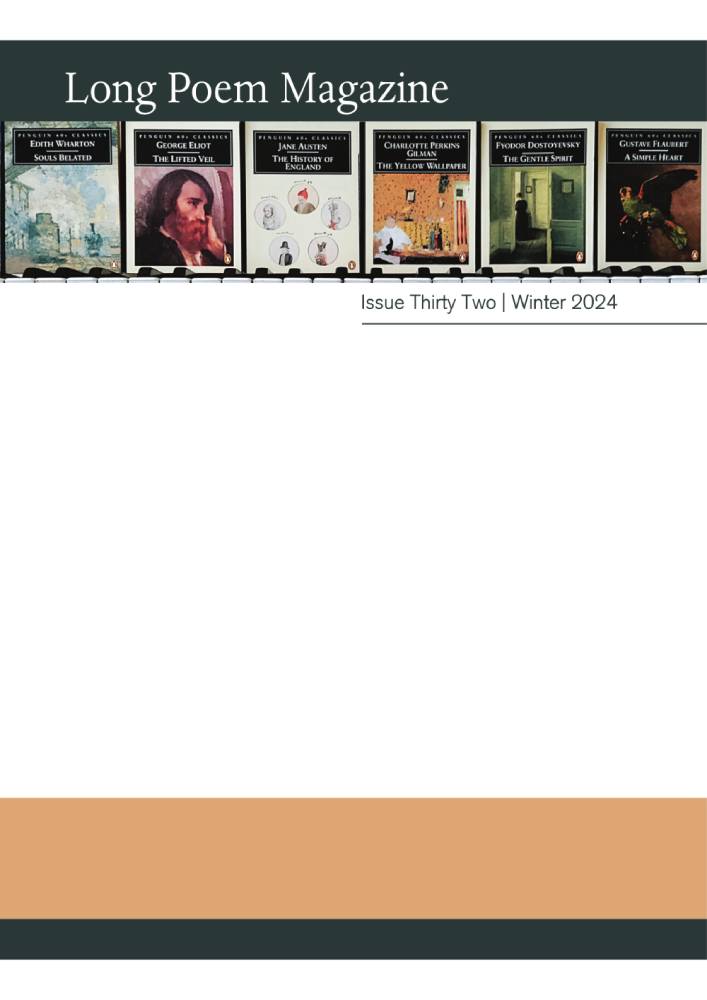
The longer poem – ‘Travel film; re-runs’ – which does indeed run to over 100 lines in full – has just appeared in The Long Poem Magazine, Issue 32, eds. Linda Black and Claire Crowther. This brilliant magazine is one of the few outlets for poems stretching beyond the ‘competition’ mark of 40/50 lines only. Poets/translators again have the opportunity to comment on the work being published. This was my Introductory paragraph:
Given his 1000 page Collected Poems (Suhrkamp, 2022), it’s remarkable that Jürgen Becker’s work has been so little translated into English. This poem, published in his 1993 collection, Foxtrot in the Erfurt Stadium, is imbued with Becker’s sense of the changes in this particular part of Europe. The interleaving of the child’s and returning adult’s vision is what yields Becker’s characteristic poetic mode: a flickering between past and present, often without warning to the reader, a past frequently oppressed by the rise of fascism in the 1930s. The translator’s difficulties lie not in his word choices (Becker plainly describes, he states), but, to some degree, in his cultural references (here, the allusion to pimpf kids (cub, little rascal, little fart) is to members of the Hitler Youth), and, primarily, in dealing with his style of montage-composition, his commitment to ‘the apparently incidental’. Becker’s porous verse contains multitudes of perspectives, voices, inner and outer events, photos, maps, postcards, news, weather reports. In translation, it’s hard to flex, to permit these into English, and I have had to learn to trust Becker’s arrangements of them into long, semi-colon linked passages, utterly remote from conventional ‘lyric’. The opening 24 lines here elide landscape, weather, employment, domesticity, and history, then on to the natural world, compositional ideas, back to history. Becker is a great poet of the present moment and of the past. He grew up in Thuringia which, following World War II, lay in the Soviet occupation zone, later the GDR. By then, Becker’s family had moved to West Germany, and, after 1990, he often returned to these childhood landscapes. This poem was published in his 1993 collection, Foxtrot in the Erfurt Stadium. Becker worked for many years in German radio, and, in this poem, we might imagine a small production team visiting an un/familiar landscape in the East, perhaps where a childhood was spent, a place later abandoned.
Travel film; re-runs (extract)
the landscape: like corrugated cardboard, an enduring, fixed
motion, on a smoky grey day. The wind came
somewhere frombelow, from a region beneath
the weather chart; in the evening, we could no longer
reach our correspondents. We drove out
to the country house; we ate
Spanish green asparagus. It was a moment
from yesterday that rolled slowly past the shelf
with its yellow calendars and diaries and pictures;
something had begun,
and you’re aware of it,
the sound of that reiteration. You can … and
you allow it … push the off button; outside the window,
the blackbird flutters up, simply waiting
to be mentioned. Now you notice the way the paint
has peeled from the window frame, and where
the ants are coming from, in January the only
living creatures in the house. Perseverance pays off
at some point, even if you have little alternative
but to gather piece after piece together. Paint pots
in the shed, shades of green and white, but
we are waiting for a consistent light,
on either side of the house. Is it too late now,
to leave again
… lake shores, before they are all
accounted for, can still be appreciated, with sandy paths
reaching the purple horizon … subjunctive, without end;
a game of evasion that you can watch until you
whistle, or shout, and it’s nothing like awakening
from a dream. In the evening, we light a fire; it’s
a sudden, impromptu decision; then follows
the next draft of the letter: your sketches litter the table
… you no longer need a pass; highways,
the middle of the village … standing beside you
on the jetty; on the opposite side, the yellow ribbon
of the shoreline…
clips from the travel film just now
set going in the blink of an eye; then the meadow
is mown; there are a few old clumps of snowdrops
we leave standing. The fact is, we have missed out
on the moment of adulthood, even if, in the evening,
you say: never, not once, did the door open, from
which a little something left, and what you are now
entered in. The contrast, the changes … the fear has
been networked, so many of these shortcomings went
into production. Piano, from beyond French windows,
Shostakovich plays Shostakovich, and the life story
draws a curve out towards the northeast. Ice floes,
accumulating along the coast; in boots and furs,
walking over the frozen river, passing pimpf kids,
and old men, and a young woman who’s most likely
Polish, and you’re not going to stop staring at her
any time soon; freezing cold on the sledge back home,
your mother doesn’t live here anymore; the whole scene
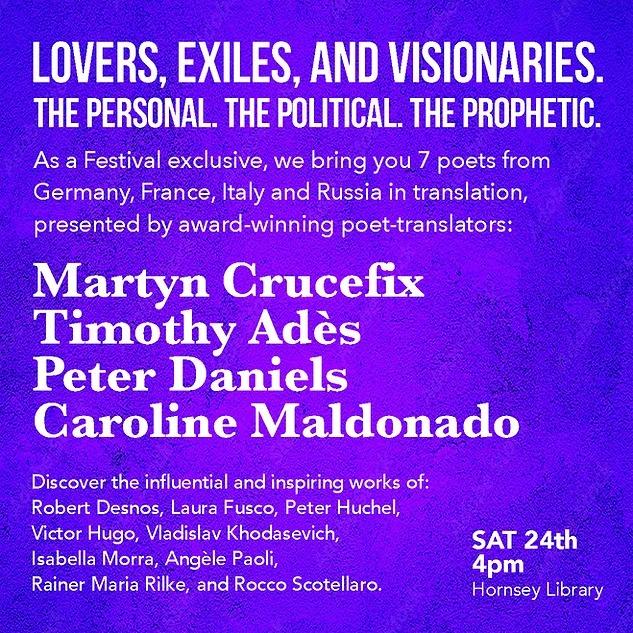
Rather late notice – not wholly down to my own tardiness – but I will be reading work in translation at the inaugural Crouch End Literary Festival this weekend. Do come along if you can. There are plenty of other events scheduled in the Festival, but this one is at 4pm on Saturday 24th February in the Gallery upstairs at the Hornsey Library Haringey Park, London N8 9JA (see map on location and how to get there). The event is free to attend and as you’ll see I am reading alongside poet/translator friends Timothy Ades, Caroline Maldonado and Peter Daniels. The poster, left, is not wholly accurate as I’ll be reading work by Rilke (Pushkin Press) and Peter Huchel (Shearsman Books) and not from my translations of Angele Paoli (that chapbook has been delayed at present). Tim will be reading from his Robert Desnos (Arc) and Victor Hugo; Peter is reading from his Vladislav Khodasevich and Caroline will (I think) be reading from her Smokestack books of work by Scotellaro and Laura Fusco.
Here are more details about the 4 of us:
Timothy Adès is a rhyming translator-poet with awards for, among others, the French poets – Victor Hugo (1802-1885) and Robert Desnos (1900-1945). Both were enormously prolific and engaged passionately with the issues of their times. Timothy is a much-praised translator with further published books from Spanish, French, and (coming soon) the German of Ricarda Huch. He runs a bookstall of translated poetry and is a member of the Royal Society of Literature and a Trustee of Agenda poetry magazine. His translations have won the John Dryden prize and the TLS Premio Valle Inclán prize. Find him on Facebook and YouTube and his website is http://www.timothyades.com
Martyn Crucefix is the author of seven original collections of poetry, most recently Between a Drowning Man (Salt, 2023) and Cargo of Limbs (Hercules Editions, 2019). Awards include an Eric Gregory award, a Hawthornden Fellowship, and the Schlegel-Tieck Prize for translations (from the German) of the poems of Peter Huchel. His translation of Rainer Maria Rilke’s Duino Elegies (Enitharmon, 2006) was shortlisted for the Popescu Prize for Poetry Translation. A major Rilke selected poems, Change Your Life, will be published by Pushkin Press in 2024. Till recently a Royal Literary Fund Fellow at The British Library, he also edits the Acumen Poetry Magazine Young Poets web page. Website at http://www.martyncrucefix.com
Peter Daniels’ most recent original books of poetry are Old Men (forthcoming, Salt 2024) and My Tin Watermelon (Salt, 2019). His acclaimed translations from the Russian of Vladislav Khodasevich appeared in 2023 from Angel Classics and was a Poetry Book Society Recommended Translation. Other publications include Counting Eggs (Mulfran Press, 2012) and the pamphlets Mr. Luczinski Makes a Move (HappenStance, 2011) and The Ballad of Captain Rigby (Personal Pronoun, 2013). Peter has won first prizes in the 2010 TLS Poetry Competition, the 2010 Ver Poets Competition, the 2008 Arvon competition, the 2002 Ledbury competition, and has twice been a winner in the Poetry Business pamphlet competition. Website at https://www.peterdaniels.org.uk
Caroline Maldonado is a poet and translator living in London and Italy. She has worked in community regeneration, in law centres and with migrants and refugees in London. She chaired the Board of Trustees of Modern Poetry in Translation until 2016. Publications of her own work include the pamphlet What they say in Avenale (Indigo Dreams Publishing, 2014) and a full collection Faultlines (Vole Books, 2022). Translations include Isabella (Smokestack Books, 2019). Other translations (all published by Smokestack Books) are poems by Rocco Scotellaro, Your call keeps us awake (2013), co-translated with Allen Prowle, and two collections of poems by Laura Fusco: Liminal (2020), which received a PEN (UK) Translates award, and Nadir (2022). More at http://www.poetrypf.co.uk/carolinemaldonadobiog.shtml
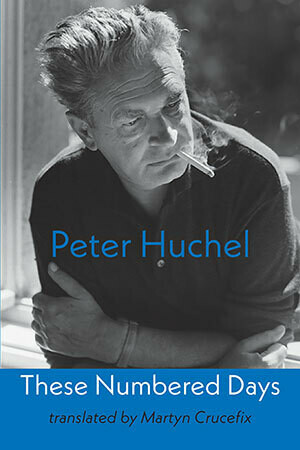
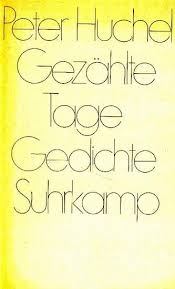
When Shearsman Books published my translations from the German of Peter Huchel’s 1972 collection These Numbered Days (Gezählte Tage), we were still in the early days of Covid restrictions and so launch events and so on were very difficult. I was pleased when the book was recognised in 2020 by winning the Schlegel-Tieck Prize for translation from German awarded by the Society of Authors. The judges were Steffan Davies and Dora Osbourne. Yet the wheels of reviewing such books turn very slowly. And I am pleased once more with the appearance of a lengthy review of the book by Frank Beck which has recently appeared in the excellent journal, The Manhattan Review, edited by Philip Fried. So, with due acknowledgements, I am reproducing Frank’s review here. Do check out his work and visit The Manhattan Review, an excellent US journal with a liking for pubishing reviews and work from the UK.
These Numbered Days (Gezählte Tage) by Peter Huchel, translated from the German by Martyn Crucefix and introduced by Karen Leeder. Emersons Green, Bristol, UK: Shearsman Books, 2019. 129 pp. $18.00 (paperback).
When poets look to the stars, often they are hoping to place their human worries in a wider context, in search of consolation. But what if they find, instead, that their concerns are reflected somehow in the sky overhead? Think of the famous fragment from Sappho: alone and unhappy, she watches the moon and the Pleiades descend together, like lovers lying down in bed. Readers may feel that something similar is happening in these lines from German poet Peter Huchel, as translated by British poet Martyn Crucefix:
Bent already by the night into his icy harness, Hercules drags the star’s chain-harrow up the northern sky. (p. 23)
When have we felt so much heft in the distant stars? We might well wonder what weight Huchel himself was bearing when he wrote this last stanza of his poem, “Under the Constellation of Hercules” (Unterm Sternbild des Hercules).
But first, let’s see how closely the English translation corresponds to the German stanza. Crucefix replicates Huchel’s pattern of three-beat lines, varied in line 3 with a two-beat phrase. He also makes use of the ready echoes some of Huchel’s words have in English: bent for gebeugt and icy for eisige. He creates a harsh music with chain-harrow, as does the clutter of consonants in Huchel’s Kettenegge. And Crucefix ties the stanza together with the r-sounds running through each of his five lines.
Of course, acoustics aren’t everything: this closing stanza owes much of its power to the two, less portentous preceding stanzas, in which the speaker describes a small, rural settlement, “no larger/than the circle/a buzzard traces/in the evening sky.” All we are shown of the place is a rough stone wall, “glittering water,” and the smoke from a fire, “cut through with voices,/none of which you know.” This sense of elemental conflict prepares us for the star-hauling of the final lines: even in the heavens, it seems, the grinding struggles of the universe go on.
In the German-speaking world, Peter Huchel is widely considered one of the finest 20th-century poets. He composed many of his poems out loud, rather than on paper, so their resonant language often seems, in the words of one critic, “as natural as air or breath.” Huchel is also admired for the way he endured years of harassment and confinement at the hands of the East German government. His reputation was consolidated in 1984, when Huchel’s poetry and prose were collected in two volumes, meticulously annotated by Axel Vieregg, a German scholar in New Zealand who had spent decades studying the poet’s work.
English translations of Huchel’s poems have been difficult to find, although selections of them were compiled and translated by Michael Hamburger and Canadian poet Henry Beissel. (This despite Joseph Brodsky’s enthusiastic endorsement of Huchel’s poetry in The Wilson Quarterly in 1994, accompanied by translations by Joel Spector and a full-scale biography by British scholar Stephen Parker, in 1998.)
These Numbered Days brings us graceful English versions of all 63 poems in Huchel’s 1972 collection, Gezählte Tage, the fourth of his five verse collections, published between 1948 and 1979. The translated poems appear side-by-side with the German originals. An introduction by Karen Leeder helps orient the English-speaking reader in Huchel’s world, while connecting his work with the most urgent issues of today. Crucefix’s fidelity to both the meaning and the manner of Huchel’s poems won his book the prestigious Schlegel-Tieck Prize for German Translation in 2020.
Huchel was born Hellmut Huchel in 1903 (the “u” is pronounced like the double vowel in moon), the son of a civil servant and his wife, from Lichterfelde, a Berlin suburb. Hellmut spent much of his youth on his grandfather’s farm in the nearby Brandenburg countryside, where he developed a feeling of deep kinship with the natural world. After studying literature and philosophy briefly, he lived in Paris for two years, then traveled extensively in Hungary, Romania, and Turkey.
In 1931, at the age of 28, Huchel returned to Berlin, first earning his living as an editor and then by writing plays for radio. He changed his first name to Peter and began to publish his poems in Dieliterarische Welt and other leading German journals. Those early lyrics often draw on his memories of country life, as in “Havelnacht,” which describes a night on the Havel River in Brandenburg. Here are the poem’s last two stanzas (my translation):
Scents of so many past years lean gently here, into the water. As we go quietly along, the night’s brew blows through us.
The greened stars are floating as they drip from the oars. And the wind cradles our lives, as it cradles willow and crane.
As beguiling as these images are, the poem’s effectiveness depends largely on its delicately deployed A/B/A/B rhyme scheme, which I have not tried to replicate. (The German poem might remind an English-speaker of Yeats.) Already, Huchel had acquired the technical mastery that the Swiss critic Paul Schorno would later describe as “certainty of what is being said through certainty of form.”
In 1941 Huchel was drafted into the Luftwaffe, where he served until being taken prisoner by the Russians. This led to his working for Radio Berlin in the Russian-occupied sector after the war; eventually he became its cultural director. In 1949, when the Federal Republic of Germany was established in western Germany and the German Democratic Republic in the east, Huchel was named editor-in-chief of the GDR’s new literary magazine, Sinn und Form (Sense and Form). Under his direction, it came to play an important role in East German culture and even earned an international reputation.
Peter Huchel
However, Huchel’s interest in the diverse contemporary poetry flourishing abroad in those years was fundamentally at odds with Communist Party ideology, and he repeatedly came into conflict with party officials. In 1962, as East Berlin was sealed off from the West by a wall, Huchel was dismissed as editor of Sinn und Form. He was forbidden to publish in East Germany or to travel, and, along with his wife, Monica, a translator of Russian, and their son Stefan, was placed under round-the-clock surveillance at their home in Wilhelmshorst, near Potsdam.
The poems in These Numbered Days were written during the subsequent nine years, as Huchel remained under virtual house arrest. (Several of them were published in West Germany during the poet’s confinement; others appeared in English-language journals in Henry Beissel’s translations.)
In these poems, the rich, rhyming music of Huchel’s early poems is replaced by a spare but flexible flow of language that can contract to a beat or two or relax into longer lines. One of the book’s finest poems considers how the work of “The Dipper” (Die Wasseramsel), a small bird that feeds along the banks of rushing streams, resembles the poetry Huchel now wants to create:
If I could plunge brighter downwards into the flowing darkness
about me to fish out a word
like this dipper beside the alder boughs picks its food
from the stony river bed.
Gold-panner, fisherman, relinquish all your gear. The shy bird
looks to work without a sound. (p. 45)
Few poems in the collection deal with the Huchels’ troubles overtly. When they do, the tone is wry, refusing to reward oppression with anger. Even as the house around him deteriorates, presumably because repairs are not permitted, the poet declares, “I will not write/the names of my enemies/on the spongy wall” (“Weeds”). One has the sense of a man and his poetry being tested and determined not to fail. That includes trying to heed the advice offered to Huchel in a song by his friend, Wolf Biermann: “Do not become embittered/in this embittered time.”
Huchel’s few visitors in Wilhelmshorst had to subject themselves to police surveillance, with all the attendant risk in such a police state, or to approach in secret, under cover of darkness, as Huchel describes in “Weeds”:
Guests are always welcome, those who love weeds, those who do not shy away from stony paths over-grown with grass. No one comes.
The coalmen come — from their filthy baskets they pour the lumpen black grief of earth into my cellar. (p. 123)
Huchel is still the keen observer of nature he was in his earlier books, but the natural world that once buoyed and nourished him now often mirrors his constricted situation, as in “Exile”:
Come evening, friends close in, the shadows of hills. Slowly they press across the threshold, darkening the salt, darkening the bread and with my silence they strike up a conversation.
Outside in the maple the wind stirs: my sister, the rainwater in the chalky trough, imprisoned, gazes up at the clouds. (p. 27)
Yet such confessions — even any use of personal pronouns — are scarce in these poems. Sometimes main verbs disappear, and the lines rely on gerunds and participles to move them forward. What is always present is Huchel’s patient watchfulness, often refracted through history and myth, as in his image of Hercules climbing the winter sky. With all roads around one blocked, the mind’s pathways become more important than ever, and allusions abound here. These poems reach out to the poet Alcaeus (a contemporary of Sappho), Tang dynasty writer Pe-Lo-Thien, Shakespeare, Kierkegaard, Virginia Woolf and other writers past and present.
Another connection that sustains Huchel, though more fleetingly, is his memory of happier times, especially his travels in the Mediterranean, as in “Dolphins”:
Gazing out across the sea in white sunlight I saw them leap above the salty weight of the water — dolphins,
my secret brothers, carrying my messages to Byzantium. (p. 91)
Such flashes of joy are tempered by the narrow confines of the Huchels’ lives. In “Hubertusweg” (the name of their street), the poet wonders about the policeman standing guard outside his house in the rain (“What’s in it for him . . . ?”) and then considers the vulnerability of each person before a totalitarian state (“The state’s a blade;/the people thistles.”) Yet even totalitarian states have a life-span. Huchel sees his son reading a cuneiform text about “the peaceful campaign” of the Bronze Age ruler, King Keret, and his poem concludes:
On the seventh day, as the God IL proclaimed, a hot wind blew and drank the wells dry, the dogs howled, the donkeys cried out with thirst. And without the use of a battering ram the city surrendered. (p. 121)
In 1971, in response to efforts by Heinrich Böll, Arthur Miller, Henry Beissel and others, the GDR allowed Peter Huchel and his family to emigrate to West Germany. He continued to write there until his death, in 1981. Eight years later, the Berlin Wall fell without a shot’s being fired, and Germany was soon reunited. The Huchels’ house in Wilhemshorst, where these poems were written, is now a writer’s center, sponsored by the state and local governments.
Today the once-divided city of Berlin is one of the most vibrant places in the world. Huchel’s poetry is still in print and still read, and, at number 10, Hanseatenweg, near the Tiergarten, Sinn and Form keeps producing new bimonthly issues, very much along the editorial lines Huchel had in mind. Thus far this year, alongside work by and about German-language writers, the journal offered its readers articles about Jorge Luis Borges, Clarice Lispector, Marcel Proust, Marina Tsvetaeva, and Adam Zagajewski.
—Reviewer Frank Beck is a writer and translator and serves as a trustee for Elgar Works, which publishes the scores of Edward Elgar. His recent thoughts on poetry and music can be found at WWW.DIEHOREN.COM.
‘I always write that which is not’ says one of Alireza Abiz’s poems, because ‘[t]hat which is is too terrifying / to wear the garment of the word’. To understand what Abiz means here – how can / why should a poet avoid writing of what is real? – we have to understand his historical and political contexts.
Abiz belongs to the 1990s generation of Iranian writers. The unattributed Introduction to The Kindly Interrogator (Shearsman Books, 2021) provides help for those of us who don’t know much about the development of modern Iranian poetry. It was Nima Yushij who, at the opening of the twentieth century, felt the then-current forms of Persian poetry had become too abstract, subjective and metaphysical. He advocated a more modern, objective approach, a more natural diction and the use of forms closer to what we would regard as blank verse. By the 1960s such freshness and freedom had yielded some of the best modern Persian poets, writing diversely, mostly in free verse. But both before and after the 1979 Revolution (which replaced a millennia old monarchical system with the Islamic Republic), poets continued to engage in political struggles and were often prosecuted by the authorities for their writings. Following 1979, and during the 8 years of war with Iraq, the artistic atmosphere continued to be both difficult and repressive.
The political reforms of the 1990s – Abiz’s period – saw a new optimism and revival in the arts, yet still prosecution and censorship remained a fact of life. Many artists left Iran and – especially after the 2009 uprising – there was a considerable migration into exile. Though currently resident in the UK (he lives in London and has a Creative Writing doctorate from Newcastle University) Abiz does not consider himself an exile as such, though inevitably his perspective has an ex patria quality, looking both dispassionately at Iran’s nature and continuing development, as well as harking back to an affective homeland.
Alireza Abiz
In these translations by the author and WN Herbert, Abiz’s free verse poems are not always reluctant to address realities, but they do tend to deploy (what the Introduction calls) a kind of ‘dialled-down or even buttoned up surrealism’. ‘The Tired Soldier’ is brief and universal. His weariness is symptomatic of a lengthy war, as well as his disillusionment with it. Jackals wail, bugles “cough” like roosters – the real and figurative creatures here close to anthropomorphic portraits of societal/political elements, close to the derangement of the surreal which is also signaled in the soldier’s action which (besides the obvious disrespect for his military service) involves an overturning, a literal inversion (feet to head, head to feet) of the norm:
The tired soldier
hangs his boots around his neck
and pisses in his helmet.
The surreal is inevitably emergent when we cease to trust our senses, or our interpretation of what we think we witness (think of Rene Magritte’s Ceci n’est pas une pipe). A black cat watches the narrator from the veranda. Given a political context in which persecution (even elimination) has become common currency, the narrator seems to fear for his own life:
It’s been a long time since I was a sparrow,
since I was a dove,
even since I was a backyard hen.
The sense of danger and paranoia here is obvious, but perhaps vague enough, quirkily surreal enough, to elude the censors. The Introduction suggests parallels with the Menglong Shi or so-called ‘Misty Poetry’ generation of writers in China in the 1980s. Then, the ‘Misty’ handle was initially a disparaging one given by officially sanctioned reviewers, suggesting these writers were creating ‘obscure, vague, incomprehensible work’ (for a good account of these issues see Yang Lian’s introductory essay to Jade Ladder: Contemporary Chinese Poetry (Bloodaxe, 2012) edited by WN Herbert and Yang Lian). But their obscurity was only really in comparison to official Chinese poetry of the period full of banal (but never obscure) sloganizing about the virtues of Socialism and the evils of Capitalism. Yang argues the mistiness of the new 1980s Chinese poets was really a return to ‘Sun, Moon, Earth, River, Life, Death, Dream’ – to the territory of Classical Chinese poetry (Li Bai and Du Fu), though often encoded within it were observations about contemporary political life. So also with Abiz’s poetry in which images of ‘doves, rabbits, ghouls, lemons, feasting, wine’ develop and imply their own slant or misty significances.
Inevitably, death and the threat of it is a preoccupation of many of these poems. The mundane incident of a fly buzzing in a kitchen leads to a meditation on conflict, guilt and futility. Looking through a window into ‘The Anatomy Hall’, the narrator sees a surgeon? a mortician? a torturer? leaning over a body on a table. He senses the man’s fear; he glimpses the flash of a knife. Then:
He bends over my head and smiles,
looking at me like a butcher looks at a carcass.
X
On the table in the middle of the hall,
relaxed, I sleep.
The relaxation of the victim comes as an additional surprise, but it gestures towards the sense of complicity that is another of Abiz’s concerns. A lengthy quotation in the Introduction, which I take to be in Abiz’s own words, argues: ‘the corrupting influence of dogmas is so insidious that no-one remains entirely innocent, or, if carried along by the paranoias of ideological purity, should be considered completely guilty’.
W N Herbert
So in ‘The Informer’ the narrator (in a Kafkaesque sort of world) has been invited to attend a ceremony to select the ‘finest informer’. There appears to be a confident pride in the way he dresses up for the occasion. In the hall, the candidates (those you expect to be on the ‘inside’) are in fact excluded. It turns out, in a detail suggestive of the elusive nature of truth and the levels on levels of surveillance in such a repressive society, that all the seats are to be taken ‘by the officers responsible for informing on the ceremony’. There is a calculated bewilderment to all this as is also revealed in the oxymoronic title of the eponymous poem, ‘The Kindly Interrogator’. Nothing so simple as a caricatured ‘bad cop’ here:
He’s interested in philosophy and free verse.
He admires Churchill and drinks green tea.
He is delicate and bespectacled.
He employs no violence, demands no confession, simply urging the narrator to ‘write the truth’. The narrator’s reply to this epitomises the uncertainties a whole society may come to labour under. He cries, ‘on my life!’. Is this the ‘I will obey’ of capitulation or the ‘kill me first’ of continued resistance? Is this the repressed and persecuted ‘life’ of what is, of what is the case, or an expression of the inalienable freedom of the inner ‘life’? Abiz is very good at exploring such complex moral quandaries and boldly warns those of us, proud and self-satisfied in our liberal democracies, not to imagine ourselves ‘immune from [the] temptation towards unequivocality’. Fenced round with doubt, with a recognition of the need for continual watchfulness, with a suspicion of the surface of things, perhaps these poems never really take off into the kind of liberated insightfulness or expression of freedom gained that the Introduction suggests a reader might find here. Abiz – the ‘melancholic scribbler of these lines’ – is the voice of a haunted and anxious conscience, a thorn in the side of repressive authorities, as much as a monitory voice for those of us easily tempted to take our eye off the ball of moral and political life nearer home.
Martyn Crucefix is our headline reader. His recent publications include Cargo of Limbs (Hercules Editions, 2019), These Numbered Days, translations of the poems of Peter Huchel (Shearsman, 2019), which won the Schlegel-Tieck Translation prize 2020, and The Lovely Disciplines (Seren, 2017). O. at the Edge of the Gorge was also published by Guillemot Press in 2017. Martyn has translated the Duino Elegies – shortlisted for the 2007 Popescu Prize for European Poetry Translation – and Sonnets to Orpheus by Rainer Maria Rilke and the Daodejing – a new version in English (Enitharmon, 2016). He is currently a Royal Literary Fund Fellow at The British Library and blogs regularly on poetry, translation and teaching at http://www.martyncrucefix.com
Main Reader – Martyn will read both original poems and from his Schlegel-Tieck Translation prizewinning book of Peter Huchel’s work.