The Soviet Briar: poems of Vladislav Khodasevich

In the light of recent political events in the UK, it seemed important to be thinking about wider perspectives this week – Europe, Revolutions, the role of poetry. The poems of Vladislav Kodasevich came easily to mind and I have wanted to praise Peter Daniels’ translations of them for a while now.

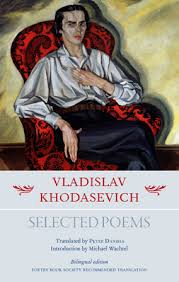
What emerges from Peter Daniels’ Vladislav Khodasevich: Selected Poems (Angel Classics, 2013) is a vivid picture of a poet who was, both by temperament and historical circumstance, very much an individual. From a Lithuanian Polish background, coming to creativity at the fag end of Symbolism, witnessing Russia’s revolutionary year of 1917, going into permanent exile in 1922, Khodasevich (1886-1939) was perhaps inevitably a writer with little sense of belonging, of sure identity. It’s no surprise that he plays with images of doubles, often standing outside himself, then counters such doubts with rather grandiose claims to his poetic vocation.
imgres

The consequent difficulty of pigeon-holing him as a poet is one of the reasons why he is less well-known than his more familiar contemporaries – Mandelshtam, Akhmatova, Tsvetayeva and Pasternak. He is also difficult to pin down because he is “a modernist, but with a classical temperament” (Daniels’ Preface). In a period when others were tearing up rule books (poetical and political) Khodasevich harks back to the “eight little volumes” of Pushkin’s works. Amongst the ruck of Symbolists, Acmeists, Futurists and Cubo-Futurists, Khodasevich’s poems mostly retain traditional forms and he proudly declares: “I grafted the classic rose / to the Soviet briar bush” (‘Petersburg’). Such formalism presents great challenges for the translator, of course, with Khodasevich flaunting his conservative and poetic concerns – “O may my last expiring groan / be wrapped inside an articulate ode!” – and, like many before and since, he argues such formal frameworks are paradoxically the way to find release. (Carol Rumens has discussed some formal aspects of a Daniels/Khodasevich poem for The Guardian). Curiously, his last ever poem was in praise of the iambic tetrameter, the classic metre of the Russian tradition:


Its nature is mysterious,

where spondee sleeps and paeon sings,

one law is held within it – freedom.

Freedom is the law it brings . . .
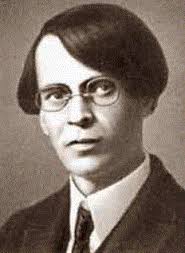
imgres
Vladislav Khodasevich

If Khodasevich uneasily straddles a variety of poetic strategies, there is a fascinating parallel to this in his views on self and society. The self is at one moment urged to “be a star that breaks away from the night” but in the next is “grunt[ing] to yourself, / looking for spectacles or keys”. This “usual self” is preoccupied with tarnished spires, the tops of cars, old iron eaves, and in ‘Berlin View’ sits shivering and sneezing in a café, surrounded by “plate-glass” reflections of itself. A couple of years later, at what seems a Dantesque ‘mid-point’ in his life, Khodasevich stares hopelessly into a mirror: “Me, me, me. What a preposterous word! / Can that man there really be me?” This is the Modernist side of the poet, observing from “the gutter”, watching a sordid Parisian cabaret, a dismal demi-monde of “tinselled chaos”. Yet the poem quoted here – ‘The Stars’ – goes on to suggest our gaze may sometimes incline upwards, “from the horizon to the stars” and – at least on occasions – we are aware of a “starry universe in glory / and the primordial loveliness”.
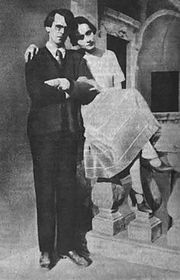
180px-Hodasevich_Berberova
Khodasevich and Nina Berberova, Sorrento, 1926

This suggests Khodasevich was still enough of a Symbolist to see the poet’s role as seeking out such “loveliness”, the transcendent within the quotidian (as Michael Wachtel’s Introduction defines this key Symbolist intent). This accounts for Khodasevich’s repeated images of stars often unseen above us (but still there) and also of the flourishing of seeds in the earth as an image of personal and social growth. The title poem of The Way of the Seed (1920), in rhymed couplets, describes the traditional sower, with seed gleaming golden in his hand, but scattered into “the blackness of the land”. There it finds “its moment for dying, and for growth”. Latterly, the poem suggests this is also the path of the “soul” as well as “my native country, and her people”. This nicely sums up Khodasevich – the progressive conservative, these organic and traditional images of the farmer absorbed into bold ideas of growth and change incorporating both a dying back and re-birth. A similar pattern is reflected in ‘Gold’ – a coin is placed into the mouth of a corpse, buried, and after many years, in the unearthed skull, the coin is found again, rattling: “the gold will flash in the midst of bones, / a tiny sun, the imprint of my soul”.
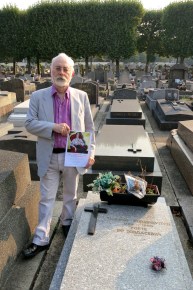
img_0011a
Peter Daniels at Khodasevich’s grave

It is in such longevity, such insightfulness that continues to be true, that Khodasevich finds reasons to celebrate the poetic vocation. Though the names of the dead who fell at the Battle of Khotin (1739) are forgotten, “the Ode upon Khotin” by Lomonosov is still recited. ‘Ballad of the Heavy Lyre’ opens with Khodasevich in the Soviet-run House of the Arts, surveying his life and finding it “worthless, a quagmire”. But eventually verses burst from him till “a galaxy streams at my head” (those stars again) and a heavy lyre is mysteriously thrust into his hands and, in the final line, he understands this is the lyre of Orpheus. Written in 1921, this poem foreshadows Khodasevich’s departure from the Soviet restrictions in the following year with hopes (one imagines) of further freedoms to be enjoyed.

I was especially interested in the seven substantial blank verse poems Khodasevich wrote in a brief period between 1918-20 (David Cooke’s review of the book for London Grip makes the same observation). These in particular bring to mind the modernist-conservatism of Robert Frost (whose two first books were published in 1913 and 1914) and it’s astonishing that Khodasevich did not pursue these successful experiments with a less formal verse that seems an ideal vehicle for his quiet observational voice, his sense of the mystery or beauty that lies beneath the ordinary, his observations of a provisional self often encountering an unstable, uncertain world.

‘An Episode’ appears to record, moment by moment, an out-of-body experience Khodasevich had in 1915 (these blank verse poems are always keen to name times, places, people). At one moment, he sits before a shelf of books, at the next he is gazing at himself as if looking at “a simple, old, old friend”. The transitional moments are evoked through the marvellous image of feeling like a “diver, plunging to the deep, [hearing] / the running about on deck and the shouts / of the sailors”. ‘2nd November’ describes the aftermath of revolution – again the precision of street names, people’s responses as they emerge into the smashed and bullet-scarred streets makes this read as a very contemporary poem indeed. The narrator watches a neighbour, a joiner, building a coffin and painting it: “under the brush / the boards were turning crimson”. But the golden seed in black earth comes to mind again as a child is observed – a “four-year-old, chubby, in a flap-eared hat” – who manages a smile as if listening to Moscow’s “beating heart, / the moving fluids, growth” though for the narrator even Pushkin’s beloved works, on this occasion, fail to alleviate the shock of political change.
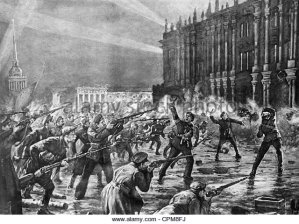
october-revolution-1917-cpm8fj

The unresolved tensions Khodasevich manages to hold together in these blank verse poems create a very modern impression. Another child appears in ‘Midday’, the narrator sitting in the most ordinary street scene, recalling a visit to Venice, fleeting glimpses of those “incandescent stars” once more. ‘An Encounter’ drops the star images for a more conventional image of beauty or inspiration, a “lovely English girl” glimpsed in Venice with its “black gondolas, / the fleeting shadows of pigeons, and the red / flow of the wine”. The extraordinary poem ‘The Monkey’ replaces the stars and the girl with the bizarre image of a tame monkey in a “red skirt”, led on a chain by an itinerant Serbian man (a much inferior translation of this poem by Alex Cigale can by read in The Kenyon Review). After a drink of water from a bowl, the monkey offers “her black and calloused hand” with such “nobility”. It’s the realism of the setting – the heat, the cock crow, the dusty lilacs – that enables Khodasevich to anthropomorphise the animal to such an extent and get away with it. It becomes another epiphanic moment in which the transcendent emerges from the quotidian. Here, a great chain of brotherhood seems implied and this makes the final line all the more devastating: “That was the day of the declaration of war”.

images

The two most Frost-like of these blank verse poems describe respectively a derelict house and a couple of neighbours chopping wood. ‘The House’ leads to reflections on transience, whether for a “palace” or a “shack”, the sudden advent of “war, plague, famine, or civil turmoil”. Such contrasts are again viewed from an Olympian height, an aloofness which has more negative capability about it than unfeeling Modernist cynicism. An old woman appears, scraping a living, and rather than pass judgement on her or her fate, the narrator joins her in stripping useful materials from the ruined house: “in pleasant harmony / we do some of the work of time”. A green moon rises ambiguously over the scene, casting light over a “tumbled” stove.  Khodasevich’s rich embrace and acceptance are also evident in ‘The Music’ as two neighbours chop wood. One suddenly claims to hear music but try as he might the other cannot hear it. In ‘Mending Wall’, Frost’s narrator likewise teased his farmer/neighbour and drew from him an old saying: “Good fences make good neighbours”. Khodasevich’s poem yields only a sense of earthly work well done together, the remoteness of the sky (from which perhaps that music fell), the clouds passing onward as “feathery angels”, or perhaps they are really no more than clouds.

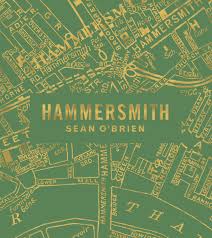
imgres

England is Finished: Sean O’Brien’s ‘Hammersmith’ reviewed

In the week of the EU Referendum it seemed appropriate to review a beautiful little chapbook by one of the UK’s most prominent poets, Sean O’Brien. Appropriate because it is a book exploring both personal and national identity, issues of migration and how new lives are begun in a new country. In particular it is a work always aware of the need for – and the difficulty of – pragmatism, honesty and truth in both personal and political worlds. Whether it is our own or our nation’s past or future, the idealism or fundamentalism of the simplistically pure, clear and incontrovertible is a false god. Worship at such an altar is the old fearful yearning for security in a world that simply is both contingent and mysterious and can only possibly be faced with a sense of compromise, processes of negotiation.

images

Beside a photograph of his own 1952 birth certificate, Sean O’Brien’s foreword to Hammersmith (Hercules Editions, 2016) ponders other people’s interest in their family histories. Perhaps our ancestors “underwrite” our lives in a way we cannot do for ourselves – in ways religion might once have done. But O’Brien assures us the two cantos (of what seems to be a longer sequence of poems yet to appear) are more the “work of the imagination” than anything narrowly documentary. He alludes to Robert Lowell’s dictum – “why not say what happened?” – only to dismiss it, suggesting Hammersmith aspires more to the condition of a dream or reverie.

If this is teasing, then it continues into the poem. With a neat circuitousness, O’Brien’s rhyming alter ego, Ryan, wanders the streets of Hammersmith recalling his parents early days and places (days and places shared with O’Brien’s own mother and father), yet his search is an endless deferral, not arriving at any clear goal, a sense of not belonging which (the Foreword has already told us) is precisely O’Brien’s experience of London: “I never feel entirely present there”. So the irresolvable uncertainty about one’s true self is re-evoked here along with a scepticism about how far delving into ancestry can really help with it and this narrative set-up allows O’Brien to pursue the dream-like interweaving of reality and imagination which has become more familiar in his work since The Drowned Book (2007). It goes without saying that this fantasmagoric journey also takes the poet back to that post-war era that so fascinates him: “a place forever on the cusp of realising the welfare state” (from Ben Wilkinson’s Guardian review of The Beautiful Librarians).

imgres

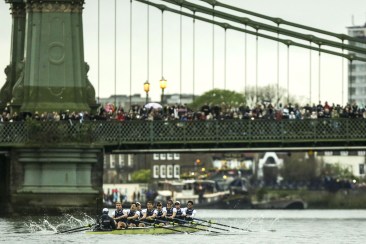
Mixing the personal, the historical and the political, most of the optimism of that earlier time has gone. Canto 1 opens dismissively: “England is finished”. Initially this seems about to be cast as an epic/tragic moment as a rower in the University Boat Race catches a crab and, amidst allusions to the “fields of Hades”,  is compared to Palinurus, Aeneas’ drowned steersman from Virgil’s Aeneid Book 6. But within a few lines, the oarsman recovers and the incident ends only in petty recriminations and unsportsmanlike appeals to umpires – more comedy than tragedy, more satire than epic. The narrative voice concludes: “I’m losing my faith in this annual fiction”. Like Aintree and Wembley, those great sporting occasions that at least gave the impression of a nation united, a clearer sense of self-identity and “name”, the Boat Race too loses its power to inspire a faith in a certain type of Englishness, “a special and definitive order of reality” (Foreword).

BoatRace-Tatler-7apr15_rex_b

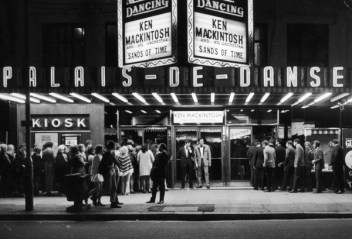
Perhaps it’s not wholly clear if this “order of reality” ever had any real existence and was lost, or whether the narrator lived the delusion of it briefly that was then corrected by his growing understanding of the significance of “class, the major stench of things”. And perhaps this is why the poem swings from imagined images of the 1940s and 1950s Hammersmith to the wanderings of Ryan/O’Brien in more contemporary settings (another photo in the chapbook is clearly O’Brien taking a selfie reflected in an underpass mirror). Canto 1 now more securely pursues the past, describing a young woman (the future mother) as nurse, teacher, doing the “pallais glide”. Such remembrance is labelled the “trap of elegy” at one moment. Ryan is caught in it and “Nor am I out of it” says another voice (O’Brien?) echoing Mephistophilis in Marlowe’s Doctor Faustus, that moment when he reveals the omnipresence of Hell.

HammersmithPalais_London_1970

What develops is a passage of a more documentary type (though no doubt the details are largely imagined) with an Irish ancestor stepping off the train at Euston, finding a room to rent: “Oh loneliness, your name is Hammersmith”. But canto 1 ends with an outbreak of irregular rhyming (the poem is written in triplets throughout) which holds together, as if in successful solution, references to Aneurin Bevan and Stafford Cripps, the ill-fated groundnut scheme of the late 1940s, Caliban and Ariel and a (more personal sounding) naïve, nursery-rhyme passage about “the boy with the curly brown hair”, who is perhaps the future father-to-be.

Canto 2 opens (having caught the habit of rhyme from the end of the preceding Canto) with another vision of the transience of London life, especially for migrants: “no fixed abode, where is no stay, / Not known at this address, / Or never known, or went away, // Gone where the post eventually goes”. This is both the contemporary figure’s fruitless search for an ancestral past as well as the post-war migrant’s experience where the world the nation fought for “admits / No Blacks and no dogs and no Irish”. There are passages here out of Dante, out of Yeats in which spectral figures go dancing through London streets “into Ravenscourt Park” and beyond the District Line. Once again, Ryan/O’Brien re-surfaces with a fierce thirst for Guinness which might “re-enchant / A world that is always and only prose”.

imgres

The earlier allusion (“where is no stay”) to Robert Frost’s comment that poetry can act as a “momentary stay against confusion” is repeated again in the context of what looks like suicidal thoughts, a personal as well as political history: “Here there is nowhere. Here is no stay”. It turns out the Ryan character has an engagement to read poems to an audience but the tone here is angrily dismissive (“Who gives a fuck?”) and heckled abuse from an audience is deemed appropriate somehow, the only thing to make sense “of a dying art”. O’Brien’s casting doubt on the efficacy – the very purpose – of poetry in the context of an ambitious poetic project like this might seem perverse but is perhaps just another de-stabilising element in the whole where past and present, political idealism and cynicism and failure battle it out across the fluid fields of the poet’s observation, memory and imagination (and anyway, if this is the opening of a long poem, this may not be the last word on the subject).

imgres

The poet’s heart seems most passionately engaged in passages concerning the mother figure, but Canto 2 ends, as did Canto 1, with allusions to the father. Like the son, he too seems to have looked always “for a sign”, for meaning in the bewildering flood and flow of the city’s life. What seems to be O’Brien’s pessimism again re-surfaces: “You will fail / Like your father before you”. The failure will be to “name” the waters (this leaves me thinking of Keats’ epitaph: one whose name was writ on water). The father’s ambition apparently yielded nothing more than a “suitcase – / Poems and politics, no fixed address” and later “Madness lay in wait”. Yet the narrative voice offers up the idea of witness, even if this does not lead to reassuring certainty: “You will lower your face to the water, // And through it, and open your eyes.” This is reminiscent of O’Brien’s poem ‘Cousin Coat’ with its self-urging to “Be memory, be conscience, will and rage” and to remain “cold and honest”, though since those lines were written in 1987 O’Brien’s range has continued to widen so that honesty in terms of documentary/historical evidence now also has to face new challenges, new types of honesty with regard to the imagination, in part those in-filling processes of personal memory, the making-up of our own past which many of us hope “underwrites” the people we have become.


tree in railing


Everything Burning: Review of Maitreyabandhu’s ‘Yarn’

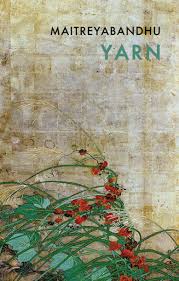
I love to follow the development of a poet’s work. This is often imaged as the finding of a voice but is really a process in which the poet brings into focus what centrally concerns them and sheds what is extraneous. A recognisable voice may be a secondary consequence of this but it is achieved through technical advances and deep thought about poetic predecessors and possible role models. Maitreyabandhu’s second collection, Yarn (Bloodaxe, 2015) is fascinating from this perspective.

images

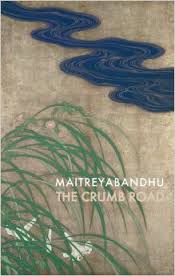
Born Ian Johnson in Warwickshire, Maitreyabandhu was ordained into the Triratna Buddhist Order in 1990. I once started a review of James Harpur’s  Angels and Harvesters (Anvil, 2012) by saying that I wanted contemporary poetry to address spiritual matters, so I was obviously excited to get hold of Maitreyabandhu’s first book, The Crumb Road, when it appeared in 2013. Given my rather narrow line of expectation, I suppose was a bit disappointed. But the book is full of vivid colloquial detail, many poems about childhood and a moving account of a homoerotic relationship between two young boys which ends with the death of one of them. The crumb road of the title is the Hansel and Gretel trail back to the past rather than a trail of stations towards spiritual enlightenment, though ‘Visitation’ is an awed encounter with something like that: “I saw you, in the mess of things, / [. . .] as a slant of grey”. The book was a PBS Recommendation, rightly praised for its melancholy modesty, quiet expression, its alert and attentive qualities, its models evidently Edward Thomas and Thomas Hardy.

imgres

Yarn develops similar materials. Maitreyabandhu’s poetic technique is even more evident in the range of forms – free verse, rhyme, prose poem, blank verse – employed to great effect. The Warwickshire childhood features again in a section called ‘The yard’ with the father’s wine-making – damson, raison and berry – and his war service, the mother’s involvement in the coach driving business, school, various distant relations. The first book’s portrayal of young love cut tragically short is echoed here in an elegiac sequence to a Buddhist friend, Mahananda. This man’s longer life (his mother’s flight from the Gestapo, his conversion to Buddhism, living in Primrose Hill, his friendships) is touchingly evoked and it is a thoroughly grief-stricken sequence: “what can I conclude on your departure? / that nothing came of it, with everything, / everything undone” (‘Souls’).

url
Ryokan

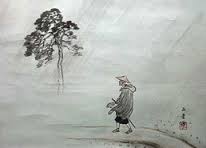
There is a curious echo of this latter phrase in a poem about the Zen Buddhist monk/poet Ryokan for whom the temple bell and old books seem to say “how everything is burning”. Such a sense of the ultimate insignificance of earthly things arises elsewhere in this book and Maitreyabandhu explores such spiritual issues more explicitly here than in The Crumb Road. Though there is often a strong response and pleasure in the natural world, ‘These Days’ suggests “our human calculus precedes / the given world” to negative effect. There is a fearful recognition that what we contribute amounts to no more than “error bred in the bone, the daily rancour / of the mind, / our clever ways to be unkind”. But the erasure of those things that we cling too can be almost as frightening. Nietzsche’s ‘The Parable of the Madman’ (1882) is alluded to, a sponge wiping away the “entire horizon”, yet the consolation (as in the death of a valued friend) can be hard to access: “I strained to see Vajra Guru’s face”. Perhaps the character in ‘The Postulant’ has “closed his eyes on this world” more successfully:


When night fell, the space between two worlds

Was all the shape he made, an empty dark [. . . ]

What he thought to be himself he didn’t know:

His pain was all that stopped the worlds unite.


But inevitably, what is ultimately not graspable in words is hard to write about and Maitreyabandhu’s often chosen model (the rhyming, song-like lyric voice) can lead to a mellifluousness that over-sweetens a poem, especially when trying to evoke more successful intuitions of “the Lotus Born” and the “illumined image” (‘The World of Senses’).

buddha-225x300

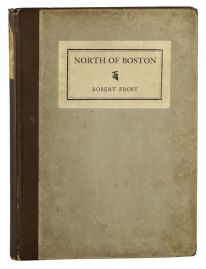
But Yarn contains three long yarns or stories in which the voice of the teller plays at least as much part as the narrative of events. This is what is new and particularly exciting in this book and reveals the influence of Robert Frost (not Edward Thomas who tried this early on with ‘Up in the Wind’ (1914) and then dropped it as not fit for his own purposes). Frost’s eclogues (especially in North of Boston (1914)) manage to convey a bleak, anti-pastoral, godless, modern world of death and often inexplicable suffering. One similarity is that ‘The Cattle Farmer’s Tale’ is spoken by a proprietorial, rather self-satisfied farmer (read Maitreyabandhu on the influence of Frost here). Like Frost, Maitreyabandhu immediately catches character and voice brilliantly. He encounters a mysterious figure: “his not pretending / to be meek or grateful to set me at my ease / and, funny thing, it stopped me in my tracks / so for a moment I stumbled on my words”. This is so like Frost’s ‘Death of the Hired Man’ – the enigmatic visitor, the farmer and his wife, the carefully sketched context, the skilful handling of dialogue in blank verse. Maitreyabandhu adds a few songs too but this is in no way a pastiche but a development of a neglected form for different purposes. The visitor is in fact Buddha and though he talks in cryptic terms, the farmer’s rootedness in the land, his evident pride in his worldly achievements, his bossiness followed by regret in dealing with his wife serve to make the Buddha’s pronouncements palatable in the poem’s world:


There are two thoughts, Dhaniya [. . .]

one leads to suffering, the other to joy.

The first is yoked to yearning like a calf,

a suckling calf that’s yoked unto it’s mother,

the other’s like a shadow that never parts.


So this really is the cattle farmer’s tale – his response to his encounter with a wholly different set of values (he and his wife are in fact deeply impressed by the visitor who stays for a month). The form of the poem allows the reader room to be sceptical in our modern fashion but also to be moved by the insights and wisdom (old fashioned word) being offered.

140905019

The second yarn, ‘The Travellers from Orissa’, is even more ambitious. Bhallika (the narrator) and Tapussa are again farmers, cattle men, who encounter Buddha in their younger days. Bhallika is again a sceptical voice (“I’m not a fool”) but is nevertheless impressed by the Master, who “spoke in a funny way with gaps / between the words as if he’d just been woken [. . .] his smile, / I shan’t forget, was like gazing at the sea”. But this is not an experience he can easily share with others and he resolves to “keep it to myself”. Tapussa’s response is quite different. The poem makes it clear Tapussa’s character inclines him to “yarns” and in the telling they grow “more fantastical each time”. His response to the meeting with Buddha is to cast himself as the rather attention-seeking disciple, who succeeds in becoming something of a cult figure: “his nodding head, how he held his finger up / each time he spoke to emphasise each word”.

But Tapussa dies, as does Bhallika’s wife and the widower lives on quietly, distantly aware of the Master’s growing fame and influence. At last he meets him again: “I said ‘Master’ before I knew I spoke”. Only now does Bhallika share the details of the original meeting with his son. In fact Tapussa had failed to understand, turning “the whole thing upside-down” to make it all “about himself”. What is moving in this yarn is the fact that Bhallika evidently understood the Buddha’s message (“There is a thorn buried / in the heart of man”) but with his commitment to wife and family and land he “walked back into [his] own life and tried to take it up”. Even years later, he understands “I’d betrayed my life” on that day and with that decision.

imgres
Coleridge’s Mariner and Wedding Guest

Such false and true followers feature in the third yarn too though the human situation is even more finely drawn and prevents any simplistic response to the questions it raises. In a still sketchy but more Westernised context (Sunday morning church) it is ‘Aaron’s Brother’ who narrates. Like Tapussa, it is Aaron who is the more overtly spiritual figure, famously suffering visitations and visions. But there is again a self-regarding quality in the way he readies himself for church before the mirror, “combing his hair”. The story is told to an unnamed guest – there’s much of Coleridge’s Ancient Mariner here – who is eager to speak to Aaron and not much interested in his brother. But the brother is in fact adopted and has further secrets to disclose of a homoerotic love between himself and Aaron and (he implies) this partly fuels Aaron’s interest in his young male acolytes.

The treatment of these ingredients of a far grander and dramatic tale than Maitreyabandhu wants to develop suggests a powerfully imaginative act by the poet, the kind of thing Keats admired in Shakespeare. In this third yarn in particular, there is no irritable reaching after facts and clarity; it is a poem which explores the perhaps irresolvable tensions  between the spiritual and the sensual life, the spiritual and materialism and fame, the spiritual and our mundane earthly loves and commitments. I’m interested that Maitreyabandhu has not yet attempted such renovations of the Frostian form in a more overtly contemporary setting. His skills with form and his brilliant capture of colloquial speech, his obviously profound engagement with Buddhist thought and his commitment to poetry as a form of expression make him a unique figure in the UK literary landscape and I really look forward to discovering the direction and innovations of his next collection.

images
Maitreyabanhu

Review: Kate Bingham’s ‘Infragreen’ (2015)

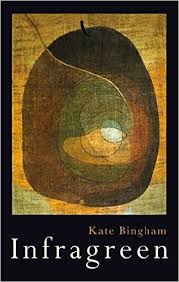
There is a side to Kate Bingham’s poetry that might be (and has been) described as steady, calmly observed, dispassionate, elegant and formally accomplished. But I also see another writer – one largely unacknowledged in Seren’s blurb to Infragreen and the many critical comments arrayed in her praise – for whom the world is endlessly atilt, above lethal undertows, aching distances, the formal wizardry in large part a white-knuckled hanging on in fear of letting go. I don’t mean the latter in any silly psycho-babble way but in relation to that moment when the black gulfs open up under all we thought we knew.

imgres
The more conventional part of this new book is the second section which seems to be visiting a landscape, a house and wooded countryside where the poet perhaps spent time in her youth. We are given reflections on early love, motherhood, the daughter becoming a mother herself, the English countryside, cattle, blackberrying. Most of these poems are obviously viewed through the perspective-glass of time past and time present and this somewhat disrupts Bingham’s more characteristic way of seeing things which is from within and without. One really marvelous poem here assumes the stance of the innocent younger girl encountering an apparently friendly farmer who keeps a bunch of string in his pocket to entertain the child while also using it to keep “his trousers up” (‘String’). It’s the humming, obsessive, ground-base of end-rhyming (string, string, twine, string, mine, strings, string, hem, string, hen, string, him) that evokes the worrying undertow of adult threat without anything explicit being said at all: “He didn’t need the string. / I tugged his arm and trotted after him”.

imgres

It’s the clash of viewpoints or perspectives – using that unsuspecting, unreliable narrative voice – that makes this gem of a poem so disturbing to read. And it is the manipulation of viewpoints that yields such rich dividends elsewhere in Infragreen. On a domestic level this is played out in ‘Next Door’ where the tone is one of some surprise that the neighbours “experience life to the full”, the latter word forming on this occasion the repeating ground-base rhyme that imports irony into the seeming admiration for the “bang and slam” of their lives. But the collection is carefully opened with two brief, curiously abstract treatments of perspective. ‘Ultragreen’ takes the ‘above and beyond’ implication of the prefix to have the narrator observe a water drop “at the end of the garden”. Through a disturbing synaesthetic travelling, the drop instantaneously appears “in my brain”, indeed takes up the narrator’s perspective precisely as it “looks out / and sees what I have seen”. What was without is now within and something “like photosynthesis begins”. As a way of announcing this poet’s basic strategies and as a metaphor for (artistic) generative fecundity this is brilliant.

gift-wrapped-tulip-bouquet

This is followed by the six cryptic lines of ‘Infragreen’ itself. I take Ultra to suggest ‘out there’ so Infra is more ‘within’ and here suggests a more harmonious coincidence of perception in which “the sun and I see eye to eye”. However, this frail connection seems always in danger of being broken, “half letting go of itself / half hanging on” and though Bingham does write occasionally of the fertile experience of such connectedness (see below) she more often writes in the throes of its breakdown, of distance and the accompanying sense of loss of control. So the archetypal ‘feel-good’ season of ‘Spring’ seems to be remotely occurring rather than directly experienced, the sun (again) “rising above its various nationalities / and making things grow”. The romantic gift of flowers is undercut in a meditation on tulip harvesting in Holland and the deliberate wrenching cliché of “the international language of flowers”. Even the self, viewed from deep within, has to be recognized through experience and even then not reliably: “it is her face my face projects / and for a moment I look strange” (‘Look’).

imgres

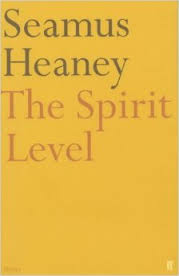
Seamus Heaney has a number of car poems in which the vehicle seems to be working benignly as a mode of travelling into wider experience (my favourite is ‘Postscript’ from The Spirit Level (1996): “As big soft buffetings come at the car sideways / And catch the heart off guard and blow it open”). For Bingham, in contrast, the narrator’s car is a place “I have to return to”, a place of (admittedly rather dull) security, “somewhere to look from” (‘Silt’). So much so that there are occasions, even when “London at night is a blaze of company”, when sitting alone in a stationery car, “seat belt on / and the engine running”, seems the best thing to do, or even the most that can be done. This is from ‘Between’, another of Bingham’s best poems in this collection, opening in the familiar only to end in another dizzying, atomised gulf.

The familiar surroundings, the container of the car, perhaps works in the way that Bingham’s use of rhyme can be seen to work, as providing a firm base from which the poem gazes outwards into the truly disturbing (Tony Harrison has said something similar about his use of metre and rhyme; it also makes me think of Elizabeth Bishop’s ‘The Art of Losing’). So the lulling rhymes of ‘On Highgate Hill’ make the stabbing on a London bus more shocking than a more informal, realist treatment. The hypnotic, mono-rhymes of ‘At Night’ (night, white, light, sight, tight, right, bright and so on) evoke a drowsy, sleepiness of thought that ventures closer and closer to the edge. On this occasion, the vision is a brighter one of something (like Edward Thomas, Bingham enjoys the nonspecific of such a word), something “mine and right / and unconditional”.

The unconditional is an escape from the binaries of perspective. It is a fleeting moment – impossible really to be written about because impossible to be disciplined into language – when self and other, those distinctions we lean on and then find ourselves manacled to, vanish. Bingham approaches such moments cautiously, “my hairs on end, my senses trespassing”, occasionally there are successes: [I] look back from where I am at where I stood / and see the wood for the trees, the trees for the wood” (‘The Wood’). On other occasions the plenitude is more overwhelming like the fisherman faced with an overflowing fish farm: “tongue-torn, foul-hooked, half tame / when there was nothing more to take more came” (‘Cull’).

il_fullxfull.274732054

But there are also a few untitled experimental pieces scattered through Infragreen that seem to be approaching this state of the unconditional in a lower-case, unpunctuated tentativeness. On page 24, a couple wake into a sleepy uncertainty in which bird song and growing buds seem one, as do thoughts and birds on a branch, the human and the natural, “one listening one listening to itself”. The final poem too, page 63, starts by undermining language (“call it what you like”) and proceeds to a car crossing Exmoor, an unaccountable stopping, the driver leaping out into a gale force wind, a slammed door offering a brief framing device, the observing voice trying to “make what I can” of it all, though within and without are bewilderingly blurred, “the other side of the force in the fence // of the foreground”.

images

Kate Bingham’s skill in tacking the vessel of form against the breeze of colloquial language is certainly to be marveled at. There is great pleasure to be had from the rightness of her positioning of words on the page. But I also admire her willingness to gaze past what Seren’s blurb refers to as “necessarily” her subjects, “the familiar, the seen again, and the returned to”, to glimpse something far more terrifying and in this she reminds me less of Edward Thomas, less of Elizabeth Bishop, more of Robert Frost.

How to Closely Analyse a Poem (and keep exam boards happy) #2 Edward Thomas’ ‘The Sun Used to Shine’

Having declared in my review of one year of blogging that I wanted to include more about teaching literature, I am posting some examples of the type of essay required by OCR exam board in module F661 (see also Essay 1). The essay following focuses on Edward Thomas’ poem ‘The Sun Used to Shine’ which can be read in full here. The poem has Thomas recalling happy days, walking with Robert Frost in the Gloucestershire countryside. Though the Great War  had begun, neither of them had yet become entangled with it. Students are supposed to present a close analysis of one selected poem (AO2) while also putting that poem into relation with some others by Thomas (AO4).

FDPhist
Little Iddens – where Robert Frost lived in 1914

Explore Thomas’ response to the English countryside of 1914 in the poem ‘The sun used to shine’. Your focus should be on close analysis of language, imagery, tone and form.

NB: Comparative sections here are in italics only to indicate the proportion of the essay devoted to that Objective (AO4). The main Objective remains AO2)

In this poem Thomas describes the English landscape as a place of pleasure and relaxed enjoyment as he walks with Robert Frost. These are remembered scenes and as the poem develops thoughts of the war of 1914-18 become more prominent. In the end perhaps the poem explores ideas about permanence and change, putting the war into a more historical perspective. The features which are typical of Thomas in the poem are the focus on the small details of the natural landscape (like ‘But These Things also’), the way the war lies in the background of the poem (like ‘Rain’ and ‘Tears’) and his interest in memory (‘Old Man’).

The opening stanza describes the two men walking at peace and the sun shining and here is an example of pathetic fallacy, the sun reflecting their happy mood. The easy rhythm of their walking is also reflected in the enjambement of lines 1-4 and the caesura in lines 2 and 4, giving a lilting, relaxed and flowing movement to the verse. At this early point in the poem, the regular ABAB rhyming adds to this impression and adverbs such as “slowly” and “cheerfully” obviously reinforce this sense of easy pleasure. The phrase “sometimes mused, sometimes talked” also suggests their free and easy life, with the caesura here again giving the steady walking rhythm of the opening as they contentedly (but thoughtfully – “mused”) explore the English landscape. This is similar to ‘As the Teams’ Head Brass’ where Thomas uses enjambement in many of the opening lines to reflect the flowing movement of the horse and plough up and down the fields. In that poem there is even less punctuation, reinforcing the idea that in ‘The Sun Used…’ the caesuras’ reflect the stopping and starting of the two men’s walking pace.

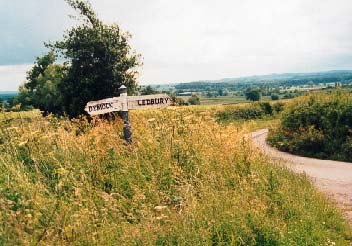
FDPsignpost

The narrator’s statement that the two men “never disagreed” about which gate to lean on is probably hyperbolic but again suggests their closeness and harmony and even the action of leaning on the gate with no urgency or hurry  reflects their relaxed state of mind. From line 6 the narrator conveys their mental focus as they walk through the landscape and suggests that they are wholly occupied in the enjoyment of the present moment. The phrases “to be” and “late past” suggest both past and future to which they give “small heed”. Other subjects are suggested by the phrase “men or poetry” and the “or” here suggests their easy freedom even in topics of conversation. However, it is at the end of stanza 2 that the war is first mentioned though at this point the word “rumours” is used, suggesting that the subject is only vaguely picked up and this is reinforced by the use of the adjective “remote” which is placed at the end of line 9 giving it an particular emphasis. At this point the war is not an important element as they walk through the landscape and this is also suggested by the word “Only” at the start of line 10 which rather dismisses the war topic of conversation in place of their focus on the landscape, this time in the form of the apples they find there.

The description of the apples is ambivalent because they are initially described with the adjectives “yellow” and “flavorous” suggesting their attractiveness and sweet taste so the reader may be a bit taken aback to hear in the next line that wasps have “undermined” the skin of the apples. The most important thing about this latter word is that it suggests the mines and mining associated with the battlefields of World War One and therefore suggests that thoughts of the war even penetrate the pleasant walks through the countryside of the two men. Something like this can also be seen in ‘Rain’ in which the narrator listens to rainfall in a depressed mood and hopes that no one who he “once loved” is doing the same. That poem uses a natural image of “Myriads of broken reeds all still and stiff” which also can be interpreted as referring to the many dead on the battlefields of France. ‘The Sun Used…’ was actually written in 1916 when Thomas was about to join up though the memory of the walks refers to 1914 when the war did seem further from him personally. These suggestions of war are continued in stanza 4 with the line of betonies described as both “dark” in colour (a contrast to the yellow apples?) and with the metaphor of “a sentry”. This makes very explicit the war reference and this is continued with the description of the crocuses (their “Pale purple” suggesting both weak vulnerability and shade) as having their birth in “sunless Hades fields”. Each of the words in this phrase might suggest the war with the darkness of “sunless”, the reference to death in “Hades” (the Classical land of the dead) and “fields” which surely refers to the battlefields in France.

robert_frost
Robert Frost

These suggestions that thoughts of war cannot be excluded from pleasant walks in the English countryside in 1914 are confirmed with the very next line: “The war / Comes back to mind”. Here it is the rising moon that reminds the two men of the war as they remember that the same moon would also be visible to soldiers on the battlefields of France “in the east”. The next word “afar” again suggests the distance of the war, though actually the poem has suggested that thoughts of it are not at all remote. The narrator’s thoughts now go beyond thoughts of the 1914 war. Typical of Thomas, he develops a more historical perspective, referring to earlier wars, “the Crusades / Or Caesar’s battles”. This has an ambiguous effect as it might suggest some consolation that war has always occurred and perhaps always will. On the other hand, perhaps it suggests the more depressing thought that humankind cannot avoid warfare. This sense of long stretches of time is quite common in Thomas’ work such as in ‘Aspens’ where he describes the trees at the crossroads and there implies that they are permanent, even indifferent to the human world: “it would be the same were no house near. / Over all sorts of weather, men, and times”.

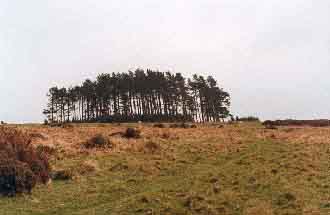
FDPmayhill2
May Hill – where Thomas and Frost often walked together

Perhaps it is this longer historical perspective that creates the thoughts of the final 11 lines of this poem. They open with a hyperbolic statement that “Everything” fades away and Thomas then uses a series of similes of things which he regards as transient, starting with the “rumours” of war, running water vividly described as “glittering // Under the moonlight” and the two men’s “walks” through the English countryside, even the men themselves (in line 26) and the apples from stanza 3 (now more pessimistically described with the adjective “fallen”) and the men’s “talks and silences”. This is a very inclusive list which gives the impression of time sweeping away many of the pleasures of life. The climax of the list is the last simile that seems to wipe away memories too (an important element in many of Thomas’ poems). He seems to suggest that memories are like marks on sand and the tide washes them away (is the tide an image of Time?). The poem ends with images of “other men” enjoying the same “easy hours” that the poem began with though now Thomas and Frost have vanished. In these last lines some things have changed (“other flowers”) but the moon alone remains “the same” suggesting that much of the landscape even will have changed (this reminds me of the felled elm tree in ‘As the Team’s Head Brass’ in which the English landscape is shown to be changing).

In this poem, Thomas records pleasures gained from walking in the English countryside in 1914 though he also suggests that thoughts of the war cannot be excluded. As the poem goes on, it seems to become detached from the countryside but does return to it at the end in suggesting that though people may vanish and die and even aspects of the countryside itself may change in the long perspectives of Time, there are a few things – like the moon – can be seen to remain constant.

Helen Mort’s ‘Division Street’ wins Aldeburgh First Collection Prize

The winner of the Fenton Aldeburgh First Collection Prize 2014 – one of the most long-established poetry awards in the UK – was announced at the opening of the 26th Aldeburgh Poetry Festival on Friday 7th November. The judges were Imtiaz Dharker, Robert Seatter (Chair) and Anthony Wilson. Here, Anthony Wilson assembles the competitors on his own blog: http://anthonywilsonpoetry.com/2014/11/08/the-fenton-aldeburgh-first-collection-prize-2014/

The prize went to Helen Mort, Division Street (Chatto, 2013): http://www.thepoetrytrust.org/news/fenton-aldeburgh-first-collection-prize-2014-ndash-winner-announced/

And here’s the review I did of the book a few months back for Poetry London:

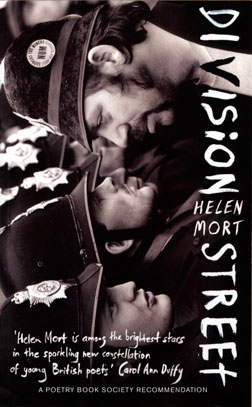
Mort’s first collection has been much anticipated (no-one else has been five-times winner of the Foyle Young Poets Award!) and Chatto have snapped her up but given her a rather ugly cover with its chalk-board script and rotated image of police confronting striking miners in 1984. Michael Symmons Roberts identifies the bedrock of the book as “the north of England” and the semiology of Division Street means the reader anticipates something more politically engaged than the poems deliver: this is not Heaney’s North, a bit more North of Boston. The north is often setting if not subject, but it is a place almost too recognisable where a girl learns “the name / for artificial hills, the bridge / where a man was felled by bricks / in the strike” (‘Twenty-Two Words for Snow’). She might learn to dance, but sniggers at the teacher’s pretentious “parr-durr-shat” (‘Miss Heath’). A man grows old “in the same bungalow for thirty years / and dreams of digging his way out” (‘Fur’). A stage comedian gets a more lively balladic treatment which suggests a more resilient culture amongst the “empty works” and “braziers / that vanished thirty years ago” but the juke box still dates from 1971(‘Stainless Steven’).

division_street_cover

The risk is regional cliché here and I’m not sure this is really Mort’s true subject. The miners’ strike is dealt with via a re-enactment of the battle of Orgreave by conceptual artist, Jeremy Deller, in 2001. Mort’s desire to write about it is important but the sequence of poems is more an exploration of good old class guilt as the narrator leaves the “Calow WMC” to study in Cambridge, a place where she “cannot learn the tune”. The resonating image is of a different “picket line/ . . . crossed” into a “gilded College gate, / a better supermarket” (‘Scab’). This is why Mort’s epigraph is from Stevenson’s doppelganger novel about the “profound duplicity” of life, but both writers are less concerned with political divisions than personal. Much of Division Street is given over to explorations of the self’s development. The finely-tuned sequence, ‘North of Everywhere’, treats location as psychological landscape where the heart can be let “go on ahead of me”, where “silences become the better part of us”. Such questing is transmuted to a mother gazing at a group of deer, “on pound-coin-coloured hooves”. They are something she denies seeing, though the daughter also finds them, “closer / than before [. . .] their eyes, like hers” (‘Deer’). There is a recurring sense that “doors to other worlds exist” (‘Lowedges’). However much a narrator likens herself to her dogs, she is different:

one night I’ll set off past the meadow, down

behind the beck, beyond the blunt profile of Silver Howe

and nobody will call me back.

‘The Dogs’

Mort’s love of landscape is profound and, like Wordsworth, her hills and skies remain a locus, as well as image of, the process of self-exploration. She boldly plays on her own name in ‘The French for Death’, fantasising of a “girl / who takes the worst route home, pauses // at the mouths of alleyways, or kisses / strangers”. But this transgressive trouble-maker is not so prominent elsewhere where a more compromised, tentative identity emerges. ‘The Girl Next Door’ becomes a haunting double who seems to co-opt the narrator’s weakening identity. ‘The Year of the Ostrich’ wittily suggests a new astrological sign for those of us with “unlikely grace, / who hide our heads, or bear the weight / of wings that will not lift us”. Mort is always good at animals and while jogging she sees a fox, supple, slinking, sly, always about to vanish: “And what she sees she cannot tell, / but what she knows of distances, / and doesn’t say, I know as well” (‘Fox Miles’).

We find and define ourselves against others and Mort does this through romantic love, mostly its loss. “I turned to ask you something and you’d gone” (‘Fagan’s’) is a recurring sentiment. The title poem itself refers to the place where “You brought me [. . .] to break it off”, though in this case it is the other whose “head-down walk” we see, passing pubs in whose windows can be seen “nothing but your own reflection”. Pessimistically, ‘End’ suggests that “Death is // the shape / beneath romance” but the hauntings a writer sustains through such poems as these, though they do not revive the love, at least reinvigorate the lover and persuade that such deaths may only be “le petit mort”.

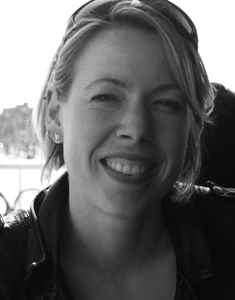
mort_helen

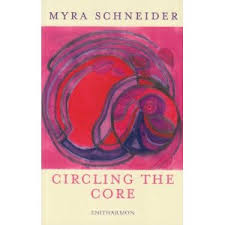
Myra Schneider’s ‘Circling the Core’ (2008)

Myra Schneider is an old friend from the North London circuit, a tireless worker for poetry and a poet of significance who has also proselytised for the therapeutic impact of creativity in relation to both physical and mental illness. She has a new book out and I saw her read from it recently. I have yet to commit my thoughts on her new work to the keyboard and screen but I thought – by way of an appetiser – this might be an opportune moment to post the review I wrote of her previous collection Circling the Core (Enitharmon Press, 2008)

Also, here is a recent interview with Myra conducted by Maitreyabandhu at Poetry East:

https://www.youtube.com/watch?v=5WfI7Bx_7Uo

The interview begins with Maitreyabandhu asking why she selected ‘The Windhover’ by Gerard Manley Hopkins and ‘Morning Song’ by Sylvia Plath, as two poems which had influenced her. He then asks about her life and the different areas of her poetry and writing.

Reading Myra Schneider’s Circling the Core, there are many things that remind me of Edward Thomas’ review of Frost’s North of Boston (1914). Thomas praises his American friend’s poems because they lack “the exaggeration of rhetoric”. He applauds his language as “free from the poetical words and forms” that harmed so much poetry in the early twentieth century. Frost avoids both “old fashioned pomp and sweetness” as well as its opposite – “discord and fuss”. The revolution that Thomas and Frost were pursuing is the recurring one of poetry’s return to common speech and this has long been one of the chief pleasures of Schneider’s work too. Since the mid-1980s, she also has pursued a voice that refuses to flaunt gratuitous formal innovation, nor does she play fast and loose with syntax, lexicon or typography. It might appear that Schneider prioritises a truth to things more than words and her conclusion is an admirable and observant humility before the world, its creatures, domestic objects, weather and places – though her attentiveness to detail is not the whole story.

images

Schneider herself also refers directly to Thomas’ example in taking the epigraph to this collection from his poem ‘The Glory’. Thomas hopes to find this glory in the “beauty of the morning”, the natural world, the acutely observed details of the “pale dust pitted with small dark drops”. Yet what draws him remains elusive and he concludes that he may have to remain “content with discontent” since he “cannot bite the day to the core”. Schneider’s poems echo many of these concerns but – despite the tentativeness of this collection’s title – she tends to be more optimistic about the search for the “core”. The book opens with a marvellous response to a Barbara Hepworth sculpture which, after tracing the curves and lines of the material reality, worms its way to a centre, a still point, “jewel, kernel, womb, unshielded self, / a promise of continuance. / We lay hands on profound silence.”

In Schneider’s work the kernel usually is that “unshielded self”, the authenticity of lived experience rather than the accumulations that can obscure and denature it. In ‘The Mnajdra Temples’, the narrator is interested in and even impressed by information associated with these Maltese Neolithic ruins, but it is “what the humans who worshipped here thought” that is the real goal: “how the human brain began making / complex plans, conceiving deities, temples”. Elsewhere, a viaduct cannot be encompassed by its dictionary definitions; it is always more than its “bare facts” (‘Images’). Similarly, personal identity is more than the sum of its material parts: a bowl created by the poet’s mother-in-law “goes deep but not deep enough to hold everything / she lost” (‘Larder’) and on a return visit to childhood landscapes in search of self, it is ironically “when I leave / the present peels away” (‘Going Back’). A poem like ‘Goulash’ is so good just because it manages to capture this core of subjectivity, the thinking mind in process as it moves from the details of cookery, to love, to landscape, to a contemplation of “darkness” which lies ambivalently at the heart of things, triumphantly ending with a celebration of friendship which is not overwhelmed by placing it beside the longer historical perspectives of the jewellery of the Sutton Hoo burial ship.

Schneider’s interest in psychological truth leads inevitably to the use of dream materials as the starting point for a number of these poems. ‘Naming It’ opens dramatically with collapsing buildings but, even after the dust settles, the “panic is all in the rubble”. The possibility of escape from such chaos is intuited when the narrator discovers a blue pool and realises it is “crucial to capture the exact word for its colour”. As well as suggesting the essential nature of her work as a whole, this also confirms that Schneider’s vision encompasses a good deal of darkness. Though there are occasions when grief, pain, injustice are countered by little more than wishful thinking, as in ‘Journey’ with its repeated “What I want . . .”, a poem like ‘Nothing’ confronts it head on in the “vacant cradle /  of delicate bones that was once a bird’s head”, an object that seems to be demanding to know how to “face nothing”. Something of a reply to this is given at the end of the sequence ‘Larder’, with its finely judged observation, defining life itself as “a series of small makings / to stack up in larders against death”.

It is less of a leap than one might imagine from this to Schneider’s re-working of the myth of Orpheus, an ambitious poem that stands up impressively alongside Carol Ann Duffy’s ‘Eurydice’. In ‘Eurydice’s Version’, Orpheus is a stunningly beautiful but selfish, spoilt man-child, beside whom his wife is initially no more than an “adjunct”. His music is presented as a compulsion she would like to resist. Her association with the shepherd, Aristaeus, is reinterpreted as a relationship in which her “actual” self is recognised in contrast to Orpheus’ chauvinistic, insistent projection of “bedmaker, breadmaker, whore / babymaker, milk-breast, childminder, nurse, / comforter, slave, mystic maiden, high goddess, // muse”. But Aristaeus’ interest in her true “core” frightens Eurydice away, allowing the snake bite that kills her to be regarded as “punishment” for turning her back on such a moment of possible honesty. Orpheus’s turning is likewise re-interpreted as a relief for Eurydice, who prefers the darkness of the underworld where, she says, “I’ve learnt to listen, to think, / for myself and when I speak I am heard” – in other words, where she lives with the virtue of truth to her inner self which this collection explores.

At one point, Eurydice wishes Nature might resist Orpheus’ melodic pushiness too and Schneider is admirably unapologetic about the importance of the natural world in the process of salving some of the harm she encounters. Those who have read her poetry in the past will recognise features of locality such as Pymmes Brook, the Piccadilly line viaduct to Arnos Grove, Arnos Park itself in north London and Schneider’s south-facing garden overlooking it. She has worked this landscape into almost mythic significance, its details able to reflect and evoke the inner experiences with which she is really concerned as in ‘Seeing the Kingfisher’, the ‘Drought’ sequence and ‘Skywards’. A little more exotically, ‘The Oyster Shell’ explores again this poet’s characteristic movement inward, a movement for which “prayer” offers no help but which, pursued with the kind of vigorous honesty that fills this book, can reach an almost Blakean intensity:

I retreat to the cradle of this shell,

creep in, unclothe my self, tread

on milkwhite and mother-of-pearl,

follow faint pools of sandgold

to the sullen indigo sea lying below

the hinge as its core. Here, I let go.

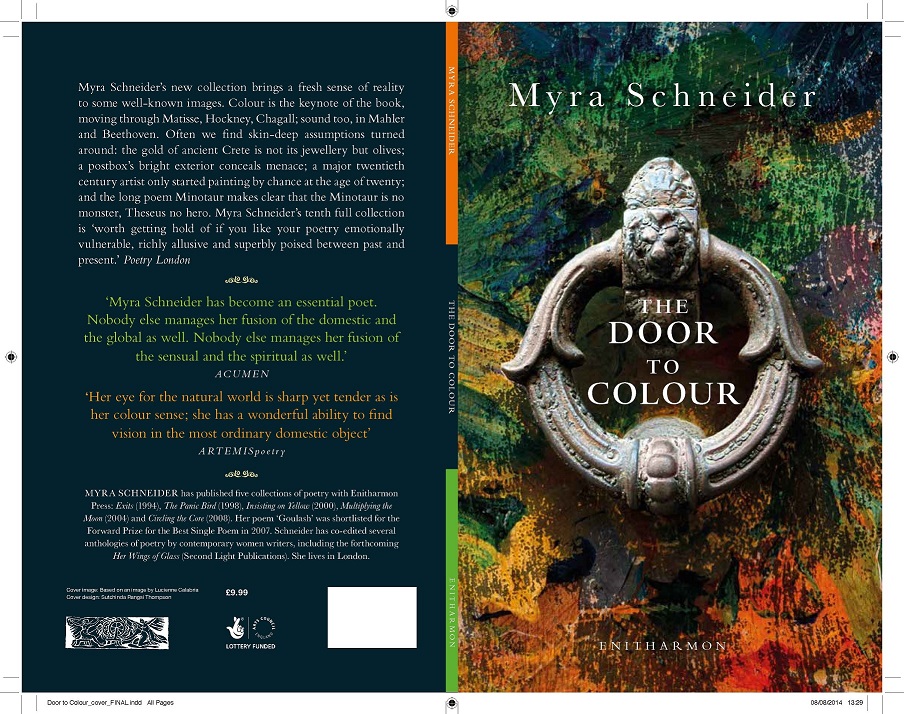
Myra’s new collection is called The Door to Colour:

http://www.enitharmon.co.uk/pages/store/products/ec_view.asp?PID=645

Schneider_Colour_PRF1 (2)

Louise Gluck’s ‘Education of the Poet’

As Keats once said, several things dove-tailed together. One of these was being asked by Poetry London to review Louise Gluck’s new collection, the PBS Recommendation, Faithful and Virtuous Night (Carcanet, 2014). The other – yesterday – was discussing with students the opening quatrain of Edward Thomas’ ‘The Sun Used to Shine’ with its marvelous evocation of the happy days he spent with Robert Frost in the Gloucestershire countryside in 1914. The opening lines employ an ABAB rhyme scheme, enjambement, judiciously placed caesuras and simple colloquial choices of verb and adverb to create its effects. As often, students asked whether what we were discussing was ‘thought about’ by the poet. My usual answer is that a writer is far more conscious of his craft that they might expect, but also that he considers options and exercises a veto. Like evolution, what fails goes to the wall; what remains becomes more and more coherent and effective. This is an idea I first saw expressed in Gluck’s essay, ‘Education of the Poet’ (originally a lecture delivered in 1989, reprinted in Proofs and Theories: Essays on Poetry (Carcanet, 1999).

imgres

Gluck’s over-riding point is that her characteristic mode of thought defines itself “in opposition”. This gives rise to her image of the poet as fundamentally in a state of helplessness much of the time, absorbing whatever is regarded as ‘oppositional’ and looking for opportunities to speak back. She makes it clear that such an idea “does not mean to distinguish writing from being alive”. What it means in practice is that the life of the poet is a life of “yearning, not [one] made serene by sensations of achievement”. The image of the writer effectively, confidently, repeatedly decanting her self, her being onto a sheet of paper is a false one. There are periods of silence, preoccupied with the desire to make art, a restlessness that may be agony. When at last “some sound, some tone” precipitates, what follows is a period of concentrated work: “so called because as long as one is working the thing itself is wrong or unfinished: a failure”. Yet when the poem, the utterance, is finished – Gluck argues – the poet is no more, reverting “simply [to] someone who wishes to be one”.

This pattern of a powerful force, a cacophony being replied to by the artistic voice  can also manifest in the way a poet engages with language. Gluck rejects the idea that poets are people who can’t get enough of individual words like ‘incarnadine’, in favour of language deployed in larger swathes to create contexts in which the “simplest vocabulary” is liberated from custom. It is custom that is thus replied to through using the gestural aspects of language – setting, timing, pacing – releasing words into novel relationships with truth. The poet generates material, improvises, plays with language and replies to what is produced through the process of veto. Like evolution, what fails goes to the wall; what remains becomes more and more coherent and effective.

imgres

So it’s no surprise that Gluck’s taste in poets favours those whose mode of poetic speech is more like a spoken confidence, a reply, a conversation: “I read to feel addressed”. Accordingly, her personal preference is not for poets – like Wallace Stevens – whose work is a more solitary musing, like “intercepted meditation”, not concerned to be listened to. I find myself in agreement with much of what Gluck says and – re-reading the essay now – I remember that she also uncovers this pattern in the teaching process. She warmly recalls being taught by Stanley Kunitz, his application to the novice writer of a steady “scrutiny”, the oppositional force “from outside, from the world, from another human being”. It’s a scrutiny and compulsion she herself continues to provide for her own students; the teacher’s presence is to stir, to provoke the reply, to kick start the process of definition.

It seems even one’s own work can be seen in this light. Considering her early collections, Gluck regards each new book as a fresh reply to what went before. This is a good answer to my students’ inquiries about how conscious an artist can be. Gluck tells us – and we should more than half believe it – that here she sought latinate suspended sentences, there how to end a poem without sealing it shut; elsewhere she looked to learn a longer breath, to make better use of the present tense; later still to write something less heroic, devoid of mythic reference. The artist is conscious, manipulative, alert. The artist waits, responds, manoeuvres. The both.