What Shape is your Poetry Workshop?

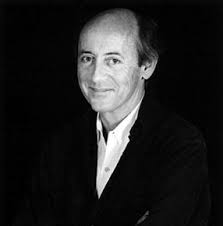
With its proximity to some of the processes of politics, what has come to be the traditional form of the poetry workshop is perhaps easily derided. Billy Collins does this  (in his book, The Art of Drowning, 1995) and we all recognise both the speaker and the likely recipient of the speech:

I might as well begin by saying how much I like the title.   

It gets me right away because I’m in a workshop now   

so immediately the poem has my attention,

like the Ancient Mariner grabbing me by the sleeve.


And I like the first couple of stanzas,

the way they establish this mode of self-pointing

that runs through the whole poem

As both leader and participant, I’ve suffered and witnessed suffering at the hands of egomaniacs, bullies and tyrants – those who come to workshops with no intention of listening to the proffered advice. What they are after is some exertion of personal power over a captive audience and, up to a point, workshop members are exactly that since the basic democratic premise is that we sit and listen with an open mind – a very open mind.
But what I’m not sure about is the voice,

which sounds in places very casual, very blue jeans,   

but other times seems standoffish,

professorial in the worst sense of the word

like the poem is blowing pipe smoke in my face.   

But maybe that’s just what it wants to do.

imgres

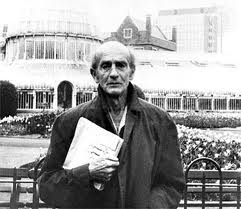
Others will know the history better than I do but the poetry workshop seems to have been organised first by Philip Hobsbaum in the 1950s. Hobsbaum was born in London to orthodox Jewish parents who moved north in 1937, sensing the threat of war and fearing the anti-semitic currents of the time. In Bradford, Hobsbaum attended Belle Vue grammar school, then Cambridge, where he studied under F R Leavis at Downing College (“the greatest man I ever met – an amazing teacher”).

F R Leavis

He also encountered Thom Gunn, just graduated, who introduced him to the early work of Larkin, and, as editor of the student literary magazine Delta, he printed work by Ted Hughes and Peter Redgrove. Most significantly, with these budding poets, he organised regular meetings. Hobsbaum possessed some training as an actor and the original idea (of what was to become ‘The Group’) was to encourage verse-speaking. But these meetings soon turned into exercises of Leavisite close analysis, or Practical Criticism in the style of I A Richards, plus a good deal of mutual support for the growing network of poets.

Maybe it’s just me,

but the next stanza is where I start to have a problem.   

I mean how can the evening bump into the stars?   

And what’s an obbligato of snow?

Also, I roam the decaffeinated streets.

At that point I’m lost. I need help.

The Group style of workshop spread as Hobsbaum himself moved to a variety of jobs from Cambridge, to London, Belfast and Glasgow in turn. Although there was some overlap in personnel with The Movement, the various incarnations of the Group had a more practical focus as there was no imposed programme or style. In Belfast (1962–1966), Hobsbaum organised what became known as The Belfast Group, including emerging authors Seamus Heaney, Edna and Michael Longley, Derek Mahon, Stewart Parker and Bernard MacLaverty. Heaney described the process in 1963: “members of the Group listen to a fellow member read a number of his poems which have been previously circulated on cyclostyled sheets. They then discuss the verse very thoroughly, frankly, informally – and the poet is there to counteract, resent, and/or benefit from the criticism”.

theme-arts-08
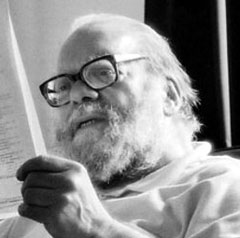
Philip Hobsbaum in later years (photo: Gerry Cambridge)

Personally, I first experienced the process at Lancaster University in the late 1970s, taking a ‘free ninth’ optional course in Creative Writing as part of a more traditional English degree. The meetings were led in Lonsdale College by David Craig and Heaney’s “previously circulated . . . cyclostyled sheets” have a very familiar ring to them. The format was somewhat different in the 4 years or so I spent attending two workshops in Oxford – copies of individual poems were handed round only on the day and discussion was spontaneous indeed (see my earlier blog ).

The other thing that throws me off,

and maybe this is just me,

is the way the scene keeps shifting around.   

First, we’re in this big aerodrome

and the speaker is inspecting a row of dirigibles,   

which makes me think this could be a dream.   

Then he takes us into his garden,

the part with the dahlias and the coiling hose,   

though that’s nice, the coiling hose,

but then I’m not sure where we’re supposed to be.   

imgres
Billy Collins

I currently attend 3 workshop groups. In none of these is work circulated beforehand. In one, the poet reads once only, the other members have photocopies and discussion ensues with the writer sworn to silence (this prevents self-defensive manoeuvres and conflict). In the second group, the same process is followed except that after the reading of the poem aloud by the poet, the members have about 10 minutes to WRITE their thoughts on the poem itself. Discussion then follows (the up-side of this is that all poets go home with annotated copies of their own work; the down side is it’s very hard work and discussion often follows the annotations, a little less fluidly).

There’s something about death going on here.

In fact, I start to wonder if what we have here   

is really two poems, or three, or four,   

or possibly none.


But then there’s that last stanza, my favourite.

The third group plays the game of anonymity. Sufficient copies are put into an envelope, no identifying marks. Each member then picks out a poem (not their own) to read aloud. On first reading the members cannot see the text. Only on second reading can they follow the text on the page. There then follows the discussion. This produces the fascinating experience for the poet of hearing another person read the poem – and the reader’s later comments about how easy or otherwise the poem was to read are always interesting to those of us who think poetry is primarily an oral art.

This is where the poem wins me back,

especially the lines spoken in the voice of the mouse [. . . ]

I start thinking about how hard the mouse had to work   

night after night collecting all these things

while the people in the house were fast asleep,   

and that gives me a very strong feeling,

a very powerful sense of something.

But I don’t know if anyone else was feeling that.   

Maybe that was just me.

Maybe that’s just the way I read it.

imgres

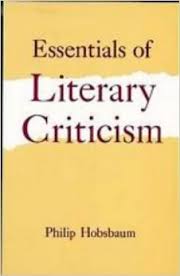
Easy to mock; easy to de-rail from their true purpose, but in creating his workshops (once more following Leavis) Hobsbaum believed a vital part of a student’s course was the rigorous discussion of text. To him, criticism was a fiercely rational, evaluative process, and any other use of language – “political propaganda, newspapers, advertisements, film, conceptual prose of all kinds” – had to be liable to the same level of scrutiny. In Essentials of Literary Criticism (1983), he maintained that “the training of a critic is also the training of a citizen”. This is surely right as the skills and sensitivities of the workshop, the class, the informal discussion of poetry anywhere, anytime, are exercises, in part, to develop the insight, the healthy scepticism, the ability to read and interpret whatever those vying for power, those possessed of power, want to say to us. Alan Brownjohn wrote in Hobsbaum’s obituary: “In a postmodernist, relativist age of education for entrepreneurship, Hobsbaum’s analytical and discriminatory approach might appear to be losing out, though reports of its death are an exaggeration.”

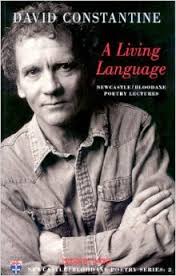
I’m sure Brownjohn is right and – as the UK General Election machine winds itself up ever higher – I’ll quote David Constantine’s important conclusion to his third Newcastle / Bloodaxe lecture in 2003: “We are, when we read poetry, during the reading of the poem and lingeringly for some while after, more wakeful, alert and various in our humanity than in our practical lives we are mostly allowed to be. Achieving that, in vital cooperation with the reader, a poet has done the most he or she is qualified to do. Any further stage, any conversion of this alerted present state into action, into behaviour, is the responsibility of the citizen. And the poet, like the reader, is always a citizen”.

imgres

Nostalgia, Spots of Time and Ourselves

My Dad is getting more forgetful. True, he has just made his 95th birthday but like that stain that slowly spreads into “a gigantic ace of hearts” at the murderous climax of Hardy’s Tess of the D’Urbervilles, there is a growing realisation among family members that this is a bit more than a run-of-the-mill absentmindedness.

lgekkc3tperdvzis70v3

Do we vanish with our memories? I’ve been repeatedly reminded, in judging a poetry competition recently, how much poetry depends on remembering, how much any of us depend on memory for a sense of who we are. So perhaps memory is a candidate for what makes us distinctly human – better even than language, the uniqueness of which has been challenged the more we understand of the animal kingdom (See Christine Kenneally’s book, The First Word)? Recalling moments from our own lives – Wordsworth’s “spots of time” that retain, he believes,  a “renovating virtue“ – seems to have something to do with identity, mental health, even our own ethical behaviour: they shall not be forgotten, we have been saying a lot recently.

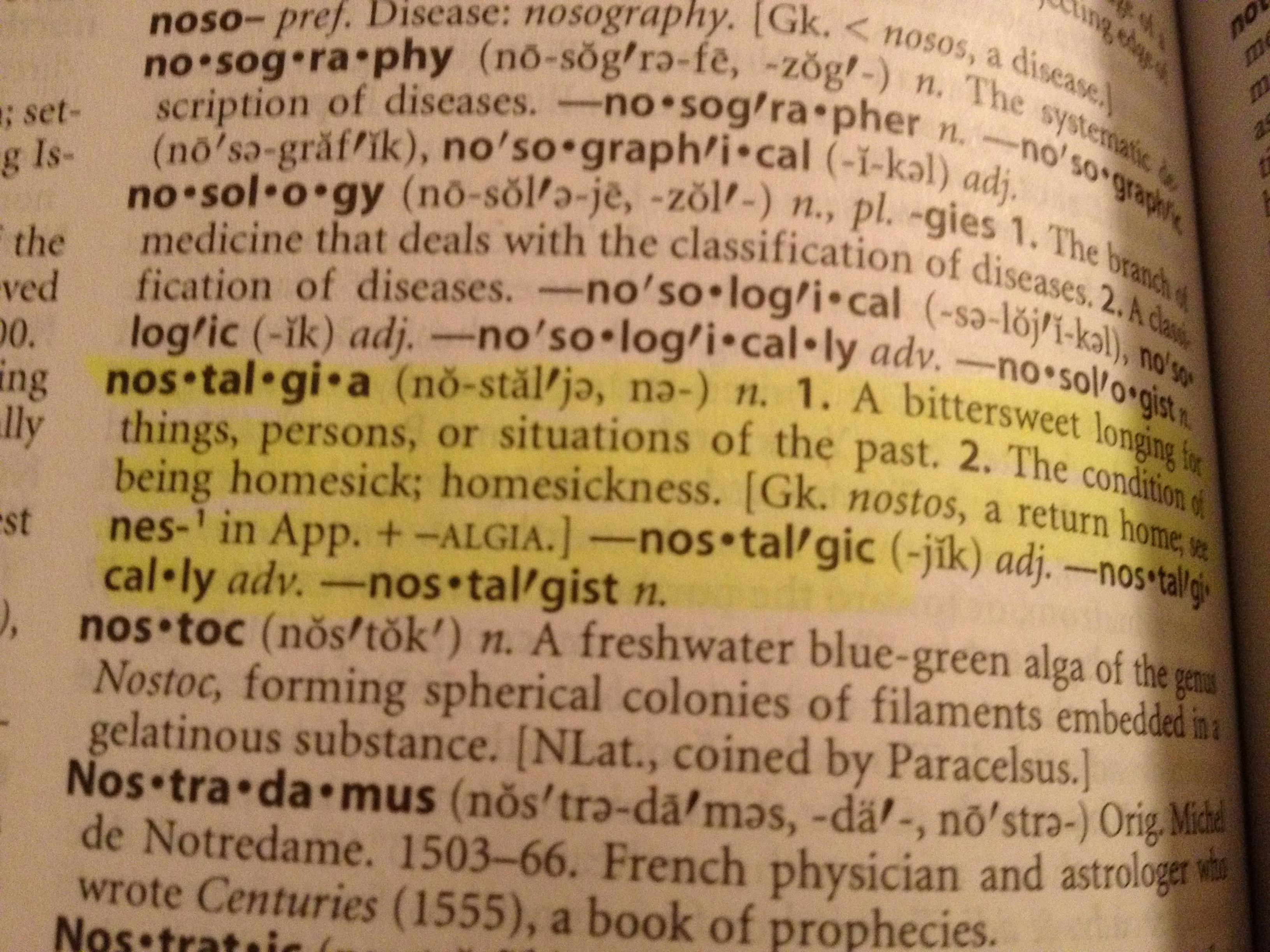
A few months ago, I read a Guardian piece about nostalgia and have kept a copy of it with me since. Nostalgia as a term was coined by a 17th-century Swiss army physician who traced the fragile mental and physical health of his troops to their longing for home – nostos in Greek means home and algos is the pain they found in such thoughts. So its roots are in mental disorder or depressive illness and for centuries it has been considered unhealthy to dwell in this way on the past, a yearning for something lost, a debilitating rosy-tinted malady.

nostaliga-defention

But psychologists have started to think of nostalgia as a more profoundly rooting experience, even a stimulant to optimism, to psychic health. At Southampton University, Constantine Sedikides and Tim Wildschut have shown the universality of nostalgia and, among its measurable effects, it is now seen as a driver of empathy and social connectedness, an antidote to loneliness and alienation. Nostalgia, by connecting our past and present, by proving the temporal oneness of being, points optimistically to the future, acts to protect against negative thoughts and situations.

The article quotes Wildschut: “Nostalgia compensates for . . . feelings of meaninglessness or discontinuity between past and present . . . it elevates meaningfulness, connectedness and continuity.” Anecdotal evidence comes from women in concentration camps who “responded to starvation by waxing nostalgic about shared meals with their families and arguing about recipes”. This is a sort of imaginative “as if” loop that writers will readily recognise and evidence suggests it can temporarily affect our body states.  Concentration camp survivors recount: “We used our memories to temporarily alter our perception of the state we were in. It was not a solution, but the temporary change in perception allowed you to persevere.”

!BYlPmUQBWk~$(KGrHgoOKj!EjlLmZDmvBKiW2UyIkw~~_35

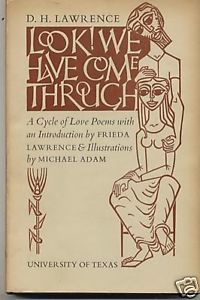
Remembering our past serves to remind us of who we are, what we have been, what intimacy we have achieved, what we are capable of, then and now, in the future. It builds resilience because, though often concerned with trauma and sadness, it is posed in a redemptive sequence: ‘look we have come through’ cries D H Lawrence and even Larkin’s depressed-sounding “first boredom then fear” might be read in this light. As to ethical consequences, apparently, in strongly nostalgic states individuals are more liable to act altruistically; the value of money is weakened; couples and families bond more closely; gratitude and connectedness increase; children grow less selfish.

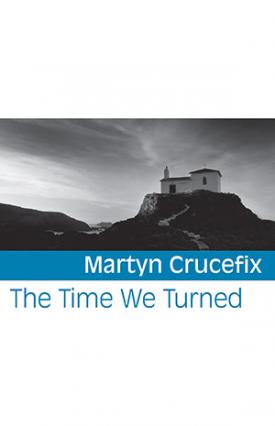
Meagre comfort when it’s you, or your father, losing the ability to recall; really this makes the loss of memory associated with old age that much more devastating. But at Southampton they are investigating nostalgia-based therapies for illnesses, including clinical depression and perhaps Alzheimer’s. Robert Lowell somewhere talks of the Christian trinity of God, Son and Holy Ghost, being replaced in the 20th century by Dad, Mum and memories of my family. Perhaps now we are gathering scientific evidence (if it was ever needed) that such a shift in focus was as much gain as loss. My poem ‘Four trees fallen’ (from The Time We Turned (Shearsman, 2014)) recollects the observation of trees fallen, the roots up-turned an image intended to evoke the unearthing of past experience:

this tree up-turned

with its metres-wide plate

of spreading roots tipped fully

ninety degrees from the horizontal

so what lay underground

is now exposed to the air [. . .]

I imagine it must have been

this same wind though perhaps

in the tempestuous pitch

of night that blew with such power

to topple a tree like this

to lever its roots up-turned

from almost immemorial dark

into the temporary dark

of one night’s storm—if it was

at night—left exposed at dawn

to new sunlight to noon and sunset

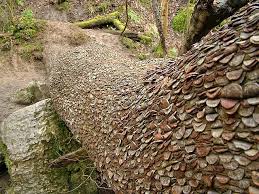
The final section remembers a pair of those fallen trees you sometimes come across where people have hammered coins into the rotting bark – a form of payment perhaps, but what for? A journey we hope always to be able to make.

images

Walking on—and with each step

I remember a third fallen tree

this morning this one skirted

some miles back beside a stream

yet this other trunk bristled

weirdly with half-moons of coins

in its papery folds each hammered

by walkers till the coins were bent

and stressed from blows

of rocks needed to sink them deep

and this tree I also remember

was not the first of its kind—what

year was it what walk beside

what stream of whisky-brown waters

did I stand by a fourth fallen trunk

in that same way gleamingly

scaled with hundreds of coins—

some had planted light-hearted

coppers while others had

invested more heavily with silver

or the thick edges of pounds

and even two-pound coins—

I suppose just taking a breather

or something to amuse the kids

while others thought playfully

to placate the spirits of the place

with its damps and shades

and slippery rocks—perhaps to give

a gift that could never be spent

digging deep in their pockets

as I too hammered and thought

I might pay the fare for a journey

yet to be made to find my way

back to dispense with the need

for daylight tempests or storms

in the pitch of night to retrace

my steps to the original place

whether it might be noon or dusk

or rain or shine a decisive taking

back a preternatural reprise

TTWT Cover image

Dannie Abse’s Memorial Celebration – 25.03.15

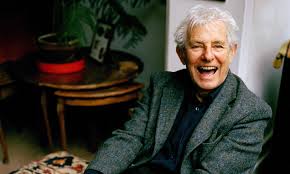
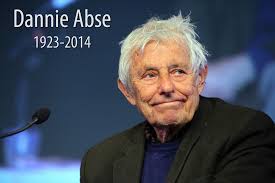
He remains a man who it feels impossible to confine to the past tense. So said Jeremy Robson, one of the speakers at Dannie Abse’s celebratory memorial event held in Kings College Great Hall on Wednesday evening this week. Indeed more than a few of those who had come to remember him, confessed they half expected Abse to be there himself, still large as life. Carol Ann Duffy imagined he’d want to “get outta here” – too much poker-faced reverence – and, yes, it was easy to imagine him somewhere still working away at his set goals – 5 or 6 publishable poems a year and every 5 years a collection of his marvellously accessible, witty and moving poems. How often did he achieve his own expectations of a good poem: that the reader should enter it sober, but leave it drunk.

imgres

Beneath a projection of this marvellous photo of Abse, Paul Gogarty oversaw the readings and recollections, immediately plotting the four compass points of the poet’s life: poetry, family, chess and Cardiff City FC. Lynne Hjelmgaard (Abse’s partner for the last 6 years) read the mysterious, life-changing visitation recorded in ‘The Uninvited’ (the only poem he would re-publish from his first book, After Every Green Thing) as well as her own moving poem in tribute to him. Alan Brownjohn, recalled his friendship with Abse and his direct acquaintance with the source materials of the two powerfully dark poems he chose to read: ‘Three Street Musicians’ and ‘A Night Out’ (the latter discussed in my earlier blog).

Tony Curtis alluded to another of Abse’s much quoted poetic observations: “I start with the visible and am startled by the visible”. He argued that, though not conventionally religious, the poet was a deeply spiritual man who could perceive the invisible through the visible. This was demonstrated in Owen Sheers’ reading of the extraordinary ‘In the Theatre’ in which a surgeon incompetently meddles with a patient’s brain (this was around 1938, only a local anaesthetic) only for the dying man to cry out hauntingly, ‘Leave my soul alone’. Sheers said this was the first Abse poem he ever heard – on a tape playing in his parents’ car apparently. Imagine the quiet drone of the engine after lines like these: “that voice so arctic and that cry so odd . . . to cease at last when something other died./ And silence matched the silence under snow”. A memorable moment, leading Sheers to dispute the reading of this particular poem with Andrew Motion, who gracefully withdrew (the English rightly ceding to the Welsh on this occasion, Motion observed) and chose instead to read ‘Apology’. Motion also recalled meeting Abse at an early Eric Gregory do and asking him (as a judge of competitions) how he approached the task of whittling down the thousands of entries. Easy, Abse apparently replied, throw out every poem containing the word ‘myriad’.

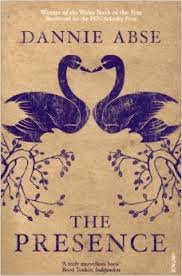
Abse’s daughter Susanna painted a more domestic picture of husband and father, a lover of all sorts of games including quizzes, board games, sing-songs on long car journeys, casting spells on recalcitrant traffic lights and pretending to talk to John Lennon on the family phone. She also recalled his “visceral” sense of loss when Joan was killed in the car accident in 2005. Only through the act of writing his memoir, The Presence (2008), and the poems later published in Two For Joy (2010) did he slowly return to something like a normal life. Elaine Feinstein read ‘White Balloon’ (“Auschwitz made me / more of a Jew than ever Moses did”) and ‘St Valentine’s Night’, the latter reminding us of Abse’s achievement as a poet of both erotic and uxorious love. Carol Ann Duffy had earlier read ‘A New Diary’ and Gillian Clarke chose the much-anthologised, neo-Romantic ‘Epithalamium’ (“Singing, today I married my white girl / beautiful in a barley field”) which she followed with her own response to it, ‘Barley’.

imgres

Perhaps most movingly there were several clips of Abse reading his own work (mostly from Ian Michael Jones BBC film series Great Welsh Writers). So the poet himself completed the evening with his reading of ‘The Presence’, the heart-rending lament for his wife, Joan, which surely everybody assembled in Kings Great Hall, beneath its classical white pillars trimmed with gold leaf, felt should now be addressed to the author himself:

It’s when I’m most myself, most alone

with all the clamour of my senses dumb,

then, in the confusion of Time’s deletion

by Eternity, I welcome you and you return

improbably close, though of course you cannot come.

images

Found Poems from Whitman’s Civil War Prose

I’m still pursuing some of the thoughts from my last blog about the difficulties of writing about current events (https://martyncrucefix.com/2015/03/13/how-do-i-write-poems-about-current-events/). I am reminded that we are closing in on the twelfth anniversary of the first so-called ‘shock and awe’ strikes by coalition forces on Saddam Hussein’s Bagdad in 2003: 

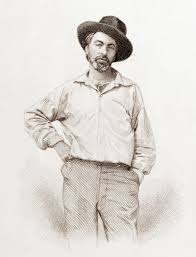
I did manage to write about the subsequent war in Iraq but on this occasion I approached it very tangentially, through the Civil War writings of Walt Whitman. The resulting poems were first published in The Long Poem Magazine (Issue 3, Winter 2009/10; sections also appeared in Acumen) with the Introduction I have posted below. There, I discuss several sections of the completed sequence though I will post up only two parts of it. For the sake of those who might be interested in how raw materials get transmuted in such a process, I have added links to the original passages from which #2 ‘The White House’ and #4 ‘I staid a long time to-night’ were derived. The full sequence was eventually published in Hurt (2010: https://martyncrucefix.com/publications/hurt/). Dan O’Brien has more recently used a not dissimilar ventriloquism in his poems about the experiences of war photographer Paul Watson. For a much more direct poetic approach to modern war (born out of direct experience as a soldier in Iraq) see the poetry of Brian Turner.

On 21st March 2003 the “big and little thunderers in chorus began to roar” over Baghdad. During Easter of that year I visited the American Museum, just outside Bath, and while my children scoured the grounds in an Easter egg hunt and my aging parents wandered around an exhibition of American rag rugs, I drifted into the bookshop and picked up a collection of Walt Whitman’s Civil War poetry and prose.

It was childhood innocence and the rag rugs’ recycling of material that were in my mind as I read the words Whitman had written in 1862 in Falmouth, Virginia: “Began my visits among the Camp Hospitals in the Army of the Potomac. Spent a good part of the day in a large brick mansion, on the banks of the Rappahannock.”

With the force of one of those visions that artists are thought to be prone to, it struck me that such a wide-eyed witnessing from an earlier conflict might be a way to write successfully about the then current conflict. Or to be more precise – since what I have just written fails to convey the powerful emotional impact of what I read – I was myself moved by reading Whitman’s observations but my emotion was not retrospective at all but immediate, topical, all about Iraq.

url

The more I read of Whitman’s prose the more genuine ties with the contemporary war I sensed. Whitman writes in his letters and journals almost as a by-stander, visiting the wounded and dying in hospitals, only occasionally being drawn to wider political observations and his focus on the individual cost of warfare exactly matched my own feelings. I began to imagine a sequence of poems framed by letters to a mother, containing the search for a brother and other references to close family members: “Han’s and George’s and Andrew’s. . . Jeff’s and his little Manahatta’s too”. The sequence came together only very slowly, partly because of my own uncertainties about its status as a partially ‘found’ poem but it eventually separated itself from its original sources and it was only later that I saw what was mine, what Whitman’s.

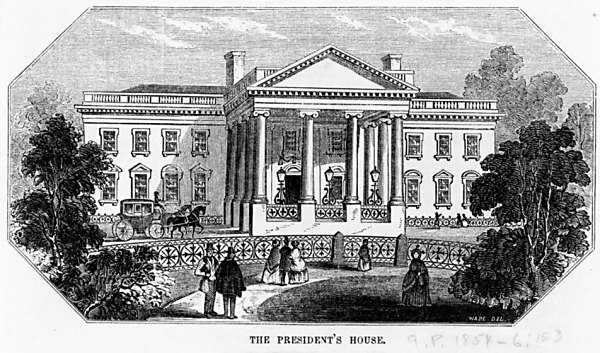
So the second piece, describing the White House, relies heavily on notes Whitman made in February 1862, but in the light of the deceit and war mongering of the early 21st century such descriptions are redolent with a bitter irony.

‘I dream’d a stockade’ is a more ‘composed’ poem, using Whitman’s familiar listing techniques, which intends to turn the suffering of the Civil War at an angle to reflect the inner conflicts that the Iraq mission quickly created in US society itself. With the inevitable reports of civilian casualties, I had little to add to Whitman’s accounts of comforting the wounded from the opposing sides of the Civil conflict to ensure a powerful contemporary resonance.

CIVIL115-1024x798
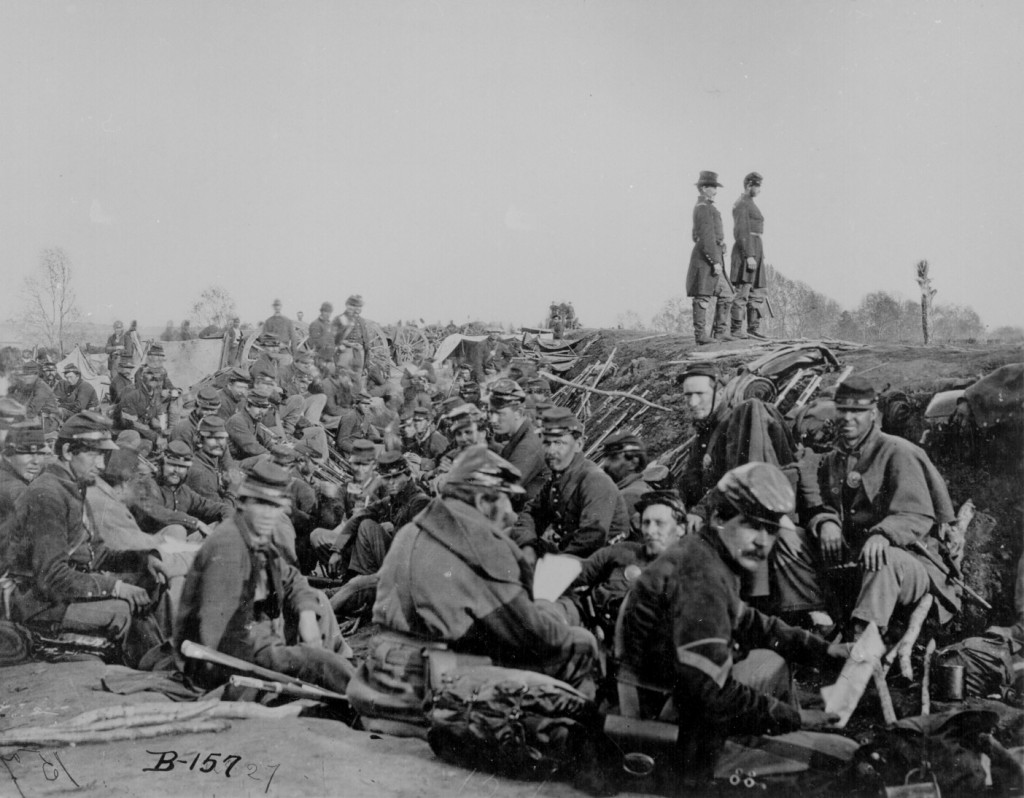
Soldiers in the trenches before battle, Petersburg, Va., 1865.

‘The President’ is drawn from Whitman’s many observations of Lincoln. He first set eyes on him in 1861 and, as with the White House material, while I was putting the sequence together, the passage of time had already imbued his original admiration with the bitterest of ironies. Of course, after the poems were completed, by January 2009 and the inauguration of Obama, time had ironically turned once more and some have since read this part of the sequence as ‘about’ the new US President.

With ‘To the Mother of one fallen’, the narrator is back at the bedside of an individual dying man whose ravings and sense of undeserved blame, of a corruption in the/his “system”, is intended to reflect warfare’s inevitable brutalisation of even the best of individuals, the results of which even now continue to be uncovered years after the world conjured its first surprised shock at events in Abu Ghraib. (click to see Whitman’s original letter of May 1865: Here )


More than it comes to

seven poems from the American War

ii. The White House

Tonight, I walk out to take a look at the President’s House.

Tonight, the white portico, the brilliant gas-light shining,

The palace-like pediment, the tall round columns, spotless as snow.

Tonight, a tender and soft moonlight flooding the pale marble,

A light that gives rise to peculiar & faint & languishing shades,

That are not shadows, for no such thing as shadow resides at this address.

On this night, a soft transparent haze under the thin moon-lace,

Where it falls amongst the bright and plentiful clusters of gas-lights,

That have been set at intervals around the façade & the columns.

Tonight, I see everything white, a marbly pure white and dazzling,

And even more so, the softest white of the White House of future poems,

And of dramas and dreams here, under the high, the copious moon.

Tonight, the pure and gorgeous front in trees under the night-lights,

The leafless silence and the trunks and myriad angles of branches.

Tonight, I see a White House of the land, a White House of the night,

And of beauty and of silence and sentries at the tall gate,

Sentries pacing in their blue overcoats, stopping me not at all,

But eyeing with their sharp sentries’ eyes whichever way I go.

For Whitman on The White House: Click Here

white-house-north-face-c1853

iv.  I staid a long time to-night

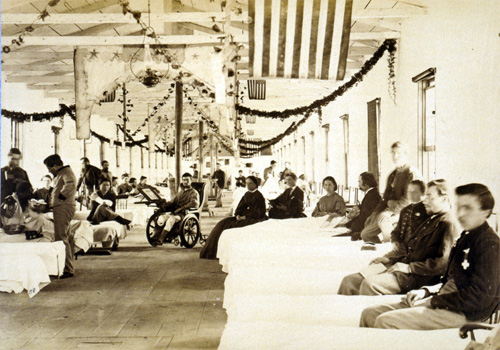
I staid a long time to-night at his difficult bed-side.

It was a young Baltimorean, grown to the age of nineteen.

He had seen so much and yet had slept such a very little,

His right leg amputated an hour since, he was feeble,

So he slept hardly at all, the morphine costing more than it comes to.

And this is what I must do, I sit still while he holds my hand,

And he puts it to his face most affectionately.

And this young, handsome, tanned Baltimorean spoke to me:

“My dear friend, I am certain you do not know who I am,

Although your sitting here so quietly and so patiently,

It means much, yet you must understand who it is you help,

Since what I stand for & fight for I know you believe to be wrong”.

I staid a long time at the bed-side of the young Baltimorean.

I staid certainly because death had mark’d him and he was quite alone.

I might say I loved him, sometimes kiss’d him and he did me.

And of his age was his brother, a brave and religious man,

His brother and officer of rank, a man I sat beside in a close, adjoining ward.

And I staid because in the same battle they were wounded alike,

The one strong Unionist, the other Secesh, and each fought well,

Each for their respective sides, brave & obedient & mark’d for the end.

Now they lay close, following the separation of many years,

Of their strongly held beliefs, the separations these had imposed on them,

And both fought well and each died in his particular cause.

whitman_05_lg
Ward in Armory Square Hospital, during Civil War, Washington, D.C.

For Whitman on the two brothers: Click Here

How Can I Write Poems About Current Events?

Recent reports coming out of Iraq suggest that Islamic State are destroying ancient artefacts, buildings, bulldozing cities like Nimrud. (see – http://www.theguardian.com/world/2015/mar/12/isis-ransack-ancient-assyrian-city-confirmed-iraq-head-of-antiquities-dur-sharrukin and http://www.theguardian.com/world/2015/mar/06/isis-destroys-ancient-assyrian-site-of-nimrud). Reading these reports has taken me straight back to the Taliban’s destruction of the two immense images of Buddha in the Bamiyan valley in 2001.

Whether it is possible to write poetry about such events is a question continually haunting me. It’s not a question I answer well or often I’m afraid – I’ve written precious few ‘political’ poems (four short pieces have recently been published here: http://themissingslate.com/2015/03/10/four-songs/). But I did manage to write about the Bamiyan valley (eventually published in 2004, in An English Nazarethhttps://martyncrucefix.com/publications/an-english-nazareth/ ). As I struggled with the poem I felt something interesting happening and I kept a drafting diary, some extracts of which I am posting below after the finished poem. I hope they provide some insight into the (often chaotic, chancy) thought processes of a writer, though they are necessarily fragmentary and I haven’t felt able to include copies of the drafts referred to (most of which I kept). I remember discussing the process of writing this particular poem with a workshop group in Bath a few years back and they responded well to the material though I’ve never organized it into a full account.

bamiyan_buddha_bg


The valley history

Over wind-eroded, bleached badlands,

creaking packs come past buttress and crevasse

through which scrolls of Chinese silk unfold,

beside green glassware from Alexandria,

poised bronze wrought in the dust of Rome

and Indian lattice-work, ivory figurines.

With an almost audible sigh of the road,

merchants and drovers lower themselves

to the lush place, benignant Bamiyan’s

sweet water, bird-song, best of all its shade.

Their hearts livened by its fine excess.

The valley gives rest beside standing pools.

There is time and reason enough to praise.

A million hammer blows hollow a place

for rough giants daubed with mud and straw,

for feet and face and Buddhas’ folded robes

in plaster-work, paint – one red, one blue –

their moonlike features, loose, gilded hands.

Yellow-robed priests are like tiny flowers

that spring beneath each benevolent gaze

by day and night, a new thousand years.

In brief intervals between battles that ebb

and flow indifferently now,

Kalashnikovs stashed between the toes

of the red figure – dry there, defendable.

Smooth head and sloping shoulder of the blue

irrupt orange as an order of dust rolls down

and the cry is All we are breaking is stone.

images

 Extracts from a diary about drafting this poem:

An article in the Saturday newspaper in the spring of 2001, recorded the apparent betrayal of his word by the Taliban leader, Mullah Mohammed Omar. In meetings with the Society for the Preservation of Afghanistan’s Cultural Heritage (SPACH), promises had been made to preserve two magnificent colossi, statues of Buddha, in the remote valley of Bamiyan. Within days of agreement being reached, rather than safeguarding the statues, the Taliban were shelling them. I sit and read this, as is usual, half-minded on other things, as I have been reading several articles the same morning, but I decide to tear this one out because I have had that inner stirring which I recognise as the voice of a poem to be. Writing the poem is finding a context – language, form, tone, narrative structure etc – what Auden calls the ‘verbal contraption’ – which will allow something of the reaction I experienced on reading the piece to re-create itself in my reader. It is that communication with which I am concerned. This is the truth I intend to communicate – not the literal honest truth.

*

I don’t progress far with a draft; I suspect because I have not yet found the distance from the informational aspects of the incident. This may or may not have been aggravated by my searching out information about the Buddhas of Bamiyan on the Internet – photos and earlier reports of concerns about the Taliban intentions and some historical details too.

Reading the first draft, it struck me that what I felt I was responding to was less a religious concern – this confirmed my uneasiness about writing about such geographically and culturally remote subjects – more an artistic one – about which I felt I might have something to say. The desecration and denial of the powers of art. This matched itself up in my mind with my sense that art arises out of an excess – economically and temporally – a luxury of a sort and the Bamiyan valley (in contrast to the surrounding rugged and desolate landscapes) seemed to suggest this contrast of the frugal and the rich. I mean the richness enough to devote survival time to the creation of art. I was therefore interested, in a second draft, in this contrast and the relation between trade – the Silk Road I began with – and the skill and beauty of the statues, the way in which they celebrate the excess and wealthiness and goodness of life – are separate from it, but at the same time arise out of it.

*

images

Then it was on Radio Four – possibly on Thought for the Day – half heard between the toast and marmalade and children’s cereals bowls. Between periods of blank inattention, I think I heard the speaker musing that she felt an irony in the situation – that it is the iconoclast who appears to attribute great power to the icon – often more so than the creators of the icon (this especially so in Buddhism where icons are certainly not created to be worshipped). The iconoclast fears the statues’ powers and this is why he feels they must be destroyed. This idea struck me as an interesting light on the situation and the tension between this idea and the declaration of Mullah Omar that these icons were just ‘rocks’ immediately presented itself as a likely ending to the poem – resonant, surprising, gesturing away from the topical towards something more universal.

*

One comment from a reader of a later draft stuck in my mind and grew into something that began to feel problematic. The comment was to the effect that the poem as it now stood had rather grand, magisterial tone, a kind of confident utterance, that swept the reader along. This had seemed fine originally, something related to the historical process and sweep I had hoped to capture and imitate in the poem as a whole. But it now hooked up with a remote dissatisfaction I had begun to feel that the poem had a remoteness that could be construed – I’m being coy here, I mean, I did construe it – as a lack of engagement with the material, in the sense that the statements the poem was making were too monolithic, confident, not as poetry, but as political/cultural comment. This took several weeks of re-reading the poem to come to the fore in my response to it and it wasn’t until – by chance – I had been reading Eavan Boland’s book, Object Lessons, that I could articulate what my objection to the poem had become.

url

In her book, Boland traces her own development as a poet, particularly as a woman poet in Ireland where she felt the tradition of Irish poetry, though vibrant and respected in ways which we, on the other side of the North Sea, often envy, did not readily allow the writer of poems to be female. One effect of this was for Boland, as an aspiring woman poet, to adopt the modes and language of the dominant male tradition. She argues that she recognised this effect in the poem ‘The War Horse’.  The poem, she felt after completing it, suffered from a confusion between “the political poem and the public poem”. She felt that she had allowed the subject of her poem “to be a representative and the object to be ornamental. In such a relation, the dangerous and private registers of feeling of the true political poem [are] truly lost. At the very moment when they [are] most needed”. I began to feel the same thing had occurred in my poem. It was a public poem (something I’d worried about from early on) and in being so, it had not encompassed, or involved, anything more personal or private of my own self, that might serve to give perspective, even to undermine the position so evidently held by the poem. This is where the confidence of the poem’s voice derives from, but also its, arguably, simplistic nature.

*

At this stage, I couldn’t see how I was going to be able to re-shape the whole piece in answer to a fundamental criticism like this. In all sorts of other ways I was pleased with the poem as it stood. Others liked it too. It might be argued that there ought to be room for a simplistic poem on a subject that seemed to provoke such outrage. Was my desire for a more destabilising ‘personal’ voice, the weakness of the liberal who tries to see all sides of a question? Perhaps. I felt uneasy aligning myself with journalists (even quality ones!) and I felt my gradually formulated criticism of the poem was a valid one. One thing I felt I could do was to remove the final two lines of the poem. These ringingly ironic lines were hard to cut, but they did end the poem on the moral high ground, as it were, assertive and confident, inviting the reader to dismiss the Mullah’s words as patently and unmistakably weasel words. The removal of this – leaving the poem to end on the rather more interesting irony of ‘Only children dare not deface a Buddha’s foot’ – went a little way to destabilising the, almost arrogance in the poem’s tone. Perhaps the Mullah’s phrase – which has been a crucial part of my poem from the very start – could be a title?

The title it became and there followed a number of drafts in which I seemed to be wrestling with the failures of the fourth stanza. There I was attempting to record in too documentary a style what the Taliban actually did with the statues. I was becoming over-involved in the image of their trepanning of the Buddhas and then placing explosives in the heads, as well as the burning tyres. In both these cases, part of the problem was that the poet in me had fallen in love with striking images which I found satisfying but which – on further reflection – probably had no real place in the poem. They were too much powered by my love of language – too little linked to the purpose they might serve at that specific point in a specific poem.

*

The poem was begun in March of 2001. And I was still working on it in September of that year – when the World Trade Centre was attacked. Al Qaeda’s links with Afghanistan are well known and the image of the monuments of East and West both being destroyed were impossible to keep apart in my mind now. I had a sense – again reflected in newspapers of the time that what had happened in Afghanistan had tortuously precipitated the Twin Towers attack. But too explicit a link would never serve so, at this stage, I tried to work in references to “stone dreams” falling not only in Bamiyan but elsewhere in the world. There were all kinds of ironies in linking these religious icons with the West’s most iconic images of capitalism and, though I don’t think I thought these through too rationally, they appealed to me and seemed to be apt in the context as Mullah Omar’s original statement caught my ear in large part because of its brutal materialism.

url

Around this stage, the form of the poem changed from the irregular stanzas it had been in since the start to unrhymed couplets. This, I hoped, would assist the lightening – the easing? – of the tone of the poem, as I’d begun to feel the clumped stanzas gave it a rather oratorical, speechifying feel, whereas the couplets would give a more unstable, edgy impression. Now called ‘The valley history’, it was still the final few lines, which seemed problematic. But with the eventual loss of the personification of ”fright”, the final choice of the phrase “irrupt orange” to suggest the splitting open of the Buddhas by the Taliban shells, and the removal of the rather too obviously paradoxical and (again) grandiose falling “stone dreams”, I felt the poem was finished enough. What eventually replaced the image of the falling towers was a phrase I was pleased to find. The “order of dust rolls down” alliterated well in the context, suggested the literal plumes of smoke and dust which accompanied the statues’ demise and, of course, also suggested the rolling dust clouds which followed 9/11. As well as literal truth, the “order” is intended to suggest a rule of government, or at least the decree of leaders, which tends towards destruction rather than construction and this was one of the originating impulses of my beginning the poem many months earlier.

crucefix_nazareth

How Do You Judge a Poem?

I am half way through the process of judging this year’s Torriano Poetry Competition (https://torrianomeetinghouse.wordpress.com/2014/10/27/torriano-poetry-competition-2015/). I’ve been lucky enough to judge a few such competitions in the last few years and what follows is a compilation of thoughts on the judging process. Though the initial sifting can be a slog, the latter stages are fascinating as poems that set little hooks in you at first reading, gradually become more clear, their internal coherence emerging alongside their skills with language and form. What follows is inevitably a personal take on the business – more so as the process unfolds – but I hope it may cast some light on it for those (of us) tempted to spend hard-earned cash on entering the numerous competitions now running (here are a few . . . http://www.poetrylibrary.org.uk/competitions/).

In the 2003 comedy film Bruce Almighty, Jim Carey plays God and, alongside with more obviously useful powers, he has to respond to the prayers of the world. But people are always praying; he rapidly approaches a kind of madness as voices swim around him, clamouring for attention.  He takes to reading the prayers in the form of e-mails. He tries to answer them individually but is receiving them faster than he can respond. He sets his e-mail account to automatically answer “yes” to all, assuming this will make everybody happy. Of course, it does not.

imgres

A poetry competition judge comparing himself to a character playing God lays himself open to criticism – but I have indeed found the initial phases of judging rather like Jim Carey’s experience. There are so many and such a variety of voices clamouring to be heard and every one of them is heart-felt, recording significant moments in people’s lives. There is a similar sense of responsibility too – the raw nature of much of the writing is impossible to deny. I’d like to set my response mechanism to say yes to everybody, but the judge’s task has to be how to distinguish submissions as poetry.

**

The numbers are always frightening. Many hundreds of poems will be submitted. Perhaps only 10% of these will demand a further reading after the brutal first sifting. Poems face an early red light from most judges because basic elements are not competently done:

  • Competitions are full of pieces where a particular verse form or rhyme pattern tyrannises the sentiment. The writer’s submission to this tyranny becomes clear quickly through the contortions imposed on the language to achieve a rhyme.
  • The writer’s choice of language can be devastating to the life of the poem. It just isn’t right to opt for forms of language or abbreviations that died out early in the nineteenth century.
  • Choice of diction also derails an entry if it is doggedly abstract. Sure, there remains much debate about whether it is the narrow English tradition that insists on things rather than ideas – but poems about Fear, Ignorance, Poverty, Eternity and Love which refuse to dip a toe into anything resembling a real life situation are going to find progress hard.

leaning-stack-of-papers-and-files

  • A fourth error is using language without being fully aware of its likely resonance with a possible reader. A poem called ‘Mother’s Pride’ which turns out not to be aware of the loaf of bread is going to have unanticipated clutter to climb over in the reader’s mind. Louis MacNeice wanted the poet not to be an ivory tower type, but rather “able-bodied, fond of talking, a reader of the newspapers, capable of pity and laughter, informed in economics . . . actively interested in politics”. All a bit Boys Own perhaps, but if this means the poet stays up to date with the way words live then he’s right.

 **

If you are thinking of submitting to a competition, it’s worth recalling Wordsworth’s formulation – familiar though it will feel – that poetry is built from “emotion recollected in tranquillity”. Poems made in the heat of the moment (and not revised and reviewed in the name of not tainting spontaneity) are seldom without their flaws. This is the kind of distinction Rilke also makes when he denies poetry is composed of feelings. Its constituents are rather “experiences” which he clarifies as “memories” though even with these, we “must be able to forget them when they are many and one must have the immense patience to wait until they come again . . . Only when they have turned to blood within us, to glance and gesture, nameless and no longer distinguished from ourselves – only then can it happen that in a most rare hour the first word of a poem arises in their midst and goes forth from them”. On the other hand, such recollection can sometimes create an intellectualised distance that may do harm to a good poem. Who said writing a poem was easy?

louis-macneice

Stephen Spender argues that a poet should try to acquire skill and virtuosity through the study and interpretation of other poetic works in the way Mozart and Beethoven did in playing the music of their predecessors.  Spender suggests translating poetry is the best possible exercise in interpretation. But the really important lessons (Spender says) are those of the eye, the ear, the athletic/poetic muscles. A poet can go a long way without a developed heart, but, he says, can get nowhere at all without these skills. The poet must ask continually of his lines: ‘Do they make the reader see, or hear, or feel, this experience which I am trying to re-create?’

 **

Reaching the final stages, the judge will be focusing more positively and more clearly on the sense, the story, the thought of a poem. Personally, I like poems that focus on small things and, in effect, make arguments for the ways in which they communicate the bigger issues that concern us all. I’m with Thomas Hardy in believing that “he used to notice such things” is one of the greatest of compliments. Edward Thomas’ poem about Spring, ‘But these things also’, likewise echoes this focus on what most people tend to overlook:

The shell of a little snail bleached

In the grass; chip of flint, and mite

Of chalk; and the small birds’ dung

In splashes of purest white . . .

Perhaps one explanation of why the question ‘what is poetry?’ is difficult to answer is because it is an art of the negative, of avoidance. The Daodejing says what is rigid and inflexible is a companion of death; what is flexible is a companion of life. I’d guess there would be general agreement that poetry is an art on the side of life. So poetry must eschew the inflexible; we must avoid the posture. And that’s very hard. In judging a competition one comes across the Wordsworth-posture, the Ginsberg-posture, alongside those of Betjeman, Hughes, Plath, Duffy . . . But we also posture like mad in ‘real life’. We may take up the pose of grief, melancholy, love, liberalism, environmentalism . . . The mark of the absence of posturing is an instability, an openness, an awareness of time (which posture tries to deny) and this is something I look for in a good poem. If a poem strikes an attitude my attention diminishes (even the attitude that wants to show a rejection of attitudinising through the hall of mirrors of ironic distancing). When the poem unearths a pulsing, shifting, live relationship between the self and the other, then I am captivated, recognising something that is both commonly human and uniquely personal.

But having said all this, I’d assure potential competition entrants that anything resembling a rule is there to be broken. Philip Pullman has said, “We don’t need a list of rights and wrongs, tables of dos and don’ts: we need books, time, and silence. Thou shalt not is soon forgotten, but Once upon a time lasts forever.”

114650911_345473c

So any poem in any form can work its magic. It will haunt its reader for days; it will make me change the way I think and feel; make me see the world differently. Ultimately, a poem contributes to who the reader is becoming. That is an exciting prospect for the writer. It is an even more exciting one for the judge who settles down to read.

The Poetry of Tom Rawling

In the early 1980s I arrived in Oxford as a self-absorbed post-graduate and promptly sought out student poets wherever I could find them. The group I joined was then (I think) meeting in rooms in Hertford College, opposite the Bodleian Library (and happily very close to the Kings Arms). Bill (W N) Herbert was there, as was Keith Jebb and Paul Mountain. The group, with changing personnel – I remember Elise Paschen was a member for a while – continued to meet throughout my 4 year stint among the dribbling spires, but we would supplement it by decamping to the Old Fire Station on George Street where Tom Rawling was running a public workshop. Tom had taken over when Anne Stevenson moved north. As a retired headmaster, Tom ran us all as a well organised and disciplined class. Elizabeth Garret joined later and I think Peter Forbes was already a member, as was Helen Kidd. Jeremy Round, who was soon to achieve short-lived fame for his cookery writing, was also a regular. My poem ‘In Memory of Jeremy Round’ (eventually published in Beneath Tremendous Rain (Enitharmon, 1990) https://martyncrucefix.com/publications/beneath-tremendous-rain-1990/) is a lament for his tragic early death, but also tries to paint a vivid picture of the workshop and its members:

We’d wrangle inconclusively

between the beers and crossfire from Tom,

elder statesman who’d slip quietly glittering

poems from his tackle bag like fish; from Helen,

whose pages always seemed typed under earthquake

conditions, whose baggy poems had more passion

than most of us could muster; from Peter’s

exactitude, schooled on a diet of science, he held

each piece like a prism till it shed eloquent

rainbows; from Bill and Keith, the ferocious

tyros, the university wits, who minced nothing

but their language into strange sweet things;

from Paul whose poems were amazed not to find

themselves loosed into a more graceful age

than the one we live in.

There were others writers, of course, to whom I apologise for not recalling them clearly. Bill has also written about these few years with great eloquence and insight: http://tracearchive.ntu.ac.uk/poets/herbert/dec_2.htm.

imgres

But rather than his aspiring students, it’s Tom Rawling’s own poetry that I want to highlight. A pamphlet called A Sort of Killing appeared in 1978 (an historical event now as this was one of the first publications by a young Neil Astley). OUP published Ghosts at My Back (1982). Two other books followed: The Old Showfield (Taxus, 1984) and The Names of the Sea-Trout (Littlewood Arc, 1993).

Grevel Lindop has long been a fan of Tom’s work (http://grevel.co.uk/poetry/tom-rawling-rediscovering-ennerdales-poet/). There is an audio recording of Tom reading many of his best poems (you can listen to one of them here: http://listenupnorth.typepad.com/listenupnorth/tom-rawling-poet.html). Listening to him again, what what comes over is his modesty, his sharp intelligence, his confidence in his own work and the vivid recall he had of his formative years, growing up in Ennerdale, Cumbria. Tom’s poems, in their accessibility, boldness with language, natural and ecological themes are (as my review concludes) ideal for the classroom and it is still a cherished hope of mine that they might be taken up by a mainstream publisher and presented to a new generation (a Rosemary Tonks of the western valleys of Cumbria, wielding his fly-fishing rod). Perhaps the best way to sing my praise of Tom’s work is to post up a review I wrote of his posthumous collection How Hall (2009).

imgres

I recommend you search out more of his work (http://en.wikipedia.org/wiki/Tom_Rawling). Here is my review:

Tom Rawling, How Hall: Poems and Memories, a passion for Ennerdale (Lamplugh and District Heritage Society, 2009), £7.50, ISBN 978-0-9547482-1-0

Tom Rawling, How Hall: selected poems of Ennerdale poet Tom Rawling, read by the author (Lamplugh and District Heritage Society, 2009), £5, CD audio recording

As a child in the 1920s, Tom Rawling grew up in the Ennerdale valley in what was then called Cumberland. It was not until his retirement in the shallow decades of the 1970s and ‘80s that he began to write poetry as a man “haunted . . . even bullied by his memories” as Anne Stevenson’s insightful introduction to this new selection explains. A marvellous collection was published by OUP in 1982 and two further publications from smaller presses resulted, but at his death in 1996 Rawling had not attracted the kind of attention he had hoped for and certainly deserved.

How Hall is a new edition of more than 70 poems, three pieces of autobiographical prose and some wonderfully evocative photographs. The accompanying CD is an audio recording of an extended reading given in 1983 and the passion and precision of his voice and his humble and insightful comments add further invaluable dimensions to any appreciation of his work. Rawling shares with Heaney the kind of vivid recall of childhood that yielded the title of his first book, Ghosts at My Back. An early poem has the young Rawling playing “squire” to the village blacksmith who also introduced him to his life-long passion, fishing – both are described as “tying knots / That didn’t slip” (‘Johnny’). Yet home life was not always so easy and there are poems that bitterly lament the repressed and repressive life of his mother (‘Hands’), his father’s drinking (‘Honour thy Father and thy Mother’) and the son’s rebellious, divisive “radical words” (‘Clipping Day’).

His rebellion took him away from home, but ironically it is for the authenticity of Rawling’s responses to the farm life and countryside of the Ennerdale of his youth that we should continue to read him. Perhaps it has taken us 25 years to understand what he felt intuitively, the importance of our relationships with the natural world and the kind of folklore that once bound man and nature together. Even in the 1920s, it was only Rawling’s grandmother who “glimpsed beyond the byre” to the atavistic fertility beliefs that lay behind “ritual no longer understood” (‘Grandmother’); it was she who knew the spell to complete a whistle carved from hedgerow sycamore (‘Sap-Whistle’). ‘The Barn’ vividly evokes the thrill of the hay harvest: “Bright prongs pierced and unpicked, ash handles / bent, they launched the bundles we embraced” and as the barn filled it was only when “heads bumped the slates / we came down the ladder in triumph”.

images

Anne Stevenson – who met Rawling in Oxford in the late 1970s – rightly directs us not to dismiss his work as “romantic retrospection” because he really “wrote poems to tell the truth and in them rehearsed the daily rituals of life and death”. ‘Rumbutter’ characteristically revels in that recipe’s “sweet beginning” as well as, “not quite hidden, the cinnamon / of the coming funeral feast”.  There is certainly no room for sentimentality in Rawling’s view of nature: a pig is to be cared for only till the “pole-axe fell” (‘Hooks in the Ceiling’) and chickens are nurtured carefully, but in their “due season, each neck pulled / . . . the admired knack of killing” (‘Feathers’). Rawling also shares with Heaney a fascination with the insights embedded in idiom and dialect. ‘Hearthwords’ addresses the younger Irish poet with their shared belief that “the naming spell / gives the thing itself / into our hands” And then, as his own poetry began to flow, he swiftly developed a precise, lean, direct form of free verse, capable of moving from the joyous observations of “cloud and sun pursu[ing] / Their steeplechase across the land (‘I Am What I Was’) to the shockingly frank recording of the realities of the cow shed: “ a column of piss / cascades to the cobbles . . . a face gurning, whistling and whispering soft farts” (‘Privy’).

But Rawling’s reach is not confined to the material. Perhaps his most distinctive poems are those that deal with angling, especially fly-fishing for salmon and sea-trout which his poems transform into an almost religious questing and testing of the individual’s devotion, skill and subterfuge. His own first encounter with the power of the sea-trout he recalled as a moment when he had “waded / into mystery, tampered with Leviathan” (‘Leviathan’). One function of any poem is to offer us profound if vicarious experiences and these poems succeed so well in this evocation, taking us to the riverside at night, “to the dub / where sea-trout rest” where we might “hear an old ewe’s husky cough, / the water slopping, slapping” (‘Night Fisherman’).

imgres

Poem after poem makes it clear that to fish in this way is to engage differently, intimately with the world and to embark on the difficult process of laying aside our humanity’s hobbling self-consciousness, to cast off the accretions of civilisation until we allow “the body [to] flow into the rod” (‘Torridge Salmon’), achieving a different form of consciousness as we “wade in deeper, / Share with the fish / Its lateral line / The current’s push” (‘Only the Body’). It’s easy to understand why Ted Hughes came to admire these poems as Rawling triumphantly celebrates the efforts and occasions when we encounter the Other in what becomes a frankly spiritual communion. So in ‘A Shared Rod’, a kingfisher perches on the “bamboo rod-tip” as the angler waits in the reed bed:

His great eye turns, a moment’s stare,

then, blue-green whirr,

the arrow skims downstream,

leaving an emptied space,

a shared rod quivering.

It is really this kind of encounter – with all that is not bounded by ourselves – that Rawling is conjuring in ‘The Names of the Sea-Trout’, a spell for fishermen that revises and revivifies his grandmother’s superstitious connections with the natural world:

Bender of steel, the breaker, the smasher,

The strong wench, the cartwheeler,

The curve of the world,

She who doesn’t want to surrender,

The desired, the sweet one.

Profound, vivid, honest, accessible – these are poems that at once connect us to a lost past and prepare us for a world in which the environment must again become our close companion. Rawling’s work would be wonderful to teach in schools if it were more easily available and a mainstream publisher would do well to bring him nearer centre stage. For the time being we must thank Michael Baron, Stan Buck and the Lamplugh and District Heritage Society for the very many pleasures of this marvellous book.

imgres

A Holocaust poem – my Dad’s desert war and one of the Magi

Last week, the 27 January 2015 marked the seventieth anniversary of the liberation of the Auschwitz concentration camp. I have only once tried to address the subject – in a poem dedicated to my father who served in WW2 in the RAF, mostly in the deserts of Egypt (he was with 80 Squadron: http://en.wikipedia.org/wiki/No._80_Squadron_RAF).

He was an engineer by trade and – as far as I know – saw no hand to hand combat. His brief was to maintain the Hawker Hurricanes that were a major component of Allied air power in North Africa. The poem records his only war injury: badly burned legs from jumping too quickly onto the nose of an aircraft after it had landed, straddling its still blisteringly hot twin exhausts. In the 1960s, he’d tell us about this while we sat at the dining table gluing together Airfix models of Hurries (as he calls them), Spits and Lancs.

77feb45061370833dbb98ad79d7f5150

The poem was finally published in 1994 in On Whistler Mountain (see https://martyncrucefix.com/publications/on-whistler-mountain/) It opens with a less than complimentary picture of my father’s unreconstructed political and racial views which I wanted to link to the birth of Christ and the Holocaust. Ironically, given his attitude to people of colour, my father dreams in the poem that he is one of the Magi, Caspar, often depicted as a King from the Indian sub-continent. The poem’s narrative folds over to encompass both the first stirrings of Caspar’s dream about the birth of Christ as well as his last days which I imagine him spending in northern Europe.

Being a King of sorts, my-father-as-Caspar imagines the birth of a conventional king, one of conventional powers, but the child’s family turns out to be of no “consequence”. The child he finds in Bethlehem (I was thinking of course of T S Eliot’s ‘Journey of the Magi’) seems little more than a “futile gesture”. More dreams – which the poem takes as shorthand/short-cuts to the life of the imagination – then drive Caspar north to settle in northern Europe, himself facing racist attitudes among the native peoples there.

 200px-Hurricanes_80_Squadron_RAF_128173

My father’s imagined bafflement before this strange dream in which he plays the role of a non-white king is – I’m sure now – partly his son’s liberal conscience obliquely criticizing his politics. My poem leaves Caspar to die in the northern forests, himself bewildered by what his own dreams have driven him to. The Christ child he dismissed years earlier, continues to visit him in dreams where he goes weeping over that “precise, god-forsaken ground”. The visionary child sees into the future, is a prescient witness to his own Jewish people rounded up by the Nazis’ similarly repellent attitudes to power and racial difference, finally entering “incinerators smoking in the German forest”. Of course, Auschwitz itself and many other camps were not built on German soil, but it was important to use the ‘G’ word at the end of the poem. In the strict pursuit of truth, I was imagining Caspar’s long-house on German soil in the locality of Dachau or Buchenwald, the name of the latter translating as ‘beech forest’.

A Long-House in the Forest

for my father

1.

His war happened in the blazing Middle East.

When he was young, far from the mud of Europe

and the wired camps, his thighs were burned

by too much bravado, sitting astride

the exhausts of a Hurricane that hadn’t cooled.

He picked up the language. Never liked Arabs.

Any dark skin’s still a nigger to this day.

So he votes for the Right, though he’s careless

of politics and takes it as read: we all

long for power and we all need to be led.

imgres

2.

In his dream, he is Caspar. He has chosen

to wait in the draughty long-house, watching

the yard collect its ragged slush of leaves.

He knows the corn-bins are flooded and rotten.

He knows this month is the anniversary

of nights when Caspar rolled in distress, youth,

dream illumination – an excited showing

of power’s open hearth, its air-gulping fire –

his sleep filled with the birth of a king

whose strong arm would invigorate the world.

At once, Caspar instructed a journey. His gift

for this new king, of course, was gold.

220px-Dieric_Bouts_004

3.

A wretched child asleep on that year’s straw.

Neither mother nor father people of consequence,

but simple Jews – trouble-making, deluded.

This was nothing worth his understanding.

(He knows Caspar is a man of wisdom and books).

What could be the need for this powerless figure?

Why this pot-bellied brat? This futile gesture?

Shepherds stood with doting faces for the boy.

He turned his back, dropped the derisory gift.

4.

Without wishing, Caspar gleaned what became

of the lad from travellers’ unlikely tales.

How he saw no reason to cloak humility.

Nor saw the need to make a show of strength.

No surprise the authorities destroyed him.

And on that day, Caspar, his dream-self,

was driven by dreams again, north this time,

to the Black Sea, fighting the Danube inland,

to this blond-haired, beer-drunk, long-limbed place,

whose people mistake him for a piece of Hell

with his blackened face and barbarian tongue.

5.

Sitting by the squadron’s crest, a photograph

of the kids, he sees no reason to dream himself

black and ignorant, plagued by dreams. But he is

Caspar, has chosen the long-house and struggles

at night – not with dreams of the hot south,

of home, courtyards, frescoes and fountains-

but with a dream that has no place yet, though

he searches for it, now that same, futile boy

in the straw has grown his only dream-guide

and weeps over this precise, god-forsaken ground.

He finds it ruled by those whose failure is to see

no need for an icon of the weak, the needful.

Here, the boy’s deluded people prove no trouble at all,

filing from wooden huts ranged like inland galleys,

to incinerators smoking in the German forest.

260px-Bundesarchiv_Bild_183-1983-0825-303,_Gedenkstätte_Buchenwald,_Wachturm,_Stacheldrahtzaun

Review of ‘The Pity’ – Part 2: new war poems commissioned by the Poetry Society

On National Poetry Day (October 2014) four contemporary poets (chosen to represent “different poetics and perspectives”) performed new work about the legacy of the First World War. Two months later the Poetry Society published The Pity as a limited edition anthology. Given free to Society members (in the last couple of weeks it has come through my letterbox with the new issue of Poetry Review), it is also available to purchase online.

In my previous blog, I discussed the contributions of Steve Ely and John Glenday (click here to read this). Here I complete the collection with comments on the work of Denise Riley, Zaffar Kunial and Warsan Shire. Overall, I think The Pity is remarkable – a gathering of voices, each wrestling with a nigh impossible commission. The four “sustained” responses to the topic (John Glenday’s was a separate, shorter brief) all splintered into fragments under the pressure of it. Ely and Shire are the boldest in widening the orbit of the commission and interestingly are also (for me) the most successful, largely by co-opting the resultant technical schisms into what they wanted to say, both of them drawing on more contemporary material, closer to their own concerns and backgrounds.

imgres

Denise Riley’s ‘A gramophone on the subject’ recalls Sassoon’s balancing act of anger and compassion. The two elements are held in tension partly because of Riley’s contrasting dual focus: the bodies of the dead and the possible consolations of spiritualism. More firmly focused on the 1914-18 conflict than the other sequences in The Pity and written in what Riley calls “a kind of ‘music-hall’ jingle or doggerel”, sections like ‘The postwar exhumation squad’s verse’ have a Brechtian feel. The soldiers detailed to pursue this ghastly task (often long after fighting was over) unearth bodies, “bits that [get] dropped in cloth bags”. Even the grisly bits are so devastated and decomposed as to be “almost unknowable”. The voice is one of the squad (or a compilation of their voices) and compassion is evoked through a father who pursues them, convinced that “a charred scrap of shirt” is his son’s body, only to be told (hear the stabbing effect of the harsh rhyme) “the thing was just dirt”.

Riley’s notes are as long as the poem sequence and it is the loss of the bodies – disfigurement past recognition or simply untraceably taken to pieces – that pre-occupies her. There is a sardonic, black humour in the verses. Dog-tags feature several times as (being made of “vulcanized fibre”) they are often the only remaining evidence of a life; a name without a body. The more precise the chosen voice in each of Riley’s 9 sections, the more successful the poem.

url

One records the voice of an ironic “heavenly choir” of the dead, bitterly objecting to Edwin Lutyens’ observation that the dead in their mass cemeteries had been ‘Tucked in where they fell’. Anger is conveyed (in what is really a found poem) by adopting the voice of a Vogue fashion correspondent in 1916: “To find a dinner gown which will be becoming, correct, and yet not depressing to its beholders is always a problem for the woman in mourning”. The lack of understanding of what the men on the Front were enduring is one of the commonest elements of literature in the period.

DeniseRiley-SquareWeb

Later, Riley drops the jaunty, sardonic versifying to record (again from contemporary sources) the common resort to spiritualism in the spirit voice of a Private Dowding: “enrolled among those who are attempting to pierce the curtain that separates your world from where we live”. More touching is the spirit’s reported loneliness which is echoed in the best poem, the last, which takes on the voice of a bereaved wife. Here the satirical form is also dropped as she speaks in unrhymed, hesitant couplets, switching from first to second person in the concluding lines as she resolves to carry on, her final monosyllables eloquently conveying both the difficulty and her determination:

I look doggedly after a missing figure.

What to do now is clear and wordless.

You will bear what can not be born.

‘The Shape Remembrance Takes’, Zaffar Kunial’s 5 poem contribution to The Pity, is the least coherent. Judith Palmer’s introduction to the book quotes Kunial on what must be a common problem with such commissions: months of scribbling gave rise to “lots of ideas but no poems”. Something of this is reflected in the liturgical refrain of ‘Poppy’ which frustratedly cries repeatedly, “No, this is not enough”. The ostensible point is the difficulty of finding what Seamus Heaney calls “images and symbols adequate to” the horrors of the situation. Kunial’s voice here is deliberately prose-y, across several lines, each a longish breath-ful, spinning different ways to allude to the familiar image of the poppy:

Remember? Who’s there in the first script, on a Mesopotamian

tablet: Hul and Gil – ‘joy flower’ – a cuneiform

cocktail, our earliest remedy . . .

images

In this way we visit natural history, China, Persephone, Lethe, Coleridge, Shakespeare and (most effectively for me) more personal associations with morphine being administered “through my mother’s veins, while she could still hear me”. But it’s hard to lose the sense of the miscellaneous/googly quality of some of these verses, reflected in the shifting (I’d say, uncertain) tone: “The deaths we live with. Enough said. Remember? / This is you. Wake up. You’re summoned. // No, this is not enough.

ZaffarKunial-SquareWeb

Lists can be the resort of the uninspired (readers of poetry will work pretty hard to do the linking for themselves) and, despite the epigraph of Archimedes’ declaration about moving the world, the historically various battles listed in ‘The Night of the World Cup Final in ‘14’ failed to achieve much leverage for this reader. A walk around Grasmere (where Kunial has been Writer in Residence) is vivid and pleasant enough; the shapes of the fells, puddles, a wishing well all suggests “it’s all about holding, around here”. But the bar room vagueness of what follows (“So here’s to those souls / who went the other way” – what? Unheld? Dropped? Dropped?) also fails to be enough.

There is some interesting (and from what I know of his work, more characteristic) play in ‘Just the Ticket’ with ideas of home, identity and language but it was apparently standing before the cenotaph in Whitehall that sparked Kunial’s sequence off and this is reflected fairly literally in ‘Letter for the Unknown Soldiers’. The blockish 50-line single stanza, perhaps an emblem of the Cenotaph itself, takes a rather slow and discursive line (“I see . . . So here I am . . . I’d guess . . .). Perhaps this is a reflection of remembrance parades, here composed of the multitudinous dead, stretching from Durham to London, “from Lahore to Delhi”. Eventually, the stone memorial comes to be seen as an “I” or a “1”, linked with the “two quick minutes” of the 11/11 day of remembrance. While this is promising (and again draws vigour from Kunial’s concerns with identity) it’s a bit inappropriately fanciful as it stands and, in various ways, it seems right the sequence ends with the narrator stranded by passing cars on a traffic island in Whitehall:

I want to cross [. . .]

[. . . ] but I’m stuck at the minute,

stranded beside this thing that stands for you –

this I – that I’ve been stood here speaking to.

Warsan Shire’s baldly titled ‘War Poem’ appears in 17 parts and has almost no direct link to the First World War. For Shire ‘war’ is less a historically delineated event, more a state of mind, more still, a condition of certain societies (including our own). Parts 1 and 9 express this through borrowing a technique from the American poet A. Van Jordan. In his book M-A-C-N-O-L-I-A (Norton, 2004) he explores individual words, including prepositions, to develop his account of the life of MacNolia Cox, the first black finalist in the National Spelling Bee Competition in 1936. (See him read about the word ‘from’: here). Shire defines the preposition ‘in’ in two ways: war is something in which we live, being “enclosed or surrounded” by it and that it is also a span of time in which events occur. The former, less conventional interpretation is the root from which her poems in The Pity proliferate. Though born in the UK, her parents are from Somalia, so for them war is an on-going state, the hope of its cessation a reason to keep “a suitcase packed just in case”. But a sense of being exiled from our own ‘country’ is a common feeling in the continuing ‘war against terror’ so that “one war [gives] birth to another . . . a snake swallowing its own head”. Rather than the explicit warfare of trenches and barbed wire, this kind of war “sleeps between me and my partner in bed”, it haunts, it stinks, its “under my nails”. Horrific headlines wake us at night, the lover’s body offering some hope of “another version of the world”. Shockingly, ten year old sisters know this sort of war.

Warsan Shire

Some of the 17 segments of the poem lack development perhaps, but parts 7 and 8 are stunning. The first of these records a Quinceanara (a fifteenth birthday celebration), initially in what seems realistic detail as “prepubescent girls” gather in “princess dresses”, a TV babbling in the corner. But through cinematic style jump cuts in the narrative, violence surreally invades the party, “men with gas masks / walk in”, leaving the surviving teenage girls “to pick up their teeth from the sticky dance floor”. Section 8, is a more comic variation on the theme with a girl singer, an “immigrant girl Icarus”, stunning the UK with her performance on The X-Factor, though even the glitz and glamour (even Simon Cowell) cannot disguise the “faint smoke of war” billowing about the girl’s watching family.

Shire’s sequence widens its focus after a reprise of the prepositional definitions. War now (“What is the name of this war?”) is manifest in police brutality in the USA, in returning universal “ghosts / of the / dead boys” who have been killed. She even manages to write of the beheading of James Foley in August 2014 in a rightly plain account of the video released by ISIS, but strips it of any media glibness, any risk of YouTube numbness, by the decision to repeat and accumulate lines agonizingly (a far more effective use of repetition than Alice Oswald’s in Memorial (Faber, 2011)). It’s Lucille Clifton’s work that Shire uses to model her conclusion, asking you/us to join her in celebration of “a kind of life”. As non-white women, both writers have been compelled to “make it up right / here in this immigration line”. This is a Pyrrhic victory perhaps, but no less one for all that, since “every day someone or something has tried to kill me and has failed”.

Review of ‘The Pity’: new war poems commissioned by the Poetry Society

On National Poetry Day (October 2014) four contemporary poets performed new work about the legacy of the First World War. Two months later the Poetry Society published The Pity as a limited edition anthology. Given free to Society members (it has just now come through my letterbox with the new issue of Poetry Review) it is also available to purchase online.

 imgres

So The Pity contains substantial poems commissioned by the Poetry Society, in which Steve Ely, Zaffar Kunial, Denise Riley and Warsan Shire (chosen to represent “different poetics and perspectives”) respond to the centenary and legacy of the First World War. The Pity was published in collaboration with Cockayne – Grants for the Arts and The London Community Foundation to mark the centenary of the First World War. John Glenday’s poem, ‘The Big Push’ is also included, providing a short coda to the volume. His poem takes inspiration from Sir Herbert James Gunn’s 1916 painting, ‘The Eve of the Battle of the Somme’, held in The Fleming Collection of Scottish Art.

In this blog, I will discuss only the contributions of Ely and Glenday; on another occasion, those of Kunial, Riley and Shire.

Steve Ely’s ‘How dear is life’ is a sequence in 7 parts mixing literary, historical and personal materials to very powerful effect. He presents nothing less than a vision of war and its causes, the careful placing of the comma in the title of the first section – ‘Business, as usual’ – indicating where he wants to lay the blame:

This time it’s oil, not markets.

This time it’s oil, not borders.

This time it’s oil, not ideas.

This time it’s money and power –

like last time and every time before.

Ely has said the whole sequence is much influenced by Henry Williamson’s fictionalized autobiography, A Chronicle of Ancient Sunlight, which presents the First World War as a sacrifice of the innocents on the altar of capital. The sequence is intended to portray a liberation from a “world-destroying growth-and-profit system”, not merely a release from the horrors of war. Though writing with commitment (see Morning Star: http://www.morningstaronline.co.uk/a-1063-Steve-Ely-commissioned-by-the-Poetry-Society-for-centenary-of-World-War-I#.VL0uW0esWss) there are two aspects of the sequence that prevent it ossifying into predictable attitudes: one a matter of materials, the other of technique.

SteveEly-SquareWeb

Ely draws on material linked with his maternal great-grand-father, Thomas Sellars, killed on the Somme in February 1917, contrasting the glorious send-off by friends and family with his eventual fate (and the shifting attitudes of those left at home):

They stuffed his lungs with poppies and crushed him

under a cenotaph. Where they weep.

Likewise, he uses material from a more extensive time period, linked with his own background in the mining communities of Yorkshire. The pressures of economic activity which determine that (on one occasion) it will take too long to recover the body of a killed miner mean that the bereaved family is fobbed off with a “screwed down coffin            packed with the stone that / killed him” (one of 262 deaths in the pits in the twentieth century). Ely deploys this alongside the 216 deaths of Frickley and Kirkby, “ragged up through two world wars”. There are moments reminiscent of Wilfred Owen’s poems here. Owen’s ‘Disabled’ is inevitably evoked when Ely treats the plight of individuals injured in wars, sickeningly evoked in ‘The Story of my Heart’:

on spoon-fed rusk-mush

matted in my beard                 pus from a crusted wound

[. . . ]

I was more than a mouth        more than shit

once                 I was

whole

But it is the first, fifth and seventh parts of the sequence where Ely’s technical choices are fully displayed. Under the creative pressure of his unifying political vision, he draws together fragments (often separated by blank spaces on the same line) into new relations with each other, melding biblical, historical, mythical and more contemporary elements together to make his point:

and what did they see

river running red         with Empire

river running green      with Deutschmarks

sterling                        Frenchfrancs        roubles        dollars

the promissory land                 of bilk and money

Using the same techniques, ‘The Vision of the White Crow’ springs from information that Hitler (while recovering from a gas attack at Pasewalk Military Hospital in 1918) experienced episodes of ‘hysterical blindness’ in which he claimed to have seen his eventual rise to power. Ely voices Hitler’s convictions that the “Reichsblood” was being drained by “socialists democrats profiteers bankers” but then propels his vision forward into the later twentieth century, “unwritten pages of world book turning”. We are whirled through Washington, Moscow, Sarajavo, Maastricht, past John Lennon, and (maybe?) Andy Warhol, towards the X-Factor and twerking with Angela Merkel. This is heady poetry of conviction and the persuasiveness of phrase-making (phrase-making that leaves syntax and causality behind) is intoxicating but perhaps is the intoxication that Auden warned himself against in the late 1930s. But Ely is clearly on the side of Shelley, echoing ‘The Masque of Anarchy’ in the final section, urging the disenfranchised – who, the poem has made it clear are always the victims of the powerful and wealthy in both war and peace – urging them to “Rise . . .Rise  . .  Rise”.

John Glenday’s single poem is as different as could be. It is an ekphrastic piece, the pictorial inspiration being Herbert James Gunn’s 1916 painting, ‘The Eve of the Battle of the Somme’.

GUNN-Sir-James-The-Eve-of-the-Battle-of-the-Somme

Much of the poem’s impact is already evident in the image: the naked, vulnerable, beautiful figures of pale youth, relaxed, hedonistic, while across the swirl of the River Somme itself, the ominous daubs and pointed shapes of the army camp are almost – but not quite – out of sight. ‘The Big Push’, in its 7 regularly lined quatrains, rhyming ABAB, is calculated to be a more conventional poem than any part of Ely’s. It’s a dramatic monologue, perhaps spoken by one of Gunn’s swimmers and it tries on many familiar tropes we might now associate with WWI and its poetry: the singing in the face of imminent extinction, the waggish black humour of the Tommies, the football playing, the stoical resilience of the trench soldier. We even have a reference to Shelley’s ‘To a Skylark’, “like an unbodied joy”.

imgres

It’s this image, drawn from the narrator’s past, that opens the way to the final two stanzas which are a sequence of associations after taking over German-dug trenches from occupying French troops, the “tiny, brilliant flowers” blooming in that place, the speculation that, if the dead might someday return, “they’ll come back green”. The poignancy of these images returns us to the Gunn painting. The young men are at one with Nature, having passed through the horrors of the Somme are gifted a return to that pastoral scene where:

. . . all the things they suffered will mean no more to them

than the setting in of the ordinary dark, or a change of weather.

I take the irony here to be at the expense of the narrative voice, whose steady, rather plangent tone and period-shaped imagination is not yet able to encompass the horrors that a modern reader all too readily associates with the battle to commence the very next day. I’m reminded of Owen again. In ‘A Terre’ (completed July 1918), his wounded officer blackly recalls Shelley (again!): “I shall be one with nature, herb, and stone”. But Owen’s narrator re-shapes the Romantic idea of the one life by envying the lives of rats, cheese mites and microbes: he already understands the horrors that Glenday’s naïve narrator has yet to learn.