Two Gas Attack Poems: Wilfred Owen and Choman Hardi

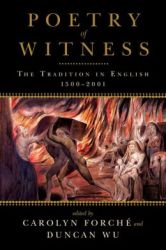
Ian Duhig has recently written for Poetry London about the genre of ‘poetry of witness’ (Poetry London). In 2014, Carolyn Forche and Duncan Wu edited The Poetry of Witness: The English Tradition, 1500–2001 (Norton) and the genre was there described as a tradition that runs through English-language poetry: “composed at an extreme of human endurance – while their authors awaited execution, endured imprisonment, fought on the battlefield, or labored on the brink of breakdown or death”. Though Duhig’s discussion raises doubts about both the genre itself, this definition, and its ethical stance, the two poems I discuss here are surely examples of it.
poetry-of-witness-cover

I’ve recently been reading Choman Hardi’s new collection and the link with Owen’s very well-known (well-studied) poem is obvious. Choman Hardi’s poem ‘Gas Attack’ comes from the ‘Anfal’ sequence in her recent book, Considering the Women (Bloodaxe, 2015). The narrator is a woman whose community is bombed by the Iraqi state in the notorious attacks on the Kurdish people in 1988. Wilfred Owen’s famous poem (‘Dulce et Decorum Est’) draws on his experiences of trench warfare on the Western Front in World War One. Owen’s title is a reference to Horace’s Odes (III, ii l. 13), the full phrase translating as “Sweet and fitting it is to die for one’s country”. It is this sort of ardent, patriotic jingoism that Owen looks to counter in the poem as it is the world’s blindness to real events in Kurdish-Iraq that Hardi wishes to correct.

Structurally both poems are similar in that they open by setting a scene of relative calm even suggesting the ordinariness of what, to most readers, must seem extraordinary. It is into these already difficult situations that the gas attacks fall and both poems (Owen’s at greater length) detail the nature of the attack and some of its immediate effects. Both poems have a third and final part in which they focus on specific victims. In Hardi’s poem this is the son of the mother narrator; in Owen’s case it is one of the gas-affected soldiers, flung onto a “wagon”, and suffering the agonizing effects of the gas. So both poems open, in effect, making use of a wide-angled lens but proceed to focus on individuals and this reflects the shared intention of both authors to elicit understanding and sympathy from their readers. It is Owen who makes this purpose more explicit in the final, bitter address to “My friend” (possibly the jingoistic writer, Jessie Pope, the original dedicatee of the poem).

imgres
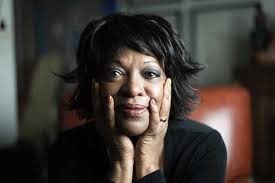
Choman Hardi

The scene set in ‘Gas Attack’ is of the routine persecution of the Kurdish people under Saddam Hussein. The deliberate plainness of the opening line (“Bombs could fall anywhere, any time of the day”) with its repetition around the caesura suggests this – as does the unruffled sense given by the line’s end-stopping. The statement that such events are to be regarded as a mere “nuisance” that can be “got used to” wrenches the reader away from the more usual evaluation of such events into a world where these things are everyday incidents. There is however something proleptic about the awkwardly enjambed breaking of line 2, the reference to “shelters” and the unease implied by words like “haunting” and “muffled”. This is confirmed (after 2 more run-on lines) by the deliberate puzzle that the explosions “deceived us”. The faint personification here and the idea that explosions (surely pretty straightforward things) might have the capacity for deception alerts the reader, creating tension: in what way are these explosions unlike other explosions?
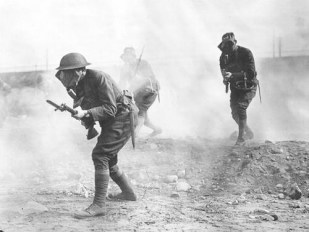
gas_attack_WW1

Owen’s opening 8 lines are immediately more harsh and noisy though even here there is some sense of routine in that the retreating men “marched asleep” (from fatigue and perhaps on ‘automatic pilot’). The fact they are heading for “distant rest” invites the reader to some mistaken sense of ease (no doubt reflecting the feelings of the men themselves as they march away from the Front Line). But through figurative language and physical positioning, Owen’s men are more distressed than Hardi’s Kurdish woman: “Bent double, like old beggars under sacks, / Knock-kneed, coughing like hags, we cursed through sludge”. Like Hardi, Owen also uses the word “haunting” but here for distant flares falling and the brief, stumbling phrases of lines 5-8 reflect the men’s difficult progress. Such devices elevate the reader’s anticipation of drama to come though again, on the surface, the men have “outstripped” shells (Five-Nines) that are dropping “behind” them. Their deafness to the sound of these shells on one side suggests their (safe) distance from them, on the other, “deaf even” (my italics) implies potential danger to come from this source.
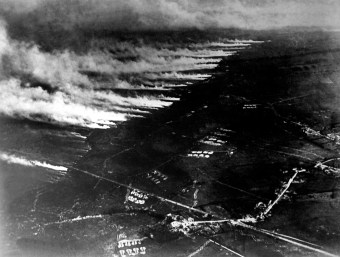
WAR & CONFLICT BOOK ERA: WORLD WAR I/THE FRONT

Owen’s lines on the attack itself are a nightmare of panic initiated by the exclamatory, capitalized shouts of the men: “Gas! GAS! Quick, boys!” This is an “ecstasy” in that their consciousness is so agitated and extra-ordinary that they feel to be watching themselves as in an out of body experience (ex-stasis). Their flurry to don gas masks is suggested by 6 present participle verbs in as many lines though most of these are equally descriptive of the poor individual who fails to get his mask on fast enough. Figurative language conveys his agonising plight as he is “like a man in fire or lime” and he moves “As under a green sea [. . . ] drowning”. By contrast, the impact of the attack in Hardi’s poem is at first a strange calm, once again related to the deceiving nature of these Iraqi bombs (thought to be conventional; in reality chemical weapons). Owen’s men are familiar with these chemical weapons; Hardi’s Kurdish community is not – yet.
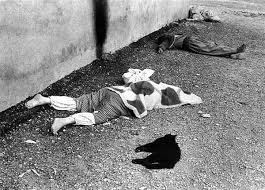
imgres

There is still no shift to the level tone of Hardi’s poem, even as the mother narrator observes how “a chalky-yellow powder settled // on our skin”. These lines seem to extend time agonisingly for the reader who, aware of the topic from the plainly informative poem title, waits for the narrator to comprehend events. In contrast to Owen’s figurative language of pain by fire and water, Hardi’s narrator’s ignorance (and therefore her innocence) is caught in her image of the powder “smelling of sweet apples at first” and it “seemed safe”. It’s the caesura of line 8 that marks the transition from ignorance to knowledge as the impact of the gas is evoked (again through a series of active present participles (going, laughing, buckling, twisting running, bumping)). The people’s erratic, tortured behavior has a black comedic, or surreal, quality which probably suggests the few shreds of the observer’s naivety (something Owen’s more experienced narrator never expresses).

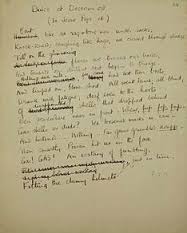
In a notable contrast between the two poems, lines 15/16 of ‘Dulce et Decorum Est’ break from the retrospective narrative into the present tense (“I saw him [. . .] He plunges”). The lines provide another image of sight, perhaps launched partially by the heightened visual quality of the glimpse of the man “through the misty panes” of the narrator’s own mask. But in these lines the “helpless sight” is one derived instead from dream-vision and memory. The fact that, at an undefined moment after these events, they still haunt the narrator gives additional weight to the horrors unfolding in the past tense narrative.
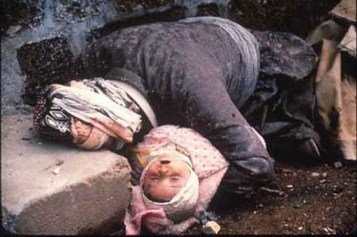
daf16862692e4bb2a52873a4ec3c9bc5

This is not something Hardi’s poem does and to this extent Owen’s narration is more complex, implying an attitude towards the events which emerges most obviously in the long single sentence of lines 17-25. The third section of Hardi’s poem continues with the level-toned witnessing: “Villages from the region came to our aid”. At first it seems curious that they are the ones to draw attention to the narrator’s son who “looked strange”. At this point it is almost as if the mother does not want to refer to her son’s injuries, a kind of denial, though eventually it emerges that it is her own blindness (as a result of the chemical weapon) that has actually prevented her even seeing its effects on her son. The boy’s strangeness is conveyed in the plain statement that “his face was blistered, blackened” but also through the strange phrase (difficult to visualize) that it was “as if his eye-colour had spilt // out”. This probably refers to the “blackened” image but also suggests the physically horrific melting of eye-balls not unlike Owen’s “white eyes writhing” and the dissolving of “froth-corrupted lungs”.

Hardi continues to hold back the fact of the mother’s blindness which accounts for the recourse to the aural image of the boy’s groan “like a calf faced with the knife”. This in turn conjures up Owen’s opening to ‘Anthem for Doomed Youth’: “What passing-bells for these who die as cattle?” I don’t see influence here other than the fact that both writers are wanting to evoke sympathy by drawing attention to the dehumanising impact of warfare’s mass slaughter. Hardi’s narrator finally reveals her own injury (“I was still blind”) and after another run of destabilizing enjambment (ll. 11-14) the last line is more heavily punctuated, slowing and emphasizing and again keeping the tone level and factual: “he / died, [I] could not see him, did not say goodbye”. The mother’s passivity is very prominent; her hopelessness is what expresses her grief. It is as though the continual persecution and horror has left her drained even of the energy to mourn with passion.
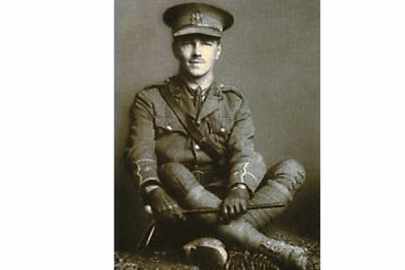
Owen

This is obviously very different to the passionately angry conclusion of Owen’s poem. Owen’s focus on the dying soldier begins at line 17 but its vivid descriptions of the man’s death are already contained within a hypothetical syntax – a point is evidently being made with the surprising appearance for the first time of the second person pronoun (“you”). Far more assertively than Hardi’s poem, Owen demands his readers, those who knew too little of the realities of warfare in 1918, put themselves in a position of greater insight: “pace / Behind the wagon that we flung him in, / And watch”. Likewise Owen does not pull punches in terms of the gruesome description of the soldier’s suffering with his “writhing” eyes, his “hanging” face (upside down, hanging off the wagon?), his “gargling” lungs. The two similes he introduces achieve the same levels of hyper-intensity with the suffering “as cancer” (obscurely or – in another draft – obscenely) and the blood in his throat like a “cud”, yet another livestock allusion to match Hardi’s doomed “calf”. The cud on this occasion is itself developed metaphorically into “vile, incurable sores on innocent tongues”, further emphasizing the appalling injustice of this slaughter.

It’s at line 25 that the “you” is addressed more directly with the ironically amicable “My friend”. The “zest” and “arden[cy]” of those eager for patriotic glory is mocked (“glory” rhyming with “mori”) but the potentially ‘hedging’ effect of these ironies is vigorously and fiercely pushed aside by the plainly monosyllabic description of the Horatian tag as “The old Lie”. Owen’s poem takes the reader into the trenches, to the post-traumatic world of nightmares, but also manages to encompass this declarative, even propagandist, point. Likewise, Hardi’s poem plunges us into the gas attack and its aftermath but never ventures into the same argumentative, passionate point-making. Her decision to allow the details of this poem to speak for itself is a brave one (of tone and manner) given the horrors of which it speaks and the author’s evident commitment to bringing them to notice.
imgres

Two Great Days at StAnza Poetry

Writing is always a rough translation from wordlessness into words – Charles Simic

I arrived at about 8pm on the Friday evening. Leuchars station is not close to St Andrews itself and (it made me feel at home) there were roadworks disrupting the usual route so instead of 5 miles it was a 10 mile trip. Actually, it was dark and I had no idea where I was so I’m just quoting the chatty taxi driver here – who also lamented the decline in business in recent years. Lack of local money generally he said and the changing habits of students who go out less, pre-drink more and choose to stumble home rather than call his cab. We waited a few minutes for Pascale Petit’s train to arrive. She’d been travelling for 12 hours (from Cornwall) which made my 5 hour train ride feel like nothing much. Unpacking, I reflected north is a very long way north.

imgres

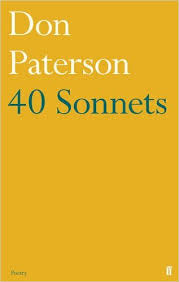
I was staying at the Greyfriars Hotel but walked up to the Byre Theatre on Abbey Street, the main Festival venue. The headline reading for the evening was Lemn Sissay (who I’d just missed) followed by Don Paterson. I arrived at the interval and the talk at the bar was of a local heckler interrupting Sissay. I never got to hear how he dealt with it but it seemed to say something about the tone of this festival that there was as much talk about inclusion as there was annoyance at the interruption. The auditorium was sold out (typical of this StAnza while I was there – you needed to book your event fast). I had no ticket but Jim Carruth took me to the studio theatre to a live relay of what remained of the event. Paterson read mostly from 40 Sonnets including ‘Here’, ‘Wave’, ‘A Powercut’, ‘Little Aster’ and the curiously moving death-of-a-dog poem ‘Mercies’. He also read aphorisms from an iPad and I remember ‘Poetry is not a vocation but a diagnosis’. And (one for his students, he said) ‘If a poem is read slowly enough we begin to hear things – which – are – not – there’.

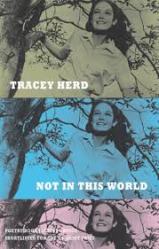
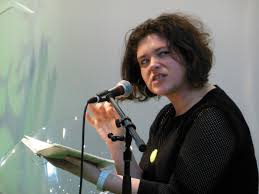
I was woken by seagulls in the grey dawn and through a gap in the Greyfriars curtains I could make out a CCTV camera on its right-angled gantry across the road, white and intent and about the size of a large gull. Perhaps I was dreaming. I was reading next morning with Tracey Herd in St John’s Undercroft, a long brick-arched room, with a great acoustic and atmospherically lit. Andrew Jackson generously introduced us and I read most of my A Hatfield Mass sequence which I think of as celebratory poetry about nature, perception, growing up/older, the body. Tracey’s book Not In This World was a PBS Choice and shortlisted for the TS Eliot Prize this year and is her first collection for 14 years. She did not read those poems about film stars or racehorses for which she’s justly renowned but powerful, recent poems of loss: “Somewhere, someone much loved is leaving”.

images

I was also reading in the afternoon at a ‘Past and Present’ event – where poets talk on writers from the past. This was the first occasion (in the Council Chamber of St Andrews’ Town Hall – where marriages are performed we were told) at which I could read some of my new, just-off-the-press versions of the Daodejing. Pascale Petit was also appearing and she talked about her enthusiasm for Tomas Transtromer, in particular the way in which his poems often use an aerial perspective; from his first published poem: “Waking up is a parachute jump from dreams”. I’m sure she said she’d consulted a Swedish friend who said his surname meant something like crane-over-water – ornithological crane obviously.

imgres

Later in the afternoon, at the Parliament Hall, Fiona Benson and Andrew McMillan read. Benson was nervous in front of the large crowd (and who can blame her) but she was soon absorbed in the poetry itself and her demeanour was not at odds with the work. Sections of ‘Love-Letter to Vincent’ (Van Gogh) were read with great intensity. Other poems of pregnancy, miscarriage, birth and motherhood were more moving and (as Dave Coates has suggested) her book’s up-beat title, Bright Travellers, misleads. The contrast with McMillan was not to either poet’s detriment. I reviewed physical on this blog back in July 2015 and his (in various senses) naked poems, even when sad, manage to stir great pleasure in the audience. In person, he adds to this a wise-cracking, witty style of introduction and between-poem chat. Given his marvellous success this year I wasn’t sure why he wanted to discuss some of the negative criticisms he’s had but even that does not prevent me wanting to use that old Hollywood term ‘star’ in listening to McMillan perform.

images
Nora Gomringer

It was another sell-out in the Byre Theatre on Saturday evening with an event indicative of the Director, Eleanor Livingstone’s innovative approach to programming (and part of the German poetry emphasis to this year). Nora Gomringer performed work (with percussionist Philipp Scholz) which reminded me at moments of Laurie Anderson, at others of the much-missed Bob Cobbing (who I saw read/sing in London in the 1980s), at all times evoking a jazz-like improvised feel. Quite brilliant. Jo Shapcott had the tricky job of following this and chose to read a number of ‘The Roses’ poems from Tender Taxes, her responses to Rilke’s poems in French. These are a bit delicate and brief to come over very strongly in a live reading and other new poems on pain (but without mentioning the word) I found not easy to appreciate. But the brilliant prose poem ‘Scorpion’, the touching ‘Somewhat Unravelled’ and the finisher, ‘Piss Flower’ ended the evening in style.

imgres

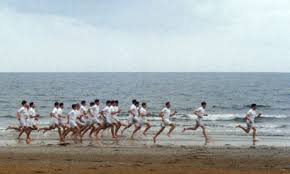
I had a train to catch next day but managed to get to stride along the Chariots of Fire beach early in the morning plus take a peek at St Andrews Old Course before the Poetry Breakfast discussion on translation. Diplomatically and informally chaired by Annie Rutherford, the theme emerged that we ought to think more loosely, more liberally about the idea of translation.  Aurelia Maurin suggested we should think of it more  as we do cover versions of songs. Claudia Daventry opened the field up by quoting Charles Simic’s idea that all poems are translations from silence. Nora Gomringer remembered a professor urging her to find ‘the game’ of any poem she intended to translate not merely to work line by line. She’d been asked to translate Yoko Ono’s poems into German but felt unable to and the importance of the rightness of a translator to a source text was demonstrated when, on another occasion, she’d translated from Russian (I think) and had actually been spat at by a disapproving reader. I was struck – as before – by what powerful emotions the idea of translation stirs up, involved as it is with ideas of truth, honesty and fidelity. I especially liked Daniela Seel’s take on the process, stressing the almost chance meeting of suitable translator with appropriate source text and the way in which the linguistic and emotional ‘body’ of the translator (his/her resources) need to be matched to the varied demands of the source text.

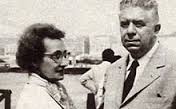
But I had to catch my train and, though exhausted, I spent some of the six hours back re-reading Montale’s loving lament and memorial to his wife, Drusilla Tanzi, here translated by G. Singh:

With my arm in yours I have descended at least a million stairs,

And now that you aren’t here, a void opens at each step.

Even so our long journey has been brief.

Mine continues still [. . . ]

url
Montale and Drusilla

‘The Bell Jar’, Lakes, Doors and Identity

I’ve had a major dose of the flu recently and have been too busy catching up with teaching and marking missed to devote much thought to blogging. So please forgive this brief and slightly self-absorbed effort. Talking about my own poetry is not really what I want to do too much of here. Nevertheless . . .

I gave a reading a couple of weeks ago in which the main focus was the idea of identity. It has been on my mind since and this week we have been looking at Sylvia Plath’s fictional self, Esther Greenwood. She is seen struggling in 1953 to appreciate she ought to be “the envy of thousands of other college girls . . . all over America”. She has won the opportunity of working for the summer as what we might now call an intern at a leading New York women’s magazine. In one of those flashes of figurative language that marks Plath the poet-novelist, Esther confesses she ought be “steering New York like her own private car”. Instead: “I wasn’t steering anything, not even myself”.

images

Esther’s ensuing breakdown – closely following Plath’s own –  can be interpreted as her searching for a clearer sense of her own identity as she ponders and then rejects role models offered by Doreen (the wild girl), Betsy (the traditional), Joan (the lesbian), Cee Jay (the older career woman) and her own mother (hard-working single parent with no prospects). If we can manage to ignore the subsequently brilliant then tragic ten years of Plath’s own life after 1953, The Bell Jar, her only-completed novel, ends on an upward trajectory. Esther is re-born in the end: “patched, retreaded and approved for the road”. She finds a more sure sense of herself. As she waits for her release from the psychiatric ward she listens to her own heart beating: “I am, I am, I am”.

To borrow from Wikipedia, identity is defined as the distinctive characteristic belonging to any given individual or shared by all members of a particular social category or group. Identity, then, is a label. However, the formation of one’s identity occurs through one’s identifications with significant others (primarily with parents and other individuals during one’s life and also with identifiable groups). These others may be benign – such that one aspires to their characteristics, values and beliefs (a process of idealistic-identification), or malign – when one wishes to dissociate from their characteristics (a defensive contra-identification).

url

Plath’s Esther Greenwood seems initially to have lost or never really determined or had no faith in her identity though I suspect this is a common enough feeling among adolescents. In retrospect this seems to be the point of one of the poems I read (first published in Hurt (2010)). It features a bunch of adolescents walking in Cumbria, one of their number too pre-occupied with fretting about a fading relationship. ‘Riders on the Storm’, the song by The Doors which they choose to put on the pub juke box, operates as a sort of mock-heroic image which the main character signally fails to live up to. Heroes know who they are; he does not. The point seems to be that the pain caused by the dissolving of the fledgling relationship is an early opportunity, perhaps, to define himself a little more clearly.


Riders on the storm

https://www.youtube.com/watch?v=DED812HKWyM


With no schedule to drive us,

we wait for rain to stop beside Ullswater’s


southern lip, for the landlord of The White Lion

to determine when it’s time to open.


Ducking through the door, Helen, Clive, Steve,

each a few weeks shy of university,


and I’m there too, heart awash

with absence, her love letters at looked-for drops,


the girl I feel leaving gradually

as the tedious route past Thirlmere to Catstye.


But it’s OK for a while – passing midday snug

in a deserted pub


while outside the downpour gurgles, begins to blur

and double with the torrential roar


of the juke-box: The Doors the only thing

we key in, its electric piano’s limpid fingering


like the give and tender recoil of water,

the lugubrious voice . . . Fifteen years later,


at his paint-spattered Pere-Lachaise stone,

I remember that wretched lunchtime


under the wettest rain in England,

when I was too ill-formed to understand.


I barely displaced a drop of local weather,

could only conceive of myself as either


a body slumped beside a dry stone wall

or drenched and raging on the dramatic fell


on the path to Ambleside bus station,

its oily tarmac smoking under black rain,


her blonde voice fluent on the phone:

‘You hear me?’ I could not even hear my own.

images

Douglas Dunn’s ‘Terry Street’ and Thoughts of 1969

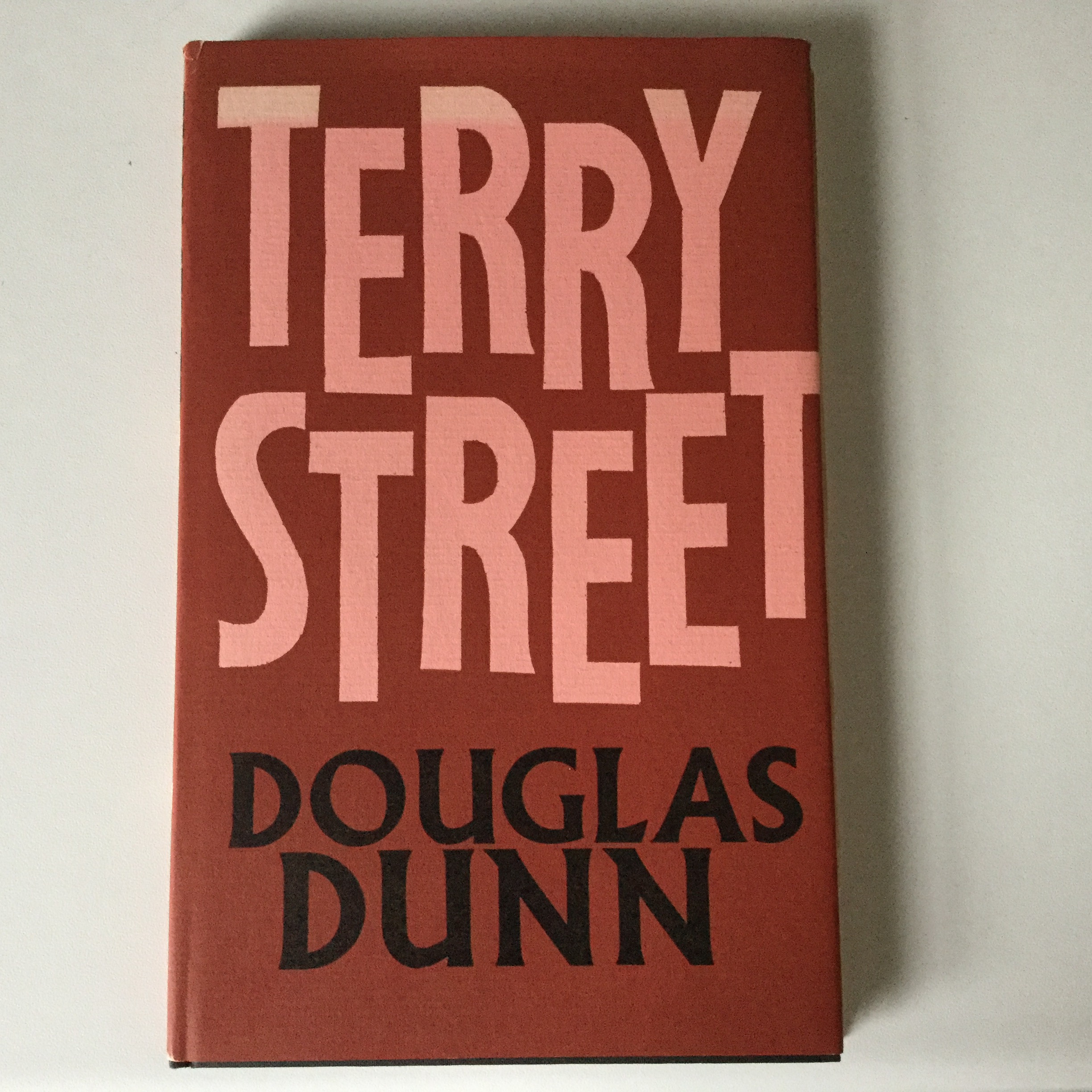
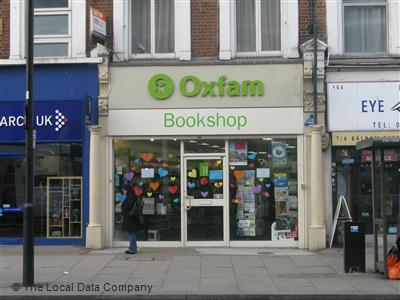
Recently, in my local Oxfam shop, I found a remarkably well-preserved hardback first edition of Douglas Dunn’s debut collection, Terry Street (Faber, 1969). Since living in a very similar street in Lancaster exactly 10 years after Dunn’s book was published (Aberdeen Road, up on the northwest-facing terraced streets above the town, looking out across Morecambe Bay to the – occasionally snow-capped – peaks of Cumbria), I’ve always had a soft spot for the book. But I hadn’t read it in years, I now realise.

images
Aberdeen Road, Lancaster, in a recent photo

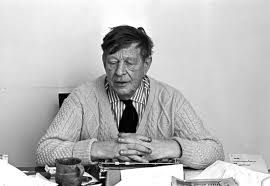
The particular copy I bought (for £2.50) still had the Poetry Book Society’s Bulletin in it as Terry Street was the PBS Choice for Autumn 1969. It printed a review by Julian Jebb of the PBS’s second Poetry International staged at the QEH, South Bank, in July 1969. Jebb praises the organisers for attending to the faults of the first such event (noted as an over-crowded audience and over-running readings by poets). WH Auden is there in the “blackest of spectacles”, reciting recent work from memory including ‘On the Circuit’ (1963) in which he satirises the lecture/reading round he has been treading in the USA: “so large / So friendly, and so rich”. He read precisely: “15 minutes and hardly a fluff”, reports Jebb.

images

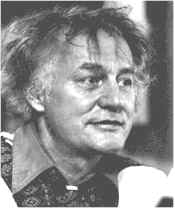
He was followed by “a ponchoed American poet, Robert Bly”. Jebb’s tone here will have been addressed to the original readership of his review (it appeared in The Financial Times) but it’s still an interesting period piece. Bly seems to have flailed his arms while reading “in tragic-comic, uncoordinated circles, strongly reminiscent of Peter Cook’s imitation of Macmillan in Beyond the Fringe”. Later he over-ran shockingly with 20 minutes of his “sloppy, deranged images about Vietnam”. This was delivered, Jebb tells us, to a growing slow hand-clap.

bly
A young-ish Robert Bly

Later in the evening, Edward Brathwaite, Derek Walcott, Ogden Nash, Miroslav Holub, Vasko Popa and Janos Pilinszky also read. Few details are given on these contributions unfortunately, but the experience of the latter three poets of the Second World War and Eastern Europe in the first half of the 20th century prompts Jebb to observe: “We have felt safer than these three men and we are grateful to them for their eloquence in telling us so”. Here is evidence that poetry was making very little happen when it came to the heavy lifting required to shift the entrenched sense of superiority and national egocentricity of the period.

So the review both evokes an earlier age of extraordinary poetry and also shows how far we have come. With Ted Hughes’ and Daniel Wiessbort’s founding of Modern Poetry in Translation in 1965. British poetry was just at this moment becoming exposed to worldwide influences (even if some were hardly listening). In this light, Douglas Dunn’s PBS Choice reads like the dying edge of the 1950s, of The Movement. The Terry Street poems themselves may be memorable evocations of working class life in Hull but what I notice now more than anything is Dunn’s obsessive use of the plural subject: young women, girls, the children, mothers, old men, the chatty women, men of Terry Street, old women, revellers, neighbours, street tarts, trawlermen, young women, the people who live here, men on bikes. These are versions of Larkin’s typological  “cut-price crowd” (‘Here’), the women in ‘Faith Healing’ and the fathers and mothers and newly married couples of ‘The Whitsun Weddings’. The difference is that Larkin would as often turn his acerbic gaze on himself. In Terry Street, Dunn makes the choice to keep himself out of the picture (behind glass) and there are hardly any delineated individuals in the book (though we all remember the man who wheels an optimistic lawnmower down Terry Street).

File 22-10-2015, 15 18 59

Dunn viewed ‘these people’ through a window – “our window” says a self-lacerating, retrospective poem of mourning addressed to his late wife, Lesley (‘Envoi’ in 1981). While the belief that these people were a fit subject for poetry is admirable, many of the poems now read as patronising, still mired in the English class system (despite Dunn’s Scottishness). To that extent I disagree with Terry Eagleton who, in 1970, praised Dunn for being able to “transcend the two major pitfalls of poetry concerned with working people – bourgeois voyeurism or sympathetic mythification”. Dunn seems to me to fall foul of both of these.

imgres

In the 1969 PBS Bulletin, the young Dunn himself wrote “Terry Street became for me a place of sad sanity . . . an alternative to the gaudy shams everywhere”. It was this sense of the real that Dunn needed (for himself) as a mature student in Hull, pursuing an English degree, and perhaps was a substitute for what he was already declaring: “Scotland is what I most want to write about and what I am least able to”. Later, Morrison and Motion’s 1982 Penguin anthology of contemporary British poets, pigeon-holed Dunn with Tony Harrison in being “sharply conscious of background and upbringing, which sets them at an angle to the cultural establishment”. But Dunn’s chosen strategy in the longer run was to acquire the ‘language’ of the poetic establishment in formal terms and try to speak up for those men and women of Terry Street (or their Scottish equivalent) rather than merely observe them from afar. ‘The Come-On’ appeared in Barbarians (1979):

Our level is the popular, the media,

  The sensational columns,

Unless we enter through a narrow gate

  In a wall they have built

To join them in the ‘disinterested tradition’

  Of tea, of couplets dipped

In sherry, and the decanted, portentous remark.

  Therefore, we will deafen them

With the dull staccato of our typewriters.

  But do not misbehave –

Threats and thrashings won’t work: we’re outnumbered.

Whatever piece it was Bly read that night in July 1969, the voice of the establishment regarded it as threats and thrashings and was too easily able to dismiss it.

How far have we come? Is it still the case that alternative poetic voices look to disguise themselves – whether with formal display like Dunn’s or with an obscuring erudition – to pass through the narrow gate into poetic acceptability? Or is it now that we anxiously seek out and fetishise what is different so poets and their publishers feel the need to define and confine work with USPs like race, gender, sexual orientation, locality, even disease – whole books focused on life events that begin to sound like the prose genre known as ‘misery memoirs’? Do poets actually articulate this to themselves: in my Creative Writing graduation ceremony, how do I ensure I stand out?

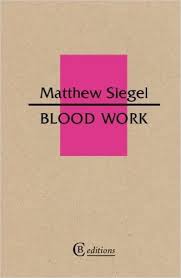
Forward First Collections Reviewed #3 – Matthew Siegel

This is the third in the series of reviews I will post over the next two months of the 5 collections chosen for the 2015 Forward Prizes Felix Dennis award for best First Collection. The £5000 prize will be decided on 28th September. The shortlist is:

Mona Arshi – Small Hands (Liverpool University Press, Pavilion Poetry) reviewed here;
Sarah Howe – Loop of Jade (Chatto & Windus); reviewed here;
Andrew McMillan – physical (Cape Poetry); reviewed here;
Matthew Siegel – Blood Work (CB Editions) reviewed here;
Karen McCarthy Woolf – An Aviary of Small Birds (Carcanet) reviewed here.

Matthew Siegel – Blood Work (CB Editions); Forward Prize webpage on Matthew Siegel: here.

imgres

This is a really good first collection because of its remarkable consistency of tone and manner and it possesses what I, perhaps narrow-mindedly think of, as that American quality of confident fluency, indeed fluidity, which seems capable of encompassing so much experience without straining at the seams. In their very different ways, I find this in the work of poets like Billy Collins, Louise Gluck, Jorie Graham, Robert Hass and Larry Levis. I’d trace it back to the big enfolding arms and lines of Whitman who, along with Rilke, are Siegel’s two declared influences. But this ‘all I survey’ quality of the book is rather undermined by the publicity surrounding it which narrowly focuses on the fact that Siegel was diagnosed at the age of sixteen with Crohn’s disease and that his debut collection is all about this. Mark Doty (no less) considers the book “a genuine contribution to the literature of illness”.

It may well be – but like Robert Lowell, Thom Gunn and more recently (Siegel’s CB Editions stable-mate) Dan O’Brien, Blood Work’s focus on a very specific milieu or set of experiences does not prevent the alchemical transformation into an art with which those not brought up in the upper reaches of New England society, in the West Coast gay scene, embroiled in modern war zones can identify. In old money terms, they find the universal in the particular and Siegel does this in poems that move beyond a young American with Crohn’s disease to explore family relations, love relationships, questions of self-definition and the tensions between speech and silence.

imgres

The opening poem is important in carving out a certain distance, an ironic space, between the Crohn’s sufferer and the poetic voice (there are a few ekphrastic poems scattered through the book which do the same job). It is one of the few poems narrated in the third person and we are urged to “look” at a hospital attendee, back in what seems familiar territory (the chronic aspect of Crohn’s), the floral prints on the walls, the hospital gown “like an old costume / pulled out of a locked trunk in the attic / of bad dreams”. He feels sexless or desexualised, but is writing a poem “in lowercase”, particularly the first person pronoun. The writing of the poem becomes the subject of the poem but this self-reflectiveness is not rebarbative in the way it often can be (self-regarding, aggrandising, clever-clever) but more modestly self-mocking, an awkward self-consciousness. The patient/poet would rather be drawing a comic book, with himself as a “small mammal”. He sees himself as a fox and in the poem’s final line he changes the title of the poem he is writing which is the title at the head of the first page we have just read: ‘fox goes to the fox hospital’.

The space created by this poem around the very specific medical context gives the remaining book permission to range widely and introduces the idea of “containment”. What can or cannot contain the individual is a recurring idea (picked up by Doty in the cover blurb). The title poem has the narrator’s blood being taken from a vein (already a familiar experience to this young man – the context seems to be earlier in the poet’s life). The nurse allows him to hold the warm filled tubes of his own blood: “I nod, think about condoms, tissues / all the things that contain us but cannot”. Containment here means summation perhaps, but with overtones of imprisonment in the sense that a medical condition (a disability? a gender? a skin colour?) may determine much about the individual, yet ought not be allowed to fully define the person. This too is Siegel’s subject in the book; the spillage, or extension, we can achieve or are permitted beyond what might define us.

So ‘Sometimes I don’t know if I’m having a feeling’ may or may not be closely related to the poet’s own medical condition but it is a familiar experience for most of us. The uncertainty of thoughts and feelings, the sensation of having missed “the entire party”, of being known only as “a strange / version of the person you thought you knew”, the old question, “Who am I?” It’s a sign of the ironic distance maintained by these poems (not at all the same as cool inconsequentiality) that Siegel can answer that question with humour: “A question / for the Lord only to decide as She looks over / my resume”. Elsewhere, such questions are more difficult to answer. ‘Love Parade’ stresses the distance the narrator feels from others (‘I fear my body incapable of loving’) or he plays with the idea that the opportunity of a poem is little more than a late-night phone-in for the lost and lonely. The desire for contact with others (that wish for spillage and extension) can grow to “the size of a building”, taking Siegel down avenues of surrealistic imagery, creating a city-scape from the thoughts of a lover’s body.

images

These ‘others’ do feature significantly in this book. We meet the heater repair woman, a Vietnamese masseuse, Nancy the dentist, a supermarket flower seller, stall-holders at a Farmer’s Market, a multitude of doctors and nurses, various romantic entanglements. Though all these dip and dance about the central consciousness, they are given individuality (more Whitman here, I think). Thirteen year old Bryan is a sleepy student and the narrator is the teacher who watches him doze at his desk, bored by a literature class. The poem is a lovely act of empathy with the boy, his awkwardness and uncertainties, concluding with the self-discovery that the boy may well become the watching adult who “instead of chastising him / wants to touch his hair”. Not what child protection might want to hear, but true enough for those who teach.

imgres

But the book is also concerned with family, in particular a mother-figure who, like Bryan, is observed while sleeping and Siegel asks “What world / contains you”. In this poem, she dozes, exhaling “in little puffs” and perhaps it is her son’s inability to quite define her that means he can “only watch for so long”. She is a mystery, though in poem after poem she is shown crying, smoking dope to forget, mourning an ex-fiance, the son helplessly, left to “wonder if I could reassemble my mother”. In ‘Matthew you’re leaving again so soon’ we hear her reported voice fussing and trying to bestow love and affection through gifts of pens, an umbrella, socks, as he prepares to leave, in an effort to say what seems impossible to be said explicitly. We see her (smoking another joint) listening to the music of Enya (‘it’s in Gaelic’), tearful again, yet smiling “as if hurt is the balm”. For all the lack of specific detail about her life and loves, this mother-figure is a powerful creation we may hear more of in Siegel’s later work.

So the book does not duck difficult experiences, nor distance them defensively. Siegel’s watchwords are openness and a winning tenderness. Despite the questions of illness, he can apply such qualities to himself too and in ‘Overlooking the City’ there is a brief respite which amounts to something like redemption: “No, I am not hurting in this moment”. As the sun sets over the city, “red does not remind me of blood” and the imagined blessing of the sun’s rays reach “even me, surrounded here and alone”.

stock-footage-time-lapse-sunset-over-los-angeles-city-landscape

Even in a poem that gets pretty explicit about his medical condition, some reconciliation seems possible. ‘Rain’ opens:

I thought I knew desperation until I found myself
tightening my asshole like a bolt,

gripping the banister and crossing both legs,
knees shaking.

I tried to read a poem on the toilet [. . .]

But still the narrator can elude such a total, imprisoning self-definition to find some pleasure in the view from a window to “see grass // glowing green in rain and streetlight – / so many bright beads of water”.

So a book I really admire for its capacity to encompass such variety without bursting into fragmentary utterances. It doesn’t do anything startling formally or linguistically, but its achievement is more emotional and empathetic, Siegel’s voice engages the reader at all times in just the way he seems to engage and commit to the many people who inhabit these poems with him. Would make a worthy Forward First Collection winner.

The Abecedary Form / Carolyn Forche

The Form: I wanted to share here some thoughts on my experiments with the form of the abecedary. An abecedarium (or abecedary) is originally an inscription consisting of the letters of an alphabet, listed in order. Abecedaries were often practice exercises, teaching aids, but also developed as an ancient poetic form guided by strict alphabetical order. The earliest examples are Semitic, found in religious Hebrew poetry and the form has been used in various cultures for prayers, hymns, and psalms. Psalm 118 (or 119 by King James numbering) consists of twenty-two eight-line stanzas, one for each letter of the Hebrew alphabet. Chaucer’s An ABC is a medieval example of the form. Some abecedaries found in the Athenian Agora appear to have been left deliberately incomplete and the imperfection of these examples may have had a magical or ritual significance.

imgres

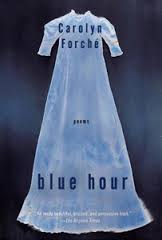
For those who have come across this form in contemporary poetry at all, it was probably (as in my case) through the poem called ‘On Earth’ in Carolyn Forche’s Blue Hour (Bloodaxe, 2003). I reviewed the book in some bewilderment at the time (see below) but have since come to see it more favourably. Forche herself says: “Gnostic abecedarian hymns date from the 3rd century AD. Along with Christian and Buddhist texts, they were recovered from small towns on the northern fringe of the Taklamakan Desert, early in the 20th century”. She also links the form with the idea of the pleroma, defined as the totality or fullness of God’s creation, the One. Over the 46 pages of ‘On Earth’, she adheres rigorously to the form in which alphabetical order guides not only the stanzas, but also the words opening every single line:

languid at the edge of the sea
lays itself open to immensity
leaf-cutter ants bearing yellow trumpet flowers along the road
left everything left all usual worlds behind
library, lilac, linens, litany

Poets.org says that abecedaries are now more commonly used as mnemonic devices and word games for children such as those written by Dr. Seuss and Edward Gorey. A derivative form is the much more familiar acrostic.

From my 2003 ReviewThe book contains 11 pieces in 65 pages, 46 of which are taken up with the long poem ‘On Earth’ and phrases do echo throughout the poems so there is a sense of unity to the whole. For the most part, Forche writes by assembling fragments and images, often without clear syntactical or narrative connections to surrounding lines. The reader experiences the verse as successive waves (lines stretch across the page and usually come in twos or threes), or as threads floating disconnectedly, but creating a striking impression of beauty. Forche’s obscurity comes more from an unshakeable confidence in her project, in her voice, in her idiosyncratic style and in her subject, largely concerned with the significance or recovery of the past in the present moment.

My difficulty with what Forche does is that all kinds of experience seem to be subjected to the same treatment, so that in the end the reader swims through an undeniably glittering, but rather gloopy, phenomenological soup in which “a city a thousand years” has the same weight as “a field of birds roasted by the heavens”, which has an equivalence to “a sudden reticence that seizes the heart”. All of the material – several deaths, the madness of a grandmother, a mother’s life, early years with a child, Chernobyl, some war-torn territories – is recorded with a swooning sensitivity, a recurring softness of diction and a penchant for grammatical inversion which seems to strain after the poetic: “In the blue silo of dawn, in earth-smoke and birch copse, / where the river of hands meets the Elbe.”

These doubts are brought to a head in the ambitious ‘On Earth’ which is (to quote the blurb) “a transcription of mind passing from life into death, in the form of an abecedary, modelled on ancient gnostic hymns”. The form is an alphabetical sequence and this additional random factor only increases this reader’s sense of a steamrollering of experience to ensure a smooth poetic passage. There is no doubt that Forche can produce some stunning images and when she strings them together in more conventional ways and the reader can hold on to her coat-tails, you can see why her reputation is so high in the U.S.

My interest in abecedaries: Has grown with my interest in looser forms of verse (I have given up on punctuation in most of my own poems these days) alongside a more-than-philosophical sense of the truth of the wholeness of being, reflecting Forche’s idea of the pleroma. This – see Rilke, see the Daodejing – is a condition impossible to be caught in the net of more conventional language and poetic form. Abecedaries encompass the whole alphabet (at least in theory – though I like the idea of the deliberate imperfection; perfection belonging only to God). An abecedary can therefore be seen as an appropriate poetic gesture (futile for sure) towards a unified field, an encompassing of everything, the only true state.

images

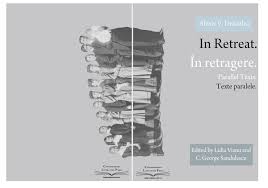
The Material: But the unified field, for an individual human being, must be regarded with some perspective; if this was not the case we would indeed be seeing with the eye of God, with his/her distance and utter impersonality. I wanted to write affective texts. I wanted my abecedary to be (paradoxically) limited. I wanted people in it; even a narrative of events. But all still subject to the demands of the form. I realised I did indeed have some suitable materials to hand. I had been asked by Professor Lidia Vianu, of University of Bucharest, to assist with the translation into English of several short stories by the relatively unknown Modernist Romanian author, Mihail C Vladescu. He published a collection of eight stories, In Retreat, almost 100 years ago. These are stories written in war-torn Eastern Europe but more significantly, Vladescu forensically portrays the sense of corruption in his society, with materialistic motives and adulterous behaviour most prominent. It seemed to me, and not merely because the centenary of the First World War is still in process around us, that this was material worth working on. I thought Vladescu’s relative obscurity to an English-speaking readership was also an advantage in such an experiment.

The Process: I selected phrases as far as possible randomly from the prose translation. These were then ordered alphabetically (via Excel spreadsheets) and subjected to as little editing as possible, though I have sectioned and created stanzas where it seemed best. Not surprisingly, my abecedaries are incomplete (x and z are more often than not the Persian flaws in the poetic carpet).

The results? Over the next 6 days I will post up the full 7 sections of my abecedary ‘Bathing in the Olt’ (from Vladescu’s original story called ‘Bathing’) and any observations would be welcomed. The text has already appeared in full in Shearsman magazine, 103/4, April 2015.

Click here to see each section posted: #1 / #2 and #3 / #4 / #5 / #6

imgres

Rita Dove / Local Library Love

Here’s a shaggy dog story.

J—–, my 17 year old daughter was travelling on the London Tube between social engagements a week or so ago. She and her friends were all a bit girly giggly – by her own admission after pre-drinking at somebody’s house – and her mobile phone got left on the train. Her unsuspecting parents – probably on the sofa that Saturday night, catching up on Wolf Hall or something similar via the i-Player – get a phone call (from a friend’s mobile) with the bad news. Oh bloody hell, full-on disapproval voice, we’ll have to cancel the contract before calls are made to Mars or Outer Mongolia, but let’s just try ringing J—-‘s number on the off chance it’s been picked up by an angel.

21084751

After a few hopeless attempts, someone answers sounding less angelic, more Eastern European. And yes, the phone is in their hands, and yes we are welcome to come and pick it up, maybe tomorrow, in some side street near Balham Tube, way across London of course. By dint of masculinity and eminence of age, it’s me who sets off next day for south London. The phone bit of the story goes rather cold here I’m afraid (uneventful, after wandering a few streets, knocking on a door, a young couple, full of the smiles of the unthinkingly virtuous, hand over the phone and I press a box of grateful chocolates into their reluctant grasp).

But Balham High Street has an Oxfam Bookshop – the kind I can never resist – and hidden away on the poetry shelves (between Everyman’s Robert Herrick, old copies of Poetry Review and a suspiciously large selection of First World War poetry) I pick out a hardback, signed first edition of Rita Dove’s 1999 collection, On the Bus With Rosa Parks, published in the US by Norton. Just reward for the unnecessarily put-upon, I think to myself.

images

‘Maple Valley Branch Library, 1967’ is one of the best poems in Dove’s book and as I rocked northwards on the Victoria line I drifted back to late 1960s, early 1970s, to my own beloved local library in Trowbridge, Wiltshire. In those days it was in a grand building not far from the central bus station (though opposite Jimmy Ladd’s hardware store) and we paid weekly visits there. My tastes were un-literary, nothing out of the ordinary, books on fishing and rugby, Tolkein, John Wyndham. I remember one occasion I went there searching for addresses of poetry magazines but this must have been a few years later when I’d begun to scribble verse. I probably sent some ill-tutored nonsense to The Times Literary Supplement and of course heard nothing back.

Later still, a TV programme on Vincent Van Gogh sent me off to borrow a book on the artist who I felt sure I resembled, my certainty expressed through vigorous claims to admire him as a painter, poet, thinker and man. Looking back, it was a rather escapist Van Gogh whose observations I copied into a diary: “We are entitled to entertain a certain hope that there may be other and better conditions for painting than here on earth – conditions that can be attained through a change that need not be more surprising than the metamorphosis of a chrysalis into a butterfly. [This] sphere of activity . . . might conceivably be one of the many stars which after death are probably no more difficult to reach than the small black dots on a map which in our earthly existence mark towns and villages. . .  It seems to me that it is far from impossible that diseases . . . are in fact heavenly means of transport . . . In that case, to die quietly of old age is to go on foot”. What I loved about this was the other-worldliness, the sense of the creative artist, the presence of death not as the end of things but as a transition to a better place. Misunderstood or not, my mind was moving beyond the limits of my home town, its confining little black dot, the piddling River Biss, Bowyers pork sausages and bloody Watneys Red Barrel. Love your local library! Click here for information about the local libraries campaign: http://www.librarycampaign.com/

And here is Rita Dove reading ‘Maple Valley Branch Library, 1967’: 

Maple Valley Branch Library, 1967

For a fifteen-year-old there was plenty

to do: Browse the magazines,

slip into the Adult Section to see

what vast tristesse was born of rush-hour traffic,

décolletés, and the plague of too much money.

There was so much to discover—how to

lay out a road, the language of flowers,

and the place of women in the tribe of Moost.

There were equations elegant as a French twist,

fractal geometry’s unwinding maple leaf;

I could follow, step-by-step, the slow disclosure

of a pineapple Jell-O mould—or take

the path of Harold’s purple crayon through

the bedroom window and onto a lavender

spill of stars. Oh, I could walk any aisle

and smell wisdom, put a hand out to touch

the rough curve of bound leather,

the harsh parchment of dreams.

As for the improbable librarian

with her salt and paprika upsweep,

her British accent and sweater clip

(mom of a kid I knew from school) —

I’d go up to her desk and ask for help

on bareback rodeo or binary codes,

phonics, Gestalt theory,

lead poisoning in the Late Roman Empire,

the play of light in Dutch Renaissance painting;

I would claim to be researching

pre-Columbian pottery or Chinese foot-binding,

but all I wanted to know was:

Tell me what you’ve read that keeps

that half smile afloat

above the collar of your impeccable blouse .

So I read Gone with the Wind because

it was big, and haiku because they were small.

I studied history for its rhapsody of dates,

lingered over Cubist art for the way

it showed all sides of a guitar at once.

All the time in the world was there, and sometimes

all the world on a single page.

As much as I could hold

on my plastic card’s imprint I took,

greedily: six books, six volumes of bliss,

the stuff we humans are made of:

words and sighs and silence,

ink and whips, Brahma and cosine,

corsets and poetry and blood sugar levels—

I carried it home, past five blocks of aluminium siding

and the old garage where, on its boarded-up doors,

someone had scrawled:

I CAN EAT AN ELEPHANT

IF I TAKE SMALL BITES.

Yes, I said, to no one in particular: That’s

what I’m gonna do!

LHB0027A
Maple Valley Branch Library

To give some impression of concluding my original narrative: as you can imagine, J—– was suitably grateful at getting her mobile back, dashing off to text friends that she was back on line and thankfully in touch with the world again. I remember we always tried hard while she and her brother were younger, taking them to Hornsey library most weeks and happily (with or without our help) they both acquired habits of reading. Even so, the local library is not really on their radar any more. It’s obvious why.

A little experiment to conclude:

bareback rodeo – about 57,800,000 results  in 0.44 seconds.

lead poisoning in the Late Roman Empire – about 479,000 results in 0.51 seconds.

pre-Columbian pottery – about 403,000 results in 0.46 seconds.

blood sugar levels – about 29,600,000 results in 0.32 seconds.

Why would you trek to the library, however close by, when you can worship at the God Google’s shrine? Yes – I use Google every day and bless it (it tells me an unsigned copy of Dove’s book might be worth 30 US dollars!). But at the same time we are well aware that such a sublime volume of information, arranged in ways not within our own control and perhaps not even within our understanding, has its drawbacks. Here’s Eddie Izzard on google, wikipedia, i-Tunes, up-dates, terms and conditions and how we blindly play along: 

The Death of Philip Levine

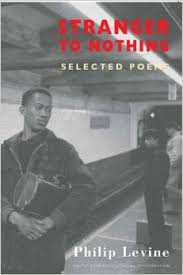
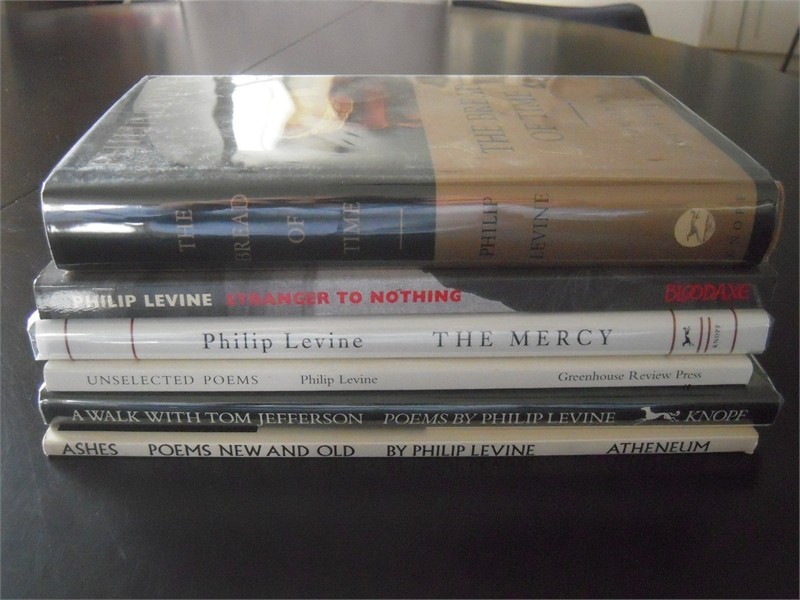
The death of Philip Levine, one of the greats of modern American poetry, was announced yesterday. Bloodaxe published his selected poems, Stranger to Nothing, in 2006: http://www.bloodaxebooks.com/titlepage.asp?isbn=1852247371. Astonishingly, this was his first UK publication since Secker produced an earlier Selected Poems in 1984. Not as well known as he should have been in this country, there has been a good deal more attention given to him in very recent years.

imgres

I’m ashamed to say I only came across him when Poetry London asked me to review Stranger to Nothing alongside Dan Chiasson’s Natural History and Other Poems (Bloodaxe, 2006). It was on the strength of the review that Anne-Marie Fyfe asked me to contribute to a Troubadour Poetry event in London celebrating Levine’s work. Sadly Levine was unable to attend on the evening due to illness and I had the honour of reading some of his work in his stead. For what they are worth, I’ll append the notes I made to myself on the poems I selected to read that evening at the end of this blog. Happily, I think I remember Anne-Marie later reporting back that Levine approved of my brief selection.

Some time later, Naomi Jaffa discussed his life and work with him at Aldeburgh in 2009. The Poetry Channel’s blurb for the recording of that conversation gives a flavour of Levine as follows: A giant of American poetry and now the newly appointed US Poet Laureate, Philip Levine memorably appeared at Aldeburgh in 2009 where he enjoyed a 45-minute conversation with Naomi Jaffa, The Poetry Trust director. In this absorbing, funny and wide-ranging interview, Levine covers growing up as a Jew in anti-semitic Detroit, working for General Motors, finding his voice as a poet, life at college with teachers Lowell and Berryman, his fascination with Lorca and Spain, his love of jazz (and loathing of Wagner), and which four writers he could bear to be stuck in a lift with: listen to that here: http://thepoetrytrust.libsyn.com/philip-levine-s-journeys

And as tribute to a truly great poet here is my September 2006 review of Stranger to Nothing:

On the face of it, the contrast between Dan Chiasson and Philip Levine could hardly be more striking. Bloodaxe have produced a fascinating selection from a poet whose relative absence from discussions of US poetry on this side of the Atlantic is a huge loss. Born in 1928 in Detroit, the son of Russian-Jewish immigrants, the first poems included here were not published until 1963. Like Raymond Carver, to whom he bears some resemblance, Levine spent many years labouring in industry  and much of his later poetry recalls these experiences and the people with whom he worked. Whereas Chiasson is urbane and metropolitan, Levine is urban and industrial. Though encompassing a long writing career, this is not a selection that reveals very much in the way of artistic development; Levine’s characteristic style and tone seems to have come to him fully formed and he has seen little need to alter it. One reason must be the premium he clearly places upon being true to his materials – and in particular the experience of the American working people he portrays.

imgres

Accordingly, there are poems in which Levine doubts the value of the imagination in its tendency to romanticise real experience. ‘Salt and Oils’ from the mid-eighties moves rapidly through moments in a life, but then concludes:

“These were not

the labours of Hercules, these were not

of meat or moment to anyone but me

or destined for story or to learn from

or to make me fit to take the hand

of a toad or a toad princess”

With very different results this might be seen as another attempt to achieve the “transparent eyeball” that Chiasson refers to. Things are what they are and it is in this sense that the collection title works. The phrase comes from an early poem in which a visit to a graveyard leads the narrator to contemplate the realities of life so that “in time one comes / to be a stranger to nothing”. This is also typical of Levine’s style – a loosely constructed, colloquial blank verse, driven along powerfully by the syntax across lengthy sentences that work by slow accumulation rather than the local explosions of linguistic surprises.

But if the fantasies of imagination are dismissed, Levine holds firmly to its role in the re-creation of the past. Often precisely dated, he vividly and lovingly portrays scenes and people from his past. A truck-driving uncle from “black Detroit” is sketched through telling detail – his “two hands kneading / each other at the sink” – and this summoning up into a type of art remote from the original life is, Levine seems to suggest, a kind of redemption or dignifying, so that the Uncle can at last “rise / above Belle Isle and the Straits, / your clear eye / rid of our rooms forever”. Throughout this book, lives are invoked in this fashion in finely-judged poems that neither underplay the poverty and misery within them, nor uncomfortably rose-tint the strength and humour such individuals need to survive.

dscn2747

Perhaps for some, there will be something too fatalistic in these portraits of working-class America. Ought there not to have been more overt political agitation? But Levine works the vein of the individual, the idiosyncratically human and, I’m sure, for him that represents political position enough. In the very recent poem ‘Our Reds’, he again memorialises three characters from school days (1930s/40s?) and their promotion of Communist doctrine. Though the poem indeed acknowledges that what the future brought was “an America no one wanted” it is to “bless” the three that the poem intends: “bless / their certainties, their fiery voices / we so easily resisted . . . their faith in us, especially / that faith, that hideous innocence”. It is perhaps only in moments that working lives are felt redeemed as in the stunning ‘An Ordinary Morning’ with its plain recounting of workers arriving in the city on a bus. The driver and a passenger strike up a song – “O heavy hangs the head” – and as dawn breaks the other passengers wake, momentarily allowed the nobility that their exterior lives seem to deny:

“the brakes

gasp and take hold, and we are

the living, newly arrived

in Detroit, city of dreams,

each on his black throne”

Levine has said that the tradition of poetry he inherited in the 1940s was “utterly lacking” in the kind of people and experiences he had grown up with. His intention was to add to US poetry “what wasn’t there” before. To have done this so consistently – to record the plight and resilience of the poor and inarticulate in America without breaking into the angry simplicities of blame or party politics or caricature is a monumental achievement. This is a collection that deserves to become a significant feature in the twenty-first century landscape of UK poetry.

And here are my notes from the Troubadour event (page numbers here refer to the Bloodaxe edition of Stranger to Nothing):

Reading Philip Levine’s poetry I was immediately put in mind of Carver’s admiration for Chekhov – he quotes Chekhov’s letter again and again in which he says “you don’t have to write about extraordinary people who accomplish extraordinary and memorable deeds”. Also like Carver, Levine worked in industry for many years – born in 1928, his first book didn’t appear till 1963. Both seem fully paid up members of the working classes – Carver said he could never write down to his own people. ‘Saturday Sweeping’ – p 26

I like the way Levine’s poems seem to meander organically from one thing to another – without a hint of irrelevance. He also plays great tricks with chronology – memory of his working years often playing such a large part in his current thinking and writing. ‘Sweet Will’ – p 84

images

Levine – like Carver – would sign up to Pound’s dictum that the only worthwhile morality in writing is “fundamental accuracy of statement”. But there is another current in Levine which can take him towards the surreal. This poem reminds me of Ken Smith’s ‘Fox Running’ (both 1981). ‘The Fox’ – p 68

In later Levine, the political anger is often transmuted into a kind of less deceived tenderness – an amazed sense of good fortune. ‘Philosophy Lesson’ – p 150

Levine often writes of visits to Europe – particularly Spain – and the Civil War clearly stimulated his imagination. Here though – I take it – he is also commenting on one of the great American poets who came to Europe – one I guess temperamentally very contrasting to Levine and I think this has to be intended partly as literary critical comment. ‘The Trade’ – p 127

Levine is also unfashionably willing to walk naked – emotionally. Some will think he sails the wrong side of sentimentality but I’d disagree.’Starlight’ – p 55

Working on Rilke for so long in recent years – I see him everywhere. In the Elegies he claims that even the street girls – prostitutes – are momentarily aware of the visionary possibilities his poems are concerned with. But here – lastly – is Levine working from a position of a good deal of factual knowledge and communicating the same thing – moments of vision without the religious baggage. ‘An Ordinary Morning’ – p 86

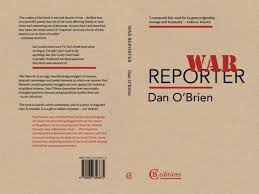
Dan O’Brien’s ‘War Reporter’ and new poems

I sometimes think poets are of two kinds: those drawn to dramatic subjects which explicitly dramatise the writer’s concerns and those drawn to more everyday topics which come to reflect the writer’s concerns in the course of the poem. I think of Hardy and Edward Thomas in the latter camp, alongside Heaney’s reference to Katherine Mansfield in North (1975): “I will tell / How the laundry basket squeaked”. In the former camp, for sure, stands the American writer, Dan O’Brien, who is everywhere at the moment.

O’Brien sees himself as “a playwright who moonlights as a poet” and he has just won the Troubadour International Poetry prize and been shortlisted for the Evening Standard theatre awards (for his play The Body of an American). He also has poems included in the recent Magma issue discussed in my last blog (https://martyncrucefix.com/2014/12/01/the-launch-of-magma-60-at-lrb-bookshop/). O’Brien’s first book of poems, War Reporter, was published by Charles Boyle’s excellent CB Editions just a year ago and I reviewed it for Poetry London. The book went on to be shortlisted for the Forward First Collection Prize and to win the Fenton Aldeburgh First Collection prize (http://www.thepoetrytrust.org/news/fenton-aldeburgh-first-collection-prize-2013-winner-announced/)

imgres

In discussion at Aldeburgh, O’Brien said War Reporter had been described as “docu-poetry” and that “sounds fair.” The war reporter in the book’s title is Canadian journalist, Paul Watson, and for seven years O’Brien has been in communication with him, “obsessively” recording and working on email conversations, as well as Watson’s recordings from conflict zones around the world. The two poems in Magma are part of new work in progress. ‘The War Reporter Paul Watson Has the Time’ is a good example of the complex webs of guilt and complicity that O’Brien poems weave at their best. The narrator has helped an “interpreter” escape from Kandahar and vengeance is taken against the interpreter’s extended family through an IED: “A bump in the road and / the usual denouement”. The poems never flinch from explicitness about physical harm (“his father, leg like broken / bricks in a bag”) or psychological damage (“a pistol for protection, against all / sense and provocation, only to suck it in his mouth and – blackout”). ‘The War Reporter Paul Watson Knows’ returns in part to the moral quandaries surrounding Watson’s 1994 Pulitzer prize-winning photograph of Staff Sgt. William Cleveland’s body being dragged from the wreck of a Black Hawk and through the streets of Mogadishu. It also alludes to Watson’s more recent eyewitness accounts from the conflict in Syria: “The West engaged / in self-soothing debates while mercenaries / penetrate the borders, tilting the board / in Assad’s favour”.

The Troubadour winning poem likewise derives from the Syrian conflict. Co-judging with Seren’s Amy Wack, Neil Astley said O’Brien submitted three poems, any one of which could have won first prize: “All three were so compelling that I found myself measuring all the other poems I read against them . . . I had no hesitation in putting forward one of them for first prize.” The eventual winner was ‘The War Reporter Paul Watson and the Barrel Bombs’: “basically pieces-of-shit / IEDs of TNT, nitrogen / -rich fertilizer, diesel, anything / likely to kindle after exploding”. This is a more brutal, less multi-dimensional poem than some of O’Brien’s but it possesses an undeniable power to shock: “A foot in a sock / sticks out of the mountain. They tickle her / to see if they should dig”.

O’Brien has just published a second collection of more personal poems with CB Editions: http://www.cbeditions.com/obrien2.html

And here is my review of War Reporter from last year:

Dan O’Brien’s book is big, brave, important and challenging even in its imperfections. It is an act of ventriloquism, hitching a desperate and often horrifying ride on the work and experiences of Canadian war reporter, Paul Watson. Watson took the 1994 Pulitzer prize-winning photograph of Staff Sgt. William Cleveland’s body being dragged from the wreck of a Black Hawk through the streets of Mogadishu. Without doubt, his work tapped something important for America; as well as Watson’s original book, Where War Lives, and these poems, there is also a play and an opera in preparation.

imgres

The poems abound in speaking voices, dominated by Watson himself, but including the “Poet”. Each piece comes at the reader as a slab of blank, largely decasyllabic verse. Voices bleed into one another, partly under the pressure of war zone experiences but also because of an explicit similitude between author and reporter: “You’re like the writer / I’ve always wished I were [. . . ] your constant / returning to an underworld we can’t / look at” (‘The War Reporter Paul Watson Describes the Ghost’). Both men admit to the allure of war and death. Watson’s voice, telling of his Mogadishu photo, confesses “When / you take a picture the camera covers / your face, you shut the rest of the world out” (‘The War Reporter Paul Watson Hears the Voice’). The quieter, more reflective stretches of the sequence explore this idea and allude to Camus’ claim to have solved the mystery of where war lives; the answer is in each of us, in our loneliness and humiliation. Watson’s book pursues this and O’Brien does the same here, taking the idea to justify excursions into both men’s personal and family backgrounds. I’m not sure how effective this is (OK, both are drawn to war’s horror, but neither are warriors) and these episodes do sap the quite astonishing power of the more direct reportage.

The book has Watson recalling scenes from Somalia, Rwanda, the Balkans, Iraq, Afghanistan and Pakistan and it is art’s ability to contemplate such horrors that makes the book an important one. Tony Harrison (who always refers to himself as the man who reads the metre) insists that his formal artistry is vital to bring the poet through the fire he is intent on penetrating. O’Brien chooses to speak of man’s brutality by telling it slant, through another’s voice. Watson witnesses the stoning of a married rapist, but the initial possessive modifier ensures we cannot push the scene into the distance: “our audience cheers an elderly man / lifting a perfect cinder block above / his head, then smashing it down where a gash / jack knifes the rapist’s neck” (‘The War Reporter Paul Watson Attends a Stoning’). War lives in all of us and the collection is a hard read partly because of our reluctance to face this. The rigid consistency of form perhaps also adds some monotony, but I’d agree with Jay Parini, that O’Brien’s success is in finding words “sufficient” for our time, a form of speech adequate to the evil that persists.

Louise Gluck’s ‘Education of the Poet’

As Keats once said, several things dove-tailed together. One of these was being asked by Poetry London to review Louise Gluck’s new collection, the PBS Recommendation, Faithful and Virtuous Night (Carcanet, 2014). The other – yesterday – was discussing with students the opening quatrain of Edward Thomas’ ‘The Sun Used to Shine’ with its marvelous evocation of the happy days he spent with Robert Frost in the Gloucestershire countryside in 1914. The opening lines employ an ABAB rhyme scheme, enjambement, judiciously placed caesuras and simple colloquial choices of verb and adverb to create its effects. As often, students asked whether what we were discussing was ‘thought about’ by the poet. My usual answer is that a writer is far more conscious of his craft that they might expect, but also that he considers options and exercises a veto. Like evolution, what fails goes to the wall; what remains becomes more and more coherent and effective. This is an idea I first saw expressed in Gluck’s essay, ‘Education of the Poet’ (originally a lecture delivered in 1989, reprinted in Proofs and Theories: Essays on Poetry (Carcanet, 1999).

imgres

Gluck’s over-riding point is that her characteristic mode of thought defines itself “in opposition”. This gives rise to her image of the poet as fundamentally in a state of helplessness much of the time, absorbing whatever is regarded as ‘oppositional’ and looking for opportunities to speak back. She makes it clear that such an idea “does not mean to distinguish writing from being alive”. What it means in practice is that the life of the poet is a life of “yearning, not [one] made serene by sensations of achievement”. The image of the writer effectively, confidently, repeatedly decanting her self, her being onto a sheet of paper is a false one. There are periods of silence, preoccupied with the desire to make art, a restlessness that may be agony. When at last “some sound, some tone” precipitates, what follows is a period of concentrated work: “so called because as long as one is working the thing itself is wrong or unfinished: a failure”. Yet when the poem, the utterance, is finished – Gluck argues – the poet is no more, reverting “simply [to] someone who wishes to be one”.

This pattern of a powerful force, a cacophony being replied to by the artistic voice  can also manifest in the way a poet engages with language. Gluck rejects the idea that poets are people who can’t get enough of individual words like ‘incarnadine’, in favour of language deployed in larger swathes to create contexts in which the “simplest vocabulary” is liberated from custom. It is custom that is thus replied to through using the gestural aspects of language – setting, timing, pacing – releasing words into novel relationships with truth. The poet generates material, improvises, plays with language and replies to what is produced through the process of veto. Like evolution, what fails goes to the wall; what remains becomes more and more coherent and effective.

imgres

So it’s no surprise that Gluck’s taste in poets favours those whose mode of poetic speech is more like a spoken confidence, a reply, a conversation: “I read to feel addressed”. Accordingly, her personal preference is not for poets – like Wallace Stevens – whose work is a more solitary musing, like “intercepted meditation”, not concerned to be listened to. I find myself in agreement with much of what Gluck says and – re-reading the essay now – I remember that she also uncovers this pattern in the teaching process. She warmly recalls being taught by Stanley Kunitz, his application to the novice writer of a steady “scrutiny”, the oppositional force “from outside, from the world, from another human being”. It’s a scrutiny and compulsion she herself continues to provide for her own students; the teacher’s presence is to stir, to provoke the reply, to kick start the process of definition.

It seems even one’s own work can be seen in this light. Considering her early collections, Gluck regards each new book as a fresh reply to what went before. This is a good answer to my students’ inquiries about how conscious an artist can be. Gluck tells us – and we should more than half believe it – that here she sought latinate suspended sentences, there how to end a poem without sealing it shut; elsewhere she looked to learn a longer breath, to make better use of the present tense; later still to write something less heroic, devoid of mythic reference. The artist is conscious, manipulative, alert. The artist waits, responds, manoeuvres. The both.