Here is Ian Brinton‘s recent review of my new Salt collection, Between a Drowning Man. It was first published by Litter Magazine in January 2024.
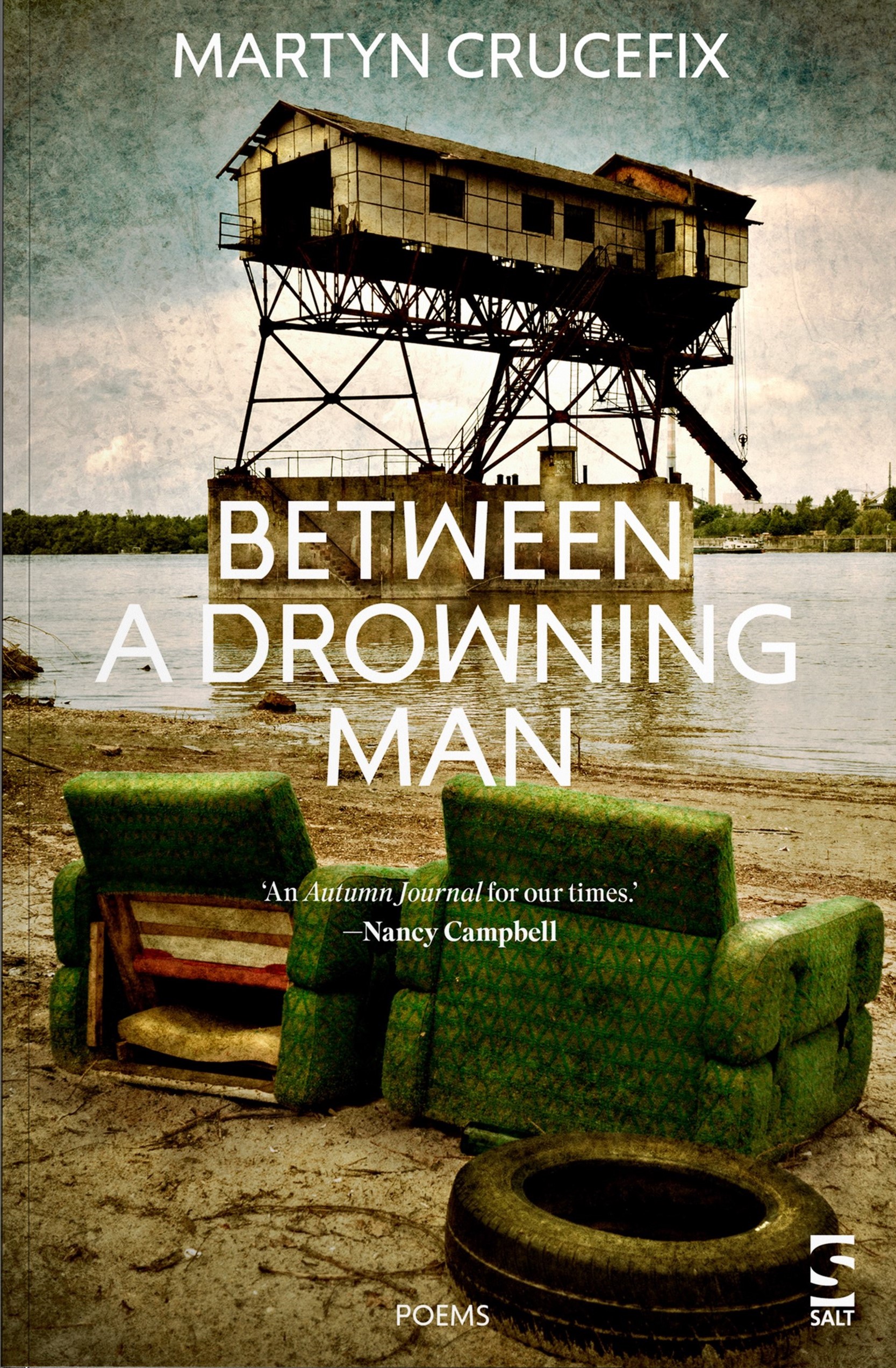
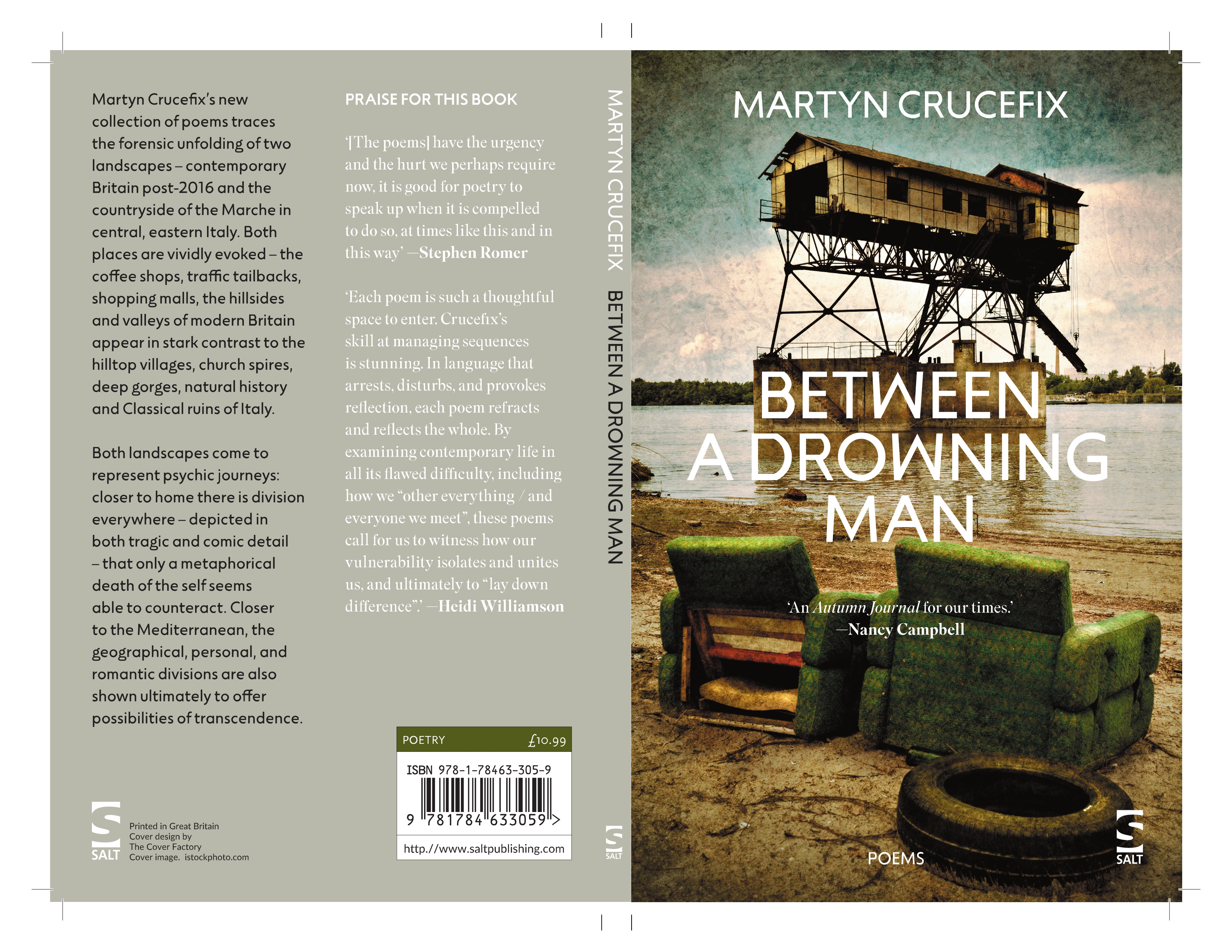
The invitation at the opening of these two remarkable sequences of poems by Martyn Crucefix emphasises both ‘difference’ and ‘ambiguity’, an ‘othering’ which hones attention rather than dulling it.
Divided into two sections, Works and Days (forty-nine poems) and O, at the Edge of the Gorge (fourteen poems) the two landscapes bring into focus a post-2016 Britain and the countryside of the Marche in central, eastern Italy. The leitmotif which threads its pathway, its recurring echo, through the first section is of ‘all the bridges’ being ‘down’ and the epigraph to section two is a quotation from Canto 16 of Dante’s Paradiso in which cities pass out of existence through warfare or disease and that which may have seemed permanent is continuously in movement. That second section of poems is a sequence of sonnets and in the final one the hawk’s resting place in the ‘shivering of poplars’ sways so that he is neither falling nor at ease
with these thinnest of airs beneath him
these shapes of loose knotted mesh
these whisperings that cradle him on a whim
That ‘othering’ prompts the poet to see the differences that are ‘like crimes woven into the weft’ and, in a way that William Blake would have recognised in his ‘A Poison Tree’, envy can be ‘buried long years in the black heart / of expressed admiration’ and ‘sunshine’ can be ‘really the withering of night’ which is ‘poured into soil where wheat grows’. And so it is—‘in and around and over and above’ because ‘all the bridges are down’.
In April 2007 Jeremy Prynne wrote some notes for students about poems and translation:
Translation is for sure a noble art, making bridges for readers who want to cross the divide between their own culture and those cultures which are situated in other parts of the world; and yet a material bridge is passive and inert, without any life of its own, whereas a poetic translator must try to make a living construction with its own energy and powers of expression, to convey the active experience of a foreign original text.
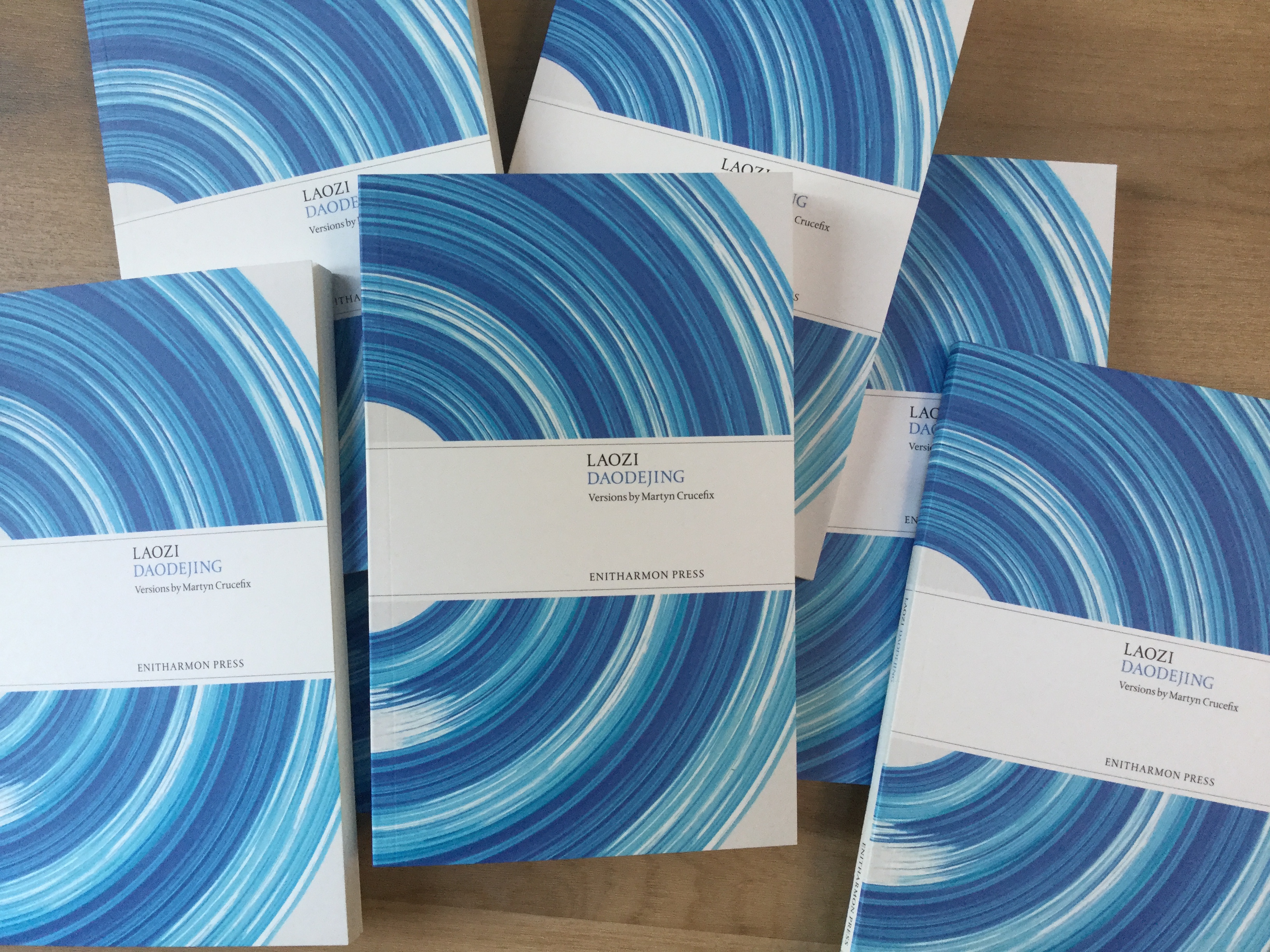
As a translator of real distinction (Rilke’s Duino Elegies and The Sonnets to Orpheus) Crucefix has for many years made these living constructions offering readers a gateway into new experiences whether it be through the world of Laozi’s Daodejing (Enitharmon Press, 2016) or through these new poems which offer echoes both of Hesiod’s Work and Days and the poems known as a vacanna which originated in the bhakti religious protest movements in 10-12th century India. His understanding of the central role language plays in our lives, that creation of bridges between humans, was one of the deeply moving and memorable moments in his collection from Seren in 2017, The Lovely Disciplines. There the poem ‘Words and things’ presented an elderly individual who discovered ‘too late this absence of words’ which now ‘builds a prison’ and Crucefix recognised that ‘a man without language is no man’: as the world of objects becomes too difficult to dominate he can only have knowledge of a world which ‘turns in your loosening grip’. The echo of Yeats’s ‘The Second Coming’ is surely no accidental one!
Translations are bridges, language is a bridge, and the distressing recognition of isolation within numbers is the dominant image in ‘fifteen kilometres of traffic’ from the first section of this new book:
fifteen kilometres of traffic wait before us
behind us the infinite tail
x
we are offered Google Map options
yet those trumpeted ten minute economies
x
are nothing till they can be proved
you make a choice you go your own way –
x
this has been better said before of course –
you cannot take the other way
x
and remain a unitary being on two paths
or perhaps sane – all roads crawl north
x
because multiple millions of cars crawl north
because all the bridges are down
Those ten minute trumpetings bring the world of Orwell’s 1984 to my mind as loud announcements of positive news seem to possess a tinny emptiness to the understanding of the isolated human who exists in a world of no bridges.
However, in contrast to this wave of uniformity one reads moments of ‘othering’ in the second section of this book as in ‘sharpening gusts along the valley floor’ a scrap of air was birthed
whirling inches above a littered drain
in a back street of some hilltop town
x
like Urbisaglia or some place that has seen
and has survived change of use
from sacred temple to church to slaughterhouse
and no gully nor hill can stop it
In this moving world ‘great swathes of air’ gather strength to flex ‘all things to a scurrying to keep up / and the truth is some will and some will fail’.
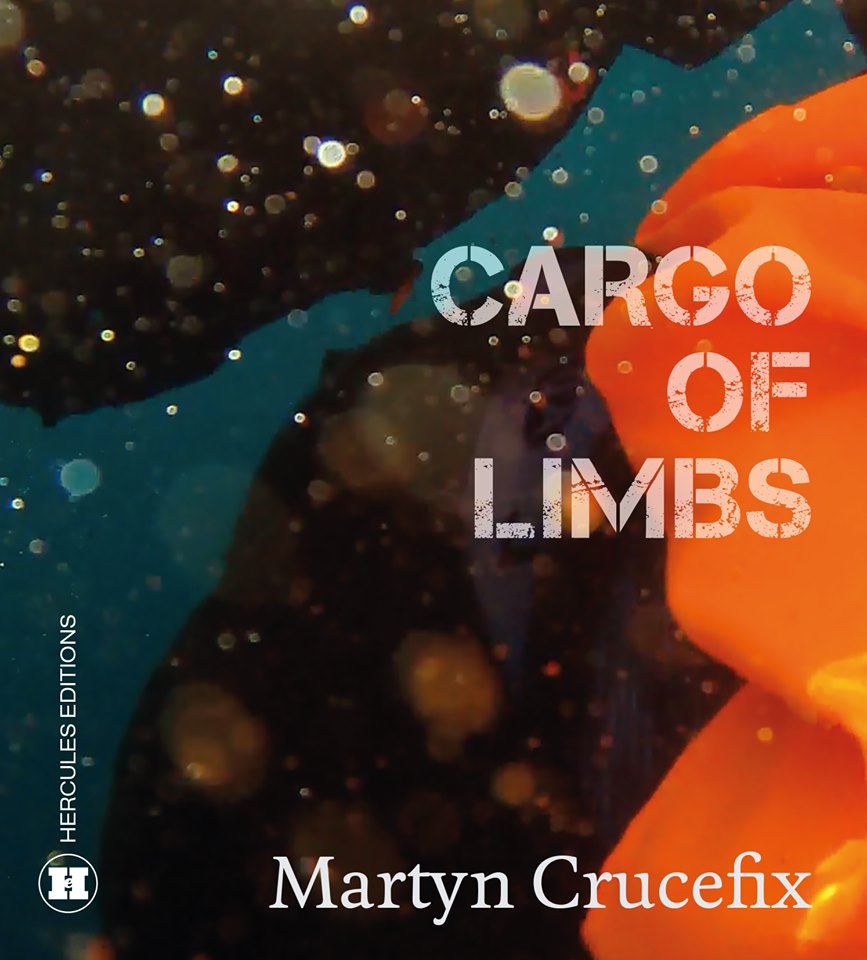
In a poem titled ‘can you imagine’ (for my children) from the first section of Between a Drowning Man the power of language to translate the invisible onto the page is presented with an unerring eye focussed upon reality. In a world in which he no longer shares the companionship of others the poet is carried safely because although ‘you find the bridges between us fallen down’ and although ‘you mourn’ you can still ‘imagine’. That sense of continuity held in the imagination is far from the image of Alan Kurdi, the three-year-old Syrian boy drowned on the beach near Bodrum, Turkey, in 2015 whose death was recorded by Crucefix’s earlier book, Cargo of Limbs, from Hercules Editions in 2019. The boy’s family had fled from the war engulfing Syria in the hope of joining relatives in the safety of Canada and became ‘part of the historic movement of refugees from the Middle East to Europe at that time’:
In the early hours of September 2nd, the family crowded onto a small inflatable boat on a Turkish beach. After only a few minutes, the dinghy capsized. Alan, his older brother, Ghalib, and his mother, Rihanna, were all drowned. They joined more than 3,600 other refugees who died in the eastern Mediterranean that year.
In this new book that ‘whim’ of a resting place for the hawk, those ‘whisperings’ prompt the bird, the poet, ‘to call it yet more steady perhaps’:
this whim—this wish—this risky flight
in the fleeting black wake of the carpenter bees


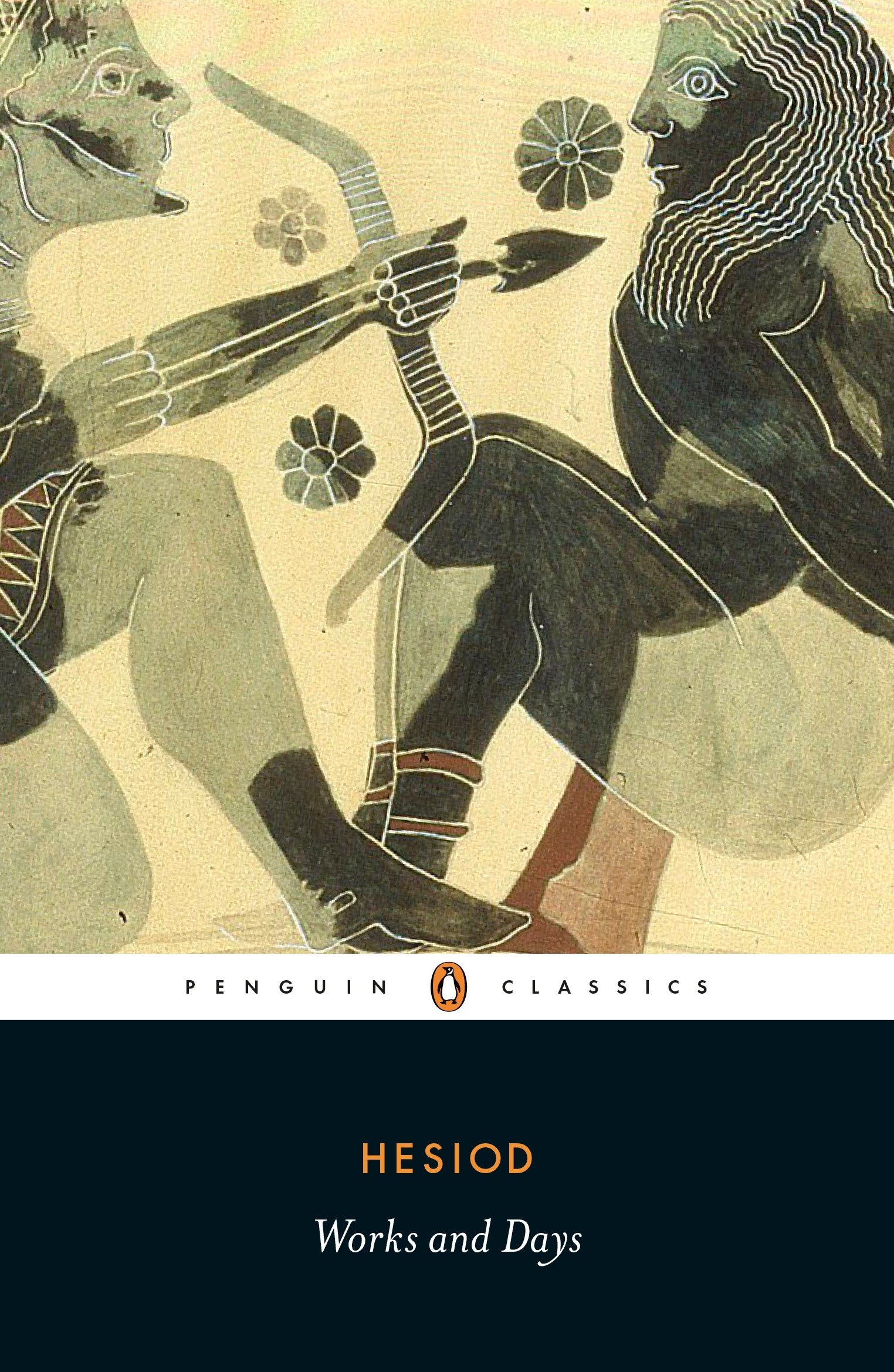
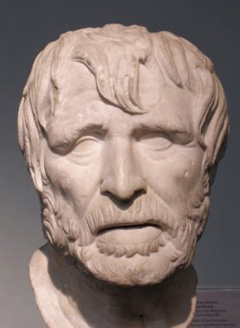 Did you know Hesiod probably pre-dates Homer? Hesiod is aware of the siege of Troy but he makes no reference to Homer’s Iliad. He’s usually placed before Homer in lists of the first poets. The other striking aspect of Works and Days is that (unlike Homer) he is not harking back to already lost eras and heroic actions. Hesiod talks about his own, contemporary workaday world, offering advice to his brother because they seem to be in a dispute with each other. Hesiod’ anti-heroic focus is an antidote to the Gods, the top brass and military heroes of Homer. Most of us live – and prefer to live – in Hesiod’s not Homer’s world.
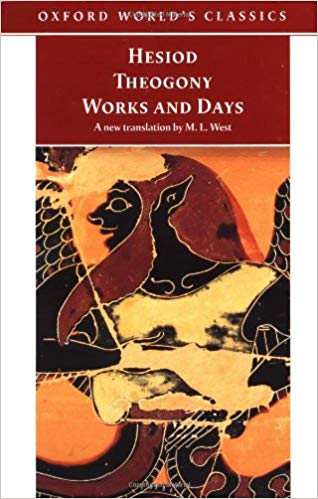 He seems to have been a poet-farmer who makes sure we are aware that he has already won a literary competition at a funeral games on the island of Euboea. His prize-winning piece may well have been his earlier
 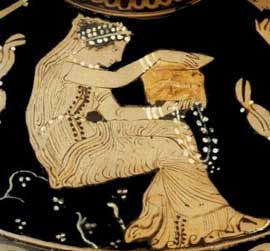 There are further reasons to set to work in the very nature of the cosmos and the human world. Hesiod tells the Pandora story here. Zeus causes the creation of a female figure, Pandora, as a way of avenging Prometheus’ pro-humankind actions (stealing fire from the gods, for example). Her name suggests she is a concoction or committee-created figure from contributions from all the Olympian Gods. She is given a jar which she opens: “ere this the tribes of men lived on earth remote and free from ills and hard toil and heavy sickness [. . .] But the woman took off the great lid of the jar with her hands and scattered all these and her thought caused sorrow and mischief to men” (tr. Evelyn-White). Hesiod’s locating of the root of human sorrow in the actions of a woman echoes the Christian story of the loss of Paradise and it is one of the reasons why Hesiod has been accused of misogyny, though as Stallings suggests, he’s not any more complimentary about the males of the human race.
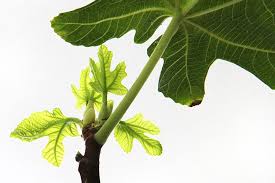 It’s certainly the lazy, self-serving, arrogant younger brother who forms the focus of the rest of the poem: “So Perses, you be heedful of what’s right . . . So Perses, mull these matters in your mind . . . Fool Perses, what I say’s for your own good” (tr. Stallings). It’s true that his name gradually fades from the text in the final 500 lines but the torrent of imperatives, offering advice and guidance on a range of practical issues, often sounds like haranguing from a concerned, perhaps slightly pissed off, brother. Much of this material is phenological – when to sow crops, when to harvest, when to shear your sheep. In winter, don’t hang around the blacksmith’s forge where other wasters gather to chat and pass the time. It’s safe to put to sea when the new fig leaves are the size of crow’s feet.
 These are the passages that, around 29BC, inspired Virgil to his own farmer’s manual, the Georgics. Hesiod ends his poem in a rather perfunctory manner, roughly saying he who follows this good advice will become “blessed and rich”. But given Pandora’s jar and the Iron Age we live in, even this seems a mite optimistic. And of course, Perses never gets the chance to speak for himself. But I guess the tensions between his brother’s call for social and religious conformity and Perses’ individualistic disobedience to the demands of the gods and the sense of what is best for a society have gone on to form the basis of the continuing Western literary canon. And does any of this help with Brexit? I conclude (largely with Hesiod) the bleeding obvious: it’s complicated – solutions must be negotiated, don’t hope for some golden age because in a fallen, less-than-ideal, complex society it’s better for the future to be decided in the glacier-slow committee rooms of a plurality of voices than in the stark divisions and dramas of the battlefield. Work hard – have patience – don’t buy into fairy tales of a recoverable golden age.
 Martyn Crucefix