Can AI Write an Original ‘Poem’ By ‘Me’?

The Atlantic recently posted a link to a site which can be used by authors of any stripe to check to see what, if any, of their works have (already) been used by Meta to train AI. For the last few weeks, social media have been full of understandably irate authors who discover this is exactly what has (already) happened. It looks to me as if prose works (fiction and non-fiction) as well as critical writing of all kinds – perhaps more than that ‘difficult’ genre poetry – have particularly fallen victim to the process. Indeed, Meta does seem to have taken some of my own writing – more critical than poetic – for its dubious purposes and it has done so without any kind of indication that this was happening, nor any request for permissions after the event, and – the harvesting of material being so vast – it’s hard to anticipate any after-the-event compensation or successful legal action. Even though, as The Atlantic‘s link has shown us, there ARE records of what has been done, a footprint, a guilty fingerprint, an undeniably smoking gun.

It’s hard not to feel that the horse has bolted on this one and – with the peevish idea of being able to mock at the anticipated results – since some of my own creativity has been stolen, I thought I’d ask ChatGPT to write a poem in the style of me. It was horribly polite in response and within a few seconds had produced a piece of writing it said was in the style of my own work and which it briskly summed up as ‘contemplative and precise [in] style, often rooted in quiet observations of the everyday, nature, and memory’. I posted this on Facebook – indicating the way this had come about – and wondering what people thought. The results surprised me as there was a mild round of applause for ChatGPT: it’s true, it did sound like a poem, it wasn’t utter nonsense (as I think I’d hoped). I don’t think anyone felt it sounded like me, but observations were made along the lines that ‘plenty of worse pieces of writing are submitted to magazines on a daily basis’.

But there was also a strong kick back against the whole process (even at my engaging with AI at all – though I really do think that horse and rider has bolted, in talking to friends (by no means all writers) and my own kids, AI has already made its way into the mainstream of work and study). There was also a strong reaction insisting that AI cannot write creatively because it does not have the human qualities out of which true (true?) creative writing emerges: the flaws, the emotions, the relationships, the memory, the history. I’m inclined to this side of the argument – though I’d also suggest it’s a kind of Doctor Who argument.

I thought it’d be worth spending a few moments looking at what ChatGPT actually produced for me. The title it chose, ‘The Last Light’, is inoffensive enough, if more Edward Thomas than Martyn Crucefix (in my view) and the form of the poem – free verse – is rather well done, though the line lengths are shorter than I think I’d have used myself. The opening stanza runs:

The hill is a shoulder—

pressed up against the sky’s slow retreat.

Beyond it, something waits:

not death,

but the unspoken

name of a tree I once knew

before its bark peeled

like old paper

from the spine of a life

I’ve half-forgotten.

That opening image is quite intriguing with its personification of both the ‘hill’ and the ‘evening’. The use of the long em dash after line 1 is something I think of as one of my techniques (though I’d not have used it there). In context of the ‘last light’ the ‘sky’s slow retreat’ is an effective phrase I’d be happy to own. I’m less happy with the next few lines, with the rather grandiose (overdramatic) ‘something waits’ (though I again hear some Ed Thomas in there) and ‘not death’. Is the latter a response to the possible (though here denied) metaphorical reading of ‘last light’? I think to suggest ‘the unspoken / name of a tree’ is what waits there is silly because it wouldn’t matter if it was spoken or not, because the ‘name’ is a thing known (it seems) and the tree bark peeling like ‘old paper’ is a poor image (what do you see there visually? compare bark to old paper?). This is compounded by suggesting the bark/paper is being peeled from ‘the spine of a life’. For a moment I see (distractingly) a human spine, then it’s replaced by the spine of a book (surely what is intended?) but this book spine seems to be from a book of ‘a life’ – or the life. Ugh no no no – the imagery there is all of a muddle which is not countered by the slightly emotive indications of ageing, loss, the past etc. To then say – as the poem does – that whatever has been said in the preceding few lines is actually ‘half-forgotten’ makes a mockery of the whole thing so far – this is like a bad poet attempting some elusive suggestiveness without really understanding (or being clear – poetry has to be clear in itself) what is being said. There is – AI critics would surely say, and I’d agree – an inhuman muddle going on in the opening 10 lines. But that is not to say that a not-very-talented human poet might have done something similar.

The poem proceeds…

A bird—

small enough to miss in motion—

cuts across the field.

Not for me, not even for itself,

but for the thread

it must continue.

The parenthetical ‘small enough to miss in motion’ doesn’t work for me. Again it seems to be yearning as it were for a sort of liminal effect – just on the edge of sense – but either it has been missed in which case it’s not been seen at all or it has been caught sight of in which case it has not been missed. The latter sentence is what I’d be arguing with myself were this actually my poem. I’d cross it out or re-write. The negatives of line 13 (‘Not for me, not even…’) again seem to be reaching for an edge of perception sort of impression, something is not known. I’d accept this as one of Crucefix’s recurrent ideas but (I hope) I don’t do it like this which is not so much a struggle to perceive, more a double blocking negative: if it’s not this and not that… then what is it? To go on to suggest there is a ‘thread’ being followed (by the seen/unseen bird? really?) And that the continuation of this ‘thread’ is something the bird is compelled to do (‘must’) is verging on the ridiculous. There are suggestions of motives, compulsions, but looked at more closely they make no sense whatsoever.

The poem’s final two stanzas are as follows:

I place my hands in the grass.

It is cold with what the earth

has kept secret all day.

I wonder

if this is what love is:

a silence left

after something essential

has flown.

The placing of hands ‘in the grass’ is rather good and the finding of ‘cold’ there is ominous (again ‘last light’?) and indicative of a death of sorts and to suggest the earth has kept this ‘secret all day’ is also a phrase – even an idea – I’d be happy to acknowledge my own (it’s not). But I can’t recall ever using the phrase ‘I wonder’ in a poem (no doubt I have) and I don’t like it. It seems to be AI’s attempt at a sort of ‘poetical’ tone and mood. In this context it feels rather cheap. And that is cheapened even further by what is wondered: ‘if this is what love is’. Where the hell did that come from? AI is using tropes which it thinks evoke the poetique…. love is a surefire winner of course…. But I can’t see how it forms any kind of ‘whole’ with what has come before. I find myself insisting this is what AI cannot really do – which a live human can potentially – create language in forms which achieve some sort of integrity, a wholeness, even out of contradictory materials, and the glue that binds them together has to be feeling, an emotional experience which lies at the root, powerful but usually not articulated in any other form than in the form of the poem itself.

The AI poem’s last fling is the colon which may or may not suggest that what follows is ‘what love is’. I think the AI mind will mean this. Once again I hear Edward Thomas more than me in this conclusion (see what ET remembers at the end of ‘Old Man’: ‘Only an avenue, dark, nameless, without end’) but the muddling of metaphors occurs again. There is a ‘silence’ left after something ‘essential’ has flown away but my reader response is straining here at the flighted thing (a motion) which is somehow abandoning an aural experience (the silence) and in leaving it something ‘essential’ has been lost (with wings?). Again AI is picking up the way poetry wants to get to the ‘essence’ of things but the words written here are merely an indication of that wish, not at all a real live accessing of it, or even a genuine gesturing towards it.

Having written this I have convinced myself – even more than I had been before – that what AI has written is a ‘hide’, a cover for a poem, making use of words and ideas that it has found associated with poems (perhaps even my own poems) but which it doesn’t itself ‘get’ (how could it?). On the other side of the desk sits the reader. The question for the reader is: how well do we read any poem that comes before us? Do we accept its (often) feeble gestures towards significance as the real thing? Out of a hundred poems we read in magazines and on-line, how many of them ARE the real thing? I’d bet my AI generated poem would find its way into a UK magazine (eventually). It has the aura of a poem, it has many of the familiar gestures of a poem, it doesn’t really make proper sense (which some think is the mark of a real poem), it doesn’t have the heart of a true poem (but lots of poems I read don’t either because they too are copying, mimicking tropes and phrases from other poems).

My astute friend, fiery critic, and fine translator, Will Stone, was kind enough to comment at length on my original Facebook post. I’m with him. I’ll leave you with his thoughts:

Martyn…. your own poetry is born of time, experience, tragedy and celebration, as well as from the inner harvest of your accomplished literary translations. This collection of admittedly impressive sounding images has been reaped from a database in nano seconds and cobbled together in some deceiving facsimile which claims to be your style. And like the macabre chitty bang bang child catcher with his tempting lollipops, it’s ‘all free today’. Like a painting let us say by Edvard Munch reconstituted by a skilful fraudster based in High Wycombe, it may appear in every way to be Munch, but it isn’t Munch. For it was the process of creation (which is unique to every individual and cannot be rationalised by densities of data capture or meticulous replication) that was invested in the original painting and by implication your poem, which counts. AI is not a creator out of inwardness, it is a skilful and persuasive designer, an artisan. It only wants to succeed and aims almost grotesquely at perfection. Genuine poets aim at expressing authentically from a deep point, and are explorers who cling to the cliff face of their poem’s construction… failure is quite possible which is why only a human can be an artist because humans alone with their insufficient organs (see Maupassant le Horla) are shaped by fear, doubt, failure, wild joy and excess. What I am trying to say is that it is as much about what we miss in a work of art to make it complete or perfect that makes it unique with its beautiful imperfection!

Related Links: Nesrine Malik’s recent Guardian article on AI: ‘With ‘AI slop’ distorting our reality, the world is sleepwalking into disaster’ plus several interesting discussions of AI and translation on the Goethe-Institute website.
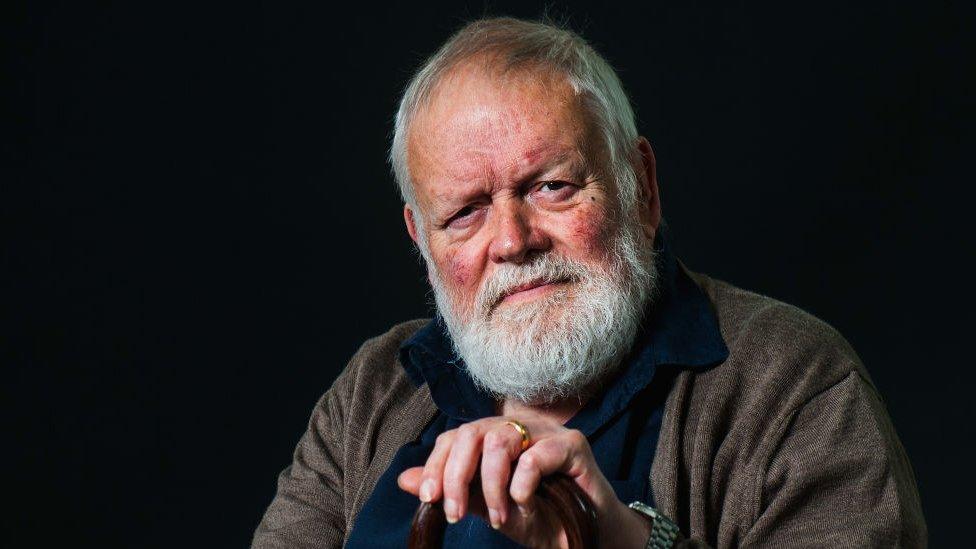
RIP Michael Longley

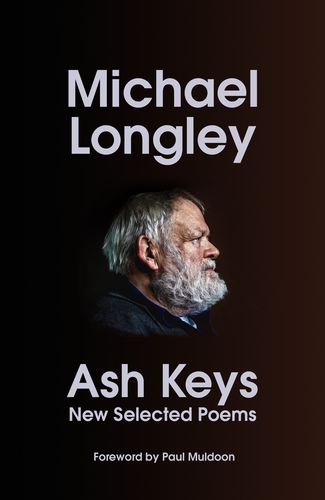
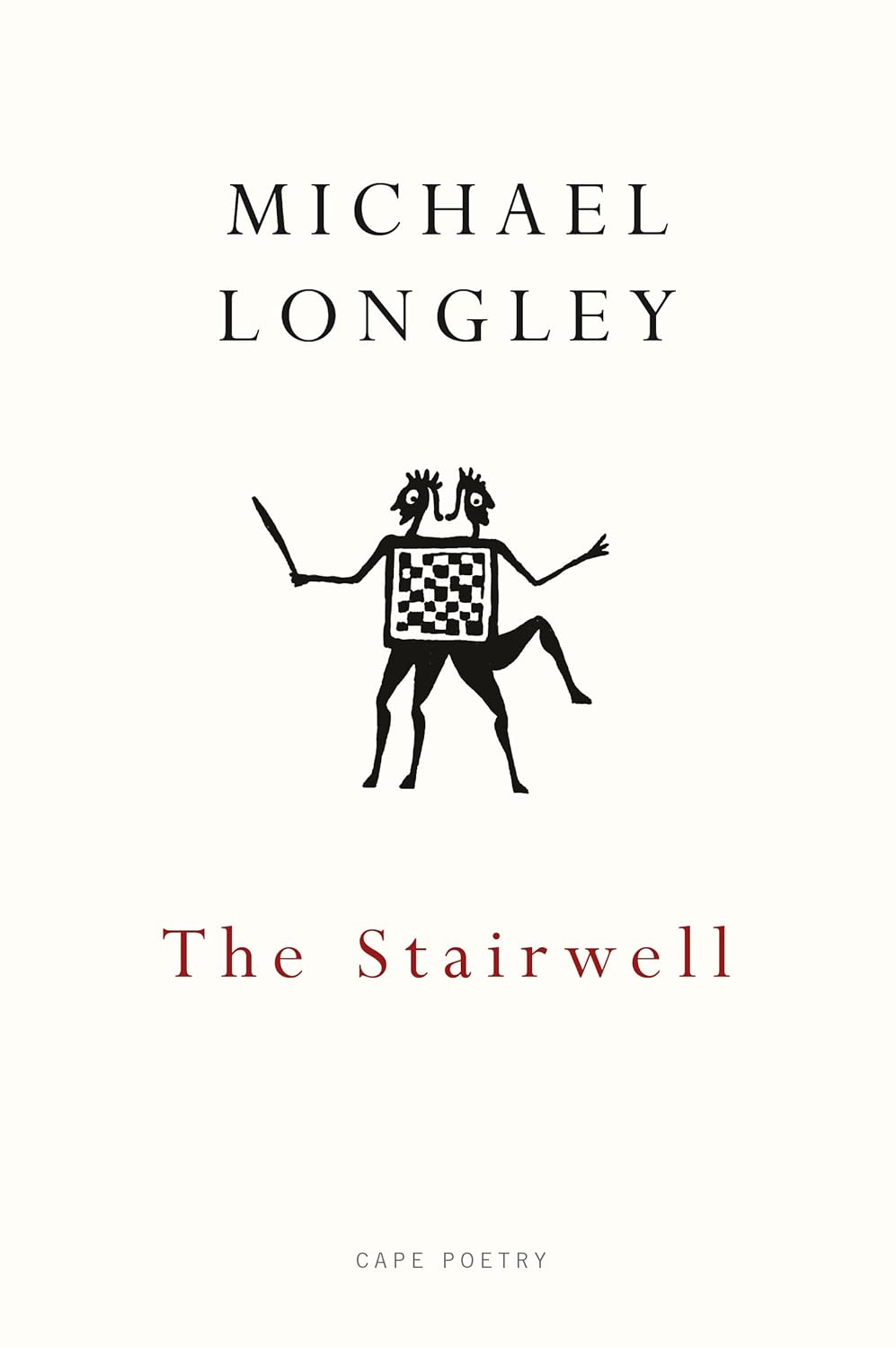
Social media – at least the bit of it that arrives on my screens – is alive this morning with many expressions of sadness at the announcement of the death of Michael Longley. I heard him read just a few months ago to launch his most recent new selected poems, Ash Keys, at the LRB Bookshop in London. He insisted then on trying to stand to read his poems, though his breathlessness and physical wobbling often made him have to take his seat again; but the humour and mischievous twinkle were as powerful as ever. Over the years, I have to admit it took me a while to really come to appreciate his work; I think I did not really ‘get’ the force of his brevity, his precision. If you have not seen it yet, do watch the brilliant, moving, inspiring BBC programme about him, his life and work here. I’m posting below my review of his 2014 collection, The Stairwell (the review originally published in Poetry London) and I hope it manages to say something useful to both new and older readers of this wonderful poet. Here he is reading ‘Remembering Carrigskeewaun’ on The Poetry Archive.

Keeper, custodian, traditionalist whose work is stringent, formalist, always elegant: critical judgments on Michael Longley’s work fence him round too closely, running the risk of misleading, even discouraging, new readers. It’s true, as a member of Philip Hobsbaum’s Group in Belfast in the 1960s, Longley’s poems were criticized for their elegance of form, rhetorical grace and verbal eloquence, though he found something of a kindred spirit in Derek Mahon. Longley wrote poems that were “polished, metrical and rhymed; oblique rather than head-on; imagistic and symbolic rather than rawly factual; rhetorical rather than documentary” (The Honest Ulsterman, November, 1976). But Seamus Heaney’s different aesthetic was Hobsbaum’s star turn and quickly became a national, then international preference. Attitudes solidified around Longley although (perhaps in the cause of self-definition) this was not something he resisted, casting himself and Mahon in the 1973 poem ‘Letters’ as “poetic conservatives”.

‘Epithalamium’, the poem that since 1969 has opened Longley’s selections and collecteds reinforces the caricature and in ‘Emily Dickinson’ he sees the need to dress “with care for the act of poetry”. But Longley’s long standing admiration of Edward Thomas was not for nothing and he shared a desire to dismiss Swinburnian “musical jargon that [. . . ] is not and never could be speech” so that in The Echo Gate (1979) he is experimenting, on the one hand with the plainly Frostian ‘Mayo Monologues’, and on the other with short, imagistic pieces in which the authorial voice seems to have taken a vow of non-intervention. ‘Thaw’ reads, in its entirety:

Snow curls into the coalhouse, flecks the coal.

We burn the snow as well in bad weather

As though to spring-clean that darkening hole.

The thaw’s a blackbird with one white feather.

This is a mode that Longley has continued to explore in accordance with another (surprisingly) early statement of poetic intent. The poet’s duty is to “celebrate life in all its aspects, to commemorate normal human activities. Art is itself a normal human activity. The more normal it appears in the eyes of the artist and his audience, the more potent a force it becomes” (Longley, ed. Causeway: The Arts in Ulster, 1971).

Subsequent collections have become concerned to list, to name, as it were ‘merely’ to record experience for its own sake, often in vivid short poems which run the risk of seeming inconsequence, though Longley has never lost his unerring eye and ear for the poetic line. Nor has he ever seriously questioned the adequacy of language (within conventional bounds) to represent experience. It’s in these ways that his work is conservative but his poems’ intention to encompass and witness is far more radical. To witness – whether it is the song of a wren near Longley’s beloved Carrigskeewaun, a Belfast bombing, or the camp at Terezin – is to acknowledge that we are bound together by what happens. From Gorse Fires (1991) to The Weather in Japan (2000) Longley comes to sound like Eliot’s Tereisias who, as the pages turn, has “seen and foresuffered all”. The beauty of nature, the horrors of mankind, birth and death, the present and the distant past are all absorbed into his steady gaze, a steady voice, intent on an anatomy of connection.

One such connection is the way Longley has been re-visiting the Iliad and Odyssey for years now, producing vivid, contemporary accounts of key scenes. Priam’s visit to Achilles tent in Book 24 of the Iliad famously became Longley’s poem ‘Ceasefire’, appearing in The Irish Times in 1994 when the IRA were considering a ceasefire themselves. The poem forges links and connections between enemies and across millennia. As ‘All of these people’ puts it, “the opposite of war / Is not so much peace as civilization” and civilization needs to be founded on a right relationship with even the smallest of things. Among many poems that articulate an ars poetica, ‘The Waterfall’ envisages the best place to read his own collected works as “this half-hearted waterfall / That allows each pebbly basin its separate say”. It is such civilized allowance, rather than the much-vaunted preservation of a tradition, that is the mark of Longley’s aesthetic, moral and political outlook.

His new collection, The Stairwell, is much obsessed with death though its inevitable reality has already been embraced by the poet’s allowance. An Exploded View (1973) already contained ‘Three Posthumous Pieces’ and twenty years later, ‘Detour’ mapped out his own funeral procession. Here, Longley has been “thinking about the music for my funeral” (‘The Stairwell’) and much of the book has the feeling of an ageing figure readying to depart. Longley himself refers to his “unassuming nunc dimittis” (‘Birth-Bed’) and the only ceremonial he anticipates is to be provided by robins, wrens, blackbirds: “I’ll leave the window open for my soul-birds” (‘Deathbed’). The counterweight to civilized allowance, even in the approach of death, is modesty and humility. If gifts are to be handed on to the future then they ought to include a little poem about a wren: “Its cotton-wool soul, / Wire skeleton [. . . ] / Its tumultuous / Aria in C” (‘Another Wren’).

Such unassuming gifts to future generations are balanced, in the civilized society Longley seeks out, by the commemoration of the past. This is something his poems continue to do with his re-imagining of his father’s experiences in the Great War and this new collection contains more of these poems; his father at ‘High Wood’ among “unburied dead”, befriending the future Hollywood star, Ronald Colman, or taking an ironic “breather before Passchendaele” (‘Second Lieutenant Tooke’). Whether looking forwards or backwards, the true gift lies in the specific, not the generalized. ‘Insomnia’ recalls Helen Thomas calming and consoling the mad Ivor Gurney, by guiding his “lonely finger down the lanes” of her husband’s map of Gloucestershire. Longley looks for this too. Here is the whole of ‘Wild Raspberries’:

Following the ponies’ hoof-prints

And your own muddy track, I find

Sweet pink nipples, wild raspberries,

A surprise among the brambles.

Having translated a poem by Mikhail Lermontov, Longley goes on to wonder what his “understated” neighbours around Carrigskeewaun would make of such “grandiloquence” (‘After Mikhail Lermontov’). It’s in the avoidance of a hyper-inflated language and tone that Longley’s re-makings of Homer are so good. The new book contains a fair sampling of these too, many of them in the second half which forms an extended elegy, commemorating Longley’s twin brother, Peter. The Homeric paralleling works less well in this context, though the unrhymed double sonnet, ‘The Apparition’, in which the ghost of Patroclus pleads to be buried by Achilles, addressing him as his “dear brother” is powerful. But I’m reminded of Heaney’s Station Island (1984) in which he revised and regretted his earlier use of “the lovely blinds of the Purgatorio” in writing a poem about the murder of Colum McCartney in Field Work (1979). Longley’s Homeric material casts such a strong shadow and the vital life of Peter is insufficiently conveyed, except in a few recollections of their shared childhood, tree-climbing, bows and arrows, boxing, visiting the zoo. Nevertheless, Longley’s determination to commemorate his twin, with whom he shared “our gloomy womb-tangle” (‘The Feet’), re-confirms human closeness, allowance, the giving of space to others, to nature, is what has driven this poet’s work for more than forty years. 

My Three Desert Island Poems

As mentioned in a post earlier in June, I spent a few days around that time trying to choose just 3 poems that I might take with me to a speculative desert island. I was asked to do this by The Friday Poem website and they have now posted the results of my labours.

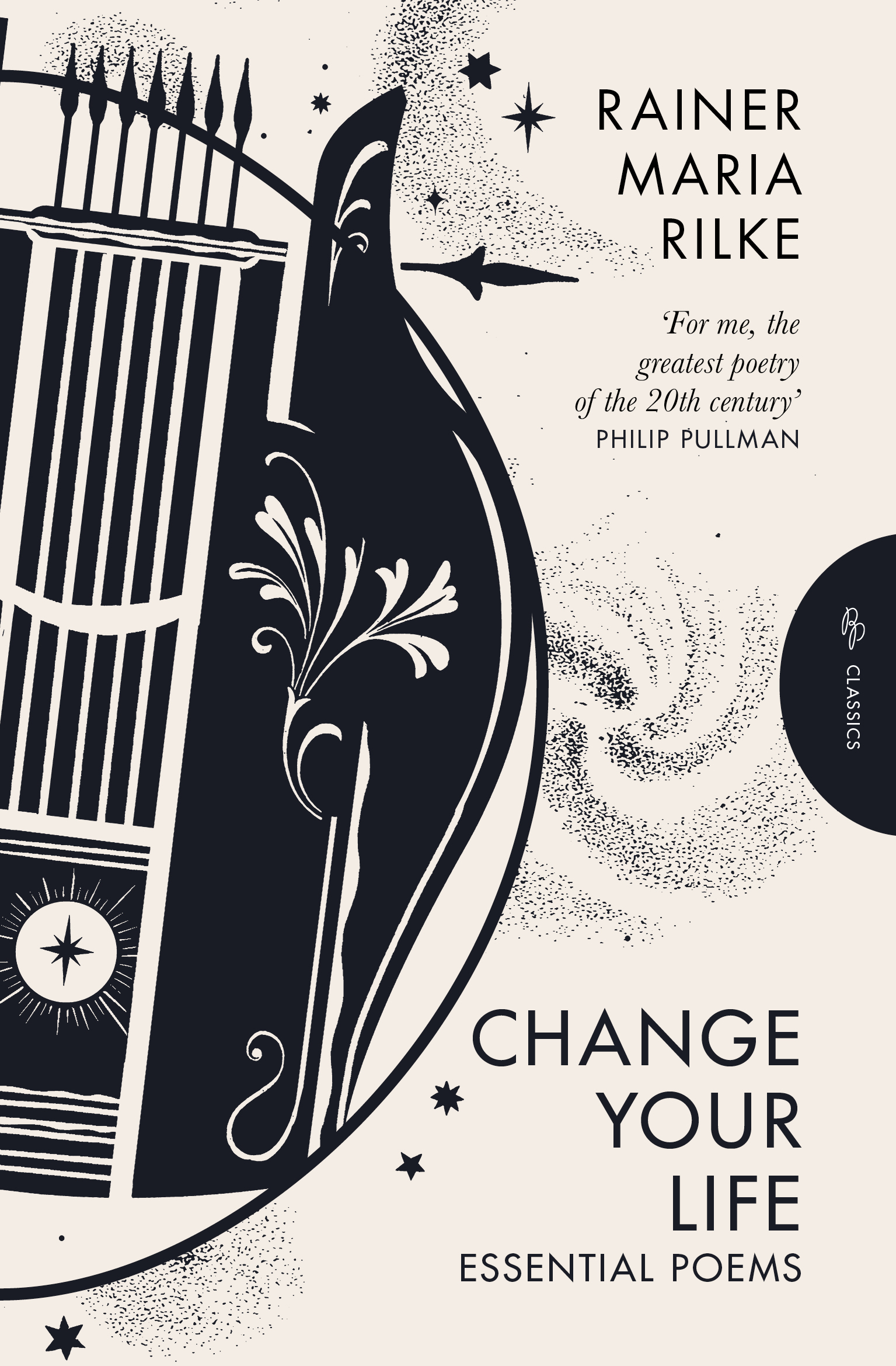
In the end I chose work by Coleridge, Edward Thomas and Rainer Maria Rilke. Of course, the latter has been on my mind a great deal in the last 12 months or so, as I have been working on a new selection and translation of his work (spanning his career from 1899 to his death in 1926). It so happens that I have just signed off the final draft of this book – all 200 pages of it – and it is scheduled for publication by Pushkin Press in the Spring of 2024.

As for that desert island, do follow the link below to read the full text of my ruminations which also includes links to my own readings of the Thomas and Rilke poems. Do explore the rest of the FRIP website – it’s full of great poems and reviews:

We are always saying goodbye – The Friday Poem

Pushkin Press Rilke book cover ready for Spring 2024

Edward Thomas, Tellisford, and a poem of my own

I have recently been writing a piece for the excellent site, The Friday Poem, or the FRIP as it styles itself, edited by Hilary Menos. I’d had a poem accepted by the FRIP earlier this year and Hilary had asked if I’d like to contribute something in prose, perhaps choosing 3 ‘desert island’ poems. An impossible challenge, of course – only three!!?? – but an interesting exercise to be sure. I’ll say no more about what I submitted to the FRIP before it appears there in the near future, only to say that one of the poems I chose was by Edward Thomas.

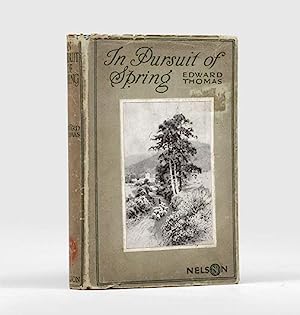
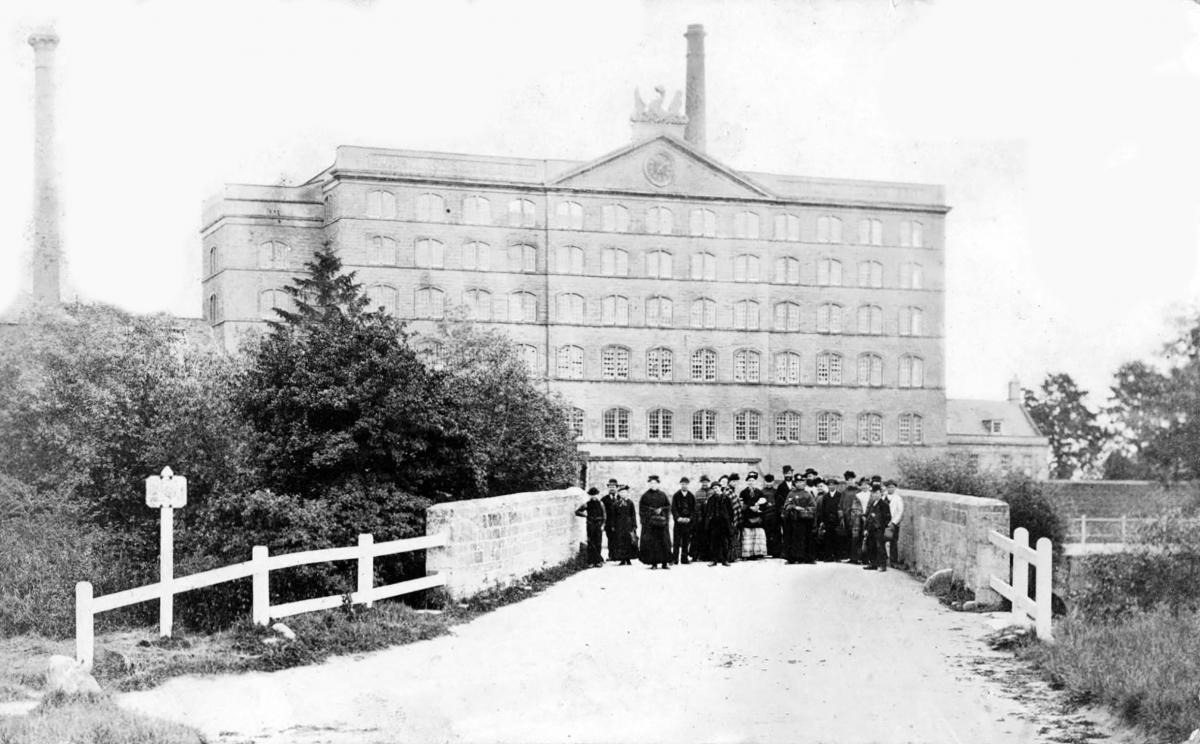
In introducing ET’s poem, I found myself talking about his prose travelogue, In Pursuit of Spring (1914). This book – apart from being wonderfully evocative of a lost, pre-WWI England, as he cycles from London, through the South Country, to end up in the Quantock Hills – has always been special for me because he makes a stopover just outside my hometown of Trowbridge, in Wiltshire. The following day he cycles out of Trowbridge, through Hilperton (the village where I grew up), out to Semington, towards Melksham, then along the meadows at Challimead, to Holt, before passing the Nestle factory at Staverton. The latter, with its River Avon (the Bristol Avon) flowing nearby, was where I used to go fishing with our next-door neighbours. The factory is also where several generations of my own family worked, including my maternal grandparents and my mother. Thomas’s descriptions of the roads and countryside are vivid:

. . . the Phoenix ‘Swiss’ Milk Factory where I crossed the Avon at Staverton . . . is an enormous stone cube, with multitudinous windows all alike, and at the back of it two tall chimneys. The Avon winding at its foot is a beautiful, willowy river. On the opposite side of the road and bridge the river bank rises up steeply, clothed evenly in elms, and crowned by Staverton’s little church which the trees half conceal.

The ‘Milk Factory’ at Staverton and the bridge over the Avon

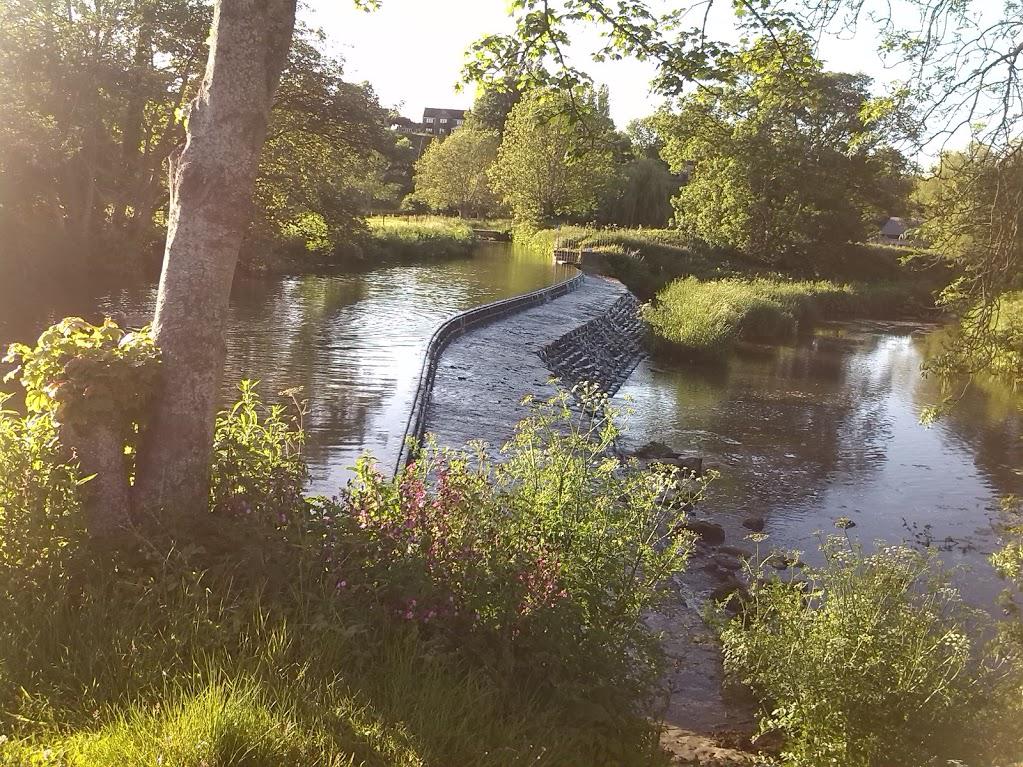
That church is where my grandparents were married. The following day, Thomas sets off again but stops this time at Tellisford. This is a small village to the west of Trowbridge, where a bridge crosses the River Frome. I’d occasionally come fishing here too, and later for the occasional romantic tryst, though more often the trip was for a picnic on the idyllic riverside meadows, listening to the water flowing over the ancient weir. Thomas’s mysterious companion, simply called the ‘Other Man’, describes the scene in 1914:

. . .  a beautiful meadow slopes between the river and the woods above. This grass, which becomes level for a few yards nearest the bank, was the best possible place, said the Other Man, for running in the sun after bathing at the weir – we could see its white wall of foam half a mile higher up the river, which was concealed by alders beyond.

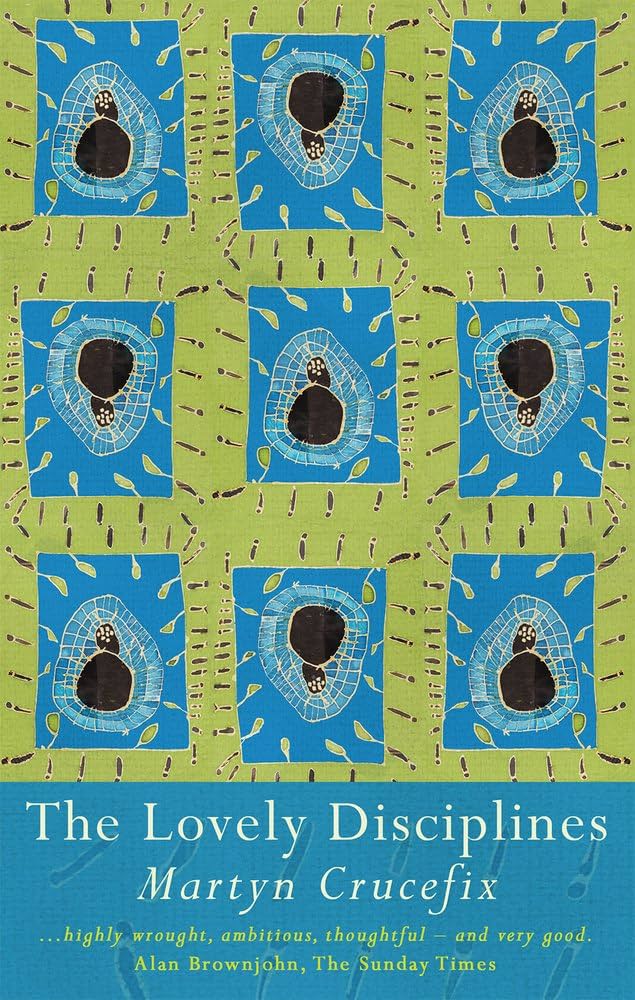
Almost nothing had changed when, years later, my whole family came here for a picnic, perhaps to celebrate my parents wedding anniversary . . .  I remember speaking to a man who lived nearby. He was rebuilding the weir which had fallen into disrepair. Years later again, I wrote a poem about the occasion (later published in my book The Lovely Disciplines (Seren Books, 2017). Called ‘Rebuilding Tellisford weir’, I gave the poem an epigraph from In Pursuit of Spring: ‘turn aside to see Tellisford’. The poem’s opening lines focus on the man’s self-given task, one of both conservation and innovation:

He refuses shade in midday heat

the old man walking

in his honey-brimmed hat

along the drained weir-shelf

x

that looks today like stacked loaves

its pallid smooth ranks

of Victorian stones

mapping precisely the Domesday line

x

where he patrols to and fro

proudly surveying the place he owns

this stretch of England

his plan to restore the workings

x

of the old watermill

to feed the Grid—and it is for this

he has ordered tons of sludge

to be dredged above the drop

x

and dozens of loosened stones

to be replaced to give

the mill-race its full head

and today he walks the slippery length

x

of the dammed weir-shelf

View of Tellisford Weir

For some reason, in my writing of the poem, I wanted to distance my own family’s part in the scene, perhaps because the incident I was recalling was a long while ago. The man hails the picnickers (rather than the other way round, which is I think what happened):

he cries what marvellous weather

x

then falls to conversation with a couple

who are celebrating sixty years

in their self-built house

with their three good boys

x

raised and schooled to distant homes

though today they recline

on trashy garden chairs

on this riverbank as if to watch

x

the old man in an antique yellow hat

who walks noting progress

on the weir

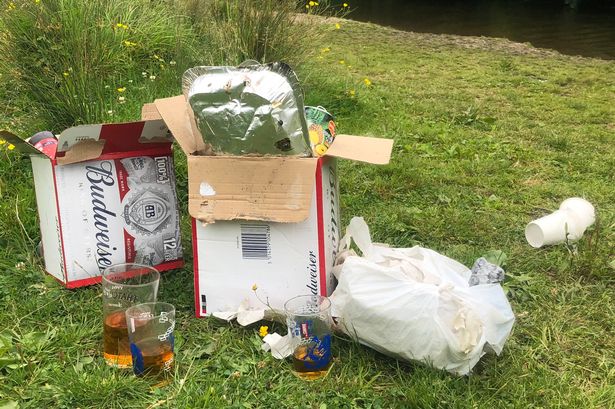
Riverside littering

My own family appear more as careless tourists than anything else. It is the man’s project which gets more attention. And – as the thought develops – it is his own state of mind that seems to interest the poem.

and how could they know

he’s something on his mind

x

for the next hundred years

how could they know more and more

these days he struggles to endure

the roaring of the fish-shoot

x

with its silted water

and these stilted conversations

with such ordinary people

their Diet Coke and egg mayonnaise

x

their crisps for the grandchildren

their Sunday newspapers

let blow and tumble across the meadow

reminding him of himself

x

how his mind often strays

up the ditch-line to the old drovers’ road

where for fifty years

their cars have pinked and purred

x

especially at night as they mount

slowly the gravel verge—

O so many love-cars for so many years

drawn to his father’s land

x

each in pursuit of what the river gives

of moonlight and chance

of the ticking of an engine

as it cools of blonde hair spilling

x

across dark seats in disarray

he knows the windows rolled to the dusk

the sickly smell of water

the murmur within

I rather like the way the poem, by this stage, seems to be moving in and out of various consciousnesses; here the narrative seems to be visiting the minds of the lovers who come to this quiet place for privacy, though the man’s noting of the fact has something of the voyeur about it too. He goes on to imagine – or perhaps he is remembering his own romantic experiences – the ‘talk / when it’s over’:

though he knows well

it is never really over—

and it’s because of this

he will not turn them away

x

although they holler and soil and litter

still he’d grant them every wish

for this his feet edge now across

the weir-shelf this afternoon

x

for this he takes his uneasy stand

hands thrust in his pockets

their cars pulling in to the dark hiss

of white gravel everywhere loosening

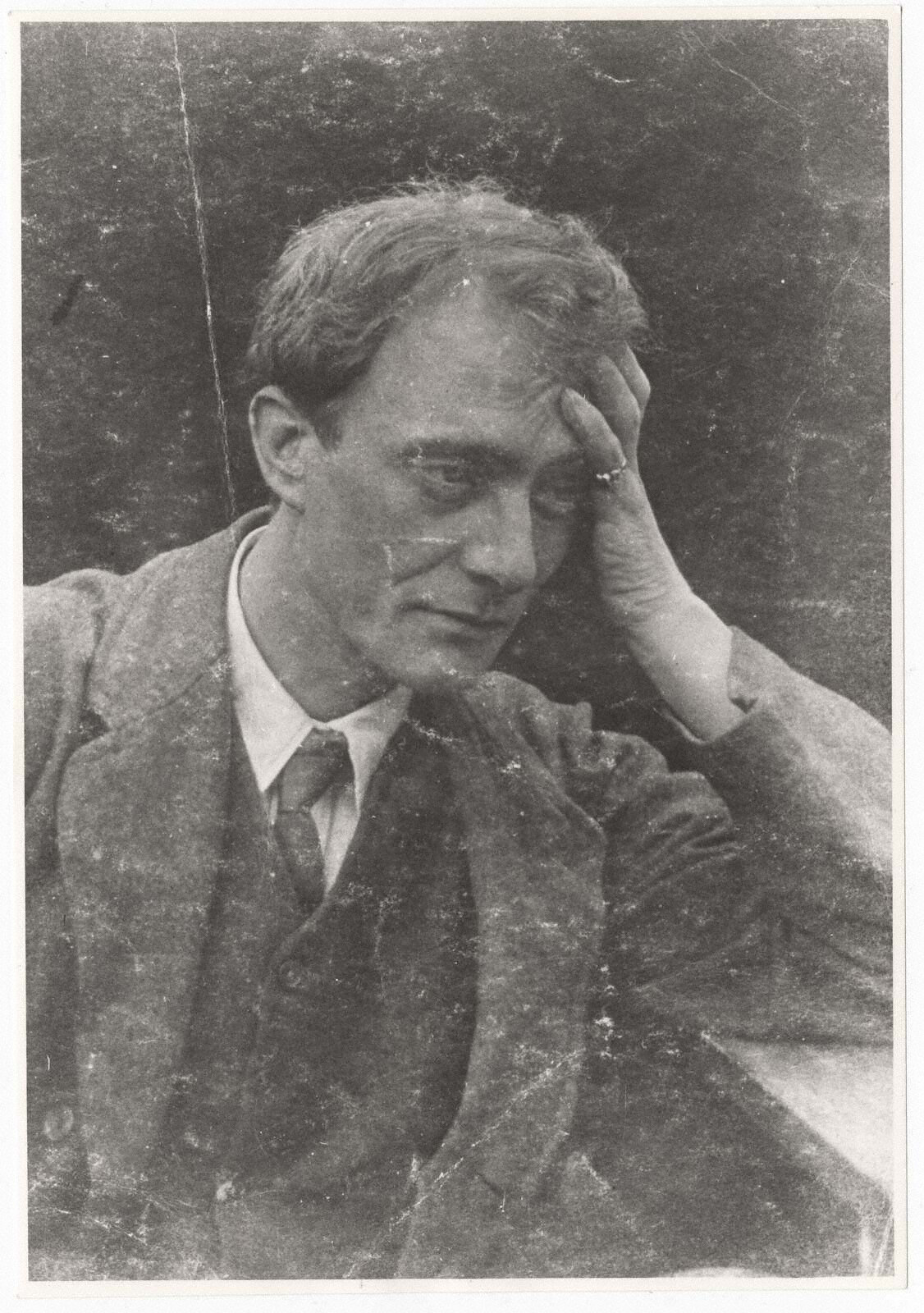
ET looking particularly dejected . . .

The final image – syntactically, the last given reason as to why he allows the lovers, as well as the ill-behaved picnickers, to use the riverside that (in the poem at least) he owns – is intended as an image of transience, of impermanence. It’s this knowledge that really drives him in his conservation project, the rebuilding of the weir, the installation of generators to connect to the Grid. His obsession (which is of course really the author’s, my own) is with the passage of time which brings in change and destruction and against which he builds (as the author builds the poem) something to stand against it, a kind of memorialisation which is also an innovation: ‘the talk / when it’s over though he knows well / it is never really over’. Throughout, I wanted to evoke something of Edward Thomas’s own work, partly through my formal choices. In ‘Gone, gone again’, for example, he views an old house:

Outmoded, dignified,

Dark and untenanted,

With grass growing instead

X

Of the footsteps of life,

The friendliness, the strife;

In its beds have lain

Youth, love, age and pain:

X

I am something like that;

Only I am not dead,

Still breathing and interested’

Buy! New Christmas Poetry Anthology

Click here to buy your copies.

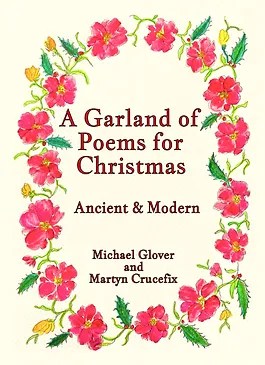
Perhaps it was in response to – really I mean a way of avoiding – the Tory party leadership campaign over the long hot summer of 2022 (and look how that turned out – and then again turned out…) that Michael Glover and I spent much of our time reading for, researching, inviting and selecting poems for a brand new poetry anthology with a focus on Christmas and the winter solstice. I know this is a bit obvious but – hey! – this might well be the solution to your up-coming Christmas gift buying deliberations – elegant, stimulating, moving, clever and very easy to wrap. That’s this new anthology. What’s not to like?

In fact, it was Michael’s original, bright idea and I was delighted to be asked to collaborate with him. It is the first anthology I have had a hand in editing and the book, in its final form, has two main sections – his bit and mine.

I found it daunting at first – where do you begin? Well, I don’t think I’m giving away any anthology-making secrets by mentioning that this Christmas collection is not the first on the market. I had a couple on my shelves already and the internet provides ready-made selections of possibilities and then less familiar collections like Enitharmon’s excellent Light Unlocked: Christmas Card Poems, eds. Kevin Crossley-Holland & Lawrence Sail (Enitharmon Press, 2005) and the rich seams of Seren’s Christmas in Wales, ed. Dewi Lewis (Seren Books, 1997) provoked thoughts and – with due acknowledgement – suggested some definite items. It was exciting when other contemporary poets were kind enough to agree to offer as yet unpublished work for the anthology – my thanks to Neil Curry, John Greening, Jeremy Hooker, Denise Saul, Joan Michelson, Penelope Shuttle and Marvin Thompson.

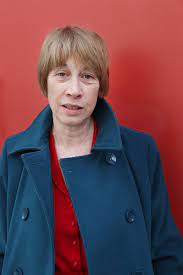
Penny Shuttle

For my own part, I pondered aspects of the ‘Christmas’ experience and came up with four loose categories: Mother and Child, Hearth and Home, Far and Near, Light and Sound.

Mother and Child was a fairly obvious place to start, and I was pleased to discover the 15th century poem ‘I syng of a mayden’ with its traditional take on the Nativity but its archaic and hence distanced and defamiliarized language. In contrast, Kevin Crossley-Holland’s plainly beautiful poem, ‘The Heart-in-Waiting’, revises the nativity story into more figurative terms for a contemporary audience: Christ is destined to be born into the human ‘heart-in-waiting’. WB Yeats’ take on the birth of Christ sees it from a quite different point of view: the pregnant mother’s sense of a divine love that ‘strikes a sudden chill into my bones / And bids my hair stand up’

Click here to buy your copies.

The thought of Hearth and Home, around the time of the winter solstice, was probably a more personal choice, partly a recollection of my own childhood but also of later Christmases with my own two children. In both cases I am lucky enough for these to be happy memories though this section is perhaps also about the great weight of expectation of happiness that the season brings with it. My own background is in West Country – people claim to still hear my old Wiltshire accent sometimes – so William Barnes’ boisterous ‘Chris’mas Invitation’ was a great find:

An’ ev’ry woone shall tell his teale,

An’ ev’ry woone shall zing his zong,

An’ ev’ry woone wull drink his eale

To love an’ frien’ship all night long.

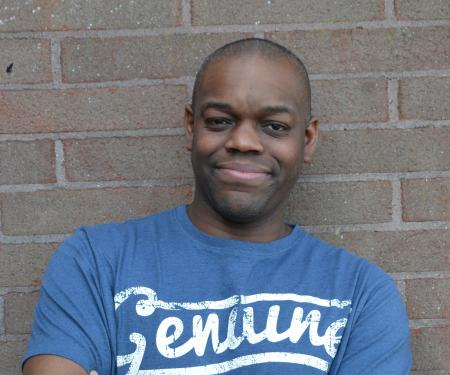
Marvin Thompson

To follow this with Thomas Hardy’s more melancholic ‘The House of Hospitalities’ seemed right – with the latter’s reminiscing of warm logs on the fire, the food and songs of Christmas past, though now (this is Hardy after all) these are little more than ‘forms of old time’. I was very pleased to be able to include Joan Michelson’s touching evocation of Christmas under the 2020 Covid lockdown and Marvin Thompson’s densely allusive poem, ‘That’s the Art Deco Odeon on London’s Holloway Road’ neatly updates the memories of those of us of a certain background and vintage of watching Morecombe and Wise at Christmas with his more recent remembering of the family laughing at Lenny Henry’s character, Deakus.

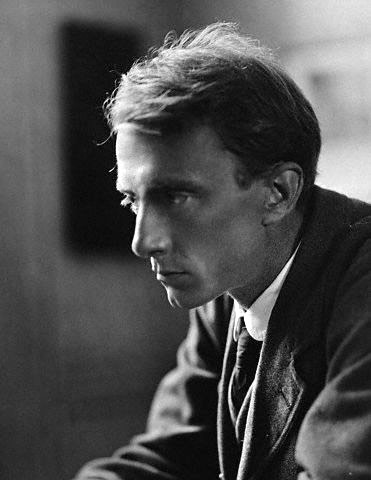
Edward Thomas

The cluster of poems around Far and Near probably sprung out of the previous section – those expectations of the season are not fulfilled for all – loved ones, the rosy-cheeked messages of the time of year or indeed happiness itself may remain at a distance. So Edward Thomas’ gypsy plays ‘Over the hills and far away’ in a darkly troubling and less than traditionally Christian style, as something more ancient, ‘a rascally Bacchanal dance’. Kate Bingham’s, ‘Cento’, cleverly re-deploys phrases so familiar from Christmas hymns and songs and manages to be both questioningly ironic and touchingly empathetic. Beyond the tired commercial and religious cliches, the darkest time of the year, its turning point, makes us think of past and present, but also about other modes of being. Jeremy Hooker’s new poem sequence praises and reflects on the season’s natural world, the blackbird and owl, the snow falling and ‘bringing up / deeper silence / from some place one dreamed of / that was always there’

Francis Kilvert

The carolling, the candles, the Christmas tree lights: the grouping of Light and Sound also seemed to be very appropriate. Everybody, I’m sure, will feel the shock of recognition in John Mole’s brilliant poem about digging out the old Christmas tree lights from last year’s box of decorations: ‘dear tangled friends / With your plaited emerald flex / And familiar chime of chip-chink / Tumbling over my wrist’. The dancing, visionary lights described by the old Wiltshire man, John Bryant (huddled in his bed against the cold ‘like a marmot in its nest’), in a diary entry of 1874 by Francis Kilvert, are, he believes, the souls of ‘just men’. These ‘rhymed’ for me with the chilly stars in Nancy Campbell’s enigmatic new piece, ‘Lights’ as a desire, felt by some people, perhaps more of us in the depths of midwinter, ‘to lose themselves in beauty’. And what better way to end than with Tennyson’s poem from In Memoriam: having fought through grief and loss to come to some more noisily belling, optimistic, celebratory vision for the coming new year:

Ring out a slowly dying cause,

And ancient forms of party strife;

Ring in the nobler modes of life,

With sweeter manners, purer laws.

x

Ring out the want, the care, the sin,

The faithless coldness of the times;

Ring out, ring out my mournful rhymes

But ring the fuller minstrel in.

Click here to buy your copies.

Quickdraw Review of Robert Selby’s ‘The Coming-Down Time’

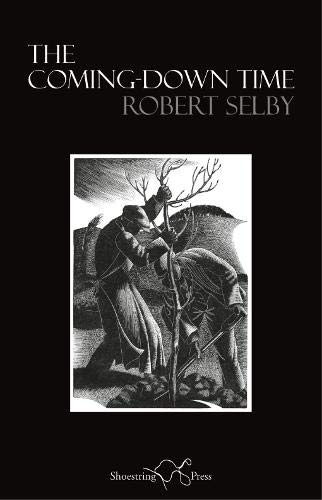
41kqq0VBdRLRobert Selby’s debut collection is fronted by a wood cut engraving by Clare Leighton, titled ‘Planting Trees’. Two flat-capped workmen labour to bed in a sapling. A wind-bent tree stands nearby; on the gusty skyline, at the top of a hill, a dark copse. It’s like something out of a Thomas Hardy poem, or an Edward Thomas one, and it’s well-chosen as these are the forebears The Coming-Down Time often explicitly acknowledges. Launched into a poetry world dominated by so many books addressing environmental, gender, race and identity issues, this collection (depending on your viewpoint) is either timeless or behind the times. Selby’s careful organisation of the poems makes it clear he knows what he’s doing and he will do it his way.
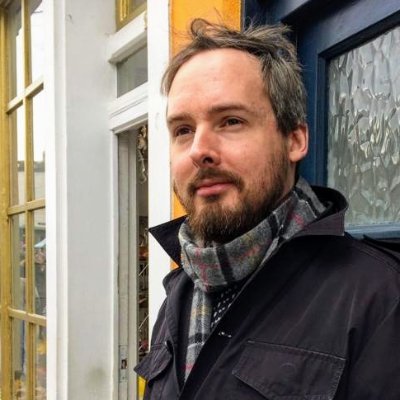
His main subjects are historical time, England and romantic love. The first of three sections, ‘East of Ipswich’, is a tribute to his grandparents, George and Lea Gissing. George “came from a long line of men who worked / now-extinct equine trades”. These are true ‘salt of the earth’ Englishmen. Enquiries as to who they were (questions of identity, we might now say) are answered with confidence, if not belligerence: “We’re Orford men, and that’s enough”. But time passes even on the edges of Suffolk. The concluding lines of ‘The End of the Horse Age’ catch a glimpse of encroaching change in the shape of a tractor:


. . . he sees an unblinkered beast

braying smoke in the top field, light

from its side-lamps shining off makers’ plates

cast from melted down horse brasses.


DyqzOg08_400x400
Robert Selby

If this is sounding like a man’s world, well, it was and Selby rolls with that. In marriage, Lea sheds her given, christian name for Doll and her maiden name also, “was gone”. There is no obvious meta-comment; Selby’s poem is more intent on celebrating the marriage of his grandparents than exploring Lea’s thoughts on these matters of gender and nomenclature. Perhaps they were not questioned at the time, but I’m uneasy at the silence surrounding such moments, given the poem is a contemporary one. Selby has perhaps inherited the “Suffolk reserve” of his grandfather, for whom “words are weeds that don’t fall to the hoe”. The wish not to (over-)dramatize seems very strong; the end of the Second World War is marked by the grandfather in terms of the cigarettes, chocolate and tea cakes at the NAAFI more than its global import.

1etwyvqevewegr269wt7k38kmhfdyp.jpeg.gallery
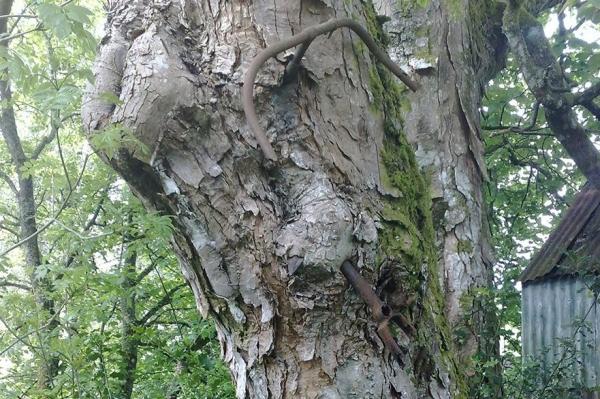
The Brig o’Turk sycamore – handlebars embedded!

Indeed, like Edward Thomas’ work, these are poems about small things. The evocation of the (seldom used) front room at his grandparents’ house is vivid and (for those of us of a certain vintage) very familiar. The sequence takes us to the funerals of the older generation via the understanding that their children (Selby’s father specifically) have already moved away from traditional lives. The father is “one of the suited men / who’ll step off the evening train”. The tone is mostly one of gentle regret at the passing of a way of life (part of which was a closeness to the environment). “How easily people forget things”, opens ‘The Winter Wood’. That same poem ends as a sort of “testament to the losing habit”. The sycamore at Brig o’Turk, in the Trossachs, which has grown around a bicycle once leant against it, is a good image for Selby’s concerns: the past remains but is inevitably absorbed and changed.

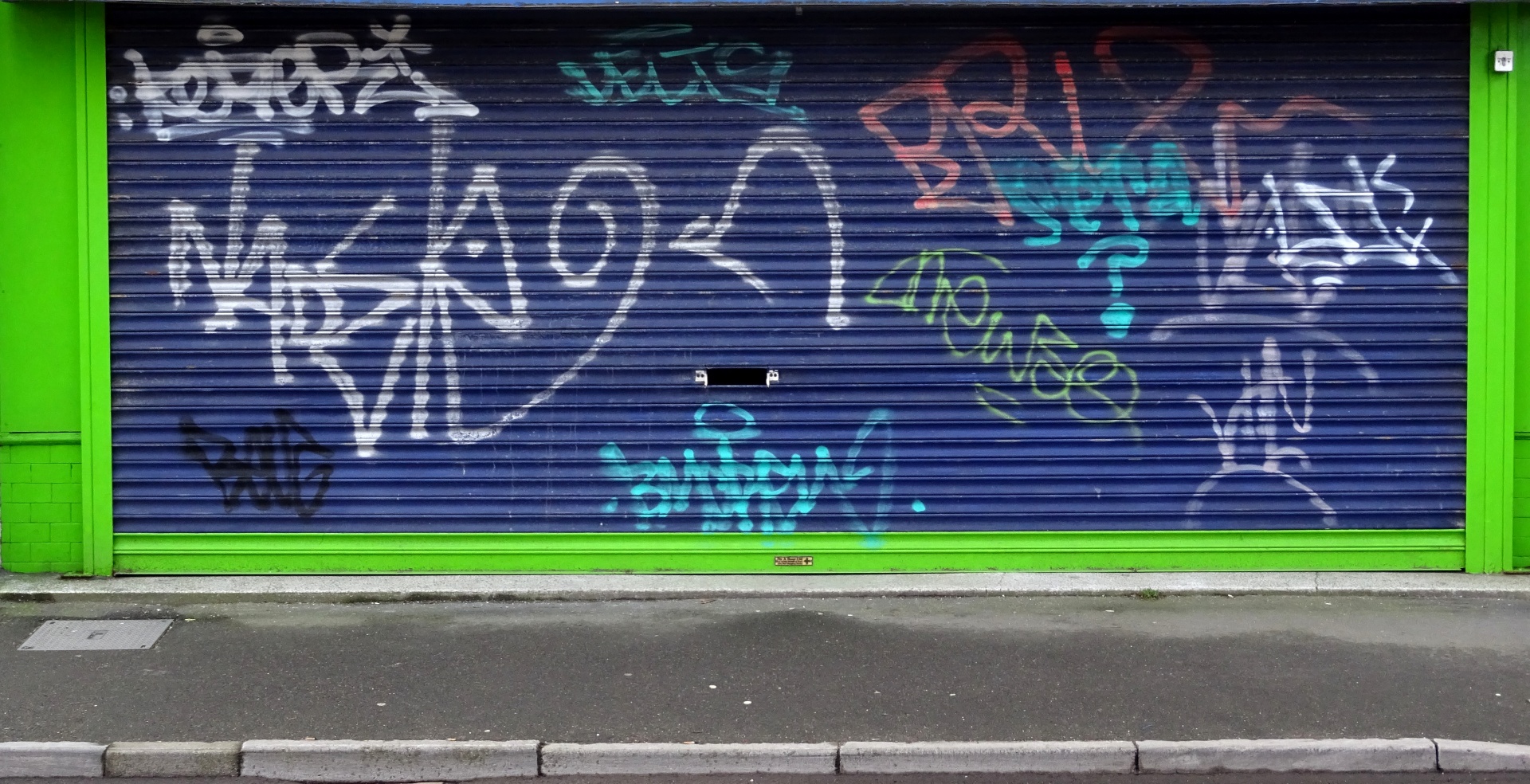
graffiti-on-shop-shuttersSelby’s use of language and form is likewise pretty traditional. It’s not just a result of the subject matter that the book is frequented by words such as smithy, shire, lambkin, deer-stalker, and lush-toned phrases such as “blossom-moted”. The flip side of this is that details of 2020 UK are often treated with a distaste, an alienated distance. Later in the book, a friend returns from the dust and pollen of the English countryside into London: “its tagged shutters and sick-flecked stops, / its scaffolding like the lies / propping up your peeling hopes”. The friend is female and (I think) Canadian. Another poem’s narrator tries to persuade her that “[t]his is the real England [. . .] It’s a place of trees; of apple, pear, cherry and plum”. There is more to be said here about the meaning of ‘real’ and it’s hard to tell if the narrator’s invitation is meant to have a deathly ring to it. He asks, “Do you want to reset your watch to the toll of here?”

brain-compass-e1552934724594The import of this question forms the emotional and dramatic context of the later poems in the collection which trace an on/off relationship. The narrator is left wondering: “I must wait for the needle / of your heart’s compass to unspin, / and see where it stops”. In reading that I’m reminded of Lea and – what seemed to be – her relative lack of choice in the earlier years of the twentieth century. There is a good deal of unalloyed nostalgia in The Coming-Down Time for an England of the mind, if it was ever part of any actual century. I find the female figures in the book suffer because of this: most of them do not achieve a specific, particular life in the poems. I’d like Selby to go on to explore the irony in two images: the masculine arms in “rolled up sleeves” that may or may not be “strong enough” and the closing lines just quoted, in which the desired woman bides her time, knowingly possessed of strength, of the agency of decision.

Judging Poetry Competitions: some notes on the process

I am half way through the process of judging this year’s Segora Poetry Competition. I’ve been lucky enough to judge several such competitions in recent years and in 2015 I published a version of what follows on my blog as a compilation of my thoughts on the judging process. I’m tweaking and re-blogging it here in response to my experience of judging this new competition in 2020. As I have always found, the initial sifting of so many poems can be a slog, but the latter stages are unfailingly fascinating as the best poems – those that set little hooks in you from first reading – gradually rise to the top, their internal coherence emerging, alongside their skills with language, tone and form. So what follows is inevitably a personal take on the business – becoming more so, perhaps, as the process unfolds – but I hope it may cast some light on it for those (of us) tempted to spend hard-earned cash on entering the numerous competitions now running. Follow this link to see more upcoming competitions.

MV5BNzMyZDhiZDUtYWUyMi00ZDQxLWE4NDQtMWFlMjI1YjVjMjZiXkEyXkFqcGdeQXVyNjU0OTQ0OTY@._V1_UX182_CR0,0,182,268_AL_Some films stick in the mind for reasons beyond the cinematic, don’t they? In the 2003 comedy Bruce Almighty, Jim Carey plays the character of God and, along with more obviously useful powers, he has to respond to the prayers of the world. But people are always praying! He rapidly approaches a kind of madness as voices swim around him, clamouring for attention. He takes to reading the prayers in the form of e-mails. He tries to answer them individually but is receiving them faster than he can possibly respond. He decides to set his e-mail account to automatically answer “yes” to all, assuming that this will make everybody happy. Of course, it does not.
Now – a poetry competition judge comparing himself to a character playing God lays him/herself open to some obvious criticism – but I have indeed found the initial phases of judging poetry competitions rather like Jim Carey’s experience. There are so many and such a variety of voices clamouring to be heard and every one of them is heart-felt, recording significant moments in people’s lives. There is a similar sense of responsibility too – the raw nature of much of the writing submitted is impossible to deny. There are moments when I’d like to set my response mechanism to say ‘yes’ to everybody, but the judge’s task has to be how to distinguish submissions as poetry.

What does that mean? The numbers involved are always a bit daunting. Many hundreds of poems have been submitted. Perhaps only 10% of these will demand a further reading after the brutal first sifting. Poems face an early, red stoplight from most judges because the basic poetic elements are not competently done. Here are some of the obvious failings:

  • Competitions are full of pieces where a particular verse form or rhyme pattern tyrannises the sentiment and/or sense. The writer’s submission to this tyranny becomes clear quickly through the contortions imposed on the language to achieve a rhyme.
  • The writer’s choice of language can be devastating to the life of the poem. It just isn’t right to opt for forms of language or abbreviations that died out early in the nineteenth century. Thankfully, this problem seems to be fading as more and more people actually read contemporary poetry books.
  • Choice of diction can also derail an entry if it is doggedly abstract. Sure, there remains much debate about whether it is the narrow English tradition that insists on things rather than ideas – but poems about Fear, Ignorance, Poverty, Eternity and Love which refuse to dip a toe into anything resembling a real life situation are going to find progress hard.
  • A fourth error is using language without being fully conscious of its likely resonance with a reader. A poem using the verb ‘gaslight’ without knowing its current slang meaning or another called ‘Mother’s Pride’ which seems unaware of the loaf of bread, well, they are going to have unanticipated clutter to climb over in any reader’s mind. Louis MacNeice wanted the poet not to be an ivory tower type, but rather “able-bodied, fond of talking, a reader of the newspapers, capable of pity and laughter, informed in economics . . . actively interested in politics”. All a bit Boys Own perhaps, but if this means the poet stays bang up to date with the way words live then he’s right.

download
Rainer Maria Rilke

If you are still thinking of submitting to a competition, it’s worth recalling Wordsworth’s formulation – familiar though it will feel to most – that poetry is built from “emotion recollected in tranquillity”. Poems forged in the heat of the moment (and not revised or reviewed) are seldom without their flaws. And this is the kind of distinction Rainer Maria Rilke makes when he denies poetry is composed of feelings. Its constituents (he says) are rather “experiences” which he clarifies as “memories” though even with these, we “must be able to forget them when they are many and one must have the immense patience to wait until they come again . . . Only when they have turned to blood within us, to glance and gesture, nameless and no longer distinguished from ourselves – only then can it happen that in a most rare hour the first word of a poem arises in their midst and goes forth from them”. On the other hand, such recollection can sometimes create an intellectualised distance that may do harm to a good poem. Who said writing a poem was easy?

41Stephen1books
Stephen Spender

Stephen Spender argued that a poet should try to acquire skill and virtuosity through the study and interpretation of other poetic works in the way Mozart and Beethoven did in playing the music of their predecessors. Spender suggests translating poetry is the best possible exercise in interpretation. But the really important lessons (Spender says) are those of the eye, the ear, the athletic/poetic muscles. A poet can go a long way without a developed heart, but, he says, can get nowhere at all without these skills. The poet must ask continually of his lines: ‘Do they make the reader see, or hear, or feel, this experience which I am trying to re-create?’

Reaching the final stages, the judge will be focusing more on positives and hence more precisely on the sense, the story, the thought and feeling of a poem. Personally, I like poems that focus on small things and, in effect, make arguments for the ways in which they communicate the bigger issues that concern us all. I’m with Thomas Hardy in believing that “he used to notice such things” is one of the greatest of compliments. Edward Thomas’ poem about Spring, ‘But these things also’, likewise echoes this focus on what most people tend to overlook:

The shell of a little snail bleached
In the grass; chip of flint, and mite
Of chalk; and the small birds’ dung
In splashes of purest white . . .

download (1)Perhaps one explanation of why the question ‘what is poetry?’ is so difficult to answer is because it is, to a large extent, an art of the negative, of avoidance. The Daodejing says what is rigid and inflexible is a companion of death; what is flexible is a companion of life. I’d guess there would be general agreement that poetry is an art on the side of life. So poetry must eschew the inflexible; we must avoid the posture. And that’s very hard. In judging a competition, one comes across the Wordsworth-posture, the Ginsberg-posture, alongside those of Hughes, Plath, Duffy, Oswald . . . But we also posture like mad in ‘real life’. We may take up the pose of grief, melancholy, love, liberalism, environmentalism . . . For me, the mark of the absence of posturing is an instability, an openness, an awareness of time (which posture tries to deny) and this is something I look for in a good poem. If a poem strikes an attitude my attention diminishes (even if the attitude is one that wants to show a rejection of attitudinising through the hall of mirrors of ironic distancing). When the poem unearths a pulsing, shifting, live relationship between the self and the other, then I am captivated, recognising something that is both commonly human and uniquely personal.

4756
Philip Pullman

But having said all this, I’d assure potential competition entrants that anything resembling a rule is there to be broken. Philip Pullman has said, “We don’t need a list of rights and wrongs, tables of dos and don’ts: we need books, time, and silence. Thou shalt not is soon forgotten, but Once upon a time lasts forever.” So any poem in any form can work its magic. It will haunt its reader for days; it will make me change the way I think and feel; make me see the world differently. Ultimately, a poem contributes to who the reader is becoming. That is an exciting prospect for the writer. It is an even more exciting one for the judge who settles down to read.

Looking Beyond Paralysis

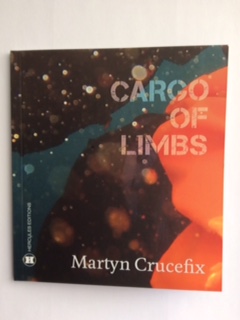
Featured Image -- 14962In lieu of a new blog post, here is a link to the Hercules Editions webpage on which I have formulated a few thoughts about the current lockdown, photography and the (forgotten?) refugee crisis in the Mediterranean. It is a piece in part related to the Hercules publication of my longer poem, Cargo of Limbs.
To read ‘Looking Beyond Paralysis’ go to : https://www.herculeseditions.com/post/looking-beyond-paralysis-by-martyn-crucefix


Everything Moving: Tamar Yoseloff’s ‘The Black Place’

Last week I attended the launch of Tamar Yoseloff’s new collection, published by Seren Books. Tammy and I have known each other for a long while, are both published by Seren and, in her role at Hercules Editions, she has just published my own recent chapbook, Cargo of Limbs. So – in the small world of British poetry – I’m hardly an unconnected critic, but I have the benefit of having followed her work over the years, reviewing her most recent New and Selected, A Formula for Night (2015) here.

In an earlier blog post, I spoke – in rather tabloid-y terms – of the tension in Yoseloff’s poems between the “sassy and the sepulchral”. In 2007’s Fetch (Salt), there were “racy, blunt narratives” which in their exploration of female freedom, restraint and taboo made for vivid, exciting reading. The other side of her gift inclines to an “apocalyptic darkness”, a preoccupation with time, loss, the inability to hold the moment. In A Formula for Night, the poem ‘Ruin’ invented a form in which a text was gradually shot to pieces as phrases, even letters, were gradually edited out, displaying the very process of ruination. Interestingly, The Black Place develops this technique in 3 ‘redaction’ poems in which most of a text has been blacked out (cut out – see Yoko Ono later), leaving only a few telling words. A note indicates the source text in all three cases was the booklet Understanding Kidney Cancer and the author’s recent experience of illness is an important element in this new collection.

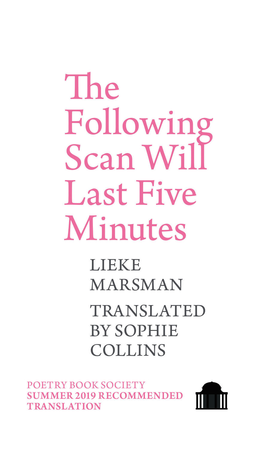
But unlike, for example, Lieke Marsman’s recent The Following Scan Will Last Five Minutes (Pavilion Poetry, 2019 – discussed here), Yoseloff’s book is not dominated by the experience of illness (and one feels this is a deliberated choice). The book opens with ‘The C Word’ which considers the phonetic parts of the word ‘cancer’, as well as its appearance: “looks like carer but isn’t”. But – within its 12 lines – Yoseloff also considers the other C word, “detonated in hate / murmured in love”. The poem is really about how an individual can contain such divergent elements, “sites of birth / and death”. So unanticipated personal experience is here being filtered through the matrix of this writer’s naturally ambivalent gift.

Illness re-emerges explicitly later in the collection, but for much of it there is a business as usual quality and I, for one, am inclined to admire this:

I refuse the confessional splurge,

the Facebook post, the hospital selfie.

I’m just another body, a statistic,

nothing special. Everyone dies –

get over yourself.

So Yoseloff gives us a marvellous send-up of Edward Thomas’ ‘Adlestrop’ in ‘Sheeple’, a central place on the darker side of Yoseloff-country: “The heartland. Lower Slaughter”. There is urbanite humour in ‘Holiday Cottage’ with its “stygian kitchen”, bad weather, boredom and kitsch:

We stare at the knock-off Hay Wain

hung crooked over the hearth

and dream of England: the shire bells,

the box set, the M&S biscuit tin

‘The Wayfarer’ is one of many ekphrastic poems here – this one based on a Bosch painting – but the “sunless land” is patently an England on which “God looked down / and spat”. These are poems written in the last 3 years or so and, inevitably, Brexit impinges, most obviously in ‘Islanders’ (“We put seas between ourselves, / we won’t be rescued”) but the cityscape equally offers little in the way of hope. There is a caricaturing quality to the life lived there: everything “pixilates, disneyfies” (‘Emoji’) and gender relationships seem warped by inequitable power, by self-destructive urges and illness: “I’d super-shrink my dimensions, / wasting is a form of perfection” (‘Walk All Over Me’).

Perhaps ‘Girl’ shows us the figure of a survivor in such a hostile environment, her energy reflecting those female figures in Fetch – “a slip, a trick, a single polka dot” – but the darkness seems thicker now, the lack of lyricism, the impossibility of a happy ending more resolved:

She’s good for nothing because nothing’s

good: sirens drown out violins

and crows swoop to carnage in the street.

As the blurb says, the book boldly eschews the sentimental sop, the capitalist hype, for truths that are hard, not to say brutal. ‘Little Black Dress’ takes both the archetypal ‘girl’ and the author herself from teen years to widowhood in a dizzyingly rapid sonnet-length poem:

drunk and disorderly, dropping off bar stools one

by one, until the time arrives for widow’s weeds

and weeping veils, Ray-Bans darkening the sun.

And it is – unsurprisingly – mortality (the sepulchral) that eventually comes to the fore. A notable absence is the author’s mother, who has often been a powerful presence in previous books. Here she re-appears briefly in ‘Jade’. The stone is reputed to be efficacious in curing ailments of the kidneys and a jade necklace inherited from Yoseloff’s mother leads her to wonder about the inheritance of disease too: “a slow / release in her body, passed down, // down”. Both parents put in a fleeting appearance in the powerful sequence ‘Darklight’, the third part of which opens with the narrator standing in a pool of streetlight, “holding the dark / at bay”. She supposes, rather hopelessly, that “this must be what it’s like to have a god”. Not an option available to her; the dark holds monsters both within and without and not just for the child:

                                                Back then

my parents would sing me to sleep;

now they’re ash and bone. Our lives are brief

like the banks of candles in cathedrals,

each a flame for someone loved;

It’s these thoughts that further the careful structuring of this collection and return it to the experience of a life-threatening illness. ‘Nephritic Sonnet’ is an interrupted or cut off – 13 line – sonnet that takes us to the hospital ward, the I.V. tubes and – as she once said of the city – the poet finds “no poetry in the hospital gown”. Except, of course, that’s exactly what we get. The determination or need to write about even the bleakest of experiences is the defiant light being held up. Yoseloff does not rage; her style is quieter and involves a steady, undeceived gaze and also – in the sequence ‘Cuts’ – the powerful sense that (as quoted above) “I’m just another body, a statistic, / nothing special. Everyone dies”.

It’s this sense of being “nothing special” that enables ‘Cuts’ dispassionately to record very personal experiences of hospital procedures alongside the contemporaneous facts of the Grenfell Tower fire and (another ekphrastic element) a 1960s performance piece by Yoko Ono called ‘Cut Piece’. These elements are ‘leaned’ against each other in a series of 13 dismembered sonnets, each broken up into sections of 6/3/4/1 lines. The fragmentary, diaristic style works well though there are risks in equating personal illness with the catastrophic accident and vital political questions surrounding Grenfell. Ono’s performance piece offers a further example of victimhood, one more chosen and controllable perhaps. What’s impressive is how Yoseloff avoids the magnetic pull of the ego, displaying – if anything – a salutary empathy for others in the midst of her own fears.

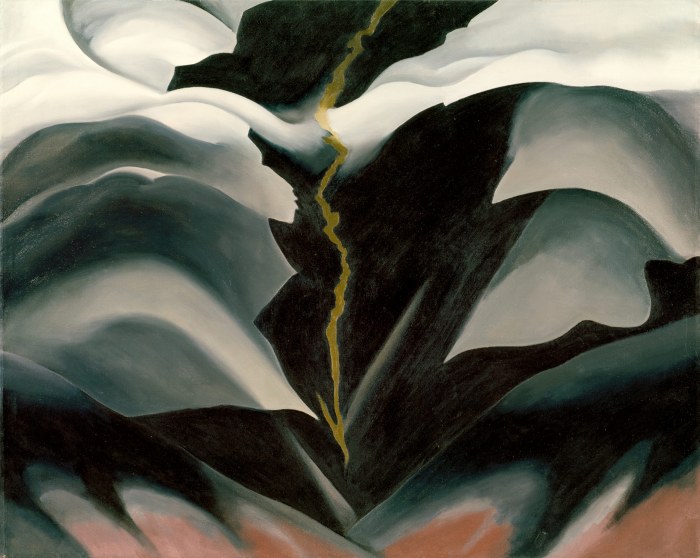
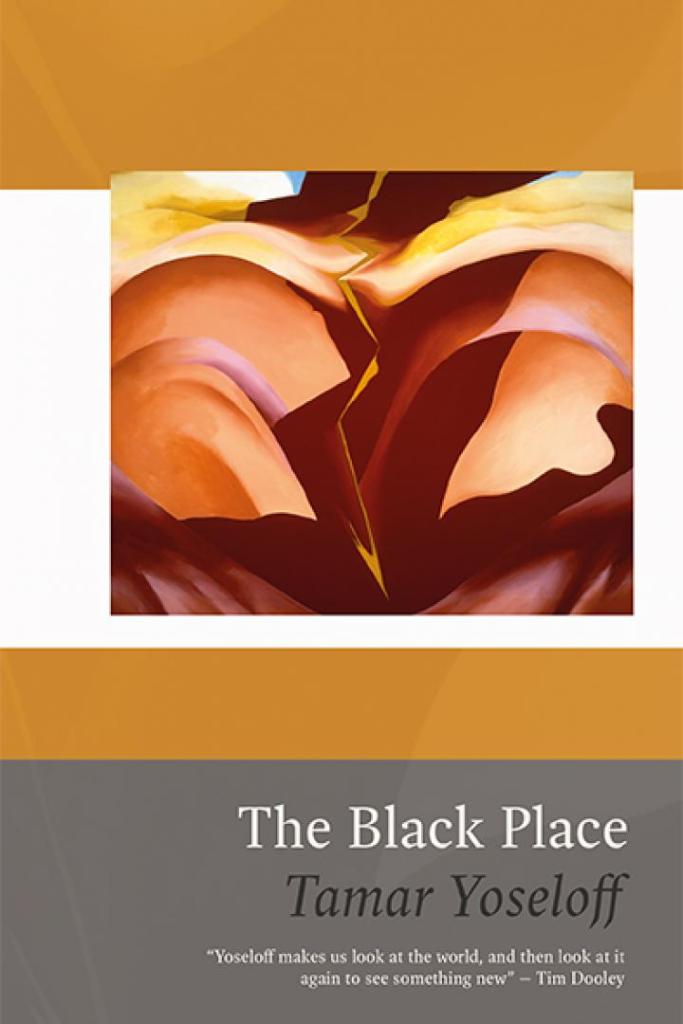
The book is titled after a Georgia O’Keefe picture, reproduced on the cover. O’Keefe’s steady gaze into the darkness created by the jagged relief of the Navajo country is something to which Yoseloff aspires, though it “chills me / just to think it into being”. It is the ultimate reality – a nothing, le néant – though like the ultimate presence of other writers (Yves Bonnefoy’s le presence, for example), can at best only be gestured towards:

We’ll never find it; as soon as we arrive,

the distance shifts to somewhere else,

we remain in foreground, everything moving

around us, even when we’re still.

Along such a difficult path, Yoseloff insists, O’Keefe’s art found “the bellow in a skull, / the swagger in a flower”. And, even in the most frightening brush with her own mortality, the poet will follow and does so in a way that is consistent with her own nature and work over many years.

A Robert Frost Primer or ‘All Life is Cellular’

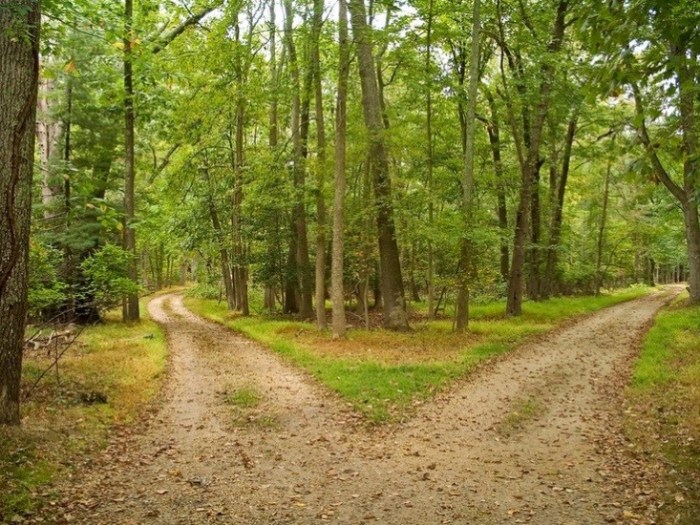
A few weeks back, I was asked to contribute to an afternoon event in Palmers Green Library, north London, with the title – from Robert Frost’s poem – ‘The Road Not Taken’. It was introduced by Maggie Butt, with readings of their own poetry around the theme by Mark Holihan and Denise Saul. I was also asked to deliver a few thoughts on the work of Robert Frost. What follows is an edited transcript of what I said then and I think of it as a basic introduction for the general reader to Frost’s work and some of the ideas which I see recurring in it. As previous posts have mentioned, I’ve been teaching Frost for a few years recently – thanks to all those students who made me go back and read the poems again!

Despite the apparent simplicity of many of his poems, the real identity of Robert Frost (1874-1963) is hard to pin down. Though raised in late 19th century America, his first book was published in England. Though on the brink of the Modern, a year before the First World War, these poems used plain language and traditional forms. He loved Europe, befriending Edward Thomas – stirring him from prose into poetry – yet Frost sailed back to the US, to farming, north of Boston. By all accounts he was never a very successful farmer, though he often presented himself as talking downright farmer-like common sense. Some find his work consolatory; but he was famously called a ‘terrifying’ poet, a bleak Modernist.

If all this sounds slippery, then Frost took it into his poetics too. He said that, while writing a poem, he was conscious of saying two things at once. But he always wanted to say the first thing so well that any reader who liked that part of the poem might feel able to rest there. Yet, he implies, for those interested in going further, beyond the particular, overt or explicit meaning – say, two farmers re-building a wall between their properties, a man stopping to watch snow fall in a wood, a mower and a butterfly – there is always an ulterior meaning (at least one) that might also be opened up.

At all levels, such defining walls, barriers and boundaries – physical, mental, spiritual – proliferate in Frost’s work. But his view of them is complex. These walls are often porous. But sometimes they can seem impenetrable. I can’t vouch for the accuracy of his biological knowledge, but here is something else Frost repeatedly jotted down in his Notebooks: “All life is cellular. No living particle of matter however small has yet been found without a skin – without a wall.”

On one side, these secure boundaries seem necessary for a successful life – like the wall round all cellular organisms. He would say: “I want to be a person. And I want you to be a person”. But the dangers are obvious. The cellular wall of identity becomes more than a means of self-definition and grows to become an exclusion zone, a solitary place, a state of solipsism. Many of Frost’s figures and narrators are found to be struggling with this state. Yet Frost’s comments about identity, wanting to be a person, wanting you to be a person, in fact continue: “then we can be as interpersonal as you please. We can pull each other’s noses – do all sorts of things”.

So the presence of these cellular walls do not necessarily hold us back. They are as often porous or permeable. Yet they seem also to offer a firm foundation from which we may reach out, we can humanly interact. We can pull each other’s noses. And there is indeed much pulling of noses in Frost’s poems. In particular, he liked to pull the nose of the person he chose to narrate many of his poems. There is very often an irony at work against the speaker. His poems are often more dramatic than lyric.

We might ask why is Frost so concerned about being a person, about the relative security of identity? Because, in other moods, he knows the dangers posed by the absence of any functioning cellular membrane: the leaking out of personality into the surrounding world, of identity dissipating to become nothing, the risk – as it were – of personal extinction.

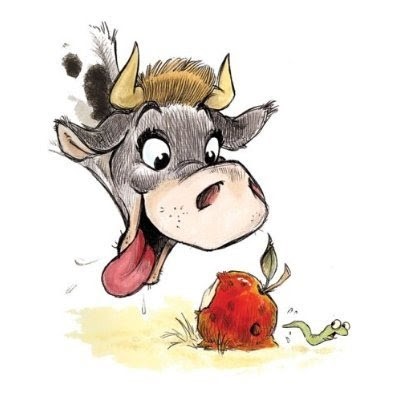
There is a little poem called ‘The Cow in Apple Time’ which (on the face of it) is about a cow who is driven by an unspecified desire to disregard the walls about her pasture. The wall is no more than an open gate to her. She charges through and greedily eats fallen apples, growing intoxicated, her face splattered with apple juice. But in this kind of gluttonous state she grows sick, in pain:

She bellows on a knoll against the sky.

Her udder shrivels and the milk goes dry.

It’s a perfectly satisfying poem about a rural incident – perhaps Farmer Frost, had once witnessed it himself. But there is Frost’s ulteriority too. The cow is consistently described using terms which anthropomorphise her. The wall breaker is perhaps on one level really human, a rebel, a sinner – written in 1914, some have even suggested the cow is an invasive force. However we see her, she is punished for her disregard of, her undervaluing of, those walls and boundaries which perhaps ought to serve to define her life.

Remember this is the same Robert Frost who disparaged the writing of free verse, by many of his more obviously Modernist contemporaries, as trying to play tennis with the net down. The same Robert Frost who disparaged the, then fashionable, interest in Surrealism with its wild leaps over convention, its dislocation of the senses, the shock value of the illogical. For Frost such practices could lead only “to undirected associations and kicking ourselves from one chance suggestion to another in all directions as of a hot afternoon in the life of a grasshopper”.

The cow with the aching stomach is paralleled by a dying peach tree in ‘There Are Roughly Zones’. The narrator has moved “far north” and has transplanted a peach tree and now the northern winter is threatening it. He sits indoors and frets about it, trying to blame the weather rather than himself. But self-criticism arises all the same and it is human “ambition” that gets the blame, that “limitless trait in the hearts of men”. More precisely:

[. . .] though there is no fixed line between right and wrong,

There are roughly zones whose laws must be obeyed.

I love the messy pragmatism implied by “roughly zones”. One of his recurring concerns, Frost said, was with “the impossibility of drawing sharp lines and making exact distinctions” – no red lines, lines in the sand, defined boundaries, but zones of negotiation, places calling for compromise, no fundamental clarity, rather a feeling-out, a region requiring a dialogue.

As in a poem like ‘The Tuft of Flowers’. A man comes to a mown field to turn the cut grass, the hay, to help its drying. He looks about for the man who had earlier mowed the grass:

But he had gone his way, the grass all mown,

And I must be, as he had been, – alone,

‘As all must be,’ I said within my heart

The hermetically cellular, or as we would now say, atomised nature of society seems to be assumed by the narrator. It looks like there is going to be no breaking of boundaries here. But a “[be]wildered” butterfly passes him, looking for flowers that grew there yesterday, now cut down. The butterfly leads him to a “leaping tongue of bloom” left deliberately, out of “sheer morning gladness” by the mower. The narrator hears the message from this “tongue of bloom” which speaks of each man as a “spirit kindred” to the other. It’s as if they now enter into a dialogue, revising the earlier solipsistic observation. Now:

‘Men work together,’ I told him from the heart,

‘Whether they work together or apart.’

There is a rosy-edged hint of sentimentality here perhaps. But the fanciful dialogue between the two men (who actually never meet) represents a successful negotiation into that rough zone between individuals, the cellular membrane is actually permeable, and the result here is consolatory.

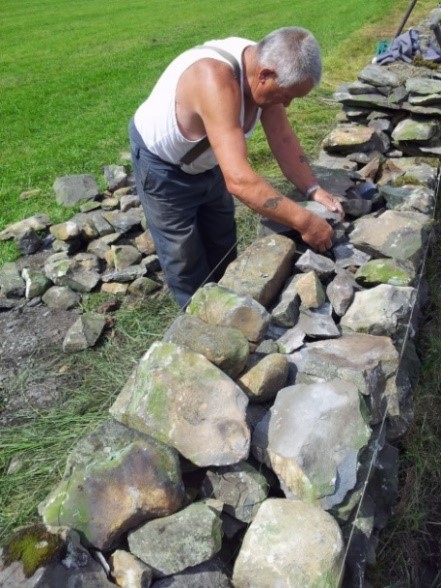
In ‘Mending Wall’, two farmers meet to patrol on either side of a dry-stone wall marking the boundary between their farms. Parts of it are always falling down. They build it back up. But the paradox is that the action of building up what separates them, brings them together each year to perform the task. The wall does not prevent or act as a brake on their relationship – rather it facilitates it – it perhaps is their relationship, what links them. From their respective sides – from their respective identities or persons – they are free to become ‘interpersonal’. But the mischievous, sceptical, modern-minded narrator expresses doubts about the importance of walls, particularly when “He is all pine and I am apple orchard”. His neighbour is a more traditional, unquestioning man, who likes to repeat his father’s advice: “Good fences make good neighbours”. The narrator mocks him (though in silence, in his head) as “an old-stone savage”, lost in actual and intellectual “darkness”. But it is significant that the wall-believer has the last word. For me, it is the moderniser is the one being ironised. If he was a versifier, he’d be trying to write poems with the net down.

Why Frost’s concern with the importance of walls? Because – in still other moods – he has looked into the abyss of experience without them. One example is given in the 16 terrifying lines of ‘Desert Places’. The narrator here seems to have taken the more modern, sceptical wall-mender’s view to heart. It seems there are no bounds here – all have vanished under “Snow falling and night falling fast oh fast”. That note of fear there adds to the nightmare feeling and when the outward-looking eye turns to look within – to find himself – he finds nothing: “I am too absent-spirited to count”. That phrase is an echo of ‘absent-minded’. There is a vacancy within and without – no mind, spirit, self, identity. There is only the concluding, devastating rhymes of “empty spaces . . . where no human race is . . . my own desert places”.  

And if ‘Desert Places’ evokes the desolation of a world viewed in the absence of a relatively secure cell-walled self, then ‘The Most of It’ shows us the horrifying effects of being walled in. In this poem, the narrator “thought he kept the universe alone”. There seems nothing else but him, only a “mocking echo of his own [voice]”. Yet he does remotely feel a desire for dialogue – perhaps just in being human – and does express a desire not for “copy speech. / But counter-love, original response”. But when the universe does eventually break into his consciousness, it arrives not in the form of dialogue or a negotiated relationship but as an utterly alien thing.

It emerges only as a strange, vague “embodiment” that “crashed” and “splashed” towards him and is recognised only by means of a simile. Perhaps it is an elk.

As a great buck it powerfully appeared,

Pushing the crumpled water up ahead,

And landed pouring like a waterfall,

And stumbled through the rocks with horny tread,

And forced the underbrush—and that was all.

There, Frost captures the egoist’s struggle to comprehend what is other than him; followed by the arrogance of his dismissal of it. And perhaps this is a particularly masculine thing. Yet there is no need to attribute these feelings to Frost himself. The speaker is best read as a dramatic representation of one extreme of Frost’s concern for borders and boundaries that are vital for our own selfhood yet must be porous enough to allow for knowledge and experience.

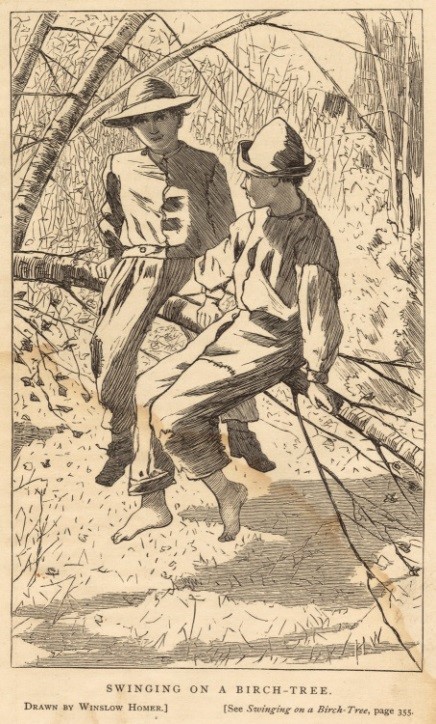
So in ‘Birches’ the narrator remembers – as a boy – climbing slender birch trees, to the top, only to leap out and bend them down with his weight. This swinging of birches can be seen – ulteriorly – as representing Frost’s belief in those negotiated rough zones of a life. We climb up, out of our element, but not too far:

It’s when I’m weary of considerations,
And life is too much like a pathless wood
Where your face burns and tickles with the cobwebs                                   
Broken across it, and one eye is weeping
From a twig’s having lashed across it open.
I’d like to get away from earth awhile
And then come back to it and begin over.
May no fate wilfully misunderstand me                                                              
And half grant what I wish and snatch me away
Not to return. Earth’s the right place for love:
I don’t know where it’s likely to go better.

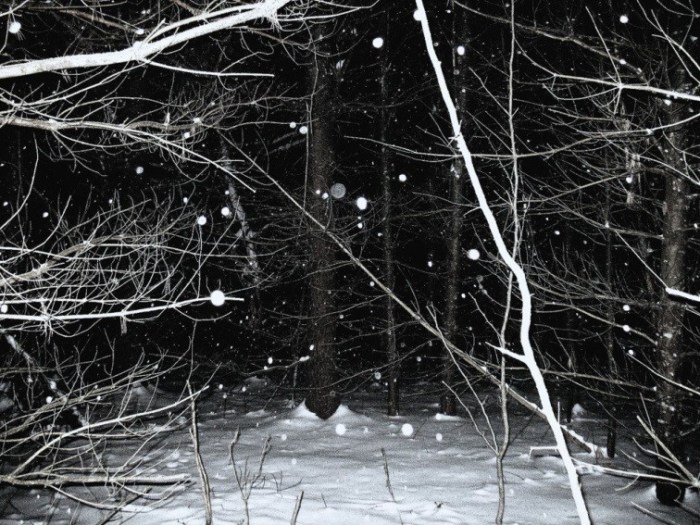
And if we find this frustratingly ambivalent – Frost sitting carefully on the fence – then he often rubs our noses in it. ‘Stopping by Woods on a Snowy Evening’ famously concludes with two lines which are identical. For me, the repetition introduces greater ambiguity into the moment. Does the narrator stop, perhaps to die, entranced by the snowfall? Or does he shake himself up, turn back to his life in the village, his roles and responsibilities?

Whose woods these are I think I know.
His house is in the village, though; 
He will not see me stopping here
To watch his woods fill up with snow.

My little horse must think it queer                                           
To stop without a farmhouse near
Between the woods and frozen lake
The darkest evening of the year.

He gives his harness bells a shake
To ask if there is some mistake.                                                
The only other sound’s the sweep
Of easy wind and downy flake.

The woods are lovely, dark, and deep,
But I have promises to keep,
And miles to go before I sleep,                                                    
And miles to go before I sleep. 

Frost throws the question back to the reader. What Frost knows is that we do not keep the universe alone. We are parts of a whole – but the borderlands are uncertain – sometimes we cross them and lose touch with ourselves, at other times we too easily accept them and fall into egotistical isolation. There maybe be a happy medium – but Frost’s dynamic poems suggest the truth is we can never find and hold to that; we are always involved in the complicated fraught business of negotiation, of swinging birches, of chasing butterflies, of building walls that will promptly fall down again.