2018 Forward First Collections Reviewed #2 – Phoebe Power

This is the second in the series of reviews I am posting over the next two months of the 5 collections chosen for the 2018 Forward Prizes Felix Dennis award for best First Collection. The £5000 prize will be decided on 18th September 2018. Click on this link to access all 5 of my reviews of the 2017 shortlisted books (eventual winner Ocean Vuong), here for my reviews of the 2016 shortlisted books (eventual winner Tiphanie Yanique), here for my reviews of the 2015 shortlisted books (eventual winner Mona Arshi).

The full 2018 shortlist is:

Kaveh Akbar – Calling a Wolf a Wolf (Penguin UK)
Abigail Parry – Jinx (Bloodaxe Books) – click here for my review of this book.
Phoebe Power – Shrines of Upper Austria (Carcanet)
Shivanee Ramlochan – Everyone Knows I Am a Haunting (Peepal Tree Press)
Richard Scott – Soho (Faber & Faber)
Latest_Power_Cover_grande

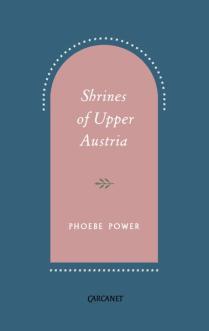
Its publisher, Carcanet, describes Phoebe Power’s debut collection like this: “Wandering in central Europe, a traveller observes and records a landscape”. I guess this is meant to conjure the rootlessness and identity-angst of a modern Euro-existentialist but, for me, Shrines of Upper Austria, too often reads like the jottings of a year-abroad student. The posture is almost always of the naif – impressed, even a bit bewildered by the strangeness she finds, yet she tries hard to absorb and/or be absorbed into the foreign culture yet manages little more than a tourist’s view (if one with a striking ability to ventriloquise and a remote familial backstory in that country).
mGBPfqK
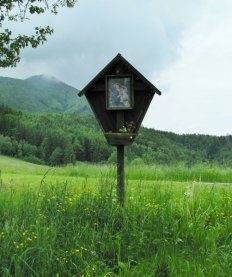
An Austrian shrine

Power raises the humble note or jotting to an ars poetica, often collaging together such “brief records of points, usually used as an aide memoire” into disjointed sequences which don’t gather much cumulatively or possess much divinable direction. One of these has a protagonist in a café, his right hand on the “open pages of an empty notepad”. It’s not the author, of course, but the distanced observation this image implies is what the book mostly offers. Simply because what is being described has a European setting does not make ‘fasching’, for example, very interesting: “at Elli’s schmankerlstube it’s all / drinking and bosners” (End notes translate for us where required: here, a carnival before Lent; a snack bar; a type of sausage). The poem begins with these two lines of verse then resorts to prose for a couple of short paragraphs. There’s drinking, dancing, children, teachers, music and a “multicoloured snake or train of people tooting its bells and flute, curving down the road beneath the green banks and a big sky, the mountains”. I can see such a passage in many a poet’s notebook but the clichés and obvious word choices surely need more working up? And if the improvisatory quality is the point, then I wish the brief apercu had a good deal more striking ‘apercevoir’ about it. Likewise, an ekphrastic poem, ‘children’, baldly describes an Egon Schiele painting while trying to get a bit more emotional leverage with frequent exclamation marks.
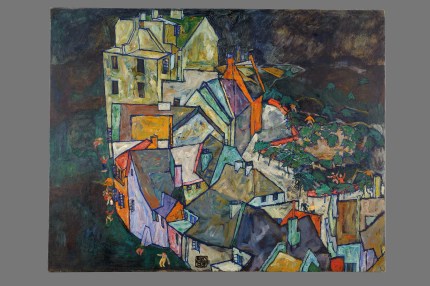
abb6.schiele.gesamt
Egon Schiele: ‘Stadtende’

The note-taker in the café, appears in the poem sequence, ‘Austrian Murder Case’, which reads like a series of (prose) screenplay notes for an all-too familiar Scandi-noir that the director has torn the best bits out of: a dull quotidian town, a moody disengaged observer, lumpen exposition from the pension owner, a woman’s dismembered body in suitcases in a lake, her husband, the murderer, does himself in at the same time. The note-taking protagonist walks away having gained some “insight into one dramatic story” and for that I’m a bit envious. The best bit of all this is the lake (“the See”) which is personified and perceiving in ways beyond the limitedly human, the humans being left at the end trying to fit bits of the story together. It’s all a bit obvious.

x354-q80You will have gathered that one of Power’s things is to mix English and Austrian German. This happens several times in ‘A Tour of Shrines of Upper Austria’ (though in this book we only get 7 parts of the full sequence). An observer stops at various shrine sites, jotting down some thoughts and taking a picture or two. Nothing is developed though Power’s poems do show an interest in religion on several other occasions. ‘The Moving Swan’ opens with a centre-justified prose description of candles flickering in a cathedral and another poem is drawn to the grave of two goats, observing: “two heaps of ivy/straw / one unlit red tealight”. And ‘Epiphany Night’ is a more extended series of notes recording a local celebration with bells, dressing-up, boats, lanterns. This is all observed in loosely irregular lines by the narrator from her “wohnung” (apartment). To wring all engagement or emotional or imaginative response from such a text is, I suppose, quite an achievement but to spend 70-odd pages in such company really is wearisome.

Power’s playing with her two languages is unusual and there are occasions when her poems read as poor, incomplete translations into English. This draws attention to the poet’s materials – language/s – as in ‘Epiphany’ again: “step down drei konige / in fancy robe and blackface paint”. In ‘Installation for a New Baby’ the effect is more comical and perhaps reflects the muddled perceptions of such an occasion: “We save soup cans, bean and veg tins / to clatter where they trail the grass, / pin a spray of rubber dummies and a / pillow, sagging rain”. And ‘8th May’ has a Google Translate feel to it: “bells are ringing, there’s a fire / sailboats calmly over the lake”. Perhaps the problem with these experiments is that we never know who the “protagonist”, the speaker, is. When Power ventriloquises more explicitly the effects are startling as in ‘Isis and Marija’. Again, mixing verse and prose, this short poem conveys Isis’ concerns about her own name (she’s from Columbia and speaks Spanish) and Marija’s more dominating personality and immigrant background: “My mother come first from Croatia for one year. Then we all come. I live in a hotel, five minutes”. Here, the buckle and twist of the language is effective in illuminating the two girls’ uneasy residence in Austria. For an older Italian woman, ‘Georgiana’ does the same in the same way: “she sets up, gets the car, / takes German class and speaks / fast with a curly accent she won’t change”.
Scannen0004

Power’s ‘doing different voices’ also occurs in the longer sequence which circles around events in which her grandmother, whose name was Chris or Christl, was found abandoned as a baby in Austria, taken in by a family (but not properly adopted) then came to Britain after WW2. Other sections suggest that the author/protagonist has later returned to Austria in search of her origins., and/or is living for a while near Gmunden in Austria. There’s a fair bit of historical and biographical exposition needed and this gives Power’s style of notation room to switch from verse to prose and back again. It’s the pieces in Christl’s demotic voice that stand out: “now I’m a bit mad at me mam, never adopted me properly, why not?” Elsewhere, her ignorance of the existence of concentration camps is stunning as is her clumsily expressed and moving sense of the fragility of her own survival: “It’s funny life when you think you get born, you weren’t here before, then you die and it’s just, you’re not there anymore”. It’s this sequence (pp. 41–52) that you should start from when you read this book.

winner-image-1071
Phoebe Power

Unfortunately, the collection trails away towards the end because, like any GCSE Modern Languages project worth its salt, there has to be section addressing Climate Change.  I’m not sure what Julie Andrews would make of ‘silver white winters that melt into springs’ but its two prose passages do little more than portray a before and after climate change. Also ‘notes on climate change’ is pretty much what it says in the title and, strangely, Christl’s voice begins to recur here too: “When I came to England first the weather was really / warm and I thought it’s warm in England nice here not so cold”. ‘Milk’ is an amusing, enjoyable prose piece detailing familiar anxieties about products like milk which adversely affect the environment though the irony that our avoidance strategies usually give rise to further problems is a bit obvious.

The closing poem is one of several in which Power interleaves two differing voices on alternate lines. I hear Christl’s voice here again, seeming to lament leaving Austria and perhaps the second voice is her granddaughter’s who might have been Austrian in another version of history. The result is a poignant sense of not quite belonging “here” but also of not really belonging “somewhere else”. It is this rootlessness that lies behind all of Powers’ poems. Not being at home in the world is an important and contemporary topic and, when she earths this in voices of specific characters, this works well. But too many of these poems record fragments without meaning without any attitude to those fragments without meaning. To end positively, ‘In and Out of Europe’ is a very good poem where the disjointed lives of grandmother and granddaughter are again aligned. But, on this occasion, it is during the June 2016 Brexit vote and the shared history of the family’s international link here has a much more profound significance and Power’s notes and jottings leap off the page with a purpose.

Dairy-reacts-to-Brexit-vote_wrbm_large

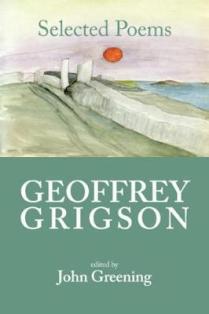
Flowers of Lime: Geoffrey Grigson’s ‘Selected Poems’

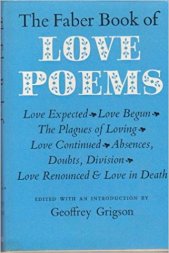
Surely we all have one or two Faber anthologies edited by Geoffrey Grigson on our shelves? Love Poems, Popular Verse, Reflective Verse, Nonsense Verse, Poems and Places, Epigrams and Epitaphs . . . As a critic he often wielded a savage power through his magazine New Verse. And as a big beast on the literary scene of the early 1980s, Hermione Lee interviewed him on Channel 4. But since his death in 1985, he’s better known merely as the husband of Jane Grigson, the celebrated cookery writer. His own poetry has been wholly neglected which makes John Greening’s new Selected Poems from Greenwich Exchange a welcome opportunity to re-consider it. I think Grigson’s contrasting themes were established early on. The influence of two great poets (not Eliot, not Yeats) is clear from the start and it may be that the limits of Grigson’s poetic achievement and the absence of much development in his style, are because he never chose one path or fully escaped either.


9781910996133

The influence of Auden is very clear in Grigson’s first collection, Several Observations (1939). ‘Meeting by the Gjulika Meadow’ presents an enigmatic narrative in a “frontier” landscape; a meeting between two men whose conversation is in large part concerned with “the thunder / about Europe”. There are sketched fragments of personal dependencies and guilts but the whole reads as a slice of narrative that has been carefully shorn of its explicatory elements. A poem from 1946 shows Grigson using similar methods but on matters much closer to home; ‘In a Dark Passage’ draws material from the deaths of two of Grigson’s brothers in WW1 and the early death of his first wife, Frances. The situations are still relatively distanced by being told in the third person and the timings of the incidents are compressed to form a litany of heartfelt if rhetorical griefs: “O floes of ice, you float downstream / But do not disappear”.

There is certainly a very dark river running through Grigson’s work. ‘Two A.M.’, from the 1970s, records a wakefulness at night filled – as so often – by nothing but questions: “all emptiness, all gravity, / Ultimacy, nothingness”. He captures vividly the way this kind of mood, at such an hour, insists on expanding exponentially, racing to fill the world’s “Sierras, monadnocks, lakes, prairies, taiga, ice”. On this occasion, there is the possibility of an erotic reply: “At least now, with our bodies close, / Be comforted”. But even that response is absent from ‘Again Discard the Night’ from the 1980 collection, History of Him. Written as a first person narrative this time, the poem pulls no punches in its flinty and unforgiving portrait of old age waking:


… you call, the kettle gathers

And talks, and Are you all right? comes your


Usual cry, and my habit insists, without sound, Reply,

Be bright, wash, shave, dress, and this once,

Again discard the night.


maxresdefault

Of course, Grigson’s sense of an ungoverned and likely meaningless universe matched with his frequent backward glances also calls to mind Hardy’s work. One of Grigson’s earliest poems, ‘The Children’, has an 11-line stanza of complex rhyme patterning that Hardy would have been proud of. The children are portrayed as playing in a natural environment and in a state of temporal innocence: “They looked for no clocks, noticed no hours”. But ending each stanza, the triple rhyme words with “hours” are (ambiguously) “sours” and “flowers”. Between the third and fourth stanza, there is the kind leap in time often found in folk songs. We have instantaneously passed many years: “The rooms were pulled down, but they always abide / In the minds of the children born in them”. These are the best lines in the poem with the much cooler closing lines for me falling flat:


They see the clocks and notice the hour

And aware that restriction of love turns sour,

They feel the cold wind and consider the flower.


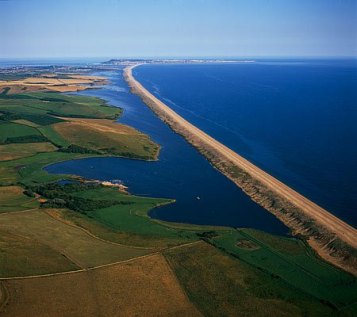
It is certainly Hardy that Grigson is thinking of in ‘In View of the Fleet’. The Fleet is the lagoon behind Chesil Beach in Dorset and the poem borrows phrases from Hardy, empathetically suggesting that each poet’s vision has the same sequential locus: “Things not as firstly well, a sparkling day, and / tolling of a bell”.


chesil-beach-aw-17-3
The Fleet and Chesil Beach


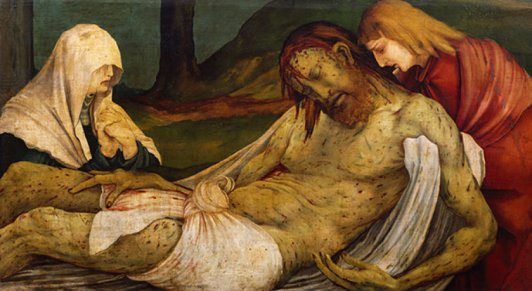
John Greening suggests in his very helpful Introduction that Grigson is also capable of an “extraordinary lyricism” and these are moments when he captures this “sparkling” quality of the natural world. In ‘A New Tree’, helped by the holding up of a child to a window, the narrator sees again with a newly cleansed perception, “a sun / being fiercely / let loose again”. Delight in the natural world recurs in a key poem, ‘Note on Grunewald’. In it, Grigson also expresses the scepticism about literary achievements which must have driven much of his own, often acerbic, critical comments on the work of others. In a man who devoted a lifetime to literary endeavours, it’s hard to take wholly seriously the poem’s assertion that he’d rather live to sniff the “scent of the flowers of lime” than to create lasting “poems”. But the scent is praised in contrast to the art of “Grunewald’s spotted green-rotted Christ”. Grigson sides with (“I join”) Cowper in deciding that death holds no attraction and that he too would choose to “leave this world never”. The perceived dichotomy between a vivid inhabiting of the world of the senses and the ‘rotten’ achievement of artists is by no means Grigson’s final comment on these issues, but the poem certainly expresses unresolved tensions.


stufftoblowyourmind-23-2014-08-isenheimdeadchrist-blog
Grunewald’s ‘spotted green-rotted Christ’


As Greening reminds us, Grigson as a critic was a feared and fearsome creature, liable to “dismissiveness and intolerance of shoddy work”. Perhaps, in his own mind, he never quite settled his assessment of his own poems. A lovely translation from Tu Fu was perhaps chosen because it laments lack of achievement, or at least of recognition: “Writing gives me no name”.*   More vigorously, ‘Lecture Note: Elizabethan period’ is an hilarious and outrageous account of a poet’s final work. While the ink was still wet on the page, he dropped dead. The poem fell to the floor only for the maid to drop it in “the jakes”. The final lines laugh cynically, sarcastically, as if this illustrates the fate of most artistic endeavours: “Now irretrievably beshitten, it was, dear sirs, / The one immortal poem he had written”. Yet this is delicate stuff compared to Grigson taking aim with both barrels in ‘Perhaps So’. The premise is that too much is being written:


Too much is told. Banish polymath Steiners

And seventy-seven other British Shiners,

Naturalists, archaeologists, publishers

Of publications in parts,

Norman Mailer

And all long-winded farts . . .


It’s hard to reconcile this voice with that of ‘A New Tree’. Interestingly, Grigson’s address to an ancestor whose name was ‘Nazareth Pitcher’ is critical on the surface, disparaging of Nazareth’s “pride”, suggesting his “lips were too thin”, that he might “be pleased” if he was to witness the parlous state of the world now (1960s). But it’s also difficult to dismiss the feeling that Grigson chose to address Nazareth because he sensed a kinship with this judgemental, sceptical and meanly satirical man.


2344
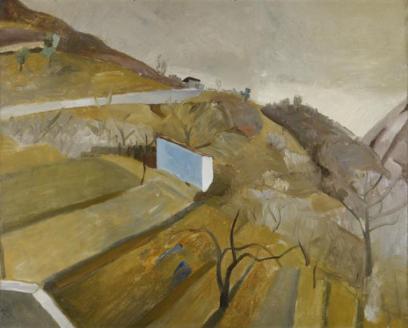
Castagnola (1923) – Ben Nicholson

But Grigson did admire, if very judiciously. Greening draws attention to an Eliotesque belief in tradition, that the best poems are made by “members of a long narrow community through time”. The word “narrow” here indicates Grigson felt that much of what was truly best was not appreciated by many. In one word perhaps, we see here his motivation to be harsh with what he felt not good enough and his hard work in anthologising what was. There are two tribute poems in Greening’s selection which show Grigson at his complimenting best. ‘A Painter of Our Day’ is about Ben Nicholson and has the feel of a Coleridgean conversation poem about it. Its tone is confiding, admiring, ranging from observations about playing with children, shared days out, discussions of Nicholson’s work, ageing and the nature of art. Nicholson seems to teach an appreciation of “what is” and an avoidance of nostalgia. But at the same time, he recognises the value of the “reiterated wisdom of perceiving”. That both poet and artist set the bar of achievement very high indeed is suggested by Grigson’s admission that, of their chosen role models, “most have been / Long dead”. I find it hard to pin down a more precisely articulated aesthetic, but these lines are revealing of any artist’s relation to his/her elders:


Suddenly when young or in our first ability

We find them, slowly we find the reasons

For our love, finding ourselves, and what we lack

As well or need the most


Finally, ‘To Wystan Auden’ records the moment Grigson learned of Auden’s death in the “English September” of 1973. His admiration for the younger poet is fulsome. With the appearance of his early work, Auden became “living’s healer, loving’s / Magician”. From the other end of the temporal telescope, now we can see what the young Grigson gleaned from Auden’s poetry:


You were our fixture, our rhythm,

Speaker, bestower, of love for us all

And forgiving, not condemning, extending

To all who would read or would hear

Your endowment of words.


41xZt262WYL._SL500_SX319_BO1,204,203,200_

For all Auden’s own protesting about poetry making nothing happen, for Grigson, “time, after you, by you / Is different by your defiance”. One might ungratefully gripe that these are rather vague compliments from one poet to another. But Greening quotes Grigson suggesting that Auden’s achievement was in destroying “a too familiar, too settled monotony in manner and subject”. This is undeniable and this selection shows Grigson following Auden’s lead, yet at the same time, through his life, also being drawn back to a different, more traditional poetic style in the model of Hardy. Here, for example, in his last years, he recalls his childhood in Cornwall:


Staring down from that broken, one-arched bridge,

In that vale of water-mint, saint, lead-mine and midge,

I was amazed by that fat black-and-white water bird

Hunting under the current, not at all disturbed.


How could I tell that what I saw then and there

Would live for me still in my eightieth year?


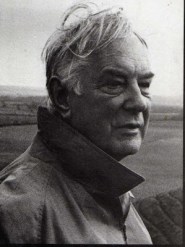
BookrideGrigsonPhoto£££*As a labouring translator myself, I have long remembered Grigson’s brilliant put-down in his Introduction to the Faber Book of Love Poems (1973). Explaining why he has not included any translations at all, he declares that their “unmeasured, thin-rolled short crust” would prove detrimental to the health of the nation’s poetic taste. Times have changed, thank goodness.

Strike a Pose: Jacqueline Saphra’s ‘A Bargain with the Light’

They come from conversations overheard or taken part in, sights, sounds and the other senses, recall, reading, when alone or in company. Poems drop into the growing matrix of all we’ve felt and known. For those who write, it goes on all day long. But only a few land propitiously and work their way into what lies beneath to root and grow. The best of them find earth particularly suited to the nature of the seed and Jacqueline Saphra’s introduction to the highly ekphrastic A Bargain with the Light (Hercules Press, 2017) records just such a moment.

DKKnm3zX0AAbJg_[1]

This exquisitely produced little book also contains a discussion of the model and photographer, Lee Miller, by the academic, Patricia Allmer. Miller emerges from this as a multitude; as object, agent, speaker, spoken of, product and producer – in Allmer’s words a “key female icon of the twentieth century”. And so, in 2016, visiting the Imperial War Museum’s exhibition, ‘Lee Miller: A Woman’s War’, Saphra was stopped “in her tracks” by a nude photograph of Miller, taken by her father. Saphra explains: “How could I not be drawn to this extraordinary, wounded woman [. . .] with her huge capacity for creativity, her beauty, her restlessness?” It can take only a moment for both the drawer and the drawn to discover in each other a mutual compatibility.

The poems that arose from Saphra’s fascination with Lee Miller take the form of an heroic crown of sonnets. The form incorporates repeats and revisitings as well as replicating, in its constituent short forms, the brief instantaneous moment of the taken photograph. By coincidence, I’ve used a less strict form of the crown of sonnets recently and, in search of a propulsive, forward movement within the sequence opted not to repeat lines verbatim and also to cut the fifteenth sonnet which repeats many lines once more. But Saphra adheres to the form pretty tightly and in doing so reflects the remarkable recurrences in Miller’s life. Though she finds some evidence of maturation and progress, her chosen form argues against this. The penultimate sonnet declares: “you’re still the same girl who trembled / in the snow wearing only silence”.

This reference is to one of the earliest images of Miller, taken by her father – as a stark naked 7 year old, standing in 2 feet of snow in her home town, Poughkeepsie. It’s an appalling image, but Saphra’s verse derives from it two elements that will recur: the (definitely creepy) power of the father and the fact that Miller is hiding in full (full frontal) sight. ‘Darkroom Lessons’ addresses another naked image of Miller, again taken by her father. But now she is a 20 year old woman. She turns her head aside as if she’s just been struck. For Saphra:


You turn and strike a pose.

Once more, you look beyond. This time your face

in profile signals absence. Your skin glows [. . .]


Miller’s nakedness demands she hide herself and the gaze from which she hides . . .


It’s him

again: the father, tucked behind the lens

sharing his expertise. This is how it starts:

with naked lines and curves; it ends

with lessons in the darkroom. This is art.


The euphemistic “lessons in the darkroom” allude to the fact that Miller was sexually abused in childhood – though by a neighbour, rather than her father.


Lee-Miller[1]
Lee Miller – Self Portrait

By the 1930s Miller had reached Paris, her naked body now proving an inspiration to artists like Man Ray. But Saphra’s poems indicate that while still an object, Miller is becoming more of an agent too: “This is your chance / to know his secrets, so you play his game”. In her compliance, Miller learned much from Man Ray. ‘The Art of Control’ responds to a watershed moment, a self-portrait image from around 1930: “You steal his eye and take both sides: / In front, behind: the seer and the seen”. The poem concludes (quietly, plainly as ever) marking Miller’s bid for an independence and freedom (as woman and artist) that perhaps seemed unlikely:


No deal to cut, no tacit threat, no flesh:

Sweetly, you make your bargain with the light,

The only safe transaction. You took this.

Here is your face. Simple. Nothing amiss.

Collaborators[1]


The sonnet crown demands that this concluding line is repeated as the first line of the subsequent poem. The risk that we might read the line too simplistically and optimistically is reduced when we hear much the same words re-applied to Miller’s 1944 photograph of a French woman accused of collaboration with the Nazis – her head shaved: “Here is your face, simple, nothing amiss”. As in this instance, as the sequence unfolds, more of the sonnets are in the voice of Miller herself. This technical shift marks the artist’s growing self confidence and one of Saphra’s suggestions is evidently that, having suffered much in her youth, she is able to confront head-on the suffering of others. And hence take a great photograph.

486434472_f02117992d_o[1]

So Miller’s image, ‘The Burgermeister’s daughter’ is of a Nazi woman who has poisoned herself. To take the image, Miller must have got very close. So too with the frightening ‘Beaten SS prison guard’, his goggling eyes and smashed, bloodstained face filling the frame. Miller took it on a visit to the Buchenwald Camp. Saphra makes Miller speak of it:


I learned how to escape. How well I hid,

how close I dared to stand. I fix my focus

inches from his face, his eyes clear, the blood

congealing on his skin. If there’s disgust,

I channel it, and if there’s fear, I know

how to burn it, use it for fuel.


The sonnet sequence does not unfold strictly chronologically. In the midst of Miller’s war years, there’s a poem in response to an image of a 6 year old Miller with her mother; then there’s another of the whole Miller family in 1911. The strategy here maybe be (reflecting the repetition of the crown form) to suggest how much of the little (abused) girl remained within the confident, female war photographer. But it does give rise to some arid repetition. In one poem Miller tells us “I’ll learn to play both naked and concealed” and in the other we are again reminded, “You learned how to escape. How well you hid”.


Saphra-interview[1]
Jacqueline Saphra

But how far Miller must have come is suggested by one of the strangest of the images here, the 1943 ‘US Army nurse drying sterilised rubber gloves’. The white uniformed, virginal nurse stands comically surrounded by grasping rubber gloves arrayed on sort of hat-stands to dry. Her figure is grotesquely dwarfed by the grasping and groping that goes on around her. Miller speaks in Saphra’s poem, reflecting on her own inner turmoil:


Where are the doctors? When will they begin

to make it better? I watch and wait

as if they’ll find a cure for this malaise,

as if the storm inside can be erased.


Though elsewhere, Miller’s voice rings out much more defiantly (“I’ll crash in, braced / to win, dig for mercy, shoot for grace”) it’s the still-troubled “girl who trembled / in the snow” we are left with in sonnet 14. If Miller truly is Allmer’s “female icon” then she is – in Saphra’s treatment of her – one achieving only a pyrrhic victory in the twentieth century gender battles: “You square your shoulders, soldier on”. Yet the poems are all the more moving because of this. The poet’s profound identification with Miller, her deployment of ekphrastic techniques and her clever use of the crown form make for a very satisfying read. It goes without saying that Hercules Press’ production and design is stunning. This is a little book to treasure or – as it’s getting close to Christmas – to give.

lee_miller_biography_beautiful_young_thing_audacious_muse_photographer_3l[1]


Guillemot Press book launch (November 2017)

DM-HkzHWkAAx8CG[1]

Last Saturday I packed my bags for a brief stopover in Devon. The train from Paddington retraced my steps (no – that’s not right; what do you say?) – re-rolled its wheels along the same route I’d travelled a couple of weeks ago to the Torbay Poetry Festival. But instead of changing at Newton Abbot, I stayed on board and we swerved inland and skirted the southern edge of Dartmoor to Plymouth, then further west to Bodmin. I was met at Bodmin Parkway by Luke Thompson who runs the Guillemot Press. Guillemot is barely a couple of years old but is already building a great reputation for the outstanding quality of its books. Luke and his partner Sarah are the driving forces behind the press and it is based in Cornwall with strong links to Falmouth University. We drove across an already dark Bodmin moor to the village of Altarnun where Luke was launching three new Guillemot titles at the Terre Verte Gallery, run by Richard Sharland.

Besides my own O. at the Edge of the Gorge, the books being launched were Nic Stringer’s first, A Day That You Happen to Know, and Andrew McNeillie’s new collection, Making Ends Meet. Both my own and Nic’s book are examples of Guillemot’s interest in combining poetry and illustration (if that’s the right word for images which respond to and add to the text rather than being merely illustrative). The two artists were at the event as well and it was wonderful to meet up and chat with Phyllida Bluemel who created the images to accompany my crown of sonnets. Her delicate, analytical yet natural images – produced only from a reading of the poems, no input from me – seem to me extraordinarily apt and, having learned of her background in philosophy as much as fine art, I’m not surprised. She and I have discussed the shaping of the whole book on the Guillemot blog.

Nic read first. Her poem, ‘Laocoon in the Vatican’, describes an image of human agony as a father defends himself and his sons from attack by serpents:


Chest curving towards his gods,

he speaks of what lies beneath devotion, where wrestler

is the same as family. But in the end he is a man

petrified [. . .]

laocoon[1]

‘Icebergs in Ilulissat’ is more of an Arctic landscape poem: “In Disko Bay the growlers and the bergy bits / crack their knuckles”. ‘Sisters’ is a fascinating 10 part sequence of poems dedicated to three Medieval Christian female mystics, ending with this exquisite lyric:


Like the Earth

I have given up

everything but God


will find a hole

to fall towards

turning without a body


to sleep

separating self

from silence

8226eece-e840-4378-9fb4-cd24af13aef4[1]

Nic’s work is various and intriguing – her Guillemot image-maker is Lucy Kerr, whose enigmatic, colourful images are almost visual riddles – and I’m looking forward to reading the whole book more slowly.

Before I read my sequence straight through without additional comments, I explained its form: a crown of 14 sonnets – the final line of each poem repeated as the opening line of the next; the opening and closing lines of the whole sequence also meant to be the same. I wanted the connectivity this creates – though the connections in this case are approximate – deliberately so, as I wanted to suggest a forward movement or progression of understanding. Much of the detail of the poem is of landscape – the Marche region of Italy – bees, buzzards, hunting dogs, trees, thistles, Classical ruins put to more modern use, hilltop villages, church towers, rocky hillsides, deep gorges. The O. of the title is an Orpheus figure, the singer, or poet. There is no narrative to the sequence, but it does allude to Orpheus’ journey to the underworld in search of Eurydice and his loss of her when he looks back. That sense of loss also explains allusions to Dante’s Paradiso, Book 16, where he refers to the ancient towns of Luni and Urbesaglia, for him, vivid images of transience.

DLRftRFW4AAtwJQ[1]

After the interval, Andrew McNeillie read from his collection. Andrew is both a poet and an editor at OUP, Archipelago magazine and he runs Clutag PressMaking Ends Meet is a full collection of almost 100 pages, including a new version of the Anglo-Saxon poem, The Battle of Maldon. At the other end of the scale, Andrew threw us an opening, squiby couplet titled ‘A Poet: 21st century: “A redundant lighthouse-keeper / striking a match in a storm”. One such match illuminating the darkness is his sonnet ‘I see Orion’, moving from a vivid evocation of star-gazing on a cold night in March to reflections on natural beauty and the passage of time. That same sense of summation, or the counting of blessings, was evident in the title poem too, which evokes an earlier time of easy creativity:


The early worm

already turning in a bird’s gut

like the one thought in my head

of lines to set and bait to put

a poem on my plate by evening.


making-ends-meet-cover[1]

And you could feel the whole audience warm to Andrew’s ‘Lunch with Seamus’, recording a meeting between the poet and Clutag editor, both “uncertain how lunch might pass”. But it passes well, the poem portraying a warmth and closeness, a shared love of poetry, the intimacy drawing from Heaney something of a confession:


‘I got the Nobel Prize too soon,’ he said.

‘It nearly did for me, you know, the fame.

It stops the clock and steals your time’


The poem is full of delicate allusions to Heaney’s work, the final lines affirming a real meeting of minds as well as echoing Heaney’s own parting from the ghost of James Joyce at the end of ‘Station Island’:


We parted and I watched him disappear

As if I’d dreamt the whole affair

But knowing I hadn’t. I’d seen the man.


This three-book launch was a marvellously affirmative evening about the power of poetry too. Our heads full of images, and words, natural landscape, the material, the spiritual, distant Italian sunshine and rocky Irish coastlines, I drove with friends through the November rainy darkness back to the town of Tavistock, perched on the edge of Dartmoor itself. And there was still time enough to eat and raise a glass of wine.

182712359-a2163bed-2fd9-4910-9e04-673d2bb611ef[1]


2017 Forward First Collections Reviewed #5 – Eric Langley

My work here is almost done . . .  This is the fifth and last in the series of reviews I have been posting over the summer months of the 5 collections chosen for the 2017 Forward Prizes Felix Dennis award for best First Collection. The £5000 prize will be decided on 21st September 2017. Click on these links to access all 5 of my reviews of the 2016 shortlisted books (eventual winner Tiphanie Yanique)  and all 5 of my reviews of the 2015 shortlisted books (eventual winner Mona Arshi).

The 2017 shortlist is:

Maria Apichella – Psalmody (Eyewear Publishing) – reviewed here

Richard Georges – Make Us All Islands (Shearsman Books) – reviewed here

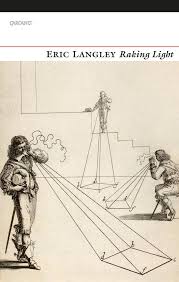
Eric Langley – Raking Light (Carcanet) –  reviewed below

Nick Makoha – Kingdom of Gravity (Peepal Tree Press) – reviewed here

Ocean Vuong – Night Sky with Exit Wounds (Cape Poetry) – reviewed here

download

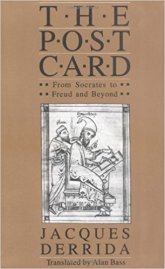
Do poets owe their readers explanatory notes? The pro-accessibility reply is ‘On principle, no!’ The googlers reply is ‘Not necessary – let your fingers do the walking’. Others might concede, ‘On occasions, maybe, for clarity’s sake or to take the piss out of critics and academe (see T.S. Eliot). But reading Eric Langley’s debut collection – if it’s proving hard to hang on to his erudite coat-tails – perhaps you cry ‘Yes, yes, for goodness sake!’ In fact, such pleas have already been answered by a curious, anonymous website that has sprung up to explicate many of these poems. Talk about poetry moving from the writer’s desk to the academic lecture hall without passing through an ordinary reader’s hands! It’s because Langley scrupulously offers us no help at all in positioning ourselves to read about the Chinese tradition of walnut gambling, Ancient Greek painter Zeuxis, Picasso’s father, Stephen Grosson’s 1579 book Schoole of Abuse, Jeremy Bentham’s panopticon, Derrida on postcards, Argus, Eurydice, Zeno, Edgar Allen Poe and (twice) the art historical term pentimenti. And that’s mostly from the opening 50 pages of this 128 page book (I think it’s about 40 pages too long).

41y6M-ulhlL._SX304_BO1,204,203,200_

On the other hand, Langley often writes with a vigour and robust rhythmical quality to perform (all these poems are very performative) a sort of Elizabethan riffing to scatter-shot effect. He has a slightly annoying, almost reflex habit of sampling bits of Shakespeare mid-poem (especially from Hamlet) but Ted Hughes wrote of Shakespeare’s language that it was “an inspired signalling and hinting of verbal heads and tails both above and below precision, [a] weirdly expressive underswell of musical neargibberish” (‘The Great Theme: Notes on Shakespeare’ (1971)) and at his very best Langley catches some of this. Literally born into the Cambridge school (Langley’s father, R. F. Langley, with his son, would often holiday with J. H. Prynne), Langley junior invigorates that difficult style with a 1590s fizz and gristle (his day job at UCL is studying the bard and more obscure Elizabethan texts) in poems whose image field is most often ekphrastic, whose emotional stance is often surprisingly sentimental and whose dominant atmosphere is one of loss.

The loss is key. Fundamentally this is about language (Cambridge School again) as the poor relation to ultimate reality. Our every living moment is a catalogue of loss; certainly our every communication is a clumsy moon-shot at a too-fast moving target, a shot also plagued by the drag of our words’ etymologies. But this is also (like the Forward short-listed books by Nick Makoha and Ocean Vuong) a book about lost fathers (Langley talks about this and other things and reads a poem in this interview). In addition, Langley’s sense of loss is elsewhere associated with the recall of a romantic attachment, what he refers to at one point, transmuting Anthony Burgess, as “memory’s ultraviolence”. This stirring of long-buried materials is what the book’s title alludes to. Raking light is used in art historical investigations to reveal the artist’s false starts and abandoned intentions – a sort of alternative historical version of the final painting. In fact, it’s that often over-done, old poetical favourite, the palimpsest, in art historical terms.

So ‘In raking light’ the narrative voice explains “in the beam’s fetch / the urgent silt sits up”. Perhaps my ‘explain’ is not the right word here – there is a sort of querulous (lover’s?) complaint going on in the tone as if the voice resents this uncovering of the past.


Once, there was life here –

residual and errant –

hushed since, shucked under

the thick skin, the tough slough.

eusq2

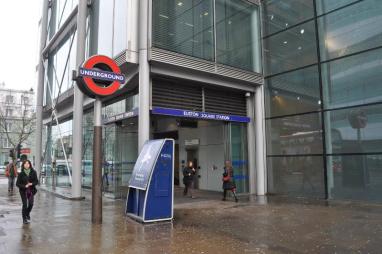
The vowel music in these few lines illustrates one of the pleasures of Langley’s work, but the “thick skin” is a gift to those who might accuse him of tending to bury hurt and loss under an avalanche of erudition rather than bringing it to the light. Indeed, it’s debatable whether this poem (in 8 sections), as it continues to offer multiples of synonymous formulations of this buried/hidden trope, manages to express a humanly complex emotional state or simply obscure it in a playful, bravura performance. The poem to read alongside this one is ‘Eurydice in Euston Square’ which – once it has got past its tacked-on allusions to Orpheus’ lost wife and Proserpina – proceeds much more nakedly and accessibly:


Come back up stairs

if you read me


up in the subway

missing the tube travel,


missing the coach trips,

all the seaside rides,


the telephones, the postcards,

telegrams on spun wire;


come back up stairs,

and I’m hanging on


subjunctives, hanging on

superlatives, hanging on


the sound of someone

long gone to static

(apologies for some loss of formatting here – blame WordPress)

slide003

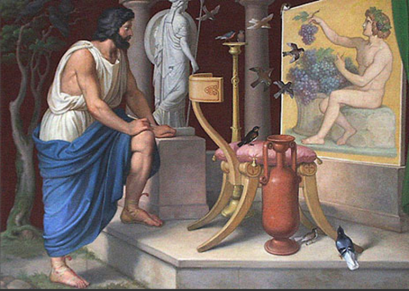
The more linguistic and epistemological losses that preoccupy Langley are clear in the opening line of the opening poem, ‘Glanced’: ‘You lovely looker on and by and by and.” The interruptive full stop is (ahem) the point (Langley’s love of puns can be infectious). The idea is then played out (again in a riffing, repetitive style) via another old favourite, Zeno’s arrow, though this time the target is Zeuxis’ painting of grapes which (in legend) was so realistic that birds swooped down to peck them. Art imagined to be closing on the real – of course, it proves a delusion. The arrow does strike the canvas but penetrates what is really nothing, then slams into a “wall”. The final section of the poem, in fact, does suggest some possible success (see Hughes’ comment on Shakespeare’s ultimate expressive achievement through signals and hints). The concluding lines display Langley’s vigorous use of anaphora, rhyme, punning and Shakespearean allusion:


So glancing blown by,

so palpably hit away, so


keep so lovely looking still

keep lovely looking till


until each hungry bird

has flown and had his fill.

MMP123510

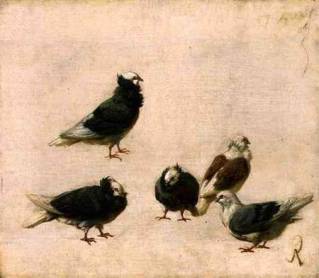
The sequence, ‘Albada: Pigeons on pink’, starts (once we’ve done the googling to find out) with Picasso’s painter father, Don Jose Ruiz y Blasco. He liked to paint pigeons and for a few sections he sounds pleased with the results. But then young Pablo asks for a pencil and his father is astonished at the boy’s skill, or the degree to which his art seems to approach reality: “all these real these / really real pigeons”. Via another allusion to Hamlet, Langley then morphs the poem into an address to his own father (who wrote a poem called ‘Jack’s Pigeon’) though the two sons – Pablo and Eric – are blurred together, avoiding filial arrogance in a burst of filial piety: “it’s all still yours, still yours to say, Jose”. An albada is a Spanish love poem – this one has been re-geared into a piece about the son’s love of a father.

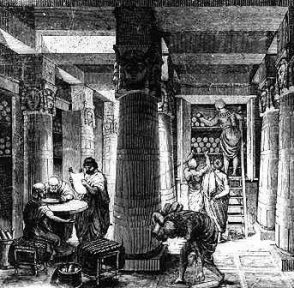
The two poems called ‘Pentimenti’ return to the ideas linked with raking light. The Italian word means ‘regrets’ and in art history it refers to changes an artist makes and covers over in the process of creation. The first of the poems is shorter and mixes images of painting with those of telephoning and it’s the latter that suggests this is really driven by a broken relationship in the modern world: “lost out here – dialling, dialling”. Such loss of contact and communication trips all Langley’s switches. A similar instinctive, welling up, or inundation, of potent material can be seen in the over-long, repetitive sequence in the middle of the book. This springs from a detail recounted by Galen of Pergamon that Ptolomaeus, King of Egypt, in assembling his great library, would take books from any ship that sailed into port, have them copied, then give back the copies, retaining the originals for his own book shelves. So language, knowledge, forgery, copies, signs, semiotics, morse code, the Dewey system of classification, plus Hamlet on the pirate ship and the final Alexandrian conflagration – Langley throws it all into the mix  and gives it a good stir.

124251-004-BDCAF293

For me, the second ‘Pentimenti’ is a much greater success, presenting itself as a literal palimpsest of the earlier poem – the thoughts, drafts and revisions that might have led to it. The performance here is not the dazzling, often impossible to follow footwork of other poems in the book, but rather one of hesitations, lines of thought taken up, then dropped, crossings out and (literal) fadings out. For me this expresses the difficulties of expression more effectively than many other poems, especially in the revisions we witness which involve a switch of verb tense from present to past. Most of these observations seem (again) to be focused on a romantic relationship so that what is the case (first draft) is being transformed into what was before our very eyes. I think (actually, I’m not sure) the sequence drifts latterly towards the relationship with the father again but even the obscurities here play an affecting role and the collection’s final lines remind me of the tragic, closing moments of Brian Friel’s play, Translations, in which the Gaelic language, culture and memory seems to be fraying and withering to nothing even as we watch and the lights dim.

Langley’s book will infuriate many and please the few. There is an impressive peculiarity here, a performative jouissance concerning language and learning which the Forward short-listing committee must be responding to. But I do wish he’d had a tougher editorial voice to cut the length of the book which – especially in the mid-sections – indulgently outstays its welcome.

eric-langley-

‘From Palette to Pen’ – a bit more ekphrasis

My blog post a couple of weeks ago on ekphrastic poems (ie. poems stimulated by visual art) proved to be one of the most popular I’ve ever written. This was in part the ‘how to’ aspect of the blog. In preparing to run a workshop at the Holburne Museum in Bath in February, 2017, I’d been reading a wide variety of poems derived in some fashion from the poet’s encounter with visual art and I tried to categorise the various approaches. I came up with 14: 

  1. Describe – and do no more.
  2. Describe but imagine beyond the frame
  3. Describe but incorporate researched materials
  4. Make Main Figure Speak – the most common approach
  5. Make Minor Figure/s Speak
  6. Make Objects Speak
  7. Make the Artist Speak
  8. Interrogation of the Artist
  9. Interrogation of illustrated Figure/s
  10. Interrogation of Yourself
  11. An Account of Your Encounter with the Art
  12. An Account of Gallery Visitors’ Experience
  13. An Account of Others’ Experience
  14. Come at a Tangent – the ekphrastic experience as after-thought or illustration

From-Palette-to-Pen-185x300

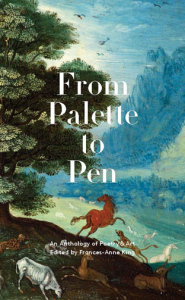
While at the Holburne Museum I was given their recent anthology of ekphrastic poems, From Palette to Pen, edited by Frances-Anne King in 2016. It contains 20 poems stimulated by art objects in the Holburne and as well as recommending it as a great resource for ekphrastic writing, I thought I’d use it to test my earlier analysis of the form to see if it held water.

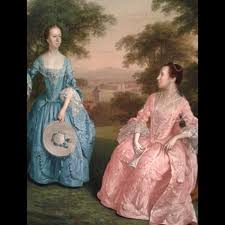
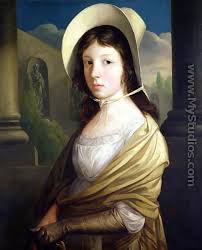
It did pretty well. It goes without saying that all the poems engaged to some degree in method 1 – description of the art object itself. But beyond that, by far the commonest approach was method 4 – making the main figure speak. This was adopted by Anna-May Laugher, Claire Dyer, Carrie Etter, Frances-Anne King, Pascale Petit, Linda Saunders and Lesley Saunders. Petit manages to make Adam speak, remembering his naming of the animals; Claire Dyer makes Rosamund Sargent speak from her own portrait by Allan Ramsay; Lesley Saunders makes one of the sisters, Alicia and Jane Clarke, speak and so betray their “little sisterly difficulties”.

imgres

Another common approach was my method 8, an interrogation of the artist (without getting the artist to actually speak for themselves (method 7)). Jenny Lewis’ poem on a 17th century Rosewater basin began in this way, inquiring “What’s on his mind as he hammers / the silver, makes light flower”. Her poem goes on to incorporate some obvious research into the object too (my method 3) which takes her poem away from a narrow view into the colonial world of “London, the world, New England” in which it was made. David Hale, writing about Jan Asselyn’s ‘Landscape with Drover’ also imagines and interogates the artist’s approach, gazing at his own picture in process:

Ah, the south. He feels the heat of it

on his face and hands, smells dust, dung

and crushed thyme as he sips his coffee,

wonders again what the bull is looking at –

where time and life have gone.

imgres

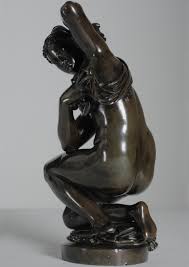
I’d be tempted to widen this category of approach – or even introduce a new one – because several poems in the anthology interrogate the artist specifically about the artistic methods used to create the art object. Sue Boyle does this in detail about the making of Antonio Susini’s bronze figure, ‘Crouching Venus’: “Coated in plaster, lowered into fire, / she must be negated, melted from her mould”. There are also elements of this approach in the poems by Dawn Gorman and Phillip Gross, the latter dwelling as much on the making of a Beadwork Basket as on its illustrations of Charles II and Catherine of Braganza. Gill Learner’s poem also looks over the artist’s shoulder as he glazes a 15th century earthenware dish.

My method 9 – interrogating or engaging with one of the figures in the art work – was used by Caroline Heaton, Wendy Klein and Tim Liardet. Klein and Liardet both directly address figures in the image (for example, “Someone chose the best for you, Mary Bourchier” and “You let the baby grip his fingers”). Heaton’s engagement with Plura’s marble statue of ‘Diana and Endymion’ is a bit less direct, using the third person (rather than a second person address) to think herself into Diana’s state of mind:

Confined to the island

of the self, she laments

the chill of her lunar circuit,

its lonely eminence.

imgres

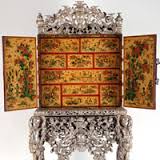
Rosie Jackson approached a piece of furniture, ‘The Witcombe Cabinet’, via a brief description of it but quickly developed thoughts about her own mother and indeed herself which I’d take to be my method 10 – using the art object to interrogate or enquire into one’s own life: “”My mother would have loved it here, / the roped off beauty […] But I ask questions of locked drawers”.

imgres

I think Claire Williamson mostly used method 3 – describe and make use of researched materials – in her poem on Thomas Barker’s painting of ‘Priscilla Jones’. The relationship between the sitter and the artist is the focus here, their romantic engagement and subsequent “passionless” marriage. In fact, I’ve not checked details of the painting/poem and I suppose it maybe that Williamson is making all this up – in which case she’s adopting method 2 – describe and imagine beyond the frame as George Szirtes does in anticipating the adult life of the boy in ‘Garton Orme at the Spinet’.

So the methods used in this anthology are fairly limited – seven of the fourteen I proposed. Those not adopted here are several varieties of ventriloquism (getting minor figures or objects to speak up; getting the artists to speak directly), the kinds of poem that more narratively describe encounters with art objects in a gallery or other location and a more tangential approach.

imgres

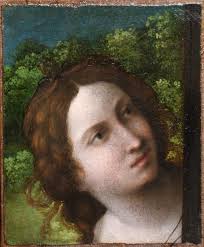
Finally, Lawrence Sail’s poem describes a Mantuan School ‘Female Head’ and is probably the ‘purest’ ekphrastic poem in the anthology in that it does little more than describe the image – method 1. However, Sail addresses the woman imaged as “Our lady of the liminal” and as such he breaches the borders (“offstage”) a fair bit, beginning to imagine beyond the frame to some degree (method 2). It’s a lovely poem and deserves quoting in full:

Female Head, about 1525

Our lady of the liminal –

witness at her back the margins of

the unruly forest,

and the focus of all her attention

being offstage.


But the heart of the story is locked

in the ghost of her gaze – its candour,

the early signs

of grief, a drift to the verge

where hope wavers.


And everywhere, time on the make –

in the darkening turquoise of the sky,

the slow swell

of the trees, the craquelure moving up

to infect her soft features.

William Carlos Williams’ Brueghel Poems

Last week I travelled down to the Holburne Museum in Bath to take a look at their Brueghel dynasty exhibition – this is where I am running a poetry workshop this coming weekend (25th Feb – it’s waiting list only now I believe). So after last week’s blog post about the varieties of ekphrastic poetry, my mind is still on the same topic. Unsurprisingly I have been looking at William Carlos Williams’ late ekphrastic poems in Pictures from Brueghel (1962). I think the reasons why Williams was so drawn to these images 50 years ago remain the reasons why Brueghel’s star continues to rise in popularity (not just among ekphrastically-inclined writers) in our century.

pieter_bruegel_the_elder_-_wedding_dance_in_the_open_air_-_wga03505

We like Pieter Brueghel the Elder’s work because it gives an impression of conveying a plain, unvarnished truth and this was done by self-consciously reacting against Romanist and more conventional, stylised Renaissance models. This gives many of the images a democratic or at least a demotic feel (something Melvyn Bragg and his guests pursued in the In Our Time edition on Brueghel’s painting ‘The Fight Between Carnival and Lent’). We also respond to Brueghel’s gentle caricaturing of human figures which seems to be done at least as much out of amused sympathy as satire. We are intrigued as well by Brueghel’s tendency to literal eccentricity, to displace the expected centre of his canvas, most notably in Biblical subjects where the Nativity or the journey to the Cross is subsumed – hard to spot – in a larger, village scene. In other images, there seems almost to be no clear centre of focus (in pictures on children’s games or Netherlandish proverbs, for example). For Williams, a 20th century poet interested in breaking with tradition (linguistically and formally), on fully recording the modern world as it is, and with a clear democratic (American) focus, Brueghel’s work makes an obvious rhyme.

Most of Williams’ poems about Brueghel’s pictures simply describe what is to be seen. There is a fidelity to the fidelity of what Brueghel does. The closing lines of ‘Children’s Games’ praises the way “Brueghel saw it all / and with his grim // humor faithfully / recorded / it”. ‘The Wedding Dance in the Open Air’ describes plainly the “riotously gay rabble of / peasants”, the poem intent mostly on conveying the sheer energy and vitality of the scene, climaxing in the “Oya!” cry which comes as much from the mouths of the peasants as from the admiring poet. What adds interest to this poem is the opening statement that such a fizzing and spilling of energy is “Disciplined by the artist / to go round / & round”.

512px-pieter_bruegel_the_elder-_the_corn_harvest_august

‘The Corn Harvest’ is likewise largely descriptive of the particular canvas though the role of the artist as ‘organiser’ is noted at the outset. The poem ‘Peasant Wedding’ repeats this descriptive method, varied only by the poet’s opening imperative address to one of the figures: “Pour the wine bridegroom”. The tension in this poem is less between artist and his boisterous subjects but between the boisterous wedding guests and the bride who sits “awkwardly silent”. Williams’ frequent thoughts about the nature of the artist surface most clearly in ‘Self-Portrait’ (a Williams’ mistake – in fact a painting not by or of Brueghel at all).  Starting again from plain description, the poem comes to focus on the artist’s eyes (“he must have / driven them hard”) and the poem deduces/speculates on the artistic commitment this implies: “no time for any- / thing but his painting”.

icarus

In ‘Landscape with the Fall of Icarus’, Williams looks at the same painting that Auden did some 20 years earlier. Williams’ take is very much like Auden’s and both are finely attuned to Brueghel’s image which characteristically displaces the centre of interest (the falling boy’s body). For Williams, the event occurs “unsignificantly” and the splash goes “quite unnoticed” or as W H Auden put it more memorably as the Second World War got under way: “everything turns away / Quite leisurely from the disaster”.

anbetung_der_konige_bruegel_1564_-_cropped

‘The Hunters in the Snow’ mixes plain description with an interrogation of the artist’s choices as “organiser” of the image, his placing of objects to left or right, background or foreground. Williams again expresses his admiration for Brueghel’s concern “with it all”, for the older artist’s inclusive, comprehensive engagement with the world; this from the poet who wrote of wheelbarrows and cold plums. This insistence on art’s encompassing what is there (more than what we’d like to be there) emerges again in ‘The Adoration of the Kings’ (Williams also wrote about this image in Paterson (1958)). Here. Williams uses a bit of art history to point out Brueghel’s divergence from “the Italian masters”. Brueghel’s mind is said to be “alert” and “dissatisfied with / what it is asked to”. Rather than a slavish adherence to tradition, Brueghel is a “chronicler”, in particular in the eccentric portrayal of Joseph, chatting distractedly in the background, and Mary, eyes downcast, self-deprecating, almost hidden from view.

1024px-pieter_bruegel_the_elder_-_the_parable_of_the_blind_leading_the_blind_-_wga3511

The best of these poems is ‘The Parable of the Blind’. Using his usual devices of description of the image and comments on the artist’s judgment (its colours and diagonal arrangement of figures), the punch of the poem arises from an imaginative reading into the image. Some of the blind men’s faces are raised skywards, Williams says ironically, “as towards the light”, yet in reality they follow one another “stick in / hand triumphant to disaster”. It’s a “horrible but superb” picture” says the poem and perhaps Williams’ sense of the horror lies in the fact Brueghel has portrayed this moment (one of many that seem to have proverbial roots) with a fidelity that, on this occasion, accentuates the grimness far more than any possible humour: it’s an unusually cruel image.

14 Ways to Write an Ekphrastic Poem

Update (June 2019): I have written more on ekphrastic choices in a recent review published in Agenda Poetry.

Ekphrastic poems (ie. poems stimulated by visual art) are on my mind a great deal as I have been planning the all-day workshop I have been asked to run at the Holburne Museum in Bath on the 25th February, 2017. This particular exhibition, ‘Breughel: Defining a Dynasty’, opens on the 11th February and was in the news recently as it will include, among many others, a newly-rediscovered painting by Peter Breughel. I’ve been reading a variety of poems derived in some fashion from the poet’s encounter with visual art and I wondered if there was a way of categorising the various approaches. There are probably many – but these 14 ways (in 5 subgroups) are what I have come up with and they might usefully serve as a way to kick-start ekphrastic poems of your own. Try one a day for the next fortnight!

Through Description

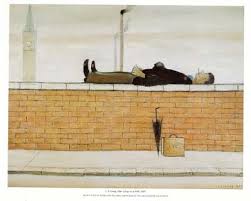
  1. Describe – and do no more. This is always the poet’s initial desire, to put into words what has caught our attention visually (and because attention has been visually caught there is something about this image or object that chimes with the writer’s subconscious). In terms of the poet’s intention, the wish to describe may be sufficient (the subconscious may do the rest). Examples might be Michael Longley’s ‘Man Lying on a Wall’ (from Lowry’s paiting of the same name) or William Carlos William’s ‘The Dance’ (from Breughel the Elder’s ‘Peasant Dance’).

imgres

  1. Describe but imagine beyond the frame – Derek Mahon’s ‘Girls on the Bridge’ (after Munch’s painting of the same name) does this, beginning with description of the scene but then wonders where the road leads away to in space, asks what the next day will bring (in time) and concludes with allusions to Munch’s more famous image ‘The Scream’: “bad dreams / You hardly know will scatter / The punctual increment of your lives”.

imgres

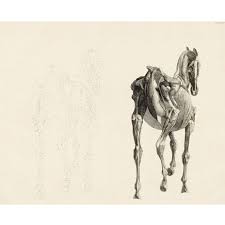
  1. Describe but incorporate researched materials – an easy option in the world of Google where the artist’s life or love life, the political context etc are easily accessed. Edward Lucie-Smith does this in ‘On Looking at Stubbs’ ‘Anatomy of the Horse’’, working with the gossip of local people in the Lincolnshire village where Stubbs worked at preparing the horse’s carcass: ‘His calm knife peeling putrid flesh from bone”.

imgres

Through Ventriloquism

  1. Make Main Figure Speak – the most common approach as famously done in Carol Ann Duffy’s ‘Standing Female Nude’ (from Georges Braque’s ‘Bather’). Thomas Hardy makes the Elgin Marbles speak in ‘Christmas in the Elgin Room’.


  1. Make Minor Figure/s Speak – UA Fanthorpe’s ‘Not my Best Side (Uccello’s ‘St George and the Dragon’) might be considered a hat-trick of the category above but her decision to make all 3 characters in the painting speak, casting side-lights to and fro, means I put it here. Delmore Schwartz’s ‘Seurat’s Sunday Afternoon along the Seine’ – while more free indirect speech than ventriloquism – has a similar effect, visiting each of the characters in Seurat’s picture and allowing their perspective to be aired.

imgres

  1. Make Objects Speak – this is an obvious category though I’m a bit short on illustrations of it. BC Leale’s ‘Sketch by Constable’ almost does it by concentrating attention on a tiny dog sketched in the corner of an image of Flatford Mill. Ann Ridler also comes close by largely ignoring the foreground figures and focusing on the landscape only in ‘Backgrounds to Italian Paintings’.


  1. Make the Artist Speak – writing about Van Gogh’s ‘Portrait of the Artist’s Mother’, Robert Fagles makes the artist speak, denouncing photography and preferring the expressive qualities of paint: “Of the life hereafter I know nothing, mother, / but when I paint you what I feel is yellow, / lemon yellow, the halo of rose”.


Through Interrogation

  1. Of the Artist – Vicki Feaver’s ‘Oi yoi yoi’ (on Roger Hilton’s image of the same name) starts with description but quickly begins talking directly to Hilton (“You were more interested / in her swinging baroque tits”). Interestingly, ekphrastic poems need not always stand in awe of the work; looking at Francis Bacon’s ‘Study for Portrait on Folding Bed’, Thomas Blackburn has a long one-sided conversation with the artist, charting a growing disenchantment with Bacon’s work, accusing him of “uttering, with superb, pretentious / Platitudes of rut, that you have said and said”.

 imgres

  1. Of the Figure/s – I have always admired Gerda Mayer’s poem, ‘Sir Brooke Boothby’ (after Joseph Wright’s image), in which she addresses with Sir Brooke about his languid pose, his copy of Rousseau, his intense scrutiny of the observer. Peter Porter’s many poems about art objects are hard to categorise but ‘Looking at a Melozzo da Forli’ (an image of the Annunciation) interrogates both image and the figure of Mary herself.

imgres

  1. Of Yourself – probably all ekphrasis is a sort of self-interrogation but some poems make this more clear. The address often takes the form of admissions of ignorance or obtuseness in the face of the image or the asking of rhetorical questions. Robert Wallace on ‘Giacometti’s Dog’ once again begins in description but asks questions about the fascination of the image, eventually concluding “We’ll stand in line all day / to see one man / love anything enough”.


Through Giving an Account

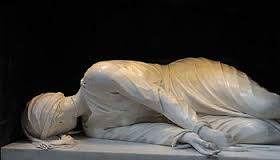
  1. Of Your Encounter – Wallace’s poem spills across these artificial categories and might be placed here, among poems where the poet explicitly records details of his/her encounter with the work of art. Yeats famously does this in ‘The Municipal Gallery Revisited’, looking at images of Augusta Gregory and John Synge. David Wright (who lost his hearing at the age of seven) movingly describes his visit to Rome to see Maderno’s sculpture of St Cecilia (patron saint of music) in his poem ‘By the Effigy of St Cecilia’.

imgres

  1. Of Gallery Visitors – poets often comment on the behaviour or experiences (imagined) of gallery visitors (and even the gallery attendants!). Gillian Clarke does this in ‘The Rothko Room’: “In this, / the last room after hours in the gallery, / a mesh diffuses London’s light and sound. / The Indian keeper nods to sleep, marooned / in a trapezium of black on red”.


  1. Of Others – admittedly a catch-all category this one, but sometimes (especially when the works of art appear in churches) the poet can be interested in speculating about the responses of more ‘ordinary’ people. Thom Gunn does this toward the end of ‘In Santa Maria del Popolo’ where Caravaggio’s ‘Conversion of St Paul’ is displayed. Having recorded his own response to the image he ends by staring at the old Roman women who come to kneel before it: “each head closeted // In tiny fists holds comfort as it can. / Their poor arms are too tired for more than this / – For the large gesture of solitary man, / Resisting, by embracing, nothingness”.

 imgres

Come At a Tangent

  1. Finally, the ekphrastic moment can be presented as if an after-thought, or illustration of a poem already half composed. There are famous examples of this, especially Auden’s ‘ Musee des Beaux Arts’ which spends most of its length contemplating in very general terms the way old paintings present suffering. Only towards the end does Auden refer to Breughel’s ‘Fall of Icarus’ which he describes in some detail to suggest how “everything turns away / Quite leisurely from the disaster”. RS Thomas’ ‘Threshold’ does something similar, only concluding with allusions to Michaelangelo’s painting of Adam in the Sistine Chapel. And Seamus Heaney’s ‘Summer 1969’ records a visit to Madrid as the Troubles boiled in Northern Ireland, and only latterly does the poem focus on Goya’s ‘Panic’: “Saturn / Jewelled in the blood of his own children, / Gigantic Chaos turning his brute hips / Over the world.imgres

Beyond Caravaggio and an old ekphrastic poem

51mrxjcbqcl-_sx351_bo1204203200_

Two things dove-tailing this week . . . My thoughts way ahead of time about ekphrastic poems (poems stimulated by visual art) in relation to the workshop I am scheduled to run at the Holburne Museum in Bath in February 2017. The particular exhibition was in the news this last week as they will be showing, amongst many others, a newly-rediscovered painting by Peter Breughel. Also I went to the Beyond Caravaggio exhibition at The National Gallery a couple of days ago. There, though the numbers of Carravaggios per square metre of wall space is relatively low, much of what’s on display by those who came under his influence is well worth seeing.

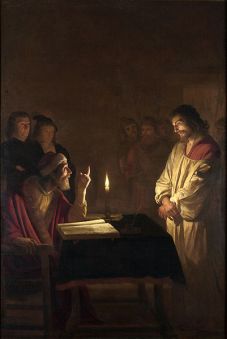
At the end of the 16th century Caravaggio brought an almost photographic precision to painting, mixing elements of still life with portraits and religious subjects. His people are caught (again almost photographically) in realistic seeming mid-gesture, twisting, stooping, hands wide or aloft. Then there’s the light: powerful light sources cast illumination and correspondingly deep shadows across the figures, darkening the brows of a face, across a hand at a card game, on exposed flesh. One of the ‘followers’ turns out to be Gerrit van Honthorst whose towering ‘Christ before the High Priest’ is displayed in the final room. As I came across it I had one of those moments of recognition. The picture has been in the National Gallery collection for many years and it provided the (ekphrastic) stimulation for one of my earliest poems.

401px-gerard_van_honthorst_-_christ_before_the_high_priest_-_wga11650

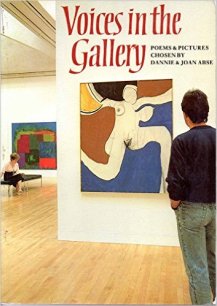
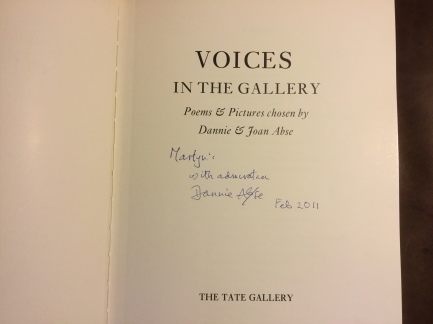
The poem eventually appeared in my first book, Beneath Tremendous Rain (Enitharmon, 1990) and I’ve always had a soft spot for it as Dannie Abse chose to include it in the plush, coffee-table anthology called Voices in the Gallery (Tate Gallery Publications) he edited 1986 with Joan, his wife and art historian. For a wannabe poet with no book yet it was a dizzying moment – a not-to-be repeated moment – being sandwiched between Zbigniew Herbert, W. H. Auden and Thomas Hardy! Year later I got Dannie to sign my original copy of it.

img_0229

The voice in my poem is naïve and unknowing, an art historian ignoramus (close to the autobiographical truth). But he looks hard, starting with a bewildered rationalism as he tries to get to grips with the stylised, stiff religious images of the “early galleries”. He understands he’s nothing more than one of the “casual visitors” who prefer to gaze at something familiar, the “recognisable gesture”, the more simply realistic and identifiable images contained in later works. But gradually he recognises the thorough-going empiricism of “dimension, distance and the need for accuracy” has its own limits (I still like the dig against my own gender’s devotion of facts, though the portrayal of the too submissive female partner I’d not let through these days).

The Expressionistic distortions of Van Gogh (“inconsistent with the camera”) begin to appeal to him as he understands the impossibility of a truly objective view (“eyes jaundiced / only with being human and limited”) which – he seems to be on a circular walk round the National Gallery – then allows him to re-assess the earlier images. With the passage of time and the loss of religious faith (I was sure of it then, back in the 1980s), these pictures also openly admit their distortions. Their “dogma is laughable now, or / almost so”. They obviously possess no camera-like claim to objectivity or all-inclusiveness. Rather they now seem to him to admit “in all self-consciousness, / other possibilities multiplying beyond the frame”. It’s at that point the image of Honthorst’s ‘Christ before the High Priest’ comes to mind. It seemed to me then an image that was interesting and powerful at least as much for what lies just out of sight as for what the casual visitor can see plainly.

Years later, in different poetic modes, I’m still intrigued by what lies just beyond our reach – the Daoist’s uncarved block of wood – still think it has as much power as what we plainly see. Here’s the old poem in full:


At The National Gallery


What am I to do with these angels’ wings,

with the literalness of these gaping heavens

and haloes in the early galleries?

No-one believes them. Beyond meaning,

they are absurd – mannered and posed figures

as unlikely as the nude’s fig-leaf, the wooden

gestures of saints staring straight through you:

uncomfortable attitudes, seeming content

with their fantasies of transfiguration and myth.


Yet casual visitors walk right past. They’re drawn

to quotidian scenes, the scruffy breeches, old hats

in later pictures where they scribble notes,

trying to capture the vanishing feelings

of viewing these captured moments

of vanishing things – the recognisable gesture

at an execution, on the river, in the boudoir.

And I with them, yet always end uncomfortably

tracing holiday strolls through Canaletto’s

Venice or impatient somehow with men

who explain to their quiet partners about

dimension, distance and the need for accuracy.


But Van Gogh’s crippled chair confounds them,

restores a sense of things perceived in ways

inconsistent with the camera, eyes jaundiced

only with being human and limited which is

other than the capture of fleeting things,

the stunned insect, and like verse that must

struggle to avoid its final stop: another fairy-tale

though there are no haloes, no heaven here.

And I go back to those old pictures to find

their appeal, uncovered, is the honesty, almost

innocence, time has forced upon them,

for what was then dogma is laughable now, or

almost so. Uncameralike, their contentment admits,

rather asserts in all self-consciousness,

other possibilities multiplying beyond the frame:


like the one candle, illuminating a room,

the gleaming tabletop, across which one detailed,

serious face confronts another, unnaturally

bound in by a darkness in which we make out

nothing, yet know someone moves inches beyond

vision, rising, strained forward and demanding:

Give me some light, I say, lights! Now! A taper!

img_0231