Beyond Caravaggio and an old ekphrastic poem

51mrxjcbqcl-_sx351_bo1204203200_

Two things dove-tailing this week . . . My thoughts way ahead of time about ekphrastic poems (poems stimulated by visual art) in relation to the workshop I am scheduled to run at the Holburne Museum in Bath in February 2017. The particular exhibition was in the news this last week as they will be showing, amongst many others, a newly-rediscovered painting by Peter Breughel. Also I went to the Beyond Caravaggio exhibition at The National Gallery a couple of days ago. There, though the numbers of Carravaggios per square metre of wall space is relatively low, much of what’s on display by those who came under his influence is well worth seeing.

At the end of the 16th century Caravaggio brought an almost photographic precision to painting, mixing elements of still life with portraits and religious subjects. His people are caught (again almost photographically) in realistic seeming mid-gesture, twisting, stooping, hands wide or aloft. Then there’s the light: powerful light sources cast illumination and correspondingly deep shadows across the figures, darkening the brows of a face, across a hand at a card game, on exposed flesh. One of the ‘followers’ turns out to be Gerrit van Honthorst whose towering ‘Christ before the High Priest’ is displayed in the final room. As I came across it I had one of those moments of recognition. The picture has been in the National Gallery collection for many years and it provided the (ekphrastic) stimulation for one of my earliest poems.

401px-gerard_van_honthorst_-_christ_before_the_high_priest_-_wga11650

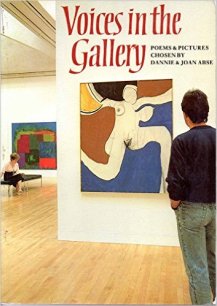
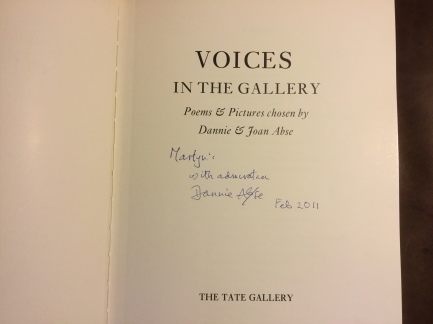
The poem eventually appeared in my first book, Beneath Tremendous Rain (Enitharmon, 1990) and I’ve always had a soft spot for it as Dannie Abse chose to include it in the plush, coffee-table anthology called Voices in the Gallery (Tate Gallery Publications) he edited 1986 with Joan, his wife and art historian. For a wannabe poet with no book yet it was a dizzying moment – a not-to-be repeated moment – being sandwiched between Zbigniew Herbert, W. H. Auden and Thomas Hardy! Year later I got Dannie to sign my original copy of it.
img_0229

The voice in my poem is naïve and unknowing, an art historian ignoramus (close to the autobiographical truth). But he looks hard, starting with a bewildered rationalism as he tries to get to grips with the stylised, stiff religious images of the “early galleries”. He understands he’s nothing more than one of the “casual visitors” who prefer to gaze at something familiar, the “recognisable gesture”, the more simply realistic and identifiable images contained in later works. But gradually he recognises the thorough-going empiricism of “dimension, distance and the need for accuracy” has its own limits (I still like the dig against my own gender’s devotion of facts, though the portrayal of the too submissive female partner I’d not let through these days).

The Expressionistic distortions of Van Gogh (“inconsistent with the camera”) begin to appeal to him as he understands the impossibility of a truly objective view (“eyes jaundiced / only with being human and limited”) which – he seems to be on a circular walk round the National Gallery – then allows him to re-assess the earlier images. With the passage of time and the loss of religious faith (I was sure of it then, back in the 1980s), these pictures also openly admit their distortions. Their “dogma is laughable now, or / almost so”. They obviously possess no camera-like claim to objectivity or all-inclusiveness. Rather they now seem to him to admit “in all self-consciousness, / other possibilities multiplying beyond the frame”. It’s at that point the image of Honthorst’s ‘Christ before the High Priest’ comes to mind. It seemed to me then an image that was interesting and powerful at least as much for what lies just out of sight as for what the casual visitor can see plainly.

Years later, in different poetic modes, I’m still intrigued by what lies just beyond our reach – the Daoist’s uncarved block of wood – still think it has as much power as what we plainly see. Here’s the old poem in full:


At The National Gallery


What am I to do with these angels’ wings,

with the literalness of these gaping heavens

and haloes in the early galleries?

No-one believes them. Beyond meaning,

they are absurd – mannered and posed figures

as unlikely as the nude’s fig-leaf, the wooden

gestures of saints staring straight through you:

uncomfortable attitudes, seeming content

with their fantasies of transfiguration and myth.


Yet casual visitors walk right past. They’re drawn

to quotidian scenes, the scruffy breeches, old hats

in later pictures where they scribble notes,

trying to capture the vanishing feelings

of viewing these captured moments

of vanishing things – the recognisable gesture

at an execution, on the river, in the boudoir.

And I with them, yet always end uncomfortably

tracing holiday strolls through Canaletto’s

Venice or impatient somehow with men

who explain to their quiet partners about

dimension, distance and the need for accuracy.


But Van Gogh’s crippled chair confounds them,

restores a sense of things perceived in ways

inconsistent with the camera, eyes jaundiced

only with being human and limited which is

other than the capture of fleeting things,

the stunned insect, and like verse that must

struggle to avoid its final stop: another fairy-tale

though there are no haloes, no heaven here.

And I go back to those old pictures to find

their appeal, uncovered, is the honesty, almost

innocence, time has forced upon them,

for what was then dogma is laughable now, or

almost so. Uncameralike, their contentment admits,

rather asserts in all self-consciousness,

other possibilities multiplying beyond the frame:


like the one candle, illuminating a room,

the gleaming tabletop, across which one detailed,

serious face confronts another, unnaturally

bound in by a darkness in which we make out

nothing, yet know someone moves inches beyond

vision, rising, strained forward and demanding:

Give me some light, I say, lights! Now! A taper!

img_0231

The Politics of the ‘Daodejing’

IMG_0217.JPG

I travelled north to Bradford earlier this week to read from my versions of the Daodejing. For the first time a reader of Mandarin was present to read from something approaching the original texts. Bradford artist Yan Wang read beautifully as well as providing the evening with a couple of large banner-scrolls of chapters from the text. The whole evening had been organised by an old friend, Bruce Barnes, a poet and tireless organiser and more recently translator of long-neglected work by Kosuke Shirasu, a Japanese proletarian writer from the 1920/30s. I read Bruce’s ‘interpretations’ of Shirasu’s work (done with the help of Jun Shirasu and published as Out of his struggles (Utistugu Press, Bradford) on the train back to London and it reminded me that I had wanted for a while to organise my thoughts about the political elements in the Daodejing poems. (Poem titles in brackets are those I have given to the individual ‘chapters’ of the text).

img_0215

It’s generally accepted that one of the purposes of the collection of texts called the Daodejing is to instruct about good government. Chapter 46 (Annexation) argues that when government adheres to the Way – the teachings of the Daoist ideas – then its great parades of horses “are put out to grass to fertilise the ground”. It’s when government neglects the Way that its “war horses sire and foal / even on sacred ground”. Such neglect leads to personal and political “unsteadiness” which Chapter 26 (‘Breath-taking Scenes’) identifies as the “loss of all authority”. This is authority in its truest sense because in other poems we read of aggressive, power-grabbing behaviour which is also a way of neglecting Daoist ideas. Chapter 29 (‘What is Fixed’) describes those who grab at “earthly power” who are as liable to smash it as gain any advantage.

One of the key chapters, 67 (‘Three Treasures’) goes so far as to suggest that “only one reluctant to grasp power / is properly capable of government”. One clear attitude in these poems is that busy, hyperactive government – one that “grows brisk full of initiatives” – is an error:


those who hope

to rule by dishing out

press releases

a multiplicity of choices

are the con-men

of the nation

Chapter 65 (‘Blizzard’)

imgres

This distrust of big government is compounded when those with power try to ingratiate themselves with those they rule. With very little modernisation, the Daodejing is suspicious of those politicians who “style themselves ‘man of the people’ / sometimes ‘housewife’ / they like to say ‘we are all in this together’” (Chapter 39). What lies behind such cynical declarations is a real hunger for power as an exercise of ego (not true government). Laozi is very clear that such egoistic motives lead only in one direction for a nation: war.


–those who govern my teacher says

must oppose conquest by force of arms


such methods swiftly rebound

thorn and bramble where troops assemble

Chapter 30 (‘Scorched Earth’)

nuclear_artillery_test_grable_event_-_part_of_operation_upshot-knothole

Leaders (and the Daodejing never really doubts that human society needs leaders of a sort) need to adhere to the Way and encourage their people to do the same. Chapter 37 (‘Dispassion’) puts it succinctly:


—the way enacts nothing yet through it all things are achieved

if the powerful

possessed themselves of it

the ten thousand would be transformed


once transformed if they begin

to demand action

they ought to be constrained

with the uncarved wood quality of namelessness


the unconditional quality of the nameless

evokes dispassion—

hence it is to be still


so the nation pursues its way in peace


This idea of ‘constraint’ begins to sound authoritarian again but elsewhere it appears our political leaders are being advised not to over-encourage our expectations. Chapter 19 (‘Fewer Wishes’) advises that a people’s restlessness ought to be dealt with by offering them “simplicity / to behold give them the uncarved block // give them selflessness give fewer wishes”. In our world of unconfined desire and acquisitiveness (the point of being alive?) this sounds suspect perhaps but is perfectly in line with those who choose to opt out of modern life towards simplicity, fewer possessions etc. The uncarved block is a recurring image representing the fullest presence of life and experience before we begin to hack away at it with our self-centred preconceptions. The three virtues of the Daodejing are to be compassionate, to be frugal and to lack ambition.

daodejing

The point is that Daoist thinking is optimistic about human nature. There is a Rousseauistic quality to its belief in the goodness of mankind as a noble savage who has for too long been corrupted by interference, too many codes of behaviour imposed from above. This is where the poems’ anti-Confucian elements are most obvious. Chapter 18 (Codes of kindness’) argues it’s only when the Way “falls into disuse / codes of kindness thoughts / of morality evolve”. Laozi argues we are better off without such rules of codified behaviour. This is not quite anarchism but certainly a powerfully libertarian thread runs through the work. In one of the most striking images in the whole sequence, Chapter 60 (‘Recipe’) compares true government to the cooking of a “delicate fish”. It requires the gentlest of touches:


no agitation

or any demon

or the fretting

of your own spirit


no shuffle or harm

or sudden injury

but aid and attend

gain advantage


the power to feed

the common purpose

maxresdefault

It’s this delicacy, gentleness, almost passivity of government that leads Laozi to associate this approach with the stereotypically ‘female’. Early on, in Chapter 6 (‘Valley’) we are told the spirit of the Way is “[a] valley without end / it is female it is called mysteriousness”. This translates politically into government playing a largely passive role (as does the good teacher) to show, facilitate, enthuse, give space, watch and approve. Government must be honest, give the tools, give opportunities, do its job well. Its role is to synthesise and connect (not disconnect or sever), shed light (but without dazzling, even inadvertently), use a delicate touch, be tangential. Its actions call forth responses to the fact it acts, plans, demands. Better back off, do not intervene, don’t use imperatives, perhaps use no words at all. It is better to play the female part, be passive, give space, encourage desired behaviours, neglect all else.


Tributaries

chapter 61


—strong nations must play the low ground

to which all contributing waters flow

the point to which all things converge

so their invitations issue from stillness

through quiescence they gather power

let’s call that female and the male cannot

resist he brings his watery tributes

and she gains adherents he procures favour

as she looks to embrace and empower

he finds himself part of a greater thing

in this way becomes part of creation

so both thrive both discovering bliss—

real power is female it rises from beneath

Study of a Kneeling Boy Bending a Bow, for Dorchester House c.1860 by Alfred Stevens 1817-1875

Like the cooked fish, another memorable image is the bending of a bow. As it is bent the top (of society) descends earthwards while what is “nearest the earth is raised up”. This is the ideal process of government in the Daodejing. Only in Chapter 80 (‘The Commonwealth’) does Laozi give something of a portrait of the contentedly ruled society. It is small, hard-working, has basic needs met; it has the capability of greater luxury (and also weapons) but none of these are made use of. This little society is aware of others around it (perhaps run on different lines) but its people are so content they feel no desire to travel.

Idealistic without doubt. But does this even sound attractive? It’s unlikely to – given our absorption into our consumerist society, our expectations that government ought to provide and lead. But we don’t need to look far to see systems breaking down and at the least what the Daodejing offers is an alternative vision of the exercise of power in society. It’s a vision that is over 2000 years old which means it’s either well past its sell-by-date or that it contains some wisdom that we ought not to ignore.

Autosave-File vom d-lab2/3 der AgfaPhoto GmbH
Martyn and Yan Wang reading from the ‘Daodejing’ for Beehive Poets, Bradford

2016 Forward First Collections Reviewed #2: Nancy Campbell

This is the second in the series of reviews I will post over the next two months of the 5 collections chosen for the 2016 Forward Prizes Felix Dennis award for best First Collection. The £5000 prize will be decided on 20th September. Click here for all 5 of my reviews of the 2015 shortlisted books (eventual winner Mona Arshi).

The 2016 shortlist is:

Nancy CampbellDisko Bay (Enitharmon Press)
Ron CareyDistance (Revival Press) – click here for my review of this book
Harry GilesTonguit (Freight Books)
Ruby RobinsonEvery Little Sound (Liverpool University Press)
Tiphanie YaniqueWife (Peepal Tree Press)

disko_bay[1]

Thanks to Enitharmon Press for providing a copy of Nancy Campbell’s book for review purposes.

The concluding poem of Nancy Campbell’s collection Disko Bay is, I think, a good place to begin. In ‘Giving Up on Capitalism’, an unnamed boy makes kayaks and sells them for one, then two kroner (these poems are mostly set in Greenland). He hands his earnings to his mother who buys basics like coffee, sugar, needles, cotton and, more ominously, whisky. If this is the nirvana of capitalist enterprise it hardly gets beyond subsistence level and then only to poisonous effect. On the third occasion he instead decides to construct a kayak for himself: taking the few remaining skins, he “pegged them down deftly / and paddled away”. The point of rejection is simply made, but the simplicity has a mythic, typological impact. The poem’s form is simple, repetitive, like a piece of folklore, an oral transmission perhaps, and – characteristic of the whole collection – the vocabulary is plain to such a degree that the reader is impressed by a paucity or poverty or essentialism (depending on how successful you think it is). Certainly this is a book unlike any other you’ll read this year, drawing on myths and landscapes of the far north (the opening section of the book has poem titles in Greenlandic first, then English). Its impact is often impersonal but Campbell’s knowledge derives from her several residencies in the region and she deploys it in a skilful and poetically knowing fashion.

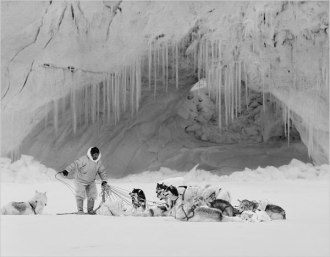
greenland5

Above all, these poems convey the harshness of scraping a human existence in the Arctic Circle, perhaps most obviously in the section called ‘Ruin Island’. An epigraph quotes the Eskimo, Osarqaq: “Our tales are narratives of human experience, and therefore do not always tell of beautiful things”. Several poems follow the exploits of Qujaavaarssuk, a heroic figure and general strong man, who is reduced to singing a dirge at the troubled fishing grounds and is advised by “a man who is not his father” (a break in traditional forms of transmission here?) that the one thing to be relied upon is that “hunger will come of its own accord”. ‘Hospitality’ in such circumstances may consist of feeding guests “the kidneys of a black seal / as the ice harden[s]”. Qujaavaarssuk’s immediate difficulty is the presence of too much ice (a deliberately ironic comment on the shrinking ice caps of our day): he sees the shadows of seals moving beneath it and sets out “to the ice edge to follow them” but what Campbell is interested in (these are contemporary poems, not slavish myth-reproductions) is the failure of the hunter. In ‘Danger of Snow Blindness’, Qujaavaarssuk returns for the first time “his sled empty, his kamiks [boots] clean”. ‘The Last Seal’ opens:

There was nothing left to feed the dogs.

Qujaavaarssuk shot them, one by one

and fed them to each other.

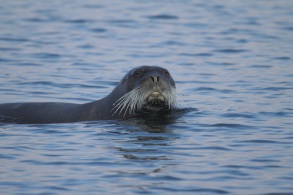
seal-5

To the contemporary reader, what lies largely unspoken beneath these chilly, often curt, unsentimental chips off a mythic block is, of course, our own awareness the adverse effects of climate change. ‘Ruin Island’ becomes apocalyptic in tone so that the words spoken by a hunter that conclude the sequence, words spoken by Jorsias Ammonsen in a real interview conducted in 2006, are presented as the reply of a hunter “who can no longer hear the question”. In this way, Campbell tragically ironises Ammonsen’s proud, nostalgic, heroic, perhaps hopeless comments:

When we were young

no place seemed too far away for hunting.


We travelled a long way,

too far to come back the same day.

We slept in stone caves

and were cold in winter.


Nothing is too harsh

when you are accustomed to it.

Nancy Campbell 2012

Campbell tries to remain true to the plain directness and dignity of such a voice in most of these poems. The figure of the poet seldom intrudes. When it does she is trying to learn the “soft uvulars” of a new language which seem like “dark flocks of sound I’ll never net, or say”. Difficulties of expression in one language are compounded by problems of communicating across distance to her own homeland: “Since I can’t post a letter this far north, / I’m sending you an Arctic snowstorm”. ‘The Night Hunter’ is typical in its use of a simple lexis – snow, door, harbour, boat, blood, sled, knife – and a repeating form of verse as if the polar climate has sheared away more baroque elaborations of language and form. At first this feels cramping, but as Campbell persists and insists this really is what she intends, the simplicity seems more likely to put us in touch with the elements, the elemental, the bottom line of harsh Arctic existence.

With figures like the hunter Qujaavaarssuk so prominent you might anticipate a macho sort of world but the harsh conditions seem to teach an underlying humility (even to men) and Campbell has a number of female narrators who are clearly no push over. In ‘The Seal People’ a seal hunter’s wife watches the vindictive spirits of killed seals approach by boat and though threatened by them her voice does not falter through three steady quatrains, the verse’s repetitions here expressive of her firm courage. ‘The Hunter’s Wife Becomes the Sun’ is a major poem (its form is a sestina with its obsessive recurrences). Here, a hunter’s wife gives him a tinny Christian memento for protection. The hunter is more concerned with the reality of death and an apocalyptic sense of the world’s end (Campbell’s chosen rhyme words are tin, angel, window, box, candle, darkness). But his wife insists on the need for “light”, transforming herself into a “vast white wake / of stars” which might be considered angels, though the man himself finds it hard to shrug off his pessimism: “At the world’s last window, I light another candle”. The shamanic implications of their exchange are more explicitly played out in three translations of crude Greenlandic Qavak songs, originally collected in the 1950s. They are spoken by a “terrible mother” a “female shaman” and an omniscient “wicked woman”, the latter advising the only way to tackle an enemy is to bite off and employ her clitoris as an arrowhead. Neither the blunt obscenity or implied moral judgement can hide the suggestion that this remote culture clearly understands the importance of the female in ultimate survival.

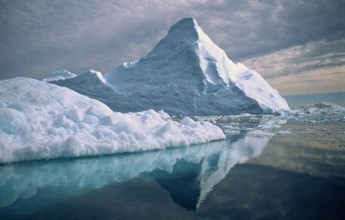
iceberg-in-disco-bay-greenland_6a7e

One of the impressive things about Disko Bay is that it is eco-poetry without shed loads of landscape description. Those vindictive seal spirits carry a powerful ecological message in their “round, black eyes” – less for the Greenland hunter and his wife (whose place and role within a traditional, sustainable Arctic ecosystem is be unlikely to unbalance things) but to us with our petrol engines, plastics and carbon complacencies. Another success of the book is its use of myths redolent of Nordic and North American materials without distracting echoes of Ted Hughes’ trickster figure Crow. In ‘Fragment’ a severed raven’s wing in the snow is enough to imply the global problem: “Never to breed, never to scavenge / on scarlet seal hearts by the ice edge”. It is brave of Campbell to delay the more eco-explicit poems to later sections of the book. Part three sets off from the premonition that “the future is full of riddles” and ‘Conversations’ conveys both the mystery and the certainty of climate change: “I don’t think it is one thing / I think it is a combination of things / a combination of everything”. The riddle-subjects appropriately include a tsunami and an iceberg but not the dirty complexities of the ever-hungry, seldom-satisfying capitalism rejected by the boy who constructs a kayak not to be sold but for his own setting out in this fine, unusual book’s concluding poem.

Read more on Nancy Campbell – in discussion with Forward Arts Foundation.


Where’s My Master Gone – Don Paterson v Li Po

Don Paterson’s 1997 book, God’s Gift to Women (Faber) includes a poem sporting the title ‘On Going to Meet a Zen Master in the Kyushu Mountains and Not Finding Him’. The reader’s eye hops off the perch of this lengthy title only to flutter down, looking in vain for a foothold, for a line, even a word – it’s a completely blank page. In a collection that includes a poem called ‘Postmodern’ and another on ‘The Alexandrian Library’, the joke is obvious enough. Any search for ‘masterly’ advice in the Kyushu Mountains or closer to home in a post-modern, relativist world in which language hides as much as it might reveal, must draw a blank. I remember seeing the poem – probably heard Paterson ‘read’ it too – the long title building expectation, a too-long pause, the announcement of the next poem (cue laughter) – and something bothered me. I think now I know what it was.

imgres

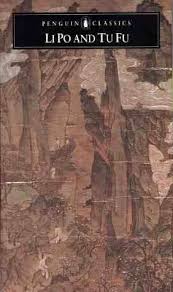
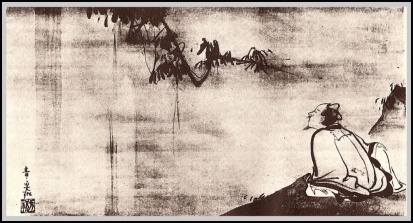
I wondered if Paterson had been reading the Penguin Classics selection of Li Po and Tu Fu (tr. Arthur Cooper, 1973). The Li Po selection opens with the poem ‘On Visiting a Taoist Master in the Tai-T’ien Mountains and Not Finding Him’. Cooper’s note tells us that ‘Visiting a Hermit and Not Finding Him’ is actually a very common theme in Chinese poetry. Such a poem (we are told) is not just an excuse for a “nature poem” but relates to the frequent “spirit-journeys” that Li Po was fond of writing. Here is Cooper’s translation:


Where the dogs bark

by roaring waters,

whose spray darkens

the petals’ colours,

deep in the woods

deer at times are seen;


the valley noon:

one can hear no bell,

but wild bamboos

cut across bright clouds,

flying cascades

hang from jasper peaks;


no one here knows

which way you have gone:

two, now three pines

I have leant against!

3-li-po

I had come across this poem while compiling my first book, Beneath Tremendous Rain (Enitharmon, 1990). I liked it for reasons I didn’t then understand and, in a very simple form of translation, I wrote an up-dated version:


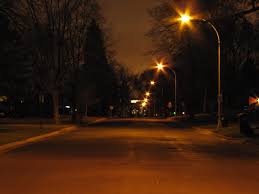
Looking for an Old Man


Where red dogs bark

on the sodium ring-road

and traffic noise

blackens adjacent houses,

I’ve come to seek you.


In each garden I pass,

pale heads of bindweed.

The night is undistinguished.

The savour of coalsmoke

flattens across the kerb.


No-one here knows

which way you have gone:

two, now three lampposts

I’ve leant against.

images

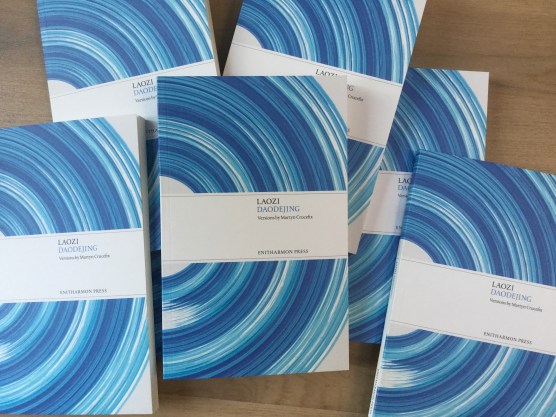
Li Po is the more Daoist of the two poets presented as a complementary pair in this Penguin book. Now, with a bit more understanding of this tradition, I’m sure that 26 years ago I was responding to something at the heart of the poem. The fact that the Daoist master cannot be found by the searching student is precisely the point since the Daoist teacher teaches “in the absence of words” (Chapter 43, ‘Best Teaching’) as I translated it in my version of the Daodejing (Enitharmon, 2016).

Interestingly, Li Po’s poem expresses this not with a blank page but (as Cooper says) through further encounters with “nature” (petals, woods, deer, valley, bamboo, clouds) or, in my version, the natural and urban world (ring-road, traffic, houses, garden, bindweed, coalsmoke, kerb). Whether we designate this a ‘spiritual’ journey or not, the point remains that the student’s search for knowledge in the form of a direct download from some master must be denied. The student’s anxious search for guidance is reflected in the number of pines/lampposts he leans against as well as the geographical over-specificity of the titles of such poems. The student’s dependency and naïve optimism is the satirical butt of the poem as he is directed back to the source of all knowledge (the world surrounding him) even as he wanders in search of his master. So Paterson’s 1997 version achieves three things: it misrepresents the spirit of the original, it’s more dramatic (comic), it’s more superficial.

imgres

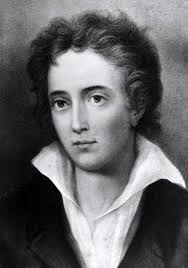
When I first read Li Po’s poem I was coming off the back of doctoral work on the Romantics, especially Shelley whose ‘A Defence of Poetry’ (1821) argues that the “poetry in [our] systems of thought is concealed by the accumulation of facts and calculating processes [. . .] we want the creative faculty to imagine that which we know”. This is succinctly put in Keats’ idea of Negative Capability, defined as a passive openness to the fullest range of human experience (“uncertainties, Mysteries, doubts”) without any imposition of preconceived notions, ideas or language: “without any irritable reaching after fact & reason”. The student in Li Po’s poem seeks just such certainties and facts and is gently deflected back into the world of observation where (I take it) he is encouraged to pursue a more full-blooded, full-bodied, open-minded encounter with the 10,000 things which (in Daoism) constitute the One, ‘what is’.

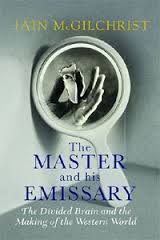
The two attitudes to knowledge here are really two ‘ways of being’ as Iain McGilchrist’s fascinating book, The Master and his Emissary (Yale, 2009) phrases it. McGilchrist argues that right and left human brain hemispheres deliver quite different kinds of attention to the world. The left perceives the world as “static, separable, bounded, but essentially fragmented [. . .] grouped into classes”. Shelley described this in 1821 and linked it to the processes of Reason and this is the attitude to knowledge and education that the anxious student of Li Po’s poem possesses. In contrast, what Shelley calls Poetry or the Imagination is what McGilchrist associates with the right brain. It tends to perceive “the live, complex, embodied, world of individual, always unique beings, forever in flux, a net of interdependencies, forming and reforming wholes, a world with which we are deeply connected”.

imgres

Without doubt, this is also the viewpoint of the Daoist master whose teaching evokes the uncarved block, the One, and who teaches best without words. Ordinary language usage is dependent on conceptual thought which is left-brain work – ordering, categorising, re-presenting the minute particulars of the world as they are perceived by the right brain. I imagine that Li Po’s master-teacher and sage is deliberately hiding somewhere beyond the bamboo canes – and this is part of the student’s lesson.

So Don Paterson’s blank page bothers me because – as McGilchrist expresses it – it represents a rather glib, post-modern position, a scepticism about language which is in danger of throwing out the interconnected real world along with the suspect tokens and counters of left-brain language: “To say that language holds truth concealed is not to say that language simply serves to conceal truth [. . .] or much worse, that there is no such thing as truth” (McGilchrist, p. 6). I’m also reminded of Yves Bonnefoy, engaging in his own battle with the early stirrings of French post-modernism. He writes: “This world here exists, of that I am certain [. . .] It is simply with us. In what can be felt and sensed”. In The Tombs of Ravenna (1953), he names this underlying truth, not as existence, but as “presence”. The right brain knows this; the left brain sets about fragmenting it, making use of it, disappearing it.

images
Yves Bonnefoy

Explaining Water Images in the ‘Daodejing’

Daoism has been referred to as the Watercourse Way because of the importance of water images in its key source, the Daodejing. I thought much about these images in translating/versioning these ancient Chinese texts and I want to record a few thoughts systematically here. However, as you’ll see, trying to ‘fix’ something runs counter to the Way – yet even if what we seek runs through our hands, the effort to consider the role of such images is worthwhile. (I have blogged about other images in the Daodejing here).

images

The Daodejing uses water images in two ways. Firstly as an image of the ineffable One, the plenitude that lies at the heart of all its thinking – imagine the vastness of the ocean, the unfixable flux of flowing water, never the same river twice. The texts also use water images to suggest aspects of our behaviour (personal and political) if we are acting in accordance with the Dao or Way. Many use metaphors of water in such a way that the vehicles are clear and recurrent (ocean, pool, river, stream) but the tenor remains an empty set, never defined because in its nature indefinable in language or figures.

So Chapter 1, ‘Nursery’ (I’ll give my titles as well as traditional Chapter numbers), introduces water images while giving a clear indication of the short-comings of all language. It deploys a metaphor that immediately undermines the efficacy of its own figurative language: “the path I can put a name to / cannot take me the whole way”. Even what can be named can only be grasped through a further metaphor: the “nursery where ten thousand things / are raised each in their own way”. What lies behind the phenomena of our world can only be suggested through additional metaphors such as a “mould”, a “source”, a “mystery”. Even this is not enough; more than a mystery it is “a riddle set adrift on a mystery”. In my version I introduced a watery context for the source itself (indefinably, untrackably “adrift”). I then developed this to image it as a body of water held behind a “flood-gate” which only in release and inundation delivers “greater truth”. The original Chinese text shifts its metaphors rapidly in just this way and this is what gives this opening Chapter the peculiar sensation of telling a clear truth that remains just beyond our grasp.

images

A similar image of a body of water occurs in Chapter 4, ‘Something greater’. The tenor of the metaphor is again reduced to “it” in the opening line.  The context indicates that “it” is the Dao itself, the One that precedes and contains all things, that state of wholeness and plentitude towards which the path of the Dao leads. Here the tentative nature of the metaphor is indicated firstly through the opening imperative – “imagine” – and then because the text itself consists of proposed alternatives to this very image. The opening formulation emphasises the Dao’s infinite nature, its resource: “a vessel to be drawn from / one that never needs to be re-filled // the bottomless source of all things”. This image of a bottomless water source is revised a few lines later in the form of a question: “is it rather a pool that never runs dry” yet this follows 4 other metaphorical formulations of the Dao’s beneficial effects:


fretted edges are smoothed within it


knots untangled all dazzle eased

all blinding clouds of dust slowly cleared

images

And the poem calmly goes on to declare its own ineffectiveness: “we cannot know it as a bodiless image / it must pre-date every beginning”. Even the concept of origin, or beginnings, is not adequate to convey the full force of the Dao but the fluidity of water – impossible to grasp, capable of taking any shape, a life-giving source – seems to come close.

The second way in which water images are used in the Daodejing is as a gesture towards actual human behaviours which occur when we are influenced by the Dao: in knowing that the truth of the Dao is like a watery flood, we behave in a water-ish fashion. So ‘The great rivers’ (Chapter 32) reminds that the Dao “has no name” and uses one of the other recurring images of it (the uncarved block of wood). If “the powerful” would attend to the nature of the Dao they would be successful “without recourse / to compulsion or law”. One of the recurring political beliefs of these texts is that if society is organised and governed in accordance with the Dao then people will live in “harmony” without even trying (indeed it is the trying that causes the harm – see wu wei below). Metaphorically, this translates as a society knowing “when to call a halt” to our distancing from truth (the hacking of the block, the reliance on naming/language, our remoteness from the ‘water’ source that is the Dao). The poem ringingly concludes with the image of right human behaviours being likened to the natural flow of water:


all things come to those

who follow the way

as all wild streams

and all unruly torrents

drive eventually

to great rivers the sea

images

Water is also the image used to consider more individual behaviour. ‘Best teaching’ (Chapter 43) opens rhetorically, alluding again to water:


—what of all things is most yielding

tell me what overwhelms the hardest


without solid form itself what flows

penetrates even the smallest gap


This understanding of the action of water in its pliability and fluidity, its erosion effects and its penetrability, reminds the poet of the concept of wu wei, or non-action, another untranslatable but key idea in the whole sequence. This is the wise person’s ability to achieve actions or goals without determined or intended pursuit of them. I have translated this as “unacted deed” and this poem immediately links this to the art of teaching, the best of which “occurs in the absence of words” (show not tell?). Water is an appropriate image for this in its passivity yet power, its pliability yet ineluctable nature. The poem ends almost with a shrug at the difficulty of grasping such concepts or behaviours:


the unacted deed the indirect

direction—it’s hard to comprehend

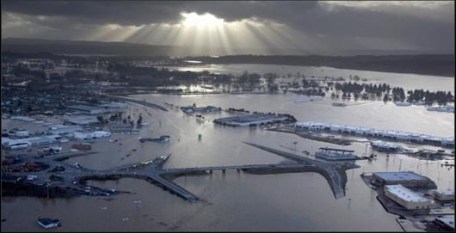
chehalis_flood_sunshine

The text of ‘Clearest words’ (Chapter 78) reinforces the image of water as a key aid to understanding Daoist thought:


—there is nothing in the world more soft

more yielding than water

yet in conflict with hard resistant things

there’s nothing better

and there is no way to alter this

what is yielding will defeat what resists

these are facts clearly known to all

why don’t we make better use of them


In these final lines we can perhaps hear Laozi’s legendary disgruntlement with the parlous state of the real world – why don’t we put known truths into action? Yet here again, the poem concludes by recognising how difficult such simple principles can be to grasp: “even clearest words are contradictory”.

Chapter 61, ‘Tributaries’, returns to a more political perspective with its comments on how “strong nations” ought to behave. The action of water in relation to both geography and gravity is the figure used on this occasion:


—strong nations must play the low ground

to which all contributing waters flow

the point to which all things converge


This ensures that any exercise of power by such nations will “issue from stillness” and “quiescence” (according to the principle of wu wei) rather than self-assertion, anxious, fearful imposition, bullying. It’s this (former) sort of behaviour that the Daodejing repeatedly returns to and characterises as “female” and what follows is one of the most beautiful passages where water images are integral to the meaning:


[ . . . ] and the male cannot

resist he brings his watery tributes

and she gains adherents he procures favour

as she looks to embrace and empower

he finds himself part of a greater thing

in this way becomes part of creation

so both thrive both discovering bliss—

real power is female it rises from beneath

url

This coincidence of water images and female images and the description of the passive exertion of power, nourishment, subtlety, irresistibility, is wholly characteristic of these poems. The image of water collecting at its lowest point – power exerted by doing nothing – is likewise the focus of ‘Influence’ (Chapter 66) which explicitly links such calculated passivity with virtuous potency:


—how do rivers and seas secure mastery

over the hundreds of lesser streams

through lying lower than they do


so to govern or teach you must stand

and acknowledge you are beneath the people

to guide them put yourself at the rear


only in this way can true leaders rise

not stifling people with their being on top

not bullying them into harm’s way


only this way all things under heaven

are content to range under your influence

not find instruction provocative—


a teacher achieves not by trying to achieve

and because she does not strain to succeed

there’s no-one comes forward to compete

File 03-03-2016, 09 02 50


Poetry at Palmers Green: live review (April 2016)

When reviewing my first year of blogging on poetry and related matters (see blogI said I wanted to review more live events. That has not happened really but this week I wanted to rectify that to some degree.

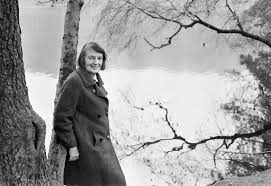
Last Saturday I drove a few miles north to Palmers Green, best known to the poetry world of course, as the home ground of Stevie Smith who moved there when she was three years old. She was educated at Palmers Green High School and North London Collegiate School for Girls and lived in the area until her death in 1971. I first became aware of the current poetry activity in the area a few years ago when I went to readings at the bookshop in the High Street run by Joanna Cameron.

images
Stevie Smith in the park in Palmers Green

But in 2006 the Palmers Green Bookshop was forced to close, the lease was sold on and I think it was an opticians that opened in its place. Since then a number of local poets and enthusiasts have been keeping poetry alive with 6 monthly poetry readings at Stevie’s church, St John’s, N13 4AL. The readings take place in the Parish Centre adjoining the church and are always friendly and well-programmed evenings. I’d recommend them if you’re in the area (Contacts: Katherine Gallagher  or Myra Schneider and on Facebook).

images

The evening was introduced with clarity and authority by Lynda How and readings took place as the April evening sun set outside. The Parish Centre looks at first a little soulless but with its shades-of-yellow decor, surprisingly tasteful lighting and pitched wedding-cake-white roof it is actually a venue which has a good acoustic and a disarming and warm atmosphere. The first reader was Danielle Hope, whose new book is Mrs Uomo’s Yearbook (Rockingham Press, 2015) from which she read the entertaining and instantly recognisable out-of-season seaside resort description  ’Llandudno Winter’. Recognisable to most of the audience it seemed and as I spent a couple of years in digs in Morecambe I knew the “please-remove-wet-shoes-at-door / heating-on-from-seven-to-eight / no-radiator-in-bar / low-watt-lamps” guesthouse. Her translations from the Italian are also impressive (Montale’s ‘Eastbourne’) and the Mrs Uomo poems manage to combine humour and acute observation with a more serious satirical edge. Mrs Uomo teaches her cat economics at one point but more poignantly is left awaiting an operation having “improved against [the NHS] recently refreshed thresholds”. Hope works as a doctor in London and knows what she is talking about here and her poems are always a pleasure to listen to delivered in a colloquial, un-stylised fashion.

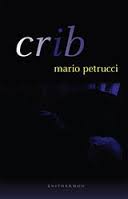
In contrast, Mario Petrucci read slowly and deliberately from crib (Enitharmon Press, 2014) which is a selection from the 111 poems he wrote during the first year of his son’s life (Mario was kind enough to allude to my own efforts in this topic area (see A Madder Ghost)). Petrucci’s work (especially in recent years) is much concerned with language as an object/medium in itself (hence his delivery). He spoke about his interest in the “deckle edge” of language where it begins to fade and dissolve and on the page he accentuates the thingi-ness of words with mostly very short lines, unpredictable line breaks, sometimes dividing words across line breaks.

imgres

The cover image of crib is of a child sleeping in almost pitch darkness – a metaphor Petrucci suggested for the way language itself struggles to communicate, picking from the mass of experience a highlight here or there. This from ‘i fish’:


in dark

with dark

as spool &


mark him

sparely

move


as if

i sought

magnified


on glass slide

that form


imgres

Gill McEvoy’s most recent pamphlet The First Telling (HappenStance, 2014) won the Michael Marks award in 2014. McEvoy’s delivery is rather more actor-ish, her voice taking on the inflections and tones of the character felt to be speaking the poems themselves. I’m never wholly convinced this is the way I (personally) want to hear poems read (I’m even more uneasy about poets who have learned texts in order to ‘act them out’). But McEvoy’s work – especially in The First Telling, which deals with rape and its aftermath – is easily powerful enough to overcome any misgivings I might have had. Her poems are often brief and delicate and disturbing:


I touch the cigarette


to my arm.

Here.

And here.


I can’t talk about it.


I could touch this fuse

to my chair.

I could watch it catch.

I could watch it flame

to roaring fury.


Counterpointing such troubling pieces, McEvoy scatters even briefer poems on birds which comment obliquely on the human narrative. Petrucci had earlier commented on the importance of the silence after a poem has been read aloud and in the intervals between many of these poems – at least while the evening light held out beyond the windows – I could hear the occasional twitter and cheep of birds in the churchyard grounds. A rather lovely accompaniment.

After the interval there were 8 floor readers. The quality of the work was high (not always the case where venues welcome floor readers) but I was struck by the number of people reading from electronic devices – phones and iPads. Of the main readers several read from their books (traditional) others from folders where the poems seemed to be printed and ordered for the occasion (the well-prepared; the short sighted). I can see the latter becoming more likely in relation to my own eye-sight but I have to say I prefer to see poets read from their books (assuming the work is published) and I can’t help think that the sight of the book cover waving around up there does something for after-reading sales too.

imgres

Simon Richey read from his first book, Naming the Tree from Oversteps Books. I’m ashamed to say I know little of his work (though he later confessed to me that he has hardly ever attended a poetry workshop, so perhaps he has just not been very visible on the ‘circuit’). I thought his work was very interesting indeed, sharing something of Petrucci’s concerns with language but also developing threads of thought and emotional responses alongside.


Somewhere
the meaning of a word,


before it becomes a word,
waits in the silence. It is as if


it has come as far as it can go
without being uttered. In a moment


it will change from one thing
into another, or its meaning


will tremble into a word,
into something barely familiar,


finding itself spoken,
finding itself understood.


Several of the pieces were prose poems – one a series of sections, called ‘The Darkness’, about the night-wanderings of cats as well as about the night-wanderings of their owner’s mind.

imgres

The final reader was Mo Gallacio whose marvellously rich reading voice (she is a trained actress) leant itself to both Scots and English verse, triumphantly avoiding that actor-voice that seems either to value the rotund vowels and the crisply planted consonants over and above the emotional tides of a piece of writing, or to emote all over the poetic text so heavily that the language and form of the poem is swamped and made unhearable. ‘Purple Iris’ is an especially moving poem about the incurable illness of a neighbour. Gallacio’s own struggles with cancer form the basis for a number of poems; in one she asks the nurse how she will feel after surgery – the nurse’s reply: like you’ve been stabbed! Gallacio’s evident love of and attentiveness to flowers and plants echoed McEvoy’s acutely observed birds and the evening ended with a celebratory bunch of brightly trumpeting daffodils (no more than £1 from Tescos) suggesting – with a nod to the Edward Thomas of ‘March’ perhaps – that Spring is most definitely HERE.

imgres

Introduction to Laozi’s ‘Daodejing’ – Part 2

What follows is the second installment taken from the Introduction to my new versions of Laozi’s Daodejing, published by Enitharmon Press. More information and comments on the book can be found here. References to the traditional 81 chapters of this ancient text are accompanied here by the titles I have given them in my versions. The first section (to read it click here) concluded by indicating how the Dao becomes manifest in the individual objects, the actions and creatures of the world we are familiar with.

wings-snakes-satan-artwork-gustave-dore-paradise-lost-john-milton-1030x1280-wallpaper_www-paperhi-com_21

Proceeding to consider how such awareness (more commonly the absence of it) impacts on our personal (and hence political) lives is also a primary concern of the Daodejing. It comes as no surprise that our battle against the tyranny of the self, that intense, intoxicating selfishness that Coleridge calls “the alcohol of egotism” is the key (the phrase is from an unassigned lecture note, date unknown, on Milton’s Satan, specifically concerning his preference to reign in hell rather than serve in heaven. See S. T. Coleridge, Collected Works, ed. Foakes (Princeton UP, 1987), Volume 5, Part 1, p. 427). This is where the untranslatable idea of wu-wei arises. The phrase is intended to characterise actions performed in accordance with, in harmony with the Dao; hence they are driven not by the blinkered and shuttered individual self, but by a more open awareness of the expansive, interconnected reality of the Dao. This is the significance of the recurring idea that the follower of the way should attend not to ‘that’ but to ‘this’. The former implies a divided world (self and other – ‘that’ out there) whereas the latter is a gesture of encompassment of both self and other, the whole, the one. Hence, the narrow intentionality, the forcefulness of the self is withdrawn from actions performed in accordance with wu-wei.

IMG_0125

In translating these ideas, I have used the phrase ‘indirect direction’ to suggest the methods of our dealings with others and the ‘unacted deed’ in an attempt to characterise the pursuit of our own intentions. Both phrases are woefully inadequate, but I hope to convey as plainly as possible the paradoxical nature of these ideas. How they are played out in real human behaviours can be glimpsed through the ‘Three treasures’ (Chapter 67). These treasures are: to be compassionate, to be frugal, to lack personal ambition. In each behaviour, egocentricity is diminished through empathy and there is an inclination towards wise passivity. There is a corresponding reduction in the individual’s personally directed desires (‘Wishes’ (Chapter 3)); we are to act ‘Like water’ (Chapter 8), flowing passively, dispassionately towards lower ground in both personal and political spheres (‘Influence’ (Chapter 66)). We are being urged (to switch the metaphor as the Daodejing deliberately does) to work with the grain of the Dao.

This is what the sage pre-eminently promulgates and performs. I have consistently translated this figure as ‘teacher’, often ‘my teacher’ and (though literary Chinese does not mark gender) there is something unmistakably feminine about her behaviours. This is a point the poems declare insistently. The Dao itself has female qualities (‘Valley’ Chapter 6)) and the teacher also reflects this in her quietness, passivity, sensitivity, lack of overt force (‘Raw material’ (Chapter 27)). Stephen Mitchell’s much praised and popular version of the poems carefully uses ‘she’ at least as often as ‘he’ to refer to the teacher figure. (See Stephen Mitchell, Tao Te Ching: a New English Version (Harper and Row, 1988), p. xi). But I wanted to go further and have consistently feminised, even personalised this figure. Early on in the translation process, I felt a need to make this shadowy figure more manifest, to ground her pedagogic statements for our more liberal, democratic age with its absence of deference. As I set about this, it was clear she had to be female and she soon took on a dual role, both as representative or personification of the Dao itself and as its incarnation in actual human form, a mother figure, a female teacher, a friend.

images

The ways in which these teachings translate into the world of politics are summed up in the terse, witty, metaphor of ‘Recipe’ (Chapter 60). The art of good governance is like the art of cooking a delicate fish: don’t interfere, don’t force it, be watchful, assist, adapt, proceed only with the lightest of touches. Laozi’s politics are impossible to translate to our modern age but given the proviso that he is determined to preserve the simplicity and frugality of people’s lives, many of his sentiments read as politically anarchic, primitivist, conservative, environmentalist. For those of us from a Western tradition, there is a Rousseauistic quality to his thinking, a belief in the goodness of mankind as noble savage who has for too long been corrupted by interference, too many codes of behaviour imposed from above. This is where the poems’ anti-Confucian elements are most obvious (‘Codes of kindness’ (Chapter 18)). Laozi is certainly vigorously anti-war, the pursuit of which he regards as the quintessence of the over-determined masculine self in action in utter disregard of the Dao.

imgres

Historically, translators have approached these poems in many ways. Benjamin Penny’s recent review of the field shows how many early versions were motivated by a Western cultural imperialism, searching out affirmations of its own monotheistic tradition (See Benjamin Penny, Introduction to Laozi: Daodejing, tr. Edmund Ryden (OUP, 2008)). Later attempts were spurred by a contrasting desire to find something different, to revitalise moribund Western values in search of exoticism, anti-rationalism, the non-Christian. Still others, keeping a firm hold on a wide variety of already settled spiritual/religious beliefs, plumbed the frequent ambiguities and lacunae of the Daodejing to re-affirm those beliefs. More recently, scholars and academics have brought an ever-growing understanding of Chinese history and culture to bear on these delicate texts and it is surely impossible to avoid accusations of Westernisation in any English version of the Daodejing. Even Stephen Mitchell – who had “a fourteen-years-long course of Zen training” to draw on – has since been accused of colonial mis-appropriation (See Mitchell, ibid., translator’s Forward. For the vigorous accusation, see Russell Kirkland and his book Taoism: The Enduring Tradition (Routledge, 2004)).

sonnets_to_orpheus

In my case, it was as a long-standing teacher, poet and recent translator of Rainer Maria Rilke that I first came to the text. I found myself in astonishing sympathy with many of the things it has to say about language and poetry and especially about the pedagogic process, both formally and in our everyday interactions. Laozi suggests the teacher’s role is to show, facilitate, enthuse, give space, watch and approve. We must be honest, be ourselves, give the tools, give opportunities, do our job well, but then let go, don’t dwell. We need to be someone to emulate, be quiet, still, attentive, be present, not absent, be mindful, be welcoming. Our role is to synthesise and connect (not disconnect or sever), shed light (but without dazzling, even inadvertently), use a delicate touch, be tangential. Laozi knows that our teacherly interventions – whether physical or verbal – must inevitably alter the material we hope to engage with; we set in motion a swinging pendulum. Our actions call forth responses to the fact we act, plan, demand. Students may re-act to this (against this) simply because we are seen to act. Better back off, do not intervene, don’t use imperatives, perhaps use no words at all. It is better to play the female part, be passive, give space, encourage desired behaviours, neglect all else. Laozi believes students come upon discoveries by themselves. So we must work via indirect direction and the unacted deed. Progress will be seen to happen of its own accord. The deed we desire will remain undone; this is the best way of getting it done.

imgres

Idealistic? Of course, as can be seen most vividly in ‘The commonwealth’ (Chapter 80) which is Laozi’s evocation of the contented society adhering to the ways of the Dao. For Western readers, this poem echoes Gonzalo’s speech in Shakespeare’s The Tempest, in its turn lifted from Montaigne’s essay ‘On Cannibals’ (Montaigne, Essays (1580). Shakespeare read and paraphrased John Florio’s 1603 translation into English). Laozi’s original gift to the gatekeeper is not to be read as a handbook, not an instructional scripture, but as inspiration. Bearing that in mind, we ought correspondingly to resist the temptation to approach it with the dismissive cynicism of an Antonio or Sebastian, Shakespeare’s all-too-modern sounding cynical ‘evil men’. I think we ought to listen to these poems open-mindedly, mindfully. We ought to resist following the crowd so vividly portrayed in ‘Adrift’ (Chapter 20) who always say, “Prithee, no more; thou dost talk nothing to me” (The Tempest, Act 2, scene 1, l.169). When the true teacher stands in our house, no matter how detached, untidy, unimpressive, even muddled she may superficially appear, Laozi is reminding us “there are treasures beneath” (‘In your house’ (Chapter 70)).

daodejing


Introduction to Laozi’s ‘Daodejing’ – Part 1

What follows is taken from the Introduction to my new versions of Laozi’s Daodejing. References to the tradition 81 chapters of this ancient text are accompanied here by the titles I have given them in my versions.

File 03-03-2016, 09 02 50

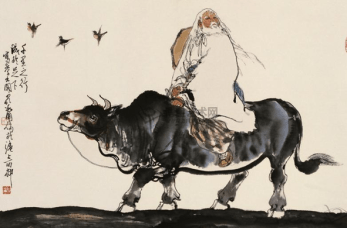
It’s said the keeper of the western gate, whose name was perhaps Yin Xi, realised the old librarian from the royal archives of the state of Zhou did not intend to return. He knew the old man as a quiet, wise character, never someone at the heart of activities, never excluded by others, an observer, seldom observed, always ready to offer advice, not eager to thrust himself forward, often ignored, never wisely. The gatekeeper called, ‘Old Master, Laozi! If you intend not to return, if you mean to renounce the world, then leave a record of your thoughts. Write me a book to remember you by.’ The old man climbed down from his humble oxcart, borrowed pen and ink. A few hours later, he handed Yin Xi a script of some 5000 characters and then continued westwards, never to be seen again.

a-journey-of-thousand-miles

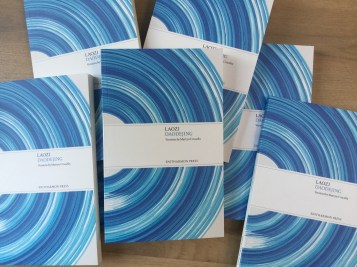
So the poems of the Daodejing are a gift, freely given at a point of change, a gateway to new experience. They are also a turning away from the world (Laozi is said to have despaired of its venality and corruption), yet a transmission intended to aid, an inspired out-pouring of poetry as much as a moral and political handbook. Perhaps above all we should think of them as a response to a personal request. Bertolt Brecht’s 1938 poem, ‘Legend of the origin of the book Tao-Te-Ching on Lao-Tzu’s road into exile’, seeks to praise the “customs man” who “deserves his bit. / It was he who called for it” (tr. John Willett). Modern scholarship, of course, has long since stripped away such eloquent myths. Most likely, the current 5000 characters of the Daodejing were far fewer to begin with, a series of orally transmitted seed verses compiled by many hands, an aide memoire, certainly an aid to teaching from as far back as the 7th century BCE. Passed on orally, then transcribed, with the usual levels of error, displacement, ‘correction’ and happenstance, the text has also been subject to the Chinese tradition of written commentaries and these intercalated texts have themselves become vanishingly absorbed into the original. Such an uncertain state of the text legitimates considerable levels of ‘correction’ for most would-be translators; in this case, I have excised material only from ‘Dangers of prominence’ (Chapter 13) and ‘The great clamour’ (Chapter 23), silently removing a few lines of (what I thought of as) redundant repetition.

41mGYLTsCVL._SX331_BO1,204,203,200_

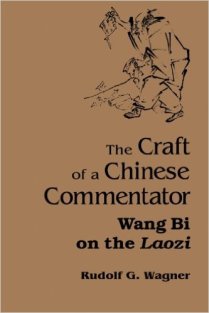
Yet the poems are still vivid, astonishingly fresh, irresistible. They are also still subject to continuing textual debate and archaeological inquiry. The standard text has long been the one associated with the scholar Wang Bi (226-49CE) which divides the Daodejing into 81 Chapters and those into two sections. On the importance and insights of Wang Bi, see Wagner, Rudolf G., The Craft of a Chinese Commentator: Wang Bi on the Laozi (SUNY Press, 2000). The Dao or Way is made up of the first 37 Chapters; the De or Power occupies Chapters 38 to 81. But an archaeological dig as recently as 1973 at Mawangdui revealed two new versions of the text, dating from around 200BCE. Surprisingly, both Mawangdui texts reverse this order and some recent versions into English have adopted this change. Most notably, see Robert G. Hendricks who produced a re-shaped Lao-tzu Te-Tao Ching: A New Translation Based on the Recently Discovered Ma-wang-tui Texts (Ballantine Books, 1989). Also see D. C. Lau’s second translation of the texts published as Lao-Tzu Tao Te Ching (Everyman Books, 1982). I have not done so. The traditional division between the Way and the Power of the Dao is by no means watertight or proven but I feel it makes more sense to explore the nature of the Way before considering its more specific manifestations. Also, as a sequence of poems, ‘Nursery’ (Chapter 1), summing up as it does so much of what is to follow, surely has to come first.

Though probably the work of many hands over many years, it’s still hard not to hear (with Wang Bi) a distinctive voice, a coherent poetic style – alluringly laconic, clipped, coolly enigmatic; it flaunts its paradoxes, is boldly metaphorical, juxtapositional, repetitive to the point of liturgical, urgent, unashamedly epigrammatic. In short, we seem to hear Laozi writing a kind of poetry which enthusiastically accepts that its profound and heartfelt messages are inevitably compromised by the need to express them in the form of language, hence demanding that it employ a variety of technical manoeuvres, that it stays light on its feet. Of course, language is imperfect but it’s what we must use and I have given titles to each of the Chapters to encourage contemporary readers to approach them in large part as language, I mean as poetry.

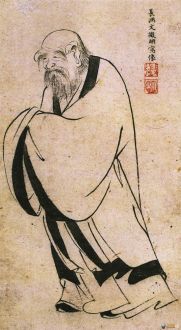
laozi-painting

For a text so geographically, culturally and temporally remote, some consideration of key images and ideas is necessary. The Dao is not an individual entity, still less anything divine, it is more a mode of being that is all encompassing, a phenomenal, an existential primacy – perhaps akin to the western idea of original chaos. It can usefully be seen from epistemological, temporal, perceptual, political or environmental perspectives, though none of these exhaust its real nature. It is not subject to time yet contains it. It is never fixed. It is the ever-here, both omnipresent and unchanging. We might be tempted to say the Dao is the substratum of all things, the ground base – but language’s introduction of levels and hierarchical ideas is not helpful to our already feeble grasp of it. Certainly, it is the whole, the one that precedes the many.

So these poems explore how the Dao becomes manifest in the individual objects, the actions and creatures of the world we are familiar with. They suggest the Dao initially gives rise to two things, heaven and earth (‘Nursery’ (Chapter 1)) and the poems subsequently make use of the formulation ‘the ten thousand things’ to suggest the Dao’s proliferation or subdivision into all there is. It is in this way that the Dao is the mother of all things (‘Of all things’ (Chapter 25)); it is like water, a pool from which all things draw life (‘Something greater’ (Chapter 4); it is the uncarved block of wood that has inherent within it all things that have been, are, will be (‘Uncarved wood’ (Chapter 15). Most importantly, the Dao is beyond conception and so beyond any conventional use of language, the limits of which constitute a recurring motif in the Daodejing: ‘Nursery’ (Chapter 1); ‘Awareness (Chapter 56); ‘Store (Chapter 81). Of course, our quotidian lives must pass in this ‘fallen’ state, full of a misplaced confidence in the reality of the ten thousand things, including our own discrete selves, so Laozi emphasises – in recurrent images of reprise or re-visiting – that only if we can return to a more clear awareness of the presence and reality of the Dao, can our behaviour and experience of life be more true, fulfilled, harmonious. Tennyson’s otherwise unremarkable poem, ‘The Ancient Sage’ (1885), describes approaching the “mortal limit of the Self” and passing “into the Nameless [. . .] and thro’ loss of Self / The gain of such large life as match’d with ours / Were sun to spark – unshadowable in words”.

images

 Part 2 of this Introduction to the Daodejing will be posted next week (and is now available by clicking here).


Review: Tamar Yoseloff’s New and Selected Poems (2015)

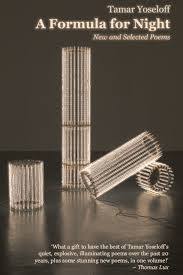
Last week, I went to the London launch of Tamar Yoseloff’s new and selected poems, A Formula for Night, published by Seren. I have reviewed a couple of her earlier collections and she asked me to contribute a blurb to The City with Horns (Salt, 2011). We’ve known each other for many years and it has been interesting to see her work develop. What follows is a review of the new book, collaged together from new and old thoughts.

imgres

Tamar Yoseloff’s first book, Sweetheart, was published by Slow Dancer Press in 1998. The new Seren collection is dedicated to Lauretta Yoseloff, the poet’s mother, and right from the outset, in ‘Selfridges’ for example, she is a powerfully evoked figure. Here, she leads her young daughter around the up-market department store, brisk and efficient. As often later, the daughter’s priorities lie elsewhere, she drifts away, gets lost, ends standing mesmerized by the butcher’s counter: “lambs’ kidneys, calves’ livers, / sweetbreads, hearts”. The moment becomes a blood-stained Wordsworthian spot of time as even years later the child recalls the meat, “indelicate, hearty, more real laid out there /  than anything that beat inside me”. The mother’s preference for delicacy and propriety and her daughter’s haunting sense of inadequacy and a fascination with death are articulated for the first, but by no means the last, time.

imgres

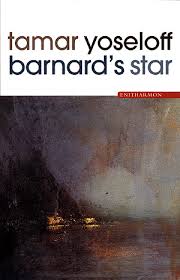
A second collection, Barnard’s Star (Enitharmon, 2004) contained many successful pieces presided over by the Robert Lowell of Life Studies. This went beyond the drawing on personal material (often from the poet’s American childhood), to the seemingly casual forms of the poems, the telling details, the tentative observer, the reined-in emotional tone, the particulars implying a wider social malaise. In ‘The Atlantic at Asbury Park’, the narrator re-visits a childhood scene now dilapidated (like Lowell’s Boston aquarium). Being told that “Annie and I would sit cross legged / in the bandstand, making plans” is as near as we are allowed to the emotional crux of the poem. Youth, ambition, friendship – Yoseloff’s vision is a mostly melancholic one as now only “the ocean is the same, / black for miles, white caps, grey sky”.

In the poem ‘Partobar’ (sadly not included in the new selection), the narrator rides the horse of that name, watched by an unsympathetic instructor and “the other girls . . . their blonde ponytails / neat down their backs, their jackets perfect”. The social as well as personal battle-lines are effectively drawn up and the poem proceeds in utterly convincing, tangible detail: “I hit the ground, / dirt and blood in my mouth, my head like a bell clap / inside the hard hat”. The sense of ignominy is powerfully real – and frighteningly permanent. Even as an adult, she watches “braver girls trot around the field, / chins up, asses out”. She sees them at parties, with men who “whinny” their approval, while the narrator remains, re-living her failure, still daunted by the explicitly male horse, “my breasts like acorns beneath my vest”.

imgres

A series of poems about her mother conjures a ghostly, curiously unphysical maternal image through the enumeration of clothes and other possessions. In ‘The Delaware and Raritan Canal’ she strides once more ahead of her daughter along the canal. There is no conventional closeness or emotional warmth; the reader gets the impression of a demanding, fierce maternal personality. The final stanza makes the daughter’s admiration clear: “But when she hits her stride, she could walk / all the way to the sea, arms sailing / forward, her course certain”. Yet even here the demands of the heart, of the human seem deflected as she sweeps past “the houses of ten thousand people”.

images

In Tamar Yoseloff’s first book with Salt, Fetch, a fetch was defined as a stratagem by which a thing is indirectly brought to pass and (the more obscure meaning of the word) a wraith or double. Using direct and punchy quatrains, in ‘Fetch’ poems scattered throughout the book (but collected together in the new selection), the narrator casts herself as a stay-at-home girl while sending her double out “into the cold dark night”. The fetch cruises bars and is ordered to trail an unidentified man and later sleeps with him. This stratagem seems to allow for the playing out of the narrator’s illicit desires, though the double runs out of control and develops her own independence, leaving the narrator lonely, then resentful, finally murderous. These racy, blunt narratives are thrilling and the exploration of female freedom, restraint and taboo makes for vivid, exciting reading.

Salt’s blurb emphasised the dark, edgy, sexy qualities of Yoseloff’s work and other pieces such as ‘Silk’ and ‘Tiger’ and ‘The Dentist’ reinforce this impression, though the latter is as much a study in masculine menace as eroticism:

He is trying not to breathe, and I am trying

not to swallow, as my saliva rises around his

finger, a foreign body. He inserts his mirror

to examine my every crevice . . .

She also continues to experiment in Fetch with a more allusive, imagistic style at its most effective in the sequence ‘The Firing’. Inspired by Julian Stair’s funerary pieces, it opens breathily once again:

I am a vessel, open

to your body. If only you could

move through me, enter

the spleen, the coiled intestine . . .

The sequence moves seamlessly and a little shockingly from passionate flesh to flesh and bone as it arrives at the collapse of a hill-top cemetery: “the graves / fall in on themselves, / marble crumbles to dust. // loved ones tumble / into each others arms, their bones / knit and form a whole”.

imgres

This apocalyptic darkness reflects an essential part of Yoseloff’s gift. She places an impressive series of poems at the beginning of Fetch that reveals preoccupations with time, loss, the inability to hold the moment. Experience is always leaking, objects losing their definition (‘Black Water’); monastic illumination only points up the fact that words fail to hold “that moment” (‘Illumination’). If we look behind us, there is shadow, “that / darkness of ourselves born / of days when the sun was blinding” (‘Shadow’). The culmination of these themes is the sequence ‘Marks’. Pushing the imagistic fragmentation close to its limits, the narrative echoes aspects of John Burnside’s work of the early 1990s. Here is the whole of part 3:

A finger blades a line

straight            from throat to womb

peel back my skin        reveal

the workhouse            of heart and lung

blood

slogging           through my veins

my discontented bones

It is this tension between the sassy and the sepulchral that is so interesting in the book. Poets create out of the matrix of their own nature and both elements are integral to Yoseloff’s vision. The choice of the concluding poem of this collection suggests she is clear-eyed on such matters: ‘The Sea at Aberystwyth’ is magnificent. The narrative voice embraces both the impersonal, heart-breaking cry “Oh rain, wash them clean” as well as humour about Norwegian tourists soaked by Welsh rain. The book closes with an unfrequented Indian restaurant as an image of metaphysical bleakness:

What we want

lies broken on the shore, what we can’t have

stays black on the horizon;

the moon of the zebra crossing

flashing for no one.

imgres

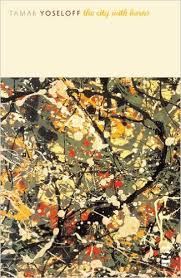
The City with Horns continued to break new ground with poems that flow and rush and fizz in ways reminiscent of Jackson Pollock’s paintings and his declaration that the good artist must paint what he or she is. From the turmoil of Pollock’s life, Yoseloff powerfully re-creates a vision in which everything knots together, a way of seeing that is intoxicated by embracing “the gift of the street, / the glare of chaos”. But the horns of this next collection are profoundly ambivalent. If the central sequence (responding to Pollock’s life and work) overflows with plenty, then the outer sections of the triptych speak of emptiness and pain in a poetic voice more familiar, curbed and astringent. Here, Yoseloff continues to explore territory she has made her own in earlier collections: snap-shots and “little fables” of up-rooted individuals whose tokens, found objects and souvenirs struggle towards articulacy just as the concrete in her cityscape possesses “no lyric dimensions” (‘Concrete’).

The more recent poems in A Formula for Night continue to offer few consolations. But the pay back for Yoseloff’s reader lies in the works chastening honesty, its ability to evoke a sensibility that feels never less than modern and – a notable achievement paradoxically – not immediately recognisable as the work of a woman. ‘Lace’ and ‘Swimmer of Lethe’ continue the preoccupation with death, treated now so directly that the haunting of Plath’s work is even more evident. ‘Construction’ paints a cityscape in which “the wrecking ball / opens another new vista” and is undeceived in counting the “[m]inutes to trash”. ‘Ruin’ invents a new poetic form in which a text is gradually shot to pieces as phrases, even letters, are gradually edited out, enacting the very process of ruination. Yoseloff perhaps finds her heraldic device in the rampaging habits of the ‘Knotweed’ with its “line of destruction // that moles its way beneath foundations”. Again echoing Plath’s tone of address to her mushrooms, Yoseloff admires the plant’s “calling: the felling / of our failing structures”.

images

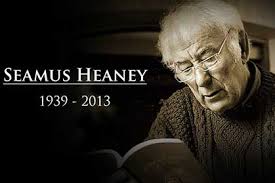
There are final poems here too about the mother figure. Her death in ‘Clear Water’ is movingly contrasted to another hospital visitor reading Seamus Heaney’s poem ‘Anahorish’ aloud in the ward. But even now, facing last things, the attentions of mother and daughter are at variance. The daughter knows and responds to the poetry; the mother sleeps through the whole incident and dies the following day. True to her vision, the poet notes Heaney’s death a few months later; she expresses an on-going concern about the other patient, “if he made it”; but the poem ends with nothing more said about the author’s mother. In ‘Skull’ the mother’s dead body is regarded as “a hollow case, all the life pulled out”. If this is shocking, it also represents a heroic devotion to telling the truth as it is experienced. A Formula for Night is a major collection and career summary and really ought to be both on your wish list and on prize shortlists in the coming 12 months.

Into the Swims – or She’s Leaving Home

A remarkable thing has happened in our house this week. My daughter’s room has been tidied – and it has remained that way.

The duvet is unrumpled on the bed. A phone charger remains thoughtfully unplugged on the floor beside the bed. The pages of Donna Tartt’s The Little Friend have not been turned any further. The few coins on the desk wait to be spent. No rubbish is accumulating in the plastic bin beside the desk. A laundry basket has been emptied and seems not to be refilling as it usually does. There are few clothes hanging in the wardrobe. The door stands open onto the landing for days on end. There is hardly a movement in the wave-shaped mirror beside which, vertically, a friend wrote in pencil  ‘Don’t crack the mirror’. Actually, to be truthful, there is the slightest of motions to be seen there – it’s me standing in the centre of the room, staring around.

We took her to university last weekend. We miss her. And in the absence of more detailed news we’re pretty sure she’s having a good time. She’s never friended us on Facebook but she somehow did so ages ago with my parents. So we hear remotely about smiling pictures, roseate cheeks in flashlight, black backdrops. I think yesterday she was supposed to be attending her first dissection (I remember that vividly – more of that in a later post perhaps).

In the mean time, to wish her well and permit myself some lovely sentimental thoughts of her in younger days, I thought I’d post a couple of older pieces I wrote which feature her.

2007_0413Northumberland0139

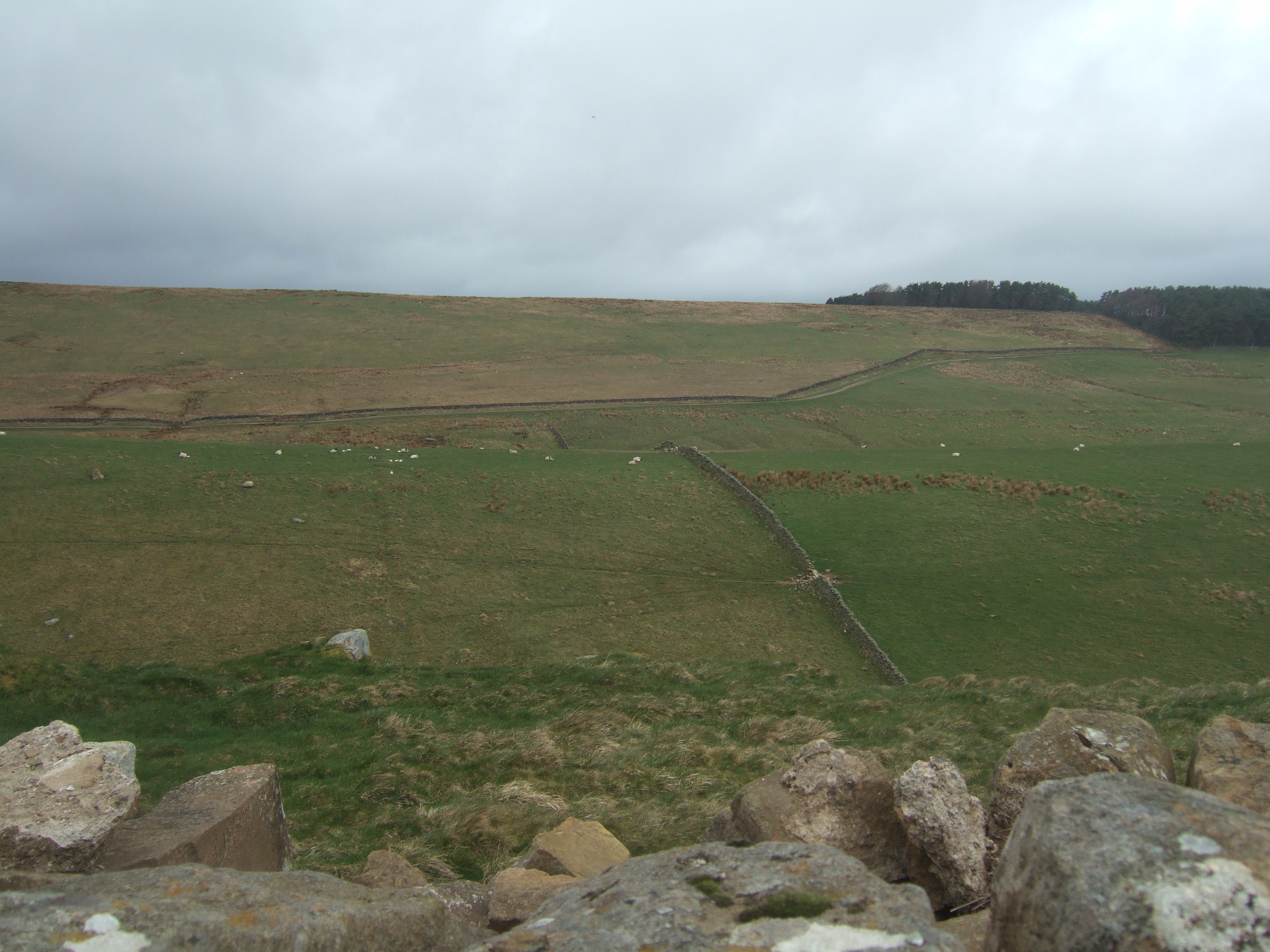
Both these poems originally appeared in Hurt (Enitharmon, 2010). The first derives from a walk we pursued when she was about 5, I think. By walk I mean, she walked a bit and I carried her on my shoulders the rest of the way. This was probably in the hills near Sedburgh – sheep country, close-cropped grass, heather, little stony paths. I suspect we plotted a waterfall or two into the route for a few squares of chocolate (temptation) for her and her older brother.

One thing after another

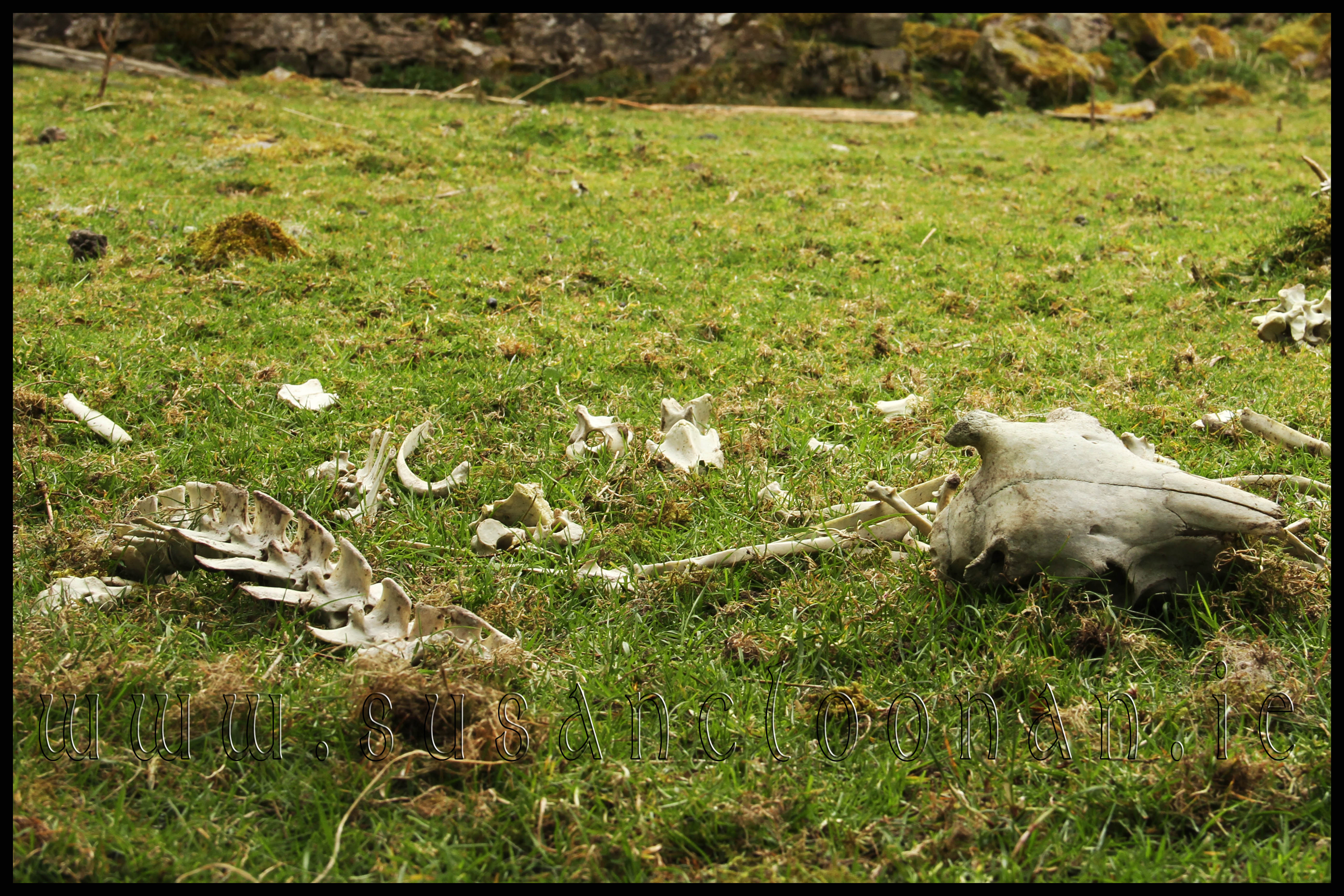
The ivory, angular vertebra I found
the day after the day my daughter found

and tried out her new word – fuck –
was bony, spiky to touch, rough as fuck.

I thought: Depths! Essence! Bone!
She bent to it, touched it, turning bone.

Leave it, I called. She said, Is it real?
White in the grass the contrast was real.

skull4

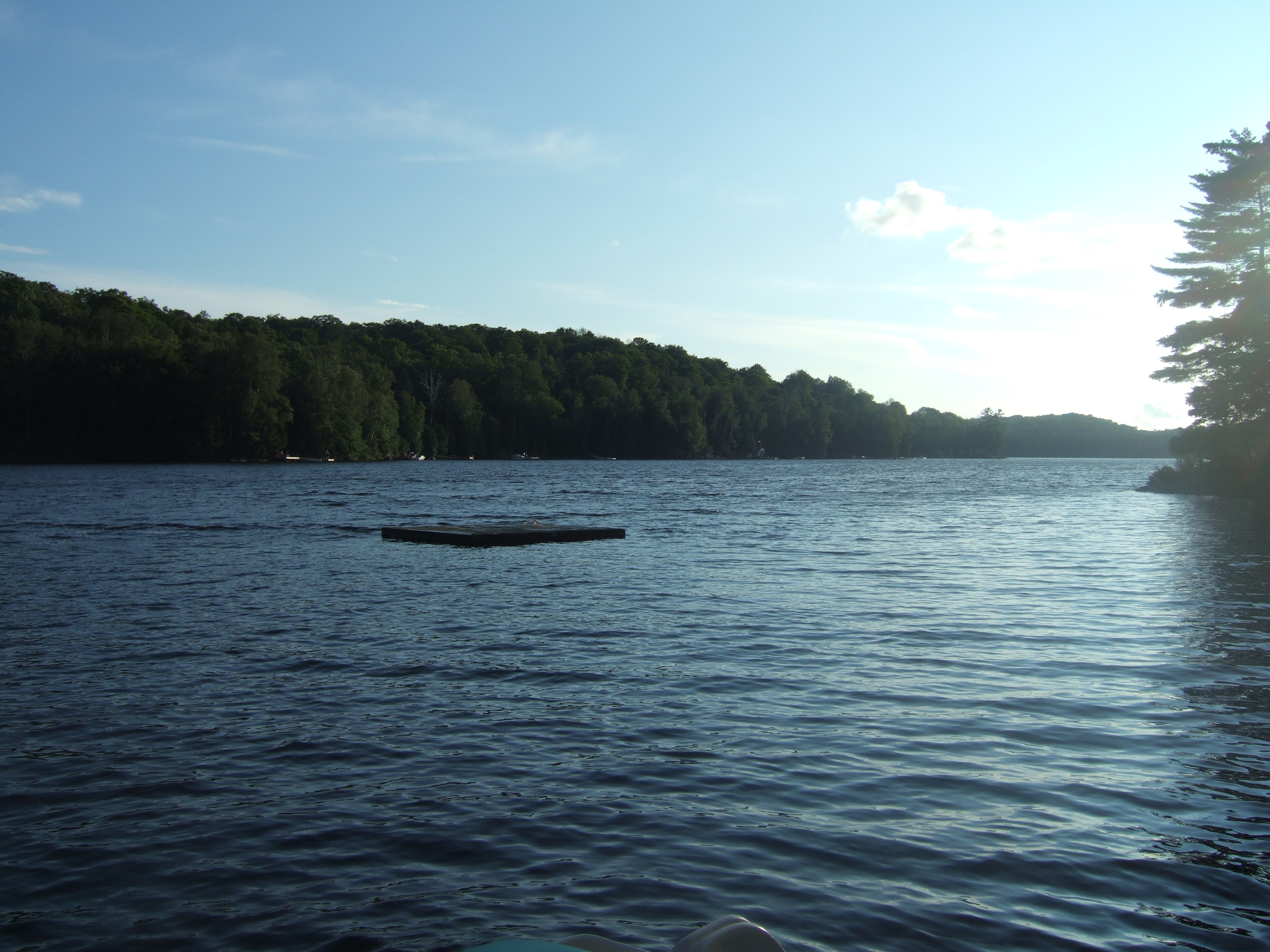
The second poem is later, from an occasion when we were visiting Canadian cousins, staying in a house in the Lake Country north of Toronto. To me it felt like something out of early Margaret Atwood and we spent ages fishing from the rickety wooden dock, paddling in a rowing boat and (as here) swimming out to a tethered raft (she has always been a good swimmer).

2008_0809Canada20080117

There is a well-buried allusion to Milton’s Paradise Lost in the middle of this poem – from the description in Book 1 of the fallen angels or devils closing in around Satan (“their doubl’d ranks they bend / From wing to wing, and half enclose him round / With all his peers” ll. 616-8). This is the second part of a sequence called Wilderness:

See my flesh and blood

here, bright and true

as a sun on the rise,

she launches herself

from the anchored platform,

flies into the air

over the blue-lit water,

unaware of tethers

beneath the surface,

of ropes, trailing weed,

slime, mud and scales

stiffening in reaction

to her vigorous action.

Here she is, hanging,

all parts my daughter,

curling like a ball,

the sudden black water,

while the white trunks

of ten thousand trees

cram the lake shore

and enclose her round.

All sounds hang back

as she arcs and peaks,

begins her slow bow

to the pull of gravity,

the smash of water,

the great churning

of foam and white limbs

yellowing as they spread

to carve out stroke

after buoyant stroke

into the swims of joy

and grief she’ll tread.

2007_0413Northumberland0079