Where’s My Master Gone – Don Paterson v Li Po

Don Paterson’s 1997 book, God’s Gift to Women (Faber) includes a poem sporting the title ‘On Going to Meet a Zen Master in the Kyushu Mountains and Not Finding Him’. The reader’s eye hops off the perch of this lengthy title only to flutter down, looking in vain for a foothold, for a line, even a word – it’s a completely blank page. In a collection that includes a poem called ‘Postmodern’ and another on ‘The Alexandrian Library’, the joke is obvious enough. Any search for ‘masterly’ advice in the Kyushu Mountains or closer to home in a post-modern, relativist world in which language hides as much as it might reveal, must draw a blank. I remember seeing the poem – probably heard Paterson ‘read’ it too – the long title building expectation, a too-long pause, the announcement of the next poem (cue laughter) – and something bothered me. I think now I know what it was.

imgres

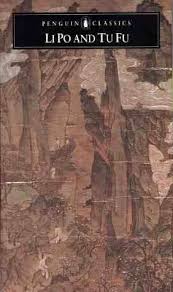
I wondered if Paterson had been reading the Penguin Classics selection of Li Po and Tu Fu (tr. Arthur Cooper, 1973). The Li Po selection opens with the poem ‘On Visiting a Taoist Master in the Tai-T’ien Mountains and Not Finding Him’. Cooper’s note tells us that ‘Visiting a Hermit and Not Finding Him’ is actually a very common theme in Chinese poetry. Such a poem (we are told) is not just an excuse for a “nature poem” but relates to the frequent “spirit-journeys” that Li Po was fond of writing. Here is Cooper’s translation:


Where the dogs bark

by roaring waters,

whose spray darkens

the petals’ colours,

deep in the woods

deer at times are seen;


the valley noon:

one can hear no bell,

but wild bamboos

cut across bright clouds,

flying cascades

hang from jasper peaks;


no one here knows

which way you have gone:

two, now three pines

I have leant against!

3-li-po

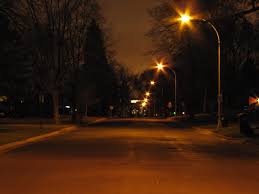
I had come across this poem while compiling my first book, Beneath Tremendous Rain (Enitharmon, 1990). I liked it for reasons I didn’t then understand and, in a very simple form of translation, I wrote an up-dated version:


Looking for an Old Man


Where red dogs bark

on the sodium ring-road

and traffic noise

blackens adjacent houses,

I’ve come to seek you.


In each garden I pass,

pale heads of bindweed.

The night is undistinguished.

The savour of coalsmoke

flattens across the kerb.


No-one here knows

which way you have gone:

two, now three lampposts

I’ve leant against.

images

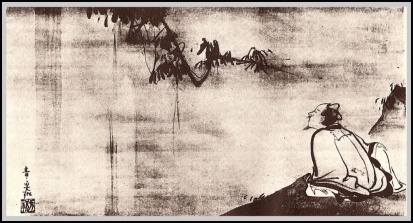
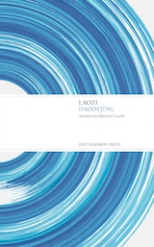
Li Po is the more Daoist of the two poets presented as a complementary pair in this Penguin book. Now, with a bit more understanding of this tradition, I’m sure that 26 years ago I was responding to something at the heart of the poem. The fact that the Daoist master cannot be found by the searching student is precisely the point since the Daoist teacher teaches “in the absence of words” (Chapter 43, ‘Best Teaching’) as I translated it in my version of the Daodejing (Enitharmon, 2016).

Interestingly, Li Po’s poem expresses this not with a blank page but (as Cooper says) through further encounters with “nature” (petals, woods, deer, valley, bamboo, clouds) or, in my version, the natural and urban world (ring-road, traffic, houses, garden, bindweed, coalsmoke, kerb). Whether we designate this a ‘spiritual’ journey or not, the point remains that the student’s search for knowledge in the form of a direct download from some master must be denied. The student’s anxious search for guidance is reflected in the number of pines/lampposts he leans against as well as the geographical over-specificity of the titles of such poems. The student’s dependency and naïve optimism is the satirical butt of the poem as he is directed back to the source of all knowledge (the world surrounding him) even as he wanders in search of his master. So Paterson’s 1997 version achieves three things: it misrepresents the spirit of the original, it’s more dramatic (comic), it’s more superficial.

imgres

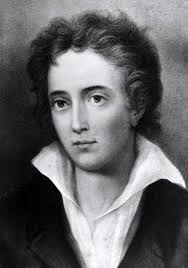
When I first read Li Po’s poem I was coming off the back of doctoral work on the Romantics, especially Shelley whose ‘A Defence of Poetry’ (1821) argues that the “poetry in [our] systems of thought is concealed by the accumulation of facts and calculating processes [. . .] we want the creative faculty to imagine that which we know”. This is succinctly put in Keats’ idea of Negative Capability, defined as a passive openness to the fullest range of human experience (“uncertainties, Mysteries, doubts”) without any imposition of preconceived notions, ideas or language: “without any irritable reaching after fact & reason”. The student in Li Po’s poem seeks just such certainties and facts and is gently deflected back into the world of observation where (I take it) he is encouraged to pursue a more full-blooded, full-bodied, open-minded encounter with the 10,000 things which (in Daoism) constitute the One, ‘what is’.

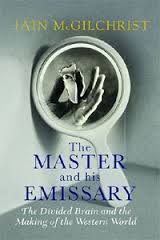
The two attitudes to knowledge here are really two ‘ways of being’ as Iain McGilchrist’s fascinating book, The Master and his Emissary (Yale, 2009) phrases it. McGilchrist argues that right and left human brain hemispheres deliver quite different kinds of attention to the world. The left perceives the world as “static, separable, bounded, but essentially fragmented [. . .] grouped into classes”. Shelley described this in 1821 and linked it to the processes of Reason and this is the attitude to knowledge and education that the anxious student of Li Po’s poem possesses. In contrast, what Shelley calls Poetry or the Imagination is what McGilchrist associates with the right brain. It tends to perceive “the live, complex, embodied, world of individual, always unique beings, forever in flux, a net of interdependencies, forming and reforming wholes, a world with which we are deeply connected”.

imgres

Without doubt, this is also the viewpoint of the Daoist master whose teaching evokes the uncarved block, the One, and who teaches best without words. Ordinary language usage is dependent on conceptual thought which is left-brain work – ordering, categorising, re-presenting the minute particulars of the world as they are perceived by the right brain. I imagine that Li Po’s master-teacher and sage is deliberately hiding somewhere beyond the bamboo canes – and this is part of the student’s lesson.

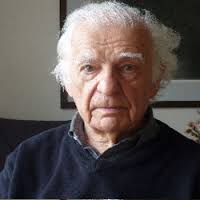
So Don Paterson’s blank page bothers me because – as McGilchrist expresses it – it represents a rather glib, post-modern position, a scepticism about language which is in danger of throwing out the interconnected real world along with the suspect tokens and counters of left-brain language: “To say that language holds truth concealed is not to say that language simply serves to conceal truth [. . .] or much worse, that there is no such thing as truth” (McGilchrist, p. 6). I’m also reminded of Yves Bonnefoy, engaging in his own battle with the early stirrings of French post-modernism. He writes: “This world here exists, of that I am certain [. . .] It is simply with us. In what can be felt and sensed”. In The Tombs of Ravenna (1953), he names this underlying truth, not as existence, but as “presence”. The right brain knows this; the left brain sets about fragmenting it, making use of it, disappearing it.

images
Yves Bonnefoy

Explaining Water Images in the ‘Daodejing’

Daoism has been referred to as the Watercourse Way because of the importance of water images in its key source, the Daodejing. I thought much about these images in translating/versioning these ancient Chinese texts and I want to record a few thoughts systematically here. However, as you’ll see, trying to ‘fix’ something runs counter to the Way – yet even if what we seek runs through our hands, the effort to consider the role of such images is worthwhile. (I have blogged about other images in the Daodejing here).
images

The Daodejing uses water images in two ways. Firstly as an image of the ineffable One, the plenitude that lies at the heart of all its thinking – imagine the vastness of the ocean, the unfixable flux of flowing water, never the same river twice. The texts also use water images to suggest aspects of our behaviour (personal and political) if we are acting in accordance with the Dao or Way. Many use metaphors of water in such a way that the vehicles are clear and recurrent (ocean, pool, river, stream) but the tenor remains an empty set, never defined because in its nature indefinable in language or figures.

So Chapter 1, ‘Nursery’ (I’ll give my titles as well as traditional Chapter numbers), introduces water images while giving a clear indication of the short-comings of all language. It deploys a metaphor that immediately undermines the efficacy of its own figurative language: “the path I can put a name to / cannot take me the whole way”. Even what can be named can only be grasped through a further metaphor: the “nursery where ten thousand things / are raised each in their own way”. What lies behind the phenomena of our world can only be suggested through additional metaphors such as a “mould”, a “source”, a “mystery”. Even this is not enough; more than a mystery it is “a riddle set adrift on a mystery”. In my version I introduced a watery context for the source itself (indefinably, untrackably “adrift”). I then developed this to image it as a body of water held behind a “flood-gate” which only in release and inundation delivers “greater truth”. The original Chinese text shifts its metaphors rapidly in just this way and this is what gives this opening Chapter the peculiar sensation of telling a clear truth that remains just beyond our grasp.

images

A similar image of a body of water occurs in Chapter 4, ‘Something greater’. The tenor of the metaphor is again reduced to “it” in the opening line.  The context indicates that “it” is the Dao itself, the One that precedes and contains all things, that state of wholeness and plentitude towards which the path of the Dao leads. Here the tentative nature of the metaphor is indicated firstly through the opening imperative – “imagine” – and then because the text itself consists of proposed alternatives to this very image. The opening formulation emphasises the Dao’s infinite nature, its resource: “a vessel to be drawn from / one that never needs to be re-filled // the bottomless source of all things”. This image of a bottomless water source is revised a few lines later in the form of a question: “is it rather a pool that never runs dry” yet this follows 4 other metaphorical formulations of the Dao’s beneficial effects:


fretted edges are smoothed within it


knots untangled all dazzle eased

all blinding clouds of dust slowly cleared

images

And the poem calmly goes on to declare its own ineffectiveness: “we cannot know it as a bodiless image / it must pre-date every beginning”. Even the concept of origin, or beginnings, is not adequate to convey the full force of the Dao but the fluidity of water – impossible to grasp, capable of taking any shape, a life-giving source – seems to come close.

The second way in which water images are used in the Daodejing is as a gesture towards actual human behaviours which occur when we are influenced by the Dao: in knowing that the truth of the Dao is like a watery flood, we behave in a water-ish fashion. So ‘The great rivers’ (Chapter 32) reminds that the Dao “has no name” and uses one of the other recurring images of it (the uncarved block of wood). If “the powerful” would attend to the nature of the Dao they would be successful “without recourse / to compulsion or law”. One of the recurring political beliefs of these texts is that if society is organised and governed in accordance with the Dao then people will live in “harmony” without even trying (indeed it is the trying that causes the harm – see wu wei below). Metaphorically, this translates as a society knowing “when to call a halt” to our distancing from truth (the hacking of the block, the reliance on naming/language, our remoteness from the ‘water’ source that is the Dao). The poem ringingly concludes with the image of right human behaviours being likened to the natural flow of water:


all things come to those

who follow the way

as all wild streams

and all unruly torrents

drive eventually

to great rivers the sea

images

Water is also the image used to consider more individual behaviour. ‘Best teaching’ (Chapter 43) opens rhetorically, alluding again to water:


—what of all things is most yielding

tell me what overwhelms the hardest


without solid form itself what flows

penetrates even the smallest gap


This understanding of the action of water in its pliability and fluidity, its erosion effects and its penetrability, reminds the poet of the concept of wu wei, or non-action, another untranslatable but key idea in the whole sequence. This is the wise person’s ability to achieve actions or goals without determined or intended pursuit of them. I have translated this as “unacted deed” and this poem immediately links this to the art of teaching, the best of which “occurs in the absence of words” (show not tell?). Water is an appropriate image for this in its passivity yet power, its pliability yet ineluctable nature. The poem ends almost with a shrug at the difficulty of grasping such concepts or behaviours:


the unacted deed the indirect

direction—it’s hard to comprehend
chehalis_flood_sunshine

The text of ‘Clearest words’ (Chapter 78) reinforces the image of water as a key aid to understanding Daoist thought:


—there is nothing in the world more soft

more yielding than water

yet in conflict with hard resistant things

there’s nothing better

and there is no way to alter this

what is yielding will defeat what resists

these are facts clearly known to all

why don’t we make better use of them


In these final lines we can perhaps hear Laozi’s legendary disgruntlement with the parlous state of the real world – why don’t we put known truths into action? Yet here again, the poem concludes by recognising how difficult such simple principles can be to grasp: “even clearest words are contradictory”.

Chapter 61, ‘Tributaries’, returns to a more political perspective with its comments on how “strong nations” ought to behave. The action of water in relation to both geography and gravity is the figure used on this occasion:


—strong nations must play the low ground

to which all contributing waters flow

the point to which all things converge


This ensures that any exercise of power by such nations will “issue from stillness” and “quiescence” (according to the principle of wu wei) rather than self-assertion, anxious, fearful imposition, bullying. It’s this (former) sort of behaviour that the Daodejing repeatedly returns to and characterises as “female” and what follows is one of the most beautiful passages where water images are integral to the meaning:


[ . . . ] and the male cannot

resist he brings his watery tributes

and she gains adherents he procures favour

as she looks to embrace and empower

he finds himself part of a greater thing

in this way becomes part of creation

so both thrive both discovering bliss—

real power is female it rises from beneath
url

This coincidence of water images and female images and the description of the passive exertion of power, nourishment, subtlety, irresistibility, is wholly characteristic of these poems. The image of water collecting at its lowest point – power exerted by doing nothing – is likewise the focus of ‘Influence’ (Chapter 66) which explicitly links such calculated passivity with virtuous potency:


—how do rivers and seas secure mastery

over the hundreds of lesser streams

through lying lower than they do


so to govern or teach you must stand

and acknowledge you are beneath the people

to guide them put yourself at the rear


only in this way can true leaders rise

not stifling people with their being on top

not bullying them into harm’s way


only this way all things under heaven

are content to range under your influence

not find instruction provocative—


a teacher achieves not by trying to achieve

and because she does not strain to succeed

there’s no-one comes forward to compete
File 03-03-2016, 09 02 50


Workshopping With Will Shakespeare

Last weekend – what with the 400th anniversary of Shakespeare’s death just gone by and seeing an advertisement on Facebook I think it was – I signed up to be a participant in a Shakespeare and writing poetry workshop. Being an English teacher, love of Shakespeare rather comes with the territory but I’m sure I’m not the only teacher who enjoys being a participant in classes. So much of my time is spent initiating, organising, timing carefully and concluding that it’s a wonderful holiday-feeling to be initiated, organised, timed carefully and concluded by somebody else. (In what follows I am able to quote the work of nobody else but myself – for which apologies).

shakespeare-first-folio-title-page-introduction

The workshop was part of a series organised through the South Bank Poetry magazine, co-edited by Peter Ebsworth (its founder) and Katherine Lockton. They were both present for the workshop – upstairs, above the Poetry Society’s Cafe in Betterton Street, Covent Garden – but it was Katherine who ran the session. We gathered about 10.45 for 11am, most of us arriving clutching the mandatory take-out coffee from the cafe or elsewhere on our walks from the Tube. A big table, a plate of biscuits, greetings, sign in (whose name do I know here?). Upstairs at the PS is a strange mix of store room, kitchen, second hand bookshop, classroom. I thought it could do with a tidy-up myself – then tried to curb my flicker of nerves, that need for control. Actually, I’ve not taken part in a public workshop like this for ages. We were probably all feeling the same: what if I write total crap and Katherine asks me to read it out. Maybe a biscuit . . .

images

We started with free writing for 5 minutes or so – “to loosen up”. Katherine wanted us to set off from “My Shakespeare is . . .” What sprang vividly to mind was an occasion teaching not Shakespeare, in fact, but Marlowe’s Doctor Faustus. A student read the “face that launched a thousand ships” speech so very badly that it achieved a weird sort of beauty in her inarticulacy. A bit like those ruins of classical statues (not far from where we were, in the British Museum) that seem to have acquired an added poignancy in not remaining whole. I rather like free writing (it’s how most of my own poems begin, a sudden splurge of material that then gets worked on) and as I wrote I ended up (from that halting reading of Marlowe) to love in a life or its opportunity missed:


Those encounters where you don’t have the words

Just stops pauses some musical sense

Of the word order but no –not the words themselves

And she turns away dips her head

Laughs at something somebody across the room has just said

eb296389fb62a4e2e059249bf0021f0e

Katherine then dished out the text of Sonnet 18: “Shall I compare thee to a summer’s day?” On the Tube in I had been wondering how I’d tackle Shakespeare in such a setting and I thought I’d not go for the more familiar moments. Katherine did and I have to say she was probably right. I’d have ended up explaining too much perhaps (too teacherly) when the point was to respond creatively to the poems. So most of us were familiar enough with this poem in which the narrator does compare his love to a summer’s day and the summer’s day turns out to be liable to be windy, over too soon, too hot, over too soon . . . The lover apparently suffers from none of these things not even death itself – because the poet has preserved her in “this” poem: “So long lives this, and this gives life to thee”. We wondered, among others things, at the manly arrogance of this.

We picked a phrase or even just a word to respond to from the poem and set off for 30 minutes or so. On this first occasion, many of us seemed to get sucked into the vortex of the sonnet form and rhyme especially. But the quality of the group that day was extraordinary. Several produced sonnets which worked well (in 30 minutes!) and all the pieces eventually read out were interesting responses. I chose the phrase “By chance, or nature” and was exploring (again) the chance or fate of meetings with the one’s you love. I was imagining the alternative worlds we jettison or turn our back on with every choice we make:


So that in one of those plural worlds

We might have met before, or later, even not

At all – through pram and playground, into school

To college, old flames, chance turn, random plot.


You can see what I mean about getting locked into a formal mode. It may be that most of us realised this as when Katherine then tried us with Sonnet 130, more of the group struck out – away from formality, probably into something more like our natural mode. This was also probably encouraged by the fact that Katherine was showing us contemporary responses to these poems as we went. Several of these were quite encouraging in that they were pretty poor as poems – there are a number of anthologies where contemporary poets respond to Shakespeare (especially this year) but so many of the poets try too hard to up-date originals into some hip idiom; embarrassing like Dad-dancing). I guess that at least gave us permission to try something more adventurous of our own.

daodejing

I found myself interested in the way the Sonnet 130 tries to define the lover through a kind of via negativa, what she is not. It’s a kind of anti-poetic in that the poet dismisses the ability of comparison (one of the poet’s main tools) to capture her in truth. This was reminding me of repeated occasions in the Daodejing poems I have been working on for 3/4 years (just published now – so fully on my mind last weekend) in which the text also argues the elusiveness of the One. The latter is often given female characteristics so it was an easy step to my scribble:


She lives in the live darkness between

The opening and shutting of my eye-lids


Between ascender and descender

Of this pen this white expanse


This Microsoft space not knowing what to do

With itself not being busy


In the moment when instructions cease

And what opens is that snow-field


Beneath the first or second chair-lift not yet

Inscribed [. . . ]

tumblr_m4v3ij8TgU1r2tbuso1_500

The third piece Katherine gave us were extracts from Romeo and Juliet (the balcony scene, the “what’s in a name” speech” and Juliet’s “O serpent heart”). We discussed these and annotated them to pick out certain patterns and concerns. We then compiled a small list of words of our own and set off with the aim of writing in the voice of a character from Shakespeare. I’ve always had a soft spot for Horatio and especially Hamlet’s gentle, though firm, put-down: “There are more things in heaven and earth, Horatio, / Than are dreamt of in your philosophy”. I had Horatio realising the truth of this, a bit Prufrock-like realising that he was not meant to play the Prince, but be an observer, something of a by-stander at the big events:


O but it’s enviousness I breed

Here listening to you roar

And glitter you go on to the very point

Or way off kilter

And patronise me yet even this you do

With such grace with warmth making me love you.

images

The rhythm of this particular workshop was a lot of time for individual writing. We shared all we wrote (no one objected – and absolutely none of it was “crap”), and Katherine introduced the extracts quite briskly while still allowing plenty of time for people’s reactions to them. The time was now about 4pm. The final piece was stimulated with small bits of cloth from Katherine’s Mum’s sewing box but also with a story she told (no details – it’s her story) which we could incorporate if we wanted to.  My final piece was the strangest I’d produced so far. My cloth was a rich red – a bit sexy – and the encounter was on a staircase, I was coming down to meet someone. Perhaps by this time I was more Juliet than myself, or I’d carved myself into two:


Everything possessed

Of that clarity

And the weight

Of heraldry—


So the long dress

I wear is gules

Its blood-red

Slit to the thigh


Its plunging neck

A sunlight wedge

At the foot

Of the shallow stair


I lift my chin

As if called for [. . . ]


I don’t know if the 4 pieces I produced will come to anything further but I can honestly say they would not have been written otherwise. In running my own workshops, I always say the simple thing they achieve is to take your writing to places you’d not have got to alone. That certainly happened the other day and I’m grateful to South Bank Poetry for the chance to participate: now back to the front of the class.

DR FAUSTUS
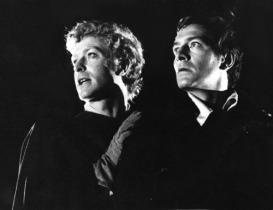
DR FAUSTUS  – Elizabeth Taylor Richard Burton

They Will Have Their Rights: Ted Hughes’ ‘Her Husband’

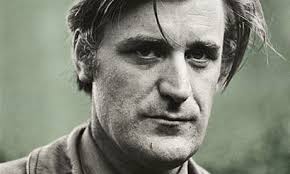
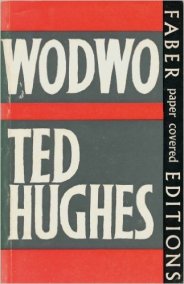
My AS level students are in the last throes of revising for exams coming in May. One question will be on a selection of Ted Hughes poems and what follows is an essay in the style required of them by the exam board (a single poem analysis of the Practical Criticism kind). ‘Her Husband’ first appeared in 1961 and then in Hughes’ 1967 collection Wodwo which mostly contained poems written before Sylvia’s Plath’s suicide in 1963 but also a few others (such as ‘The Howling of Wolves’) written after it. Hughes’ next major publication was Crow in 1970. Leonard Scigaj has noted how many of the Wodwo poems contain “recurring feuds and destructiveness” and ‘Her Husband’ is a domesticated, Lawrentian version of this.

images

Her Husband

Comes home dull with coal-dust deliberately
To grime the sink and foul towels and let her
Learn with scrubbing brush and scrubbing board
The stubborn character of money.

And let her learn through what kind of dust
He has earned his thirst and the right to quench it
And what sweat he has exchanged for his money
And the blood-weight of money. He’ll humble her

With new light on her obligations.
The fried, woody, chips, kept warm two hours in the oven,
Are only part of her answer.
Hearing the rest, he slams them to the fire back

And is away round the house-end singing
‘Come back to Sorrento’ in a voice
Of resounding corrugated iron.
Her back has bunched into a hump as an insult.

For they will have their rights.
Their jurors are to be assembled
From the little crumbs of soot. Their brief
Goes straight up to heaven and nothing more is heard of it.


Introduction

Ted Hughes is more renowned for his portraits of animals and natural landscape than people. Especially early on, he is more interested in, as he expressed it, capturing animal and natural life in language as he does so brilliantly in poems like ‘The Jaguar’, ‘Wind’ and ‘Thrushes’. However, it’s not true to say Hughes does not write about human life and some would argue that a poem like ‘Hawk Roosting’ though on the face of it about a creature is really about human behaviour. In ‘Her Husband’ Hughes is clearly focussed on the human in a marriage which is full of bitterness and resentment.

images

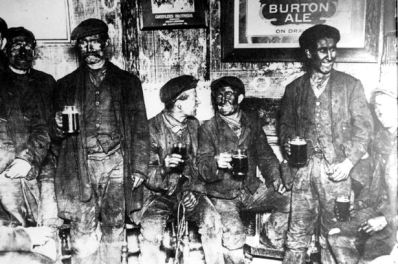
‘Her Husband’ is written in the third person, giving a distanced but vivid portrait of a marriage through the events of one evening. The title of the poem forms part of the opening sentence so the poem’s opening line, starting with “Comes home”, already gives the impression of the husband as an almost impersonal force, unnamed perhaps because already all too familiar to his wife. The thumping alliteration of the opening line (dull – dust – deliberately), reinforces the man’s brute entry into the house. As a working miner he spreads “coal-dust” about the house but Hughes emphasises his inconsiderate nature with the adverb “deliberately” and the forceful, unpleasant verbs associated with his arrival: “grime” and “foul”. This opening quatrain flows quickly, being unpunctuated from start to finish, evoking an arrival which is sudden, sweeping, unstoppable. The ugly internal rhyme of “foul towels” also contributes to the impression of his disruptive arrival and Hughes conveys the husband’s resentful attitude with the idea that he intends to teach his wife about the “stubborn character of money”. This personification of money as a person difficult to deal with, to persuade, cleverly conveys the husband’s own difficulties with the exhausting character of his day’s work. But he intends to impress this resentment on his wife who he wants to work (repetitively) with “scrubbing brush and scrubbing board”. This is not a relationship in which we see any love, compromise or mutual respect, though we have yet to be shown much of the wife’s perspective.

coal

In fact the second quatrain continues in much the same vein with a repetition of the phrase “let her learn”. All this repetition conveys the husband’s determined intentions. Lines 4-8 also introduce a vocabulary of a more moralistic kind. The narrative voice echoes what must be the husband’s thoughts about the way he has “earned” the “right” to go drinking in the pub before he returns home. He regards the earning of his wage as a physical and personal “exchange” of his physical “sweat” for cash and the hyphenated phrase describing money as possessing “blood-weight” particularly conveys the sense of his personal sacrifice as a working man, how he feels the day’s work metaphorically costs him “blood” (as a miner this might be sometimes literal too). I think Hughes goes some way here to encouraging sympathy from the reader for the husband’s situation but the quick return to his aggressive, even vicious, attitude to his wife in the heavily alliterated and emphatic phrase “He’ll humble her” (line 8) definitely lessens any sympathy I may be feeling.

474360547

The simple metaphor of casting “new light” on his wife’s role is used in line 9. There is a sort of tired familiarity throughout this poem (on both husband and wife’s sides) and I suspect this sort of encounter is not the first of its kind so the idea of him casting/teaching “new” light probably really reflects his sense that however much he tries to do this she does not “learn” to behave as he expects by more obediently taking note of what he sees as her “obligations”. I doubt whether he himself would have used many of the moral terms that the third person narrative voice employs in these lines, so the distancing voice Hughes has chosen to use enables these more abstract points to be made. It’s only at line 10 that we get a sense of the wife’s “answer” to her husband’s demands. As has been implied already, her reply to his demands is not at all submissive. We are told “part of her answer” is the disgusting-sounding meal with its “fried, woody chips” though it’s partly unpleasant because it has had to be kept warm in the oven “for two hours” (the fact that he’s so late home increases our sympathy for his wife). But her fight back is sustained it seems; the other “part” of her answer to his demanding and bullying attitudes must be spoken to him or probably shouted. Interestingly, Hughes gives us none of this directly as it is only implied in the brief phrase “Hearing the rest” in line 12.

The husband’s corresponding response to his wife’s uncooperative (surely complaining) reply is immediate and violent. The husband’s vigorous determination causes Hughes to run-on sentences at the end of both stanza 2 and 3. Here, the violent verb “slams” shows how he disposes of her cooked meal in the fire and sweeps out of the house and “away round the house-end” all in one flowing, swift, uninterrupted sentence. The husband’s singing voice is described as “resounding corrugated iron” in a typical Hughesian metaphor (linking the organic with the metallic or industrial). Also the song he chooses to sing is full of irony and deliberately insulting as it is a romantic song of lost love. Line 16 gives us a brief last glimpse of the wife’s response, her body language suggesting her own stubborn resentment, “bunched into a hump”. Hughes adds a simile to make her antagonism even more clear: “as an insult”.

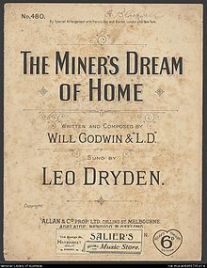
1890_A_miners_dream_of_home

The final quatrain now departs from the specific actions of the married couple and returns to the more moralistic and even legalistic language that I noted earlier in the poem. Here the narrator’s distance from the domestic argument is clear again. This poem was first published in Wodwo (Faber, 1967) and, as a relatively early Hughes poem, it is unusual in its focus on individual people though this distancing effect suggests he may be observing their behaviour in the same way as he does a jaguar in a cage or the power of the wind. Line 17 is the shortest sentence in the whole poem and declares, in firm monosyllables, that both sides in this conflict “will have their rights”. This makes it clear there is no room or desire for compromise. The final three lines introduce the language of the law court (a divorce court perhaps?) though the jury are “to be assembled / From the little crumbs of soot”. This soot reminds us of the coal-dust he brings into the house in line 1, but also of the burnt dinner thrown into the fire-back in line 12. These tiny black specks suggest to me that such a jury will never come to any clear conclusion in this dispute. They suggest the hopelessness of the couple’s situation. This rather depressing ending to the portrait of a marriage is confirmed in the final line and a half as we are told that the legal “brief” (a technical term for one side’s case in a law court) follows the smoke and soot up the chimney. This suggests that the arguments on both sides metaphorically go up in smoke. Hughes concludes in the plainest language: “nothing more is heard of it”. The way in which the events of the dismal evening vanish up the chimney suggest the likelihood that something similar may happen again tomorrow and the day after.

Conclusion

So Hughes’ portrait of a marriage is very bleak indeed. The narrative voice describes events at a distance and though there are occasions when the reader does feel sympathy for the people involved, the language of the poem itself is not at all emotional. The poem’s voice sees events from both husband and wife’s perspectives though it’s interesting that we are never given any actual dialogue in this domestic row. Hughes’ irregularly-lined and unrhymed quatrains suit the poem’s plain description in a mostly colloquial tone: this is not a poem or situation where any lyricism or poetically-charged language would really be appropriate.

5113sBWRWFL._SX321_BO1,204,203,200_


Poetry at Palmers Green: live review (April 2016)

When reviewing my first year of blogging on poetry and related matters (see blogI said I wanted to review more live events. That has not happened really but this week I wanted to rectify that to some degree.

Last Saturday I drove a few miles north to Palmers Green, best known to the poetry world of course, as the home ground of Stevie Smith who moved there when she was three years old. She was educated at Palmers Green High School and North London Collegiate School for Girls and lived in the area until her death in 1971. I first became aware of the current poetry activity in the area a few years ago when I went to readings at the bookshop in the High Street run by Joanna Cameron.

images
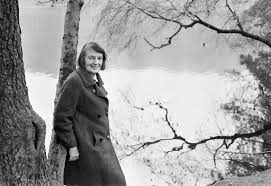
Stevie Smith in the park in Palmers Green

But in 2006 the Palmers Green Bookshop was forced to close, the lease was sold on and I think it was an opticians that opened in its place. Since then a number of local poets and enthusiasts have been keeping poetry alive with 6 monthly poetry readings at Stevie’s church, St John’s, N13 4AL. The readings take place in the Parish Centre adjoining the church and are always friendly and well-programmed evenings. I’d recommend them if you’re in the area (Contacts: Katherine Gallagher  or Myra Schneider and on Facebook).

images

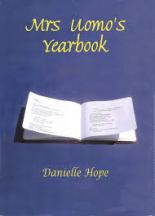
The evening was introduced with clarity and authority by Lynda How and readings took place as the April evening sun set outside. The Parish Centre looks at first a little soulless but with its shades-of-yellow decor, surprisingly tasteful lighting and pitched wedding-cake-white roof it is actually a venue which has a good acoustic and a disarming and warm atmosphere. The first reader was Danielle Hope, whose new book is Mrs Uomo’s Yearbook (Rockingham Press, 2015) from which she read the entertaining and instantly recognisable out-of-season seaside resort description  ’Llandudno Winter’. Recognisable to most of the audience it seemed and as I spent a couple of years in digs in Morecambe I knew the “please-remove-wet-shoes-at-door / heating-on-from-seven-to-eight / no-radiator-in-bar / low-watt-lamps” guesthouse. Her translations from the Italian are also impressive (Montale’s ‘Eastbourne’) and the Mrs Uomo poems manage to combine humour and acute observation with a more serious satirical edge. Mrs Uomo teaches her cat economics at one point but more poignantly is left awaiting an operation having “improved against [the NHS] recently refreshed thresholds”. Hope works as a doctor in London and knows what she is talking about here and her poems are always a pleasure to listen to delivered in a colloquial, un-stylised fashion.

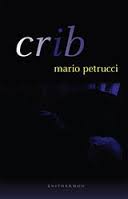
In contrast, Mario Petrucci read slowly and deliberately from crib (Enitharmon Press, 2014) which is a selection from the 111 poems he wrote during the first year of his son’s life (Mario was kind enough to allude to my own efforts in this topic area (see A Madder Ghost)). Petrucci’s work (especially in recent years) is much concerned with language as an object/medium in itself (hence his delivery). He spoke about his interest in the “deckle edge” of language where it begins to fade and dissolve and on the page he accentuates the thingi-ness of words with mostly very short lines, unpredictable line breaks, sometimes dividing words across line breaks.

imgres

The cover image of crib is of a child sleeping in almost pitch darkness – a metaphor Petrucci suggested for the way language itself struggles to communicate, picking from the mass of experience a highlight here or there. This from ‘i fish’:


in dark

with dark

as spool &


mark him

sparely

move


as if

i sought

magnified


on glass slide

that form


imgres

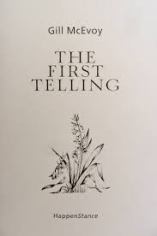
Gill McEvoy’s most recent pamphlet The First Telling (HappenStance, 2014) won the Michael Marks award in 2014. McEvoy’s delivery is rather more actor-ish, her voice taking on the inflections and tones of the character felt to be speaking the poems themselves. I’m never wholly convinced this is the way I (personally) want to hear poems read (I’m even more uneasy about poets who have learned texts in order to ‘act them out’). But McEvoy’s work – especially in The First Telling, which deals with rape and its aftermath – is easily powerful enough to overcome any misgivings I might have had. Her poems are often brief and delicate and disturbing:


I touch the cigarette


to my arm.

Here.

And here.


I can’t talk about it.


I could touch this fuse

to my chair.

I could watch it catch.

I could watch it flame

to roaring fury.


Counterpointing such troubling pieces, McEvoy scatters even briefer poems on birds which comment obliquely on the human narrative. Petrucci had earlier commented on the importance of the silence after a poem has been read aloud and in the intervals between many of these poems – at least while the evening light held out beyond the windows – I could hear the occasional twitter and cheep of birds in the churchyard grounds. A rather lovely accompaniment.

After the interval there were 8 floor readers. The quality of the work was high (not always the case where venues welcome floor readers) but I was struck by the number of people reading from electronic devices – phones and iPads. Of the main readers several read from their books (traditional) others from folders where the poems seemed to be printed and ordered for the occasion (the well-prepared; the short sighted). I can see the latter becoming more likely in relation to my own eye-sight but I have to say I prefer to see poets read from their books (assuming the work is published) and I can’t help think that the sight of the book cover waving around up there does something for after-reading sales too.

imgres

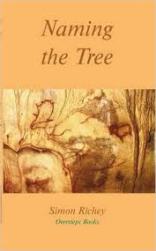
Simon Richey read from his first book, Naming the Tree from Oversteps Books. I’m ashamed to say I know little of his work (though he later confessed to me that he has hardly ever attended a poetry workshop, so perhaps he has just not been very visible on the ‘circuit’). I thought his work was very interesting indeed, sharing something of Petrucci’s concerns with language but also developing threads of thought and emotional responses alongside.


Somewhere
the meaning of a word,


before it becomes a word,
waits in the silence. It is as if


it has come as far as it can go
without being uttered. In a moment


it will change from one thing
into another, or its meaning


will tremble into a word,
into something barely familiar,


finding itself spoken,
finding itself understood.


Several of the pieces were prose poems – one a series of sections, called ‘The Darkness’, about the night-wanderings of cats as well as about the night-wanderings of their owner’s mind.

imgres

The final reader was Mo Gallacio whose marvellously rich reading voice (she is a trained actress) leant itself to both Scots and English verse, triumphantly avoiding that actor-voice that seems either to value the rotund vowels and the crisply planted consonants over and above the emotional tides of a piece of writing, or to emote all over the poetic text so heavily that the language and form of the poem is swamped and made unhearable. ‘Purple Iris’ is an especially moving poem about the incurable illness of a neighbour. Gallacio’s own struggles with cancer form the basis for a number of poems; in one she asks the nurse how she will feel after surgery – the nurse’s reply: like you’ve been stabbed! Gallacio’s evident love of and attentiveness to flowers and plants echoed McEvoy’s acutely observed birds and the evening ended with a celebratory bunch of brightly trumpeting daffodils (no more than £1 from Tescos) suggesting – with a nod to the Edward Thomas of ‘March’ perhaps – that Spring is most definitely HERE.

imgres

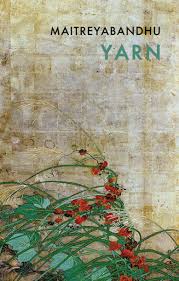
Everything Burning: Review of Maitreyabandhu’s ‘Yarn’

I love to follow the development of a poet’s work. This is often imaged as the finding of a voice but is really a process in which the poet brings into focus what centrally concerns them and sheds what is extraneous. A recognisable voice may be a secondary consequence of this but it is achieved through technical advances and deep thought about poetic predecessors and possible role models. Maitreyabandhu’s second collection, Yarn (Bloodaxe, 2015) is fascinating from this perspective.

images

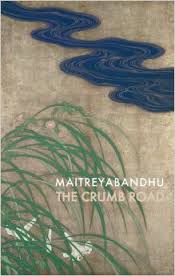
Born Ian Johnson in Warwickshire, Maitreyabandhu was ordained into the Triratna Buddhist Order in 1990. I once started a review of James Harpur’s  Angels and Harvesters (Anvil, 2012) by saying that I wanted contemporary poetry to address spiritual matters, so I was obviously excited to get hold of Maitreyabandhu’s first book, The Crumb Road, when it appeared in 2013. Given my rather narrow line of expectation, I suppose was a bit disappointed. But the book is full of vivid colloquial detail, many poems about childhood and a moving account of a homoerotic relationship between two young boys which ends with the death of one of them. The crumb road of the title is the Hansel and Gretel trail back to the past rather than a trail of stations towards spiritual enlightenment, though ‘Visitation’ is an awed encounter with something like that: “I saw you, in the mess of things, / [. . .] as a slant of grey”. The book was a PBS Recommendation, rightly praised for its melancholy modesty, quiet expression, its alert and attentive qualities, its models evidently Edward Thomas and Thomas Hardy.

imgres

Yarn develops similar materials. Maitreyabandhu’s poetic technique is even more evident in the range of forms – free verse, rhyme, prose poem, blank verse – employed to great effect. The Warwickshire childhood features again in a section called ‘The yard’ with the father’s wine-making – damson, raison and berry – and his war service, the mother’s involvement in the coach driving business, school, various distant relations. The first book’s portrayal of young love cut tragically short is echoed here in an elegiac sequence to a Buddhist friend, Mahananda. This man’s longer life (his mother’s flight from the Gestapo, his conversion to Buddhism, living in Primrose Hill, his friendships) is touchingly evoked and it is a thoroughly grief-stricken sequence: “what can I conclude on your departure? / that nothing came of it, with everything, / everything undone” (‘Souls’).

url
Ryokan

There is a curious echo of this latter phrase in a poem about the Zen Buddhist monk/poet Ryokan for whom the temple bell and old books seem to say “how everything is burning”. Such a sense of the ultimate insignificance of earthly things arises elsewhere in this book and Maitreyabandhu explores such spiritual issues more explicitly here than in The Crumb Road. Though there is often a strong response and pleasure in the natural world, ‘These Days’ suggests “our human calculus precedes / the given world” to negative effect. There is a fearful recognition that what we contribute amounts to no more than “error bred in the bone, the daily rancour / of the mind, / our clever ways to be unkind”. But the erasure of those things that we cling too can be almost as frightening. Nietzsche’s ‘The Parable of the Madman’ (1882) is alluded to, a sponge wiping away the “entire horizon”, yet the consolation (as in the death of a valued friend) can be hard to access: “I strained to see Vajra Guru’s face”. Perhaps the character in ‘The Postulant’ has “closed his eyes on this world” more successfully:


When night fell, the space between two worlds

Was all the shape he made, an empty dark [. . . ]

What he thought to be himself he didn’t know:

His pain was all that stopped the worlds unite.


But inevitably, what is ultimately not graspable in words is hard to write about and Maitreyabandhu’s often chosen model (the rhyming, song-like lyric voice) can lead to a mellifluousness that over-sweetens a poem, especially when trying to evoke more successful intuitions of “the Lotus Born” and the “illumined image” (‘The World of Senses’).

buddha-225x300

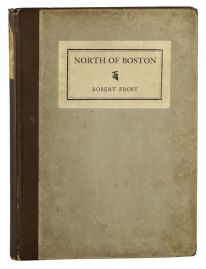
But Yarn contains three long yarns or stories in which the voice of the teller plays at least as much part as the narrative of events. This is what is new and particularly exciting in this book and reveals the influence of Robert Frost (not Edward Thomas who tried this early on with ‘Up in the Wind’ (1914) and then dropped it as not fit for his own purposes). Frost’s eclogues (especially in North of Boston (1914)) manage to convey a bleak, anti-pastoral, godless, modern world of death and often inexplicable suffering. One similarity is that ‘The Cattle Farmer’s Tale’ is spoken by a proprietorial, rather self-satisfied farmer (read Maitreyabandhu on the influence of Frost here). Like Frost, Maitreyabandhu immediately catches character and voice brilliantly. He encounters a mysterious figure: “his not pretending / to be meek or grateful to set me at my ease / and, funny thing, it stopped me in my tracks / so for a moment I stumbled on my words”. This is so like Frost’s ‘Death of the Hired Man’ – the enigmatic visitor, the farmer and his wife, the carefully sketched context, the skilful handling of dialogue in blank verse. Maitreyabandhu adds a few songs too but this is in no way a pastiche but a development of a neglected form for different purposes. The visitor is in fact Buddha and though he talks in cryptic terms, the farmer’s rootedness in the land, his evident pride in his worldly achievements, his bossiness followed by regret in dealing with his wife serve to make the Buddha’s pronouncements palatable in the poem’s world:


There are two thoughts, Dhaniya [. . .]

one leads to suffering, the other to joy.

The first is yoked to yearning like a calf,

a suckling calf that’s yoked unto it’s mother,

the other’s like a shadow that never parts.


So this really is the cattle farmer’s tale – his response to his encounter with a wholly different set of values (he and his wife are in fact deeply impressed by the visitor who stays for a month). The form of the poem allows the reader room to be sceptical in our modern fashion but also to be moved by the insights and wisdom (old fashioned word) being offered.

140905019

The second yarn, ‘The Travellers from Orissa’, is even more ambitious. Bhallika (the narrator) and Tapussa are again farmers, cattle men, who encounter Buddha in their younger days. Bhallika is again a sceptical voice (“I’m not a fool”) but is nevertheless impressed by the Master, who “spoke in a funny way with gaps / between the words as if he’d just been woken [. . .] his smile, / I shan’t forget, was like gazing at the sea”. But this is not an experience he can easily share with others and he resolves to “keep it to myself”. Tapussa’s response is quite different. The poem makes it clear Tapussa’s character inclines him to “yarns” and in the telling they grow “more fantastical each time”. His response to the meeting with Buddha is to cast himself as the rather attention-seeking disciple, who succeeds in becoming something of a cult figure: “his nodding head, how he held his finger up / each time he spoke to emphasise each word”.

But Tapussa dies, as does Bhallika’s wife and the widower lives on quietly, distantly aware of the Master’s growing fame and influence. At last he meets him again: “I said ‘Master’ before I knew I spoke”. Only now does Bhallika share the details of the original meeting with his son. In fact Tapussa had failed to understand, turning “the whole thing upside-down” to make it all “about himself”. What is moving in this yarn is the fact that Bhallika evidently understood the Buddha’s message (“There is a thorn buried / in the heart of man”) but with his commitment to wife and family and land he “walked back into [his] own life and tried to take it up”. Even years later, he understands “I’d betrayed my life” on that day and with that decision.

imgres
Coleridge’s Mariner and Wedding Guest

Such false and true followers feature in the third yarn too though the human situation is even more finely drawn and prevents any simplistic response to the questions it raises. In a still sketchy but more Westernised context (Sunday morning church) it is ‘Aaron’s Brother’ who narrates. Like Tapussa, it is Aaron who is the more overtly spiritual figure, famously suffering visitations and visions. But there is again a self-regarding quality in the way he readies himself for church before the mirror, “combing his hair”. The story is told to an unnamed guest – there’s much of Coleridge’s Ancient Mariner here – who is eager to speak to Aaron and not much interested in his brother. But the brother is in fact adopted and has further secrets to disclose of a homoerotic love between himself and Aaron and (he implies) this partly fuels Aaron’s interest in his young male acolytes.

The treatment of these ingredients of a far grander and dramatic tale than Maitreyabandhu wants to develop suggests a powerfully imaginative act by the poet, the kind of thing Keats admired in Shakespeare. In this third yarn in particular, there is no irritable reaching after facts and clarity; it is a poem which explores the perhaps irresolvable tensions  between the spiritual and the sensual life, the spiritual and materialism and fame, the spiritual and our mundane earthly loves and commitments. I’m interested that Maitreyabandhu has not yet attempted such renovations of the Frostian form in a more overtly contemporary setting. His skills with form and his brilliant capture of colloquial speech, his obviously profound engagement with Buddhist thought and his commitment to poetry as a form of expression make him a unique figure in the UK literary landscape and I really look forward to discovering the direction and innovations of his next collection.

images
Maitreyabanhu

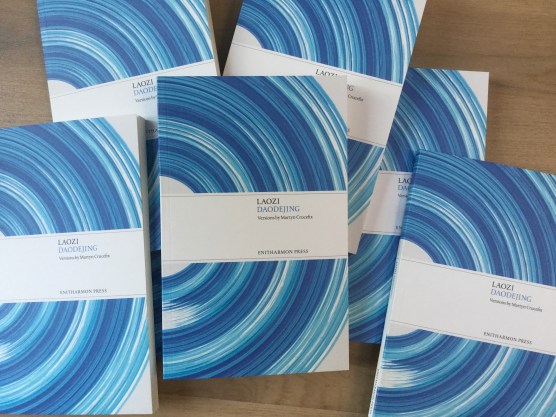
Introduction to Laozi’s ‘Daodejing’ – Part 2

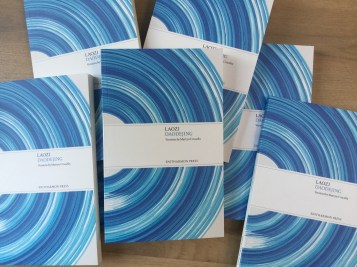
What follows is the second installment taken from the Introduction to my new versions of Laozi’s Daodejing, published by Enitharmon Press. More information and comments on the book can be found here. References to the traditional 81 chapters of this ancient text are accompanied here by the titles I have given them in my versions. The first section (to read it click here) concluded by indicating how the Dao becomes manifest in the individual objects, the actions and creatures of the world we are familiar with.

wings-snakes-satan-artwork-gustave-dore-paradise-lost-john-milton-1030x1280-wallpaper_www-paperhi-com_21

Proceeding to consider how such awareness (more commonly the absence of it) impacts on our personal (and hence political) lives is also a primary concern of the Daodejing. It comes as no surprise that our battle against the tyranny of the self, that intense, intoxicating selfishness that Coleridge calls “the alcohol of egotism” is the key (the phrase is from an unassigned lecture note, date unknown, on Milton’s Satan, specifically concerning his preference to reign in hell rather than serve in heaven. See S. T. Coleridge, Collected Works, ed. Foakes (Princeton UP, 1987), Volume 5, Part 1, p. 427). This is where the untranslatable idea of wu-wei arises. The phrase is intended to characterise actions performed in accordance with, in harmony with the Dao; hence they are driven not by the blinkered and shuttered individual self, but by a more open awareness of the expansive, interconnected reality of the Dao. This is the significance of the recurring idea that the follower of the way should attend not to ‘that’ but to ‘this’. The former implies a divided world (self and other – ‘that’ out there) whereas the latter is a gesture of encompassment of both self and other, the whole, the one. Hence, the narrow intentionality, the forcefulness of the self is withdrawn from actions performed in accordance with wu-wei.

IMG_0125

In translating these ideas, I have used the phrase ‘indirect direction’ to suggest the methods of our dealings with others and the ‘unacted deed’ in an attempt to characterise the pursuit of our own intentions. Both phrases are woefully inadequate, but I hope to convey as plainly as possible the paradoxical nature of these ideas. How they are played out in real human behaviours can be glimpsed through the ‘Three treasures’ (Chapter 67). These treasures are: to be compassionate, to be frugal, to lack personal ambition. In each behaviour, egocentricity is diminished through empathy and there is an inclination towards wise passivity. There is a corresponding reduction in the individual’s personally directed desires (‘Wishes’ (Chapter 3)); we are to act ‘Like water’ (Chapter 8), flowing passively, dispassionately towards lower ground in both personal and political spheres (‘Influence’ (Chapter 66)). We are being urged (to switch the metaphor as the Daodejing deliberately does) to work with the grain of the Dao.

This is what the sage pre-eminently promulgates and performs. I have consistently translated this figure as ‘teacher’, often ‘my teacher’ and (though literary Chinese does not mark gender) there is something unmistakably feminine about her behaviours. This is a point the poems declare insistently. The Dao itself has female qualities (‘Valley’ Chapter 6)) and the teacher also reflects this in her quietness, passivity, sensitivity, lack of overt force (‘Raw material’ (Chapter 27)). Stephen Mitchell’s much praised and popular version of the poems carefully uses ‘she’ at least as often as ‘he’ to refer to the teacher figure. (See Stephen Mitchell, Tao Te Ching: a New English Version (Harper and Row, 1988), p. xi). But I wanted to go further and have consistently feminised, even personalised this figure. Early on in the translation process, I felt a need to make this shadowy figure more manifest, to ground her pedagogic statements for our more liberal, democratic age with its absence of deference. As I set about this, it was clear she had to be female and she soon took on a dual role, both as representative or personification of the Dao itself and as its incarnation in actual human form, a mother figure, a female teacher, a friend.

images

The ways in which these teachings translate into the world of politics are summed up in the terse, witty, metaphor of ‘Recipe’ (Chapter 60). The art of good governance is like the art of cooking a delicate fish: don’t interfere, don’t force it, be watchful, assist, adapt, proceed only with the lightest of touches. Laozi’s politics are impossible to translate to our modern age but given the proviso that he is determined to preserve the simplicity and frugality of people’s lives, many of his sentiments read as politically anarchic, primitivist, conservative, environmentalist. For those of us from a Western tradition, there is a Rousseauistic quality to his thinking, a belief in the goodness of mankind as noble savage who has for too long been corrupted by interference, too many codes of behaviour imposed from above. This is where the poems’ anti-Confucian elements are most obvious (‘Codes of kindness’ (Chapter 18)). Laozi is certainly vigorously anti-war, the pursuit of which he regards as the quintessence of the over-determined masculine self in action in utter disregard of the Dao.

imgres

Historically, translators have approached these poems in many ways. Benjamin Penny’s recent review of the field shows how many early versions were motivated by a Western cultural imperialism, searching out affirmations of its own monotheistic tradition (See Benjamin Penny, Introduction to Laozi: Daodejing, tr. Edmund Ryden (OUP, 2008)). Later attempts were spurred by a contrasting desire to find something different, to revitalise moribund Western values in search of exoticism, anti-rationalism, the non-Christian. Still others, keeping a firm hold on a wide variety of already settled spiritual/religious beliefs, plumbed the frequent ambiguities and lacunae of the Daodejing to re-affirm those beliefs. More recently, scholars and academics have brought an ever-growing understanding of Chinese history and culture to bear on these delicate texts and it is surely impossible to avoid accusations of Westernisation in any English version of the Daodejing. Even Stephen Mitchell – who had “a fourteen-years-long course of Zen training” to draw on – has since been accused of colonial mis-appropriation (See Mitchell, ibid., translator’s Forward. For the vigorous accusation, see Russell Kirkland and his book Taoism: The Enduring Tradition (Routledge, 2004)).

sonnets_to_orpheus

In my case, it was as a long-standing teacher, poet and recent translator of Rainer Maria Rilke that I first came to the text. I found myself in astonishing sympathy with many of the things it has to say about language and poetry and especially about the pedagogic process, both formally and in our everyday interactions. Laozi suggests the teacher’s role is to show, facilitate, enthuse, give space, watch and approve. We must be honest, be ourselves, give the tools, give opportunities, do our job well, but then let go, don’t dwell. We need to be someone to emulate, be quiet, still, attentive, be present, not absent, be mindful, be welcoming. Our role is to synthesise and connect (not disconnect or sever), shed light (but without dazzling, even inadvertently), use a delicate touch, be tangential. Laozi knows that our teacherly interventions – whether physical or verbal – must inevitably alter the material we hope to engage with; we set in motion a swinging pendulum. Our actions call forth responses to the fact we act, plan, demand. Students may re-act to this (against this) simply because we are seen to act. Better back off, do not intervene, don’t use imperatives, perhaps use no words at all. It is better to play the female part, be passive, give space, encourage desired behaviours, neglect all else. Laozi believes students come upon discoveries by themselves. So we must work via indirect direction and the unacted deed. Progress will be seen to happen of its own accord. The deed we desire will remain undone; this is the best way of getting it done.

imgres

Idealistic? Of course, as can be seen most vividly in ‘The commonwealth’ (Chapter 80) which is Laozi’s evocation of the contented society adhering to the ways of the Dao. For Western readers, this poem echoes Gonzalo’s speech in Shakespeare’s The Tempest, in its turn lifted from Montaigne’s essay ‘On Cannibals’ (Montaigne, Essays (1580). Shakespeare read and paraphrased John Florio’s 1603 translation into English). Laozi’s original gift to the gatekeeper is not to be read as a handbook, not an instructional scripture, but as inspiration. Bearing that in mind, we ought correspondingly to resist the temptation to approach it with the dismissive cynicism of an Antonio or Sebastian, Shakespeare’s all-too-modern sounding cynical ‘evil men’. I think we ought to listen to these poems open-mindedly, mindfully. We ought to resist following the crowd so vividly portrayed in ‘Adrift’ (Chapter 20) who always say, “Prithee, no more; thou dost talk nothing to me” (The Tempest, Act 2, scene 1, l.169). When the true teacher stands in our house, no matter how detached, untidy, unimpressive, even muddled she may superficially appear, Laozi is reminding us “there are treasures beneath” (‘In your house’ (Chapter 70)).

daodejing


Introduction to Laozi’s ‘Daodejing’ – Part 1

What follows is taken from the Introduction to my new versions of Laozi’s Daodejing. References to the tradition 81 chapters of this ancient text are accompanied here by the titles I have given them in my versions.

File 03-03-2016, 09 02 50

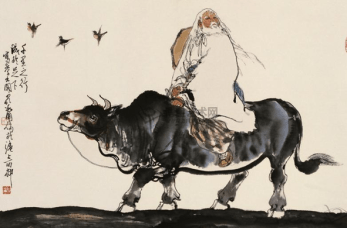
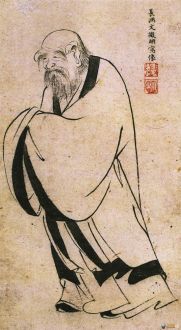
It’s said the keeper of the western gate, whose name was perhaps Yin Xi, realised the old librarian from the royal archives of the state of Zhou did not intend to return. He knew the old man as a quiet, wise character, never someone at the heart of activities, never excluded by others, an observer, seldom observed, always ready to offer advice, not eager to thrust himself forward, often ignored, never wisely. The gatekeeper called, ‘Old Master, Laozi! If you intend not to return, if you mean to renounce the world, then leave a record of your thoughts. Write me a book to remember you by.’ The old man climbed down from his humble oxcart, borrowed pen and ink. A few hours later, he handed Yin Xi a script of some 5000 characters and then continued westwards, never to be seen again.

a-journey-of-thousand-miles

So the poems of the Daodejing are a gift, freely given at a point of change, a gateway to new experience. They are also a turning away from the world (Laozi is said to have despaired of its venality and corruption), yet a transmission intended to aid, an inspired out-pouring of poetry as much as a moral and political handbook. Perhaps above all we should think of them as a response to a personal request. Bertolt Brecht’s 1938 poem, ‘Legend of the origin of the book Tao-Te-Ching on Lao-Tzu’s road into exile’, seeks to praise the “customs man” who “deserves his bit. / It was he who called for it” (tr. John Willett). Modern scholarship, of course, has long since stripped away such eloquent myths. Most likely, the current 5000 characters of the Daodejing were far fewer to begin with, a series of orally transmitted seed verses compiled by many hands, an aide memoire, certainly an aid to teaching from as far back as the 7th century BCE. Passed on orally, then transcribed, with the usual levels of error, displacement, ‘correction’ and happenstance, the text has also been subject to the Chinese tradition of written commentaries and these intercalated texts have themselves become vanishingly absorbed into the original. Such an uncertain state of the text legitimates considerable levels of ‘correction’ for most would-be translators; in this case, I have excised material only from ‘Dangers of prominence’ (Chapter 13) and ‘The great clamour’ (Chapter 23), silently removing a few lines of (what I thought of as) redundant repetition.

41mGYLTsCVL._SX331_BO1,204,203,200_

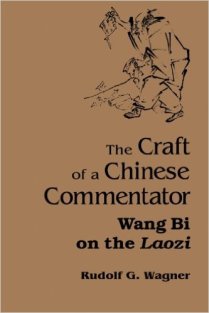
Yet the poems are still vivid, astonishingly fresh, irresistible. They are also still subject to continuing textual debate and archaeological inquiry. The standard text has long been the one associated with the scholar Wang Bi (226-49CE) which divides the Daodejing into 81 Chapters and those into two sections. On the importance and insights of Wang Bi, see Wagner, Rudolf G., The Craft of a Chinese Commentator: Wang Bi on the Laozi (SUNY Press, 2000). The Dao or Way is made up of the first 37 Chapters; the De or Power occupies Chapters 38 to 81. But an archaeological dig as recently as 1973 at Mawangdui revealed two new versions of the text, dating from around 200BCE. Surprisingly, both Mawangdui texts reverse this order and some recent versions into English have adopted this change. Most notably, see Robert G. Hendricks who produced a re-shaped Lao-tzu Te-Tao Ching: A New Translation Based on the Recently Discovered Ma-wang-tui Texts (Ballantine Books, 1989). Also see D. C. Lau’s second translation of the texts published as Lao-Tzu Tao Te Ching (Everyman Books, 1982). I have not done so. The traditional division between the Way and the Power of the Dao is by no means watertight or proven but I feel it makes more sense to explore the nature of the Way before considering its more specific manifestations. Also, as a sequence of poems, ‘Nursery’ (Chapter 1), summing up as it does so much of what is to follow, surely has to come first.

Though probably the work of many hands over many years, it’s still hard not to hear (with Wang Bi) a distinctive voice, a coherent poetic style – alluringly laconic, clipped, coolly enigmatic; it flaunts its paradoxes, is boldly metaphorical, juxtapositional, repetitive to the point of liturgical, urgent, unashamedly epigrammatic. In short, we seem to hear Laozi writing a kind of poetry which enthusiastically accepts that its profound and heartfelt messages are inevitably compromised by the need to express them in the form of language, hence demanding that it employ a variety of technical manoeuvres, that it stays light on its feet. Of course, language is imperfect but it’s what we must use and I have given titles to each of the Chapters to encourage contemporary readers to approach them in large part as language, I mean as poetry.

laozi-painting

For a text so geographically, culturally and temporally remote, some consideration of key images and ideas is necessary. The Dao is not an individual entity, still less anything divine, it is more a mode of being that is all encompassing, a phenomenal, an existential primacy – perhaps akin to the western idea of original chaos. It can usefully be seen from epistemological, temporal, perceptual, political or environmental perspectives, though none of these exhaust its real nature. It is not subject to time yet contains it. It is never fixed. It is the ever-here, both omnipresent and unchanging. We might be tempted to say the Dao is the substratum of all things, the ground base – but language’s introduction of levels and hierarchical ideas is not helpful to our already feeble grasp of it. Certainly, it is the whole, the one that precedes the many.

So these poems explore how the Dao becomes manifest in the individual objects, the actions and creatures of the world we are familiar with. They suggest the Dao initially gives rise to two things, heaven and earth (‘Nursery’ (Chapter 1)) and the poems subsequently make use of the formulation ‘the ten thousand things’ to suggest the Dao’s proliferation or subdivision into all there is. It is in this way that the Dao is the mother of all things (‘Of all things’ (Chapter 25)); it is like water, a pool from which all things draw life (‘Something greater’ (Chapter 4); it is the uncarved block of wood that has inherent within it all things that have been, are, will be (‘Uncarved wood’ (Chapter 15). Most importantly, the Dao is beyond conception and so beyond any conventional use of language, the limits of which constitute a recurring motif in the Daodejing: ‘Nursery’ (Chapter 1); ‘Awareness (Chapter 56); ‘Store (Chapter 81). Of course, our quotidian lives must pass in this ‘fallen’ state, full of a misplaced confidence in the reality of the ten thousand things, including our own discrete selves, so Laozi emphasises – in recurrent images of reprise or re-visiting – that only if we can return to a more clear awareness of the presence and reality of the Dao, can our behaviour and experience of life be more true, fulfilled, harmonious. Tennyson’s otherwise unremarkable poem, ‘The Ancient Sage’ (1885), describes approaching the “mortal limit of the Self” and passing “into the Nameless [. . .] and thro’ loss of Self / The gain of such large life as match’d with ours / Were sun to spark – unshadowable in words”.

images

 Part 2 of this Introduction to the Daodejing will be posted next week (and is now available by clicking here).


Two Gas Attack Poems: Wilfred Owen and Choman Hardi

Ian Duhig has recently written for Poetry London about the genre of ‘poetry of witness’ (Poetry London). In 2014, Carolyn Forche and Duncan Wu edited The Poetry of Witness: The English Tradition, 1500–2001 (Norton) and the genre was there described as a tradition that runs through English-language poetry: “composed at an extreme of human endurance – while their authors awaited execution, endured imprisonment, fought on the battlefield, or labored on the brink of breakdown or death”. Though Duhig’s discussion raises doubts about both the genre itself, this definition, and its ethical stance, the two poems I discuss here are surely examples of it.

poetry-of-witness-cover

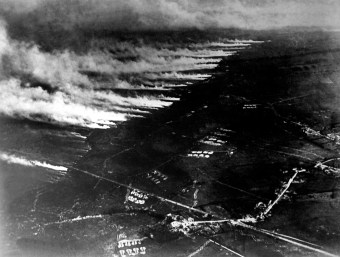
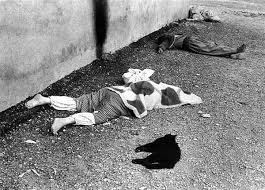
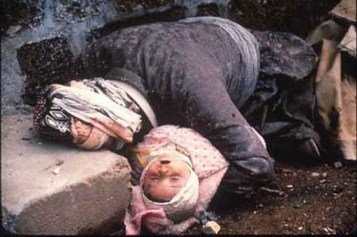
I’ve recently been reading Choman Hardi’s new collection and the link with Owen’s very well-known (well-studied) poem is obvious. Choman Hardi’s poem ‘Gas Attack’ comes from the ‘Anfal’ sequence in her recent book, Considering the Women (Bloodaxe, 2015). The narrator is a woman whose community is bombed by the Iraqi state in the notorious attacks on the Kurdish people in 1988. Wilfred Owen’s famous poem (‘Dulce et Decorum Est’) draws on his experiences of trench warfare on the Western Front in World War One. Owen’s title is a reference to Horace’s Odes (III, ii l. 13), the full phrase translating as “Sweet and fitting it is to die for one’s country”. It is this sort of ardent, patriotic jingoism that Owen looks to counter in the poem as it is the world’s blindness to real events in Kurdish-Iraq that Hardi wishes to correct.

Structurally both poems are similar in that they open by setting a scene of relative calm even suggesting the ordinariness of what, to most readers, must seem extraordinary. It is into these already difficult situations that the gas attacks fall and both poems (Owen’s at greater length) detail the nature of the attack and some of its immediate effects. Both poems have a third and final part in which they focus on specific victims. In Hardi’s poem this is the son of the mother narrator; in Owen’s case it is one of the gas-affected soldiers, flung onto a “wagon”, and suffering the agonizing effects of the gas. So both poems open, in effect, making use of a wide-angled lens but proceed to focus on individuals and this reflects the shared intention of both authors to elicit understanding and sympathy from their readers. It is Owen who makes this purpose more explicit in the final, bitter address to “My friend” (possibly the jingoistic writer, Jessie Pope, the original dedicatee of the poem).

imgres
Choman Hardi

The scene set in ‘Gas Attack’ is of the routine persecution of the Kurdish people under Saddam Hussein. The deliberate plainness of the opening line (“Bombs could fall anywhere, any time of the day”) with its repetition around the caesura suggests this – as does the unruffled sense given by the line’s end-stopping. The statement that such events are to be regarded as a mere “nuisance” that can be “got used to” wrenches the reader away from the more usual evaluation of such events into a world where these things are everyday incidents. There is however something proleptic about the awkwardly enjambed breaking of line 2, the reference to “shelters” and the unease implied by words like “haunting” and “muffled”. This is confirmed (after 2 more run-on lines) by the deliberate puzzle that the explosions “deceived us”. The faint personification here and the idea that explosions (surely pretty straightforward things) might have the capacity for deception alerts the reader, creating tension: in what way are these explosions unlike other explosions?

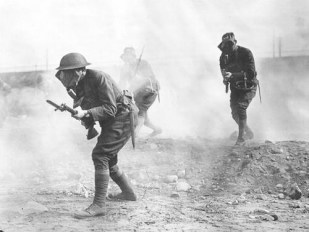
gas_attack_WW1

Owen’s opening 8 lines are immediately more harsh and noisy though even here there is some sense of routine in that the retreating men “marched asleep” (from fatigue and perhaps on ‘automatic pilot’). The fact they are heading for “distant rest” invites the reader to some mistaken sense of ease (no doubt reflecting the feelings of the men themselves as they march away from the Front Line). But through figurative language and physical positioning, Owen’s men are more distressed than Hardi’s Kurdish woman: “Bent double, like old beggars under sacks, / Knock-kneed, coughing like hags, we cursed through sludge”. Like Hardi, Owen also uses the word “haunting” but here for distant flares falling and the brief, stumbling phrases of lines 5-8 reflect the men’s difficult progress. Such devices elevate the reader’s anticipation of drama to come though again, on the surface, the men have “outstripped” shells (Five-Nines) that are dropping “behind” them. Their deafness to the sound of these shells on one side suggests their (safe) distance from them, on the other, “deaf even” (my italics) implies potential danger to come from this source.

WAR & CONFLICT BOOK ERA: WORLD WAR I/THE FRONT

Owen’s lines on the attack itself are a nightmare of panic initiated by the exclamatory, capitalized shouts of the men: “Gas! GAS! Quick, boys!” This is an “ecstasy” in that their consciousness is so agitated and extra-ordinary that they feel to be watching themselves as in an out of body experience (ex-stasis). Their flurry to don gas masks is suggested by 6 present participle verbs in as many lines though most of these are equally descriptive of the poor individual who fails to get his mask on fast enough. Figurative language conveys his agonising plight as he is “like a man in fire or lime” and he moves “As under a green sea [. . . ] drowning”. By contrast, the impact of the attack in Hardi’s poem is at first a strange calm, once again related to the deceiving nature of these Iraqi bombs (thought to be conventional; in reality chemical weapons). Owen’s men are familiar with these chemical weapons; Hardi’s Kurdish community is not – yet.

imgres

There is still no shift to the level tone of Hardi’s poem, even as the mother narrator observes how “a chalky-yellow powder settled // on our skin”. These lines seem to extend time agonisingly for the reader who, aware of the topic from the plainly informative poem title, waits for the narrator to comprehend events. In contrast to Owen’s figurative language of pain by fire and water, Hardi’s narrator’s ignorance (and therefore her innocence) is caught in her image of the powder “smelling of sweet apples at first” and it “seemed safe”. It’s the caesura of line 8 that marks the transition from ignorance to knowledge as the impact of the gas is evoked (again through a series of active present participles (going, laughing, buckling, twisting running, bumping)). The people’s erratic, tortured behavior has a black comedic, or surreal, quality which probably suggests the few shreds of the observer’s naivety (something Owen’s more experienced narrator never expresses).

In a notable contrast between the two poems, lines 15/16 of ‘Dulce et Decorum Est’ break from the retrospective narrative into the present tense (“I saw him [. . .] He plunges”). The lines provide another image of sight, perhaps launched partially by the heightened visual quality of the glimpse of the man “through the misty panes” of the narrator’s own mask. But in these lines the “helpless sight” is one derived instead from dream-vision and memory. The fact that, at an undefined moment after these events, they still haunt the narrator gives additional weight to the horrors unfolding in the past tense narrative.

daf16862692e4bb2a52873a4ec3c9bc5

This is not something Hardi’s poem does and to this extent Owen’s narration is more complex, implying an attitude towards the events which emerges most obviously in the long single sentence of lines 17-25. The third section of Hardi’s poem continues with the level-toned witnessing: “Villages from the region came to our aid”. At first it seems curious that they are the ones to draw attention to the narrator’s son who “looked strange”. At this point it is almost as if the mother does not want to refer to her son’s injuries, a kind of denial, though eventually it emerges that it is her own blindness (as a result of the chemical weapon) that has actually prevented her even seeing its effects on her son. The boy’s strangeness is conveyed in the plain statement that “his face was blistered, blackened” but also through the strange phrase (difficult to visualize) that it was “as if his eye-colour had spilt // out”. This probably refers to the “blackened” image but also suggests the physically horrific melting of eye-balls not unlike Owen’s “white eyes writhing” and the dissolving of “froth-corrupted lungs”.

Hardi continues to hold back the fact of the mother’s blindness which accounts for the recourse to the aural image of the boy’s groan “like a calf faced with the knife”. This in turn conjures up Owen’s opening to ‘Anthem for Doomed Youth’: “What passing-bells for these who die as cattle?” I don’t see influence here other than the fact that both writers are wanting to evoke sympathy by drawing attention to the dehumanising impact of warfare’s mass slaughter. Hardi’s narrator finally reveals her own injury (“I was still blind”) and after another run of destabilizing enjambment (ll. 11-14) the last line is more heavily punctuated, slowing and emphasizing and again keeping the tone level and factual: “he / died, [I] could not see him, did not say goodbye”. The mother’s passivity is very prominent; her hopelessness is what expresses her grief. It is as though the continual persecution and horror has left her drained even of the energy to mourn with passion.

Owen

This is obviously very different to the passionately angry conclusion of Owen’s poem. Owen’s focus on the dying soldier begins at line 17 but its vivid descriptions of the man’s death are already contained within a hypothetical syntax – a point is evidently being made with the surprising appearance for the first time of the second person pronoun (“you”). Far more assertively than Hardi’s poem, Owen demands his readers, those who knew too little of the realities of warfare in 1918, put themselves in a position of greater insight: “pace / Behind the wagon that we flung him in, / And watch”. Likewise Owen does not pull punches in terms of the gruesome description of the soldier’s suffering with his “writhing” eyes, his “hanging” face (upside down, hanging off the wagon?), his “gargling” lungs. The two similes he introduces achieve the same levels of hyper-intensity with the suffering “as cancer” (obscurely or – in another draft – obscenely) and the blood in his throat like a “cud”, yet another livestock allusion to match Hardi’s doomed “calf”. The cud on this occasion is itself developed metaphorically into “vile, incurable sores on innocent tongues”, further emphasizing the appalling injustice of this slaughter.

It’s at line 25 that the “you” is addressed more directly with the ironically amicable “My friend”. The “zest” and “arden[cy]” of those eager for patriotic glory is mocked (“glory” rhyming with “mori”) but the potentially ‘hedging’ effect of these ironies is vigorously and fiercely pushed aside by the plainly monosyllabic description of the Horatian tag as “The old Lie”. Owen’s poem takes the reader into the trenches, to the post-traumatic world of nightmares, but also manages to encompass this declarative, even propagandist, point. Likewise, Hardi’s poem plunges us into the gas attack and its aftermath but never ventures into the same argumentative, passionate point-making. Her decision to allow the details of this poem to speak for itself is a brave one (of tone and manner) given the horrors of which it speaks and the author’s evident commitment to bringing them to notice.

imgres

Two Great Days at StAnza Poetry

Writing is always a rough translation from wordlessness into words – Charles Simic

I arrived at about 8pm on the Friday evening. Leuchars station is not close to St Andrews itself and (it made me feel at home) there were roadworks disrupting the usual route so instead of 5 miles it was a 10 mile trip. Actually, it was dark and I had no idea where I was so I’m just quoting the chatty taxi driver here – who also lamented the decline in business in recent years. Lack of local money generally he said and the changing habits of students who go out less, pre-drink more and choose to stumble home rather than call his cab. We waited a few minutes for Pascale Petit’s train to arrive. She’d been travelling for 12 hours (from Cornwall) which made my 5 hour train ride feel like nothing much. Unpacking, I reflected north is a very long way north.

imgres

I was staying at the Greyfriars Hotel but walked up to the Byre Theatre on Abbey Street, the main Festival venue. The headline reading for the evening was Lemn Sissay (who I’d just missed) followed by Don Paterson. I arrived at the interval and the talk at the bar was of a local heckler interrupting Sissay. I never got to hear how he dealt with it but it seemed to say something about the tone of this festival that there was as much talk about inclusion as there was annoyance at the interruption. The auditorium was sold out (typical of this StAnza while I was there – you needed to book your event fast). I had no ticket but Jim Carruth took me to the studio theatre to a live relay of what remained of the event. Paterson read mostly from 40 Sonnets including ‘Here’, ‘Wave’, ‘A Powercut’, ‘Little Aster’ and the curiously moving death-of-a-dog poem ‘Mercies’. He also read aphorisms from an iPad and I remember ‘Poetry is not a vocation but a diagnosis’. And (one for his students, he said) ‘If a poem is read slowly enough we begin to hear things – which – are – not – there’.

I was woken by seagulls in the grey dawn and through a gap in the Greyfriars curtains I could make out a CCTV camera on its right-angled gantry across the road, white and intent and about the size of a large gull. Perhaps I was dreaming. I was reading next morning with Tracey Herd in St John’s Undercroft, a long brick-arched room, with a great acoustic and atmospherically lit. Andrew Jackson generously introduced us and I read most of my A Hatfield Mass sequence which I think of as celebratory poetry about nature, perception, growing up/older, the body. Tracey’s book Not In This World was a PBS Choice and shortlisted for the TS Eliot Prize this year and is her first collection for 14 years. She did not read those poems about film stars or racehorses for which she’s justly renowned but powerful, recent poems of loss: “Somewhere, someone much loved is leaving”.

images

I was also reading in the afternoon at a ‘Past and Present’ event – where poets talk on writers from the past. This was the first occasion (in the Council Chamber of St Andrews’ Town Hall – where marriages are performed we were told) at which I could read some of my new, just-off-the-press versions of the Daodejing. Pascale Petit was also appearing and she talked about her enthusiasm for Tomas Transtromer, in particular the way in which his poems often use an aerial perspective; from his first published poem: “Waking up is a parachute jump from dreams”. I’m sure she said she’d consulted a Swedish friend who said his surname meant something like crane-over-water – ornithological crane obviously.

imgres

Later in the afternoon, at the Parliament Hall, Fiona Benson and Andrew McMillan read. Benson was nervous in front of the large crowd (and who can blame her) but she was soon absorbed in the poetry itself and her demeanour was not at odds with the work. Sections of ‘Love-Letter to Vincent’ (Van Gogh) were read with great intensity. Other poems of pregnancy, miscarriage, birth and motherhood were more moving and (as Dave Coates has suggested) her book’s up-beat title, Bright Travellers, misleads. The contrast with McMillan was not to either poet’s detriment. I reviewed physical on this blog back in July 2015 and his (in various senses) naked poems, even when sad, manage to stir great pleasure in the audience. In person, he adds to this a wise-cracking, witty style of introduction and between-poem chat. Given his marvellous success this year I wasn’t sure why he wanted to discuss some of the negative criticisms he’s had but even that does not prevent me wanting to use that old Hollywood term ‘star’ in listening to McMillan perform.

images
Nora Gomringer

It was another sell-out in the Byre Theatre on Saturday evening with an event indicative of the Director, Eleanor Livingstone’s innovative approach to programming (and part of the German poetry emphasis to this year). Nora Gomringer performed work (with percussionist Philipp Scholz) which reminded me at moments of Laurie Anderson, at others of the much-missed Bob Cobbing (who I saw read/sing in London in the 1980s), at all times evoking a jazz-like improvised feel. Quite brilliant. Jo Shapcott had the tricky job of following this and chose to read a number of ‘The Roses’ poems from Tender Taxes, her responses to Rilke’s poems in French. These are a bit delicate and brief to come over very strongly in a live reading and other new poems on pain (but without mentioning the word) I found not easy to appreciate. But the brilliant prose poem ‘Scorpion’, the touching ‘Somewhat Unravelled’ and the finisher, ‘Piss Flower’ ended the evening in style.

imgres

I had a train to catch next day but managed to get to stride along the Chariots of Fire beach early in the morning plus take a peek at St Andrews Old Course before the Poetry Breakfast discussion on translation. Diplomatically and informally chaired by Annie Rutherford, the theme emerged that we ought to think more loosely, more liberally about the idea of translation.  Aurelia Maurin suggested we should think of it more  as we do cover versions of songs. Claudia Daventry opened the field up by quoting Charles Simic’s idea that all poems are translations from silence. Nora Gomringer remembered a professor urging her to find ‘the game’ of any poem she intended to translate not merely to work line by line. She’d been asked to translate Yoko Ono’s poems into German but felt unable to and the importance of the rightness of a translator to a source text was demonstrated when, on another occasion, she’d translated from Russian (I think) and had actually been spat at by a disapproving reader. I was struck – as before – by what powerful emotions the idea of translation stirs up, involved as it is with ideas of truth, honesty and fidelity. I especially liked Daniela Seel’s take on the process, stressing the almost chance meeting of suitable translator with appropriate source text and the way in which the linguistic and emotional ‘body’ of the translator (his/her resources) need to be matched to the varied demands of the source text.

But I had to catch my train and, though exhausted, I spent some of the six hours back re-reading Montale’s loving lament and memorial to his wife, Drusilla Tanzi, here translated by G. Singh:

With my arm in yours I have descended at least a million stairs,

And now that you aren’t here, a void opens at each step.

Even so our long journey has been brief.

Mine continues still [. . . ]

url
Montale and Drusilla