Aonghas MacNeacail’s English Language Poems Reviewed

An edited (shorter) version of this review first appeared in Poetry Salzberg Review in June 2025. Many thanks to the editor, Wolfgang Görtschacher, for commissioning the writing of it.
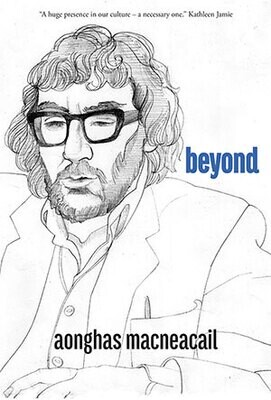
It is as a poet writing in Gaelic that MacNeacail – who died in 2022 – is most well-known, though he would himself provide translations of his work into English, what, in the poem ‘last night’, he refers to as Gaelic’s ‘sister tongue’. There were also poems written in Scots and these variants give an insight into what Colin Bramwell here calls ‘the language situation in Scotland’ within which MacNeacail worked all his life. For a number of years, MacNeacail lived and wrote under the anglicised name Angus Nicolson, but always considered himself a tri-lingualist and antagonistic to the kind of divisiveness such a ‘situation’ might give rise to. His natural inclination was democratic, pacifist, anti-authoritarian, and modernist. Now, the collection, beyond (eds. Colin Bramwell with Gerda Stevenson (Shearsman Books, 2024)) gives readers a selection of poems written in English by Aonghas MacNeacail over the past 30 years. One of the implications of the book’s title is his deeply held wish to look ‘beyond’ division, not to anything transcendental (MacNeacail’s focus was always this world, not some other), but to the next term in an on-going dialectical process. One of the little gems from ‘the notebook’, included here, imagines a cup of knowledge, the liquor within, also knowledge, a grain is added and stirred, and the grain then consumes the liquor and continues to ‘grow, root, sprout / find elbows, crack the cup // find clay’.

MacNeacail’s modernism took its key lessons from the likes of William Carlos Williams, Olson, and Creeley and most of the poems here have that fluid, unpunctuated (hence pointed by the breath), often short lined, often indented formal shape we associate with the Black Mountain. He was a member of one of Phillip Hobsbaum’s fertile ‘groups’ (along with Liz Lochhead, Alasdair Gray and Tom Leonard) and the advice given was to go back to his roots, to ‘write about what you know’. In part, this took MacNeacail back to his childhood, growing up in Uig, on the Isle of Skye, speaking only Gaelic. It also made it clear what he wanted to escape from: Gerda Stevenson describes this as ‘the confines of the proscriptive Free Church of Scotland’. Several childhood poems, illustrate the stifling force of religion, on his mother, for example, ‘strapped down tightly / by a darkly warding book thick with orders that drove / and hedged her way’ (‘missing’). The church governed education too, the teacher little more than a ‘stern presence’, who demanded ‘psalms / from memory’ (‘crofter, not’).
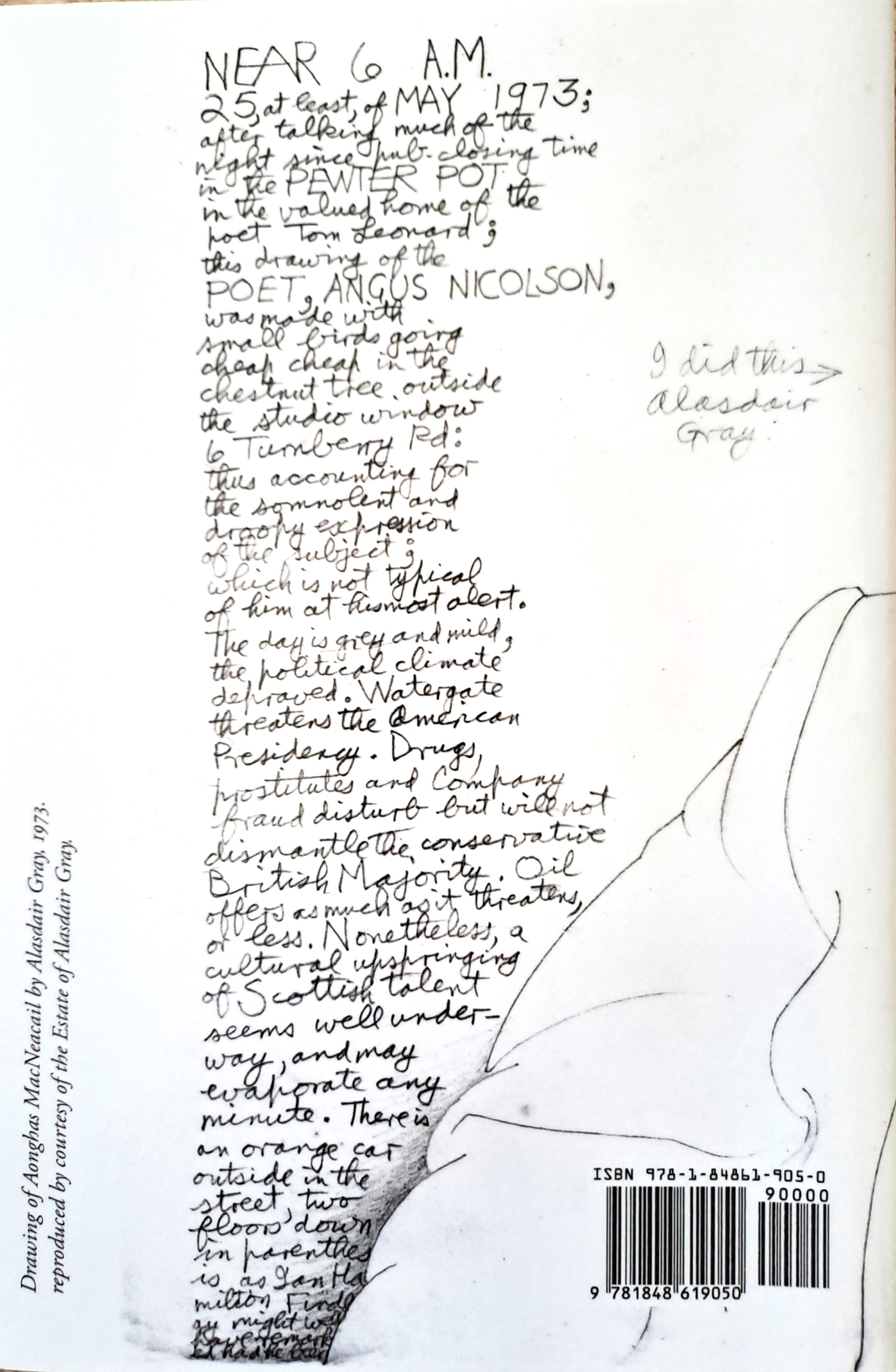
The teacher’s ‘granite eye’ also features in ‘forbidden fruit’ where the contrast is between education’s confining ‘barbed-wire’ and the invitations of the natural world (of Skye), specifically the allure of ‘the biggest [. . .] sweetest’ nut hanging on a branch over a waterfall. The poem ‘had adam not eaten the apple’ feels like a later piece, with a more self-confident, liberated MacNeacail declaring ‘the thing is / not to always / spell the word correctly’ and imagining god’s demands for eternal perfection leading him to waken every morning, complaining ‘another fucking immaculate day’. A longer poem like ‘gaudy jane’ gives a sense of MacNeacail’s unshackling from restrictions. The figure addressed is part woman, part a realm of liberation, a window onto ‘wild excursions’, towards ‘dancing voices, laughing feet’, she is a glass of whisky, a doorway into nature, to sensuality, and a way to access the ‘little gods of mischief and delight’. Celebrations of the natural landscapes of Skye (and elsewhere) in fact become one of the characteristics of MacNeacail’s writing. Snowfall over hills is as if ‘god’s apron / settles on our field and makes / a tranquil bowl’ (‘snowhere’). In ‘a rainbow’, the natural phenomenon is enjoyed and admired, ‘so real // high up on that pentland slope’, its natural beauty preferred to any fanciful talk of pots of gold, its fleetingness an image of imagination and memory. MacNeacail’s ‘primula scottica at yesnaby’ celebrates the rare wildflower’s fragile beauty, its hardy nature, till it also becomes an image of Scotland itself: ‘the air it breathes is stiff with brine / this whit of life      still flowers / every tiny purple radiance is lambent / in the blood of time’. 
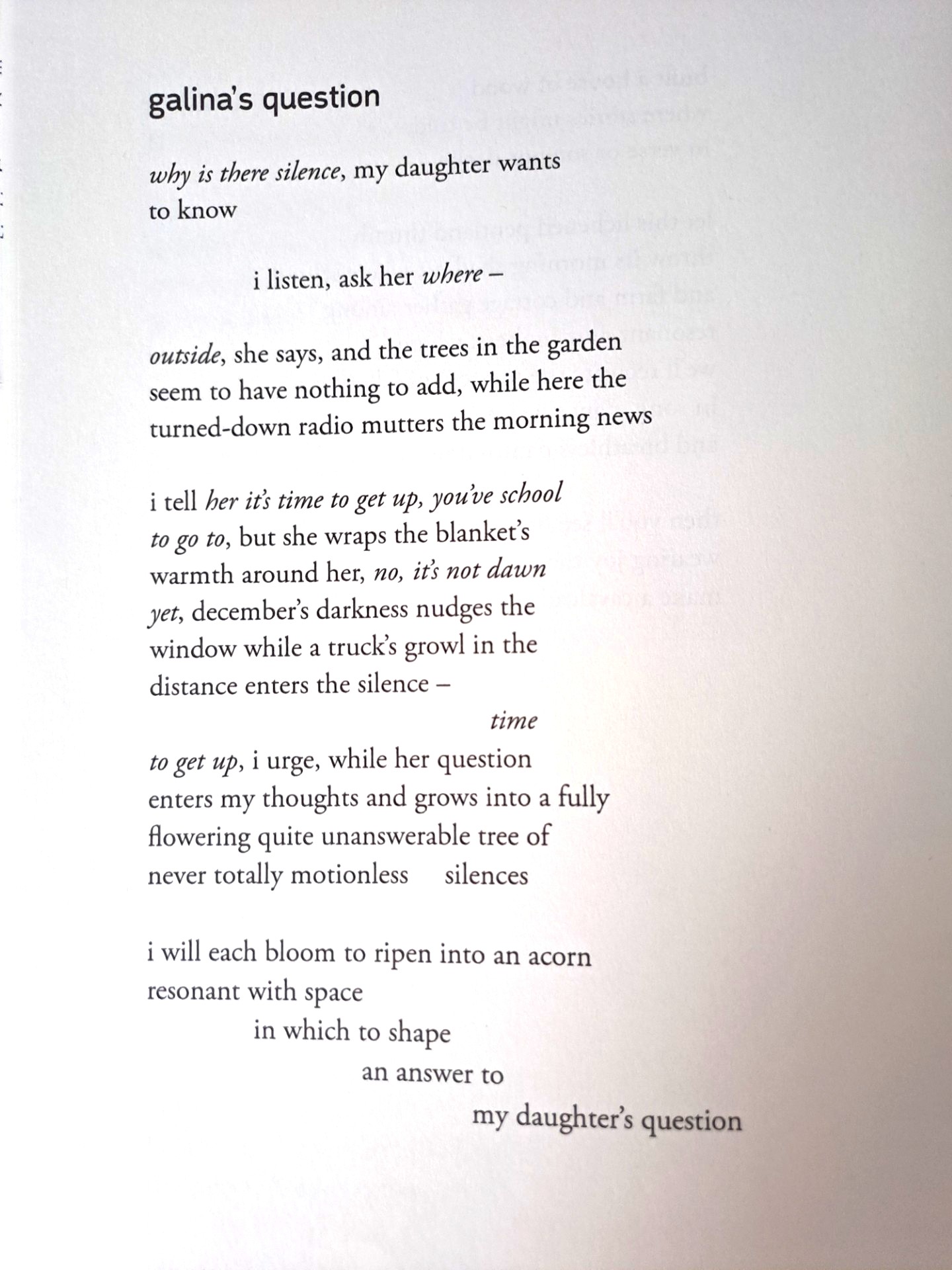
MacNeacail’s love of Nature is matched only by his writing on the varieties of human love, erotic, romantic, filial, parental, between friends. I can’t think of any other poet who’d compose 80 lines (both touching and hilarious) in praise of ‘some of my best friends’. A poem like ‘love in the moonlight’ is unashamedly romantic in its contrasting of the moon’s ‘pallor’ with the loved one’s ‘sun- / wrapped noons, bright mornings / and the way your evenings / dance into a fiery dusk’. There are several delicate poems featuring MacNeacail’s daughter, Galina, and – reminiscent of Courbet’s ‘The Origin of the World’ painting – ‘the curious eternal’ is a marvellous erotically-charged paean to a loved one, ‘after all those years / the mystery / of flesh, secretions, pulse and breathing patterns’. MacNeacail’s English poems exude a human warmth that, to judge from comments from friends and colleagues, was true to the man himself. They are driven by his wish to communicate – in whatever language, in truth – and his slipping free from Christianity’s ‘one book’, that would ‘consign all art and ingenuity / to black irrelevance’ (‘this land is your land’), allowed him to celebrate the flawed, the not perfectly straight, the interrupted conversations, that constitute being human with a passion and modesty. These lines from ‘the notebook’, are a characteristic, and invaluable, vade mecum: ‘no matter / how little / you say / it may / be worth / the saying, if it / touches the edge / of a shadow / that can / (possibly) / be thinned / by the breath / of words’.

Laurel Prize Shortlist 2025 – My Favourite Is….!

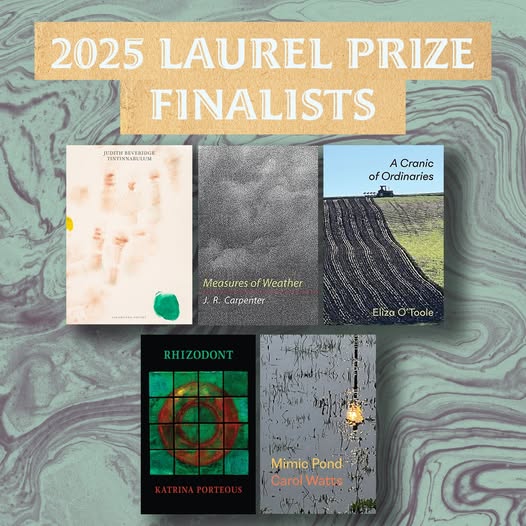
The shortlist for the eco-poetry/nature poetry Laurel Prize 2025 has just been announced. The finalists – judged this year by the poets Kathleen Jamie (Chair)Daljit Nagra, and the former leader & co-leader, Green Party of England and Wales Caroline Lucas – are (in alphabetical order):

Judith Beveridge Tintinnabulum (Giramondo Publishing)
JR Carpenter Measures of Weather (Shearsman Books)Carol Watts
Eliza O’Toole A Cranic of Ordinaries (Shearsman Books)
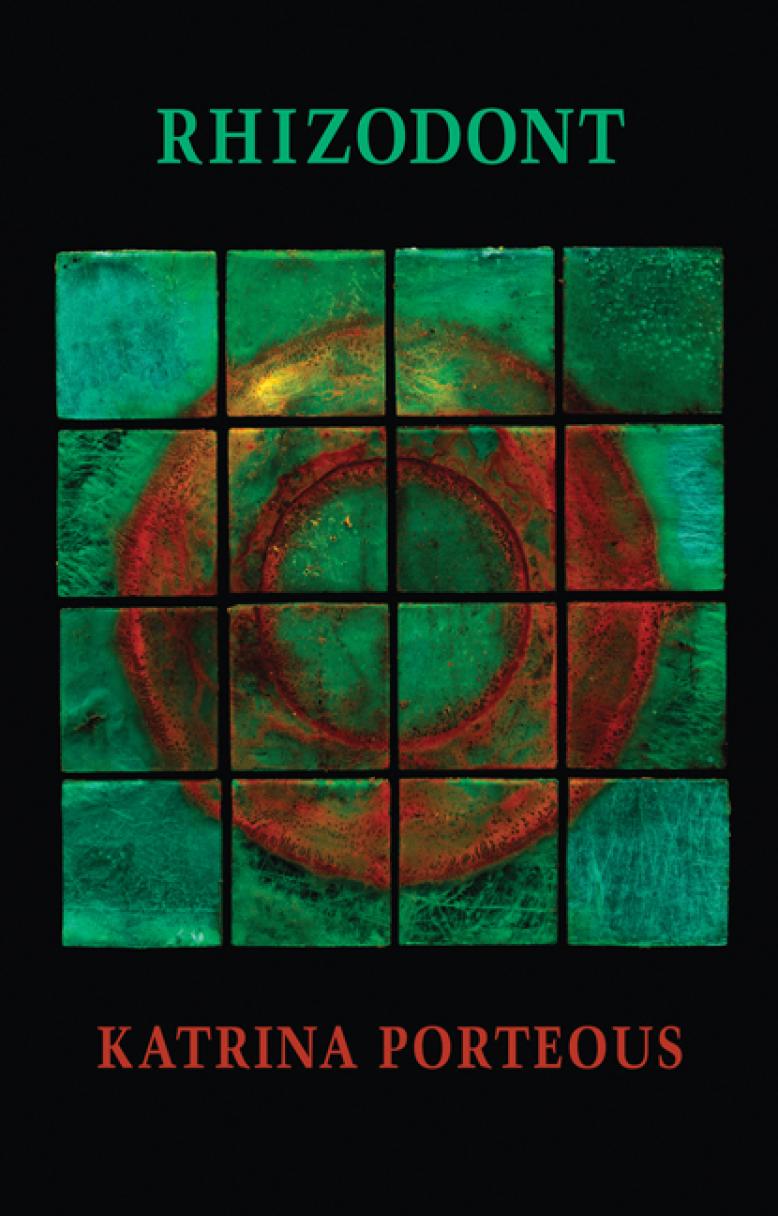
Katrina Porteous Rhizodont (Bloodaxe Books)
Carol Watts Mimic Pond (Shearsman Books)

It turns out I have reviewed two of these collections – one of them I have been bending the ears of anyone who will listen about how very very good it is. I reviewed Katrina Porteous’s Rhizodont (Bloodaxe Books) for Poetry Salzberg Review fairly recently and posted an extended version of the review here. I concluded that ‘The people and landscapes of ‘Carboniferous’ are far more successful as poems to be read and enjoyed, while ‘Invisible Everywhere’ is a bold, well-intentioned experiment that fails’.

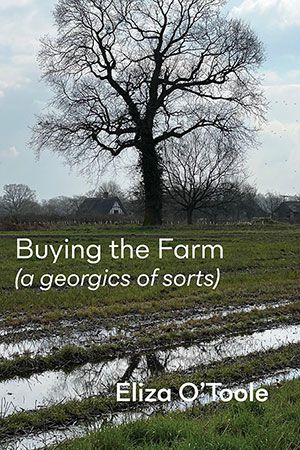
It is Eliza O’Toole’s A Cranic of Ordinaries (Shearsman Books) that I have been telling everybody about. Interestingly – and demonstrating the great enthusiasm the publisher shares for this poet – Shearsman have just published her NEXT collection: Buying the Farm (a georgics of sorts). The nominated collection was published in 2024.

I reviewed it in brief for The Times Literary Supplement recently, as follows:

The premise of Eliza O’Toole’s superb debut collection, A Cranic of Ordinaries, is unpromising: a year’s cycle of diaristic pieces in which the poet walks her dog through the Stour valley. But the result is a sublime form of ecopoetry which is visionary, yet creaturely and incarnate, and to achieve this O’Toole channels two great nineteenth century writers. Gerard Manley Hopkins’ ‘Hurrahing in Harvest’ joys in the things of Nature which are always ‘here and but the beholder / Wanting’. When self and natural world do communicate, Hopkins named that flash of true relationship ‘instress’.  O’Toole’s ‘Stour Owls’ records just such a moment, listening to the calls of a female tawny owl, the ‘slight pin-thin / hoot’ of the male, followed by a tense silence: ‘then the low slow of the barn owl as the / white slide of her glide brushes the air we / both hold & then breathe’ (12).

O’Toole also adopts Emerson’s idea of the ‘transparent eyeball’, seeing all, yet being itself ‘nothing’. The excision of the self’s perspective is systematically pursued. Seldom is the landscape ‘seen’ but is rather subject to plain statement: ‘It was a machine-gun of a morning’ (11), ‘a vixen-piss of a morning’ (13), ‘a muck spread of a morning’ (34). O’Toole has an extraordinarily observant eye, but this repeated trope counters any taint of the constructed picturesque, the human-centring of vanishing points and perspective. The observer grows ‘part or parcel’ of the world. Such a vision makes demands on language because in truth, ‘It is necessary / to write what cannot be written’ (94), and this yields one of the most exciting aspects of this collection as the poet deploys varieties of plain-speaking, scientific, ancient, and esoteric vocabularies as well as a Hopkinsesque ‘unruly syntax’. She describes ‘young buds. Just starting from / the line of life, phloem sap climbing, / a shoot apical meristem and post / zygotic. It was bud-set’ (26).

O’Toole’s choices about form are also bold, almost all the poems being both right and left justified, creating blocks (windows?) opening on each page. The realm the reader is invited into (not told about, not shown) is one where the manifold particularities of the natural world are also and at once a whole. O’Toole’s dog digs a hole: ‘In / the hole and out of it, the soil was / whole. There was a unity and no lack. / In the hole was soil. It was a / comprehensive various entirety; it / was a universe of relatings’. (38) In such ways O’Toole’s ordinaries are made ‘strange’ (33) and the toxic divide between modern humanity and the natural is momentarily, repeatedly, bridged.

Here’s one of the poems from A Cranic of Ordinaries. Apologies are due for formatting accuracy as – as we all know – WordPress is rubbish at dealing with poetry. But you’ll get the idea…..

Perpetual gravity – Box Tombs at Wiston

(the quality of appearing to recede, essential to the landscape tradition)

Now illegible, the children of John

Whitmore and Susanna his wife,

Sarah aged 11 Months,

Robert aged 2 Years,

Rebeckah aged 11 Months,

Elizabeth aged …. Weeks,

Lucy aged 1 Week,

Susanna aged 20 Years,

Thomas Aged 6 Years.

John Whitmore departed this life Jany

the ….6th 1746 Aged (6)6. He was a

good husband loving father faithful

friend and a Good Christian. Susanna

Whitmore died / Jany. 25 1789 Aged

(?8)6. To dwell until all the world

inscribed when it was still possible to

die. To lie slightly foxed, mortared in

a brick box irregularly repaired, alive

with stone-devouring lichen and

littered with dry lime, leaves and

frass. Fin* pees antimony and sees off

the squirrel, wards off unbelievers we

have no need for having no place

amongst toppling tombs. A litany

indescribable, a conjugation beyond

reach, an accent mark over a vowel,

an entire landscape made grave. It

was October, the same fields were

ditched, furrowed, carved, still dug

over and still the Stour was flowing. In

the picture’s distant plain, the sun

like other yellows, was still fading.

Generally, a history remains unsure.

*O’Toole’s dog

The Laurel Prize awards £5,000 for the winner of the prize and £1,000 for the other four finalists – so congratulations are due to all of them. The winner will be announced at the Laurel Prize Ceremony which is taking place on Friday 19 September at 5.30pm (BST), and will be aired via a free live-stream. This year’s ceremony is a part of BBC Contains Strong Language which takes place in Bradford from 18-21 September.

Katrina Porteous’ most recent Bloodaxe collection, ‘Rhizodont’, reviewed.

An edited (shorter) version of this review first appeared in Poetry Salzberg Review in June 2025. Many thanks to the editor, Wolfgang Görtschacher, for commissioning the writing of it. The collection, Rhizodont, was shortlisted for the TS Eliot Prize in 2024.

The ‘rhizodont’ which provides the title for Katrina Porteous’ fourth collection (Bloodaxe Books, 2024) is not some niche root-canal dental work, but a large predatory species of fish, which became extinct 310 million years ago. It’s thought to be the first creature to transition from water to land and hence the ancestor of all four-limbed vertebrates (including humans). The poems here are divided into two superficially very separate books (titled ‘Carboniferous’ and ‘Invisible Everywhere’) but what Porteous insists holds them together is her exploration of this notion of transition. As ‘#rhizodont’ puts it, ‘We’re all on a journey’, and the ambition of this book touches upon transformations various: geological, natural, industrial, cultural (and linguistic) and technological. There can be no faulting the ambition of this and there are many fine poems, though Porteous insists on Notes explaining a great deal of what she is doing/writing about which gives the whole a rather teacherly quality that will divide her readership. Here’s the title poem in full, plus a video of the author reading it:

#rhizodont

Then, in a flash,

It claps shut – an ambush –

Teeth, fangs, tusks – crunch, rip,

Snap. The rhizodont,

Dragging itself out of water.

The old world sinks and slips

Beneath its tilted strata.

We’re all on a journey.

This one’s about us

Unearthing ourselves from a place –

Somatic, interlaced –

To be conjured from light, and sent

Invisible, everywhere,

For everyone to possess.

The children stare at their phones,

A fervent, lit up,

Incorporeal congregation,

Some deep, residual

Root in a life everlasting

Outlasting them, like a fossil

Sarcopterygian fish.

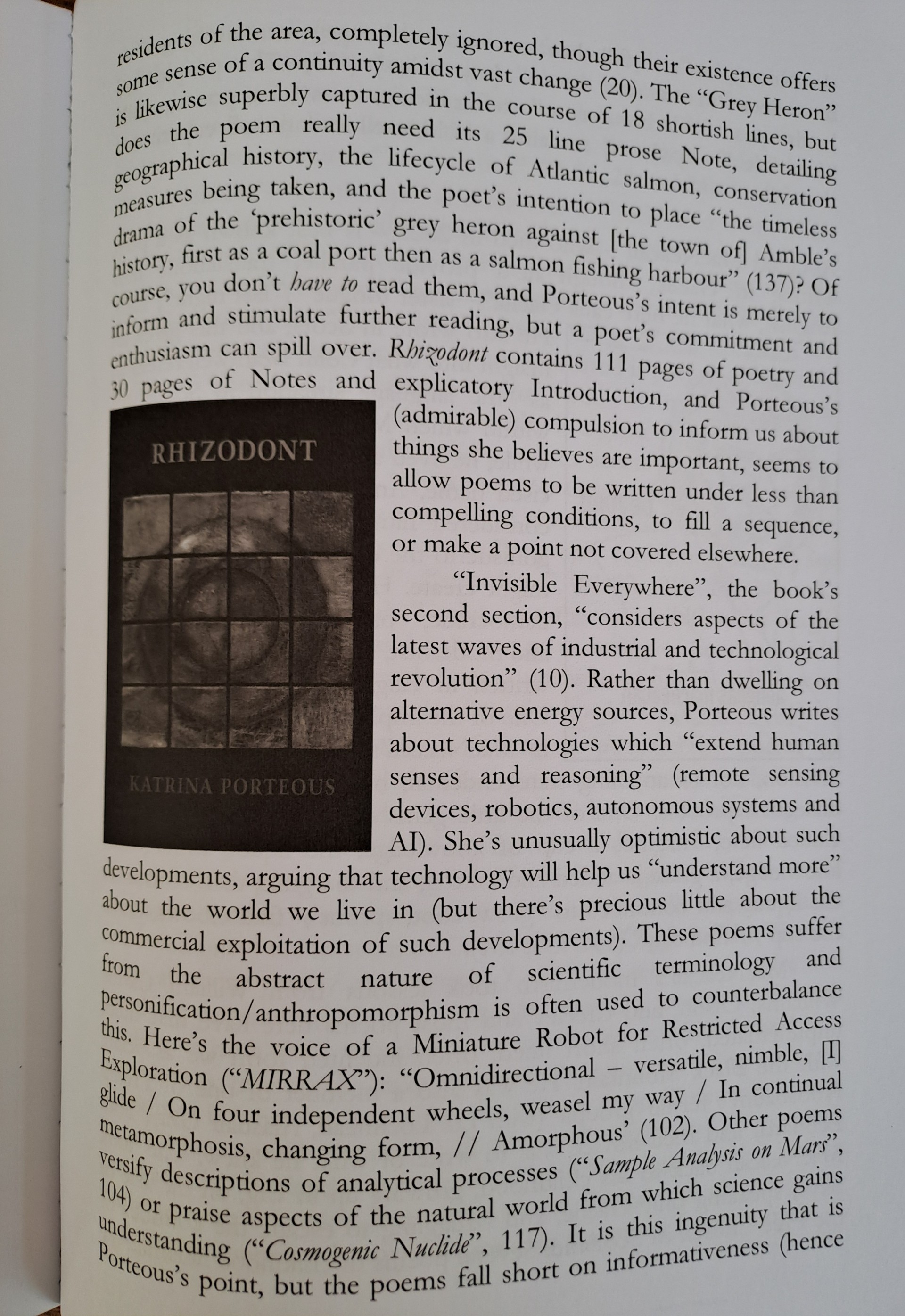
The longer ‘Carboniferous’ section is loosely glued together by a geographical journey from the former coalmining communities of East Durham, moving up the Northumberland coast to Holy Island. This is familiar territory, important to Porteous’ earlier collections, and she again writes well (with great local knowledge) of the geological conditions that have eventually given rise to the important fishing and mining industries (and cultural communities) in the area. Both industries are now in decline and in ‘A Short Walk from the Sea’s Edge’, while the older folk still use ‘old words’ (like stobbie, skyemmie, and gowdspink), the younger generation ‘checks in with Insta before school’. This also illustrates Porteous’ belief that the post-war generations’ transition ‘from analogue to digital technologies’ is a particularly dividing and challenging shift such that ‘the analogue island we lived on’, will seem as incomprehensible as ‘Latin and Greek’ to future generations (‘Hermeneutics’).

The poems also portray the natural wildlife of the region – dragonflies, sandhoppers, crabs and a wide variety of birds and plants. Despite coastal erosion and industrial pollution, Porteous focuses on such ‘small and local’ species as have been around for (often) millions of years. The glowworms in ‘Tiny Lights’ are ‘alien, ancient’ and for most residents of the area, completely ignored, though their continuing existence offers some sense of a continuity amidst vast change. The sounds and sights of the birds in ‘Goldcrests’ are marvellously observed, and they serve both to mark the season and, ‘bringing // Wildness’, they remind us of the natural world’s wider perspectives. The ‘Grey Heron’ is likewise superbly captured in the course of 18 shortish lines, but does the poem really need its 25 line prose Note, detailing the setting’s geographical history, the life cycle of Atlantic salmon, conservation measures being taken and the poet’s intention to place ‘the timeless drama of the ‘prehistoric’ grey heron against [the town of] Amble’s history, first as a coal port then as a salmon fishing harbour, and depict the bird as an explorer, venturing into Amble’s still-to-be-decided future’? I’m not convinced, though you don’t have to read them, and it’s true Porteous’ stated intent is merely to inform, and stimulate further reading.

But can a poet’s commitment and enthusiasm spill over too much? Rhizodont contains 111 pages of poetry and 30 pages of Notes and explicatory Introduction, containing lots of interesting facts and figures, but also a good deal of over-explanation as in the Note to the poem ‘Wishbone’: ‘The poem juxtaposes recent cultural evolution with this enormous timescale, and asks what we, with our plastic waste, will leave behind us’. Most poets would leave such interpretation up to the reader and Porteous’ (admirable) compulsion to write about things she believes are important, is also conducive to poems being written under less than compelling conditions, perhaps to fill a gap in a sequence, or to make a point not yet covered elsewhere. It’s almost certainly deliberately excluded, but this reader misses a bit more of the poet’s involvement, either personally, as in ‘Begin Again’ in which, confronted with the vastness of geological time and Nature’s endurance, the speaker’s suddenly ‘ glad / Of tea-cups, hands, companionable laughter’, or of the poet’s love of words and music as in the several balladlike pieces included here ( like ‘The Tide Clock’ and ‘Low Light’).

The collection’s second section ‘considers aspects of the latest waves of industrial and technological revolution’ and, rather than dwelling on alternative energy sources, Porteous writes about technologies which ‘extend human senses and reasoning’, by which she means remote sensing devices, robotics, autonomous systems and AI. She is unusually optimistic about such developments, arguing (in poems and Notes) that such technology will be used to ‘understand more’ about the world we live in (but there’s precious little here about the commercial exploitation of such developments). And the poems themselves? They often suffer from the abstract nature of scientific terminology and don’t convincingly convey much emotion about the tech. It’s interesting how often personification / anthropomorphism is used in these poems; the Antarctic ice speaks, or is spoken to, and here is the voice of a Miniature Robot for Restricted Access Exploration (‘MIRRAX’): ‘Omnidirectional – versatile, nimble, [I] glide / On four independent wheels, weasel my way / In continual metamorphosis, changing form, // Amorphous’. Other poems versify descriptions of analytical processes (‘Sample Analysis on Mars’) or praise certain aspects of the natural world from which science gains understanding (‘Cosmogenic Nuclide’, ‘Basal Shear’). It is this ingenuity that is the point, but the poems fall short on informativeness (hence the need for Notes), but also fall short on emotional engagement (poetry?), failing in the end to convey Porteous’ stated intention: to reflect ‘in awe and wonder that human consciousness is able to gather and interpret [all this] information’ [my italics]. The people and landscapes of ‘Carboniferous’ are far more successful as poems to be read and enjoyed, while ‘Invisible Everywhere’ is a bold, well-intentioned experiment that fails.

Durs Grünbein Reading at The Goethe-Institute, London

Please Note: this blog and website are now captured and preserved at the UK Web Archive held at The British Museum. Many thanks to them.

The highlight of last week was attending Durs Grünbein’s reading at The Goethe- Institute, where he was in discussion with his English translator, Karen Leeder. At the beginning of the evening, Grünbein joked that he’d not been in the UK for a few years and this was the first time he’d had to produce his passport (the blessings of Brexit). Interestingly, in the light of last weekend’s German election results, Grünbein has often been described as a poet of the reunified Germany, having been born in Dresden and now living with his family in eastern Berlin. Grünbein’s poetry is witty, wry, perceptive, and influenced by a broad range of literary texts and often presents the disillusionment of having grown up in East Germany and explores Germany’s identity in post-Cold War Europe. He has been very vocal in recent years on the issues of immigration and the defence of Ukraine. Helen Vendler commented on the ‘sardonic humour, the savagery, the violent candor—all expressed in lines of cool formal elegance’ and Philip Ottermann, in The Independent, noted ‘Grünbein loves to jump from one register to another—one moment he is the street poet of Berlin, the next … all marble and ancient philosophy’.

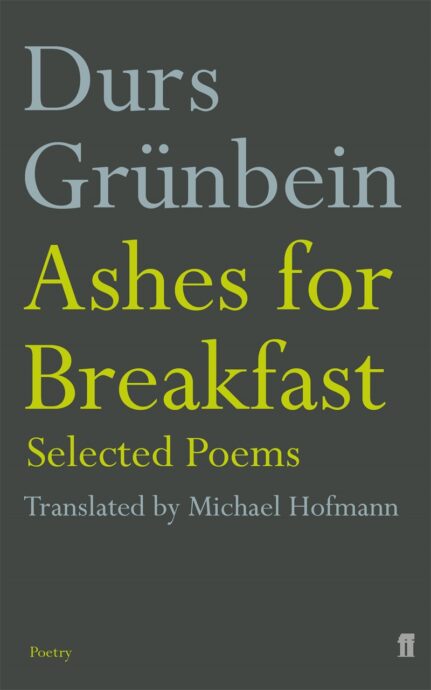
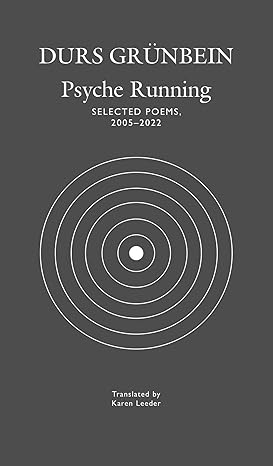
Grünbein’s earlier poems were translated into English by Michael Hofmann and published in Ashes for Breakfast: Selected Poems (Faber, 2005). Karen Leeder has now published Psyche Running, a selection of more recent poems from 2005–2022 (Seagull Books). During the evening, Grünbein commented on the process of those earlier translations as ‘strange’ and the results (as is Hofmann’s wont) as being very free, very sparky, and Leeder suggested there was a particular excitement in the ‘to and fro’ between author and translator to be found in them. She then suggested her approach has been rather different, perhaps a more dutiful one, still needing to make the poems ‘live’ in the target language, but also demanding a fidelity, to capture the original’s form and architecture as closely as possible. The work read during the evening suggests that her translations triumphantly achieve these goals.

Leeder said that his work can have a ‘marble’-like quality, a firm (unbending?) Classicism, and also that he has himself been labelled a ‘poeta doctus’, given the learned, wide-ranging references he incorporates. Grünbein rather demurred at these descriptions and (an idea he repeated a couple of times in slightly different forms) any interesting poem must be the result of two steps, the first poetic, the second, a more critical, a process of reflection (a later formulation suggested the two steps were ‘perceptual’ and ‘conceptual’). These two phases result in the finished poem as ‘a form of knowledge’; Grünbein pointed out that philosophy arose out of poetry in Classical times (not the other way round). The first poem he read, ‘Childhood in the Diorama’, does have a ‘marble’-like quality to it: longish, unrhymed lines in a solid verse paragraph and the child’s preference for the posed scenes of a museum’s diorama, their ‘inert’ quality. But on one occasion, the boy sensed some movement, a ‘draught, perhaps, had blown through the displays’, perhaps suggestive of the child’s development into a more unstable, fluid view of the world.

Other poems read that evening included ‘Nee Wachtel’, ‘Exaltations in Sleep’, and ‘Inspector Kobold’ which is a ‘Martian’ sort of piece describing seahorses, in ‘their whalebone corsets, like ‘tiny ocean Lipizzaners’ (here’s an alternative translation by Michael Eskin). If we are to take Grünbein’s poems as ‘forms of knowledge’ then they certainly range widely through the natural sciences, language, science more generally, astronomy, history and politics. He felt what binds all this together is the one individual life, the single life perspective, poetry as a sort of anthropological study, at which Leeder suggested there was a ‘fragility’ to much of his work, the vulnerability of the single life as much as all life (ecologically?). The poet was happy to agree to this, suggesting ‘marble’ was not at all the right term for his poetry, that there was always something ‘flowing’ about it, multiple angles and perspectives. He once claimed not to be a ‘German’ poet, but simply someone who wrote in the German language. This evening he stood by that statement: his own identity is wrapped up in language use, the mother’s language, used daily for years, and is not a function of birthplace alone (remember Grünbein grew up in East Germany and now lives in the unified Germany).

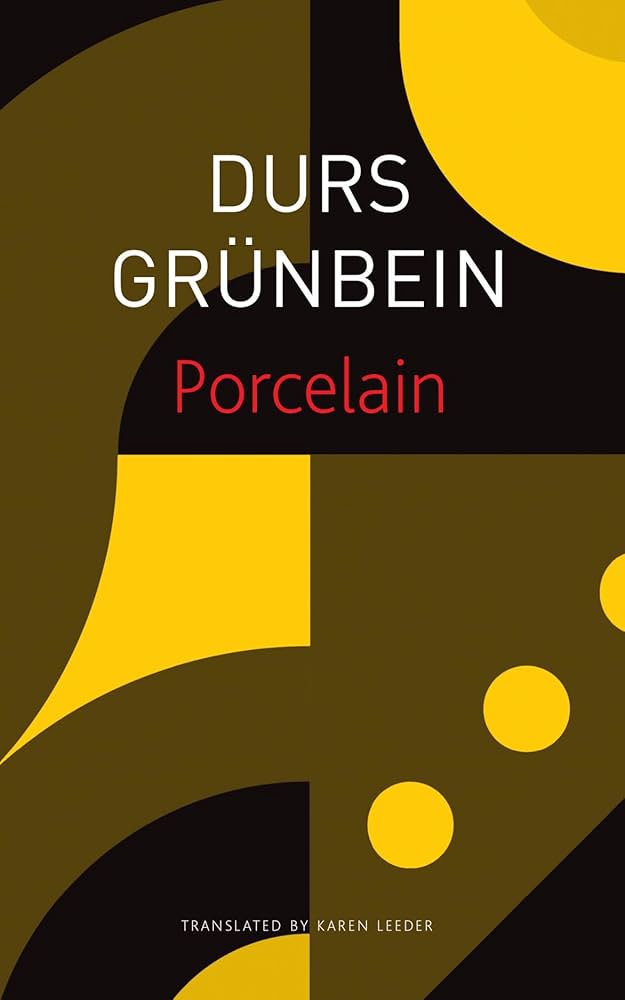
But his birthplace has been undoubtedly important in Porcelain (Seagull, 2020), the long sequence of poems (written slowly, we learned, on the February anniversaries of the Allies’ bombing of his hometown, Dresden). I reviewed this book here, when it was published). Grünbein read 10 poems from this sequence (some poems were read only in German with the English translation projected above), other poems read in both languages. Porcelain is an elegy the poet suggested, a Classical form, longing for what is lost. Poem #7 is one of the most remarkable, another museum visit by the young poet, who’d stare at a cherry stone from the 16th century, carved with 185 tiny heads. The poem comes to regard the curious object as an ‘emblem of the future’ of Dresden, presenting as it seemed to, faces, ‘eyes wide with terror, on every tiny screaming face, / inferno on a needle tip’.

The poet suggested the whole sequence of poems is also a kind of ‘sound system’ containing echoes or samples of other poets’ work, including Paul Celan, with Grünbein’s title (Porce-lain) being a pun on the earlier poet’s name. Leeder added that it should not be read in a narrowly nationalistic fashion, that a lot more (bombed) cities than just Dresden were alluded to by the poem (Coventry, Warsaw, Odessa, Guernica). She asked Grünbein what was it that kept drawing him back to Dresden as a subject matter for poems. He thought it had something to do with the moment when he realised that his own childhood was ‘historical’, in the sense of being intimately connected to major historical events. He recalls seeing truckloads of Russian soldiers passing where he grew up, heading to the nearby Russian military barracks. This produced a sense in the young boy that much in (his) life had been determined before his arrival on the scene. In this sense, his hometown acquired a ‘mythic’ quality.

KL: You mean it was a ‘world place’?

DG: Yes – I realised it was a reference point, worldwide, its splendour and its ruins. From the city of Dresden one can draw out a lot of history, a seed point, or like a jigsaw, that can be slowly pieced together.

Perhaps half a dozen more poems were presented from more recent collections. ‘Flea Market’ is a peerless poem about German history, starting from the bric-a-brac found in such markets – the spoons, brooches, bird cages, tables – and wondering ‘what / do they say, what do they hide’? Quiet allusions to ‘uniforms and daggers of honour’, seque into the next, even more troubling, question: ‘How can one’s thoughts not go astray / faced with the piles of glasses, / and old leather suitcases?’ The poem ‘Lumière’ also alludes to the Holocaust and starts out from descriptions of the Lumière brothers’ 1896 film of a train pulling into a station. The first film-goers were frightened at the image of the train’s approach, ‘but not yet the horror / at all the implacable trains / that have criss-crossed the century, / the endless rows of sealed trucks.’

Asked where his poetry might be heading, Grünbein surprisingly suggested that he felt a more prose-like quality entering his work – not so Classical then! A soberness in some ways – but with flashes of magic, magic spells even. His earlier suggestion that the good poem is a 2-step process – perceptual, conceptual – seems to be still important, though in the final result (I’m guessing Grünbein would agree with this) the two stages must be simultaneously present in the reader’s experience.

I have to say, one of the great pleasures of the evening was the way in which both participants took the poetry seriously and gave it a good outing. This may sound odd for a poetry reading, but often these days, I find too many readings/launches contain too little poetry and rather too much gossiping, drinking and networking (all of which can be excluding for those not in the swim). Can I make a plea for more reading at readings, a little less career-building? Of course, at The Goethe-Institute we were listening to two writers at the very top of their game and what they are creating – in German and in English – is vital, lasting stuff. But, if we are publishing poetry, we should not be shy of reading it (remember, not everyone attending will be able to afford to buy the book and take it home).

Impressions of the TS Eliot Prize Readings 2025

I’ve always enjoyed Ladybird spotting the ways poets present themselves in a reading situation. Last night’s TS Eliot prize readings at the Festival Hall was a grand opportunity for such a pursuit. Ten readers in a row. Here are a few jotted down impressions, gleaned from the on-line version of the show. Before you crucify me for such poor, ill-informed critical judgements, I do hereby declare I have only thoroughly read two of the contenders, so these are very much impressions of ‘what happened on the night’. I’ll leave mentioning my favourite and my predicted winner (not the same poet) to the end. The award will be announced this evening (Monday 13th January 2025).

The housekeeping…. This year, the shortlist was chosen by judges Mimi Khalvati (Chair), Hannah Sullivan and Anthony Joseph. The TS Eliot Prize (it says on their website) is among the world’s most celebrated awards. Inaugurated in 1993 to celebrate the Poetry Book Society’s 40th birthday and to honour its founding poet, the prize is now awarded by the TS Eliot Foundation. The evening was introduced by Ian McMillan.

In the order the shortlist for this year’s prize was presented last night:

Katrina Porteous Rhizodont (Bloodaxe Books) – KP was described as a northern lighthouse by Ian McMillan – finding the universal in the local – the north east of England – Holy Island – this is poetry full of its concrete ‘subject’ – details and actuality, a powerful wish to communicate (the book is full of explanatory Notes) – here, the coal beginning (to be formed) again – Our Billie – a local girl, forms the backbone of one poem  – some unfortunate ‘down with the kids’ moments, referencing Insta and emojis – KP reads in a bobbing, fidgeting sort of way – does stillness evoke more power? – ‘The children STARE at their phones’ – particular words picked out for heavy emphasis – a bit over insistent on their significance – a robot explores the moon surface now – an interest in new technology – but then, the Antarctic without ice – the book title, rhizodont, is a fish transitioning onto land a very long time ago – the delivery here surely too mimetic – snarly, is that how a fish sounds? But passionately held views without a doubt.

Rachel Mann Eleanor Among the Saints (Carcanet Press) – McMillan suggested that Mann takes up liturgical language and re-invents it (for a modern audience?) – Eleanor the central figure is a trans woman of the 14th century – at one point she’s in conversation with Julian of Norwich and Margery Kemp, so lots of hazelnut references – but thank goodness I didn’t hear ‘all shall be well’ – the delivery a slow emphatic one, I actually wrote ‘from the pulpit’ before I noticed (I think) the dog collar – am I right? – lots of first person voice going on here – often in an ecstatic (religious) mode, a few grand arm gestures – the language often moving towards Hopkins (why not?) – masculinity? –embroidering a priest, sanctus, sanctus, then love – the murdering of a trans girl, drawing a bead on contemporary relevance – in 1394 Eleanor was arrested – the dark shades worn by RM curiously out of keeping with the verse lines.

Carl Phillips Scattered Snows, to the North (Carcanet Press) – from the US –‘quiet’ being the word here – rather sweetly alluded to his sponsors for the evening – Lemsip – welcome to England – the lines being read in the cadence of a breath, a dying fall – suggestive here of an interior communion, very delicate, exploration of an emotional life – McMillan suggested this is where time and intimacy meet – what do they say to each other I wonder? – a taking off of  clothes – then he also takes his clothes off – colours and a bell – a concern (as technique and subject matter) for precision, for what is true? (how unfashionable in the US) – snows in the title poem, Phillips manages to take us to Roman history and love without us getting lost along the way – quietly persuasive and good company – a forest journey – things almost said – a vulnerability to this writer (someone else posted this idea) I’ll borrow it.

Gustav Parker Hibbett High Jump as Icarus Story (Banshee Press) – opening with allusions to Ovid for the Icarus link – reaching for the sunlight (not the best of phrases) – but athletics as a metaphor it seems at first – sliding into athletics for real – practising high jumps with a friend – in a world where they are regarded as ‘interchangeable’ because of ethnicity – the dark body hanging – the poems delivered head down, reading from the page, a whispering voice, not coming from the throat or diaphragm, so intimate as to be rather too in-turned – these are plain narratives, lots of ‘stuff’ – one later poem is longer, more sustained and the insistence on these real details begins to transform the poem into something a bit more visionary – jumping 6’ 8” – Noah, all he wanted was the stars – black boys doing anything – the USA and Mexico – to customise paradigms if they don’t fit.

Karen McCarthy Woolf Top Doll (Dialogue Books) – this turns out to be a verse novel so rather hard to convey a clear impression of it – Hugette a female recluse who lived with lots of dolls – KMW read several dramatic monologues this evening – Maman being spoken by a French doll – a rag doll speaking as if a military general, denying that he is a ‘gollywog’ – big pause on that – these are probably funny in many ways – but with their points to be made – but Woolf is acting them out with neck, eyes and eyebrows – male dolls, deep-voiced, female, light, a dancer doll flighty voiced – Ballerina Barbie is all en pointe and pirouette (arms being waved on stage) – yes, fictional and imaginative recreation, but this begins to feel like a sort of ventriloquism in the delivery – the mask is evident – being acted out – I can’t hear the verse of this verse novel – a Japanese doll to finish off with – cherry blossom, bento, the moon. My review of KMW’s earlier collection An Aviary of Small Birds.

Interval

Helen Farish The Penny Dropping (Bloodaxe Books) – a book-long retrospective on an old ended relationship – trying to say what is perhaps inarticulate – joy and ache – biographical narrative as universal – McMillan suggests the relationship is merely a ‘hook’ rather than the ‘focus’ that it surely is? – the delivery is slow and fluting, very deliberate and clear almost as if Farish is finding the words (for the first time) as she goes – effective I think – again poetry with a lot of subject stuff – lists of local colour, places, events, food and drink – things we loved, a list – though spoken of as ‘a’ relationship this feels really quite narrowly autobiographical – driving the M40 discussing having (not having) children – a bit toe-curling, some allusions to film Pretty Woman with Gere and Roberts – who is it says ‘we were made for each other’ these days – a valentine card? – nice recipe at the end, pasta and red wine – but surely a candle was on the table too?

Peter Gizzi Fierce Elegy (Penguin Poetry) – also from the US – the delivery here a steady pulsing (these are short lines, I think, and Gizzi seems to be breathing and voicing that – a rich, resonant voice (the kind you’re born with) – a terrific flow and a shifting from concrete to abstract – the moon and then ‘kinda real, kinda not’ – the ingenious light – a letting out of inner weather – a rather self-conscious making of fine phrases and with the ‘self’ as the primary subject (not the outer) there are passages of pure lyricism – risks even allusions to the Muse, a lyre, but bedded in American colloquial – neatly done – forests, shapes, landscapes all becoming the inner life, representing it – shapes become the beloved – without reading more I’m none the wiser as to what is elegiac here or fierce – but interesting poems.

Hannah Copley Lapwing (Pavilion Poetry) – McMillan suggesting Copley’s book pushes language to the state of music – do we expect Mallarme? – not at all – the lapwing gives the chance for some birdsong – but lapwing does not speak but is rather spoken about – another bird, a daughter… Peet? – all the folksy names for a lapwing, of course – the bird is found to be missing – a mosaic, otherwise know as – the bird becoming person – a poem about addiction – our creaturely behaviours – the difficulty of caring for someone (some bird) – raggedy, slugs, let him disintegrate, love – Copley also reads in cadences that fall every time, not quite clear whether these are the lines of verse or her grammatical units – the lapwing figure is anthropomorphised or a human being is birdified – a nice balancing act mostly – though some less so – a family tree and (very human) grief – something to feather – ready to give – think I’d have liked more musicality.

Gboyega Odubanjo Adam (Faber & Faber) – Odubanjoof course not present after his tragic, untimely death – this his first and only collection – Adam the name given to the torso of a boy pulled from the Thames some years back – a couple of recordings of the author were played – poems read by Joe Carrick-Varty and Gabriel Akamo – the latter the much better reader – a memorial set of poems to the disappeared, the dispossessed – the dead boy’s imagined journey through Germany to the UK – thank you to the woman, the people, the police – this language is more like music – a montage-like, even Whitmanesque feel to the rolling cadences, a riffing and use of repetition, the material rising towards the mythic – blow trumpet as if apocalyptic – chorus, musical bridge transition, outro – a burned CD, its track-listing – a weird fairy tale about water – frog and scorpion, two sisters, ocean and sun in a dialogue – gosh – yes this is good work.

Raymond Antrobus: Signs, Music (Picador Poetry) – this was introduced as a book about fatherhood and masculinity – wasn’t that the 1990s? – a subject for all time – the pleasures (and anxiety) about bathing with your own child – coded with scripture – the son doesn’t pee, but it would have been OK if he did – this is poetry with a lot of ‘I’ – but surreal little flights and often incantatory, an enjoyable allowance of the musical nature of language – I broke up with, I broke up with – anaphora-driven here – the buying of a second hand noise – but I said nothing is where it ends – the intrigue of what remains silent – poems are being performed but not acted out – though there’s a bit of surf-board business, arms keeping balance, as the poem is read – teaching his son BSL – for music – another swaying, conducting sort of motion – yes – very engaging – ‘poetry is music from the place we were born’ (though that’s a very constricting definition). I reviewed two of RA’s earlier collections – The Perseverance and All the Names Given.

On the night, my favourite was Carl Phillips (despite his sore throat). But Gboyega Odubanjo’s work was also powerful in ways that I cannot articulate and for that reason – but also for reasons external to the poetry – I think he will be posthumously awarded the TS Eliot Prize 2025.

Late Addendum (11pm Monday 13th January) – and the winner was Peter Gizzi Fierce Elegy (Penguin Poetry)

‘Muzzle’ – a new poem for the New Year

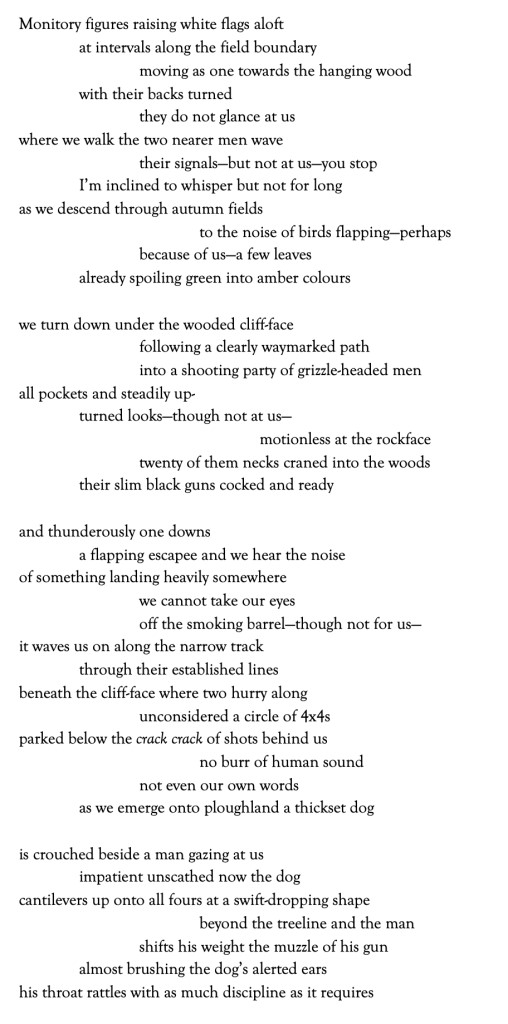
Happy New Year to all of you. We are hoping for the best aren’t we? Come rain, shine or named storm, the poems go on, saying something at least for the individual, the social, for careful consideration of the world out there, the world in here, and the languages we use. I’m posting a poem which has just appeared on New Year’s Day at the excellent Modron Magazine, its strap line is ‘Writing on Nature and the Ecological Crisis’. Glyn F Edwards also interviewed me about the making of the poem and I’ll post the text of that below, along with the link to Modron. Do go and take a good look at what other work they have put up in this new Issue 5. And then subscribe to them. My poem is weirdly formatted – so here is an image of it, lacking its title which is: ‘Muzzle’

On the Writing of ‘Muzzle’

MC: It’s so interesting to be encouraged to look back at the process of writing a poem. I seldom do it (I suspect I’m not alone), forever rushing on to the next ‘best’ thing (we think, we hope). In looking back at ‘Muzzle’ (I find I have the very first draft and several subsequent ones) two things strike me: that it took so long to get to a ‘finish’, and that I’d forgotten how important the context of the poem was to what it might be expressing.

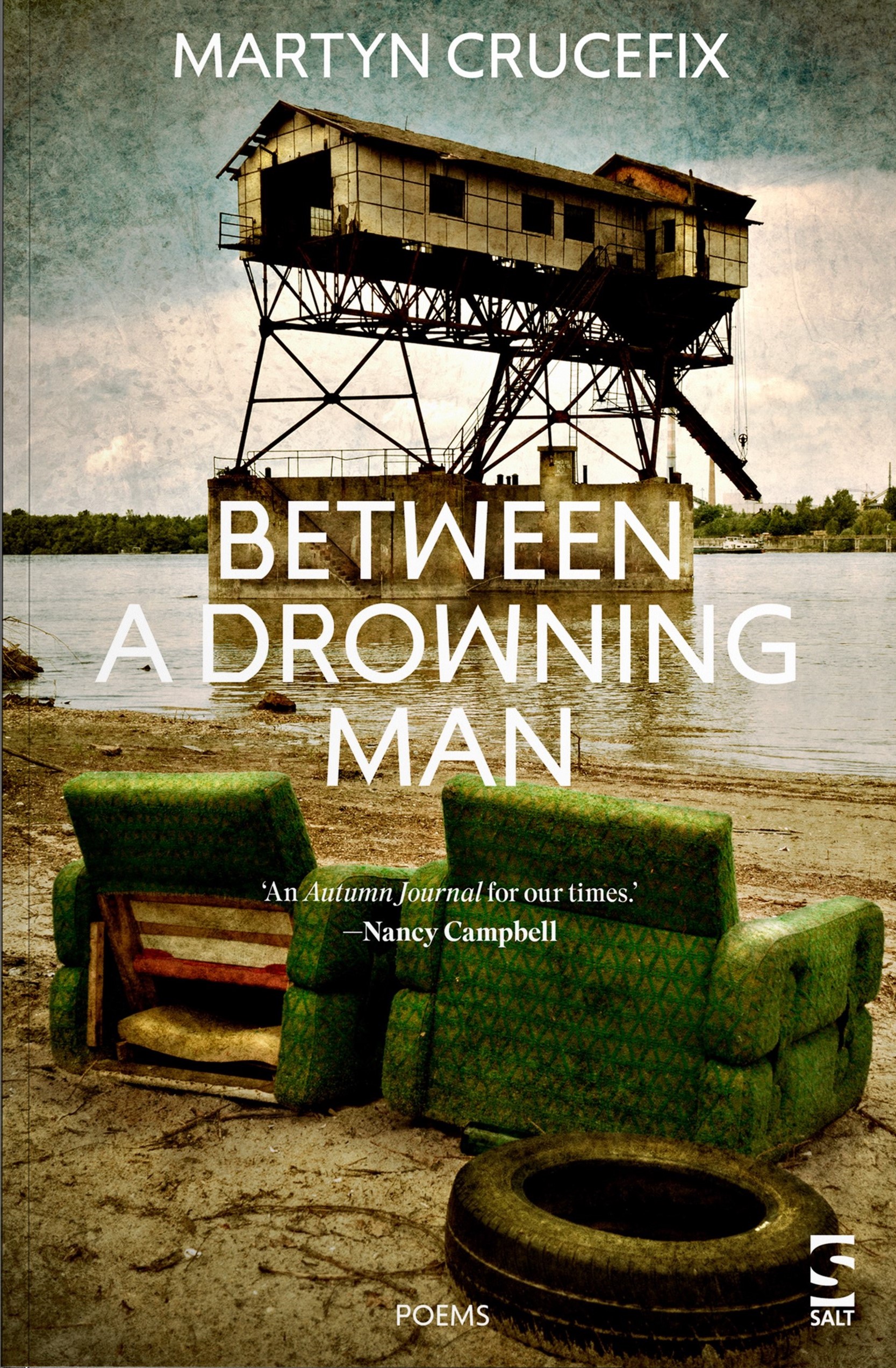
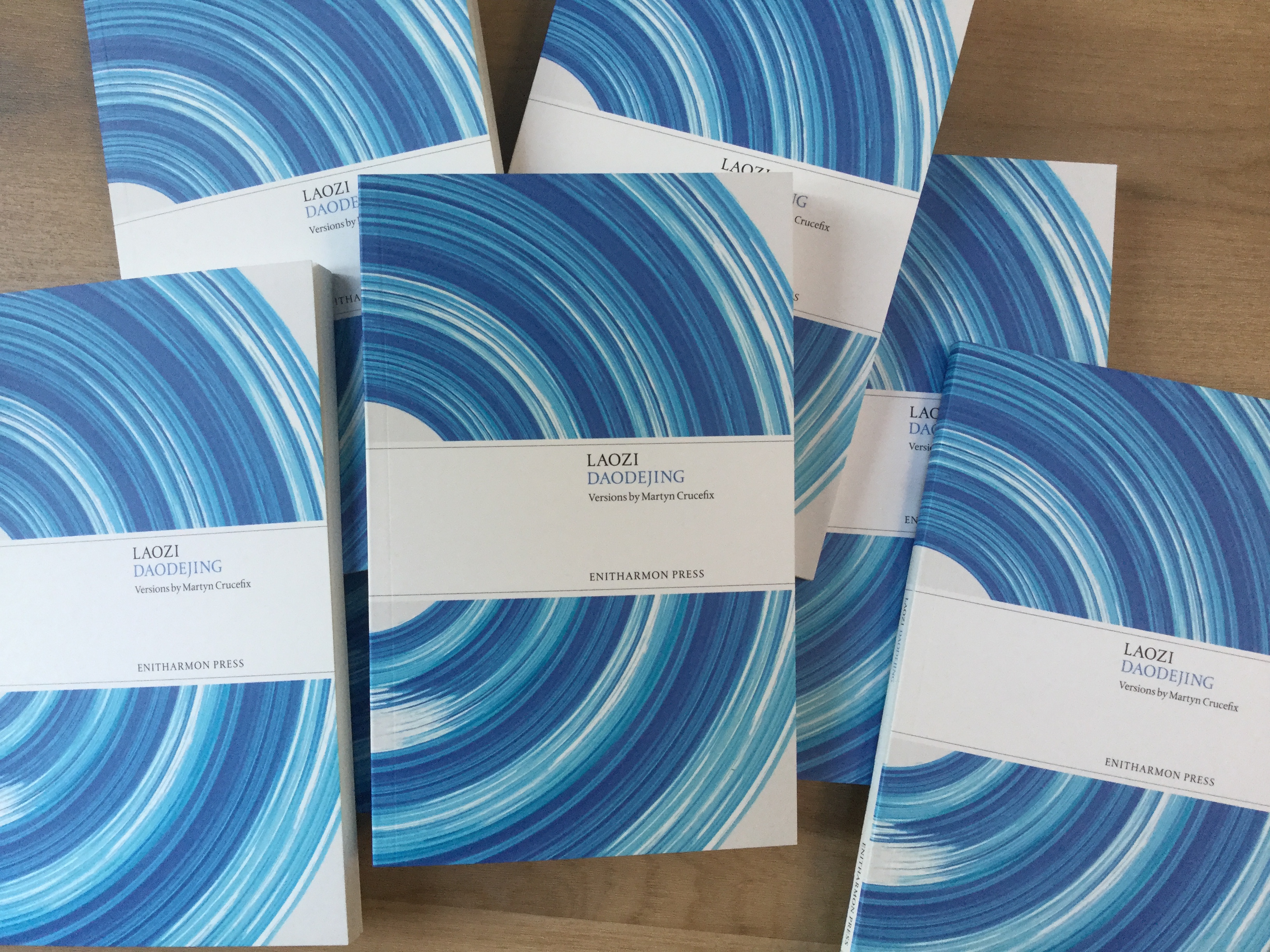
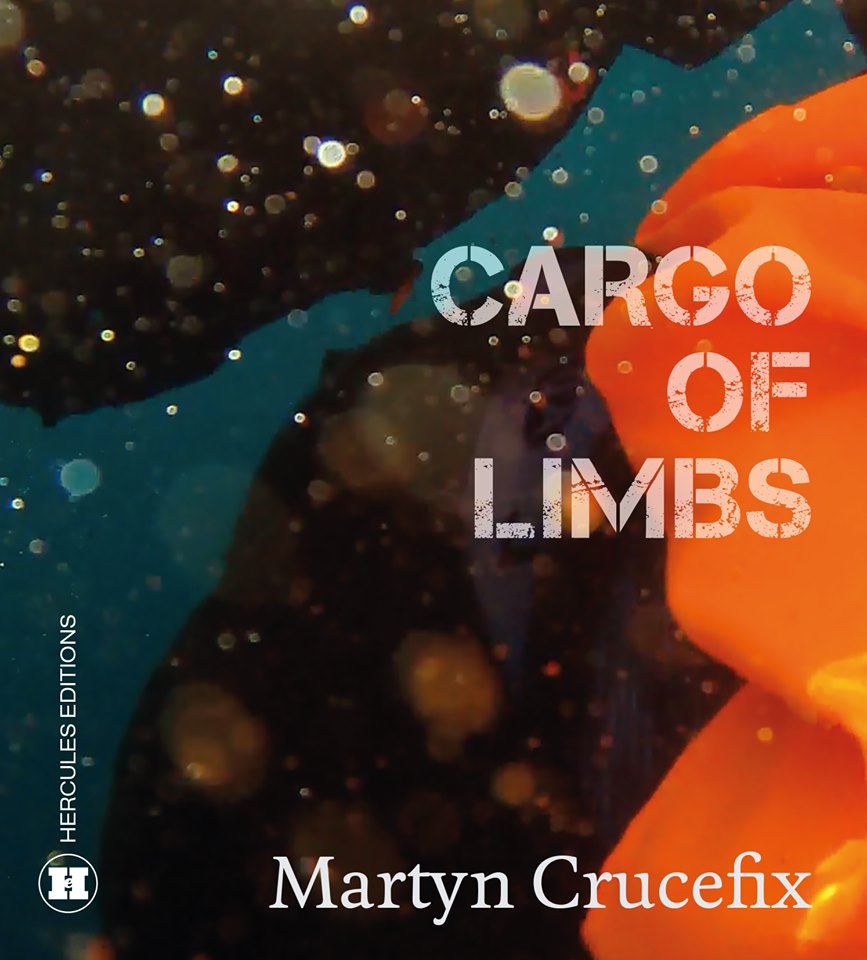
The first draft was scribbled in a notebook in the autumn of 2016. Earlier in the same notebook, I was sketching out thoughts on my, then, just-published version of the classic Chinese poems, the Daodejing (Enitharmon, 2016), preparing for readings I was to give from the book. Elsewhere there are fragments about my parents’ growing difficulties at home and (later) in their care home, plus some quite late drafts of the longish poem about the plight of refugees in the Mediterranean which was published as Cargo of Limbs (Hercules, 2019), and even first drafts of the poems which have eventually come to make up my most recent collection, Between a Drowning Man (Salt, 2023). Remember, the Brexit referendum took place in June 2016 and if there is an idea that links all these differing creative endeavours (including ‘Muzzle’) it is the idea of ‘division’.

Q1 – Only with the word ‘dog’ at the end of the third stanza does the reader gain a semantic connection to the ‘Muzzle’ in the title of the poem. Of course, Chekhov’s gun was ‘cocked’ all along, and the ‘muzzle’ becomes the open end of a weapon where a bullet escapes. Can you explain a little more of the rationale for this subtle title? 

MC: To my surprise, I find, the first draft has no ‘muzzle’ mentioned in it at all. But the shape and a lot of the substance of the finished poem is already there: the flag-waving men during an idyllic autumn walk (on the Sussex Downs, as far as I remember), the shooting party, even the man and his dog at the end of the poem. The muzzle of a ‘smoking gun’ is clearly implied but the final dog’s muzzle does not make an appearance till quite late (I mean 2020 or so!). In fact, in the first draft I clearly don’t know how to end the poem. There, the walking couple emerge from the wood ‘unscathed’, the dog in the field grows tense, and there’s a sense of the man’s day being ‘interrupted’ by the couple. But these final 5 lines are crossed through. In the later draft, the dog now ‘cantilevers up’ onto all fours (the mechanisation of the creature is part of the male group’s malign influence in my mind) – but still no muzzle as such. That only comes via a reference to the man’s gun and, with its proximity to the dog’s head and ears, there is a transference of the word/idea to the dog itself. I’m pretty sure it wasn’t till this point that I thought of calling the poem ‘Muzzle’ and that I also wanted the word to apply to the walking couple who have been (by the experience, by their apprehension, if not their genuine fear) muted or muzzled themselves. The idea was actually there early on; the first draft briefly sketched in, ‘no human voice we do not talk’.

Q2 – The refrain ‘not at us’ is repeated, and echoes again in ‘not for us’ – amongst the ‘white flags’, and the reassurances of safety, there appears a growing threat to the speaker. The reader is left with the feeling that somehow this danger extends beyond the shooting party, and beyond bloodsports. Did you seek for the poem to act as a wider allegorical foreboding, and, if so, would you elaborate on the metaphor? 

MC: Yes, the ‘not at us’ phrase or versions of it are already in the first draft, indeed on four occasions. This is one of the main sources of the idea of ‘division’ in the poem. It’s a simple ‘us’ and ‘them’ situation. The white flags – I think these would simply be the shooting-party’s beaters’ flags being waved to move the birds across the field into the woods, or possibly they are genuinely ‘monitory’ (meaning simply to warn or admonish), but in being white they also have (ironic) resonances of surrender (these guys were not going to surrender anything). The repeating phrase emphasises the gulf between the two elements of the encounter and particularly the sense (clear on the actual occasion) that those holding guns did not seem much concerned that unsuspecting, endangered walkers might be near at hand. We felt ignored; they seemed not to look at us. Being England, there is a strong class element here, which does not map easily onto the question of the voting intentions by class in the Brexit referendum, but factions on all sides seemed not to be paying much attention to any other. The devastating Tory defeat of 2024 should be regarded as reflecting much of this: eventually the country at large felt those in government were simply not paying any attention ‘to us’. I’ve always been pleased with the adjective ‘established’ to describe the shooting-party’s positioning, their being arrayed as the ‘establishment’. The finished poem ends ambivalently. The walking couple escape the shooting-party but are faced with another threatening situation: the gun, the dog. The ‘guard-like’ posture now puts me in mind of prison camp patrols the world over and I’d be happy for readers to get there too: there is a policing of freedoms going on here, a sliding scale from rural pastimes, to political enforcement, to genocidal pograms.

Q3 – ‘Muzzle’ zigzags, indents, retraces its steps. Some stanzas loop longer, and when the final sestet ends abruptly, without full stop, the reader becomes aware of the absence of punctuation throughout. You have a very idiosyncratic approach to presenting and punctuating the poem – could you share your intentions in this poem, and elaborate on whether these ally or counter your conventional style?

MC: The final form of the poem – which you describe so well – came very late. Most often my poems ‘find’ their own form – they don’t begin with any sense of the shape they will eventually take. The 2020 draft was coming out in tercets and I remember liking the ‘walking pace’, step by step, which that shape suggested. But in the end I wanted the poem to be more radical, to suggest a sense of freedom (in contrast to what is felt by the couple during the incident), a freedom to roam as it were, for lines to wander across the page and back again, while also acknowledging that this meandering might well yield some uneasiness in the reader (where’s he going?!). Both freedom and anxiety would be appropriate here. The form and the absence of punctuation (the latter I have been working with for several years now) are intended to generate some ambiguity. For example, I’m hoping for a fluidity in the opening lines, with the putative subject or focus being the flag-waving men, eliding to the walking couple – the ‘you’, then the ‘I’ – the birds, the leaves turning, finally to the ‘grizzle-headed men’. Within this fluency, a bit later, I want several adjectives to be hovering between subjects. The word ‘unconsidered’ floats between the lack of consideration given to the couple and the waiting circle of parked cars. Similarly, ‘impatient unscathed’ buzzes between the couple (again) and the waiting man and dog. This culminates in the rattling throat in the final line which (I want) to be as much about the man as the dog itself and so the ‘discipline’ demanded of the situation ought to be seen as human as much as canine. I guess I’m trying for fertile ambiguities, trying to suggest two things at once. The opening of the Daodejing says: ‘the path I can put a name to / cannot take me the whole way’ (my version).

Q4 – The shooting party negatively influences their surroundings, their presence ‘Hanging’ and ‘spoiling’ the woods, and the walk of the speaker. How much familiarity do you have with these ‘grizzle-headed men’, and do any occasions, such as the one in ‘Muzzle’ stand out as memorable, or significant? 

MC: As you suggest, I have allowed the shooting-party to be, and remain, those wearing the black hats. More often than not I feel the need, the wish, to revisit such emphatic designations: what’s to be said ‘on the other hand’ (ever the wishy-washy liberal). The jaw-dropping presumption of the shooters in the original incident (the poem says pretty much exactly what happened), coupled with the generally felt anger and dividedness of the UK at the time (and since) goes to explain why I have not done so here. Do I know people like this? I guess not. A remote acquaintance likes to share his stories of attending such exciting shooting-parties, but it’s hard even to find the language to create much common ground. Perhaps I am just too urban, metropolitan even. About hunting wild animals, Rilke says, ‘to kill is one form of our restless grief’ (Sonnets to Orpheus, II, 11; my translation). Nothing I witnessed on that day in 2016 served to convince me otherwise; the taking out of another living thing for no useful purpose seems to require an arrogant presumption that I cannot get my head around and I find rather terrifying; the ‘monitory’ urgency in the final poem is as much concerned with how this sort of attitude plays out in the political, even in the military, sphere as it is with ‘blood sports’ more narrowly defined.

December 2024

Here’s the direct link to Modron – https://modronmagazine.com/a-poem-and-interview-with-martin-crucefix/


A Run of Readings in October/November

Talk to whomsoever (among the poets you may know) and a common theme is just how hard it can be to get invitations to read. It really is hard going and for those of us – most of us – who have an aversion to the push and flaunt that is required – it can even feel quite painful. But do it we must. So it’s really nice when it produces a few results. This, by way of saying that I have a few appearances – brief in the main – not as headline reader – coming up at the end of this month and the opening of November. A couple of these readings are translation-related, two others are to mark the publication of extracts from some more experimental work (in original poetry) that I have been pursuing in the last couple of years. I’m particularly happy that these more ‘odd’ compositions have found such warm responses and it makes me think I ought to be looking to publish them in full. Though I have another, other book sitting ready to go… publishers??

Some more event details….

On 26th October, 2pm, at The Library, Conway Hall, London, as part of the Small Publishers Fair, Wivenhoe-based Dunlin Press will be launching four new pamphlets of writing: Kathmandu by Andrew Shaw, Bomb by Samuel Reid, From Stone to Clay to Butter by Lily Petch, and A Raven on a Writing Desk by Julie Hogg. These talented people were the winners of the Press’ 2024 competition for experimental writing. Sad to say, I’ll not actually be reading here, but some of my work is included in the accompanying anthology (those who just missed out I like to think!). My contribution is an extract from A Shout Across Dursey Sound, a sequence of poems set on the Beara Peninsula in Ireland. The anthology’s title is Objects (buy it here) and it includes work by Galia Admoni, MW Bewick ,Emma Bolland, Richard Capener, Tessa Foley, Anthony Ogbonnaya Chukwu, Richard Skinner, Isabella Streffen, and others.

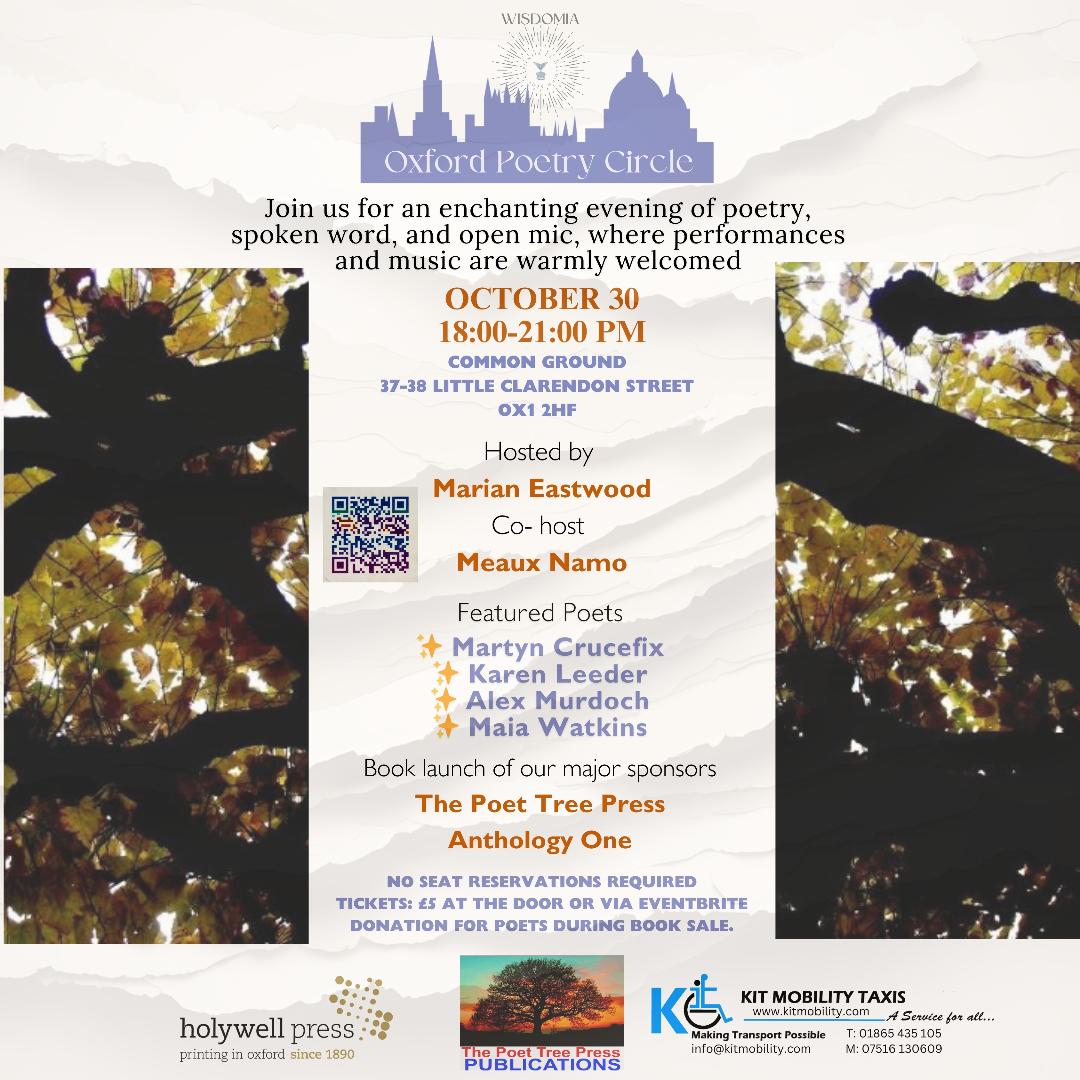
Then, on Wednesday, 30th October, 6pm-9pm, I’m off to Oxford to read for the Oxford Poetry Circle, as announced in a previous post. This is taking place at Common Ground, on Little Clarendon Street, Oxford. There, I’ll be reading work in translation only – from my recent Rilke book published by Pushkin Press (reviewed here on The Friday Poem by Victoria Moul) and from my 2019 Shearsman Books collection of poems by Peter Huchel. I’m particularly pleased to be reading on this occasion with the brilliant and super-industrious translator, academic and friend, Karen Leeder. Other readers are Alex Murdoch and Laia Watkins – and there will be readers from the floor.

A couple of days later, the evening of Friday 1st November, I will be reading from a second experimental sequence of my own poems at the launch reading for Steve Ely’s anthology called Apocalyptic Landscape (Valley Press). My poems, a sequence called Olga Liking Sunflowers, roam through the pandemic experience, the work of David Jones, my local landscape and the delights (or otherwise) of social media. Contributors were encouraged to generate visionary responses to the crisis of the Anthropocene in the context of landscapes important to them. I will be reading alongside Steve, Jill Abram (who is organising the London launch for the book), as well as Katy Evans-Bush, JP Seabright, Anita Pati, and Caroline Maldonado. Steve Ely is also reading from his book Orasaigh, a collaboration between Steve and photographer Michael Faint, inspired by the landscape around the tidal island of Orasaigh, located on the coast of South Uist at Boisdale. This event will take place upstairs at the Devereux pub, 20 Devereux Ct, London WC2R 3JJ. Doors open 6:30, Poetry starts 7pm FREE event.

Finally, I have also been lucky enough to have a translated longer poem (by the contemporary German poet Jürgen Becker) accepted to appear in Issue 32 of The Long Poem Magazine and I will be reading ‘Travel film: re-runs’ at their launch event in the afternoon of Saturday 16th November 1.30 to 3.45, at the Barbican Library, Barbican Centre, Silk Street, London, EC2 8DS. Other readers will be: Angela Gardner, Charlie Baylis, Sue Burge, Sharon Holm, Claire Cox, Sian Thomas, Peter RobinsonKhaled HakimTimothy AdesJulian Stannard. FREE ENTRY and there will be a short interval for sales and chats. Refreshments are available downstairs from the Barbican Cafe and Bar. I hope to see you at one or another of these events. I’ll leave you with a few lines from my sequence in Steve Ely’s apocalyptic anthology:

Olga likes my post of the tall sunflowers in the square.

Through google translate, her post in Russian reads: adrenaline is my doping.

I draw for the soul.

There are hundreds of images of herself. Some with wild animals.

Surely, they’re not really wild.

In a zoo. Under lock and key.

Others touch the hem of the pornographic.

Others look like cheap advertisements for luxury cars.

The kind of posts, I wonder, that end with an offer of marriage from the viewer.

Another shows her bald headed, holding a snake, just weeks after the remission of her illness.

I want to ask her: what was the exact nature of the disease?

I want to ask her.

What mark will this make in history?

I want to ask her. When will this stop?


Reading Rilke’s poems – 6pm this Saturday in Bristol

I will be giving a reading from this year’s Pushkin Press publication, Change Your Life: Essential Poems of Rainer Maria Rilke. The reading is being organised, and taking place at Heron Books in Bristol as follows:

Heron Books Unit 5, The Clifton Arcade
Bristol, BS8 4AA United Kingdom + Google Map

Join us for Poetry In Herons with Martyn Crucefix

Join us in the Arcade after hours for our monthly poetry series. 6pm, Saturday 17th August. We will be celebrating the publication of Martyn’s translation of Rainer Maria Rilke’s poetry, Change Your Life

You can buy tickets in advance online or in the shop. For more details and booking click here
Tickets are £4 or free with the purchase of Change Your Life. All tickets include a glass of something sparkling on arrival.

Tickets are fully redeemable against buying the books on the night.
Book orders will be ready for you to pick up and get signed at the event.

And here’s a taster poem – an unusual one from Rilke which perhaps we read these days with an ecopoetic slant – a translation of a poem in German by Rainer Maria Rilke (from New Poems II; The Other Part (1908)

to thrive, content that they lived anywhere,

sharing a sense of kinship, they found signs

of their peers in the ocean’s fluid empire,

which the old sea god, with dripping tritons,

would sometimes stir to tempest and flood;

for there surfaced the creature that showed

itself to be far more than the dumb,

dull-witted breed of fish: blood of their blood,

and distantly inclined to the human.

A school of them, rolling, leaping, appeared,

seeming conscious of the glittering sea:

joyful, trusting, warm-blooded, they wreathed

the sea voyage with their brave assembly

and would sport round the ship’s prow with ease,

as if tracing the curved outlines of a vase,

heedless, blessed, never fearing injury,

now enraptured, breaching, speeding along

and diving deep as if to exchange places

with the waves that calmly bore the trireme on.

And the sailors took these newly discovered

friends into their lives of lonely hazard

and they contrived for these companions—

and believed it true—a world of gratitude,

in which they loved gods and music and gardens

and the year’s silent, deep constellations.

Remembering John Burnside

With yesterday’s announcement of John Burnside’s death, I thought of this review that I wrote in 2006 of his Selected Poems, published by Cape Poetry. His work meant a lot to me around that time and I enjoyed the chance to try to articulate what I found fascinating in it.

John Burnside’s poetry has, for some years now, been offering us a modern egotistical sublime. With Wordsworth, he shares a responsive delight in nature and daunting powers of self-analysis; also similarly, he can slip towards the prolix and portentous and there is something of the same difficulty with projection into another’s experience. But Burnside’s work frequently achieves a moving sublimity without loosening its grip on reality. He is the only contemporary poet who consistently demonstrates the power of a poetic form that is something other than mini fictional narrative, raw confessional, or condensed dramatic monologue. That he is also successful in writing prose makes his achievement all the more impressive.

His work was recognised in the early 1990s despite bucking the trends of secularism, formalism, and plain/street language. His poetry’s brooding intensity lacked laddish brouhaha. The palette was never broad – rural twilights, leaf litter, owls hunting, tracks across snow – but his eye was always on the margins of such things, where the human and the natural met and negotiated. It felt like something spiritual was about to be said or had been articulated and just missed. This was twinned with the powerfully felt absence of fixed personal identity that has remained so deeply engrained in his work. In poems that in many ways were hardly radical, it was this element that made Burnside feel modern. In a self-regarding culture ever more attached to the teats of mobility, individuality, celebrity and fashion, his relentless worrying away at the obscurity of the self, his flirting with its non-existence, struck dissonant but resonating chords.

Burnside’s themes are frequently disturbing. But in a poem like ‘Halloween’ (from The Myth of the Twin, published in 1994) his exquisite ability to conjure up the British countryside proves to be an essential part of the pleasure of reading him. As often, the season is autumn – cold, mostly deserted, snow, rain, “the fernwork of ice and water”. The narrator peels bark from a tree to smell “its ghost” in a characteristic movement from the precisely evoked physical to the almost casually implied spiritual. What the figure in the landscape is trying to do is to “define my place”. Even scraping down in the leaf mould, he finds fungal traces that look “like the first elusive threads / of unmade souls”. Nearby village bells provide “nothing” and the poem typically ends with the figure’s sense of “other versions of myself” on the periphery of vision and these can be taken to imply other futures, untaken pasts, other roles familiarly adopted, even selves beyond the physical – the inconclusiveness is the point.

Burnside has pursued experiments with differing perspectives that were first signalled by the opening and closing poems of The Myth of the Twin. For example, though in the end less successful than its predecessor, Swimming in the Flood (1995)dramatically broadened his poetry’s reach to include the experience of others, often in more extended form and in dramatic monologues. Persecutors and victims inhabit these poems and speak disturbingly of abuse and “the inexplicable / malice of being” (‘Schadenfreude’). This was a turning point in Burnside’s development as what now flooded into the poetry was what had lain buried in the delicacy and tentativeness of the earlier work. In the ‘The Old Gods’ he declares their power is strongest “when anger or fear / is fuzzing the surface, / making us dizzy and whole”. The process of uncovering is shown to be one of healing and this selection includes the sequence called ‘Burning a Woman’ which seems nakedly to speak of the poet’s mother and father. Equally, the ‘Parousia’ sequence (not included in this Selected) ends with what appear to be sceptical reflections on his earlier inquisition beyond the merely physical: “All resurrections are local . . ./ the sign I have waited to see / is happening now / and always”. Here Burnside seems to arrive at a sense of secular miracle (a version of Rilke’s “Hiersein ist herrlich”) less concerned with the reality of religious presence than with the individual’s response to its possibility.

And yet, the dramatic monologues proved something of a cul de sac. With his subsequent work, Burnside has returned to his best subject: himself. Partly what makes the award-winning The Asylum Dance such a magnificent achievement is the development of the fluid poetic form he combines with a second person plural address that achieves the universal without being either hectoring or twee. The influence of William Carlos Williams is obvious, but Burnside extends this beyond a fluent impressionism concerned with the truth of things to encompass a philosophical musing, the lines flickering across the page as if viewed through water. This new selection is too brief to achieve the full sense of his development, but one of the marvels of Burnside’s work is its continuing delivery of extraordinary evocations of the natural world that have become gradually melded with an introspective depth that does not merely offer insight, but sustained meditation. The four long sequences from The Asylum Dance are rightly given space here and constitute a masterpiece in which the poems offer up rich, disturbing, beautiful, precise, profound, and sustained experiences undergone in the act of reading, rather than a lesser poetry’s marshalling of moments of insight and feeling. Burnside’s career already provides ample proof of a fascinating and significant artistic development, and this selection will prove a good starting point for anyone not yet following it.

Ian Brinton reviews ‘Between a Drowning Man’

Here is Ian Brinton‘s recent review of my new Salt collection, Between a Drowning Man. It was first published by Litter Magazine in January 2024.

The invitation at the opening of these two remarkable sequences of poems by Martyn Crucefix emphasises both ‘difference’ and ‘ambiguity’, an ‘othering’ which hones attention rather than dulling it.

Divided into two sections, Works and Days (forty-nine poems) and O, at the Edge of the Gorge (fourteen poems) the two landscapes bring into focus a post-2016 Britain and the countryside of the Marche in central, eastern Italy. The leitmotif which threads its pathway, its recurring echo, through the first section is of ‘all the bridges’ being ‘down’ and the epigraph to section two is a quotation from Canto 16 of Dante’s Paradiso in which cities pass out of existence through warfare or disease and that which may have seemed permanent is continuously in movement. That second section of poems is a sequence of sonnets and in the final one the hawk’s resting place in the ‘shivering of poplars’ sways so that he is neither falling nor at ease

with these thinnest of airs beneath him

these shapes of loose knotted mesh

these whisperings that cradle him on a whim

That ‘othering’ prompts the poet to see the differences that are ‘like crimes woven into the weft’ and, in a way that William Blake would have recognised in his ‘A Poison Tree’, envy can be ‘buried long years in the black heart / of expressed admiration’ and ‘sunshine’ can be ‘really the withering of night’ which is ‘poured into soil where wheat grows’. And so it is—‘in and around and over and above’ because ‘all the bridges are down’. 

In April 2007 Jeremy Prynne wrote some notes for students about poems and translation:

Translation is for sure a noble art, making bridges for readers who want to cross the divide between their own culture and those cultures which are situated in other parts of the world; and yet a material bridge is passive and inert, without any life of its own, whereas a poetic translator must try to make a living construction with its own energy and powers of expression, to convey the active experience of a foreign original text.

As a translator of real distinction (Rilke’s Duino Elegies and The Sonnets to Orpheus) Crucefix has for many years made these living constructions offering readers a gateway into new experiences whether it be through the world of Laozi’s Daodejing (Enitharmon Press, 2016) or through these new poems which offer echoes both of Hesiod’s Work and Days and the poems known as a vacanna which originated in the bhakti religious protest movements in 10-12th century India. His understanding of the central role language plays in our lives, that creation of bridges between humans, was one of the deeply moving and memorable moments in his collection from Seren in 2017, The Lovely Disciplines. There the poem ‘Words and things’ presented an elderly individual who discovered ‘too late this absence of words’ which now ‘builds a prison’ and Crucefix recognised that ‘a man without language is no man’: as the world of objects becomes too difficult to dominate he can only have knowledge of a world which ‘turns in your loosening grip’. The echo of Yeats’s ‘The Second Coming’ is surely no accidental one!

Translations are bridges, language is a bridge, and the distressing recognition of isolation within numbers is the dominant image in ‘fifteen kilometres of traffic’ from the first section of this new book:

fifteen kilometres of traffic wait before us

behind us the infinite tail

we are offered Google Map options

yet those trumpeted ten minute economies

are nothing till they can be proved

you make a choice you go your own way –

this has been better said before of course –

you cannot take the other way

and remain a unitary being on two paths

or perhaps sane – all roads crawl north

because multiple millions of cars crawl north

because all the bridges are down

Those ten minute trumpetings bring the world of Orwell’s 1984 to my mind as loud announcements of positive news seem to possess a tinny emptiness to the understanding of the isolated human who exists in a world of no bridges.

However, in contrast to this wave of uniformity one reads moments of ‘othering’ in the second section of this book as in ‘sharpening gusts along the valley floor’ a scrap of air was birthed

whirling inches above a littered drain

in a back street of some hilltop town

like Urbisaglia or some place that has seen

and has survived change of use

from sacred temple to church to slaughterhouse

and no gully nor hill can stop it

In this moving world ‘great swathes of air’ gather strength to flex ‘all things to a scurrying to keep up / and the truth is some will and some will fail’.

In a poem titled ‘can you imagine’ (for my children) from the first section of Between a Drowning Man the power of language to translate the invisible onto the page is presented with an unerring eye focussed upon reality. In a world in which he no longer shares the companionship of others the poet is carried safely because although ‘you find the bridges between us fallen down’ and although ‘you mourn’ you can still ‘imagine’. That sense of continuity held in the imagination is far from the image of Alan Kurdi, the three-year-old Syrian boy drowned on the beach near Bodrum, Turkey, in 2015 whose death was recorded by Crucefix’s earlier book, Cargo of Limbs, from Hercules Editions in 2019. The boy’s family had fled from the war engulfing Syria in the hope of joining relatives in the safety of Canada and became ‘part of the historic movement of refugees from the Middle East to Europe at that time’:

In the early hours of September 2nd, the family crowded onto a small inflatable boat on a Turkish beach. After only a few minutes, the dinghy capsized. Alan, his older brother, Ghalib, and his mother, Rihanna, were all drowned. They joined more than 3,600 other refugees who died in the eastern Mediterranean that year.

In this new book that ‘whim’ of a resting place for the hawk, those ‘whisperings’ prompt the bird, the poet, ‘to call it yet more steady perhaps’:

this whim—this wish—this risky flight

in the fleeting black wake of the carpenter bees