Forward First Collections Reviewed #3 – Matthew Siegel

This is the third in the series of reviews I will post over the next two months of the 5 collections chosen for the 2015 Forward Prizes Felix Dennis award for best First Collection. The £5000 prize will be decided on 28th September. The shortlist is:

Mona Arshi – Small Hands (Liverpool University Press, Pavilion Poetry) reviewed here;
Sarah Howe – Loop of Jade (Chatto & Windus); reviewed here;
Andrew McMillan – physical (Cape Poetry); reviewed here;
Matthew Siegel – Blood Work (CB Editions) reviewed here;
Karen McCarthy Woolf – An Aviary of Small Birds (Carcanet) reviewed here.

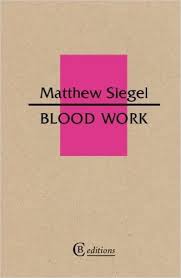
Matthew Siegel – Blood Work (CB Editions); Forward Prize webpage on Matthew Siegel: here.
imgres

This is a really good first collection because of its remarkable consistency of tone and manner and it possesses what I, perhaps narrow-mindedly think of, as that American quality of confident fluency, indeed fluidity, which seems capable of encompassing so much experience without straining at the seams. In their very different ways, I find this in the work of poets like Billy Collins, Louise Gluck, Jorie Graham, Robert Hass and Larry Levis. I’d trace it back to the big enfolding arms and lines of Whitman who, along with Rilke, are Siegel’s two declared influences. But this ‘all I survey’ quality of the book is rather undermined by the publicity surrounding it which narrowly focuses on the fact that Siegel was diagnosed at the age of sixteen with Crohn’s disease and that his debut collection is all about this. Mark Doty (no less) considers the book “a genuine contribution to the literature of illness”.

It may well be – but like Robert Lowell, Thom Gunn and more recently (Siegel’s CB Editions stable-mate) Dan O’Brien, Blood Work’s focus on a very specific milieu or set of experiences does not prevent the alchemical transformation into an art with which those not brought up in the upper reaches of New England society, in the West Coast gay scene, embroiled in modern war zones can identify. In old money terms, they find the universal in the particular and Siegel does this in poems that move beyond a young American with Crohn’s disease to explore family relations, love relationships, questions of self-definition and the tensions between speech and silence.

imgres

The opening poem is important in carving out a certain distance, an ironic space, between the Crohn’s sufferer and the poetic voice (there are a few ekphrastic poems scattered through the book which do the same job). It is one of the few poems narrated in the third person and we are urged to “look” at a hospital attendee, back in what seems familiar territory (the chronic aspect of Crohn’s), the floral prints on the walls, the hospital gown “like an old costume / pulled out of a locked trunk in the attic / of bad dreams”. He feels sexless or desexualised, but is writing a poem “in lowercase”, particularly the first person pronoun. The writing of the poem becomes the subject of the poem but this self-reflectiveness is not rebarbative in the way it often can be (self-regarding, aggrandising, clever-clever) but more modestly self-mocking, an awkward self-consciousness. The patient/poet would rather be drawing a comic book, with himself as a “small mammal”. He sees himself as a fox and in the poem’s final line he changes the title of the poem he is writing which is the title at the head of the first page we have just read: ‘fox goes to the fox hospital’.

The space created by this poem around the very specific medical context gives the remaining book permission to range widely and introduces the idea of “containment”. What can or cannot contain the individual is a recurring idea (picked up by Doty in the cover blurb). The title poem has the narrator’s blood being taken from a vein (already a familiar experience to this young man – the context seems to be earlier in the poet’s life). The nurse allows him to hold the warm filled tubes of his own blood: “I nod, think about condoms, tissues / all the things that contain us but cannot”. Containment here means summation perhaps, but with overtones of imprisonment in the sense that a medical condition (a disability? a gender? a skin colour?) may determine much about the individual, yet ought not be allowed to fully define the person. This too is Siegel’s subject in the book; the spillage, or extension, we can achieve or are permitted beyond what might define us.

So ‘Sometimes I don’t know if I’m having a feeling’ may or may not be closely related to the poet’s own medical condition but it is a familiar experience for most of us. The uncertainty of thoughts and feelings, the sensation of having missed “the entire party”, of being known only as “a strange / version of the person you thought you knew”, the old question, “Who am I?” It’s a sign of the ironic distance maintained by these poems (not at all the same as cool inconsequentiality) that Siegel can answer that question with humour: “A question / for the Lord only to decide as She looks over / my resume”. Elsewhere, such questions are more difficult to answer. ‘Love Parade’ stresses the distance the narrator feels from others (‘I fear my body incapable of loving’) or he plays with the idea that the opportunity of a poem is little more than a late-night phone-in for the lost and lonely. The desire for contact with others (that wish for spillage and extension) can grow to “the size of a building”, taking Siegel down avenues of surrealistic imagery, creating a city-scape from the thoughts of a lover’s body.

images

These ‘others’ do feature significantly in this book. We meet the heater repair woman, a Vietnamese masseuse, Nancy the dentist, a supermarket flower seller, stall-holders at a Farmer’s Market, a multitude of doctors and nurses, various romantic entanglements. Though all these dip and dance about the central consciousness, they are given individuality (more Whitman here, I think). Thirteen year old Bryan is a sleepy student and the narrator is the teacher who watches him doze at his desk, bored by a literature class. The poem is a lovely act of empathy with the boy, his awkwardness and uncertainties, concluding with the self-discovery that the boy may well become the watching adult who “instead of chastising him / wants to touch his hair”. Not what child protection might want to hear, but true enough for those who teach.

imgres

But the book is also concerned with family, in particular a mother-figure who, like Bryan, is observed while sleeping and Siegel asks “What world / contains you”. In this poem, she dozes, exhaling “in little puffs” and perhaps it is her son’s inability to quite define her that means he can “only watch for so long”. She is a mystery, though in poem after poem she is shown crying, smoking dope to forget, mourning an ex-fiance, the son helplessly, left to “wonder if I could reassemble my mother”. In ‘Matthew you’re leaving again so soon’ we hear her reported voice fussing and trying to bestow love and affection through gifts of pens, an umbrella, socks, as he prepares to leave, in an effort to say what seems impossible to be said explicitly. We see her (smoking another joint) listening to the music of Enya (‘it’s in Gaelic’), tearful again, yet smiling “as if hurt is the balm”. For all the lack of specific detail about her life and loves, this mother-figure is a powerful creation we may hear more of in Siegel’s later work.

So the book does not duck difficult experiences, nor distance them defensively. Siegel’s watchwords are openness and a winning tenderness. Despite the questions of illness, he can apply such qualities to himself too and in ‘Overlooking the City’ there is a brief respite which amounts to something like redemption: “No, I am not hurting in this moment”. As the sun sets over the city, “red does not remind me of blood” and the imagined blessing of the sun’s rays reach “even me, surrounded here and alone”.

stock-footage-time-lapse-sunset-over-los-angeles-city-landscape

Even in a poem that gets pretty explicit about his medical condition, some reconciliation seems possible. ‘Rain’ opens:

I thought I knew desperation until I found myself
tightening my asshole like a bolt,

gripping the banister and crossing both legs,
knees shaking.

I tried to read a poem on the toilet [. . .]

But still the narrator can elude such a total, imprisoning self-definition to find some pleasure in the view from a window to “see grass // glowing green in rain and streetlight – / so many bright beads of water”.

So a book I really admire for its capacity to encompass such variety without bursting into fragmentary utterances. It doesn’t do anything startling formally or linguistically, but its achievement is more emotional and empathetic, Siegel’s voice engages the reader at all times in just the way he seems to engage and commit to the many people who inhabit these poems with him. Would make a worthy Forward First Collection winner.
Forward First Collections Reviewed – #2 Karen McCarthy Woolf

This is the second in a series of reviews I will post over the next two months of the 5 collections chosen for the 2015 Forward Prizes Felix Dennis award for best First Collection. The £5000 prize will be decided on 28th September. The shortlist is:

Mona Arshi – Small Hands (Liverpool University Press, Pavilion Poetry) reviewed here;
Sarah Howe – Loop of Jade (Chatto & Windus); reviewed here;
Andrew McMillan – physical (Cape Poetry); reviewed here;
Matthew Siegel – Blood Work (CB Editions) reviewed here;
Karen McCarthy Woolf – An Aviary of Small Birds (Carcanet) reviewed here.

*

Karen McCarthy Woolf – An Aviary of Small Birds (Carcanet/Oxford Poets): Woolf’s website.

imgres

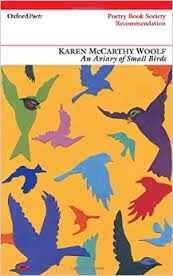
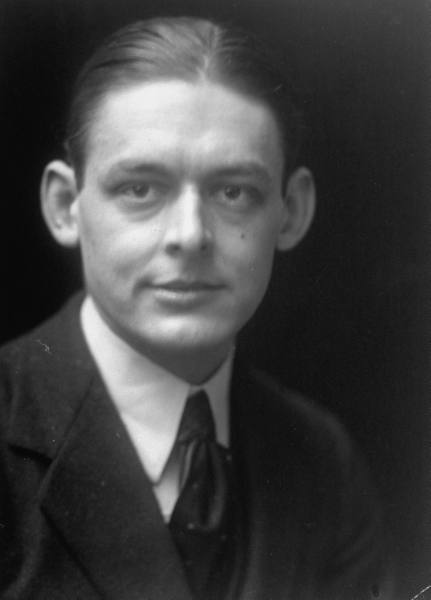
Carcanet’s colourful cover image of fluttering songbirds belies the terrific freight of grief that this book carries. The poems are presented as highly autobiographical and there are actually three deaths involved: that of a friend from cancer, a mother-in-law, and the central focus is the stillbirth of the author’s son in August 2009. The very personal nature of the materials makes critical discussion difficult but, in reading the poems, I found myself thinking of T S Eliot’s observations about what he regarded as the failure of Hamlet. This is the 1919 essay in which Eliot proposes his idea of the objective correlative, “a set of objects, a situation, a chain of events which shall be the formula of [a] particular emotion”. The emotion is re-evoked in the reader when the objective correlative is supplied by the writer. But Eliot argues Shakespeare could never quite unearth or disentangle the true emotions which he hoped would empower the play’s chain of events of a father’s untimely death and a mother’s remarriage.

tseliot_03

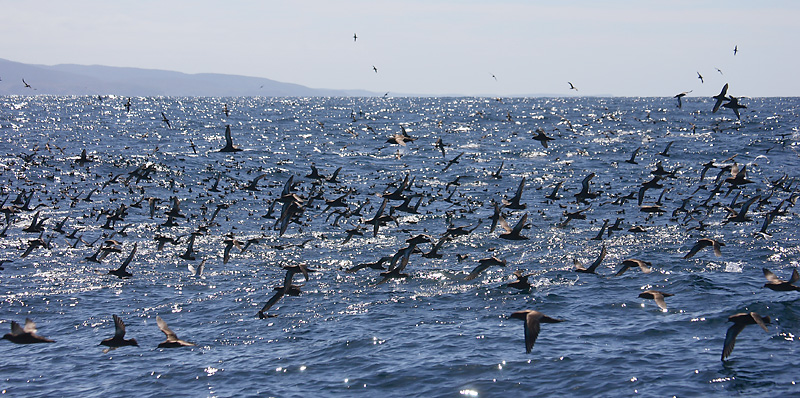
McCarthy Woolf’s book suggests something quite the opposite in that the specific emotions and key events of the child’s death always form the underlying premise on which every single one of these poems runs. This is both a strength and a weakness. The problem can be seen in ‘The Sooty Shearwaters’ which plainly describes the birds heading out to sea to feed. Their return at night time is aided by the switching off of TVs and streetlamps so the birds can “navigate by starlight / to find their young”. The birds’ cry is unique we are told; DJs come to sample it. But what the poem gives us is a chain of events, an objective correlative, which fails to evoke a strong response unless and until the reader brings to the poem the prior knowledge of the stillborn child’s loss. Only when plugged into that does the shearwaters’ determined, instinctive return to their young (and the island population’s touching assistance to that end), really gain force.

76557098.meqOaT2U.000sootyOZ9W1835

Also, as an exploration of the experience of grief, the book faces inevitable limitations because of the nature of the loss. There are several poems set in the acute moments surrounding the stillbirth and immediately afterwards but the majority are set sometime later (the book was six years in the making). Poems are arranged in a broadly chronological fashion and in an interesting reflection of the way a reader must keep in mind the premise of the original loss, many of the poems record the mother’s inability to move on from that same loss so that she, and the world around her, is repeatedly haunted by it. There are powerful moments here to be sure but no broadening religious dimension (Tennyson’s In Memoriam), no political thread (Tony Harrison’s The School of Eloquence), nor can there be any development (other than speculatively) about the nature of the lost one as in Hardy’s 1912 poems, Douglas Dunn’s Elegies, Anne Carson’s Nox, or Rilke’s Requiem for a Friend. The utterly tragic nature of the child’s loss in still birth imposes its own limits on the artistic response.

Nevertheless, An Aviary of Small Birds is admirably experimental in formal terms, some successful, others reading (surprisingly) like exercises carried out. For example, ‘The Museum of Best Laid Plans’ is a prose listing of the items on a bedside shelving unit, ending with a lock of infant hair. In contrast, ‘Morbleu’ takes us into the panic-stricken, semi-chaos of the delivery room, which is frighteningly conveyed through typographical layout and spacing: “ – we haven’t got – / a heart beat”. These are examples of the poems that stand up well independently, communicating fully to any reader whether in the context of this intensely-focused collection or not. Some of the best and most moving of other pieces take a markedly tangential approach to the tragic circumstances (perhaps the only way to approach such a grief). So ‘The Paperwork’ focuses on filling in a post-mortem form and makes powerful use of the tone and language of formality and administration so that one of the last options to be considered acquires, by contrast, even greater emotional weight: “Eyes not to be touched. / The doctor bites her lip, writes it in the box”. ‘The Registrar’s Office’ also manages to contain and convey its grief through indirectness as the bereaved mother, in a lightly punctuated flow and flurry of words, unburdens herself to the Registrar, but ends being more concerned about the windowless room in which the woman works. This illogical transference of the mother’s grief to a separate object is clear and credible and powerfully communicated to the reader.

imgres

What the book does not offer in a sustained fashion is a more forensic analysis of grief, its impact and evolution; it says mainly that grief does not go away. ‘Where Steel Clatters’ is a strong poem describing a threatening-seeming landscape of whining saws, bullet holes, “a burnt-out Renault” – but the bereaved mother is unmoved by it, having learned that “the worst things happen in brash, / fluorescent rooms where steel clatters / and silence is the total absence of movement”. ‘Starlight’ is a curbed, curtailed, halting poem – as if it were weighed down by grief – expressing more directly the desire to be “away / from the gurney // and the empty metal cot”. It is perhaps through experiences with the natural world that some sort of consolation begins to be felt. ‘The Calf’ is set off the Canary Islands and makes untypical but important use of the islanders mythic belief that “the animal you need // always comes to you”. What the bereaved mother wants is to swim with a pilot whale calf, though this is “against the law”. There is a sighting from a boat: “then he’s gone // down into the dark. / Something is better than nothing.” In fact, the poem, which has surely ended here, goes on for another four lines (over a page break) and there are a few other moments where a final edit might have been considered.

pilot-1

McCarthy Woolf has great empathy with the many animals in her poems and not only concerning the bird motif that runs through the collection. A dead hawk lying in a stream provides some “comfort” in a godless and faithless age; the “return to water, to the stream, to the earth” suggests some sort of cycle of life thing. And this is one of the most moving aspects of these poems of contemporary grief – the signal lack of outlets or rituals that might serve as ways of dealing with the loss. Latterly, rivers are imagined as speaking of the need to “endure” and the title poem itself redeploys the image of the lost child as a small bird in an aviary. The instinct of the natural creature, its need to be let go, is what teaches right action to the atomised, isolated, faithless individual of the mother in this book: though there is precious little evidence of moving on to be found in the collection, there is a realisation that it will be achieved only when the mother learns “to leave the door ajar”.

So: critical comment feels inappropriate at times with this book but it is presented to the reader as a poetry collection not a memoir. There is, throughout, a reaching for poetic variety not wholly matched by a variety of perspectives on the fundamental grief portrayed. There are several very powerful poems which I admire as technical achievements (given the powerful emotions from which they are derived, I don’t mean that as faint praise). But there are also a few make-weight pieces. McCarthy Woolf, whose book runs to only 63 pages, might, even so, have learned from the ultra-brevity and resultingly intense focus and consistency of a book like Colette Bryce’s The Whole and Rain-domed Universe (Picador), which weighed in last year at just 49 pages.

The Abecedary Form / Carolyn Forche

The Form: I wanted to share here some thoughts on my experiments with the form of the abecedary. An abecedarium (or abecedary) is originally an inscription consisting of the letters of an alphabet, listed in order. Abecedaries were often practice exercises, teaching aids, but also developed as an ancient poetic form guided by strict alphabetical order. The earliest examples are Semitic, found in religious Hebrew poetry and the form has been used in various cultures for prayers, hymns, and psalms. Psalm 118 (or 119 by King James numbering) consists of twenty-two eight-line stanzas, one for each letter of the Hebrew alphabet. Chaucer’s An ABC is a medieval example of the form. Some abecedaries found in the Athenian Agora appear to have been left deliberately incomplete and the imperfection of these examples may have had a magical or ritual significance.

imgres

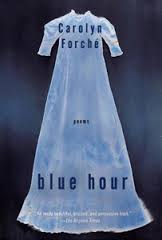
For those who have come across this form in contemporary poetry at all, it was probably (as in my case) through the poem called ‘On Earth’ in Carolyn Forche’s Blue Hour (Bloodaxe, 2003). I reviewed the book in some bewilderment at the time (see below) but have since come to see it more favourably. Forche herself says: “Gnostic abecedarian hymns date from the 3rd century AD. Along with Christian and Buddhist texts, they were recovered from small towns on the northern fringe of the Taklamakan Desert, early in the 20th century”. She also links the form with the idea of the pleroma, defined as the totality or fullness of God’s creation, the One. Over the 46 pages of ‘On Earth’, she adheres rigorously to the form in which alphabetical order guides not only the stanzas, but also the words opening every single line:

languid at the edge of the sea
lays itself open to immensity
leaf-cutter ants bearing yellow trumpet flowers along the road
left everything left all usual worlds behind
library, lilac, linens, litany

Poets.org says that abecedaries are now more commonly used as mnemonic devices and word games for children such as those written by Dr. Seuss and Edward Gorey. A derivative form is the much more familiar acrostic.

From my 2003 ReviewThe book contains 11 pieces in 65 pages, 46 of which are taken up with the long poem ‘On Earth’ and phrases do echo throughout the poems so there is a sense of unity to the whole. For the most part, Forche writes by assembling fragments and images, often without clear syntactical or narrative connections to surrounding lines. The reader experiences the verse as successive waves (lines stretch across the page and usually come in twos or threes), or as threads floating disconnectedly, but creating a striking impression of beauty. Forche’s obscurity comes more from an unshakeable confidence in her project, in her voice, in her idiosyncratic style and in her subject, largely concerned with the significance or recovery of the past in the present moment.

My difficulty with what Forche does is that all kinds of experience seem to be subjected to the same treatment, so that in the end the reader swims through an undeniably glittering, but rather gloopy, phenomenological soup in which “a city a thousand years” has the same weight as “a field of birds roasted by the heavens”, which has an equivalence to “a sudden reticence that seizes the heart”. All of the material – several deaths, the madness of a grandmother, a mother’s life, early years with a child, Chernobyl, some war-torn territories – is recorded with a swooning sensitivity, a recurring softness of diction and a penchant for grammatical inversion which seems to strain after the poetic: “In the blue silo of dawn, in earth-smoke and birch copse, / where the river of hands meets the Elbe.”

These doubts are brought to a head in the ambitious ‘On Earth’ which is (to quote the blurb) “a transcription of mind passing from life into death, in the form of an abecedary, modelled on ancient gnostic hymns”. The form is an alphabetical sequence and this additional random factor only increases this reader’s sense of a steamrollering of experience to ensure a smooth poetic passage. There is no doubt that Forche can produce some stunning images and when she strings them together in more conventional ways and the reader can hold on to her coat-tails, you can see why her reputation is so high in the U.S.

My interest in abecedaries: Has grown with my interest in looser forms of verse (I have given up on punctuation in most of my own poems these days) alongside a more-than-philosophical sense of the truth of the wholeness of being, reflecting Forche’s idea of the pleroma. This – see Rilke, see the Daodejing – is a condition impossible to be caught in the net of more conventional language and poetic form. Abecedaries encompass the whole alphabet (at least in theory – though I like the idea of the deliberate imperfection; perfection belonging only to God). An abecedary can therefore be seen as an appropriate poetic gesture (futile for sure) towards a unified field, an encompassing of everything, the only true state.

images

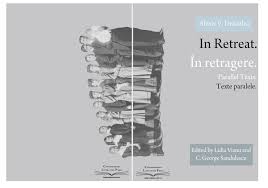
The Material: But the unified field, for an individual human being, must be regarded with some perspective; if this was not the case we would indeed be seeing with the eye of God, with his/her distance and utter impersonality. I wanted to write affective texts. I wanted my abecedary to be (paradoxically) limited. I wanted people in it; even a narrative of events. But all still subject to the demands of the form. I realised I did indeed have some suitable materials to hand. I had been asked by Professor Lidia Vianu, of University of Bucharest, to assist with the translation into English of several short stories by the relatively unknown Modernist Romanian author, Mihail C Vladescu. He published a collection of eight stories, In Retreat, almost 100 years ago. These are stories written in war-torn Eastern Europe but more significantly, Vladescu forensically portrays the sense of corruption in his society, with materialistic motives and adulterous behaviour most prominent. It seemed to me, and not merely because the centenary of the First World War is still in process around us, that this was material worth working on. I thought Vladescu’s relative obscurity to an English-speaking readership was also an advantage in such an experiment.

The Process: I selected phrases as far as possible randomly from the prose translation. These were then ordered alphabetically (via Excel spreadsheets) and subjected to as little editing as possible, though I have sectioned and created stanzas where it seemed best. Not surprisingly, my abecedaries are incomplete (x and z are more often than not the Persian flaws in the poetic carpet).

The results? Over the next 6 days I will post up the full 7 sections of my abecedary ‘Bathing in the Olt’ (from Vladescu’s original story called ‘Bathing’) and any observations would be welcomed. The text has already appeared in full in Shearsman magazine, 103/4, April 2015.

Click here to see each section posted: #1 / #2 and #3 / #4 / #5 / #6

imgres

A bundle of 50 sticks for William and Juliet

Last Saturday I travelled down to Chepstow to read at an event organized by William Ayot who, with his wife Juliet, runs the On the Border series of readings. They tend to bill a Welsh poet with A. N. Other; I was the latter and Richard Gwyn the former. Richard runs the Creative Writing MA at Cardiff University and is a brilliant poet and translator from the Spanish (especially South American poetry). He read some heart-stoppingly powerful new work from three Mexican poets recently published in Poetry Wales and some of his own prose poems from Sad Giraffe Café (Arc Publications). I read from my translations of Rilke’s Sonnets to Orpheus and also extracts from The Time We Turned.

Richard Gwyn

On the train down I was again reading Lee Harwood’s work (see my last blog post) and came across ‘Days and Night: Accidental Sightings – a bundle of 50 sticks for Joseph Cornell and others’. I’ve put together my own loose bundle of sticks as a modest thank you to William and Juliet for their hospitality in their extraordinary house, their passion for poetry in its widest sense, and that marvellous coronation chicken!

scout-sticks1

A bundle of 50 sticks for William and Juliet

At the track side willow belts always unkempt trunks leaning some broken

*

luminous blue sky in early May

*

On a diversionary loop the train slows as if to allow the doe standing knee deep in meadow grass to watch us as we pass we watch her

*

She wears muddy walking boots and has brought out a flask of something hot

*

clipping tickets he is careful to be polite though from those upgrading to First Class he has had money already

*

‘why do you do this’ the effect is never quite the same twice

*

In a faded green t-shirt a man walking with arms folded across his chest as if he had breasts he hoped to steady

*

mud-brown canal waters held eight of nine feet high behind a lock gate

*

An upturned wheelbarrow on a long houseboat its purple paint job a statement of optimistic intent

*

Words carve out sense as tractor tyres embrown the field’s new growth each year their lines down the hillside conclude at an iron gate

*

I feel with each mile nearer home I mean nearing the place I grew up in

*

Hills like the scarp edge of Salisbury Plain wait O this is not a likeness this is ‘the actual place’

*

a diversion to a chalk white horse full of memories

*

the Tory heartlands a tractor slowly turning over the ground

*

I ring home and wake my sleeping parents

*

‘Let’s make flying fun again’

*

a basket of split logs waits for the fire

*

On a wooden writing desk three animal skulls

*

‘quietude not inquietude’

*

Nine owl feathers in a china mug a sort of chalice

*

A glazed bowl with an assortment of matte pebbles from the beach

*

His son spoke out but the police were in bed with the FARC who saw to it he and his friends were tortured and killed can you believe it

*

I like to work I prefer to work with those who want to want to stop

*

a tall poplar tree like an exclamation mark he wrote as if to say this is it

*

One skull another skull then another skull beside another skull

*

rose gardens and orchards

*

If they haven’t killed enough by their early 20s they’re losers whose life expectancy is anyway no more than 24

*

Down to the underworld but returns if somewhat empty-handed he does return

*

mausoleums for themselves a cult of death

*

Bluebells in the hedgerows on either side of the road

*

left hand short by two digits his wife’s wrist broken by a fall

*

shut-eyed Blake above the flat-screen TV seems to offer the room a challenge

*

the watercourse way

*

Everything is a fiction the novel in your shoulder bag is the bank statement you use as a bookmark inside it that too

*

The narrative of the oh-eight crash there are other ways for it to be recounted that’s not a joke

*

Oppositional to a large degree I guess we are not pebbles from the same beach but it’s more than just rubbing along

*

A chimney balloon

*

On-line so many ‘friends’ devastated by the surprise results

*

It’s staying in places like this makes me feel a Londoner

*

He waves his paddle to let the train go then flips it up inside the back of his orange hi-viz jacket and pushing the handle into his back pocket it’s safely stowed

*

A speck of thistledown drifting up the aisle

*

attentiveness

*

banked blue rectangles squat in meadows to scoop the sunlight

*

Dirt is matter out of place but this is not dirt it is marvelously out of place

*

Red kite above the monkey puzzle

*

on an elevated hillside ahead yellow rape now level with me receding away behind

*

In tunnels my ears close as if valved

*

either that or everything is a metaphor I see myself turning socks inside out little involved packages

*

What will Rose and Richard be doing this morning

*

Wishing Iolo courage for his father’s passing

images

On Translating Rilke’s ‘Duino Elegies’

Idris Parry writes in the current PN Review (March/April 2015) comparing Rilke’s Duino Elegies with the Sonnets to Orpheus. The poet always spoke of the sonnets as subsidiary to the elegies, but Parry argues that while the elegies “talk about” the poet’s task, the sonnets perform it. I’d agree and, in translating both in the last 20 years or so, I have come to prefer the vivid enactments of the sonnets. Parry explores Rilke’s response to Rodin in Paris in 1902. What struck Rilke was Rodin’s “dark patience which makes him [as creative artist] almost anonymous”. What the young poet learned was to pursue an “unhurried and uncommitted exposure to experience” (Parry’s words). This is opposed to impatience which is (contra-Keats) an irritable reaching after clarity: “making up your mind before the event instead of letting the event shape your mind” (Parry again).

Rilke’s “praise” is just this acceptance and faithful utterance and is predicated on the truth of an underlying unity of existence. The poet is obliged to speak of this unity but can only use the language of division, a language deluded by the conviction of finality. Parry epigrammatically concludes: “We punctuate to retain our sanity, but we should not come to believe the punctuation”. The PN Review piece ends by looking at sonnet II, 18 and asks, if Rilke’s own German is a poor translation (using shabby tools) of an ultimate reality, how can translators hope to do it justice in bringing it over into English?

Reading Parry this week, reminded me of my own thoughts, not long after having translated Duino Elegies (https://martyncrucefix.com/publications/translations/duino-elegies/). They were originally published in Magma Magazine; I hope they are worth making public again:

My own grappling with the issue of what can be lost and gained in translation began over 10 years ago when London’s Blue Nose Poetry group staged an evening to celebrate Rilke’s work. This was partly in response to a Poetry Review survey of the original 1994 New Generation Poets, several of whom declared his work to have been influential. Though a name I was familiar with, I have to confess I hadn’t gotten far through my Penguin Selected. Perhaps on account of my ignorance, I was to contribute only by reading aloud from the Elegies. The Ninth was chosen but as I practised, I found myself stumbling, losing the thread and, frankly, I hardly knew what it was I was reading:

Here is the time for the Tellable, here is its home.

Speak and proclaim. More than ever

Things we can live with are falling away, for that

Which is oustingly taking their place is an imageless act.

Act under crusts, that will readily split as soon

As the doing within outgrows them and takes a new outline.

This is Leishman’s translation of the Ninth Elegy and I supposed the obscurity was part of the point – that it must signal hitherto unplumbed depths of profundity. My view on this remains equivocal, but I believe a proportion of the difficulty is obfuscation and the impression of slippery ‘mysticism’ it generates has misleadingly become part of Rilke’s appeal for many readers. For me, the bottom line was I could not read this aloud with the kind of conviction that I demanded. I tried a couple of other easily available translations – Stephen Cohn’s and David Young’s – but still was not happy with the sound these poems made in my mouth.

images
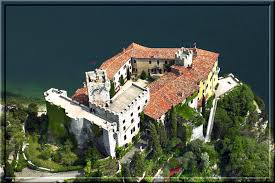
Castle Duino

Within a month I had produced a ‘version’ of my own. By version, I meant a close-ish translation, but I had taken considerable liberties with the more difficult passages and inserted what I thought Rilke might have meant or what I wanted him to mean. At the time this seemed to me a risky strategy compelled by necessity, though there is nowadays a good deal more debate about the role and value of versioning. My own position is that I prefer a genuine attempt to translate the original into a contemporary target language. I see the point of versions – but it is hardly ever what I am seeking as a reader. Nobody imagines translation is easy; but only a fool anticipates a perfect rendering. We expect translators to work in good faith and that their work will read sufficiently well in the target language not to distract us with the stale sweat of their strenuous wrestling with the original. Nor should they cover the difficulties of translation by delivering obscurities that defensively resist comprehension.

It was coming across my first attempt a couple of years later that set me systematically picking my way through the million pitfalls of the Elegies. Take for instance Rilke’s opening lines, the great cry at the start of the sequence. Rilke writes “Wer, wenn ich schriee, hörte mich denn aus der Engel / Ordnungen?” Not too much of a problem you might think, but William Gass, in his book, Reading Rilke: Reflections on the Problems of Translation (Basic Books, 1999), considers no fewer than 15 versions of these 11 words. Most – though by no means all – accept Rilke’s opening word – “Who” – and most, though not all, take over Rilke’s relative clause “if I cried”. But is he merely crying or crying out? And beyond this point of relative agreement lie terrible dragons of disagreement, especially over the word “Ordnungen”. How are the angels deployed? Are they in “angelic orders”, “amid the host of the angels”, “among the hierarchy of angels”, “the order of the angels”, “among the angels’ hierarchies”, “among the ranked Angels”, “through the Angel Orders” or even (Gass gives his own version) “among the Dominions of Angels”? In such company, my own version, “Who, if I cried out, would hear me among the ranks / of the angels?” runs the risk of a watery plainness but it has the advantages of clarity, echoes the rhythm, syntax and line break of the original closely, and (remembering my first concern was for oral performance) the line has a satisfying aural quality. I hear in the first phrases high, thin vowels that contrast the second half’s weightier, assonantal ‘a’ sounds: the cry of alienated humanity contrasts the solid, seemingly impregnable powers that lie beyond our reach.

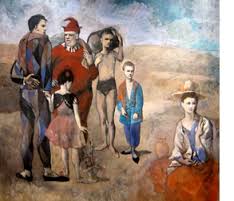
But the best-equipped translator faces especially difficult problems in Rilke. In the Fifth Elegy, for example, the poem describes some acrobats. This is a combined portrait of a troupe Rilke knew while living in Paris and a painting by Picasso (La Famille des Saltimbanques, 1905) with which Rilke lived in the summer of 1915 in the house of the dedicatee of this Elegy, Frau Hertha Koenig. This is, formally, one of the freer of the Elegies, its lines extending and contracting to reflect the energy of the tumblers.

imgres
Picasso’s ‘La Famille des Saltimbanques’ (1905)

But in the Picasso painting the figures are arranged in an almost imperceptible D-shape and Rilke writes:  “Und kaum dort, / aufrecht, da und gezeigt: des Dastehns / großer Anfangsbuchstab . . .” In my version: “And barely discernible, / yet up-standing and unmistakeably on display, / the capital D of Destiny . . .” The original word “Dastehns” (something like “standing there”) reflects the visual pun and it would be a great loss not to bring this into the English. Stephen Mitchell uses the word “Duration”; Young’s looser version loses the pun with “existence . . . presence”. On this occasion, I found myself following Stephen Cohn and opting for “Destiny” (more usually the translation of “Schicksal”) which I felt conveyed Rilke’s sense of how these individuals are driven to perform by forces external to them, rather than by a more truthful inner compulsion.

imgres

Another critical decision arises in the Tenth Elegy with its tribe of people who enjoy a closer, more authentic relationship with death and grief than Rilke perceived in contemporary Western culture. He uses the word “Klage” and an English equivalent has to be found that works as the name of a young woman, her tribe, her ancestors and her country. Like the sound of the original, the word also has to reflect the harshness of the grief felt, while at the same time suggesting a dignity in such powerful emotions. For Rilke, the role of this personification and her whole tribe is certainly heroic. Most previous translators have opted for the word “Lament” but I felt this suggested a rather affected, almost poetic attitude – precisely the kind of posturing that Rilke asks us to avoid in our confrontation with these difficult aspects of life. I chose the word “Keening” to convey the genuine edginess of feeling (aurally again I liked the harsh initial K and the word’s trailing, wailing fall). This word seemed to me to work perfectly as personal and tribal name and geographical location: “gently she guides him through the vast / Keening landscape, shows him temple columns, / ruins of castles from which the Keening princes / once wisely governed”.

One thing I have learned is that translators take sustenance from their chosen originals. This is not just in the obvious way of extending their range, but also that they feed on a familiar. They find in their subject an answering voice, a confirmation of something already present within themselves. I experienced this in a surprising way. Rilke’s influence on Auden was particularly evident in the late 1930s. The sonnet sequence In Time of War refers directly to him and Mendelson’s Later Auden (Farrar, Straus and Giroux, 1999) argues that ‘In Memory of W. B. Yeats’ concludes with “an explicit echo” of Rilke’s Ninth Elegy and its famous injunction to “praise this world to the angel”.

imgres

Auden asks Yeats’ spirit to “Teach the free man how to praise”. Interestingly, Auden has never been a strong influence for me, yet the elegy to Yeats is a poem I have always loved. In fact, five or six years before I got to know Rilke, I remember modelling an elegy of my own on Auden’s – from the choice of title, the formal variety of its sections, to a finale in which I too celebrated one who “loved the world, craved its taste”, elevating him to a teacher of praise: “Listen, let me make this master speak: / Laughter, love, the senses are profound. / Drink deep, remember, Jeremy Round” (‘In Memory of Jeremy Round’). Reading Mendelson’s book has convinced me that I had been responding not merely to Auden but also – unknowingly – to Rilke. It turns out I have been finding a sympathetic familiar in him for longer than I had imagined.

How Do You Judge a Poem?

I am half way through the process of judging this year’s Torriano Poetry Competition (https://torrianomeetinghouse.wordpress.com/2014/10/27/torriano-poetry-competition-2015/). I’ve been lucky enough to judge a few such competitions in the last few years and what follows is a compilation of thoughts on the judging process. Though the initial sifting can be a slog, the latter stages are fascinating as poems that set little hooks in you at first reading, gradually become more clear, their internal coherence emerging alongside their skills with language and form. What follows is inevitably a personal take on the business – more so as the process unfolds – but I hope it may cast some light on it for those (of us) tempted to spend hard-earned cash on entering the numerous competitions now running (here are a few . . . http://www.poetrylibrary.org.uk/competitions/).

In the 2003 comedy film Bruce Almighty, Jim Carey plays God and, alongside with more obviously useful powers, he has to respond to the prayers of the world. But people are always praying; he rapidly approaches a kind of madness as voices swim around him, clamouring for attention.  He takes to reading the prayers in the form of e-mails. He tries to answer them individually but is receiving them faster than he can respond. He sets his e-mail account to automatically answer “yes” to all, assuming this will make everybody happy. Of course, it does not.

imgres

A poetry competition judge comparing himself to a character playing God lays himself open to criticism – but I have indeed found the initial phases of judging rather like Jim Carey’s experience. There are so many and such a variety of voices clamouring to be heard and every one of them is heart-felt, recording significant moments in people’s lives. There is a similar sense of responsibility too – the raw nature of much of the writing is impossible to deny. I’d like to set my response mechanism to say yes to everybody, but the judge’s task has to be how to distinguish submissions as poetry.

**

The numbers are always frightening. Many hundreds of poems will be submitted. Perhaps only 10% of these will demand a further reading after the brutal first sifting. Poems face an early red light from most judges because basic elements are not competently done:

  • Competitions are full of pieces where a particular verse form or rhyme pattern tyrannises the sentiment. The writer’s submission to this tyranny becomes clear quickly through the contortions imposed on the language to achieve a rhyme.
  • The writer’s choice of language can be devastating to the life of the poem. It just isn’t right to opt for forms of language or abbreviations that died out early in the nineteenth century.
  • Choice of diction also derails an entry if it is doggedly abstract. Sure, there remains much debate about whether it is the narrow English tradition that insists on things rather than ideas – but poems about Fear, Ignorance, Poverty, Eternity and Love which refuse to dip a toe into anything resembling a real life situation are going to find progress hard.

leaning-stack-of-papers-and-files

  • A fourth error is using language without being fully aware of its likely resonance with a possible reader. A poem called ‘Mother’s Pride’ which turns out not to be aware of the loaf of bread is going to have unanticipated clutter to climb over in the reader’s mind. Louis MacNeice wanted the poet not to be an ivory tower type, but rather “able-bodied, fond of talking, a reader of the newspapers, capable of pity and laughter, informed in economics . . . actively interested in politics”. All a bit Boys Own perhaps, but if this means the poet stays up to date with the way words live then he’s right.

 **

If you are thinking of submitting to a competition, it’s worth recalling Wordsworth’s formulation – familiar though it will feel – that poetry is built from “emotion recollected in tranquillity”. Poems made in the heat of the moment (and not revised and reviewed in the name of not tainting spontaneity) are seldom without their flaws. This is the kind of distinction Rilke also makes when he denies poetry is composed of feelings. Its constituents are rather “experiences” which he clarifies as “memories” though even with these, we “must be able to forget them when they are many and one must have the immense patience to wait until they come again . . . Only when they have turned to blood within us, to glance and gesture, nameless and no longer distinguished from ourselves – only then can it happen that in a most rare hour the first word of a poem arises in their midst and goes forth from them”. On the other hand, such recollection can sometimes create an intellectualised distance that may do harm to a good poem. Who said writing a poem was easy?

louis-macneice

Stephen Spender argues that a poet should try to acquire skill and virtuosity through the study and interpretation of other poetic works in the way Mozart and Beethoven did in playing the music of their predecessors.  Spender suggests translating poetry is the best possible exercise in interpretation. But the really important lessons (Spender says) are those of the eye, the ear, the athletic/poetic muscles. A poet can go a long way without a developed heart, but, he says, can get nowhere at all without these skills. The poet must ask continually of his lines: ‘Do they make the reader see, or hear, or feel, this experience which I am trying to re-create?’

 **

Reaching the final stages, the judge will be focusing more positively and more clearly on the sense, the story, the thought of a poem. Personally, I like poems that focus on small things and, in effect, make arguments for the ways in which they communicate the bigger issues that concern us all. I’m with Thomas Hardy in believing that “he used to notice such things” is one of the greatest of compliments. Edward Thomas’ poem about Spring, ‘But these things also’, likewise echoes this focus on what most people tend to overlook:

The shell of a little snail bleached

In the grass; chip of flint, and mite

Of chalk; and the small birds’ dung

In splashes of purest white . . .

Perhaps one explanation of why the question ‘what is poetry?’ is difficult to answer is because it is an art of the negative, of avoidance. The Daodejing says what is rigid and inflexible is a companion of death; what is flexible is a companion of life. I’d guess there would be general agreement that poetry is an art on the side of life. So poetry must eschew the inflexible; we must avoid the posture. And that’s very hard. In judging a competition one comes across the Wordsworth-posture, the Ginsberg-posture, alongside those of Betjeman, Hughes, Plath, Duffy . . . But we also posture like mad in ‘real life’. We may take up the pose of grief, melancholy, love, liberalism, environmentalism . . . The mark of the absence of posturing is an instability, an openness, an awareness of time (which posture tries to deny) and this is something I look for in a good poem. If a poem strikes an attitude my attention diminishes (even the attitude that wants to show a rejection of attitudinising through the hall of mirrors of ironic distancing). When the poem unearths a pulsing, shifting, live relationship between the self and the other, then I am captivated, recognising something that is both commonly human and uniquely personal.

But having said all this, I’d assure potential competition entrants that anything resembling a rule is there to be broken. Philip Pullman has said, “We don’t need a list of rights and wrongs, tables of dos and don’ts: we need books, time, and silence. Thou shalt not is soon forgotten, but Once upon a time lasts forever.”

114650911_345473c

So any poem in any form can work its magic. It will haunt its reader for days; it will make me change the way I think and feel; make me see the world differently. Ultimately, a poem contributes to who the reader is becoming. That is an exciting prospect for the writer. It is an even more exciting one for the judge who settles down to read.

The Death of Philip Levine

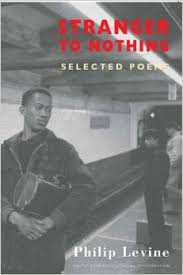
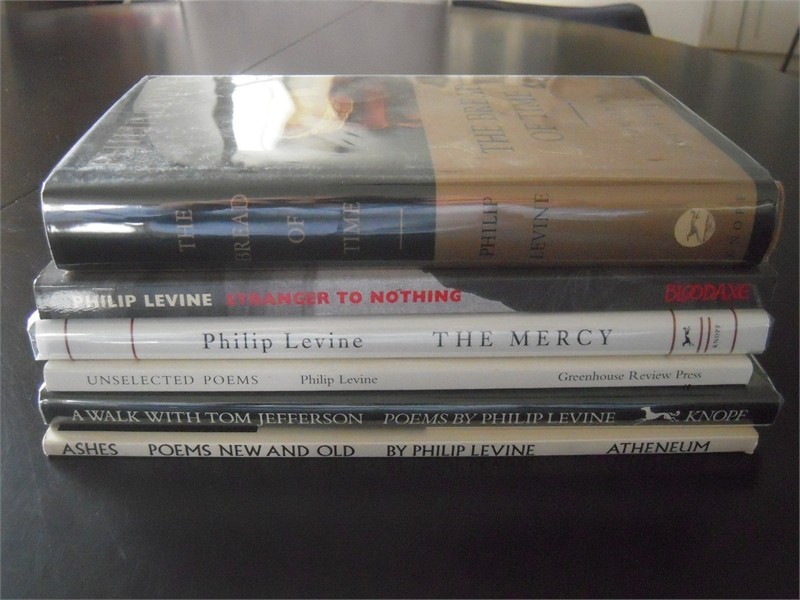
The death of Philip Levine, one of the greats of modern American poetry, was announced yesterday. Bloodaxe published his selected poems, Stranger to Nothing, in 2006: http://www.bloodaxebooks.com/titlepage.asp?isbn=1852247371. Astonishingly, this was his first UK publication since Secker produced an earlier Selected Poems in 1984. Not as well known as he should have been in this country, there has been a good deal more attention given to him in very recent years.

imgres

I’m ashamed to say I only came across him when Poetry London asked me to review Stranger to Nothing alongside Dan Chiasson’s Natural History and Other Poems (Bloodaxe, 2006). It was on the strength of the review that Anne-Marie Fyfe asked me to contribute to a Troubadour Poetry event in London celebrating Levine’s work. Sadly Levine was unable to attend on the evening due to illness and I had the honour of reading some of his work in his stead. For what they are worth, I’ll append the notes I made to myself on the poems I selected to read that evening at the end of this blog. Happily, I think I remember Anne-Marie later reporting back that Levine approved of my brief selection.

Some time later, Naomi Jaffa discussed his life and work with him at Aldeburgh in 2009. The Poetry Channel’s blurb for the recording of that conversation gives a flavour of Levine as follows: A giant of American poetry and now the newly appointed US Poet Laureate, Philip Levine memorably appeared at Aldeburgh in 2009 where he enjoyed a 45-minute conversation with Naomi Jaffa, The Poetry Trust director. In this absorbing, funny and wide-ranging interview, Levine covers growing up as a Jew in anti-semitic Detroit, working for General Motors, finding his voice as a poet, life at college with teachers Lowell and Berryman, his fascination with Lorca and Spain, his love of jazz (and loathing of Wagner), and which four writers he could bear to be stuck in a lift with: listen to that here: http://thepoetrytrust.libsyn.com/philip-levine-s-journeys

And as tribute to a truly great poet here is my September 2006 review of Stranger to Nothing:

On the face of it, the contrast between Dan Chiasson and Philip Levine could hardly be more striking. Bloodaxe have produced a fascinating selection from a poet whose relative absence from discussions of US poetry on this side of the Atlantic is a huge loss. Born in 1928 in Detroit, the son of Russian-Jewish immigrants, the first poems included here were not published until 1963. Like Raymond Carver, to whom he bears some resemblance, Levine spent many years labouring in industry  and much of his later poetry recalls these experiences and the people with whom he worked. Whereas Chiasson is urbane and metropolitan, Levine is urban and industrial. Though encompassing a long writing career, this is not a selection that reveals very much in the way of artistic development; Levine’s characteristic style and tone seems to have come to him fully formed and he has seen little need to alter it. One reason must be the premium he clearly places upon being true to his materials – and in particular the experience of the American working people he portrays.

imgres

Accordingly, there are poems in which Levine doubts the value of the imagination in its tendency to romanticise real experience. ‘Salt and Oils’ from the mid-eighties moves rapidly through moments in a life, but then concludes:

“These were not

the labours of Hercules, these were not

of meat or moment to anyone but me

or destined for story or to learn from

or to make me fit to take the hand

of a toad or a toad princess”

With very different results this might be seen as another attempt to achieve the “transparent eyeball” that Chiasson refers to. Things are what they are and it is in this sense that the collection title works. The phrase comes from an early poem in which a visit to a graveyard leads the narrator to contemplate the realities of life so that “in time one comes / to be a stranger to nothing”. This is also typical of Levine’s style – a loosely constructed, colloquial blank verse, driven along powerfully by the syntax across lengthy sentences that work by slow accumulation rather than the local explosions of linguistic surprises.

But if the fantasies of imagination are dismissed, Levine holds firmly to its role in the re-creation of the past. Often precisely dated, he vividly and lovingly portrays scenes and people from his past. A truck-driving uncle from “black Detroit” is sketched through telling detail – his “two hands kneading / each other at the sink” – and this summoning up into a type of art remote from the original life is, Levine seems to suggest, a kind of redemption or dignifying, so that the Uncle can at last “rise / above Belle Isle and the Straits, / your clear eye / rid of our rooms forever”. Throughout this book, lives are invoked in this fashion in finely-judged poems that neither underplay the poverty and misery within them, nor uncomfortably rose-tint the strength and humour such individuals need to survive.

dscn2747

Perhaps for some, there will be something too fatalistic in these portraits of working-class America. Ought there not to have been more overt political agitation? But Levine works the vein of the individual, the idiosyncratically human and, I’m sure, for him that represents political position enough. In the very recent poem ‘Our Reds’, he again memorialises three characters from school days (1930s/40s?) and their promotion of Communist doctrine. Though the poem indeed acknowledges that what the future brought was “an America no one wanted” it is to “bless” the three that the poem intends: “bless / their certainties, their fiery voices / we so easily resisted . . . their faith in us, especially / that faith, that hideous innocence”. It is perhaps only in moments that working lives are felt redeemed as in the stunning ‘An Ordinary Morning’ with its plain recounting of workers arriving in the city on a bus. The driver and a passenger strike up a song – “O heavy hangs the head” – and as dawn breaks the other passengers wake, momentarily allowed the nobility that their exterior lives seem to deny:

“the brakes

gasp and take hold, and we are

the living, newly arrived

in Detroit, city of dreams,

each on his black throne”

Levine has said that the tradition of poetry he inherited in the 1940s was “utterly lacking” in the kind of people and experiences he had grown up with. His intention was to add to US poetry “what wasn’t there” before. To have done this so consistently – to record the plight and resilience of the poor and inarticulate in America without breaking into the angry simplicities of blame or party politics or caricature is a monumental achievement. This is a collection that deserves to become a significant feature in the twenty-first century landscape of UK poetry.

And here are my notes from the Troubadour event (page numbers here refer to the Bloodaxe edition of Stranger to Nothing):

Reading Philip Levine’s poetry I was immediately put in mind of Carver’s admiration for Chekhov – he quotes Chekhov’s letter again and again in which he says “you don’t have to write about extraordinary people who accomplish extraordinary and memorable deeds”. Also like Carver, Levine worked in industry for many years – born in 1928, his first book didn’t appear till 1963. Both seem fully paid up members of the working classes – Carver said he could never write down to his own people. ‘Saturday Sweeping’ – p 26

I like the way Levine’s poems seem to meander organically from one thing to another – without a hint of irrelevance. He also plays great tricks with chronology – memory of his working years often playing such a large part in his current thinking and writing. ‘Sweet Will’ – p 84

images

Levine – like Carver – would sign up to Pound’s dictum that the only worthwhile morality in writing is “fundamental accuracy of statement”. But there is another current in Levine which can take him towards the surreal. This poem reminds me of Ken Smith’s ‘Fox Running’ (both 1981). ‘The Fox’ – p 68

In later Levine, the political anger is often transmuted into a kind of less deceived tenderness – an amazed sense of good fortune. ‘Philosophy Lesson’ – p 150

Levine often writes of visits to Europe – particularly Spain – and the Civil War clearly stimulated his imagination. Here though – I take it – he is also commenting on one of the great American poets who came to Europe – one I guess temperamentally very contrasting to Levine and I think this has to be intended partly as literary critical comment. ‘The Trade’ – p 127

Levine is also unfashionably willing to walk naked – emotionally. Some will think he sails the wrong side of sentimentality but I’d disagree.’Starlight’ – p 55

Working on Rilke for so long in recent years – I see him everywhere. In the Elegies he claims that even the street girls – prostitutes – are momentarily aware of the visionary possibilities his poems are concerned with. But here – lastly – is Levine working from a position of a good deal of factual knowledge and communicating the same thing – moments of vision without the religious baggage. ‘An Ordinary Morning’ – p 86

Marxian glory days

The number of Marxian ideas and expressions I have forgotten since reading him at university is perhaps something not decently, publicly admissible. But one idea has stayed with me, become something of a talisman of a personal rather than political kind. In The German Ideology (1845) he declares that in the well-governed society, in a communist society, where nobody has one exclusive sphere of activity but each can become accomplished in any branch he wishes, society regulates the general production and thus makes it possible for me to do one thing today and another tomorrow, to hunt in the morning, fish in the afternoon, rear cattle in the evening, criticise after dinner, just as I have a mind, without ever becoming hunter, fisherman, herdsman or critic. 

Karl Marx - portrait

The well-governed life continues to prove as elusive as the well-governed society, of course, but a day of real/metaphorical hunting, fishing, rearing and criticising has remained an ideal of contentment. It was Henry de Montherlant (http://en.wikipedia.org/wiki/Henry_de_Montherlant) whose aphorism suggested that ‘happiness writes white (“Le bonheur écrit à l’encre blanche sur des pages blanches.” (Don Juan II, IV, 1048)) but in recording something like the perfect day I am running the greater risk of the plush, crushed raspberry colourings of complacency and self-satisfaction. But perhaps describing one’s own pleasure can be a political act.

My daughter has to be dropped off at 7am at school. Elevated to the dizzying heights of Year 7 prefect she is off to Wiltshire to accompany the ‘new kids’ on some bonding, outward-bound sessions. This leaves me near Hampstead Heath and time to jog/walk my way round it in the early morning with just dog-walkers and others getting the sluggish blood moving. Back at home with that serotonin high, paradoxically both both pumped-up and emptied-ready-to-be-filled, I work through some drafts of my current project, a version of  Daodejing. As a writer, I came to the Daodejing after translating the German poetry of Rainer Maria Rilke. Perhaps more importantly, it was as a long-standing teacher that I read Laozi’s 81 ‘chapters’. There are colourful myths about their origins, but they were probably a series of orally transmitted seed verses compiled as far back as the 7th century BCE by many Chinese hands, an aide memoire, certainly an aid to teaching.

imgres

The Dao or Way is not an individual entity, still less anything divine. It is a mode of being, all encompassing, a phenomenal, existential primacy, perhaps akin to the Western idea of original chaos. The text emphasises its feminine characteristics. It can be viewed from spiritual, epistemological, educational, political or environmental perspectives, though none of these exhausts its true nature. The poems enthusiastically accept that their profound and urgent messages are inevitably compromised by the need to express them in language, hence demanding a variety of technical manoeuvres – they stay light on their feet.

Into college for the afternoon, interviewing students, mostly about mistakes, choices, salvage operations possible for them after GCSE, AS or A2 exams. But also some preparation for the new course we have devised for A2 Coursework combining Fitzgerald’s The Great Gatsby, T S Eliot’s Prufrock and Other Observations, and Nathanael West’s The Day of the Locust. W H Auden’s brief discussion of West in The Dyer’s Hand is interesting, suggesting he portrays a Kingdom of Hell, ruled by the Father of Wishes. I read it, knowing I’m having a good day, some wishes coming true in contrast to West’s visions of West Coast apocalypse. Right here, right now, a brief, various-faceted jewel in the setting of others of more usual monotony. (More of West in another blog perhaps).

Driving home – the rolling dice of Henley’s Corner – I listen to the opening bars of tonight’s Prom: Brahm’s Third Symphony. By 9.30pm I’m walking into the Albert Hall myself for the late-night show: Beethoven’s Missa Solemnis. Didn’t I promise a good day? It’s John Eliot Gardiner and the Monteverdi Choir and Orchestre Révolutionnaire et Romantique  (http://www.bbc.co.uk/programmes/b04f8vlq). Gardiner says in a brief introductory interview that Beethoven’s unconventional Mass often skims more traditional moments of the text but is ‘marvellous’ on the ineffability of the Godhead, the humbleness of mankind and I’m in the mood to hear it…

Driving back up the Edgware Road, the sky is big as it seldom seems in London. The lights are bright in the Lebanese restaurants, my eyesight – usually close to blurry – seeming sharp tonight, hyperreal, resonant, woven still with the threads of earlier hours. Tomorrow, will be a thinner diet, more monotone, less good.

George Herbert’s ‘Prayer 1’

Herbert, Brodsky, Rilke, Weil . . . Having read John Drury’s excellent biography of George Herbert, ‘Music at Midnight’, a while back, I was re-reading the poem Prayer (I). The poem is really a list of images of prayer, multiple perspectives, full of vigorous relish and un-churchy energy.

Prayer the church’s banquet, angel’s age,
God’s breath in man returning to his birth,
The soul in paraphrase, heart in pilgrimage,
The Christian plummet sounding heav’n and earth;

The whole poem is one sentence, rushing across line breaks and quatrains to herald prayer as a feast, an inversion of inspiration, a precis of our spiritual self, holy journey, a measuring or plumbing not of depth but height –

Engine against th’ Almighty, sinner’s tow’r,
Reversed thunder, Christ-side-piercing spear,
The six-days world transposing in an hour,
A kind of tune, which all things hear and fear;

The scale roughly switches to the power of prayer here – Herbert’s religion is bracing and unsentimental – militaristic images and thunder (again reversed in direction – all things come from God but prayer is our chance to respond), even a wounding of Christ. The ambiguity of ‘transposing’ (transfiguring, translating, transcending) leads Herbert to the quieter image of prayer as a cosmic music.

Softness, and peace, and joy, and love, and bliss,
Exalted manna, gladness of the best,
Heaven in ordinary, man well drest,
The milky way, the bird of Paradise,

The third line of Q3, balanced around the caesura, captures the role of prayer as go-between, conduit, glue between the height of heaven and the fallen state of man – the former leaning sympathetically down towards the ordinary, the latter aspiring to our best. The four phrases of the concluding couplet are marked by speed, a testing of the elasticity of the reader’s imagination (the ‘land of spices’ perhaps the least successful of the poem’s images), and the extraordinary understatement of the two last words.

Church-bells beyond the stars heard, the soul’s blood,
The land of spices; something understood.

What the poem has done is prepare the ground for what ought to strike as inadequate vagueness, but what here reads as fullness, a plenitude which encompasses all that has gone before and gestures towards more, far more, the entire creation. ‘Understood’ has also been broken free of its moorings to suggest far more than an intellectual grasp – perhaps a literal under-standing or underpinning of our place in creation. Brodsky says poetry accelerates our minds; here, the reader does not need to share Herbert’s religious views to experience the graceful jemmying open of our mind by the poem. Prayer in a secular age is Rilke’s praising; it is as Simone Weil thought, “absolutely unmixed attention”, a rich mindfulness.