More than 10 years of blogging on poetry and translation – over 39,000 views in 2024 – now captured and preserved at the UK Web Archive: 'one of the top 10 poetry blogs' (Rogue Strands)
This review – or a shortened version of it – first appeared in The Times Literary Supplement, 25th December 2025. Many thanks to Camille Ralphs for commissioning it. The Opposite of Seduction: New Poetry in Germanis edited by Alexander Kappe, Nicola Thomas, Jana Maria Weiß and published by Shearsman Books, 2025.
Rebuff, repulsion, lacking allure – it’s a risk to call an anthology of poetry The Opposite of Seduction and perhaps Nicola Thomas’ brief Introduction to this book of new German poetry in translation suspects as much. She concedes, ‘poems here . . . may test the boundaries of Anglophone tastes’. But that depends on your taste and for most readers this anthology will seem a vigorous enjoyable collection of young(ish) voices, most hardly ever heard in English before like Nadja Küchenmeister’s delicate, flowing lyrics of existential uncertainty (tr. Aimee Chor), or Anja Utler’s sole contribution, a re-writing of the Daphne myth, exploiting the white page, a choppy fragmentation, exclamation, and a suitably headlong, hectic delivery. A different note is struck by Uljana Wolf, in her whimsical teasing away at self-awareness, waking at four in the morning, or down on hands and knees with an English-speaking partner, to consider dust bunnies (in German ‘Wollmaus’); ‘our little creatures, how they swap their fluffy, moon-gray names’ (tr. Sophie Seita).
Friederike Mayröcker
Yet despite its brevity, Thomas’ Introduction raises questions it leaves unanswered, rather misrepresents the book’s contents, and shows signs of revisions and deletions (it’s puzzling that her two co-editors do not put their name to it). She suggests the years since the millennium have been ones of great vitality for the ‘German language lyric’ and the resulting achievements have passed unnoticed in English-speaking countries for want of translations gathered in one place. A broad survey of the genre and period would indeed be welcome, but this anthology lays claim to ‘range and variety, something for (almost) everyone’, yet makes definitive choices and has startling exclusions. The editors nominate Friederike Mayröcker, Elke Erb, and Thomas Kling as presiding spirits, spawning a ‘genealogy’ of lyric writing in German. Born in the 1920s, ‘30s and ‘50s respectively, it’s not their age that links these ‘senior figures’ and because poets included in The Opposite of Seduction have birth dates ranging from the 1930s to the 1970s/80s, the idea of inheritance is at best questionable. If ‘range and variety’ is what the editors intended, then where are other ‘senior’ candidates like Nelly Sachs, Bertolt Brecht, Peter Huchel, Paul Celan, Ingeborg Bachmann, Jürgen Becker, Volker Braun, Durs Grünbein?
In fact, the reader is here presented with a particular slant on the lyric: these are poets inclined to collage-form, whose subject is as much language as world, who ‘resist limpet-clinging to past metrics, self-satisfied irony, the self-regarding ego . . . [standing for] resistance to habitual responses . . . without a safety-net for the poet or reader’. Thomas can make it sound as if the English-speaking poetry world has somehow missed out on such millennial developments, but the latter quotation comes from Eric Mottram’s description of writers included in the new british poetry, published over thirty years ago. So any English-speaking reader familiar with Mottram’s anthology of ‘marginalised’ poets will feel at home in (rather than tested by) The Opposite of Seduction.
Elke Erb
As to the poems themselves, we have far more examples of Gedankenlyrik (poems of ideas) than Erlebnislyrik (poems of experience). It’s Mayröcker’s style (closely followed by Kling) of dismantling language, of fragmentation, the avoidance of closure, narrative, or simple affirmation, that is the order of the day. Language is foregrounded, pushed to its limits with capitals (or avoidance of), italicisation, referential leaps, allusions, repetitions, abrupt switches of tone and subject matter. Monika Rinck’s long prose-y lines (punctuated, no capitals) stand out. They carry a stream of consciousness voice with a self-deprecating humour. It’s one of her poems that provides the anthology title; a lament for neglected office pot plants that manages to encompass Psalm 23, dog breeding, coffee grounds and human fallibility: ‘they all say: / i’ll bring some peat tomorrow. the morrow never comes. no one brings peat.’ Iain Galbraith’s brilliant renderings of poems by Peter Waterhouse are also a revelation. His is a voice delivering slightly crazed, swift, pseudo-socratic dialogues as poems, wearing a sly smile, and exploring questions of identity, language and spatial relationships: ‘With regard / to the room the stranger thinks: I could enter myself. Thus / answering the ancient question. What question? The question / of the exceptions to be borne in mind. The question / of borders’.
Technique dominates rather than subject matter, though the selection is organised by subjects such as Heart, Body, Soul, Beast, Season, Machine, Home. Oswald Egger writes lush, musical celebrations of the natural world which in Ian Galbraith’s renderings evoke Hopkins, even Dylan Thomas. Dinçer Güçyeter brings material from the migrant experience (tr. Caroline Wilcox Reul) and Ulrike Almut Sandig creates a genuine split-screen reading experience, playing poem texts off against story board instructions either side of the page (tr. Karen Leeder). Given the breadth of experimentation going on here, there are inevitable failures. These are poets working to free both writer and reader from conventions, to open up novel realms of human experience, a liberation from history. Occasionally, Jan Kuhlbrodt’s nightmare vision of a man hoarding books and newspapers hovers behind some poems, so intent on their own language are they, perhaps in need of a ‘reminder of a reality that knows more than paper’ (tr. Alexander Kappe).
I will be contributing to an event in London next week which will mark 100 years since Rilke’s death. I will read from my translations of Rilke as published in Change Your Life (Pushkin Press, 2024).
To quote from the Goethe-Institut’s publicity for the evening: Please join us us for a vibrant evening celebrating Tanzt die Orange —a groundbreaking new anthology that brings Rilke’s poetry into the language of today. Curated by award-winning poets Jan Wagner and Norbert Hummelt, the collection features reinterpretations of Rilke’s verses by 75 leading voices in contemporary German-language poetry.
At this special London event, Wagner and Hummelt will read selections from the anthology and discuss the enduring resonance of Rilke’s work. Co-presenting the event are the acclaimed translators Karen Leeder and Martyn Crucefix, who will guide the conversation and provide English translations of the poems, opening a dialogue between Rilke’s legacy and today’s poetic voices. The event will be presented in both German and English. Tickets £6, £3 concessions and for Goethe-Institut language students & library members. For more information and booking click here.
Venue: Goethe-Institut London Library, 50 Princes Gate, Exhibition Road, London SW7 2PH
Also on the horizon is the launch reading for my new full collection of original poems, Our Weird Regiment (Shearsman Books). This will take place on Tuesday 10th March at 7.30pm at the Swedenborg Hall, 20/21 Bloomsbury Way, London WC1A 2TH. (See map here.) Admission is free.
The reading will be hosted by Tony Frazer, publisher of Shearsman Books, as one of Shearsman’s regular programme of launches and readings. I will be reading alongside Jorge Valdés Díaz-Vélez.
This review first appeared in Acumen Poetry Magazine in the autumn of 2025. Many thanks to the reviews editor, Andrew Geary, for commissioning it.
Vanishing Points, by Lucija Stupica, is a translation from the Slovene (by Andrej Peric, published by Arc Publications in 2024) of the poet’s fourth collection, published in 2019, and is her first book to appear in English. Like Krisztina Tóth, whose book My Secret Life (translated by George Szirtes) I reviewed here, Stupica began publishing in the early 1990s, after the dissolution of the former Yugoslavia and Slovenian independence. Also like Tóth, this book suggests a searching restlessness, perhaps a carrying of deep scars that continue to affect a life. The book’s epigraph is taken from Elizabeth Bishop’s great poem, ‘Questions of Travel’ (1965): ‘Should we have stayed at home, / wherever that may be?’ The Vanishing Points Stupica seems to have in mind are those to do with distance, diminishment, travel and perspective. This has been stimulated by (or has itself provoked) her leaving Slovenia to live on the tiny island of Oaxen, near Stockholm, in 2012. This experiment in ‘island living’ proved unhappy and short-lived, as she and her family moved to Stockholm itself three years later and many of these poems explore this experience.
Of course, ‘home’ is partly temporal: the past, our family, our childhood. The book opens with memories of old Yugoslavia, what might be Stupica’s parents’ experiences in Zagreb in 1941. But memory itself is uncertain: ‘I try to breathe through some other time, / some other life [. . .] I feel I can touch it. Then I let go’ (‘The Blue Gondola’). Her mother’s recipe for ‘Chinese Cake’ gives a different sort of access to the past and perspectives through time (more than place) is important in ‘The Last Photo Together’ where two children are photographed with their old grandfather. The young girl gazes out of the image ‘towards a different place’, towards the future. But the book’s fifth poem is already called ‘The Point of Leaving’ and the sense of deracination is powerfully apparent: ‘Instead of the old plum tree, a house, / instead of the apple tree, a fence’. Perhaps like all such moves, there is optimism at the start (‘serenity in the eye’), but subsequent poems tell a different story.
Lucija Stupica
Bishop (like early Lowell) manages the trick of making personal experiences resonate far beyond the merely autobiographical. I don’t think Stupica has the same magic for the most part. In ‘North’, there is something more narrowly personal in the differing wishes of the man and woman. He wishes for a lake, darkness, spruce trees, while she wishes for the sea and light. The re-location to Oaxen seems to provoke a divergence of views. The woman experiences boredom, a sense of death (the demise of a beetle in one poem, a toad in another) and a brief prose poem evokes a stultifying routine: ‘You’ve become heavy as a rock. Move it. Eat up your meal. Do the cleaning. Talk to the neighbour. Smile. Brush your teeth’. A more extended meditation on the fascination with islands, ‘Islomania’, presents some of the more attractive aspects of the wintry landscape, the wild orchids, seal spotting, but the midnight sun and the summer’s tourist invasion, convince the narrator that those who bear the ‘affliction’ of islomania have contacted a rare disease, an intoxication, even a ‘sort of scar until the end of time’.
Andrej Peric
One of the best poems here is an ekphrastic piece in response to Bosnian artist Safet Zec’s painting ‘The Bed’. Stupica’s neat narrative manipulation means we have the couple’s response to the painting first. They find its image of rumpled sheets ultimately dispiriting, reading ‘the anatomy of an absent body’ in them. This is followed by the couple’s earlier excited approach to the painting, ‘all fired up in the fresh promise of love’, momentarily to be disappointed and in the context of the collection as a whole, we must read this as a comment on the optimism in advance of a geographical re-location which leads to disappointment.
This poem does manage to make the shift from the personal to the more universal: it’s a little mythos, an illustration of life’s disappointments. One of the most devastating disappointments of Stupica’s move to Oaxen seems to have been the withering of her creativity, as ‘Things as They Are’ expresses it, her growing ‘incapacity of putting things into words’. We don’t hear much about the family’s move to Stockholm in 2015, but a couple of poems suggest the poet’s return to form. ‘On Beauty’ appears to be set in a health spa of some kind and is a piece of satirical observation of others, not unlike TV’s The White Lotus comedy-drama, unlike most other poems in Vanishing Points. It is women’s obsession with beauty that is the target here, the mantra to ‘Fix the body. Pull it tight. Clean it up’. The narrator takes a distanced, sceptical view of this and in ‘The Fortune-Teller’, another ekphrastic poem, Stupica’s more characteristic, feminist outlook emerges in her portrayal of the artist figure, gazing into the future, engaged in a process of self-creation, perhaps escaping the past, past mistakes, the malign influences of the ‘wrong’ place:
and there are no words anymore, just the strokes on the canvas,
and herself, liberated in a world, deprived of home,
pasting them on the stretched linen surface,
changing the colours, the contours, playing with her life,
This review first appeared in Acumen Poetry Magazine in the autumn of 2025. Many thanks to the reviews editor, Andrew Geary, for commissioning it.
As a female writer, talented in a variety of genres, living in a difficult political climate, Hungarian born Krisztina Tóth shares a good deal with Huch (my review of Tim Adès translation of Huch’s final book was posted here). Coming to the fore around the revolutionary year, 1989, Tóth has written poetry, children’s books, fiction, drama and musicals. My Secret Life (Bloodaxe Books, 2025) is her first sole author publication in English, ably translated and introduced by George Szirtes, presenting an overview of her poetry from 2001 to the present. Szirtes tells us that Tóth is no longer living in Hungary because of unbearable frictions with the Orbán regime. Like Huch she is drawn to poetry as personal expression, often to the formal elements of the art, both perhaps offering a redoubt against values she finds unacceptable. If there is little redemption to be found in her poems, there is some consolation to be had through the twin imperatives she expresses, to remain compassionate and to persist in trying to articulate human experience. Neither goal is easy.
Szirtes argues Tóth’s style is conversational, plain, precise, offering ‘a kind of kitchen-sink realism’. The personal also features and in these self-selected poems we get glimpses of a barely affectionate mother, a father who dies young, children, lovers, and a difficult grandmother. It’s not clear if these are genuinely autobiographical portraits and, anyway, they are most often absorbed into Tóth’s emblematic writing. An example would be ‘Barrier’ in which a couple are crossing a bridge, seemingly discussing ending their relationship. With the river below and trams thundering past, ‘the pavement was juddering’ and the poem is really about this instability in relationships as much as the (social/political) world, concluding there were ‘certain matters that couldn’t be finalised’. Such uncertainty drives roots even into the self: ‘I’m somebody else today or simply elsewhere’ (‘Send me a Smile’). Tóth uses the image of the ‘professional tourist’ in one of the major poems included here. With little background given, the narrator visits town after town, apparently hoping to be joined by a ‘you’ who never appears. Obviously a ‘stranger’, she wanders aimlessly, haplessly, buys a few things, the poem inconclusively ending with an image of a used toothbrush, ‘like an angry old punk, / its face turned to the tiles, / its white bristles stiff with paste’ (‘Tourist’).
Alienation, expressed through a profound sense of homelessness, is Tóth’s real subject. With the irony turned up to 11, the poem ‘Homeward’ ends quizzically, ‘But where’s home?’ In such a world view, the ability to remain compassionate is important to the poet, however hard it may be. The painfully brilliant ‘Dog’ presents a couple driving at night, seeing a badly injured dog at the roadside, and the woman wants the man to stop. I think they do, but the poem’s focus is on the powerful impetus to help versus the powerful sense that whatever can be done will prove futile. More weirdly, in ‘Duration’, the narrator finds a Mermaid Barbie doll stuck in the ground outside her flat. The childhood associations, the vulnerability of the frail figure, seem to compel action, but ‘what’?
Should I pull the thing out of the ground so it
sheds earth every night, because however often
we wash it, or wrap it in a tissue or leave it
on the radiator we’ll only have to bin it in the end?
Tóth’s wry, highly original lament, on deciding not to buy a universal plug adaptor, perhaps suggests what is being wished for in many of these poems. It is a way for a feeling human being to feel more at home in a world of suffering: ‘how to adapt the world / and its gizmos to the pounding of so many hearts’.
‘Song of the Secret Life’ pulls together many of these strands with the life as much the inner life of the self (the heart) as the life kept hidden in an unsympathetic personal or political environment. In the case of an artist, it is also the creative life, and as much ‘an utter mystery, a puzzle undone’, to the writer herself. But in order ‘to survive it needs telling’ and – like Huch’s creative figure in ‘The Poet’ – even if current conditions do not welcome such efforts, the individual must continue to write, to use language, to affirm the validity of the individual viewpoint. This is the burden of the magnificently hypnotic long concluding poem, ‘Rainy Summer’, in which the long-lined, rhymed couplets, express an unrelenting haunting of the speaker by ‘a sentence’. The latter phrase opens many of the lines, and it goes talking, throbbing, pulsing, dancing and rushing through the poem itself, though as much as the sentence might prove to be some sort of ‘home’ we are never told what it expresses. This is largely because it is a ‘rhythmic unit without words’, it is ‘the bodiless body of language’, it is the ‘speech that knows no speech’, it is ‘a sentence that contained you, gone yet here, some of each’.
Szirtes’ emphasis on the political backdrop to Tóth’s poems might lead us to expect more obvious political engagement and subject matter. That’s not what we get here, though no doubt her surroundings have determined many aspects of the work. Hers is a profound voice, finding in the menace, alienation, and instability around her emblems of more universally shared experiences of rootlessness, troubled self-questioning, of sensibilities that find the world as it is a painful and difficult place to navigate, of the pull of pity and compassion versus an overwhelming sense of the futility of individual action. ‘Sleeper’ addresses what might be a transmigrating soul or spirit, a ‘little pulse box’, asking question after question about where it has been, what it has seen, the mysterious passage from life to death, or vice versa: ‘what’s it like to step into such cold, unlit fiefdoms, / does anything remain’? Tóth’s poems ask such questions and like the best modern poems offer us equivocal answers only, consolatory but not redemptive.
Here is the whole of one poem included here:
Where – Kristina Toth, tr. George Szirtes
Not there, on the tight bend of the paved highway,
where cars are occasionally prone to skidding,
chiefly in winter, though no one dies there,
x
not there where streets are greener and leafier
where lawns are mowed and there’s a dog in the garden
and the head of the family gets home late at night,
x
nor there in front of the school where every morning
a man is waiting regular as clockwork,
nor inside the gates on the concrete playground,
x
nor in the neglected, dehydrated meadow
where a discarded dog-end hits the ground and glows
This review is an extended version of the one which first appeared in Acumen Poetry Magazine in the autumn of 2025. Many thanks to the reviews editor, Andrew Geary, for commissioning it.
Considered by Thomas Mann as ‘the first lady of German letters’ and as the first woman to receive the prestigious Goethe Award (1931), Ricarda Huch (1864-1947) was a literary superstar of her time, yet remains little known in English. She was an historian who published novels, philosophy, drama and poetry. With the rise of Hitler, she made her rejection of Nazi doctrine clear, remaining in Germany as an ‘inner émigré’, but surviving the war years. Autumn Fire (Poetry Salzberg, 2024) is her last collection, published in 1944, and powerfully reflects her lifelong fascination with the Romantic movement. As Karen Leeder’s scene-setting Introduction explains, this is evidenced in the poems’ formal choices as well as imagery, ‘a repertoire of sprites, flowers, scents, birdsong, gardens, moons, fairy tales, and love’. An English poetry reader would initially place this work in parallel to the least challenging of the Georgian poets of 1914.
There is frequently a faux medievalism at work, as in ‘The trees of autumn murmur’ which tells the story of a Prince who wanders into the woods and is bewitched by ‘fairies wild’ to live a sad, unloving, unhappy life. Other poems remind us of Hardy’s folkloric, time-obsessed lyrics in similarly challenging stanza forms:
On far-off floors the dancers face the middle,
The hems swing stiffly to the threshers’ drum.
Accordion and bass and fiddle
Ethereal hum.
(‘Autumn’)
Also from the stock Romantic image bank comes the isolated, tortured figure of the poet who, as spring days arrive, remains unmoved by them because mysteriously ‘troubled’ and when called upon to sing his songs (this is Huch’s own masculine gendering), finds that his creative efforts are ‘unwelcome’ to society at large (‘Morning of twittering birds’).
However, a closer reading of Huch’s poems clarifies their curiously hybrid effects, as in ‘The Old Minstrel’ in which the violent early years of the twentieth century come forward dressed in medieval garb. The narrative voice encourages the minstrel to sing and play his harp: ‘songs of golden treasure, / Times of playfulness and pleasure’. But the final lines of the poem are spoken (we must assume) by the minstrel who warns that what may come from him demands powerful trigger warnings:
Woe betide ye when I call
Forth my lions, every string,
Dumb in dusty ambuscade,
Torpid now, glistening
Thick with matted blood!
Huch boldly leaves the poem there, without any return to a possibly moderating, narrative voice. ‘The Heroes’ Tomb’ also makes use of familiar images (a tomb, a blustery November day, an old man, a passing shepherd, a youngster asking questions) to address a distanced ‘wicked war’. This poem similarly ends bloodily (though note, we are still in the era of swords rather than machine guns), as those who are inclined to stoop and listen at the tomb, can ‘make out far below the clash of swords, / And tell the drip, drip, drip, and hear the sound. / Can it be blood?’
Such lines contrast the lark’s song, the perfumed jasmine, the poplars and lime trees inhabiting so many of these pages and Huch herself seems to shuttle between a religious-based optimism and a much more modern sounding despair. In ‘Moonlit Night’, an owl flies through a wood and takes a mouse as prey. The moon seems to be portrayed as looking on, wholly indifferent, as it picks its way through the branches, ‘twinkle-toed and light’. Only the form and language here makes the poem feel less than genuinely Modern. As for the owl, it becomes proleptic of technological advances in air warfare as she sweeps off through the wood, ‘the murderess, / whose claws the victim hold, / airborne above black treetops’ emptiness’. Another predator image later provides the reader with a further shock. In ‘My heart, my lion, grasps its prey’, the latter is identified as ‘the hated’. And the passionate nature of Huch’s antagonism – though the object of her hate is never named – is startling, and she uses repetition, shortened lines and rhyme to make her point:
My heart hates yet the hated,
My heart holds fast its prey,
That none may palter or gainsay,
No liar gild the worst,
Nor lift the curse from the accursed.
Almost inevitably you feel, the elements of modern warfare seep into Huch’s poems. In the midst of another Hardyesque stanzaic poem, between the ‘honey-brown’ buds on the trees and the lark’s ‘music-making’, more familiar ‘war poem’ sounds provide the base notes: ‘The earth shakes with battle, the air with shellfire heaves’ (‘War Winter’). The ABAB quatrains of ‘The Young Fallen’ mourn those taken by war by first evoking the innocence of their childhoods, schooldays, their unfulfilled worldly ambitions. Then ‘War came’. And though much of the detail and imagery could be applied to wars fought anytime in the last few centuries, there are moments when the realities of the mid-twentieth century cannot be denied. The young men’s hands are a focus, as they ‘Not long ago reached out for toys and fun. / Those hands, conversant with the tools of murder, / Control the howitzer and grip the gun’.
In fact, Huch was living in Jena when the city was bombed by the Allies and ‘The Flying Death’ comes closer than any other poem in conveying her experiences of modern warfare. Though the Flying Death is an old-fashioned personification, its modus operandi is up to date: ‘The chimney reels, the roof-beams groan, / By distant thunder he is known’. Even as the air bombardment is imaged as approaching on ‘iron steeds’, its impact is plainly conveyed as ‘A whistling, hissing din, and more, / A jarring shriek is heard, a roar, / As if the earth would burst.’ This Poetry Salzberg publication unfortunately does not give the reader the original German, but Timothy Adès’ translations are quite brilliant in their preservation of form and rhyme, while at the same time conveying both the sweetness and the violence in Huch’s curious, powerful, under-appreciated poetry.
Excerpts from Autumn Fire, tr. Timothy Adès
Stralsund
The old grey town that blue sea girds: The swell of rust-red sails, The squawking, tumbling salt-sea birds, The flash of clean fish-scales.
On this church wall the pounding wave And tempest waste their fire: Though organ-thunder shakes the nave, No foe hurls down the spire.
The clouds with tender beating wing Caress its head, that dreams Of fierce-fought battles reddening Its foot with gory streams.
The dead are sleeping, stone by stone, The sounding bells request: Eternal memory, my son, Be thine, eternal rest!
Music
Melodies heal up our every smart; Happiness, Lost to us, they redress; They are balsam to our ailing heart.
From the earth where we without respite Toil enslaved, As on wings of blessed angels saved They transport us to a land of light.
Sound, sound forth, ye songs of mystery! Worlds fly far; Earth sinks down, our red and bloodstained star; Love distils its essence from on high.
With the sad news of the passing of Tony Harrison, who as a working class poet had a great impact on me during my formative years of writing in the 1980s, I went back to a piece I was commissioned to write for an OUP collection of essays on his writing – both poetic and dramatic – in 1997. The book, Tony Harrison: Loiner, was edited by Sandie Byrne and included articles from Richard Eyre, Melvyn Bragg, Alan Rusbridger, Rick Rylance, and Bernard O’Donoghue. This is the full text of what I contributed: an intense focus on and close analysis of two of Harrison’s key poems, ‘A Cold Coming’ (for Harrison reading this poem click here) and ‘Them & [uz]’ (for the text of this poem click here).
The Drunken Porter Does Poetry:Metre and Voice in the Poems of Tony Harrison
Part I
Harrison’s first full collection, entitled The Loiners after the inhabitants of his native Leeds, was published in 1970 and contained this limerick:
There was a young man from Leeds
Who swallowed a packet of seeds.
A pure white rose grew out of his nose
And his arse was covered in weeds.
Without losing sight of the essential comedy of this snatch, it can be seen as suggestive of aspects of Harrison’s career. For example, the comic inappropriateness of the Leeds boy swallowing seeds becomes the poet’s own ironic image of his classical grammar school education. As a result of this, in a deliberately grotesque image, arises the growth of the white rose of poetry – from the boy’s nose, of course, since Harrison in the same volume gave credence to the idea that the true poet is born without a mouth (1). The bizarrely contrasting weed-covered arse owes less to the intake of seeds (rose seeds wherever transplanted will never yield weeds) than to the harsh conditions Harrison premises in the Loiner’s life, as indicated in an early introduction to his work, where he defines the term as referring to “citizens of Leeds, citizens who bear their loins through the terrors of life, ‘loners'”(2).
Harrison’s now-legendary seed-master on the staff of Leeds Grammar School was the one who humiliated him for reciting Keats in a Yorkshire accent, who felt it more appropriate if the boy played the garrulous, drunken Porter in Macbeth.(3) The truth is that the master’s attitudes determined the kind of poetic rose that grew, in particular its technical facility which Harrison worked at to show his ‘betters’ that Loiners could do it as well as (better than?) they could. Yet this was no sterile technical exercise and Harrison’s success lies in the integrity with which he has remained true to those regions “covered with weeds” and in the fact that his work has always struggled to find ways to unite the weed and the rose. Perhaps the most important of these, as the limerick’s anatomical geography already predicted in 1970, is via the rhythms of his own body.
Harrison has declared his commitment to metrical verse because “it’s associated with the heartbeat, with the sexual instinct, with all those physical rhythms which go on despite the moments when you feel suicidal” (4). In conversation with Richard Hoggart, he explains that without the rhythmical formality of poetry he would be less able to confront, without losing hope, the unweeded gardens of death, time and social injustice which form his main concerns. “That rhythmical thing is like a life-support system. It means I feel I can go closer to the fire, deeper into the darkness . . . I know I have this rhythm to carry me to the other side” (5). There are few of Harrison’s poems that go closer to the fire than the second of his Gulf War poems, ‘A Cold Coming’ (6). Its initial stimulus, reproduced on the cover of the original Bloodaxe pamphlet, was a photograph by Kenneth Jarecke in The Observer. The picture graphically showed the charred head of an Iraqi soldier leaning through the windscreen of his burned-out truck which had been hit by Allied Forces in the infamous ‘turkey-shoot’ as Saddam’s forces retreated from Kuwait City. In the poem, Harrison makes the Iraqi himself speak both with a brutal self-recognition (“a skull half roast, half bone”) as well as a scornful envy of three American soldiers who were reported to have banked their sperm for posterity before the war began (hence, with a scatological nod to Eliot, the title of the poem). There are undoubtedly echoes in the Iraqi’s speech of the hooligan alter ego in the poem ‘V’, yet Harrison worries little over any narrow authenticity of voice in this case, and he does triumphantly pull off the balancing act between the reader’s emotional engagement with this fierce personal voice and a more universalising portrayal of a victim of modern warfare. Furthermore, it is Harrison’s establishment and then variation of the poem’s metrical “life-support system” that enables him to achieve this balance, to complete a poem which weighs in against Adorno’s view that lyric poetry has become an impossibility in the shadow of this century’s brutality.
The poem’s form – rhymed iambic tetrameter couplets – seems in itself chosen with restraint in mind, as if the photographic evidence of the horror lying in front of him led Harrison to opt for a particularly firm rhythmical base “to carry [him] to the other side”. Indeed, the opening five stanzas are remarkable in their regularity with only a brief reversed foot in the fourth line foreshadowing the more erratic energies soon to be released by the Iraqi soldier’s speech:
I saw the charred Iraqi lean
towards me from bomb-blasted screen,
his windscreen wiper like a pen
ready to write down thoughts for men.
The instant the Iraqi’s voice breaks in, the metre is under threat. Each of his first four stanzas opens with trochaic imperatives or questions and at one point he asks if the “gadget” Harrison has (apparently a tape-recorder but a transparent image of poetry itself) has the power to record “words from such scorched vocal chords”. Apart from the drumming of stresses in lines such as this, Harrison deploys sibilance, the alliteration of g’s and d’s, followed by an horrific mumbling of m’s to suggest the charred figure’s effortful speech in the first moments of the encounter. Regularity is re-established the moment the tape-recorder’s mike is held “closer to the crumbling bone” and there is a strong sense of release from the dead man’s initial aggressive buttonholing as his voice (and the verse) now speeds away:
I read the news of three wise men
who left their sperm in nitrogen,
three foes of ours, three wise Marines,
with sample flasks and magazines . . .
In the stanzas that follow, the dead man’s angry, envious sarcasm is controlled within the bounds of the form and it is rather Harrison’s rhymes which provide much of the kick: God/wad, Kuwait/procreate, fate/ejaculate, high tech’s/sex. It is only when the man demands that Harrison/the reader imagines him in a sexual embrace with his wife back home in Baghdad that the metrical propulsion again begins to fail. It is in moments such as this that the difficult emotional work in the poem is to be done. This is our identification with these ghastly remains, with the enemy, and it is as if the difficulty of it brings the verse juddering and gasping to an incomplete line with “the image of me beside my wife / closely clasped creating life . . .”
The difficulty of this moment is further attested to by the way the whole poem turns its back upon it. Harrison inserts a parenthetical section, preoccupied not with the empathic effort the dead Iraqi has asked for but with chilly, ironic deliberations on “the sperm in one ejaculation”. Yet all is not well, since this section stumbles and hesitates metrically as if Harrison himself (or rather the persona he has adopted in the poem) is half-conscious of retreating into safe, calculative and ratiocinative processes. Eventually, a conclusion yields itself up, but it is once again the metrical change of gear into smooth regularity (my italics below) that suggests this is a false, defensive even cynical avoidance of the difficult issues raised by the charred body in the photograph:
Whichever way Death seems outflanked
by one tube of cold bloblings banked.
Poor bloblings, maybe you’ve been blessed
with, of all fates possible, the best
according to Sophocles i.e.
‘the best of fates is not to be’
a philosophy that’s maybe bleak
for any but an ancient Greek . . .
That this is the way to read this passage is confirmed by the renewed aggression of the Iraqi soldier who hears these thoughts and stops the recorder with a thundering of alliterative stresses: “I never thought life futile, fool! // Though all Hell began to drop / I never wanted life to stop”. What follows is the Iraqi soldier’s longest and most impassioned speech, by turns a plea for attention and a sarcastic commentary on the collusion of the media whose behaviour will not “help peace in future ages”. Particular mention is given to the “true to bold-type-setting Sun” and, as can be seen from such a phrase, Harrison once more allows particular moments of anger and high emotion to burst through the fluid metrical surface like jagged rocks. There is also a sudden increase in feminine rhyme endings in this section which serves to give a barely-caged impression, as if the voice is trembling on the verge of bursting its metrical limits and racing across the page. This impression is further reinforced in the series of imperatives – again in the form of snapping trochees at the opening of several stanzas – that form the climax to this section of the poem:
Lie that you saw me and I smiled
to see the soldier hug his child.
Lie and pretend that I excuse
my bombing by B52s.
The final ten stanzas culminate in a fine example of the way in which Harrison manipulates metrical form to good effect. In a kind of atheistic religious insight, the “cold spunk” so carefully preserved becomes a promise, or perhaps an eternal teasing reminder, of the moment when “the World renounces War”. However, emphasis falls far more heavily on the seemingly insatiable hunger of the present for destruction because of the way Harrison rhythmically clogs the penultimate stanza, bringing it almost to a complete halt. The frozen semen is “a bottled Bethlehem of this come- /curdling Cruise/Scud-cursed millennium”. Yet, as we have seen, Harrison understands the need to come through “to the other side” of such horrors and the final stanza does shakily re-establish the form (though the final line opens with two weak stresses and does not close). However, any naive understanding of the poet’s comments about coming through the fire can be firmly dismissed. This is not the place for any sentimental or rational synthetic solution. Simply, we are returned to the charred face whose painful, personal testament this poem has managed to encompass and movingly dramatise but without losing its form, thus ensuring a simultaneous sense of the universality of its art and message:
I went. I pressed REWIND and PLAY
and I heard the charred man say:
Part II
It was Wordsworth whose sense of physical rhythm in his verse was so powerful that he is reported to have often composed at a walk. It should come as no surprise that Harrison has been known to do the same. Though it was Keats’ ‘Ode to a Nightingale’ Harrison ‘mispronounced’ at school, it is actually Wordsworth who is more important to him because both share a belief in poetry as the voice of a man speaking to men. This conception of poetry as speech is a powerful constituent in Harrison’s work and perhaps one not clearly understood. John Lucas, for example, has attacked what he sees as loose metrics in the poem ‘V’ (7) but, to reverse Harrison’s comment that all his writing (theatrical or otherwise) is poetry, all his poetry needs to be read as essentially dramatic and deserves to be tested in the spoken voice as much as in the study. On occasions, Harrison, only half-humourously, draws attention to the fact that two uncles – one a stammerer, the other dumb – had considerable influence on his becoming a poet and it is the struggling into and with voice that such a claim highlights.(8) I have already mentioned Harrison’s interest in the curious idea that the true poet is born without a mouth. This too, implies the difficult battling for a voice or voices which can be found everywhere in his work and it is in this clamour that I find its dramatic quality. In a public poem like ‘A Cold Coming’, Harrison makes use of the contrasting and conflicting voices by playing them off against a regular form. This is almost always the case, but in what follows I prefer to concentrate less on metrical effects than on the way voices interweave, in this case, in more personal work from The School of Eloquence sequence.
The very title of the pair of sonnets, ‘Them & [uz]’, seems to promise conflict, at best dialogue, and it opens with what could be taken as the howl of inarticulacy. In fact each pair of these opening syllables gestures towards crucial worlds in Harrison’s universe. The αίαι of classical dramatic lament is echoed by the “ay, ay!” of the musical hall comedian cheekily working up an audience. Immediately, the reader is plunged into the unresolved drama of two differing voices, instantly implying the two cultures of the sonnets’ title. The line and a half which follows, sketching Demosthenes practicing eloquence on the beach, is intriguing in that its locus as speech is hard to pin down. It is perhaps intended at this stage (apart from introducing the poems’ central issue) to hover in an Olympian fashion above the ruck of dialogue that follows, implying the heroic stance which will be taken up in the second sonnet.
Line 3 opens again into a dramatic situation with the voice of the narrator (the adult Harrison), repeating his own interrupted recital of Keats in the classroom, while the master’s scornful comments appear fresh, unreported, as if still raw and present, in speech marks. The narratorial comment on this – “He was nicely spoken” – confirms this poem’s tendency to switch voices for its effects, this time its brief sarcasm barely obscuring the unironic comment likely to be made by an aspiring Loiner, or by an ambitious parent. The example of nice speaking given (again in direct quotes in the following line) is the master’s claim to possession, to authority in matters of language and culture and the separated-off reply of the narrator – “I played the Drunken Porter in Macbeth – with its full rhyme and sudden regular iambic pentameter, implies both a causal link between the two lines, painting Harrison as dispossessed specifically by the master’s attitudes, as well as conveying the tone of resignation in the young schoolboy.
It will be clear that much of the tension and success of the poem has already arisen from the dramatic interchange of voices and the master’s voice asserts itself again in line 7, ironically claiming a kind of monolithic, aristocratic purity to poetry which this poem has already attempted to subvert:
Poetry’s the speech of kings. You’re one of those
Shakespeare gives the comic bits to: prose!”
The following lines contain a curious wavering in the clear interplay of dramatic voices, only part of which is resolved as the poem proceeds. Evidently, the intrusive, even hectoring, parenthesis (at line 9) is the narrator’s questioning of what appears to be the master’s voice’s continuing argument that “All poetry” belongs to Received Pronunciation. Yet the aggression of this attack, with its harsh alliteration and sarcastic question mark, is out of key with the other narratorial comments in part I, though the tone is re-established in part II. In addition, I have some difficulty in accepting the master’s words as appropriate to the situation which – with no break – continues the speech made to the young Harrison. For example, the word “dubbed”, with its implication of the deliberate laying of a second voice over an ‘original’, already hands victory in the argument to Harrison’s claim for the authenticity of ‘dialect’ and, as such, would not be used by the believer in “the speech of kings”. Equally, the apparent plea, “please believe [Λs] / your speech is in the hands of the Receivers”, does not accord with the voice that summarily dismissed the pupil as a “barbarian” 7 lines earlier. In this case, Harrison’s desire for the dramatic has foundered momentarily on that old dramatist’s rock, the necessity for exposition which compromises the integrity of the speaking voice.
The true note of the master returns – interestingly, following one of Harrison’s moveable stanza breaks, as if confirming a shift in voice though the speech actually continues across the break – with “We say [Λs] not [uz], T.W.!” The tone of the responding voice, after the suggestion of a more spirited response in the Keats comment, has returned to the resignation of the brow-beaten pupil. This is reinforced by the more distant comparison of the boy to the ancient Greek of the opening lines, heroically “outshouting seas”, while the young Harrison’s mouth is “all stuffed with glottals, great / lumps to hawk up and spit out”. This first sonnet draws to a close with this tone of frustrated defeat for the boy, yet the drama has one final twist, as the voice of the master, sneering, precise and italicised, has the last word – “E-nun-ci-ate!“. There can be little doubt that the boy must have felt as his father is reported to have done in another sonnet from The School of Eloquence, “like some dull oaf”. (9)
The second part of ‘Them & [uz]’ contrasts dramatically with the first, though the seeds of it lie in the image of heroic Demosthenes and the accusatory tone of the reference to Keats which seemed a little out of place in part I. This second sonnet’s opening expletive aggression strikes a new tone of voice altogether. “So right, yer buggers, then! We’ll occupy / your lousy leasehold Poetry”. The poem’s premise is that it will redress the defeat suffered in part I in an assertive, unopposed manner. Not the master, nor any spokesman for RP is allowed a direct voice, yet the interchange of speech and implied situation can still be found to ensure a dramatic quality to the verse.
Demosthenes
The passionate and confrontational situation of the opening challenge is clear enough, yet it’s striking how it has taken the autobiographical incident in part I and multiplied it (“yer buggers . . . We’ll occupy”) to present the wider political and cultural context as a future battlefield. Even so, there is no let up in the clamour of voices raised in the poem. Immediately, the narratorial voice shifts to a more reflective, past tense (at line 3) as the rebel reports actions already taken – and with some success, judging from the tone of pride and defiance: “[I] used my name and own voice: [uz] [uz] [uz]”. Even within this one line, the final three syllables are spat out in a vivid reenactment of Harrison’s defiant spoken self-assertion. It is this slippery elision of voice and situation which creates the undoubted excitement of these and many of Harrison’s poems as they try to draw the rapidity and short-hand nature of real speech, its miniature dramas and dramatisations into lyric poetry. A further shift can be found in lines 9 and 10, in that the voice now turns to address a different subject. The addressee is not immediately obvious as the staccato initials in the line are blurted out in what looks like a return to the situation and voice with which this sonnet opened. Only at the end of line 10 does it become clear that the addressee is the poet’s younger self, or the self created as the “dull oaf” by the kind of cultural repression practised by the schoolmaster. The reader is further drawn into the drama of the situation by this momentary uncertainty: RIP RP, RIP T.W. / “I’m Tony Harrison no longer you!”.
The remaining 6 lines are, as a speech act, more difficult to locate. There is an initial ambiguity in that they may continue to address “T.W.”, though the stanza break suggests a change and, anyway, this makes little sense as T.W. is now dead (“RIP T.W.”). In fact, these lines use the second person pronoun in the impersonal sense of ‘one’, addressing non-RP speakers in general, and it is the generalised nature of these lines which disarms the effectiveness of the passage. This is particularly important in line 14, “[uz] can be loving as well as funny”, the tone of which, commentators like John Haffenden have questioned. (10) The difficulty here is that if Harrison is addressing those who might use [uz] anyway, though there may well be many amongst them for whom the fact that “Wordsworth’s matter / water are full rhymes” is useful ammunition and reassurance, the same cannot be said of the “loving as well as funny” line which might be variously construed as patronising, sentimental or just plain unnecessary. Nevertheless, the poem regains a surer touch in the final lines in its use of the reported ‘voice’ of The Times in renaming the poet “Anthony“. The effect here is both humorous (this, after all the poet’s passionate efforts!) and yet ominous in that the bastions of cultural and linguistic power are recognised as stubborn, conservative forces, still intent on re-defining the poet according to their own agenda, imposing their own voice where there are many.
Harrison’s use of both metre and voice reflect the struggle in much of his work between the passion for articulation, especially of experiences capable of overwhelming verse of less conviction, and the demands of control which preserve the poet’s utterance as art. Harrison’s more recent work – especially that written in America – is more relaxed, meditative, less inhabited by differing and different voices, more easily contained in its forms. There are undoubtedly great successes amongst these (‘A Kumquat for John Keats’, ‘The Mother of the Muses’, part III of ‘Following Pine’) but there are moments when Harrison seems to idle within his technique, perhaps too able to ruminate aloud without the clamour of voices rising around him. It is likely that Harrison’s legacy will eventually be seen as a reassessment of the uses of formal verse and an exploration of the dramatic potential of lyric verse. These elements are rooted ultimately in his attempts to unite the rose of poetry with the weeds of truth and (often painful) experience, by trusting to the measures of his own body and to a language he returns to the mouth.
Footnotes
1. In a note to section III of ‘The White Queen’, Harrison records that “Hieronymus Fracastorius (1483-1553), the author of Syphilis, was born, as perhaps befits a true poet, without a mouth”. Selected Poems, p.30.
2. ‘The Inkwell of Dr. Agrippa’, reproduced in Tony Harrison: Critical Anthology, p.34.
3. See Richard Hoggart, ‘In Conversation with Tony Harrison’, Critical Anthology, p.40.
4. John Haffenden, ‘Interview with Tony Harrison’, Critical Anthology, p.236.
5. Hoggart, Critical Anthology, p.43.
6. The Gaze of the Gorgon, pp.48-54.
7. John Lucas, ‘Speaking for England?’, Critical Anthology, pp.359/60.
An edited (shorter) version of this review first appeared in Poetry Salzberg Review in June 2025. Many thanks to the editor, Wolfgang Görtschacher, for commissioning the writing of it.
It is as a poet writing in Gaelic that MacNeacail – who died in 2022 – is most well-known, though he would himself provide translations of his work into English, what, in the poem ‘last night’, he refers to as Gaelic’s ‘sister tongue’. There were also poems written in Scots and these variants give an insight into what Colin Bramwell here calls ‘the language situation in Scotland’ within which MacNeacail worked all his life. For a number of years, MacNeacail lived and wrote under the anglicised name Angus Nicolson, but always considered himself a tri-lingualist and antagonistic to the kind of divisiveness such a ‘situation’ might give rise to. His natural inclination was democratic, pacifist, anti-authoritarian, and modernist. Now, the collection, beyond (eds. Colin Bramwell with Gerda Stevenson (Shearsman Books, 2024)) gives readers a selection of poems written in English by Aonghas MacNeacail over the past 30 years. One of the implications of the book’s title is his deeply held wish to look ‘beyond’ division, not to anything transcendental (MacNeacail’s focus was always this world, not some other), but to the next term in an on-going dialectical process. One of the little gems from ‘the notebook’, included here, imagines a cup of knowledge, the liquor within, also knowledge, a grain is added and stirred, and the grain then consumes the liquor and continues to ‘grow, root, sprout / find elbows, crack the cup // find clay’.
MacNeacail’s modernism took its key lessons from the likes of William Carlos Williams, Olson, and Creeley and most of the poems here have that fluid, unpunctuated (hence pointed by the breath), often short lined, often indented formal shape we associate with the Black Mountain. He was a member of one of Phillip Hobsbaum’s fertile ‘groups’ (along with Liz Lochhead, Alasdair Gray and Tom Leonard) and the advice given was to go back to his roots, to ‘write about what you know’. In part, this took MacNeacail back to his childhood, growing up in Uig, on the Isle of Skye, speaking only Gaelic. It also made it clear what he wanted to escape from: Gerda Stevenson describes this as ‘the confines of the proscriptive Free Church of Scotland’. Several childhood poems, illustrate the stifling force of religion, on his mother, for example, ‘strapped down tightly / by a darkly warding book thick with orders that drove / and hedged her way’ (‘missing’). The church governed education too, the teacher little more than a ‘stern presence’, who demanded ‘psalms / from memory’ (‘crofter, not’).
The teacher’s ‘granite eye’ also features in ‘forbidden fruit’ where the contrast is between education’s confining ‘barbed-wire’ and the invitations of the natural world (of Skye), specifically the allure of ‘the biggest [. . .] sweetest’ nut hanging on a branch over a waterfall. The poem ‘had adam not eaten the apple’ feels like a later piece, with a more self-confident, liberated MacNeacail declaring ‘the thing is / not to always / spell the word correctly’ and imagining god’s demands for eternal perfection leading him to waken every morning, complaining ‘another fucking immaculate day’. A longer poem like ‘gaudy jane’ gives a sense of MacNeacail’s unshackling from restrictions. The figure addressed is part woman, part a realm of liberation, a window onto ‘wild excursions’, towards ‘dancing voices, laughing feet’, she is a glass of whisky, a doorway into nature, to sensuality, and a way to access the ‘little gods of mischief and delight’. Celebrations of the natural landscapes of Skye (and elsewhere) in fact become one of the characteristics of MacNeacail’s writing. Snowfall over hills is as if ‘god’s apron / settles on our field and makes / a tranquil bowl’ (‘snowhere’). In ‘a rainbow’, the natural phenomenon is enjoyed and admired, ‘so real // high up on that pentland slope’, its natural beauty preferred to any fanciful talk of pots of gold, its fleetingness an image of imagination and memory. MacNeacail’s ‘primula scottica at yesnaby’ celebrates the rare wildflower’s fragile beauty, its hardy nature, till it also becomes an image of Scotland itself: ‘the air it breathes is stiff with brine / this whit of life still flowers / every tiny purple radiance is lambent / in the blood of time’.
MacNeacail’s love of Nature is matched only by his writing on the varieties of human love, erotic, romantic, filial, parental, between friends. I can’t think of any other poet who’d compose 80 lines (both touching and hilarious) in praise of ‘some of my best friends’. A poem like ‘love in the moonlight’ is unashamedly romantic in its contrasting of the moon’s ‘pallor’ with the loved one’s ‘sun- / wrapped noons, bright mornings / and the way your evenings / dance into a fiery dusk’. There are several delicate poems featuring MacNeacail’s daughter, Galina, and – reminiscent of Courbet’s ‘The Origin of the World’ painting – ‘the curious eternal’ is a marvellous erotically-charged paean to a loved one, ‘after all those years / the mystery / of flesh, secretions, pulse and breathing patterns’. MacNeacail’s English poems exude a human warmth that, to judge from comments from friends and colleagues, was true to the man himself. They are driven by his wish to communicate – in whatever language, in truth – and his slipping free from Christianity’s ‘one book’, that would ‘consign all art and ingenuity / to black irrelevance’ (‘this land is your land’), allowed him to celebrate the flawed, the not perfectly straight, the interrupted conversations, that constitute being human with a passion and modesty. These lines from ‘the notebook’, are a characteristic, and invaluable, vade mecum: ‘no matter / how little / you say / it may / be worth / the saying, if it / touches the edge / of a shadow / that can / (possibly) / be thinned / by the breath / of words’.
I was recently tagged in a social media post by someone doing the Sealey Challenge – one poetry book a day for the month of August! I do admire people’s stamina. I was tagged because the book of the day for this person – and a mercifully short one at that – turned out to be my own chapbook, published by Hercules Editions back in 2019 under the title Cargo of Limbs. Originating in events almost 10 years ago now, it is utterly depressing that the longish poem that constitutes most of the book remains relevant. Now – as then – the news is full of people in small boats. Then, refugees and migrants were embarking in the Mediterranean. Now, most of the talk here is of people embarking from the coast of France to risk the real dangers of the English Channel. The book remains in print and can be bought from Hercules here or by contacting me directly.
I posted a short piece about the chapbook during the Covid lockdown in April 2020. I was preoccupied then with what writers can/cannot do in such dire circumstances as pandemics and wars: ‘Beyond feeling helpless, what do writers do in a crisis? I think of Shelley hearing news of the Manchester Massacre from his seclusion in Italy in 1822; Whitman’s close-up hospital journals and poems during the American Civil War; Edward Thomas hearing grass rustling on his helmet in the trenches near Ficheux; Ahkmatova’s painfully clear-sighted stoicism in Leningrad in the 1930s; MacNeice’s montage of “neither final nor balanced” thoughts in his Autumn Journal of 1938; Carolyn Forche witnessing events in 1970s El Salvador; Heaney’s re-location and reinvention of himself as “an inner émigré, grown long-haired / And thoughtful” in 1975; Brian Turner’s raw responses to his experience as a US soldier in Iraq in 2003′. You can read more of that piece – and hear me read the opening of the poem – here.
In the chapbook I wrote a ‘How I Wrote the Poem’ type of discussion and it’s that that I felt would be worth posting in full here because, though times have changed, nothing seems very different about the refugee crisis and the moral issues surrounding it . . .
It’s early in 2016 and I am on a train crossing southern England. On my headphones, Ian McKellen is reading Seamus Heaney’s just-published translation of Book 6 of Virgil’s Aeneid. This is the book in which Aeneas journeys into the Underworld. As he descends, he encounters terror, war and violence before the house of the dead. He finds a tree filled with “[f]alse dreams”, then grotesque beasts, centaurs, gorgons, harpies. At the river Acheron, he sees crowds of people thronging towards a boat. These people are desperate to cross, yet the ferryman, Charon, only allows some to embark, rejecting others. At this point, in Heaney’s translation, Aeneas cries out to his Sibyl guide: “What does it mean [. . . ] / This push to the riverbank? What do these souls desire? / What decides that one group is held back, another / Rowed across the muddy waters?”
The timing is crucial. I’m listening to these powerful words in March 2016 and, rather than the banks of the Acheron and the spirits of the dead, they conjure up the distant Mediterranean coastline I’m seeing every day on my TV screen: desperate people fleeing their war-torn countries. The timing is crucial. It’s just six months since the terrible images of Alan Kurdi’s body – drowned on the beach near Bodrum, Turkey – had filled the media. In the summer of 2015, this three-year-old Syrian boy of Kurdish origins and his family had fled the war engulfing Syria. They hoped to join relatives in the safety of Canada and were part of the historic movement of refugees from the Middle East to Europe at that time. In the early hours of September 2nd, the family crowded onto a small inflatable boat on a Turkish beach. After only a few minutes of their planned flight across the Aegean, the dinghy capsized. Alan, his older brother, Ghalib, and his mother, Rihanna, were all drowned. They joined more than 3,600 other refugees who died in the eastern Mediterranean that year.
Beyond my train window, the fields of England swept past; Virgil’s poem continued to evoke the journeys of refugees such as the Kurdi family. It struck me that some form of versioning of these ancient lines might be a way of addressing – as a poet – such difficult, contemporary events. I hoped they might offer a means of support as Tony Harrison has spoken of using rhyme and metre to negotiate, to pass through the “fire” of painful material. I also saw a further aspect to these dove-tailing elements that interested me: the power of the image. The death of Alan Kurdi made the headlines because photographs of his drowned body, washed up on the beach, had been taken. When Nilüfer Demir, a Turkish photographer for the Dogan News Agency, arrived on the beach that day, she said it was like a “children’s graveyard”. She took pictures of Alan’s lifeless body; a child’s body washed up along the shore, half in the sand and half in the water, his trainers still on his feet. Demir’s photographs, shared by Peter Bouckaert of Human Rights Watch on social media, became world news.
Demir’s images were indeed shocking, breaking established, unspoken conventions about showing the bodies of dead children. I remember passionate online debates about the rights and wrongs of disseminating such images. Yet the power of the images, without doubt, contributed to a shift in opinion, marked to some degree by a shift in language as those people moving towards Europe came to be termed “refugees” more often than the othering word, “migrants”. This tension between the desire to draw attention to suffering and the risks of exploitation has arisen more recently. In June 2019, the hull of a rusty fishing boat arrived in Venice to form part of an installation at the Biennale by the artist, Christoph Buchel. The vessel had foundered off the Italian island of Lampedusa in April 2015 with 700 people aboard. They too were refugees seeking a better life. Only 28 people survived. When the Italian authorities recovered the vessel in 2016 there were 300 bodies still trapped inside. Buchel called his exhibit Barca Nostra (Our Boat) and there is little doubting his (and the Biennale organisers’) good intentions to raise public awareness of the continuing plight of refugees travelling across the Mediterranean. Yet Lorenzo Tondo, for example, has argued that Buchel’s exhibit diminishes, even exploits, the suffering of those who died, “losing any sense of political denunciation, transforming it into a piece [of art] in which provocation prevails over the goal of sensitising the viewer’s mind” (The Observer, 12.05.19).
Interestingly, in Book 6, Virgil asks the Gods to strengthen his resolve to report back the horrifying truths he’s about to witness and I came to realise that the narrative voice in my new version ought to be the voice of a witnessing photojournalist. It is this narrator who accompanies my Aeneas (renamed Andras) through a more contemporary ‘underworld’. I imagine Andras also as a journalist, though he is a man of words rather than images. At some distance now from the writing of the poem, I see that the two western journalists have differing reactions to what they encounter. The photographer holds firm to recording events with a distanced objectivity. He considers it his role, his duty, to deliver such truths (perhaps as Nilüfer Demir felt on the beach at Bodrum; perhaps as Amel El Zakout felt on her own harrowing journey from Istanbul in 2015, the extraordinary images of which accompany this poem). My photographer’s partner, Andras, has a lot less poem-time, yet – following the outline of Virgil’s poem closely – he has a more emotional, empathetic response. By turns, he is fearful and compassionate. I think he has more moral scruple. As well as presenting the plight of contemporary refugees, between them I hope they are also debating, in part, the role of any artist impelled to bear witness to the suffering of others.
So Virgil’s original lines provided guidance but I have changed some things. As I have said, early on he apostrophises the Gods, asking for assistance in accurately reporting his journey to the Underworld. I saw no justification for my own narrator to be appealing to divine powers, though he understands those people fleeing might well put their trust in their own God. So it’s with tongue in cheek that he asks to be allowed to “file” his work in a way that is accurate (“what / happens is what’s true”) and these lines become his moment to make his faith in objectivity clear: “let me file // untroubled as I’m able”. The “brother” he alludes to is one-time journalist, Ernest Hemingway, who would often risk gunfire to file his despatches in Madrid, during the Spanish Civil War.
Later, Virgil describes the journey of Aeneas and the Sibyl through an ill-lit landscape, drained of colour, approaching the jaws of Hell. All around are personifications of Grief, Care, Disease, Old Age, Fear, Hunger, War and Death itself (Heaney’s translation buries these personifications to a large degree; in general, I prefer Allen Mandelbaum’s 1961 translation). I wanted to retain the device of personification but shifted the physical contexts of the actions to evoke the kind of experiences refugees are still fleeing from: bombing, persecution, the use of chemical weapons (“yellow dust of poison breeze running // into the trunks of trees” – an image I have borrowed from Choman Hardi’s fine poem ‘Gas Attack’). Aeneas then discovers “a giant shaded elm” (tr. Mandelbaum). Heaney’s translation associates this with “False dreams”; Mandelbaum has “empty Dreams”. All around the tree are grotesque beasts (centaurs, gorgons, harpies) which frighten Aeneas and he draws his sword against them. In my version, the tree of false dreams becomes an image of the often vain hopes that drive people to flee their homes, while Virgil’s menagerie of beasts suggest the kinds of distortions, the physical and mental lengths to which such people are driven and the dangers they face in such extremities: “bestialised women // girls groomed to new shape”. It’s here my Andras reveals his more volatile emotional nature in fearing what he sees, thinking these figures may be a threat to him. In the original, it is the Sibyl who calms Aeneas; in my version it is the less emotionally engaged narrator/photojournalist who lends Andras the defence of more emotional “distance”.
Virgil’s Aeneas begins to descend towards the River Acheron and the “squalid ferryman”, Charon. The landscape of my version is a portrait of routes overland to the sea’s edge and my figure of Charon, “the guardian of the crossing”, becomes an inscrutable and unscrupulous people smuggler. Virgil makes it clear he is aged, “but old age in a god is tough and green”. I took this hint of ambiguity further in terms of Charon’s eyes, his outstretched hand, even his physical appearance and presence: “young and attentive / yet from the choppy tide / he’s older gazing / a while then—ah— // gone—”. Virgil describes the “multitude” rushing eagerly to Charon’s boat and makes use of two epic similes comparing the human figures to falling autumn leaves and flocks of migrating birds. I’ve kept the ghosts of these images and extended the people’s approach to the ferryman as an opportunity to describe the kinds of perilous vessels that since 2015 have been launched into the Mediterranean: “they long to stagger // into the dinghy’s wet mouth / the oil-stinking holds / where shuttered waters / pool”. Virgil’s Charon permits some to board but bars others. As Book 6 proceeds, it is made clear those who are rejected are the dead who remain as yet unburied. In my version, the people smuggler also retains the power to choose who travels, but his reasons for doing so are not clear (probably money, possibly caprice). The irony is that in not permitting some to embark he may also be saving lives.
In Virgil’s poem, before he hears the full explanation of Charon’s selection process, Aeneas is baffled and deeply moved by it. He cries out – this time in Mandelbaum’s translation – for an explanation to the guiding Sibyl: “by what rule / must some keep off the bank while others sweep / the blue-black waters with their oars?” I wanted my Andras to be equally moved by their plight and the seeming injustice. But the question he tries to articulate is directed not merely at those who make a living from such dangerous journeys but also (I hope) to those in more official, political, public capacities – those who represent us – who also possess the power to accept or deny entry to people fleeing for their lives. There is no Virgilian equivalent to my final five lines but I wanted to accentuate the growing disparity between the ways the two western journalists are responding to what they witness. The narrator still wants to take good images. But Andras is moved enough to see the need for less distance, to dash the camera to the ground, to engage with those who are fleeing, to try to help.
The shortlist for the eco-poetry/nature poetry Laurel Prize 2025 has just been announced. The finalists – judged this year by the poets Kathleen Jamie (Chair), Daljit Nagra, and the former leader & co-leader, Green Party of England and Wales Caroline Lucas – are (in alphabetical order):
Judith Beveridge Tintinnabulum (Giramondo Publishing) JR Carpenter Measures of Weather (Shearsman Books)Carol Watts Eliza O’Toole A Cranic of Ordinaries (Shearsman Books) Katrina Porteous Rhizodont (Bloodaxe Books) Carol Watts Mimic Pond (Shearsman Books)
It turns out I have reviewed two of these collections – one of them I have been bending the ears of anyone who will listen about how very very good it is. I reviewed Katrina Porteous’s Rhizodont (Bloodaxe Books) for Poetry Salzberg Review fairly recently and posted an extended version of the review here. I concluded that ‘The people and landscapes of ‘Carboniferous’ are far more successful as poems to be read and enjoyed, while ‘Invisible Everywhere’ is a bold, well-intentioned experiment that fails’.
It is Eliza O’Toole’s A Cranic of Ordinaries (Shearsman Books) that I have been telling everybody about. Interestingly – and demonstrating the great enthusiasm the publisher shares for this poet – Shearsman have just published her NEXT collection: Buying the Farm (a georgics of sorts). The nominated collection was published in 2024.
I reviewed it in brief for The Times Literary Supplement recently, as follows:
The premise of Eliza O’Toole’s superb debut collection, A Cranic of Ordinaries, is unpromising: a year’s cycle of diaristic pieces in which the poet walks her dog through the Stour valley. But the result is a sublime form of ecopoetry which is visionary, yet creaturely and incarnate, and to achieve this O’Toole channels two great nineteenth century writers. Gerard Manley Hopkins’ ‘Hurrahing in Harvest’ joys in the things of Nature which are always ‘here and but the beholder / Wanting’. When self and natural world do communicate, Hopkins named that flash of true relationship ‘instress’. O’Toole’s ‘Stour Owls’ records just such a moment, listening to the calls of a female tawny owl, the ‘slight pin-thin / hoot’ of the male, followed by a tense silence: ‘then the low slow of the barn owl as the / white slide of her glide brushes the air we / both hold & then breathe’ (12).
O’Toole also adopts Emerson’s idea of the ‘transparent eyeball’, seeing all, yet being itself ‘nothing’. The excision of the self’s perspective is systematically pursued. Seldom is the landscape ‘seen’ but is rather subject to plain statement: ‘It was a machine-gun of a morning’ (11), ‘a vixen-piss of a morning’ (13), ‘a muck spread of a morning’ (34). O’Toole has an extraordinarily observant eye, but this repeated trope counters any taint of the constructed picturesque, the human-centring of vanishing points and perspective. The observer grows ‘part or parcel’ of the world. Such a vision makes demands on language because in truth, ‘It is necessary / to write what cannot be written’ (94), and this yields one of the most exciting aspects of this collection as the poet deploys varieties of plain-speaking, scientific, ancient, and esoteric vocabularies as well as a Hopkinsesque ‘unruly syntax’. She describes ‘young buds. Just starting from / the line of life, phloem sap climbing, / a shoot apical meristem and post / zygotic. It was bud-set’ (26).
O’Toole’s choices about form are also bold, almost all the poems being both right and left justified, creating blocks (windows?) opening on each page. The realm the reader is invited into (not told about, not shown) is one where the manifold particularities of the natural world are also and at once a whole. O’Toole’s dog digs a hole: ‘In / the hole and out of it, the soil was / whole. There was a unity and no lack. / In the hole was soil. It was a / comprehensive various entirety; it / was a universe of relatings’. (38) In such ways O’Toole’s ordinaries are made ‘strange’ (33) and the toxic divide between modern humanity and the natural is momentarily, repeatedly, bridged.
Here’s one of the poems from A Cranic of Ordinaries. Apologies are due for formatting accuracy as – as we all know – WordPress is rubbish at dealing with poetry. But you’ll get the idea…..
Perpetual gravity – Box Tombs at Wiston
(the quality of appearing to recede, essential to the landscape tradition)
Now illegible, the children of John
Whitmore and Susanna his wife,
Sarah aged 11 Months,
Robert aged 2 Years,
Rebeckah aged 11 Months,
Elizabeth aged …. Weeks,
Lucy aged 1 Week,
Susanna aged 20 Years,
Thomas Aged 6 Years.
John Whitmore departed this life Jany
the ….6th 1746 Aged (6)6. He was a
good husband loving father faithful
friend and a Good Christian. Susanna
Whitmore died / Jany. 25 1789 Aged
(?8)6. To dwell until all the world
inscribed when it was still possible to
die. To lie slightly foxed, mortared in
a brick box irregularly repaired, alive
with stone-devouring lichen and
littered with dry lime, leaves and
frass. Fin* pees antimony and sees off
the squirrel, wards off unbelievers we
have no need for having no place
amongst toppling tombs. A litany
indescribable, a conjugation beyond
reach, an accent mark over a vowel,
an entire landscape made grave. It
was October, the same fields were
ditched, furrowed, carved, still dug
over and still the Stour was flowing. In
the picture’s distant plain, the sun
like other yellows, was still fading.
Generally, a history remains unsure.
*O’Toole’s dog
The Laurel Prize awards £5,000 for the winner of the prize and £1,000 for the other four finalists – so congratulations are due to all of them. The winner will be announced at the Laurel Prize Ceremony which is taking place on Friday 19 September at 5.30pm (BST), and will be aired via a free live-stream. This year’s ceremony is a part of BBC Contains Strong Language which takes place in Bradford from 18-21 September.
An edited (shorter) version of this review first appeared in Poetry Salzberg Review in June 2025. Many thanks to the editor, Wolfgang Görtschacher, for commissioning the writing of it.
As the editor, Grevel Lindop, says in his Introduction to Collusive Strangers: New Selected Poems (Shearsman Books, 2024), the literary world has not taken enough notice of the remarkable oeuvre of Jeremy Reed. Many of his recent collections have appeared without much, if any, critical notice, so it’s to be hoped that this substantial new selection, from 1979 -2016, will bring this misfit-poet’s work back to more general attention. The problem is that the protean Reed fits no pigeonhole, plus the fact that he’s been astonishingly prolific. Intensity of perception and a phenomenal dynamism of language and creativity are his hallmarks, and he matches the best in nature poetry (Clare and Hughes), the decadent, urban flaneur (Baudelaire), then writes as Symbolist and Surrealist (Gascoyne), pursues sci-fi, focuses on pop and fashion, next becomes a portraitist and moving elegist. Even given these 300 pages, Reed – a sometime Peter Pan now into his 70’s – continues to be elusive. Compared to the prolific poet/novelist John Burnside, the difference is clear: we all knew what the brilliant, much-missed John was up to. With Reed, we are endlessly being caught by surprise.
Even Reed’s earliest work arrived fully formed. In the late 1970s and early 1980s, the urban, neurasthenic wanderer appears in ‘Claustrophobia (Kings Cross)’, the narrator’s need being ‘so strong it might involve the police’. In contrast, ‘Dwight’s Brother’ is an early stanzaic, sci-fi piece, a character from the future obsessed with Manson’s and Nixon’s careers, and ‘the monomania that burns planets’. And the magnificent ‘John Clare’s Journal’ ventriloquises the nature poet’s concerns for the natural world of Helpston, his stumbling literary repute, and fear for the future of his children, ‘laid / out as corpses’. Reed’s ambition is clear from the start, and in a poem like ‘Visit to George Barker’ he evidently empathises with the older poet’s withdrawal and seclusion, his writing contemporaries being harshly judged for a lack of ambition as ‘poets whose very aim is minimal / gesture, earning [Barker’s] dismissal’.
My own first acquaintance with Reed’s writing was in the two volumes from Cape in 1984/5, By the Fisheries and Nero, when James Lasdun edited him. These particularly highlighted the Nature poems, for example ‘Conger’ which outdid Ted Hughes: ‘They’ll shave a finger off with precision, / clean as a horse bite, or close round a hand / and leave it as taut gristle strung on bone.’ In a quieter poem, the narrator is fishing in a harbour, near a ‘desalination plant’, the tautly strung reactions of a shoal of mullet seemingly reflected in the fisherman’s own alertness and nerves (‘By the Fisheries’). ‘Spider Fire’ plays brilliantly with perspectives as every sort of tiny beast and insect flees a wildfire, while the narrator, at a distance, observes ‘a black hoop / ironed into the shire’. Though the first-person pronoun recurs in many poems, Reed is usually not much interested in self-revelation. One wonders, if he was/had been, he might be more widely appreciated, because it’s not that he can’t do it. ‘Visiting Hours’, for example, is enough to make a grown wo/man weep as the narrator visits his father in hospital, economical with the truth that this is ‘terminal’, the child compelled to play the father, the father, ‘like a diver gone on down // to find an exit that was always there, / but never used’. In characteristic ABCB quatrains, ‘Changes’ perhaps records the poet’s re-visiting Jersey and a brother, or boyhood friend, who stayed behind as a farmer, both recognising ‘our youth survives, the present is a gap’. And Lindop includes two remarkable poems from the Nineties collection, in which we seem to get close to Reed’s own autobiographical difficulties, when personal survival seems ‘to be the question’ (‘Samaritans’), and, in ‘Prayer’, Reed addresses a divinity of an uncertain variety, pleading for illumination, for help, a hearing, a pointing of a way out, from guilt, dread, self-injury, poverty, ‘the unappeasable, involuntary / inheritance of lucklessness’.
But Reed deals with topics, rather than ‘issues’, and his work is descriptive in character, never preachy or judgemental, so he seldom offers us his ‘views’. The work is driven by his ‘curiosity’, which both ‘holds us to life and feeds us to the flame’ (‘Moth-Trapper’). His praise of the artist, in ‘Cezanne’, is revealing of his fascination for the ‘ordinary’ and for the shared knowledge that ‘the beautiful / is inherent in all that lives, / and once externalised in its true form, / remains as that’. Over and over again, Reed captures – hence externalises – the true form of things in the colourful, vigorous, unblinking poems selected here. And as the millennium approached, Reed extended his range even further towards ‘all that lives’. There are uncharacteristic political poems (Tony Blair is a particular target), but Reed also writes of the experience of AIDS, and with a Baudelairean dwelling on sexuality, in poems like ‘Transsexual’ and ‘Brothels’, and is drawn closer to popular culture, its fashions, music, and iconic figures. But many of the poems on Madonna, Billie Holiday, Elvis and The Rolling Stones drift to looser forms of summary and the decade from 1993 to the early 2000s contains less brilliant work, though 2006’s Orange Sunshine with its evocations of 1960s London marks a return to form.
Reed as elegist, as in This Is How You Disappear (Enitharmon Press, 2007), was perhaps unexpected, but poems like ‘Paula Stratton’ and ‘John Berger’ (not the art critic) must rate amongst the finest in that genre produced in the last 100 years. The honesty, attention to detail, the empathy extended to his subjects (Stratton was a drug addict; Berger a difficult Jersey friend and Nazi-collaborator), and the apparent ease and beauty of the writing, mean these poems ought to have been anthologised everywhere. The elegiac note is hardly surprising as Reed moves through his seventh decade and poems about socks, potted plants, tea, honey, and cupcakes seem to mark shifts in focus though Reed remains true to his repeated maxim that ‘everything I see [is] poetry’ (‘London Flowers’). The poems retain the vigour and speed that he admires in Plath’s work: ‘her fast ball imagery / on speed-trajectories [. . .] her plugged-in dare-all energies’ (‘Re-reading Sylvia Plath’). As he puts it in an extract from ‘White Bear and Francis Bacon’, Reed has remained true to his early ambitions ‘to kick poetry into near sci-fi / [. . .] like dirty-bombing the dictionary into my face’ and there are thrills to be had by any reader on every one of these 300 pages in which Reed makes so many contemporary poets look sluggish, mired in virtue signalling, lumbering in form, and monotone compared to his vivid technicolours.
Here is the whole of ‘Elegy for a Polka Dot Shirt’ from Orange Sunshine (2006):
Unreconstructed 60s ostentation snowed on blue labelled Jacques Fath, tailored fit, fished from Retro on a simmmery cloud hung-over August day, bought for pop connotations – high collar with flouncy points, cotton married to the skin. Medium size: 38 cm: structured for a defined waist sexless to the vanity of ownership. Affordable at £15, the item begged me to retrieve its showy staginess. Outside, airless haze, W11 backpacking crowds random like footage spilled into a documentary.
Later I tore a fragile seam tracking towards left underarm, the fissure sounding like hot oil pronouncing itself in a pan. The tear backtracked through history to the anonymous wearer, who bought sensation, sold it on into a chain, the onion skin thinning from use; the scar re-sewn, but evident, a little glitch caught in the fabric like a blues lament, the singer head-bowed on a stool, cooking up trouble, while the club tug at his vulnerability and modulate applause from hot to cool.
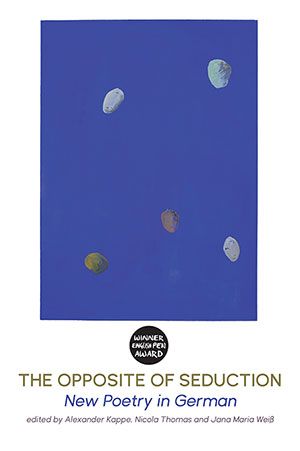
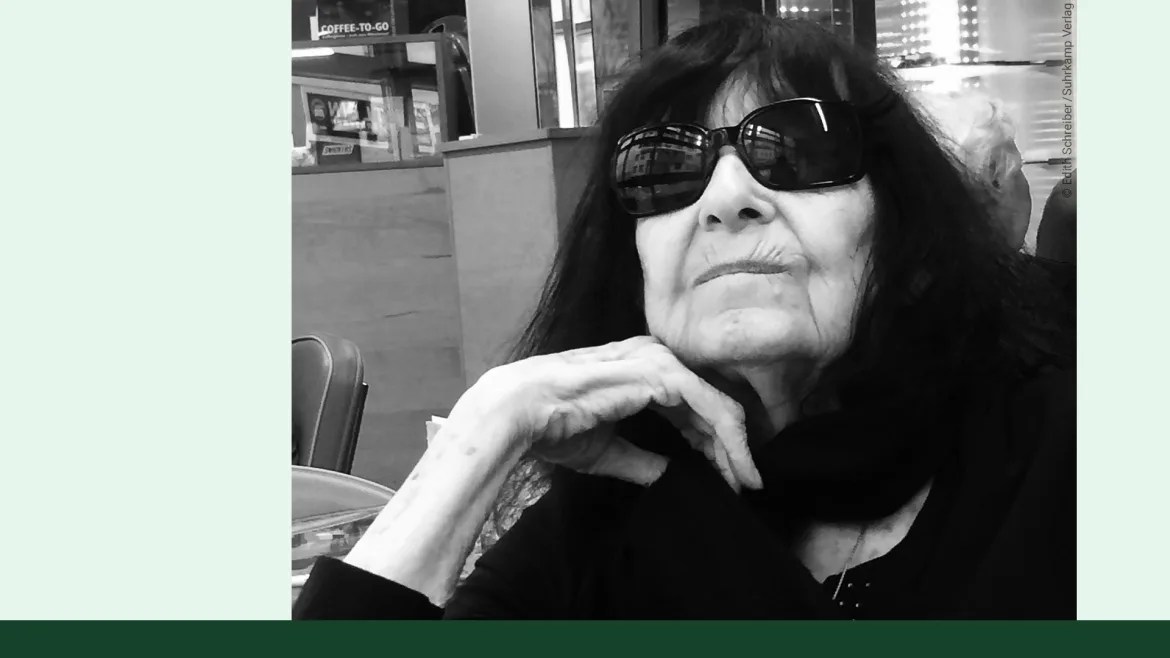
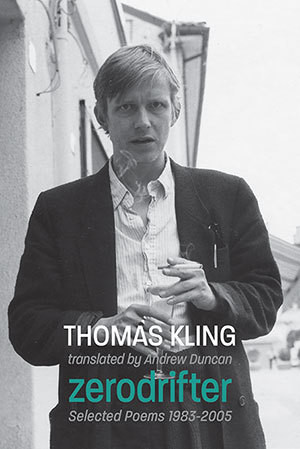
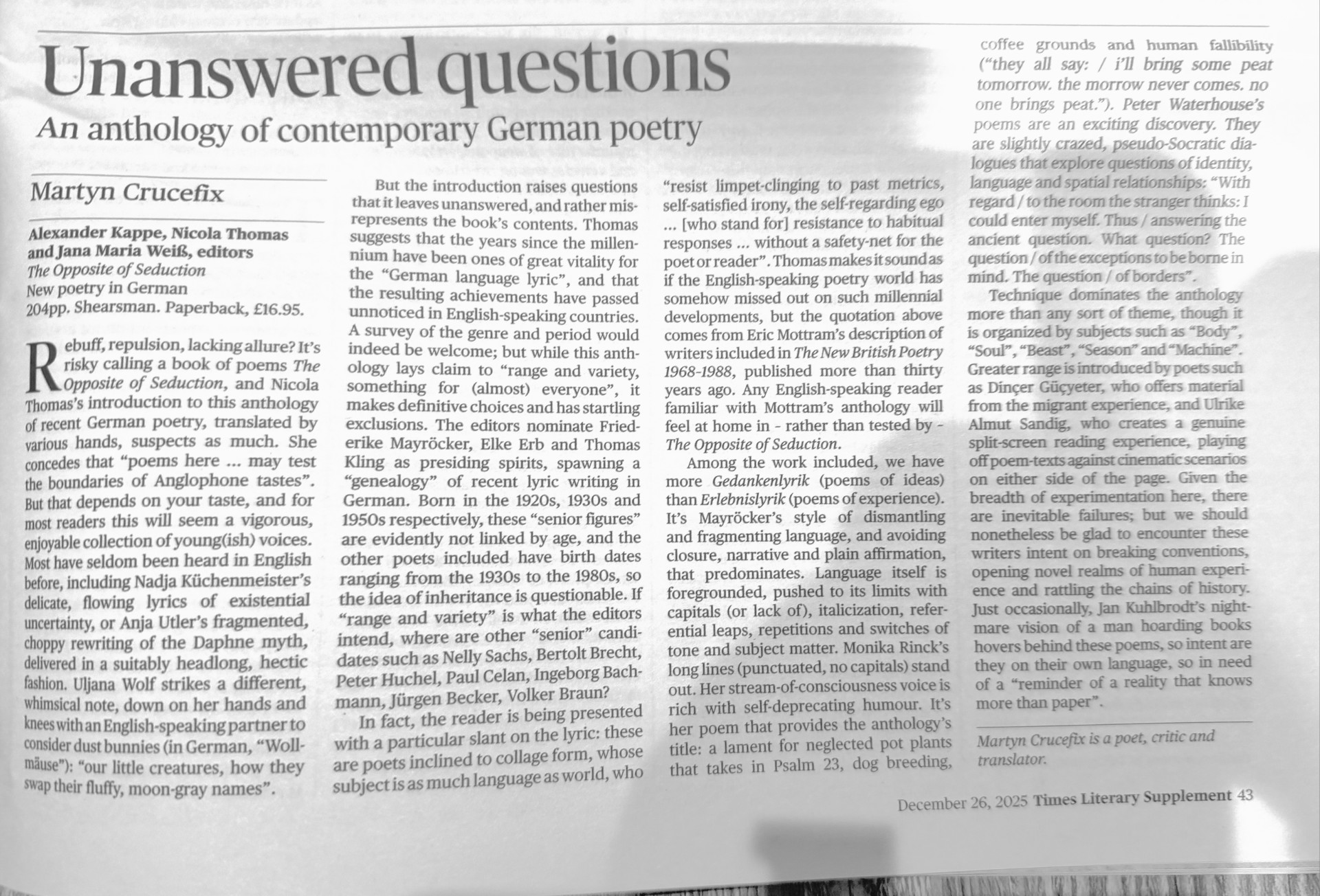



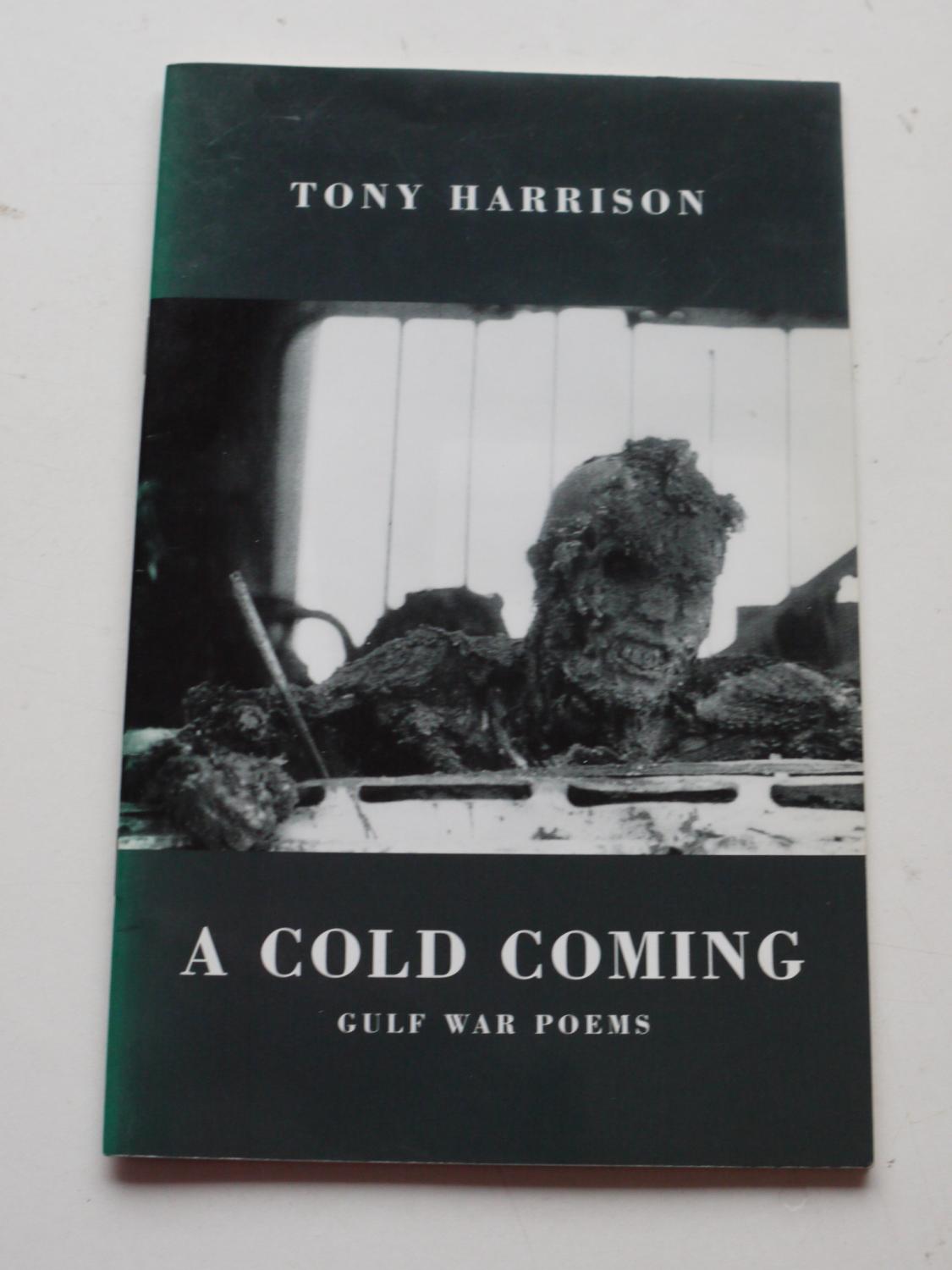
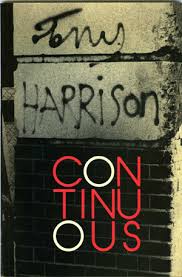
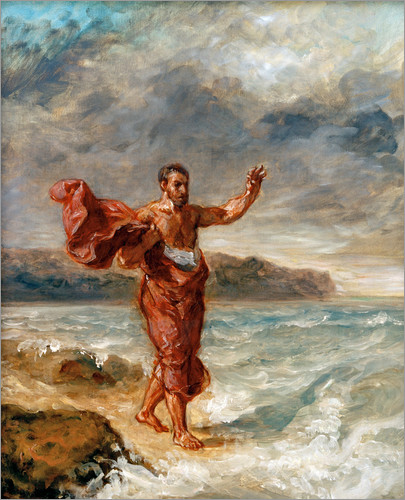
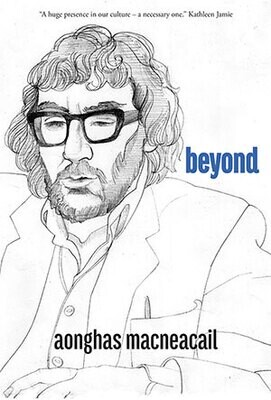
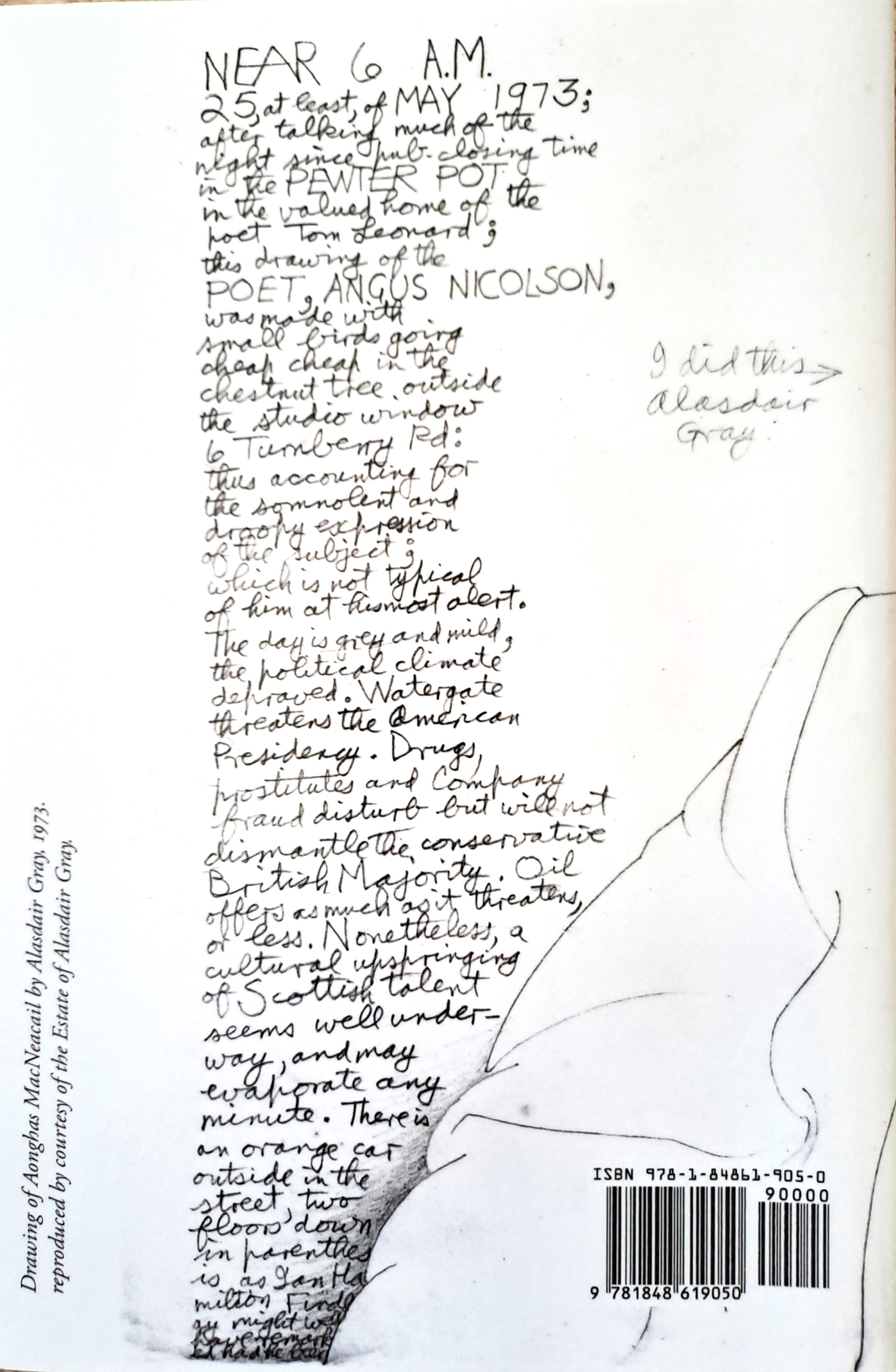
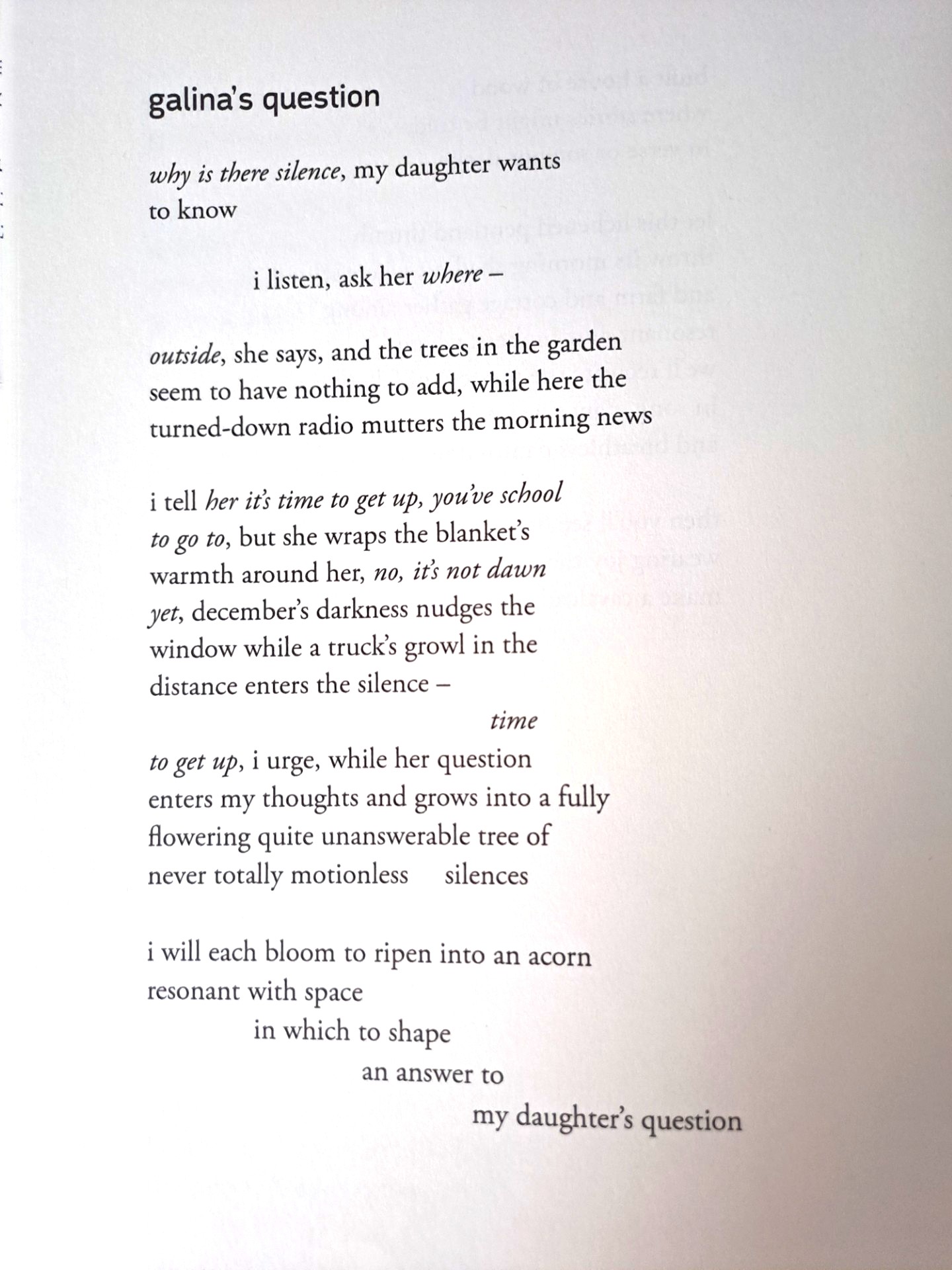

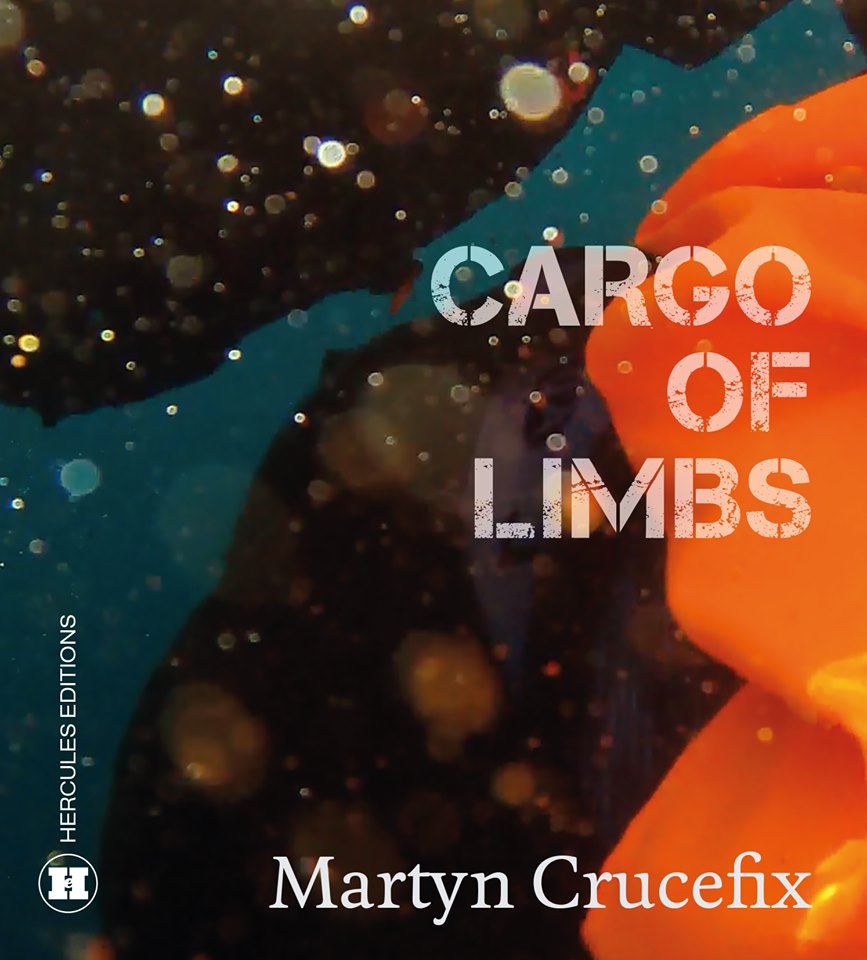


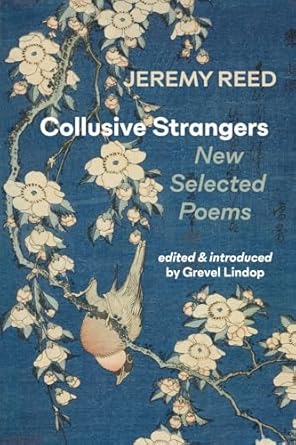
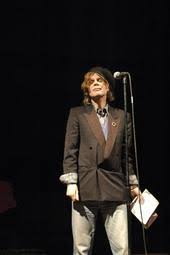
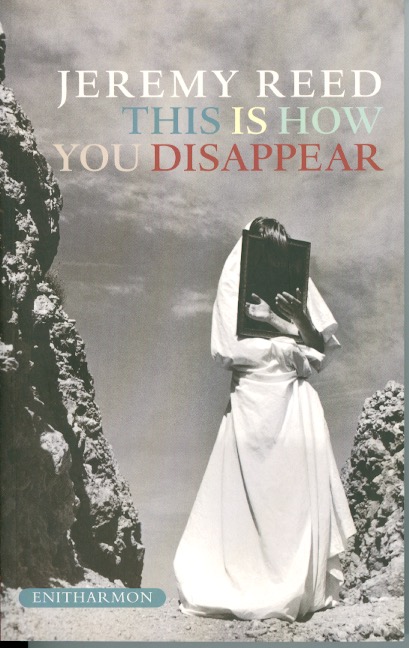
 Martyn Crucefix