Back in the A.S.M.R.

I see the curious physical/psychological sensation that is ASMR is back in the news again: here’s a recent Guardian piece about it which suggests that ‘younger adults [who] are increasingly overwhelmed by in-person interaction [are] soothing themselves instead with sensory online content, according to a report on the wildly popular online content known as ASMR’. It reminded me that in the early days of this blog, I posted a little piece about my own experience of the phenomenon and – 10 years is a long time in blogging – I thought it would be worthwhile re-posting the piece. Reading it over again, I once more felt that shiver in the spine, that crawling under the scalp that is the hallmark of ASMR. And what does it have to do with poetry? Well, read on….

Something on early morning Radio Four this week sent me hurrying to the files of autobiographical notes I’ve been writing sporadically over the last few years. It was a discussion of an experience I have never heard spoken of, but felt often enough. It has a name these days: Autonomous Sensory Meridian Response. I’ll put down my memories as I recall them but also with some of the surrounding context too as that may be relevant to the phenomenon itself:

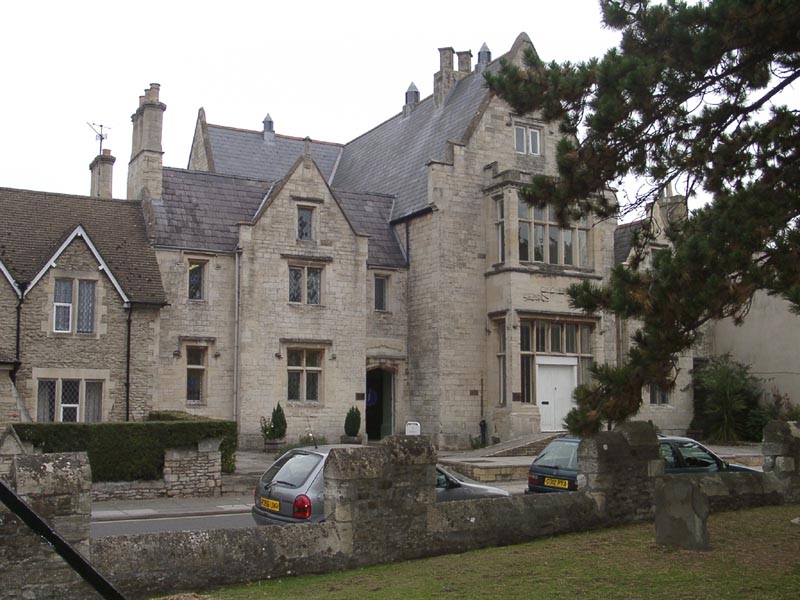
trowbridge_picF0010
The Parochial School, Trowbridge (old building)

In the 1960s, in my second year at Parochial Junior School (I’m about 9 years old at this time), we crocodile out the front door and occasionally turn right along Church Street towards St James’ Parish Church, Trowbridge (George Crabbe’s last posting). On those occasions, we usually cross the road for religious services like Easter, Harvest Festival and Christmas. We wheel and snake into the churchyard and follow the tilting, worn flagstone path, passing Thomas Helliker’s casket tomb to the church porch.

But on more ordinary days we turn left along Church Street, passing Shanley’s the barbers and a low butcher’s window where our regimented pairings are disturbed by squeals and extraneous movement, by our fascination with or repulsion from the red and pink slabs and cuts of meat, the creamy fat like curds laid out on plastic white trays. Most fascinating and least attractive are the lolling ox tongues, cut at the root, purple, stilled, obscene. Later, back in the main school building, moving to other rooms downstairs aware of girls talking, manoeuvring to walk alongside me, giggles, but I have no recognition of what this means, certainly no idea that it might be exploited. In fact, I don’t recall much sense of my own position in this little closed society at all. It is as if I moved through a mist of my own creating, barely self-aware. But I imagine myself proceeding quietly, studiously mostly, probably a pleasure to teach, though reports are already lamenting how deeply I live in myself. Already teachers are reaching for the old metaphor of the shell, the frustrating creature living within.

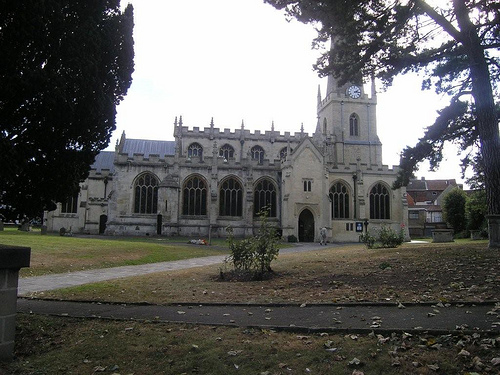
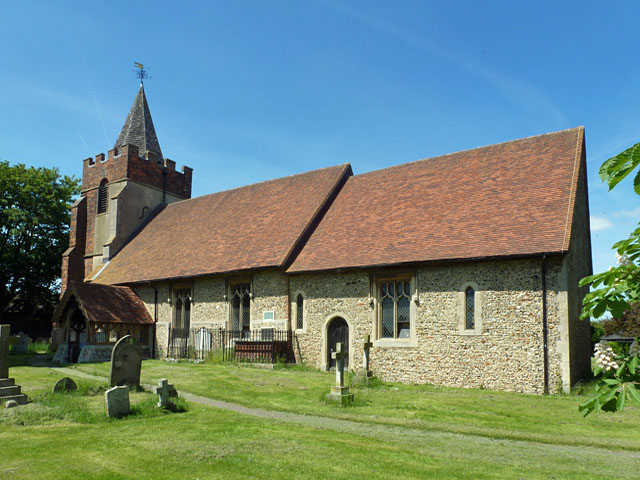
3975485172_bc361c22dc
St James’ Parish Church, Trowbridge

Then we turn left into Duke Street and left again through an almost hidden door that, even then, I would associate with those obscured entrances and exits in children’s stories. Through this door, we traipse down a passage into what we call Emmanuel, a kind of annex with a couple of extra classrooms. I don’t remember any separate play area. It’s in these classrooms that I remember adjusting to new spectacles from Carter and Harding after I had been diagnosed with short sight. I was straining to read the teacher’s scrawl on the blackboard. Here too I remember the first incidents (though surely these could not have been the first) of a very peculiar sensation. It’s a prickling that runs up my back and shoulders, a sort of shiver moving upwards across my neck into my scalp when a teacher (not my usual one) writes on the blackboard. It’s a ripple of pleasure out of unfamiliarity (or the familiar defamiliarised), a kind of low level erotic shiver I still occasionally feel now when the college cleaner comes into my room – moving books, touching the table and chairs, my familiar items touched by another’s hand. I’ve never heard this described before . . .

I find that Wikipedia describes ASMR as a neologism for a perceptual phenomenon characterized as a distinct, pleasurable tingling sensation in the head, scalp, back, or peripheral regions of the body in response to visual, auditory, tactile, olfactory, or cognitive stimuli. The nature and classification of the ASMR phenomenon is controversial, with strong anecdotal evidence to support the phenomenon but little or no scientific explanation or verified data. It has become a recent internet phenomenon. Online discussion groups such as the Society of Sensationalists formed in 2008 on Yahoo! and The Unnamed Feeling blog created in 2010 by Andrew MacMuiris aim to provide a community for learning more about the sensation by sharing ideas and personal experiences. Some earlier names for ASMR in these discussion groups included attention induced head orgasmattention induced euphoria, and attention induced observant euphoria.

Quotation-Emily-Dickinson-poetry-Meetville-Quotes-87875

It’s interesting that these titles draw attention to the ‘paying of attention’ and, inevitably perhaps, my own thoughts about it revolve around poetry and its effects: the familiar defamiliarised, the frisson of the uncanny, Emily Dickinson talking about poems taking the top of your head off. ASMR seems linked to a particular quality of attention-giving which yields a rippling of pleasure, close to the erotic, but not the same as that. It is powerful yet undramatic; it is most common in quiet moments of observation. It seems to come when there are no goal-directed intentions in the attention-giving. It is also in a neutral sense ‘bestial’, an animal shiver, like hackles rising, but not out of anger. It’s surely something reaching far back into our ancient past, linking body and mind, yielding pleasure, rooted in a mode of being pre-dating language and conceptualisation. That interests me a great deal. Poetry is language deployed to circumvent the limits of language; these days I take that as a given. Yves Bonnefoy says: “poetry was not made to mean, but to restore words to their full intensity, their integral capacity to designate fundamental things in our relationships with ourselves and others, here and now, amid those chances that one should never, as Mallarmé did, dream of abolishing” (2012 PN Review interview with Chris Miller. Even if just considered as metaphor, perhaps ASMR is what poetry taps into, invokes, rehearses, re-discovers.

Two New Poems – at ‘The High Window’

Two new poems by yours truly – one featuring class, eroticism, and valeting a car and the other of 4 quatrains of mourning modelled on a little-know poem by Bertolt Brecht – have just been published/posted on The High Window website here. Do click the link and read the poems there – the site (edited by poet David Cooke) publishes a number of poems by different authors, so to see mine scroll down (alphabetically). There is of course lots of other interesting work on show by these excellent poets: Anindya Banerjee • Robyn Bolam • Pat Boran • Malcom Carson • Maggie Castle • Martyn Crucefix  Peter Daniels • Mair De-Gare Pitt • Frank Dullaghan • Alexis Rhone Fancher • Marilyn Francis • Greg Freeman • Jeff Gallagher • Mark Granier • Gill Learner • Emma Lee • Alison Mace • Patricia McCarthy •  Beth McDonough • Fokkina McDonnell • Maggie McKay • Ted Mico • Sean O’Brien • Tanya Parker • Sheenagh Pugh • Tracey Rhys • Padraig Rooney • Ernesto P. Santiago • Andrew Seear and Victor Adereth • Richard Skinner • Angela Topping • Mark Totterdell • Miriam Valencia • Scotia Vincent • Rodney Wood  Marc Woodward . In my experience, people are always eager to hear about the origins of poems (perhaps because their beginnings are often both mundane and utterly mysterious) so I thought it might be a chance to say something about these two in particular.

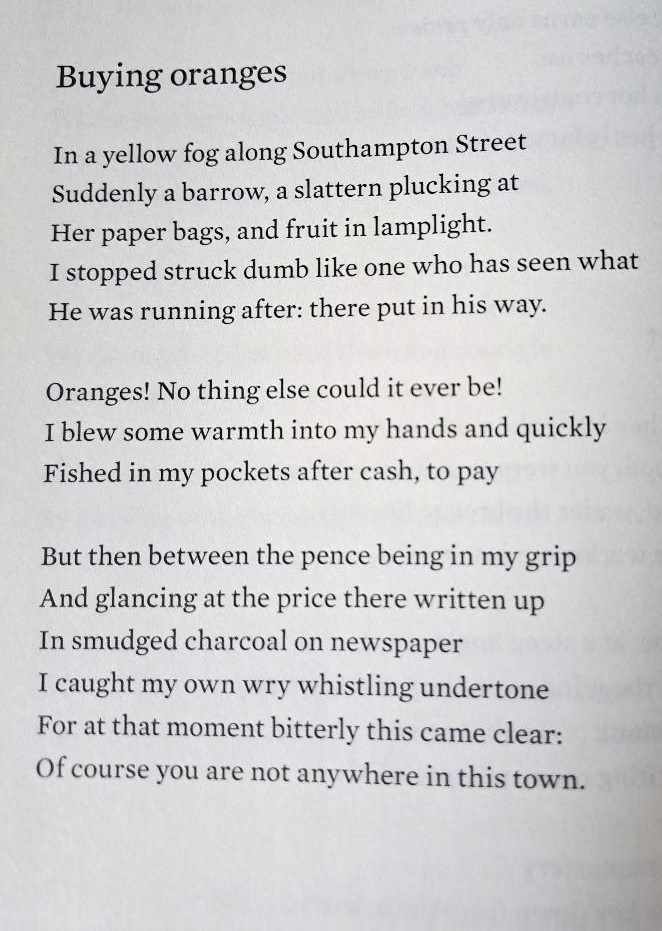
The Brecht-related poem arose after I’d attended a discussion on the German poet/dramatist by David Constantine. One of the poems he presented to those attending (with his translation) was ‘Buying Oranges’. This is one of the poems Brecht wrote for his lover, Margarete Steffin, in the 1930s. Constantine’s translation (from The Collected Poems of Bertolt Brecht (Norton, 2019) goes like this (hear it read by Daisy Lafarge here):

It was the circumstances surrounding my first acquaintance with this poem that led me to write a very loose version of it. I’d booked the event with David Constantine months before, but it happened that my mother sadly (but not unexpectedly) died in her Wiltshire care home the night before. I debated what I should do but decided in the end to attend the talk (I figured there was nothing urgently to be done; Dad had died a year or two before). The world looked different of course. In fact the day was bright and sunny. The event was near Holborn (not far from Southampton Street itself). As you’ll see, I turned oranges into chrysanthemums (my mother’s favourite flowers) and I find now that I lengthened BB’s irregular sonnet to 16 lines. Here’s my version:

ON SOUTHAMPTON STREET
after Bertolt Brecht

A mizzling cold fog on Southampton Street
then suddenly a market stall
with its spectral blooms
under a bare bulb preternaturally lit

a sullen frizz-haired girl cutting stems
and I’m dumbstruck as one who’s found
the thing he looked for
here—at arm’s length—chrysanthemums—

nothing but them! I blow on stiff fingers
plunge them into a pocket for coins
but between fumbling silver
and glancing back up to check the price

scrawled on a yellow card it feels as if I
interrupt myself—a dull under-voice
lifted in bleak remembrance—
since last night you’re not here or any place

The second poem appearing on The High Window this week had a much more mundane beginning. Several years ago (how long can some poems take to arrive in their proper form?) I was staring from a window (in a classroom – perhaps I was invigilating a test) and down in the car park below I saw a car valet parking up his van next to a much fancier car. I seem to have watched him pretty carefully if the poem is to be believed (which I’d usually say not to). Gradually, the poem acquired its erotic undertones (the lovers back to back in bed, the intimacy of the hand-washing, the moisture, the smells, the final turning away) which surprised me as I thought the poem was mostly a comment on work, labour (I love poems about processes) and ultimately about class differences (for money, one man cleans another man’s car). The epigraph is, of course, from Donne’s great love poem ‘To His Mistress Going To Bed’ but here is intended to reflect the working man’s thoroughness!

MOBILE CAR VALET
‘Before, behind, between, above, below’

Like a pair of lovers back-to-back bored in bed
his white van closes rear bumper to bumper

he opens the doors wide and starts to squeegee
the mucky hubs of the big black German

from a sudsy bucket he works the dusty body
with a chamois leather inscribing S-shapes

like the briefest foaming of bold graffiti over
and round wing mirrors and shining roof rails

then balanced on a tyre sweeps half the roof
now the other side and inside across the length

of the dash a pale duster the armrests especially
working the driver’s side then a jet-spray

jumps into hissing life spilling gassy whites
over the wings and the tyres his best weapon

set back in the van then out with the ancient Henry
its scarlet chess piece and snaking black hose

used to scour the seats deep into the footwells
and the chamois is back again to buff stray drops

on windows with windolene it smells good to him
now the doors slammed the remote locking chirps

as he carries the fob back into the marble foyer
like a hatchling his van waits out the length

of one smoke nothing to say to the big German
where it glitters alongside already turning away

Durs Grünbein Reading at The Goethe-Institute, London

Please Note: this blog and website are now captured and preserved at the UK Web Archive held at The British Museum. Many thanks to them.

The highlight of last week was attending Durs Grünbein’s reading at The Goethe- Institute, where he was in discussion with his English translator, Karen Leeder. At the beginning of the evening, Grünbein joked that he’d not been in the UK for a few years and this was the first time he’d had to produce his passport (the blessings of Brexit). Interestingly, in the light of last weekend’s German election results, Grünbein has often been described as a poet of the reunified Germany, having been born in Dresden and now living with his family in eastern Berlin. Grünbein’s poetry is witty, wry, perceptive, and influenced by a broad range of literary texts and often presents the disillusionment of having grown up in East Germany and explores Germany’s identity in post-Cold War Europe. He has been very vocal in recent years on the issues of immigration and the defence of Ukraine. Helen Vendler commented on the ‘sardonic humour, the savagery, the violent candor—all expressed in lines of cool formal elegance’ and Philip Ottermann, in The Independent, noted ‘Grünbein loves to jump from one register to another—one moment he is the street poet of Berlin, the next … all marble and ancient philosophy’.

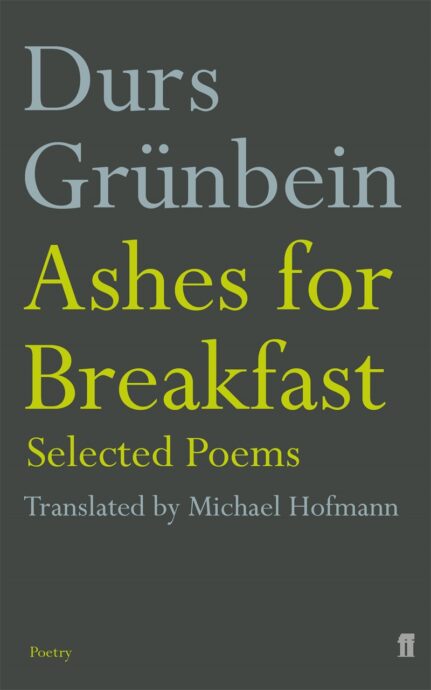
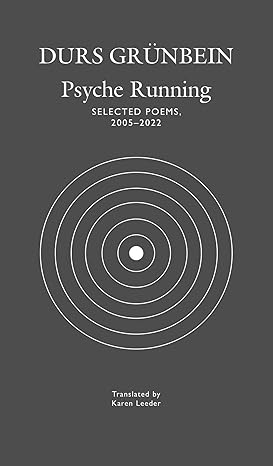
Grünbein’s earlier poems were translated into English by Michael Hofmann and published in Ashes for Breakfast: Selected Poems (Faber, 2005). Karen Leeder has now published Psyche Running, a selection of more recent poems from 2005–2022 (Seagull Books). During the evening, Grünbein commented on the process of those earlier translations as ‘strange’ and the results (as is Hofmann’s wont) as being very free, very sparky, and Leeder suggested there was a particular excitement in the ‘to and fro’ between author and translator to be found in them. She then suggested her approach has been rather different, perhaps a more dutiful one, still needing to make the poems ‘live’ in the target language, but also demanding a fidelity, to capture the original’s form and architecture as closely as possible. The work read during the evening suggests that her translations triumphantly achieve these goals.

Leeder said that his work can have a ‘marble’-like quality, a firm (unbending?) Classicism, and also that he has himself been labelled a ‘poeta doctus’, given the learned, wide-ranging references he incorporates. Grünbein rather demurred at these descriptions and (an idea he repeated a couple of times in slightly different forms) any interesting poem must be the result of two steps, the first poetic, the second, a more critical, a process of reflection (a later formulation suggested the two steps were ‘perceptual’ and ‘conceptual’). These two phases result in the finished poem as ‘a form of knowledge’; Grünbein pointed out that philosophy arose out of poetry in Classical times (not the other way round). The first poem he read, ‘Childhood in the Diorama’, does have a ‘marble’-like quality to it: longish, unrhymed lines in a solid verse paragraph and the child’s preference for the posed scenes of a museum’s diorama, their ‘inert’ quality. But on one occasion, the boy sensed some movement, a ‘draught, perhaps, had blown through the displays’, perhaps suggestive of the child’s development into a more unstable, fluid view of the world.

Other poems read that evening included ‘Nee Wachtel’, ‘Exaltations in Sleep’, and ‘Inspector Kobold’ which is a ‘Martian’ sort of piece describing seahorses, in ‘their whalebone corsets, like ‘tiny ocean Lipizzaners’ (here’s an alternative translation by Michael Eskin). If we are to take Grünbein’s poems as ‘forms of knowledge’ then they certainly range widely through the natural sciences, language, science more generally, astronomy, history and politics. He felt what binds all this together is the one individual life, the single life perspective, poetry as a sort of anthropological study, at which Leeder suggested there was a ‘fragility’ to much of his work, the vulnerability of the single life as much as all life (ecologically?). The poet was happy to agree to this, suggesting ‘marble’ was not at all the right term for his poetry, that there was always something ‘flowing’ about it, multiple angles and perspectives. He once claimed not to be a ‘German’ poet, but simply someone who wrote in the German language. This evening he stood by that statement: his own identity is wrapped up in language use, the mother’s language, used daily for years, and is not a function of birthplace alone (remember Grünbein grew up in East Germany and now lives in the unified Germany).

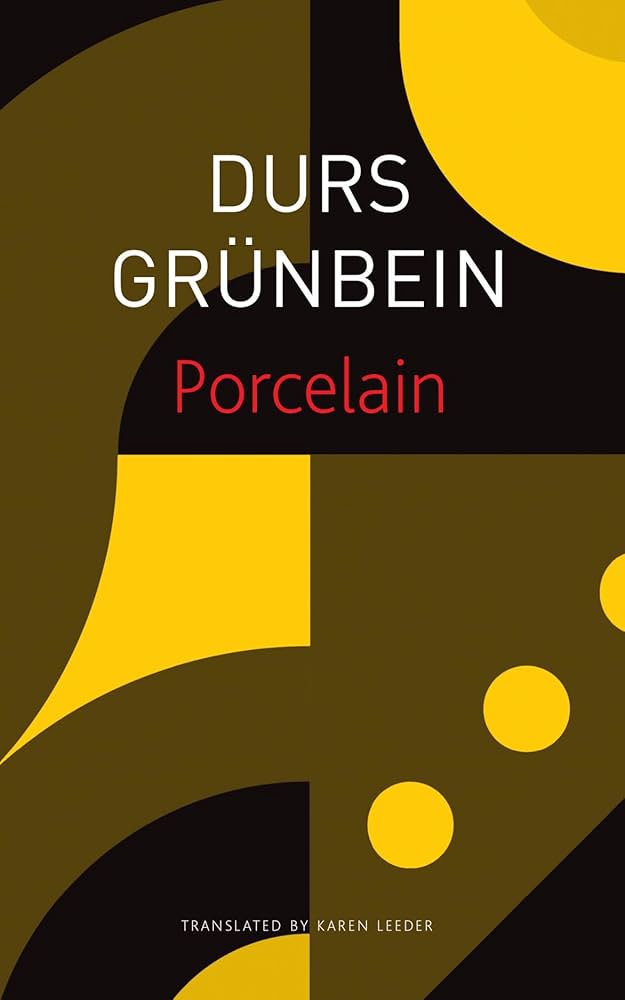
But his birthplace has been undoubtedly important in Porcelain (Seagull, 2020), the long sequence of poems (written slowly, we learned, on the February anniversaries of the Allies’ bombing of his hometown, Dresden). I reviewed this book here, when it was published). Grünbein read 10 poems from this sequence (some poems were read only in German with the English translation projected above), other poems read in both languages. Porcelain is an elegy the poet suggested, a Classical form, longing for what is lost. Poem #7 is one of the most remarkable, another museum visit by the young poet, who’d stare at a cherry stone from the 16th century, carved with 185 tiny heads. The poem comes to regard the curious object as an ‘emblem of the future’ of Dresden, presenting as it seemed to, faces, ‘eyes wide with terror, on every tiny screaming face, / inferno on a needle tip’.

The poet suggested the whole sequence of poems is also a kind of ‘sound system’ containing echoes or samples of other poets’ work, including Paul Celan, with Grünbein’s title (Porce-lain) being a pun on the earlier poet’s name. Leeder added that it should not be read in a narrowly nationalistic fashion, that a lot more (bombed) cities than just Dresden were alluded to by the poem (Coventry, Warsaw, Odessa, Guernica). She asked Grünbein what was it that kept drawing him back to Dresden as a subject matter for poems. He thought it had something to do with the moment when he realised that his own childhood was ‘historical’, in the sense of being intimately connected to major historical events. He recalls seeing truckloads of Russian soldiers passing where he grew up, heading to the nearby Russian military barracks. This produced a sense in the young boy that much in (his) life had been determined before his arrival on the scene. In this sense, his hometown acquired a ‘mythic’ quality.

KL: You mean it was a ‘world place’?

DG: Yes – I realised it was a reference point, worldwide, its splendour and its ruins. From the city of Dresden one can draw out a lot of history, a seed point, or like a jigsaw, that can be slowly pieced together.

Perhaps half a dozen more poems were presented from more recent collections. ‘Flea Market’ is a peerless poem about German history, starting from the bric-a-brac found in such markets – the spoons, brooches, bird cages, tables – and wondering ‘what / do they say, what do they hide’? Quiet allusions to ‘uniforms and daggers of honour’, seque into the next, even more troubling, question: ‘How can one’s thoughts not go astray / faced with the piles of glasses, / and old leather suitcases?’ The poem ‘Lumière’ also alludes to the Holocaust and starts out from descriptions of the Lumière brothers’ 1896 film of a train pulling into a station. The first film-goers were frightened at the image of the train’s approach, ‘but not yet the horror / at all the implacable trains / that have criss-crossed the century, / the endless rows of sealed trucks.’

Asked where his poetry might be heading, Grünbein surprisingly suggested that he felt a more prose-like quality entering his work – not so Classical then! A soberness in some ways – but with flashes of magic, magic spells even. His earlier suggestion that the good poem is a 2-step process – perceptual, conceptual – seems to be still important, though in the final result (I’m guessing Grünbein would agree with this) the two stages must be simultaneously present in the reader’s experience.

I have to say, one of the great pleasures of the evening was the way in which both participants took the poetry seriously and gave it a good outing. This may sound odd for a poetry reading, but often these days, I find too many readings/launches contain too little poetry and rather too much gossiping, drinking and networking (all of which can be excluding for those not in the swim). Can I make a plea for more reading at readings, a little less career-building? Of course, at The Goethe-Institute we were listening to two writers at the very top of their game and what they are creating – in German and in English – is vital, lasting stuff. But, if we are publishing poetry, we should not be shy of reading it (remember, not everyone attending will be able to afford to buy the book and take it home).

Remembering Geoffrey Grigson

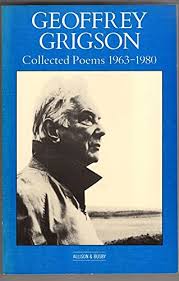
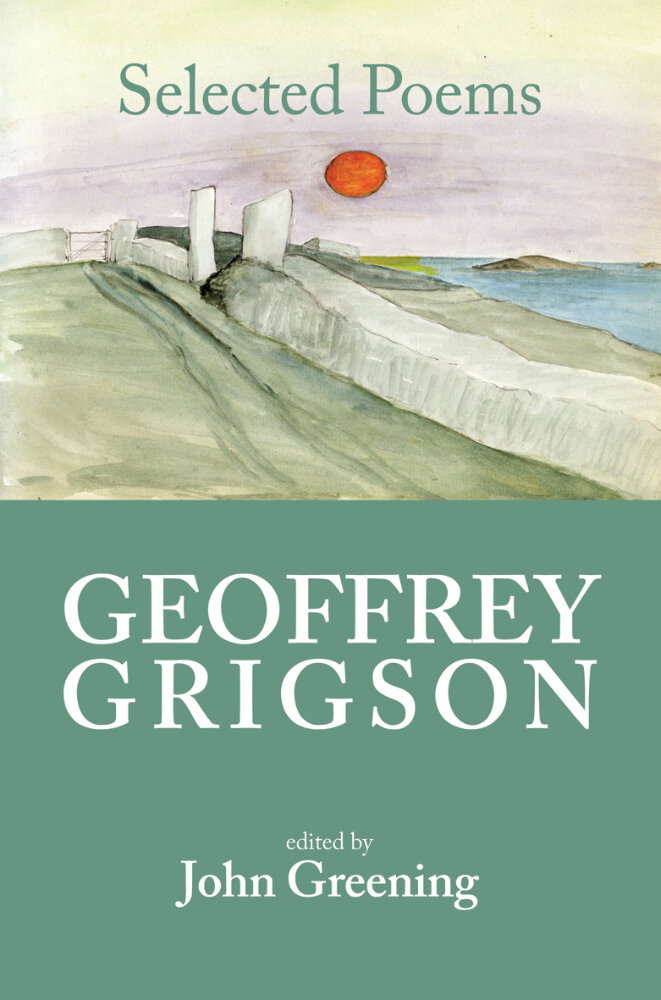
I’ve recently seen announced a celebration of the work of Geoffrey Grigson (1905-1985), scheduled to take place at 7.30pm, on Tuesday March 4th at West Greenwich Library. The event is called ‘In His Own Voice: Geoffrey’s Grigson’s Poetry’ and is being organised by John Greening with contributions from Grigson’s daughter, Caroline, his grandson, Joe Banks, and poets Graham High and Blake Morrison (and archive recordings of the poet himself). The event is free to attend (donations welcome), plus refreshments and books on sale. Texts will be projected on screen. As the event blurb reminds us, Grigson lived and worked through amazing times, culturally and politically, and was a prolific poet, writer, critic and editor. At the centre of English intellectual life, he knew the poetry grandees of his days and greatly admired those of the past. When he was only 27, he founded the bi-monthly journal ‘New Verse’, thus becoming hugely influential in the poetry world.  I reviewed John Greening’s selection of Grigson’s work when it came out in 2017, and this seems an opportune moment to re-post it here and on my new Substack. 

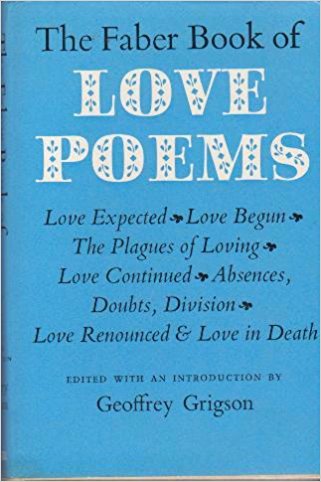
Surely we all have one or two Faber anthologies edited by Geoffrey Grigson on our shelves? Love Poems, Popular Verse, Reflective Verse, Nonsense Verse, Poems and Places, Epigrams and Epitaphs . . . As a critic he often wielded a savage power through his magazine New Verse. And as a big beast on the literary scene of the early 1980s, Hermione Lee interviewed him on Channel 4. But since his death in 1985, he’s better known merely as the husband of Jane Grigson, the celebrated cookery writer. His own poetry has been neglected which made John Greening’s 2017 Selected Poems from Greenwich Exchange a welcome opportunity to re-consider it. I think Grigson’s contrasting themes were established early on. The influence of two great poets (not Eliot, not Yeats) is clear from the start and it may be that the limits of Grigson’s poetic achievement and the absence of much development in his style, are because he never chose one path or fully escaped either.

The influence of Auden was very clear in Grigson’s first collection, Several Observations (1939). ‘Meeting by the Gjulika Meadow’ presents an enigmatic narrative in a “frontier” landscape; a meeting between two men whose conversation is in large part concerned with “the thunder / about Europe”. There are sketched fragments of personal dependencies and guilts but the whole reads as a slice of narrative that has been carefully shorn of its explicatory elements. A poem from 1946 shows Grigson using similar methods but on matters much closer to home; ‘In a Dark Passage’ draws material from the deaths of two of Grigson’s brothers in WW1 and the early death of his first wife, Frances. The situations are still relatively distanced by being told in the third person and the timings of the incidents are compressed to form a litany of heartfelt if rhetorical griefs: “O floes of ice, you float downstream / But do not disappear”.

There is certainly a very dark river running through Grigson’s work. ‘Two A.M.’, from the 1970s, records a wakefulness at night filled – as so often – by nothing but questions: “all emptiness, all gravity, / Ultimacy, nothingness”. He captures vividly the way this kind of mood, at such an hour, insists on expanding exponentially, racing to fill the world’s “Sierras, monadnocks, lakes, prairies, taiga, ice”. On this occasion, there is the possibility of an erotic reply: “At least now, with our bodies close, / Be comforted”. But even that response is absent from ‘Again Discard the Night’ from the 1980 collection, History of Him. Written as a first person narrative this time, the poem pulls no punches in its flinty and unforgiving portrait of old age waking:

… you call, the kettle gathers

And talks, and Are you all right? comes your

Usual cry, and my habit insists, without sound, Reply,

Be bright, wash, shave, dress, and this once,

Again discard the night.

Of course, Grigson’s sense of an ungoverned and likely meaningless universe matched with his frequent backward glances also calls to mind Hardy’s work. One of Grigson’s earliest poems, ‘The Children’, has an 11-line stanza of complex rhyming that Hardy would have been proud of. The children are portrayed as playing in a natural environment and in a state of temporal innocence: “They looked for no clocks, noticed no hours”. But ending each stanza, the triple rhyme words with “hours” are (ambiguously) “sours” and “flowers”. Between the third and fourth stanza, there is the kind leap in time often found in folk song (and Hardy). We have instantaneously passed many years: “The rooms were pulled down, but they always abide / In the minds of the children born in them”. These are the best lines in the poem with the much cooler closing lines rather falling flat:

They see the clocks and notice the hour

And aware that restriction of love turns sour,

They feel the cold wind and consider the flower.

It is certainly Hardy that Grigson is thinking of in ‘In View of the Fleet’. The Fleet is the lagoon behind Chesil Beach in Dorset and the poem borrows phrases from Hardy, empathetically suggesting that each poet’s vision has the same sequential locus: “Things not as firstly well, a sparkling day, and / tolling of a bell”.

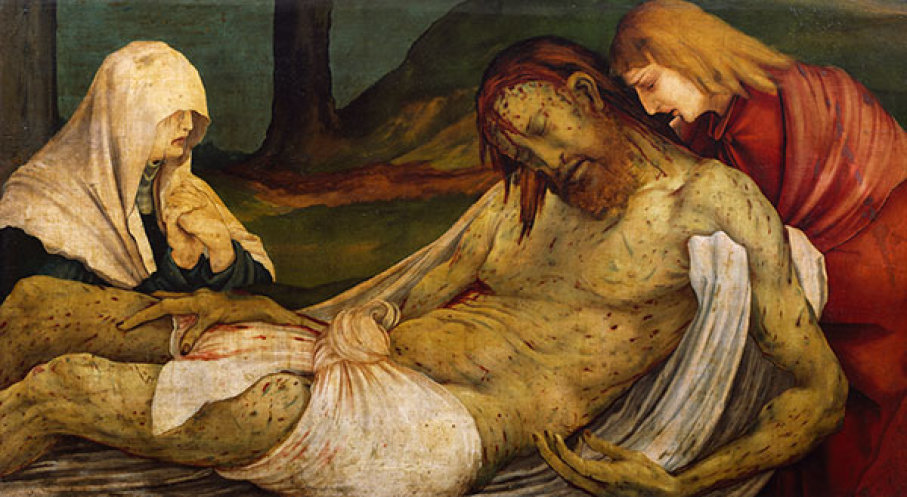
John Greening suggests in his very helpful Introduction that Grigson is also capable of an “extraordinary lyricism” and these are moments when he captures this “sparkling” quality of the natural world. In ‘A New Tree’, helped by the holding up of a child to a window, the narrator sees again with a newly cleansed perception, “a sun / being fiercely / let loose again”. Delight in the natural world recurs in a key poem, ‘Note on Grunewald’. In it, Grigson also expresses the scepticism about literary achievements which must have driven much of his own, often acerbic, critical comments on the work of others. In a man who devoted a lifetime to literary endeavours, it’s hard to take wholly seriously the poem’s assertion that he’d rather live to sniff the “scent of the flowers of lime” than to create lasting “poems”. But the scent is praised in contrast to the art of “Grunewald’s spotted green-rotted Christ”. Grigson sides with (“I join”) Cowper in deciding that death holds no attraction and that he too would choose to “leave this world never”. The perceived dichotomy between a vivid inhabiting of the world of the senses and the ‘rotten’ achievement of artists is by no means Grigson’s final comment on these issues, but the poem certainly expresses unresolved tensions.

As Greening reminds us, Grigson as a critic was a feared and fearsome creature, liable to “dismissiveness and intolerance of shoddy work”. Perhaps, in his own mind, he never quite resolved his assessment of his own poems. A lovely translation from Tu Fu was perhaps chosen because it laments lack of achievement, or at least of recognition: “Writing gives me no name”.* More vigorously, ‘Lecture Note: Elizabethan period’ is an hilarious and outrageous account of a poet’s final work. While the ink was still wet on the page, he dropped dead. The poem fell to the floor only for the maid to drop it in “the jakes”. The final lines laugh cynically, sarcastically, as if this illustrates the fate of most artistic endeavours: “Now irretrievably beshitten, it was, dear sirs, / The one immortal poem he had written”. Yet this is delicate stuff compared to Grigson taking aim with both barrels in ‘Perhaps So’. The premise is that too much is being written:

Too much is told. Banish polymath Steiners

And seventy-seven other British Shiners,

Naturalists, archaeologists, publishers

Of publications in parts,

Norman Mailer

And all long-winded farts . . .

It’s hard to reconcile this voice with that of ‘A New Tree’. Interestingly, Grigson’s address to an ancestor whose name was ‘Nazareth Pitcher’ is critical on the surface, disparaging of Nazareth’s “pride”, suggesting his “lips were too thin”, that he might “be pleased” if he was to witness the parlous state of the world now (1960s). But it’s also difficult to dismiss the feeling that Grigson chose to address Nazareth because he sensed a kinship with this judgemental, sceptical and meanly satirical man.

Having said that, Grigson did admire, if very judiciously. Greening draws attention to an Eliotesque belief in tradition, that the best poems are made by “members of a long narrow community through time”. The word “narrow” here indicates Grigson felt that much of what was truly best was not appreciated by many. In one word perhaps, we see here his motivation to be harsh with what he felt not good enough and his hard work in anthologising what was. There are two tribute poems in Greening’s selection which show Grigson at his complimenting best. ‘A Painter of Our Day’ is about Ben Nicholson and has the feel of a Coleridgean conversation poem. Its tone is confiding, admiring, ranging from observations about playing with children, shared days out, discussions of Nicholson’s work, ageing and the nature of art. Nicholson seems to teach an appreciation of “what is” and an avoidance of nostalgia. But at the same time, he recognises the value of the “reiterated wisdom of perceiving”. That both poet and artist set the bar of achievement very high indeed is suggested by Grigson’s admission that, of their chosen role models, “most have been / Long dead”. I find it hard to pin down a more precisely articulated aesthetic, but these lines are revealing of any artist’s relation to his/her elders:

Suddenly when young or in our first ability

We find them, slowly we find the reasons

For our love, finding ourselves, and what we lack

As well or need the most

Finally, ‘To Wystan Auden’ records the moment Grigson learned of Auden’s death in the “English September” of 1973. His admiration for the younger poet is fulsome. With the appearance of his early work, Auden became “living’s healer, loving’s / Magician”. From the other end of the temporal telescope, we can now see what the young Grigson gleaned from Auden’s poetry:

You were our fixture, our rhythm,

Speaker, bestower, of love for us all

And forgiving, not condemning, extending

To all who would read or would hear

Your endowment of words.

For all Auden’s own protesting about poetry making nothing happen, for Grigson, “time, after you, by you / Is different by your defiance”. One might ungratefully gripe that these are rather vague compliments from one poet to another. But Greening quotes Grigson suggesting that Auden’s achievement was in destroying “a too familiar, too settled monotony in manner and subject”. This is undeniable and this selection shows Grigson following Auden’s lead, yet at the same time, through his life, also being drawn back to a different, more traditional poetic style in the model of Hardy. Here, for example, in his last years, he recalls his childhood in Cornwall:

Staring down from that broken, one-arched bridge,

In that vale of water-mint, saint, lead-mine and midge,

I was amazed by that fat black-and-white water bird

Hunting under the current, not at all disturbed.

How could I tell that what I saw then and there

Would live for me still in my eightieth year?

*As a labouring translator myself, I have long remembered Grigson’s brilliant put-down in his Introduction to the Faber Book of Love Poems (1973). Explaining why he has not included any translations at all, he declares that their “unmeasured, thin-rolled short crust” would prove detrimental to the health of the nation’s poetic taste. Times have changed, thank goodness.

Remembering Blue Nose Poetry events in London

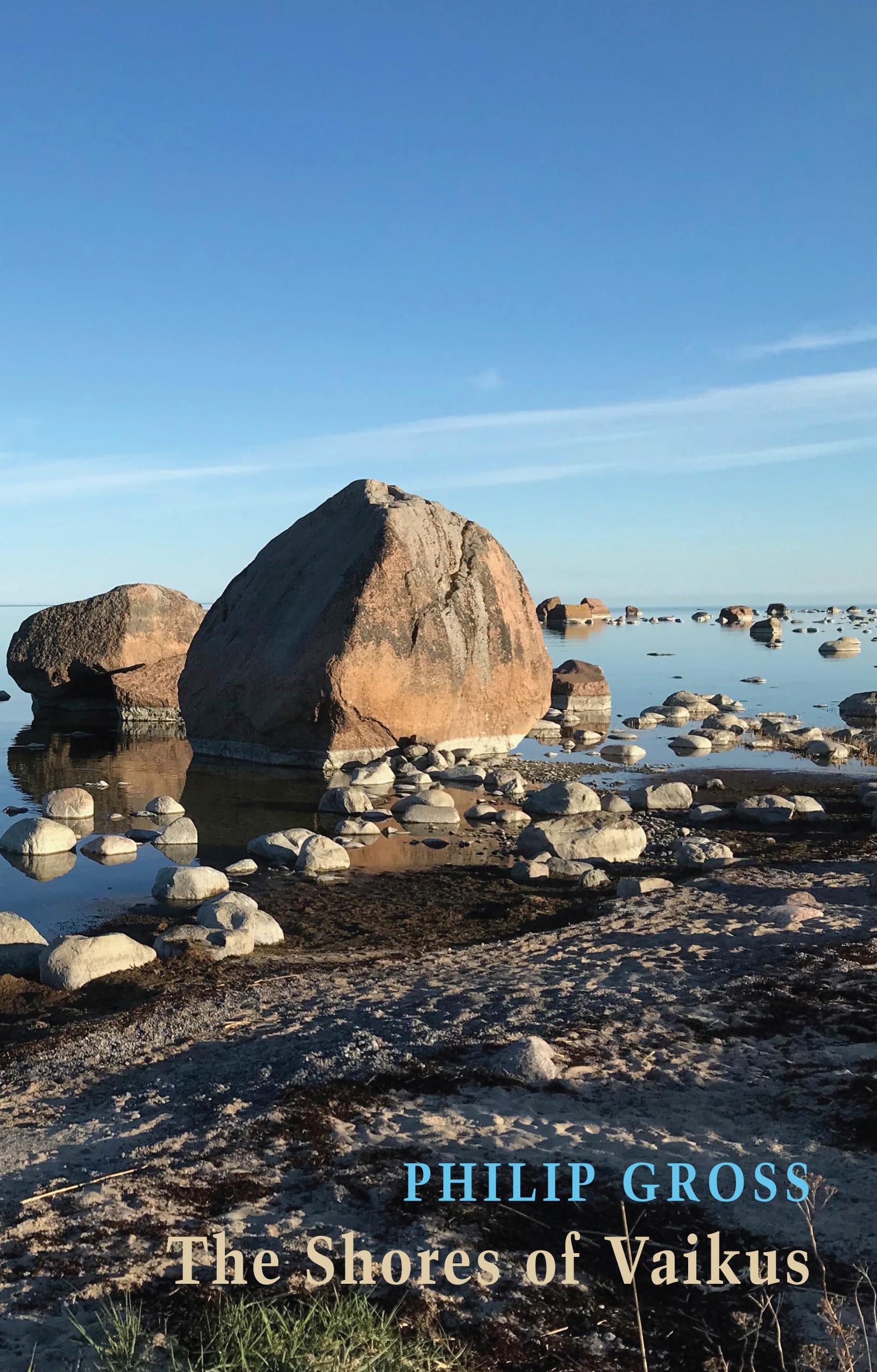
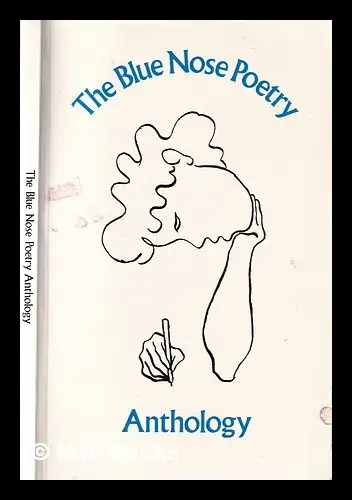
I recently attended the launch of Philip Gross’ new collection, The Shores of Vaikus (Bloodaxe Books, 2024) at the Estonian Embassy (the poems and prose pieces in the book refer to Gross’ father’s Estonian heritage and the poet’s visits to that country). I’ve followed his poetry since Faber published The Ice Factory in 1984. Neither of us could recall when we’d last met up but, after the event, I remembered that Philip was one of the first poets to read at the series of poetry readings (and associated workshops) I helped curate in the late 1980s/early 1990s, the Blue Nose Poetry series in London. I introduced him on the occasion (I still have the notes I made for the event in a Notebook for Spring 1989). I checked out the precise date in The Blue Nose Poetry Anthology (1993) which has sat on my shelves for many years now. The Blue Nose Poets (for personnel see below) invited all those who had read in the series to submit work and it strikes me now that it would be a shame if a record of our endeavours over a number of years was lost to sight completely. So, I’m posting here the Introduction to the Anthology and the full list of readers who appeared (often being paid nothing or a mere pittance) between 1989 and 1993. Interesting? I think so – given we hosted the likes of Dannie Abse, Patience Agbabi, Moniza Alvi, Simon Armitage, James Berry, Robert Creeley, Fred D’Aguiar, Michael Donaghy, Carol Ann Duffy, Michael Horowitz, Jackie Kay, Adrian Mitchell, Peter Porter, Peter Reading, Michèle Roberts, Ken Smith, and many more.

Introduction to The Blue Nose Poetry Anthology

This anthology celebrates four years of Blue Nose Poetry in London. Its beginnings can be traced back to 1988, when Sue Hubbard advertised for members to join a small poetry workshop at her house in Highbury. Amongst others who began meeting regularly were the four founder members of the Blue Nose: Sue, Martyn Crucefix, Mick Kinshott and Denis Timm. At that time, poetry readings in London seemed to be in the doldrums. Uninviting rooms and draughty halls with chairs in impersonal ranks were often depressingly matched by poor organisation. The Blue Nose Poetry activities were set up with the express intention of providing workshops and readings in a friendly, accessible and organised atmosphere for new voices, up and coming writers and the already established. We were convinced that a cabaret setting of tables, candles and a drink with other enthusiasts could make poetry enjoyable. It was only with the discovery of The Blue Nose Cafe in Mountgrove Road, close to Highbury Stadium, that we found a name for the project and the real success of the Blue Nose began.

Our first poets came to the Cafe and read out of the goodness of their hearts. We thank them all once again. The first event with Michèle Roberts was packed and exceeded our wildest expectations. Within the course of one evening we had proved that exciting contemporary poetry could be presented really successfully. Soon, in response to Blue Nose’s track record of commitment and quality, GLA (later LAB) and Islington Borough agreed to support the project. Since then, there have been various changes. Mick Kinshott felt unable to continue as an organiser in 1990 and his commitment and humour was a great loss. His place was taken for two years by Bruce Barnes, whose knowledge of the poetry and arts funding world in London proved invaluable to the development of the project. More recently, Mimi Khalvati and Mario Petrucci have joined the three original members. In the middle of the Spring 1991 season, the Cafe where we held the events went into liquidation and a reading by Tom Pickard and Rosemary Norman sadly had to be called off. Regular events did not begin again until May 1991, when we moved into the more accessible, roomy and centrally located Market Tavern in Islington. Despite the many advantages of this new venue, there are a few who still regret the passing of the old Café which, though tiny, disorganised and terminally broke, did have a superb atmosphere for poetry.

In an appendix to this anthology, we list all the readers who have appeared at the venue/s – a genuinely comprehensive survey of poetry in recent years. This, of course, does not include the many poets who have had the opportunity to read from the floor at Blue Nose events. More importantly, this book contains no record of the hundreds and hundreds of people who have enjoyed and supported Blue Nose Poetry. This book is dedicated to them.

Martyn Crucefix / Sue Hubbard / Mimi Khalvati / Mario Petrucci / Denis Timm

Full List of Main/Support Readers for Blue Nose Poetry Seasons 1989 – 1993

March – July 1989

Michèle Roberts read with Martyn Crucefix; Philip Gross read with Sue Hubbard; Jeremy Silver read with Mick Kinshott; Jo Shapcott read with Denis Timm; Leo Aylen read with Gerda Mayer; Alison Fell read with Hume Cronyn; The Blue Nose Poets; Carole Satyamurti read with Barbara Zanditon; Michael Donaghy read with Rupert Slade; Adam Thorpe read with Al Celestine.

Philip Gross

September – December 1989

Ken Smith read with Mimi Khalvati; Anna Adams and Julian May; Gerda Mayer read with Chris Powici; The Blue Nose Poets; The Performing Oscars; Maura Dooley read with Sara Boyes; Fred D’Aguiar read with Matt Caley; Matthew Sweeney read with Hilary Davies.

January – April 1990

Fleur Adcock read with John Harvey; Dannie Abse read with Myra Schneider; Elaine Randell read with Frances Presley; Hugo Williams read with Keith Spencer; Pitika Ntuli read with Bruce Barnes; John Cotton read with Bridget Bard; Michele Roberts read with Peter Daniels.

Robert Creeley

May – July 1990

The Blue Nose Poets; Sarah Maguire read with Vicki Feaver; Jeni Couzyn read with W N Herbert; James Berry read with Susan McGarry; Simon Armitage read with Chris Gutkind; E A Markham read with Mimi Khalvati; Brian Patten.

September – December 1990

In the Gold of Flesh anthology with Valerie Sinason, Dinah Livingstone, Pascal Petit, Jenny Vuglar; George Szirtes read with Gabriel Chanan; Kit Wright read with Candice Lange; The Blue Nose Poets; Michael Horovitz read with Raggy Farmer; Patience Agbabi and Judi Benson; Jenako Arts Writers; Carol Ann Duffy read with Steve Griffiths.

January – March 1991

Judith Kazantzis read with Mario Petrucci; Robert Creeley read with Mick Kinshott; Jackie Kay read with the Speech Painters; Peter Forbes and Eva Salzman; [Blue Nose Cafe in Highbury suddenly closes]; Lemn Sissay read with Adam Acidophilus.

May – July 1991

Peter Porter read with Elizabeth Garrett; The Blue Nose Poets; Carole Satyamurti read with Leon Cych; Peter Scupham read with Lucien Jenkins; Leo Aylen read with Rosemary Norman.

October – December 1991

Sylvia Kantaris read with Andrew Jordan; Gillian Allnutt read with Helen Kidd; Alan Jenkins read with Eric Heretic; Sean Street and Hubert Moore; Lee Harwood and Richard Cadell; Xmas Party – Tony Maude, Speech Painters and music from Dean Carter.

January – April 1992

Adrian Mitchell; David Constantine read with Tim Gallagher; David Morley with Martyn Crucefix; Sue Stewart read with Bruce Barnes; Glyn Maxwell read with Sue Hubbard; Peter Abbs read with Nicky Rice.

Adrian Mitchell

May – July 1992

Jo Shapcott read with Mick Kinshott; Bobbie Louise Hawkins read with Robert Sheppard; Birdyak – Bob Cobbing and Hugh Metcalfe; Colin Rowbotham read with Richard Tyrrell; Ken Smith read with Eric Heretic.

October – December 1992

Connie Bensley and Felicity Napier; The Poetry Show at Rebecca Hossack Gallery; Donald Atkinson read with Jane Duran; Ruth Fainlight read with Moniza Alvi.

January – April 1993

Peter Reading read with Briar Wood; Ruth Valentine; Myra Schneider read with Mario Petrucci; Carol Rumens read with Daphne Rock.

‘Dressel’s Garden’ – a new translation from the German

My new translation of a long(ish) Jürgen Becker poem (the first ever into English) has just been posted on the US site, Asymptote. Do click the link above and have a look at it. You can also hear an audio recording of the opening passages of the poem read in German (thank you, old friend, Tim Turner). Becker’s work is really very unusual – and hardly known at all in translation. I have been working on a particular collection of his poems, published originally in 1993 – Foxtrot at the Erfurt Stadium. Asymptote is a marvellous site with a whole range of creative work, so once you are there, stay and have a look around.

‘Midsummer at High Laver’: a return to an old poem of mine

We were out in Essex recently. My daughter is planning to get married and she wanted to look at wedding venues! I know. Things you do. I’ll give nothing away but just to say the trip was a success – the happy day will be in 18 months time. But while checking google maps as to how to get to the venue, I noticed that we were going to be driving near the village of High Laver. All sorts of bells clanged as a friend of mine used to rent a house up near there and we visited him many years ago. The house was a classic English cottage, must have been 16/17th century; nothing in it was straight, wood paneling everywhere, and he told stories of ghostly presences, things moving about in the night. I remember him opening an old wooden chest – something out of Wolf Hall, I now think – and inside was a fine old vinyl record player. Nice mix of old and new. The landscape was Essex-flat in the main, large fields. It must have been summertime – water irrigators were spraying the fields, and the fields seemed to be full of potato plants coming into flower.

There was a party in the evening – of which I remember nothing – but at some point, we drove to High Laver itself, to All Saints’ Church. I imagine this was just a local ‘sight’, though it may well have been that I initiated the trip as I knew who was buried in the churchyard. Wikipedia tells me: High Laver is a village and civil parish in the Epping Forest district of the county of Essex, England. The parish is noted for its association with the philosopher John Locke. Yes – I may well have been fan-hunting an old philosopher’s grave. But this was not long after I’d completed my doctorate on the philosophy and poetry of PB Shelley and Locke’s influence on PBS formed a major chapter. Wiki again: one of the most influential of Enlightenment thinkers and commonly known as the ‘father of liberalism’, Locke was one of the first of the British empiricists in the tradition of Francis Bacon. His ideas include social contract theory and significant contributions to epistemology and political philosophy.

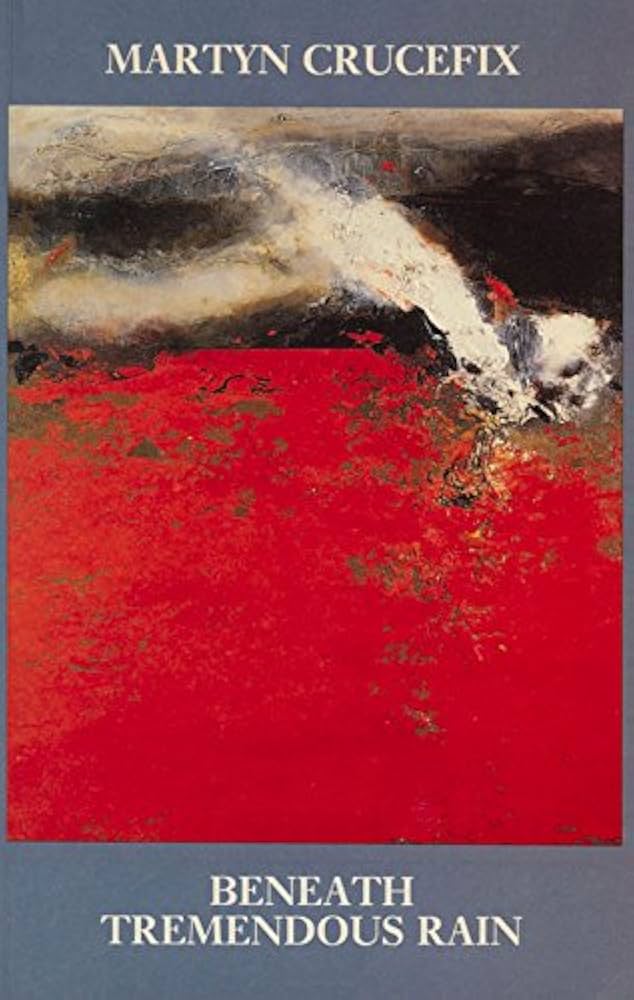
The poem – a sequence of 5 short lyrics – that came from this visit was eventually published in my first book, Beneath Tremendous Rain (1990). I don’t remember the truth of the chronology, but the poem suggests I’d been to my parents’ home in Wiltshire, perhaps immediately before. Remember, I was coming out of years of Higher Education, probably wondering what (if anything) I was now fit for, ceasing (at last) being a child, becoming an adult, looking back and forwards into my own and my parents’ futures. So the ‘journey’ motif with which the poem opens is both literally geographical and autobiographical – the long summer roads of childhood…

I’ve beaten roads dusty with summer to be here.

Left the two of them, hands held, then waving

before the groomed hedge. Both looked older

again, walking Wiltshire fields, where slopes

have browned and stained poppy-red in places

like a bloody graze across sun-burned knees:

a hurt from those days quickly soothed by Mum;

bragged up later to a great exploit for Dad.

The two of them . . .

I remember I was pleased with the image of the Wiltshire fields (to be contrasted a bit later with the fields of Essex) and I know I was thinking/seeing in my mind a particular field beside the A4 from Silbury Hill to Marlborough on my regular route from Wiltshire to London: the dry field browning, the red poppies drifted through it: a graze on a sunburned knee. The drive to Essex goes on in the poem….

                                        Absentminded,

my body alone has felt the pedals, held the wheel

as I’ve unearthed older and younger days

as precisely as those thumb-nail steps carved

in the solid encyclopedia I homeworked from,

perched at a desk on the edge of my bed.

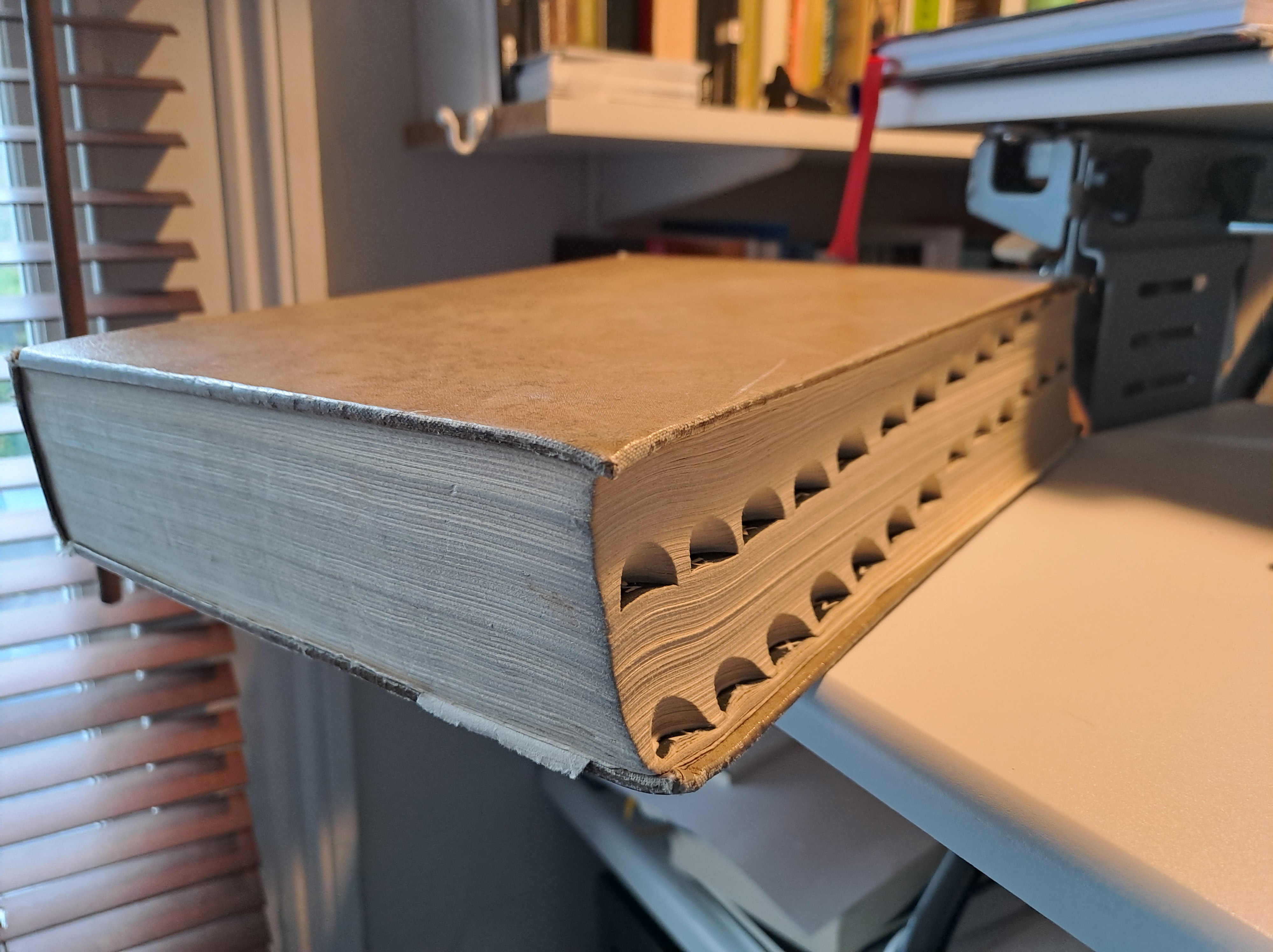
The process of psychological recovery – the unearthing – of past youth: hence both ‘older and younger days’. As a schoolkid, I’d take homework upstairs, exactly as described here, unfold a little card table (green baize), sit on my bed, and work. The dictionary, I still have it. The Universal English Dictionary, edited by Henry Cecil Wyld, in the Thirteenth Impression of 1960. It smells musty, but still somehow of home. Is there a technical name for the thumb-nail steps for each letter of the alphabet? It is the precision of these steps and the idea of dictionary definitions that enter the poem here in the shape of my childhood and teenage faith in reason and empirical accuracy as a way forward (till I was 19 I thought I was going to be a scientist). The second part of the poem runs:

I bolted knowledge then.

The cuckoo, beak biggest part of itself.

A schoolboy stealing coinage from lucid books,

laying instalments on a life of smart logic.

The irony being applied to my younger self, my self-(over-)confidence, is a bit obvious I guess in the choice of ‘bolted’, the cuckoo image, the thieving image, ‘lucid’ and ‘smart’ as easy adjectives, and the hire purchase image of ‘instalments’. The contrast is made immediately in the poem via natural images of earth and stars (the potato flowers):

Now I drive through the fecundity of earth,

through these hectares of flowering potato,

white constellations adrift on undulating green,

with the conviction that this is a watershed:

so much of the talk at home is of death;

how do I brazen that out with an argument?

My old subject: time. Against which there can be no argument. What does the reasonable man say to time and death?

The third part of the poem re-states this same idea through a rather caricatured version of John Locke (the ‘stodgy book’ is his Essay Concerning Human Understanding (1689) which I’d waded through for my thesis). Time and death are restated also via images of the graveyard at High Laver, trying to make sense of my inclination to visit graveyards, finally accepting that the impetus for this is of the ‘heart’ not of the head.

I’ve come to where jet-sprays of irrigation

relieve the cracked fields of hot midsummer.

I’ve come in self-conscious homage to High Laver,

burial place of that logical father,

whose stodgy book of rational commonsense,

sprung the tradition I’ve clung to long enough.

A laburnum sapling creaks in its rubber thong

at a stake, where I stalk the graveyard to find

the oldest stone . . . Always I’ve done this,

yet surreptitiously, plotting false explanations

for myself as it’s the heart that says this

is a powerful place, where generations

of local good and ill in swathes

have gone down like centuries of grass.

In the fourth part of the poem, I am caught off-guard on what began as a ‘reasoned’ piece of literary tourism by an access of powerful emotion in relation to the lives and (feared) deaths of my own parents: ‘there’s more than I feared / of the two of them’.

But I forget what I’m here for.

Stood beside this body volume of displaced earth,

piled weeks ago beneath the trees –

on that last day some stranger’s beloved mother

had more flowers than she ever dreamed of.

The blown wreathes outstare me.

In a blink aside there’s more than I feared

of the two of them, wrapped against coming cold:

Dad, hands stuffed in his pockets,

standing off on his own; Mum, struggling

to peg out snapping shirtfuls of wind.

The sequence ends with more ‘straight’ description of the rural landscape of Essex. I remember labouring hard over the image of the water irrigation system which directs its spray (often 40 feet into the air) in one direction and then (through some mechanism I don’t know about) it flips and begins spraying in a quite different direction. I knew this was the ‘objective correlative’ of what felt like a significant shifting of my own outlook; simply, a recognition of the importance of the ‘heart’, though ‘judder’ ‘slam’ and ‘sudden’ suggest a near traumatic shift at that. Nor did I want the ending of the poem to be too gloomy, and those white-flowering potato plants return in the final phrase to suggest the psychic shift I’m trying to explore will have a fertility of its own (even if yet unseen) personally and artistically.

I watch the flailing mare’s-tail, the jet-stream

spray of the irrigator beside the church.

Its white angle above the potato fields

seems to crumple to a vaporous nothing, yet

a judder slams sudden clouds of fizzing spray.

It’s drenching some different sector of the field,

this drained, tearful, flowering place.

‘Muzzle’ – a new poem for the New Year

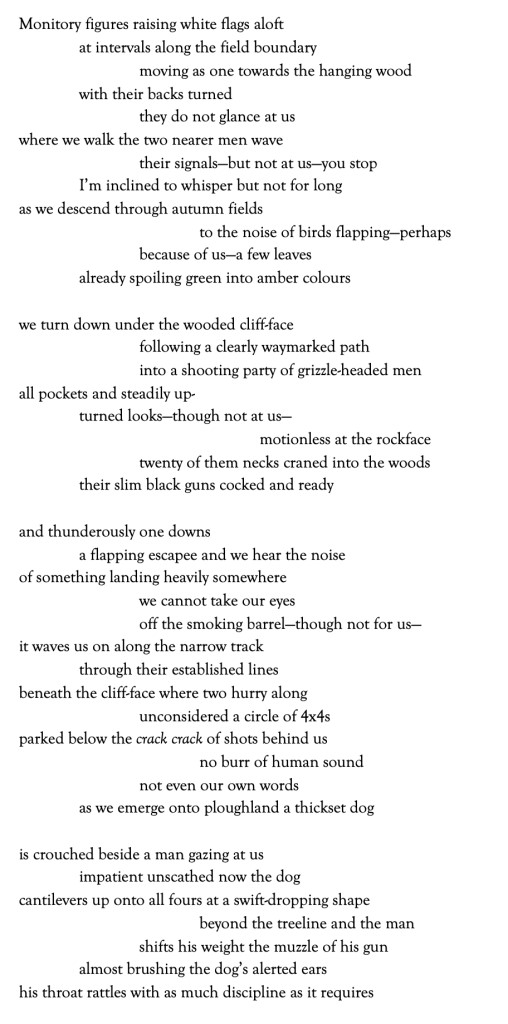
Happy New Year to all of you. We are hoping for the best aren’t we? Come rain, shine or named storm, the poems go on, saying something at least for the individual, the social, for careful consideration of the world out there, the world in here, and the languages we use. I’m posting a poem which has just appeared on New Year’s Day at the excellent Modron Magazine, its strap line is ‘Writing on Nature and the Ecological Crisis’. Glyn F Edwards also interviewed me about the making of the poem and I’ll post the text of that below, along with the link to Modron. Do go and take a good look at what other work they have put up in this new Issue 5. And then subscribe to them. My poem is weirdly formatted – so here is an image of it, lacking its title which is: ‘Muzzle’

On the Writing of ‘Muzzle’

MC: It’s so interesting to be encouraged to look back at the process of writing a poem. I seldom do it (I suspect I’m not alone), forever rushing on to the next ‘best’ thing (we think, we hope). In looking back at ‘Muzzle’ (I find I have the very first draft and several subsequent ones) two things strike me: that it took so long to get to a ‘finish’, and that I’d forgotten how important the context of the poem was to what it might be expressing.

The first draft was scribbled in a notebook in the autumn of 2016. Earlier in the same notebook, I was sketching out thoughts on my, then, just-published version of the classic Chinese poems, the Daodejing (Enitharmon, 2016), preparing for readings I was to give from the book. Elsewhere there are fragments about my parents’ growing difficulties at home and (later) in their care home, plus some quite late drafts of the longish poem about the plight of refugees in the Mediterranean which was published as Cargo of Limbs (Hercules, 2019), and even first drafts of the poems which have eventually come to make up my most recent collection, Between a Drowning Man (Salt, 2023). Remember, the Brexit referendum took place in June 2016 and if there is an idea that links all these differing creative endeavours (including ‘Muzzle’) it is the idea of ‘division’.

Q1 – Only with the word ‘dog’ at the end of the third stanza does the reader gain a semantic connection to the ‘Muzzle’ in the title of the poem. Of course, Chekhov’s gun was ‘cocked’ all along, and the ‘muzzle’ becomes the open end of a weapon where a bullet escapes. Can you explain a little more of the rationale for this subtle title? 

MC: To my surprise, I find, the first draft has no ‘muzzle’ mentioned in it at all. But the shape and a lot of the substance of the finished poem is already there: the flag-waving men during an idyllic autumn walk (on the Sussex Downs, as far as I remember), the shooting party, even the man and his dog at the end of the poem. The muzzle of a ‘smoking gun’ is clearly implied but the final dog’s muzzle does not make an appearance till quite late (I mean 2020 or so!). In fact, in the first draft I clearly don’t know how to end the poem. There, the walking couple emerge from the wood ‘unscathed’, the dog in the field grows tense, and there’s a sense of the man’s day being ‘interrupted’ by the couple. But these final 5 lines are crossed through. In the later draft, the dog now ‘cantilevers up’ onto all fours (the mechanisation of the creature is part of the male group’s malign influence in my mind) – but still no muzzle as such. That only comes via a reference to the man’s gun and, with its proximity to the dog’s head and ears, there is a transference of the word/idea to the dog itself. I’m pretty sure it wasn’t till this point that I thought of calling the poem ‘Muzzle’ and that I also wanted the word to apply to the walking couple who have been (by the experience, by their apprehension, if not their genuine fear) muted or muzzled themselves. The idea was actually there early on; the first draft briefly sketched in, ‘no human voice we do not talk’.

Q2 – The refrain ‘not at us’ is repeated, and echoes again in ‘not for us’ – amongst the ‘white flags’, and the reassurances of safety, there appears a growing threat to the speaker. The reader is left with the feeling that somehow this danger extends beyond the shooting party, and beyond bloodsports. Did you seek for the poem to act as a wider allegorical foreboding, and, if so, would you elaborate on the metaphor? 

MC: Yes, the ‘not at us’ phrase or versions of it are already in the first draft, indeed on four occasions. This is one of the main sources of the idea of ‘division’ in the poem. It’s a simple ‘us’ and ‘them’ situation. The white flags – I think these would simply be the shooting-party’s beaters’ flags being waved to move the birds across the field into the woods, or possibly they are genuinely ‘monitory’ (meaning simply to warn or admonish), but in being white they also have (ironic) resonances of surrender (these guys were not going to surrender anything). The repeating phrase emphasises the gulf between the two elements of the encounter and particularly the sense (clear on the actual occasion) that those holding guns did not seem much concerned that unsuspecting, endangered walkers might be near at hand. We felt ignored; they seemed not to look at us. Being England, there is a strong class element here, which does not map easily onto the question of the voting intentions by class in the Brexit referendum, but factions on all sides seemed not to be paying much attention to any other. The devastating Tory defeat of 2024 should be regarded as reflecting much of this: eventually the country at large felt those in government were simply not paying any attention ‘to us’. I’ve always been pleased with the adjective ‘established’ to describe the shooting-party’s positioning, their being arrayed as the ‘establishment’. The finished poem ends ambivalently. The walking couple escape the shooting-party but are faced with another threatening situation: the gun, the dog. The ‘guard-like’ posture now puts me in mind of prison camp patrols the world over and I’d be happy for readers to get there too: there is a policing of freedoms going on here, a sliding scale from rural pastimes, to political enforcement, to genocidal pograms.

Q3 – ‘Muzzle’ zigzags, indents, retraces its steps. Some stanzas loop longer, and when the final sestet ends abruptly, without full stop, the reader becomes aware of the absence of punctuation throughout. You have a very idiosyncratic approach to presenting and punctuating the poem – could you share your intentions in this poem, and elaborate on whether these ally or counter your conventional style?

MC: The final form of the poem – which you describe so well – came very late. Most often my poems ‘find’ their own form – they don’t begin with any sense of the shape they will eventually take. The 2020 draft was coming out in tercets and I remember liking the ‘walking pace’, step by step, which that shape suggested. But in the end I wanted the poem to be more radical, to suggest a sense of freedom (in contrast to what is felt by the couple during the incident), a freedom to roam as it were, for lines to wander across the page and back again, while also acknowledging that this meandering might well yield some uneasiness in the reader (where’s he going?!). Both freedom and anxiety would be appropriate here. The form and the absence of punctuation (the latter I have been working with for several years now) are intended to generate some ambiguity. For example, I’m hoping for a fluidity in the opening lines, with the putative subject or focus being the flag-waving men, eliding to the walking couple – the ‘you’, then the ‘I’ – the birds, the leaves turning, finally to the ‘grizzle-headed men’. Within this fluency, a bit later, I want several adjectives to be hovering between subjects. The word ‘unconsidered’ floats between the lack of consideration given to the couple and the waiting circle of parked cars. Similarly, ‘impatient unscathed’ buzzes between the couple (again) and the waiting man and dog. This culminates in the rattling throat in the final line which (I want) to be as much about the man as the dog itself and so the ‘discipline’ demanded of the situation ought to be seen as human as much as canine. I guess I’m trying for fertile ambiguities, trying to suggest two things at once. The opening of the Daodejing says: ‘the path I can put a name to / cannot take me the whole way’ (my version).

Q4 – The shooting party negatively influences their surroundings, their presence ‘Hanging’ and ‘spoiling’ the woods, and the walk of the speaker. How much familiarity do you have with these ‘grizzle-headed men’, and do any occasions, such as the one in ‘Muzzle’ stand out as memorable, or significant? 

MC: As you suggest, I have allowed the shooting-party to be, and remain, those wearing the black hats. More often than not I feel the need, the wish, to revisit such emphatic designations: what’s to be said ‘on the other hand’ (ever the wishy-washy liberal). The jaw-dropping presumption of the shooters in the original incident (the poem says pretty much exactly what happened), coupled with the generally felt anger and dividedness of the UK at the time (and since) goes to explain why I have not done so here. Do I know people like this? I guess not. A remote acquaintance likes to share his stories of attending such exciting shooting-parties, but it’s hard even to find the language to create much common ground. Perhaps I am just too urban, metropolitan even. About hunting wild animals, Rilke says, ‘to kill is one form of our restless grief’ (Sonnets to Orpheus, II, 11; my translation). Nothing I witnessed on that day in 2016 served to convince me otherwise; the taking out of another living thing for no useful purpose seems to require an arrogant presumption that I cannot get my head around and I find rather terrifying; the ‘monitory’ urgency in the final poem is as much concerned with how this sort of attitude plays out in the political, even in the military, sphere as it is with ‘blood sports’ more narrowly defined.

December 2024

Here’s the direct link to Modron – https://modronmagazine.com/a-poem-and-interview-with-martin-crucefix/


Translating Georg Heym’s ‘Berlin II’

Michael Hofmann’s Faber Book of Twentieth Century German Poems includes four pieces by Georg Heym – not bad for someone who died at the age of 24 (in 1912 – an accidental drowning in the frozen Havel River, probably while trying to save a friend). Heym is generally regarded as an early Expressionist writer (of poems and short prose/novellas), though his early poems are very much under the influence of Hölderlin, then much of the surviving work suggests the powerful influence of Baudelaire (in both form and content), though in his final months there seems to have been a return to the looser forms of Hölderlin. His best-known poems combine a gothic, morbid imagination, often with extremes of Expressionistic distortion, with a counterbalancing devotion to regular forms. The sonnet ‘Berlin II’, when it appeared in Der Demokrat, in November 1910, led to the publication of Heym’s only collection published during his lifetime: Der ewig Tag (The Eternal Day).

Antony Hasler’s translations, published by Libris in 2004 (Hofmann also includes translations by Babette Deutsch and Avrahm Yarmolinsky, and Christopher Middleton), are the best to be had at the moment and I’d definitely recommend searching them out (Libris has since folded). I’ve been in a bit of a translation lull for a few months so thought I’d try a few of Heym’s poems myself. The challenge is to make something readable in English, while not toning down the dark brutality, yet also staying close to his classical chosen forms.

In ‘Berlin II’, Heym’s Petrarchan rhyme scheme is ABBA CDDC EFE GHG. The opening quatrain is fairly straightforward. A literal transcription might be: ‘Betarred barrels rolled from the thresholds / of dark warehouses onto the high barges/boats). / The tugboats moved in. The smoke’s mane / hung sooty above the oily waters’.

Hasler has:

From the dim warehouse thresholds barrels caulked

with tar went rolling down to the tall lighters.

The tugboats started. On the oily waters

a mane of soot was trailing from the smoke.

The ‘lighters’ / ‘waters’ rhyme is a stroke of genius (a lighter is a river boat) but the opening line and the fourth seemed to me less successful. I kept the opening line simple and turned ‘waters’ into a possessive and I rather saw the (lion’s) mane more visually linked to the billowing of the smoke which is ‘soot-filled’ (I also tried ‘sooty’, even ‘smutty’). This is what I ended up with:

The tarred barrels rolled from open doorways

of dark warehouses onto the tall lighters.

The tugboats closed in. Across the waters’

oily surface hung the smoke’s soot-filled mane.

I went for the tugboats ‘closing in’ – not merely approaching, but something more threatening – as it seemed in keeping with the ominous atmosphere which develops as the poem goes on (the drumming in line 11).

The second quatrain might be given as: ‘Two steamers came with musical bands. / Their funnels cut/clipped the arch of the bridge. / Smoke, soot, stink lay on the dirty waves / of the tanneries with their brown skins’.

Hasler has:

Two pleasure-steamers came with music playing.

They dipped their funnels at the bridge’s curve.

Smoke, soot, stench lay on the dirty waves

by tanneries where the brown hides were drying.

I couldn’t quite see the funnels being dipped under the bridges (though I believe some boats do this) and I feel the bridge’s ‘curve’ (for roof or arch?) not quite right. So I went with the sense of the funnels actually scraping the roof of the bridges (as if these pleasure steamers did not really fit the generally grim, sordid scene). I was very happy to arrive at the bridge/stench half-rhyme for the middle couplet because the sounds there conveyed more of the Heymian ugliness of the scene. Like Hasler, I felt the need to explain a little what the pelts/skins/hides were doing hanging up at the tanneries. Here’s my second quatrain:

With music playing, two steamers passed by:

their funnels clipped the roof of the bridge.

On the filthy waves, smoke, smut, and stench

at the tanneries, where brown pelts hung to dry.

Lines 9-11 probably caused me the greatest difficulty, not so much in getting the word order and form right, but in simply grasping what was being said in relation to the bridges, the barge, and the narrator’s position. Literally they might read: ‘In/at/all the bridges, beneath us the barge / Carried through, the signals sounded / As if in drums, growing in the silence’.

As I see it, the speaker is being carried on a barge, through and under bridges, and there are signals/sirens sounding that bring to his mind an ominous drumming. So Hasler has:

Every time the barge that bore us travelled

beneath a bridge, the signal’s sudden parley

swelled out of stillness like a deep drum’s rattle.

The ‘barge that bore us’ has echoes of TS Eliot (perhaps not irrelevant in context, and I felt I couldn’t better it in the end) but I’m not sure Hasler makes sense (to me) of the signals and the ‘parley’ metaphor he introduces here is not there in the original. The ‘deep drum’ also seems to be picking up on the ‘ominousness’ of the scene but (for me) a bit heavy-handedly. In the end, I went for:

Through all the bridges, the barge that bore us

made its way, signals resounding as if

a drum’s beat grew louder in the stillness.

In the final 3 lines I made the biggest alteration, the biggest interference with the original poem. Literally, the lines might read: ‘We let go and drifted in the canal / Alongside the gardens slowly. In the idyll / We saw the giant chimneys’ night beacons’. Hasler loses the ‘letting go’ idea, but otherwise keeps the order of these lines well:

We entered the canal, and drifting journeyed

slowly alongside gardens. In the idyll

we saw the night-flares of the giant chimneys.

‘In the idyll’ is perhaps puzzling, though it’s pretty clear there is a bitter irony at work – this is no idyllic scene, and Heym’s other Berlin poems confirm this, the city is a monstrous megalopolis. But there has been a slight shift of scene with the boat moving along a canal now, between gardens. Perhaps this (more bourgeois?) setting might be thought of as more idyllic? But even so, the massive smoking and flaring chimneys of industrial Berlin can still be seen. I confess that I shifted the ‘idyll’ to the final lines to get the final rhyme with ‘canal’. But I have left it – translators, like poets, have the power of veto, whether we exercise it or not. And I have persuaded myself that the savagery of the irony comes out better if the final phrase of the poem contains it. So I went with:

We cut loose, went drifting along the canal,

gradually, between gardens, glimpses of

the vast chimneys’ night-flares in the idyll.

So – to sum up (though translations are always really a work in progress) – here is Heym’s original German followed by my own version of the poem:

Berlin II

Beteerte Fässer rollten von den Schwellen

Der dunklen Speicher auf die hohen Kähne.

Die Schlepper zogen an. Des Rauches Mähne

Hing rußig nieder auf die öligen Wellen.

Zwei Dampfer kamen mit Musikkapellen.

Den Schornstein kappten sie am Brückenbogen.

Rauch, Ruẞ, Gestank lag auf den schmutzigen Wogen

Der Gerbereien mit den braunen Fellen.

In allen Brücken, drunter uns die Zille

Hindurchgebracht, ertönten die Signale

Gleichwie in Trommeln wachsend in der Stille.

Wir ließen los und trieben im Kanale

An Gärten langsam hin. In dem Idylle

Sahn wir der Riesenschlote Nachtfanale.

Berlin II (tr. Martyn Crucefix)

of dark warehouses onto the tall lighters.

The tugboats closed in. Across the waters’

oily surface hung the smoke’s soot-filled mane.

With music playing, two steamers passed by:

their funnels clipped the roof of the bridge.

On the filthy waves, smoke, smut, and stench

at the tanneries, where brown pelts hung to dry.

Through all the bridges, the barge that bore us

made its way, signals resounding as if

a drum’s beat grew louder in the stillness.

We cut loose, went drifting along the canal,

gradually, between gardens, glimpses of

the vast chimneys’ night-flares in the idyll.

On Revisiting Blockley

A rather more personal post than usual, though a poem (an older one of my own) is attached to it. Last week, I spent a few days with family in the beautiful village of Blockley, in the Cotswolds. The weather was very good for late November and we walked a couple of times – from Broadway up the muddy hill to the folly of Broadway Tower (once frequented by William Morris apparently) and around Hailes Abbey (now a ruin, local lore has it that Thomas Cromwell watched the destruction of the Abbey from a nearby hilltop). Blockley itself is near Moreton-in-Marsh, a place almost destroyed by the volume of traffic flowing through it (even in November), where The Bell Inn was once a favourite of JRR Tolkein, and is supposedly the model for The Prancing Pony in The Lord of the Rings. But Blockley, for me at least, had another powerful ghost haunting it.

As a couple, with young children, we stayed in the village over 20 years ago, in one of the original silk weavers cottages built along Park Road, which looks down over the village and valley. The house was owned by a colleague of mine at the time, Laurence Bowkett. He taught Classics and Latin and often spent the summer vacations away on archaeological digs of various kinds. That must have been the situation then as he’d allowed us to use the house in his absence. His early death, within a year or two of this, was a shock to us all. He had no family of his own and I don’t know what happened to the house later. So, fast forward to 2024, and here we are staying in Blockley again, only partly by coincidence. We have always had good memories of the place and (again, partly by an AirB&B chance) we ended up renting an almost identical cottage in the very same terrace above the village. Indeed, maybe it was the same cottage – I couldn’t remember enough of the details. The layout was certainly the same – the front door in off the road, straight into a little front room, a chilly basement kitchen and upstairs two small bedrooms.

Laurence’s was not the first death of a contemporary I knew well, but it greatly affected me and I tried to express something of this in the poem – an elegy – I wrote for him later. It is called ‘The umbrella and the bay tree’ and it mixes memories of him, his enthusiasms (he had a lot of those – all his students loved him for it), with details from my own family life at the time. It opens with an imagined scene, all his teaching colleagues gathered (as we often did then) in the local pub, remembering him in his absence. The ‘laral gods’ – the Lares – are Classical Roman guardian deities. The laurus nobilis refers to a little bay tree I bought after our first stay in Blockley as a thank you gift . . .

By seven-thirty, you are with us all

tonight in the gloom of The Washington,

though we omit you from every round.

Powerless as laral gods who gave you

no protection, even laurus nobilis,

the bay tree I bought you, proved no use.

Our children were at Infant and Junior School at the time and – to be honest – I can’t now remember if the details the poem goes on to mention are truth or fiction. But Laurence was the kind of guy who’d keep his own books in scrupulous order (as he did with his extensive collection of Marvel comics) so the library setting has always felt right . . .

Today, I searched 570 and 790,

in the Dewey decimal classification

your fingers ran through a thousand times,

for the facts of death and irrepressible life,

as if I looked for you now and you then.

You taught shard-life and careful fieldwork,

the near-dead language of not giving in.

You offered the heroic a modern face,

though death proved the more determined.

You understood lives alter what they touch:

a house, a street, a flowering tree,

for those who know us are not struck dumb,

a library unread the moment we die.

They roar like a lantern with our life inside.

The idea of lives of the dead altering the lives of those they have touched in life is familiar enough, though I was working on my translations of Rainer Maria Rilke around this time and I’m sure his influence is in here. It is not just the remembering of a friend who has passed away, but also that our own perceptions of ‘a house, a street, a flowering tree’, for want of a better word, spiritualises the material object, giving it a life, a light, an existence, beyond the ordinary. The resurrection of the bugs stomped by my daughter in what follows is probably an allusion to the early primitive computer games the kids used to play in which a failed – hence fatal – leap from a high building would result only in a brief ‘death’ and their 1st person avatar would soon revive and carry on in pursuit of adventure.

In Hornsey Central at 570

this morning, I found books to undermine

my daughter’s smiling confidence

that bugs she crushes beneath her shoe

lie dead a while, then revive good as new.

At 790, I leafed through life and death

in Ancient Egypt for her older brother:

how they wash their dead in water and oil,

then bind them in linen smeared with gum

and priests wrap lucky charms inside

in hope that none will break the seal

till the dead themselves in time of need.

The ‘lucky charms’ idea naturally led the poem on to what I myself might place in a good friend’s sarcophagus and gave rise to a list of his multifarious likes and loves, concluding with the heartfelt wish that his (prematurely unhirsute) head might – even in death (though he had no religious belief as far as I know) – remain somehow protected. The image on the underside of Laurence’s umbrella is a truth!

Then I’ll wrap Homer for you, Wolves black-

and-gold, your Micra, Marvel, Blockley

and booze, moist, sweet cake for the road,

Frederick Leighton, Sir Frankie Howerd,

Wisden, The Smiths and that Italian umbrella

you flourished one day and thundered open –

behold! the Sistine roof appeared

to keep your bald head from the hissing rain.

‘The umbrella and the bay tree’ was originally published in An English Nazareth (Enitharmon Press, 2004).