Unquiet to Unbusy – Coleridge, Hartley Coleridge and ‘Frost at Midnight’

This week I was invited to another of Michael Glover’s wonderful Bowwowshop soirees at the Omnibus Arts Centre in Clapham. The focus was on the work of Coleridge. Tom Lowenstein read from From Culbone Wood – in Xanadu (Shearsman Books). There was also fiddle music and an aria from Mozart and parts of ‘The Ancient Mariner’ performed as a sea shanty (it really worked!). What follows is the text of my contribution (at some length, I’m afraid). By the way, Hartley Coleridge must be in the air at the moment as this blog post has just been put up by Alan Price.

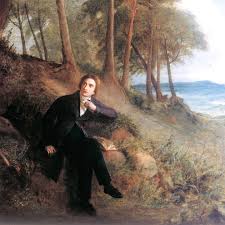
I have been asked to read ‘Frost at Midnight’ – the 1798 poem in which the young father watches his sleeping child, thinks of his own past and foresees for the boy a bright future. The suggestion was also to focus on the more human side of Coleridge, less on the unique genius, the flood of ideas and knowledge, more on what we must all share with him: quiet moments of reflection, how we are made by our past, our hopes for the future, how blood is thicker than water.

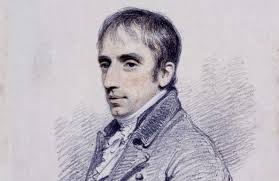
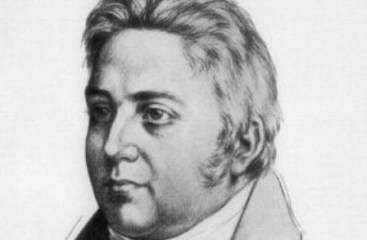
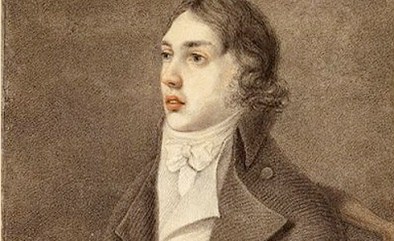
So – in 1824, the young Thomas Carlyle visited Coleridge in Highgate, where he was now staying with Dr Gillman. The poet was 52 years old. Carlyle describes  – “ a fat, flabby, incurvated personage, at once short, rotund, and relaxed, with a watery mouth, a snuffy nose, a pair of strange, brown, timid, yet earnest looking eyes, a high tapering brow, and a great bush of grey hair” He seemed a good soul (thought Carlyle), “full of religion, and affection and poetry and animal magnetism”.  Perhaps his observations had already been influenced by William Hazlitt’s earlier description, noting the poet’s nose, “the rudder of his face, the index of his will, [how it] was small, feeble, nothing – like what he had done”. Carlyle also concluded with that thought, “he wants will. He has no resolution”.
samuel-taylor-coleridge-448

Given what Coleridge had been through in his life, Carlyle’s portrait is really one of a survivor against the odds. A couple of years earlier, Coleridge was contemplating the four greatest sorrows of his life. He noted: his failed marriage with Sara Fricker, his wife of almost 30 years, the mother of his 3 children; the bitter quarrel with Wordsworth; the relationship, that perhaps never even got going, with Sara Hutchinson – Asra. Coleridge’s fourth sorrow was a much more recent wound, still raw, on-going when Carlyle met him in 1824. It bears on my main subject, Coleridge’s poem about his first born son, Hartley.

To explain, I’ll go back a few years  . . . In a life that Richard Holmes in his wonderful biography has described as full of “black storms and glittering sunlit spells”, the year 1819 was a great, sunlit moment. The 23 year old Hartley had just secured a Probationary Fellowship at Oriel College, Oxford. His father and mother were overjoyed, a feeling they shared – so an unusual moment. Coleridge could reasonably conclude that the boy he had always loved best had perhaps not been harmed or disabled by his peculiar brand of absentee fathering, the difficult marriage of his parents, his father’s often public financial, literary and opium-related humiliations.

But storm always follows sunlight for Coleridge. In June 1820, Hartley – the little child who, 22 years earlier, had slept so peacefully on a frosty night in Stowey in Somerset – Hartley was accused of drunkenness, of “sottishness, a love of low company, and general inattention to the College rules”. In a moment of ghastly, public humiliation, his Fellowship was not to be renewed. Hartley himself seems not to have dared to inform either parent; he vanished for days on end and try as Coleridge might the College would not relent.
Flock-of-Starlings

It was a disaster. Ann Gillman remembers Coleridge being “convulsed with agony” over it – surely in part because the accusation of intemperance and drunkenness reflected his own long-established, unshakeable addictive behaviours. The sins of the fathers, is what Coleridge must have been thinking.

And really, if we look back at Hartley’s life the disaster was not so unexpected. With the benefit of hindsight, we can trace events, poignantly, in reverse. During his third year at Oxford, in 1817, Hartley had come to visit Highgate and among the promising signs Coleridge fretted about his son’s unsystematic approach to life, there was some drunkenness, an evident loneliness.  On a return visit to Stowey, the clever college boy had tried to enamour himself with the local girls but they recoiled from his strangeness, melancholy, his dark shaggy beard. They called him the Black Dwarf.

At the age of 18, in 1815, he’d visited his father in Calne, Wiltshire, first ever summer vacation with his father. They celebrated the victory at Waterloo but Hartley was fascinated by the travelling players, by itinerants. He seemed solitary, a bit restless. People again remarked on his odd manners, his scrawny black beard. At 15, Hartley’s mother was optimistically thinking he might make a lawyer, with his “Gift of the Gab”. They were living in the Lake District and Hartley was a great local favourite, though Sara thought “a little spoilt” – in adult company he was not only permitted to speak, he was expected to speak.

At 13 he was brilliant – but quarrelsome. At the age of 10, planning a visit to his West Country relations, Coleridge wrote him a letter – a Polonius sort of letter – on how to behave. His son, he pointed out possessed a “self-gratifying fancy”, his spirits always at “high tide and flood”. The father recognised a tendency that swept away all “unpleasant and painful thoughts”. There were refusals to accept discipline; there was stealing food, snatching at things, standing in half-open doorways. Too often, the boy used his cleverness for lies, fantasies, false excuses. Coleridge urged on his son no procrastination, no self-delusion.

Even as a young child, Hartley had once asked his father what it would be like if there were Nothing! – just darkness and coldness. Apparently, he’d be thinking of it all day. The boy was 5. He often found playmates more a burden than a delight. A year earlier, celebrating moving from baby clothes into trousers, Coleridge already mourned the child’s old, joyous ways of playing. His activity now seemed governed by a more self-conscious “eager & solemn gladness”.
imgres

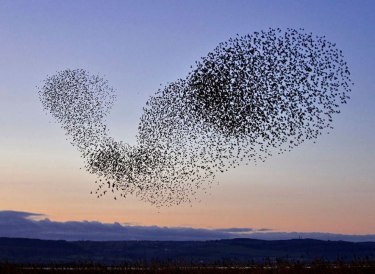
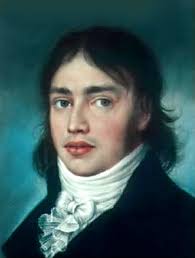
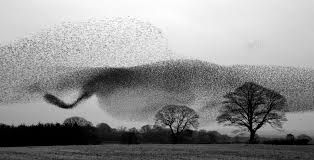
I imagine him watching the boy – the young father as he was described by Dorothy Wordsworth in 1797. She thought Coleridge then plain looking, pale and thin, a wide mouth, thick lips, not very good teeth. He had longish, loose-growing, half-curling rough black hair, his eyes large and full, not dark but grey, fine dark eyebrows, an overhanging forehead. And this is the man who, around this time, watched a massive starling flock in flight. He described it “like smoke, mist, or any thing misty without volition – now a circular area inclined in an Arc – now a Globe – now from complete Orb into an Ellipse and Oblong [. . . ] & still it expands & condenses, some moments glimmering & shivering, dim and shadowy, now thickening, deepening, blackening”.
imgres

This image haunted him for the rest of his life. It became more and more clear he had been fascinated by a self-image, a counter image of uncertainty, a lack of volition and determination, a swirling, aimless life quite unlike the one he had imagined for himself and his first born son in ‘Frost at Midnight’. In the poem Coleridge finds another self-image – the thin carbon film accumulated on a fire grate. Superstition told that this ‘stranger’ as it was called, foretold some new arrival. Coleridge remembers thinking of it as a sign of good things to come in his own unhappy school days at Christ’s Hospital in London.

In lieu of my reading of ‘Frost at Midnight’, here it is read by Richard Burton with accompanying text.
images

Such hopes were not to be. After the Oriel College disaster, Hartley was urged into school-mastering but he was never very good at classroom control. The boys must have found him odd, melancholy, solitary – apparently suicidal at times.

By 1829 – now fully 5 years after Carlyle had visited Coleridge in Highgate that time – Hartley had drifted out of teaching, was just wandering aimlessly through the Lake District, living with farmers, writing a few sonnets while the aging father fretted vainly in Gillman’s Highgate garden. In 1825, Coleridge made a self-portrait in sonnet form. In the poem ‘Work Without Hope’ he is the “sole unbusy thing”, uncreative, not having built anything to last, nor preparing to build. In the octave, amaranth is the mythical flower awarded to successful poets.

Work without Hope

All Nature seems at work. Slugs leave their lair—

The bees are stirring—birds are on the wing—

And Winter slumbering in the open air,

Wears on his smiling face a dream of Spring!

And I the while, the sole unbusy thing,

Nor honey make, nor pair, nor build, nor sing.

Yet well I ken the banks where amaranths blow,

Have traced the fount whence streams of nectar flow.

Bloom, O ye amaranths! bloom for whom ye may,

For me ye bloom not! Glide, rich streams, away!

With lips unbrightened, wreathless brow, I stroll:

And would you learn the spells that drowse my soul?

Work without Hope draws nectar in a sieve,

And Hope without an object cannot live.

If we humanise Coleridge – if we turn aside from the work achieved, half-achieved, the fragments and Notebooks – perhaps we see too much of tragedy: the great potential, a life unfulfilled. After all this is the man who watched Hartley play and understood that for children the means is the end; he knew beauty is the intuition of the one in the many and therefore the first-born of beauty is the geometrical shape, the triangle; he thought of the sonnet as a sigh, something we let escape us, a single thought; he understood the poet must possess the ear of a wild Arab listening in the silent desert, the eye of a North American Indian tracker, the touch of a blind man feeling the face of a darling child; he thought poets were those who knew where the riddle of the universe remained unsolved; he thought a punchy, crisp style of writing lacked the cement of thought, the hooks and eyes of memory; he thought altruism required a generosity to oneself, without which we live in a despotism of the present moment.
tumblr_lw9ofoo8l21qf4hl5o1_500
Hartley Coleridge

And perhaps there was a little honey at the last. In 1833, Hartley published the poems he had been working on and dedicated them to his father. He offered them in thanks for what Coleridge, for all his flaws and personal failings – had given him. It’s the note for us, who love English literature, to strike too: gratitude. Hartley’s sonnet, like a sigh, poignantly alludes to and quotes ‘Frost at Midnight’ on his father’s early hopes for the boy whose own life went awry.

Father, and Bard revered! to whom I owe,

Whate’er it be, my little art of numbers,

Thou, in thy night-watch o’er my cradled slumbers,

Didst meditate the verse that lives to show,

(And long shall live, when all alike are low)

Thy prayer how ardent, and thy hope so strong,

That I should learn of Nature’s self the song,

The lore which none but Nature’s pupils know.

The prayer was heard: I ‘wander’d like a breeze’,

By mountain brooks and solitary meres,

And gather’d there the shapes and phantasies

Which, mixt with passions of my sadder years,

Compose this book. If good therein there be,

That good, my sire, I dedicate to thee.

What Love Is: Hilary Davies’ ‘Exile and the Kingdom’

9781910392171

I met poet, translator and critic, Hilary Davies, back in the early 1980s and our paths have kept crossing since. She was one of the first intake of women undergraduates at Wadham College, Oxford, where she read French and German. She won an Eric Gregory award in 1983, has been a Hawthornden Fellow and chair of the Poetry Society (1992–3). With David Constantine, she co-founded and edited the poetry magazine Argo and has three previous collections of poetry (published by Enitharmon): The Shanghai Owner of the Bonsai Shop (1991); In a Valley of This Restless Mind (1997); Imperium (2005). She was head of languages at St Paul’s Girls’ School, London, for 19 years and was married to the poet, Sebastian Barker, who died in 2014.

hilarydavies-180x235

Davies’ new collection, Exile and the Kingdom (Enitharmon, 2016), is framed by two very powerful sequences. It opens with ‘Across Country’, a series of seven poems which add up to an autobiographical ‘growth of the poet’s mind’. The book concludes with ‘Exile and the Kingdom’ itself, a further eight poems which are nothing less than a meditation on the poet’s raw grief and re-discovery, or reassertion, of her religious faith. Both sequences contain weddings.

‘Across Country’ opens with an evocation of a child’s first moments, “what gets forgotten”, in a state of inarticulacy, no ability to exert our own will, with no will even, language-less and effectively silent, being “carried by gods”.  Passive in the hands of mother and father, the journey variously begins in “The reindeer saddle and the motor car, / the sighing desert and the plateau wind”. Davies seems to suggest these first human experiences fall onto a tabula rasa as they “Etch the first surfaces of particularity / And settle in our souls”. The particular development traced here is Davies’ own, of course, and crucially this involves a later period of travel in France. Happily alluding to Wordsworth’s own tracing of his youthful days and Revolutionary enthusiasm in France (“Bliss it was in that dawn to be alive /But to be young was very heaven” – The Prelude, Book 11), Davies praises “the glory of the cornfield and belltower, / Granite, limestone, vineyard and cloister”. As with Wordsworth, France offers an experience of human love, but Davies is also drawn to intellectual pursuits, the thrilling confusion of “many minds passing”, arguments of “polity and governance” and to the “meretricious fruit / Of the ideology tree”. We are being told this in order for such concerns to be ultimately dismissed:


The lords of existence

Are neither economist nor philosopher

The Lord of existence

Shows himself not in systems


The fourth poem in ‘Across Country’ seems to record the young woman’s first realisation that religion was to be the answer to many of the questions she was asking: “I crossed into church after church that summer, / Thinking of erudition, but beside me trod Love”. The capitalisation and conventional personification makes it clear that Davies is deliberate and happy to place herself in a long tradition of poetry dealing with religious experience; there is no radical re-making of poetic form or language. Davies does not use masks. Discursive passages are in unrhymed, fairly irregular paragraphs which are punctuated every so often with more lyrical rhyming passages, song-like.

Poem five of ‘Across Country’ is just such a lyrical piece, portraying a wedding, but not one that lasts:


Hate has eaten my bridegroom’s heart

And remorse is become my fury

Now I must go the road of affliction

Searching for mercy.


That search, Davies argues, is more a matter of “Waiting, not willing”. It is the traditional negative road in the sense of the centrality of “self-surrender”, imaged in the seventh poem as the sensation of being on a boat on a threatening ocean: “No measure but the dark blue breathing of the opening deep, / Where personhood dissolves beyond mere terror”. I don’t share Davies’ faith but I share her belief that, in terms of our daily acts and choices, we are to be judged in the long run: “Only perdurance delivers”. And in terms of the nature of those acts and choices, whatever set-backs are faced, we need to be accompanied by that same figure who walked beside her into the churches in France: “what love is, and does”. Read as the record of the poet’s experiences, it’s likely that this opening sequence concludes with Davies meeting with Sebastian Barker, the beginning of new happiness (“I knew instantly I had to go the hard way with you / To learn how to love better”).

.

p46-sebastian-barker
Sebastian Barker


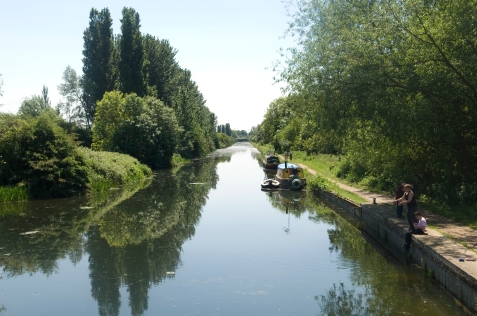
The central sections of this collection are made up of poems more directly engaged with the contemporary world of north London, Stamford Hill, Walthamstow, the valley of the River Lee, Abney Park in Stoke Newington (I blogged one of these poem’s a few weeks ago). There are also poems more explicitly concerned with the relationship with Barker with titles like ‘Night’s Cloak’, ‘Aubade’, ‘Love Song’. I’ve always thought it a premature admission of defeat to declare ‘happiness writes white’ but some of these poems slip too easily into a mode in which this reader feels more like eavesdropping than sharing the experience of years of happy marriage; technically there is a flowering of lyricism and some softening of the vocabulary. On the other hand nobody is going to read these poems and not be thinking of Hardy’s tributes to Emma Gifford – it seems whether the marriage was mutually loving or not, the sense of loss remains overwhelming.

Lee Valley Park.  Photo: Eleanor Bentall 2nd June 2007 Tel: 07768 377413
River Lee and Valley Park

This is where the concluding sequence picks up though there is no need to narrow Davies’ focus wholly to the autobiographical. As I’ve said, these poems are in the tradition of religious verse and there are passages here that stand comparison with the Eliot of the Four Quartets. The opening poem – a little sequence in itself – paints a state of despair, initially social and political, latterly more personal:


Then there’s the heartache

At the core of things: attachment, the blank certainty

Of letting go, the arbitrary wing of accident,

Wrong gene or partner, a lifetime bled into the dusty ground

Of non-fulfilment, the waste [. . . ]”


The temptation is to try to counter this by accepting “ourselves as measure”, to focus simply on career, material gain, simply being busy, keeping warm. That this is never enough in itself is suggested when Davies recalls a favourite uncle who, having apparently a comfortable and successful life kills himself. For the young Davies what this taught was clear: “the impossibility of loving begets despair, / And despair kills”. The third poem of ‘Exile and the Kingdom’ seems to mark the beginning of the end of exile and returns to one of the many French churches mentioned in the earlier sequence.


300px-facade_st-gervais_st-protais
Church of St-Gervais-et-St-Protais, Paris


Out of the bustling Parisian streets, the narrator turns aside and understands, “Even if I have all gifts without love I am nothing”. As in Four Quartets, Davies mixes philosophical discursiveness with personal reminiscence and poem four recalls a Christmas morning in a country church. The priest, apparently ill, still takes the service, his gasping for breath making his faith even more memorable, a Wordsworthian spot of time worthy of recall in darker moments in the struggle to “retain that sudden downrush / Of the numinous that was supposed to change us”.  Poem seven expresses the sense of hard-won joy through another lyrical presentation of a second wedding. On this occasion, no clouds foreshadow failure but as the bride stands at the door, a wind blows her veil up like a candle flame or flower:


The guests are gathered in the church at Salle

The light falls on the floor;

For all eternity the rose

Stands at heaven’s door.


But the sequence and whole book ends in the altogether wilder landscape of St David’s, Wales. The final poem suggests such rose and flame moments are but parts of the coherence of a life where experience must inevitably consist of “Innocence and loss, hope, wisdom, regret and thanksgiving”. Exile and the Kingdom intends to convey this in full. Although propelled most often by loss of a loved one, the burden of the book remains love not grief. It matters little whether we share Davies’ particular form of faith, since what comes strongly from these pages is her concern for the way we treat each other, our overloaded preoccupation with ourselves, how our acts and choices are affected. Poems like these themselves form spots of time for the reader and I’m not going to forget their human concern for what love is and does.

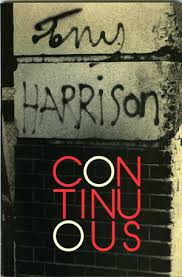
Tony Harrison’s ‘Them and [uz]’

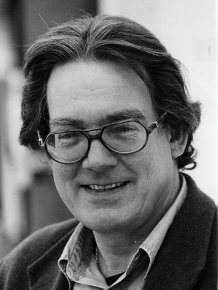
Last week I posted on Tony Harrison’s ‘A Cold Coming’. The following discussion of another extraordinary Tony Harrison poem originally appeared in book form in Tony Harrison: Loiner (Clarendon Press, 1997), edited by Sandie Byrne.

imgres

‘Them and [uz]’ – listen to Harrison read this poem here.

for Professors Richard Hoggart & Leon Cortez

I

αίαι, ay, ay! … stutterer Demosthenes

gob full of pebbles outshouting seas –


4 words only of mi ‘art aches and … ‘Mine’s broken,

you barbarian, T.W.!’ He was nicely spoken.

‘Can’t have our glorious heritage done to death!’


I played the Drunken Porter in Macbeth.


‘Poetry’s the speech of kings. You’re one of those

Shakespeare gives the comic bits to: prose!

All poetry (even Cockney Keats?) you see

‘s been dubbed by [Λs] into RP,

Received Pronunciation, please believe [Λs]

your speech is in the hands of the Receivers.’


‘We say [Λs] not [uz], T.W.!’ That shut my trap.

I doffed my flat a’s (as in ‘flat cap’)

my mouth all stuffed with glottals, great

lumps to hawk up and spit out… E-nun-ci-ate!


II

So right, ye buggers, then! We’ll occupy

your lousy leasehold Poetry.


I chewed up Littererchewer and spat the bones

into the lap of dozing Daniel Jones,

dropped the initials I’d been harried as

and used my name and own voice: [uz] [uz] [uz],

ended sentences with by, with, from,

and spoke the language that I spoke at home.

RIP, RP, RIP T.W.

I’m Tony Harrison no longer you!


You can tell the Receivers where to go

(and not aspirate it) once you know

Wordsworth’s matter/water are full rhymes,

[uz] can be loving as well as funny.


My first mention in the Times

automatically made Tony Anthony!

Read about the drafting of this poem – in the Tony Harrison Archive at Leeds University.

url

Though it was Keats’ ‘Ode to a Nightingale’ Harrison ‘mispronounced’ at school, it is actually Wordsworth who is more important to him because both share a belief in poetry as the voice of a man speaking to men. This conception of poetry as speech is a powerful constituent in Harrison’s work and perhaps one not clearly understood. John Lucas, for example, has attacked what he sees as loose metrics in the poem ‘V’ but, to reverse Harrison’s comment that all his writing (theatrical or otherwise) is poetry, all his poetry needs to be read as essentially dramatic and deserves to be tested in the spoken voice as much as in the study. Harrison’s interest in the curious idea that the true poet is born without a mouth implies the difficult battling for a voice or voices which can be found everywhere in his work and it is in this clamour that I find its dramatic quality. In a public poem like ‘A Cold Coming’, Harrison makes use of the contrasting and conflicting voices by playing them off against a regular form. This is almost always the case, but in what follows I prefer to concentrate less on metrical effects than on the way voices interweave.

The very title of the pair of sonnets, ‘Them & [uz]’, seems to promise conflict, at best dialogue, and it opens with what could be taken as the howl of inarticulacy. In fact each pair of these opening syllables gestures towards crucial worlds in Harrison’s universe. The ‘αίαιof classical dramatic lament is echoed by the “ay, ay!” of the musical hall comedian cheekily working up an audience. Immediately, the reader is plunged into the unresolved drama of two differing voices, instantly implying the two cultures of the sonnets’ title. The line and a half which follows, sketching Demosthenes practicing eloquence on the beach, is intriguing in that its locus as speech is hard to pin down. It is perhaps intended at this stage (apart from introducing the poems’ central issue) to hover in an Olympian fashion above the ruck of dialogue that follows, implying the heroic stance which will be taken up in the second sonnet.

poster-demostheness-spricht-meeresfluten-310780

Line 3 opens again into a dramatic situation with the voice of the narrator (the adult Harrison), repeating his own interrupted recital of Keats in the classroom, while the master’s scornful comments appear fresh, unreported, as if still raw and present, in speech marks. The narratorial comment on this – “He was nicely spoken” – confirms this poem’s tendency to switch voices for its effects, this time its brief sarcasm barely obscuring the unironic comment likely to be made by an aspiring Loiner, or by an ambitious parent. The example of nice speaking given (again in direct quotes in the following line) is the master’s claim to possession, to authority in matters of language and culture and the separated-off reply of the narrator – “I played the Drunken Porter in Macbeth – with its full rhyme and sudden regular iambic pentameter, implies both a causal link between the two lines, painting Harrison as dispossessed specifically by the master’s attitudes, as well as conveying the tone of resignation in the young schoolboy.

images

Much of the tension and success of the poem has already arisen from the dramatic interchange of voices and the master’s voice asserts itself again in line 7 ironically claiming a kind of monolithic, aristocratic purity to poetry which this poem has already attempted to subvert:


Poetry’s the speech of kings. You’re one of those

Shakespeare gives the comic bits to: prose!”


The following lines contain a curious wavering in the clear interplay of dramatic voices, only part of which is resolved as the poem proceeds. Evidently, the intrusive, even hectoring, parenthesis (at line 9) is the narrator’s questioning of what appears to be the master’s voice’s continuing argument that “All poetry” belongs to Received Pronunciation. Yet the aggression of this attack, with its harsh alliteration and sarcastic question mark, is out of key with the other narratorial comments in part I, though the tone is re-established in part II. In addition, I have some difficulty in accepting the master’s words as appropriate to the situation which – with no break – continues the speech made to the young Harrison. For example, the word “dubbed”, with its implication of the deliberate laying of a second voice over an ‘original’, already hands victory in the argument to Harrison’s claim for the authenticity of ‘dialect’ and, as such, would not be used by the believer in “the speech of kings”. Equally, the apparent plea, “please believe [ s] / your speech is in the hands of the Receivers”, does not accord with the voice that summarily dismissed the pupil as a “barbarian” 7 lines earlier. In this case, Harrison’s desire for the dramatic has foundered momentarily on that old dramatist’s rock, the necessity for exposition which compromises the integrity of the speaking voice.

imgres

The true note of the master returns – interestingly, following one of Harrison’s movable stanza breaks, as if confirming a shift in voice though the speech actually continues across the break – with “We say [Λs] not [uz], T.W.!” The tone of the responding voice, after the suggestion of a more spirited response in the Keats comment, has returned to the resignation of the brow-beaten pupil. This is reinforced by the more distant comparison of the boy to the ancient Greek of the opening lines, heroically “outshouting seas”, while the young Harrison’s mouth is “all stuffed with glottals, great / lumps to hawk up and spit out”. This first sonnet draws to a close with this tone of frustrated defeat for the boy, yet the drama has one final twist, as the voice of the master, sneering, precise and italicised, has the last word – “E-nun-ci-ate!“. There can be little doubt that the boy must have felt as his father is reported to have done in another sonnet from The School of Eloquence, “like some dull oaf”.

The second part of ‘Them & [uz]’ contrasts dramatically with the first, though the seeds of it lie in the image of heroic Demosthenes and the accusatory tone of the reference to Keats which seemed a little out of place in part I. This second sonnet’s opening expletive aggression strikes a new tone of voice altogether. “So right, yer buggers, then! We’ll occupy / your lousy leasehold Poetry”. The poem’s premise is that it will redress the defeat suffered in part I in an assertive, unopposed manner. Not the master, nor any spokesman for RP is allowed a direct voice, yet the interchange of speech and implied situation can still be found to ensure a dramatic quality to the verse.

The passionate and confrontational situation of the opening challenge is clear enough, yet it’s striking how it has taken the autobiographical incident in part I and multiplied it (“yer buggers . . . We’ll occupy”) to present the wider political and cultural context as a future battlefield. Even so, there is no let up in the clamour of voices raised in the poem. Immediately, the narratorial voice shifts to a more reflective, past tense (at line 3) as the rebel reports actions already taken – and with some success, judging from the tone of pride and defiance: “[I] used my name and own voice: [uz] [uz] [uz]”. Even within this one line, the final three stressed syllables are spat out in a vivid reenactment of Harrison’s defiant spoken self-assertion. It is this slippery elision of voice and situation which creates the undoubted excitement of these and many of Harrison’s poems as they try to draw the rapidity and short-hand nature of real speech, its miniature dramas and dramatisations into lyric poetry. A further shift can be found in lines 9 and 10, in that the voice now turns to address a different subject. The addressee is not immediately obvious as the staccato initials in the line are blurted out in what looks like a return to the situation and voice with which this sonnet opened. Only at the end of line 10 does it become clear that the addressee is the poet’s younger self, or the self created as the “dull oaf” by the kind of cultural repression practised by the schoolmaster. The reader is further drawn into the drama of the situation by this momentary uncertainty: RIP RP, RIP T.W. / “I’m Tony Harrison no longer you!”.

images

The remaining 6 lines are, as a speech act, more difficult to locate. There is an initial ambiguity in that they may continue to address “T.W.”, though the stanza break suggests a change and, anyway, this makes little sense as T.W. is now dead (“RIP T.W.”). In fact, these lines use the second person pronoun in the impersonal sense of ‘one’, addressing non-RP speakers in general, and it is the generalised nature of these lines which disarms the effectiveness of the passage. This is particularly important in line 14, “[uz] can be loving as well as funny”, the tone of which, commentators like John Haffenden have questioned. The difficulty here is that if Harrison is addressing those who might use [uz] anyway, though there may well be many amongst them for whom the fact that “Wordsworth’s matter / water are full rhymes” is useful ammunition and reassurance, the same cannot be said of the “loving as well as funny” line which might variously be construed as patronising, sentimental or just plain unnecessary. Nevertheless, the poem regains a more sure touch in the final lines in its use of the reported ‘voice’ of The Times in renaming the poet “Anthony“. The effect here is both humorous (this, after all the poet’s passionate efforts!) and yet ominous in that the bastions of cultural and linguistic power are recognised as stubborn, conservative forces, still intent on re-defining the poet according to their own agenda, imposing their own hegemonic voice where there might be many.

Images of the Child in Laozi’s ‘Daodejing’

Most images of the child in Laozi’s Daodejing appear as metaphors. For a text that has a strongly backward-looking, even primitivist tendency there is surprisingly little of our own post-Romantic fetishisation of childhood. For Wordsworth, the child could be seriously considered father of the man and the loss of childhood an event from which we never recover. But for Laozi (almost as paradoxically) the child is more often used as an image of the state of being towards which the wise man or woman strives.

imgres

For example in Chapter 20, the narrative voice compares himself to a child (all translations in what follows are from my forthcoming book (Spring 2016)). This is one of the few parts of the Daodejing where we hear a reasonably consistent lyric voice (not the figure of the teacher) expressing a troubled state of mind because he tries to adopt the teachings of Laozi. Though opening optimistically, “—in putting by what / passes for knowledge / truth is there are / fewer reasons to grieve”, the narrator is soon perturbed by his observations of “the grinning crowd”. What follows is a vivid description of the worldly mob, intent on their own petty, material lives, their narrow purposes:


as if celebrating

closing some deal


about to embark

on a summer vacation

crowd-2

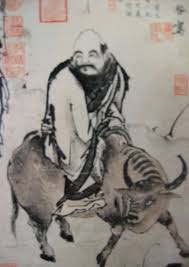
This is the world that Laozi (the putative author of the Daodejing) is said to have despaired of in his own time. The story goes that he vanished from Chinese society sometime in the sixth century BCE, leaving behind only the 81 Chapters of the Daodejing as a kind of despairing, if consolatory handbook. In Chapter 20, the narrator reaches for the image of a child in trying to characterise himself:


I live in solitude

I’m like a quiet child


though one who’s yet

to take his first steps

I’m like an infant

incapable of smiling


I dither and droop

find no place to belong

[. . . ] I seem

to have let things slip

imgres

His contrast to the determined mob is vivid and for most of the poem it seems not strongly in his favour. However, the concluding lines present a more satirical tone, a more defiant effort at self-confidence, declaring that he finds:


no significance

in those things

that do not drive roots

deep in the way


On several occasions, the poems present those who follow the way, the teachings of Laozi, as ill-adjusted to the world as we find it. Chapter 28 begins to explain why. The follower of the way does not divide or discriminate; her vision of life is comprehensive:


—know the male

yet hold to the female

become a valley

in receipt of all things


in becoming a valley

know the power

that cannot be

called on in vain


In achieving such a state of perception (we might say vision), the poem again calls on the image of a child: “this the reprise / to the child-like state”. That this is a reprise, a return of some sort, is an idea repeated throughout the 81 Chapters of the Daodejing. I think this sounds more Wordsworthian than it really is. Laozi is more concerned to draw his readers’ attention back to the wisdom of a previous age rather than one innately the preserve of childhood and subsequently lost as the bars of the prison house fall. But perhaps both images really ought to be read as no more than metaphors. Interestingly, Chapter 28, deploys an alternative metaphor in its effort to convey the wholeness of vision:


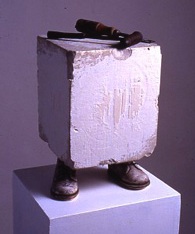
be the reversion

to the uncarved block

when the block is cut

shaped for use


by the teacher’s hand

a controlling force

the truth is who carves

best carves least

uncarvedblockblog1

Reprise here becomes “reversion” but the “uncarved block” represents the oneness of being that Laozi’s teaching is founded on. The resort to the figurative suggests the basic inadequacy of language to encompass this oneness – just one of the very modern-seeming themes of these wonderful poems.

The premise of this oneness yields the (again modern-sounding) corollary that even our individual selves are provisional at best. The opening of Chapter 49 suggests:


—the true teacher is like a poet

who has no self to speak of

using the self of others as his own


And Laozi is under no illusions about how such beliefs distance the believer from the world as it is lived. The sage, or master, or (as I have translated it) the teacher, inevitably seems a square peg in a round hole. But it is ironically she who perceives the underlying truth of things:


in the way she deals with the world

the teacher may seem dazed

confused as if her wits were dull


yet even as the nation’s households

strain ears and eyes she listens

she watches in the guise of a child

9482381-Closeup-portrait-of-cute-little-baby-girl-crying-in-pink-pajama-hat--Stock-Photo

The most developed consideration of the image of the child comes in Chapter 55. Those who manage to follow the way possess a child-like innocence that William Blake would recognise as built not on narrowness, naivety and ignorance but on a fullness of knowledge beyond what most of us can aspire to and such transcendent innocence is like a protective charm. In Chapter 55, images of children include indications of sexuality and pain suggesting a world undivided by conventionally shallow ideas of morality or ‘happiness’, a world of profound harmony discovered in the recognition of the oneness of all things. The poem also powerfully argues that to be ignorant of this truth breeds egotism and greed which, under the guise of acquisition and self-aggrandisement, turn out to be nothing less than a primrose path to a form of extinction.


Dead inflexibility

chapter 55


—the immunity of one pursuing the way

is like the charm of innocence about a child


winged insects will not sting nor beasts

attack sharp beaks do not swoop to peck


though bones may be soft and sinews weak

yet the grip of the child is powerful still


and though the sexual life is still remote

the boy’s prick stands stiff as a thumb


despite the hungry child’s keening all day

she sleeps with no rawness in her throat


the body of a child has such harmony—

to know harmony is to find the ever-here


finding the ever-here is enlightenment

but cramming life to the brim is foolish


when such a person asks so much of life

the resulting glut is dead inflexibility


such irritable reaching only ends in decay


11-30-12_Glut

The Month of the Drowned Dog: Ted Hughes’ ‘November’

Though November has just transformed itself into December here, still Ted Hughes’ sodden, rain-soaked poem from Lupercal (1960) comes to mind as I watch the TV footage of floods in the North-West of England. I’ve never thought enough attention has been given to the role of the narrator in this poem. It’s one of the selected poems studied on the Cambridge International Examinations’ A-level. Students are asked to discuss one specific poem in detail or two poems from a more thematic perspective. What follows is a loose version of the first type of question (apologies for some loss of formatting in the poem itself). NB. For another close discussion of an early Ted Hughes poem – ‘Meeting’ – click here.

The month of the drowned dog. After long rain the land
Was sodden as the bed of an ancient lake,
Treed with iron and bird less. In the sunk lane
The ditch – a seep silent all summer –

Made brown foam with a big voice: that, and my boots
On the lane’s scrubbed stones, in the gulleyed leaves
Against the hill’s hanging silence;

Hughes opens the poem with a bewildering mix of images of motion and stasis. Flooding must account for the “drowned dog” (more literal than figurative or colloquial here) and the absence of a verb emphasizes the stillness of death, the burden of the month, the real entrance way to winter. The land is so sodden as to have suffered inversion to become “the bed of an ancient lake”. It’s an alien landscape – trees (as so often in Hughes) are now composed of industrial “iron” and inevitably “birdless”. Yet in contrast to such stillness, the ditch water (which in summer is a soothing sibilant “seep silent”) is now possessed of a “big voice” composed of brown foam and beside it, the narrator’s boots scrape along the lane. These two sounds are all that can be arrayed against “the hill’s hanging silence” and the contrasts of movement and stillness, noise and silence compose the greater world of this poem.

Mist silvering the droplets on the bare thorns

Slower than the change of daylight.
In a let of the ditch a tramp was bundled asleep;
Face tucked down into beard, drawn in
Under his hair like a hedgehog’s. I took him for dead,

But his stillness separated from the death
From the rotting grass and the ground. The wind chilled,
And a fresh comfort tightened through him,
Each hand stuffed deeper into the other sleeve.

His ankles, bound with sacking and hairy band,
Rubbed each other, resettling.

It’s this greater world that the narrator fears and the tramp entrusts himself to. To the narrator, the tramp sleeping in a let of the ditch, is comparable to an animal, a “hedgehog”. In the narrator’s world view, this is no compliment and indeed in the next phrase (line 12), he considers the tramp “dead”. To give the narrator credit he perceives his mistake and next sees the tramp’s vitality, though (in a reversal of our preconceptions) it is his “stillness” rather than animation that “separate[s him] from the death” all around. The animation of the “wind” evokes a corresponding movement in the tramp: “a fresh comfort tightened through him, / Each hand stuffed deeper into the other sleeve”. There is paradox here too in that the tramp’s movements are intended both to shield him from the elements yet also settle him more comfortably among them.

The wind hardened;
A puff shook a glittering from the thorns,
And again the rains’ dragging grey columns

Smudged the farms. In a moment
The fields were jumping and smoking; the thorns
Quivered, riddled with the glassy verticals.

Lines 18 – 23 seem to represent a moment in which the narrator looks away from the tramp. What he sees is a world he might once have been familiar with dissolving before his very eyes. This is partly a result of optical effects brought on by atmospheric conditions, but Hughes’s language systematically destabilizes the solid and still (the farms, the fields, the thorns) and solidifies the diffuse and shapeless (the wind, the rains). Such a renovation of perception is comparable to the stunned narrator at the end of Hughes’ story ‘The Rain Horse’ (from Wodwo, 1967) who, after the terrifying encounter with the horse, sits “staring at the ground, as if some important part had been cut out of his brain”. The poem’s narrator reports in line 24 that he “stayed on under the welding cold” and the colloquialism of the first two words here implies that any sane person might have retired to shelter; whatever transformative process Hughes is representing in the encounter between narrator and tramp is already under way. The narrator seems to surprise himself by staying as if he were watching the actions of another.

I stayed on under the welding cold

Watching the tramp’s face glisten and the drops on his coat
Flash and darken. I thought what strong trust
Slept in him- as the trickling furrows slept,
And the thorn-roots in their grip on darkness;

And the buried stones taking the weight of winter;
The hill where the hare crouched with clenched teeth.

In fact he stays to continue to watch the tramp becoming part of the landscape: “I thought what strong trust / Slept in him”. All the critics you’ll read agree this is the key idea; but as Keith Sagar asks: in what exactly does “the tramp trust?” The image of sleep links this trust also to the fields’ “furrows”, to “thorn-roots”, to “buried stones” and to the hill itself where the hare is “crouched with clenched teeth”. Is this merely a trust in a viable future? A sort of wishful thinking? A consolation? Perhaps it is if the furrows imply next year’s crop, the roots suggest the new year’s growth, the stones will be unearthed to build new walls, the hare will survive to unclench in the Spring. There is something Romantically attractive about this reading and we might remember Wordsworth’s encounter with the Leech Gatherer who also seems part of the landscape (“as a huge stone”). Wordsworth is equally uncertain of the man’s status: “not all alive nor dead, / Nor all asleep”. As their conversation continues, the Leech Gatherer’s voice becomes indistinguishable from “a stream” and in some low level psychic derangement Wordsworth imagines the Gatherer as “Like one whom I had met with in a dream; / Or like a man from some far region sent, / To give me human strength, by apt admonishment”.

Rain plastered the land till it was shining
Like hammered lead, and I ran, and in the rushing wood

Shuttered by a black oak leaned.
The keeper’s gibbet had owls and hawks
By the neck, weasels, a gang of cats, crows:
Some stiff, weightless, twirled like dry bark bits

In the drilling rain. Some still had their shape,
Had their pride with it; hung, chins on chests,
Patient to outwait these worst days that beat
Their crowns bare and dripped from their feet.

But Hughes’ tramp is far less consoling, far more frightening. In the concluding stanzas, the narrator runs away – on the face of it to shelter from the rain though earlier this had not troubled him. He runs into a wood in something of a panic as the breathless, long-delayed verb here suggests: “in the rushing wood // Shuttered by a black oak leaned”. It’s what the narrator encounters in the wood that provides the final piece of the jigsaw for this poem. He confronts death in the shape of a gamekeeper’s gibbet and it is really death in which the tramp trusts, as much as he trusts himself to life. This is the point of the poem’s many transformational oppositions, of stasis and movement, solid and diffuse, sleep and waking, dead and alive. As the “flash and darken” of raindrops on his coat suggest, the tramp’s instinct is to entrust himself to both life and death without making any clear, rational distinction between the two.

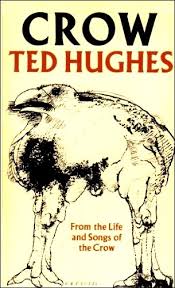
I think the narrator has preserved this distinction and perhaps does so even at the end. Of the bodies on the gibbet, some are fresh, others are like “dry bark bits” being twirled in the rainfall. The narrator seems inclined to focus on those retaining their living “shape”, those who he says retain “their pride”, those who seem (like Wordsworth’s Gatherer) to teach patience, and endurance against “these worst days”. But the incontrovertible fact is they are all dead and death is lesson 101 in Hughes’ work as can be seen in Crow’s ‘Examination at the Womb-Door’ (Crow, 1970). It is the denial of death’s reality that leads to delusion and a false consciousness of our own position in the world. The narrator of ‘November’ still hankers after the human scale of virtues such as patience and Wordsworthian endurance. It is the tramp – ironically rather forgotten by the end of the poem, lying foetal in the let of the ditch, still huddled against the month’s elements – who entrusts himself to the risks of exposure and death, but in doing so may hear (what the sheltered narrator will never hear) the reply that Crow gives to the final question he faces:

But who is stronger than death?

                                         Me, evidently.

Pass, Crow.

imgres

How Do You Judge a Poem?

I am half way through the process of judging this year’s Torriano Poetry Competition (https://torrianomeetinghouse.wordpress.com/2014/10/27/torriano-poetry-competition-2015/). I’ve been lucky enough to judge a few such competitions in the last few years and what follows is a compilation of thoughts on the judging process. Though the initial sifting can be a slog, the latter stages are fascinating as poems that set little hooks in you at first reading, gradually become more clear, their internal coherence emerging alongside their skills with language and form. What follows is inevitably a personal take on the business – more so as the process unfolds – but I hope it may cast some light on it for those (of us) tempted to spend hard-earned cash on entering the numerous competitions now running (here are a few . . . http://www.poetrylibrary.org.uk/competitions/).

In the 2003 comedy film Bruce Almighty, Jim Carey plays God and, alongside with more obviously useful powers, he has to respond to the prayers of the world. But people are always praying; he rapidly approaches a kind of madness as voices swim around him, clamouring for attention.  He takes to reading the prayers in the form of e-mails. He tries to answer them individually but is receiving them faster than he can respond. He sets his e-mail account to automatically answer “yes” to all, assuming this will make everybody happy. Of course, it does not.

imgres

A poetry competition judge comparing himself to a character playing God lays himself open to criticism – but I have indeed found the initial phases of judging rather like Jim Carey’s experience. There are so many and such a variety of voices clamouring to be heard and every one of them is heart-felt, recording significant moments in people’s lives. There is a similar sense of responsibility too – the raw nature of much of the writing is impossible to deny. I’d like to set my response mechanism to say yes to everybody, but the judge’s task has to be how to distinguish submissions as poetry.

**

The numbers are always frightening. Many hundreds of poems will be submitted. Perhaps only 10% of these will demand a further reading after the brutal first sifting. Poems face an early red light from most judges because basic elements are not competently done:

  • Competitions are full of pieces where a particular verse form or rhyme pattern tyrannises the sentiment. The writer’s submission to this tyranny becomes clear quickly through the contortions imposed on the language to achieve a rhyme.
  • The writer’s choice of language can be devastating to the life of the poem. It just isn’t right to opt for forms of language or abbreviations that died out early in the nineteenth century.
  • Choice of diction also derails an entry if it is doggedly abstract. Sure, there remains much debate about whether it is the narrow English tradition that insists on things rather than ideas – but poems about Fear, Ignorance, Poverty, Eternity and Love which refuse to dip a toe into anything resembling a real life situation are going to find progress hard.

leaning-stack-of-papers-and-files

  • A fourth error is using language without being fully aware of its likely resonance with a possible reader. A poem called ‘Mother’s Pride’ which turns out not to be aware of the loaf of bread is going to have unanticipated clutter to climb over in the reader’s mind. Louis MacNeice wanted the poet not to be an ivory tower type, but rather “able-bodied, fond of talking, a reader of the newspapers, capable of pity and laughter, informed in economics . . . actively interested in politics”. All a bit Boys Own perhaps, but if this means the poet stays up to date with the way words live then he’s right.

 **

If you are thinking of submitting to a competition, it’s worth recalling Wordsworth’s formulation – familiar though it will feel – that poetry is built from “emotion recollected in tranquillity”. Poems made in the heat of the moment (and not revised and reviewed in the name of not tainting spontaneity) are seldom without their flaws. This is the kind of distinction Rilke also makes when he denies poetry is composed of feelings. Its constituents are rather “experiences” which he clarifies as “memories” though even with these, we “must be able to forget them when they are many and one must have the immense patience to wait until they come again . . . Only when they have turned to blood within us, to glance and gesture, nameless and no longer distinguished from ourselves – only then can it happen that in a most rare hour the first word of a poem arises in their midst and goes forth from them”. On the other hand, such recollection can sometimes create an intellectualised distance that may do harm to a good poem. Who said writing a poem was easy?

louis-macneice

Stephen Spender argues that a poet should try to acquire skill and virtuosity through the study and interpretation of other poetic works in the way Mozart and Beethoven did in playing the music of their predecessors.  Spender suggests translating poetry is the best possible exercise in interpretation. But the really important lessons (Spender says) are those of the eye, the ear, the athletic/poetic muscles. A poet can go a long way without a developed heart, but, he says, can get nowhere at all without these skills. The poet must ask continually of his lines: ‘Do they make the reader see, or hear, or feel, this experience which I am trying to re-create?’

 **

Reaching the final stages, the judge will be focusing more positively and more clearly on the sense, the story, the thought of a poem. Personally, I like poems that focus on small things and, in effect, make arguments for the ways in which they communicate the bigger issues that concern us all. I’m with Thomas Hardy in believing that “he used to notice such things” is one of the greatest of compliments. Edward Thomas’ poem about Spring, ‘But these things also’, likewise echoes this focus on what most people tend to overlook:

The shell of a little snail bleached

In the grass; chip of flint, and mite

Of chalk; and the small birds’ dung

In splashes of purest white . . .

Perhaps one explanation of why the question ‘what is poetry?’ is difficult to answer is because it is an art of the negative, of avoidance. The Daodejing says what is rigid and inflexible is a companion of death; what is flexible is a companion of life. I’d guess there would be general agreement that poetry is an art on the side of life. So poetry must eschew the inflexible; we must avoid the posture. And that’s very hard. In judging a competition one comes across the Wordsworth-posture, the Ginsberg-posture, alongside those of Betjeman, Hughes, Plath, Duffy . . . But we also posture like mad in ‘real life’. We may take up the pose of grief, melancholy, love, liberalism, environmentalism . . . The mark of the absence of posturing is an instability, an openness, an awareness of time (which posture tries to deny) and this is something I look for in a good poem. If a poem strikes an attitude my attention diminishes (even the attitude that wants to show a rejection of attitudinising through the hall of mirrors of ironic distancing). When the poem unearths a pulsing, shifting, live relationship between the self and the other, then I am captivated, recognising something that is both commonly human and uniquely personal.

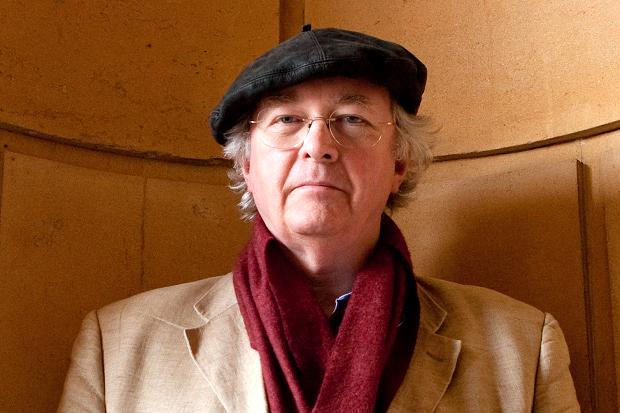
But having said all this, I’d assure potential competition entrants that anything resembling a rule is there to be broken. Philip Pullman has said, “We don’t need a list of rights and wrongs, tables of dos and don’ts: we need books, time, and silence. Thou shalt not is soon forgotten, but Once upon a time lasts forever.”

114650911_345473c

So any poem in any form can work its magic. It will haunt its reader for days; it will make me change the way I think and feel; make me see the world differently. Ultimately, a poem contributes to who the reader is becoming. That is an exciting prospect for the writer. It is an even more exciting one for the judge who settles down to read.