More than 10 years of blogging on poetry and translation – over 39,000 views in 2024 – now captured and preserved at the UK Web Archive: 'one of the top 10 poetry blogs' (Rogue Strands)
John Greening has recently reviewed my new chapbook of poems, Walking Away (Dare-Gale Press, 2025), a review which first appeared on The High Window website.Many thanks to David Cooke at THW and to the reviewer for his kind and perceptive comments about a set of poems for which I feel (an obvious) affection. Mum and Dad would be bemused by it all I think, but pleased to be so remembered.
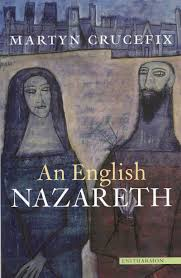
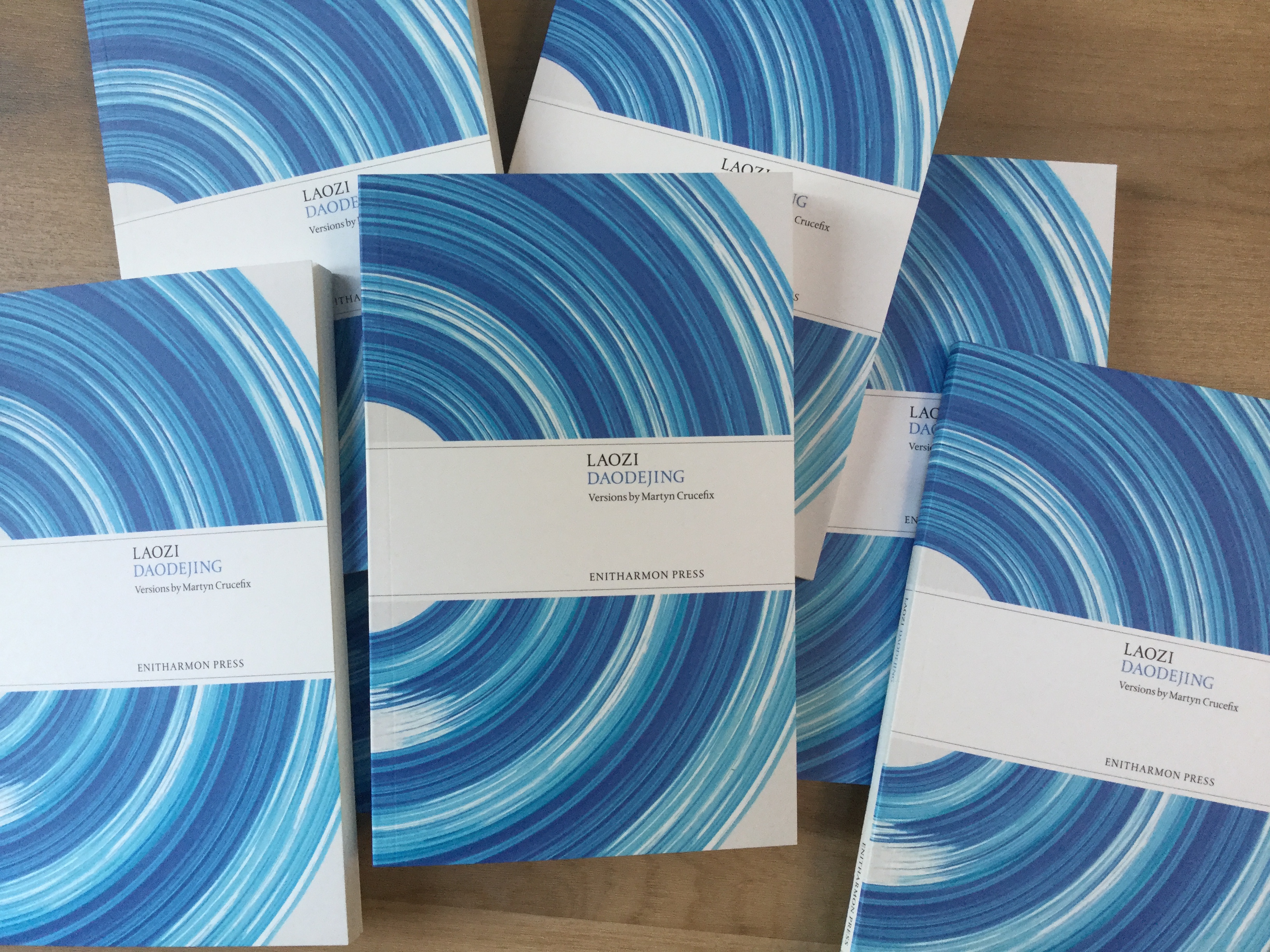
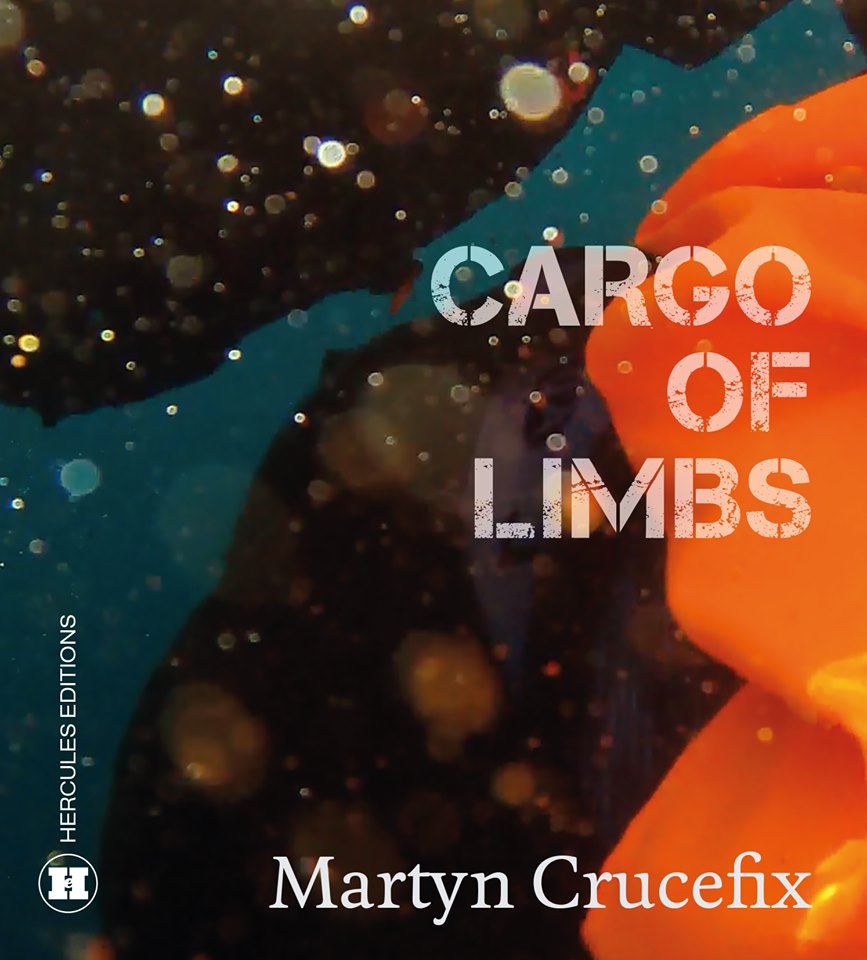
Martyn Crucefix has come a long way since his remarkable Enitharmon debut, Beneath Tremendous Rain (1990). Learning, no doubt, from poetry he has since translated or adapted – notably Rilke, but also Peter Huchel, Rosalía de Castro and the Daodejing (more familiar as the Tao te Ching) – he has become more and more experimental, more complicatedly troubled. This was especially evident in his 2017 sequence A Convoy and in the beautifully illustrated Cargo of Limbs from Hercules Editions (2019), itself a version of Book Six of the Aeneid.
Walking Away is more straightforward and in some ways a shift towards a major key, though the subject matter might make it appear otherwise. Even the tranquil landscape on the cover reminds us that Crucefix has always had a pastoral streak: he was, after all, brought up in the West Country, which features here a good deal, if elegiacally. The book is dedicated to his parents and it opens with a ‘Video Call’ full of tragi-comic touches (the camera is ‘angled so I catch only the crowns // of grey heads then a giant hand/reaches forward to re-adjust’) and ends with gracefully formal stanzas evoking a ‘provincial market town’ (Trowbridge, perhaps, near the Wiltshire village where Crucefix grew up?).
Fourteen of the pamphlet’s pages are occupied by the remarkable title sequence of four-line poems (drawing on ‘the vivid, condensed power of the haiku form’, as the blurb puts it, but each of a different syllable count) about the decline of the poet’s elderly mother, whose state is addressed more directly in the penultimate poem of the four in Walking Away: ‘My Mother’s Care-home Room (as Cleopatra’s Monument)’. She is portrayed unsparingly with ‘an Easter Island profile / gaunt and beaked’ but becomes a regal presence by the poem’s end as her son keeps his vigil with a final flourish of rhyme:
with all the helpless- ness of a Charmian at the cooling feet of her brave Queen the asp flung down beneath the only chair there has ever been
The title sequence, however, is the book’s great success, a brilliant series of vignettes, like theatre music without the play, set largely, it seems, during a period when the poet’s mother was in her own home. Some of these don’t feel like haiku, but others have that unmistakable, indefinable quality – perhaps to do with awareness of the seasons:
Turning in at your mother’s front gate Eighty years at a stroke
Swifts no longer nesting
Crucefix knows how to find the Imagistic essence of a situation, as the form demands; and his gift for metaphor has always been considerable:
This week’s new dosette box Grey windows not yet broken
Twenty-eight channels nothing on
Once you work out what a ‘dosette box’ is (one of those compartmentalized containers for daily tablets), the image here is potent and at least as good as ‘Petals on a wet, black bough’. For their full effect, these fragments do need each other, and they don’t often need such glossing. Take the next one, only the third in the sequence:
Telephone numerals are big and bold The size of Scrabble pieces
A language you once knew
The brevity is fitting, since that’s often the way one communicates with those in decline; there is tea, a shared remark, more tea, a view of a lawn, knick-knacks on the mantelpiece, a car passing, a nap, a scratching mouse, ‘The clamour of carers / A microwave ping’. And while nothing connects with nothing, we are embraced by an intense emotion and a sense of an approaching end. Walking Away demands to be read.
An edited (shorter) version of this review first appeared in Poetry Salzberg Review in June 2025. Many thanks to the editor, Wolfgang Görtschacher, for commissioning the writing of it.
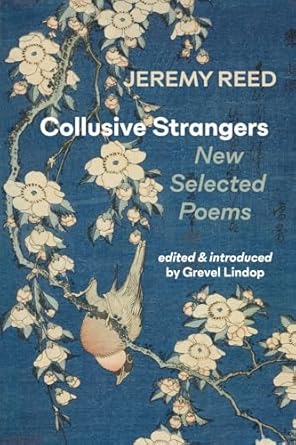
As the editor, Grevel Lindop, says in his Introduction to Collusive Strangers: New Selected Poems (Shearsman Books, 2024), the literary world has not taken enough notice of the remarkable oeuvre of Jeremy Reed. Many of his recent collections have appeared without much, if any, critical notice, so it’s to be hoped that this substantial new selection, from 1979 -2016, will bring this misfit-poet’s work back to more general attention. The problem is that the protean Reed fits no pigeonhole, plus the fact that he’s been astonishingly prolific. Intensity of perception and a phenomenal dynamism of language and creativity are his hallmarks, and he matches the best in nature poetry (Clare and Hughes), the decadent, urban flaneur (Baudelaire), then writes as Symbolist and Surrealist (Gascoyne), pursues sci-fi, focuses on pop and fashion, next becomes a portraitist and moving elegist. Even given these 300 pages, Reed – a sometime Peter Pan now into his 70’s – continues to be elusive. Compared to the prolific poet/novelist John Burnside, the difference is clear: we all knew what the brilliant, much-missed John was up to. With Reed, we are endlessly being caught by surprise.
Even Reed’s earliest work arrived fully formed. In the late 1970s and early 1980s, the urban, neurasthenic wanderer appears in ‘Claustrophobia (Kings Cross)’, the narrator’s need being ‘so strong it might involve the police’. In contrast, ‘Dwight’s Brother’ is an early stanzaic, sci-fi piece, a character from the future obsessed with Manson’s and Nixon’s careers, and ‘the monomania that burns planets’. And the magnificent ‘John Clare’s Journal’ ventriloquises the nature poet’s concerns for the natural world of Helpston, his stumbling literary repute, and fear for the future of his children, ‘laid / out as corpses’. Reed’s ambition is clear from the start, and in a poem like ‘Visit to George Barker’ he evidently empathises with the older poet’s withdrawal and seclusion, his writing contemporaries being harshly judged for a lack of ambition as ‘poets whose very aim is minimal / gesture, earning [Barker’s] dismissal’.
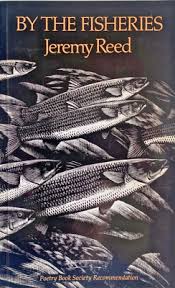
My own first acquaintance with Reed’s writing was in the two volumes from Cape in 1984/5, By the Fisheries and Nero, when James Lasdun edited him. These particularly highlighted the Nature poems, for example ‘Conger’ which outdid Ted Hughes: ‘They’ll shave a finger off with precision, / clean as a horse bite, or close round a hand / and leave it as taut gristle strung on bone.’ In a quieter poem, the narrator is fishing in a harbour, near a ‘desalination plant’, the tautly strung reactions of a shoal of mullet seemingly reflected in the fisherman’s own alertness and nerves (‘By the Fisheries’). ‘Spider Fire’ plays brilliantly with perspectives as every sort of tiny beast and insect flees a wildfire, while the narrator, at a distance, observes ‘a black hoop / ironed into the shire’. Though the first-person pronoun recurs in many poems, Reed is usually not much interested in self-revelation. One wonders, if he was/had been, he might be more widely appreciated, because it’s not that he can’t do it. ‘Visiting Hours’, for example, is enough to make a grown wo/man weep as the narrator visits his father in hospital, economical with the truth that this is ‘terminal’, the child compelled to play the father, the father, ‘like a diver gone on down // to find an exit that was always there, / but never used’. In characteristic ABCB quatrains, ‘Changes’ perhaps records the poet’s re-visiting Jersey and a brother, or boyhood friend, who stayed behind as a farmer, both recognising ‘our youth survives, the present is a gap’. And Lindop includes two remarkable poems from the Nineties collection, in which we seem to get close to Reed’s own autobiographical difficulties, when personal survival seems ‘to be the question’ (‘Samaritans’), and, in ‘Prayer’, Reed addresses a divinity of an uncertain variety, pleading for illumination, for help, a hearing, a pointing of a way out, from guilt, dread, self-injury, poverty, ‘the unappeasable, involuntary / inheritance of lucklessness’.
But Reed deals with topics, rather than ‘issues’, and his work is descriptive in character, never preachy or judgemental, so he seldom offers us his ‘views’. The work is driven by his ‘curiosity’, which both ‘holds us to life and feeds us to the flame’ (‘Moth-Trapper’). His praise of the artist, in ‘Cezanne’, is revealing of his fascination for the ‘ordinary’ and for the shared knowledge that ‘the beautiful / is inherent in all that lives, / and once externalised in its true form, / remains as that’. Over and over again, Reed captures – hence externalises – the true form of things in the colourful, vigorous, unblinking poems selected here. And as the millennium approached, Reed extended his range even further towards ‘all that lives’. There are uncharacteristic political poems (Tony Blair is a particular target), but Reed also writes of the experience of AIDS, and with a Baudelairean dwelling on sexuality, in poems like ‘Transsexual’ and ‘Brothels’, and is drawn closer to popular culture, its fashions, music, and iconic figures. But many of the poems on Madonna, Billie Holiday, Elvis and The Rolling Stones drift to looser forms of summary and the decade from 1993 to the early 2000s contains less brilliant work, though 2006’s Orange Sunshine with its evocations of 1960s London marks a return to form.
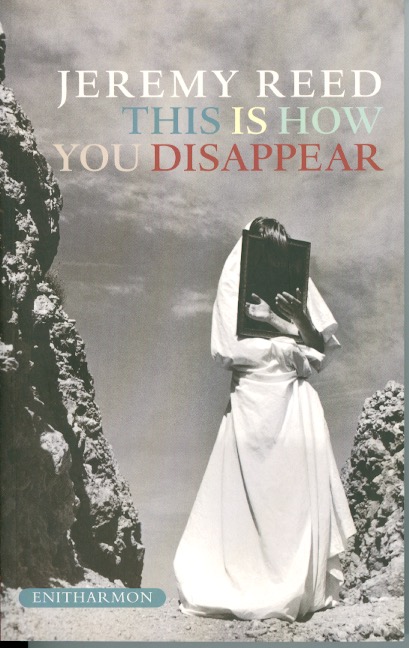
Reed as elegist, as in This Is How You Disappear (Enitharmon Press, 2007), was perhaps unexpected, but poems like ‘Paula Stratton’ and ‘John Berger’ (not the art critic) must rate amongst the finest in that genre produced in the last 100 years. The honesty, attention to detail, the empathy extended to his subjects (Stratton was a drug addict; Berger a difficult Jersey friend and Nazi-collaborator), and the apparent ease and beauty of the writing, mean these poems ought to have been anthologised everywhere. The elegiac note is hardly surprising as Reed moves through his seventh decade and poems about socks, potted plants, tea, honey, and cupcakes seem to mark shifts in focus though Reed remains true to his repeated maxim that ‘everything I see [is] poetry’ (‘London Flowers’). The poems retain the vigour and speed that he admires in Plath’s work: ‘her fast ball imagery / on speed-trajectories [. . .] her plugged-in dare-all energies’ (‘Re-reading Sylvia Plath’). As he puts it in an extract from ‘White Bear and Francis Bacon’, Reed has remained true to his early ambitions ‘to kick poetry into near sci-fi / [. . .] like dirty-bombing the dictionary into my face’ and there are thrills to be had by any reader on every one of these 300 pages in which Reed makes so many contemporary poets look sluggish, mired in virtue signalling, lumbering in form, and monotone compared to his vivid technicolours.
Here is the whole of ‘Elegy for a Polka Dot Shirt’ from Orange Sunshine (2006):
Unreconstructed 60s ostentation snowed on blue labelled Jacques Fath, tailored fit, fished from Retro on a simmmery cloud hung-over August day, bought for pop connotations – high collar with flouncy points, cotton married to the skin. Medium size: 38 cm: structured for a defined waist sexless to the vanity of ownership. Affordable at £15, the item begged me to retrieve its showy staginess. Outside, airless haze, W11 backpacking crowds random like footage spilled into a documentary.
Later I tore a fragile seam tracking towards left underarm, the fissure sounding like hot oil pronouncing itself in a pan. The tear backtracked through history to the anonymous wearer, who bought sensation, sold it on into a chain, the onion skin thinning from use; the scar re-sewn, but evident, a little glitch caught in the fabric like a blues lament, the singer head-bowed on a stool, cooking up trouble, while the club tug at his vulnerability and modulate applause from hot to cool.
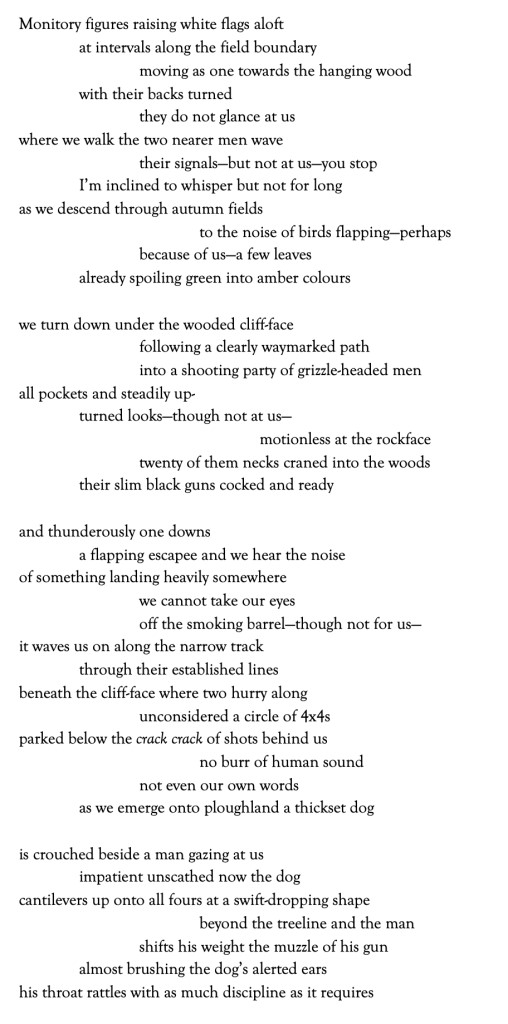
Happy New Year to all of you. We are hoping for the best aren’t we? Come rain, shine or named storm, the poems go on, saying something at least for the individual, the social, for careful consideration of the world out there, the world in here, and the languages we use.I’m posting a poem which has just appeared on New Year’s Day at the excellent Modron Magazine, its strap line is ‘Writing on Nature and the Ecological Crisis’. Glyn F Edwards also interviewed me about the making of the poem and I’ll post the text of that below, along with the link to Modron. Do go and take a good look at what other work they have put up in this new Issue 5. And then subscribe to them. My poem is weirdly formatted – so here is an image of it, lacking its title which is: ‘Muzzle’
On the Writing of ‘Muzzle’
MC: It’s so interesting to be encouraged to look back at the process of writing a poem. I seldom do it (I suspect I’m not alone), forever rushing on to the next ‘best’ thing (we think, we hope). In looking back at ‘Muzzle’ (I find I have the very first draft and several subsequent ones) two things strike me: that it took so long to get to a ‘finish’, and that I’d forgotten how important the context of the poem was to what it might be expressing.
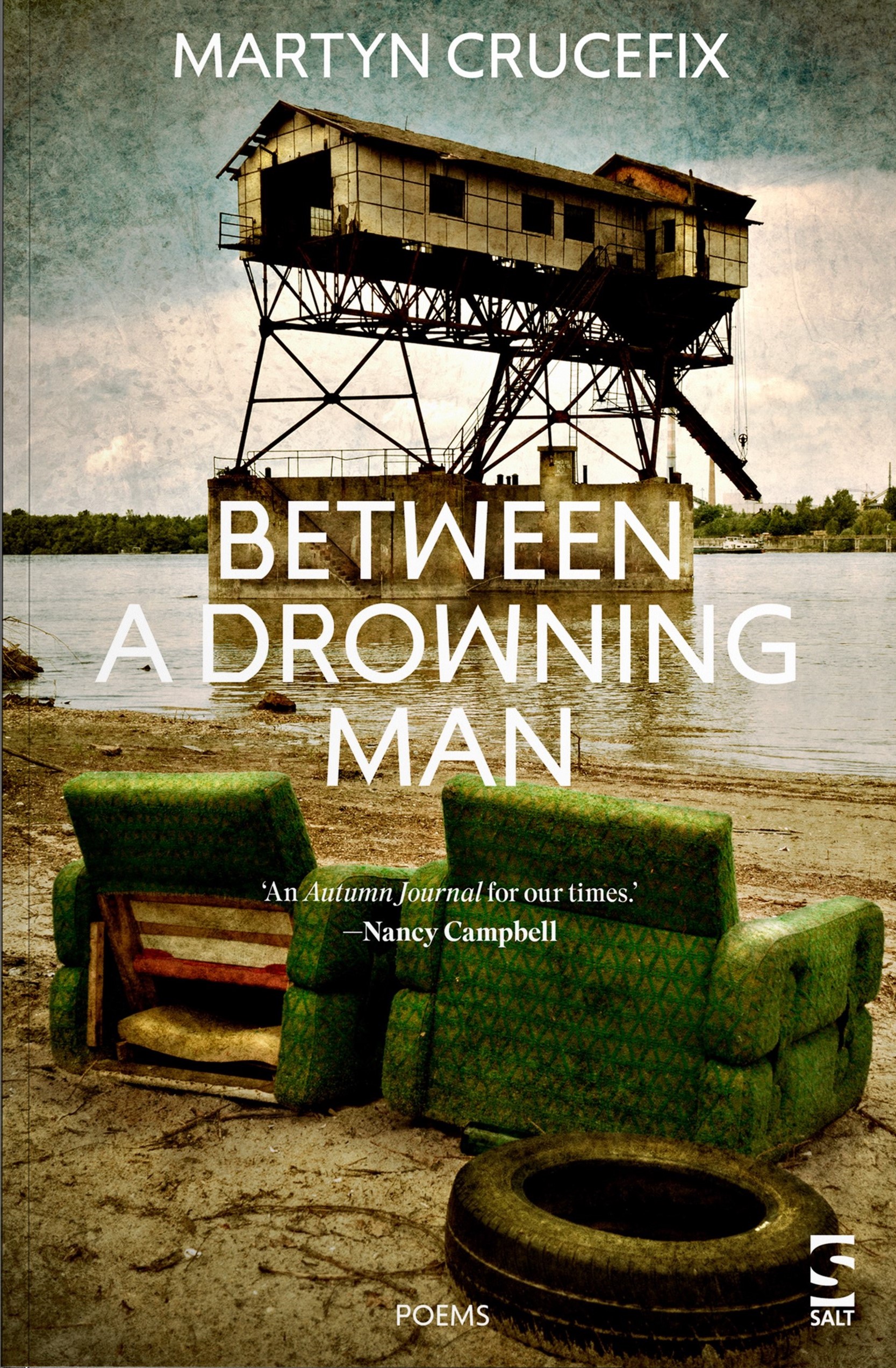
The first draft was scribbled in a notebook in the autumn of 2016. Earlier in the same notebook, I was sketching out thoughts on my, then, just-published version of the classic Chinese poems, the Daodejing (Enitharmon, 2016), preparing for readings I was to give from the book. Elsewhere there are fragments about my parents’ growing difficulties at home and (later) in their care home, plus some quite late drafts of the longish poem about the plight of refugees in the Mediterranean which was published as Cargo of Limbs (Hercules, 2019), and even first drafts of the poems which have eventually come to make up my most recent collection, Between a Drowning Man (Salt, 2023). Remember, the Brexit referendum took place in June 2016 and if there is an idea that links all these differing creative endeavours (including ‘Muzzle’) it is the idea of ‘division’.
Q1 – Only with the word ‘dog’ at the end of the third stanza does the reader gain a semantic connection to the ‘Muzzle’ in the title of the poem. Of course, Chekhov’s gun was ‘cocked’ all along, and the ‘muzzle’ becomes the open end of a weapon where a bullet escapes. Can you explain a little more of the rationale for this subtle title?
MC: To my surprise, I find, the first draft has no ‘muzzle’ mentioned in it at all. But the shape and a lot of the substance of the finished poem is already there: the flag-waving men during an idyllic autumn walk (on the Sussex Downs, as far as I remember), the shooting party, even the man and his dog at the end of the poem. The muzzle of a ‘smoking gun’ is clearly implied but the final dog’s muzzle does not make an appearance till quite late (I mean 2020 or so!). In fact, in the first draft I clearly don’t know how to end the poem. There, the walking couple emerge from the wood ‘unscathed’, the dog in the field grows tense, and there’s a sense of the man’s day being ‘interrupted’ by the couple. But these final 5 lines are crossed through. In the later draft, the dog now ‘cantilevers up’ onto all fours (the mechanisation of the creature is part of the male group’s malign influence in my mind) – but still no muzzle as such. That only comes via a reference to the man’s gun and, with its proximity to the dog’s head and ears, there is a transference of the word/idea to the dog itself. I’m pretty sure it wasn’t till this point that I thought of calling the poem ‘Muzzle’ and that I also wanted the word to apply to the walking couple who have been (by the experience, by their apprehension, if not their genuine fear) muted or muzzled themselves. The idea was actually there early on; the first draft briefly sketched in, ‘no human voice we do not talk’.
Q2 – The refrain ‘not at us’ is repeated, and echoes again in ‘not for us’ – amongst the ‘white flags’, and the reassurances of safety, there appears a growing threat to the speaker. The reader is left with the feeling that somehow this danger extends beyond the shooting party, and beyond bloodsports. Did you seek for the poem to act as a wider allegorical foreboding, and, if so, would you elaborate on the metaphor?
MC: Yes, the ‘not at us’ phrase or versions of it are already in the first draft, indeed on four occasions. This is one of the main sources of the idea of ‘division’ in the poem. It’s a simple ‘us’ and ‘them’ situation. The white flags – I think these would simply be the shooting-party’s beaters’ flags being waved to move the birds across the field into the woods, or possibly they are genuinely ‘monitory’ (meaning simply to warn or admonish), but in being white they also have (ironic) resonances of surrender (these guys were not going to surrender anything). The repeating phrase emphasises the gulf between the two elements of the encounter and particularly the sense (clear on the actual occasion) that those holding guns did not seem much concerned that unsuspecting, endangered walkers might be near at hand. We felt ignored; they seemed not to look at us. Being England, there is a strong class element here, which does not map easily onto the question of the voting intentions by class in the Brexit referendum, but factions on all sides seemed not to be paying much attention to any other. The devastating Tory defeat of 2024 should be regarded as reflecting much of this: eventually the country at large felt those in government were simply not paying any attention ‘to us’. I’ve always been pleased with the adjective ‘established’ to describe the shooting-party’s positioning, their being arrayed as the ‘establishment’. The finished poem ends ambivalently. The walking couple escape the shooting-party but are faced with another threatening situation: the gun, the dog. The ‘guard-like’ posture now puts me in mind of prison camp patrols the world over and I’d be happy for readers to get there too: there is a policing of freedoms going on here, a sliding scale from rural pastimes, to political enforcement, to genocidal pograms.
Q3 – ‘Muzzle’ zigzags, indents, retraces its steps. Some stanzas loop longer, and when the final sestet ends abruptly, without full stop, the reader becomes aware of the absence of punctuation throughout. You have a very idiosyncratic approach to presenting and punctuating the poem – could you share your intentions in this poem, and elaborate on whether these ally or counter your conventional style?
MC: The final form of the poem – which you describe so well – came very late. Most often my poems ‘find’ their own form – they don’t begin with any sense of the shape they will eventually take. The 2020 draft was coming out in tercets and I remember liking the ‘walking pace’, step by step, which that shape suggested. But in the end I wanted the poem to be more radical, to suggest a sense of freedom (in contrast to what is felt by the couple during the incident), a freedom to roam as it were, for lines to wander across the page and back again, while also acknowledging that this meandering might well yield some uneasiness in the reader (where’s he going?!). Both freedom and anxiety would be appropriate here. The form and the absence of punctuation (the latter I have been working with for several years now) are intended to generate some ambiguity. For example, I’m hoping for a fluidity in the opening lines, with the putative subject or focus being the flag-waving men, eliding to the walking couple – the ‘you’, then the ‘I’ – the birds, the leaves turning, finally to the ‘grizzle-headed men’. Within this fluency, a bit later, I want several adjectives to be hovering between subjects. The word ‘unconsidered’ floats between the lack of consideration given to the couple and the waiting circle of parked cars. Similarly, ‘impatient unscathed’ buzzes between the couple (again) and the waiting man and dog. This culminates in the rattling throat in the final line which (I want) to be as much about the man as the dog itself and so the ‘discipline’ demanded of the situation ought to be seen as human as much as canine. I guess I’m trying for fertile ambiguities, trying to suggest two things at once. The opening of the Daodejing says: ‘the path I can put a name to / cannot take me the whole way’ (my version).
Q4 – The shooting party negatively influences their surroundings, their presence ‘Hanging’ and ‘spoiling’ the woods, and the walk of the speaker. How much familiarity do you have with these ‘grizzle-headed men’, and do any occasions, such as the one in ‘Muzzle’ stand out as memorable, or significant?
MC: As you suggest, I have allowed the shooting-party to be, and remain, those wearing the black hats. More often than not I feel the need, the wish, to revisit such emphatic designations: what’s to be said ‘on the other hand’ (ever the wishy-washy liberal). The jaw-dropping presumption of the shooters in the original incident (the poem says pretty much exactly what happened), coupled with the generally felt anger and dividedness of the UK at the time (and since) goes to explain why I have not done so here. Do I know people like this? I guess not. A remote acquaintance likes to share his stories of attending such exciting shooting-parties, but it’s hard even to find the language to create much common ground. Perhaps I am just too urban, metropolitan even. About hunting wild animals, Rilke says, ‘to kill is one form of our restless grief’ (Sonnets to Orpheus, II, 11; my translation). Nothing I witnessed on that day in 2016 served to convince me otherwise; the taking out of another living thing for no useful purpose seems to require an arrogant presumption that I cannot get my head around and I find rather terrifying; the ‘monitory’ urgency in the final poem is as much concerned with how this sort of attitude plays out in the political, even in the military, sphere as it is with ‘blood sports’ more narrowly defined.
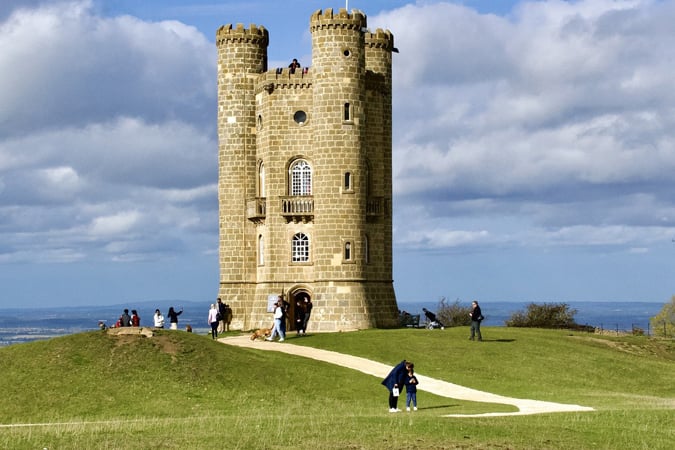
A rather more personal post than usual, though a poem (an older one of my own) is attached to it. Last week, I spent a few days with family in the beautiful village of Blockley, in the Cotswolds. The weather was very good for late November and we walked a couple of times – from Broadway up the muddy hill to the folly of Broadway Tower (once frequented by William Morris apparently) and around Hailes Abbey (now a ruin, local lore has it that Thomas Cromwell watched the destruction of the Abbey from a nearby hilltop). Blockley itself is near Moreton-in-Marsh, a place almost destroyed by the volume of traffic flowing through it (even in November), where The Bell Inn was once a favourite of JRR Tolkein, and is supposedly the model for The Prancing Pony in The Lord of the Rings. But Blockley, for me at least, had another powerful ghost haunting it.
As a couple, with young children, we stayed in the village over 20 years ago, in one of the original silk weavers cottages built along Park Road, which looks down over the village and valley. The house was owned by a colleague of mine at the time, Laurence Bowkett. He taught Classics and Latin and often spent the summer vacations away on archaeological digs of various kinds. That must have been the situation then as he’d allowed us to use the house in his absence. His early death, within a year or two of this, was a shock to us all. He had no family of his own and I don’t know what happened to the house later. So, fast forward to 2024, and here we are staying in Blockley again, only partly by coincidence. We have always had good memories of the place and (again, partly by an AirB&B chance) we ended up renting an almost identical cottage in the very same terrace above the village. Indeed, maybe it was the same cottage – I couldn’t remember enough of the details. The layout was certainly the same – the front door in off the road, straight into a little front room, a chilly basement kitchen and upstairs two small bedrooms.
Laurence’s was not the first death of a contemporary I knew well, but it greatly affected me and I tried to express something of this in the poem – an elegy – I wrote for him later. It is called ‘The umbrella and the bay tree’ and it mixes memories of him, his enthusiasms (he had a lot of those – all his students loved him for it), with details from my own family life at the time. It opens with an imagined scene, all his teaching colleagues gathered (as we often did then) in the local pub, remembering him in his absence. The ‘laral gods’ – the Lares – are Classical Roman guardian deities. The laurus nobilis refers to a little bay tree I bought after our first stay in Blockley as a thank you gift . . .
x
By seven-thirty, you are with us all
tonight in the gloom of The Washington,
though we omit you from every round.
Powerless as laral gods who gave you
no protection, even laurus nobilis,
x
the bay tree I bought you, proved no use.
x
Our children were at Infant and Junior School at the time and – to be honest – I can’t now remember if the details the poem goes on to mention are truth or fiction. But Laurence was the kind of guy who’d keep his own books in scrupulous order (as he did with his extensive collection of Marvel comics) so the library setting has always felt right . . .
x
Today, I searched 570 and 790,
in the Dewey decimal classification
your fingers ran through a thousand times,
for the facts of death and irrepressible life,
x
as if I looked for you now and you then.
You taught shard-life and careful fieldwork,
the near-dead language of not giving in.
You offered the heroic a modern face,
though death proved the more determined.
x
You understood lives alter what they touch:
a house, a street, a flowering tree,
for those who know us are not struck dumb,
a library unread the moment we die.
They roar like a lantern with our life inside.
x
The idea of lives of the dead altering the lives of those they have touched in life is familiar enough, though I was working on my translations of Rainer Maria Rilke around this time and I’m sure his influence is in here. It is not just the remembering of a friend who has passed away, but also that our own perceptions of ‘a house, a street, a flowering tree’, for want of a better word, spiritualises the material object, giving it a life, a light, an existence, beyond the ordinary. The resurrection of the bugs stomped by my daughter in what follows is probably an allusion to the early primitive computer games the kids used to play in which a failed – hence fatal – leap from a high building would result only in a brief ‘death’ and their 1st person avatar would soon revive and carry on in pursuit of adventure.
x
In Hornsey Central at 570
this morning, I found books to undermine
my daughter’s smiling confidence
that bugs she crushes beneath her shoe
lie dead a while, then revive good as new.
x
At 790, I leafed through life and death
in Ancient Egypt for her older brother:
how they wash their dead in water and oil,
then bind them in linen smeared with gum
and priests wrap lucky charms inside
x
in hope that none will break the seal
till the dead themselves in time of need.
x
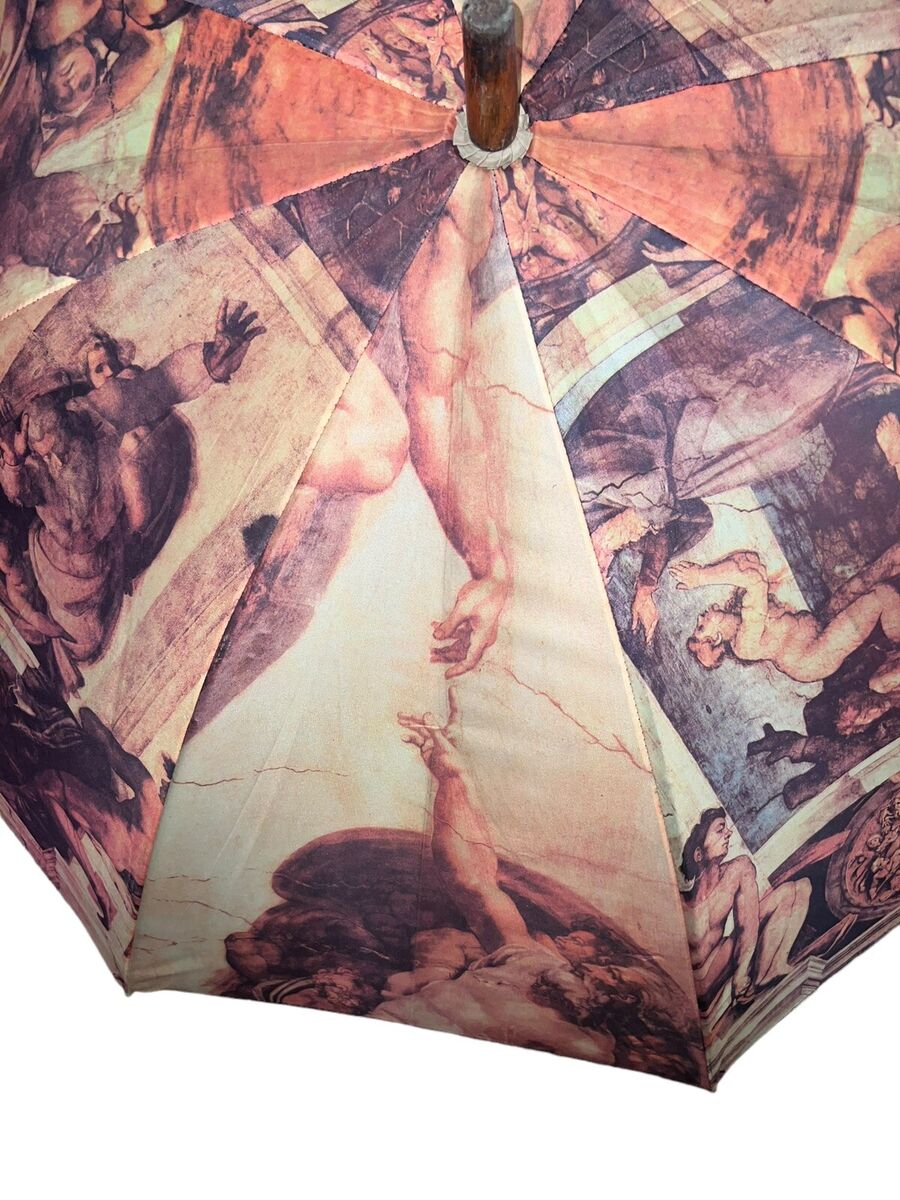
The ‘lucky charms’ idea naturally led the poem on to what I myself might place in a good friend’s sarcophagus and gave rise to a list of his multifarious likes and loves, concluding with the heartfelt wish that his (prematurely unhirsute) head might – even in death (though he had no religious belief as far as I know) – remain somehow protected. The image on the underside of Laurence’s umbrella is a truth!
The invitation at the opening of these two remarkable sequences of poems by Martyn Crucefix emphasises both ‘difference’ and ‘ambiguity’, an ‘othering’ which hones attention rather than dulling it.
Divided into two sections, Works and Days (forty-nine poems) and O, at the Edge of the Gorge (fourteen poems) the two landscapes bring into focus a post-2016 Britain and the countryside of the Marche in central, eastern Italy. The leitmotif which threads its pathway, its recurring echo, through the first section is of ‘all the bridges’ being ‘down’ and the epigraph to section two is a quotation from Canto 16 of Dante’s Paradiso in which cities pass out of existence through warfare or disease and that which may have seemed permanent is continuously in movement. That second section of poems is a sequence of sonnets and in the final one the hawk’s resting place in the ‘shivering of poplars’ sways so that he is neither falling nor at ease
with these thinnest of airs beneath him
these shapes of loose knotted mesh
these whisperings that cradle him on a whim
That ‘othering’ prompts the poet to see the differences that are ‘like crimes woven into the weft’ and, in a way that William Blake would have recognised in his ‘A Poison Tree’, envy can be ‘buried long years in the black heart / of expressed admiration’ and ‘sunshine’ can be ‘really the withering of night’ which is ‘poured into soil where wheat grows’. And so it is—‘in and around and over and above’ because ‘all the bridges are down’.
In April 2007 Jeremy Prynne wrote some notes for students about poems and translation:
Translation is for sure a noble art, making bridges for readers who want to cross the divide between their own culture and those cultures which are situated in other parts of the world; and yet a material bridge is passive and inert, without any life of its own, whereas a poetic translator must try to make a living construction with its own energy and powers of expression, to convey the active experience of a foreign original text.
As a translator of real distinction (Rilke’s Duino Elegies and The Sonnets to Orpheus) Crucefix has for many years made these living constructions offering readers a gateway into new experiences whether it be through the world of Laozi’s Daodejing (Enitharmon Press, 2016) or through these new poems which offer echoes both of Hesiod’s Work and Days and the poems known as a vacanna which originated in the bhakti religious protest movements in 10-12th century India. His understanding of the central role language plays in our lives, that creation of bridges between humans, was one of the deeply moving and memorable moments in his collection from Seren in 2017, The Lovely Disciplines. There the poem ‘Words and things’ presented an elderly individual who discovered ‘too late this absence of words’ which now ‘builds a prison’ and Crucefix recognised that ‘a man without language is no man’: as the world of objects becomes too difficult to dominate he can only have knowledge of a world which ‘turns in your loosening grip’. The echo of Yeats’s ‘The Second Coming’ is surely no accidental one!
Translations are bridges, language is a bridge, and the distressing recognition of isolation within numbers is the dominant image in ‘fifteen kilometres of traffic’ from the first section of this new book:
fifteen kilometres of traffic wait before us
behind us the infinite tail
x
we are offered Google Map options
yet those trumpeted ten minute economies
x
are nothing till they can be proved
you make a choice you go your own way –
x
this has been better said before of course –
you cannot take the other way
x
and remain a unitary being on two paths
or perhaps sane – all roads crawl north
x
because multiple millions of cars crawl north
because all the bridges are down
Those ten minute trumpetings bring the world of Orwell’s 1984 to my mind as loud announcements of positive news seem to possess a tinny emptiness to the understanding of the isolated human who exists in a world of no bridges.
However, in contrast to this wave of uniformity one reads moments of ‘othering’ in the second section of this book as in ‘sharpening gusts along the valley floor’ a scrap of air was birthed
whirling inches above a littered drain
in a back street of some hilltop town
x
like Urbisaglia or some place that has seen
and has survived change of use
from sacred temple to church to slaughterhouse
and no gully nor hill can stop it
In this moving world ‘great swathes of air’ gather strength to flex ‘all things to a scurrying to keep up / and the truth is some will and some will fail’.
In a poem titled ‘can you imagine’ (for my children) from the first section of Between a Drowning Man the power of language to translate the invisible onto the page is presented with an unerring eye focussed upon reality. In a world in which he no longer shares the companionship of others the poet is carried safely because although ‘you find the bridges between us fallen down’ and although ‘you mourn’ you can still ‘imagine’. That sense of continuity held in the imagination is far from the image of Alan Kurdi, the three-year-old Syrian boy drowned on the beach near Bodrum, Turkey, in 2015 whose death was recorded by Crucefix’s earlier book, Cargo of Limbs, from Hercules Editions in 2019. The boy’s family had fled from the war engulfing Syria in the hope of joining relatives in the safety of Canada and became ‘part of the historic movement of refugees from the Middle East to Europe at that time’:
In the early hours of September 2nd, the family crowded onto a small inflatable boat on a Turkish beach. After only a few minutes, the dinghy capsized. Alan, his older brother, Ghalib, and his mother, Rihanna, were all drowned. They joined more than 3,600 other refugees who died in the eastern Mediterranean that year.
In this new book that ‘whim’ of a resting place for the hawk, those ‘whisperings’ prompt the bird, the poet, ‘to call it yet more steady perhaps’:
One of the joys of social media (and there are plenty of aspects of them that are less than joyful) is that occasionally a notification pops up from an unexpected source and when you check it out there is something really worthwhile to be found. This happened the other day – via Instagram. Someone called Matt McGettrick had tagged me. I don’t know Matt, but he is a student on the BA course in TV and Radio Production at the University of Salford.
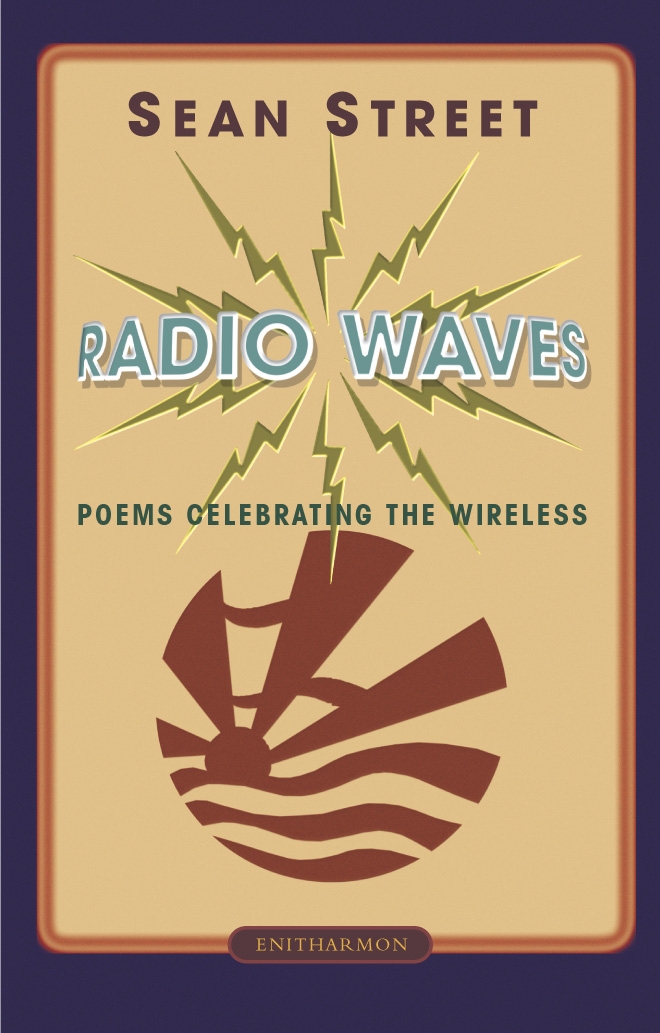
Matt’s instapost said he had recently created a soundscape based on a poem I published in 1990, in my first book from Enitharmon Press, called Beneath Tremendous Rain. It’s unlikely that the poem was found in that book itself, but I remember it was selected more than 10 years later by Sean Street to appear in an anthology called Radio Waves: poems celebrating the wireless (Entharmon, 2004). There, I was happily rubbing shoulders with the likes of Auden, Brecht, MacNeice, Heaney and Carol Ann Duffy. Sean – whose is a poet, broadcaster and recently retired Professor of Radio at Bournemouth University – had divided the anthology up into sections variously titled, Music Radio, Talk Radio, Weather, Listeners and Signals. My piece was in the section called ‘In the Car’.
Here’s that original poem. It’s voiced by a persona – I had no children at this point and had not moved out of the ‘dark’ streets of Manchester to the countryside.
Air-Waves
As I slowed up and shifted downgear,
a dance song thumping from the car radio
was stretched out and smashed to pieces.
x
But we barely noticed that first time –
all eager to see the house, where it stood
beneath the surfing crackle of the pylons.
x
The girls loved the sight of so much sky.
They slipped into new schools with ease
though Sue and I made it home more slowly.
x
And by then, there was Stephen, almost four,
suddenly ill, his rush of growing gone awry,
and the doctor’s face, closed up and dark
x
as the Manchester streets we had left behind.
He could tell me nothing. Inexplicable,
the pattern of disease. A year – maybe two.
x
Driving back across the hills, roadside wires
loop down, are yanked back to the blunted head
of each telegraph pole – and further off,
x
the pylons, hitching up skeins of darkness,
striding up country to a house where this car
and their sheaf of hot wires will converge,
x
where a young man’s voice on the radio
will melt down in a surge of boiling static
as I slow up, shift gear, and stop.
I remember a great deal of concern – this will have been in the late 1980s – about the possible harmful effects of living too close to the electrical fields generated by pylons. There was a particular study in 1979 that did conclude there might be a link between electromagnetic fields and childhood cancer (and this is the kind of scenario I am thinking of in the poem). However, other studies in the 2000s did not find an association or found an association only in homes with very high levels of magnetic forces, which is rare, according to the National Cancer Institute.
There was a personal connection, I remember, as my in-laws lived in a house which nestled in beneath a line of high voltage cables and pylons. But perhaps concerns about cancer-inducing lines of pylons have now gone the way of those early concerns about the dangers of mobile phones. Or has it even been consigned to the slightly cranky end of health concerns along with those people who sabotage 5G masts in the name of suspected links to the on-going pandemic? Even so, though it has dated a little, I’d like to think of the poem as one of my earliest expressions of environmental concern: if the electromagnetic fields do turn out to be perfectly safe, they are here acting as a metaphor for the kind of degradation of the lived-in environment caused by human action for which there is an indisputable and growing body of evidence.
Anyway – all this is simply by way of introducing Matt McGettrick’s excellent piece of work. The reader is Matthew Green. As the author of the original piece, it seems to me that both reading and soundscape engineering do a really fine job of responding sensitively to the text’s meaning, its structure and its rhythms. Have a listen – Matt suggests headphones are a good way to hear his work. It’s just over 5 minutes long.
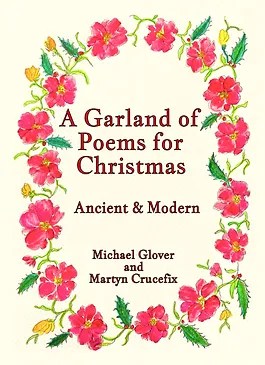
Perhaps it was in response to – really I mean a way of avoiding – the Tory party leadership campaign over the long hot summer of 2022 (and look how that turned out – and then again turned out…) that Michael Glover and I spent much of our time reading for, researching, inviting and selecting poems for a brand new poetry anthology with a focus on Christmas and the winter solstice. I know this is a bit obvious but – hey! – this might well be the solution to your up-coming Christmas gift buying deliberations – elegant, stimulating, moving, clever and very easy to wrap. That’s this new anthology. What’s not to like?
In fact, it was Michael’s original, bright idea and I was delighted to be asked to collaborate with him. It is the first anthology I have had a hand in editing and the book, in its final form, has two main sections – his bit and mine.
I found it daunting at first – where do you begin? Well, I don’t think I’m giving away any anthology-making secrets by mentioning that this Christmas collection is not the first on the market. I had a couple on my shelves already and the internet provides ready-made selections of possibilities and then less familiar collections like Enitharmon’s excellent Light Unlocked: Christmas Card Poems, eds. Kevin Crossley-Holland & Lawrence Sail (Enitharmon Press, 2005) and the rich seams of Seren’s Christmas in Wales, ed. Dewi Lewis (Seren Books, 1997) provoked thoughts and – with due acknowledgement – suggested some definite items. It was exciting when other contemporary poets were kind enough to agree to offer as yet unpublished work for the anthology – my thanks to Neil Curry, John Greening, Jeremy Hooker, Denise Saul, Joan Michelson, Penelope Shuttle and Marvin Thompson.
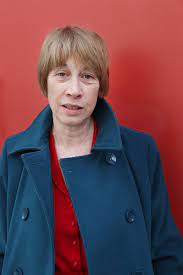
Penny Shuttle
For my own part, I pondered aspects of the ‘Christmas’ experience and came up with four loose categories: Mother and Child, Hearth and Home, Far and Near, Light and Sound.
Mother and Child was a fairly obvious place to start, and I was pleased to discover the 15th century poem ‘I syng of a mayden’ with its traditional take on the Nativity but its archaic and hence distanced and defamiliarized language. In contrast, Kevin Crossley-Holland’s plainly beautiful poem, ‘The Heart-in-Waiting’, revises the nativity story into more figurative terms for a contemporary audience: Christ is destined to be born into the human ‘heart-in-waiting’. WB Yeats’ take on the birth of Christ sees it from a quite different point of view: the pregnant mother’s sense of a divine love that ‘strikes a sudden chill into my bones / And bids my hair stand up’
The thought of Hearth and Home, around the time of the winter solstice, was probably a more personal choice, partly a recollection of my own childhood but also of later Christmases with my own two children. In both cases I am lucky enough for these to be happy memories though this section is perhaps also about the great weight of expectation of happiness that the season brings with it. My own background is in West Country – people claim to still hear my old Wiltshire accent sometimes – so William Barnes’ boisterous ‘Chris’mas Invitation’ was a great find:
An’ ev’ry woone shall tell his teale,
An’ ev’ry woone shall zing his zong,
An’ ev’ry woone wull drink his eale
To love an’ frien’ship all night long.
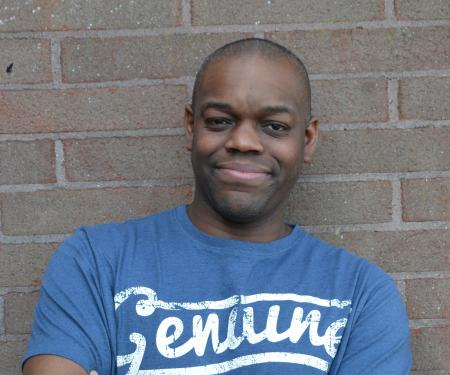
Marvin Thompson
To follow this with Thomas Hardy’s more melancholic ‘The House of Hospitalities’ seemed right – with the latter’s reminiscing of warm logs on the fire, the food and songs of Christmas past, though now (this is Hardy after all) these are little more than ‘forms of old time’. I was very pleased to be able to include Joan Michelson’s touching evocation of Christmas under the 2020 Covid lockdown and Marvin Thompson’s densely allusive poem, ‘That’s the Art Deco Odeon on London’s Holloway Road’ neatly updates the memories of those of us of a certain background and vintage of watching Morecombe and Wise at Christmas with his more recent remembering of the family laughing at Lenny Henry’s character, Deakus.
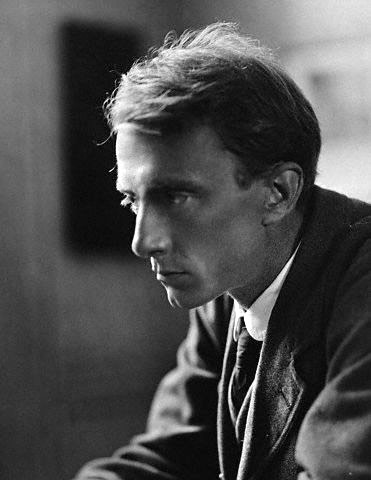
Edward Thomas
The cluster of poems around Far and Near probably sprung out of the previous section – those expectations of the season are not fulfilled for all – loved ones, the rosy-cheeked messages of the time of year or indeed happiness itself may remain at a distance. So Edward Thomas’ gypsy plays ‘Over the hills and far away’ in a darkly troubling and less than traditionally Christian style, as something more ancient, ‘a rascally Bacchanal dance’. Kate Bingham’s, ‘Cento’, cleverly re-deploys phrases so familiar from Christmas hymns and songs and manages to be both questioningly ironic and touchingly empathetic. Beyond the tired commercial and religious cliches, the darkest time of the year, its turning point, makes us think of past and present, but also about other modes of being. Jeremy Hooker’s new poem sequence praises and reflects on the season’s natural world, the blackbird and owl, the snow falling and ‘bringing up / deeper silence / from some place one dreamed of / that was always there’
Francis Kilvert
The carolling, the candles, the Christmas tree lights: the grouping of Light and Sound also seemed to be very appropriate. Everybody, I’m sure, will feel the shock of recognition in John Mole’s brilliant poem about digging out the old Christmas tree lights from last year’s box of decorations: ‘dear tangled friends / With your plaited emerald flex / And familiar chime of chip-chink / Tumbling over my wrist’. The dancing, visionary lights described by the old Wiltshire man, John Bryant (huddled in his bed against the cold ‘like a marmot in its nest’), in a diary entry of 1874 by Francis Kilvert, are, he believes, the souls of ‘just men’. These ‘rhymed’ for me with the chilly stars in Nancy Campbell’s enigmatic new piece, ‘Lights’ as a desire, felt by some people, perhaps more of us in the depths of midwinter, ‘to lose themselves in beauty’. And what better way to end than with Tennyson’s poem from In Memoriam: having fought through grief and loss to come to some more noisily belling, optimistic, celebratory vision for the coming new year:
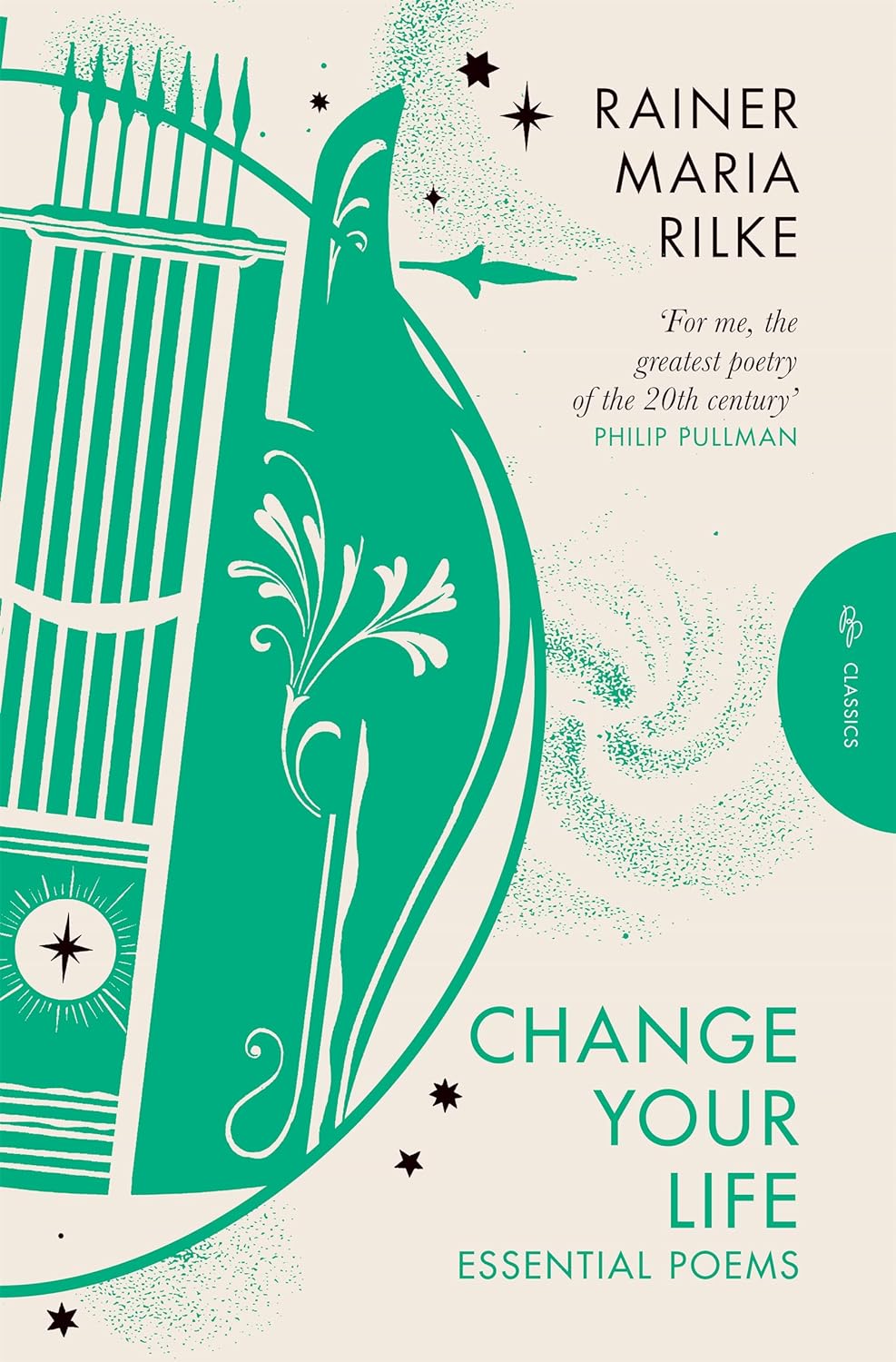
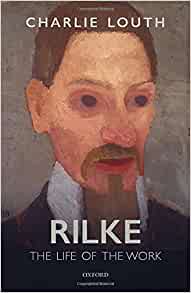
This is the second and final part of an uncut version of my recent review of Charlie Louth’s excellent book on Rilke, Rilke: the Life of the Work (OUP, 2020). A shorter version of this review appeared in the latest Agenda magazine, ‘Altered Distances’ (Vol 54, Nos. 1/2). Many thanks to the editor, Patricia McCarthy for asking me to write it. As I mentioned last week, much of my time through lockdown has been taken up with translation. One of these projects is a commission by Pushkin Press to complete a new selection and translation of the work of Rainer Maria Rilke, scheduled to appear in 2023. Some of you will be aware of my earlier published versions of the Duino Elegies and the Sonnets to Orpheus (both available from Enitharmon Press). This new project will contain selections from those sequences and a significant number of earlier poems – from the Book of Hours, the Book of Images and the New Poems. I am includinga few of my new translations in these two posts (or at least these are reasonably progressed drafts – just as with original work, translations need to sit a drawer for a while before they can be more fairly judged)
Part II
Louth argues Rilke’s journey towards the poetics of the New Poems began in the period he resided in the artists’ community in Germany at Worpswede. A lot of his thinking there concerned images of man and landscape. For the majority of the time, humans and nature live “side-by-side with hardly any knowledge of one another” and it is in the ‘as if’ of the work of art that they can be brought closer, into a more conscious relation. These are the thoughts that preoccupied Rilke when he moved, in 1902, to Paris, in part to observe Rodin at work. Louth is right that the poet’s move towards a poetry that cultivated the “earthly”, the world of “things”, was already well under way. He then looked to Rodin’s methods for “dependability, concentration and craft” and in a poem like ‘The Panther’ the fruits of more compactness of diction, a more supple articulation of syntax, a lexis of more precise, everyday words and an increased emphasis on the visual are clearly seen.
Here is my translation of ‘The Panther’:
The Panther
in the Jardin des Plantes, Paris
With this pacing the bars’ back and forth, his gaze
grows so weary there is nothing it can hold.
To him, there appears to be a thousand bars
and beyond the thousand bars, no world.
x
The lithe, smooth steps of his powerful gait
(in the narrowest of circles he spins round)
is like a dance of power around a point
at which an immense will stands, stunned.
x
In moments only does the pupil’s curtain
sway noiselessly open – an image enters
and drives through the mute tension of each limb
into the heart, where it disappears.
Under Rodin’s influence, Rilke became a more self-conscious labourer in language. These are the poems that are held up as examples of ‘Kunst-Ding’ (art-thing). In August 1903, Rilke wrote to Lou: “The thing is definite, the art-thing must be even more definite; taken out of the realm of chance, removed from every unclarity, relieved of time and given to space’.
Gerard Manley Hopkins
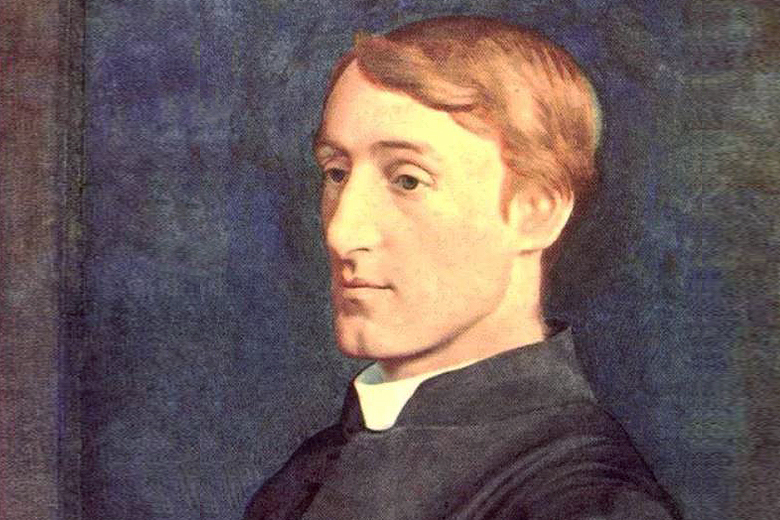
Louth often draws comparisons between Rilke’s work and poets from the English language poetry sphere. Here he compares Hopkins’ ideas of ‘inscape’ and ‘instress’ as “akin” to Rilke’s ideas of object/form and its impact on the observing individual. Certainly, with Hopkins, Rilke valorises the moment of perception, the process of looking. This, from a letter to Clara Rilke in 1907, is worth quoting at length: “Looking is such a wonderful thing, and we know so little about it; with it, we are turned completely outwards, but precisely, when we are most so turned, things seem to go on inside us that have been longingly waiting not to be observed, and while, intact and curiously anonymous, they take place inside us, without us, their meaning grows in the object outside [. . .] without ourselves getting anywhere near it, grasping it only very faintly, from a distance, under the sign of a thing that was foreign to us and the next moment is estranged once more”. These are little contacts with God, transient though they may be. The way we are to put our conscious self into our gaze and let it stream out of us, so enabling us to ‘receive’ the object without, recalls the idea of kenosis. Louth’s account of it is cool and clear: “the whole process can be thought of as two parabolas intersecting at their tips, the mind going out as the gaze summons the object into its focus”. He goes on to say that the details of the process may seem mystical, or indeed oddly physical, but the point is that the precise perception and discovery of things is also self-discovery, suggesting that the New Poems are not objective (as is often blithely observed) and not subjective either, but complicatedly both at once.
T E Hulme
Another of Louth’s interesting contextualisations is the link he makes between Rilke’s practice and the Imagists in general and, in particular, T.E. Hulme’s essay from around 1911, ‘Romanticism and Classicism’. There, Hulme also associates poetry with “an extraordinary interest in a thing”, described with an accuracy that avoids “falling into the conventional curves of ingrained technique [. . .] from gliding through an abstract process”. For Hulme, the artist is one who simply can’t bear the idea of [. . .] ‘approximately’”; hence one who always struggles to get “the exact curve of the thing”. Rilke’s New Poems are on the same trail, though he complicated and extended it with what he learned about ‘surface’ from Rodin. Gazing at the sculptor’s work, Rilke began to understand that surface “consisted of infinitely many encounters of the light with the thing [. . .] There is no point on the surface of a statue that is dead, no point isolated from the others, not participating in the total effect and life of the whole”. In a Rodin sculpture – and this is what he wished for his poetry – Rilke saw that “[n]o part of the body was insignificant or slight: it lived”. Yet such an interconnected, encompassing vision is inevitably transient. Louth brilliantly concludes that the New Poems are “things which record moments that are over, at the very least strongly imply their loss”, hence revising the accepted reading of this work: “the collection is haunted by things rather than full of them”.
Here’s an example of close observation not a thing but an individual:
Going Blind
There she sat with the others, taking tea.
And beside the others, I felt, at first,
that she held out her cup differently.
At one point she smiled. It almost hurt.
x
And when at last they rose from their chairs
slowly, still talking, as it happened
(laughing and chatting), moving on elsewhere,
I noticed her again. She lagged behind,
x
reticent, more like a woman compelled
to sing in front of a crowd of people.
In her shining eyes, the light seemed to fall
as if from outside, reflected in a pool.
x
She followed on, slowly, biding her time,
as if something more had to be overcome,
and yet, as if following that translation,
she would never again walk, rather fly.
X
Louth’s chapters 7 and 8 are both titled ‘The Interim’, tracing Rilke’s life and work from 1914 to 1922. After the drafts of the first and second Duino Elegies in 1912, the following 10 years are often seen as a period of failure and difficulty, of writer’s block. Louth argues otherwise. Though Rilke felt it was a period of drought (and discussed it as such often in his letters), poems were being written (over 150 in 1913/4) and the poet seems to be deliberately marking a break in his writing career in order to spur himself on to greater experimentation. The interim is filled with reading and much translation work too. Also, the orientation toward the visual arts which was such an important aspect of the New Poems grows less strong and is replaced (in a poem like ‘Wendung’ in 1914) with ‘heart-work’ (‘Herz-Werk’). Louth explains, this “implies a stronger recognition that the qualities of things depend on being noticed, received and remembered and that these are processes which have to do with time”.
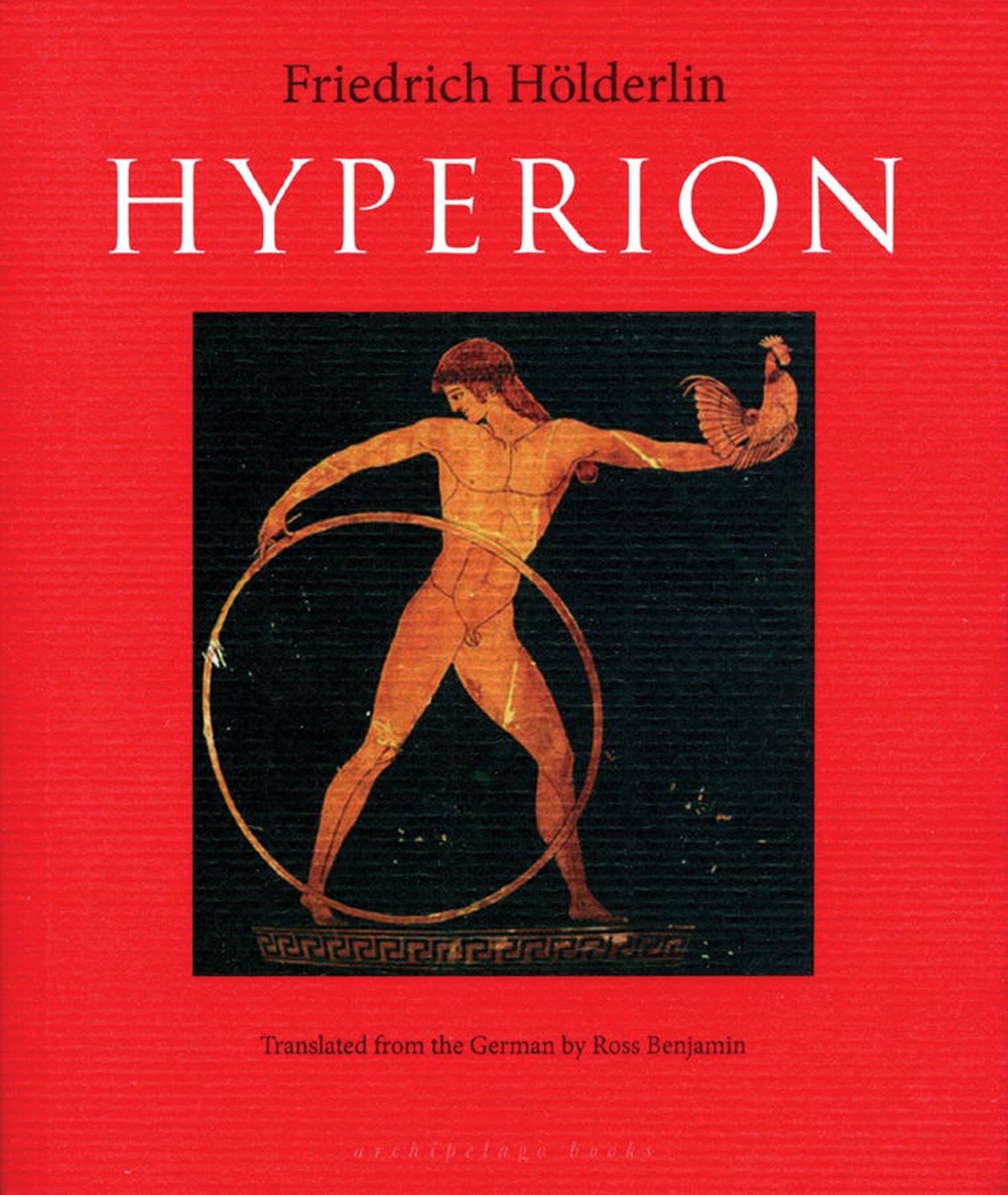
It was also his reading of Hölderlin that spurred Rilke forwards, both the poems and the novel Hyperion (1797/99). The New Poems are haunted by transience (as is the great ‘Requiem’ to Paula Modersohn-Becker (1909)), but Rilke comes to see poetry’s temporal nature not as something to be lamented and combated, but as its strength, what “allows it to enter into and elucidate the movement of life”. Years later, the unfolding of the Duino Elegies is just this: an initial lamentation at the transience of life, turning slowly towards celebration of that fact. Rilke learned from Hölderlin’s abrupt style, his winding, fractured or abbreviated syntax. The poem ‘To Hölderlin’ (1914) praises him and sets out a programme for Rilke himself. This is Louth’s translation:
To linger, even on what we know best,
is not for us; out of the fulfilled
pictures the spirit pitches to ones now to be filled; lakes
are only in eternity. Here falling is
the best we can do. Out of a feeling we’ve learnt,
falling onwards into one we divine, further.
Louth argues, “What Rilke apprehends in Hölderlin and works into the form of his poem to him, is movement itself, the poem as a passage ‘felt in departures’. It is ‘Herz-Werk’ in that it traces the flexion of time”.
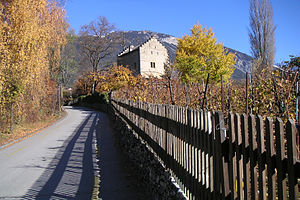
Rilke’s last house, Muzot
The long-nurtured fruits of these lessons in poetic diction, syntax and a vision of life are what burst from Rilke years later at Muzot. Much has been written about the inspired “hurricane of the heart and mind” that resulted in the completion of both the Duino Elegies and the Sonnets to Orpheus in February 1922. Some may find Louth’s 100 pages on the Elegies – a systematic ‘going through’ each poem in detail – to be at risk of losing the uplift and often dizzying experience that readers can have with this text which Rilke called a “great white sail”. But Louth’s forensic approach is not a dismantling of the poems, rather “a way of inhabiting them”. The poems are not elegies in any formal or traditional sense but about the kind of loss that had always been Rilke’s subject: the necessary loss of our necessary preconceptions about the world so that we can (if only passingly) experience its ultimate nature as a wholeness of being. The angels who make brief appearances stand for all that we are not (but might briefly glimpse). The lack of self-consciousness Rilke perceives in animals – their capacity to see the Open (“das Offene”) without reflection – proves an alternative way of critiquing the way we live. The acrobats in the fifth poem (the last to be completed) serve to suggest that life itself is “a questionable kind of performance, a contrivance, endlessly failing and having to be begun again”. Once this is felt in the blood and we distance ourselves from a world view in which “theories, the conception of things, have come to dominate over the things themselves”, then (as the seventh Elegy proclaims) “Just being here is glorious” (‘Hiersein ist herrlich’).
The only chance of preserving such glory is (following Hölderlin) to ensure no particular interpretation of experience becomes “the fixed and solely valid one”. The language of poetry becomes a way of “hooking ourselves to things, tangling ourselves in them” while retaining a sense of inevitable provisionality. So poetry reflects the nature of a life “improvised into a makeshift whole which acknowledges the complexity of life while also showing how it can still be experienced as a rich, meaningful practice”. Louth’s methodical tracking through the poems is an effective approach because the work itself is “extensive, various, not linear in progression, and often hard to construe, to read it is also to live in it, and the kind of reading required—to be willing to take things on trust, to allow rhythms to inform arguments, to carry unresolved moments, to connect disparate images into promising patterns—is akin to the ways we have of getting through life itself”.
Likewise, the Orphic song of the Sonnets also “comes and goes” and the self-contained, episodic, yet intricately interconnected form Rilke chooses (over 55 sonnets) yields what is Rilke’s greatest work. Louth takes a thematic approach, looking at Poetry and Technology, Sense and the Senses as well as Vera Oukama Knoop (the putative addressee of the Sonnets) and the marvellously inventive use Rilke makes of the sonnet form. This works less well because these poems are far more light-footed, less “hard to construe” than the Elegies. They require less explication and dance away from the forensic. But Louth knows as much: “The language of the [Sonnets] has two particularly striking aspects. One is its allusiveness and elusiveness, a curious looseness and lightness of reference, as if the words have become detached from their normal task of signifying and approach pure form [. . .] The other is the way the language grows out of itself, unfolding genetically and responding to its own promptings, as if it were listening to itself”.
Interesting though it is to see Louth complete his grand project with a discussion of the many French poems that Rilke turned to after 1922, there is once more a sense of trying to pin down the ineffable. Many poems were responses to the Vallais countryside, a place where the restless poet at last felt more rooted. But the lightness and playfulness of the poetry makes it hard to evaluate. Brief poems often aspire to the condition of haiku, or in Louth’s words, “almost avoid being writing at all”. Philippe Jaccottet in 1970, found in them a delicacy, preciosity, even a kind of soppiness. Many poems do have the Sonnets’ light-footedness and grace, yet often without their intensity and reach. Louth’s final judgement is suitably delicate: “There is a definite sense of Rilke taking his foot off the pedal in his last phase, productive though it was, but not as mere relaxation: as a deliberate exploring of unburdened existence”. So there is a dwelling in simple things, through simple language which can hardly be begrudged a man approaching his death from leukaemia in December 1926. His last published poem listens to and ventures out with the hunters in the Vallais, envying them their energy and vitality, as the dying poet (still fascinated by paradox) describes them as “pressing up close to what’s living”. This last phrase is a fine formulation for precisely what Rilke tries and succeeds in doing in so many of his poems.
As I mentioned in my last blog post, much of my time through lockdown and in the last few months has been taken up with translation. One of these projects is as daunting as it is exciting. Pushkin Press have commissioned me to complete a new selection and translation of the work of Rainer Maria Rilke to appear in 2023. Some of you will be aware of my earlier published versions of the Duino Elegies and the Sonnets to Orpheus (both available from Enitharmon Press). The new project will contain selections from those sequences and a good selection of earlier poems, including from the New Poems. As well as trying out a few of my new translations in this post (and the following one), the body of it is an uncut version of my recent review of Charlie Louth’s excellent book on Rilke, Rilke: the Life of the Work (OUP, 2020). A shorter version of this review appeared in the latest Agenda magazine, ‘Altered Distances’ (Vol 54, Nos. 1/2). Many thanks to the editor, Patricia McCarthy for asking me to write it.
Part I
Rilke has long suffered from two types of criticism. Among his enthusiasts, some declare his work close to sacred and therefore hardly open to ‘normal’ practices of critical analysis, at risk of spoiling the ‘bloom’ of mystery they find there. Others, of a more negative inclination, accuse him of an aloof aestheticism, a likely fatal distance from ‘real’ life. One such was Thomas Mann who can be found, Charlie Louth notes, “(rather richly) calling him an ‘arch aesthete’”. Both viewpoints risk downplaying the skilled crafting of Rilke’s work (he thought long and hard about poems as artefacts, things consciously and intricately made) but also risk mistaking the particular power of his poetry. Rilke: the Life of the Work is comprehensive, erudite, always clear and – most importantly – keeps returning us to the poetry to which Louth enthusiastically responds: “When we read Rilke, the poems do not feel aloof, and they do not feel merely aesthetic in their claims. They press upon us and make us examine ourselves, and they help us experience our life in the world with greater clarity and depth”. Most readers will recognise this as an allusion to the ‘Archaic Torso of Apollo’ (from New Poems) which concludes “You must change your life”. Louth again: “It is unusual for Rilke to be so direct, but as I see it a similar spirit animates most if not all of his poems”.
This book aims to bridge the gulf between enthusiastic, non-specialist readers of poetry (Louth translates his foreign language quotations himself) and the German lang/lit academic and student. The balance between engaged readability and academic thoroughness is very well judged. I particularly value Louth’s close readings of ‘the work’, viewed as objectively as possible (Louth declares early on that he has no “overarching thesis”). There are other readily available biographical and critical works, but the strength of Rilke: the Life of the Work is that, with its discussion of the formal choices, wording and syntax of so many poems, it is a comprehensive attempt at ‘Reading Rilke’. The structure of the book’s 600 pages is primarily chronological, from the poet’s earliest publication, Lives and Songs (1894) through to Vergers (1926). Louth only departs from this chronological survey twice. Early on, he looks at several poems that open Rilke’s published books, then, in Chapter 6, he discusses the four poems Rilke wrote as requiems.
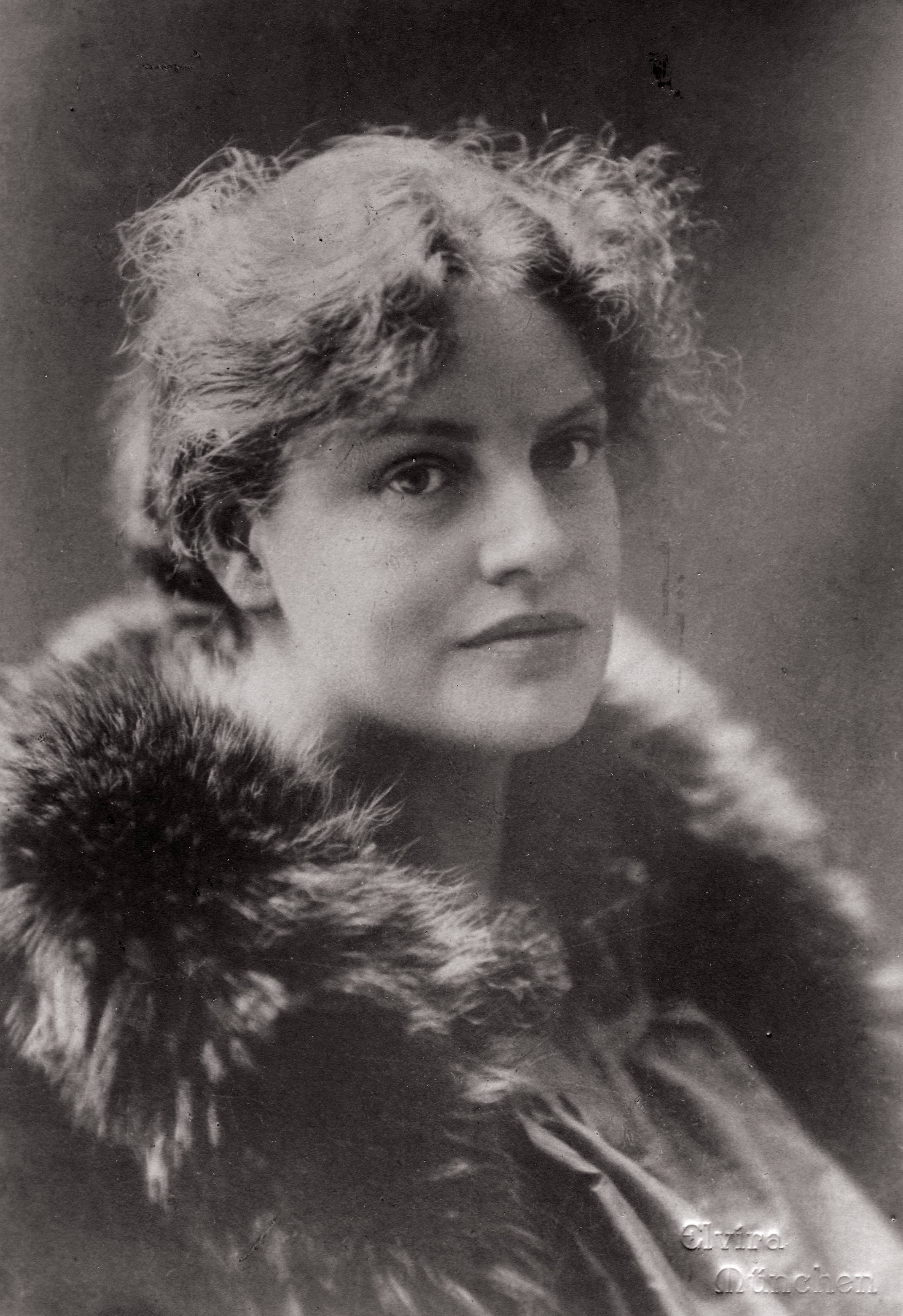
Lou Andreas Salome
So Louth’s Rilke is a craftsman and moralist who urges us to live better. The kind of closed system of a purely aesthetic art was the poet’s abhorrence. In a lecture he gave early in his career, Rilke is already sure that “‘art is only a path, not a destination’. In a letter to Lou Andreas-Salomé in 1903 he confirms: ‘I do not want to tear art and life apart; I know that in the end they are one and the same’. As so often, Louth articulates his subject’s attitude with great clarity: “for Rilke, there can be no question of shutting oneself away from life, of retreating into the work, and the desk, if it is to be the place of necessary writing, must be a ‘vitale Mitte’, a site right in the middle of life and exposed to all its risks and promises. To write is not to withdraw but precisely to engage”.
Rilke’s poetry pays particular attention to the processes of change associated with being human. Poems record such moments of change but also act, in the process of being read and openly experienced, as opportunities where change in an individual might take place. For those with faith in literature, Louth articulates the exciting prospect: “to read at all is to pause, is to take your time in times when an anxious haste pervades much of what we do. In some sense it is to live better whether poetry makes anything happen or not”. Writing to Thankmar von Münchhausen in 1915, Rilke asks, “What is our job if not, purely and freely, to provide occasions for change?” Louth finds these ideas in ‘Eingang’ / ‘Entrance’, one of the poems Rilke placed at the start of The Book of Images (1902/06). The furniture of this poem – the self, a house, a tree – is a grouping that recurs throughout Rilke’s work and what interests him is the suggestion that, as we leave the familiarity of our house, “the house of our habits, we enter the imaginary space of another building [. . .] coming from life into the poem, and passing through the poem into life”. Here is my new translation of this poem:
Whoever you are: in the evening, step out
of your living room, from all that’s familiar;
in the distance, the last thing, your house:
no matter who you are.
And although your eyes have grown so weary
you can barely lift them from the worn threshold,
slowly, with them, you still raise a black tree
and set it before the sky: lean and alone.
And you have made a world. And it is immense,
like a word, in silence, it continues to grow.
And as your will grasps its significance,
so your eyes, tenderly, let it go . . .
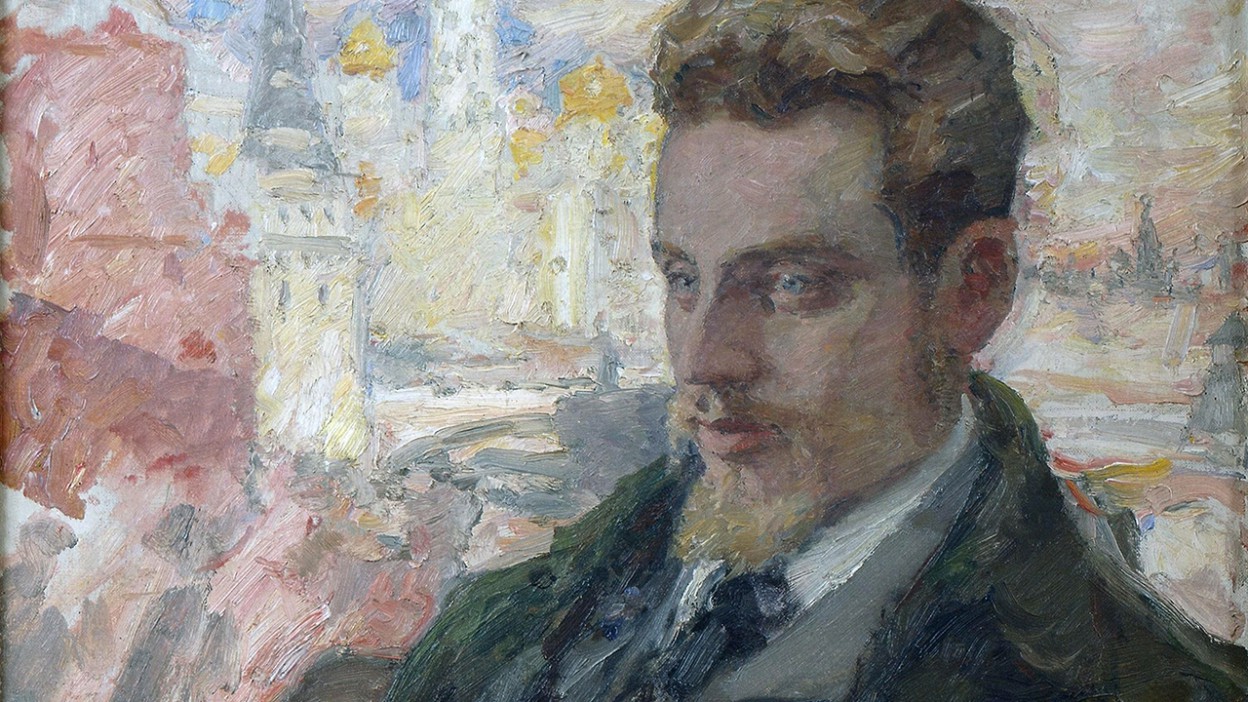
Portrait of Rainer Maria Rilke, 1928, by Leonid Pasternak
For Rilke’s own life and work, the key meeting was with Lou Andreas-Salomé in May 1897. Lou changed his handwriting and his name (from René to Rainer), but it was the confidence and groundedness in the world that she brought to his life that pushed his art “closer to the details of lived experience”. Rilke himself wrote: “The world lost its cloudiness [. . .] I learnt a simplicity, learnt slowly and laboriously how simple everything is, and I gained the maturity to talk of simple things”. Lou’s influence can be seen in the lecture he gave in Prague in 1898, where he distances himself from Symbolism and aestheticism (the dominant strands of ‘modern poetry’ at the turn of the century) to argue that the artist must not be “shut out of the great channel of life”, but must evoke the constant dialogue between the individual and things, “the strange coincidences between inner and outer out of which experience is made”. As Louth says, this is an early statement of the theme which will occupy his whole life.
Here is a brief poem – actually naming Lou and indicating her influence in persuading Rilke of the sacredness of the ordinary. It went unpublished for years, but was part of Rilke’s sequence called To Celebrate You (Dir zur Feier):
The rain runs its chilly fingers
down our windows, unseeing;
we lean back in deep armchairs
and listen, as if the quiet hours
dripped from a weary mill all evening.
x
And then Lou speaks. Our souls incline
one to another. Even cut flowers
at the window nod their topmost bloom
and we are completely at home,
here in this tranquil, white house.
For Rilke, the successful poem is a space in which the mysteries of things and personal confession are both explored, or revealed, simultaneously. Louth argues that, from the outset, Rilke’s view of this was always positive: “there is no unnerving consciousness of the self ’s arbitrary dependence on chance encounters with the outside world”, but equally, there is “no doubt about the existence of an underlying unity to which the poet has access”. What he feared was ‘the interpreted world’ (‘der gedeuteten Welt’), a world view shorn of all mystery, a perspective that perhaps most of us inhabit, a view in which language has become dominantly instrumental, “narrowing our vision so that life appears cut and dried without any possibility of the unknown and the unknowable”. Louth explains what readers of Rilke value in his work: “poetic language, as he understands it, is precisely a way of talking that avoids directness and allows the mutability of experience and the mystery of the world to be expressed. It releases rather than limits possibility”. Beyond this stands what Rilke might have meant by the term ‘God’. ‘He’ is “an experience of totality, life felt as a whole, in which self and other are not distinct or momentarily lose their distinctness”.
Here is my new translation of an early poem from The Book of Hours (Das Stundenbuch) in which Rilke is developing these ideas:
You, the darkness from which I came,
I love you more than the flame
scoring the world’s edge
with a glimmer
upon some sphere,
beyond which no-one has more knowledge.
x
Yet the darkness binds everything into itself:
all forms, flames, creatures, myself,
it seizes on them,
all powers, everything human . . .
x
And it may be: there is an immense might
stirring nearby –
x
I believe in the night.
It is in part because the enemy of mystery is language (too casually used) that poetry (constructed from language more carefully used) has an advantage over other art forms like painting. There’s an irony here, of course, because Rilke learned so much from other workers in the fine arts. Most know about the debt he owed to Rodin and Cezanne, but Louth argues Rilke’s journey towards the poetics of the New Poems began in the period he resided in the artists’ community in Germany at Worpswede. A lot of his thinking there concerned images of man and landscape. For the majority of the time, humans and nature live “side-by-side with hardly any knowledge of one another” and it is in the ‘as if’ of the work of art that they can be brought closer, into a more conscious relation. But because a poem works through time, such a correspondence is acknowledged as “something one traverses and gains knowledge of but cannot hold onto”.



 Martyn Crucefix