Jeremy Reed’s ‘Collusive Strangers: new selected poems’ (1979-2016) reviewed

An edited (shorter) version of this review first appeared in Poetry Salzberg Review in June 2025. Many thanks to the editor, Wolfgang Görtschacher, for commissioning the writing of it.
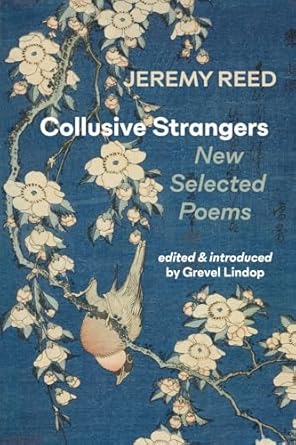
As the editor, Grevel Lindop, says in his Introduction to Collusive Strangers: New Selected Poems (Shearsman Books, 2024), the literary world has not taken enough notice of the remarkable oeuvre of Jeremy Reed. Many of his recent collections have appeared without much, if any, critical notice, so it’s to be hoped that this substantial new selection, from 1979 -2016, will bring this misfit-poet’s work back to more general attention. The problem is that the protean Reed fits no pigeonhole, plus the fact that he’s been astonishingly prolific. Intensity of perception and a phenomenal dynamism of language and creativity are his hallmarks, and he matches the best in nature poetry (Clare and Hughes), the decadent, urban flaneur (Baudelaire), then writes as Symbolist and Surrealist (Gascoyne), pursues sci-fi, focuses on pop and fashion, next becomes a portraitist and moving elegist. Even given these 300 pages, Reed – a sometime Peter Pan now into his 70’s – continues to be elusive. Compared to the prolific poet/novelist John Burnside, the difference is clear: we all knew what the brilliant, much-missed John was up to. With Reed, we are endlessly being caught by surprise.

Even Reed’s earliest work arrived fully formed. In the late 1970s and early 1980s, the urban, neurasthenic wanderer appears in ‘Claustrophobia (Kings Cross)’, the narrator’s need being ‘so strong it might involve the police’. In contrast, ‘Dwight’s Brother’ is an early stanzaic, sci-fi piece, a character from the future obsessed with Manson’s and Nixon’s careers, and ‘the monomania that burns planets’. And the magnificent ‘John Clare’s Journal’ ventriloquises the nature poet’s concerns for the natural world of Helpston, his stumbling literary repute, and fear for the future of his children, ‘laid / out as corpses’. Reed’s ambition is clear from the start, and in a poem like ‘Visit to George Barker’ he evidently empathises with the older poet’s withdrawal and seclusion, his writing contemporaries being harshly judged for a lack of ambition as ‘poets whose very aim is minimal / gesture, earning [Barker’s] dismissal’.
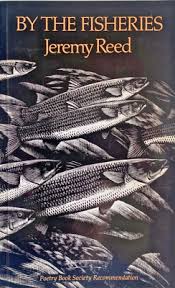
My own first acquaintance with Reed’s writing was in the two volumes from Cape in 1984/5, By the Fisheries and Nero, when James Lasdun edited him. These particularly highlighted the Nature poems, for example ‘Conger’ which outdid Ted Hughes: ‘They’ll shave a finger off with precision, / clean as a horse bite, or close round a hand / and leave it as taut gristle strung on bone.’ In a quieter poem, the narrator is fishing in a harbour, near a ‘desalination plant’, the tautly strung reactions of a shoal of mullet seemingly reflected in the fisherman’s own alertness and nerves (‘By the Fisheries’). ‘Spider Fire’ plays brilliantly with perspectives as every sort of tiny beast and insect flees a wildfire, while the narrator, at a distance, observes ‘a black hoop / ironed into the shire’. Though the first-person pronoun recurs in many poems, Reed is usually not much interested in self-revelation. One wonders, if he was/had been, he might be more widely appreciated, because it’s not that he can’t do it. ‘Visiting Hours’, for example, is enough to make a grown wo/man weep as the narrator visits his father in hospital, economical with the truth that this is ‘terminal’, the child compelled to play the father, the father, ‘like a diver gone on down // to find an exit that was always there, / but never used’. In characteristic ABCB quatrains, ‘Changes’ perhaps records the poet’s re-visiting Jersey and a brother, or boyhood friend, who stayed behind as a farmer, both recognising ‘our youth survives, the present is a gap’. And Lindop includes two remarkable poems from the Nineties collection, in which we seem to get close to Reed’s own autobiographical difficulties, when personal survival seems ‘to be the question’ (‘Samaritans’), and, in ‘Prayer’, Reed addresses a divinity of an uncertain variety, pleading for illumination, for help, a hearing, a pointing of a way out, from guilt, dread, self-injury, poverty, ‘the unappeasable, involuntary / inheritance of lucklessness’.
But Reed deals with topics, rather than ‘issues’, and his work is descriptive in character, never preachy or judgemental, so he seldom offers us his ‘views’. The work is driven by his ‘curiosity’, which both ‘holds us to life and feeds us to the flame’ (‘Moth-Trapper’). His praise of the artist, in ‘Cezanne’, is revealing of his fascination for the ‘ordinary’ and for the shared knowledge that ‘the beautiful / is inherent in all that lives, / and once externalised in its true form, / remains as that’. Over and over again, Reed captures – hence externalises – the true form of things in the colourful, vigorous, unblinking poems selected here. And as the millennium approached, Reed extended his range even further towards ‘all that lives’. There are uncharacteristic political poems (Tony Blair is a particular target), but Reed also writes of the experience of AIDS, and with a Baudelairean dwelling on sexuality, in poems like ‘Transsexual’ and ‘Brothels’, and is drawn closer to popular culture, its fashions, music, and iconic figures. But many of the poems on Madonna, Billie Holiday, Elvis and The Rolling Stones drift to looser forms of summary and the decade from 1993 to the early 2000s contains less brilliant work, though 2006’s Orange Sunshine with its evocations of 1960s London marks a return to form.
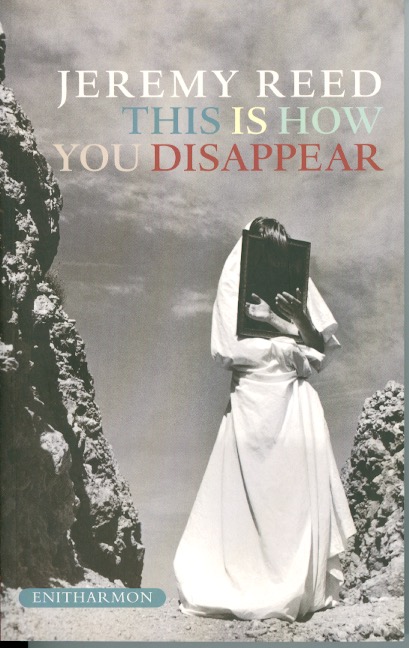
Reed as elegist, as in This Is How You Disappear (Enitharmon Press, 2007), was perhaps unexpected, but poems like ‘Paula Stratton’ and ‘John Berger’ (not the art critic) must rate amongst the finest in that genre produced in the last 100 years. The honesty, attention to detail, the empathy extended to his subjects (Stratton was a drug addict; Berger a difficult Jersey friend and Nazi-collaborator), and the apparent ease and beauty of the writing, mean these poems ought to have been anthologised everywhere. The elegiac note is hardly surprising as Reed moves through his seventh decade and poems about socks, potted plants, tea, honey, and cupcakes seem to mark shifts in focus though Reed remains true to his repeated maxim that ‘everything I see [is] poetry’ (‘London Flowers’). The poems retain the vigour and speed that he admires in Plath’s work: ‘her fast ball imagery / on speed-trajectories [. . .] her plugged-in dare-all energies’ (‘Re-reading Sylvia Plath’). As he puts it in an extract from ‘White Bear       and Francis Bacon’, Reed has remained true to his early ambitions ‘to kick poetry into near sci-fi / [. . .] like dirty-bombing the dictionary into my face’ and there are thrills to be had by any reader on every one of these 300 pages in which Reed makes so many contemporary poets look sluggish, mired in virtue signalling, lumbering in form, and monotone compared to his vivid technicolours.

Here is the whole of ‘Elegy for a Polka Dot Shirt’ from Orange Sunshine (2006):

Unreconstructed 60s
ostentation snowed on blue
labelled Jacques Fath, tailored fit,
fished from Retro on a simmmery
cloud hung-over August day,
bought for pop connotations –
high collar with flouncy points,
cotton married to the skin.
Medium size:
              38 cm:
structured for a defined waist
sexless to the vanity
of ownership.
Affordable at £15,
the item begged me to retrieve
its showy staginess.
             Outside, airless haze,
W11 backpacking crowds
random like footage spilled
into a documentary.

Later I tore a fragile seam
tracking towards left underarm,
the fissure sounding like hot oil
pronouncing itself in a pan.
The tear backtracked through history
to the anonymous wearer,
who bought sensation, sold it on
into a chain, the onion skin
thinning from use;
              the scar re-sewn,
but evident, a little glitch
caught in the fabric like a blues
lament,
the singer head-bowed on a stool,
cooking up trouble, while the club
tug at his vulnerability
and modulate applause from hot to cool.
Remembering John Burnside

With yesterday’s announcement of John Burnside’s death, I thought of this review that I wrote in 2006 of his Selected Poems, published by Cape Poetry. His work meant a lot to me around that time and I enjoyed the chance to try to articulate what I found fascinating in it.

John Burnside’s poetry has, for some years now, been offering us a modern egotistical sublime. With Wordsworth, he shares a responsive delight in nature and daunting powers of self-analysis; also similarly, he can slip towards the prolix and portentous and there is something of the same difficulty with projection into another’s experience. But Burnside’s work frequently achieves a moving sublimity without loosening its grip on reality. He is the only contemporary poet who consistently demonstrates the power of a poetic form that is something other than mini fictional narrative, raw confessional, or condensed dramatic monologue. That he is also successful in writing prose makes his achievement all the more impressive.

His work was recognised in the early 1990s despite bucking the trends of secularism, formalism, and plain/street language. His poetry’s brooding intensity lacked laddish brouhaha. The palette was never broad – rural twilights, leaf litter, owls hunting, tracks across snow – but his eye was always on the margins of such things, where the human and the natural met and negotiated. It felt like something spiritual was about to be said or had been articulated and just missed. This was twinned with the powerfully felt absence of fixed personal identity that has remained so deeply engrained in his work. In poems that in many ways were hardly radical, it was this element that made Burnside feel modern. In a self-regarding culture ever more attached to the teats of mobility, individuality, celebrity and fashion, his relentless worrying away at the obscurity of the self, his flirting with its non-existence, struck dissonant but resonating chords.

Burnside’s themes are frequently disturbing. But in a poem like ‘Halloween’ (from The Myth of the Twin, published in 1994) his exquisite ability to conjure up the British countryside proves to be an essential part of the pleasure of reading him. As often, the season is autumn – cold, mostly deserted, snow, rain, “the fernwork of ice and water”. The narrator peels bark from a tree to smell “its ghost” in a characteristic movement from the precisely evoked physical to the almost casually implied spiritual. What the figure in the landscape is trying to do is to “define my place”. Even scraping down in the leaf mould, he finds fungal traces that look “like the first elusive threads / of unmade souls”. Nearby village bells provide “nothing” and the poem typically ends with the figure’s sense of “other versions of myself” on the periphery of vision and these can be taken to imply other futures, untaken pasts, other roles familiarly adopted, even selves beyond the physical – the inconclusiveness is the point.

Burnside has pursued experiments with differing perspectives that were first signalled by the opening and closing poems of The Myth of the Twin. For example, though in the end less successful than its predecessor, Swimming in the Flood (1995)dramatically broadened his poetry’s reach to include the experience of others, often in more extended form and in dramatic monologues. Persecutors and victims inhabit these poems and speak disturbingly of abuse and “the inexplicable / malice of being” (‘Schadenfreude’). This was a turning point in Burnside’s development as what now flooded into the poetry was what had lain buried in the delicacy and tentativeness of the earlier work. In the ‘The Old Gods’ he declares their power is strongest “when anger or fear / is fuzzing the surface, / making us dizzy and whole”. The process of uncovering is shown to be one of healing and this selection includes the sequence called ‘Burning a Woman’ which seems nakedly to speak of the poet’s mother and father. Equally, the ‘Parousia’ sequence (not included in this Selected) ends with what appear to be sceptical reflections on his earlier inquisition beyond the merely physical: “All resurrections are local . . ./ the sign I have waited to see / is happening now / and always”. Here Burnside seems to arrive at a sense of secular miracle (a version of Rilke’s “Hiersein ist herrlich”) less concerned with the reality of religious presence than with the individual’s response to its possibility.

And yet, the dramatic monologues proved something of a cul de sac. With his subsequent work, Burnside has returned to his best subject: himself. Partly what makes the award-winning The Asylum Dance such a magnificent achievement is the development of the fluid poetic form he combines with a second person plural address that achieves the universal without being either hectoring or twee. The influence of William Carlos Williams is obvious, but Burnside extends this beyond a fluent impressionism concerned with the truth of things to encompass a philosophical musing, the lines flickering across the page as if viewed through water. This new selection is too brief to achieve the full sense of his development, but one of the marvels of Burnside’s work is its continuing delivery of extraordinary evocations of the natural world that have become gradually melded with an introspective depth that does not merely offer insight, but sustained meditation. The four long sequences from The Asylum Dance are rightly given space here and constitute a masterpiece in which the poems offer up rich, disturbing, beautiful, precise, profound, and sustained experiences undergone in the act of reading, rather than a lesser poetry’s marshalling of moments of insight and feeling. Burnside’s career already provides ample proof of a fascinating and significant artistic development, and this selection will prove a good starting point for anyone not yet following it.

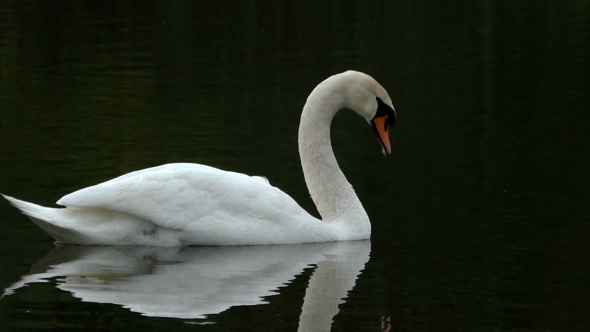
I Saw Three Swans: Baudelaire, Rilke, Oswald

A friend of mine recently asked what I thought of Alice Oswald’s poem, ‘Swan’ – in fact, what did I think it meant. It appears in her 2016 collection Falling Awake (Cape Poetry). I’m not sure I can give a direct answer to her direct question, but it linked up with two other swan poems I have read recently. Baudelaire’s poem appears in The Flowers of Evil and I have been re-reading a couple of translations of that collection because of the French poet’s influence on Rilke. Rilke’s swan poem (included in New Poems) is one of the poems I have been translating for the projected 2023 Pushkin Press book mentioned in my previous two posts. So – by way of an oblique answer to my friend’s question and because these poems and (two of) the poets relate to my current project and out of sheer curiosity – I thought I’d read these three poems alongside each other here.

Baudelaire’s ‘Swan’ is the longest of the three, divided into two parts. Written in late 1859 and dedicated to Victor Hugo, Baudelaire described the poem as an attempt to “record rapidly all that a casual occurrence, an image, can offer by way of suggestions, and how the sight of a suffering animal can urge the mind towards all those beings that we love”. His definition of those we love is remarkable broad, as we’ll see. The poem is also remarkable for the range of its components: evocations of the modern city (Paris), the creature itself, anthropomorphism, personal memory, literary references and an imaginative and empathetic ‘lift off’ towards the end. I’m looking at Anthony Mortimer’s translation published by Alma Classics in 2016. Here is an older, clunky, but openly available translation.

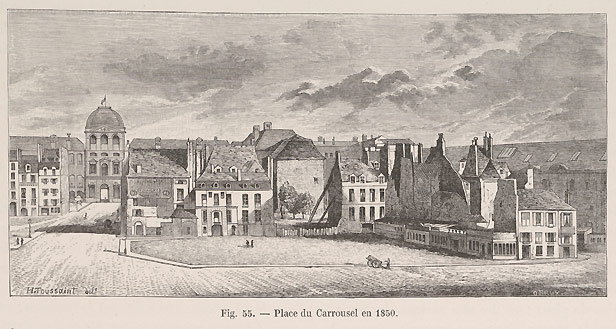
The reader might be taken aback by the opening exclamation: this swan poem opens with ‘Andromache, I think of you!’ In Book 3 of The Aeneid, Andromache, wife of the killed Trojan hero, Hector, is living in exile (‘we, our homeland burned, were carried over / strange seas’ – tr. Mandelbaum) and now weeps for her husband beside a little stream, a paltry reminder (Baudelaire: ‘a poor sad mirror’) of the mighty river, Simoeis, near Troy. She is an image of an abused and displaced exile, a refugee and it is the narrator’s strolling through the Place du Carrousel in Paris that prompts this literary recall. It’s because he himself feels out of place. Between 1853-1870, the Paris Baudelaire had known was in the process of being re-designed and re-built by Georges-Eugene Haussmann. Cityscapes change ‘more swiftly than a mortal heart’ says the narrator and he prefers to recall the old, ramshackle state of the area, where there was once also ‘a menagerie’. One morning, in that previous era, he caught sight of an escaped swan that ‘[d]ragged his white feathers on the dirty road’.

Rapid cutting from literary allusion to gritty realism to anthropomorphism is part of Baudelaire’s boldly making it new. The swan is ‘doomed’ in a literal sense, yet also ‘mythical’, at least for the narrator, who makes the beast speak: ‘Water, when will you rain?’ The intertextual resonances are further extended: the narrator sees the bird ‘sometimes like the man in Ovid’. This is the moment of man’s first creation: ‘given a towering head and commanded to stand / erect, with his face uplifted to gaze on the stars’ (Metamorphoses, tr. David Raeburn). But Baudelaire’s allusion is ironic, confirming the swan’s standing for itself and humankind in 19th century Paris: the swan stretches ‘his writhing neck and hungry head / Towards the cruel sky’s ironic blue’.

Part II of ‘The Swan’ reverts to the changing vista of Paris. As the new is erected, the old buildings ‘turn allegorical’, working as allusions to objects and experiences that no longer exist. The diffuseness and proliferating resonance of the swan image itself suggests that ‘symbolic’ might be a better word than allegorical. Now strolling near the Louvre, thinking still of the swan memory, the narrator reflects on ‘how / All exiles are ridiculous and sublime’. The earlier Andromache reference now makes sense and it resurfaces. It is the ‘incessant longing’ of all exiles that fascinates Baudelaire and from the (passionately felt) literary figure, he turns to a real black woman, ‘thin and consumptive, / Trudging through mud’ (in Paris, I take it) who yearns for her African homeland, obscured by a northern European ‘wall of fog’. The narrator ‘seeks’ exile we are told or, in his alienation from the modern world, he is compelled to seek it in a (mental) forest in which a ‘distant memory winds its full-breathed horn’. Imprecise as the significance of this image is, it evokes a full-throated, rather nostalgic longing for something long past; somewhat ridiculous and yet sublime in its depth of feeling. But the poem’s final lines expand to encompass thoughts of ‘castaway sailors’ and ‘captives, the defeated . . . and of many, many more’. The memory of the swan has focused (and continues to do so) the narrator’s thoughts on the ubiquity of such states of alienation, of actual and psychological exile.

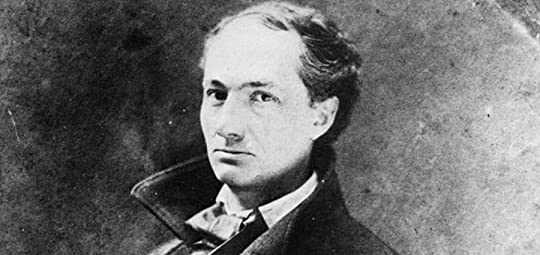
Charles Baudelaire

By comparison, the 12 lines of Rilke’s ‘The Swan’ are astonishingly compact. But, on its smaller scale, Rilke’s poem also opens as obliquely as Baudelaire’s. There are two lines before the creature appears and when it does so it seems to be in a figurative role: as an image of human life, which is itself characterised as a ‘struggling with a task not yet complete’. The contingencies and difficulties of a life lived are compared to the awkward movements of a swan’s movements out of water, weighed down, ponderous, ‘constrained’, as if its legs could not move freely. Baudelaire kept the two sides of his comparison (the swan and the experience of exile) clearly demarcated. Rilke balances the two sides of his comparison more evenly and potentially more confusingly. Is this a poem about a swan that conjures thoughts about life and death, or is it about life and death which now remind the narrator of the movements (in and out of water) of a swan?

Certainly, the initial topic seems to be life (its difficulties) and then in the second stanza, death itself: ‘that sense of our slackening grip / on the earth where we stand every day’. What is bold about this poem is how the final seven lines take off from this introduction of death into a second series of images related to the swan entering the water. But it is a series that does not return from the swan to the probable theme of human life/death. Instead, the poem records, in exquisite detail, the process of the swan entering the water and settling and then swimming away. It has the clarity of an Imagist poem (and I am hoping for that in my translation of it):

so, tentatively, he lowers himself down

x

and onto the waters that welcome him

gently, already, contentedly letting slip,

retreating beneath him, a moving tide,

while he, infinitely still and assured

and ever more majestic, more mature,

is content the more placidly to glide.

The growingly anthropomorphic quality of Rilke’s description (like Baudelaire’s before) implies the swan’s representative role in reflecting human life and in this instance, human death. Or at least, the idealised image of death that Rilke wants to convey: not something to be feared, but a gradual transition, a becoming, a maturing, an integral part of a life’s ‘struggling’. The poem’s playing with our perception of the swan/life divide is part of Rilke’s intention: life, as much as death, is not something Other, detached from the world of things, but something co-existing alongside it, within it. The creature’s placid transition from land to water, life into death, represents a true death for Rilke. This is not something available to all. In an earlier poem from the Book of Hours – in a poem which shows the influence of Baudelaire – Rilke portrays the poor of Paris, ‘wan-faced and petal-white’, frightened of being admitted to the hospitals of the city, knowing death awaits them. But this is a ‘petty death’, the demise of the body with no spiritual dimension; it is not ‘their real death’ which remains ‘hanging green, not yet sweet / like a fruit within that will never ripen’. So Rilke’s swan, as it glides placidly from life into death, is an image of such an ideal transition.  

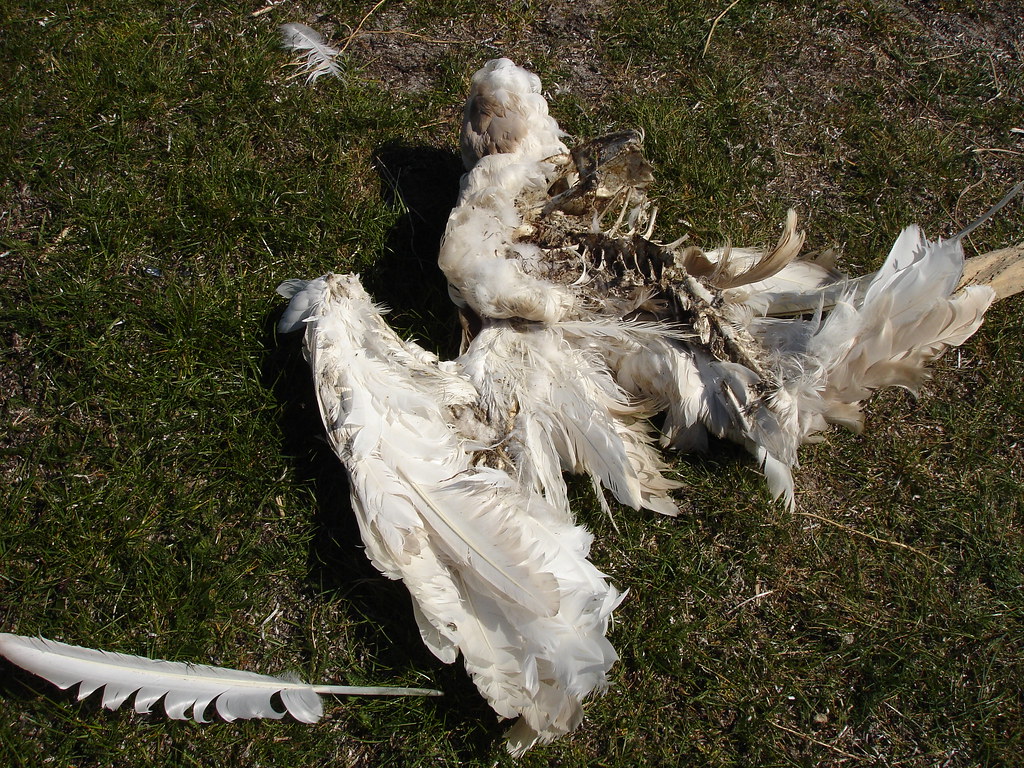
It’s possible Oswald’s poem, ‘Swan’, has Rilke’s in mind as its preoccupation is also with life and death. Compared to the Parisian perambulatory of Baudelaire’s regular ABAB quatrains and the meditative, imagistic, quasi-sonnet form of Rilke, Oswald’s poem wanders freely across the page echoing the disintegration of her already dead and rotting swan. The poem is composed of two elements: narrative description and the imagined voice or thoughts of the dead swan as it rises away (soul-like) from its own corpse. The only real puzzle here is the final speech of the swan.

The opening harks back to the sound world and imagery of Ted Hughes. The harsh assonance of the curt opening phrase (‘A rotted swan’) is an example, as is the following long line with its splashing sibilance and use of a technological image applied to the natural world: the swan is ‘hurrying away from the plane-crash of her wings’. Also like Hughes, Oswald likes to use the space of the page; the phrase ‘one here’, repeated for each of the wings, is placed as if the material of the words indicated the location of the wings set awry. The plane image is picked up again with the metaphor of the swan leaving the ‘cockpit’ of her own flying machine. The dualism of mind/self/spirit/soul versus body is adopted in what seems to be a simple manner.

Alice Oswald

Baudelaire’s swan in exile cried for rain in its natural watery homeland. Oswald’s is puzzled by its sudden divorce and alienation from its own body. In its first speech, it does not recognise its wings: ‘those two white clips that connected my strength / to its floatings’. The tone is similar in the second speech: ‘strange / strange’. The swan seems aware here of its own sense of ‘yearning’, experienced in its life, that the body’s ‘fastenings’ (wings? tendons? muscles?) were never able to ‘contain’. As with all these swan poems, the bird is being co-opted to represent humanity; here, our sense of being more than merely physical. The swan sees her own black feet, now ‘poised’ but unused. The corpse is an intricate, marvellous machine, but without whatever is now departing, it appears ‘a waste of detail’. Before the third and final speech, the body and all its ‘tools’ are now abandoned, with all its ‘rusty juices trickling back to the river’.

I think that last phrase is important. This is one of Oswald’s best poems but I’m uneasy with the conventionality of the spirit/body trope. Perhaps what is leaving the body is returning to the environment (an after-life of that sort)? In the final passage, the swan wants to address its own corpse before it ‘thaws’ or rots away. This suggests a desire for some ritual. The perspective of the poem now zooms in on the head, then the eye, which is visible and into its ‘cone of twilight’, the fading gleam within it, and into the cone, almost as if looking into a snow globe. The swan sees a scene there: a bride setting out to her wedding. Is this an image of the renewal of life after death? The ‘trickling back to the river’? But this return journey seems difficult: ‘it is so cold’. I’m not clear if I should be taking this in a narrow way: this individual creature will be extinguished. Or more broadly, the natural cycle of life-death-decomposition-new-life has been compromised (by human actions?). Oswald’s final image is of tolling bells, ringing in the putative wedding venue, bells like ‘iron angels’, insistently, ‘ringing and ringing’. Oswald’s swan is marvellously physical in its demise but its projected commentary on itself feels at times naively anthropomorphic (the death I’m left thinking of is a human death), at others puzzlingly obtuse.

Louise Gluck’s Poetry: Whole But Not Final

Lots of hits in the last 24 hours on my earlier blog post about Louise Gluck. Being awarded the Nobel Prize in Literature tends to have that effect… She’s a fascinating writer, always experimenting, but Anne Carson or Claudia Rankine would have come before her on my list. But given the obvious interest in her work, I’m posting here the text of the review I wrote for Poetry London in 2014 of Gluck’s last (ie. latest, though 6 years old now) book, Faithful and Virtuous Night (Carcanet). The review was paired with Michael Longley’s The Stairwell (Cape, 2014).

Louise Gluck’s comments on George Oppen remain one of the best ways into her own poetry. In praising Oppen, she declares her own hand: “I love white space, love the telling omission [. . .] find oddly depressing that which seems to have left out nothing. Such poetry seems to love completion too much, and like a thoroughly cleaned room, it paralyses activity” (Proofs and Theories, Carcanet, 1994). The homely metaphor here is also characteristic. She shares with Oppen (and surprisingly with Longley) a preference for what is singular, common, small, for “solid nouns”, a language restored “to natural health [. . .] for common use”, rather than a Stevensian “hermetic patois” (‘On George Oppen’ ). So her style has been variously called spare, stripped down, deflated, thinned (especially so since Ararat (1990)). Yet the miraculous paradox her poems evoke is suggested by a further observation from 1994, that “precision is not the opposite of mystery”. Gluck’s dreamlike, enigmatic narratives are all the more powerful – convincing one might say – precisely because of the directness, plainness of her language.

It’s appropriate then that in her new book one of the protagonists paints canvases which are “immense and entirely white” (‘The White Series’). There is mystery enough in this new collection which (as often with Gluck) gestures towards a narrative but whose narrators switch gender, are much concerned with parents (who have perhaps died in a car crash), a caring aunt, a brother (perhaps a sister). These are scenes from (at least one) life. The dominant voice is that of a male artist who, after a career interruption, begins to paint white on a visit to America. He takes on a nephew as a companion as he approaches death. In ‘A Summer Garden’, he discovers a photo of his mother slipped into a translation of Thomas Mann’s Death in Venice (1912) and a studied, fin de siècle fastidiousness over language surfaces in many poems. Gluck’s novelistic skills in drawing a world in a few strokes and character in even fewer are evident, though once again action is missing; Gluck’s characters, whether male or female, are passive.

Like Mann’s Gustav von Aschenbach, Gluck’s figures contemplate mortality while turning over their past. Though less obviously personal and less contented, as with Longley, the term nunc dimittis seems appropriate. The loss of parental figures is a recurrent trope and in ‘An Adventure’ love too is stripped away in a vain hope of “profound discoveries”. Poetry is lost too, again anticipating “the vast territory / opening to us with each valediction”. In A Village Life (2009), such a via negativa was doubted as “illumination / of the kind [that] destroys / creatures who depend on things” (‘Bats’) and here too it seems ineffectual. The quasi-Victorian cosiness evoked by the book’s title is exposed as false as remembered days “become unstable”, time leaps to and fro, seemingly at random and, if the soul travels at all, the puzzle remains that it always returns “empty-handed”:

[. . .] there is no perfect ending.

Indeed, there are infinite endings.

Or perhaps, once one begins,

there are only endings.

                                                                        ‘Faithful and Virtuous Night’

This is a bleak world not unfamiliar to readers of Gluck. In 1985 she asked, “Why love what you will lose?” only to answer, “There is nothing else to love” (From the Japanese’). Here, her real subject is the way we create our own meanings. ‘Afterword’ reflects on an earlier poem in the collection, suspicious of the “instinct / [to] discern a shape, the artist in me / intervening to stop traffic, as it were”. A meeting with an old woman yields the anticipation “that some important secret / was about to be entrusted” but on reflection her words are “pointless” (‘A Sharply Worded Silence’). Gluck (again like Longley) has used Homeric and Greek mythic material to ironise her more contemporary subjects. Faithful and Virtuous Night instead makes reference to T H White’s The Sword in the Stone to evoke the same kind of focused, watershed moment, indubitably saturated with meaning that the events of her narrator’s lives lack. Even the analyst’s couch offers nothing more than “my ingenuity versus / his evasiveness: our little game” (’The Sword in the Stone’).

In recent years, the Italian settings of Averno (2006) and A Village Life have seemed to warm Gluck’s empathy, developing a more dramatic quality to her work in portraits less obviously autobiographical. This new collection perhaps reverts, but still she engages and moves her readers and there do seem to be eventual gains along this apparently bleak road. These lie in the poems’ openness, the way they seem capable of encompassing such varieties of experience, of saying ‘yes’. Of Oppen, she wrote that his work had the power to seem “simultaneously, whole and not final, the power to generate, not annul, energy”. As in sitting before a Samuel Beckett drama, the paradox is we are not drained of energy by the apparently fruitless search for meaning, but are thrown back onto the road all the more attuned to the clues, to the activity demanded of us. In his last days, Gluck’s artist has his nephew sing Jacques Brel’s ‘The Old Folks’ (“The little cat is dead and no more do they sing“) as well as Rodgers and Hammerstein’s ‘The Hills are Alive’. The insight is that “we do not, in the main, need to choose between them” (‘The White Series’).

To end at the beginning, Faithful and Virtuous Night opens with ‘Parable’ in which, “as St. Francis teaches”, a group of people divest themselves of worldly goods, better to focus on their goals, better to move unencumbered towards them. But the direction of travel is unclear, as is their purpose. Much debate ensues; time passes. In the background, perhaps we hear Brel’s “old silver clock” ticking. The group grows old in debate and their ageing (some believe) is their true purpose, while others believe the passage of time is the truth they hoped to be revealed. Both seem satisfied and perhaps we need not choose between them, only admire Gluck’s precise evocation of the mystery.

2017 Forward First Collections Reviewed #4 – Ocean Vuong

This is the fourth in the series of reviews I have been posting over the summer months of the 5 collections chosen for the 2017 Forward Prizes Felix Dennis award for best First Collection. The £5000 prize will be decided on 21st September 2017. Click on these links to access all 5 of my reviews of the 2016 shortlisted books (eventual winner Tiphanie Yanique)  and all 5 of my reviews of the 2015 shortlisted books (eventual winner Mona Arshi).

The 2017 shortlist is:

Maria Apichella – Psalmody (Eyewear Publishing) – reviewed here

Richard Georges – Make Us All Islands (Shearsman Books) – reviewed here

Eric Langley – Raking Light (Carcanet) – reviewed here

Nick Makoha – Kingdom of Gravity (Peepal Tree Press) – reviewed here

Ocean Vuong – Night Sky with Exit Wounds (Cape Poetry)

download

In living with Ocean Vuong’s book over the last week or two I have on occasions mistaken its title for Night Sky with Exile Wounds. It will become obvious why. But it has also been hard to ‘see’ this collection because of the accumulated material – interviews, awards, perhaps hype – that already surrounds it in a way that affects none of the other Forward First Collections this year. Vuong has already appeared on the cover of Poetry London and been interviewed by The New Yorker. He has been nominated as one of Foreign Policy magazine’s 100 Leading Global Thinkers. Such recognition is even more extraordinary given that Vinh Quoc Vuong was born in 1988 on a rice farm outside Saigon and, at the age of two, he and six relatives emigrated to Hartford, Connecticut, where they lived together in a one-bedroom apartment. On learning that ‘ocean’ (in American English) is a body of water that touches many countries – including Vietnam and the United States – his mother renamed her son.

Ocean Vuong is also gay. Hence his exile – the word that kept coming into my mind – is one not only from his birth country and culture but also from the mainstreams of his adopted country. It’s no surprise there are several Ocean Vuongs in this book in terms of subject matter as well as in its use of a variety of poetic forms. This might – reflecting his given name – be an essential, protean, shape-shifting style or it might reveal the kind of casting around in the sea of form and content one might expect from a first collection. I think it is more the latter than the former, though the thrashing and contortion involved in such self creation (we used to refer to ‘self discovery’ – the book title has ‘self portrait’) is now a topic of such ubiquity in Western culture that Vuong’s personal struggles may come to be considered as representative in themselves.

-
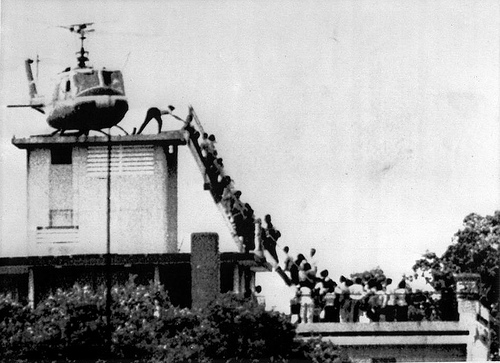
Saigon 1975

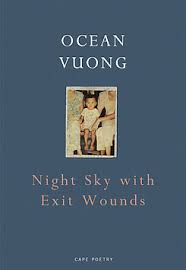
Though 13 years before his birth, ‘Aubade with Burning City’ portrays the American withdrawal from Saigon in 1975. Apparently, Armed Forces Radio played ‘White Christmas’ as a sign to commence the withdrawal and the poem assembles a montage of the song lyric, events on the streets of Saigon and a sinister, coercive-sounding male/female dialogue. The result reflects the chaos of such a moment of violent transition (though the ironies of the sentimental song are a bit obvious) and introduces a recurrent thread in Vuong’s work, the uneasy alliance between power and sex. ‘A Little Closer to the Edge’ seems a reminiscence, perhaps of his own conception (Cape’s cover image of the young poet encourages this biographical approach). Among bomb craters and anticipated domestic violence, a young Vietnamese couple are at first “hand in hand”. Then:


He lifts her white cotton skirt, revealing

another hour. His hand. His hands. The syllables


inside them. O father, O foreshadow, press

into her –


For his mother’s part, the narrative voice asks her to show “how ruin makes a home / out of hip bones” and also to “teach me / how to hold a man”.

Vuong-cover-020116-1-1
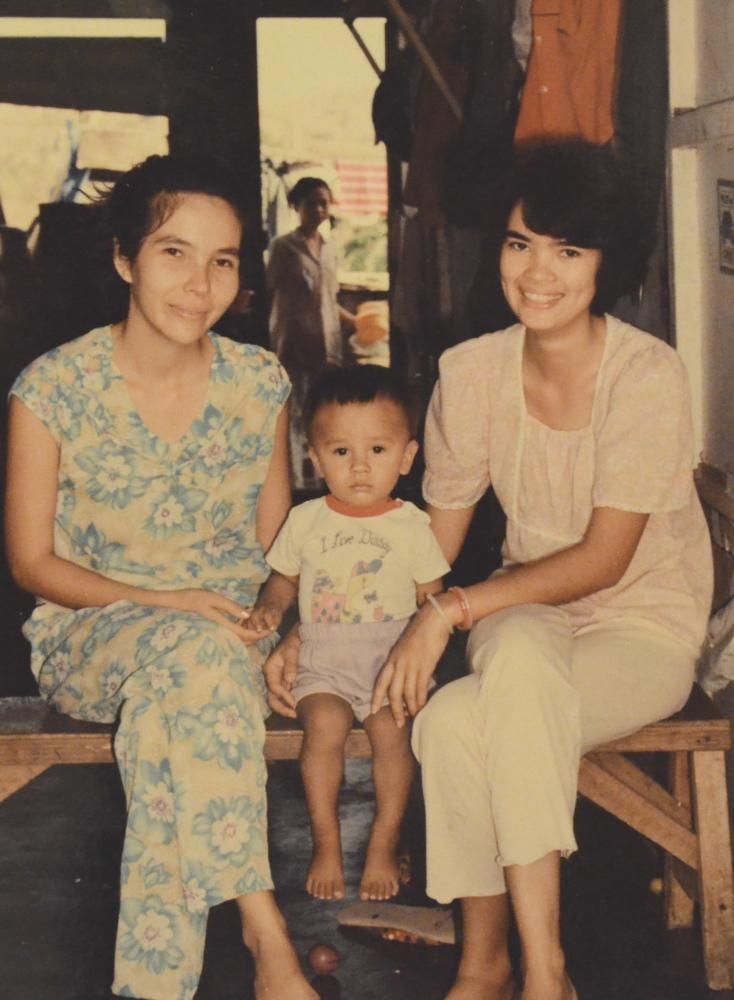
Vuong with his mother and aunt -refugee camp Philippines, c.1989.

Once in the USA, there are poems that treat both parents with some tenderness. In ‘The Gift’, the son teaches his mother the alphabet. She can hardly get beyond the third letter, the fourth, gone astray, appearing only as


a strand of black hair – unravelled

from the alphabet

& written

on her cheek


Several portrayals of Vuong’s father suggest violence and drinking but in ‘In Newport I Watch my Father Lay his Cheek to a Beached Dolphin’s Wet Back’ he is seen to express concern for the creature, “the wet refugee”, though the poem is fractured by bullets, Huey helicopters, shrapnel and snipers as if to suggest the root of the father’s violence and his inability to express affection for his own family.

91c43df9d7c2bf90139dc2df89bfa134
Ernest Hemingway and his son (plus guns)

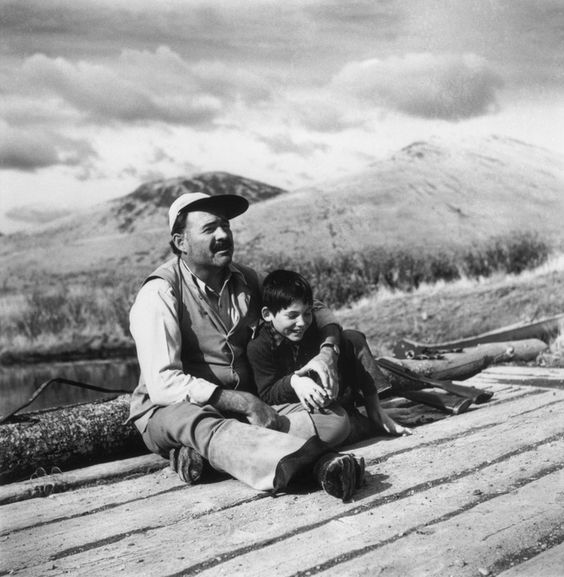
Or perhaps such things innate to a man? Another major theme in the book is masculinity itself as expressed through father figures and a young gay man growing up. The former is seen in two poems involving guns. ‘The Smallest Measure’ has the father instructing the boy on how to handle a Winchester rifle (it reminds me of a photograph of Hemingway and his son). ‘Always and Forever’ (Vuong’s note tells us this is his father’s favourite Luther Vandross song) has the father substituting himself with a Colt.45 in a shoe box: “Open this when you need me most”, he says. The boy seems to wonder if the gun might deliver a liberation of sorts: “[I] wonder if an entry wound in the night // would make a hole wide as morning”. This image of an aperture being made in darkness – most often through an act of violence – to let in light recurs in these poems. I can’t quite see what is intended here but there are again links to the erotic/violence motif. Later, the gun barrel must “tighten” around the bullet “to make it speak”, making further obscure, but interesting, links to violence and the ability to speak (or write).

aseq

What it is to be a (young, gay) man is explored in the second part of the collection. Andrew McMillan’s physical comes to mind in reading these poems (McMillan interviewed Vuong for Poetry London recently). ‘Because It’s Summer’ is a more conventionally lineated poem in the second person singular (some distancing there) of slipping away from a mother’s control (and expectations) to meet a boy “waiting / in the baseball field behind the dugout”. It’s particularly good at conveying the exciement (on both sides) of a desire, previously played out alone, being mutually gratified: “the boy [. . .] finds you / beautiful because you’re not / a mirror”. ‘Homewrecker’ evokes the energy of erotic discovery as well as the ‘wreckage’ it threatens (to some) in the “father’s tantrum” as much as the “mothers’ / white dresses spilling from our feet”. ‘Seventh Circle of Earth’ is particularly inventive in its form. The poem – set as prose, but with line break slashes included (a baggy, hybrid form Vuong uses elsewhere) – appears as a series of footnotes. The footnote numbers appear scattered across a blank page. The poem deals with the murder, by immolation, of two gay men in Dallas in 2011. The mainstream silence is cleverly played against the passionate love poem only recorded as footnotes.

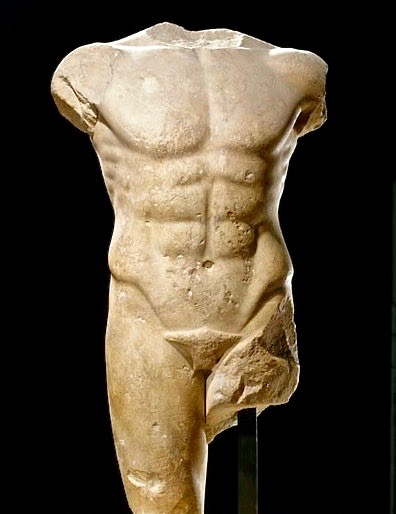
Elsewhere, Vuong hits less successful notes and styles. There are some dream poems – like ‘Queen under the Hill’ – which don’t always escape the hermetic seal around an individual’s dream world. On other occasions, he wants to use mythic stories to scaffold his own. ‘Telemachus’ is probably the most successful of these (the materials again feeling dream-like to me) as the son pulls his dead (shot dead) father from the ocean. Elsewhere we find allusions to Orpheus and Eurydice (and to Lorca’s ‘Sleepwalking Ballad’ and Rilke’s ‘Archaic Torso of Apollo’). Certainly, Vuong is not fearful of taking on big subjects such as JFK’s assassination (‘Of Thee I Sing’), the murders of Jeffrey Dahmer (‘Into the Breach’) and 9/11 (‘Untitled’).


miletus torso_cropped - 1
Archaic Torso of Apollo


But actually I think ‘ordinariness’ and those poems which show the influence of O’Hara and the New York School prove a more fertile direction. In an interview, Vuong has discussed the Rilkean imperative to look, what the young poet calls the “inexhaustibility in gazing”, something with which we might “resist the capitalist mythos of an expendable gaze”. So ‘On Earth We Are Briefly Gorgeous’ (I do hope Vuong thinks, as I do, of Jay Gatsby whenever he uses that last word) the fragments of vivid perception amount to more than the sum of its parts. ‘Notebook Fragments’ – which appears to be precisely what the title says – works better than some more crafted poems in the collection. And ‘Devotion’ – with its concluding placement suggesting Vuong knows how good it is – rises out of the sometimes conflicting biographical currents that by his own admission have buffeted him. It’s a beautiful lyric (the form, tripping, delicate, this time not drawing attention to itself) about oral sex; its debatable claims made with utter conviction:


there’s nothing

more holy than holding

a man’s heartbeat between

your teeth, sharpened

with too much

air


The lilting lineation, the brush-strokes of punctuation, work better here than in some of Vuong’s more Whitman-esque streamings of consciousness. The enviable, insouciance of youth – “& so what” – is thrillingly conveyed. Yet, it turns out,  this is not really about the provocative challenges of a variety of states of exile and  ‘otherness’, but about the need to feel anything “fully”, however transient it may prove to be:


Only to feel

this fully, this

entire, the way snow

touches bare skin – & is,

suddenly, snow

no longer.


Forward First Collections: Some Early Results 2015/2014

The 2015 Forward Prizes Felix Dennis award for Best First Collection (with its £5000 cheque) will be awarded finally on 28th September. I have been reviewing the shortlisted books this summer as follows:

Mona Arshi – Small Hands (Liverpool University Press) reviewed here;
Sarah Howe – Loop of Jade (Chatto & Windus); reviewed here;
Andrew McMillan – physical (Cape Poetry); reviewed here;
Matthew Siegel – Blood Work (CB Editions) reviewed here;
Karen McCarthy Woolf – An Aviary of Small Birds (Carcanet) reviewed here.

Who will win?  I can give you what blog-mathematics tells me and I can give you my own modest opinion and I can give you a prediction of who I think might be picked by the judges who are A L Kennedy (Chair), Colette Bryce, Carrie Etter, Emma Harding & Warsan Shire.

  1. Judging merely by hits on the reviews on this blog (statistically wholly unreliable) the winner will be Andrew McMillan – agreed this might just reflect the fact that he and his supports are more social media savvy than others but I suspect it reveals an real interest in his work out there. (And for completists among you, the remaining rank order was then Arshi, Howe, Siegel, McCarthy Woolf).
  2. Who do I think should win? All five books have been hung on topic-hooks by their publishers (illness, ancestry, cultural difference, sexuality, miscarriage) though only Howe and McMillan really justify this as complete volumes. It’s a sign of the need to market a book these days and I’m sure this trend will grow more powerful though I don’t think it’s a great idea for either writer or reader (is it an appeal to the ‘general’ reader?). But the ground being broken by McMillan has been thoroughly ploughed by his (acknowledged) hero Thom Gunn and Howe’s cross-cultural explorations and formal experiments I find interesting but not necessarily volume-coherent. My favoured book was actually the American one, Blood Work by Matthew Siegel which I thought was a wonderfully coherent, moving, funny and achieved collection (despite being a first book). So he’s my pick – and I’ll be wrong on the night!
  3. Who will the judges choose? McMillan – that combination of (sufficient) controversy and accessibility.

Whoever it is in the end, congratulations to them and to all the shortlisted poets.  It’s been a feast and thanks to those who have been following my travels through these books.

As a final footnote, in October last year (somewhat after the event, I confess), I reviewed Liz Berry’s winning first collection and as a bit of context I’ll post that again below. For the record, I think her book is better than any of this year’s five.

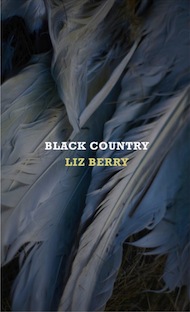
Liz Berry, Black Country (Chatto Poetry, 2014)

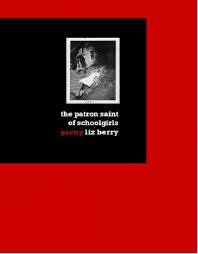
If a reputation can be earned through the writing of half a dozen poems of real worth then Liz Berry has probably already written them, earning her place in the landscape of early 21st century British poetry. Her debut collection (containing 14 poems from the earlier chapbook The Patron Saint of Schoolgirls (tall-lighthouse, 2010) has charm, accessibility and a humour that belies the serious ways in which she exerts pressure to counter the hegemonies of language, gender, locality, even of perception. Berry is a teacher by profession and will, no doubt, have equivocal feelings about her work appearing in classrooms – but it will rapidly and rightfully find a place there.

imgres

We resist what tries to define and suffocate us in part by declaring who we are. Berry’s confident, natural, even uninhibited use of her own Black Country dialect is one of the most superficially striking things about this book. Against “hours of elocution”, she opts for “vowels ferrous as nails, consonants // you could lick the coal from” (‘Homing’). Variously her grandmother and mother influence her in this and, in ‘The Sea of Talk’, her father also urges her never to forget the place of her birth with “its babble never caught by ink or book”. The definition of a community against the pull of a conventional linguistic centre is explicit here. Her grandmother is a frequent role model and the growing girl studies “her careful craft”. “Right bostin fittle”, the older woman declares (ie. great food – brains, trotters, groaty pudding) and the budding poet willingly touches her “lips to the hide of the past” to inherit the authentic gift.

Other poems, making it clear that locality is as much a component of who we are, record and celebrate the Black Country as “a wingless Pegasus” composed of scrub, derelict factories, disused coal shafts, yet still a “gift from the underworld” whose nature and fate is enough literally to make grown men weep (‘Black Country’). Berry takes huge pleasure in enumerating the details of her locale. “Come wi’ me, bab, wum Tipton-on-Cut” invites one poem which then takes a tour of waterways, allotments, parks, mosques, steelworks and canals (‘Tipton-On-Cut’). Similarly, ‘Christmas Eve’ seems to improvise from the great concluding paragraphs of Joyce’s story ‘The Dead’, using the ubiquitous fall of snow to lead the reader across the landscape of Beacon Hill, Bilston and Molineux.

Liz-Berry

We elude being imposed on and defined by others by changing. This, for me, is the more profound aspect of Berry’s work; so many poems unfold as processes of self-transformation. A mark of the book’s self-confidence can be found in ‘Bird’ which announces this motif of liberation: “When I became a bird, Lord, nothing could stop me”. Here, it is the mother’s voice urging, “Tek flight, chick, goo far fer the winter”. In keeping with this, the poems display a formal variety – free verse, short-lined quatrains, couplets, tercets, ballad forms, punctuation comes and goes. This is further reinforced by Berry’s bold, category-dissolving imagination which instinctively reaches for metamorphic possibilities. In ‘Birmingham Roller’ the escapee is a bird again, “jimmucking the breeze, somersaulting”; people become dogs, trees, pigs, fade to mere echoes, girls become boys. The donning of a pair of red shoes invigorates, eroticises: “rubies that glistened up a dress, / flushed thighs with fever” (‘The Red Shoes’).

Sexuality features so prominently in Black Country in part because of its potential for transgressive energy. I’m sure ‘Sow’ is anthology-bound with its “farmyardy sweet” female narrator, rejecting external definitions (“I’ve stopped denying meself”), accepting her true nature as a “guzzler, gilt. / Trollopy an’ canting”. This is a real tour de force of dialect, imaginative transformation and downright feminist self-realisation that “the sow I am / was squailin an’ biting to gerrout”, even daring the reader to “Root yer tongue beneath / me frock an’ gulp the brute stench of the sty”. Berry’s power of imaginative transformation is so powerful that the book creates mythic figures at will: the sow girl, the Black Country pegasus, the patron saint of school girls, Carmella the hairdresser, the Black Delph bride, the last lady ratcatcher. ‘Fishwife’ presents another of these figures like something from a quasi-pornographic Grimm’s tales. Attending a 17 year old girl’s wedding, she brings the gift of oysters, erotic energy, transgressive flirtation, power and ultimately pleasure:

                                            I slipped
from my bare skin
alive oh alive         all tail           all fin
how the tide tossed
until alive ohhh alive
the waves flung my shining body        upon the rock

She kisses the bride with “her tongue a plump trout” and other poems also resist categories to the extent of a sensation of gender-bending, or more accurately gender neutrality. I’ve already mentioned the girl who becomes a boy. ‘Trucker’s Mate’ reads like a homosexual “romance” and ‘In the Steam Room’ positively drips with sexuality – but of an explicitly “sexless” kind in which “any body / might give you pleasure”. ‘The Silver Birch’ achieves the extraordinary feat of evoking “sex [. . .] before sex” (eroticism before gender), “when I was neither girl or boy [. . .] a sheaf / of unwritten-upon paper”.

imgres

With so much dissolution of the normative, Berry dallies with the surreal and there can be dangers if the work does not also bear a weight of darkness. A poet like Tomaz Salamun writes in the tradition of Rimbaud’s systematic disorganisation of the senses, but combines, as Ed Hirsch suggests, “exuberant whimsy and fierce rebellion” to resist too easy a relationship with the pressures of the real. Happily, Black Country encompasses some richly productive tensions between the real and imagined, home and away, past and future, conformity and rebellion, sex and death. The latter rises to the surface through the middle of the book in poems like ‘The Bone Orchard Wench’, ‘Echo’ and the murder ballad ‘The Black Delph Bride’, acknowledging that the traffic between real and imagined contains plenty of irresolvable grit, impossible to wish away in any facile manner.

The collection concludes in more plainly autobiographical terms with the approach of the birth of a child and perhaps there is less imaginative pressure here, a risk of sentiment, “waiting [. . .] for the little creature that grew inside me”. Nevertheless, in reviewing first collections it’s traditional to look forward to achievements to come but this is inappropriate with Black Country simply because there is so much confidence, focus, shapeliness, already achieved uniqueness. Rather, this is a poet whose work presently demands our admiration. Oh yes . . . and what about those half dozen or so poems of real worth? I’d suggest ‘Bird’, ‘Bostin Fittle’, ‘Black Country’, ‘Tipton-On-Cut’, ‘The Silver Birch’, ‘Sow’, ‘Fishwife’. You’ll hear more of these in years to come.

Forward First Collections Reviewed #4 – Andrew McMillan

This is the fourth in the series of reviews I will post over the next two months of the 5 collections chosen for the 2015 Forward Prizes Felix Dennis award for best First Collection. The £5000 prize will be decided on 28th September. The shortlist is:

Mona Arshi – Small Hands (Liverpool University Press, Pavilion Poetry) reviewed here;
Sarah Howe – Loop of Jade (Chatto & Windus); reviewed here;
Andrew McMillan – physical (Cape Poetry); reviewed here;
Matthew Siegel – Blood Work (CB Editions) reviewed here;
Karen McCarthy Woolf – An Aviary of Small Birds (Carcanet) reviewed here.

Andrew McMillan – physical (Cape Poetry); author’s website here.
Article from The Independent on Andrew McMillan here.

A man’s torso, from just below the shoulder to half-way down the rounded buttocks, tastefully lit from the back to catch the curves, his left hand visible clutching (quite hard) his own right flank. It’s sexy and lonely and longing and anonymous. It’s a bit Fifty Shades but Cape Poetry’s cover image does say something about Andrew McMillan’s first full collection, though it’s too confining. It’s the sort of sharply targeted thing marketing people come up with and the author (who is achieving cleanly-shaped, clear, bold things in terms of subject-matter and form) may squirm at.

imgres

But the image is flauntingly male (and happily the skin blemishes have not been air-brushed) and what it is to be a man is certainly one of McMillan’s concerns. In ‘strongman’ a nephew wants to be bench-pressed by the male narrator and (even from the young child) this is a clear challenge as “his mother’s lover” often does it, the boy has declared the narrator’s boyfriend “illegal” and he brings with him the freight of traditional masculine values: “his dad’s voice and jaw”. The narrator obliges “because / what is masculinity if not taking the weight // of a boy and straining it from oneself?” It’s not just the bench-press requiring careful balance here in the close masculine contact, the show of strength, the carefully maintained distance in the preposition “from”. The inculcation of traditional male values starts early as in ‘The Schoolboys’ who clamber onto a bus, all bulge and muscle and “sprints of growth”, wrestling “to impress the girls”. The poem ‘things men take’ is one of McMillan’s lists, articulating a more adult version of this: they take “the room above the ceiling / the better pay the jobs / your space at the bar”. But it’s with a poem like ‘the men are weeping in the gym’ that we begin to see this poet’s determination to challenge the status quo in its brief fantasy of male affectiveness: “their hearts have grown too big / for their chests their chests have grown too big / for their shirts [. . . ] they are crying in the toilet”. There is real humour here as the gym is turned from a place of physical exercise to a place where emotions are released and flexed, a re-definition of those traditional ideas of ‘strength’: “they don’t hear / the thousands of tiny fracturings / needed to build something stronger”.

images

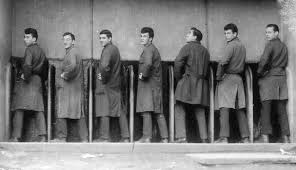
But masculinity as in what it is to be a gay man in love is even more central to physical. A definition of love emerges at the end of one poem which begins with awkward fears of (literally) bumping into men in a urinal, causing spillage, splash, a turning, the revelation: “neither of us will look / or he’ll look at me avoiding looking / feigning interest in the hard cream tiles”. This is funny again though halfway through the bluntly titled ‘urination’, McMillan considers the privacy and intimacy of “the toilet”, the poem lifting into praise of waking to hear (and smell) a lover pissing “the morning’s pale yellow loss” into the toilet “and take the whole of him in your hand / and feel the water moving through him”. Such intimacy of contact is one of the provisional definitions of love: “the prone flesh / what we expel from the body and what we let inside”. Poems that explore the physicality of the male body make this book remarkable, even given McMillan’s acknowledged debt to Thom Gunn. Much after the pattern of ‘urination’, ‘yoga’ begins with the physical stretching and breathing of the class, but shades seamlessly into a love-making which echoes the breath, control, weightlessness and absence of “judgement” in the discipline of yoga. ‘Saturday night’ takes lines from Gunn’s poem of that name this time to explore a more roaming, disjointed experience of love and sexuality. The rule of ‘Boss Cupid’ is no more reliable than in the straight world, of course, and McMillan gives us other images of sleeping with “Thom night after night / open at the spine”, rather than any flesh and blood lover. And ‘screen’ imagines how even a gay porn star, so perfect and capable on screen, in real life “without direction” struggles to express himself, “stopping mid kiss pulling back mumbling”.

imgres

As my quotes suggest, McMillan abandons most punctuation in these poems, using only line and stanza breaks and long spaces to create pauses and some sense of syntactical form. This works well – it doesn’t for me interrupt or confuse at all – and contributes to the often passionate flow of the poems. It’s hard to convey this in short quotes but ‘choke’, running for just 22 lines, takes us rapidly through a relationship break up, weeping, talking, loving and next day reflections, managing to evoke the agitation, fluidity of feelings, and final resolve “to tough it out” and the lack of pointing is part of this success. Elsewhere, the flow and even blurring achieved syntactically is just right for the loss of self-consciousness associated with sexual pleasure.

Jacob and the Angel - Epstein
Jacob and the Angel – Jacob Epstein

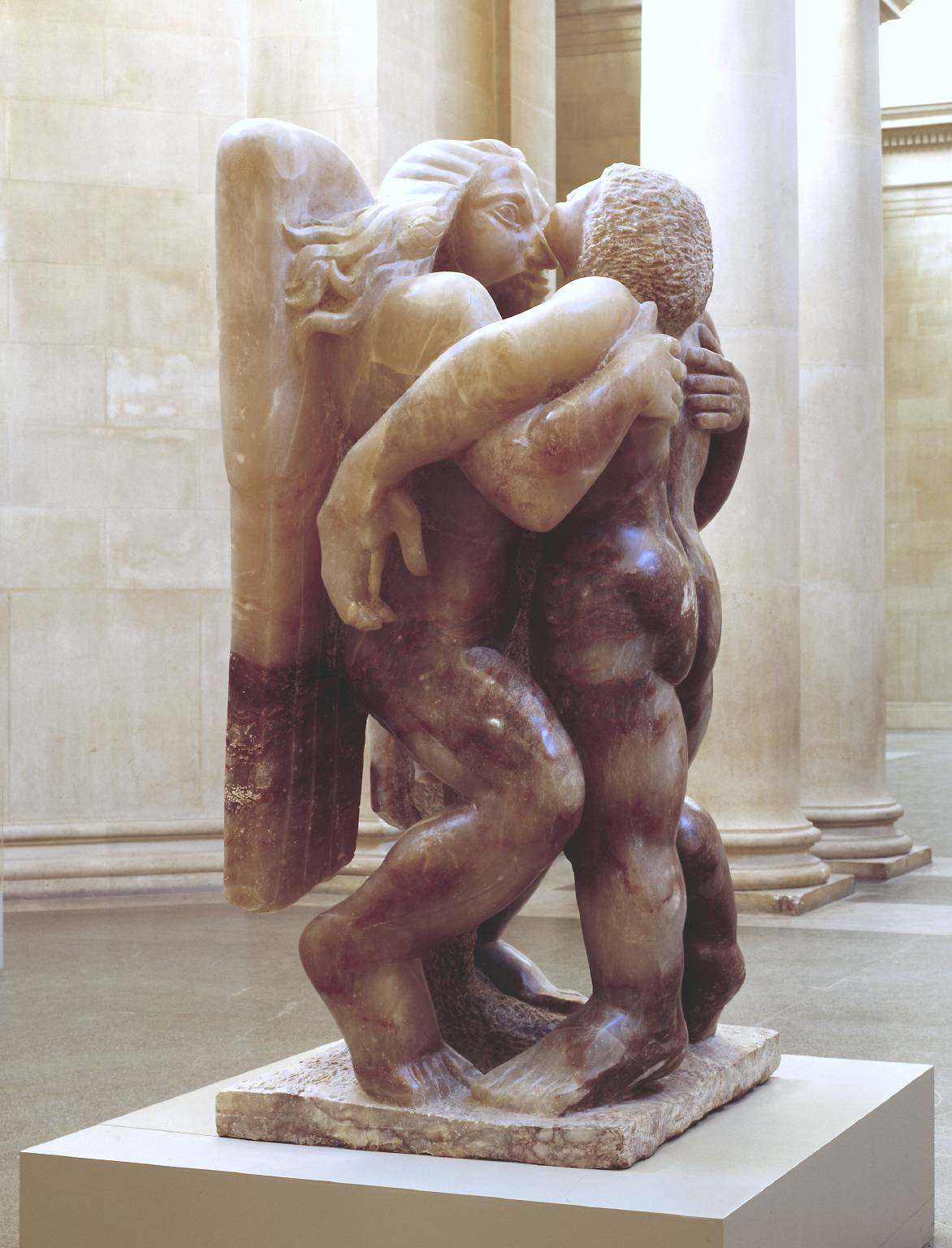
What is interesting is that beside the passionate and “carnal” (Michael Symmons Roberts) nature of much of this book and alongside Thom Gunn as mentor and role model, McMillan also name-checks C.S. Lewis’ Mere Christianity. The opening poem of the book portrays gay sexuality with Jacob wrestling the angel and I’ve mentioned the paralleling in ‘yoga’ and those beefy men crying in the gym are said to have “God” entering them as they weep. Furthermore, ‘revelations’ argues that each subsequent love is only a searching for the first, “in the manner of the humble saints who make / the worship of a nameless god relatable”. Each lover is renamed, Saint Gavin Saint Ged Saint Unknown / of Manchester Bedsit”. Humour is used here but it hardly disguises the poet’s interest in the more spiritual implications of the physicality his poems work so hard to evoke. This religious sensibility emerges in the brief foray, moving from Eros towards Thanatos, in poems in the third part of the book. The deaths of a grandfather and a young girl strike a very different note and suggest that McMillan may have found in Gunn not merely ways to explore his own sexuality in verse but also (from early Gunn) that existential sense, so wonderfully expressed in ‘On the Move’ (1957), that movement (whether on a motor bike or in bed) is at least one way towards self-definition: “astride the created will / They burst away [. . . ] Reaching no absolute in which to rest, / One is always nearer by not keeping still”.

imgres
Thom Gunn

There is something of this in the final poem of physical. Ironically titled ‘finally’, it evokes a new morning in “the xylophone / of sunthroughblinds”, but the lover is gone, not to return and the poet is like the birds who, though it hasn’t rained, pretend that it has, so “they can sing”. Earlier, the longer sequence ‘protest of the physical’ noted “there is beauty in the ordinary” but this is a pallid observation in contrast to this poet’s determination towards self-definition through loving, through singing when the loving is over.

In a collection full of humour and sadness alongside the plain-spoken eroticism, I really like what McMillan is doing with the fluidity of his form. I don’t think the longer sequence ‘protest of the physical’ is as good as the other sections of the book (I believe it preceded them in terms of date written) but here is a really talented and bold writer and I can see further areas of exploration opening up and it will be exciting to follow him there.

237946238_ca1d002403_b