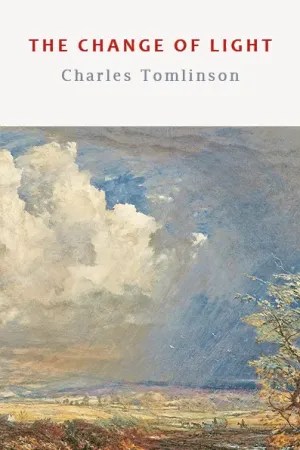
This review of Charles Tomlinson’s The Change of Light, published by Dare-Gale Press in 2025, first appeared in Acumen magazine, commissioned by reviews’ editor, Andrew Geary. Many thanks for the invitation to write about these fine, posthumously published poems.
Beginning to publish poems in the early 1950s, Charles Tomlinson will have been conscious of his outsider status on several fronts. Antipathetic to the still-echoing boom and verbal excess of Dylan Thomas, and sceptical of the narrowed range and palette of the fashionable Movement poets, the young Tomlinson was also developing an interest in European writing, which only became in vogue with Ted Hughes’ founding of Modern Poetry in Translation in 1965. Even further beyond the pale, his Cambridge friendship with Donald Davie stirred a lifelong enthusiasm for American poetry. His interest in things transatlantic yielded several extended visits to the US, and the 1966 collection American Scenes and Other Poems (OUP) which also boasted a section of ‘Mexican Poems’.

Tomlinson died in 2015 and The Change of Light from Dare-Gale Press is a timely reminder of his excellence. In these 22 late, unpublished poems, there are glimpses of his wide-ranging interests with allusions to French poetry, the Greek Islands, the Adriatic Coast, and even to Japan. But we are in a predominantly English landscape here, consisting of woodlands, rivers, trout streams and gardens. The poems are without exception beautiful in their precision, tonal elegance and civility of expression, pursuing, as Tomlinson always did, both the unfolding of abstract ideas as well as a close engagement with landscape and the natural world.
It is the poet’s acuity of observation that is immediately pleasurable for the reader. In ‘Between Seasons’, Tomlinson looks for Spring to arrive while a hawk moves through the garden, ‘on such sharp and silent wings, / It skims more like a knife’. This sort of equivocation between promise and threat is characteristic of the poet. The poem ‘On the Frontier: in March’ also explores the uncertain ‘swaying frontier’ between the seasons, the precarious balance of which is brilliantly conveyed in the sinuosity of Tomlinson’s syntax which runs as one single sentence through 23 lines, before a breath-taking expansion of vision to Planet Earth itself (‘this wandering sphere, / the unpiloted craft’). As this makes clear, Tomlinson’s often alluded to sense of Eden always did encompass what we now call eco-poetry and in ‘Snow’ the paradisal garden is once again deployed for the beauty of the earth, seen ‘with the eyes now / of its first inhabitants’.

The quality of observation in ‘Trout II’ is likewise as freshly peeled as to feel Edenic. The fish’s ‘wirey curvature’ is held as the water’s currents ‘caress, shape, swerve’ past it. The narrator contrasts the ‘Choice’ the creature has to ride the flow with the lack of choice possessed by a rock in the same stream. The trout has an agency, deciding to hang in the water, and is ‘Willing to be no more than weed / That fluctuates beside him like his shadow’, and in so choosing, the fish transforms its environment into ‘aim, discernment, dance’. Tomlinson imagines the creature acting with ‘pleasure’, a pleasure surely also felt by poet and reader, a pleasure derived in part from the trout’s willing abandonment of its body to the water’s flow.
Tomlinson valued chance in both life and creativity (a 1969 poem is called ‘The Chances of Rhyme’) and to take advantage of chance we need to yield up control. He wrote of embracing possibility, achieved only when the ‘self would have to embrace that possibility somewhat self-forgetfully, putting aside the more possessive and violent claims of personality’. This self-forgetfulness, the laying aside of individual personality, is key to Tomlinson’s work (and in passing, it is what makes him a great translator). ‘Raindrops Reconsidered’ contains a pun on the seeing ‘eye (an I)’ which observes best when the ego does not bring with it ‘fable’ or the preconceptions of our daily lives and language. ‘Views’ insists that the genuinely ‘realist’ perception questions the ‘bland misprisions of the day’ so that the everyday world suddenly ‘bursts into wing, flame, flights’, into a perception that is ‘festive’.
This ‘festive’ quality refreshes our acquaintance with the world, but it also opens up vistas in which the diminishment of the self becomes not decrease but an access to something greater. In ‘The Infinite’, sitting on a hillside, beside a hedge, the narrator finds an unnerving tranquillity. The wind in the trees contrasts this, opening up a sense of ‘eternity’ and the individual self vanishes into a wider sphere: ‘In this immensity / my own thoughts drown / and it is sweet to shipwreck in this sea’. For such a poet, the loss of any access to his senses would have been devastating. In 1997, a routine cataract operation went awry and deprived Tomlinson of the sight in his left eye. The loss of binocular vision means judging distances is difficult and Tomlinson here laments the ‘flat projection’ he now has instead of full sight (‘The Accident’).
The poems in The Change of Light would appear to be late work; in ‘Courteous Death’ Tomlinson senses his own mortality. Channelling a little bit of Emily Dickinson, the personification of a surprisingly polite Death advances to greet the poet. In a sudden change of mind, Death offers complete blindness rather than demise. Tomlinson’s ‘one good eye’ refuses (at least for a while). Yet like the rock in ‘Trout II’, there comes a point at which ‘preference has no power’, no choice, though up till now, the poet says, he has expected it to ‘tip the balance / Always in my favour’. But Death allows the poet a little more time, time spent perhaps, in part, on these really fine, pleasing and profound last poems.
 Martyn Crucefix