Charlie Louth’s Rilke + new Rilke translations

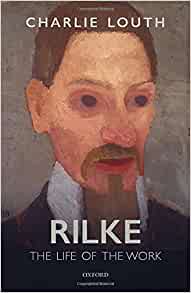
As I mentioned in my last blog post, much of my time through lockdown and in the last few months has been taken up with translation. One of these projects is as daunting as it is exciting. Pushkin Press have commissioned me to complete a new selection and translation of the work of Rainer Maria Rilke to appear in 2023. Some of you will be aware of my earlier published versions of the Duino Elegies and the Sonnets to Orpheus (both available from Enitharmon Press). The new project will contain selections from those sequences and a good selection of earlier poems, including from the New Poems. As well as trying out a few of my new translations in this post (and the following one), the body of it is an uncut version of my recent review of Charlie Louth’s excellent book on Rilke, Rilke: the Life of the Work (OUP, 2020). A shorter version of this review appeared in the latest Agenda magazine, ‘Altered Distances’ (Vol 54, Nos. 1/2). Many thanks to the editor, Patricia McCarthy for asking me to write it.

Part I

Rilke has long suffered from two types of criticism. Among his enthusiasts, some declare his work close to sacred and therefore hardly open to ‘normal’ practices of critical analysis, at risk of spoiling the ‘bloom’ of mystery they find there. Others, of a more negative inclination, accuse him of an aloof aestheticism, a likely fatal distance from ‘real’ life. One such was Thomas Mann who can be found, Charlie Louth notes, “(rather richly) calling him an ‘arch aesthete’”. Both viewpoints risk downplaying the skilled crafting of Rilke’s work (he thought long and hard about poems as artefacts, things consciously and intricately made) but also risk mistaking the particular power of his poetry. Rilke: the Life of the Work is comprehensive, erudite, always clear and – most importantly – keeps returning us to the poetry to which Louth enthusiastically responds: “When we read Rilke, the poems do not feel aloof, and they do not feel merely aesthetic in their claims. They press upon us and make us examine ourselves, and they help us experience our life in the world with greater clarity and depth”. Most readers will recognise this as an allusion to the ‘Archaic Torso of Apollo’ (from New Poems) which concludes “You must change your life”. Louth again: “It is unusual for Rilke to be so direct, but as I see it a similar spirit animates most if not all of his poems”.

This book aims to bridge the gulf between enthusiastic, non-specialist readers of poetry (Louth translates his foreign language quotations himself) and the German lang/lit academic and student. The balance between engaged readability and academic thoroughness is very well judged. I particularly value Louth’s close readings of ‘the work’, viewed as objectively as possible (Louth declares early on that he has no “overarching thesis”). There are other readily available biographical and critical works, but the strength of Rilke: the Life of the Work is that, with its discussion of the formal choices, wording and syntax of so many poems, it is a comprehensive attempt at ‘Reading Rilke’. The structure of the book’s 600 pages is primarily chronological, from the poet’s earliest publication, Lives and Songs (1894) through to Vergers (1926). Louth only departs from this chronological survey twice. Early on, he looks at several poems that open Rilke’s published books, then, in Chapter 6, he discusses the four poems Rilke wrote as requiems.

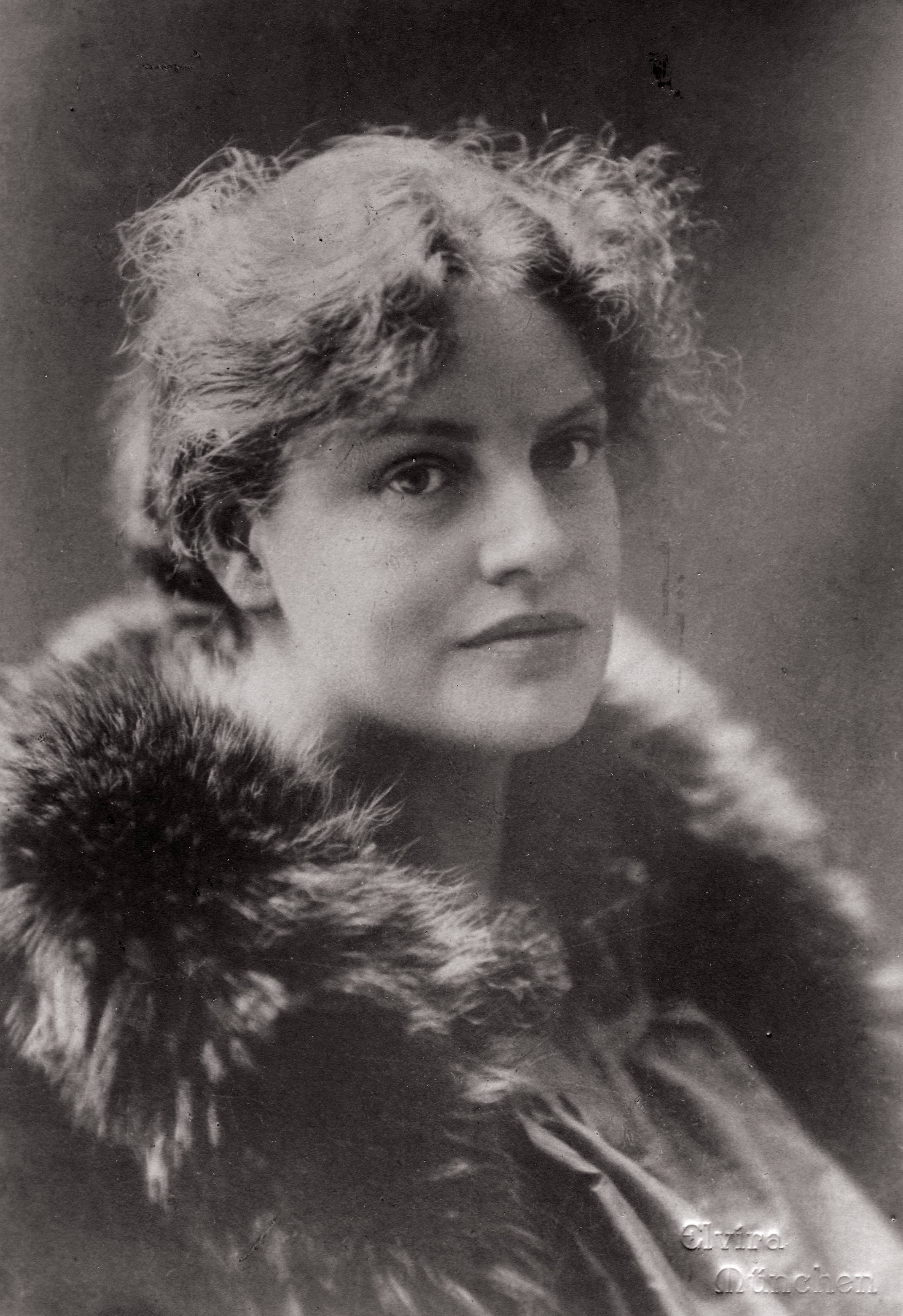
Lou Andreas Salome

So Louth’s Rilke is a craftsman and moralist who urges us to live better. The kind of closed system of a purely aesthetic art was the poet’s abhorrence. In a lecture he gave early in his career, Rilke is already sure that “‘art is only a path, not a destination’. In a letter to Lou Andreas-Salomé in 1903 he confirms: ‘I do not want to tear art and life apart; I know that in the end they are one and the same’. As so often, Louth articulates his subject’s attitude with great clarity: “for Rilke, there can be no question of shutting oneself away from life, of retreating into the work, and the desk, if it is to be the place of necessary writing, must be a ‘vitale Mitte’, a site right in the middle of life and exposed to all its risks and promises. To write is not to withdraw but precisely to engage”.

Rilke’s poetry pays particular attention to the processes of change associated with being human. Poems record such moments of change but also act, in the process of being read and openly experienced, as opportunities where change in an individual might take place. For those with faith in literature, Louth articulates the exciting prospect: “to read at all is to pause, is to take your time in times when an anxious haste pervades much of what we do. In some sense it is to live better whether poetry makes anything happen or not”. Writing to Thankmar von Münchhausen in 1915, Rilke asks, “What is our job if not, purely and freely, to provide occasions for change?” Louth finds these ideas in ‘Eingang’ / ‘Entrance’, one of the poems Rilke placed at the start of The Book of Images (1902/06). The furniture of this poem – the self, a house, a tree – is a grouping that recurs throughout Rilke’s work and what interests him is the suggestion that, as we leave the familiarity of our house, “the house of our habits, we enter the imaginary space of another building [. . .] coming from life into the poem, and passing through the poem into life”. Here is my new translation of this poem:

Whoever you are: in the evening, step out

of your living room, from all that’s familiar;

in the distance, the last thing, your house:

no matter who you are.

And although your eyes have grown so weary

you can barely lift them from the worn threshold,

slowly, with them, you still raise a black tree

and set it before the sky: lean and alone.

And you have made a world. And it is immense,

like a word, in silence, it continues to grow.

And as your will grasps its significance,

so your eyes, tenderly, let it go . . .

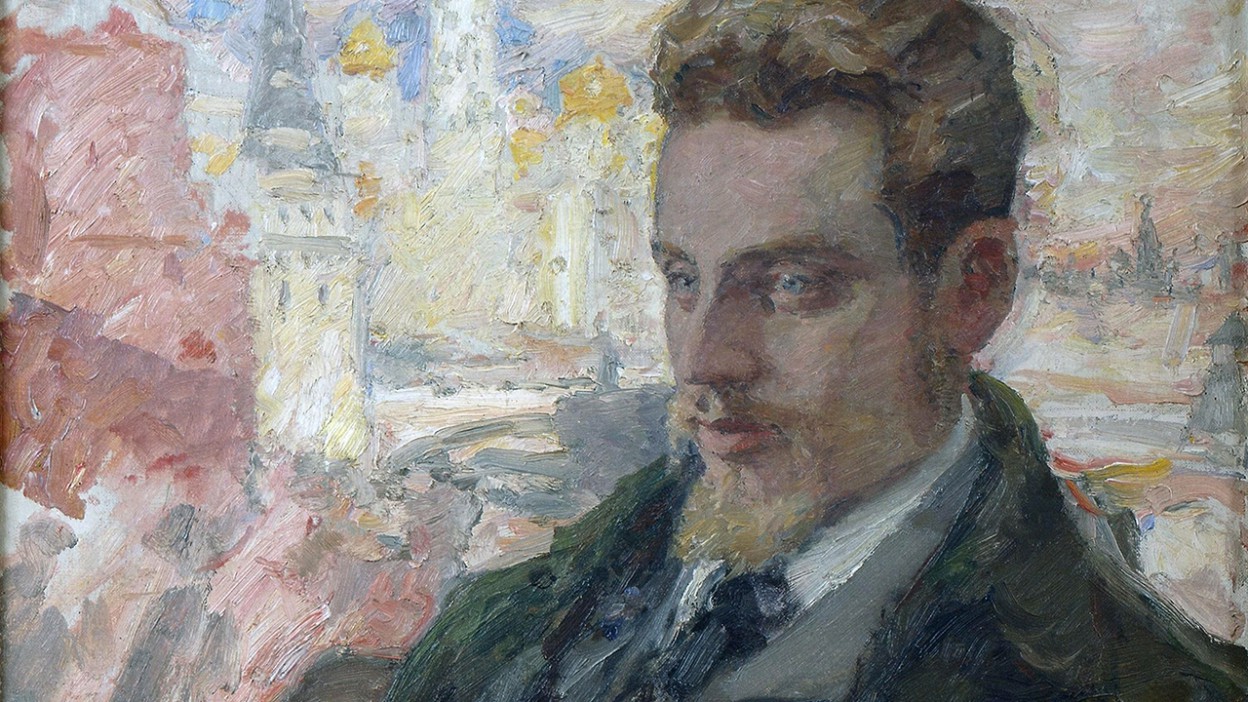
Portrait of Rainer Maria Rilke, 1928, by Leonid Pasternak

For Rilke’s own life and work, the key meeting was with Lou Andreas-Salomé in May 1897. Lou changed his handwriting and his name (from René to Rainer), but it was the confidence and groundedness in the world that she brought to his life that pushed his art “closer to the details of lived experience”. Rilke himself wrote: “The world lost its cloudiness [. . .] I learnt a simplicity, learnt slowly and laboriously how simple everything is, and I gained the maturity to talk of simple things”. Lou’s influence can be seen in the lecture he gave in Prague in 1898, where he distances himself from Symbolism and aestheticism (the dominant strands of ‘modern poetry’ at the turn of the century) to argue that the artist must not be “shut out of the great channel of life”, but must evoke the constant dialogue between the individual and things, “the strange coincidences between inner and outer out of which experience is made”. As Louth says, this is an early statement of the theme which will occupy his whole life.

Here is a brief poem – actually naming Lou and indicating her influence in persuading Rilke of the sacredness of the ordinary. It went unpublished for years, but was part of Rilke’s sequence called To Celebrate You (Dir zur Feier):

The rain runs its chilly fingers

down our windows, unseeing;                             

we lean back in deep armchairs

and listen, as if the quiet hours

dripped from a weary mill all evening.

x

And then Lou speaks. Our souls incline

one to another. Even cut flowers

at the window nod their topmost bloom

and we are completely at home,

here in this tranquil, white house.

For Rilke, the successful poem is a space in which the mysteries of things and personal confession are both explored, or revealed, simultaneously. Louth argues that, from the outset, Rilke’s view of this was always positive: “there is no unnerving consciousness of the self ’s arbitrary dependence on chance encounters with the outside world”, but equally, there is “no doubt about the existence of an underlying unity to which the poet has access”. What he feared was ‘the interpreted world’ (‘der gedeuteten Welt’), a world view shorn of all mystery, a perspective that perhaps most of us inhabit, a view in which language has become dominantly instrumental, “narrowing our vision so that life appears cut and dried without any possibility of the unknown and the unknowable”. Louth explains what readers of Rilke value in his work: “poetic language, as he understands it, is precisely a way of talking that avoids directness and allows the mutability of experience and the mystery of the world to be expressed. It releases rather than limits possibility”. Beyond this stands what Rilke might have meant by the term ‘God’. ‘He’ is “an experience of totality, life felt as a whole, in which self and other are not distinct or momentarily lose their distinctness”.

Here is my new translation of an early poem from The Book of Hours (Das Stundenbuch) in which Rilke is developing these ideas:

You, the darkness from which I came,

I love you more than the flame

scoring the world’s edge

with a glimmer

upon some sphere,

beyond which no-one has more knowledge.

x

Yet the darkness binds everything into itself:

all forms, flames, creatures, myself,

it seizes on them,

all powers, everything human . . .

x

And it may be: there is an immense might

stirring nearby –

x

I believe in the night.

It is in part because the enemy of mystery is language (too casually used) that poetry (constructed from language more carefully used) has an advantage over other art forms like painting. There’s an irony here, of course, because Rilke learned so much from other workers in the fine arts. Most know about the debt he owed to Rodin and Cezanne, but Louth argues Rilke’s journey towards the poetics of the New Poems began in the period he resided in the artists’ community in Germany at Worpswede. A lot of his thinking there concerned images of man and landscape. For the majority of the time, humans and nature live “side-by-side with hardly any knowledge of one another” and it is in the ‘as if’ of the work of art that they can be brought closer, into a more conscious relation. But because a poem works through time, such a correspondence is acknowledged as “something one traverses and gains knowledge of but cannot hold onto”.

Part 2 of this review coming next week…..

We’ll Meet Again/Well Met Again: my first public reading since lockdown

It has been a long time since I last posted anything substantial on my blog. In the great scheme of things pandemic, this will not have been remarked upon; though for anybody out there who has noticed, I send my apologies. A particular disappointment is that I have not been able to review this year’s shortlisted Forward First Collections (and the announcement of the winner is almost upon us). For what it’s worth, I think Caleb Femi will win with his Penguin collection, Poor. I still hope to review some of the shortlist, in the near future.

Though I have managed a couple of book reviews (on Pia Tafdrup’s new Bloodaxe collection, on Charlie Louth’s excellent book about Rilke) to be published elsewhere, alongside this blogging drought there has been a more significant one (for me at least): I have hardly managed to write any poetry of my own for well over nine months now. Even the few things I managed to draft (especially at the height of the Covid second wave (last January)), I have signally failed to return to and they may all now fall by the wayside. In moments, it is as if I have forgotten HOW to write a poem; a questioning of the importance of this solitary business; a simple lack of external stimulation perhaps. The one thing I have been able to do during this awful period is more translation. I have (happily) been commissioned to complete exciting projects for two publishers (publication dates off into 2023 in both cases) and I hope to say more about these in later blogs. Yes, my intention is to get back to blogging more regularly.

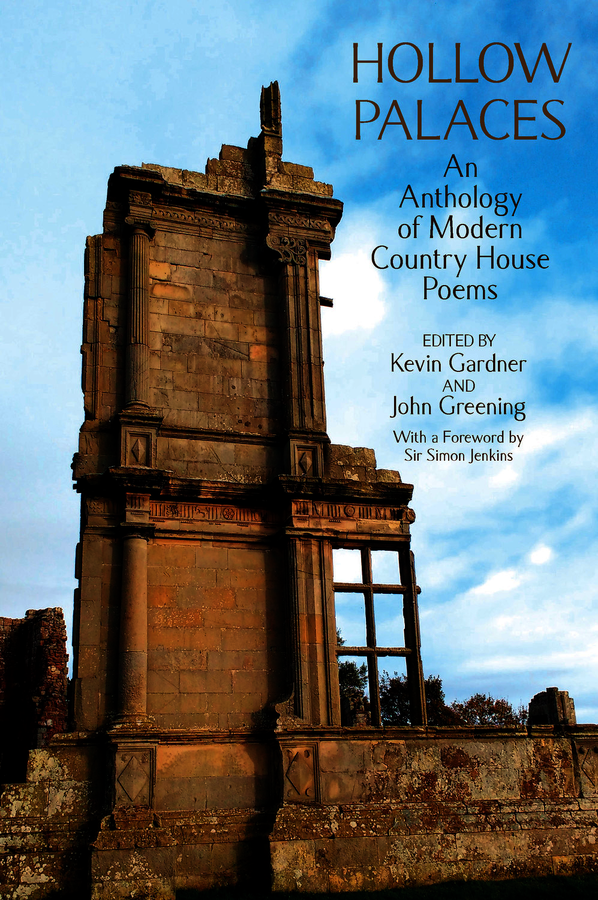
It has also been a long time since I gave anything resembling a public reading. But last Sunday afternoon I travelled with poet, Hilary Davies, out of London to Kimbolton School, north of Bedford for an actual in person book launch! The book was the sumptuous new anthology, Hollow Palaces, published by Liverpool University press and edited by John Greening and Kevin Gardner from Baylor University in the USA. The book is the first complete anthology of modern country house poems, including over 160 poets from Yeats and Betjeman to Heaney, Boland, Armitage and Evaristo.

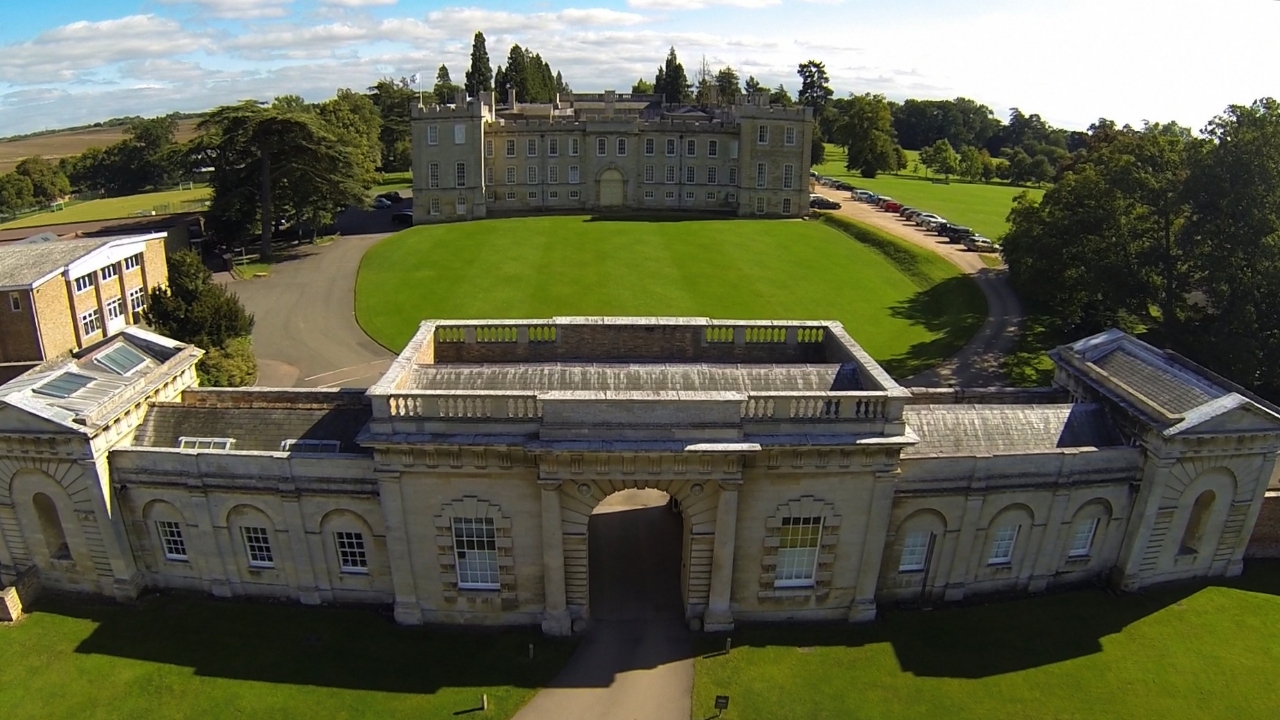
Kimbolton Castle

The venue was fittingly grand. Kimbolton Castle is a country house in the little town of Kimbolton, Huntingdonshire and it was the final home of King Henry VIII’s first wife, Catherine of Aragon. Originally a medieval castle, it was later converted into a stately palace and was the family seat of the Dukes of Manchester from 1615 until 1950. It now houses Kimbolton School and this is where John Greening taught for a number of years (alongside Stuart Henson, another poet represented in the anthology).

With the declining sun streaming in through the opened French windows, looking out across the school playing fields, after an introduction from Kevin Gardner, we each read a couple of poems from the anthology. So – amongst others – John Greening read ‘A Huntingdonshire Nocturne’ about the very room we were assembled in, a subtle take on English history and education, Ulster and Drogheda. Hilary Davies’s poem rooted in Old Gwernyfed Manor in Wales, was a fantasy of lust, sacrifice, murder and hauntings. Stuart Henson’s compressed novelistic piece mysteriously described the murder or suicide of a Fourteenth Earl. Anne Berkeley remembered childhood isolation and bullying at a dilapidated Revesby Abbey. Rory Waterman re-visited the ruins of an old, tied lodge-house his grandmother once lived in. Lisa Kelly’s chewy foregrounded language (‘O drear, o dreary dreary dirge for this deer’) shaped itself into a sonnet. Rebecca Watts looked slant and briefly at Ickworth House, a glimpse of bees in lavender. Robert Selby was at Chevening, considering the clash of perspectives between the tourist’s casual gaze and the realities of tombs, time and history.

I chose to read Louis MacNeice’s brilliant, late poem ‘Soap Suds’. Written in 1961, he is remembering the grand house called Seapark which overlooks Belfast Lough. Jon Stallworthy has called the poem a ‘Proustian daydream’, the simple act of washing one’s hands acting as the trigger for remembrance of time past. What appeals to me about the poems is its subtle handling of several times periods: the ageing man washing his hands, looking back to idyllic occasional visits to the house, as well as later, less happy times there (the house belonged to Thomas Macgregor Greer, only brother of MacNeice’s step-mother), the imagery beginning to verge on the nightmarish. (For another blog on MacNeice’s work click here.)

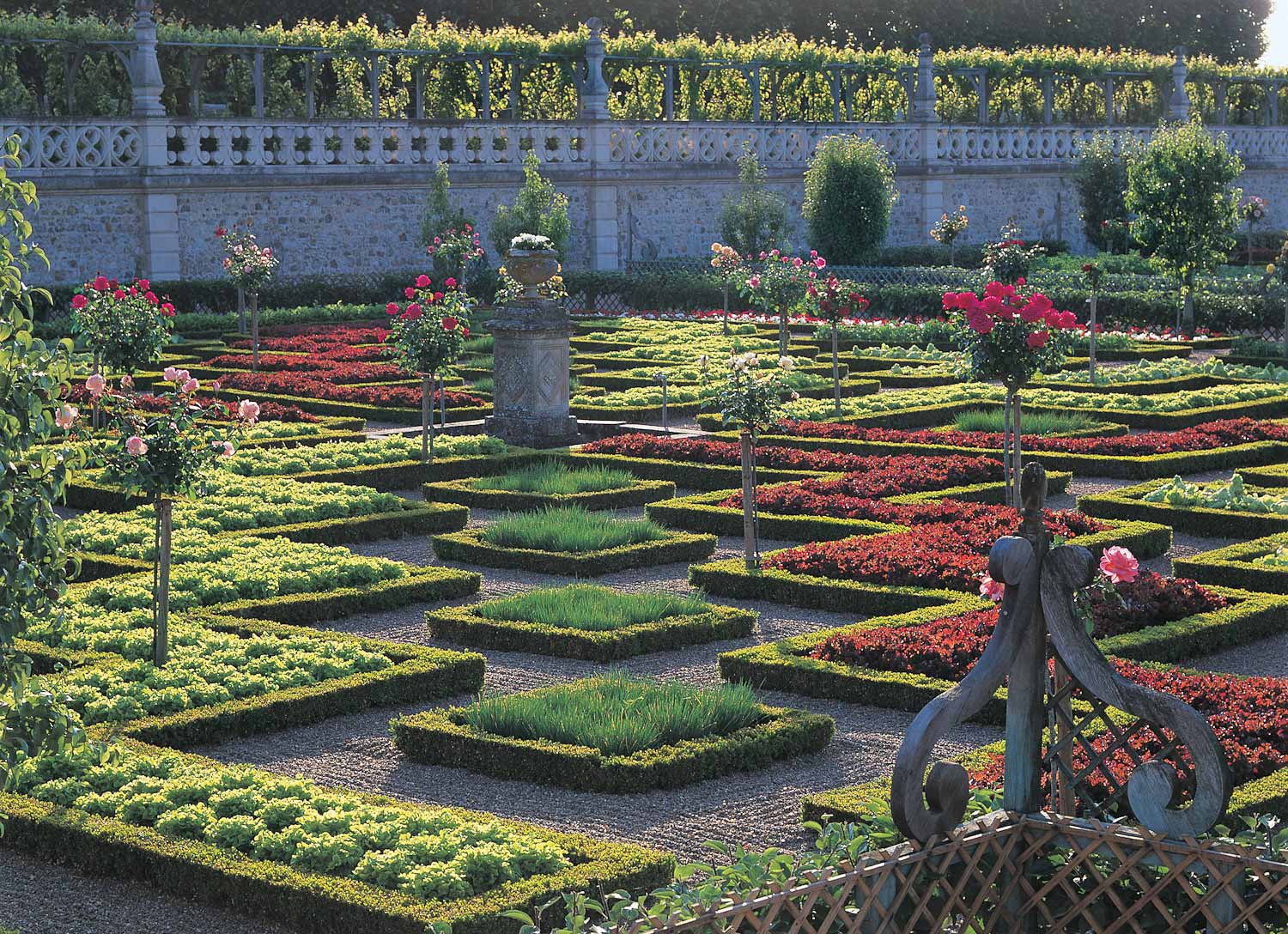
Chateau at Villandry

My own poem in the book, as yet unpublished elsewhere, is called ‘Our Weird Regiment’. The poems remembers a compilation of country house visits over the years. One was a visit to the French chateau at Villandry where the formal gardens, I remember, were not conventionally planted with flowers but with vegetables and herbs. I’m posting the text to MacNeice’s as well as my own poem, alongside the phone video (made by Jane Greening) of the 5/6 minute reading I gave at Kimbolton.

Soap Suds by Louis MacNeice

This brand of soap has the same smell as once in the big
House he visited when he was eight: the walls of the bathroom open
To reveal a lawn where a great yellow ball rolls back through a hoop
To rest at the head of a mallet held in the hands of a child.

And these were the joys of that house: a tower with a telescope;
Two great faded globes, one of the earth, one of the stars;
A stuffed black dog in the hall; a walled garden with bees;
A rabbit warren; a rockery; a vine under glass; the sea.

To which he has now returned. The day of course is fine
And a grown-up voice, cries Play! The mallet slowly swings,
Then crack, a great gong booms from the dog-dark hall and the ball
Skims forward through the hoop and then through the next and then

Through hoops where no hoops were and each dissolves in turn
And the grass has grown head-high and an angry voice cries Play!
But the ball is lost and the mallet slipped long since from the hands
Under the running tap that are not the hands of a child.

x

Our weird regiment by Martyn Crucefix

How the rich impress us

with what they own

displaying family photos

on the piano lid

as if no different

x

to those of us who shuffle

through elaborate rooms

or glance aside

through leaded glass

x

into formal gardens

where cabbage

potato and mint perhaps

chive and marjoram

x

are elegantly deployed

to be admired

not cooked or eaten

our guide explains

x

the farmlands purchased

to the churchyard wall

and then beyond it

every mound ploughed

x

and levelled in accord

with his lordship’s

goose-feathered whim

yet a scattering of bones

x

has assembled itself

in a heap at the gate

now beyond the gate

x

our weird regiment

lurches into the road

a swaying of skulls

and whitened knucklebones

Upcoming Zoom Reading by Martyn Crucefix

Oxford Stanza 2

Reading and Open Mic – Zoom Meeting

Date: Monday, May 24th

Time: 7pm

Martyn Crucefix is our headline reader. His recent publications include Cargo of Limbs (Hercules Editions, 2019), These Numbered Days, translations of the poems of Peter Huchel (Shearsman, 2019), which won the Schlegel-Tieck Translation prize 2020, and The Lovely Disciplines (Seren, 2017). O. at the Edge of the Gorge was also published by Guillemot Press in 2017. Martyn has translated the Duino Elegies – shortlisted for the 2007 Popescu Prize for European Poetry Translation – and Sonnets to Orpheus by Rainer Maria Rilke and the Daodejing – a new version in English (Enitharmon, 2016). He is currently a Royal Literary Fund Fellow at The British Library and blogs regularly on poetry, translation and teaching at http://www.martyncrucefix.com

  • Main Reader – Martyn will read both original poems and from his Schlegel-Tieck Translation prizewinning book of Peter Huchel’s work.
  • Questions and answers
  • Interval
  • Open mic poets

Join Zoom Meeting

https://us02web.zoom.us/j/84012338448?pwd=R0FCdS8ra3BVUjQrNFBWL1Jick00QT09

Meeting ID: 840 1233 8448

Passcode: 807313

For further information, please contact: kathleenmcphilemy@gmail.com

Peter Huchel in Translation – review

Marvellously thoughtful and well-informed review of my (fairly) recent translations of the poems of Peter Huchel. Also recent winner of the Society of Authors’ Schlegel-Tieck Prize for Translation 2020.

Many thanks to Rebecca DeWald and to Reading in Translation.

“Remember me, whispers the dust”: Peter Huchel’s “These Numbered Days,” translated from German by Martyn Crucefix (readingintranslation.com)

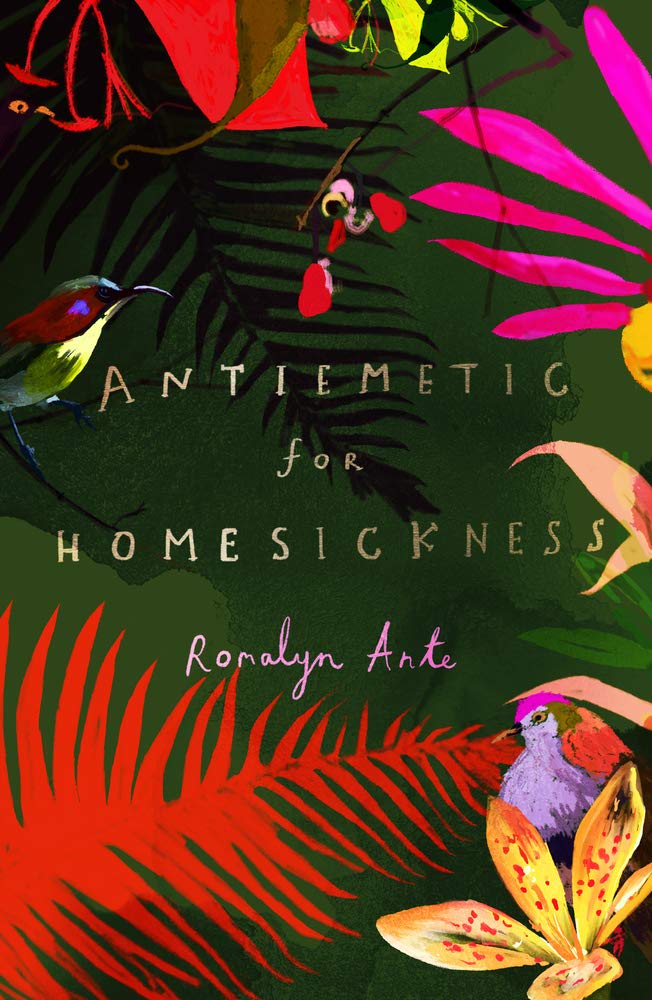
Tagay! on Romalyn Ante’s ‘Antiemetic for Homesickness’

Romalyn Ante was born in Lipa Batangas, in the Philippines, in 1989. For much of her childhood her parents were absent as migrant workers and the family moved to the UK in the mid-2000s where her mother was a nurse in the NHS. Ante herself now also works as a registered nurse and psychotherapist. As a result, this debut collection has multiple perspectives running through it: the child grappling with the parents’ absence, the mother’s exile, the daughter’s later emigration and a broader, political sense of the plight of migrant workers. The economic driving force behind such movements of people is recorded in ‘Mateo’, responding to the Gospel of Matthew’s observation about birds neither sowing nor reaping with this downright response: “But birds have no bills”. So, in poem after poem, the need for money, for a roof, livestock, fruit trees, medical treatment, even for grave plots back home is made evident.

Antiemetic for Homesickness also consequently has two prime locations: the UK appears as snow-bound streets, red buses, the day to day labour of nursing grateful (and often less than grateful) patients, casual racism. But it is the home country that predominates in vivid images of its landscape, people, culture, folk tales, food and frequent fragments of its Tagalog language (there is a glossary of sorts, but I found many phrases not included). So the promise implied by the title poem – a cure for homesickness – is willed, even a delusion, but a necessary one adopted for self-preservation. It’s a great poem. Opening with “A day will come when you won’t miss / the country na nagluwal sa ‘yo” (lit. who gave birth to you), it also closes in the same mood: “You will learn to heal the wounds / of [patients’] lives and the wounds of yours”. But the central stanzas are densely populated by memories of home, the airport goodbyes, the tapes recorded by left-behind children, the recalled intimacies of the left-behind husband, the gatherings and food of the distant place. The antiemetic is proving less than effective.

This is the material for all Ante’s poems here. ‘The Making of a Smuggler’ opens with “Wherever we travel, we carry / the whole country with us” – lines that recall Moniza Alvi’s, ‘The country at my shoulder’ from 1993. Despite Ante’s personal experiences, these poems often speak in this plural pronoun (a sense of solidarity in experiences shared plus a pained awareness of the plight of unnumbered, unknown migrant workers). The ‘smuggling’ image also suggests an illicit action, a coming under suspicion in the destination country. What is being smuggled across borders under the insensitive noses of its guardians are memories, places: “He can’t cup his ear // with my palm and hear the surfs / of Siargao beach”. If these are thoughts on arrival then ‘Notes inside a Balikbayan Box’ evoke the on-going sense of loss, distance, almost bereavement accumulating through years of working abroad. Such boxes – Ante’s notes explain – are used by Overseas Filipino Workers (OFW) and filled with small gifts to be eventually sent back home, a kind of ‘repatriate box’.

Accordingly, the poem takes the form of a note – “Dear son” – partly accompanying objects such as shoes, video tapes, E45 cream, incontinence pads, perfume but, just as important, offering life-advice and apologies:

I owe you for every Simbang Gabi and PTA meeting

I could not attend. I promise I’ll be there for Christmas.

I know I’ve been saying this for a decade now.

Romalyn Ante

Scattered throughout the collection are short extracts intended to reflect cassette tape recordings – sent in the reverse direction to the Balikbayan Box – by a child to her distant mother. The risks of attempting such a child’s perspective are many and Ante keeps these little more than fragmentary utterances, not authentically child-like. These were some of the less successful moments in the collection, many others of which also arose from such formal experiments. Ante tries out the forms of a drug protocol, a questionnaire, a concrete poem, centred, right or left justified verse, prose passages, assemblages of fragments, typographical variants. Such moments presumably constitute the “dazzling formal dexterity” alluded to in the jacket blurb, but you’d not read Ante for this but for the poems’ “emotional resonance”, also referred to in the blurb.

Siargao Beach

The plurality of her subjects also gives rise to poems in several voices. ‘Tagay!’ portrays the migrant workers’ embattled situation and their making the best of it through the communal drinking of Lambanog (distilled palm liquor) – the title is something akin to ‘Cheers!’ Each speaker toasts the others present, going on to imagine their personal homecoming: welcoming smiles at Arrivals, the bringing home of Cadbury’s chocolate, the heat of Manila, home-cooked food at last, story-telling, marital sex. Many of the speakers cannot keep their work out of the moment: “Tomorrow we’ll be changing bed covers, / soaking dentures, creaming cracked heels”… but for the moment, “Tagay!” Something similar is attempted in ‘Group Portrait at the Stopover’, in which migrant workers are briefly thrown together at an airport, in 5 short sections swapping gifts and stories of their labours and abuse, preferring not to think “of the next generation that will meet at this gate, / the same old stories that will hum out of younger mouths”.

‘Group Portrait..’ is one of Ante’s poems that explicitly addresses the long-standing global reality of migrant labour and ‘Invisible Women’ does the same. These are the women, world over, who are seldom given credit or even attention, yet are “goddesses of caring and tending”. Ante’s mother is one of them, a woman who “walks to work when the sky is black / and comes out from work when the sky is black” (the studied repetitions here more effective than many other formal innovations). The deification of such women is part of Ante’s point. The costs of such migration are repeatedly made clear in this book, but the admiration for those who leave home to earn money for the benefit of those left at home is also clear. These invisible women (and as often men) are heroic in their determination, their sacrifices and their hard work.

A poem that returns the reader to the individual is ‘Ode to a Pot Noodle’. Owing something to Neruda’s Odas elementales (1954), the narrator is taking a short break from “fast-paced” hospital duties – a Pot Noodle is all there is time for. In the daze of night and fatigue, images arise (of course) of her distant home, her grandfather, of Philippine food and conversations that, in the time it takes to boil a kettle, vanish as quickly. She addresses those distant people: “this should have been an ode to you. / Forgive me, forgive me”. But the Ode has already been written in the course of Antiemetic for Homesickness. The collection is a testament to the presence of the absent, the persistence of memory, the heroism and suffering of those who we hold at arms’ length, invisible but without whom our modern society – our NHS – would fail to function. In the time of Covid – and after it too – Romalyn Ante’s book is reminding us of debts and inequalities too long unacknowledged.

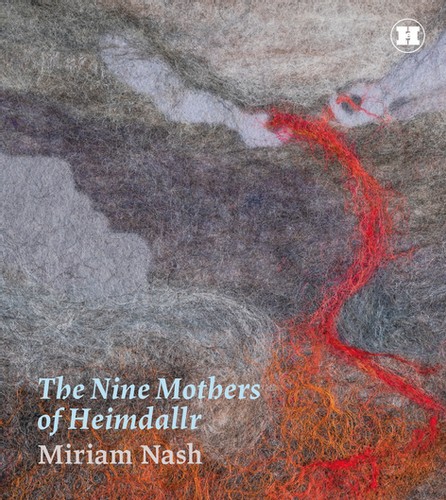
Gods and Giants: Miriam Nash’s ‘The Nine Mothers of Heimdallr’

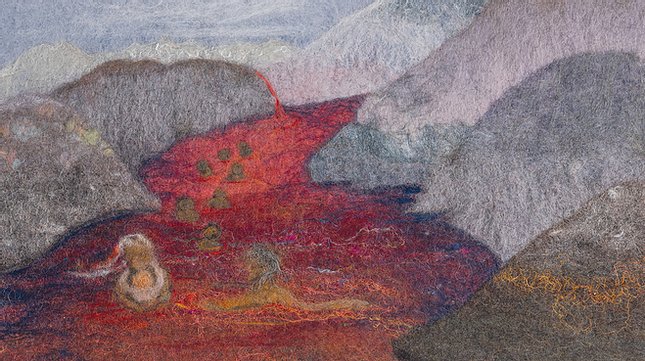
Miriam Nash’s new, 180 line poem is fascinating in the transformation of its sources in Norse myth, its quiet yet firm challenging of racial and gender hierarchies and in its exquisite presentation by Hercules Editions, accompanied as it is by an essay from Jóhanna Katrín Friðriksdóttir and textiles imagery created by Christina Edlund-Plater (in fact, Nash’s mother).

Friðriksdóttir gives those of us not up to speed with the Norse sagas some explanation. It seems the gods were actually not primary but descended from the race of giants. Yet since gaining supremacy, the gods have excluded and denigrated the giants. Generated from a hegemonic point of view (the top people in medieval Icelandic society), these Norse myths (as do most) tend to “justify and naturalise the status quo”, as Friðriksdóttir puts it, and what is being naturalised is a particular view of history, ancestry and masculinity. The anxiety of the Norse myths is a familiar one, tied up with patriarchy and the male control of women. There is a scene of ‘original sin’ in these stories in which the gods, Odin and his brothers, kill Ymir, the first and oldest giant. Out of Ymir’s dismembered body parts, the gods create the earth. This is a Fall from a primordial unitary state; Friðriksdóttir again: “at this juncture, one group becomes two” and conflict becomes the condition of life on earth.

So much for the birth of conflict and violence. The sagas are also notable for the relative absence of the feminine. An exception can be found in obscure references to the god Heimdallr who was born from nine giant mothers (possibly sisters) and it is through ‘writing on’ from these few suggestions that Miriam Nash’s poem develops a richly female addition to the Norse sagas. She challenges the old tales’ defensiveness about race (giant and gods) and gender and offers the modern reader a narrative of nurture, warmth and closeness in contrast to violence and conflict. The battle lines as they are drawn up are pretty obvious and will surprise no-one but Nash’s use of balladic form, of spoken voices and her re-scripting of details from the traditional stories conveys something vital and moving, a new myth for the age of Black Lives Matter and the #MeToo movement with its original purpose of empowering women through empathy.

Nash’s poem opens at the heart of an unorthodox family with one of Heimdallr’s mothers speaking tenderly. The whole family have gathered round a campfire, a hearth, in various states of sleep and wakefulness, cooking, sword-sharpening, comforting and acting as a seer. She tells Heimdallr the story of his remote origins in the primordial time when division was not known: “a tale of giants, a tale of gods / in early time, in frost-fire time”. A time of community and peace: “we lived snore-close, heart-close”. Also a time before language (or at least, language as we now have it) and Nash makes Ymir – the representative figure of this lost age – a “mother-father”, represented by the possessive determiner “their”. As in the traditional stories, Ymir creates/finds Buri in a glacier and Odin is Buri’s grandson. It is Odin who first declares division:

Odin said he was a God

Odin said the Gods were old

older than Ymir or giants

older than the ice-fire world.

Miriam Nash

This is an example of Nash’s form – loose quatrains of usually 4-beat lines, often part-rhymed at lines 2 and 4. And Odin’s declaration – his myth creation, his propaganda, his re-writing of history, his self-aggrandisement – is at the heart of the world’s troubles. Heimdallr asks who made the gods and the answer is that “They made themselves / with stories”. The poem goes on to recount Odin’s slaying of Ymir and the word “blood” recurs over and over again in the following quatrains.

But it is a blood ocean across which the nine mothers of Heimdallr have protectively carried their child. The child instinctively sees the roots of division and does not want to be “a half”, does not want to be merely “a god”. The comforting mother’s voice offers a startling solution (if we live in the fallen world); “Ymir was mother-father, child / Both might be your path”. The possibility is raised of a mode of living in which opposites may be once again reconciled, male/female, god/giant, fire/ice and the passage towards such a life is evidently through the tenderness and supportiveness of the mothers who advise Heimdallr to: “dream of ice-lands and of flame / sleep, snore-close, heart-close to me”.

One being walked – on Ricky Ray’s ‘The Sound of the Earth Singing to Herself’

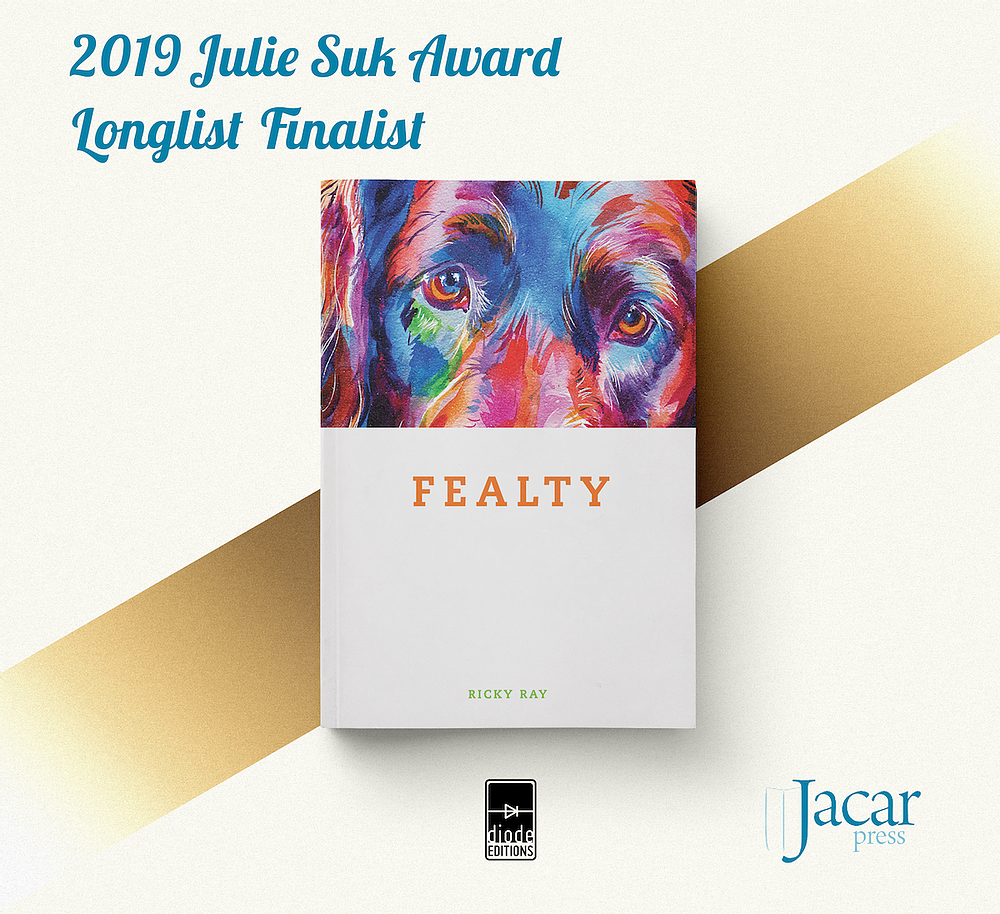
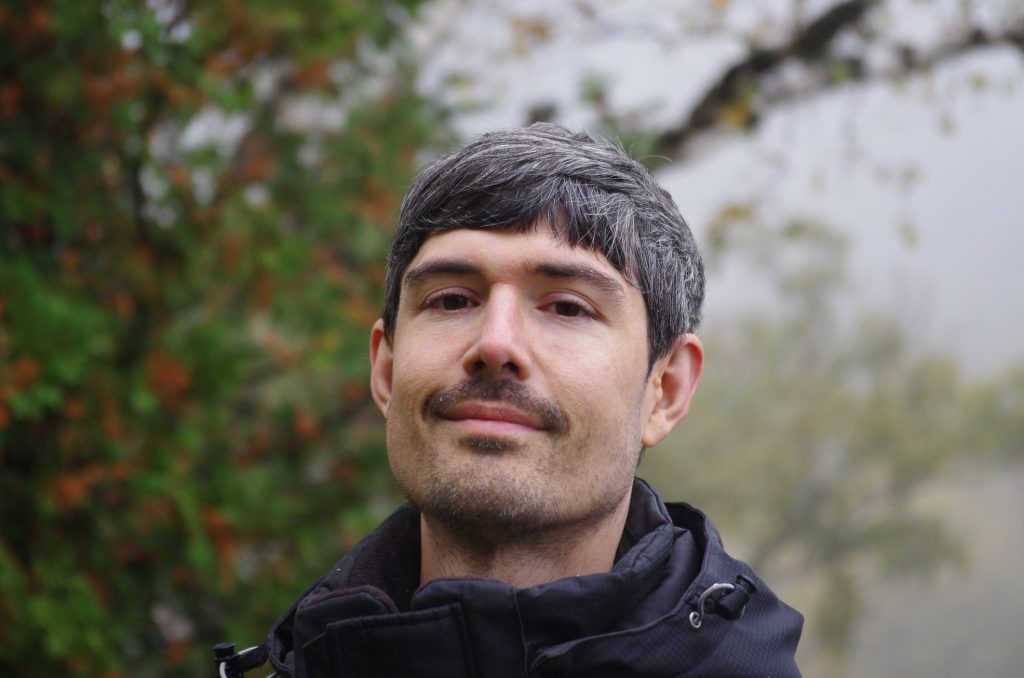
This is the second of Ricky Ray’s chapbooks to be published in the UK this year (2020) – the other is appearing with Broken Sleep Books under the title, Quiet, Grit, Glory. A full collection, Fealty, also appeared in the UK through Eyewear Publishing in 2018 and it is now republished in the US by Diode Editions. The biographical note from Fly on the Wall Press refers to Ray as “a disabled poet, critic, essayist and founding editor of Rascal: a Journal of Ecology, Literature and Art– all this suggesting that Ray has several highly ‘categorizable’ aspects to his work, but from the evidence in The Sound of the Earth Singing to Herself, he manages, to the benefit of us all, to elude being pigeon-holed in any neat way. See Ricky Ray reading poetry on the completion of his MFA degree – featuring poems about “dogs, disability, waywardness, childhood, childlessness, ecological consciousness, despair, and the search for hope”. 

If poems can withstand the pressure of readers drawing biographical conclusions, Ray’s upbringing was difficult. ‘Sometimes Vision Withers on the Vine’ portrays a chaotic, poverty-stricken household with erratic running water and power supply because “crack was more alluring than the bills”. The boy’s drug-using father’s drug-using friend burns candles on the palm of his hand, apparently feeling no pain. The vision seen in the light seems to be nothing more than a death’s head, a version of the future in which “nothing happens”. Another poem remembers the putting down of a pet dog: “the news // had blown out all moisture and made of my body / Oklahoma”. This is an amazing image of a sudden expansiveness of the self, or its wiping out, in a state of grief at the loss of a creature the boy regarded as closer to a brother. The father had the dog destroyed, as we say, out of kindness, and the boy/poet comments: “a kindness I never wanted, still don’t”, thereby broaching the subject of his own ‘viability’.

Ray’s physical disabilities give him relentless pain, the prospect of comfort realistically being merely “pain / that relents / from a knife-twist / to a dog gnawing / an old / bone” (‘What’s Left’). ‘Toward What’ records a good day in which he falls only once and “take[s] three / minutes to ascend six stairs”. Yet there are some days, “my body is so beautiful / I can’t believe I get to live here” (‘(Dis)ability’). It’s somewhere along this existential line, between the confines of a body in pain and the expansive, close to out of body experience, signalled by that Oklahoma image, that Ray’s poems really come into their own. He can celebrate an incarnated, ‘being in the world’, with both a sense of its pleasures and a sense of what it costs to remain here.

Such a celebration is ‘So Long as There is Light, There is Song’. The narrator and his dog, Addie, are in a field, the dog’s pleasurable ease in the world engendering similar feelings in the poet. There’s a Whitmanesque quality to the loafing in the grass, the blessing of ants, of the grass itself, the dawning sense of a life larger than any of the individuals present:

                        You could call it continuity.

You could call it the field itself. I like to call it what calls.

And I like to live in her song.

For want of a better label, what is sensed is the Earth, “singing her duet with the sun”, the natural world for sure, but Ray’s language implies a close to sentient being, sensed in the co-habiting of the multitude of separate living things. In considering the ravaging of ‘My Favourite Sweater’ by moths, Ray shows how the human heart might respond to such a sense of “continuity”, in the generosity of his wishing “the moths no ill”:

[I] say to myself it’s all down to pattern, a shifting

pattern, a thread of wool raveling into a thread of moth,

the moth’s wings the stitchwork of the hand that knits us all,

the hand itself a stitch along a seam my mind unravels

It’s Whitman’s long lines and levelling up of all phenomena that comes to mind as the poem goes on to “thank until I run out of things to thank”. Even in the midst of natural danger – in this case a hurricane – the poet/narrator seems to revel in the ominous signals of the storm’s approach, promising to protect his dog. Like the Oklahoma image earlier, this poem (‘On Hurricanes’) ends in mid-flight, the storm raging, the individual consciousness being smashed and scattered, “like fusion, like retribution—/ bang bang bang”. Yet the final image of peril in the face of nature is also an image of becoming one with it, of realising a kind of incarnation: “the roar of it so loud / I can hear the lion’s mouth around my head”.

Ricky Ray

If ‘On Hurricanes’ reaches apocalyptic levels, the final poem in this chapbook is calmer, more meditative. ‘A Walk in the Woods’ opens with nature and Ray’s ever-present dog, Addie, being company enough for an individual who, for a variety of alienating reasons, has never felt humanity was “a species I was given to understand”. He identifies more with trees, “which may be a function of how poorly my legs work”. The presence of trees consoles, inspires, as Ray again approaches the trailing hem of the divine: “I see a mind at work. Whose, though?” The questioning is not pursued by the rational mind; rather the experiential pleasure – a drifting in an “amniotic ocean” – is allowed to be all. Instead, of an individual walking through a wood, the poem offers us a sensation not of “one walking” but rather of “one being walked”, a moment we might think of as disembodied from the physical world but is as much incarnated within it and is perhaps the most heightened state of environmental consciousness.

The Outlaw Beyond the Wall: the poetry of Peter Huchel

To mark the shortlisting – for the Society of Authors’ Schlegel-Tieck Translation Prize 2020 – of my Peter Huchel translations, published by Shearsman Books, I’m posting here a piece I wrote about Huchel’s poetry which first appeared in Acumen 98 (September 2020). Peter Huchel’s work has its place in the tradition of the greats of twentieth-century German poetry – Rilke, Trakl, Brecht, Benn and Celan – but he is also, as Karen Leeder has argued, a “one off”.[i] Iain Galbraith also lists Huchel among a “handful of essential post-war poets” in German, but his poetry is far less well known than it deserves to be. His presence in English at all is thanks to Michael Hamburger’s 1983 translations published by Anvil[ii]. I came across isolated examples of his work a few years ago and was immediately drawn to his startling observations of the natural world which function often as “metaphors [to] take us deep into the social and historical landscape” of his era (Galbraith again). I believe he is a poet with important things to say to us in our own conflicted times and my translation of Huchel’s best collection, These Numbered Days (1972), was published last year by Shearsman Books. Here, I put Huchel’s work into the context of the great events in Europe in the twentieth century.


Huchel’s description of Pe-Lo-Thien, the poet, social critic and sometime exile from the Tang Dynasty, is intended also as a portrait of the poet himself – a dissident figure, an “outlaw, / who lives beyond the wall / with his cranes and cats” (‘Pe-Lo-Thien’). It’s no surprise that the spare, impersonal, often lapidary quality of the poems in These Numbered Days was remarked on by Karl Alfred Wolken as offering the reader something of a Chinese book in German.[iii] The poet himself, carefully scrutinising the natural world – the perception of which constitutes the substance of so many of his poems – tries to descry “Signs, / written by the hand / of a Mandarin” (‘No Answer’). If such allusions suggest a minimalist and tight-lipped quality to Huchel’s poems, this is precisely what might be expected from an artist forced to play, as he did for so many years, the role of inner émigré.

For readers of British and Irish poetry, the term ‘inner émigré’ will be familiar from Seamus Heaney’s use of it in his 1975 poem ‘Exposure’. Discussing the idea, Heaney acknowledged the term’s specific meaning in the 1920/30s in Soviet Russia as referring to a dissident who had not actually gone into exile but remained at home, disaffected from and under the surveillance of the authorities. Heaney saw himself in this light in relation to Northern Ireland. He also associated the idea with the position of George Seferis, concluding that “poetry secures some final place in your being, some little redoubt in your consciousness that will not be taken over by history or the world or disaster”.[iv] This same sense of confinement, wrestling with conscience and the frequent resort to codification which results from such a compromised position is the best way into Huchel’s work as a writer whose life and historical circumstances astonishingly led him to play the role of inner émigré twice over.

He was born Hellmut Huchel in 1903 in Alt-Lichterfelde, now part of Berlin. Due to his mother’s chronic illness, the boy was taken from the city to be raised on his grandfather’s farm at Alt-Langewisch, in the Brandenburg countryside near Potsdam. As an adult, Huchel was fond of quoting St. Augustine on the importance of memory as a “great field or a spacious palace, a storehouse for countless images of all kinds”.[v] Huchel argued that it is “the experiences of childhood, roughly between the ages of five and ten, that exercise a decisive influence in later years”.[vi] But if this period seems to have had something of the idyll about it for the 11 year old boy, it was dramatically shattered by the death of his beloved grandfather and the outbreak of war in Europe in 1914.

After his country’s defeat, the 17 year old Huchel took part in the conservative Kapp-Putsch against the Weimar Republic in 1920 which was fuelled by a resentment of the German government’s agreeing to the punishing conditions of the Treaty of Versailles. Huchel was wounded in the fighting associated with this failed coup but it was during his recovery in hospital that his sympathies for socialism and Marxism fully developed. His very early poems can be linked to the sort of art fostered by the League of Proletarian Revolutionary Writers. He has said: “What did I care about in those days? I wanted to make visible in the poem a deliberately ignored, suppressed class, the class of the people, the maidservants and coachmen”.[vii]

By 1932 he was working as an editorial assistant for Die Literarische Welt. His first collection of poems was accepted for publication under the title Der Knabenteich (‘The Boy’s Pond’). But with the rise of Hitler, Die Literarische Welt had to cease publication and it is at this moment that Huchel developed the strategy of the ‘inner émigré’. He published very little, eventually deciding to withhold Der Knabenteich. He was deeply troubled that the Nazis liked his work, reading into it as they did a version of the blood and soil nationalism they hoped to foster. So, by 1936 he was refusing permission for any publication and he did not publish any new poems during the rest of Hitler’s rule. Rather, he withdrew to the Brandenburg countryside. His response to tyranny was silence and non-cooperation, though he was eventually drafted in 1941 and ended the war in a Russian prisoner of war camp.

With the fall of the Third Reich, Huchel enthusiastically shared the democratic and socialist optimism of many of his compatriots for the reconstruction of East Germany. His short-lived faith in land reform in the immediate Soviet-Occupied post-war years is consistent with his earlier social concerns. He now began working for East German radio and in 1948 at last published his first collection, Gedichte (‘Poems’). In 1949 he became editor of the influential literary magazine Sinn und Form (‘Sense and Form’). Though Huchel’s poems were applauded both for their craft and socialist undercurrents, they did not satisfy those who were soon demanding much more explicit support for the German Democratic experiment. Huchel’s dark rural landscapes offered equivocal support at best for the governing regime and his instinctively conservative harking back to childhood and the natural world (rather than a modern revolutionary transformation of human society) were judged to fall short of the expected unquestioning celebration of the GDR’s project.

With the poet’s increasing sense of disaffection from the direction of GDR society, Huchel was once more forced to adopt the role of ‘inner émigré’. The tone of his work becomes increasingly sombre and melancholy, his poetic diction grows more clipped and cryptic, his palette narrowing. In his work at the journal Sinn und Form, he was determined to maintain editorial freedom and the publication flaunted an international outlook with contributions from Aragon, Bloch, Brecht (two special issues), Camus, Eluard, Langston Hughes, Thomas Mann, Neruda, Sartre, Yevtushenko and Zweig. Increasingly, he came into conflict with the authorities and was put under immense pressure to conform. He resisted for 13 years – in large part because of the determined support of Brecht. Brecht’s death in 1956 left Huchel exposed and he was asked to resign his editorship. He refused and so compelled the East German government publicly to force his resignation.

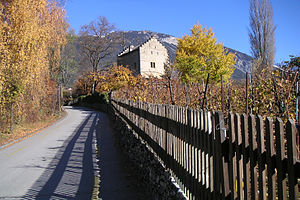
The Huchel house, Wilhelmshorst

A year after the building of the Berlin Wall in 1961, Huchel was banished at the age of 59 to effective house arrest in Wilhelmshorst. It was at this moment that his second collection of poems, Chausseen, Chausseen (‘Roads, Roads’), appeared. He published it – in bold defiance of the GDR authorities – in the West. It was much praised in the author’s absence. Henry Beissel describes the leanness and density of these new free verse poems: “images are more insistent on turning concreteness into a code; sadness emanates from a sense of the inevitability of loss and from a world bent on self-destruction”.[viii] Huchel’s images from nature are left to speak for themselves; his is often an impersonal poetry of a particularly haunted and pessimistic kind. Yet there is stoical survival too; the poems remain marvellous acts of observation.

The poem ‘Hubertusweg’ vividly portrays this period of his life, from 1962 to 1971, living in isolation, under Stasi surveillance. Gezählte Tage (‘These Numbered Days’) appeared in 1972, the title suggesting the counted days of Huchel’s time under house arrest, his poems recording them, marking them, but also a residual sense of them actually counting towards something, his legacy as a poet, his hoped-for release. Huchel repeatedly applied for an exit visa for himself, his wife and son and in this he was supported by PEN in an internationally orchestrated campaign.

Eventually, in 1971, the Ulbricht government granted his release and he lived first in Rome, then in a borrowed house near Freiburg in West Germany. But like many GDR artists who moved to the West, Huchel was equivocal – to put it mildly – about what he found here. Because the GDR had failed to bring about a truly democratic and socialist society did not mean that he had given up his ideals and the West’s materialism, egotism and faithless profiteering were repellent to him. There is a spiritual emptiness everywhere as in ‘Subiaco’, set in Italy, where Pilate’s bowl stands emptied of water so the taint of guilt cannot be washed away. Huchel’s gloom is partly determined by his own nature, partly by his background, by political persecution and by his divorce from his Brandenburg homeland. The poet bears witness to the inadequate present.

In Huchel’s few remaining years he was lauded in the West but perhaps this was just another form of exile, though one in which he was able to speak and publish. Even so, his final collection, Die Neunte Stunde (‘The Ninth Hour’) which appeared in 1979, is a book almost exclusively of elegy and lament. The ninth hour is the hour of despair, the hour in which Christ died on the Cross, crying out, “My God, my God, why have you forsaken me?” Huchel himself died in 1981, aged 78. Contemporary readers can hear something of his more personal voice – so finely attuned to the natural world, but gifted only a tragically powerless place in history, yet driven to labour and bear witness against the odds – in the words of the unnamed peasant who narrates ‘Middleham Castle’, one of Huchel’s more explicit and terrifying portraits of tyranny:

Familiar with the ways of great forests –

the year streaked with the jays’ colours,

painful brightness of frosted boughs,

the winter hair of deer stuck to bark,

fawns huddled together at evening,

warming themselves in the cloud of their breathing –

up the gorse-clad hill with rope and horses

I haul tree trunks to Middleham Castle.

Martyn Crucefix

London July 2020


[i] Karen Leeder, Introduction to These Numbered Days, Peter Huchel, tr. Martyn Crucefix (Shearsman, 2019).

[ii] The Garden of Theophrastus and other poems, tr. Michael Hamburger (Anvil Press, 2004).

[iii] Karl Alfred Wolken, in a review of Gezählte Tage (Rias Berlin, 1972), see http://www.planetlyrik.de/peter-huchel-gezahlte-tage/2011/10/

[iv] George Morgan, ‘Interview with Seamus Heaney’, Cycnos, Volume 15 No. 2, July, 2008: http://revel.unice.fr/cycnos/index.html?id=1594.

[v] Saint Augustine, Confessions, Book X, viii (Penguin, tr. R.S. Pine-Coffin).

[vi] Huchel’s acceptance speech for the 1974 Literature Prize of the Free Masons, quoted by Henry Beissel, A Thistle in His Mouth: Poems by Peter Huchel (1987), p. 10.

[vii] Quoted and translated by John Flores, Poetry in East Germany (1971), from Eduard Zak, Der Dichter Peter Huchel (1951), p. 124.

[viii] Beissel, p. 16.

Not Yet Born – Louis MacNeice’s ‘Prayer Before Birth’

(Apologies for any formatting errors in what follows – this poem’s many indents make it hard to represent accurately in WordPress – this link has the full layout)

This poem demonstrates, in obvious ways, what Louis MacNeice called the “dramatic” nature of lyric poetry. In ‘Experiences with Images’ (1949), he says that “all lyric poems . . . in varying degrees, are dramatic”. Firstly, he argues this in relation to a poem’s voice and mood: “though they may pretend to be spontaneous, [they] are in even the most ‘personal’ of poets . . . a chosen voice and mood”. He also says “even in what is said (apart from the important things unsaid) all poems . . . contain an internal conflict, cross-talk, backwash, comeback, pay off . . . often conveyed by sleight of hand – the slightest change of tone, a heightening or lowering of diction, a rhythmical shift or a jump in ideas. Hence all poems …  are ironic”.

In ‘Prayer before Birth’, (hear the poem read) the chosen, dramatic situation is obvious as the poem is spoken by an unborn foetus in the womb. And one of the ironies here is to what or whom this ‘prayer’ is directed: “O hear me”. Besides the increasingly desperate tone of the repeated statements which open each stanza, except the last (“I am not yet born”), MacNeice’s foetus cries out, pleading, hear me, console me, provide me, forgive me, rehearse me, hear me (again), fill me, kill me. Though there may be religious allusions in the poem, the evidence does not suggest this is a plea for any divine intervention. In fact, though the “human race” features largely as what is feared by the unborn child, the poem contains the kind of “cross-talk, backwash” that MacNeice finds in much lyric poetry, in that it is also to “humanity” that the poem appeals for protection and rescue. We are therefore present in the poem as both aggressor towards and potential saviour of the unborn child. MacNeice is dramatising the idea of ‘choice’.

This poet’s early work can be read as journalistic, reports on ‘chunks of life’, as suggested by titles such as ‘Belfast’, ‘Birmingham’, ‘Train to Dublin’ and ‘Carrickfergus’. This conception of poetry, consciously contrasted to the Ivory Towers of etiolated Romanticism and fin de siècle Aestheticism, is firmly rooted in MacNeice’s vital political concerns. It produced his (now fatally compromised) description of the ideal poet: “I would have a poet able-bodied [sic], fond of talking, a reader of the newspapers, capable of pity and laughter, informed in economics, appreciative of women [sic], involved in personal relationships, actively interested in politics, susceptible to physical impressions”. The epitome of this approach in MacNeice’s work is the great achievement of Autumn Journal, published in 1939 (read here by Colin Morgan for the BBC). But the poems published in Plant and Phantom (1941) are already asking to be read more as ‘parables’ in that they combine more nakedly emblematic and moral elements and, as Edna Longley argues, they mark the beginnings of MacNeice’s dissatisfaction with his journalistic verse, with societal panoramas, with ‘chunks of life’. ‘Prayer before Birth’ (published in Springboard in 1944) is also to be read as parabolic, its liturgical use of anaphora/repetition one obvious sign of this shift in style:

I am not yet born; O hear me.
Let not the bloodsucking bat or the rat or the stoat or the

xxxxxxclub-footed ghoul come near me.

The ‘this is’ of MacNeice’s earlier poetry has here been replaced by the parabolic, ‘as if’: in this case the imaginative conceit of a conscious, passionate, forward-looking, articulate foetus. MacNeice always liked to exploit the sounds of words and the clattering of the consonants in these opening lines, the internal rhymes and half rhymes, evoke the voice’s fear of brutal treatment.

I am not yet born, console me.
I fear that the human race may with tall walls wall me,

xxxxxwith strong drugs dope me, with wise lies lure me,

            xxxxon black racks rack me, in blood-baths roll me.

In contrast to the soft sounds of “born” and “console”, internal rhyming and alliteration work in the same ‘brutalist’ way in this next stanza. The thumping, thickly clotted monosyllables (tall wall wall / strong drugs dope / black racks rack / blood-baths roll) also achieve an impressive level of evoked threat and consequent fear.

I am not yet born; provide me
With water to dandle me, grass to grow for me, trees to talk

            to me, sky to sing to me, birds and a white light
                        in the back of my mind to guide me.

The tone here changes as this stanza provides indications of the kinds of consolation mentioned in stanza 2. Comforts are largely pastoral in nature – water, grass, trees, sky, birds – which, given MacNeice’s previous achievements in portraying the realities of mid-20th century life in Britain and Ireland, is rather disappointing. The choice of ‘dandle’ pushes irony to the point of sarcasm. He reaches for an easy option of traditional, Classical imagery here. The vague “white light” is also not altogether convincing or clear. Is this a religious image? Or a more humanistic one – the guiding light of rationality? Or of innate morality? Compassion?

I am not yet born; forgive me
For the sins that in me the world shall commit, my words
            when they speak me, my thoughts when they think me,
                        my treason engendered by traitors beyond me,
                                    my life when they murder by means of my
                                                hands, my death when they live me.

Stanza 4 complicates the moral position of the foetus’ future life because it recognises that s/he will not only suffer but commit sins. The lines suggest a compulsion to commit such acts, a compulsion originating in “the world”, interestingly operating via language and thought control, beyond these standing shadowy “traitors” and other figures unnamed. Probably such figures are developed more precisely in the following lines:

I am not yet born; rehearse me
In the parts I must play and the cues I must take when
            old men lecture me, bureaucrats hector me, mountains
                        frown at me, lovers laugh at me, the white
                                    waves call me to folly and the desert calls
                                                me to doom and the beggar refuses
                                                            my gift and my children curse me.

A compulsion again is prominent (I must play / I must take), here derived from “old men” and “bureaucrats”. This rings more true to the left-leaning, politically radical MacNeice, though the sense of a parable unfolding reasserts itself in the anthropomorphising of the mountains, waves and desert. The beggar’s refusal and the children’s curses are harder to interpret but seem also to derive from actions performed in bad faith – under compulsion.

I am not yet born; O hear me,
Let not the man who is beast or who thinks he is God
            come near me.

Gun emplacement on Primrose Hill, London in WW2 – MacNeice lived close by.

My favourite line from the poem appears here in the way MacNeice identifies the roots of evil at opposing ends of a spectrum: men who are bestial, men who believe they are God-like. I’d argue it’s particularly the latter who are the focus of the final lines of the poem , “those” who deny or denigrate the individual’s humanity, turn her/him into an automaton/cog/thing, whose disregard for the individual human life results in (a very effective return of the water image from stanza 3) the spilling of the individual’s worth.

I am not yet born; O fill me
With strength against those who would freeze my
            humanity, would dragoon me into a lethal automaton,
                        would make me a cog in a machine, a thing with
                                    one face, a thing, and against all those
                                                who would dissipate my entirety, would
                                                            blow me like thistledown hither and
                                                                        thither or hither and thither
                                                                                    like water held in the
                                                                                                hands would spill me.

Let them not make me a stone and let them not spill me.
Otherwise kill me.

The last phrase is dramatic but perhaps over-dependent on its rhyme and savage brevity for effect. The foetus’ call for abortion is full of complex issues but perhaps less so if we keep reading the poem as parable (stepping away from more literal interpretation). The parable suggests the dangers, compromises and complicities that any individual coming into the world has to face. A natural response to the poem would be to hope – indeed take action – to alleviate such fears. There is a choice implied. In this, MacNeice is remaining consistent with his earlier political activism and associated journalistic style of poetry. In a 1941 essay, he argued that “the ‘message’ of a work of art may appear to be defeatist, negative, nihilist; the work of art itself is always positive. A poem in praise of suicide is an act of homage to life”. This is how we ought to try to read the poem’s final dramatic utterance.

In the same essay (‘Broken Windows or Thinking Aloud’), MacNeice looked around in 1941 and observed “we are all being dragooned by outside conditions, we look like shuttlecocks of War”. Yet he also concludes, “it is therefore all the more necessary to think of ourselves as free agents”. This is the path of resilience taken by the pragmatic empiricist as MacNeice sees her/him: “someone who follows an ideal that is always developing, implicit rather than explicit” – no room here for God-like, fundamentalist convictions. Freedom, justice and the happiness of the individual may be under threat – as ‘Prayer Before Birth’ makes all too clear – but the poet’s belief remains in line yet with the optimistic, pragmatic, humanistic credo he expressed so elegantly towards the end of section II of Autumn Journal:

I must go out tomorrow as the others do

xxxxxxAnd build the falling castle;

Which never has fallen, thanks

xxxxxxNot to any formula, red tape or institution,

Not to any creeds or banks,

xxxxxxBut to the human animal’s endless courage.