14 Ways to Write an Ekphrastic Poem

Update (June 2019): I have written more on ekphrastic choices in a recent review published in Agenda Poetry.

Ekphrastic poems (ie. poems stimulated by visual art) are on my mind a great deal as I have been planning the all-day workshop I have been asked to run at the Holburne Museum in Bath on the 25th February, 2017. This particular exhibition, ‘Breughel: Defining a Dynasty’, opens on the 11th February and was in the news recently as it will include, among many others, a newly-rediscovered painting by Peter Breughel. I’ve been reading a variety of poems derived in some fashion from the poet’s encounter with visual art and I wondered if there was a way of categorising the various approaches. There are probably many – but these 14 ways (in 5 subgroups) are what I have come up with and they might usefully serve as a way to kick-start ekphrastic poems of your own. Try one a day for the next fortnight!

Through Description

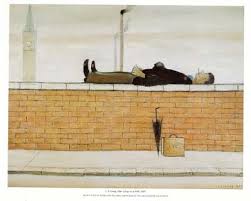
  1. Describe – and do no more. This is always the poet’s initial desire, to put into words what has caught our attention visually (and because attention has been visually caught there is something about this image or object that chimes with the writer’s subconscious). In terms of the poet’s intention, the wish to describe may be sufficient (the subconscious may do the rest). Examples might be Michael Longley’s ‘Man Lying on a Wall’ (from Lowry’s paiting of the same name) or William Carlos William’s ‘The Dance’ (from Breughel the Elder’s ‘Peasant Dance’).
imgres

  1. Describe but imagine beyond the frame – Derek Mahon’s ‘Girls on the Bridge’ (after Munch’s painting of the same name) does this, beginning with description of the scene but then wonders where the road leads away to in space, asks what the next day will bring (in time) and concludes with allusions to Munch’s more famous image ‘The Scream’: “bad dreams / You hardly know will scatter / The punctual increment of your lives”.

imgres

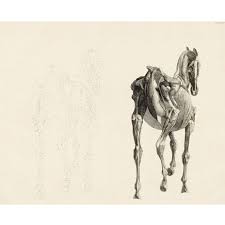
  1. Describe but incorporate researched materials – an easy option in the world of Google where the artist’s life or love life, the political context etc are easily accessed. Edward Lucie-Smith does this in ‘On Looking at Stubbs’ ‘Anatomy of the Horse’’, working with the gossip of local people in the Lincolnshire village where Stubbs worked at preparing the horse’s carcass: ‘His calm knife peeling putrid flesh from bone”.
imgres

Through Ventriloquism

  1. Make Main Figure Speak – the most common approach as famously done in Carol Ann Duffy’s ‘Standing Female Nude’ (from Georges Braque’s ‘Bather’). Thomas Hardy makes the Elgin Marbles speak in ‘Christmas in the Elgin Room’.


  1. Make Minor Figure/s Speak – UA Fanthorpe’s ‘Not my Best Side (Uccello’s ‘St George and the Dragon’) might be considered a hat-trick of the category above but her decision to make all 3 characters in the painting speak, casting side-lights to and fro, means I put it here. Delmore Schwartz’s ‘Seurat’s Sunday Afternoon along the Seine’ – while more free indirect speech than ventriloquism – has a similar effect, visiting each of the characters in Seurat’s picture and allowing their perspective to be aired.

imgres

  1. Make Objects Speak – this is an obvious category though I’m a bit short on illustrations of it. BC Leale’s ‘Sketch by Constable’ almost does it by concentrating attention on a tiny dog sketched in the corner of an image of Flatford Mill. Ann Ridler also comes close by largely ignoring the foreground figures and focusing on the landscape only in ‘Backgrounds to Italian Paintings’.


  1. Make the Artist Speak – writing about Van Gogh’s ‘Portrait of the Artist’s Mother’, Robert Fagles makes the artist speak, denouncing photography and preferring the expressive qualities of paint: “Of the life hereafter I know nothing, mother, / but when I paint you what I feel is yellow, / lemon yellow, the halo of rose”.


Through Interrogation

  1. Of the Artist – Vicki Feaver’s ‘Oi yoi yoi’ (on Roger Hilton’s image of the same name) starts with description but quickly begins talking directly to Hilton (“You were more interested / in her swinging baroque tits”). Interestingly, ekphrastic poems need not always stand in awe of the work; looking at Francis Bacon’s ‘Study for Portrait on Folding Bed’, Thomas Blackburn has a long one-sided conversation with the artist, charting a growing disenchantment with Bacon’s work, accusing him of “uttering, with superb, pretentious / Platitudes of rut, that you have said and said”.

 imgres

  1. Of the Figure/s – I have always admired Gerda Mayer’s poem, ‘Sir Brooke Boothby’ (after Joseph Wright’s image), in which she addresses with Sir Brooke about his languid pose, his copy of Rousseau, his intense scrutiny of the observer. Peter Porter’s many poems about art objects are hard to categorise but ‘Looking at a Melozzo da Forli’ (an image of the Annunciation) interrogates both image and the figure of Mary herself.

imgres

  1. Of Yourself – probably all ekphrasis is a sort of self-interrogation but some poems make this more clear. The address often takes the form of admissions of ignorance or obtuseness in the face of the image or the asking of rhetorical questions. Robert Wallace on ‘Giacometti’s Dog’ once again begins in description but asks questions about the fascination of the image, eventually concluding “We’ll stand in line all day / to see one man / love anything enough”.


Through Giving an Account

  1. Of Your Encounter – Wallace’s poem spills across these artificial categories and might be placed here, among poems where the poet explicitly records details of his/her encounter with the work of art. Yeats famously does this in ‘The Municipal Gallery Revisited’, looking at images of Augusta Gregory and John Synge. David Wright (who lost his hearing at the age of seven) movingly describes his visit to Rome to see Maderno’s sculpture of St Cecilia (patron saint of music) in his poem ‘By the Effigy of St Cecilia’.
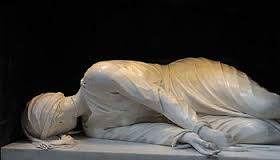
imgres

  1. Of Gallery Visitors – poets often comment on the behaviour or experiences (imagined) of gallery visitors (and even the gallery attendants!). Gillian Clarke does this in ‘The Rothko Room’: “In this, / the last room after hours in the gallery, / a mesh diffuses London’s light and sound. / The Indian keeper nods to sleep, marooned / in a trapezium of black on red”.


  1. Of Others – admittedly a catch-all category this one, but sometimes (especially when the works of art appear in churches) the poet can be interested in speculating about the responses of more ‘ordinary’ people. Thom Gunn does this toward the end of ‘In Santa Maria del Popolo’ where Caravaggio’s ‘Conversion of St Paul’ is displayed. Having recorded his own response to the image he ends by staring at the old Roman women who come to kneel before it: “each head closeted // In tiny fists holds comfort as it can. / Their poor arms are too tired for more than this / – For the large gesture of solitary man, / Resisting, by embracing, nothingness”.

 imgres

Come At a Tangent

  1. Finally, the ekphrastic moment can be presented as if an after-thought, or illustration of a poem already half composed. There are famous examples of this, especially Auden’s ‘ Musee des Beaux Arts’ which spends most of its length contemplating in very general terms the way old paintings present suffering. Only towards the end does Auden refer to Breughel’s ‘Fall of Icarus’ which he describes in some detail to suggest how “everything turns away / Quite leisurely from the disaster”. RS Thomas’ ‘Threshold’ does something similar, only concluding with allusions to Michaelangelo’s painting of Adam in the Sistine Chapel. And Seamus Heaney’s ‘Summer 1969’ records a visit to Madrid as the Troubles boiled in Northern Ireland, and only latterly does the poem focus on Goya’s ‘Panic’: “Saturn / Jewelled in the blood of his own children, / Gigantic Chaos turning his brute hips / Over the world.imgres

How to Grow your Own Iambics Part 2

This is the second posting on a metrical exercise on iambics. I have been teaching 3 sessions for the Poetry School in the last few weeks, contributing to the ongoing course called The Construction of the Poem which takes students through the various constituent elements that go to make up a poem. It is advertised as on ‘the history and application of formal techniques’ and my brief is to cover metrical issues. Though the course is directed more at learning about such techniques than the application of them (this is partly just a matter of time restrictions), one exercise we have played around with is growing our own iambics – this began with an iambic monometer and grew into an iambic tetrameter as detailed in my previous posting.

images

Starting from the tetrameter again, the poem will now grow some more . . . This is where I got to last time:


Because I hope to speak to her

I walk again along the way,

the path beside the old canal,

where children play and mothers come,

where thistles bloom in purple knots

that grey and drift across the path,

here strewn with wrappers torn from sweets,

with needles dropped another day,

where users lean and drift, ascend

above the clouds and steeple cock.


From this pretty regular iambic tetrameter, grow on further lines while at the same time lengthened these lines to iambic pentameter (5 iambic feet per line). New material indicated in italics:


Because I hope to speak to her, I walk

again along this way, the path beside

the old canal where children play and mothers

come, where thistles bloom in purple knots

that grey and drift across the path. It’s strewn

with wrappers torn from sweets, with needles dropped

another day, where users lean and drift,

ascend above the clouds and steeple cock.

Its glint I glimpse where water stands, its gold

a coin, a drowned, two-headed coin she tossed.

A bird is panicked from the reeds, its wings

slapping the surface like a window smashed.


I’ve slightly re-jigged line 2 here and feel the need to punctuate more heavily with the lengthening lines. The di-syllabic “mothers” again presents an issue at line 3 – I’ve made the same choice here as before, not breaking the word, allowing 11 syllables in line 3, shortening line 4 to 9 syllables. “Slapping” – given the sudden violence of the bird’s flight – I have allowed to stand as a reversed, trochaic foot opening line 12. I’m now thinking of the narrator as a mother (though as easily a father) who has come to a place remembered as visited with a daughter, now more grown up. The coin toss image seems to allude to some life-chance or choice and the inclusion in the poem – in the narrator’s observations – of the discarded needles probably tells its own story.


Beyond the pentameter lies the less common reaches of the hexameter or alexandrine – six iambic feet per line:


Because I hope to speak to her, I walk again

along the path, this way beside the old canal

where children play and mothers come, thistles

bloom into purple knots that grey and drift across

the path strewn here with wrappers torn from sweets, needles

dropped on another day, where users lean and drift,

ascend above the clouds and steeple cock. Its glint

I glimpse where water stands, its gold a coin, a drowned

two-headed coin she tossed. A bird is panicked from

the reeds, its wings beat the water like a window

smashed. If I stand inside the door and gaze across

the pews towards the brightly coloured glass of saints

and martyrs, mother, child in arms, its chubby limbs

each filled with sun, her robe is blue, her arms are full.


The lengthened line now begins to drag a little and is feeling rather clumsy here (it would need more work if I wanted to go with this) but as a reader I think of the slow, rather mournful walk of what now seems to be the possibly bereaved narrator. In line 3 the two syllables of “thistles” again ought to be broken across the line break – this time I cut the preceding word (“where”) to give more of a jolt to this threatening word so line 3 ends with a trochaic foot – “come” and “thist-” forming a spondee. Line 4 opens with a trochee too. The word “needles” presents the same problem at the end of line 5 – this I’ve re-jigged as above (though it does not read well to my ear at the moment). But I guess I’m happier to disrupt the predominant iambic by this stage – partly because it’s clearer to me now that this poem has a dark edge to it – but also because the longer lines give (maybe they need?) the chance of more variation. Line 10 has also been altered a little, “slapping” is replaced by the stronger monosyllable “beat”. The unexpected leap into the church interior seemed a good idea – a change of scene – and an intuitive link to the smashed rippling of the canal water, reminding the narrator of stained-glass. The image of Madonna and child is maybe too obvious but actually feels right for both writer (me) and the narrator (definitely now a mother of a child lost somehow). It’s also more acceptable as the church steeple had already been alluded to in the poem.


I’m now going to take this as far as the iambic heptameter line or fourteener:


Because I hope to speak to her, I walk again along

the way, this path beside the old canal, where children play

and mothers come and thistles bloom in purple knots that grey

and drift across the path. It’s strewn with wrappers torn from sweets,

with needles dropped another day, where users lean and drift,

ascend above the clouds and steeple cock. I glimpse its glint

where water stands, its gold a coin, a drowned two-headed coin

she tossed. A bird is panicked from the reeds, its wing-beats break

the water like a window smashed. I stand inside the door

and gaze across the pews towards the brightly coloured glass

of saints and martyrs, mother, child in arms, its chubby limbs

each filled with sun. Her robe is blue, her arms are full of blood,

the red of ribbons, red of nails, the red of every month.

It’s her I think I need to find. Beyond the traffic noise,

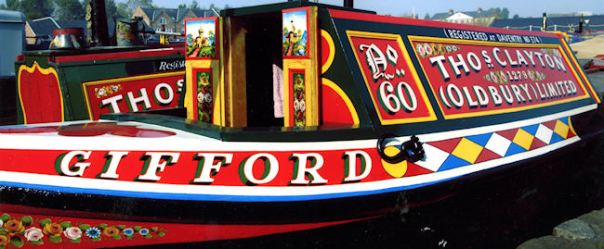
I cross the bridge. A narrow boat is gliding down below,

its brightly painted tubs, its name a girl’s, I watch it pass

into the dark, a stink of smoke, a swirl, a wink of light.

 gifford1

That the Madonna’s arms are full of blood surprised me but probably I am echoing those earlier thoughts of veins and needles. The repetitions of “red” felt quite bold, I think following the maturing of the narrator’s daughter. I grew up near the Kennet and Avon canal and still walk there often watching the narrow boats pass. Many of them are carefully decorated by their owners and this was coming to mind at the end though I still think this is a very urban part of the canal network. Obviously the passing boat, with its girl’s name, reminds the mother of her daughter (I guess we still don’t know exactly what happened to her) and though there is something positive in the painted colours of the boat (echoing the coloured windows in church I now realize), its passing into the tunnel is ominous and the fragmenting of the lines (these long lines are good for this) suggest a dissolving or passing away.

I don’t know how this reads yet as a poem and it’s certainly to raw and new to think which of these forms suit it best (if any). But it’s not a poem or a place I might have entered into without the use of this very methodical exercise. It’s worth a try, I think, and whatever the results, it’ll set you thinking about line lengths generally and patterned rhythm or metre more specifically – essential tools of the poet at any stage.

How to Grow your Own Iambics Part 1

I have been teaching 3 sessions for the Poetry School in the last few weeks. I have been contributing to the ongoing course called The Construction of the Poem which takes students through the various constituent elements that go to make up a poem. It is advertised as on ‘the history and application of formal techniques’ and my brief is to cover metrical issues. Though the course is directed more at learning about such techniques than the application of them (this is partly just a matter of time restrictions), one exercise we have played around with is growing our own iambics – from little monometers great fourteeners may grow!

gifford1

The first dab of culture in the experimental petri dish is the simplest of forms, the iambic monometer. If you want to join in with this, it hardly matters what you come up with (and I certainly make no claims for what follows) partly because the exercise is also exploring Glyn Maxwell’s claim that using form will propel the poet towards “words you didn’t expect, matter you never chose, resonances that crept up around you” (from On Poetry (Oberon Books, 2012)). Michael Donaghy often suggested something similar: “Like good poets whom the tyranny of rhyme forces into the discovery of their finest lines, I’m in it for the discovery. If writing poems were merely a matter of bulldozing ahead with what you’d already made up in your mind to say I’d have long ago given it up for something more dignified” (from ‘My Report Card’ – 2000).


Because

I hope

To speak

To her

I walk

Again

Along

The way

The path

Beside

The old

Canal


Here I’m more concerned with choosing regular iambs than making much sense. The hesitating movement of the short lines works quite well.  In the Poetry School sessions we looked at Robert Herrick’s famous poem in this metre, ‘Upon His Departure Hence’, as well as one by Karen McCarthy Woolf (‘Mort-Dieu’). Both poems use the curbed tentativeness of the metre to reflect on mortality – almost as if the form offered a safe form, a containment of (too) powerful emotion.

Now re-organise the same material as a dimeter. This will involve the composition (if that’s quite the word) of further lines simply to complete the form and this will take you into unexpected territory perhaps . . .


Because I hope

To speak to her

I walk again

Along the way


The path beside

the old canal

where children play

and mothers come


The dimeter remains a very brief line (I don’t feel much need for punctuation yet) but here the short reach of each line gives some urgency to the narrator’s hoping to speak to “her”. The reader (as much as the writer at this stage) is wondering who both narrator and hoped-for interlocutor is. The extra material begins to suggest maternal possibilities, partners, other children . . . The “again” of line 3 is also interesting – a recurrent search. Why can’t she be found. What is this need to speak to her? Why come to this location?

Now re-organise further to make a trimeter:


Because I hope to speak

to her I walk again

along the way, the path

beside the old canal,


where children play and mothers

come, where thistles bloom

in purple knots that grey

and drift across the path.


It feels natural to want to punctuate these lines now with their greater complexity and greater risk of ambiguity. The three beat lines perhaps begin to evoke the pacing of the walker? There is an issue with the 5th line in which (keeping to a strict iambic metre) the word “mothers” ought to be broken across the line break. I’ve decided to allow an extra syllable into line 5, so ending it with a feminine, weak, seventh syllable. Line 6 I’ve therefore left with one syllable short. It’s happenstance but I like the extra dwelling of a reader’s attention on “mothers” (I begin to think the “she’ is a mother, or the narrator may be a mother searching for a female child). The shortening of line 6 which refers to “thistles” also feels right; it introduces a spiky, perhaps threatening image and the shortened line creates an uneasy feel. These undoubtedly ‘fortuitous’ developments are just the sort of thing the poet has a veto over – we decide whether they stand or need to be revised further. Here, I let them stand.

imgres

Next stage is an iambic tetrameter – four iambs per line:


Because I hope to speak to her

I walk again along the way,

the path beside the old canal,

where children play and mothers come,

where thistles bloom in purple knots

that grey and drift across the path,

here strewn with wrappers torn from sweets,

with needles dropped another day,

where users lean and drift, ascend

above the clouds and steeple cock.


Woah! No – I don’t know where this is heading . . . The longer length of line now begins to give a more conversational feel. This four beat line (either with accentual-syllabic or plain stress metre) is probably the most common in English verse. I think of it (and the good old iambic pentameter) as sort of neutral spots on the metrical continuum – neither too tightly bound nor loosely adrift). The greying of the thistles now seems to allude to aging (of the narrator?), certainly to time passing, time on her mind. The sweet wrappers make a clear gesture towards childhood; the discarded needles strike a far more ominous note (if a bit clichéd). Is the narrator seeking a child, no longer a child, has she become involved with drug abuse?


If you want to see this poem developing into an iambic pentameter – and find out (with me) what the poem is really about – I’ll post the remainder of this blog on Monday.

Lots of Poetry, Too Little Cake

breakingsmall

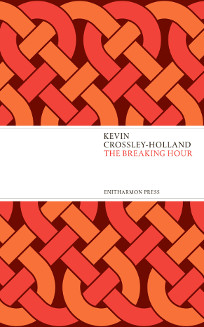
Last Saturday I attended one of the half-yearly poetry events in Palmers Green, north London. These are always very good evenings, these days full of music as well as poetry as the Helios Consort of recorders play before and after the interval. Kevin Crossley-Holland was reading (a superb poet, as well as all his other literary achievements) as was Sarah Westcott (recently published by Pavilion – having just won the Manchester Cathedral Poetry Competition) and Katherine Gallagher, launching her new Arc collection – about which someone called Crucefix has blurbed:

This new collection is bejewelled throughout with haiku-like moments of vivid observation. Her delighted responses – in particular to the natural world – serve to peel away the film of familiarity through which we usually gaze. Yet Gallagher combines such excited observation with a quality of restraint, a respect for what she encounters in a process of self-creation – “from myself into myself” as her epigraph from Rose Auslander puts it. Sequences about her Australian mother and the loss of her brother are imbued with this same gift: life is celebrated in poems that never forget our mortality: “This is time we have underlined, / remembering what we’ve done, where we’re going” (‘Quotidian’).

On the following morning I was taking part in the Bloomsbury Festival, talking about the art of translation with Chris Campbell, Literary Manager, Royal Court Theatre and Gregory Thompson, Creative Entrepreneur in Residence at UCL. Chaired by Geraldine Brodie, Lecturer in Translation Theory and Theatre Translation at UCL, the talk – in the very comfortable, wood-panelled surroundings of the Churchill Room, Goodenough College, London House, Mecklenburgh Square, London – was really wide-ranging from Gregory’s experiences of directing Shakespeare in the Indian sub-continent and the kind of cultural translation that takes place on such occasions to Chris’s translations of drama texts to and from the French and French-Canadian. One issue there is the translation of comic references such as cricket allusions or types of motor cars (I think he suggested a Vauxhall Cavalier equivalent in a French cultural context would be a Renault 21). I thought there was quite a bit of common ground when I was explaining how I fell into translation through the need to stand up and declaim/read/perform translations which I felt did not really convince in English. This is how I began the idea that I might try to translate Rilke’s 9th Duino Elegy many, many years ago – I could not find a version that read well aloud. I still regard that as a key test.

c45407b1ab4103bca137a0808bc8c042

This idea that poetry ought to be read aloud is common enough in most writing workshops but I do wonder how many people really adhere to it. This came up again with my third engagement of the busy weekend – teaching my first session for the Poetry School on ‘music and metre’ on Monday evening. As I explained to the class, formal verse is not especially my thing but it is also an area I have had to teach on various occasions. I kicked off by reading James Fenton’s powerful poem ‘Tiananmen’ – see below – and Auden’s observations about the benefits of form:

images

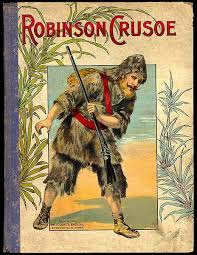
The poet who writes ‘free’ verse is like Robinson Crusoe on his desert island: he must do all his cooking, laundry and darning for himself. In a few exceptional cases, this manly independence produces something original and impressive, but more often the result is squalor – dirty sheets on the unmade bed and empty bottles on the unswept floor.

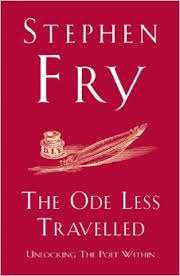
I love the swipe at “manly independence” there. Not very surprisingly, this observation is quoted by Stephen Fry in his The Ode Less Travelled (Hutchinson, 2005) which also suggests modern poetry, because of its abandonment of formal constraints is now “laughably easy” to write. Elsewhere Fry describes most contemporary poetry as suffering from anaemia; it’s a lifeless trickle, rhetorically listless . . . Fry doesn’t mind setting himself up like this – and tucked away in the book you’ll also find his appreciation of Whitman, Anne Carson, Denise Riley and many others.

imgres

I told the class, having spoken to a fair number of poets recently about form, that they’d be surprised (or maybe not) how few published poets would confidently declare their own grasp of metrical matters. On the night, we didn’t get along as fast as I’d anticipated – there was good discussion, especially of the areas of inevitably uncertainty in scanning a poem etc – it’s like jazz?? – so I’m looking forward to picking up the themes again next Monday evening with Tony Harrison, Wordsworth, Stevens, Elizabeth Jennings . . .

Now I’m feeling a bit poetry-ed out. Coffee and cake are required . . . after this:


Tiananmen – James Fenton

Tianamen
Is broad and clean
And you can’t tell
Where the dead have been
And you can’t tell
What happened then
And you can’t speak
Of Tianamen.

You must not speak.
You must not think.
You must not dip
Your brush in ink.
You must not say
What happened then,
What happened there
In Tiananmen.

The cruel men
Are old and deaf
Ready to kill
But short of breath
And they will die
Like other men
And they’ll lie in state
In Tianamen.

They lie in state.
They lie in style.
Another lie’s
Thrown on the pile,
Thrown on the pile
By the cruel men
To cleanse the blood
From Tianamen.

Truth is a secret.
Keep it dark.
Keep it dark.
In our heart of hearts.
Keep it dark
Till you know when
Truth may return
To Tiananmen.

Tiananmen
Is broad and clean
And you can’t tell
Where the dead have been
And you can’t tell
When they’ll come again.
They’ll come again
To Tiananmen.

imgres
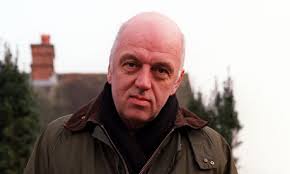
James Fenton


Tony Harrison’s ‘A Cold Coming’

I have been thinking about the role of metre in poetry in preparation for 3 evening sessions I have been asked to teach for the Poetry School in London. The sessions are part of a wide-ranging course on some of the basics of poetry (other parts of it will be taught by Tim Dooley, Judy Brown, Claire Crowther and Matthew Caley). Also, last Saturday I attended the Free Verse Poetry Book Fair in Red Lion Square, London. There – apart from spending too much money on poetry books and chatting with people who had come from all over the country – I listened to a discussion about the role of poetry in relation to politics. Fiona Moore chaired a discussion involving Choman Hardi, Bill Herbert, Sophie Mayer and R A Villanueva. Ideas put forward included the delicate issue of ‘using’ the experience of others in political poetry as well as the need to work polyvalently or collaboratively to combat the influence of unquestioned language and form. Herbert quoted W S Graham’s line: “What is the language using us for?” At the confluence of these two biographical moments I found myself thinking of Tony Harrison’s solutions to the poetry/politics issue – in part through his use of formal metre. The following discussion of Harrison’s Iraq War poem, ‘A Cold Coming’, originally appeared in book form in Tony Harrison: Loiner (Clarendon Press, 1997), edited by Sandie Byrne.

imgres

Harrison has declared his commitment to metrical verse because “it’s associated with the heart beat, with the sexual instinct, with all those physical rhythms which go on despite the moments when you feel suicidal”. In conversation with Richard Hoggart, he explains that without the rhythmical formality of poetry he would be less able to confront, without losing hope, his favoured themes of death, time and social injustice. “That rhythmical thing is like a life-support system. It means I feel I can go closer to the fire, deeper into the darkness . . . I know I have this rhythm to carry me to the other side”.

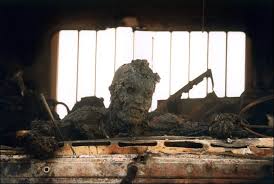
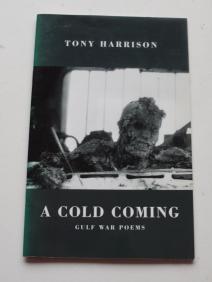
There are few of Harrison’s poems that go closer to the fire than the second of his Gulf War poems, ‘A Cold Coming’. Its initial stimulus, reproduced on the cover of the original Bloodaxe pamphlet, was a photograph by Kenneth Jarecke in The Observer. The picture graphically showed the charred head of an Iraqi soldier leaning through the windscreen of his burned-out truck which had been hit by Allied Forces in the infamous ‘turkey-shoot’ as Saddam’s forces retreated from Kuwait City. In the poem, Harrison makes the Iraqi himself speak both with a brutal self-recognition (“a skull half roast, half bone”) as well as a scornful envy of three American soldiers who were reported to have banked their sperm for posterity before the war began (hence, with a scatological nod to Eliot, the title of the poem). There are undoubtedly echoes in the Iraqi’s speech of the hooligan alter ego in the poemV’, yet Harrison worries little over any narrow authenticity of voice in this case, and he does triumphantly pull off the balancing act between the reader’s emotional engagement with this fierce personal voice and a more universalising portrayal of  a victim of modern warfare. Furthermore, it is Harrison’s establishment and then variation of the poem’s metrical “life-support system” that enables him to achieve this balance, to complete a poem which weighs in against Adorno’s view that lyric poetry has become an impossibility in the shadow of this century’s brutality.

imgres

The poem’s form – rhymed iambic tetrameter couplets – seems in itself chosen with restraint in mind, as if the photographic evidence of the horror lying in front of him led Harrison to opt for a particularly firm rhythmical base “to carry [him] to the other side”. Indeed, the opening five stanzas are remarkable in their regularity with only a brief reversed foot in the fourth line foreshadowing the more erratic energies soon to be released by the Iraqi soldier’s speech:


I saw the charred Iraqi lean

towards me from bomb-blasted screen,


his windscreen wiper like a pen

ready to write down thoughts for men.


The instant the Iraqi’s voice breaks in, the metre is under threat. Each of his first four stanzas opens with trochaic imperatives or questions and at one point he asks if the “gadget” Harrison has (apparently a tape-recorder but a transparent image of poetry itself) has the power to record “words from such scorched vocal chords”. Apart from the drumming of stresses in lines such as this, Harrison deploys sibilance, the alliteration of g’s and d’s, followed by an horrific mumbling of m’s to suggest the charred figure’s effortful speech in the first moments of the encounter. Regularity is re-established the moment the tape-recorder’s mike is held “closer to the crumbling bone” and there is a strong sense of release from the dead man’s initial aggressive button-holing as his voice (and the verse) now speeds away:


I read the news of three wise men

who left their sperm in nitrogen,


three foes of ours, three wise Marines,

with sample flasks and magazines . . .

10051408090


In the stanzas that follow the dead man’s angry, envious sarcasm is controlled within the bounds of the form and it is rather Harrison’s rhymes which provide much of the kick: God/wad, Kuwait/procreate, fate/ejaculate, high tech’s/sex. It is only when the man demands that Harrison/the reader imagines him in a sexual embrace with his wife back home in Baghdad that the metrical propulsion again begins to fail. It is in moments such as this that the difficult emotional work in the poem is to be done. This is our identification with these ghastly remains, with the enemy, and it is as if the difficulty of it brings the verse juddering and gasping to an incomplete line with “the image of me beside my wife / closely clasped creating life . . .”

The difficulty of this moment is further attested to by the way the whole poem turns its back upon it. Harrison inserts a parenthetical section, preoccupied not with the empathic effort the dead Iraqi has asked for but with chilly, ironic deliberations on “the sperm in one ejaculation”. Yet all is not well, since this section stumbles and hesitates metrically as if Harrison himself (or rather the persona he has adopted in the poem) is half-conscious of retreating into safe, calculative and ratiocinative processes. Eventually, a conclusion yields itself up, but it is once again the metrical change of gear into smooth regularity (my italics below) that suggests this is a false, defensive even cynical avoidance of the difficult issues raised by the charred body in the photograph:


Whichever way Death seems outflanked

by one tube of cold bloblings banked.


Poor bloblings, maybe you’ve been blessed

with, of all fates possible, the best


according to Sophocles i.e.

‘the best of fates is not to be’


a philosophy that’s maybe bleak

for any but an ancient Greek . . .

imgres

That this is the way to read this passage is confirmed by the renewed aggression of the Iraqi soldier who hears these thoughts and stops the recorder with a thundering of alliterative stresses: “I never thought life futile, fool! // Though all Hell began to drop / I never wanted life to stop”. What follows is the Iraqi soldier’s longest and most impassioned speech, by turns a plea for attention and a sarcastic commentary on the collusion of the media whose behaviour will not “help peace in future ages”. Particular mention is given to the “true to bold-type-setting Sun” and, as can be seen from such a phrase, Harrison once more allows particular moments of anger and high emotion to burst through the fluid metrical surface like jagged rocks. There is also a sudden increase in feminine rhyme endings in this section which serves to give a barely-caged impression, as if the voice is trembling on the verge of bursting its metrical limits and racing across the page. This impression is further reinforced in the series of imperatives – again in the form of snapping trochees at the opening of several stanzas – that form the climax to this section of the poem:


Lie that you saw me and I smiled

to see the soldier hug his child.


Lie and pretend that I excuse

my bombing by B52s.


The final ten stanzas culminate in a fine example of the way in which Harrison manipulates metrical form to good effect. In a kind of atheistic religious insight, the “cold spunk” so carefully preserved becomes a promise, or perhaps an eternal teasing reminder, of the moment when “the World renounces War”. However, emphasis falls far more heavily on the seemingly insatiable hunger of the present for destruction because of the way Harrison rhythmically clogs the penultimate stanza, bringing it almost to a complete halt. The frozen semen is “a bottled Bethlehem of this come- /curdling Cruise/Scud-cursed millennium”. Yet, as we have seen, Harrison understands the need to come through “to the other side” of such horrors and the final stanza does shakily re-establish the form (though the final line opens with two weak stresses and does not close). However, any naive understanding of the poet’s comments about coming through the fire can be firmly dismissed. This is not the place for any sentimental or rational synthetic solution. Simply, we are returned to the charred face whose painful, personal testament this poem has managed to encompass and movingly dramatise but without losing its form, thus ensuring a simultaneous sense of the universality of its art and message:


I went. I pressed REWIND and PLAY

and I heard the charred man say:


Workshopping With Will Shakespeare

Last weekend – what with the 400th anniversary of Shakespeare’s death just gone by and seeing an advertisement on Facebook I think it was – I signed up to be a participant in a Shakespeare and writing poetry workshop. Being an English teacher, love of Shakespeare rather comes with the territory but I’m sure I’m not the only teacher who enjoys being a participant in classes. So much of my time is spent initiating, organising, timing carefully and concluding that it’s a wonderful holiday-feeling to be initiated, organised, timed carefully and concluded by somebody else. (In what follows I am able to quote the work of nobody else but myself – for which apologies).

shakespeare-first-folio-title-page-introduction

The workshop was part of a series organised through the South Bank Poetry magazine, co-edited by Peter Ebsworth (its founder) and Katherine Lockton. They were both present for the workshop – upstairs, above the Poetry Society’s Cafe in Betterton Street, Covent Garden – but it was Katherine who ran the session. We gathered about 10.45 for 11am, most of us arriving clutching the mandatory take-out coffee from the cafe or elsewhere on our walks from the Tube. A big table, a plate of biscuits, greetings, sign in (whose name do I know here?). Upstairs at the PS is a strange mix of store room, kitchen, second hand bookshop, classroom. I thought it could do with a tidy-up myself – then tried to curb my flicker of nerves, that need for control. Actually, I’ve not taken part in a public workshop like this for ages. We were probably all feeling the same: what if I write total crap and Katherine asks me to read it out. Maybe a biscuit . . .

images

We started with free writing for 5 minutes or so – “to loosen up”. Katherine wanted us to set off from “My Shakespeare is . . .” What sprang vividly to mind was an occasion teaching not Shakespeare, in fact, but Marlowe’s Doctor Faustus. A student read the “face that launched a thousand ships” speech so very badly that it achieved a weird sort of beauty in her inarticulacy. A bit like those ruins of classical statues (not far from where we were, in the British Museum) that seem to have acquired an added poignancy in not remaining whole. I rather like free writing (it’s how most of my own poems begin, a sudden splurge of material that then gets worked on) and as I wrote I ended up (from that halting reading of Marlowe) to love in a life or its opportunity missed:


Those encounters where you don’t have the words

Just stops pauses some musical sense

Of the word order but no –not the words themselves

And she turns away dips her head

Laughs at something somebody across the room has just said

eb296389fb62a4e2e059249bf0021f0e

Katherine then dished out the text of Sonnet 18: “Shall I compare thee to a summer’s day?” On the Tube in I had been wondering how I’d tackle Shakespeare in such a setting and I thought I’d not go for the more familiar moments. Katherine did and I have to say she was probably right. I’d have ended up explaining too much perhaps (too teacherly) when the point was to respond creatively to the poems. So most of us were familiar enough with this poem in which the narrator does compare his love to a summer’s day and the summer’s day turns out to be liable to be windy, over too soon, too hot, over too soon . . . The lover apparently suffers from none of these things not even death itself – because the poet has preserved her in “this” poem: “So long lives this, and this gives life to thee”. We wondered, among others things, at the manly arrogance of this.

We picked a phrase or even just a word to respond to from the poem and set off for 30 minutes or so. On this first occasion, many of us seemed to get sucked into the vortex of the sonnet form and rhyme especially. But the quality of the group that day was extraordinary. Several produced sonnets which worked well (in 30 minutes!) and all the pieces eventually read out were interesting responses. I chose the phrase “By chance, or nature” and was exploring (again) the chance or fate of meetings with the one’s you love. I was imagining the alternative worlds we jettison or turn our back on with every choice we make:


So that in one of those plural worlds

We might have met before, or later, even not

At all – through pram and playground, into school

To college, old flames, chance turn, random plot.


You can see what I mean about getting locked into a formal mode. It may be that most of us realised this as when Katherine then tried us with Sonnet 130, more of the group struck out – away from formality, probably into something more like our natural mode. This was also probably encouraged by the fact that Katherine was showing us contemporary responses to these poems as we went. Several of these were quite encouraging in that they were pretty poor as poems – there are a number of anthologies where contemporary poets respond to Shakespeare (especially this year) but so many of the poets try too hard to up-date originals into some hip idiom; embarrassing like Dad-dancing). I guess that at least gave us permission to try something more adventurous of our own.

daodejing

I found myself interested in the way the Sonnet 130 tries to define the lover through a kind of via negativa, what she is not. It’s a kind of anti-poetic in that the poet dismisses the ability of comparison (one of the poet’s main tools) to capture her in truth. This was reminding me of repeated occasions in the Daodejing poems I have been working on for 3/4 years (just published now – so fully on my mind last weekend) in which the text also argues the elusiveness of the One. The latter is often given female characteristics so it was an easy step to my scribble:


She lives in the live darkness between

The opening and shutting of my eye-lids


Between ascender and descender

Of this pen this white expanse


This Microsoft space not knowing what to do

With itself not being busy


In the moment when instructions cease

And what opens is that snow-field


Beneath the first or second chair-lift not yet

Inscribed [. . . ]

tumblr_m4v3ij8TgU1r2tbuso1_500

The third piece Katherine gave us were extracts from Romeo and Juliet (the balcony scene, the “what’s in a name” speech” and Juliet’s “O serpent heart”). We discussed these and annotated them to pick out certain patterns and concerns. We then compiled a small list of words of our own and set off with the aim of writing in the voice of a character from Shakespeare. I’ve always had a soft spot for Horatio and especially Hamlet’s gentle, though firm, put-down: “There are more things in heaven and earth, Horatio, / Than are dreamt of in your philosophy”. I had Horatio realising the truth of this, a bit Prufrock-like realising that he was not meant to play the Prince, but be an observer, something of a by-stander at the big events:


O but it’s enviousness I breed

Here listening to you roar

And glitter you go on to the very point

Or way off kilter

And patronise me yet even this you do

With such grace with warmth making me love you.

images

The rhythm of this particular workshop was a lot of time for individual writing. We shared all we wrote (no one objected – and absolutely none of it was “crap”), and Katherine introduced the extracts quite briskly while still allowing plenty of time for people’s reactions to them. The time was now about 4pm. The final piece was stimulated with small bits of cloth from Katherine’s Mum’s sewing box but also with a story she told (no details – it’s her story) which we could incorporate if we wanted to.  My final piece was the strangest I’d produced so far. My cloth was a rich red – a bit sexy – and the encounter was on a staircase, I was coming down to meet someone. Perhaps by this time I was more Juliet than myself, or I’d carved myself into two:


Everything possessed

Of that clarity

And the weight

Of heraldry—


So the long dress

I wear is gules

Its blood-red

Slit to the thigh


Its plunging neck

A sunlight wedge

At the foot

Of the shallow stair


I lift my chin

As if called for [. . . ]


I don’t know if the 4 pieces I produced will come to anything further but I can honestly say they would not have been written otherwise. In running my own workshops, I always say the simple thing they achieve is to take your writing to places you’d not have got to alone. That certainly happened the other day and I’m grateful to South Bank Poetry for the chance to participate: now back to the front of the class.

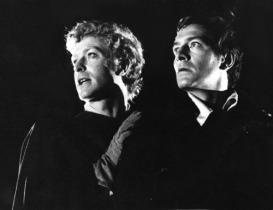
DR FAUSTUS
DR FAUSTUS  – Elizabeth Taylor Richard Burton

What Shape is your Poetry Workshop?

With its proximity to some of the processes of politics, what has come to be the traditional form of the poetry workshop is perhaps easily derided. Billy Collins does this  (in his book, The Art of Drowning, 1995) and we all recognise both the speaker and the likely recipient of the speech:

I might as well begin by saying how much I like the title.   

It gets me right away because I’m in a workshop now   

so immediately the poem has my attention,

like the Ancient Mariner grabbing me by the sleeve.


And I like the first couple of stanzas,

the way they establish this mode of self-pointing

that runs through the whole poem

As both leader and participant, I’ve suffered and witnessed suffering at the hands of egomaniacs, bullies and tyrants – those who come to workshops with no intention of listening to the proffered advice. What they are after is some exertion of personal power over a captive audience and, up to a point, workshop members are exactly that since the basic democratic premise is that we sit and listen with an open mind – a very open mind.

But what I’m not sure about is the voice,

which sounds in places very casual, very blue jeans,   

but other times seems standoffish,

professorial in the worst sense of the word

like the poem is blowing pipe smoke in my face.   

But maybe that’s just what it wants to do.

imgres

Others will know the history better than I do but the poetry workshop seems to have been organised first by Philip Hobsbaum in the 1950s. Hobsbaum was born in London to orthodox Jewish parents who moved north in 1937, sensing the threat of war and fearing the anti-semitic currents of the time. In Bradford, Hobsbaum attended Belle Vue grammar school, then Cambridge, where he studied under F R Leavis at Downing College (“the greatest man I ever met – an amazing teacher”).

F R Leavis

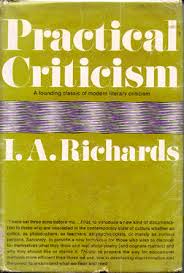
He also encountered Thom Gunn, just graduated, who introduced him to the early work of Larkin, and, as editor of the student literary magazine Delta, he printed work by Ted Hughes and Peter Redgrove. Most significantly, with these budding poets, he organised regular meetings. Hobsbaum possessed some training as an actor and the original idea (of what was to become ‘The Group’) was to encourage verse-speaking. But these meetings soon turned into exercises of Leavisite close analysis, or Practical Criticism in the style of I A Richards, plus a good deal of mutual support for the growing network of poets.

Maybe it’s just me,

but the next stanza is where I start to have a problem.   

I mean how can the evening bump into the stars?   

And what’s an obbligato of snow?

Also, I roam the decaffeinated streets.

At that point I’m lost. I need help.

The Group style of workshop spread as Hobsbaum himself moved to a variety of jobs from Cambridge, to London, Belfast and Glasgow in turn. Although there was some overlap in personnel with The Movement, the various incarnations of the Group had a more practical focus as there was no imposed programme or style. In Belfast (1962–1966), Hobsbaum organised what became known as The Belfast Group, including emerging authors Seamus Heaney, Edna and Michael Longley, Derek Mahon, Stewart Parker and Bernard MacLaverty. Heaney described the process in 1963: “members of the Group listen to a fellow member read a number of his poems which have been previously circulated on cyclostyled sheets. They then discuss the verse very thoroughly, frankly, informally – and the poet is there to counteract, resent, and/or benefit from the criticism”.

theme-arts-08
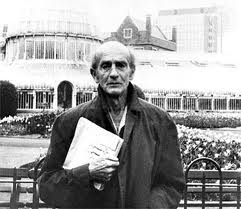
Philip Hobsbaum in later years (photo: Gerry Cambridge)

Personally, I first experienced the process at Lancaster University in the late 1970s, taking a ‘free ninth’ optional course in Creative Writing as part of a more traditional English degree. The meetings were led in Lonsdale College by David Craig and Heaney’s “previously circulated . . . cyclostyled sheets” have a very familiar ring to them. The format was somewhat different in the 4 years or so I spent attending two workshops in Oxford – copies of individual poems were handed round only on the day and discussion was spontaneous indeed (see my earlier blog ).

The other thing that throws me off,

and maybe this is just me,

is the way the scene keeps shifting around.   

First, we’re in this big aerodrome

and the speaker is inspecting a row of dirigibles,   

which makes me think this could be a dream.   

Then he takes us into his garden,

the part with the dahlias and the coiling hose,   

though that’s nice, the coiling hose,

but then I’m not sure where we’re supposed to be.   

imgres
Billy Collins

I currently attend 3 workshop groups. In none of these is work circulated beforehand. In one, the poet reads once only, the other members have photocopies and discussion ensues with the writer sworn to silence (this prevents self-defensive manoeuvres and conflict). In the second group, the same process is followed except that after the reading of the poem aloud by the poet, the members have about 10 minutes to WRITE their thoughts on the poem itself. Discussion then follows (the up-side of this is that all poets go home with annotated copies of their own work; the down side is it’s very hard work and discussion often follows the annotations, a little less fluidly).

There’s something about death going on here.

In fact, I start to wonder if what we have here   

is really two poems, or three, or four,   

or possibly none.


But then there’s that last stanza, my favourite.

The third group plays the game of anonymity. Sufficient copies are put into an envelope, no identifying marks. Each member then picks out a poem (not their own) to read aloud. On first reading the members cannot see the text. Only on second reading can they follow the text on the page. There then follows the discussion. This produces the fascinating experience for the poet of hearing another person read the poem – and the reader’s later comments about how easy or otherwise the poem was to read are always interesting to those of us who think poetry is primarily an oral art.

This is where the poem wins me back,

especially the lines spoken in the voice of the mouse [. . . ]

I start thinking about how hard the mouse had to work   

night after night collecting all these things

while the people in the house were fast asleep,   

and that gives me a very strong feeling,

a very powerful sense of something.

But I don’t know if anyone else was feeling that.   

Maybe that was just me.

Maybe that’s just the way I read it.

imgres

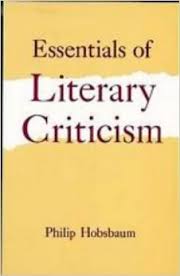
Easy to mock; easy to de-rail from their true purpose, but in creating his workshops (once more following Leavis) Hobsbaum believed a vital part of a student’s course was the rigorous discussion of text. To him, criticism was a fiercely rational, evaluative process, and any other use of language – “political propaganda, newspapers, advertisements, film, conceptual prose of all kinds” – had to be liable to the same level of scrutiny. In Essentials of Literary Criticism (1983), he maintained that “the training of a critic is also the training of a citizen”. This is surely right as the skills and sensitivities of the workshop, the class, the informal discussion of poetry anywhere, anytime, are exercises, in part, to develop the insight, the healthy scepticism, the ability to read and interpret whatever those vying for power, those possessed of power, want to say to us. Alan Brownjohn wrote in Hobsbaum’s obituary: “In a postmodernist, relativist age of education for entrepreneurship, Hobsbaum’s analytical and discriminatory approach might appear to be losing out, though reports of its death are an exaggeration.”

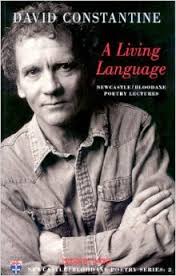
I’m sure Brownjohn is right and – as the UK General Election machine winds itself up ever higher – I’ll quote David Constantine’s important conclusion to his third Newcastle / Bloodaxe lecture in 2003: “We are, when we read poetry, during the reading of the poem and lingeringly for some while after, more wakeful, alert and various in our humanity than in our practical lives we are mostly allowed to be. Achieving that, in vital cooperation with the reader, a poet has done the most he or she is qualified to do. Any further stage, any conversion of this alerted present state into action, into behaviour, is the responsibility of the citizen. And the poet, like the reader, is always a citizen”.

imgres

The Poetry of Tom Rawling

In the early 1980s I arrived in Oxford as a self-absorbed post-graduate and promptly sought out student poets wherever I could find them. The group I joined was then (I think) meeting in rooms in Hertford College, opposite the Bodleian Library (and happily very close to the Kings Arms). Bill (W N) Herbert was there, as was Keith Jebb and Paul Mountain. The group, with changing personnel – I remember Elise Paschen was a member for a while – continued to meet throughout my 4 year stint among the dribbling spires, but we would supplement it by decamping to the Old Fire Station on George Street where Tom Rawling was running a public workshop. Tom had taken over when Anne Stevenson moved north. As a retired headmaster, Tom ran us all as a well organised and disciplined class. Elizabeth Garret joined later and I think Peter Forbes was already a member, as was Helen Kidd. Jeremy Round, who was soon to achieve short-lived fame for his cookery writing, was also a regular. My poem ‘In Memory of Jeremy Round’ (eventually published in Beneath Tremendous Rain (Enitharmon, 1990) https://martyncrucefix.com/publications/beneath-tremendous-rain-1990/) is a lament for his tragic early death, but also tries to paint a vivid picture of the workshop and its members:

We’d wrangle inconclusively

between the beers and crossfire from Tom,

elder statesman who’d slip quietly glittering

poems from his tackle bag like fish; from Helen,

whose pages always seemed typed under earthquake

conditions, whose baggy poems had more passion

than most of us could muster; from Peter’s

exactitude, schooled on a diet of science, he held

each piece like a prism till it shed eloquent

rainbows; from Bill and Keith, the ferocious

tyros, the university wits, who minced nothing

but their language into strange sweet things;

from Paul whose poems were amazed not to find

themselves loosed into a more graceful age

than the one we live in.

There were others writers, of course, to whom I apologise for not recalling them clearly. Bill has also written about these few years with great eloquence and insight: http://tracearchive.ntu.ac.uk/poets/herbert/dec_2.htm.

imgres

But rather than his aspiring students, it’s Tom Rawling’s own poetry that I want to highlight. A pamphlet called A Sort of Killing appeared in 1978 (an historical event now as this was one of the first publications by a young Neil Astley). OUP published Ghosts at My Back (1982). Two other books followed: The Old Showfield (Taxus, 1984) and The Names of the Sea-Trout (Littlewood Arc, 1993).

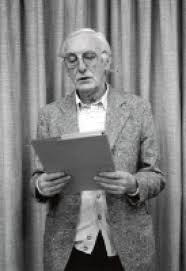
Grevel Lindop has long been a fan of Tom’s work (http://grevel.co.uk/poetry/tom-rawling-rediscovering-ennerdales-poet/). There is an audio recording of Tom reading many of his best poems (you can listen to one of them here: http://listenupnorth.typepad.com/listenupnorth/tom-rawling-poet.html). Listening to him again, what what comes over is his modesty, his sharp intelligence, his confidence in his own work and the vivid recall he had of his formative years, growing up in Ennerdale, Cumbria. Tom’s poems, in their accessibility, boldness with language, natural and ecological themes are (as my review concludes) ideal for the classroom and it is still a cherished hope of mine that they might be taken up by a mainstream publisher and presented to a new generation (a Rosemary Tonks of the western valleys of Cumbria, wielding his fly-fishing rod). Perhaps the best way to sing my praise of Tom’s work is to post up a review I wrote of his posthumous collection How Hall (2009).

imgres

I recommend you search out more of his work (http://en.wikipedia.org/wiki/Tom_Rawling). Here is my review:

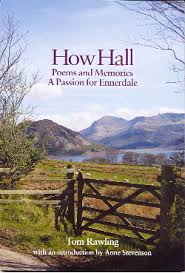
Tom Rawling, How Hall: Poems and Memories, a passion for Ennerdale (Lamplugh and District Heritage Society, 2009), £7.50, ISBN 978-0-9547482-1-0

Tom Rawling, How Hall: selected poems of Ennerdale poet Tom Rawling, read by the author (Lamplugh and District Heritage Society, 2009), £5, CD audio recording

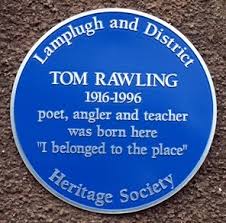
As a child in the 1920s, Tom Rawling grew up in the Ennerdale valley in what was then called Cumberland. It was not until his retirement in the shallow decades of the 1970s and ‘80s that he began to write poetry as a man “haunted . . . even bullied by his memories” as Anne Stevenson’s insightful introduction to this new selection explains. A marvellous collection was published by OUP in 1982 and two further publications from smaller presses resulted, but at his death in 1996 Rawling had not attracted the kind of attention he had hoped for and certainly deserved.

How Hall is a new edition of more than 70 poems, three pieces of autobiographical prose and some wonderfully evocative photographs. The accompanying CD is an audio recording of an extended reading given in 1983 and the passion and precision of his voice and his humble and insightful comments add further invaluable dimensions to any appreciation of his work. Rawling shares with Heaney the kind of vivid recall of childhood that yielded the title of his first book, Ghosts at My Back. An early poem has the young Rawling playing “squire” to the village blacksmith who also introduced him to his life-long passion, fishing – both are described as “tying knots / That didn’t slip” (‘Johnny’). Yet home life was not always so easy and there are poems that bitterly lament the repressed and repressive life of his mother (‘Hands’), his father’s drinking (‘Honour thy Father and thy Mother’) and the son’s rebellious, divisive “radical words” (‘Clipping Day’).

His rebellion took him away from home, but ironically it is for the authenticity of Rawling’s responses to the farm life and countryside of the Ennerdale of his youth that we should continue to read him. Perhaps it has taken us 25 years to understand what he felt intuitively, the importance of our relationships with the natural world and the kind of folklore that once bound man and nature together. Even in the 1920s, it was only Rawling’s grandmother who “glimpsed beyond the byre” to the atavistic fertility beliefs that lay behind “ritual no longer understood” (‘Grandmother’); it was she who knew the spell to complete a whistle carved from hedgerow sycamore (‘Sap-Whistle’). ‘The Barn’ vividly evokes the thrill of the hay harvest: “Bright prongs pierced and unpicked, ash handles / bent, they launched the bundles we embraced” and as the barn filled it was only when “heads bumped the slates / we came down the ladder in triumph”.

images

Anne Stevenson – who met Rawling in Oxford in the late 1970s – rightly directs us not to dismiss his work as “romantic retrospection” because he really “wrote poems to tell the truth and in them rehearsed the daily rituals of life and death”. ‘Rumbutter’ characteristically revels in that recipe’s “sweet beginning” as well as, “not quite hidden, the cinnamon / of the coming funeral feast”.  There is certainly no room for sentimentality in Rawling’s view of nature: a pig is to be cared for only till the “pole-axe fell” (‘Hooks in the Ceiling’) and chickens are nurtured carefully, but in their “due season, each neck pulled / . . . the admired knack of killing” (‘Feathers’). Rawling also shares with Heaney a fascination with the insights embedded in idiom and dialect. ‘Hearthwords’ addresses the younger Irish poet with their shared belief that “the naming spell / gives the thing itself / into our hands” And then, as his own poetry began to flow, he swiftly developed a precise, lean, direct form of free verse, capable of moving from the joyous observations of “cloud and sun pursu[ing] / Their steeplechase across the land (‘I Am What I Was’) to the shockingly frank recording of the realities of the cow shed: “ a column of piss / cascades to the cobbles . . . a face gurning, whistling and whispering soft farts” (‘Privy’).

But Rawling’s reach is not confined to the material. Perhaps his most distinctive poems are those that deal with angling, especially fly-fishing for salmon and sea-trout which his poems transform into an almost religious questing and testing of the individual’s devotion, skill and subterfuge. His own first encounter with the power of the sea-trout he recalled as a moment when he had “waded / into mystery, tampered with Leviathan” (‘Leviathan’). One function of any poem is to offer us profound if vicarious experiences and these poems succeed so well in this evocation, taking us to the riverside at night, “to the dub / where sea-trout rest” where we might “hear an old ewe’s husky cough, / the water slopping, slapping” (‘Night Fisherman’).

imgres

Poem after poem makes it clear that to fish in this way is to engage differently, intimately with the world and to embark on the difficult process of laying aside our humanity’s hobbling self-consciousness, to cast off the accretions of civilisation until we allow “the body [to] flow into the rod” (‘Torridge Salmon’), achieving a different form of consciousness as we “wade in deeper, / Share with the fish / Its lateral line / The current’s push” (‘Only the Body’). It’s easy to understand why Ted Hughes came to admire these poems as Rawling triumphantly celebrates the efforts and occasions when we encounter the Other in what becomes a frankly spiritual communion. So in ‘A Shared Rod’, a kingfisher perches on the “bamboo rod-tip” as the angler waits in the reed bed:

His great eye turns, a moment’s stare,

then, blue-green whirr,

the arrow skims downstream,

leaving an emptied space,

a shared rod quivering.

It is really this kind of encounter – with all that is not bounded by ourselves – that Rawling is conjuring in ‘The Names of the Sea-Trout’, a spell for fishermen that revises and revivifies his grandmother’s superstitious connections with the natural world:

Bender of steel, the breaker, the smasher,

The strong wench, the cartwheeler,

The curve of the world,

She who doesn’t want to surrender,

The desired, the sweet one.

Profound, vivid, honest, accessible – these are poems that at once connect us to a lost past and prepare us for a world in which the environment must again become our close companion. Rawling’s work would be wonderful to teach in schools if it were more easily available and a mainstream publisher would do well to bring him nearer centre stage. For the time being we must thank Michael Baron, Stan Buck and the Lamplugh and District Heritage Society for the very many pleasures of this marvellous book.

imgres

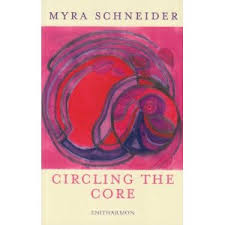
Myra Schneider’s ‘Circling the Core’ (2008)

Myra Schneider is an old friend from the North London circuit, a tireless worker for poetry and a poet of significance who has also proselytised for the therapeutic impact of creativity in relation to both physical and mental illness. She has a new book out and I saw her read from it recently. I have yet to commit my thoughts on her new work to the keyboard and screen but I thought – by way of an appetiser – this might be an opportune moment to post the review I wrote of her previous collection Circling the Core (Enitharmon Press, 2008)

Also, here is a recent interview with Myra conducted by Maitreyabandhu at Poetry East:

https://www.youtube.com/watch?v=5WfI7Bx_7Uo

The interview begins with Maitreyabandhu asking why she selected ‘The Windhover’ by Gerard Manley Hopkins and ‘Morning Song’ by Sylvia Plath, as two poems which had influenced her. He then asks about her life and the different areas of her poetry and writing.

Reading Myra Schneider’s Circling the Core, there are many things that remind me of Edward Thomas’ review of Frost’s North of Boston (1914). Thomas praises his American friend’s poems because they lack “the exaggeration of rhetoric”. He applauds his language as “free from the poetical words and forms” that harmed so much poetry in the early twentieth century. Frost avoids both “old fashioned pomp and sweetness” as well as its opposite – “discord and fuss”. The revolution that Thomas and Frost were pursuing is the recurring one of poetry’s return to common speech and this has long been one of the chief pleasures of Schneider’s work too. Since the mid-1980s, she also has pursued a voice that refuses to flaunt gratuitous formal innovation, nor does she play fast and loose with syntax, lexicon or typography. It might appear that Schneider prioritises a truth to things more than words and her conclusion is an admirable and observant humility before the world, its creatures, domestic objects, weather and places – though her attentiveness to detail is not the whole story.

images

Schneider herself also refers directly to Thomas’ example in taking the epigraph to this collection from his poem ‘The Glory’. Thomas hopes to find this glory in the “beauty of the morning”, the natural world, the acutely observed details of the “pale dust pitted with small dark drops”. Yet what draws him remains elusive and he concludes that he may have to remain “content with discontent” since he “cannot bite the day to the core”. Schneider’s poems echo many of these concerns but – despite the tentativeness of this collection’s title – she tends to be more optimistic about the search for the “core”. The book opens with a marvellous response to a Barbara Hepworth sculpture which, after tracing the curves and lines of the material reality, worms its way to a centre, a still point, “jewel, kernel, womb, unshielded self, / a promise of continuance. / We lay hands on profound silence.”

In Schneider’s work the kernel usually is that “unshielded self”, the authenticity of lived experience rather than the accumulations that can obscure and denature it. In ‘The Mnajdra Temples’, the narrator is interested in and even impressed by information associated with these Maltese Neolithic ruins, but it is “what the humans who worshipped here thought” that is the real goal: “how the human brain began making / complex plans, conceiving deities, temples”. Elsewhere, a viaduct cannot be encompassed by its dictionary definitions; it is always more than its “bare facts” (‘Images’). Similarly, personal identity is more than the sum of its material parts: a bowl created by the poet’s mother-in-law “goes deep but not deep enough to hold everything / she lost” (‘Larder’) and on a return visit to childhood landscapes in search of self, it is ironically “when I leave / the present peels away” (‘Going Back’). A poem like ‘Goulash’ is so good just because it manages to capture this core of subjectivity, the thinking mind in process as it moves from the details of cookery, to love, to landscape, to a contemplation of “darkness” which lies ambivalently at the heart of things, triumphantly ending with a celebration of friendship which is not overwhelmed by placing it beside the longer historical perspectives of the jewellery of the Sutton Hoo burial ship.

Schneider’s interest in psychological truth leads inevitably to the use of dream materials as the starting point for a number of these poems. ‘Naming It’ opens dramatically with collapsing buildings but, even after the dust settles, the “panic is all in the rubble”. The possibility of escape from such chaos is intuited when the narrator discovers a blue pool and realises it is “crucial to capture the exact word for its colour”. As well as suggesting the essential nature of her work as a whole, this also confirms that Schneider’s vision encompasses a good deal of darkness. Though there are occasions when grief, pain, injustice are countered by little more than wishful thinking, as in ‘Journey’ with its repeated “What I want . . .”, a poem like ‘Nothing’ confronts it head on in the “vacant cradle /  of delicate bones that was once a bird’s head”, an object that seems to be demanding to know how to “face nothing”. Something of a reply to this is given at the end of the sequence ‘Larder’, with its finely judged observation, defining life itself as “a series of small makings / to stack up in larders against death”.

It is less of a leap than one might imagine from this to Schneider’s re-working of the myth of Orpheus, an ambitious poem that stands up impressively alongside Carol Ann Duffy’s ‘Eurydice’. In ‘Eurydice’s Version’, Orpheus is a stunningly beautiful but selfish, spoilt man-child, beside whom his wife is initially no more than an “adjunct”. His music is presented as a compulsion she would like to resist. Her association with the shepherd, Aristaeus, is reinterpreted as a relationship in which her “actual” self is recognised in contrast to Orpheus’ chauvinistic, insistent projection of “bedmaker, breadmaker, whore / babymaker, milk-breast, childminder, nurse, / comforter, slave, mystic maiden, high goddess, // muse”. But Aristaeus’ interest in her true “core” frightens Eurydice away, allowing the snake bite that kills her to be regarded as “punishment” for turning her back on such a moment of possible honesty. Orpheus’s turning is likewise re-interpreted as a relief for Eurydice, who prefers the darkness of the underworld where, she says, “I’ve learnt to listen, to think, / for myself and when I speak I am heard” – in other words, where she lives with the virtue of truth to her inner self which this collection explores.

At one point, Eurydice wishes Nature might resist Orpheus’ melodic pushiness too and Schneider is admirably unapologetic about the importance of the natural world in the process of salving some of the harm she encounters. Those who have read her poetry in the past will recognise features of locality such as Pymmes Brook, the Piccadilly line viaduct to Arnos Grove, Arnos Park itself in north London and Schneider’s south-facing garden overlooking it. She has worked this landscape into almost mythic significance, its details able to reflect and evoke the inner experiences with which she is really concerned as in ‘Seeing the Kingfisher’, the ‘Drought’ sequence and ‘Skywards’. A little more exotically, ‘The Oyster Shell’ explores again this poet’s characteristic movement inward, a movement for which “prayer” offers no help but which, pursued with the kind of vigorous honesty that fills this book, can reach an almost Blakean intensity:

I retreat to the cradle of this shell,

creep in, unclothe my self, tread

on milkwhite and mother-of-pearl,

follow faint pools of sandgold

to the sullen indigo sea lying below

the hinge as its core. Here, I let go.

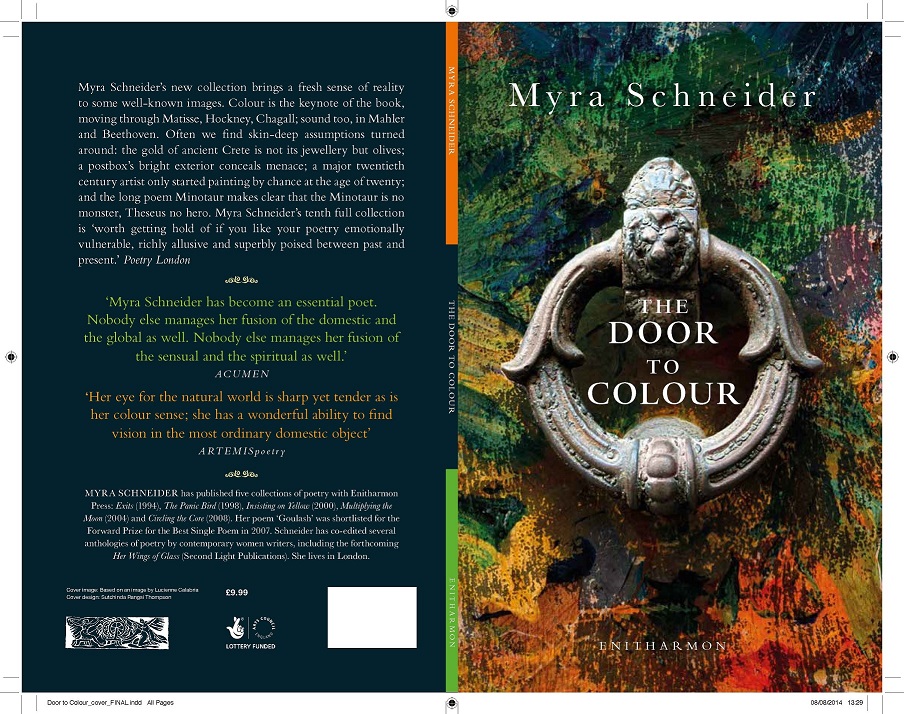
Myra’s new collection is called The Door to Colour:

http://www.enitharmon.co.uk/pages/store/products/ec_view.asp?PID=645

Schneider_Colour_PRF1 (2)