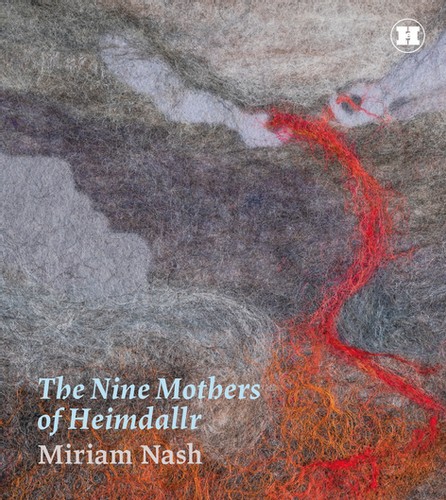
 Miriam Nash’s new, 180 line poem is fascinating in the transformation of its sources in Norse myth, its quiet yet firm challenging of racial and gender hierarchies and in its exquisite presentation by Hercules Editions, accompanied as it is by an essay from Jóhanna Katrín Friðriksdóttir and textiles imagery created by Christina Edlund-Plater (in fact, Nash’s mother).
Friðriksdóttir gives those of us not up to speed with the Norse sagas some explanation. It seems the gods were actually not primary but descended from the race of giants. Yet since gaining supremacy, the gods have excluded and denigrated the giants. Generated from a hegemonic point of view (the top people in medieval Icelandic society), these Norse myths (as do most) tend to “justify and naturalise the status quo”, as Friðriksdóttir puts it, and what is being naturalised is a particular view of history, ancestry and masculinity. The anxiety of the Norse myths is a familiar one, tied up with patriarchy and the male control of women. There is a scene of ‘original sin’ in these stories in which the gods, Odin and his brothers, kill Ymir, the first and oldest giant. Out of Ymir’s dismembered body parts, the gods create the earth. This is a Fall from a primordial unitary state; Friðriksdóttir again: “at this juncture, one group becomes two” and conflict becomes the condition of life on earth.
So much for the birth of conflict and violence. The sagas are also notable for the relative absence of the feminine. An exception can be found in obscure references to the god Heimdallr who was born from nine giant mothers (possibly sisters) and it is through ‘writing on’ from these few suggestions that Miriam Nash’s poem develops a richly female addition to the Norse sagas. She challenges the old tales’ defensiveness about race (giant and gods) and gender and offers the modern reader a narrative of nurture, warmth and closeness in contrast to violence and conflict. The battle lines as they are drawn up are pretty obvious and will surprise no-one but Nash’s use of balladic form, of spoken voices and her re-scripting of details from the traditional stories conveys something vital and moving, a new myth for the age of Black Lives Matter and the #MeToo movement with its original purpose of empowering women through empathy.
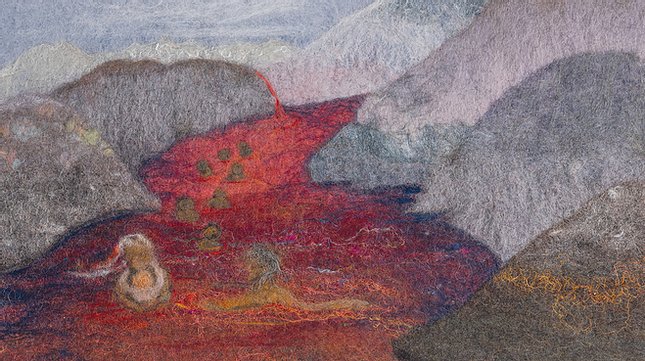 Nash’s poem opens at the heart of an unorthodox family with one of Heimdallr’s mothers speaking tenderly. The whole family have gathered round a campfire, a hearth, in various states of sleep and wakefulness, cooking, sword-sharpening, comforting and acting as a seer. She tells Heimdallr the story of his remote origins in the primordial time when division was not known: “a tale of giants, a tale of gods / in early time, in frost-fire time”. A time of community and peace: “we lived snore-close, heart-close”. Also a time before language (or at least, language as we now have it) and Nash makes Ymir – the representative figure of this lost age – a “mother-father”, represented by the possessive determiner “their”. As in the traditional stories, Ymir creates/finds Buri in a glacier and Odin is Buri’s grandson. It is Odin who first declares division:
Odin said he was a God
Odin said the Gods were old
older than Ymir or giants
older than the ice-fire world.

This is an example of Nash’s form – loose quatrains of usually 4-beat lines, often part-rhymed at lines 2 and 4. And Odin’s declaration – his myth creation, his propaganda, his re-writing of history, his self-aggrandisement – is at the heart of the world’s troubles. Heimdallr asks who made the gods and the answer is that “They made themselves / with stories”. The poem goes on to recount Odin’s slaying of Ymir and the word “blood” recurs over and over again in the following quatrains.
But it is a blood ocean across which the nine mothers of Heimdallr have protectively carried their child. The child instinctively sees the roots of division and does not want to be “a half”, does not want to be merely “a god”. The comforting mother’s voice offers a startling solution (if we live in the fallen world); “Ymir was mother-father, child / Both might be your path”. The possibility is raised of a mode of living in which opposites may be once again reconciled, male/female, god/giant, fire/ice and the passage towards such a life is evidently through the tenderness and supportiveness of the mothers who advise Heimdallr to: “dream of ice-lands and of flame / sleep, snore-close, heart-close to me”.

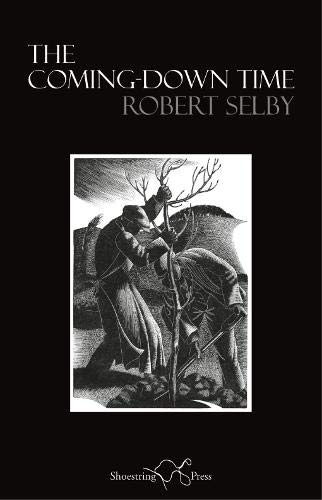 Robert Selby’s debut collection is fronted by a wood cut engraving by Clare Leighton, titled ‘Planting Trees’. Two flat-capped workmen labour to bed in a sapling. A wind-bent tree stands nearby; on the gusty skyline, at the top of a hill, a dark copse. It’s like something out of a Thomas Hardy poem, or an Edward Thomas one, and it’s well-chosen as these are the forebears The Coming-Down Time often explicitly acknowledges. Launched into a poetry world dominated by so many books addressing environmental, gender, race and identity issues, this collection (depending on your viewpoint) is either timeless or behind the times. Selby’s careful organisation of the poems makes it clear he knows what he’s doing and he will do it his way.
 Selby’s use of language and form is likewise pretty traditional. It’s not just a result of the subject matter that the book is frequented by words such as smithy, shire, lambkin, deer-stalker, and lush-toned phrases such as “blossom-moted”. The flip side of this is that details of 2020 UK are often treated with a distaste, an alienated distance. Later in the book, a friend returns from the dust and pollen of the English countryside into London: “its tagged shutters and sick-flecked stops, / its scaffolding like the lies / propping up your peeling hopes”. The friend is female and (I think) Canadian. Another poem’s narrator tries to persuade her that “[t]his is the real England [. . .] It’s a place of trees; of apple, pear, cherry and plum”. There is more to be said here about the meaning of ‘real’ and it’s hard to tell if the narrator’s invitation is meant to have a deathly ring to it. He asks, “Do you want to reset your watch to the toll of here?”
 The import of this question forms the emotional and dramatic context of the later poems in the collection which trace an on/off relationship. The narrator is left wondering: “I must wait for the needle / of your heart’s compass to unspin, / and see where it stops”. In reading that I’m reminded of Lea and – what seemed to be – her relative lack of choice in the earlier years of the twentieth century. There is a good deal of unalloyed nostalgia in The Coming-Down Time for an England of the mind, if it was ever part of any actual century. I find the female figures in the book suffer because of this: most of them do not achieve a specific, particular life in the poems. I’d like Selby to go on to explore the irony in two images: the masculine arms in “rolled up sleeves” that may or may not be “strong enough” and the closing lines just quoted, in which the desired woman bides her time, knowingly possessed of strength, of the agency of decision.


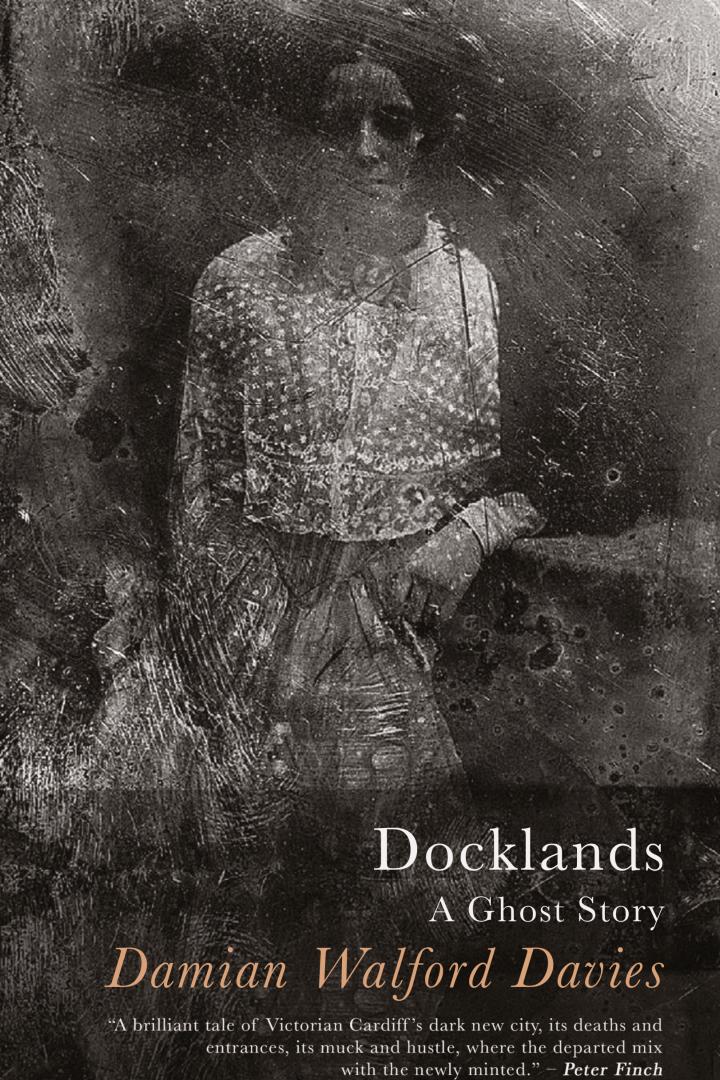 This is Walford Davies’ fourth book from Seren and it is an ambitious project, combining narrative and lyric form (every poem is 16 lines long, in unrhymed couplets, most in four beat lines). It’s also a dramatic monologue, in effect, as the speaker is a thoroughly unpleasant, arrogant, but haunted architect engaged in several large urban projects in Cardiff between the years 1890 and 1982. Talk about the male gaze, this man epitomizes it. He and his wife have recently buried a child lost in stillbirth (“they wrapped it in a pall // not bigger than my handkerchief”) and while she mourns the loss, he gets on with his work and frequents bars and prostitutes in Cardiff’s docklands. The sympathetic reader is probably going to try to read this man’s cruel and dismissive treatment of his wife (and his exploitative relationships with other women) as his own rather twisted way of dealing with grief. But it’s hard to maintain that view, as Walford Davies is often shockingly good at catching his loathsome attitudes, especially towards women: “This quarter grows on me. / In shabby rooms in Stuart Street // my new friend swears // she’ll tackle anything for oranges”.
 Walford Davies, in an end note, talks of the ambiguity of the female figures – wife, prostitutes, dead girl – who do tend to float without clear identity, disembodied, through the text. It adds something to the ghost-like quality of the book, but the loss is any more powerful evocation of them. Also, the choice of brief lyrics to develop what could well have been a novel, gives the reader some powerful moments but few prolonged engagements with any of the characters. And the nature of the central male figure is problematic because of his downright unpleasantness (though, I suppose, Browning managed it in ‘My Last Duchess’) and in 2020 there will be plenty of readers who find such a portrayal an absolute bar to reading. I don’t think Walford Davies ironises and critiques his male figure enough, or clearly enough.
