Laurel Prize Shortlist 2025 – My Favourite Is….!

The shortlist for the eco-poetry/nature poetry Laurel Prize 2025 has just been announced. The finalists – judged this year by the poets Kathleen Jamie (Chair)Daljit Nagra, and the former leader & co-leader, Green Party of England and Wales Caroline Lucas – are (in alphabetical order):

Judith Beveridge Tintinnabulum (Giramondo Publishing)
JR Carpenter Measures of Weather (Shearsman Books)Carol Watts
Eliza O’Toole A Cranic of Ordinaries (Shearsman Books)
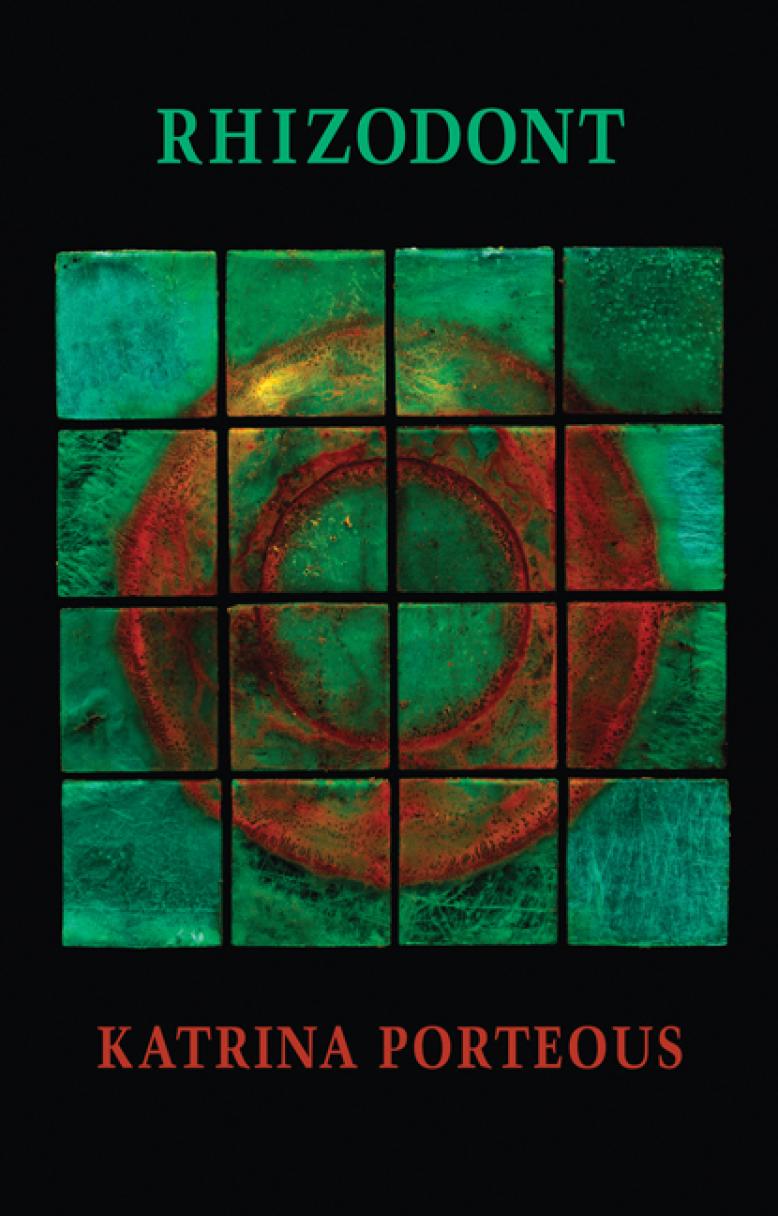
Katrina Porteous Rhizodont (Bloodaxe Books)
Carol Watts Mimic Pond (Shearsman Books)

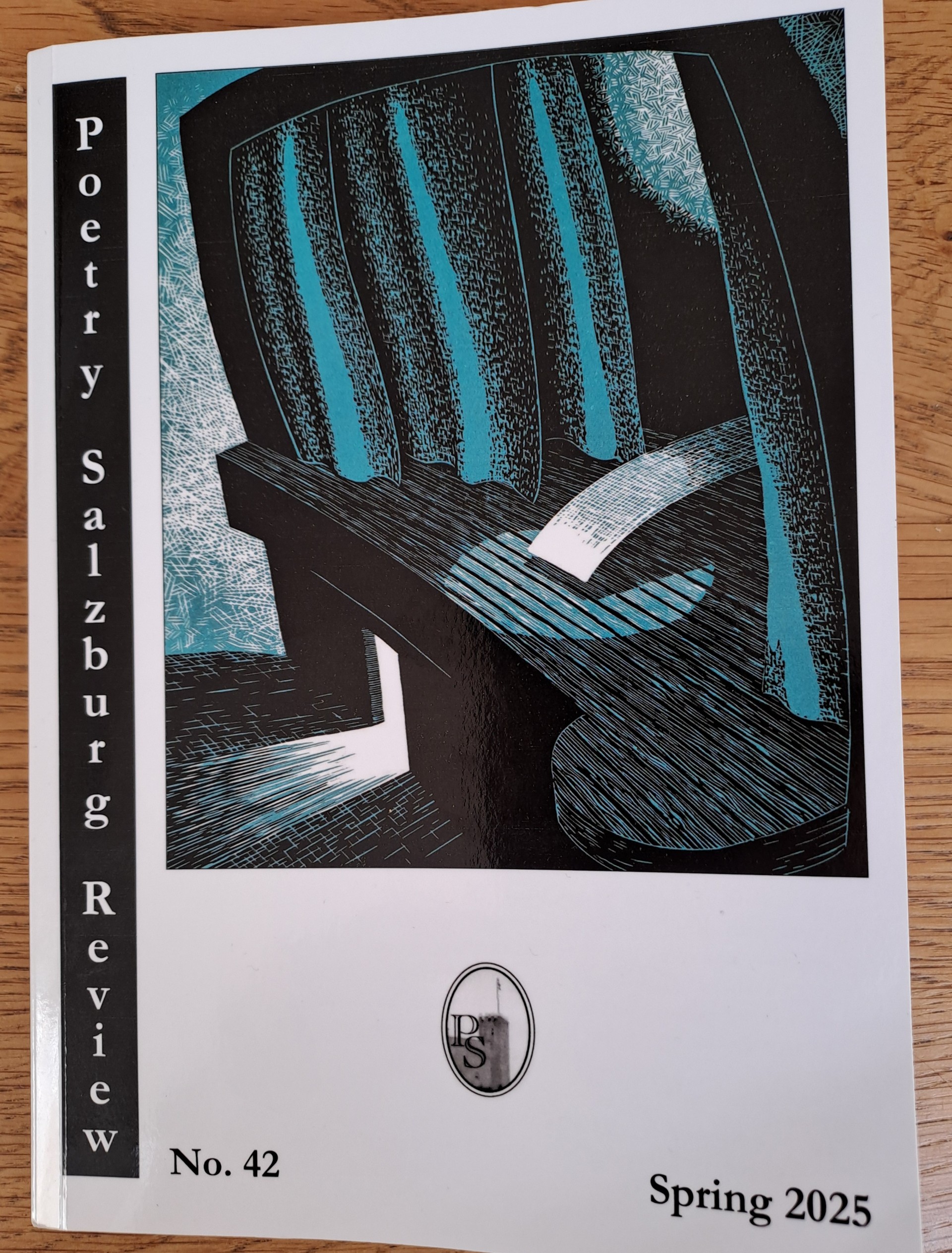
It turns out I have reviewed two of these collections – one of them I have been bending the ears of anyone who will listen about how very very good it is. I reviewed Katrina Porteous’s Rhizodont (Bloodaxe Books) for Poetry Salzberg Review fairly recently and posted an extended version of the review here. I concluded that ‘The people and landscapes of ‘Carboniferous’ are far more successful as poems to be read and enjoyed, while ‘Invisible Everywhere’ is a bold, well-intentioned experiment that fails’.

It is Eliza O’Toole’s A Cranic of Ordinaries (Shearsman Books) that I have been telling everybody about. Interestingly – and demonstrating the great enthusiasm the publisher shares for this poet – Shearsman have just published her NEXT collection: Buying the Farm (a georgics of sorts). The nominated collection was published in 2024.

I reviewed it in brief for The Times Literary Supplement recently, as follows:

The premise of Eliza O’Toole’s superb debut collection, A Cranic of Ordinaries, is unpromising: a year’s cycle of diaristic pieces in which the poet walks her dog through the Stour valley. But the result is a sublime form of ecopoetry which is visionary, yet creaturely and incarnate, and to achieve this O’Toole channels two great nineteenth century writers. Gerard Manley Hopkins’ ‘Hurrahing in Harvest’ joys in the things of Nature which are always ‘here and but the beholder / Wanting’. When self and natural world do communicate, Hopkins named that flash of true relationship ‘instress’.  O’Toole’s ‘Stour Owls’ records just such a moment, listening to the calls of a female tawny owl, the ‘slight pin-thin / hoot’ of the male, followed by a tense silence: ‘then the low slow of the barn owl as the / white slide of her glide brushes the air we / both hold & then breathe’ (12).

O’Toole also adopts Emerson’s idea of the ‘transparent eyeball’, seeing all, yet being itself ‘nothing’. The excision of the self’s perspective is systematically pursued. Seldom is the landscape ‘seen’ but is rather subject to plain statement: ‘It was a machine-gun of a morning’ (11), ‘a vixen-piss of a morning’ (13), ‘a muck spread of a morning’ (34). O’Toole has an extraordinarily observant eye, but this repeated trope counters any taint of the constructed picturesque, the human-centring of vanishing points and perspective. The observer grows ‘part or parcel’ of the world. Such a vision makes demands on language because in truth, ‘It is necessary / to write what cannot be written’ (94), and this yields one of the most exciting aspects of this collection as the poet deploys varieties of plain-speaking, scientific, ancient, and esoteric vocabularies as well as a Hopkinsesque ‘unruly syntax’. She describes ‘young buds. Just starting from / the line of life, phloem sap climbing, / a shoot apical meristem and post / zygotic. It was bud-set’ (26).

O’Toole’s choices about form are also bold, almost all the poems being both right and left justified, creating blocks (windows?) opening on each page. The realm the reader is invited into (not told about, not shown) is one where the manifold particularities of the natural world are also and at once a whole. O’Toole’s dog digs a hole: ‘In / the hole and out of it, the soil was / whole. There was a unity and no lack. / In the hole was soil. It was a / comprehensive various entirety; it / was a universe of relatings’. (38) In such ways O’Toole’s ordinaries are made ‘strange’ (33) and the toxic divide between modern humanity and the natural is momentarily, repeatedly, bridged.

Here’s one of the poems from A Cranic of Ordinaries. Apologies are due for formatting accuracy as – as we all know – WordPress is rubbish at dealing with poetry. But you’ll get the idea…..

Perpetual gravity – Box Tombs at Wiston

(the quality of appearing to recede, essential to the landscape tradition)

Now illegible, the children of John

Whitmore and Susanna his wife,

Sarah aged 11 Months,

Robert aged 2 Years,

Rebeckah aged 11 Months,

Elizabeth aged …. Weeks,

Lucy aged 1 Week,

Susanna aged 20 Years,

Thomas Aged 6 Years.

John Whitmore departed this life Jany

the ….6th 1746 Aged (6)6. He was a

good husband loving father faithful

friend and a Good Christian. Susanna

Whitmore died / Jany. 25 1789 Aged

(?8)6. To dwell until all the world

inscribed when it was still possible to

die. To lie slightly foxed, mortared in

a brick box irregularly repaired, alive

with stone-devouring lichen and

littered with dry lime, leaves and

frass. Fin* pees antimony and sees off

the squirrel, wards off unbelievers we

have no need for having no place

amongst toppling tombs. A litany

indescribable, a conjugation beyond

reach, an accent mark over a vowel,

an entire landscape made grave. It

was October, the same fields were

ditched, furrowed, carved, still dug

over and still the Stour was flowing. In

the picture’s distant plain, the sun

like other yellows, was still fading.

Generally, a history remains unsure.

*O’Toole’s dog

The Laurel Prize awards £5,000 for the winner of the prize and £1,000 for the other four finalists – so congratulations are due to all of them. The winner will be announced at the Laurel Prize Ceremony which is taking place on Friday 19 September at 5.30pm (BST), and will be aired via a free live-stream. This year’s ceremony is a part of BBC Contains Strong Language which takes place in Bradford from 18-21 September.

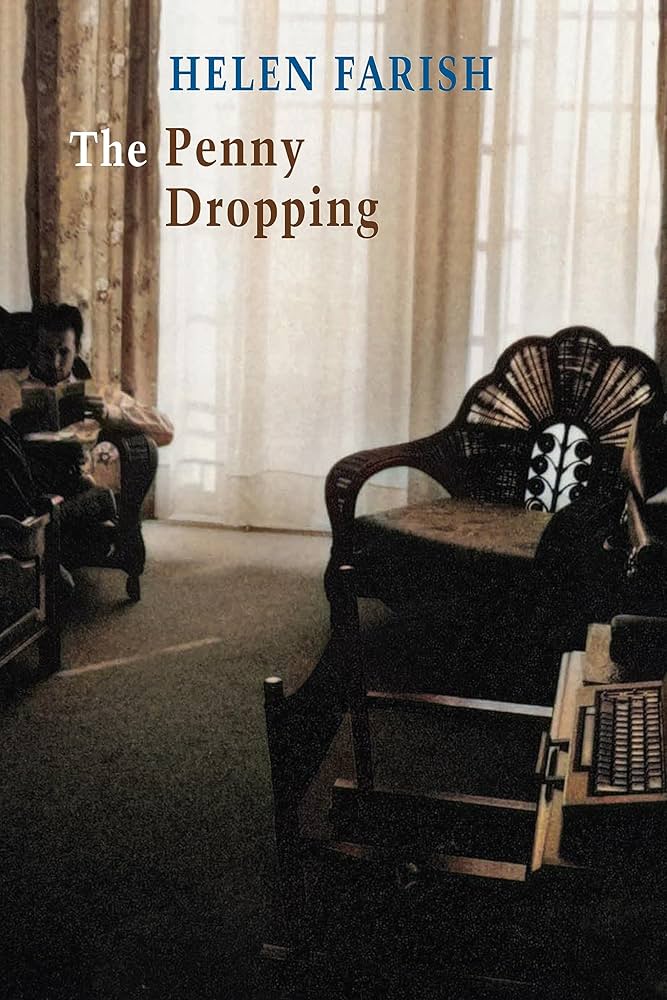
Helen Farish’s new collection, ‘The Penny Dropping’, reviewed

An edited (shorter) version of this review first appeared in Poetry Salzberg Review in June 2025. Many thanks to the editor, Wolfgang Görtschacher, for commissioning the writing of it. The collection, The Penny Dropping, was shortlisted for the TS Eliot Prize in 2024.

Tennessee Williams once wrote that ‘memory takes a lot of poetic licence’, but Helen Farish’s memory poems in The Penny Dropping (Bloodaxe Books, 2024) declare from the outset that their intention is to set things (here quoting TS Eliot) ‘in order’, by settling ‘life accounts bravely in the face of now and then, and [to] settle them honestly’ (here quoting Charlotte Bronte’s Villette). This is quite a task given the love affair the book recalls and reflects on occurred almost 40 years ago (the absence of mobile phones, internet and social media is particularly striking and hence evokes the ‘period’). But how ‘honest’ these poems are, of course, we cannot tell, though Farish’s commitment to autobiographical fidelity means any potential reviewer must be warily self-conscious – we do not want to criticise a (real) life, with all its choices good and bad, but to focus on the artistry of the poems. This commitment to honesty also has implications for the poet: a plain-speaking truth demands (as did Othello’s) a plain, unvarnished re-telling.

Indeed, Farish’s lyric poems are very plainly told (readers tiring of a lot of contemporary poetry’s tricksy obfuscation and language ‘breaking’ will be delighted to read poems here which are immediately direct and accessible) and formally they are unrhymed, irregularly lined verse paragraphs, attuned to the colloquial, the storytelling. But, with its age-old narrative (girl meets boy, they fall in love, fall out of love, difficult break up) and insistence on plain-speaking, Farish runs the risks of cliché. Often, she does not steer clear of very (over-) familiar phrases such as ‘pick up the pieces’, ‘a weight off his mind’ (‘Premonition’), ‘on the breadline’, ‘when push came to shove’ (‘Qui e Li’), ‘winning smiles’, doing ‘things by the book’ (‘The Butcher’s Boy’). Moreover, the male love interest is stereotypically a ‘hero’ in the poem of that name, is even designated ‘Tall, Dark, Handsome’ (‘Thanking the Universe’), and the rather feeble title of the collection – the penny dropping, the realisation of the end of the relationship – seems all rather too familiar for contemporary poetry (in fact, Farish is better than this and the penny that drops is not quite so obvious – more of this later).

So, the collection traces – in old-fashioned chronological order – the start, middle, end, and aftermath of a decades old love relationship. It’s a little bit Shirley Valentine, a little bit The End of the Affair, though the role model Farish herself suggests is Woody Allen’s Annie Hall. Despite the long distance recall, there is a vivid, sensuous immediacy to the writing. In lesser hands, a likely recourse would be to old photograph albums, but Farish is as liable to start a poem from an old map, still in her possession, on which the young lovers scribbled notes for their anticipated, future return (which never happened). And there must have been a lot of maps, as the book unfolds in an almost picaresque fashion with the lovers meeting in Morocco, travelling to Italy, and Sicily, onto Greece, and Crete, before a return to the UK in Oxford. One of the key methods Farish uses to convey the thrill, freedom and passion of early love is through these exotic locations, the colours and customs, the names, the booze, the food. ‘Things We Loved’ – the book’s first poem – does this via Morocco’s markets, rose sellers, taxis, tagines, its acrobats and a dilapidated cinema. In Palermo, we’re along the Via Maqueda, sampling gelato, or polishing off a bottle of Donnafugata in bed (‘Mozart’s 233rd Birthday’). Later in the book, the woman – now looking back over the decades – finds it’s still a bold Italian red, penne, gorgonzola, and oranges that conjure those long-lost days in true Proustian fashion (‘Pasta alla Gorgonzola’).

Bernard O’Donoghue praises The Penny Dropping not only as a book of poems but also as possessing the ‘coherence of a novel’. There is a clear narrative, but the characterisation of the male lover is very sketchy and, if the genders were reversed, surely we’d be railing against the male writer’s disservice to the female figure’s reality? Though a photograph (in ‘Exposure’), taken in Fez, is said to have caught him unawares, with his ‘own barriers down’, we never get much more about him than that he is sociable (more than the woman), is ‘too much the gentleman’ (‘May Day’), is good with children (and wants them; she doesn’t), has bouts of unexplained illness, and is eventually unfaithful to her. Bloodaxe’s unattributed cover image – in shadowy, ‘memoir’ sepia – has a self-absorbed, book-reading man almost out of frame and this seems about right. But, fair enough, the book is (a la Bronte) the author’s settling of her own accounts and Farish really does do this with tremendous honesty and an astonishing absence of blame (though plenty of self-criticism).

Even in the early days of the affair, she is conscious of the couple’s differences. At a Greek Orthodox Easter celebration, he is at ease and happy, ‘good with the little ones’ but she has ‘said no to the tripe and only joined in / for one glass of tsikoudia / before going back to [their] room to write’ (‘Christ Has Risen! He Has Risen Indeed!’). In ‘May Day’ he ‘would have joined in’ another local celebration and (in retrospect) she berates herself: ‘I should have said You go’. The self-blame here feels truthful, and is so commonly gendered, and the same perhaps for her (perceived) faults of passivity and sense that ‘I always had guilt inside’ (‘Scapegoat’). ‘In Seville That Spring’, at the moment of crisis (you ‘couldn’t go on, / you wanted space’) the woman again regrets and self-lacerates: ‘I should have made you talk to me, / I should have fought for you, stomping my feet [. . .] Instead, British-style, I drove north, / three hundred miles’.

These are painful poems in the end and the reader may well share in some of the criticism Farish levels at herself. But we are often wrong-footed. In the book’s title poem, there are two pennies dropping: one is the man’s sudden realisation that the relationship (in his view) is finished, but the other (in the poem, presented as an explicatory parallel to his realisation) is Farish’s sudden grasping that her mother is terminally ill. And it’s not until close to the end of the book, in ‘Beauty Spot’, that we are given to understand that her mother’s early death traumatised Farish, so much so that (speaking of herself), ‘she’ll lose you if she doesn’t absorb / how self-absorbed she is, / [. . .] you’ll look elsewhere’. Perhaps this is what happened. The story valorises truth, rather than being any sort of role model narrative for young women (or men for that matter). This is admirable and it’s in these final few poems that the emotional complexity of the relationship really emerges, the woman, now in her sixties, is left with a Goethean ‘blessed longing’, an emotional state, ‘not sorrow, and more sinuous than sadness’, not resolved, no longer rawly anguished, but with a desire to place, to settle, what has happened, to ‘have the memory / and be through the loss itself’ (‘That Selige Sehnsucht Feeling’).

That Selige Sehnsucht Feeling

I’d name it Selige Sehnsucht, that feeling

my home gave me yesterday, words

you used once in a note –

I must have forgotten something,

I have that Selige Sehnsucht feeling.

It’s an indefinable ache – not melancholy,

ot sorrow, and more sinuous than sadness –

a feeling on a journey, picking up

strands of other like-hearted feelings on its way.

Is it possible to be sick for home while still there?

I think you were saying you missed me

before you’d even left. And yesterday,

as the red sun lowered, picking up other reds

on its way – flame red, orange red, ember red –

I ached for what I was looking at:

the long tawny-brown grass which,

from across the field, the house seemed

to grow out of putting me in mind

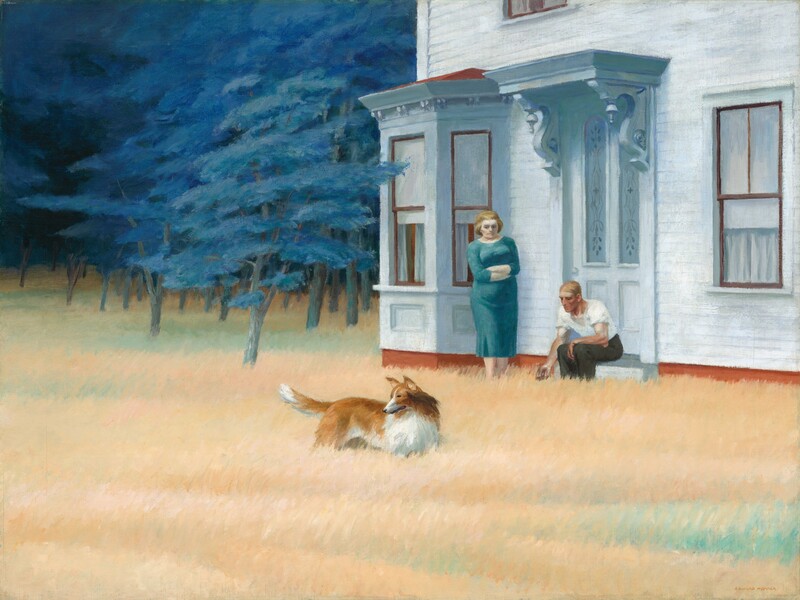
of an Edward Hopper house in a timeless

American field and the house retreating

into itself in the restful silence.

The bats came out. A barn owl flew close.

And the wind which often stirs at the end

of a summer’s day stirred. Take the place from me,

I almost thought, so I can have the memory

and be through the loss itself.

Was it something similar, a feeling in the same family

of feelings, that prompted your use of Selige Sehnsucht

in that long-ago note? I must have forgotten something,

you wrote, though whatever it was that was

taking you away for a few nights hadn’t even begun:

Or is it just that I love you so?

Jeremy Reed’s ‘Collusive Strangers: new selected poems’ (1979-2016) reviewed

An edited (shorter) version of this review first appeared in Poetry Salzberg Review in June 2025. Many thanks to the editor, Wolfgang Görtschacher, for commissioning the writing of it.

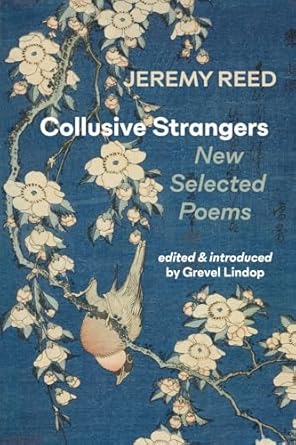
As the editor, Grevel Lindop, says in his Introduction to Collusive Strangers: New Selected Poems (Shearsman Books, 2024), the literary world has not taken enough notice of the remarkable oeuvre of Jeremy Reed. Many of his recent collections have appeared without much, if any, critical notice, so it’s to be hoped that this substantial new selection, from 1979 -2016, will bring this misfit-poet’s work back to more general attention. The problem is that the protean Reed fits no pigeonhole, plus the fact that he’s been astonishingly prolific. Intensity of perception and a phenomenal dynamism of language and creativity are his hallmarks, and he matches the best in nature poetry (Clare and Hughes), the decadent, urban flaneur (Baudelaire), then writes as Symbolist and Surrealist (Gascoyne), pursues sci-fi, focuses on pop and fashion, next becomes a portraitist and moving elegist. Even given these 300 pages, Reed – a sometime Peter Pan now into his 70’s – continues to be elusive. Compared to the prolific poet/novelist John Burnside, the difference is clear: we all knew what the brilliant, much-missed John was up to. With Reed, we are endlessly being caught by surprise.

Even Reed’s earliest work arrived fully formed. In the late 1970s and early 1980s, the urban, neurasthenic wanderer appears in ‘Claustrophobia (Kings Cross)’, the narrator’s need being ‘so strong it might involve the police’. In contrast, ‘Dwight’s Brother’ is an early stanzaic, sci-fi piece, a character from the future obsessed with Manson’s and Nixon’s careers, and ‘the monomania that burns planets’. And the magnificent ‘John Clare’s Journal’ ventriloquises the nature poet’s concerns for the natural world of Helpston, his stumbling literary repute, and fear for the future of his children, ‘laid / out as corpses’. Reed’s ambition is clear from the start, and in a poem like ‘Visit to George Barker’ he evidently empathises with the older poet’s withdrawal and seclusion, his writing contemporaries being harshly judged for a lack of ambition as ‘poets whose very aim is minimal / gesture, earning [Barker’s] dismissal’.

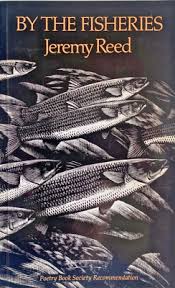
My own first acquaintance with Reed’s writing was in the two volumes from Cape in 1984/5, By the Fisheries and Nero, when James Lasdun edited him. These particularly highlighted the Nature poems, for example ‘Conger’ which outdid Ted Hughes: ‘They’ll shave a finger off with precision, / clean as a horse bite, or close round a hand / and leave it as taut gristle strung on bone.’ In a quieter poem, the narrator is fishing in a harbour, near a ‘desalination plant’, the tautly strung reactions of a shoal of mullet seemingly reflected in the fisherman’s own alertness and nerves (‘By the Fisheries’). ‘Spider Fire’ plays brilliantly with perspectives as every sort of tiny beast and insect flees a wildfire, while the narrator, at a distance, observes ‘a black hoop / ironed into the shire’. Though the first-person pronoun recurs in many poems, Reed is usually not much interested in self-revelation. One wonders, if he was/had been, he might be more widely appreciated, because it’s not that he can’t do it. ‘Visiting Hours’, for example, is enough to make a grown wo/man weep as the narrator visits his father in hospital, economical with the truth that this is ‘terminal’, the child compelled to play the father, the father, ‘like a diver gone on down // to find an exit that was always there, / but never used’. In characteristic ABCB quatrains, ‘Changes’ perhaps records the poet’s re-visiting Jersey and a brother, or boyhood friend, who stayed behind as a farmer, both recognising ‘our youth survives, the present is a gap’. And Lindop includes two remarkable poems from the Nineties collection, in which we seem to get close to Reed’s own autobiographical difficulties, when personal survival seems ‘to be the question’ (‘Samaritans’), and, in ‘Prayer’, Reed addresses a divinity of an uncertain variety, pleading for illumination, for help, a hearing, a pointing of a way out, from guilt, dread, self-injury, poverty, ‘the unappeasable, involuntary / inheritance of lucklessness’.

But Reed deals with topics, rather than ‘issues’, and his work is descriptive in character, never preachy or judgemental, so he seldom offers us his ‘views’. The work is driven by his ‘curiosity’, which both ‘holds us to life and feeds us to the flame’ (‘Moth-Trapper’). His praise of the artist, in ‘Cezanne’, is revealing of his fascination for the ‘ordinary’ and for the shared knowledge that ‘the beautiful / is inherent in all that lives, / and once externalised in its true form, / remains as that’. Over and over again, Reed captures – hence externalises – the true form of things in the colourful, vigorous, unblinking poems selected here. And as the millennium approached, Reed extended his range even further towards ‘all that lives’. There are uncharacteristic political poems (Tony Blair is a particular target), but Reed also writes of the experience of AIDS, and with a Baudelairean dwelling on sexuality, in poems like ‘Transsexual’ and ‘Brothels’, and is drawn closer to popular culture, its fashions, music, and iconic figures. But many of the poems on Madonna, Billie Holiday, Elvis and The Rolling Stones drift to looser forms of summary and the decade from 1993 to the early 2000s contains less brilliant work, though 2006’s Orange Sunshine with its evocations of 1960s London marks a return to form.

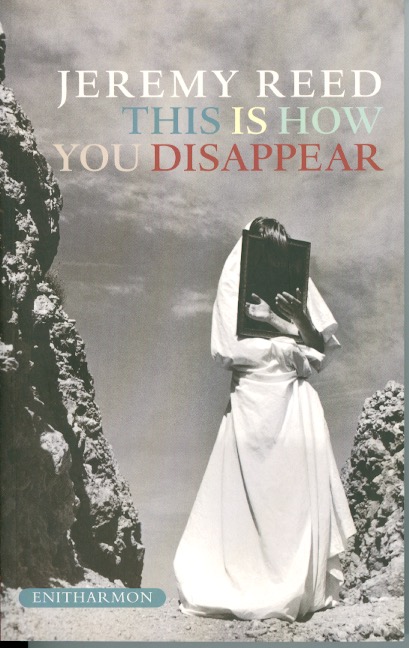
Reed as elegist, as in This Is How You Disappear (Enitharmon Press, 2007), was perhaps unexpected, but poems like ‘Paula Stratton’ and ‘John Berger’ (not the art critic) must rate amongst the finest in that genre produced in the last 100 years. The honesty, attention to detail, the empathy extended to his subjects (Stratton was a drug addict; Berger a difficult Jersey friend and Nazi-collaborator), and the apparent ease and beauty of the writing, mean these poems ought to have been anthologised everywhere. The elegiac note is hardly surprising as Reed moves through his seventh decade and poems about socks, potted plants, tea, honey, and cupcakes seem to mark shifts in focus though Reed remains true to his repeated maxim that ‘everything I see [is] poetry’ (‘London Flowers’). The poems retain the vigour and speed that he admires in Plath’s work: ‘her fast ball imagery / on speed-trajectories [. . .] her plugged-in dare-all energies’ (‘Re-reading Sylvia Plath’). As he puts it in an extract from ‘White Bear       and Francis Bacon’, Reed has remained true to his early ambitions ‘to kick poetry into near sci-fi / [. . .] like dirty-bombing the dictionary into my face’ and there are thrills to be had by any reader on every one of these 300 pages in which Reed makes so many contemporary poets look sluggish, mired in virtue signalling, lumbering in form, and monotone compared to his vivid technicolours.

Here is the whole of ‘Elegy for a Polka Dot Shirt’ from Orange Sunshine (2006):

Unreconstructed 60s
ostentation snowed on blue
labelled Jacques Fath, tailored fit,
fished from Retro on a simmmery
cloud hung-over August day,
bought for pop connotations –
high collar with flouncy points,
cotton married to the skin.
Medium size:
              38 cm:
structured for a defined waist
sexless to the vanity
of ownership.
Affordable at £15,
the item begged me to retrieve
its showy staginess.
             Outside, airless haze,
W11 backpacking crowds
random like footage spilled
into a documentary.

Later I tore a fragile seam
tracking towards left underarm,
the fissure sounding like hot oil
pronouncing itself in a pan.
The tear backtracked through history
to the anonymous wearer,
who bought sensation, sold it on
into a chain, the onion skin
thinning from use;
              the scar re-sewn,
but evident, a little glitch
caught in the fabric like a blues
lament,
the singer head-bowed on a stool,
cooking up trouble, while the club
tug at his vulnerability
and modulate applause from hot to cool.

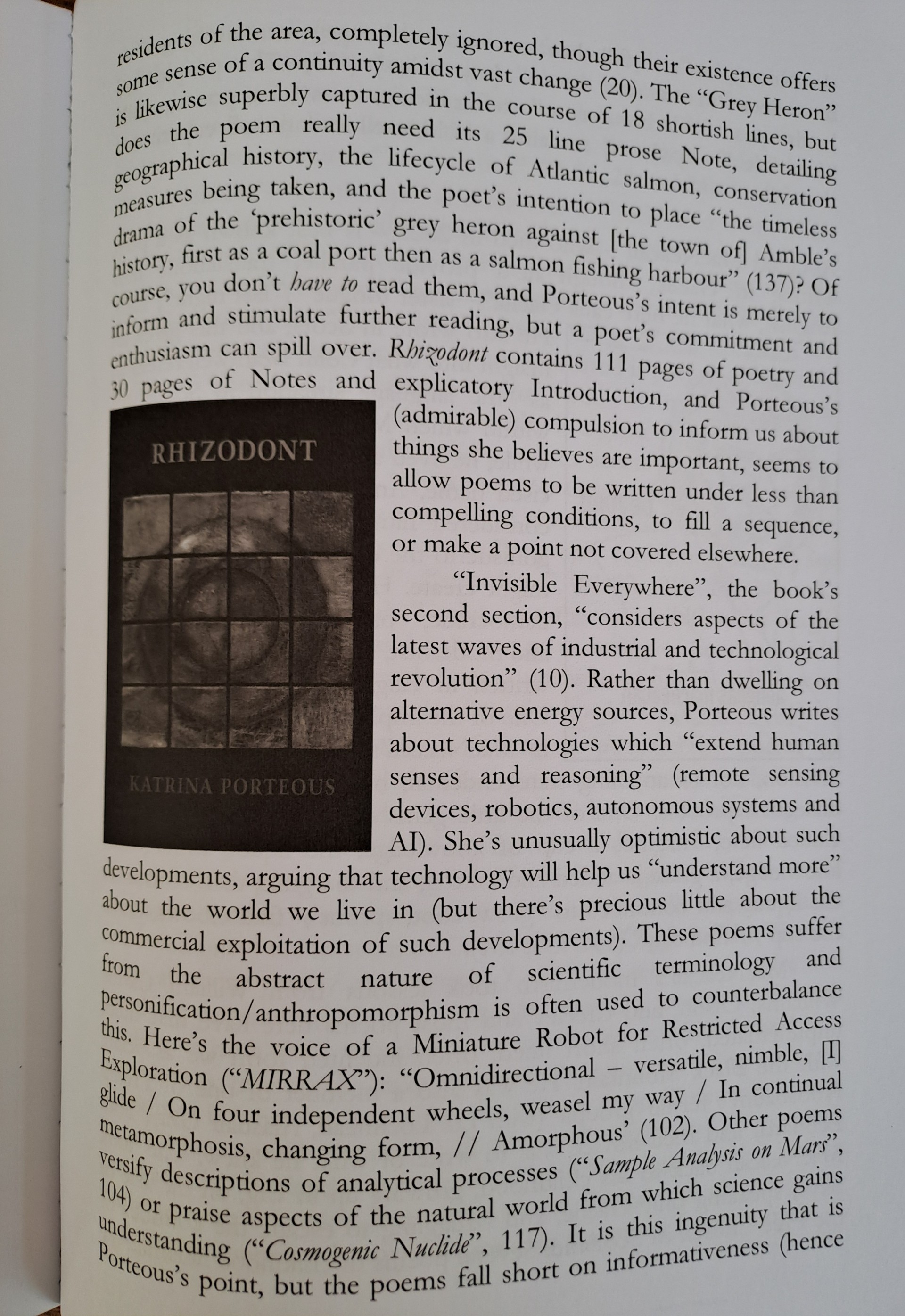
Katrina Porteous’ most recent Bloodaxe collection, ‘Rhizodont’, reviewed.

An edited (shorter) version of this review first appeared in Poetry Salzberg Review in June 2025. Many thanks to the editor, Wolfgang Görtschacher, for commissioning the writing of it. The collection, Rhizodont, was shortlisted for the TS Eliot Prize in 2024.

The ‘rhizodont’ which provides the title for Katrina Porteous’ fourth collection (Bloodaxe Books, 2024) is not some niche root-canal dental work, but a large predatory species of fish, which became extinct 310 million years ago. It’s thought to be the first creature to transition from water to land and hence the ancestor of all four-limbed vertebrates (including humans). The poems here are divided into two superficially very separate books (titled ‘Carboniferous’ and ‘Invisible Everywhere’) but what Porteous insists holds them together is her exploration of this notion of transition. As ‘#rhizodont’ puts it, ‘We’re all on a journey’, and the ambition of this book touches upon transformations various: geological, natural, industrial, cultural (and linguistic) and technological. There can be no faulting the ambition of this and there are many fine poems, though Porteous insists on Notes explaining a great deal of what she is doing/writing about which gives the whole a rather teacherly quality that will divide her readership. Here’s the title poem in full, plus a video of the author reading it:

#rhizodont

Then, in a flash,

It claps shut – an ambush –

Teeth, fangs, tusks – crunch, rip,

Snap. The rhizodont,

Dragging itself out of water.

The old world sinks and slips

Beneath its tilted strata.

We’re all on a journey.

This one’s about us

Unearthing ourselves from a place –

Somatic, interlaced –

To be conjured from light, and sent

Invisible, everywhere,

For everyone to possess.

The children stare at their phones,

A fervent, lit up,

Incorporeal congregation,

Some deep, residual

Root in a life everlasting

Outlasting them, like a fossil

Sarcopterygian fish.

The longer ‘Carboniferous’ section is loosely glued together by a geographical journey from the former coalmining communities of East Durham, moving up the Northumberland coast to Holy Island. This is familiar territory, important to Porteous’ earlier collections, and she again writes well (with great local knowledge) of the geological conditions that have eventually given rise to the important fishing and mining industries (and cultural communities) in the area. Both industries are now in decline and in ‘A Short Walk from the Sea’s Edge’, while the older folk still use ‘old words’ (like stobbie, skyemmie, and gowdspink), the younger generation ‘checks in with Insta before school’. This also illustrates Porteous’ belief that the post-war generations’ transition ‘from analogue to digital technologies’ is a particularly dividing and challenging shift such that ‘the analogue island we lived on’, will seem as incomprehensible as ‘Latin and Greek’ to future generations (‘Hermeneutics’).

The poems also portray the natural wildlife of the region – dragonflies, sandhoppers, crabs and a wide variety of birds and plants. Despite coastal erosion and industrial pollution, Porteous focuses on such ‘small and local’ species as have been around for (often) millions of years. The glowworms in ‘Tiny Lights’ are ‘alien, ancient’ and for most residents of the area, completely ignored, though their continuing existence offers some sense of a continuity amidst vast change. The sounds and sights of the birds in ‘Goldcrests’ are marvellously observed, and they serve both to mark the season and, ‘bringing // Wildness’, they remind us of the natural world’s wider perspectives. The ‘Grey Heron’ is likewise superbly captured in the course of 18 shortish lines, but does the poem really need its 25 line prose Note, detailing the setting’s geographical history, the life cycle of Atlantic salmon, conservation measures being taken and the poet’s intention to place ‘the timeless drama of the ‘prehistoric’ grey heron against [the town of] Amble’s history, first as a coal port then as a salmon fishing harbour, and depict the bird as an explorer, venturing into Amble’s still-to-be-decided future’? I’m not convinced, though you don’t have to read them, and it’s true Porteous’ stated intent is merely to inform, and stimulate further reading.

But can a poet’s commitment and enthusiasm spill over too much? Rhizodont contains 111 pages of poetry and 30 pages of Notes and explicatory Introduction, containing lots of interesting facts and figures, but also a good deal of over-explanation as in the Note to the poem ‘Wishbone’: ‘The poem juxtaposes recent cultural evolution with this enormous timescale, and asks what we, with our plastic waste, will leave behind us’. Most poets would leave such interpretation up to the reader and Porteous’ (admirable) compulsion to write about things she believes are important, is also conducive to poems being written under less than compelling conditions, perhaps to fill a gap in a sequence, or to make a point not yet covered elsewhere. It’s almost certainly deliberately excluded, but this reader misses a bit more of the poet’s involvement, either personally, as in ‘Begin Again’ in which, confronted with the vastness of geological time and Nature’s endurance, the speaker’s suddenly ‘ glad / Of tea-cups, hands, companionable laughter’, or of the poet’s love of words and music as in the several balladlike pieces included here ( like ‘The Tide Clock’ and ‘Low Light’).

The collection’s second section ‘considers aspects of the latest waves of industrial and technological revolution’ and, rather than dwelling on alternative energy sources, Porteous writes about technologies which ‘extend human senses and reasoning’, by which she means remote sensing devices, robotics, autonomous systems and AI. She is unusually optimistic about such developments, arguing (in poems and Notes) that such technology will be used to ‘understand more’ about the world we live in (but there’s precious little here about the commercial exploitation of such developments). And the poems themselves? They often suffer from the abstract nature of scientific terminology and don’t convincingly convey much emotion about the tech. It’s interesting how often personification / anthropomorphism is used in these poems; the Antarctic ice speaks, or is spoken to, and here is the voice of a Miniature Robot for Restricted Access Exploration (‘MIRRAX’): ‘Omnidirectional – versatile, nimble, [I] glide / On four independent wheels, weasel my way / In continual metamorphosis, changing form, // Amorphous’. Other poems versify descriptions of analytical processes (‘Sample Analysis on Mars’) or praise certain aspects of the natural world from which science gains understanding (‘Cosmogenic Nuclide’, ‘Basal Shear’). It is this ingenuity that is the point, but the poems fall short on informativeness (hence the need for Notes), but also fall short on emotional engagement (poetry?), failing in the end to convey Porteous’ stated intention: to reflect ‘in awe and wonder that human consciousness is able to gather and interpret [all this] information’ [my italics]. The people and landscapes of ‘Carboniferous’ are far more successful as poems to be read and enjoyed, while ‘Invisible Everywhere’ is a bold, well-intentioned experiment that fails.

Can AI Write an Original ‘Poem’ By ‘Me’?

The Atlantic recently posted a link to a site which can be used by authors of any stripe to check to see what, if any, of their works have (already) been used by Meta to train AI. For the last few weeks, social media have been full of understandably irate authors who discover this is exactly what has (already) happened. It looks to me as if prose works (fiction and non-fiction) as well as critical writing of all kinds – perhaps more than that ‘difficult’ genre poetry – have particularly fallen victim to the process. Indeed, Meta does seem to have taken some of my own writing – more critical than poetic – for its dubious purposes and it has done so without any kind of indication that this was happening, nor any request for permissions after the event, and – the harvesting of material being so vast – it’s hard to anticipate any after-the-event compensation or successful legal action. Even though, as The Atlantic‘s link has shown us, there ARE records of what has been done, a footprint, a guilty fingerprint, an undeniably smoking gun.

It’s hard not to feel that the horse has bolted on this one and – with the peevish idea of being able to mock at the anticipated results – since some of my own creativity has been stolen, I thought I’d ask ChatGPT to write a poem in the style of me. It was horribly polite in response and within a few seconds had produced a piece of writing it said was in the style of my own work and which it briskly summed up as ‘contemplative and precise [in] style, often rooted in quiet observations of the everyday, nature, and memory’. I posted this on Facebook – indicating the way this had come about – and wondering what people thought. The results surprised me as there was a mild round of applause for ChatGPT: it’s true, it did sound like a poem, it wasn’t utter nonsense (as I think I’d hoped). I don’t think anyone felt it sounded like me, but observations were made along the lines that ‘plenty of worse pieces of writing are submitted to magazines on a daily basis’.

But there was also a strong kick back against the whole process (even at my engaging with AI at all – though I really do think that horse and rider has bolted, in talking to friends (by no means all writers) and my own kids, AI has already made its way into the mainstream of work and study). There was also a strong reaction insisting that AI cannot write creatively because it does not have the human qualities out of which true (true?) creative writing emerges: the flaws, the emotions, the relationships, the memory, the history. I’m inclined to this side of the argument – though I’d also suggest it’s a kind of Doctor Who argument.

I thought it’d be worth spending a few moments looking at what ChatGPT actually produced for me. The title it chose, ‘The Last Light’, is inoffensive enough, if more Edward Thomas than Martyn Crucefix (in my view) and the form of the poem – free verse – is rather well done, though the line lengths are shorter than I think I’d have used myself. The opening stanza runs:

The hill is a shoulder—

pressed up against the sky’s slow retreat.

Beyond it, something waits:

not death,

but the unspoken

name of a tree I once knew

before its bark peeled

like old paper

from the spine of a life

I’ve half-forgotten.

That opening image is quite intriguing with its personification of both the ‘hill’ and the ‘evening’. The use of the long em dash after line 1 is something I think of as one of my techniques (though I’d not have used it there). In context of the ‘last light’ the ‘sky’s slow retreat’ is an effective phrase I’d be happy to own. I’m less happy with the next few lines, with the rather grandiose (overdramatic) ‘something waits’ (though I again hear some Ed Thomas in there) and ‘not death’. Is the latter a response to the possible (though here denied) metaphorical reading of ‘last light’? I think to suggest ‘the unspoken / name of a tree’ is what waits there is silly because it wouldn’t matter if it was spoken or not, because the ‘name’ is a thing known (it seems) and the tree bark peeling like ‘old paper’ is a poor image (what do you see there visually? compare bark to old paper?). This is compounded by suggesting the bark/paper is being peeled from ‘the spine of a life’. For a moment I see (distractingly) a human spine, then it’s replaced by the spine of a book (surely what is intended?) but this book spine seems to be from a book of ‘a life’ – or the life. Ugh no no no – the imagery there is all of a muddle which is not countered by the slightly emotive indications of ageing, loss, the past etc. To then say – as the poem does – that whatever has been said in the preceding few lines is actually ‘half-forgotten’ makes a mockery of the whole thing so far – this is like a bad poet attempting some elusive suggestiveness without really understanding (or being clear – poetry has to be clear in itself) what is being said. There is – AI critics would surely say, and I’d agree – an inhuman muddle going on in the opening 10 lines. But that is not to say that a not-very-talented human poet might have done something similar.

The poem proceeds…

A bird—

small enough to miss in motion—

cuts across the field.

Not for me, not even for itself,

but for the thread

it must continue.

The parenthetical ‘small enough to miss in motion’ doesn’t work for me. Again it seems to be yearning as it were for a sort of liminal effect – just on the edge of sense – but either it has been missed in which case it’s not been seen at all or it has been caught sight of in which case it has not been missed. The latter sentence is what I’d be arguing with myself were this actually my poem. I’d cross it out or re-write. The negatives of line 13 (‘Not for me, not even…’) again seem to be reaching for an edge of perception sort of impression, something is not known. I’d accept this as one of Crucefix’s recurrent ideas but (I hope) I don’t do it like this which is not so much a struggle to perceive, more a double blocking negative: if it’s not this and not that… then what is it? To go on to suggest there is a ‘thread’ being followed (by the seen/unseen bird? really?) And that the continuation of this ‘thread’ is something the bird is compelled to do (‘must’) is verging on the ridiculous. There are suggestions of motives, compulsions, but looked at more closely they make no sense whatsoever.

The poem’s final two stanzas are as follows:

I place my hands in the grass.

It is cold with what the earth

has kept secret all day.

I wonder

if this is what love is:

a silence left

after something essential

has flown.

The placing of hands ‘in the grass’ is rather good and the finding of ‘cold’ there is ominous (again ‘last light’?) and indicative of a death of sorts and to suggest the earth has kept this ‘secret all day’ is also a phrase – even an idea – I’d be happy to acknowledge my own (it’s not). But I can’t recall ever using the phrase ‘I wonder’ in a poem (no doubt I have) and I don’t like it. It seems to be AI’s attempt at a sort of ‘poetical’ tone and mood. In this context it feels rather cheap. And that is cheapened even further by what is wondered: ‘if this is what love is’. Where the hell did that come from? AI is using tropes which it thinks evoke the poetique…. love is a surefire winner of course…. But I can’t see how it forms any kind of ‘whole’ with what has come before. I find myself insisting this is what AI cannot really do – which a live human can potentially – create language in forms which achieve some sort of integrity, a wholeness, even out of contradictory materials, and the glue that binds them together has to be feeling, an emotional experience which lies at the root, powerful but usually not articulated in any other form than in the form of the poem itself.

The AI poem’s last fling is the colon which may or may not suggest that what follows is ‘what love is’. I think the AI mind will mean this. Once again I hear Edward Thomas more than me in this conclusion (see what ET remembers at the end of ‘Old Man’: ‘Only an avenue, dark, nameless, without end’) but the muddling of metaphors occurs again. There is a ‘silence’ left after something ‘essential’ has flown away but my reader response is straining here at the flighted thing (a motion) which is somehow abandoning an aural experience (the silence) and in leaving it something ‘essential’ has been lost (with wings?). Again AI is picking up the way poetry wants to get to the ‘essence’ of things but the words written here are merely an indication of that wish, not at all a real live accessing of it, or even a genuine gesturing towards it.

Having written this I have convinced myself – even more than I had been before – that what AI has written is a ‘hide’, a cover for a poem, making use of words and ideas that it has found associated with poems (perhaps even my own poems) but which it doesn’t itself ‘get’ (how could it?). On the other side of the desk sits the reader. The question for the reader is: how well do we read any poem that comes before us? Do we accept its (often) feeble gestures towards significance as the real thing? Out of a hundred poems we read in magazines and on-line, how many of them ARE the real thing? I’d bet my AI generated poem would find its way into a UK magazine (eventually). It has the aura of a poem, it has many of the familiar gestures of a poem, it doesn’t really make proper sense (which some think is the mark of a real poem), it doesn’t have the heart of a true poem (but lots of poems I read don’t either because they too are copying, mimicking tropes and phrases from other poems).

My astute friend, fiery critic, and fine translator, Will Stone, was kind enough to comment at length on my original Facebook post. I’m with him. I’ll leave you with his thoughts:

Martyn…. your own poetry is born of time, experience, tragedy and celebration, as well as from the inner harvest of your accomplished literary translations. This collection of admittedly impressive sounding images has been reaped from a database in nano seconds and cobbled together in some deceiving facsimile which claims to be your style. And like the macabre chitty bang bang child catcher with his tempting lollipops, it’s ‘all free today’. Like a painting let us say by Edvard Munch reconstituted by a skilful fraudster based in High Wycombe, it may appear in every way to be Munch, but it isn’t Munch. For it was the process of creation (which is unique to every individual and cannot be rationalised by densities of data capture or meticulous replication) that was invested in the original painting and by implication your poem, which counts. AI is not a creator out of inwardness, it is a skilful and persuasive designer, an artisan. It only wants to succeed and aims almost grotesquely at perfection. Genuine poets aim at expressing authentically from a deep point, and are explorers who cling to the cliff face of their poem’s construction… failure is quite possible which is why only a human can be an artist because humans alone with their insufficient organs (see Maupassant le Horla) are shaped by fear, doubt, failure, wild joy and excess. What I am trying to say is that it is as much about what we miss in a work of art to make it complete or perfect that makes it unique with its beautiful imperfection!

Related Links: Nesrine Malik’s recent Guardian article on AI: ‘With ‘AI slop’ distorting our reality, the world is sleepwalking into disaster’ plus several interesting discussions of AI and translation on the Goethe-Institute website.

‘I am not I’: the Slippery First-Person in Poems

A couple of recent experiences with my own poems being posted/published on-line and kind readers then commenting on them has made me think again about the use of the first-person singular in poems – the use of ‘I’. Perhaps ‘think again’ is the wrong phrase as I have never – or at least not since my far distant teen years – really thought of the ‘I’ appearing in my poems as identical to the biographical, historical, personal ‘me’ tapping this out on a keyboard on a sunny Tuesday morning after the Easter weekend. How many millions of times have I suggested to students: let’s not make the assumption that the ‘I’ in Sylvia Plath’s poems is necessarily Sylvia Plath. And that perhaps is not the best example to give as we’ll then get into a debate about what exactly ‘confessional’ poetry is. But the fact that there has sprung up a category of ‘confessional’ suggest that the majority of other poems are not of that type. In which case the ‘I’ is to be taken with a large pinch of salt. Poems are not diaries or even journals but finely (I mean carefully) constructed mechanisms and the ‘I’ is but one of the building blocks.

Artists regularly move trees I’m told (within their frame). A painting is not a documentary. Some way back I remember reading that Auden would switch a positive to a negative for the sake of the music he aspired to. I’ve often found myself suggesting (in workshops) that the writer might try shifting the first person to the third, even the masculine pronoun to the feminine. These are just the little lies we tell in order to express the larger truth we are aspiring to and I’d fight to preserve that freedom of language and imagination, even the questions it might raise about ‘identity’. But what about the two poems I mentioned before. What was going on there?

The first poem appeared on Bill Herbert’s fascinating Ghost Furniture Catalogue site – which if you haven’t been there – go! Responses to this poem seemed to suggest the literalness with which some readers will approach a poem as voicing a ‘personal’ experience. Perhaps I was already wary of a too literal reading even in sending it out for publication. The title (‘A bedroom paranoia’) I chose wants to warn readers: there is something fantastical or imaginary here – there is a paranoia at work (that is not really the truth). One thing I’d say about the poem was that the experience – based on a real incident – had been sitting in a notebook for several years. I’d always felt there was something interesting in it – but couldn’t get it anywhere near right. I think my own learning experience was that to succeed you have to move a few trees… The opening 5 lines are (I’ll admit) close to the truth…

Pitch-dark, the carpet brushed by the door,

  hush-ush, you’re up, a while, now you’re back,

damp from the shower, waking the radio,

  and – who knew? – a king’s birthday, his anthem

limping on while you find clothes for the day

…. but by the time I felt I was getting close to the true poem that I wanted, the Queen had died and I had to substitute her son, Charles III, for her, in order not to make the whole thing misleadingly ‘historical’. The door brushing the carpet is something to be heard every morning. The woman rising before the (loafing) poetic voice is also not uncommon in real life. It’s the second line that is crucial: ‘hush-ush, you’re up, a while, now you’re back’. I wanted to evoke my own experience of dozing to and fro, time slipping forwards without being conscious (awake) to experience it. And that experience is taken up in the next 4 lines:

  and I roll – the pomp now fading – to take

my usual plunge, all the way to the floor,

  turning to smile at you. But the shadows

are vacant where you stood moments before

The first person has dozed off again for several minutes and the woman has simply gone downstairs to begin her day. The paranoia kicks in in the final 5 lines, despite the rational mind knowing what has happened. I wanted to capture (something I did feel to a degree) the sense of ‘what if’? What if the partner had gone not merely down the stairs but off into the world, away from home, never to return? I thought ‘brute stab of abandonment’ was a decent phrase for this emotional moment.

  and – though explaining this is easy

as my drifting in and out of sleep – all day

I’ll nurse the brute stab of abandonment,

  gone – the shock – you left no word – worse,

you were sure no word was worth the leaving.

Looking back, the verb ‘nurse’ seems important. The paranoia is largely self-inflicted, even encouraged (even as the day goes on), in a kind of picking at a scab, a masochistic inclination to ‘try out’ how that ‘abandonment’ would feel. I don’t think this is an admirable trait – but one which of us would say we have never felt? It’s here that the fictionalising comes in. I don’t think I DID feel like this all day, but I’m happy to represent ‘myself’ in this way to explore the (rather male?) emotional response. One of the comments on this poem was to commiserate with me that my partner had indeed actually left me. I guess that needs to be read as a compliment: it suggests the poem conveys the ‘stab’ as pretty convincingly ‘true’.

The second poem was recently published in Poetry Scotland and I trumpeted the fact (as you do) with a Facebook post to which there were a number of likes and comments. Several clearly implied that the reader had read the poem as autobiographical. In fact, there is less here that is personal than the previous poem. It derives from notes I made back in the time of Covid. My own father in fact died before the pandemic (a fact for which I often feel grateful… then guilty). So – as the poem discusses an absent father – the truth it is exploring is my own ‘feeling’ about an absent parent (though the cause of death is different). The title was a late addition (‘How to Address the Inquiry’), chosen as the Covid Inquiry has been taking place (to very little public response. The tone of the poem is angry:

If he was still in his armchairbeside me

I guess I’d try to raise a smile—

perhaps, for want of better, with this tale

of last night’s troubled tossing in bed

one arm snagging the bedside lamp

to bring it thump onto the bridge of my nose

to leave a bleb of dried blood

in the mirror this morning proving

I fought and lost—or else I might

tease him with his beloved City

in the fight for relegation again

or perhaps I’d pull back the curtain

you see there! a few primroses!

Plenty of the detail here is personal – the wrestling with the bedside lamp actually happened (to me – though after Dad had died), he supported (rather unenthusiastically, Bristol City), he loved his garden. The next detail is pure fiction but I felt the showing of the image to a man already dead would be a powerful one:

or I’d find my phone and maybe show

the newly done memorial bench

bearing his name by a tree in the park

And I wanted to let him speak for himself, to express his own anger. To me he is one of the many voiceless dead, resulting from Covid, especially those in care homes (both my parents ended in such a place and died there), those who could not be visited by relatives and friends due to contact restrictions:

and in the quiet I’d hear ashes stir

a murmuring of lips beyond cracked

and inaudible though I know the gist

that I was let down—they’re slow to act

letting people come they let people go

running it’ll be fine! up their fucking flagpole

then backhanding fat cat chums

with a hundred and fifty thousand lives

a fire sale fobbed me off with shit deals

even dangling one last Christmas before me

only to shove it—old ashy whisperer—

foldedinto yourself a dishcloth

on the drainer—a hiccupping cough

into your pillow—a last companion—

too old to ventilate . . .

We all read the stories of deaths of this sort. None of this is ‘true’ to my own experience (or my parents) but this is where the ‘larger’ truth surfaces, and this was my own way of trying to say something about it. The poem ends very emotionally (for me) because it returns again to autobiographical details. I DO have this picture on my mantlepiece (behind me as I type this out). I’m drawing on my own sense of loss, but I hope the dovetailing with what is fictional (for me) is effective enough. People wrote indicating their compassionating sense that I had indeed lost a parent during Covid and I want to again take this as a compliment to the technical success of the poem in its final state.

        I’ve his wedding day

on my fireplace—you should come see

how young they are with what awkward pride

he stands in sunlight at the end of the war

in his mid-twenties in his air force uniform    

Three Poems by Jürgen Becker

Following on from the publication in January 2025 of my translation of ‘Dressel’s Garden’, one of Jürgen Becker’s longer poems (which recently appeared on the USA site Asymptote Journal), three more poems by this fascinating German poet have just appeared in Shearsman magazine and our hope is (permissions permitting etc) that Shearsman Books will be publishing a full collection of his work in the near future. All these poems are taken from Becker’s crucial 1993 collection, Foxtrot in the Erfurt Stadium. The newly published poems are relatively brief so I thought I’d post two them here with a little bit of literary and historical context. (I’ll comment in a later post on the longest of the three poems now published by Shearsman).

In her Afterword to Jürgen Becker’s monumental 1000-page Collected Poems (2022), Marion Poschmann praises the poet as being ‘the writer of his generation who has most consistently exposed himself to the work of remembrance, who approaches the repressed with admirable subtlety and is able to reconcile his personal biography with the great upheavals of history.’ Likewise, in their adjudication, the 2014 Büchner Prize jury highlighted the way ‘Becker’s writing is interwoven with the times, with what is observed and what is remembered, what is personal and what is historical.’ Jürgen Becker’s own personal journey began on July 10, 1932, on Strundener Strasse, in Cologne. In August 1939, shortly before the outbreak of the war, his father was transferred from his place of work in Cologne to Erfurt in Central Germany. This was the beginning of the seven-year-old Becker’s experience of war and a post-war childhood in Thuringia. In 1947, the family left Erfurt and returned to West Germany. Becker has said about this period that there was never any thought of wanting to travel to the Eastern zone, let alone to the GDR, to see the places and landscapes where he’d spent his childhood years: ‘For a long time, I oriented myself solely towards western horizons; I lived, so to speak, with my back to the GDR; my childhood was separated by a border, seemingly closed’. (More of borders in a moment).

Becker’s interest in ‘events’ – political and historical – can clearly be seen in the short poem ‘Reporter’. Its subject never seems to become outdated (as I write this, Turkey is enforcing a crackdown on reporting – see the arrest and deportation of BBC reporter, Mark Lowen, very recently). Becker’s poem is not set in any particular time period, though the allusion to a ‘vast thing, fading away’ suggests an epoch of great change, one political system fading, another on the rise. I love the journalist’s reported observation that he ‘can only leave / when nothing else happens’. In Becker’s writing, there is always something else arising (history does not stop happening – as we see in this particularly fast-moving historical moment). I take the implication of the final 4 words to suggest that the reporter may well be ‘removed’ by the authorities from whatever the situation currently is (against his wishes by the sound of it) and that we will all become the poorer for that, more poorly informed, less capable of distinguishing the truth of things: ‘He will be missed’.

He barely looks at the camera; it almost seems

as if he’s talking to himself, a correspondence

with something on the unseen table, perhaps

with the pencil, the cigarette.

A slight tremor in the hands … who knows; anyway,

very likeable, nothing specific, more a murmur,

what can you say … cold weather and glimpses

along a street which is illuminated a little

by the snowfall; a leftover flag being stirred

by a wind machine. A vast thing, fading away

slowly … it has already disappeared, even before

a decree. He repeats it: he can only leave

when nothing else happens. He will be missed.

The second poem, ‘Meanwhile in the Ore Mountains’, bears strong similarities in that the specific time period (though not the setting) is left deliberately vague, though so many of the details in the poem possess a terrific (terrifying?) resonance for our own times. As to place, the Ore Mountains lie along the Czech-German border and borders are important in this poem. As I mentioned above, Becker was born in the eastern region of Germany, but from age 7, he was brought up in West Germany, and after the fall of the Wall in 1990, he’d often return to his (eastern) childhood landscape. The resulting blending of a child’s and adult’s vision is what gives rise to Becker’s characteristic poetic mode: a flickering between past and present, often without clear signalling, the past frequently haunted by the disturbing changes that happened in Germany in the 1930s. I’ll post the original German of this poem as well, as in what follows I’ll make a few observations about translation.

Though relatively brief, this poem is just one sentence, woven together with the conjunction ‘wie’ (translated here both as ‘how’ and ‘the way’). The weave is dense and as I’ve suggested it’s not really possible to tell whether what is observed – the children, the oil spill, the tree stump (resembling a body) – are contemporaneous or from different eras. My translation keeps these possibilities open: borders here are felt to be temporal, as well as geographical. The German word ‘Avantgarde’ has artistic as well as political implications, but my choice of ‘vanguard’ also brings out the militaristic connotations which are reinforced by the ‘spitzen, grünen Lanzen’ (‘sharp, green spears’) which are then swiftly transformed into a bunch of sprouting snowdrops. These flowers of Spring are interestingly referred to as a ‘Konvention’ and I retained the English equivalent, intending to suggest both a performance (something conventional, perhaps not genuine), as well as a political gathering or agreement (like the Convention on Human Rights). The ambiguity felt very relevant (and once again topical).

The final vivid, visual images – a TV screen observed through a window, a script on the screen, a woman talking, but she is inaudible to the observer – sum up Becker’s concerns about the media, political and historical change, borders real and imagined, exclusion, and the need to ask questions of those in power. Issues as real today as when the poem was written in the early 1990s.

Sitting still, watching how the afternoon below

waits for the dusk, the way snipers vanish

behind the remains of a wall and children run

after a white, armoured vehicle, the way a line

of hills, which marks a boundary, divides

the nothingness of snow from the nothingness of sky,

and along the frontier, one this side, another

along the other, fly the only two crows

to be found in this treeless landscape, the way

the iridescent pattern of an oil spill develops

with darkening edges, the way a tree stump

in the field becomes the shape of a body with

severed arms and legs, how, under the cherry,

the vanguard shows with sharp, green spears,

which later, over the next few days, assumes

the convention of snowdrops, how dark windows

are lit by screens, and on each screen appears,

at first, lettering, and then the face of

a woman who is soundlessly moving her lips.

Zwischendurch im Erzgebirge

Still sitzen und sehen, wie unten der Nachmittag

die Dämmerung erwartet, wie Scharfschützen hinter

einem Mauerrest verschwinden und Kinder

einem weißen gepanzerten Fahrzeug nachlaufen, wie

eine Hügellinie, die eine Grenzlinie ist, das Nichts

des Schnees vom Nichts des Himmels trennt, und

entlang der Grenze, die eine diesseits, die andere

jenseits, fliegen die beiden einzigen Krähen, die

es in dieser baumlosen Landschaft gibt, wie

das changierende Muster eines Ölteppichs entsteht

mit dunkler werdenden Rändern, wie auf der Wiese

ein Baumstumpf die Form eines Körpers annimmt mit

abgeschlagenen Armen und Beinen, wie unterm Kirschbaum

sich die Avantgarde zeigt, mit spitzen, grünen Lanzen,

die später, in den nächsten Tagen, die Konvention

der Schneeglöckchen annimmt, wie in dunklen Fenstern

Bildschirme aufleuchten und auf jedem Bildschirm

zuerst eine Schrift und dann das Gesicht einer Frau

erscheint, die lautlos die Lippen bewegt.

Back in the A.S.M.R.

I see the curious physical/psychological sensation that is ASMR is back in the news again: here’s a recent Guardian piece about it which suggests that ‘younger adults [who] are increasingly overwhelmed by in-person interaction [are] soothing themselves instead with sensory online content, according to a report on the wildly popular online content known as ASMR’. It reminded me that in the early days of this blog, I posted a little piece about my own experience of the phenomenon and – 10 years is a long time in blogging – I thought it would be worthwhile re-posting the piece. Reading it over again, I once more felt that shiver in the spine, that crawling under the scalp that is the hallmark of ASMR. And what does it have to do with poetry? Well, read on….

Something on early morning Radio Four this week sent me hurrying to the files of autobiographical notes I’ve been writing sporadically over the last few years. It was a discussion of an experience I have never heard spoken of, but felt often enough. It has a name these days: Autonomous Sensory Meridian Response. I’ll put down my memories as I recall them but also with some of the surrounding context too as that may be relevant to the phenomenon itself:

trowbridge_picF0010
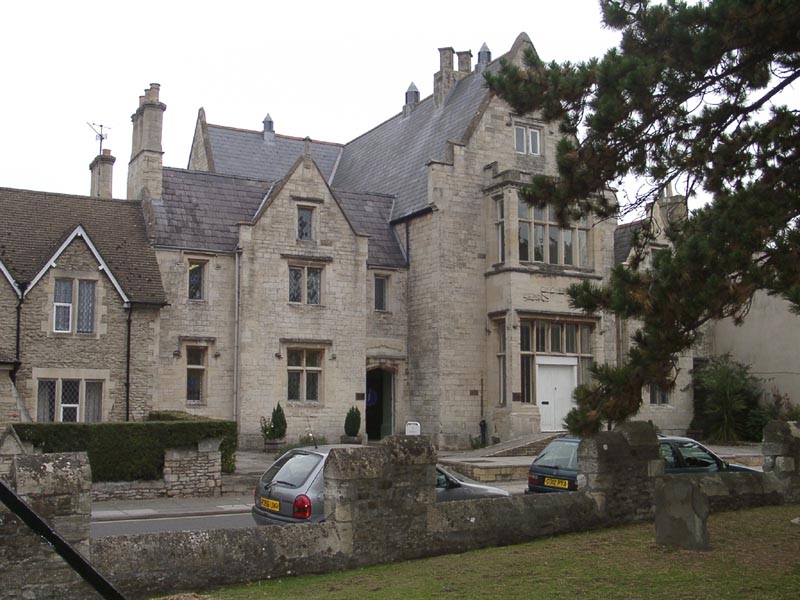
The Parochial School, Trowbridge (old building)

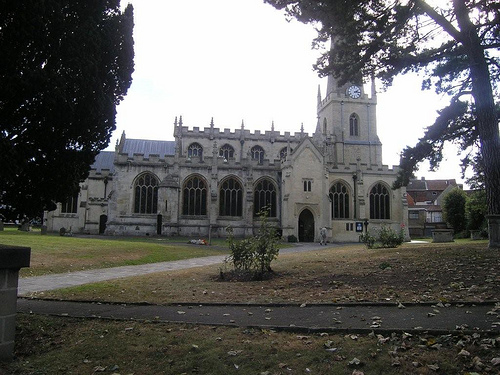
In the 1960s, in my second year at Parochial Junior School (I’m about 9 years old at this time), we crocodile out the front door and occasionally turn right along Church Street towards St James’ Parish Church, Trowbridge (George Crabbe’s last posting). On those occasions, we usually cross the road for religious services like Easter, Harvest Festival and Christmas. We wheel and snake into the churchyard and follow the tilting, worn flagstone path, passing Thomas Helliker’s casket tomb to the church porch.

But on more ordinary days we turn left along Church Street, passing Shanley’s the barbers and a low butcher’s window where our regimented pairings are disturbed by squeals and extraneous movement, by our fascination with or repulsion from the red and pink slabs and cuts of meat, the creamy fat like curds laid out on plastic white trays. Most fascinating and least attractive are the lolling ox tongues, cut at the root, purple, stilled, obscene. Later, back in the main school building, moving to other rooms downstairs aware of girls talking, manoeuvring to walk alongside me, giggles, but I have no recognition of what this means, certainly no idea that it might be exploited. In fact, I don’t recall much sense of my own position in this little closed society at all. It is as if I moved through a mist of my own creating, barely self-aware. But I imagine myself proceeding quietly, studiously mostly, probably a pleasure to teach, though reports are already lamenting how deeply I live in myself. Already teachers are reaching for the old metaphor of the shell, the frustrating creature living within.

3975485172_bc361c22dc
St James’ Parish Church, Trowbridge

Then we turn left into Duke Street and left again through an almost hidden door that, even then, I would associate with those obscured entrances and exits in children’s stories. Through this door, we traipse down a passage into what we call Emmanuel, a kind of annex with a couple of extra classrooms. I don’t remember any separate play area. It’s in these classrooms that I remember adjusting to new spectacles from Carter and Harding after I had been diagnosed with short sight. I was straining to read the teacher’s scrawl on the blackboard. Here too I remember the first incidents (though surely these could not have been the first) of a very peculiar sensation. It’s a prickling that runs up my back and shoulders, a sort of shiver moving upwards across my neck into my scalp when a teacher (not my usual one) writes on the blackboard. It’s a ripple of pleasure out of unfamiliarity (or the familiar defamiliarised), a kind of low level erotic shiver I still occasionally feel now when the college cleaner comes into my room – moving books, touching the table and chairs, my familiar items touched by another’s hand. I’ve never heard this described before . . .

I find that Wikipedia describes ASMR as a neologism for a perceptual phenomenon characterized as a distinct, pleasurable tingling sensation in the head, scalp, back, or peripheral regions of the body in response to visual, auditory, tactile, olfactory, or cognitive stimuli. The nature and classification of the ASMR phenomenon is controversial, with strong anecdotal evidence to support the phenomenon but little or no scientific explanation or verified data. It has become a recent internet phenomenon. Online discussion groups such as the Society of Sensationalists formed in 2008 on Yahoo! and The Unnamed Feeling blog created in 2010 by Andrew MacMuiris aim to provide a community for learning more about the sensation by sharing ideas and personal experiences. Some earlier names for ASMR in these discussion groups included attention induced head orgasmattention induced euphoria, and attention induced observant euphoria.

Quotation-Emily-Dickinson-poetry-Meetville-Quotes-87875

It’s interesting that these titles draw attention to the ‘paying of attention’ and, inevitably perhaps, my own thoughts about it revolve around poetry and its effects: the familiar defamiliarised, the frisson of the uncanny, Emily Dickinson talking about poems taking the top of your head off. ASMR seems linked to a particular quality of attention-giving which yields a rippling of pleasure, close to the erotic, but not the same as that. It is powerful yet undramatic; it is most common in quiet moments of observation. It seems to come when there are no goal-directed intentions in the attention-giving. It is also in a neutral sense ‘bestial’, an animal shiver, like hackles rising, but not out of anger. It’s surely something reaching far back into our ancient past, linking body and mind, yielding pleasure, rooted in a mode of being pre-dating language and conceptualisation. That interests me a great deal. Poetry is language deployed to circumvent the limits of language; these days I take that as a given. Yves Bonnefoy says: “poetry was not made to mean, but to restore words to their full intensity, their integral capacity to designate fundamental things in our relationships with ourselves and others, here and now, amid those chances that one should never, as Mallarmé did, dream of abolishing” (2012 PN Review interview with Chris Miller. Even if just considered as metaphor, perhaps ASMR is what poetry taps into, invokes, rehearses, re-discovers.

Two New Poems – at ‘The High Window’

Two new poems by yours truly – one featuring class, eroticism, and valeting a car and the other of 4 quatrains of mourning modelled on a little-know poem by Bertolt Brecht – have just been published/posted on The High Window website here. Do click the link and read the poems there – the site (edited by poet David Cooke) publishes a number of poems by different authors, so to see mine scroll down (alphabetically). There is of course lots of other interesting work on show by these excellent poets: Anindya Banerjee • Robyn Bolam • Pat Boran • Malcom Carson • Maggie Castle • Martyn Crucefix  Peter Daniels • Mair De-Gare Pitt • Frank Dullaghan • Alexis Rhone Fancher • Marilyn Francis • Greg Freeman • Jeff Gallagher • Mark Granier • Gill Learner • Emma Lee • Alison Mace • Patricia McCarthy •  Beth McDonough • Fokkina McDonnell • Maggie McKay • Ted Mico • Sean O’Brien • Tanya Parker • Sheenagh Pugh • Tracey Rhys • Padraig Rooney • Ernesto P. Santiago • Andrew Seear and Victor Adereth • Richard Skinner • Angela Topping • Mark Totterdell • Miriam Valencia • Scotia Vincent • Rodney Wood  Marc Woodward . In my experience, people are always eager to hear about the origins of poems (perhaps because their beginnings are often both mundane and utterly mysterious) so I thought it might be a chance to say something about these two in particular.

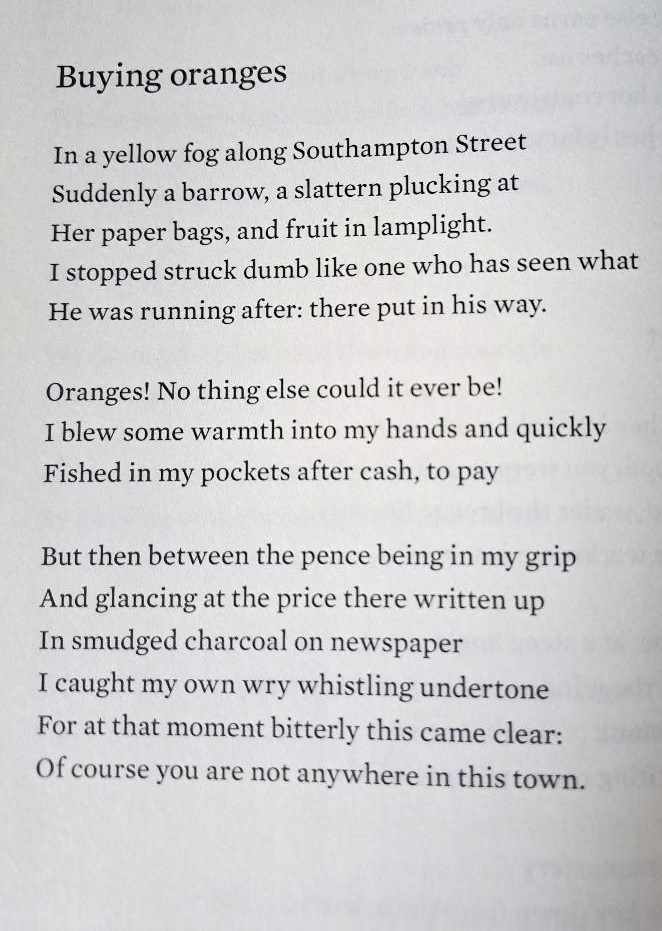
The Brecht-related poem arose after I’d attended a discussion on the German poet/dramatist by David Constantine. One of the poems he presented to those attending (with his translation) was ‘Buying Oranges’. This is one of the poems Brecht wrote for his lover, Margarete Steffin, in the 1930s. Constantine’s translation (from The Collected Poems of Bertolt Brecht (Norton, 2019) goes like this (hear it read by Daisy Lafarge here):

It was the circumstances surrounding my first acquaintance with this poem that led me to write a very loose version of it. I’d booked the event with David Constantine months before, but it happened that my mother sadly (but not unexpectedly) died in her Wiltshire care home the night before. I debated what I should do but decided in the end to attend the talk (I figured there was nothing urgently to be done; Dad had died a year or two before). The world looked different of course. In fact the day was bright and sunny. The event was near Holborn (not far from Southampton Street itself). As you’ll see, I turned oranges into chrysanthemums (my mother’s favourite flowers) and I find now that I lengthened BB’s irregular sonnet to 16 lines. Here’s my version:

ON SOUTHAMPTON STREET
after Bertolt Brecht

A mizzling cold fog on Southampton Street
then suddenly a market stall
with its spectral blooms
under a bare bulb preternaturally lit

a sullen frizz-haired girl cutting stems
and I’m dumbstruck as one who’s found
the thing he looked for
here—at arm’s length—chrysanthemums—

nothing but them! I blow on stiff fingers
plunge them into a pocket for coins
but between fumbling silver
and glancing back up to check the price

scrawled on a yellow card it feels as if I
interrupt myself—a dull under-voice
lifted in bleak remembrance—
since last night you’re not here or any place

The second poem appearing on The High Window this week had a much more mundane beginning. Several years ago (how long can some poems take to arrive in their proper form?) I was staring from a window (in a classroom – perhaps I was invigilating a test) and down in the car park below I saw a car valet parking up his van next to a much fancier car. I seem to have watched him pretty carefully if the poem is to be believed (which I’d usually say not to). Gradually, the poem acquired its erotic undertones (the lovers back to back in bed, the intimacy of the hand-washing, the moisture, the smells, the final turning away) which surprised me as I thought the poem was mostly a comment on work, labour (I love poems about processes) and ultimately about class differences (for money, one man cleans another man’s car). The epigraph is, of course, from Donne’s great love poem ‘To His Mistress Going To Bed’ but here is intended to reflect the working man’s thoroughness!

MOBILE CAR VALET
‘Before, behind, between, above, below’

Like a pair of lovers back-to-back bored in bed
his white van closes rear bumper to bumper

he opens the doors wide and starts to squeegee
the mucky hubs of the big black German

from a sudsy bucket he works the dusty body
with a chamois leather inscribing S-shapes

like the briefest foaming of bold graffiti over
and round wing mirrors and shining roof rails

then balanced on a tyre sweeps half the roof
now the other side and inside across the length

of the dash a pale duster the armrests especially
working the driver’s side then a jet-spray

jumps into hissing life spilling gassy whites
over the wings and the tyres his best weapon

set back in the van then out with the ancient Henry
its scarlet chess piece and snaking black hose

used to scour the seats deep into the footwells
and the chamois is back again to buff stray drops

on windows with windolene it smells good to him
now the doors slammed the remote locking chirps

as he carries the fob back into the marble foyer
like a hatchling his van waits out the length

of one smoke nothing to say to the big German
where it glitters alongside already turning away

Durs Grünbein Reading at The Goethe-Institute, London

Please Note: this blog and website are now captured and preserved at the UK Web Archive held at The British Museum. Many thanks to them.

The highlight of last week was attending Durs Grünbein’s reading at The Goethe- Institute, where he was in discussion with his English translator, Karen Leeder. At the beginning of the evening, Grünbein joked that he’d not been in the UK for a few years and this was the first time he’d had to produce his passport (the blessings of Brexit). Interestingly, in the light of last weekend’s German election results, Grünbein has often been described as a poet of the reunified Germany, having been born in Dresden and now living with his family in eastern Berlin. Grünbein’s poetry is witty, wry, perceptive, and influenced by a broad range of literary texts and often presents the disillusionment of having grown up in East Germany and explores Germany’s identity in post-Cold War Europe. He has been very vocal in recent years on the issues of immigration and the defence of Ukraine. Helen Vendler commented on the ‘sardonic humour, the savagery, the violent candor—all expressed in lines of cool formal elegance’ and Philip Ottermann, in The Independent, noted ‘Grünbein loves to jump from one register to another—one moment he is the street poet of Berlin, the next … all marble and ancient philosophy’.

Grünbein’s earlier poems were translated into English by Michael Hofmann and published in Ashes for Breakfast: Selected Poems (Faber, 2005). Karen Leeder has now published Psyche Running, a selection of more recent poems from 2005–2022 (Seagull Books). During the evening, Grünbein commented on the process of those earlier translations as ‘strange’ and the results (as is Hofmann’s wont) as being very free, very sparky, and Leeder suggested there was a particular excitement in the ‘to and fro’ between author and translator to be found in them. She then suggested her approach has been rather different, perhaps a more dutiful one, still needing to make the poems ‘live’ in the target language, but also demanding a fidelity, to capture the original’s form and architecture as closely as possible. The work read during the evening suggests that her translations triumphantly achieve these goals.

Leeder said that his work can have a ‘marble’-like quality, a firm (unbending?) Classicism, and also that he has himself been labelled a ‘poeta doctus’, given the learned, wide-ranging references he incorporates. Grünbein rather demurred at these descriptions and (an idea he repeated a couple of times in slightly different forms) any interesting poem must be the result of two steps, the first poetic, the second, a more critical, a process of reflection (a later formulation suggested the two steps were ‘perceptual’ and ‘conceptual’). These two phases result in the finished poem as ‘a form of knowledge’; Grünbein pointed out that philosophy arose out of poetry in Classical times (not the other way round). The first poem he read, ‘Childhood in the Diorama’, does have a ‘marble’-like quality to it: longish, unrhymed lines in a solid verse paragraph and the child’s preference for the posed scenes of a museum’s diorama, their ‘inert’ quality. But on one occasion, the boy sensed some movement, a ‘draught, perhaps, had blown through the displays’, perhaps suggestive of the child’s development into a more unstable, fluid view of the world.

Other poems read that evening included ‘Nee Wachtel’, ‘Exaltations in Sleep’, and ‘Inspector Kobold’ which is a ‘Martian’ sort of piece describing seahorses, in ‘their whalebone corsets, like ‘tiny ocean Lipizzaners’ (here’s an alternative translation by Michael Eskin). If we are to take Grünbein’s poems as ‘forms of knowledge’ then they certainly range widely through the natural sciences, language, science more generally, astronomy, history and politics. He felt what binds all this together is the one individual life, the single life perspective, poetry as a sort of anthropological study, at which Leeder suggested there was a ‘fragility’ to much of his work, the vulnerability of the single life as much as all life (ecologically?). The poet was happy to agree to this, suggesting ‘marble’ was not at all the right term for his poetry, that there was always something ‘flowing’ about it, multiple angles and perspectives. He once claimed not to be a ‘German’ poet, but simply someone who wrote in the German language. This evening he stood by that statement: his own identity is wrapped up in language use, the mother’s language, used daily for years, and is not a function of birthplace alone (remember Grünbein grew up in East Germany and now lives in the unified Germany).

But his birthplace has been undoubtedly important in Porcelain (Seagull, 2020), the long sequence of poems (written slowly, we learned, on the February anniversaries of the Allies’ bombing of his hometown, Dresden). I reviewed this book here, when it was published). Grünbein read 10 poems from this sequence (some poems were read only in German with the English translation projected above), other poems read in both languages. Porcelain is an elegy the poet suggested, a Classical form, longing for what is lost. Poem #7 is one of the most remarkable, another museum visit by the young poet, who’d stare at a cherry stone from the 16th century, carved with 185 tiny heads. The poem comes to regard the curious object as an ‘emblem of the future’ of Dresden, presenting as it seemed to, faces, ‘eyes wide with terror, on every tiny screaming face, / inferno on a needle tip’.

The poet suggested the whole sequence of poems is also a kind of ‘sound system’ containing echoes or samples of other poets’ work, including Paul Celan, with Grünbein’s title (Porce-lain) being a pun on the earlier poet’s name. Leeder added that it should not be read in a narrowly nationalistic fashion, that a lot more (bombed) cities than just Dresden were alluded to by the poem (Coventry, Warsaw, Odessa, Guernica). She asked Grünbein what was it that kept drawing him back to Dresden as a subject matter for poems. He thought it had something to do with the moment when he realised that his own childhood was ‘historical’, in the sense of being intimately connected to major historical events. He recalls seeing truckloads of Russian soldiers passing where he grew up, heading to the nearby Russian military barracks. This produced a sense in the young boy that much in (his) life had been determined before his arrival on the scene. In this sense, his hometown acquired a ‘mythic’ quality.

KL: You mean it was a ‘world place’?

DG: Yes – I realised it was a reference point, worldwide, its splendour and its ruins. From the city of Dresden one can draw out a lot of history, a seed point, or like a jigsaw, that can be slowly pieced together.

Perhaps half a dozen more poems were presented from more recent collections. ‘Flea Market’ is a peerless poem about German history, starting from the bric-a-brac found in such markets – the spoons, brooches, bird cages, tables – and wondering ‘what / do they say, what do they hide’? Quiet allusions to ‘uniforms and daggers of honour’, seque into the next, even more troubling, question: ‘How can one’s thoughts not go astray / faced with the piles of glasses, / and old leather suitcases?’ The poem ‘Lumière’ also alludes to the Holocaust and starts out from descriptions of the Lumière brothers’ 1896 film of a train pulling into a station. The first film-goers were frightened at the image of the train’s approach, ‘but not yet the horror / at all the implacable trains / that have criss-crossed the century, / the endless rows of sealed trucks.’

Asked where his poetry might be heading, Grünbein surprisingly suggested that he felt a more prose-like quality entering his work – not so Classical then! A soberness in some ways – but with flashes of magic, magic spells even. His earlier suggestion that the good poem is a 2-step process – perceptual, conceptual – seems to be still important, though in the final result (I’m guessing Grünbein would agree with this) the two stages must be simultaneously present in the reader’s experience.

I have to say, one of the great pleasures of the evening was the way in which both participants took the poetry seriously and gave it a good outing. This may sound odd for a poetry reading, but often these days, I find too many readings/launches contain too little poetry and rather too much gossiping, drinking and networking (all of which can be excluding for those not in the swim). Can I make a plea for more reading at readings, a little less career-building? Of course, at The Goethe-Institute we were listening to two writers at the very top of their game and what they are creating – in German and in English – is vital, lasting stuff. But, if we are publishing poetry, we should not be shy of reading it (remember, not everyone attending will be able to afford to buy the book and take it home).