More than 10 years of blogging on poetry and translation – over 75,000 views in 2025 – now captured and preserved at the UK Web Archive: 'one of the top 10 poetry blogs' (Rogue Strands)
A little flock of reading dates – replacing the swifts that have left our skies recently – have gathered themselves into something that almost resembles a brief Autumn Reading Tour. Admittedly, not going too far beyond the Greater London area – but to Maidstone and (briefly) Winchester – but of course I’m very happy to be granted these opportunities to read my work. Live links to these events are provided in the details below. And, as you’ll see from the details below, the chance to read with some really talented, inventive and entertaining poets along the way. In particular, I’ll be launching my new chapbook of poems – Walking Away – published by Paul O’Prey’s excellent Dare-Gale Press. If you are in any of the vicinities mentioned – I’d be delighted to see you there – Martyn
Wednesday 10th September– 8pm @ Highgate Literary & Scientific Institution, 11 South Grove, London N6 6BS – reading w/ Tim Ades and Maggie Brookes-Butt. HLSI Fundraising Event: Tickets £10 https://hlsi.org.uk/whats-on/poetry-please/
Saturday 25th October – 1pm @ The Small Publishers Fair, Conway Hall, 25 Red Lion St, London WC1R 4RL reading w/ David Harsent. Free Event. This is a Dare-Gale Press reading, launching my chapbook which they are publishing: Walking Away. Free Event: https://smallpublishersfair.co.uk/
And on the SAME DAY I’ll be second launching the chapbook Walking Away…
Saturday 25th October – 7pm @ The Ship Poetry Reading Series, organised by Chris Beckett, 134 New Cavendish St. London W1W 6YB – reading w/ Barbara Cumbers, Jack Cooper, Anthony Joseph, + Fawzia Muradali Kane: £5 https://www.chrisbeckettpoems.com/news.html
Following on from the publication in January 2025 of my translation of ‘Dressel’s Garden’, one of Jürgen Becker’s longer poems (which recently appeared on the USA site Asymptote Journal), three more poems by this fascinating German poet have just appeared in Shearsman magazine and our hope is (permissions permitting etc) that Shearsman Books will be publishing a full collection of his work in the near future. All these poems are taken from Becker’s crucial 1993 collection, Foxtrot in the Erfurt Stadium. The newly published poems are relatively brief so I thought I’d post two them here with a little bit of literary and historical context. (I’ll comment in a later post on the longest of the three poems now published by Shearsman).
In her Afterword to Jürgen Becker’s monumental 1000-page Collected Poems (2022), Marion Poschmann praises the poet as being ‘the writer of his generation who has most consistently exposed himself to the work of remembrance, who approaches the repressed with admirable subtlety and is able to reconcile his personal biography with the great upheavals of history.’ Likewise, in their adjudication, the 2014 Büchner Prize jury highlighted the way ‘Becker’s writing is interwoven with the times, with what is observed and what is remembered, what is personal and what is historical.’ Jürgen Becker’s own personal journey began on July 10, 1932, on Strundener Strasse, in Cologne. In August 1939, shortly before the outbreak of the war, his father was transferred from his place of work in Cologne to Erfurt in Central Germany. This was the beginning of the seven-year-old Becker’s experience of war and a post-war childhood in Thuringia. In 1947, the family left Erfurt and returned to West Germany. Becker has said about this period that there was never any thought of wanting to travel to the Eastern zone, let alone to the GDR, to see the places and landscapes where he’d spent his childhood years: ‘For a long time, I oriented myself solely towards western horizons; I lived, so to speak, with my back to the GDR; my childhood was separated by a border, seemingly closed’. (More of borders in a moment).
Becker’s interest in ‘events’ – political and historical – can clearly be seen in the short poem ‘Reporter’. Its subject never seems to become outdated (as I write this, Turkey is enforcing a crackdown on reporting – see the arrest and deportation of BBC reporter, Mark Lowen, very recently). Becker’s poem is not set in any particular time period, though the allusion to a ‘vast thing, fading away’ suggests an epoch of great change, one political system fading, another on the rise. I love the journalist’s reported observation that he ‘can only leave / when nothing else happens’. In Becker’s writing, there is always something else arising (history does not stop happening – as we see in this particularly fast-moving historical moment). I take the implication of the final 4 words to suggest that the reporter may well be ‘removed’ by the authorities from whatever the situation currently is (against his wishes by the sound of it) and that we will all become the poorer for that, more poorly informed, less capable of distinguishing the truth of things: ‘He will be missed’.
The second poem, ‘Meanwhile in the Ore Mountains’, bears strong similarities in that the specific time period (though not the setting) is left deliberately vague, though so many of the details in the poem possess a terrific (terrifying?) resonance for our own times. As to place, the Ore Mountains lie along the Czech-German border and borders are important in this poem. As I mentioned above, Becker was born in the eastern region of Germany, but from age 7, he was brought up in West Germany, and after the fall of the Wall in 1990, he’d often return to his (eastern) childhood landscape. The resulting blending of a child’s and adult’s vision is what gives rise to Becker’s characteristic poetic mode: a flickering between past and present, often without clear signalling, the past frequently haunted by the disturbing changes that happened in Germany in the 1930s. I’ll post the original German of this poem as well, as in what follows I’ll make a few observations about translation.
Though relatively brief, this poem is just one sentence, woven together with the conjunction ‘wie’ (translated here both as ‘how’ and ‘the way’). The weave is dense and as I’ve suggested it’s not really possible to tell whether what is observed – the children, the oil spill, the tree stump (resembling a body) – are contemporaneous or from different eras. My translation keeps these possibilities open: borders here are felt to be temporal, as well as geographical. The German word ‘Avantgarde’ has artistic as well as political implications, but my choice of ‘vanguard’ also brings out the militaristic connotations which are reinforced by the ‘spitzen, grünen Lanzen’ (‘sharp, green spears’) which are then swiftly transformed into a bunch of sprouting snowdrops. These flowers of Spring are interestingly referred to as a ‘Konvention’ and I retained the English equivalent, intending to suggest both a performance (something conventional, perhaps not genuine), as well as a political gathering or agreement (like the Convention on Human Rights). The ambiguity felt very relevant (and once again topical).
The final vivid, visual images – a TV screen observed through a window, a script on the screen, a woman talking, but she is inaudible to the observer – sum up Becker’s concerns about the media, political and historical change, borders real and imagined, exclusion, and the need to ask questions of those in power. Issues as real today as when the poem was written in the early 1990s.
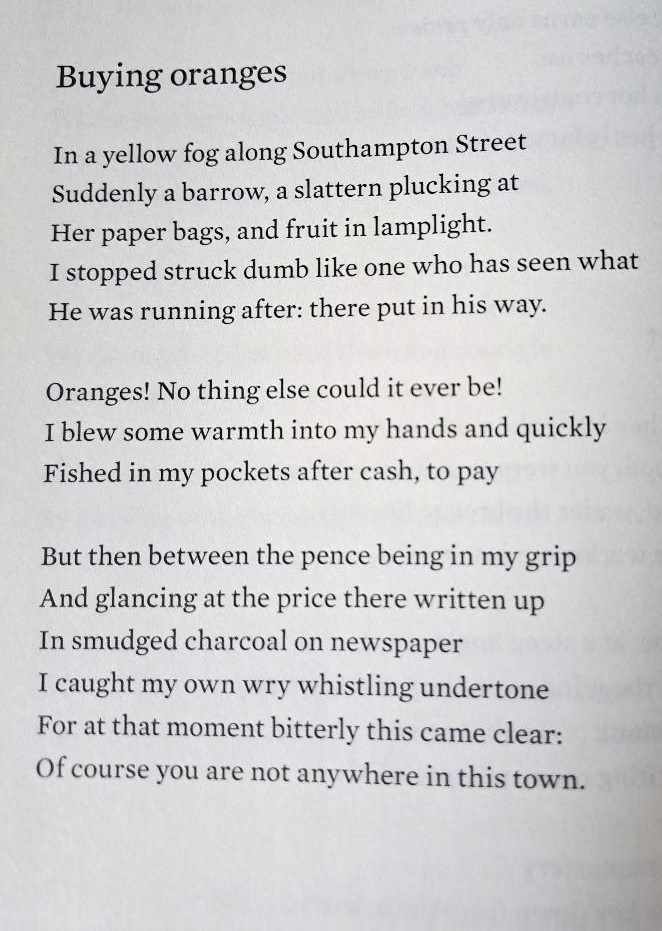
The Brecht-related poem arose after I’d attended a discussion on the German poet/dramatist by David Constantine. One of the poems he presented to those attending (with his translation) was ‘Buying Oranges’. This is one of the poems Brecht wrote for his lover, Margarete Steffin, in the 1930s. Constantine’s translation (from The Collected Poems of Bertolt Brecht (Norton, 2019) goes like this (hear it read by Daisy Lafarge here):
It was the circumstances surrounding my first acquaintance with this poem that led me to write a very loose version of it. I’d booked the event with David Constantine months before, but it happened that my mother sadly (but not unexpectedly) died in her Wiltshire care home the night before. I debated what I should do but decided in the end to attend the talk (I figured there was nothing urgently to be done; Dad had died a year or two before). The world looked different of course. In fact the day was bright and sunny. The event was near Holborn (not far from Southampton Street itself). As you’ll see, I turned oranges into chrysanthemums (my mother’s favourite flowers) and I find now that I lengthened BB’s irregular sonnet to 16 lines. Here’s my version:
ON SOUTHAMPTON STREET after Bertolt Brecht
A mizzling cold fog on Southampton Street then suddenly a market stall with its spectral blooms under a bare bulb preternaturally lit
a sullen frizz-haired girl cutting stems and I’m dumbstruck as one who’s found the thing he looked for here—at arm’s length—chrysanthemums—
nothing but them! I blow on stiff fingers plunge them into a pocket for coins but between fumbling silver and glancing back up to check the price
scrawled on a yellow card it feels as if I interrupt myself—a dull under-voice lifted in bleak remembrance— since last night you’re not here or any place
The second poem appearing on The High Window this week had a much more mundane beginning. Several years ago (how long can some poems take to arrive in their proper form?) I was staring from a window (in a classroom – perhaps I was invigilating a test) and down in the car park below I saw a car valet parking up his van next to a much fancier car. I seem to have watched him pretty carefully if the poem is to be believed (which I’d usually say not to). Gradually, the poem acquired its erotic undertones (the lovers back to back in bed, the intimacy of the hand-washing, the moisture, the smells, the final turning away) which surprised me as I thought the poem was mostly a comment on work, labour (I love poems about processes) and ultimately about class differences (for money, one man cleans another man’s car). The epigraph is, of course, from Donne’s great love poem ‘To His Mistress Going To Bed’ but here is intended to reflect the working man’s thoroughness!
MOBILE CAR VALET ‘Before, behind, between, above, below’
Like a pair of lovers back-to-back bored in bed his white van closes rear bumper to bumper
he opens the doors wide and starts to squeegee the mucky hubs of the big black German
from a sudsy bucket he works the dusty body with a chamois leather inscribing S-shapes
like the briefest foaming of bold graffiti over and round wing mirrors and shining roof rails
then balanced on a tyre sweeps half the roof now the other side and inside across the length
of the dash a pale duster the armrests especially working the driver’s side then a jet-spray
jumps into hissing life spilling gassy whites over the wings and the tyres his best weapon
set back in the van then out with the ancient Henry its scarlet chess piece and snaking black hose
used to scour the seats deep into the footwells and the chamois is back again to buff stray drops
on windows with windolene it smells good to him now the doors slammed the remote locking chirps
as he carries the fob back into the marble foyer like a hatchling his van waits out the length
of one smoke nothing to say to the big German where it glitters alongside already turning away
Please Note: this blog and website are now captured and preserved at the UK Web Archive held at The British Museum. Many thanks to them.
The highlight of last week was attending Durs Grünbein’s reading at The Goethe- Institute, where he was in discussion with his English translator, Karen Leeder. At the beginning of the evening, Grünbein joked that he’d not been in the UK for a few years and this was the first time he’d had to produce his passport (the blessings of Brexit). Interestingly, in the light of last weekend’s German election results, Grünbeinhas often been described as a poet of the reunified Germany, having been born in Dresden and now living with his family in eastern Berlin. Grünbein’s poetry is witty, wry, perceptive, and influenced by a broad range of literary texts and often presents the disillusionment of having grown up in East Germany and explores Germany’s identity in post-Cold War Europe. He has been very vocal in recent years on the issues of immigration and the defence of Ukraine. Helen Vendler commented on the ‘sardonic humour, the savagery, the violent candor—all expressed in lines of cool formal elegance’ and Philip Ottermann, in The Independent, noted ‘Grünbein loves to jump from one register to another—one moment he is the street poet of Berlin, the next … all marble and ancient philosophy’.
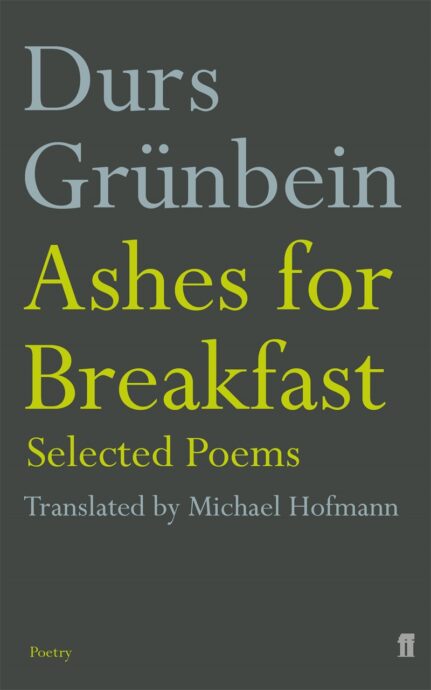
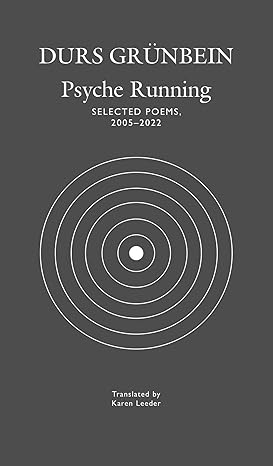
Grünbein’s earlier poems were translated into English by Michael Hofmann and published in Ashes for Breakfast: Selected Poems (Faber, 2005). Karen Leeder has now published Psyche Running, a selection of more recent poems from 2005–2022 (Seagull Books). During the evening, Grünbein commented on the process of those earlier translations as ‘strange’ and the results (as is Hofmann’s wont) as being very free, very sparky, and Leeder suggested there was a particular excitement in the ‘to and fro’ between author and translator to be found in them. She then suggested her approach has been rather different, perhaps a more dutiful one, still needing to make the poems ‘live’ in the target language, but also demanding a fidelity, to capture the original’s form and architecture as closely as possible. The work read during the evening suggests that her translations triumphantly achieve these goals.
Leeder said that his work can have a ‘marble’-like quality, a firm (unbending?) Classicism, and also that he has himself been labelled a ‘poeta doctus’, given the learned, wide-ranging references he incorporates. Grünbein rather demurred at these descriptions and (an idea he repeated a couple of times in slightly different forms) any interesting poem must be the result of two steps, the first poetic, the second, a more critical, a process of reflection (a later formulation suggested the two steps were ‘perceptual’ and ‘conceptual’). These two phases result in the finished poem as ‘a form of knowledge’; Grünbein pointed out that philosophy arose out of poetry in Classical times (not the other way round). The first poem he read, ‘Childhood in the Diorama’, does have a ‘marble’-like quality to it: longish, unrhymed lines in a solid verse paragraph and the child’s preference for the posed scenes of a museum’s diorama, their ‘inert’ quality. But on one occasion, the boy sensed some movement, a ‘draught, perhaps, had blown through the displays’, perhaps suggestive of the child’s development into a more unstable, fluid view of the world.
Other poems read that evening included ‘Nee Wachtel’, ‘Exaltations in Sleep’, and ‘Inspector Kobold’ which is a ‘Martian’ sort of piece describing seahorses, in ‘their whalebone corsets, like ‘tiny ocean Lipizzaners’ (here’s an alternative translation by Michael Eskin). If we are to take Grünbein’s poems as ‘forms of knowledge’ then they certainly range widely through the natural sciences, language, science more generally, astronomy, history and politics. He felt what binds all this together is the one individual life, the single life perspective, poetry as a sort of anthropological study, at which Leeder suggested there was a ‘fragility’ to much of his work, the vulnerability of the single life as much as all life (ecologically?). The poet was happy to agree to this, suggesting ‘marble’ was not at all the right term for his poetry, that there was always something ‘flowing’ about it, multiple angles and perspectives. He once claimed not to be a ‘German’ poet, but simply someone who wrote in the German language. This evening he stood by that statement: his own identity is wrapped up in language use, the mother’s language, used daily for years, and is not a function of birthplace alone (remember Grünbein grew up in East Germany and now lives in the unified Germany).
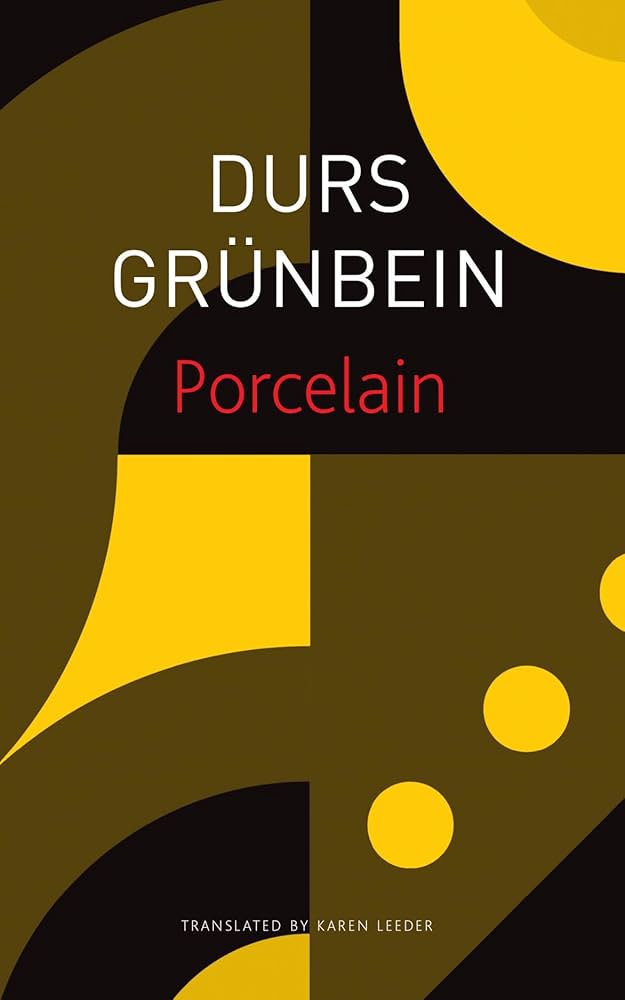
But his birthplace has been undoubtedly important in Porcelain (Seagull, 2020), the long sequence of poems (written slowly, we learned, on the February anniversaries of the Allies’ bombing of his hometown, Dresden). I reviewed this book here, when it was published). Grünbein read 10 poems from this sequence (some poems were read only in German with the English translation projected above), other poems read in both languages. Porcelain is an elegy the poet suggested, a Classical form, longing for what is lost. Poem #7 is one of the most remarkable, another museum visit by the young poet, who’d stare at a cherry stone from the 16th century, carved with 185 tiny heads. The poem comes to regard the curious object as an ‘emblem of the future’ of Dresden, presenting as it seemed to, faces, ‘eyes wide with terror, on every tiny screaming face, / inferno on a needle tip’.
The poet suggested the whole sequence of poems is also a kind of ‘sound system’ containing echoes or samples of other poets’ work, including Paul Celan, with Grünbein’s title (Porce-lain) being a pun on the earlier poet’s name. Leeder added that it should not be read in a narrowly nationalistic fashion, that a lot more (bombed) cities than just Dresden were alluded to by the poem (Coventry, Warsaw, Odessa, Guernica). She asked Grünbein what was it that kept drawing him back to Dresden as a subject matter for poems. He thought it had something to do with the moment when he realised that his own childhood was ‘historical’, in the sense of being intimately connected to major historical events. He recalls seeing truckloads of Russian soldiers passing where he grew up, heading to the nearby Russian military barracks. This produced a sense in the young boy that much in (his) life had been determined before his arrival on the scene. In this sense, his hometown acquired a ‘mythic’ quality.
KL: You mean it was a ‘world place’?
DG: Yes – I realised it was a reference point, worldwide, its splendour and its ruins. From the city of Dresden one can draw out a lot of history, a seed point, or like a jigsaw, that can be slowly pieced together.
Perhaps half a dozen more poems were presented from more recent collections. ‘Flea Market’ is a peerless poem about German history, starting from the bric-a-brac found in such markets – the spoons, brooches, bird cages, tables – and wondering ‘what / do they say, what do they hide’? Quiet allusions to ‘uniforms and daggers of honour’, seque into the next, even more troubling, question: ‘How can one’s thoughts not go astray / faced with the piles of glasses, / and old leather suitcases?’ The poem ‘Lumière’ also alludes to the Holocaust and starts out from descriptions of the Lumière brothers’ 1896 film of a train pulling into a station. The first film-goers were frightened at the image of the train’s approach, ‘but not yet the horror / at all the implacable trains / that have criss-crossed the century, / the endless rows of sealed trucks.’
Asked where his poetry might be heading, Grünbein surprisingly suggested that he felt a more prose-like quality entering his work – not so Classical then! A soberness in some ways – but with flashes of magic, magic spells even. His earlier suggestion that the good poem is a 2-step process – perceptual, conceptual – seems to be still important, though in the final result (I’m guessing Grünbein would agree with this) the two stages must be simultaneously present in the reader’s experience.
I have to say, one of the great pleasures of the evening was the way in which both participants took the poetry seriously and gave it a good outing. This may sound odd for a poetry reading, but often these days, I find too many readings/launches contain too little poetry and rather too much gossiping, drinking and networking (all of which can be excluding for those not in the swim). Can I make a plea for more reading at readings, a little less career-building? Of course, at The Goethe-Institute we were listening to two writers at the very top of their game and what they are creating – in German and in English – is vital, lasting stuff. But, if we are publishing poetry, we should not be shy of reading it (remember, not everyone attending will be able to afford to buy the book and take it home).
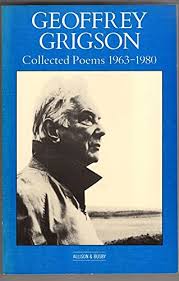
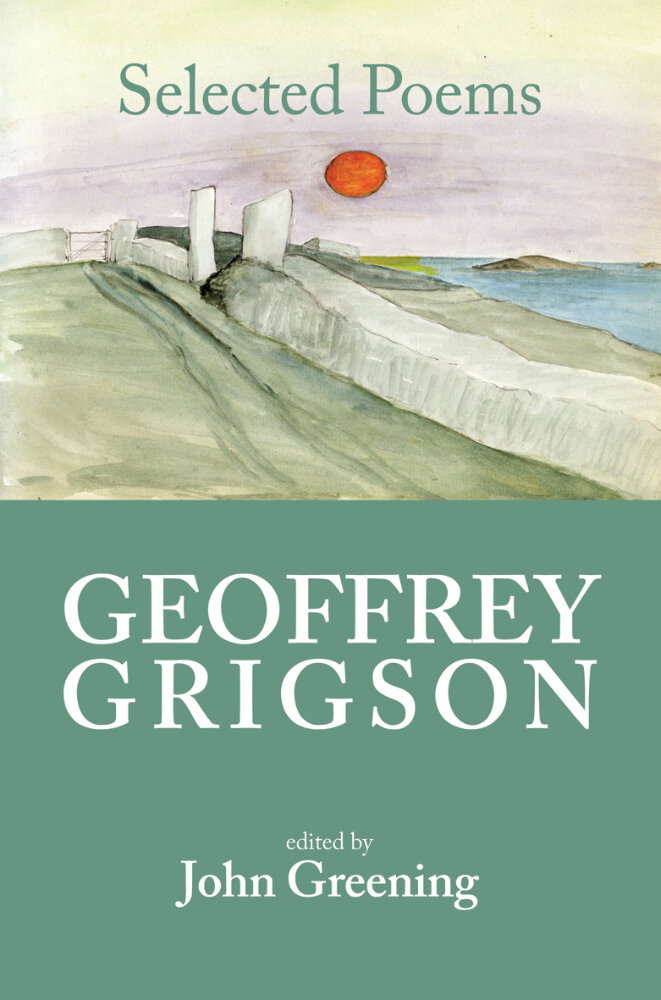
I’ve recently seen announced a celebration of the work of Geoffrey Grigson (1905-1985), scheduled to take place at 7.30pm, on Tuesday March 4th at West Greenwich Library. The event is called ‘In His Own Voice: Geoffrey’s Grigson’s Poetry’ and is being organised by John Greening with contributions from Grigson’s daughter, Caroline, his grandson, Joe Banks, and poets Graham High and Blake Morrison (and archive recordings of the poet himself). The event is free to attend (donations welcome), plus refreshments and books on sale. Texts will be projected on screen. As the event blurb reminds us, Grigson lived and worked through amazing times, culturally and politically, and was a prolific poet, writer, critic and editor. At the centre of English intellectual life, he knew the poetry grandees of his days and greatly admired those of the past. When he was only 27, he founded the bi-monthly journal ‘New Verse’, thus becoming hugely influential in the poetry world. I reviewed John Greening’s selection of Grigson’s work when it came out in 2017, and this seems an opportune moment to re-post it here and on my new Substack.
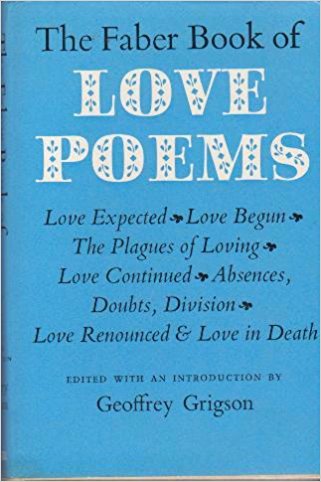
Surely we all have one or two Faber anthologies edited by Geoffrey Grigson on our shelves? Love Poems, Popular Verse, Reflective Verse, Nonsense Verse, Poems and Places, Epigrams and Epitaphs . . . As a critic he often wielded a savage power through his magazine New Verse. And as a big beast on the literary scene of the early 1980s, Hermione Lee interviewed him on Channel 4. But since his death in 1985, he’s better known merely as the husband of Jane Grigson, the celebrated cookery writer. His own poetry has been neglected which made John Greening’s 2017 Selected Poems from Greenwich Exchange a welcome opportunity to re-consider it. I think Grigson’s contrasting themes were established early on. The influence of two great poets (not Eliot, not Yeats) is clear from the start and it may be that the limits of Grigson’s poetic achievement and the absence of much development in his style, are because he never chose one path or fully escaped either.
The influence of Auden was very clear in Grigson’s first collection, Several Observations (1939). ‘Meeting by the Gjulika Meadow’ presents an enigmatic narrative in a “frontier” landscape; a meeting between two men whose conversation is in large part concerned with “the thunder / about Europe”. There are sketched fragments of personal dependencies and guilts but the whole reads as a slice of narrative that has been carefully shorn of its explicatory elements. A poem from 1946 shows Grigson using similar methods but on matters much closer to home; ‘In a Dark Passage’ draws material from the deaths of two of Grigson’s brothers in WW1 and the early death of his first wife, Frances. The situations are still relatively distanced by being told in the third person and the timings of the incidents are compressed to form a litany of heartfelt if rhetorical griefs: “O floes of ice, you float downstream / But do not disappear”.
There is certainly a very dark river running through Grigson’s work. ‘Two A.M.’, from the 1970s, records a wakefulness at night filled – as so often – by nothing but questions: “all emptiness, all gravity, / Ultimacy, nothingness”. He captures vividly the way this kind of mood, at such an hour, insists on expanding exponentially, racing to fill the world’s “Sierras, monadnocks, lakes, prairies, taiga, ice”. On this occasion, there is the possibility of an erotic reply: “At least now, with our bodies close, / Be comforted”. But even that response is absent from ‘Again Discard the Night’ from the 1980 collection, History of Him. Written as a first person narrative this time, the poem pulls no punches in its flinty and unforgiving portrait of old age waking:
… you call, the kettle gathers
And talks, and Are you all right? comes your
Usual cry, and my habit insists, without sound, Reply,
Be bright, wash, shave, dress, and this once,
Again discard the night.
Of course, Grigson’s sense of an ungoverned and likely meaningless universe matched with his frequent backward glances also calls to mind Hardy’s work. One of Grigson’s earliest poems, ‘The Children’, has an 11-line stanza of complex rhyming that Hardy would have been proud of. The children are portrayed as playing in a natural environment and in a state of temporal innocence: “They looked for no clocks, noticed no hours”. But ending each stanza, the triple rhyme words with “hours” are (ambiguously) “sours” and “flowers”. Between the third and fourth stanza, there is the kind leap in time often found in folk song (and Hardy). We have instantaneously passed many years: “The rooms were pulled down, but they always abide / In the minds of the children born in them”. These are the best lines in the poem with the much cooler closing lines rather falling flat:
They see the clocks and notice the hour
And aware that restriction of love turns sour,
They feel the cold wind and consider the flower.
It is certainly Hardy that Grigson is thinking of in ‘In View of the Fleet’. The Fleet is the lagoon behind Chesil Beach in Dorset and the poem borrows phrases from Hardy, empathetically suggesting that each poet’s vision has the same sequential locus: “Things not as firstly well, a sparkling day, and / tolling of a bell”.
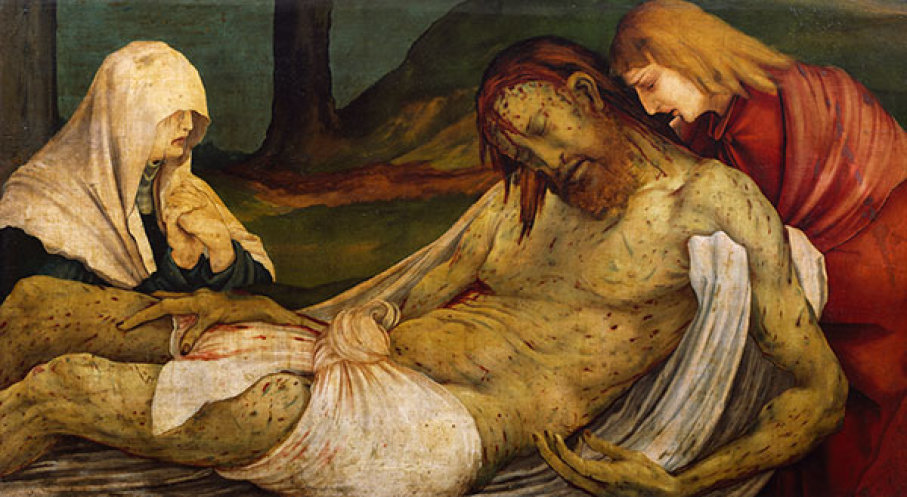
John Greening suggests in his very helpful Introduction that Grigson is also capable of an “extraordinary lyricism” and these are moments when he captures this “sparkling” quality of the natural world. In ‘A New Tree’, helped by the holding up of a child to a window, the narrator sees again with a newly cleansed perception, “a sun / being fiercely / let loose again”. Delight in the natural world recurs in a key poem, ‘Note on Grunewald’. In it, Grigson also expresses the scepticism about literary achievements which must have driven much of his own, often acerbic, critical comments on the work of others. In a man who devoted a lifetime to literary endeavours, it’s hard to take wholly seriously the poem’s assertion that he’d rather live to sniff the “scent of the flowers of lime” than to create lasting “poems”. But the scent is praised in contrast to the art of “Grunewald’s spotted green-rotted Christ”. Grigson sides with (“I join”) Cowper in deciding that death holds no attraction and that he too would choose to “leave this world never”. The perceived dichotomy between a vivid inhabiting of the world of the senses and the ‘rotten’ achievement of artists is by no means Grigson’s final comment on these issues, but the poem certainly expresses unresolved tensions.
As Greening reminds us, Grigson as a critic was a feared and fearsome creature, liable to “dismissiveness and intolerance of shoddy work”. Perhaps, in his own mind, he never quite resolved his assessment of his own poems. A lovely translation from Tu Fu was perhaps chosen because it laments lack of achievement, or at least of recognition: “Writing gives me no name”.* More vigorously, ‘Lecture Note: Elizabethan period’ is an hilarious and outrageous account of a poet’s final work. While the ink was still wet on the page, he dropped dead. The poem fell to the floor only for the maid to drop it in “the jakes”. The final lines laugh cynically, sarcastically, as if this illustrates the fate of most artistic endeavours: “Now irretrievably beshitten, it was, dear sirs, / The one immortal poem he had written”. Yet this is delicate stuff compared to Grigson taking aim with both barrels in ‘Perhaps So’. The premise is that too much is being written:
Too much is told. Banish polymath Steiners
And seventy-seven other British Shiners,
Naturalists, archaeologists, publishers
Of publications in parts,
Norman Mailer
And all long-winded farts . . .
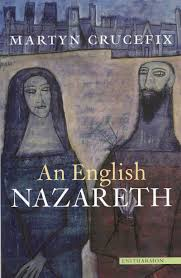
It’s hard to reconcile this voice with that of ‘A New Tree’. Interestingly, Grigson’s address to an ancestor whose name was ‘Nazareth Pitcher’ is critical on the surface, disparaging of Nazareth’s “pride”, suggesting his “lips were too thin”, that he might “be pleased” if he was to witness the parlous state of the world now (1960s). But it’s also difficult to dismiss the feeling that Grigson chose to address Nazareth because he sensed a kinship with this judgemental, sceptical and meanly satirical man.
Having said that, Grigson did admire, if very judiciously. Greening draws attention to an Eliotesque belief in tradition, that the best poems are made by “members of a long narrow community through time”. The word “narrow” here indicates Grigson felt that much of what was truly best was not appreciated by many. In one word perhaps, we see here his motivation to be harsh with what he felt not good enough and his hard work in anthologising what was. There are two tribute poems in Greening’s selection which show Grigson at his complimenting best. ‘A Painter of Our Day’ is about Ben Nicholson and has the feel of a Coleridgean conversation poem. Its tone is confiding, admiring, ranging from observations about playing with children, shared days out, discussions of Nicholson’s work, ageing and the nature of art. Nicholson seems to teach an appreciation of “what is” and an avoidance of nostalgia. But at the same time, he recognises the value of the “reiterated wisdom of perceiving”. That both poet and artist set the bar of achievement very high indeed is suggested by Grigson’s admission that, of their chosen role models, “most have been / Long dead”. I find it hard to pin down a more precisely articulated aesthetic, but these lines are revealing of any artist’s relation to his/her elders:
Suddenly when young or in our first ability
We find them, slowly we find the reasons
For our love, finding ourselves, and what we lack
As well or need the most
Finally, ‘To Wystan Auden’ records the moment Grigson learned of Auden’s death in the “English September” of 1973. His admiration for the younger poet is fulsome. With the appearance of his early work, Auden became “living’s healer, loving’s / Magician”. From the other end of the temporal telescope, we can now see what the young Grigson gleaned from Auden’s poetry:
You were our fixture, our rhythm,
Speaker, bestower, of love for us all
And forgiving, not condemning, extending
To all who would read or would hear
Your endowment of words.
For all Auden’s own protesting about poetry making nothing happen, for Grigson, “time, after you, by you / Is different by your defiance”. One might ungratefully gripe that these are rather vague compliments from one poet to another. But Greening quotes Grigson suggesting that Auden’s achievement was in destroying “a too familiar, too settled monotony in manner and subject”. This is undeniable and this selection shows Grigson following Auden’s lead, yet at the same time, through his life, also being drawn back to a different, more traditional poetic style in the model of Hardy. Here, for example, in his last years, he recalls his childhood in Cornwall:
Staring down from that broken, one-arched bridge,
In that vale of water-mint, saint, lead-mine and midge,
I was amazed by that fat black-and-white water bird
Hunting under the current, not at all disturbed.
How could I tell that what I saw then and there
Would live for me still in my eightieth year?
*As a labouring translator myself, I have long remembered Grigson’s brilliant put-down in his Introduction to the Faber Book of Love Poems (1973). Explaining why he has not included any translations at all, he declares that their “unmeasured, thin-rolled short crust” would prove detrimental to the health of the nation’s poetic taste. Times have changed, thank goodness.
My new translation of a long(ish) Jürgen Becker poem (the first ever into English) has just been posted on the US site, Asymptote. Do click the link above and have a look at it. You can also hear an audio recording of the opening passages of the poem read in German (thank you, old friend, Tim Turner). Becker’s work is really very unusual – and hardly known at all in translation. I have been working on a particular collection of his poems, published originally in 1993 – Foxtrot at the Erfurt Stadium.Asymptote is a marvellous site with a whole range of creative work, so once you are there, stay and have a look around.
Michael Hofmann’s Faber Book of Twentieth Century German Poems includes four pieces by Georg Heym – not bad for someone who died at the age of 24 (in 1912 – an accidental drowning in the frozen Havel River, probably while trying to save a friend). Heym is generally regarded as an early Expressionist writer (of poems and short prose/novellas), though his early poems are very much under the influence of Hölderlin, then much of the surviving work suggests the powerful influence of Baudelaire (in both form and content), though in his final months there seems to have been a return to the looser forms of Hölderlin. His best-known poems combine a gothic, morbid imagination, often with extremes of Expressionistic distortion, with a counterbalancing devotion to regular forms. The sonnet ‘Berlin II’, when it appeared in Der Demokrat, in November 1910, led to the publication of Heym’s only collection published during his lifetime: Der ewig Tag (The Eternal Day).
Antony Hasler’s translations, published by Libris in 2004 (Hofmann also includes translations by Babette Deutsch and Avrahm Yarmolinsky, and Christopher Middleton), are the best to be had at the moment and I’d definitely recommend searching them out (Libris has since folded). I’ve been in a bit of a translation lull for a few months so thought I’d try a few of Heym’s poems myself. The challenge is to make something readable in English, while not toning down the dark brutality, yet also staying close to his classical chosen forms.
In ‘Berlin II’, Heym’s Petrarchan rhyme scheme is ABBA CDDC EFE GHG. The opening quatrain is fairly straightforward. A literal transcription might be: ‘Betarred barrels rolled from the thresholds / of dark warehouses onto the high barges/boats). / The tugboats moved in. The smoke’s mane / hung sooty above the oily waters’.
Hasler has:
From the dim warehouse thresholds barrels caulked
with tar went rolling down to the tall lighters.
The tugboats started. On the oily waters
a mane of soot was trailing from the smoke.
The ‘lighters’ / ‘waters’ rhyme is a stroke of genius (a lighter is a river boat) but the opening line and the fourth seemed to me less successful. I kept the opening line simple and turned ‘waters’ into a possessive and I rather saw the (lion’s) mane more visually linked to the billowing of the smoke which is ‘soot-filled’ (I also tried ‘sooty’, even ‘smutty’). This is what I ended up with:
The tarred barrels rolled from open doorways
of dark warehouses onto the tall lighters.
The tugboats closed in. Across the waters’
oily surface hung the smoke’s soot-filled mane.
I went for the tugboats ‘closing in’ – not merely approaching, but something more threatening – as it seemed in keeping with the ominous atmosphere which develops as the poem goes on (the drumming in line 11).
The second quatrain might be given as: ‘Two steamers came with musical bands. / Their funnels cut/clipped the arch of the bridge. / Smoke, soot, stink lay on the dirty waves / of the tanneries with their brown skins’.
Hasler has:
Two pleasure-steamers came with music playing.
They dipped their funnels at the bridge’s curve.
Smoke, soot, stench lay on the dirty waves
by tanneries where the brown hides were drying.
I couldn’t quite see the funnels being dipped under the bridges (though I believe some boats do this) and I feel the bridge’s ‘curve’ (for roof or arch?) not quite right. So I went with the sense of the funnels actually scraping the roof of the bridges (as if these pleasure steamers did not really fit the generally grim, sordid scene). I was very happy to arrive at the bridge/stench half-rhyme for the middle couplet because the sounds there conveyed more of the Heymian ugliness of the scene. Like Hasler, I felt the need to explain a little what the pelts/skins/hides were doing hanging up at the tanneries. Here’s my second quatrain:
With music playing, two steamers passed by:
their funnels clipped the roof of the bridge.
On the filthy waves, smoke, smut, and stench
at the tanneries, where brown pelts hung to dry.
Lines 9-11 probably caused me the greatest difficulty, not so much in getting the word order and form right, but in simply grasping what was being said in relation to the bridges, the barge, and the narrator’s position. Literally they might read: ‘In/at/all the bridges, beneath us the barge / Carried through, the signals sounded / As if in drums, growing in the silence’.
As I see it, the speaker is being carried on a barge, through and under bridges, and there are signals/sirens sounding that bring to his mind an ominous drumming. So Hasler has:
Every time the barge that bore us travelled
beneath a bridge, the signal’s sudden parley
swelled out of stillness like a deep drum’s rattle.
The ‘barge that bore us’ has echoes of TS Eliot (perhaps not irrelevant in context, and I felt I couldn’t better it in the end) but I’m not sure Hasler makes sense (to me) of the signals and the ‘parley’ metaphor he introduces here is not there in the original. The ‘deep drum’ also seems to be picking up on the ‘ominousness’ of the scene but (for me) a bit heavy-handedly. In the end, I went for:
Through all the bridges, the barge that bore us
made its way, signals resounding as if
a drum’s beat grew louder in the stillness.
In the final 3 lines I made the biggest alteration, the biggest interference with the original poem. Literally, the lines might read: ‘We let go and drifted in the canal / Alongside the gardens slowly. In the idyll / We saw the giant chimneys’ night beacons’. Hasler loses the ‘letting go’ idea, but otherwise keeps the order of these lines well:
We entered the canal, and drifting journeyed
slowly alongside gardens. In the idyll
we saw the night-flares of the giant chimneys.
‘In the idyll’ is perhaps puzzling, though it’s pretty clear there is a bitter irony at work – this is no idyllic scene, and Heym’s other Berlin poems confirm this, the city is a monstrous megalopolis. But there has been a slight shift of scene with the boat moving along a canal now, between gardens. Perhaps this (more bourgeois?) setting might be thought of as more idyllic? But even so, the massive smoking and flaring chimneys of industrial Berlin can still be seen. I confess that I shifted the ‘idyll’ to the final lines to get the final rhyme with ‘canal’. But I have left it – translators, like poets, have the power of veto, whether we exercise it or not. And I have persuaded myself that the savagery of the irony comes out better if the final phrase of the poem contains it. So I went with:
We cut loose, went drifting along the canal,
gradually, between gardens, glimpses of
the vast chimneys’ night-flares in the idyll.
x
So – to sum up (though translations are always really a work in progress) – here is Heym’s original German followed by my own version of the poem:
A rather more personal post than usual, though a poem (an older one of my own) is attached to it. Last week, I spent a few days with family in the beautiful village of Blockley, in the Cotswolds. The weather was very good for late November and we walked a couple of times – from Broadway up the muddy hill to the folly of Broadway Tower (once frequented by William Morris apparently) and around Hailes Abbey (now a ruin, local lore has it that Thomas Cromwell watched the destruction of the Abbey from a nearby hilltop). Blockley itself is near Moreton-in-Marsh, a place almost destroyed by the volume of traffic flowing through it (even in November), where The Bell Inn was once a favourite of JRR Tolkein, and is supposedly the model for The Prancing Pony in The Lord of the Rings. But Blockley, for me at least, had another powerful ghost haunting it.
As a couple, with young children, we stayed in the village over 20 years ago, in one of the original silk weavers cottages built along Park Road, which looks down over the village and valley. The house was owned by a colleague of mine at the time, Laurence Bowkett. He taught Classics and Latin and often spent the summer vacations away on archaeological digs of various kinds. That must have been the situation then as he’d allowed us to use the house in his absence. His early death, within a year or two of this, was a shock to us all. He had no family of his own and I don’t know what happened to the house later. So, fast forward to 2024, and here we are staying in Blockley again, only partly by coincidence. We have always had good memories of the place and (again, partly by an AirB&B chance) we ended up renting an almost identical cottage in the very same terrace above the village. Indeed, maybe it was the same cottage – I couldn’t remember enough of the details. The layout was certainly the same – the front door in off the road, straight into a little front room, a chilly basement kitchen and upstairs two small bedrooms.
Laurence’s was not the first death of a contemporary I knew well, but it greatly affected me and I tried to express something of this in the poem – an elegy – I wrote for him later. It is called ‘The umbrella and the bay tree’ and it mixes memories of him, his enthusiasms (he had a lot of those – all his students loved him for it), with details from my own family life at the time. It opens with an imagined scene, all his teaching colleagues gathered (as we often did then) in the local pub, remembering him in his absence. The ‘laral gods’ – the Lares – are Classical Roman guardian deities. The laurus nobilis refers to a little bay tree I bought after our first stay in Blockley as a thank you gift . . .
x
By seven-thirty, you are with us all
tonight in the gloom of The Washington,
though we omit you from every round.
Powerless as laral gods who gave you
no protection, even laurus nobilis,
x
the bay tree I bought you, proved no use.
x
Our children were at Infant and Junior School at the time and – to be honest – I can’t now remember if the details the poem goes on to mention are truth or fiction. But Laurence was the kind of guy who’d keep his own books in scrupulous order (as he did with his extensive collection of Marvel comics) so the library setting has always felt right . . .
x
Today, I searched 570 and 790,
in the Dewey decimal classification
your fingers ran through a thousand times,
for the facts of death and irrepressible life,
x
as if I looked for you now and you then.
You taught shard-life and careful fieldwork,
the near-dead language of not giving in.
You offered the heroic a modern face,
though death proved the more determined.
x
You understood lives alter what they touch:
a house, a street, a flowering tree,
for those who know us are not struck dumb,
a library unread the moment we die.
They roar like a lantern with our life inside.
x
The idea of lives of the dead altering the lives of those they have touched in life is familiar enough, though I was working on my translations of Rainer Maria Rilke around this time and I’m sure his influence is in here. It is not just the remembering of a friend who has passed away, but also that our own perceptions of ‘a house, a street, a flowering tree’, for want of a better word, spiritualises the material object, giving it a life, a light, an existence, beyond the ordinary. The resurrection of the bugs stomped by my daughter in what follows is probably an allusion to the early primitive computer games the kids used to play in which a failed – hence fatal – leap from a high building would result only in a brief ‘death’ and their 1st person avatar would soon revive and carry on in pursuit of adventure.
x
In Hornsey Central at 570
this morning, I found books to undermine
my daughter’s smiling confidence
that bugs she crushes beneath her shoe
lie dead a while, then revive good as new.
x
At 790, I leafed through life and death
in Ancient Egypt for her older brother:
how they wash their dead in water and oil,
then bind them in linen smeared with gum
and priests wrap lucky charms inside
x
in hope that none will break the seal
till the dead themselves in time of need.
x
The ‘lucky charms’ idea naturally led the poem on to what I myself might place in a good friend’s sarcophagus and gave rise to a list of his multifarious likes and loves, concluding with the heartfelt wish that his (prematurely unhirsute) head might – even in death (though he had no religious belief as far as I know) – remain somehow protected. The image on the underside of Laurence’s umbrella is a truth!
The sad news that Jürgen Becker (1932-2024) died recently at the age of 92 was particularly poignant as I have been translating his work for the past 3 years. I first read about his poetry in an essay I was translating by Lutz Seiler (published in In Case of Loss (And Other Stories, 2024)). There, Seiler characterises Becker’s work as ‘a process that integrate[s] both immediate and more distant modalities of language, his own voice as well as materials drawn from other sources such as events, photos, maps as well as interjections from neighbouring rooms, from the mail, the news, weather conditions and whatever else stray[s] within range’ (my translation). History, politics, the importance of recording ‘small things’, an extraordinarly porous kind of poetry – these were the aspects that drew me to his work (as a writer of my own poems as much as translator).
Becker’s ‘typical’ poem works at length, resembling a stream-of-consciousness, but better thought of as a kind of collage or montage. His effects are slow-burning, allusive, even elusive, and I don’t think his work is likely to top any UK chart of popular poetry any time soon. But his revered status in Germany is remarkable and I have actually had a couple of successes recently with my translations: a Highly Commended in the 2024 Stephen Spender Trust Translation Competition, judged by Taher Adel and Jennifer Wong (with the poem ‘Meanwhile in the Ore Mountains’), and one of Becker’s longer poems in translation being published (‘Travel film; re-runs’ – see below).
Becker grew up in the German region of Thuringia which, after World War II, was in the Soviet occupation zone, later the GDR. By then, his family had moved to West Germany and, after the fall of the Berlin Wall in 1990, the writer often returned to his childhood landscape. I have concentrated my translation efforts on Becker’s 1993 poems in Foxtrot in the Erfurt Stadium, published by Suhrkamp. The full translation is due to be published by Shearsman Books in 2025. The Spender Trust Competition poem is a short piece which I can quote in full. The Competition requires entrants to say a few words about the poem and the translation process. Here is a video of the Intro and Reading of the poem for the prize event, and (alongside) the text that I originally submitted:
Commentary – The Ore Mountains lie along the Czech-German border. Borders are important in this poem. Born in the East German region, brought up in West Germany, after the fall of the Wall in 1990, Becker often returned to his childhood landscape. Though relatively brief, this poem is just one sentence, woven together with the conjunction ‘wie’ (translated here both as ‘how’ and ‘the way’). The weave is dense and it’s not possible to tell whether what is observed – the children, the oil spill, the tree stump (resembling a body) – are contemporaneous or from different eras. My translation keeps these possibilities open: borders here are temporal, as well as geographical. The German word ‘Avantgarde’ has artistic as well as political implications, but my choice of ‘vanguard’ also brings out the militaristic connotations which are reinforced by the ‘spitzen, grünen Lanzen’ (‘sharp, green spears’) which are swiftly transformed into a bunch of sprouting snowdrops. These flowers of Spring are referred to as a ‘Konvention’ and I retained the English equivalent, intending to suggest both a performance (something conventional, perhaps not genuine), as well as a political gathering or agreement (like the Convention on Human Rights). The ambiguity felt relevant. The final vivid, visual images – a TV screen seen through a window, a script on the screen, a woman talking, but inaudible to the observer – sum up Becker’s concerns about the media, political and historical change, borders real and imagined, exclusion, and the need to ask questions of those in power. Issues as real today as when the poem was written.
the nothingness of snow from the nothingness of sky,
and along the frontier, one this side, another
along the other, fly the only two crows
to be found in this treeless landscape, the way
the iridescent pattern of an oil spill develops
with darkening edges, the way a tree stump
in the field becomes the shape of a body with
severed arms and legs, how, under the cherry,
the vanguard shows with sharp, green spears,
which later, over the next few days, assumes
the convention of snowdrops, how dark windows
are lit by screens, and on each screen appears,
at first, lettering, and then the face of
a woman who is soundlessly moving her lips.
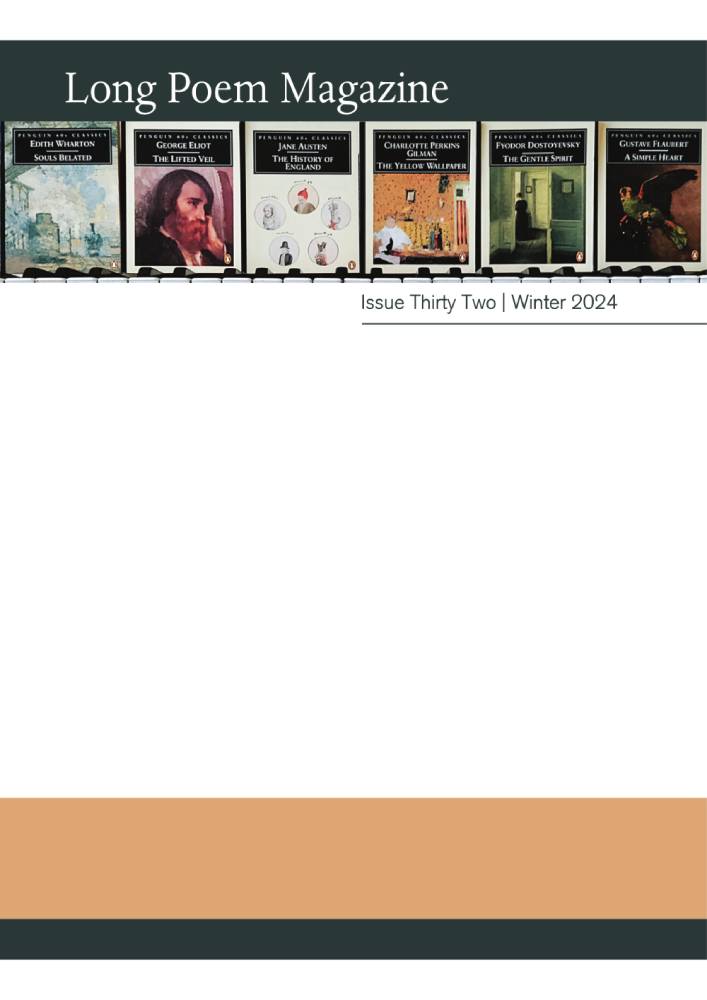
The longer poem – ‘Travel film; re-runs’ – which does indeed run to over 100 lines in full – has just appeared in The Long Poem Magazine, Issue 32, eds. Linda Black and Claire Crowther. This brilliant magazine is one of the few outlets for poems stretching beyond the ‘competition’ mark of 40/50 lines only. Poets/translators again have the opportunity to comment on the work being published. This was my Introductory paragraph:
Given his 1000 page Collected Poems (Suhrkamp, 2022), it’s remarkable that Jürgen Becker’s work has been so little translated into English. This poem, published in his 1993 collection, Foxtrot in the Erfurt Stadium, is imbued with Becker’s sense of the changes in this particular part of Europe. The interleaving of the child’s and returning adult’s vision is what yields Becker’s characteristic poetic mode: a flickering between past and present, often without warning to the reader, a past frequently oppressed by the rise of fascism in the 1930s. The translator’s difficulties lie not in his word choices (Becker plainly describes, he states), but, to some degree, in his cultural references (here, the allusion to pimpf kids (cub, little rascal, little fart) is to members of the Hitler Youth), and, primarily, in dealing with his style of montage-composition, his commitment to ‘the apparently incidental’. Becker’s porous verse contains multitudes of perspectives, voices, inner and outer events, photos, maps, postcards, news, weather reports. In translation, it’s hard to flex, to permit these into English, and I have had to learn to trust Becker’s arrangements of them into long, semi-colon linked passages, utterly remote from conventional ‘lyric’. The opening 24 lines here elide landscape, weather, employment, domesticity, and history, then on to the natural world, compositional ideas, back to history. Becker is a great poet of the present moment and of the past. He grew up in Thuringia which, following World War II, lay in the Soviet occupation zone, later the GDR. By then, Becker’s family had moved to West Germany, and, after 1990, he often returned to these childhood landscapes. This poem was published in his 1993 collection, Foxtrot in the Erfurt Stadium. Becker worked for many years in German radio, and, in this poem, we might imagine a small production team visiting an un/familiar landscape in the East, perhaps where a childhood was spent, a place later abandoned.
Travel film; re-runs (extract)
the landscape: like corrugated cardboard, an enduring, fixed
motion, on a smoky grey day. The wind came
somewhere frombelow, from a region beneath
the weather chart; in the evening, we could no longer
reach our correspondents. We drove out
to the country house; we ate
Spanish green asparagus. It was a moment
from yesterday that rolled slowly past the shelf
with its yellow calendars and diaries and pictures;
something had begun,
and you’re aware of it,
the sound of that reiteration. You can … and
you allow it … push the off button; outside the window,
the blackbird flutters up, simply waiting
to be mentioned. Now you notice the way the paint
has peeled from the window frame, and where
the ants are coming from, in January the only
living creatures in the house. Perseverance pays off
at some point, even if you have little alternative
but to gather piece after piece together. Paint pots
in the shed, shades of green and white, but
we are waiting for a consistent light,
on either side of the house. Is it too late now,
to leave again
… lake shores, before they are all
accounted for, can still be appreciated, with sandy paths
reaching the purple horizon … subjunctive, without end;
a game of evasion that you can watch until you
whistle, or shout, and it’s nothing like awakening
from a dream. In the evening, we light a fire; it’s
a sudden, impromptu decision; then follows
the next draft of the letter: your sketches litter the table
… you no longer need a pass; highways,
the middle of the village … standing beside you
on the jetty; on the opposite side, the yellow ribbon
of the shoreline…
clips from the travel film just now
set going in the blink of an eye; then the meadow
is mown; there are a few old clumps of snowdrops
we leave standing. The fact is, we have missed out
on the moment of adulthood, even if, in the evening,
you say: never, not once, did the door open, from
which a little something left, and what you are now
entered in. The contrast, the changes … the fear has
been networked, so many of these shortcomings went
into production. Piano, from beyond French windows,
Shostakovich plays Shostakovich, and the life story
draws a curve out towards the northeast. Ice floes,
accumulating along the coast; in boots and furs,
walking over the frozen river, passing pimpf kids,
and old men, and a young woman who’s most likely
Polish, and you’re not going to stop staring at her
any time soon; freezing cold on the sledge back home,
your mother doesn’t live here anymore; the whole scene
Talk to whomsoever (among the poets you may know) and a common theme is just how hard it can be to get invitations to read. It really is hard going and for those of us – most of us – who have an aversion to the push and flaunt that is required – it can even feel quite painful. But do it we must. So it’s really nice when it produces a few results. This, by way of saying that I have a few appearances – brief in the main – not as headline reader – coming up at the end of this month and the opening of November. A couple of these readings are translation-related, two others are to mark the publication of extracts from some more experimental work (in original poetry) that I have been pursuing in the last couple of years. I’m particularly happy that these more ‘odd’ compositions have found such warm responses and it makes me think I ought to be looking to publish them in full.Though I have another, other book sitting ready to go… publishers??
Some more event details….
On 26th October, 2pm, at The Library, Conway Hall, London, as part of the Small Publishers Fair, Wivenhoe-based Dunlin Press will be launching four new pamphlets of writing: Kathmandu by Andrew Shaw, Bomb by Samuel Reid, From Stone to Clay to Butter by Lily Petch, and A Raven on a Writing Desk by Julie Hogg. These talented people were the winners of the Press’ 2024 competition for experimental writing. Sad to say, I’ll not actually be reading here, but some of my work is included in the accompanying anthology (those who just missed out I like to think!). My contribution is an extract from A Shout Across Dursey Sound, a sequence of poems set on the Beara Peninsula in Ireland. The anthology’s title is Objects (buy it here) and it includes work by Galia Admoni, MW Bewick ,Emma Bolland, Richard Capener, Tessa Foley, Anthony Ogbonnaya Chukwu, Richard Skinner, Isabella Streffen, and others.
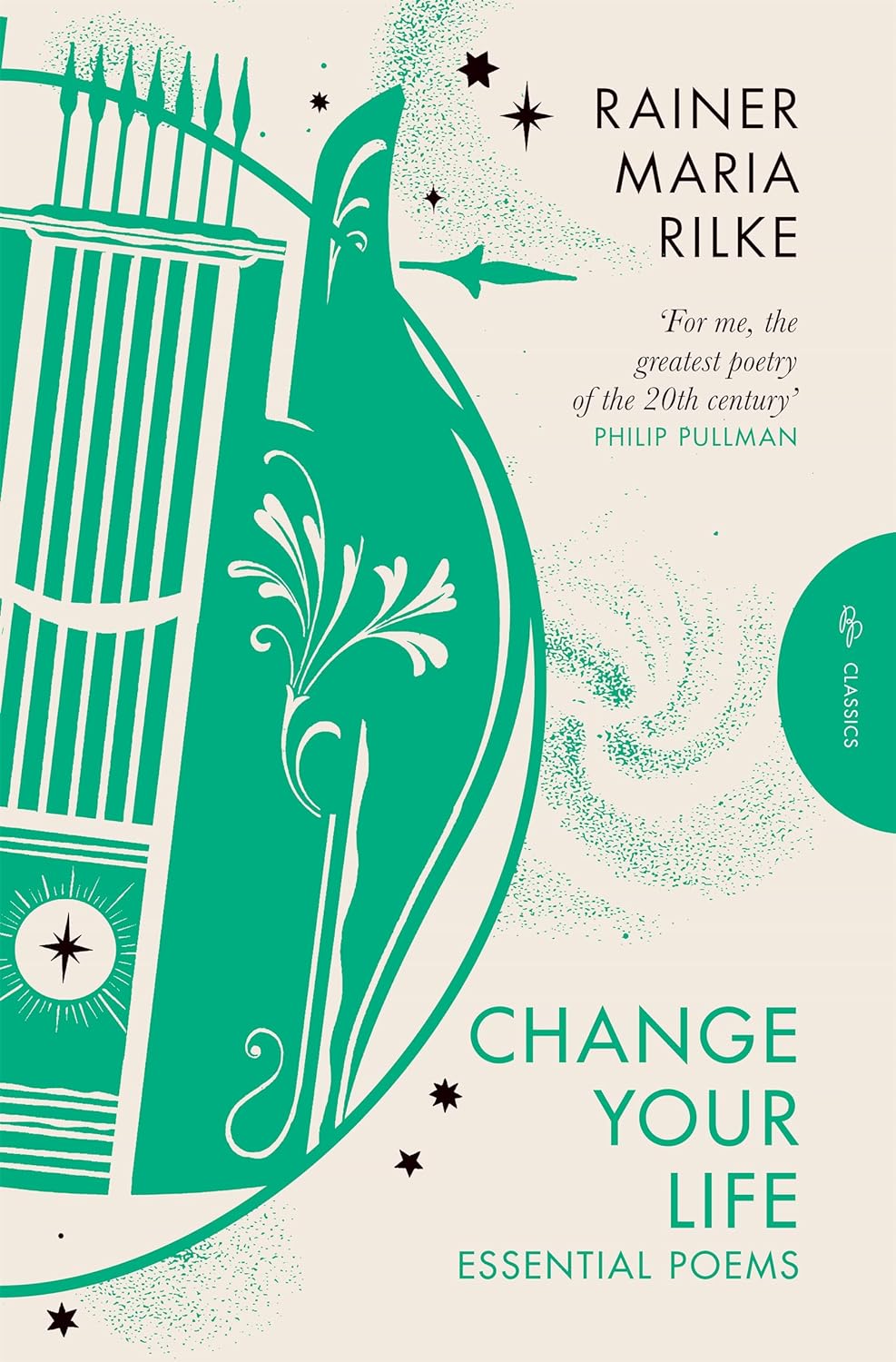
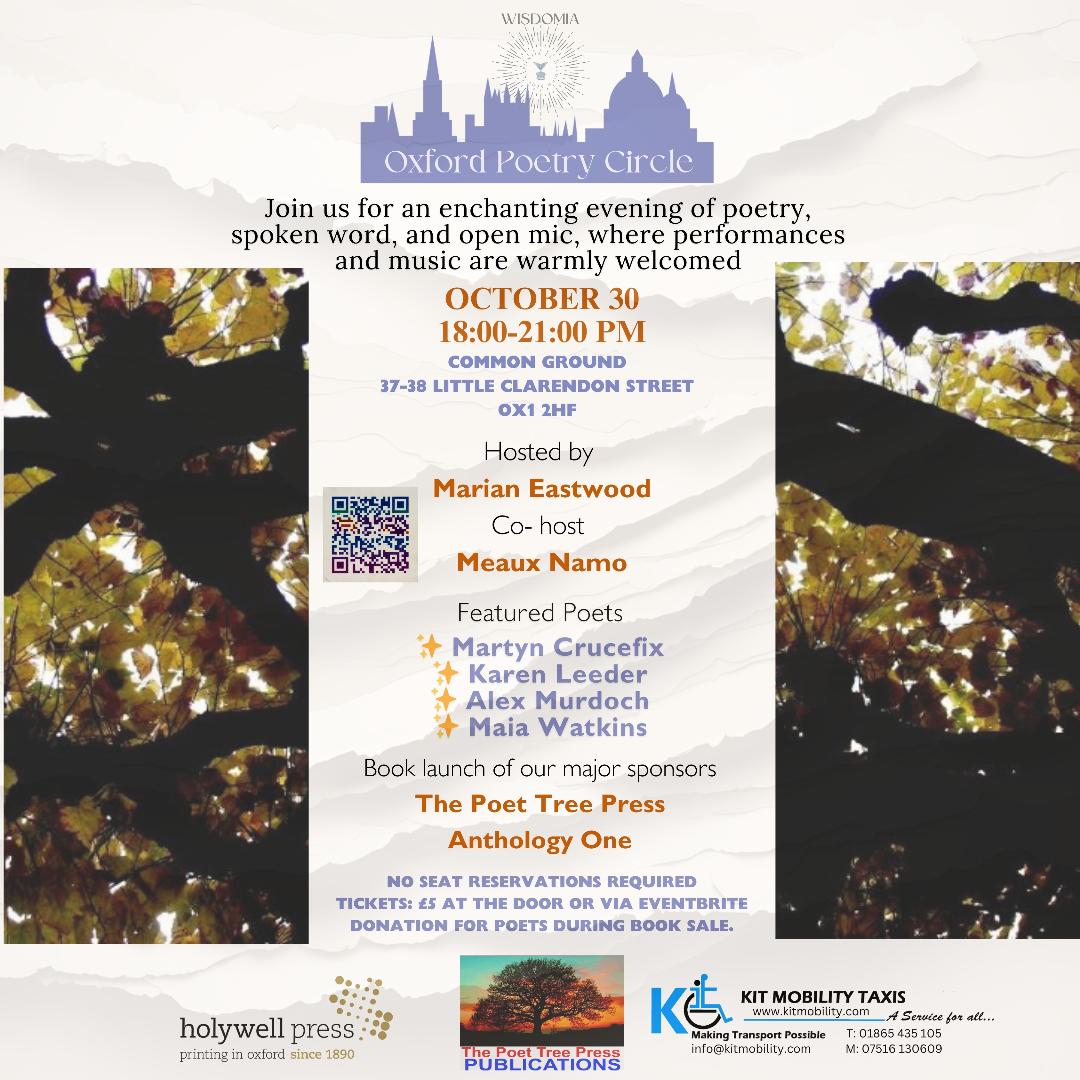
Then, on Wednesday, 30th October, 6pm-9pm, I’m off to Oxford to read for the Oxford Poetry Circle, as announced in a previous post. This is taking place at Common Ground, on Little Clarendon Street, Oxford. There, I’ll be reading work in translation only – from my recent Rilke book published by Pushkin Press (reviewed here on The Friday Poem by Victoria Moul) and from my 2019 Shearsman Books collection of poems by Peter Huchel. I’m particularly pleased to be reading on this occasion with the brilliant and super-industrious translator, academic and friend, Karen Leeder. Other readers are Alex Murdoch and Laia Watkins – and there will be readers from the floor.
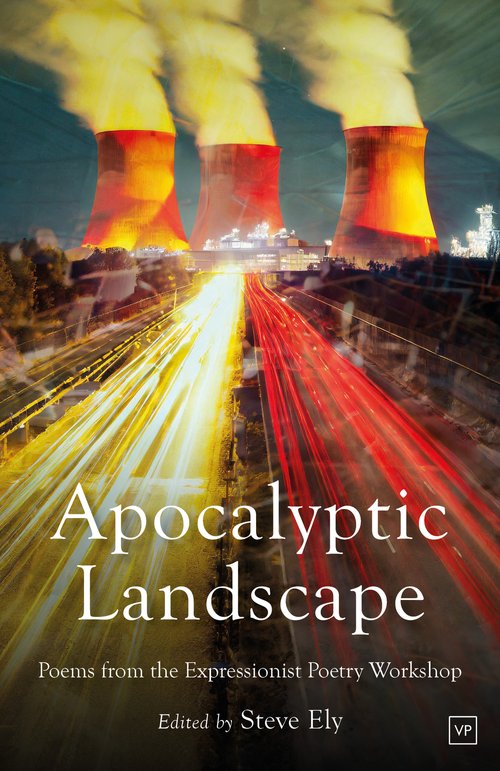
A couple of days later, the evening of Friday 1st November, I will be reading from a second experimental sequence of my own poems at the launch reading for Steve Ely’s anthology called Apocalyptic Landscape (Valley Press). My poems, a sequence called Olga Liking Sunflowers, roam through the pandemic experience, the work of David Jones, my local landscape and the delights (or otherwise) of social media. Contributors were encouraged to generate visionary responses to the crisis of the Anthropocene in the context of landscapes important to them. I will be reading alongside Steve, Jill Abram (who is organising the London launch for the book), as well as Katy Evans-Bush, JP Seabright, Anita Pati, and Caroline Maldonado. Steve Ely is also reading from his book Orasaigh, a collaboration between Steve and photographer Michael Faint, inspired by the landscape around the tidal island of Orasaigh, located on the coast of South Uist at Boisdale. This event will take place upstairs at the Devereux pub, 20 Devereux Ct, London WC2R 3JJ. Doors open 6:30, Poetry starts 7pm FREE event.
Finally, I have also been lucky enough to have a translated longer poem (by the contemporary German poet Jürgen Becker) accepted to appear in Issue 32 of The Long Poem Magazine and I will be reading ‘Travel film: re-runs’ at their launch event in the afternoon of Saturday 16th November 1.30 to 3.45, at the Barbican Library, Barbican Centre, Silk Street, London, EC2 8DS. Other readers will be: Angela Gardner, Charlie Baylis, Sue Burge, Sharon Holm, Claire Cox, Sian Thomas, Peter Robinson, Khaled Hakim, Timothy Ades, Julian Stannard. FREE ENTRY and there will be a short interval for sales and chats. Refreshments are available downstairs from the Barbican Cafe and Bar. I hope to see you at one or another of these events. I’ll leave you with a few lines from my sequence in Steve Ely’s apocalyptic anthology:
Olga likes my post of the tall sunflowers in the square.
Through google translate, her post in Russian reads: adrenaline is my doping.
I draw for the soul.
x
There are hundreds of images of herself. Some with wild animals.
Surely, they’re not really wild.
In a zoo. Under lock and key.
x
Others touch the hem of the pornographic.
Others look like cheap advertisements for luxury cars.
The kind of posts, I wonder, that end with an offer of marriage from the viewer.
x
Another shows her bald headed, holding a snake, just weeks after the remission of her illness.
x
I want to ask her: what was the exact nature of the disease?








 Martyn Crucefix