Translating Transtromer: Fulton v Robertson

With his death a few weeks ago, I have been re-reading Tomas Transtromer’s work and the first place to go (after the poet’s own website and video) is, of course, Robin Fulton’s comprehensive collection from Bloodaxe. But I have been comparing Fulton’s translations, which seem very faithful if a bit unexciting, to several done by Robin Robertson as published by Enitharmon in 2006.

imgres

Robertson bills his 14 pieces (presented usefully as a parallel text with the original Swedish) as ‘versions’ or, in the acknowledgements as “imitations”. There seems to me a good deal more vigour and poetic heft to Robertson’s versions, but it’s not immediately clear how many liberties he is taking with the originals and it’s interesting that Fiona Sampson suggests the Swedish writer has been an important influence on Robertson. In what follows I’m looking closely at just one  poem from both translators (by the way, I don’t have any Swedish except what a dictionary can give me; nor have I ever made any academic study of Transtromer’s work).
tumblr_ljq342taqj1qzdxojo1_400
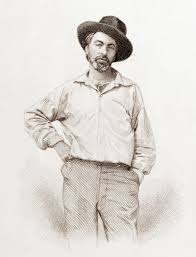
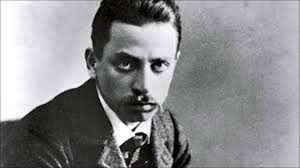
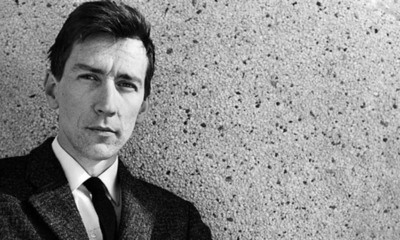
Tomas Transtromer, an early photograph

‘The Couple’ first appeared in Transtromer’s collection The Half-Finished Heaven (1962). It’s a distanced study of love (over three quatrains) as a couple turn out the light in a hotel room and, after making love, they sleep. In the third quatrain, darkness and unilluminated houses gather about them as if to watch or bear witness or threaten. Fulton’s opening is very plain and factual: ‘They switch off the light and its white shade / glimmers’. Robertson’s version feels more vivid though it does have a stagey-ness about it, the light becoming the slightly archaic ‘lamplight’ and the plain shade elevated to a ‘globe’. This theatricality is developed in Robertson’s version and is to some degree justified by the final image of the poem where the outer night transmutes to watchers, almost to an audience. But as far as I can tell, this trope is not made much of in the original until that last image.

Transtromer develops the fading of the extinguished light in a striking image of it as a dissolving pill or ‘tablet in a glass of darkness’ (Fulton). In the original, the simile is clearly marked and plainly given but Robertson adds a colon and allows the metaphor a good deal more space: ‘an aspirin rising and falling / then dissolving in a glass of darkness’. This is again vivid, visual, though perhaps the dissolving pill image takes over too much from the idea of the fading out of the electric lamp. The original has nothing of this energetic dissolving of the pill with its up and down movement (and does Transtromer’s tablet carry more weight of darkness than Robertson’s headache-curing ‘aspirin’?). The rising and falling image may have come from Transtromer’s next phrase: ‘Then up’ (Fulton). Turning the line ending, this becomes clearly linked with the rising up of the hotel walls (presumably in the couple’s perception, as the light fades and darkness asserts itself). This brief, even curt phrase is isolated between full stops and Fulton follows this and seems to be responding to the signals of the original in terms of the couple’s alienated, isolated experience, with language itself fragmenting to reflect that. Robertson differs again, lengthening and making more elegant the end to quatrain 1. He also introduces another theatrical reference not present in Transtromer’s original: ‘Around them, / the hotel walls slide like a back-drop up into the night sky’. Against Transtromer/Fulton’s jagged, uncomfortable process, Robertson’s walls rise more smoothly, the logic of his image suggesting they more fully establish a scene, rather than imprison. Again Robertson’s version is visually more pleasurable but on second or third thought, how many back-drops have you seen rise from the floor, going upwards?

2Q==

Quatrain 2 opens apparently after the couple have made love. Fulton again seems to follow the plainness of the original with ‘The movements of love have settled’. ‘Subsided’ might have been a better word but it’s hard to judge whether the strangeness of this is in the translation or the original which does seem to want to describe  the couple’s intimacy from a frightening distance. Robertson’s theatrical imagery recurs with ‘Love’s drama has died down’ which also distances the intimacy, though in a different way, gesturing towards the hollowness of romantic cliché rather than Fulton’s ‘movements’ which suggests a more completely meaningless activity. There’s not a lot to choose between the two versions in the remainder of quatrain 2 as the couple’s ‘dreams’ (Robertson) or ‘most secret thoughts’ (Fulton – this is pretty literal) are said to meet (Transtromer repeats the word ‘meets’ here) like colours blurring in a child’s painting. For Robertson, the colours ‘meet and bleed’ whereas for Fulton they ‘meet and flow’. ‘Bleed’ is a powerful word choice of Robertson’s here but again I wonder how right it is as the evocation of a wound in this middle quatrain where (if anywhere in this tough little poem) there seems to be some suggestion of communion, some sort of meeting of human lives.

The end of the poem is fascinating. Transtromer’s original has 5 brief, buttoned-down sentences, again reflecting the fragmentation I spoke of earlier. All is dark. The city draws close. Windows are unlit. The houses approach. They crowd in close, waiting, expressionless. Fulton – as we have come to expect, follows this faithfully but at the expense (for me) of some sensitivity to the ebb and flow of line endings, to the sonic dimensions of a poem (which in being brought over into English from Swedish have to be re-made, re-heard):

It is dark and silent. But the town has pulled closer

tonight. With quenched windows. The houses have approached.

‘Quenched’ windows? In contrast, Robertson, again smoothes and unroughens, but like a good jazz band, his words are listening to each other better than Fulton’s are:

All around is dark, and silent. The city has drawn in,

extinguishing its windows. The houses have approached.

Robertson’s vivid animation of the city-scape is more thorough and convincing at this point and, in the poem, that is important.

images

The final lines bring the houses even closer to the couple with faces expressionless (Transtromer’s word here is ‘uttryckslösa’ = expressionless or deadpan) and in an attitude of waiting (‘vantan’ = to wait or anticipate). Fulton again conveys the meaning well enough, though there is some sense of redundancy with both ‘throng’ and ‘crowd’. The problem for me is that it is hard to catch the significance of the ‘expressionless’ faces here:

They stand close up in a throng, waiting,

a crowd whose faces have no expressions.

To ‘have no expression’ is a profoundly neutral way of saying ‘expressionless’ and Fulton often goes for something like this, not quite daring to leap towards a more focused (I suppose I mean interpretative) word choice. This is not something Robertson ever seems reluctant to do – perhaps behind the defence of his poems as ‘versions’, gifting him greater freedom (a little less responsibility?) than if he’d declared the full ‘t’ word, translation. Robertson goes:

They crowd in close, attentive:

this audience of cancelled faces.

This is wonderfully economical, with a good play of vowel and consonant music, although ‘attentive’ is more neutral than waiting or anticipatory. Both ‘audience’ and ‘cancelled faces’ are dramatic choices. In one sense they complete the decision Robertson makes to bring the theatrical imagery far higher in the mix than in Transtromer’s original; the couple’s lives are performances though the only audience they have is the featureless and expressionless city about them. But ‘cancelled’ is also a surely over-dramatic in suggesting the faces have suffered (see ‘bleed earlier’) some mysterious trauma whereas in Fulton (and I think in Transtromer) the waiting a faces are merely empty, indeed, perhaps waiting to be filled.

Transtromer’s poem has a poignancy derived from the fact that the couple’s love-making, though distanced and close to meaningless in the great scheme of things, is perhaps the only possible source of meaning/expression in a largely unresponsive world. Robertson’s version manages to turn the dramatic volume several notches but in doing so pushes out to the extremes. His poem suggests an even bleaker diagnosis in which human activity is nothing but theatricality, stage sets, drama, while any potential audience or act of witness that might be possible involves only those whose faces and identities have already been wiped.

The Verdict: actually I set out preferring Robertson’s version because it garnered a more immediate response from me with its obvious sense of drama. On reflection – and looking more closely (as far as I’m able) at the original Swedish – I think Fulton is closer to the source (and therefore his poem reads more strangely, less easily, than Robertson’s). It’s this kind of frustratingly equivocal conclusion that makes those who fancy themselves as translators think it’s worth having yet another go at bringing a poem across into English. Just to throw a curved ball in right here at the end, here is Robert Bly’s translation of the same poem . . . declare your preference!!

They turn the light off, and its white globe glows
an instant and then dissolves, like a tablet
in a glass of darkness. Then arising.
The hotel walls shoot up into heaven’s darkness.

Their movements have grown softer, and they sleep,
but their most secret thoughts begin to meet
like two colors that meet and run together
on the wet paper in a schoolboy’s painting.

It is dark and silent. The city however has come nearer
tonight. With its windows turned off. Houses have come.
They stand packed and waiting very near,
a mob of people with blank faces.


A bundle of 50 sticks for William and Juliet

Last Saturday I travelled down to Chepstow to read at an event organized by William Ayot who, with his wife Juliet, runs the On the Border series of readings. They tend to bill a Welsh poet with A. N. Other; I was the latter and Richard Gwyn the former. Richard runs the Creative Writing MA at Cardiff University and is a brilliant poet and translator from the Spanish (especially South American poetry). He read some heart-stoppingly powerful new work from three Mexican poets recently published in Poetry Wales and some of his own prose poems from Sad Giraffe Café (Arc Publications). I read from my translations of Rilke’s Sonnets to Orpheus and also extracts from The Time We Turned.

Richard Gwyn

On the train down I was again reading Lee Harwood’s work (see my last blog post) and came across ‘Days and Night: Accidental Sightings – a bundle of 50 sticks for Joseph Cornell and others’. I’ve put together my own loose bundle of sticks as a modest thank you to William and Juliet for their hospitality in their extraordinary house, their passion for poetry in its widest sense, and that marvellous coronation chicken!

scout-sticks1

A bundle of 50 sticks for William and Juliet

At the track side willow belts always unkempt trunks leaning some broken

*

luminous blue sky in early May

*

On a diversionary loop the train slows as if to allow the doe standing knee deep in meadow grass to watch us as we pass we watch her

*

She wears muddy walking boots and has brought out a flask of something hot

*

clipping tickets he is careful to be polite though from those upgrading to First Class he has had money already

*

‘why do you do this’ the effect is never quite the same twice

*

In a faded green t-shirt a man walking with arms folded across his chest as if he had breasts he hoped to steady

*

mud-brown canal waters held eight of nine feet high behind a lock gate

*

An upturned wheelbarrow on a long houseboat its purple paint job a statement of optimistic intent

*

Words carve out sense as tractor tyres embrown the field’s new growth each year their lines down the hillside conclude at an iron gate

*

I feel with each mile nearer home I mean nearing the place I grew up in

*

Hills like the scarp edge of Salisbury Plain wait O this is not a likeness this is ‘the actual place’

*

a diversion to a chalk white horse full of memories

*

the Tory heartlands a tractor slowly turning over the ground

*

I ring home and wake my sleeping parents

*

‘Let’s make flying fun again’

*

a basket of split logs waits for the fire

*

On a wooden writing desk three animal skulls

*

‘quietude not inquietude’

*

Nine owl feathers in a china mug a sort of chalice

*

A glazed bowl with an assortment of matte pebbles from the beach

*

His son spoke out but the police were in bed with the FARC who saw to it he and his friends were tortured and killed can you believe it

*

I like to work I prefer to work with those who want to want to stop

*

a tall poplar tree like an exclamation mark he wrote as if to say this is it

*

One skull another skull then another skull beside another skull

*

rose gardens and orchards

*

If they haven’t killed enough by their early 20s they’re losers whose life expectancy is anyway no more than 24

*

Down to the underworld but returns if somewhat empty-handed he does return

*

mausoleums for themselves a cult of death

*

Bluebells in the hedgerows on either side of the road

*

left hand short by two digits his wife’s wrist broken by a fall

*

shut-eyed Blake above the flat-screen TV seems to offer the room a challenge

*

the watercourse way

*

Everything is a fiction the novel in your shoulder bag is the bank statement you use as a bookmark inside it that too

*

The narrative of the oh-eight crash there are other ways for it to be recounted that’s not a joke

*

Oppositional to a large degree I guess we are not pebbles from the same beach but it’s more than just rubbing along

*

A chimney balloon

*

On-line so many ‘friends’ devastated by the surprise results

*

It’s staying in places like this makes me feel a Londoner

*

He waves his paddle to let the train go then flips it up inside the back of his orange hi-viz jacket and pushing the handle into his back pocket it’s safely stowed

*

A speck of thistledown drifting up the aisle

*

attentiveness

*

banked blue rectangles squat in meadows to scoop the sunlight

*

Dirt is matter out of place but this is not dirt it is marvelously out of place

*

Red kite above the monkey puzzle

*

on an elevated hillside ahead yellow rape now level with me receding away behind

*

In tunnels my ears close as if valved

*

either that or everything is a metaphor I see myself turning socks inside out little involved packages

*

What will Rose and Richard be doing this morning

*

Wishing Iolo courage for his father’s passing

images

One of the Best Poets of the Present Moment in France

So here’s a poet well worth getting to know (if you don’t already). The new issue of Modern Poetry in Translation contains a new translation by Marilyn Hacker of the great contemporary French poet, Guy Goffette. Hacker has referred to Goffette as “one of the most unabashedly lyrical contemporary French poets, who claims Verlaine . . . as one of his literary godfathers”. He’s an admirer of Auden and his own work is not oppressively ‘literary’, not referential, not obscurely self-referential. He’s a poet somewhat to the ‘English’ taste (OK – you got me – to my taste), using quotidian words, everyday expressions, making them new, re-investing them with humour, connotation and emotion. Hacker has argued that “after a period in which much of French poetry eschewed the concrete, the narrative and the quotidian”, Goffette’s poems have recently found an enthusiastic readership. Yves Bonnefoy admires him as a writer who “has decided to remain faithful to his own personal life, in its humblest moments. He keeps things simple, he is marvellously able to capture the emotions and desires common to us all . . . without question one of the best poets of the present moment in France”.

images

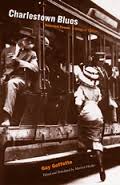
The new poems in MPT – a sequence of 6 sonnet-like pieces published in 2009 – make up an ‘Elegy for a Friend’, the poet Paul de Roux. The form used is a thirteen-liner, made up of three usually unrhymed quatrains and a last line which sometimes, though not always, reaches the classic 12 syllables. Since the early 1990s, this has become “Goffette’s ‘signature’ strophe” (Hacker again), whether used as part of a sequence or standing on its own. I reviewed Goffette’s last recent major appearance in English, Charlestown Blues, for Poetry London in 2007. I reproduce the review here and add comments on the new poems at the end.

The longer term coherence and success of a poet’s work is not – ought not – to be something willed. Like the oyster with its grain of sand, there is surely always something fortuitous about it. Marilyn Hacker’s fine translations from the French of Guy Goffette’s work suggest that, in this instance, Rimbaud’s declaration that “You never leave (“On ne part pas”) has proved a spectacularly productive starting point.  Rimbaud’s comment suggests restlessness and desire for the other, yet also the tragic recognition of human limits as well as the idea that imaginative travel is more real than any form of mere physical tourism. These are indeed the topics and tensions that weave through Charlestown Blues.

220px-Guy_Goffette_20080316_Salon_du_livre_1

Hacker’s introduction characterises Goffette in contrast to the Anglo-American preconception of contemporary French poets and not only due to his interest in form. She suggests we see modern French poetry as “abstract, more concerned with concepts than with human experience  . . . resolutely “difficult””. Goffette’s work, in contrast, is diffused with “humour, longing, tenderness, nostalgia and occasional cruelty” and, though Hacker over-states his likeness to James Wright and Seamus Heaney, the general thrust of her argument is right. Born in 1947, of the same generation as our Motion and Raine, Goffette grew up on the shifting French/Belgian border (travelling without moving?). He now lives in Paris but still tends to look to the provinces while the metropolis is more often “a place from which his speaker is perpetually ready to depart” (Hacker’s introduction).

The title sequence, using a decasyllabic dixain and written during a residence in Rimbaud’s Charleville, seems scatter-shot and observational but with a strong thread of erotic longing: “your drying / stockings and scanties of a nun at bay – / poisonous flowers for a lonely man” (‘Letter to the Unknown Woman across the Street, 1’). Sex is one form of ‘leaving’ and Goffette catches such longing vividly: “oh beautiful stranger, / that creature who’s so often on the move” ((‘Letter to the Unknown Woman across the Street, 2’). Goffette’s work certainly revels in such demotic pleasures and Rimbaud himself puts in an appearance shouting “Fuck off! to puttering poetry” (‘February ‘98’). Earlier he wrings “the neck of the azure, which always puts / too much honey on the tails of verse-worms” (‘Farewell, Chateaux’). In the context of French poetry, it is this combative stance that leads Goffette towards the more grounded – even sordid – presentations of life that Hacker argues make him attractive to readers of English and American poetry.

imgres

Goffette’s natural reach approximates to the sonnet and these are frequently arranged in sequences, such as in ‘Waiting’. Largely from the point of view of a woman addressing her lover, these pieces suggest that it is the ultimate ‘leaving’ of death as well as desire that fuels his poetry. Here, eroticism is more explicitly a stay against death and time – “the judgment of this absence crushing me // like an insect on the pane” – though the final poem ventures a kind of romantic nostalgia, suggesting that even sex must fall short of human longing. The woman is made to envisage an island “where the surprise / of being lasts . . . the heart is still / in place, captain of the old ship”. This paradisal view is left to stand in stark contrast to the lovers’ reality, as they undress each other “amidst time’s peelings”.

So Goffette’s themes are the classical ones of love, time and death and though his diction is familiar enough with the contemporary, much of his imagery has a timelessness in its reference to journeys, rivers, trees, rooms, seashore, roads, stars. ‘Boarding the Streetcar: Variations’ responds to a photograph of New York in 1900 in which a woman climbs onto a streetcar watched intently by a male passenger and a (male) conductor. In a miracle of economy, the passenger’s viewpoint is sketched in and within six lines the moment of voyeuristic pleasure has come to represent “everything”:

the swift brightness of minnows

in a current, the taste of the first

fruit swiped from a market-stall, and how

the hazel switch whistled in the air

when it was about to strike a child’s

back

Yet when the passenger tries to articulate this moment he can manage “nothing” or the best he achieves are “words // like paper littering the grass after a fair / when shadows as they lengthen chill our hearts”. In contrast, the conductor’s view of the incident suggests its mix of beauty and danger, its very ordinariness, provides him with some memory which makes “the blood of things beat lengthily like a heart / in the shadow of dead rooms”.

imgres

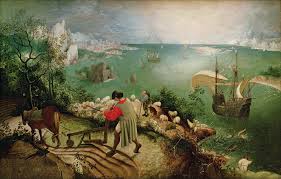
Hacker’s selection covers ten years from 1991 and concludes with a longer sequence published in 2001. ‘The Raising of Icarus’ is based on the same Breughel painting that inspired Auden’s ‘Musee des Beaux Arts’. Constructed from sonnet-like pieces once more, Goffette does not dwell long on the painting itself and instead seems to be observing people in the Paris metro, “running // against each other, same face same / night, and each one was night for every other” (‘In the Depths of the Labyrinth’). Rimbaud’s phrase is again apposite; these commuters travel without arriving anywhere and yet “To embark and not return is what they wanted” (‘In the Depths of the Labyrinth’). Later, they turn on the Shepherd in the painting who – they enviously feel – leads an idyllic pastoral life, while they must be “winning gold . . . cheers . . . bread” (‘The Shepherd Reproached’). It may be that the Shepherd is an artist figure but his response is that his life is no different to the crowd, though the one thing he does know is that death and the final dissolution of things is what serves to “raise every object up from darkness” (‘The Shepherd Answers’).

Goffette2
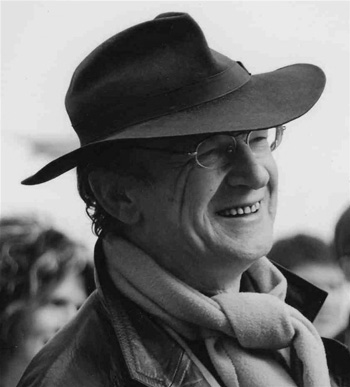
Guy Goffette

Death is, of course, the subject of the more recent sequence, ‘Elegy for a Friend’. It opens with memories of two friends in their youth, “When life was strong”, once again drawing on Rimbaud’s sense of restlessness, the youthful ease of travel, transformation, the passage of time unnoticed, yet (ominously) “it was already dancing there”, the shadow that “burns all shadows”. In the second section, temporal words become sand grains, become silence that eventually “takes up all the space and screams”. Yet, as the Shepherd figure in ‘The Raising of Icarus’ suggested, it is the presence of death that leads the poet to his creative “double question” about identity and time. If there is any regret, it is that this wisdom was not learned soon enough and, like stricken teenagers, the youthful poets sat too long in their “afflicted bedrooms”, or bickered unsympathetically, ignorant for too long of the real “desert of life”. Goffette’s elegy maintains a classical distance and relative impersonality with the sixth section using the first personal plural pronoun to sound more universal than intimate: “One day we must depart”. It’s a bleak ending full of thorns, scorched earth, what remains is “paltry”. There do remain the words on paper, “read and reread”, but their author is ambiguously described as a “blind man dancing in the fire”. Do we stress the blindness, our ultimate ignorance? Or the all-consuming fire? Or should it be the struggle to make art, the act of dancing?

This is challenging and wonderful contemporary poetry and – though the parallel text faces each page in Charlestown Blues – I seldom found myself checking the original which suggests that Hacker is doing a magnificent and valuable job of bringing Goffette’s work into English.

goffette3

Found Poems from Whitman’s Civil War Prose

I’m still pursuing some of the thoughts from my last blog about the difficulties of writing about current events (https://martyncrucefix.com/2015/03/13/how-do-i-write-poems-about-current-events/). I am reminded that we are closing in on the twelfth anniversary of the first so-called ‘shock and awe’ strikes by coalition forces on Saddam Hussein’s Bagdad in 2003: 

I did manage to write about the subsequent war in Iraq but on this occasion I approached it very tangentially, through the Civil War writings of Walt Whitman. The resulting poems were first published in The Long Poem Magazine (Issue 3, Winter 2009/10; sections also appeared in Acumen) with the Introduction I have posted below. There, I discuss several sections of the completed sequence though I will post up only two parts of it. For the sake of those who might be interested in how raw materials get transmuted in such a process, I have added links to the original passages from which #2 ‘The White House’ and #4 ‘I staid a long time to-night’ were derived. The full sequence was eventually published in Hurt (2010: https://martyncrucefix.com/publications/hurt/). Dan O’Brien has more recently used a not dissimilar ventriloquism in his poems about the experiences of war photographer Paul Watson. For a much more direct poetic approach to modern war (born out of direct experience as a soldier in Iraq) see the poetry of Brian Turner.

On 21st March 2003 the “big and little thunderers in chorus began to roar” over Baghdad. During Easter of that year I visited the American Museum, just outside Bath, and while my children scoured the grounds in an Easter egg hunt and my aging parents wandered around an exhibition of American rag rugs, I drifted into the bookshop and picked up a collection of Walt Whitman’s Civil War poetry and prose.

It was childhood innocence and the rag rugs’ recycling of material that were in my mind as I read the words Whitman had written in 1862 in Falmouth, Virginia: “Began my visits among the Camp Hospitals in the Army of the Potomac. Spent a good part of the day in a large brick mansion, on the banks of the Rappahannock.”

With the force of one of those visions that artists are thought to be prone to, it struck me that such a wide-eyed witnessing from an earlier conflict might be a way to write successfully about the then current conflict. Or to be more precise – since what I have just written fails to convey the powerful emotional impact of what I read – I was myself moved by reading Whitman’s observations but my emotion was not retrospective at all but immediate, topical, all about Iraq.

url

The more I read of Whitman’s prose the more genuine ties with the contemporary war I sensed. Whitman writes in his letters and journals almost as a by-stander, visiting the wounded and dying in hospitals, only occasionally being drawn to wider political observations and his focus on the individual cost of warfare exactly matched my own feelings. I began to imagine a sequence of poems framed by letters to a mother, containing the search for a brother and other references to close family members: “Han’s and George’s and Andrew’s. . . Jeff’s and his little Manahatta’s too”. The sequence came together only very slowly, partly because of my own uncertainties about its status as a partially ‘found’ poem but it eventually separated itself from its original sources and it was only later that I saw what was mine, what Whitman’s.

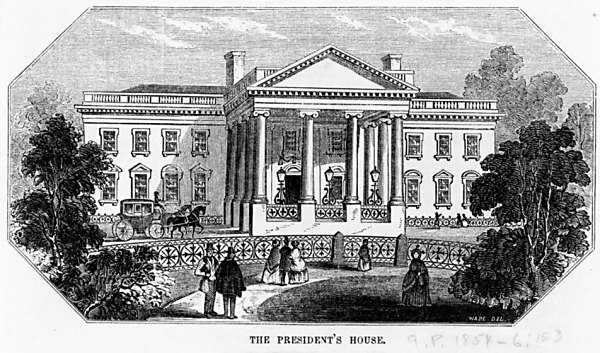
So the second piece, describing the White House, relies heavily on notes Whitman made in February 1862, but in the light of the deceit and war mongering of the early 21st century such descriptions are redolent with a bitter irony.

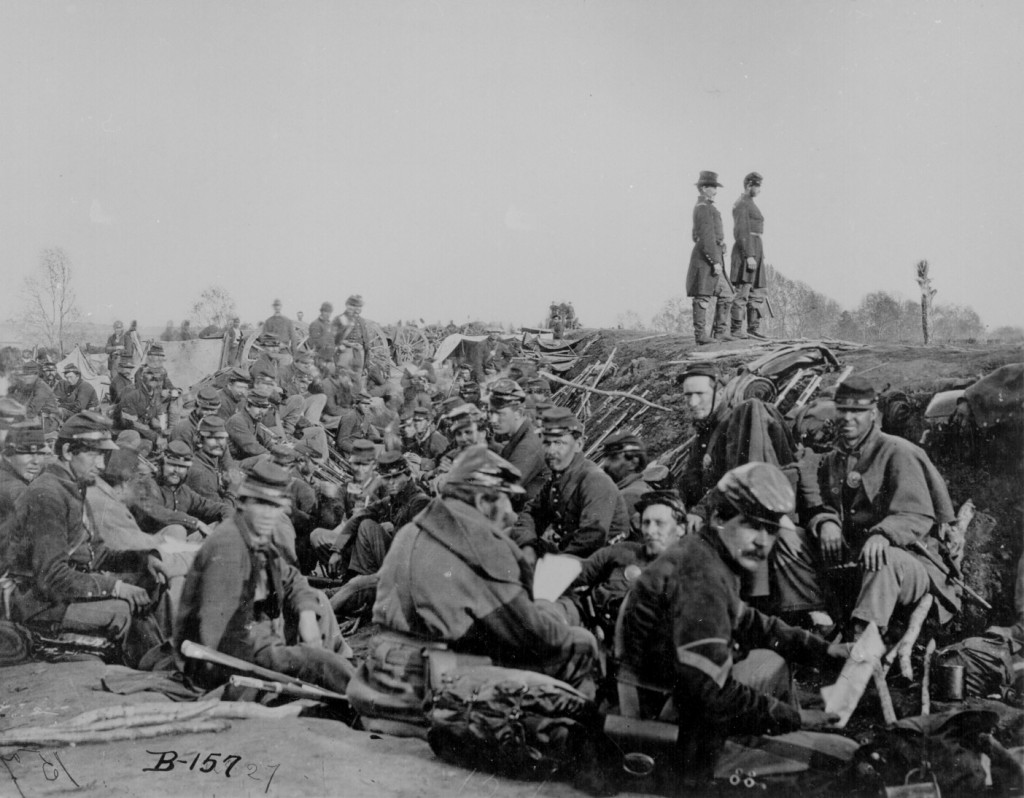
‘I dream’d a stockade’ is a more ‘composed’ poem, using Whitman’s familiar listing techniques, which intends to turn the suffering of the Civil War at an angle to reflect the inner conflicts that the Iraq mission quickly created in US society itself. With the inevitable reports of civilian casualties, I had little to add to Whitman’s accounts of comforting the wounded from the opposing sides of the Civil conflict to ensure a powerful contemporary resonance.

CIVIL115-1024x798
Soldiers in the trenches before battle, Petersburg, Va., 1865.

‘The President’ is drawn from Whitman’s many observations of Lincoln. He first set eyes on him in 1861 and, as with the White House material, while I was putting the sequence together, the passage of time had already imbued his original admiration with the bitterest of ironies. Of course, after the poems were completed, by January 2009 and the inauguration of Obama, time had ironically turned once more and some have since read this part of the sequence as ‘about’ the new US President.

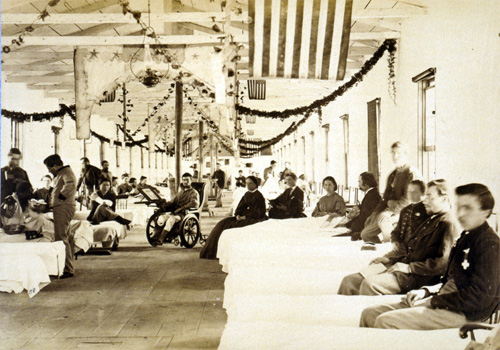
With ‘To the Mother of one fallen’, the narrator is back at the bedside of an individual dying man whose ravings and sense of undeserved blame, of a corruption in the/his “system”, is intended to reflect warfare’s inevitable brutalisation of even the best of individuals, the results of which even now continue to be uncovered years after the world conjured its first surprised shock at events in Abu Ghraib. (click to see Whitman’s original letter of May 1865: Here )


More than it comes to

seven poems from the American War

ii. The White House

Tonight, I walk out to take a look at the President’s House.

Tonight, the white portico, the brilliant gas-light shining,

The palace-like pediment, the tall round columns, spotless as snow.

Tonight, a tender and soft moonlight flooding the pale marble,

A light that gives rise to peculiar & faint & languishing shades,

That are not shadows, for no such thing as shadow resides at this address.

On this night, a soft transparent haze under the thin moon-lace,

Where it falls amongst the bright and plentiful clusters of gas-lights,

That have been set at intervals around the façade & the columns.

Tonight, I see everything white, a marbly pure white and dazzling,

And even more so, the softest white of the White House of future poems,

And of dramas and dreams here, under the high, the copious moon.

Tonight, the pure and gorgeous front in trees under the night-lights,

The leafless silence and the trunks and myriad angles of branches.

Tonight, I see a White House of the land, a White House of the night,

And of beauty and of silence and sentries at the tall gate,

Sentries pacing in their blue overcoats, stopping me not at all,

But eyeing with their sharp sentries’ eyes whichever way I go.

For Whitman on The White House: Click Here

white-house-north-face-c1853

iv.  I staid a long time to-night

I staid a long time to-night at his difficult bed-side.

It was a young Baltimorean, grown to the age of nineteen.

He had seen so much and yet had slept such a very little,

His right leg amputated an hour since, he was feeble,

So he slept hardly at all, the morphine costing more than it comes to.

And this is what I must do, I sit still while he holds my hand,

And he puts it to his face most affectionately.

And this young, handsome, tanned Baltimorean spoke to me:

“My dear friend, I am certain you do not know who I am,

Although your sitting here so quietly and so patiently,

It means much, yet you must understand who it is you help,

Since what I stand for & fight for I know you believe to be wrong”.

I staid a long time at the bed-side of the young Baltimorean.

I staid certainly because death had mark’d him and he was quite alone.

I might say I loved him, sometimes kiss’d him and he did me.

And of his age was his brother, a brave and religious man,

His brother and officer of rank, a man I sat beside in a close, adjoining ward.

And I staid because in the same battle they were wounded alike,

The one strong Unionist, the other Secesh, and each fought well,

Each for their respective sides, brave & obedient & mark’d for the end.

Now they lay close, following the separation of many years,

Of their strongly held beliefs, the separations these had imposed on them,

And both fought well and each died in his particular cause.

whitman_05_lg
Ward in Armory Square Hospital, during Civil War, Washington, D.C.

For Whitman on the two brothers: Click Here

On Translating Rilke’s ‘Duino Elegies’

Idris Parry writes in the current PN Review (March/April 2015) comparing Rilke’s Duino Elegies with the Sonnets to Orpheus. The poet always spoke of the sonnets as subsidiary to the elegies, but Parry argues that while the elegies “talk about” the poet’s task, the sonnets perform it. I’d agree and, in translating both in the last 20 years or so, I have come to prefer the vivid enactments of the sonnets. Parry explores Rilke’s response to Rodin in Paris in 1902. What struck Rilke was Rodin’s “dark patience which makes him [as creative artist] almost anonymous”. What the young poet learned was to pursue an “unhurried and uncommitted exposure to experience” (Parry’s words). This is opposed to impatience which is (contra-Keats) an irritable reaching after clarity: “making up your mind before the event instead of letting the event shape your mind” (Parry again).

Rilke’s “praise” is just this acceptance and faithful utterance and is predicated on the truth of an underlying unity of existence. The poet is obliged to speak of this unity but can only use the language of division, a language deluded by the conviction of finality. Parry epigrammatically concludes: “We punctuate to retain our sanity, but we should not come to believe the punctuation”. The PN Review piece ends by looking at sonnet II, 18 and asks, if Rilke’s own German is a poor translation (using shabby tools) of an ultimate reality, how can translators hope to do it justice in bringing it over into English?

Reading Parry this week, reminded me of my own thoughts, not long after having translated Duino Elegies (https://martyncrucefix.com/publications/translations/duino-elegies/). They were originally published in Magma Magazine; I hope they are worth making public again:

My own grappling with the issue of what can be lost and gained in translation began over 10 years ago when London’s Blue Nose Poetry group staged an evening to celebrate Rilke’s work. This was partly in response to a Poetry Review survey of the original 1994 New Generation Poets, several of whom declared his work to have been influential. Though a name I was familiar with, I have to confess I hadn’t gotten far through my Penguin Selected. Perhaps on account of my ignorance, I was to contribute only by reading aloud from the Elegies. The Ninth was chosen but as I practised, I found myself stumbling, losing the thread and, frankly, I hardly knew what it was I was reading:

Here is the time for the Tellable, here is its home.

Speak and proclaim. More than ever

Things we can live with are falling away, for that

Which is oustingly taking their place is an imageless act.

Act under crusts, that will readily split as soon

As the doing within outgrows them and takes a new outline.

This is Leishman’s translation of the Ninth Elegy and I supposed the obscurity was part of the point – that it must signal hitherto unplumbed depths of profundity. My view on this remains equivocal, but I believe a proportion of the difficulty is obfuscation and the impression of slippery ‘mysticism’ it generates has misleadingly become part of Rilke’s appeal for many readers. For me, the bottom line was I could not read this aloud with the kind of conviction that I demanded. I tried a couple of other easily available translations – Stephen Cohn’s and David Young’s – but still was not happy with the sound these poems made in my mouth.

images
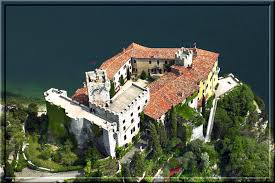
Castle Duino

Within a month I had produced a ‘version’ of my own. By version, I meant a close-ish translation, but I had taken considerable liberties with the more difficult passages and inserted what I thought Rilke might have meant or what I wanted him to mean. At the time this seemed to me a risky strategy compelled by necessity, though there is nowadays a good deal more debate about the role and value of versioning. My own position is that I prefer a genuine attempt to translate the original into a contemporary target language. I see the point of versions – but it is hardly ever what I am seeking as a reader. Nobody imagines translation is easy; but only a fool anticipates a perfect rendering. We expect translators to work in good faith and that their work will read sufficiently well in the target language not to distract us with the stale sweat of their strenuous wrestling with the original. Nor should they cover the difficulties of translation by delivering obscurities that defensively resist comprehension.

It was coming across my first attempt a couple of years later that set me systematically picking my way through the million pitfalls of the Elegies. Take for instance Rilke’s opening lines, the great cry at the start of the sequence. Rilke writes “Wer, wenn ich schriee, hörte mich denn aus der Engel / Ordnungen?” Not too much of a problem you might think, but William Gass, in his book, Reading Rilke: Reflections on the Problems of Translation (Basic Books, 1999), considers no fewer than 15 versions of these 11 words. Most – though by no means all – accept Rilke’s opening word – “Who” – and most, though not all, take over Rilke’s relative clause “if I cried”. But is he merely crying or crying out? And beyond this point of relative agreement lie terrible dragons of disagreement, especially over the word “Ordnungen”. How are the angels deployed? Are they in “angelic orders”, “amid the host of the angels”, “among the hierarchy of angels”, “the order of the angels”, “among the angels’ hierarchies”, “among the ranked Angels”, “through the Angel Orders” or even (Gass gives his own version) “among the Dominions of Angels”? In such company, my own version, “Who, if I cried out, would hear me among the ranks / of the angels?” runs the risk of a watery plainness but it has the advantages of clarity, echoes the rhythm, syntax and line break of the original closely, and (remembering my first concern was for oral performance) the line has a satisfying aural quality. I hear in the first phrases high, thin vowels that contrast the second half’s weightier, assonantal ‘a’ sounds: the cry of alienated humanity contrasts the solid, seemingly impregnable powers that lie beyond our reach.

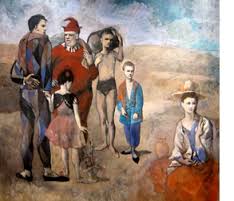
But the best-equipped translator faces especially difficult problems in Rilke. In the Fifth Elegy, for example, the poem describes some acrobats. This is a combined portrait of a troupe Rilke knew while living in Paris and a painting by Picasso (La Famille des Saltimbanques, 1905) with which Rilke lived in the summer of 1915 in the house of the dedicatee of this Elegy, Frau Hertha Koenig. This is, formally, one of the freer of the Elegies, its lines extending and contracting to reflect the energy of the tumblers.

imgres
Picasso’s ‘La Famille des Saltimbanques’ (1905)

But in the Picasso painting the figures are arranged in an almost imperceptible D-shape and Rilke writes:  “Und kaum dort, / aufrecht, da und gezeigt: des Dastehns / großer Anfangsbuchstab . . .” In my version: “And barely discernible, / yet up-standing and unmistakeably on display, / the capital D of Destiny . . .” The original word “Dastehns” (something like “standing there”) reflects the visual pun and it would be a great loss not to bring this into the English. Stephen Mitchell uses the word “Duration”; Young’s looser version loses the pun with “existence . . . presence”. On this occasion, I found myself following Stephen Cohn and opting for “Destiny” (more usually the translation of “Schicksal”) which I felt conveyed Rilke’s sense of how these individuals are driven to perform by forces external to them, rather than by a more truthful inner compulsion.

imgres

Another critical decision arises in the Tenth Elegy with its tribe of people who enjoy a closer, more authentic relationship with death and grief than Rilke perceived in contemporary Western culture. He uses the word “Klage” and an English equivalent has to be found that works as the name of a young woman, her tribe, her ancestors and her country. Like the sound of the original, the word also has to reflect the harshness of the grief felt, while at the same time suggesting a dignity in such powerful emotions. For Rilke, the role of this personification and her whole tribe is certainly heroic. Most previous translators have opted for the word “Lament” but I felt this suggested a rather affected, almost poetic attitude – precisely the kind of posturing that Rilke asks us to avoid in our confrontation with these difficult aspects of life. I chose the word “Keening” to convey the genuine edginess of feeling (aurally again I liked the harsh initial K and the word’s trailing, wailing fall). This word seemed to me to work perfectly as personal and tribal name and geographical location: “gently she guides him through the vast / Keening landscape, shows him temple columns, / ruins of castles from which the Keening princes / once wisely governed”.

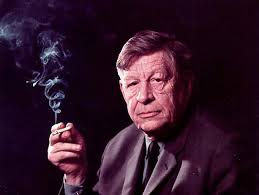
One thing I have learned is that translators take sustenance from their chosen originals. This is not just in the obvious way of extending their range, but also that they feed on a familiar. They find in their subject an answering voice, a confirmation of something already present within themselves. I experienced this in a surprising way. Rilke’s influence on Auden was particularly evident in the late 1930s. The sonnet sequence In Time of War refers directly to him and Mendelson’s Later Auden (Farrar, Straus and Giroux, 1999) argues that ‘In Memory of W. B. Yeats’ concludes with “an explicit echo” of Rilke’s Ninth Elegy and its famous injunction to “praise this world to the angel”.

imgres

Auden asks Yeats’ spirit to “Teach the free man how to praise”. Interestingly, Auden has never been a strong influence for me, yet the elegy to Yeats is a poem I have always loved. In fact, five or six years before I got to know Rilke, I remember modelling an elegy of my own on Auden’s – from the choice of title, the formal variety of its sections, to a finale in which I too celebrated one who “loved the world, craved its taste”, elevating him to a teacher of praise: “Listen, let me make this master speak: / Laughter, love, the senses are profound. / Drink deep, remember, Jeremy Round” (‘In Memory of Jeremy Round’). Reading Mendelson’s book has convinced me that I had been responding not merely to Auden but also – unknowingly – to Rilke. It turns out I have been finding a sympathetic familiar in him for longer than I had imagined.

Writing poems to the tune of Sibelius (circa 1990)

This has been a very busy week and blogging time has been hard to find. At work we are gathering and discussing plans for the 3000-word A2 essays on T S Eliot, West and Fitzgerald – don’t let anyone give you any nonsense about how easy A levels are! But the other evening was spent at Holy Trinity in Sloane Square (not a usual haunt of mine) at my daughter’s school concert. The final piece they played was Sibelius’ Karelia Suite and it set me thinking about a poetic project I embarked on in the 1980s.

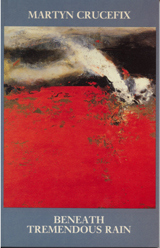
It’s with awed admiration as well as a good deal hilarity that I remember setting out to write a sequence of poems – one each month – based on the 7 symphonies of Sibelius. In my wholly untutored way, what I found in the music was a fluidity of movement – one section seamlessly linked to the next – that I wanted to echo in verse. I failed badly, I think, and perhaps only more recently have I found ways to achieve something like it. I also wanted a diaristic quality to the poems, recording and responding to events as they occurred in my own life through the period set. Perhaps not so sadly, I’m not sure I could now lay my hands on the full typescript. Only one of the ‘symphonies’ survived to be published in my first collection Beneath Tremendous Rain (1990): see https://martyncrucefix.wordpress.com/wp-admin/post.php?post=68&action=edit

btr-cover

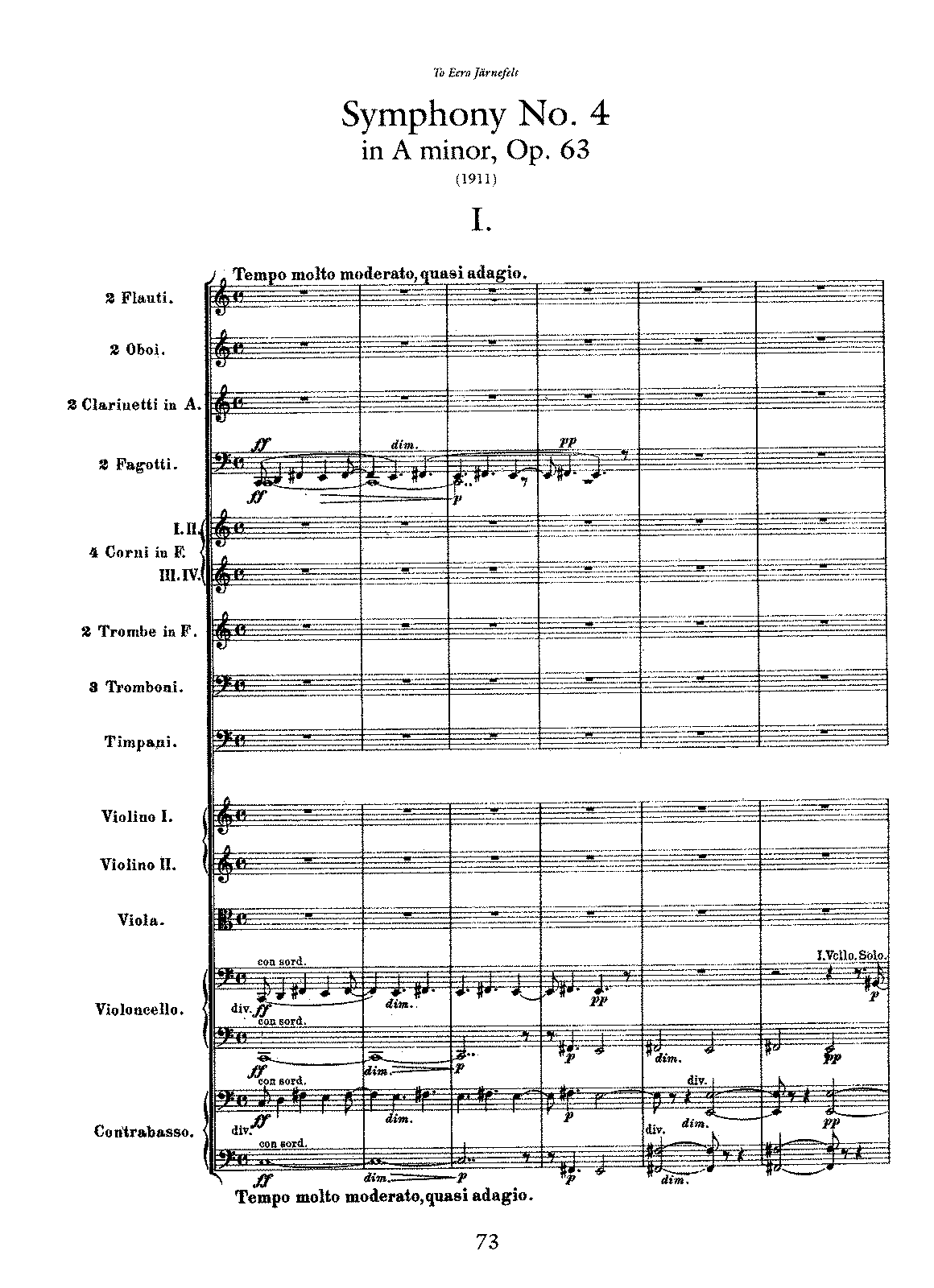
It was the extraordinary Fourth Symphony (1911):  http://en.wikipedia.org/wiki/Symphony_No._4_(Sibelius)

Listen to it here: 

And here’s Wikipedia on it: Many commentators have heard in the symphony evidence of struggle or despair. Harold Truscott writes, “This work … is full of a foreboding which is probably the unconscious result of … the sensing of an atmosphere which was to explode in 1914 into a world war.” Sibelius also had recently endured terrors in his personal life: in 1908, in Berlin, he had a cancerous tumour removed from his throat. Timothy Day writes that “the operation was successful, but he lived for many years in constant fear of the tumour recurring, and from 1908 to 1913 the shadow of death lay over his life.” Other critics have heard bleakness in the work: one early Finnish critic, Elmer Diktonius, dubbed the work the Barkbröd symphony, referring to the famine in the previous century during which starving Scandinavians had had to eat bark bread to survive.

2b400e06440de71fa24ce91517d87a561ffb25a6

The seven months were (I think) through the winter; so the fourth was probably linked with December and my partner had had a scare with a breast lump. The music’s dark, stark, exploratory qualities all found correlatives in what was going on around me. References to Betjeman and Larkin in section 1, allude to that BBC Monitor programme (https://www.youtube.com/watch?v=BTdDS05x6d0) which I had been using to teach Larkin’s The Whitsun Weddings around the same time. My partner’s grandparents had also recently died. In section 3, the reference to Ainola is to Sibelius’s beloved retreat beside Lake Tuusula in Finland, named after his wife: http://en.wikipedia.org/wiki/Ainola

So – in lieu of anything more fresh, here’s the 4 part poem – with all its faults – long, thin and astringent . . .

Barkbrod

1.

It is the rawness

of my own throat

that forebodes.

So little else has

been altered, yet

everything’s realigned

as if from without.

My peasant-thoughts

mix bitter bark

with dull flour

to eke life out.

They recognise

the violent-sudden

clarification

of their strength,

its cropped boundary.

Breath shortens.

Sweet Betjeman,

black-eyed Larkin:

these two dead men

alive on a screen

to discuss poetry,

the intimacies

of panic and pain.

And a malignancy

in the songbird’s

weak throat severs

the transference

from hand to hand.

The grandparents

of my young bride

pass along these

pallid, frost-blue

roses on bone-china.

Whether shelved or

to hand, they chill me:

their stark reaction

to our modish

wisdom, our shallow

unquestionable

optimism . . .

Take up the bitterness

of this bread,

brush every crumb

towards the sink

and douse your plate.

Baptise and scour

each blue-ice rose.

2.

The first peculiarities of this year’s

snowlight break up the bedroom glass.

There’s a crackle of news in the kitchen.

All is well. Yet the difficulty is this:

to convey information which is true,

while avoiding fear which is unnecessary,

yet maintain hope which is essential.

In a mess of sensual pleasure and death

it rose obediently to hand as I soaped

my breasts, in my left, quite low down.

Unmistakable. How long have I nursed

this featureless clod over my heart?

Water gems and drains from my feet.

The radio chuckles at my trembling.

3.

What remains to be done

but retire into some

Ainola of the mind,

glimpsed down a track

of snow, pine, a refuge

still as a blown flute.

I wake at night thirsty

and from the window,

across tangled gardens,

a yellow light burns,

sketching the grid

of dull-bricked walls.

But I sink to sleep

still unresolved

whether this midnight’s

oil is some illness,

vocation, compassion,

or the absentmindedness

we fearfully deny.

Your thinned hair now

combed neatly back

behind fleshy ears.

And how is the throat?

Nervy artist’s hands

flutter about the chin.

Those pale eyes of yours

gaze hard at my room,

at this ceiling’s rose

across my shoulders.

I guess you’re slow to be

moved, yet once begun

a relentless nature

like time or weather.

It’s a gaze to outlast

any physique: this slip

of a thing, your strength.

4.

This clod in my breast

wears a tight

black neckerchief.


It must be evil

that I think of it

as a child . . .


Dark nights running

I dream of him

rapping gently


against the door

 – our bedroom door –

till I answer.

So she speaks

as we journey south

out of London,

through the suburbs’

assembled brambled

tussocky plots,

bright washing

collecting the sun

as it drops

long shadows

to meet us both

on the allotments.

Vitality sickens me

with fierce envy

and the why? why?

Across the carriage

a brash student

absently rearranges

his big thighs.

Two powerful hands

murder the fruit

he cleanly eats.

I let him in

over the threshold.

These backs of houses

so ordinary

that reassurance

ought to flow

from them. Yet

we both move here

as an illustration,

a shadow,

quite regardless:

of how a charming boy

will come to the door

from without,

how you bend to him

just as he’s hulking

through transformation

into a killer

in our bedroom

who bolts you upright,

over and over,

screaming unrestrained

beside me.