‘I Hear the Unheard Heart’: the Poems of Rose Auslander

What follows is a review – originally published by Poetry London earlier last year – of Rose Auslander’s poetry. As I say below, her work has been surprisingly little noticed in the UK literary world. The situation is rather different in her own culture where she is well-known and much admired as this entry on the germanlit.org website makes clear. She is an unusual and original poet well worth seeking out and you can find this book on the Arc website.

While I Am Drawing Breath is a revised version of Mother Tongue, Anthony Vivis and Jean Boase-Beier’s 1995 volume of  Rose Auslander’s poems. That book strode across an effectively empty stage and the same is surprisingly true of this new version: there are really no rival translations into English currently available (she’s not even included in Michael Hoffman’s Twentieth-Century German Poems (Faber, 2005)). This sadly reflects Auslander’s reception through the first half of last century. Only at the age of 64 did her work begin to be noticed, though until her death, 23 years later, she received prizes and accolades, mostly in Germany. Her relative neglect is surprising given her extraordinary personal story, surviving the worst horrors of the twentieth century, and the vivid, gem-like minimalism of her work.
mc_While_I_am_Drawing_Breath_cvr_pbk_6_May_14

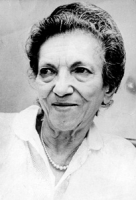
The life is important. Rose Scherzer was born into a German-speaking Jewish family in 1901, growing up in Czernowitz (then part of Austria-Hungary). The First World War forced the family to Vienna, then Budapest, but later Auslander returned to study at Czernowitz University. She made the acquaintance of philosopher, Constantin Brunner, but in 1921 emigrated to America with Ignaz Auslander (to whom she was briefly married). She returned to Czernowitz only to find it occupied by the Nazi’s in 1941. She lived in the Jewish ghetto, surviving against the odds, writing poetry and meeting Paul Antschel (later Paul Celan). The town was liberated by the Russians but while Auslander tried to arrange for the family to emigrate to America, her mother died, precipitating her daughter’s breakdown. She did not write in her native tongue again for another 10 years.

While I Am Drawing Breath contains work written in these later years (it’s a shame the arrangement of this book gives no sense of chronological development). By then the friendship with Celan had been revived and Auslander abandoned the rhyme schemes and metrical patterning of earlier work for a more free, highly compressed, yet colloquial style, rejecting all punctuation. It is this style that German readers recognise as her distinctive achievement and is the culmination of the tragic restlessness of her life as well as her fascination with language. It was hard to speak of what she had witnessed:


From the eyes

of sated man-eaters

smoke surges

and my words

have blackened

in it

(‘Smoke’)

Paul Celan

Eloquence, volubility, the pleasures of the text risked disrespect for the victims of war. Auslander’s words are never far from mourning:

I call out

my willow-word

to the sunken souls

the squall has

driven down

to the pebbles

(‘Willow Word’)

Czernowitz, probably 1941

Yet she seldom speaks directly of pogroms and persecution. ‘And Shut Out Their Love’ does record the advent of “guns and jagged banners”, but Auslander’s imagery is more mythic, more folk tale: hunger, blood, fire, snow, ashes, smoke. Faced with the “unbearable reality” of the Czernowitz ghetto, the options were to despair or dwell in “dreamwords” and there are strong escapist longings as in ‘In Those Years’ with its snow-bound world into which come seductive rumours of  a “country / where the lemons flower” (an allusion to Goethe’s 1795 lyric ‘Mignon’). ‘Immer Atlantis’ (translated here as ‘Atlantis Always Glittering’) re-creates that mythic city:

there are always celebrations in swaying gardens

well-proportioned people

always holy and delicate
tn_auslander

But her friendship with Brunner suggests Auslander was pursuing something more complex than the sort of consolatory fantasy this suggests. He warned against the dangers of superstition, or pseudo-contemplation: unfounded beliefs creating a distortion of true insight. Auslander regards language itself as a ‘third way’, a melding of self and world, without the risks of denying reality. In ‘Mother Tongue’, movement along the “word path” leads to transformation “from myself into myself / from moment to moment”. In ‘Words’, language is neither slave to reality nor liberated self-expression, but “my source”. In ‘The Net’ the goal is “one word / which says it all” as Brunner suggested, an ascent to a plane of spiritual (geistig) contemplation encompassing love, art, and philosophy.

That Auslander’s work pursues such goals without tumbling into arid abstraction and commentary is one of the pleasures of these tough, unselfpitying poems. She is open to “dull brown” as well as “radiant blue” (‘As If’) and her obsession “for binding words” is an attempt “to reach even further / into this known / unknowable / world” (‘Sentences’). What she hears through the cuckoo, rainbow, snow, camomile, mills, carnivals, islands and trees is a spiritual realm, given validity not by any organised religion but by the suffering she has endured:

I hear the unheard heart

in my breathing

like a clock made of air

then the melody of the music-box

is alive in my temples

its tones muted like the moving spheres

(‘The Unheard Heart’)
Jan Wagner: the Poet as Tea-Bag and as Chameleon

imgres

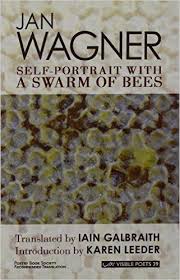
Iain Galbraith’s really skillful translations of the German poet Jan Wagner have just won the Popescu European Poetry Prize. Wagner’s poems brew a formal brilliance (Karen Leeder remarks in her Introduction to Arc’s Self-Portrait with a Swarm of Bees, that “virtuoso” is the compliment most often applied to him) with an intense concentration on really existing things. In the German tradition, of course, such a meticulous and sensual evocation of things (‘die Dinge’) harks back to Rilke’s advice in the ninth of his Duino Elegies (1922):


Perhaps we are here to say: house,

bridge, fountain, gate, jug, fruit tree, window –

at most: column, tower . . .


Rilke’s cycle of poems arrives at this conclusion (“Praise this world to the angel, not some / inexpressible other”) not at all in the spirit of defeat but in a celebratory mood because it is only through honest interaction with the world that we define and refine our sense of ourselves. Equally and dialectically, through, our emotional and artistic responses to the world of things we are able to translate the inanimate and unconscious world into something more significant, lasting, spiritualized.


And these things, which live by passing away,

acknowledge your praise of them, as they vanish,

they look to us to deliver them, we, the most

fleeting of all. They long for us to change them,

utterly, in our invisible hearts – oh, endlessly,

to be within us – whoever, at last, we may be.


It is just this ebb and flow between self and other, each re-defining the other, each growing in response to the other, that Wagner seems intent on recording. But it’s not always an easy process as the poem ‘Mushrooms’ suggests. The narrator must listen for the snap of a twisted stem as if cracking a safe, “hoping for the right combination”. But when the right balance (I’m afraid it has to be this dull-seeming word) is achieved between active exploration and passive sensitivity then two worlds are miraculously joined.

10117b9d-d35e-424f-8aba-89d57234ee71-vision

But we need not get too po-faced about the process. Wagner suggests a tea-bag might help us envisage it. In two haikus, he wryly evokes both facets of such communion in a religious visionary and a rope-dangling, Indiana Jones-type adventurer:


1

draped only in a

sackcloth mantle. the little

hermit in his cave


2

a single thread leads

to the upper world. we shall

give him five minutes

Jan Wagner
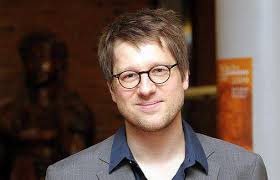
Jan Wagner

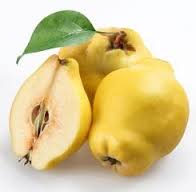
Wagner reflects the often rebarbative nature of the process partly through typographical choices, abandoning capital letters throughout (a far more disturbing move in German, of course, which capitalizes all nouns, all things). It’s also reflected in the choice of fruit in ‘Quince Jelly’. Knobbly and ugly, even ripe quinces are inedible when raw, astringent and tough. Wagner acknowledges the “tough and foreign” quality of the fruit and its taste which makes “our palates baulk”. Yet the human work invested in the transformative domestic process yields great rewards:


quinces, jellied, lined up in bellied jars on

shelves and set aside for the darkness, stored for

harsher days, a cellar of days, in which they

shone, are still shining.

imgres

Such meticulous observation and sensual details held in the form of verse ensure Wagner’s things are always more than themselves and here the quince jelly is a poem, much like Wordsworth’s daffodils, an accumulation of “wealth” to flash upon “that inward eye” in days and years to come.

Wagner also chooses a ‘Chameleon’ to represent the poet. Describing the creature’s curved tail as a “pastoral staff” raises the spiritual stakes with a wonderfully light touch. The animal’s perceptive acuity is likewise explored with its tongue like a “telescope”, snapping up the “constellation” of a dragonfly. Its eye is a “fortress” yet contains a flickering pupil; an indefinable restlessness is suggested by its shed skin like “an outpost or long-discarded theory”. Most tellingly, the chameleon’s independently moving eyes enable Wagner to suggest the balance of both centrifugal and centripetal thrusts of the true perception: the animal gazes “simultaneously at the sky / and the ground, keeping his distance / from both”.

imgres

The title poem of Arc’s selection (taken from 5 collections between 2001-2014) is another portrait of the poet. ‘Self-Portrait with a Swarm of Bees’ has the narrator wearing an ever-accumulating beard of swarming bees. The risks and dangers are part of the point but the poem focuses on the accumulating “weight and spread”, suggesting the swarm extends and adds to the narrator in some intrinsic way. Indeed, he becomes “the stone-still centre of song”. In the next quatrain, the passive singer is converted into an “ancient knight” arming for battle, yet he does not either advance or retreat:


just stands there gleaming, with barely a hint

of wind behind the lustre, lingering breath,

and only vanishing becomes distinct.


This teasing last line (“und wirklich sichtbar erst mit dem verschwinden”) is best understood again through Rilke. Auden affectionately ribbed Rilke as a poet whom “die Dinge bless, / The Santa Claus of loneliness” but it is in the challenge to self confronted through honest encounters with the world of things that we re-make and re-define our sense of self. Here is the idea expressed in Rilke’s Sonnet to Orpheus, 2, 13:


To the used up – to all Nature’s musty and mute,

its brimming storehouse, its inexpressible sum –

joyously add yourself and the account’s done.

 (All translations from Rilke here taken from my translations of  ‘Duino Elegies’ and ‘Sonnets to Orpheus’)

bee-beard

Hear Galbraith read ‘December 1914’ below:


War on the Poor God Bless the Palaces: Volker Braun’s ‘Rubble Flora’ reviewed

imgres

Volker Braun’s Rubble Flora (tr. David Constantine and Karen Leeder (Seagull Books, 2014)) was one of the commended texts in this year’s Popescu Translation Prize. I was surprised it did not make it to the final shortlist. His passionate and abrasive voice (in these excellent translations) is certainly worth sampling as a model for poetry engaging with political change. Here he is writing from the GDR after the Berlin Wall has come down.

Property

That’s me still here. My country’s going West.

WAR ON THE POOR GOD BLESS THE PALACES.

I helped it out the door with all the rest.

What paltry charms it has it gives away.

After winter comes the summer of excess.

And I can go to hell is what they say.

I don’t know the meaning of my text.

What I never owned, they’ve taken even this.

What I never lived, I know I’ll always miss.

It was hope that came before this fall.

My property, you flog from stall to stall.

When will I say mine again and mean of all.

(tr. Karen Leeder)

Braun was born in Dresden in 1939. His childhood was spent in the post-war ruins of that city which he describes as a locus of re-birth as much as devastation: “Fiery lupins and / Widows in the ruins set up house and home” (‘Rubble Flora’). His early work reflects the pioneering spirit of the foundation of the GDR, though a poem like ‘Demand’, with its vigour and idealism expressed through bold exclamatory phrases, already runs counter to the growing repressiveness of the state. Braun consistently relishes the provisional:

Don’t come to us with it all sewn up. We need work in progress.

Out with the venison roast – in with the knife and the forest.

Here experiment is king, not fixed routine.

His urge to move forward becomes an unhealed wound. ‘At Dawn’, in its entirety reads: “Every step I’ve still to take / tears me apart”.

A_012

There is also a strong streak of sensuality throughout Braun’s work and eros is celebrated in contrast to what ‘Afternoon’ terms “the pre-printed schedules / And fully synchronised reports” that constituted ‘really existing socialism’. Karen Leeder’s Introduction discusses Braun’s ability to “manoeuver within the [Communist} system” and, feeling the pressures of history unfolding, ‘Fief’ expresses something of a stoical attitude: “I’ll hold out here, find succour in the East”. By the 1980s, Braun’s hopes for a fitting fief were also taking the form of Rimbaudian flights of fancy as here in the landscape of ‘Innermost Africa’:

Under the soft tamarisks

Into the tropical rains that wash

The slogans off, the dry memoranda

Also around this time, Braun alludes to Goethe’s idyllic images of lemon trees in bloom from his 1795 lyric ‘Mignon’. Here they flash past in a fragmentary manner, alongside other literary references, prose passages, graffiti-like capitalised phrases and seeming non-sequiturs. Both Leeder and Constantine deal brilliantly with the challenge such a style presents to its translators. In this way, Braun’s work betrays the pressures of speaking in a repressive regime and so it is interesting that the more lucid lyrics of The Zig-Zag Bridge (1988) pre-empt the fall of the Berlin Wall and the possibility of speaking out.

berlin20wall20freedom

But Braun’s visions of the fulfilled life were hardly advanced with the advent of capitalism. The changes of 1989 are repeatedly portrayed as a false dawn. The magnificent sequence, ‘West Shore’, roars with hopes and disappointments in the embrace of the new ideology:

the abrupt come-down

Of the roped-together

From the north face of the Eager

Into nothing—

As above, ‘Property’ sees the old GDR “going West” yet the poet is bewildered even by his own “text” as everything gets “flog[ged] from stall to stall”. Braun pursues intertextual effects with Eliot-like allusions as in ‘O Chicago! O Contradiction’ where he draws on Brecht’s 1927 poem ‘Vom armen B.B.’ (see my earlier blog and translation of this poem) and Hamlet to evoke “the chilly byways / Of market economics”. But after 1989, such allusions are more frequently to brand names and consumer goods as here in the mock-jaunty optimism of “Socialism’s out the door, but here comes Johnnie Walker”.

johnnie-walker-logo-old

Neither communism nor capitalism nurtures the life Braun seeks and he turns his vitriol on the new world where “King Customer” rules (‘Common Ownership’), where the “supercontinent [. . . ] COCA COLA” rises from the ocean (‘West Shore’) and fashion shows in ‘Lagerfeld’ show capitalism making people “more beautiful but not better”. It’s Helena Christensen who stalks the catwalks of this poem only to arrive at:

the throwaway society

The arena full of the last screams Ideas

Rome’s last era, unseriousness

Now watch the finale ME OR ME

Greetings, barbarians.

If Braun still finds pleasure in the world it is despite political change not because of it. ‘Art’ asks torturedly, rhetorically, “How / Is it possible that things the way they are / Are dancing?” Rubble Flora concludes with work since 2005 and there is more Rilkean “praise [of] the world as it appears” (‘When He Could See Again’) and this affords some relief from the “stifling  / Of [the] ability to be human” (‘Conversation About the Trees in Gezi Park’). One of the “things” still dancing for Braun is the erotic. The loss of desire is the sole subject of ‘My Fear’ and the hope that “some gentle breast might fasten for a while / And quicken my blood” (‘Findings’) offers some counterbalance to the almost deafening, continuing “twitter-storm” (‘Wilderness’) of injustice, greed, poverty and violence in the world generally, more specifically in his own “re-disunited Germany” (‘De Vita Beata’).

This review originally published in Poetry London (March 2015)

On Yves Bonnefoy’s ‘The Tombs of Ravenna’

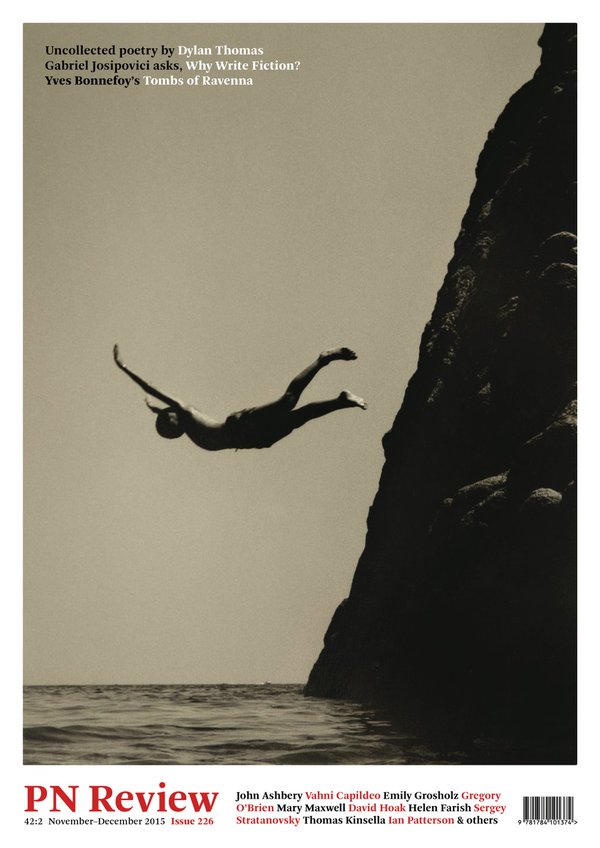
In my last blog I was discussing Keats’ ideas about Negative Capability, provoked by a visit to Keats House and a discussion there about Negative Capability and psychoanalysis. The speakers were Dr Margot Waddell, a child psychotherapist from the Tavistock Clinic, and Dr Toni Griffiths, Trustee of the Keats Foundation. Waddell focused on the acknowledged influence of Keats’ idea on the work of psychoanalyst Wilfred Bion. In the aftermath of such major stimulation, the new issue of PN Review fell through the front door, containing John Naughton’s excellent new translation of Yves Bonnefoy’s 1953 essay, The Tombs of Ravenna. Keats and Bonnefoy melded in my mind and I was reading the latter in terms of the former as follows.

CTnk-FAUYAA5TFU

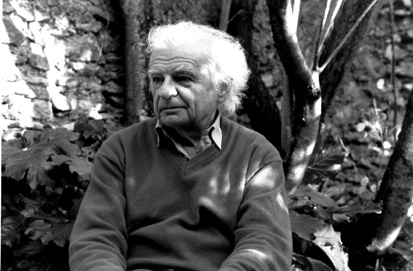
Bonnefoy observes that though many philosophers have discussed death, few have bothered to ponder the places where we traditionally lodge the dead: sepulchers and tombs. The explanation he offers introduces a key term for both his prose and poetry from 1953 to the present day: the concept. The concept, as in conceptual thinking, is a human creation, abstracted from the plentitude, the flood and flux of actual, particular human experience. It is “always a means of escape” into a more fixed abode. The concept denies time and is “a profound rejection of death”. It denies the fact of death as our inevitable fate and constructs an illusory “dwelling place of logic”, a more alluring place of “permanence and identity”. Also, and crucially, the concept is “made of words”. Language is a similar construct, also seeming to promise the same sort of escape into the timeless, the unchanging. All forms of conceptual thinking seem to promise an achievable resolution but, Bonnefoy argues, “what is pondered is no longer the real object”. Instead, we contemplate “a dubious knowledge” though it may soothe our “initial anguish and trivialises that most somber melody with words that mask the reality of death”.

Bonnefoy1

So the concept promises a “strange immortality” but only if we can “forget brutal reality” – which, of course, we can and readily do. One reason is that there are general truths in conceptual thinking and a particular kind of power derived from it. It “allows thinking” of a certain kind; it is linked with “the vast power of words”. But any gain is predicated on a significant loss, the abandonment of the actually existing “world of things”. Conceptual thinking is “systematized”, generalizing, categorizing; it’s in this that its “flight” from the real is found. The only sort of thing that can be held up to counter the concept are specific particularities of human experience: Bonnefoy asks “Is there a concept for footsteps in the night, for a cry, for a stone rolling in the brushwood? For the feeling evoked by an empty house? No [. . . ]”

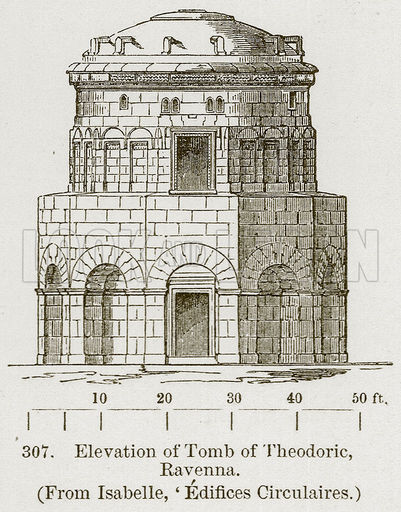
Elevation of Tomb of Theodoric, Ravenna

In his letters, Keats calls this sort of non-particular thinking “preresolved” and he encountered it especially in his friend Charles Dilke: “a man who [. . . ] has made his Mind up about every thing” (303; page numbers in brackets are to John Keats: Selected Letters (Oxford World Classics, newly revised 2002)). Dilke is one of the “stubborn arguers” who never begin on any subject “they have not preresolved upon” (303). In contrast, Keats argues the only means of strengthening one’s intellect and identity “is to make up one’s mind about nothing – to let the mind be a thoroughfare for all thoughts” (303). Keats’ best formulation of this idea arises when several things “dovetailed” in his mind after a frustrating debate with Dilke. The quality that marks out the artist – Shakespeare especially, he says – is Negative Capability. He defines this as consisting of a passive openness to the full range of particular human experience (“uncertainties, Mysteries, doubts”) without any imposition of preconceived notions, preresolved ideas or language: “without any irritable reaching after fact & reason” (41/2). Bonnefoy’s insight is that rather than being an occasional tendency, this reaching after fact and reason (conceptual thinking rather than direct, particular, various experience) is our default status. We pass our days in a delusion of resolution and systematization because if we did not we might fry our brains with the overload. In his last ever letter, Keats laments “the knowledge of contrast, feeling for light and shade, all that information (primitive sense)” as having become a great enemy to his “recovery” from his present state of illness. (369).

Yet the dully pragmatic ought not to be allowed to displace truth: Keats in better health argued this and Bonnefoy does the same in The Tombs of Ravenna. Bonnefoy’s essay for several paragraphs plays devil’s advocate, expecting to find “horror” in visiting the tombs of the dead, yet admitting that he felt “nothing but lightheartedness”. Initially, he locates this sense of up-lift in the ornamentation of the tombs, the “braids and interlacing [. . .] bows and foliage”. The essay playfully misleads its reader, suggesting that this effect of the ornamentation must be because it is comparable to the “concept” in denying the fact of death. Bonnefoy says he believed (note the past tense here) that ornamentation also abstracted towards the universal from the real, that the ornamentation presented “a closed world”, a world of “harmony”. Hence, just as the concept “seeks to establish truth without death [. . .] It seemed to me that ornamentation sought to build a dwelling place for us without death, and to have death no longer be here”. Visiting Ravenna, Bonnefoy felt lighthearted beside the tombs because its skilled and delicate ornamentation persuaded him of a world of permanence and consoling abstraction (beyond death, other than death).

20901_7280829414ee63113ca44b

But the essay now turns dramatically to deny the validity of such consoling sophistry. It’s invalid because Bonnefoy had failed to understand “the power of stone”. His insight is that it is not the ornamentation which is at the root of his lightheartedness but the very material out of which it has been carved. Stone is “unfathomable, and this abyss of plentitude, this night covered by an eternal light, is for [Bonnefoy] the exemplary form of the real”. What he means is that stone deflects the grasp of conceptual thought; conceptual thought distances itself from stone as it does from death. Stone is or represents “the difficult real” and it is or represents the “dawn of the sensory world”. Stone’s resistance, its very hardness, gestures towards the fullness and particularity of human experience (what Keats calls a “Life of Sensations”), towards “everything that has flesh, heartbeat, immanence”. The stone leads us towards the “truth tenaciously present beneath the truth of the concept”. And it is the latter ‘truth’ that Bonnefoy declares he must “tenaciously contest”.

The battle in Bonnefoy’s thought between the sensory world and the concept reflects Existentialism’s concern for existence rather than essence. His faith in a world resistant to and actually prior to the draining, withering forces of the intellect, his resistance to post-modernism, are reasons why he strikes many as such an inspiring figure. He says: “This world here exists, of that I am certain [. . .] It is simply with us. In what can be felt and sensed”. In The Tombs of Ravenna he names this underlying truth, not as existence, but “presence”. It is “what is perceived by the senses” and it was a dimly stirring awareness of this truth that constituted the “lightheartedness” he felt before the tombs of Ravenna. Through an encounter with the stone from which the tombs are constructed, the resistance of both life and death to the abstracting processes of conceptual thought was made clear and the pleasure induced arose from his closer approach to a fundamental truth.

Just as for Keats, such ideas have consequences for art and poetry. For Bonnefoy, poetry seeks to represent the real particular truths of human experience, to convey what it can of the “dawn of the sensory world”, as opposed to succumbing to the lure of conceptual thinking, even that conceptual thinking inherent in the very fabric of language itself. This specific paradox is not explored very far in The Tombs of Ravenna in which he confines himself to declaring that we require “another language than that of the concept” to articulate such truths. He concludes poetry’s only concern is “for that spot in the world I can sense” and because it must, as far as possible, resist the lure of conceptual truths (truth without death) it follows that “poetry and journey are of the same substance, the same blood”.

SONY DSC

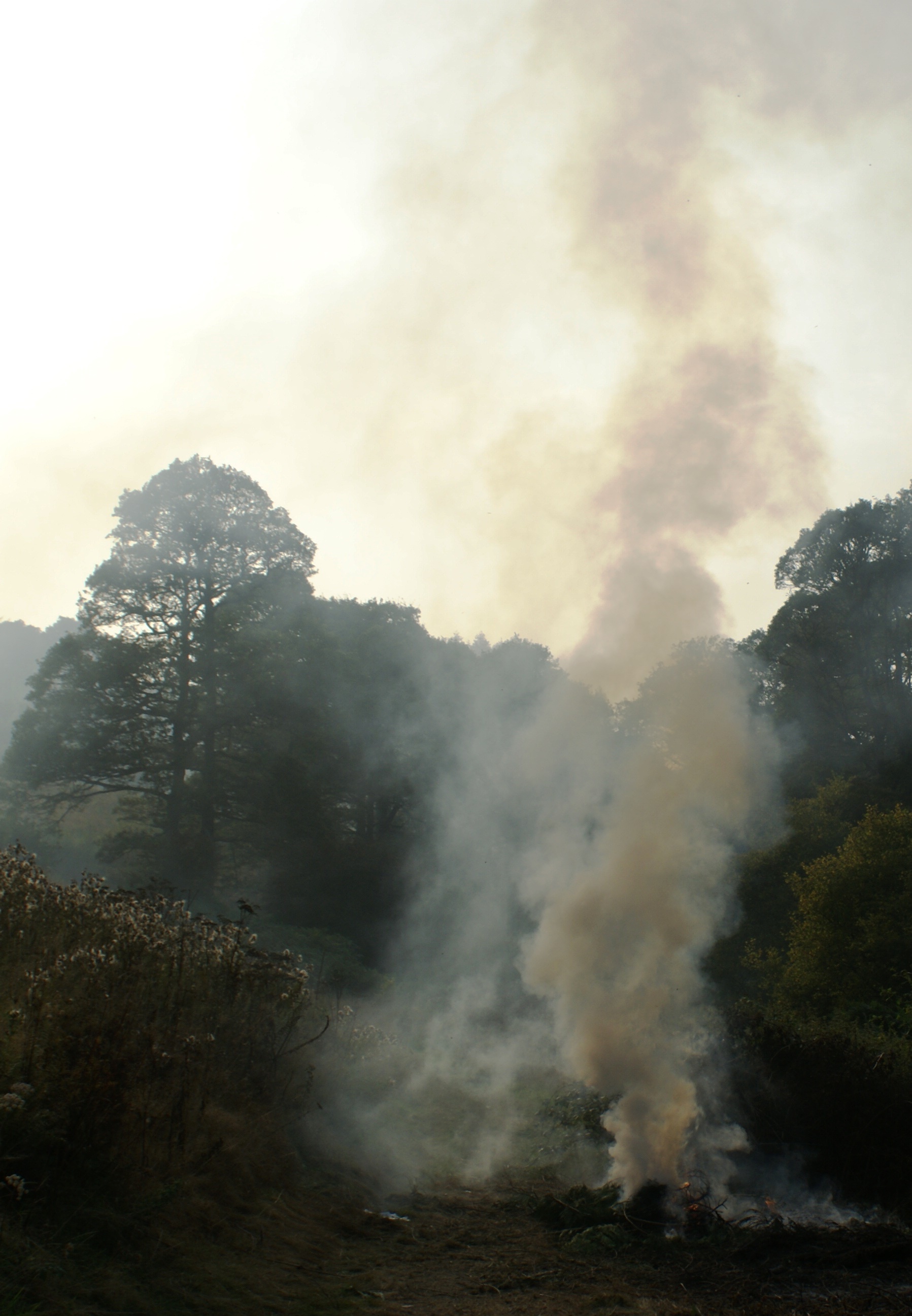
What such a poem might look like is suggested in those few moments when Bonnefoy himself resorts to “minute particulars”. On one such occasion, drawing from his own life, he tells us of “the cry of a bird I heard as a child, at the crest of a kind of cliff. I don’t know where that valley is anymore, or why or when I was there. The light is the light of dawn or of evening, it doesn’t matter. Through the brushwood runs the pungent smoke of a fire. The bird sang. Rather I should say, to be exact, it spoke, raucous on its misty height, for a moment of perfect solitude”.

Or as Keats put it in 1819, having listened to a nightingale singing on Hampstead Heath:

Adieu! adieu! thy plaintive anthem fades

Past the near meadows, over the still stream,

Up the hill-side; and now ’tis buried deep

In the next valley-glades:

Was it a vision, or a waking dream?

Fled is that music:—Do I wake or sleep?

730052102

A new translation of Brecht’s ‘Of poor B.B.’

Having posted last week about Brecht’s poem ‘Of poor B.B.’ it felt pretty inevitable that I should have a go at translating it myself. Though it can’t always be the case, most translations are like this – undertaken as a tribute to the original poet and poem, a public declaration that this fascinated me, an attempt to really work out how the text functions and achieves its ends. Disseminating the text to the target language’s reading public is also an aspect of this tribute paid.

249y242_mpt_no22015_coverfront

David Constantine, writing in Modern Poetry in Translation (No. 2 2015) about Derek Mahon’s recently published translations (Echo’s Grove (Gallery Press, 2013)) considers the “liberties” Mahon tends to take with such work to produce “almost” original poems in English while allowing their sources to remain audible. Mahon does this by working from “cribs of one kind or another” and Constantine suggests that this has become a very common practice. Indeed, “Mahon practices the belief that you don’t actually need to know well or even at all the languages you translate out of; even – a possible sub-text – that knowing them might be a disadvantage” (MPT, No. pp.111-113). As someone who was remarkably poor at languages at school, this is something I have found myself saying in recent years since going public with a few translations (for example, see post on translating Rilke). I like to think of the source poem as a series of gestures – like a dance performed by the original author – so the translator must try to achieve similar effects but with his/her own body (of language). A crib will guide me to the main movements, even to much of the details, but tone, emotional colour, shades of irony are harder to trans-late and cannot merely be copied. This gesture made by this body, if repeated precisely by my body, will more likely look awkward, or meaningless, or comic when it was intended as serious. I have to achieve the end (as far as I see it and understand its intended impact – you have to rely on the translator for that certainly) by using the resources at my disposal, my physique, my body of language.

egon-schiele4-300x199

In practice, what this means is that once the basic outline and incontrovertible details are in place in a translation, I have to close the source book and try to pump some life into the target text. Ted Hughes imagined a poem without true life in it as limping (Poetry in the Making, p.15); a translation without true life in it is only going to be a halting performance you’d rather not witness, worrying about whether such a gesture was intended or not, ironic or not, you fear the whole is not coherent, a mere series of movements, not a dance at all. I’ve always liked Charles Tomlinson’s formulation of the translation task: in introducing his now 50-year-old translations of Fyodor Tyutchev, he claimed ‘The aim of these translations has been to preserve not the metre, but the movement of each poem – its flight, or track through the mind’ (Versions from Fyodor Tyutchev 1803-1873 (Oxford: OUP, 1960)).

Happily, ‘Of poor B.B.’ is not a text of great complexity. Brecht is usually concerned to communicate clearly and he says in ‘On Rhymeless Verse with Irregular Rhythms’ (Poems 1913-1956, pp. 463-471)) “what was needed was the tone of direct and spontaneous speech”. He mostly wanted to use “everyday speech” and “sobriety of expression” which he felt was “by no means irreconcilable with poetry”. So Brecht is not exactly Rilke or Mallarme for the translator. Looking at Hofmann and Hamburger’s translations (as referred to in last week’s post), most of Brecht’s dance is clearly conveyed with little variation between the two versions. Though Brecht’s lines are pretty irregular he does keep a ballad-like rhyme in lines 2 and 4 of each quatrain and I miss this in Hofmann’s version. Hoffman also (to my mind) overelaborates in a few of his English choices. “Sterbsakrament” (Hamburger has “last sacrament”) becomes “every sacramental perquisite”. Hofmann’s narrator looks at the two women in quatrain 4 “insouciantly” and his pine trees “micturate” (when the point of the contrast with the city asks for something more downright like Hamburger’s “piss”). I don’t think lexical adventures here are quite right for this poem. Also in quatrain 7, Hofmann’s antennae “underwire” the Atlantic. Brecht is referring to transatlantic cables but the allusion to supportive bras seems distracting and gives mankind’s efforts too much power. I read the point as suggesting our technology is dwarfed by the ocean in the remarkable image that our best advances merely entertain (“unterhalten”) or “amuse” (Hamburger) the Atlantic.

Egon_Schiele_060

Regarding the hat donned by the narrator to fit in with city folk, Hofmann’s “top hat” seems a little too up-market, while Hamburger’s “hard hat” conjures up a building site. I have gone for “bowler hat” of a clerk or business man. The sound of the birds in quatrain 6 is important. Hofmann’s “bawl” catches the anti-pastoral tone of the poem but Hamburger is forced by the needs of form to go for “twitter and cheep” (to rhyme with “sleep”). There is also some ambiguity in the final stanza where the narrator hopes to keep his “Virginia” alight in the coming earthquakes of social disruption. The German suggests the cigar will hopefully not go out (“nicht ausgeher”) and the cause: “lassen durch Bitterkeit”. Hofmann renders this as hoping the cigar will not “go bitter on me” whereas Hamburger (again in part for the sake of form) hopes to keep the cigar alight “embittered or no”. Hofmann’s phrase feels too narrowly concerned with the smoking experience but Hamburger’s rather awkward phrase does successfully suggest what I see in the final lines – the narrator’s hope (if not altogether sincerely) that he himself may avoid becoming bitter. My solution tries to hold both literal and transferred metaphorical senses of the bitter cigar equally within the line. I’ve come to think of this as important to the poem as the narrator is blessed with a degree of self awareness as much as he is cursed with a cynical, dismissive hedonism.

images

Of poor B.B.

I, Bertolt Brecht, came from the black forests.
My mother bore me into the city
while I was in her womb. And till my dying day
the chill of the woods will lie there inside me.

In the asphalt city I’m at home. From the beginning
supplied with every last sacrament:
with newspapers – and tobacco – and with brandy.
To the end, suspicious, lazy, content.

I’m amicable with the people I meet. I don
a bowler hat in just the way they do.
I say: they’re animals with a quite peculiar smell.
And I say: so what – I am too.

In the morning, in my vacant rocking chairs,
I sometimes set for myself a couple of women
and carelessly gaze at them and converse with them:
in me you have one here you can’t rely on.

When night falls, I gather men around me;
we address each other as ‘gentlemen’.
They swing their feet onto my table tops.
They say: things will improve for us. I don’t ask when.

Come morning, in dawn’s grey light, pine trees piss
and their vermin, the birds, start to shriek.
At that hour, in the city, I drain a glass and fling
my cigar butt away and, troubled, fall asleep.

We have settled, a superficial crew,
in houses that to our minds will never fall derelict
(we’ve built tower blocks over Manhattan Island
and spindly antennae that tickle the Atlantic).

What will last of cities is what blows through them: wind!
Houses make happy eaters: wolfed in a moment.
We know it – we are temporary
and after us comes nothing really worthy of comment.

In the earthquakes that are to come, I hope I’ll keep
my Virginia lit, not doused, grown bitter.
I, Bertolt Brecht, carried off to the asphalt cities
long ago from the black forests inside my mother.

tr. Martyn Crucefix

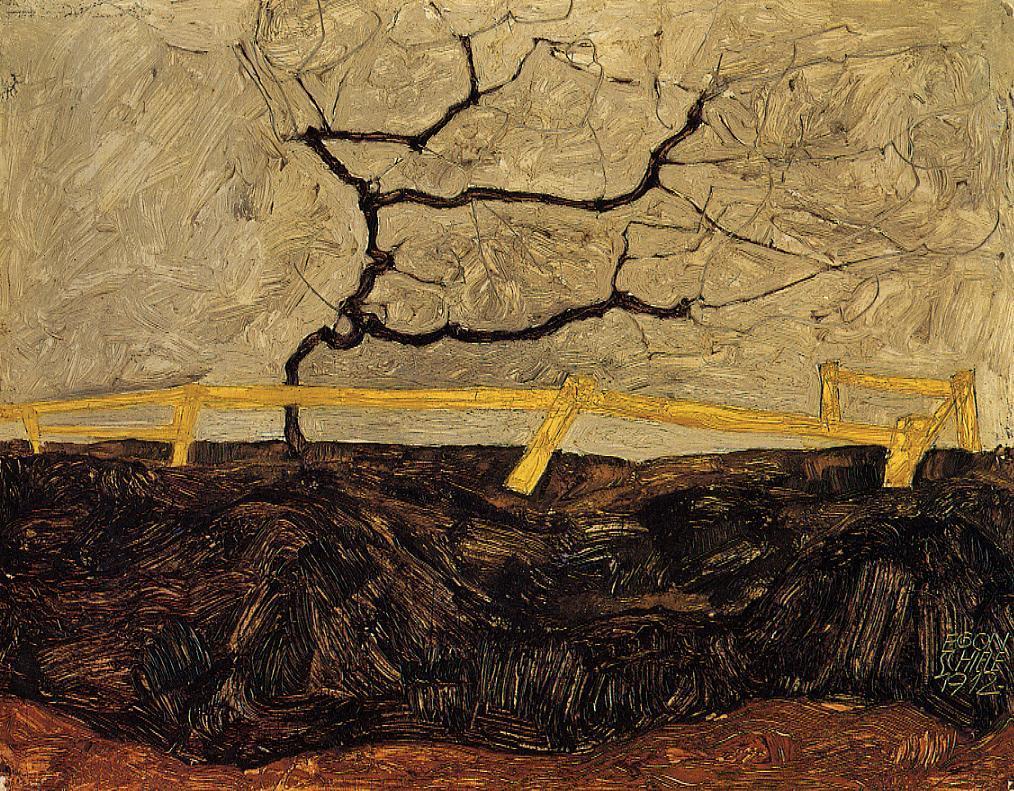
bare-tree-behind-a-fence-1912

Things of the Earth: Joaquin Giannuzzi’s Poems

Here’s a game: search the little haystack that follows for the several needle-reasons why I wanted to blog something this week about the poetry of Joaquin Giannuzzi.

In a review in Poetry Wales, Nia Davies praises Giannuzzi’s “singular, destabilising and pessimistic, but humane take on the world” and, in part, she links this to the turbulent political landscape of Argentina through the twentieth century. This is poetry “always aware of the presence of violence behind a wall” though Giannuzzi is probably a less explicitly political writer than this suggests. The violence he sees in the world is a harshness even beyond politics and his humanity lies in a hard-won sympathy that we all inhabit a world in which human endeavour has become something of a “mockery”, death the only certainty.

imgres

Giannuzzi was born in 1924 to a family of Italian immigrants in Argentina. He chose journalism as a career and his observational gifts are obvious, poems often focusing on individual objects or people. He is a poet of disengagement, the objective gaze (as much as that is ever possible) though what is revealed is in part the poet’s response to what he sees, in part an ironic detachment from it. These are points made by Richard Gwyn (who also links him with Samuel Beckett) in a selection of his brilliant translations of Giannuzzi’s work from 1977 on, A Complicated Mammal (CB Editions, 2012). It was reading with Gwyn in Wales a few weeks ago that first brought Giannuzzi’s work to my notice.

The title ‘Garbage at daybreak’ says a lot about Giannuzzi’s approach. There is the distancing effect of reporting that a “sociological interest” brings the narrator to examine the garbage bins though what he learns is that “things don’t die but are murdered”. His listing of items begins obviously enough but takes a more troubling turn with “a doll’s torso, with a dark stain” (that turbulent twentieth century again?) into a more metaphysical malaise suggested by the ambiguous phrase “rosy meadow death” (una especie de muerte en un campo rosado). The poem ends with a discomforting “comfort”, realising that “not even this excrement / is obliged to abandon the planet”. Why do we harbor such crap and ugliness? But what if we compelled it to be ejected, might we be left even more empty-handed?

images

It was while completing an interview about my own writing (to appear in Acumen Poetry Magazine later this year) that I found myself saying “I’d be happy to accept I am committed to the empirical. As a child, though very quiet and reserved, I don’t remember living in any kind of fantasy world: I would be observing things going on around me. I used to find objects when I was a kid – coloured stones, shells, lost coins – and I remember the pleasure when my mother would say, ‘You’re always on the look-out. You never miss anything’. To this day, I like poems that focus on small things and, in effect, make arguments for the ways in which they communicate the bigger issues”. From this, it’s obvious why I respond to Giannuzzi’s work and ‘Coffee and apples’ is a good example of what Gwyn calls Giannuzzi’s concern for “thingitude” or las cosas de la tierra (things of the earth). He locates the poem in an afternoon in June, a moment of uncharacteristic ease since the world “has become hospitable”, though this is immediately cast into doubt with the simile comparing this to “a truce”, a mere postponement of hostilities. But for a while the things of this world give off an allure of “radiance” and “steam” while the narrator sprawls on his “backside”. But the truce is indeed short-lived as the poem ends with a bomb blast, police arriving, all delivered in a tone suggestive of the commonplace.

imgres

Giannuzzi’s narrators are often solitary and self-critical. In another moment of what seems like ease, one turns accusingly on himself: “I sold out my youth”. The waste of time, sucking on the “ribs of aesthetics” has yielded nothing, not even (look how quickly the Absurdist gulf opens in the course of these three lines): “a personal system of language / I mean an act of writing / That my contemporaries might interpret sufficiently badly” (‘Self-criticism). What Giannuzzi does do is see things and poetry (argues the poem ‘Poetics’) “is what is being seen”.

There are rare moments of tenderness. In being aware of his daughter dressing for a night out, another narrator reaches for religious hyperbole as she evokes a second Eden, “a second perfection of nature”. What propels her to this is a “faith” he cannot share or even imagine and as she puts finishing touches to the creation of herself – especially memorable in the clicking of her bracelets closing – he sees her leave the room “and everything that I am not goes with her”. This treads a fine line between self-pity and an excoriating nihilism that risks wiping out his daughter’s youthful optimism: but it is a line Giannuzzi treads so skillfully, leaving the reader with the strange pleasures of a hard-headed modernist perception alongside a touching evocation of paternal love. Brilliant – especially so when it floated into my mind lying awake waiting for my just-eighteen-year-old daughter turning the lock downstairs, back from late-night clubbing in Shoreditch. She’s back safe and sound; that big world out there.

2058

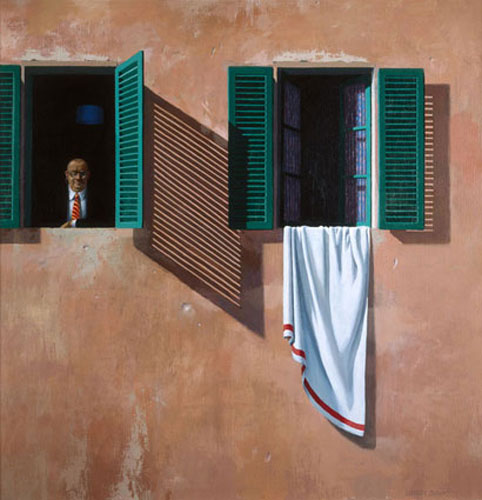
Gwyn notes that Giannuzzi’s narrators are often caught gazing through a window at the big world out there. In one case, what is observed is only an “indistinct appearance”, fragments, colours, a suffering, “tangled up in itself”. The poem imagines a million other similar windows, each framing its “failed theologian” and for Giannuzzi the adjective makes the point here; divinity is only present “by gloomy delegation”, though even that is probably too strongly put. Desertion, perhaps would be better, more truthful. Giannuzzi’s is not the best of all possible worlds, it is the “only possible” and ‘Theologian at the window’ ends by suggesting the human animal has little choice but to suffer “a corresponding headache”.

These are a great poems, short, modern, dark lyrics (that would knock most of the 2015 Forward shortlists into a cocked hat) by a poet compared by Jessica Sequeira in the Glasgow Review of Books to Montale, Auden, Pavese and T. S. Eliot. Richard Gwyn has done a magnificent job of translating him for us – the least we can do is go and buy it.

Joaquin Giannuzzi is interviewed (in Spanish) and reads his poem ‘La desaparición’:

Bathing in the Olt #7

Introduction to the abecedary form of this sequence: click here.

Previous installments:  #1 / #2 and #3 / #4 / #5 / #6

Bathing in the Olt

7.

The past behind its drawn curtains

the train to Slatina

their loved ones emerged from the glittering water

*

their property stood on a hill of red soil, a few hundred feet distant but facing the river Olt

they were making for the other bank

they had no thought for the tragedy that had already

*

this was Violetta now in love with Virgil

though she would have been happy to be rescued

to irresistible longing

to swim where the currents allowed

two nights of absence . . . to her that was evidence enough

urgent matters would force delay

*

Violetta seemed to have handled the short separation well enough

Violetta suddenly disappearing from sight

Violetta took her revenge

Violetta was a powerful swimmer

Virgil Trancu and his family lived close by in the neighbouring village

*

waiting for the scandal to break at any moment

waiting for what he felt sure would happen

warm sand under leafy osiers in the breath of a day drawing to a close

was meant simply to entice him

was out of danger

was wrong and she suddenly burst into tears

*

yawning, carefully, she un-

zipped her “maillot” and lay indifferently, beautiful and seductive

arcade-card-french-woman-in-head-scarf-and-wooly-bathing-suit-sitting-on-beach-leaning-on-one-arm-1920s

Bathing in the Olt #6

Introduction to the abecedary form of this sequence: click here.

Previous installments: #1 / #2 and #3 / #4 / #5

Bathing in the Olt

6.

Reasons for panic at Milcoveni as the heated imagination of his girlfriend

she bent briefly forward as if liable to fall

she had a simple plan

she had made it the night before and she would carry it out

she seemed to be begging for help and attention which she did not truly need

*

skirting the strongest currents of the river, he managed to reach the other bank

slave to her own impressionable nature

so hard to counter. Cautiously, he tried to spare her any pain

so it was that the two couples often met

*

soil erosion caused by the powerful and frequent flooding of the waters of the

mighty Olt

some high society woman in Craiova

something of a coward and Benedict a mere beginner

struck out decisively for the side where the current seemed most powerful

*

taken aback and then enchanted by this new music

the “maillots” were brought out and Violetta’s was especially fine

*

the delay seemed to make sense no longer

the fear lovers experience when the one they love is not beside them

the grace and elegance of the two girls contrasted sharply with the ravines and the

river bed, hollowed out by the destructive fury

*

the material evidence . . . He found the two “maillots”

mvalea-oltului3

(Next installment posted tomorrow)

Bathing in the Olt #5

Introduction to the abecedary form of this sequence: click here.

Previous installments: #1 / #2 and #3 / #4

Bathing in the Olt

5.

Near the bank the river was quiet

neither love nor life in the old, white house in Milcoveni

*

no direct path so they had to make a detour to reach the water

no inkling that anything was amiss

no trace of Benedict

not at all hard to convince. And he surrendered

not taken in by his gesture; it merely fuelled her suspicions

*

nothing seemed to threaten their happiness

now they had lost almost everything

*

on the opposite bank something strange was happening

one solitary gesture: one of renunciation

perfectly covering her body it emphasized her beautiful figure

pretending fatigue and weakness

quickly went under without trace

The_Olt_river

(Next installment posted tomorrow)

Bathing in the Olt #2 and #3

Introduction to the abecedary form of this sequence: click here.

Previous installment: #1

Bathing in the Olt

2.

Dawning on Benedict

*

deeply

delightful entertainment during the long, hot summer days, bathing in the Olt

*

did not shout

did not threaten, did not say a word

drowning in the whirlpool of the Olt

.

3.

Elegant, young, attractive

even Benedict seemed to have lost his confidence

forests of osiers, of dense, hollow willow trees and huge sand bars that gave the impression of tremendous disturbance in the landscape

for her these were dreadful moments

*

given the opportunity to sneak back she swiftly dressed herself

*

going to bed that night they abandoned themselves to passionate embraces

he would not be able to keep the promise he had made when he’d left his girlfriend, Violetta

her eternal threat never left his mind

her misfortune was not something Violetta thought greatly about

hidden under the shaggy willow trees on the fine, dry sand, beneath the melancholy rays of twilight

his athletic body and complete absence of hair

his body found where the current had brought it to the river bank

his was unexpected

5836008337_970273f706_b

(Next installment posted tomorrow)