Everything Burning: Review of Maitreyabandhu’s ‘Yarn’

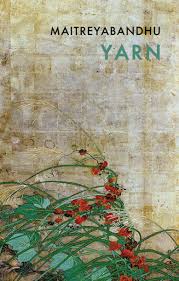
I love to follow the development of a poet’s work. This is often imaged as the finding of a voice but is really a process in which the poet brings into focus what centrally concerns them and sheds what is extraneous. A recognisable voice may be a secondary consequence of this but it is achieved through technical advances and deep thought about poetic predecessors and possible role models. Maitreyabandhu’s second collection, Yarn (Bloodaxe, 2015) is fascinating from this perspective.
images

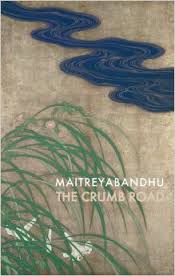
Born Ian Johnson in Warwickshire, Maitreyabandhu was ordained into the Triratna Buddhist Order in 1990. I once started a review of James Harpur’s  Angels and Harvesters (Anvil, 2012) by saying that I wanted contemporary poetry to address spiritual matters, so I was obviously excited to get hold of Maitreyabandhu’s first book, The Crumb Road, when it appeared in 2013. Given my rather narrow line of expectation, I suppose was a bit disappointed. But the book is full of vivid colloquial detail, many poems about childhood and a moving account of a homoerotic relationship between two young boys which ends with the death of one of them. The crumb road of the title is the Hansel and Gretel trail back to the past rather than a trail of stations towards spiritual enlightenment, though ‘Visitation’ is an awed encounter with something like that: “I saw you, in the mess of things, / [. . .] as a slant of grey”. The book was a PBS Recommendation, rightly praised for its melancholy modesty, quiet expression, its alert and attentive qualities, its models evidently Edward Thomas and Thomas Hardy.
imgres

Yarn develops similar materials. Maitreyabandhu’s poetic technique is even more evident in the range of forms – free verse, rhyme, prose poem, blank verse – employed to great effect. The Warwickshire childhood features again in a section called ‘The yard’ with the father’s wine-making – damson, raison and berry – and his war service, the mother’s involvement in the coach driving business, school, various distant relations. The first book’s portrayal of young love cut tragically short is echoed here in an elegiac sequence to a Buddhist friend, Mahananda. This man’s longer life (his mother’s flight from the Gestapo, his conversion to Buddhism, living in Primrose Hill, his friendships) is touchingly evoked and it is a thoroughly grief-stricken sequence: “what can I conclude on your departure? / that nothing came of it, with everything, / everything undone” (‘Souls’).
url
Ryokan

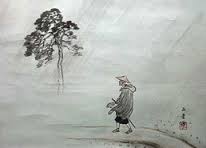
There is a curious echo of this latter phrase in a poem about the Zen Buddhist monk/poet Ryokan for whom the temple bell and old books seem to say “how everything is burning”. Such a sense of the ultimate insignificance of earthly things arises elsewhere in this book and Maitreyabandhu explores such spiritual issues more explicitly here than in The Crumb Road. Though there is often a strong response and pleasure in the natural world, ‘These Days’ suggests “our human calculus precedes / the given world” to negative effect. There is a fearful recognition that what we contribute amounts to no more than “error bred in the bone, the daily rancour / of the mind, / our clever ways to be unkind”. But the erasure of those things that we cling too can be almost as frightening. Nietzsche’s ‘The Parable of the Madman’ (1882) is alluded to, a sponge wiping away the “entire horizon”, yet the consolation (as in the death of a valued friend) can be hard to access: “I strained to see Vajra Guru’s face”. Perhaps the character in ‘The Postulant’ has “closed his eyes on this world” more successfully:


When night fell, the space between two worlds

Was all the shape he made, an empty dark [. . . ]

What he thought to be himself he didn’t know:

His pain was all that stopped the worlds unite.


But inevitably, what is ultimately not graspable in words is hard to write about and Maitreyabandhu’s often chosen model (the rhyming, song-like lyric voice) can lead to a mellifluousness that over-sweetens a poem, especially when trying to evoke more successful intuitions of “the Lotus Born” and the “illumined image” (‘The World of Senses’).
buddha-225x300

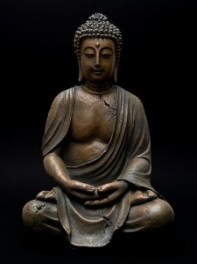
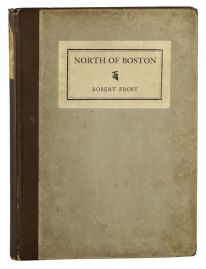
But Yarn contains three long yarns or stories in which the voice of the teller plays at least as much part as the narrative of events. This is what is new and particularly exciting in this book and reveals the influence of Robert Frost (not Edward Thomas who tried this early on with ‘Up in the Wind’ (1914) and then dropped it as not fit for his own purposes). Frost’s eclogues (especially in North of Boston (1914)) manage to convey a bleak, anti-pastoral, godless, modern world of death and often inexplicable suffering. One similarity is that ‘The Cattle Farmer’s Tale’ is spoken by a proprietorial, rather self-satisfied farmer (read Maitreyabandhu on the influence of Frost here). Like Frost, Maitreyabandhu immediately catches character and voice brilliantly. He encounters a mysterious figure: “his not pretending / to be meek or grateful to set me at my ease / and, funny thing, it stopped me in my tracks / so for a moment I stumbled on my words”. This is so like Frost’s ‘Death of the Hired Man’ – the enigmatic visitor, the farmer and his wife, the carefully sketched context, the skilful handling of dialogue in blank verse. Maitreyabandhu adds a few songs too but this is in no way a pastiche but a development of a neglected form for different purposes. The visitor is in fact Buddha and though he talks in cryptic terms, the farmer’s rootedness in the land, his evident pride in his worldly achievements, his bossiness followed by regret in dealing with his wife serve to make the Buddha’s pronouncements palatable in the poem’s world:


There are two thoughts, Dhaniya [. . .]

one leads to suffering, the other to joy.

The first is yoked to yearning like a calf,

a suckling calf that’s yoked unto it’s mother,

the other’s like a shadow that never parts.


So this really is the cattle farmer’s tale – his response to his encounter with a wholly different set of values (he and his wife are in fact deeply impressed by the visitor who stays for a month). The form of the poem allows the reader room to be sceptical in our modern fashion but also to be moved by the insights and wisdom (old fashioned word) being offered.
140905019

The second yarn, ‘The Travellers from Orissa’, is even more ambitious. Bhallika (the narrator) and Tapussa are again farmers, cattle men, who encounter Buddha in their younger days. Bhallika is again a sceptical voice (“I’m not a fool”) but is nevertheless impressed by the Master, who “spoke in a funny way with gaps / between the words as if he’d just been woken [. . .] his smile, / I shan’t forget, was like gazing at the sea”. But this is not an experience he can easily share with others and he resolves to “keep it to myself”. Tapussa’s response is quite different. The poem makes it clear Tapussa’s character inclines him to “yarns” and in the telling they grow “more fantastical each time”. His response to the meeting with Buddha is to cast himself as the rather attention-seeking disciple, who succeeds in becoming something of a cult figure: “his nodding head, how he held his finger up / each time he spoke to emphasise each word”.

But Tapussa dies, as does Bhallika’s wife and the widower lives on quietly, distantly aware of the Master’s growing fame and influence. At last he meets him again: “I said ‘Master’ before I knew I spoke”. Only now does Bhallika share the details of the original meeting with his son. In fact Tapussa had failed to understand, turning “the whole thing upside-down” to make it all “about himself”. What is moving in this yarn is the fact that Bhallika evidently understood the Buddha’s message (“There is a thorn buried / in the heart of man”) but with his commitment to wife and family and land he “walked back into [his] own life and tried to take it up”. Even years later, he understands “I’d betrayed my life” on that day and with that decision.
imgres
Coleridge’s Mariner and Wedding Guest

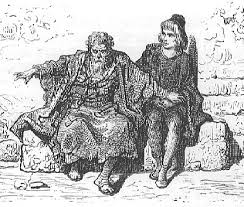
Such false and true followers feature in the third yarn too though the human situation is even more finely drawn and prevents any simplistic response to the questions it raises. In a still sketchy but more Westernised context (Sunday morning church) it is ‘Aaron’s Brother’ who narrates. Like Tapussa, it is Aaron who is the more overtly spiritual figure, famously suffering visitations and visions. But there is again a self-regarding quality in the way he readies himself for church before the mirror, “combing his hair”. The story is told to an unnamed guest – there’s much of Coleridge’s Ancient Mariner here – who is eager to speak to Aaron and not much interested in his brother. But the brother is in fact adopted and has further secrets to disclose of a homoerotic love between himself and Aaron and (he implies) this partly fuels Aaron’s interest in his young male acolytes.

The treatment of these ingredients of a far grander and dramatic tale than Maitreyabandhu wants to develop suggests a powerfully imaginative act by the poet, the kind of thing Keats admired in Shakespeare. In this third yarn in particular, there is no irritable reaching after facts and clarity; it is a poem which explores the perhaps irresolvable tensions  between the spiritual and the sensual life, the spiritual and materialism and fame, the spiritual and our mundane earthly loves and commitments. I’m interested that Maitreyabandhu has not yet attempted such renovations of the Frostian form in a more overtly contemporary setting. His skills with form and his brilliant capture of colloquial speech, his obviously profound engagement with Buddhist thought and his commitment to poetry as a form of expression make him a unique figure in the UK literary landscape and I really look forward to discovering the direction and innovations of his next collection.


images
Maitreyabanhu

How Do You Judge a Poem?

I am half way through the process of judging this year’s Torriano Poetry Competition (https://torrianomeetinghouse.wordpress.com/2014/10/27/torriano-poetry-competition-2015/). I’ve been lucky enough to judge a few such competitions in the last few years and what follows is a compilation of thoughts on the judging process. Though the initial sifting can be a slog, the latter stages are fascinating as poems that set little hooks in you at first reading, gradually become more clear, their internal coherence emerging alongside their skills with language and form. What follows is inevitably a personal take on the business – more so as the process unfolds – but I hope it may cast some light on it for those (of us) tempted to spend hard-earned cash on entering the numerous competitions now running (here are a few . . . http://www.poetrylibrary.org.uk/competitions/).

In the 2003 comedy film Bruce Almighty, Jim Carey plays God and, alongside with more obviously useful powers, he has to respond to the prayers of the world. But people are always praying; he rapidly approaches a kind of madness as voices swim around him, clamouring for attention.  He takes to reading the prayers in the form of e-mails. He tries to answer them individually but is receiving them faster than he can respond. He sets his e-mail account to automatically answer “yes” to all, assuming this will make everybody happy. Of course, it does not.

imgres

A poetry competition judge comparing himself to a character playing God lays himself open to criticism – but I have indeed found the initial phases of judging rather like Jim Carey’s experience. There are so many and such a variety of voices clamouring to be heard and every one of them is heart-felt, recording significant moments in people’s lives. There is a similar sense of responsibility too – the raw nature of much of the writing is impossible to deny. I’d like to set my response mechanism to say yes to everybody, but the judge’s task has to be how to distinguish submissions as poetry.

**

The numbers are always frightening. Many hundreds of poems will be submitted. Perhaps only 10% of these will demand a further reading after the brutal first sifting. Poems face an early red light from most judges because basic elements are not competently done:

  • Competitions are full of pieces where a particular verse form or rhyme pattern tyrannises the sentiment. The writer’s submission to this tyranny becomes clear quickly through the contortions imposed on the language to achieve a rhyme.
  • The writer’s choice of language can be devastating to the life of the poem. It just isn’t right to opt for forms of language or abbreviations that died out early in the nineteenth century.
  • Choice of diction also derails an entry if it is doggedly abstract. Sure, there remains much debate about whether it is the narrow English tradition that insists on things rather than ideas – but poems about Fear, Ignorance, Poverty, Eternity and Love which refuse to dip a toe into anything resembling a real life situation are going to find progress hard.

leaning-stack-of-papers-and-files

  • A fourth error is using language without being fully aware of its likely resonance with a possible reader. A poem called ‘Mother’s Pride’ which turns out not to be aware of the loaf of bread is going to have unanticipated clutter to climb over in the reader’s mind. Louis MacNeice wanted the poet not to be an ivory tower type, but rather “able-bodied, fond of talking, a reader of the newspapers, capable of pity and laughter, informed in economics . . . actively interested in politics”. All a bit Boys Own perhaps, but if this means the poet stays up to date with the way words live then he’s right.

 **

If you are thinking of submitting to a competition, it’s worth recalling Wordsworth’s formulation – familiar though it will feel – that poetry is built from “emotion recollected in tranquillity”. Poems made in the heat of the moment (and not revised and reviewed in the name of not tainting spontaneity) are seldom without their flaws. This is the kind of distinction Rilke also makes when he denies poetry is composed of feelings. Its constituents are rather “experiences” which he clarifies as “memories” though even with these, we “must be able to forget them when they are many and one must have the immense patience to wait until they come again . . . Only when they have turned to blood within us, to glance and gesture, nameless and no longer distinguished from ourselves – only then can it happen that in a most rare hour the first word of a poem arises in their midst and goes forth from them”. On the other hand, such recollection can sometimes create an intellectualised distance that may do harm to a good poem. Who said writing a poem was easy?

louis-macneice

Stephen Spender argues that a poet should try to acquire skill and virtuosity through the study and interpretation of other poetic works in the way Mozart and Beethoven did in playing the music of their predecessors.  Spender suggests translating poetry is the best possible exercise in interpretation. But the really important lessons (Spender says) are those of the eye, the ear, the athletic/poetic muscles. A poet can go a long way without a developed heart, but, he says, can get nowhere at all without these skills. The poet must ask continually of his lines: ‘Do they make the reader see, or hear, or feel, this experience which I am trying to re-create?’

 **

Reaching the final stages, the judge will be focusing more positively and more clearly on the sense, the story, the thought of a poem. Personally, I like poems that focus on small things and, in effect, make arguments for the ways in which they communicate the bigger issues that concern us all. I’m with Thomas Hardy in believing that “he used to notice such things” is one of the greatest of compliments. Edward Thomas’ poem about Spring, ‘But these things also’, likewise echoes this focus on what most people tend to overlook:

The shell of a little snail bleached

In the grass; chip of flint, and mite

Of chalk; and the small birds’ dung

In splashes of purest white . . .

Perhaps one explanation of why the question ‘what is poetry?’ is difficult to answer is because it is an art of the negative, of avoidance. The Daodejing says what is rigid and inflexible is a companion of death; what is flexible is a companion of life. I’d guess there would be general agreement that poetry is an art on the side of life. So poetry must eschew the inflexible; we must avoid the posture. And that’s very hard. In judging a competition one comes across the Wordsworth-posture, the Ginsberg-posture, alongside those of Betjeman, Hughes, Plath, Duffy . . . But we also posture like mad in ‘real life’. We may take up the pose of grief, melancholy, love, liberalism, environmentalism . . . The mark of the absence of posturing is an instability, an openness, an awareness of time (which posture tries to deny) and this is something I look for in a good poem. If a poem strikes an attitude my attention diminishes (even the attitude that wants to show a rejection of attitudinising through the hall of mirrors of ironic distancing). When the poem unearths a pulsing, shifting, live relationship between the self and the other, then I am captivated, recognising something that is both commonly human and uniquely personal.

But having said all this, I’d assure potential competition entrants that anything resembling a rule is there to be broken. Philip Pullman has said, “We don’t need a list of rights and wrongs, tables of dos and don’ts: we need books, time, and silence. Thou shalt not is soon forgotten, but Once upon a time lasts forever.”

114650911_345473c

So any poem in any form can work its magic. It will haunt its reader for days; it will make me change the way I think and feel; make me see the world differently. Ultimately, a poem contributes to who the reader is becoming. That is an exciting prospect for the writer. It is an even more exciting one for the judge who settles down to read.

Teaching Dannie Abse’s ‘Two For Joy’ (2010)

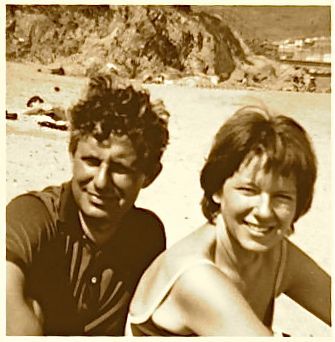
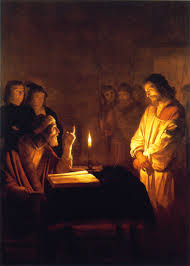
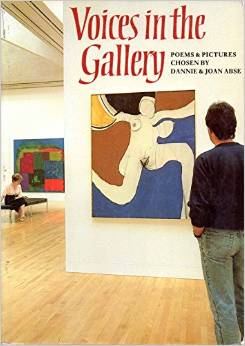
I first became aware of Dannie Abse’s work in 1986 when he and his wife, Joan, were editing Voices in the Gallery,  a sumptuous anthology of poems about paintings for the Tate Gallery. To my astonished delight, they accepted ‘At The National Gallery’, an early poem of mine about Gerrit van Honthorst’s ‘Christ Before the High Priest’ which later appeared in Beneath Tremendous Rain (1990). Our paths continued to cross around the London poetry scene, especially at (usually fraught) Poetry Society Council meetings in the 1990s. A couple of years ago he visited the College where I work and happily discussed his poems with students. His death in September 2014 was such a sad loss.

With the New Year we are again teaching Dannie Abse’s collection Two for Joy (http://www.amazon.co.uk/exec/obidos/ASIN/0091931177/karelsoftw-21). But with the changes to A Levels being hurried in from September 2015, this will be the last time we work on this book (for AS Level Coursework) though it has proved a joy to teach. This is perhaps a surprise given its subject matter.

The book is a compilation of work from several years focused on Abse’s relationship with Joan, his wife (herself a writer, editor and acclaimed art historian). It was published a couple of years after The Presence (http://www.amazon.co.uk/exec/obidos/ASIN/0099531860/karelsoftw-21), a memoir completed in response to Joan’s tragic death in a car accident in 2005. ‘Two for Joy’, of course, alludes to the old country saying, cited on seeing magpies: one for sorrow, two for joy. The poems in the collection evoke both sides of this cryptic saw, from the early joys of young love to the sorrowing widower more than 50 years later.

imgres

In terms of teaching and coursework the book’s focus is so intense, powerful and yet varied that the material always goes down very well with students and enables them to write confidently about ‘the collection’ (one of the Assessment Objectives). We might start with the simplicity of ‘Condensation on a Windowpane’ where the aging narrator inscribes his and his lover’s names on the wet windowpane because he wants to write “something simple as pure water”. Yet even water, further considered, is complicated, “like steam, like ice, like clouds”. This plainness of address and nakedness of emotion is immediately engaging but Abse is really flagging up the collection’s main themes of love and time as, eventually, the words fade, dribbling down the glass: “They weep as they vanish”.

Or what better way (I mean appalling way) to gain students’ attention than this opening quatrain of ‘Lachrymae’:

I crawled from the noise of the upturned car

And the silence in the dark began to grow.

I called out her name again and again

To where neither words nor love could go.

This little sequence of poems like tear drops is set after Joan’s death and delicately re-visits a few scenes from married life, only to end with the narrator walking in solitude beside the Hampstead ponds, “where a lone swan sings / without a sound”.

An earlier poem ‘A Night Out’ records a visit the couple made to the Academy cinema in Oxford Street in the 1950s. As a Welsh Jew in London, courting and marrying a gentile, there are plenty of moments in these poems where the unconventional couple have to confront the narrow-mindedness and bigotry of the 1950s and early 1960s: anti-Semitism in ‘A Marriage’; general moral strictures in ‘Two for Joy’. On the occasion of the cinema visit, Abse’s cultural background is significant as they watch a fictionalised account of the Holocaust: “images of Auschwitz, almost authentic, the human obscenity in close-up” so much that “we forgot the barbed wire / was but a prop [. . . ] those striped victims merely actors”. Afterwards, the couple are stunned by what they have seen, sitting in a “bored espresso bar”. Gathering themselves at last, they return home to a German au pair girl, their own children safely asleep upstairs:

Reassured, together we climbed the stairs,

undressed together, and naked together,

in the dark, in the marital bed, made love.

images

Abse’s technical skill with plain language is on full show in such lines and the class might have debates about how far individual love is shown to counter, compensate, or merely distract from world horrors. In a 1980 essay called ‘Rhyme’ (collected in Dannie Abse: a Sourcebook, ed. Cary Archard: http://www.amazon.co.uk/exec/obidos/ASIN/1854115073/karelsoftw-21) Abse has commented on this poem and presenting students with his observations has often proved to be a moment when sceptics about the deliberateness of a writer’s choices can be converted. He compares ‘A Night Out’ with ‘In Llandough Hospital’ arguing that the charge of emotion from the film was so powerful that he “did not want to make any pretty artifice out of it. I did not want to be lyrical about such a theme. I wanted to be as truthful as possible, to avoid all kinds of artificiality, to say what I felt and to say it plainly. I wanted the verisimilitude of prose”.

The period of the Cold War is briefly evoked at the end of ‘A Scene from Married Life’ in contrast to the “few and brief” cold wars of the couple’s marital rows. Set in Abse’s beloved Ogmore-by-the-Sea in South Glamorgan, after a petty squabble, the narrator metamorphoses into a monster of self-pity and suicidal thoughts. The poem cleverly balances the two perspectives of the over-dramatising, younger self with a more ironic, mature judgment. It’s only at the end with the appearance of Joan on the cliff top (surely an echo Thomas Hardy’s ‘The Voice, with Emma in her ‘sky blue gown’) that the faux-suicide relents:

On the high cliff my wife dressed in blue and all

The best of the world true and desirable.

With surrendering waves I crawled back to the shore.

6110017_ee8699d49a_m

Such humour, often in self-mockery is never far from Abse’s work. The darker side of grief is evoked in the image of blood-stained petals falling in ‘Magnolia’ (“bridal branches slowly violated”) but most powerfully in ‘The Revisit’ which again works the rich seam of two periods of life knotted together. A beautiful lake scene enjoyed together is re-vised by the lonely widower into an apocalyptic vision, with the sun-set now evocative of “Angel wars. Such April bloodshed!” Though there are more consolatory poems in the book, where time the healer is seen to begin its work, ‘The Revisit’ shocks in its blunt confrontation with grief and on this occasion Abse’s use of poetical devices, the abundant skill of the artist, only serves to emphasise the helplessness of the man:

The gradual distance between two stars is night.

Ago, love, we made love till dark was bright.

Now without you dark is darker still and infinite

It would be a shame indeed if, in the mean-spirited, ever-narrowing criteria of the new A Level specifications, a collection such as this one could not continue to find a place. Dannie Abse’s website is at: http://www.dannieabse.com/.

imgresjpeg

Dan O’Brien’s ‘War Reporter’ and new poems

I sometimes think poets are of two kinds: those drawn to dramatic subjects which explicitly dramatise the writer’s concerns and those drawn to more everyday topics which come to reflect the writer’s concerns in the course of the poem. I think of Hardy and Edward Thomas in the latter camp, alongside Heaney’s reference to Katherine Mansfield in North (1975): “I will tell / How the laundry basket squeaked”. In the former camp, for sure, stands the American writer, Dan O’Brien, who is everywhere at the moment.

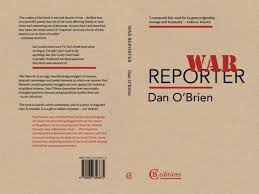
O’Brien sees himself as “a playwright who moonlights as a poet” and he has just won the Troubadour International Poetry prize and been shortlisted for the Evening Standard theatre awards (for his play The Body of an American). He also has poems included in the recent Magma issue discussed in my last blog (https://martyncrucefix.com/2014/12/01/the-launch-of-magma-60-at-lrb-bookshop/). O’Brien’s first book of poems, War Reporter, was published by Charles Boyle’s excellent CB Editions just a year ago and I reviewed it for Poetry London. The book went on to be shortlisted for the Forward First Collection Prize and to win the Fenton Aldeburgh First Collection prize (http://www.thepoetrytrust.org/news/fenton-aldeburgh-first-collection-prize-2013-winner-announced/)

imgres

In discussion at Aldeburgh, O’Brien said War Reporter had been described as “docu-poetry” and that “sounds fair.” The war reporter in the book’s title is Canadian journalist, Paul Watson, and for seven years O’Brien has been in communication with him, “obsessively” recording and working on email conversations, as well as Watson’s recordings from conflict zones around the world. The two poems in Magma are part of new work in progress. ‘The War Reporter Paul Watson Has the Time’ is a good example of the complex webs of guilt and complicity that O’Brien poems weave at their best. The narrator has helped an “interpreter” escape from Kandahar and vengeance is taken against the interpreter’s extended family through an IED: “A bump in the road and / the usual denouement”. The poems never flinch from explicitness about physical harm (“his father, leg like broken / bricks in a bag”) or psychological damage (“a pistol for protection, against all / sense and provocation, only to suck it in his mouth and – blackout”). ‘The War Reporter Paul Watson Knows’ returns in part to the moral quandaries surrounding Watson’s 1994 Pulitzer prize-winning photograph of Staff Sgt. William Cleveland’s body being dragged from the wreck of a Black Hawk and through the streets of Mogadishu. It also alludes to Watson’s more recent eyewitness accounts from the conflict in Syria: “The West engaged / in self-soothing debates while mercenaries / penetrate the borders, tilting the board / in Assad’s favour”.

The Troubadour winning poem likewise derives from the Syrian conflict. Co-judging with Seren’s Amy Wack, Neil Astley said O’Brien submitted three poems, any one of which could have won first prize: “All three were so compelling that I found myself measuring all the other poems I read against them . . . I had no hesitation in putting forward one of them for first prize.” The eventual winner was ‘The War Reporter Paul Watson and the Barrel Bombs’: “basically pieces-of-shit / IEDs of TNT, nitrogen / -rich fertilizer, diesel, anything / likely to kindle after exploding”. This is a more brutal, less multi-dimensional poem than some of O’Brien’s but it possesses an undeniable power to shock: “A foot in a sock / sticks out of the mountain. They tickle her / to see if they should dig”.

O’Brien has just published a second collection of more personal poems with CB Editions: http://www.cbeditions.com/obrien2.html

And here is my review of War Reporter from last year:

Dan O’Brien’s book is big, brave, important and challenging even in its imperfections. It is an act of ventriloquism, hitching a desperate and often horrifying ride on the work and experiences of Canadian war reporter, Paul Watson. Watson took the 1994 Pulitzer prize-winning photograph of Staff Sgt. William Cleveland’s body being dragged from the wreck of a Black Hawk through the streets of Mogadishu. Without doubt, his work tapped something important for America; as well as Watson’s original book, Where War Lives, and these poems, there is also a play and an opera in preparation.

imgres

The poems abound in speaking voices, dominated by Watson himself, but including the “Poet”. Each piece comes at the reader as a slab of blank, largely decasyllabic verse. Voices bleed into one another, partly under the pressure of war zone experiences but also because of an explicit similitude between author and reporter: “You’re like the writer / I’ve always wished I were [. . . ] your constant / returning to an underworld we can’t / look at” (‘The War Reporter Paul Watson Describes the Ghost’). Both men admit to the allure of war and death. Watson’s voice, telling of his Mogadishu photo, confesses “When / you take a picture the camera covers / your face, you shut the rest of the world out” (‘The War Reporter Paul Watson Hears the Voice’). The quieter, more reflective stretches of the sequence explore this idea and allude to Camus’ claim to have solved the mystery of where war lives; the answer is in each of us, in our loneliness and humiliation. Watson’s book pursues this and O’Brien does the same here, taking the idea to justify excursions into both men’s personal and family backgrounds. I’m not sure how effective this is (OK, both are drawn to war’s horror, but neither are warriors) and these episodes do sap the quite astonishing power of the more direct reportage.

The book has Watson recalling scenes from Somalia, Rwanda, the Balkans, Iraq, Afghanistan and Pakistan and it is art’s ability to contemplate such horrors that makes the book an important one. Tony Harrison (who always refers to himself as the man who reads the metre) insists that his formal artistry is vital to bring the poet through the fire he is intent on penetrating. O’Brien chooses to speak of man’s brutality by telling it slant, through another’s voice. Watson witnesses the stoning of a married rapist, but the initial possessive modifier ensures we cannot push the scene into the distance: “our audience cheers an elderly man / lifting a perfect cinder block above / his head, then smashing it down where a gash / jack knifes the rapist’s neck” (‘The War Reporter Paul Watson Attends a Stoning’). War lives in all of us and the collection is a hard read partly because of our reluctance to face this. The rigid consistency of form perhaps also adds some monotony, but I’d agree with Jay Parini, that O’Brien’s success is in finding words “sufficient” for our time, a form of speech adequate to the evil that persists.