The Month of the Drowned Dog: Ted Hughes’ ‘November’

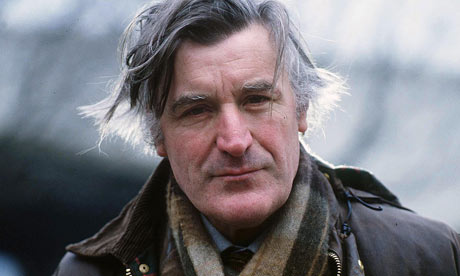
Though November has just transformed itself into December here, still Ted Hughes’ sodden, rain-soaked poem from Lupercal (1960) comes to mind as I watch the TV footage of floods in the North-West of England. I’ve never thought enough attention has been given to the role of the narrator in this poem. It’s one of the selected poems studied on the Cambridge International Examinations’ A-level. Students are asked to discuss one specific poem in detail or two poems from a more thematic perspective. What follows is a loose version of the first type of question (apologies for some loss of formatting in the poem itself). NB. For another close discussion of an early Ted Hughes poem – ‘Meeting’ – click here.

The month of the drowned dog. After long rain the land
Was sodden as the bed of an ancient lake,
Treed with iron and bird less. In the sunk lane
The ditch – a seep silent all summer –

Made brown foam with a big voice: that, and my boots
On the lane’s scrubbed stones, in the gulleyed leaves
Against the hill’s hanging silence;

Hughes opens the poem with a bewildering mix of images of motion and stasis. Flooding must account for the “drowned dog” (more literal than figurative or colloquial here) and the absence of a verb emphasizes the stillness of death, the burden of the month, the real entrance way to winter. The land is so sodden as to have suffered inversion to become “the bed of an ancient lake”. It’s an alien landscape – trees (as so often in Hughes) are now composed of industrial “iron” and inevitably “birdless”. Yet in contrast to such stillness, the ditch water (which in summer is a soothing sibilant “seep silent”) is now possessed of a “big voice” composed of brown foam and beside it, the narrator’s boots scrape along the lane. These two sounds are all that can be arrayed against “the hill’s hanging silence” and the contrasts of movement and stillness, noise and silence compose the greater world of this poem.

Mist silvering the droplets on the bare thorns

Slower than the change of daylight.
In a let of the ditch a tramp was bundled asleep;
Face tucked down into beard, drawn in
Under his hair like a hedgehog’s. I took him for dead,

But his stillness separated from the death
From the rotting grass and the ground. The wind chilled,
And a fresh comfort tightened through him,
Each hand stuffed deeper into the other sleeve.

His ankles, bound with sacking and hairy band,
Rubbed each other, resettling.

It’s this greater world that the narrator fears and the tramp entrusts himself to. To the narrator, the tramp sleeping in a let of the ditch, is comparable to an animal, a “hedgehog”. In the narrator’s world view, this is no compliment and indeed in the next phrase (line 12), he considers the tramp “dead”. To give the narrator credit he perceives his mistake and next sees the tramp’s vitality, though (in a reversal of our preconceptions) it is his “stillness” rather than animation that “separate[s him] from the death” all around. The animation of the “wind” evokes a corresponding movement in the tramp: “a fresh comfort tightened through him, / Each hand stuffed deeper into the other sleeve”. There is paradox here too in that the tramp’s movements are intended both to shield him from the elements yet also settle him more comfortably among them.

The wind hardened;
A puff shook a glittering from the thorns,
And again the rains’ dragging grey columns

Smudged the farms. In a moment
The fields were jumping and smoking; the thorns
Quivered, riddled with the glassy verticals.

Lines 18 – 23 seem to represent a moment in which the narrator looks away from the tramp. What he sees is a world he might once have been familiar with dissolving before his very eyes. This is partly a result of optical effects brought on by atmospheric conditions, but Hughes’s language systematically destabilizes the solid and still (the farms, the fields, the thorns) and solidifies the diffuse and shapeless (the wind, the rains). Such a renovation of perception is comparable to the stunned narrator at the end of Hughes’ story ‘The Rain Horse’ (from Wodwo, 1967) who, after the terrifying encounter with the horse, sits “staring at the ground, as if some important part had been cut out of his brain”. The poem’s narrator reports in line 24 that he “stayed on under the welding cold” and the colloquialism of the first two words here implies that any sane person might have retired to shelter; whatever transformative process Hughes is representing in the encounter between narrator and tramp is already under way. The narrator seems to surprise himself by staying as if he were watching the actions of another.

I stayed on under the welding cold

Watching the tramp’s face glisten and the drops on his coat
Flash and darken. I thought what strong trust
Slept in him- as the trickling furrows slept,
And the thorn-roots in their grip on darkness;

And the buried stones taking the weight of winter;
The hill where the hare crouched with clenched teeth.

In fact he stays to continue to watch the tramp becoming part of the landscape: “I thought what strong trust / Slept in him”. All the critics you’ll read agree this is the key idea; but as Keith Sagar asks: in what exactly does “the tramp trust?” The image of sleep links this trust also to the fields’ “furrows”, to “thorn-roots”, to “buried stones” and to the hill itself where the hare is “crouched with clenched teeth”. Is this merely a trust in a viable future? A sort of wishful thinking? A consolation? Perhaps it is if the furrows imply next year’s crop, the roots suggest the new year’s growth, the stones will be unearthed to build new walls, the hare will survive to unclench in the Spring. There is something Romantically attractive about this reading and we might remember Wordsworth’s encounter with the Leech Gatherer who also seems part of the landscape (“as a huge stone”). Wordsworth is equally uncertain of the man’s status: “not all alive nor dead, / Nor all asleep”. As their conversation continues, the Leech Gatherer’s voice becomes indistinguishable from “a stream” and in some low level psychic derangement Wordsworth imagines the Gatherer as “Like one whom I had met with in a dream; / Or like a man from some far region sent, / To give me human strength, by apt admonishment”.

Rain plastered the land till it was shining
Like hammered lead, and I ran, and in the rushing wood

Shuttered by a black oak leaned.
The keeper’s gibbet had owls and hawks
By the neck, weasels, a gang of cats, crows:
Some stiff, weightless, twirled like dry bark bits

In the drilling rain. Some still had their shape,
Had their pride with it; hung, chins on chests,
Patient to outwait these worst days that beat
Their crowns bare and dripped from their feet.

But Hughes’ tramp is far less consoling, far more frightening. In the concluding stanzas, the narrator runs away – on the face of it to shelter from the rain though earlier this had not troubled him. He runs into a wood in something of a panic as the breathless, long-delayed verb here suggests: “in the rushing wood // Shuttered by a black oak leaned”. It’s what the narrator encounters in the wood that provides the final piece of the jigsaw for this poem. He confronts death in the shape of a gamekeeper’s gibbet and it is really death in which the tramp trusts, as much as he trusts himself to life. This is the point of the poem’s many transformational oppositions, of stasis and movement, solid and diffuse, sleep and waking, dead and alive. As the “flash and darken” of raindrops on his coat suggest, the tramp’s instinct is to entrust himself to both life and death without making any clear, rational distinction between the two.

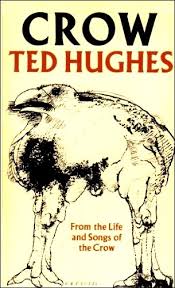
I think the narrator has preserved this distinction and perhaps does so even at the end. Of the bodies on the gibbet, some are fresh, others are like “dry bark bits” being twirled in the rainfall. The narrator seems inclined to focus on those retaining their living “shape”, those who he says retain “their pride”, those who seem (like Wordsworth’s Gatherer) to teach patience, and endurance against “these worst days”. But the incontrovertible fact is they are all dead and death is lesson 101 in Hughes’ work as can be seen in Crow’s ‘Examination at the Womb-Door’ (Crow, 1970). It is the denial of death’s reality that leads to delusion and a false consciousness of our own position in the world. The narrator of ‘November’ still hankers after the human scale of virtues such as patience and Wordsworthian endurance. It is the tramp – ironically rather forgotten by the end of the poem, lying foetal in the let of the ditch, still huddled against the month’s elements – who entrusts himself to the risks of exposure and death, but in doing so may hear (what the sheltered narrator will never hear) the reply that Crow gives to the final question he faces:

But who is stronger than death?

                                         Me, evidently.

Pass, Crow.
imgres

A bundle of 50 sticks to start a fire

I have used this form – derived from Lee Harwood – for a blog-poem before. I rather like its loose encompassment and also as a welcome change to the often ‘lit crit’ nature of my usual blogs. Just roll with it . . . it’s what I say to myself. This one is dedicated to Stephen Stuart-Smith and all at Enitharmon Press.

images


A bundle of 50 sticks to start a fire

(for Stephen)

I did not break my fast Thursday last

Rose and showered at 7am before realizing and getting back under the covers for another 20 minutes

The street strangely lit there seemed to be so much more sky

The council have cut down flowering cherries claiming they are diseased but the word is it is to prevent – in both senses – claims against them for subsidence

At the surgery I was sixth in line

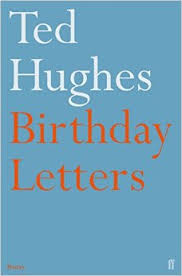
reading Blake Morrison on Ted Hughes published 5 September 1993 on yellowing newspaper pages that had tumbled out of a book I was re-shelving

As for his marriage to Plath, one day he may choose to speak about it, but for now –

I glimpse an old neighbor now divorced his wife and children have moved out we nod but very remotely

never watch when the blood is taken

images

Starbucks trade in the medical centre I watched being built years ago when I’d swim more often even then imagining myself at one of the windows waiting for news of some test or other

T. has woken by the time I return to eat but it’s me who puts away the groceries that have been delivered

handed me the bottle of wine laughing you don’t want to lose that he said my hesitation as I re-envisaged him as a romantic gift-bringer left an awkward pause I couldn’t cover

How does I have plenty of time transform itself swiftly into running late

hardly anywhere to park

Queens Wood stretches up behind these houses then bridges a road then sinks following its contours to the pond then rises again climbing to Muswell Hill and this is to be boxed into the word ‘topography’

A half empty carriage

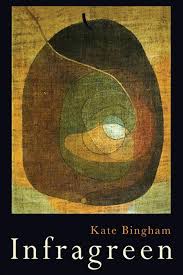
‘Ultragreen’ in which what is out there seems to come inside in a process Kate cleverly likens to photosynthesis and cleverly this gets away from me

imgres

The Whitehill Food Market I have passed that place

Walking up from the Emirates when I can’t get my mind off the strange limps and weaves of the way other people walk they are not hell but merely unfamiliar ways of moving

the fountains flow in the centre of the square

A dog wets its feet and drops a red ball into the pool and I guess its owner will be irritated by that

Brecht refused to award the prize to any of the five hundred entries. In none, he said, was there any successful attempt to communicate anything of any value

‘Nothing makes me feel more like a poet than being unable to talk’

Pub date Isobel calls it pub date

The absence of punctuation is in the spirit of the Daodejing it is the water course way one drop of water in the ocean no trace of it but don’t tell me it’s not there

A house in Selbourne

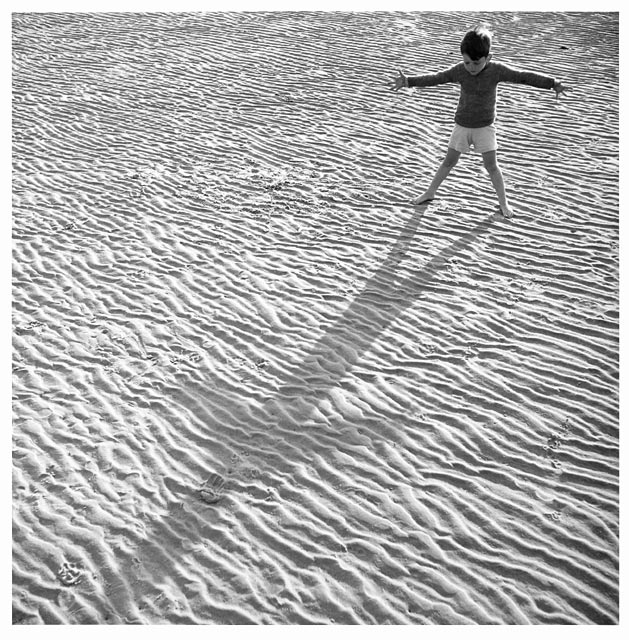
An image of a child with arms outstretched fingers widespread so much he might be a tree

Ripples of damp sand are the footprints of the shaggy oceanic beast

‘To embrace’

y30

A plain cheese and tomato brown bread roll and I am back madeleine-like to dinner-time sandwiches at Junior School during which we’d meet Mum from work and sit in Trowbridge Park why did we do that

It must have saved money

A timetable is the opposite of the way water flows and this grid dominates my life

Poems not even by rote but by the hour of the day

‘Pike’ so we watched YouTube clips of fish ducklings kittens being devoured it gets them started

Town kids city dwellers

as out of place as John Wyndham’s alien creatures like little pink M&Ms on four legs two of which are really arms they carry fire sticks

‘A sort of genocide’

The original Homer Simpson whose hands are uncontrollable

‘his thumb received a nasty cut. Although the wound must have hurt, the calm, slightly querulous expression he usually wore did not change’

images

Explore how far West’s presentation of Homer suggests he is a trapped man

The spider plant on the windowsill looks anaemic in its white pot against white painted window frames against thunderheads miles off

I am free at 17.10

I don’t need most of this

Occasionally there are evenings I can’t remember where I parked the car once I thought I’d left it on the garage forecourt after filling it up and I went in and got them to review the CCTV footage which told me that I had driven it away earlier that day and like some log-jam shifting slightly I had a vision of parking it on First Avenue and there it was all along

I need a framework perhaps

‘Echo Beach far away in time Echo Beach far away in time’

I like to change my clothes after a day’s work

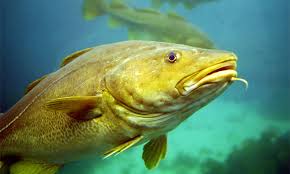
So I asked them to bring in pictures of pike and this one brought in a picture of a cod

A Delia recipe

The evening is filled with cakes of varying heights

42

A new translation of Brecht’s ‘Of poor B.B.’

Having posted last week about Brecht’s poem ‘Of poor B.B.’ it felt pretty inevitable that I should have a go at translating it myself. Though it can’t always be the case, most translations are like this – undertaken as a tribute to the original poet and poem, a public declaration that this fascinated me, an attempt to really work out how the text functions and achieves its ends. Disseminating the text to the target language’s reading public is also an aspect of this tribute paid.

249y242_mpt_no22015_coverfront

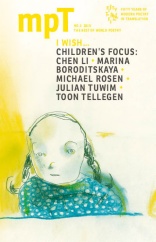
David Constantine, writing in Modern Poetry in Translation (No. 2 2015) about Derek Mahon’s recently published translations (Echo’s Grove (Gallery Press, 2013)) considers the “liberties” Mahon tends to take with such work to produce “almost” original poems in English while allowing their sources to remain audible. Mahon does this by working from “cribs of one kind or another” and Constantine suggests that this has become a very common practice. Indeed, “Mahon practices the belief that you don’t actually need to know well or even at all the languages you translate out of; even – a possible sub-text – that knowing them might be a disadvantage” (MPT, No. pp.111-113). As someone who was remarkably poor at languages at school, this is something I have found myself saying in recent years since going public with a few translations (for example, see post on translating Rilke). I like to think of the source poem as a series of gestures – like a dance performed by the original author – so the translator must try to achieve similar effects but with his/her own body (of language). A crib will guide me to the main movements, even to much of the details, but tone, emotional colour, shades of irony are harder to trans-late and cannot merely be copied. This gesture made by this body, if repeated precisely by my body, will more likely look awkward, or meaningless, or comic when it was intended as serious. I have to achieve the end (as far as I see it and understand its intended impact – you have to rely on the translator for that certainly) by using the resources at my disposal, my physique, my body of language.

egon-schiele4-300x199

In practice, what this means is that once the basic outline and incontrovertible details are in place in a translation, I have to close the source book and try to pump some life into the target text. Ted Hughes imagined a poem without true life in it as limping (Poetry in the Making, p.15); a translation without true life in it is only going to be a halting performance you’d rather not witness, worrying about whether such a gesture was intended or not, ironic or not, you fear the whole is not coherent, a mere series of movements, not a dance at all. I’ve always liked Charles Tomlinson’s formulation of the translation task: in introducing his now 50-year-old translations of Fyodor Tyutchev, he claimed ‘The aim of these translations has been to preserve not the metre, but the movement of each poem – its flight, or track through the mind’ (Versions from Fyodor Tyutchev 1803-1873 (Oxford: OUP, 1960)).

Happily, ‘Of poor B.B.’ is not a text of great complexity. Brecht is usually concerned to communicate clearly and he says in ‘On Rhymeless Verse with Irregular Rhythms’ (Poems 1913-1956, pp. 463-471)) “what was needed was the tone of direct and spontaneous speech”. He mostly wanted to use “everyday speech” and “sobriety of expression” which he felt was “by no means irreconcilable with poetry”. So Brecht is not exactly Rilke or Mallarme for the translator. Looking at Hofmann and Hamburger’s translations (as referred to in last week’s post), most of Brecht’s dance is clearly conveyed with little variation between the two versions. Though Brecht’s lines are pretty irregular he does keep a ballad-like rhyme in lines 2 and 4 of each quatrain and I miss this in Hofmann’s version. Hoffman also (to my mind) overelaborates in a few of his English choices. “Sterbsakrament” (Hamburger has “last sacrament”) becomes “every sacramental perquisite”. Hofmann’s narrator looks at the two women in quatrain 4 “insouciantly” and his pine trees “micturate” (when the point of the contrast with the city asks for something more downright like Hamburger’s “piss”). I don’t think lexical adventures here are quite right for this poem. Also in quatrain 7, Hofmann’s antennae “underwire” the Atlantic. Brecht is referring to transatlantic cables but the allusion to supportive bras seems distracting and gives mankind’s efforts too much power. I read the point as suggesting our technology is dwarfed by the ocean in the remarkable image that our best advances merely entertain (“unterhalten”) or “amuse” (Hamburger) the Atlantic.

Egon_Schiele_060

Regarding the hat donned by the narrator to fit in with city folk, Hofmann’s “top hat” seems a little too up-market, while Hamburger’s “hard hat” conjures up a building site. I have gone for “bowler hat” of a clerk or business man. The sound of the birds in quatrain 6 is important. Hofmann’s “bawl” catches the anti-pastoral tone of the poem but Hamburger is forced by the needs of form to go for “twitter and cheep” (to rhyme with “sleep”). There is also some ambiguity in the final stanza where the narrator hopes to keep his “Virginia” alight in the coming earthquakes of social disruption. The German suggests the cigar will hopefully not go out (“nicht ausgeher”) and the cause: “lassen durch Bitterkeit”. Hofmann renders this as hoping the cigar will not “go bitter on me” whereas Hamburger (again in part for the sake of form) hopes to keep the cigar alight “embittered or no”. Hofmann’s phrase feels too narrowly concerned with the smoking experience but Hamburger’s rather awkward phrase does successfully suggest what I see in the final lines – the narrator’s hope (if not altogether sincerely) that he himself may avoid becoming bitter. My solution tries to hold both literal and transferred metaphorical senses of the bitter cigar equally within the line. I’ve come to think of this as important to the poem as the narrator is blessed with a degree of self awareness as much as he is cursed with a cynical, dismissive hedonism.

images

Of poor B.B.

I, Bertolt Brecht, came from the black forests.
My mother bore me into the city
while I was in her womb. And till my dying day
the chill of the woods will lie there inside me.

In the asphalt city I’m at home. From the beginning
supplied with every last sacrament:
with newspapers – and tobacco – and with brandy.
To the end, suspicious, lazy, content.

I’m amicable with the people I meet. I don
a bowler hat in just the way they do.
I say: they’re animals with a quite peculiar smell.
And I say: so what – I am too.

In the morning, in my vacant rocking chairs,
I sometimes set for myself a couple of women
and carelessly gaze at them and converse with them:
in me you have one here you can’t rely on.

When night falls, I gather men around me;
we address each other as ‘gentlemen’.
They swing their feet onto my table tops.
They say: things will improve for us. I don’t ask when.

Come morning, in dawn’s grey light, pine trees piss
and their vermin, the birds, start to shriek.
At that hour, in the city, I drain a glass and fling
my cigar butt away and, troubled, fall asleep.

We have settled, a superficial crew,
in houses that to our minds will never fall derelict
(we’ve built tower blocks over Manhattan Island
and spindly antennae that tickle the Atlantic).

What will last of cities is what blows through them: wind!
Houses make happy eaters: wolfed in a moment.
We know it – we are temporary
and after us comes nothing really worthy of comment.

In the earthquakes that are to come, I hope I’ll keep
my Virginia lit, not doused, grown bitter.
I, Bertolt Brecht, carried off to the asphalt cities
long ago from the black forests inside my mother.

tr. Martyn Crucefix

bare-tree-behind-a-fence-1912

Review of Sheenagh Pugh’s ‘Short Days, Long Shadows’

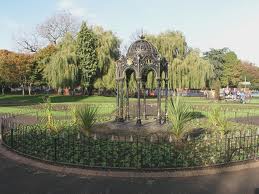
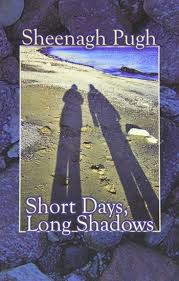
Sheenagh Pugh’s Short Days, Long Shadows strongly bears the mark of her re-location in recent years from Cardiff to the Shetland Islands. There are a couple of leaving-taking pieces here with ‘How to Leave’ re-enacting the slow, even painful, notation of local details and the levels of self-deception often accompanying what looks like a partly reluctant move. ‘Ghosts of Cardiff’ more reflectively argues that it is less the “now” that proves so hard to turn away from, it is “all the thens” which, even walking down St Mary Street or through Victoria Park, remain at least as vivid as any present moment. These hauntings form just one of the many sub-sets of ‘Long Shadows’ in this collection and Pugh’s much-remarked sense of history is a further important manifestation of this too.

imgres
Victoria Park, Cardiff

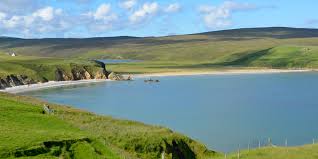
But it is the northern landscapes that dominate the book, the Shetlands and Scandinavia. ‘Big Sky’ makes the scenic novelty clear when the gaze from a window meets “no branch, no office block”, but “overflows with sky”. The breadth and variety of cloudscape and the bright night’s “cluster and prickle” of stars are vividly evoked yet the individual’s humility before such a natural scene is undermined by a final line suggesting a yearning for “the way out”. There is something of this reflected in the book’s structuring where, instead of blockish sequences of related poems, individual pieces tend to bounce and ricochet off each other. Pugh’s language risks becoming a little dull but I find this quality of restlessness in her work very engaging. It is a determination not to accept limits as in ‘Living in a Snow Globe’ where a northern blizzard again concludes with a small figure “fixed in a shaking flux and unsure / where here is, or how to get out”.

imgres
View of the Shetlands

It must be just such an isolated figure who, in one of the best poems here, talks to the ocean and asks why our figures and metaphors for it – though accurate in some ways – are always inadequate: “you / swallow each likeness, each true word / and spit it out, rejected” (‘Sea’s Answer’). I’m not sure I quite follow the sea’s reply, but it seems to imply that our endless figuring is really driven by our own desire “to be like” the sea, implying perhaps our existential uncertainties, at least when confronted with the sea’s Olympian-seeming, seeming unconditional, independent life, reminding me of Whitman’s 1871 ‘Song of the Exposition’ (as used by Vaughan Williams in ‘A Sea Symphony’) where he declares the sea remains always and only “the sea itself”.

images

But such metaphysical themes are infrequent in Pugh’s work (or at least they remain well-buried) and she focuses usually on the more common personal experience. She often approaches this through historical time in, for example, a sequence on sixteenth century spies in ‘Walsingham’s Men’ and several later pieces clearly based on encounters with museum exhibits. There are also poems here about the approach (for a father?) of cancer and death, reminisces about wartime experiences and several touching poems about the author’s mother: “I shall look back at her from my seventies // before long, saying this is how it is, / the age you never reached” (‘Catching Up’). As this suggests, Pugh’s over-riding obsession is the passage of time, both in the shadows it casts back and forth and in the sense of transience implied in the phrase ‘Short Days’. ‘Wasting Time’ is a fine poem opening with the narrator watching the sea’s actions of building and destroying along the coastline. Quoting “I wasted time, and now doth time waste me” from Shakespeare’s Richard II, the poem goes beyond this, acknowledging “the one thing / you cannot do is keep it”. Here also, Pugh resists the lure of a neatly tied up conclusion, merely suggesting that the sequential linearity of time must mean that in focusing on – or even in loving and appreciating – one thing, we must be missing out on another or absently on the look-out for something better. That restlessness again.

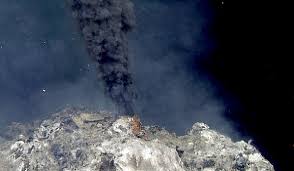
Since she gave out the hostage to fortune that being judged “too accessible” as a poet was the best sort of compliment, there has been much discussion of Pugh’s plainness, simplicity, even her unchallenging art. It’s true there are poems here that do little more than make a few well-turned observations in plain language in skilfully handled, mostly free verse. But I think – in the face of a pretty bleak view of temporal change – the stoicism which underlies much of her thought manifests itself in lexical and formal choices as the desire to communicate truth as plainly as possible. There is surely something of this in the astutely placed opening poem, ‘Extremophile’. The title refers to those life forms which, against all the odds, manage to carve out a life in extreme conditions around hydrothermal vents, in permanently darkened caves, in Antarctic valleys. It is this determination that Pugh finds inspiring: “There is nowhere / life cannot take hold, nowhere so salt, / so cold, so acid, but some chancer / will be there”. Look at that brilliantly chosen colloquialism “chancer” to suggest the risk-taking, against-the-odds, stubborn resilience of life itself that Pugh’s human subjects more often than not also share.

images

Even so, it’s a very long way from this Hughesian Crow-like affirmation of life against the odds to another poem later in the collection which confirms that, whatever the questions over accessibility, Pugh remains a poet capable of facing up to the terrifying brevity of life. ‘The Vanishing Bishop’ is one of the museum-inspired pieces, I think, but we are taken to the moment when a coffin is unearthed and opened and news is sent to the archaeologists while the digger/narrator remains waiting, observing the corpse: “face, full lips, firm lines, / furrowed brow”. But suddenly, as the narrator sits in imagined silent dialogue with the dead bishop’s body, the air attacks the long-preserved face:

[as] when a big log

has burned so long, it’s ash

in the shape of wood, nothing

holding it together

but habit. His whole face

suddenly settled, fell in on itself,

letting go its last memory

of who he’d been.

Though uneven, Short Days, Long Shadows is a highly readable collection with perhaps half a dozen of the best poems Pugh has written and these wear their profundity so lightly that you will want to go back and re-read them to find out with what cunning, near-invisible skill they have been composed.

imgres

Ted Hughes’ ‘Swifts’

Our swifts returned two days ago – the 10th of May – now they are now installed, screaming around the terrace row, occupying the air over this little patch of north London. No better tribute to their speed, power, heroic journeying and the pleasure given by their return than Ted Hughes’ poem from Season Songs (Faber, 1976):

Ted-Hughes-001

Swifts

Fifteenth of May. Cherry blossom. The swifts
Materialize at the tip of a long scream
Of needle. ‘Look! They’re back! Look!’ And they’re gone
On a steep

Controlled scream of skid
Round the house-end and away under the cherries. Gone.
Suddenly flickering in sky summit, three or four together,
Gnat-whisp frail, and hover-searching, and listening

For air-chills – are they too early? With a bowing
Power-thrust to left, then to right, then a flicker they
Tilt into a slide, a tremble for balance,
Then a lashing down disappearance

Behind elms.
They’ve made it again,
Which means the globe’s still working, the Creation’s
Still waking refreshed, our summer’s
Still all to come —
And here they are, here they are again
Erupting across yard stones
Shrapnel-scatter terror. Frog-gapers,
Speedway goggles, international mobsters —

A bolas of three or four wire screams
Jockeying across each other
On their switchback wheel of death.
They swat past, hard-fletched

Veer on the hard air, toss up over the roof,
And are gone again. Their mole-dark labouring,
Their lunatic limber scramming frenzy
And their whirling blades

Sparkle out into blue —
Not ours any more.
Rats ransacked their nests so now they shun us.
Round luckier houses now
They crowd their evening dirt-track meetings,

Racing their discords, screaming as if speed-burned,
Head-height, clipping the doorway
With their leaden velocity and their butterfly lightness,
Their too much power, their arrow-thwack into the eaves.

Every year a first-fling, nearly flying
Misfit flopped in our yard,
Groggily somersaulting to get airborne.
He bat-crawled on his tiny useless feet, tangling his flails

Like a broken toy, and shrieking thinly
Till I tossed him up — then suddenly he flowed away under
His bowed shoulders of enormous swimming power,
Slid away along levels wobbling

On the fine wire they have reduced life to,
And crashed among the raspberries.
Then followed fiery hospital hours
In a kitchen. The moustached goblin savage

Nested in a scarf. The bright blank
Blind, like an angel, to my meat-crumbs and flies.
Then eyelids resting. Wasted clingers curled.
The inevitable balsa death.
Finally burial
For the husk
Of my little Apollo —

The charred scream
Folded in its huge power.

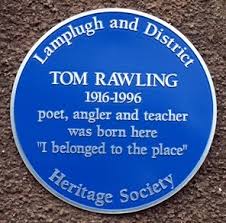
The Poetry of Tom Rawling

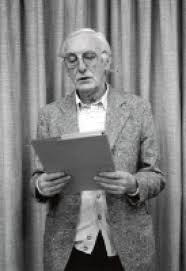
In the early 1980s I arrived in Oxford as a self-absorbed post-graduate and promptly sought out student poets wherever I could find them. The group I joined was then (I think) meeting in rooms in Hertford College, opposite the Bodleian Library (and happily very close to the Kings Arms). Bill (W N) Herbert was there, as was Keith Jebb and Paul Mountain. The group, with changing personnel – I remember Elise Paschen was a member for a while – continued to meet throughout my 4 year stint among the dribbling spires, but we would supplement it by decamping to the Old Fire Station on George Street where Tom Rawling was running a public workshop. Tom had taken over when Anne Stevenson moved north. As a retired headmaster, Tom ran us all as a well organised and disciplined class. Elizabeth Garret joined later and I think Peter Forbes was already a member, as was Helen Kidd. Jeremy Round, who was soon to achieve short-lived fame for his cookery writing, was also a regular. My poem ‘In Memory of Jeremy Round’ (eventually published in Beneath Tremendous Rain (Enitharmon, 1990) https://martyncrucefix.com/publications/beneath-tremendous-rain-1990/) is a lament for his tragic early death, but also tries to paint a vivid picture of the workshop and its members:

We’d wrangle inconclusively

between the beers and crossfire from Tom,

elder statesman who’d slip quietly glittering

poems from his tackle bag like fish; from Helen,

whose pages always seemed typed under earthquake

conditions, whose baggy poems had more passion

than most of us could muster; from Peter’s

exactitude, schooled on a diet of science, he held

each piece like a prism till it shed eloquent

rainbows; from Bill and Keith, the ferocious

tyros, the university wits, who minced nothing

but their language into strange sweet things;

from Paul whose poems were amazed not to find

themselves loosed into a more graceful age

than the one we live in.

There were others writers, of course, to whom I apologise for not recalling them clearly. Bill has also written about these few years with great eloquence and insight: http://tracearchive.ntu.ac.uk/poets/herbert/dec_2.htm.

imgres

But rather than his aspiring students, it’s Tom Rawling’s own poetry that I want to highlight. A pamphlet called A Sort of Killing appeared in 1978 (an historical event now as this was one of the first publications by a young Neil Astley). OUP published Ghosts at My Back (1982). Two other books followed: The Old Showfield (Taxus, 1984) and The Names of the Sea-Trout (Littlewood Arc, 1993).

Grevel Lindop has long been a fan of Tom’s work (http://grevel.co.uk/poetry/tom-rawling-rediscovering-ennerdales-poet/). There is an audio recording of Tom reading many of his best poems (you can listen to one of them here: http://listenupnorth.typepad.com/listenupnorth/tom-rawling-poet.html). Listening to him again, what what comes over is his modesty, his sharp intelligence, his confidence in his own work and the vivid recall he had of his formative years, growing up in Ennerdale, Cumbria. Tom’s poems, in their accessibility, boldness with language, natural and ecological themes are (as my review concludes) ideal for the classroom and it is still a cherished hope of mine that they might be taken up by a mainstream publisher and presented to a new generation (a Rosemary Tonks of the western valleys of Cumbria, wielding his fly-fishing rod). Perhaps the best way to sing my praise of Tom’s work is to post up a review I wrote of his posthumous collection How Hall (2009).

imgres

I recommend you search out more of his work (http://en.wikipedia.org/wiki/Tom_Rawling). Here is my review:

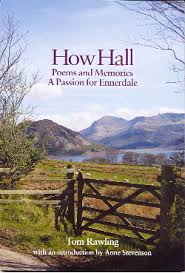
Tom Rawling, How Hall: Poems and Memories, a passion for Ennerdale (Lamplugh and District Heritage Society, 2009), £7.50, ISBN 978-0-9547482-1-0

Tom Rawling, How Hall: selected poems of Ennerdale poet Tom Rawling, read by the author (Lamplugh and District Heritage Society, 2009), £5, CD audio recording

As a child in the 1920s, Tom Rawling grew up in the Ennerdale valley in what was then called Cumberland. It was not until his retirement in the shallow decades of the 1970s and ‘80s that he began to write poetry as a man “haunted . . . even bullied by his memories” as Anne Stevenson’s insightful introduction to this new selection explains. A marvellous collection was published by OUP in 1982 and two further publications from smaller presses resulted, but at his death in 1996 Rawling had not attracted the kind of attention he had hoped for and certainly deserved.

How Hall is a new edition of more than 70 poems, three pieces of autobiographical prose and some wonderfully evocative photographs. The accompanying CD is an audio recording of an extended reading given in 1983 and the passion and precision of his voice and his humble and insightful comments add further invaluable dimensions to any appreciation of his work. Rawling shares with Heaney the kind of vivid recall of childhood that yielded the title of his first book, Ghosts at My Back. An early poem has the young Rawling playing “squire” to the village blacksmith who also introduced him to his life-long passion, fishing – both are described as “tying knots / That didn’t slip” (‘Johnny’). Yet home life was not always so easy and there are poems that bitterly lament the repressed and repressive life of his mother (‘Hands’), his father’s drinking (‘Honour thy Father and thy Mother’) and the son’s rebellious, divisive “radical words” (‘Clipping Day’).

His rebellion took him away from home, but ironically it is for the authenticity of Rawling’s responses to the farm life and countryside of the Ennerdale of his youth that we should continue to read him. Perhaps it has taken us 25 years to understand what he felt intuitively, the importance of our relationships with the natural world and the kind of folklore that once bound man and nature together. Even in the 1920s, it was only Rawling’s grandmother who “glimpsed beyond the byre” to the atavistic fertility beliefs that lay behind “ritual no longer understood” (‘Grandmother’); it was she who knew the spell to complete a whistle carved from hedgerow sycamore (‘Sap-Whistle’). ‘The Barn’ vividly evokes the thrill of the hay harvest: “Bright prongs pierced and unpicked, ash handles / bent, they launched the bundles we embraced” and as the barn filled it was only when “heads bumped the slates / we came down the ladder in triumph”.

images

Anne Stevenson – who met Rawling in Oxford in the late 1970s – rightly directs us not to dismiss his work as “romantic retrospection” because he really “wrote poems to tell the truth and in them rehearsed the daily rituals of life and death”. ‘Rumbutter’ characteristically revels in that recipe’s “sweet beginning” as well as, “not quite hidden, the cinnamon / of the coming funeral feast”.  There is certainly no room for sentimentality in Rawling’s view of nature: a pig is to be cared for only till the “pole-axe fell” (‘Hooks in the Ceiling’) and chickens are nurtured carefully, but in their “due season, each neck pulled / . . . the admired knack of killing” (‘Feathers’). Rawling also shares with Heaney a fascination with the insights embedded in idiom and dialect. ‘Hearthwords’ addresses the younger Irish poet with their shared belief that “the naming spell / gives the thing itself / into our hands” And then, as his own poetry began to flow, he swiftly developed a precise, lean, direct form of free verse, capable of moving from the joyous observations of “cloud and sun pursu[ing] / Their steeplechase across the land (‘I Am What I Was’) to the shockingly frank recording of the realities of the cow shed: “ a column of piss / cascades to the cobbles . . . a face gurning, whistling and whispering soft farts” (‘Privy’).

But Rawling’s reach is not confined to the material. Perhaps his most distinctive poems are those that deal with angling, especially fly-fishing for salmon and sea-trout which his poems transform into an almost religious questing and testing of the individual’s devotion, skill and subterfuge. His own first encounter with the power of the sea-trout he recalled as a moment when he had “waded / into mystery, tampered with Leviathan” (‘Leviathan’). One function of any poem is to offer us profound if vicarious experiences and these poems succeed so well in this evocation, taking us to the riverside at night, “to the dub / where sea-trout rest” where we might “hear an old ewe’s husky cough, / the water slopping, slapping” (‘Night Fisherman’).

imgres

Poem after poem makes it clear that to fish in this way is to engage differently, intimately with the world and to embark on the difficult process of laying aside our humanity’s hobbling self-consciousness, to cast off the accretions of civilisation until we allow “the body [to] flow into the rod” (‘Torridge Salmon’), achieving a different form of consciousness as we “wade in deeper, / Share with the fish / Its lateral line / The current’s push” (‘Only the Body’). It’s easy to understand why Ted Hughes came to admire these poems as Rawling triumphantly celebrates the efforts and occasions when we encounter the Other in what becomes a frankly spiritual communion. So in ‘A Shared Rod’, a kingfisher perches on the “bamboo rod-tip” as the angler waits in the reed bed:

His great eye turns, a moment’s stare,

then, blue-green whirr,

the arrow skims downstream,

leaving an emptied space,

a shared rod quivering.

It is really this kind of encounter – with all that is not bounded by ourselves – that Rawling is conjuring in ‘The Names of the Sea-Trout’, a spell for fishermen that revises and revivifies his grandmother’s superstitious connections with the natural world:

Bender of steel, the breaker, the smasher,

The strong wench, the cartwheeler,

The curve of the world,

She who doesn’t want to surrender,

The desired, the sweet one.

Profound, vivid, honest, accessible – these are poems that at once connect us to a lost past and prepare us for a world in which the environment must again become our close companion. Rawling’s work would be wonderful to teach in schools if it were more easily available and a mainstream publisher would do well to bring him nearer centre stage. For the time being we must thank Michael Baron, Stan Buck and the Lamplugh and District Heritage Society for the very many pleasures of this marvellous book.

imgres

Re-packaging ‘percussive’ Ted Hughes

Anthologies are the reluctant poetry readers’ hedging bet. There’s a good chance that something good will turn up and prove a winner. They sell well – they are the infrequent poetry buyer’s punt for a gift that will please at least in parts. So Alice Oswald’s compilation of Ted Hughes’ animal poems into a Bestiary will certainly put more cash into the Faber vault. But few complaints – anything to get more people reading any poetry cannot be bad.

Ted-Hughes-001

Oswald discusses her approach to the selection in The Guardian: 

http://www.theguardian.com/books/2014/aug/29/ted-hughes-alice-oswald-animal-poetry-bestiary

She picks up Hughes’ own early image of his poems as creatures with a “vivid life” of their own. He condemns poems which fail to possess this coherent vitality as likely to walk with a pronounced limp – a wonderful way, I’ve found, of imaging that elusive ‘rightness’ of a poem for students and workshoppers. Interestingly though, there is a shimmering, vacillatory quality to others things Oswald writes and this comes directly from Hughes himself. His animals are very much themselves yet they are expressive of human qualities too. Oswald quotes from Moortown Diary; Hughes on the poet “getting close to what is going on, and staying close, and of excluding everything else that might be pressing to interfere with the watching eye”. Held in tension with this are other Hughes’ statements such as this, in a letter, warning of the dangers of mere observation: “When a man becomes a mirror, he just ceases to be interesting to men.”

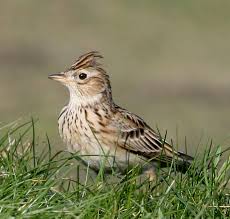
Oswald goes on to suggest that it is the “percussion” of Hughes’ language that instills such vivid life into his poems, quoting from ‘Skylarks’:

The lark begins to go up
Like a warning
As if the globe were uneasy –

Barrel-chested for heights,
Like an Indian of the high Andes,

A whippet head, barbed like

a hunting arrow,

But leaden
With muscle
For the struggle
Against
Earth’s centre.

And leaden
For ballast
In the rocketing storms of the breath.

Leaden
Like a bullet
To supplant
Life from its centre.

imgres

If it is a percussive effect that is critical here it is more Mozart than Stomp. Oswald has precious little space to develop her argument, but what I find in such a passage is Hughes’ distinctive manipulation of scale and perspective, not unrelated to his paradoxical comments above. Microcosm and macrocosm are continually leant against each other here, or – it being a more metamorphic, high-pressured process – they are spun about each other till it’s hard to pick one from the other. The tiny body of the lark is a warning to the globe; its braced, needle-thin ribs conjure images of Andean mountains; its crested, whippet head seems to speed lethally through remote forests. The three stanzas focusing on the “leaden” nature of the bird – less weight it seems to me, more loaded with quiddity, self-ness – provoke the reader to focus closely on its body, only again for our attention to be spun outwards to “Earth’s centre . . . rocketing storms”, vulnerable life beating at its “centre”.

In part, what Hughes achieves is a sense of interconnectedness – which he would have intended in both spiritual and environmental terms. What the reader experiences is a sudden inflation or deflation of scale and perspective, a magical effect, an effect created through language, an effect achieved so skillfully and instantaneously that one might well have some sense of a percussive, explosive or implosive quality. I don’t hear or feel a noise as such – my sense of the world pulses, is stretched or compressed in the most exciting fashion. An effect with a moral dimension to it as well – a serious, ludic experience, in which we see and re-see our own place in the world.