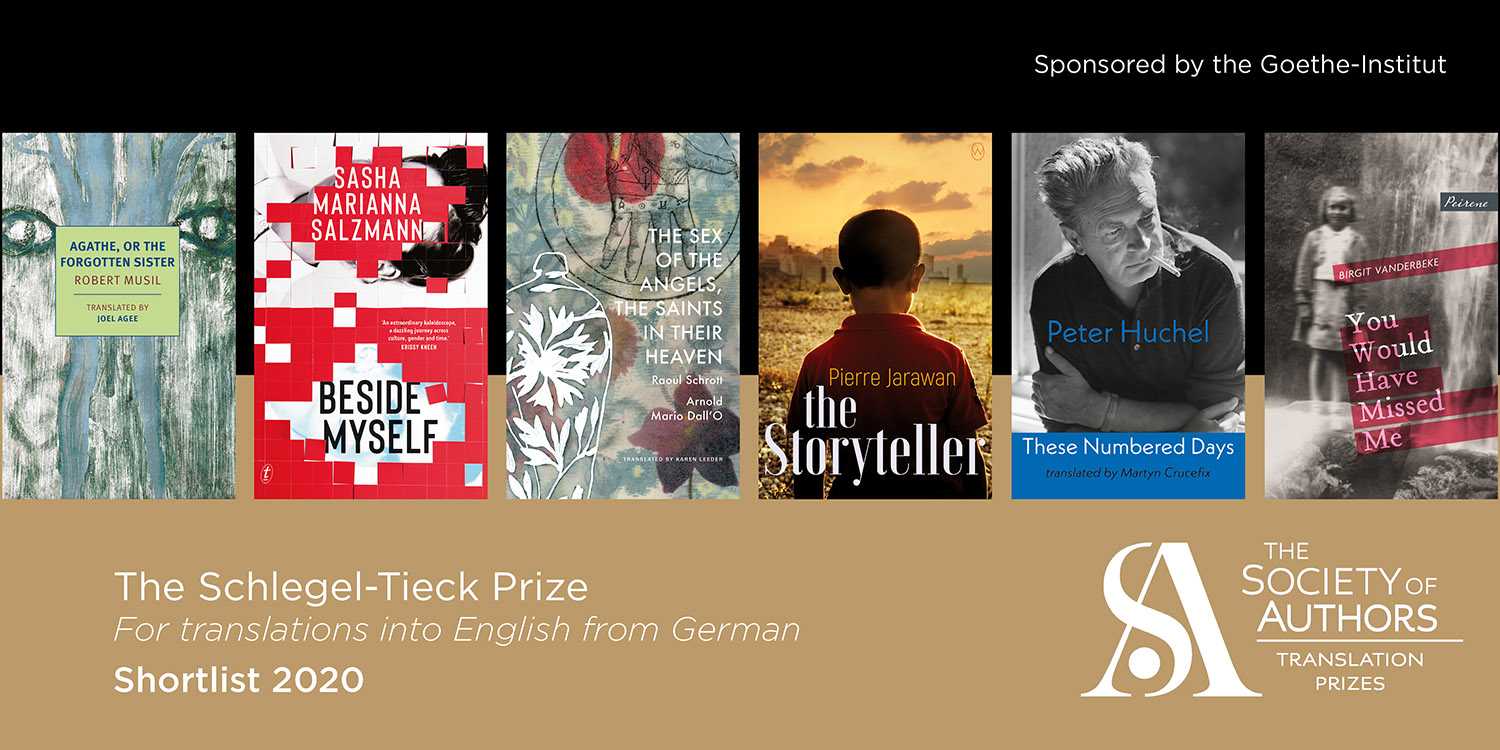
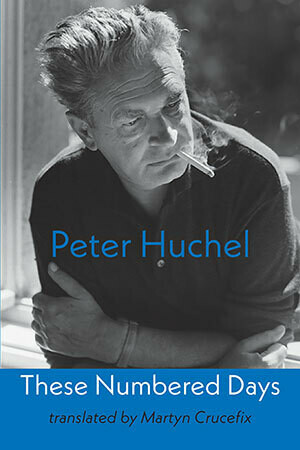
To mark the shortlisting – for the Society of Authors’ Schlegel-Tieck Translation Prize 2020 – of my Peter Huchel translations, published by Shearsman Books, I’m posting here a piece I wrote about Huchel’s poetry which first appeared in Acumen 98 (September 2020). Peter Huchel’s work has its place in the tradition of the greats of twentieth-century German poetry – Rilke, Trakl, Brecht, Benn and Celan – but he is also, as Karen Leeder has argued, a “one off”.[i] Iain Galbraith also lists Huchel among a “handful of essential post-war poets” in German, but his poetry is far less well known than it deserves to be. His presence in English at all is thanks to Michael Hamburger’s 1983 translations published by Anvil[ii]. I came across isolated examples of his work a few years ago and was immediately drawn to his startling observations of the natural world which function often as “metaphors [to] take us deep into the social and historical landscape” of his era (Galbraith again). I believe he is a poet with important things to say to us in our own conflicted times and my translation of Huchel’s best collection, These Numbered Days (1972), was published last year by Shearsman Books. Here, I put Huchel’s work into the context of the great events in Europe in the twentieth century.
 Huchel’s description of Pe-Lo-Thien, the poet, social critic and sometime exile from the Tang Dynasty, is intended also as a portrait of the poet himself – a dissident figure, an “outlaw, / who lives beyond the wall / with his cranes and cats” (‘Pe-Lo-Thien’). It’s no surprise that the spare, impersonal, often lapidary quality of the poems in These Numbered Days was remarked on by Karl Alfred Wolken as offering the reader something of a Chinese book in German.[iii] The poet himself, carefully scrutinising the natural world – the perception of which constitutes the substance of so many of his poems – tries to descry “Signs, / written by the hand / of a Mandarin” (‘No Answer’). If such allusions suggest a minimalist and tight-lipped quality to Huchel’s poems, this is precisely what might be expected from an artist forced to play, as he did for so many years, the role of inner émigré.
For readers of British and Irish poetry, the term ‘inner émigré’ will be familiar from Seamus Heaney’s use of it in his 1975 poem ‘Exposure’. Discussing the idea, Heaney acknowledged the term’s specific meaning in the 1920/30s in Soviet Russia as referring to a dissident who had not actually gone into exile but remained at home, disaffected from and under the surveillance of the authorities. Heaney saw himself in this light in relation to Northern Ireland. He also associated the idea with the position of George Seferis, concluding that “poetry secures some final place in your being, some little redoubt in your consciousness that will not be taken over by history or the world or disaster”.[iv] This same sense of confinement, wrestling with conscience and the frequent resort to codification which results from such a compromised position is the best way into Huchel’s work as a writer whose life and historical circumstances astonishingly led him to play the role of inner émigré twice over.
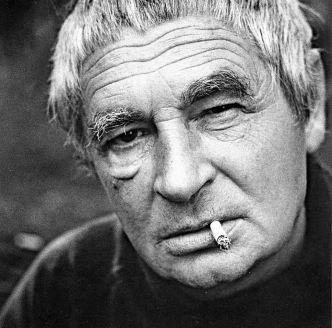
He was born Hellmut Huchel in 1903 in Alt-Lichterfelde, now part of Berlin. Due to his mother’s chronic illness, the boy was taken from the city to be raised on his grandfather’s farm at Alt-Langewisch, in the Brandenburg countryside near Potsdam. As an adult, Huchel was fond of quoting St. Augustine on the importance of memory as a “great field or a spacious palace, a storehouse for countless images of all kinds”.[v] Huchel argued that it is “the experiences of childhood, roughly between the ages of five and ten, that exercise a decisive influence in later years”.[vi] But if this period seems to have had something of the idyll about it for the 11 year old boy, it was dramatically shattered by the death of his beloved grandfather and the outbreak of war in Europe in 1914.
 After his country’s defeat, the 17 year old Huchel took part in the conservative Kapp-Putsch against the Weimar Republic in 1920 which was fuelled by a resentment of the German government’s agreeing to the punishing conditions of the Treaty of Versailles. Huchel was wounded in the fighting associated with this failed coup but it was during his recovery in hospital that his sympathies for socialism and Marxism fully developed. His very early poems can be linked to the sort of art fostered by the League of Proletarian Revolutionary Writers. He has said: “What did I care about in those days? I wanted to make visible in the poem a deliberately ignored, suppressed class, the class of the people, the maidservants and coachmen”.[vii]
By 1932 he was working as an editorial assistant for Die Literarische Welt. His first collection of poems was accepted for publication under the title Der Knabenteich (‘The Boy’s Pond’). But with the rise of Hitler, Die Literarische Welt had to cease publication and it is at this moment that Huchel developed the strategy of the ‘inner émigré’. He published very little, eventually deciding to withhold Der Knabenteich. He was deeply troubled that the Nazis liked his work, reading into it as they did a version of the blood and soil nationalism they hoped to foster. So, by 1936 he was refusing permission for any publication and he did not publish any new poems during the rest of Hitler’s rule. Rather, he withdrew to the Brandenburg countryside. His response to tyranny was silence and non-cooperation, though he was eventually drafted in 1941 and ended the war in a Russian prisoner of war camp.
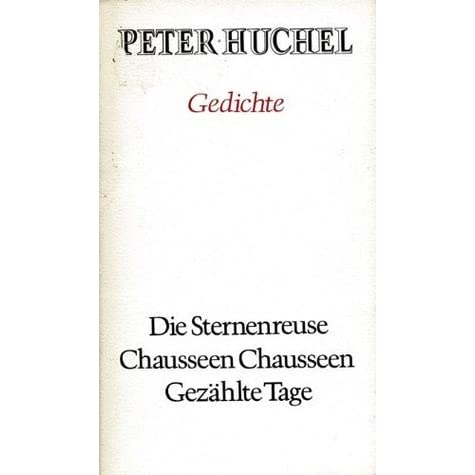 With the fall of the Third Reich, Huchel enthusiastically shared the democratic and socialist optimism of many of his compatriots for the reconstruction of East Germany. His short-lived faith in land reform in the immediate Soviet-Occupied post-war years is consistent with his earlier social concerns. He now began working for East German radio and in 1948 at last published his first collection, Gedichte (‘Poems’). In 1949 he became editor of the influential literary magazine Sinn und Form (‘Sense and Form’). Though Huchel’s poems were applauded both for their craft and socialist undercurrents, they did not satisfy those who were soon demanding much more explicit support for the German Democratic experiment. Huchel’s dark rural landscapes offered equivocal support at best for the governing regime and his instinctively conservative harking back to childhood and the natural world (rather than a modern revolutionary transformation of human society) were judged to fall short of the expected unquestioning celebration of the GDR’s project.
With the poet’s increasing sense of disaffection from the direction of GDR society, Huchel was once more forced to adopt the role of ‘inner émigré’. The tone of his work becomes increasingly sombre and melancholy, his poetic diction grows more clipped and cryptic, his palette narrowing. In his work at the journal Sinn und Form, he was determined to maintain editorial freedom and the publication flaunted an international outlook with contributions from Aragon, Bloch, Brecht (two special issues), Camus, Eluard, Langston Hughes, Thomas Mann, Neruda, Sartre, Yevtushenko and Zweig. Increasingly, he came into conflict with the authorities and was put under immense pressure to conform. He resisted for 13 years – in large part because of the determined support of Brecht. Brecht’s death in 1956 left Huchel exposed and he was asked to resign his editorship. He refused and so compelled the East German government publicly to force his resignation.
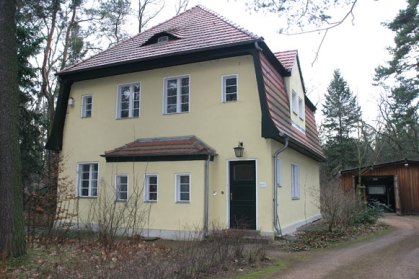
A year after the building of the Berlin Wall in 1961, Huchel was banished at the age of 59 to effective house arrest in Wilhelmshorst. It was at this moment that his second collection of poems, Chausseen, Chausseen (‘Roads, Roads’), appeared. He published it – in bold defiance of the GDR authorities – in the West. It was much praised in the author’s absence. Henry Beissel describes the leanness and density of these new free verse poems: “images are more insistent on turning concreteness into a code; sadness emanates from a sense of the inevitability of loss and from a world bent on self-destruction”.[viii] Huchel’s images from nature are left to speak for themselves; his is often an impersonal poetry of a particularly haunted and pessimistic kind. Yet there is stoical survival too; the poems remain marvellous acts of observation.
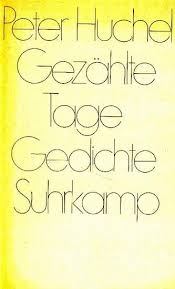
The poem ‘Hubertusweg’ vividly portrays this period of his life, from 1962 to 1971, living in isolation, under Stasi surveillance. Gezählte Tage (‘These Numbered Days’) appeared in 1972, the title suggesting the counted days of Huchel’s time under house arrest, his poems recording them, marking them, but also a residual sense of them actually counting towards something, his legacy as a poet, his hoped-for release. Huchel repeatedly applied for an exit visa for himself, his wife and son and in this he was supported by PEN in an internationally orchestrated campaign.
Eventually, in 1971, the Ulbricht government granted his release and he lived first in Rome, then in a borrowed house near Freiburg in West Germany. But like many GDR artists who moved to the West, Huchel was equivocal – to put it mildly – about what he found here. Because the GDR had failed to bring about a truly democratic and socialist society did not mean that he had given up his ideals and the West’s materialism, egotism and faithless profiteering were repellent to him. There is a spiritual emptiness everywhere as in ‘Subiaco’, set in Italy, where Pilate’s bowl stands emptied of water so the taint of guilt cannot be washed away. Huchel’s gloom is partly determined by his own nature, partly by his background, by political persecution and by his divorce from his Brandenburg homeland. The poet bears witness to the inadequate present.
 In Huchel’s few remaining years he was lauded in the West but perhaps this was just another form of exile, though one in which he was able to speak and publish. Even so, his final collection, Die Neunte Stunde (‘The Ninth Hour’) which appeared in 1979, is a book almost exclusively of elegy and lament. The ninth hour is the hour of despair, the hour in which Christ died on the Cross, crying out, “My God, my God, why have you forsaken me?” Huchel himself died in 1981, aged 78. Contemporary readers can hear something of his more personal voice – so finely attuned to the natural world, but gifted only a tragically powerless place in history, yet driven to labour and bear witness against the odds – in the words of the unnamed peasant who narrates ‘Middleham Castle’, one of Huchel’s more explicit and terrifying portraits of tyranny:
Familiar with the ways of great forests –
the year streaked with the jays’ colours,
painful brightness of frosted boughs,
the winter hair of deer stuck to bark,
fawns huddled together at evening,
warming themselves in the cloud of their breathing –
up the gorse-clad hill with rope and horses
I haul tree trunks to Middleham Castle.
Martyn Crucefix
London July 2020
[i] Karen Leeder, Introduction to These Numbered Days, Peter Huchel, tr. Martyn Crucefix (Shearsman, 2019).
[ii] The Garden of Theophrastus and other poems, tr. Michael Hamburger (Anvil Press, 2004).
[iii] Karl Alfred Wolken, in a review of Gezählte Tage (Rias Berlin, 1972), see http://www.planetlyrik.de/peter-huchel-gezahlte-tage/2011/10/
[iv] George Morgan, ‘Interview with Seamus Heaney’, Cycnos, Volume 15 No. 2, July, 2008: http://revel.unice.fr/cycnos/index.html?id=1594.
[v] Saint Augustine, Confessions, Book X, viii (Penguin, tr. R.S. Pine-Coffin).
[vi] Huchel’s acceptance speech for the 1974 Literature Prize of the Free Masons, quoted by Henry Beissel, A Thistle in His Mouth: Poems by Peter Huchel (1987), p. 10.
[vii] Quoted and translated by John Flores, Poetry in East Germany (1971), from Eduard Zak, Der Dichter Peter Huchel (1951), p. 124.
[viii] Beissel, p. 16.







 Martyn Crucefix