More than 10 years of blogging on poetry and translation – over 39,000 views in 2024 – now captured and preserved at the UK Web Archive: 'one of the top 10 poetry blogs' (Rogue Strands)
John Greening has recently reviewed my new chapbook of poems, Walking Away (Dare-Gale Press, 2025), a review which first appeared on The High Window website.Many thanks to David Cooke at THW and to the reviewer for his kind and perceptive comments about a set of poems for which I feel (an obvious) affection. Mum and Dad would be bemused by it all I think, but pleased to be so remembered.
Martyn Crucefix has come a long way since his remarkable Enitharmon debut, Beneath Tremendous Rain (1990). Learning, no doubt, from poetry he has since translated or adapted – notably Rilke, but also Peter Huchel, Rosalía de Castro and the Daodejing (more familiar as the Tao te Ching) – he has become more and more experimental, more complicatedly troubled. This was especially evident in his 2017 sequence A Convoy and in the beautifully illustrated Cargo of Limbs from Hercules Editions (2019), itself a version of Book Six of the Aeneid.
Walking Away is more straightforward and in some ways a shift towards a major key, though the subject matter might make it appear otherwise. Even the tranquil landscape on the cover reminds us that Crucefix has always had a pastoral streak: he was, after all, brought up in the West Country, which features here a good deal, if elegiacally. The book is dedicated to his parents and it opens with a ‘Video Call’ full of tragi-comic touches (the camera is ‘angled so I catch only the crowns // of grey heads then a giant hand/reaches forward to re-adjust’) and ends with gracefully formal stanzas evoking a ‘provincial market town’ (Trowbridge, perhaps, near the Wiltshire village where Crucefix grew up?).
Fourteen of the pamphlet’s pages are occupied by the remarkable title sequence of four-line poems (drawing on ‘the vivid, condensed power of the haiku form’, as the blurb puts it, but each of a different syllable count) about the decline of the poet’s elderly mother, whose state is addressed more directly in the penultimate poem of the four in Walking Away: ‘My Mother’s Care-home Room (as Cleopatra’s Monument)’. She is portrayed unsparingly with ‘an Easter Island profile / gaunt and beaked’ but becomes a regal presence by the poem’s end as her son keeps his vigil with a final flourish of rhyme:
with all the helpless- ness of a Charmian at the cooling feet of her brave Queen the asp flung down beneath the only chair there has ever been
The title sequence, however, is the book’s great success, a brilliant series of vignettes, like theatre music without the play, set largely, it seems, during a period when the poet’s mother was in her own home. Some of these don’t feel like haiku, but others have that unmistakable, indefinable quality – perhaps to do with awareness of the seasons:
Turning in at your mother’s front gate Eighty years at a stroke
Swifts no longer nesting
Crucefix knows how to find the Imagistic essence of a situation, as the form demands; and his gift for metaphor has always been considerable:
This week’s new dosette box Grey windows not yet broken
Twenty-eight channels nothing on
Once you work out what a ‘dosette box’ is (one of those compartmentalized containers for daily tablets), the image here is potent and at least as good as ‘Petals on a wet, black bough’. For their full effect, these fragments do need each other, and they don’t often need such glossing. Take the next one, only the third in the sequence:
Telephone numerals are big and bold The size of Scrabble pieces
A language you once knew
The brevity is fitting, since that’s often the way one communicates with those in decline; there is tea, a shared remark, more tea, a view of a lawn, knick-knacks on the mantelpiece, a car passing, a nap, a scratching mouse, ‘The clamour of carers / A microwave ping’. And while nothing connects with nothing, we are embraced by an intense emotion and a sense of an approaching end. Walking Away demands to be read.
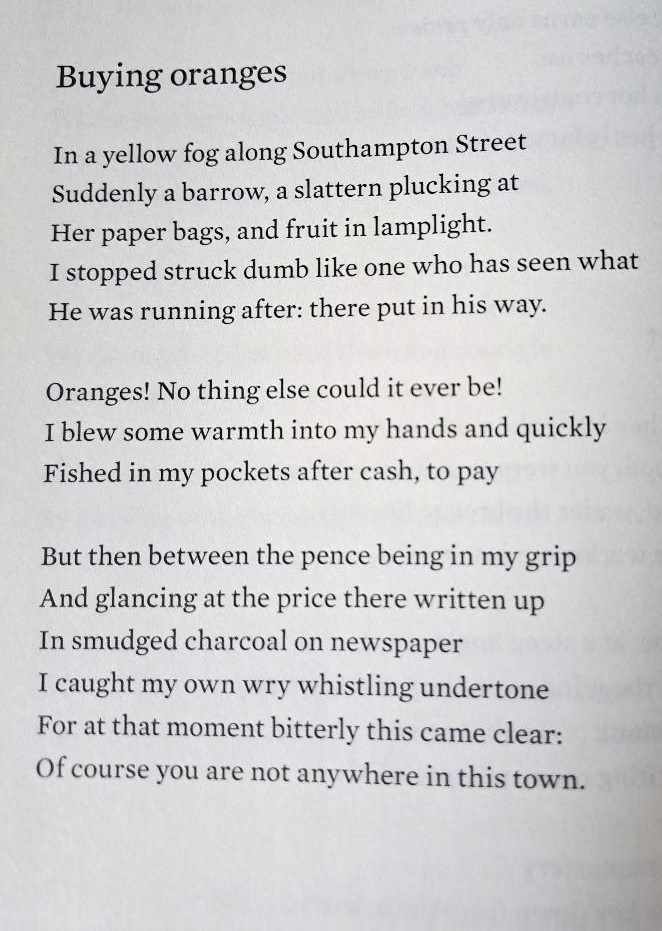
The Brecht-related poem arose after I’d attended a discussion on the German poet/dramatist by David Constantine. One of the poems he presented to those attending (with his translation) was ‘Buying Oranges’. This is one of the poems Brecht wrote for his lover, Margarete Steffin, in the 1930s. Constantine’s translation (from The Collected Poems of Bertolt Brecht (Norton, 2019) goes like this (hear it read by Daisy Lafarge here):
It was the circumstances surrounding my first acquaintance with this poem that led me to write a very loose version of it. I’d booked the event with David Constantine months before, but it happened that my mother sadly (but not unexpectedly) died in her Wiltshire care home the night before. I debated what I should do but decided in the end to attend the talk (I figured there was nothing urgently to be done; Dad had died a year or two before). The world looked different of course. In fact the day was bright and sunny. The event was near Holborn (not far from Southampton Street itself). As you’ll see, I turned oranges into chrysanthemums (my mother’s favourite flowers) and I find now that I lengthened BB’s irregular sonnet to 16 lines. Here’s my version:
ON SOUTHAMPTON STREET after Bertolt Brecht
A mizzling cold fog on Southampton Street then suddenly a market stall with its spectral blooms under a bare bulb preternaturally lit
a sullen frizz-haired girl cutting stems and I’m dumbstruck as one who’s found the thing he looked for here—at arm’s length—chrysanthemums—
nothing but them! I blow on stiff fingers plunge them into a pocket for coins but between fumbling silver and glancing back up to check the price
scrawled on a yellow card it feels as if I interrupt myself—a dull under-voice lifted in bleak remembrance— since last night you’re not here or any place
The second poem appearing on The High Window this week had a much more mundane beginning. Several years ago (how long can some poems take to arrive in their proper form?) I was staring from a window (in a classroom – perhaps I was invigilating a test) and down in the car park below I saw a car valet parking up his van next to a much fancier car. I seem to have watched him pretty carefully if the poem is to be believed (which I’d usually say not to). Gradually, the poem acquired its erotic undertones (the lovers back to back in bed, the intimacy of the hand-washing, the moisture, the smells, the final turning away) which surprised me as I thought the poem was mostly a comment on work, labour (I love poems about processes) and ultimately about class differences (for money, one man cleans another man’s car). The epigraph is, of course, from Donne’s great love poem ‘To His Mistress Going To Bed’ but here is intended to reflect the working man’s thoroughness!
MOBILE CAR VALET ‘Before, behind, between, above, below’
Like a pair of lovers back-to-back bored in bed his white van closes rear bumper to bumper
he opens the doors wide and starts to squeegee the mucky hubs of the big black German
from a sudsy bucket he works the dusty body with a chamois leather inscribing S-shapes
like the briefest foaming of bold graffiti over and round wing mirrors and shining roof rails
then balanced on a tyre sweeps half the roof now the other side and inside across the length
of the dash a pale duster the armrests especially working the driver’s side then a jet-spray
jumps into hissing life spilling gassy whites over the wings and the tyres his best weapon
set back in the van then out with the ancient Henry its scarlet chess piece and snaking black hose
used to scour the seats deep into the footwells and the chamois is back again to buff stray drops
on windows with windolene it smells good to him now the doors slammed the remote locking chirps
as he carries the fob back into the marble foyer like a hatchling his van waits out the length
of one smoke nothing to say to the big German where it glitters alongside already turning away
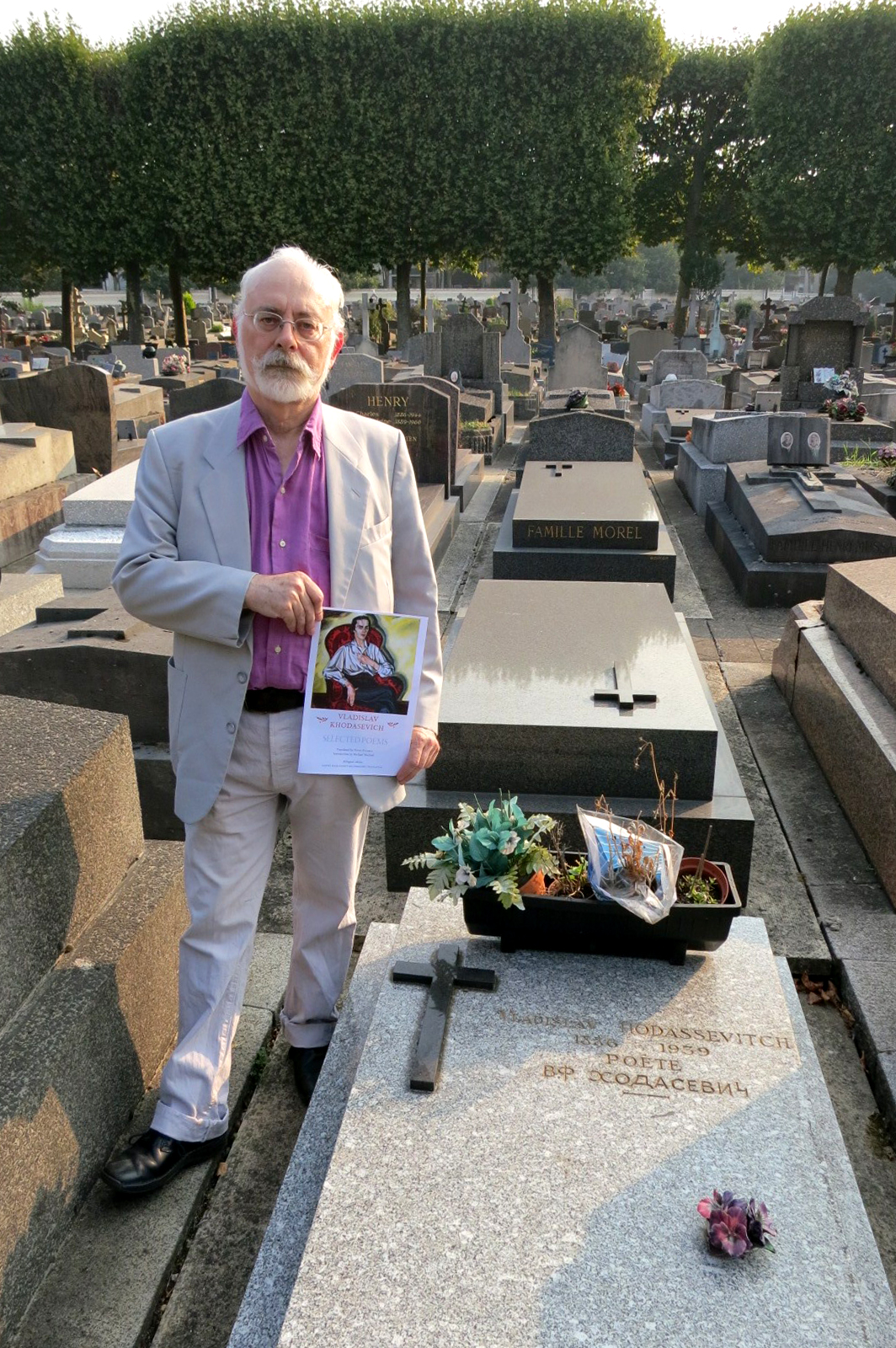
In the light of recent political events in the UK, it seemed important to be thinking about wider perspectives this week – Europe, Revolutions, the role of poetry. The poems of Vladislav Kodasevich came easily to mind and I have wanted to praise Peter Daniels’ translations of them for a while now.
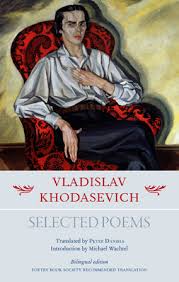
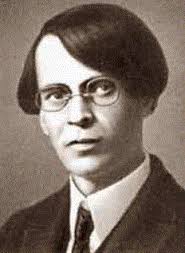
What emerges from Peter Daniels’ Vladislav Khodasevich: Selected Poems (Angel Classics, 2013) is a vivid picture of a poet who was, both by temperament and historical circumstance, very much an individual. From a Lithuanian Polish background, coming to creativity at the fag end of Symbolism, witnessing Russia’s revolutionary year of 1917, going into permanent exile in 1922, Khodasevich (1886-1939) was perhaps inevitably a writer with little sense of belonging, of sure identity. It’s no surprise that he plays with images of doubles, often standing outside himself, then counters such doubts with rather grandiose claims to his poetic vocation.
The consequent difficulty of pigeon-holing him as a poet is one of the reasons why he is less well-known than his more familiar contemporaries – Mandelshtam, Akhmatova, Tsvetayeva and Pasternak. He is also difficult to pin down because he is “a modernist, but with a classical temperament” (Daniels’ Preface). In a period when others were tearing up rule books (poetical and political) Khodasevich harks back to the “eight little volumes” of Pushkin’s works. Amongst the ruck of Symbolists, Acmeists, Futurists and Cubo-Futurists, Khodasevich’s poems mostly retain traditional forms and he proudly declares: “I grafted the classic rose / to the Soviet briar bush” (‘Petersburg’). Such formalism presents great challenges for the translator, of course, with Khodasevich flaunting his conservative and poetic concerns – “O may my last expiring groan / be wrapped inside an articulate ode!” – and, like many before and since, he argues such formal frameworks are paradoxically the way to find release. (Carol Rumens has discussed some formal aspects of a Daniels/Khodasevich poem for The Guardian). Curiously, his last ever poem was in praise of the iambic tetrameter, the classic metre of the Russian tradition:
Its nature is mysterious,
where spondee sleeps and paeon sings,
one law is held within it – freedom.
Freedom is the law it brings . . .
Vladislav Khodasevich
If Khodasevich uneasily straddles a variety of poetic strategies, there is a fascinating parallel to this in his views on self and society. The self is at one moment urged to “be a star that breaks away from the night” but in the next is “grunt[ing] to yourself, / looking for spectacles or keys”. This “usual self” is preoccupied with tarnished spires, the tops of cars, old iron eaves, and in ‘Berlin View’ sits shivering and sneezing in a café, surrounded by “plate-glass” reflections of itself. A couple of years later, at what seems a Dantesque ‘mid-point’ in his life, Khodasevich stares hopelessly into a mirror: “Me, me, me. What a preposterous word! / Can that man there really be me?” This is the Modernist side of the poet, observing from “the gutter”, watching a sordid Parisian cabaret, a dismal demi-monde of “tinselled chaos”. Yet the poem quoted here – ‘The Stars’ – goes on to suggest our gaze may sometimes incline upwards, “from the horizon to the stars” and – at least on occasions – we are aware of a “starry universe in glory / and the primordial loveliness”.
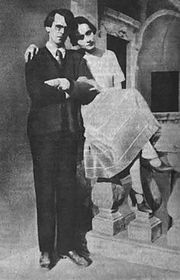
Khodasevich and Nina Berberova, Sorrento, 1926
This suggests Khodasevich was still enough of a Symbolist to see the poet’s role as seeking out such “loveliness”, the transcendent within the quotidian (as Michael Wachtel’s Introduction defines this key Symbolist intent). This accounts for Khodasevich’s repeated images of stars often unseen above us (but still there) and also of the flourishing of seeds in the earth as an image of personal and social growth. The title poem of The Way of the Seed (1920), in rhymed couplets, describes the traditional sower, with seed gleaming golden in his hand, but scattered into “the blackness of the land”. There it finds “its moment for dying, and for growth”. Latterly, the poem suggests this is also the path of the “soul” as well as “my native country, and her people”. This nicely sums up Khodasevich – the progressive conservative, these organic and traditional images of the farmer absorbed into bold ideas of growth and change incorporating both a dying back and re-birth. A similar pattern is reflected in ‘Gold’ – a coin is placed into the mouth of a corpse, buried, and after many years, in the unearthed skull, the coin is found again, rattling: “the gold will flash in the midst of bones, / a tiny sun, the imprint of my soul”.
Peter Daniels at Khodasevich’s grave
It is in such longevity, such insightfulness that continues to be true, that Khodasevich finds reasons to celebrate the poetic vocation. Though the names of the dead who fell at the Battle of Khotin (1739) are forgotten, “the Ode upon Khotin” by Lomonosov is still recited. ‘Ballad of the Heavy Lyre’ opens with Khodasevich in the Soviet-run House of the Arts, surveying his life and finding it “worthless, a quagmire”. But eventually verses burst from him till “a galaxy streams at my head” (those stars again) and a heavy lyre is mysteriously thrust into his hands and, in the final line, he understands this is the lyre of Orpheus. Written in 1921, this poem foreshadows Khodasevich’s departure from the Soviet restrictions in the following year with hopes (one imagines) of further freedoms to be enjoyed.
I was especially interested in the seven substantial blank verse poems Khodasevich wrote in a brief period between 1918-20 (David Cooke’s review of the book for London Grip makes the same observation). These in particular bring to mind the modernist-conservatism of Robert Frost (whose two first books were published in 1913 and 1914) and it’s astonishing that Khodasevich did not pursue these successful experiments with a less formal verse that seems an ideal vehicle for his quiet observational voice, his sense of the mystery or beauty that lies beneath the ordinary, his observations of a provisional self often encountering an unstable, uncertain world.
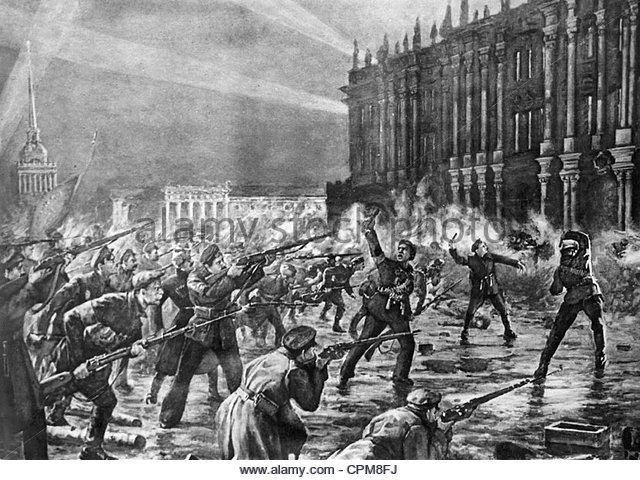
‘An Episode’ appears to record, moment by moment, an out-of-body experience Khodasevich had in 1915 (these blank verse poems are always keen to name times, places, people). At one moment, he sits before a shelf of books, at the next he is gazing at himself as if looking at “a simple, old, old friend”. The transitional moments are evoked through the marvellous image of feeling like a “diver, plunging to the deep, [hearing] / the running about on deck and the shouts / of the sailors”. ‘2nd November’ describes the aftermath of revolution – again the precision of street names, people’s responses as they emerge into the smashed and bullet-scarred streets makes this read as a very contemporary poem indeed. The narrator watches a neighbour, a joiner, building a coffin and painting it: “under the brush / the boards were turning crimson”. But the golden seed in black earth comes to mind again as a child is observed – a “four-year-old, chubby, in a flap-eared hat” – who manages a smile as if listening to Moscow’s “beating heart, / the moving fluids, growth” though for the narrator even Pushkin’s beloved works, on this occasion, fail to alleviate the shock of political change.
The unresolved tensions Khodasevich manages to hold together in these blank verse poems create a very modern impression. Another child appears in ‘Midday’, the narrator sitting in the most ordinary street scene, recalling a visit to Venice, fleeting glimpses of those “incandescent stars” once more. ‘An Encounter’ drops the star images for a more conventional image of beauty or inspiration, a “lovely English girl” glimpsed in Venice with its “black gondolas, / the fleeting shadows of pigeons, and the red / flow of the wine”. The extraordinary poem ‘The Monkey’ replaces the stars and the girl with the bizarre image of a tame monkey in a “red skirt”, led on a chain by an itinerant Serbian man (a much inferior translation of this poem by Alex Cigale can by read in The Kenyon Review). After a drink of water from a bowl, the monkey offers “her black and calloused hand” with such “nobility”. It’s the realism of the setting – the heat, the cock crow, the dusty lilacs – that enables Khodasevich to anthropomorphise the animal to such an extent and get away with it. It becomes another epiphanic moment in which the transcendent emerges from the quotidian. Here, a great chain of brotherhood seems implied and this makes the final line all the more devastating: “That was the day of the declaration of war”.
The two most Frost-like of these blank verse poems describe respectively a derelict house and a couple of neighbours chopping wood. ‘The House’ leads to reflections on transience, whether for a “palace” or a “shack”, the sudden advent of “war, plague, famine, or civil turmoil”. Such contrasts are again viewed from an Olympian height, an aloofness which has more negative capability about it than unfeeling Modernist cynicism. An old woman appears, scraping a living, and rather than pass judgement on her or her fate, the narrator joins her in stripping useful materials from the ruined house: “in pleasant harmony / we do some of the work of time”. A green moon rises ambiguously over the scene, casting light over a “tumbled” stove. Khodasevich’s rich embrace and acceptance are also evident in ‘The Music’ as two neighbours chop wood. One suddenly claims to hear music but try as he might the other cannot hear it. In ‘Mending Wall’, Frost’s narrator likewise teased his farmer/neighbour and drew from him an old saying: “Good fences make good neighbours”. Khodasevich’s poem yields only a sense of earthly work well done together, the remoteness of the sky (from which perhaps that music fell), the clouds passing onward as “feathery angels”, or perhaps they are really no more than clouds.



 Martyn Crucefix