Forward First Collections Reviewed #4 – Andrew McMillan

This is the fourth in the series of reviews I will post over the next two months of the 5 collections chosen for the 2015 Forward Prizes Felix Dennis award for best First Collection. The £5000 prize will be decided on 28th September. The shortlist is:

Mona Arshi – Small Hands (Liverpool University Press, Pavilion Poetry) reviewed here;
Sarah Howe – Loop of Jade (Chatto & Windus); reviewed here;
Andrew McMillan – physical (Cape Poetry); reviewed here;
Matthew Siegel – Blood Work (CB Editions) reviewed here;
Karen McCarthy Woolf – An Aviary of Small Birds (Carcanet) reviewed here.

Andrew McMillan – physical (Cape Poetry); author’s website here.
Article from The Independent on Andrew McMillan here.

A man’s torso, from just below the shoulder to half-way down the rounded buttocks, tastefully lit from the back to catch the curves, his left hand visible clutching (quite hard) his own right flank. It’s sexy and lonely and longing and anonymous. It’s a bit Fifty Shades but Cape Poetry’s cover image does say something about Andrew McMillan’s first full collection, though it’s too confining. It’s the sort of sharply targeted thing marketing people come up with and the author (who is achieving cleanly-shaped, clear, bold things in terms of subject-matter and form) may squirm at.

imgres

But the image is flauntingly male (and happily the skin blemishes have not been air-brushed) and what it is to be a man is certainly one of McMillan’s concerns. In ‘strongman’ a nephew wants to be bench-pressed by the male narrator and (even from the young child) this is a clear challenge as “his mother’s lover” often does it, the boy has declared the narrator’s boyfriend “illegal” and he brings with him the freight of traditional masculine values: “his dad’s voice and jaw”. The narrator obliges “because / what is masculinity if not taking the weight // of a boy and straining it from oneself?” It’s not just the bench-press requiring careful balance here in the close masculine contact, the show of strength, the carefully maintained distance in the preposition “from”. The inculcation of traditional male values starts early as in ‘The Schoolboys’ who clamber onto a bus, all bulge and muscle and “sprints of growth”, wrestling “to impress the girls”. The poem ‘things men take’ is one of McMillan’s lists, articulating a more adult version of this: they take “the room above the ceiling / the better pay the jobs / your space at the bar”. But it’s with a poem like ‘the men are weeping in the gym’ that we begin to see this poet’s determination to challenge the status quo in its brief fantasy of male affectiveness: “their hearts have grown too big / for their chests their chests have grown too big / for their shirts [. . . ] they are crying in the toilet”. There is real humour here as the gym is turned from a place of physical exercise to a place where emotions are released and flexed, a re-definition of those traditional ideas of ‘strength’: “they don’t hear / the thousands of tiny fracturings / needed to build something stronger”.
images

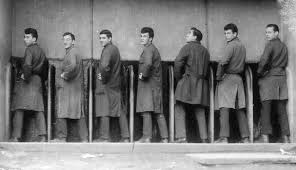
But masculinity as in what it is to be a gay man in love is even more central to physical. A definition of love emerges at the end of one poem which begins with awkward fears of (literally) bumping into men in a urinal, causing spillage, splash, a turning, the revelation: “neither of us will look / or he’ll look at me avoiding looking / feigning interest in the hard cream tiles”. This is funny again though halfway through the bluntly titled ‘urination’, McMillan considers the privacy and intimacy of “the toilet”, the poem lifting into praise of waking to hear (and smell) a lover pissing “the morning’s pale yellow loss” into the toilet “and take the whole of him in your hand / and feel the water moving through him”. Such intimacy of contact is one of the provisional definitions of love: “the prone flesh / what we expel from the body and what we let inside”. Poems that explore the physicality of the male body make this book remarkable, even given McMillan’s acknowledged debt to Thom Gunn. Much after the pattern of ‘urination’, ‘yoga’ begins with the physical stretching and breathing of the class, but shades seamlessly into a love-making which echoes the breath, control, weightlessness and absence of “judgement” in the discipline of yoga. ‘Saturday night’ takes lines from Gunn’s poem of that name this time to explore a more roaming, disjointed experience of love and sexuality. The rule of ‘Boss Cupid’ is no more reliable than in the straight world, of course, and McMillan gives us other images of sleeping with “Thom night after night / open at the spine”, rather than any flesh and blood lover. And ‘screen’ imagines how even a gay porn star, so perfect and capable on screen, in real life “without direction” struggles to express himself, “stopping mid kiss pulling back mumbling”.
imgres

As my quotes suggest, McMillan abandons most punctuation in these poems, using only line and stanza breaks and long spaces to create pauses and some sense of syntactical form. This works well – it doesn’t for me interrupt or confuse at all – and contributes to the often passionate flow of the poems. It’s hard to convey this in short quotes but ‘choke’, running for just 22 lines, takes us rapidly through a relationship break up, weeping, talking, loving and next day reflections, managing to evoke the agitation, fluidity of feelings, and final resolve “to tough it out” and the lack of pointing is part of this success. Elsewhere, the flow and even blurring achieved syntactically is just right for the loss of self-consciousness associated with sexual pleasure.
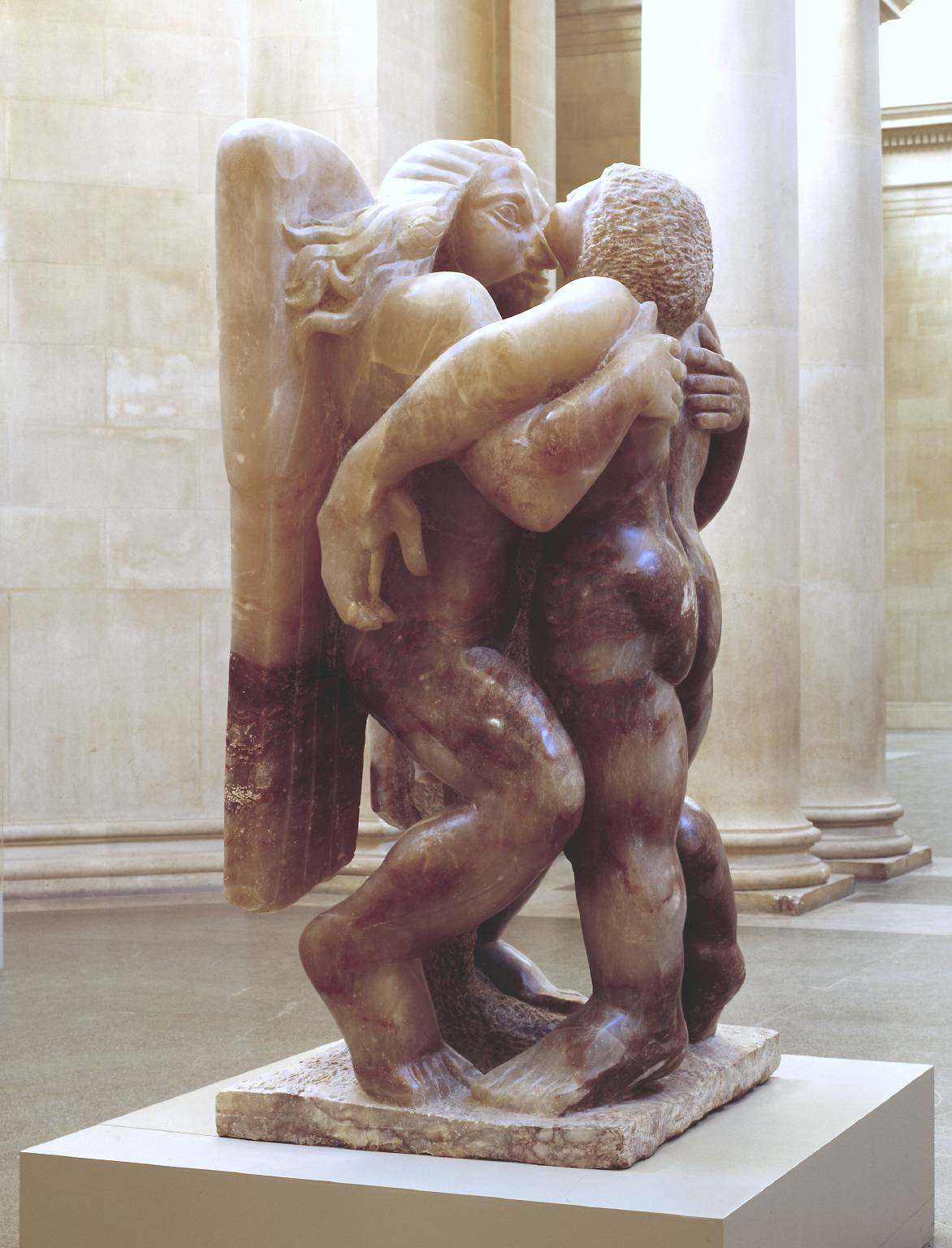
Jacob and the Angel - Epstein
Jacob and the Angel – Jacob Epstein

What is interesting is that beside the passionate and “carnal” (Michael Symmons Roberts) nature of much of this book and alongside Thom Gunn as mentor and role model, McMillan also name-checks C.S. Lewis’ Mere Christianity. The opening poem of the book portrays gay sexuality with Jacob wrestling the angel and I’ve mentioned the paralleling in ‘yoga’ and those beefy men crying in the gym are said to have “God” entering them as they weep. Furthermore, ‘revelations’ argues that each subsequent love is only a searching for the first, “in the manner of the humble saints who make / the worship of a nameless god relatable”. Each lover is renamed, Saint Gavin Saint Ged Saint Unknown / of Manchester Bedsit”. Humour is used here but it hardly disguises the poet’s interest in the more spiritual implications of the physicality his poems work so hard to evoke. This religious sensibility emerges in the brief foray, moving from Eros towards Thanatos, in poems in the third part of the book. The deaths of a grandfather and a young girl strike a very different note and suggest that McMillan may have found in Gunn not merely ways to explore his own sexuality in verse but also (from early Gunn) that existential sense, so wonderfully expressed in ‘On the Move’ (1957), that movement (whether on a motor bike or in bed) is at least one way towards self-definition: “astride the created will / They burst away [. . . ] Reaching no absolute in which to rest, / One is always nearer by not keeping still”.

imgres
Thom Gunn

There is something of this in the final poem of physical. Ironically titled ‘finally’, it evokes a new morning in “the xylophone / of sunthroughblinds”, but the lover is gone, not to return and the poet is like the birds who, though it hasn’t rained, pretend that it has, so “they can sing”. Earlier, the longer sequence ‘protest of the physical’ noted “there is beauty in the ordinary” but this is a pallid observation in contrast to this poet’s determination towards self-definition through loving, through singing when the loving is over.

In a collection full of humour and sadness alongside the plain-spoken eroticism, I really like what McMillan is doing with the fluidity of his form. I don’t think the longer sequence ‘protest of the physical’ is as good as the other sections of the book (I believe it preceded them in terms of date written) but here is a really talented and bold writer and I can see further areas of exploration opening up and it will be exciting to follow him there.

237946238_ca1d002403_b

Forward First Collections Reviewed #3 – Matthew Siegel

This is the third in the series of reviews I will post over the next two months of the 5 collections chosen for the 2015 Forward Prizes Felix Dennis award for best First Collection. The £5000 prize will be decided on 28th September. The shortlist is:

Mona Arshi – Small Hands (Liverpool University Press, Pavilion Poetry) reviewed here;
Sarah Howe – Loop of Jade (Chatto & Windus); reviewed here;
Andrew McMillan – physical (Cape Poetry); reviewed here;
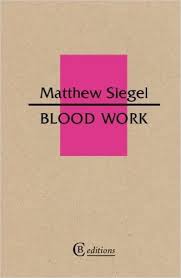
Matthew Siegel – Blood Work (CB Editions) reviewed here;
Karen McCarthy Woolf – An Aviary of Small Birds (Carcanet) reviewed here.

Matthew Siegel – Blood Work (CB Editions); Forward Prize webpage on Matthew Siegel: here.

imgres

This is a really good first collection because of its remarkable consistency of tone and manner and it possesses what I, perhaps narrow-mindedly think of, as that American quality of confident fluency, indeed fluidity, which seems capable of encompassing so much experience without straining at the seams. In their very different ways, I find this in the work of poets like Billy Collins, Louise Gluck, Jorie Graham, Robert Hass and Larry Levis. I’d trace it back to the big enfolding arms and lines of Whitman who, along with Rilke, are Siegel’s two declared influences. But this ‘all I survey’ quality of the book is rather undermined by the publicity surrounding it which narrowly focuses on the fact that Siegel was diagnosed at the age of sixteen with Crohn’s disease and that his debut collection is all about this. Mark Doty (no less) considers the book “a genuine contribution to the literature of illness”.

It may well be – but like Robert Lowell, Thom Gunn and more recently (Siegel’s CB Editions stable-mate) Dan O’Brien, Blood Work’s focus on a very specific milieu or set of experiences does not prevent the alchemical transformation into an art with which those not brought up in the upper reaches of New England society, in the West Coast gay scene, embroiled in modern war zones can identify. In old money terms, they find the universal in the particular and Siegel does this in poems that move beyond a young American with Crohn’s disease to explore family relations, love relationships, questions of self-definition and the tensions between speech and silence.

imgres

The opening poem is important in carving out a certain distance, an ironic space, between the Crohn’s sufferer and the poetic voice (there are a few ekphrastic poems scattered through the book which do the same job). It is one of the few poems narrated in the third person and we are urged to “look” at a hospital attendee, back in what seems familiar territory (the chronic aspect of Crohn’s), the floral prints on the walls, the hospital gown “like an old costume / pulled out of a locked trunk in the attic / of bad dreams”. He feels sexless or desexualised, but is writing a poem “in lowercase”, particularly the first person pronoun. The writing of the poem becomes the subject of the poem but this self-reflectiveness is not rebarbative in the way it often can be (self-regarding, aggrandising, clever-clever) but more modestly self-mocking, an awkward self-consciousness. The patient/poet would rather be drawing a comic book, with himself as a “small mammal”. He sees himself as a fox and in the poem’s final line he changes the title of the poem he is writing which is the title at the head of the first page we have just read: ‘fox goes to the fox hospital’.

The space created by this poem around the very specific medical context gives the remaining book permission to range widely and introduces the idea of “containment”. What can or cannot contain the individual is a recurring idea (picked up by Doty in the cover blurb). The title poem has the narrator’s blood being taken from a vein (already a familiar experience to this young man – the context seems to be earlier in the poet’s life). The nurse allows him to hold the warm filled tubes of his own blood: “I nod, think about condoms, tissues / all the things that contain us but cannot”. Containment here means summation perhaps, but with overtones of imprisonment in the sense that a medical condition (a disability? a gender? a skin colour?) may determine much about the individual, yet ought not be allowed to fully define the person. This too is Siegel’s subject in the book; the spillage, or extension, we can achieve or are permitted beyond what might define us.

So ‘Sometimes I don’t know if I’m having a feeling’ may or may not be closely related to the poet’s own medical condition but it is a familiar experience for most of us. The uncertainty of thoughts and feelings, the sensation of having missed “the entire party”, of being known only as “a strange / version of the person you thought you knew”, the old question, “Who am I?” It’s a sign of the ironic distance maintained by these poems (not at all the same as cool inconsequentiality) that Siegel can answer that question with humour: “A question / for the Lord only to decide as She looks over / my resume”. Elsewhere, such questions are more difficult to answer. ‘Love Parade’ stresses the distance the narrator feels from others (‘I fear my body incapable of loving’) or he plays with the idea that the opportunity of a poem is little more than a late-night phone-in for the lost and lonely. The desire for contact with others (that wish for spillage and extension) can grow to “the size of a building”, taking Siegel down avenues of surrealistic imagery, creating a city-scape from the thoughts of a lover’s body.

images

These ‘others’ do feature significantly in this book. We meet the heater repair woman, a Vietnamese masseuse, Nancy the dentist, a supermarket flower seller, stall-holders at a Farmer’s Market, a multitude of doctors and nurses, various romantic entanglements. Though all these dip and dance about the central consciousness, they are given individuality (more Whitman here, I think). Thirteen year old Bryan is a sleepy student and the narrator is the teacher who watches him doze at his desk, bored by a literature class. The poem is a lovely act of empathy with the boy, his awkwardness and uncertainties, concluding with the self-discovery that the boy may well become the watching adult who “instead of chastising him / wants to touch his hair”. Not what child protection might want to hear, but true enough for those who teach.

imgres

But the book is also concerned with family, in particular a mother-figure who, like Bryan, is observed while sleeping and Siegel asks “What world / contains you”. In this poem, she dozes, exhaling “in little puffs” and perhaps it is her son’s inability to quite define her that means he can “only watch for so long”. She is a mystery, though in poem after poem she is shown crying, smoking dope to forget, mourning an ex-fiance, the son helplessly, left to “wonder if I could reassemble my mother”. In ‘Matthew you’re leaving again so soon’ we hear her reported voice fussing and trying to bestow love and affection through gifts of pens, an umbrella, socks, as he prepares to leave, in an effort to say what seems impossible to be said explicitly. We see her (smoking another joint) listening to the music of Enya (‘it’s in Gaelic’), tearful again, yet smiling “as if hurt is the balm”. For all the lack of specific detail about her life and loves, this mother-figure is a powerful creation we may hear more of in Siegel’s later work.

So the book does not duck difficult experiences, nor distance them defensively. Siegel’s watchwords are openness and a winning tenderness. Despite the questions of illness, he can apply such qualities to himself too and in ‘Overlooking the City’ there is a brief respite which amounts to something like redemption: “No, I am not hurting in this moment”. As the sun sets over the city, “red does not remind me of blood” and the imagined blessing of the sun’s rays reach “even me, surrounded here and alone”.

stock-footage-time-lapse-sunset-over-los-angeles-city-landscape

Even in a poem that gets pretty explicit about his medical condition, some reconciliation seems possible. ‘Rain’ opens:

I thought I knew desperation until I found myself
tightening my asshole like a bolt,

gripping the banister and crossing both legs,
knees shaking.

I tried to read a poem on the toilet [. . .]

But still the narrator can elude such a total, imprisoning self-definition to find some pleasure in the view from a window to “see grass // glowing green in rain and streetlight – / so many bright beads of water”.

So a book I really admire for its capacity to encompass such variety without bursting into fragmentary utterances. It doesn’t do anything startling formally or linguistically, but its achievement is more emotional and empathetic, Siegel’s voice engages the reader at all times in just the way he seems to engage and commit to the many people who inhabit these poems with him. Would make a worthy Forward First Collection winner.

How to Write a (Poetry) Blog

A provocative blog title perhaps but hard to resist sometimes – see point 2.18 later – but this is less generally instructional and more a prompt to self-reflection. Amazingly, it is a year this week since I started this blog. Never the same river twice, of course, but I thought it right to post a few reflections on how it’s gone so far. My intentions, changes, thoughts on and lessons learned – plus nine bits of Blog Wisdom picked up along the way.

imgres


  1. My original intentions

1.1  I always enjoy critical writing but chafe sometimes against waiting to be asked to review or the choice of review books I have been given, or word limits. My own place where I could be editor and reviewer seemed very attractive

1.2  I wanted to become familiar with the idea, techniques and impact of blogging as this seemed a form of cultural contribution that was of growing importance and I didn’t want to feel wholly left behind

1.3  I could pick out three vaguely-defined areas of blogging possibilities for myself: poetry, teaching, translation

1.4  I had been reviewing poetry books and writing about poetry writing for years in a variety of paper magazines prior to starting the blog. Part of my intention was to be able to post up some of these older pieces (where I still thought them relevant and worthwhile) so that they would be searchable on the web, hopefully preserving their lifetime

1.5  I can’t remember how I came across the WordPress system – probably by chance, or perhaps via another’s blog – but it seemed so user friendly that I thought even I might manage it (I’d had a few false starts trying to create a web page)

1.6  I understood intuitively and then found it out there as Blog Wisdom that regular posting is important and I set myself the task of a weekly post.

images

1.7  I was anxious before I got started about whether I would find things to write about on a weekly basis – I sort of hoped it would acquire a momentum of its own

1.8  I never intended the blog to be very personally revealing (though this is advised in the Blog Wisdom) – this was to be a place where I might discuss the art of poetry (and teaching literature and issues of translation) with myself and in the hope of drawing a response from others

1.9  On the other hand, I’d also been writing sections of autobiographical material in recent years and I vaguely  thought I might be able to post this up in experimental posts – something I was not likely to be asked to do by the usual journals and magazines

1.10  I thought the blog would contribute to my self-promotion – after all a writer is supposed to actually sell booksimages

  1. How the year unfolded

2.1  Having begun very tentatively with WordPress, it quickly became clear that I could easily create a full website using its simple tools – not merely a blogging site

2.2  I’d not been much of a blog follower before starting my own – since then I have enjoyed following others and not merely as a means of spying on the competition (though of course it’s not a competition)

imgres

2.3  I figured out how to tag posts to make the site more searchable by Google etc (the Blog Wisdom seems to be that no more than a dozen tags should be used – beyond that they become less effective – still a bit foggy on this)

2.4  I also figured how to Tweet a link to the blog posting and link to FaceBook and other blog sharing sites (also still a work in progress)

2.5  I had problems preserving stanza breaks as the WordPress system seemed to collapse everything down to standard line break widths once posted. Thank you, Josephine Corcoran for helping out with this one.

2.6  I have really enjoyed choosing a variety of images to decorate the blogs – and captioning some of them (once I’d worked out how to make a caption)

2.7  The Blog Wisdom has it that the more active you are on others’ blogs (liking and commenting etc) the more likely you are to get traffic back. I’m sure this is true and I’m sure I don’t do it enough. This could be a full time job in itself but I’m sure it would reap benefits if I did it

images

2.8  I thought I would post some of my own poems on the blog but in fact have not done much of this at all – these days the definition of ‘publication’ often includes even a personal blog and that may not be the best place for work to appear first. On a few occasions I’ve posted up already published work

2.9  The Blog Wisdom has it that embarking on a series of related posts is a good idea assuming that you might gather up an audience on the way, create expectations etc. I’ve had a go at this a couple of times. Jury’s out on this one

2.10  Fairly early on in the year I had the idea of recording briefly my own reading (mostly poetry related texts) and set up the What Have I Mostly Been Reading page. I’m updating this roughly every month and it has proved a page that people visit quite often. There is a temptation to make my brief comments less brief

2.11  I realised that what I was doing with the blog was journalism. Pretty obvious to most but it struck me forcibly as a different sort of writing with its own rules and I rather enjoyed the frequent deadlines

2.12  I also tried reviewing live poetry events that I attended and these seem to have proved quite popular – certainly there is not much of this sort of reviewing around and it’s good to record these ephemeral occasions in some way

Poetry-182-150x150[1]

2.13  The Blog Wisdom has it that blogs develop any kind of following slowly and that is true enough. But when even a few comments and likes start coming in there is a surprisingly immediate sense of a community. WordPress provides statistical analysis of visitors and views on a blog site and these also give some sense that what you are writing is not being wholly ignored (but see dangers later . . . )

2.14  The Blog Wisdom also has it that to associate posts with specific events, times of year, cultural events, prizes, other publications etc is a good thing. I’ve tried to do this with live event reviews, prize lists, magazine publications, book publications

2.15  As the year has gone on I have sadly found less room for blogging about the teaching of literature – largely because (as it turned out) I had plenty of pressing ideas in the other two areas of poetry and translation. I regret this

2.16  As the year has gone on, I’ve been more drawn than I expected towards reviewing new collections of poetry. I’m not sure about the wisdom of this, though it has proved quite popular

2.17  I posted one week on How Do You Judge a Poem which proved very popular and it struck me (as it has struck many publishers) that offering (or seeming to offer) instruction was a way of courting more hits

2.18  I see dangers (as 2.17 suggests) in the temptation to court more hits by naming blogs provocatively, like a journalistic headline or an advertiser. Blog Wisdom suggests this is exactly what one should be doing but I don’t feel comfortable with this

2.19  I see dangers also in the temptation to be wilfully controversial as Blog Wisdom also suggests one should be. But I don’t want to write a tabloid blog

images

2.20  I see dangers in getting obsessed by checking the blog stats several times a day. It’s like checking emails or phones in the same way. As someone once said, this is like opening the front door every few minutes to check whether the postman is coming. Get on with life

2.21  I see dangers of my life being taken over by blog writing and planning what to write. Rilke warned against critical writing of any kind sapping one’s strength and time for real creativity. Was he ever tempted to write a blog?

imgres

Forward First Collections Reviewed – #2 Karen McCarthy Woolf

This is the second in a series of reviews I will post over the next two months of the 5 collections chosen for the 2015 Forward Prizes Felix Dennis award for best First Collection. The £5000 prize will be decided on 28th September. The shortlist is:

Mona Arshi – Small Hands (Liverpool University Press, Pavilion Poetry) reviewed here;
Sarah Howe – Loop of Jade (Chatto & Windus); reviewed here;
Andrew McMillan – physical (Cape Poetry); reviewed here;
Matthew Siegel – Blood Work (CB Editions) reviewed here;
Karen McCarthy Woolf – An Aviary of Small Birds (Carcanet) reviewed here.

*

Karen McCarthy Woolf – An Aviary of Small Birds (Carcanet/Oxford Poets): Woolf’s website.

imgres

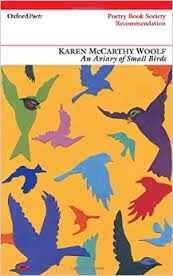
Carcanet’s colourful cover image of fluttering songbirds belies the terrific freight of grief that this book carries. The poems are presented as highly autobiographical and there are actually three deaths involved: that of a friend from cancer, a mother-in-law, and the central focus is the stillbirth of the author’s son in August 2009. The very personal nature of the materials makes critical discussion difficult but, in reading the poems, I found myself thinking of T S Eliot’s observations about what he regarded as the failure of Hamlet. This is the 1919 essay in which Eliot proposes his idea of the objective correlative, “a set of objects, a situation, a chain of events which shall be the formula of [a] particular emotion”. The emotion is re-evoked in the reader when the objective correlative is supplied by the writer. But Eliot argues Shakespeare could never quite unearth or disentangle the true emotions which he hoped would empower the play’s chain of events of a father’s untimely death and a mother’s remarriage.

tseliot_03

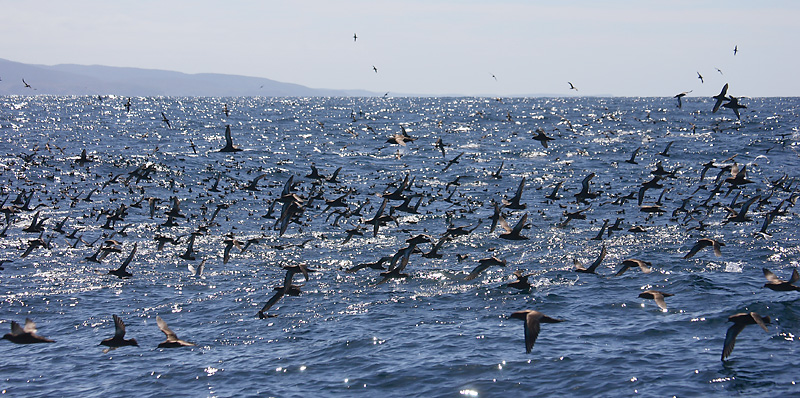
McCarthy Woolf’s book suggests something quite the opposite in that the specific emotions and key events of the child’s death always form the underlying premise on which every single one of these poems runs. This is both a strength and a weakness. The problem can be seen in ‘The Sooty Shearwaters’ which plainly describes the birds heading out to sea to feed. Their return at night time is aided by the switching off of TVs and streetlamps so the birds can “navigate by starlight / to find their young”. The birds’ cry is unique we are told; DJs come to sample it. But what the poem gives us is a chain of events, an objective correlative, which fails to evoke a strong response unless and until the reader brings to the poem the prior knowledge of the stillborn child’s loss. Only when plugged into that does the shearwaters’ determined, instinctive return to their young (and the island population’s touching assistance to that end), really gain force.

76557098.meqOaT2U.000sootyOZ9W1835

Also, as an exploration of the experience of grief, the book faces inevitable limitations because of the nature of the loss. There are several poems set in the acute moments surrounding the stillbirth and immediately afterwards but the majority are set sometime later (the book was six years in the making). Poems are arranged in a broadly chronological fashion and in an interesting reflection of the way a reader must keep in mind the premise of the original loss, many of the poems record the mother’s inability to move on from that same loss so that she, and the world around her, is repeatedly haunted by it. There are powerful moments here to be sure but no broadening religious dimension (Tennyson’s In Memoriam), no political thread (Tony Harrison’s The School of Eloquence), nor can there be any development (other than speculatively) about the nature of the lost one as in Hardy’s 1912 poems, Douglas Dunn’s Elegies, Anne Carson’s Nox, or Rilke’s Requiem for a Friend. The utterly tragic nature of the child’s loss in still birth imposes its own limits on the artistic response.

Nevertheless, An Aviary of Small Birds is admirably experimental in formal terms, some successful, others reading (surprisingly) like exercises carried out. For example, ‘The Museum of Best Laid Plans’ is a prose listing of the items on a bedside shelving unit, ending with a lock of infant hair. In contrast, ‘Morbleu’ takes us into the panic-stricken, semi-chaos of the delivery room, which is frighteningly conveyed through typographical layout and spacing: “ – we haven’t got – / a heart beat”. These are examples of the poems that stand up well independently, communicating fully to any reader whether in the context of this intensely-focused collection or not. Some of the best and most moving of other pieces take a markedly tangential approach to the tragic circumstances (perhaps the only way to approach such a grief). So ‘The Paperwork’ focuses on filling in a post-mortem form and makes powerful use of the tone and language of formality and administration so that one of the last options to be considered acquires, by contrast, even greater emotional weight: “Eyes not to be touched. / The doctor bites her lip, writes it in the box”. ‘The Registrar’s Office’ also manages to contain and convey its grief through indirectness as the bereaved mother, in a lightly punctuated flow and flurry of words, unburdens herself to the Registrar, but ends being more concerned about the windowless room in which the woman works. This illogical transference of the mother’s grief to a separate object is clear and credible and powerfully communicated to the reader.

imgres

What the book does not offer in a sustained fashion is a more forensic analysis of grief, its impact and evolution; it says mainly that grief does not go away. ‘Where Steel Clatters’ is a strong poem describing a threatening-seeming landscape of whining saws, bullet holes, “a burnt-out Renault” – but the bereaved mother is unmoved by it, having learned that “the worst things happen in brash, / fluorescent rooms where steel clatters / and silence is the total absence of movement”. ‘Starlight’ is a curbed, curtailed, halting poem – as if it were weighed down by grief – expressing more directly the desire to be “away / from the gurney // and the empty metal cot”. It is perhaps through experiences with the natural world that some sort of consolation begins to be felt. ‘The Calf’ is set off the Canary Islands and makes untypical but important use of the islanders mythic belief that “the animal you need // always comes to you”. What the bereaved mother wants is to swim with a pilot whale calf, though this is “against the law”. There is a sighting from a boat: “then he’s gone // down into the dark. / Something is better than nothing.” In fact, the poem, which has surely ended here, goes on for another four lines (over a page break) and there are a few other moments where a final edit might have been considered.

pilot-1

McCarthy Woolf has great empathy with the many animals in her poems and not only concerning the bird motif that runs through the collection. A dead hawk lying in a stream provides some “comfort” in a godless and faithless age; the “return to water, to the stream, to the earth” suggests some sort of cycle of life thing. And this is one of the most moving aspects of these poems of contemporary grief – the signal lack of outlets or rituals that might serve as ways of dealing with the loss. Latterly, rivers are imagined as speaking of the need to “endure” and the title poem itself redeploys the image of the lost child as a small bird in an aviary. The instinct of the natural creature, its need to be let go, is what teaches right action to the atomised, isolated, faithless individual of the mother in this book: though there is precious little evidence of moving on to be found in the collection, there is a realisation that it will be achieved only when the mother learns “to leave the door ajar”.

So: critical comment feels inappropriate at times with this book but it is presented to the reader as a poetry collection not a memoir. There is, throughout, a reaching for poetic variety not wholly matched by a variety of perspectives on the fundamental grief portrayed. There are several very powerful poems which I admire as technical achievements (given the powerful emotions from which they are derived, I don’t mean that as faint praise). But there are also a few make-weight pieces. McCarthy Woolf, whose book runs to only 63 pages, might, even so, have learned from the ultra-brevity and resultingly intense focus and consistency of a book like Colette Bryce’s The Whole and Rain-domed Universe (Picador), which weighed in last year at just 49 pages.

Poems, Swerve and Alan Brownjohn’s Sky Blue Trousers

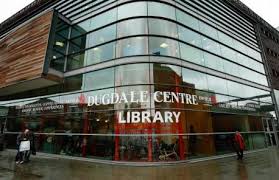
Life should be full of swerve is what I have been thinking recently. It’s how I prefer my days to unfold and certainly one of the main reasons why I value poetry. In dipping and swooping from this to that, swerve serves to exercise our capacities in terms of tension, torque, balance and force. I’m talking emotionally and psychological here, of course, though last Saturday evening did find me doing swerving obeisance to the sat nav woman as I drove up to the Dugdale Centre in Enfield, north London.

imgres

It had also been a pretty swervy week in the more serious sense too. My brother and I have been emailing trying to organise a Lasting Power of Attorney in regard to our nonagenarian parents, alongside my daughter’s final events in the Sixth Form, filled with promise and talented and beautiful friends. A liking for swerve also accounts for why I have always loved that moment in The Winter’s Tale when the Old Shepherd talks of meeting both things dying and things new-born.

As it’s also the end of my teaching year, the week had also been spent revising what I think of these days (thanks for nothing Sam Riviere) as my ‘81 Laozis’: my new versions of the 81 chapters of Laozi’s Daodejing which Enitharmon will be publishing next Spring. There’s a good deal of swerve in the poems’ urging towards openness, flexibility, sense of balance:

[to be] circumspect as a man

who crosses a stream in winter

watchful and alert to danger on all sides

respectful as on a first visit

yielding like ice when the thaw sets in

blank as a piece of uncarved wood

receptive as a valley cut through hills

I think of what the Daodejing proposes as the exact opposite of the (too much blood-stained) rigidities of fundamentalism. As I said, this is why I love poetry’s ability to swerve quickly, often without transition, from one thing to another, one emotion or image to another. And so, I was off to Enfield where Alan Murray runs the meetings of Enfield poets at the unprepossessing Dugdale Centre which – as its name might suggest – contains a Lidl store, an Argos store, a multistory car park and a theatre and arts complex. The readings on Saturday took place in a municipal box within a municipal box but even that didn’t spoil the event (poetry does make something happen when it’s read and shared like this).

imgres

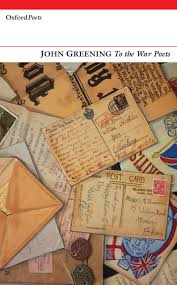
Alan (whose thoughtful book Perhaps was published by Acumen in 2013) introduced floor readers then handed over to Patricia Oxley as the three main poets were Acumen magazine related. John Greening first, whose quiet, measured delivery belies the time he has spent teaching literature to classes of schoolchildren. Dressed in chinos and pale shirt (yes, I’m doing the fashion notes too this time), I grudgingly admit (being a teacher myself) that he looked like a teacher, suggesting nothing of the real powerhouse of writing, editing, anthologising, reviewing and social-medi-ing that Greening is beneath that mild Clark Kent exterior. Born and raised in Hounslow he read ‘Heath Row’ from To the War Poets.

images

Topical, given the recent scandalous report suggesting a third runway to plague the poor citizens of west London, the poem reverses time’s arrow, unearthing what lies beneath tarmac and terminals, back to the original heath and bog, to sarsen stones and druidic rites, back further to a time when “the earth shudders, floods, howls, ignites”. His most recent book is threaded with addresses to the First World War poets and each short poem cunningly, often wittily, says something about the work of each. ‘To Edward Thomas’ notes: “You died at an observation post. / You looked and looked, and saw the detail / we do not”. Greening has also just published a major anthology, Accompanied Voices, with one of the world’s great music-publishing companies, Boydell Press. He read his own ‘Field’ from it, about poor John Field (inventor of the Nocturne) and the artistic irony that it was Chopin who superceded him, or as the poem puts it with all the brutality of the historical process, he “walked all over him”.

imgres

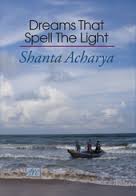
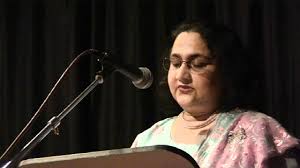
Shanta Acharya’s poems often record the phenomena of the natural world in part for themselves but also, as (her DPhil subject) Emerson suggests, because they can be read as the language of the “Universal Being”. Set in the artistic beauty of a Catholic church, the opening lines of ‘Italian Prayer’ ask: “How does one accustomed to the cold candour of stones / bend one’s knee in reverence”. Acharya’s work is, as Mimi Khalvati has said, “unafraid to take on the abstract, metaphysical, spiritual”. Dressed in an exquisite ivory-cream shalwar-kameez she also read the poem ‘Somewhere, Something’ from Dreams That Spell The Light (Arc Publications, 2010) that argues we do not travel “to explore another country / but to return home fresh, bearing gifts”. In fact, these gifts are for the self because all true experiences – thus discounting those of the ‘mere’ tourist – inevitably change us. The poem concludes, “Let’s fly free, not nailed to a mast; / see the universe with new eyes / not blinded by shadows that light casts”.

images

She also spoke of the Sanskrit phrase ‘neti neti’ (the title of an earlier collection) meaning ‘not this, not that’ as a definition of God or spiritual experience. This provoked a later discussion on the link between this idea and Laozi’s Daoist ideas, then The Cloud of Unknowing, followed by the writings of Julian of Norwich. Good swerves all. Lidl and Argos were well closed by this time of night.

imgres

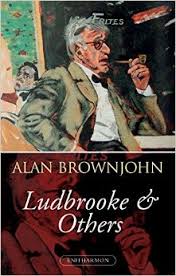
My maternal grandmother would look sceptically up to a cloudy sky on occasions and make a meteorological call on the basis of whether or not there was enough blue sky to make a man’s pair of trousers. Well, those very trousers were being worn by Alan Brownjohn last Saturday evening, teamed with an unthreatening-cloud-coloured pale shirt. Brownjohn’s delivery is also very quiet, words seeming to emerge more from the side of his mouth, confirming that his tongue is often firmly in his cheek, doing deconstruction and the humour of post-modern irony before it was called such. Yet he manages to load poems with a weight of emotion too; he burns away sentiment, but still moves his readers.

Alan Brownjohn more formally attired

I was pleased he read several of the Ludbrooke & Others poems, 13 line sonnets for our austere age and an anti-hero-loser who nevertheless somehow gets our sympathy. Ludbrooke boasts of his “transformative” love-making in ‘His Classic Modesty’ (he persuades us it “is like the Acropolis”). In ‘His Jealousy’ he wants to persuade us (and himself, of course) that he has “deconstructed” and “junked” that emotion, only to feel the full force of it around line 12 to 13. We recognise a commonality at the same time as being allowed the space to imagine ourselves better than Ludbrooke. See the setting, re-setting, re-positioning of the powerful swerve going on there? That feeling you get after vigourous physical exercise of being stronger, more balanced, more capable? Poetry makes that happen to your heart – the figurative one.

imgres

Things of the Earth: Joaquin Giannuzzi’s Poems

Here’s a game: search the little haystack that follows for the several needle-reasons why I wanted to blog something this week about the poetry of Joaquin Giannuzzi.

In a review in Poetry Wales, Nia Davies praises Giannuzzi’s “singular, destabilising and pessimistic, but humane take on the world” and, in part, she links this to the turbulent political landscape of Argentina through the twentieth century. This is poetry “always aware of the presence of violence behind a wall” though Giannuzzi is probably a less explicitly political writer than this suggests. The violence he sees in the world is a harshness even beyond politics and his humanity lies in a hard-won sympathy that we all inhabit a world in which human endeavour has become something of a “mockery”, death the only certainty.

imgres

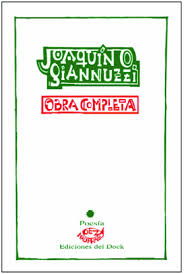
Giannuzzi was born in 1924 to a family of Italian immigrants in Argentina. He chose journalism as a career and his observational gifts are obvious, poems often focusing on individual objects or people. He is a poet of disengagement, the objective gaze (as much as that is ever possible) though what is revealed is in part the poet’s response to what he sees, in part an ironic detachment from it. These are points made by Richard Gwyn (who also links him with Samuel Beckett) in a selection of his brilliant translations of Giannuzzi’s work from 1977 on, A Complicated Mammal (CB Editions, 2012). It was reading with Gwyn in Wales a few weeks ago that first brought Giannuzzi’s work to my notice.

The title ‘Garbage at daybreak’ says a lot about Giannuzzi’s approach. There is the distancing effect of reporting that a “sociological interest” brings the narrator to examine the garbage bins though what he learns is that “things don’t die but are murdered”. His listing of items begins obviously enough but takes a more troubling turn with “a doll’s torso, with a dark stain” (that turbulent twentieth century again?) into a more metaphysical malaise suggested by the ambiguous phrase “rosy meadow death” (una especie de muerte en un campo rosado). The poem ends with a discomforting “comfort”, realising that “not even this excrement / is obliged to abandon the planet”. Why do we harbor such crap and ugliness? But what if we compelled it to be ejected, might we be left even more empty-handed?

images

It was while completing an interview about my own writing (to appear in Acumen Poetry Magazine later this year) that I found myself saying “I’d be happy to accept I am committed to the empirical. As a child, though very quiet and reserved, I don’t remember living in any kind of fantasy world: I would be observing things going on around me. I used to find objects when I was a kid – coloured stones, shells, lost coins – and I remember the pleasure when my mother would say, ‘You’re always on the look-out. You never miss anything’. To this day, I like poems that focus on small things and, in effect, make arguments for the ways in which they communicate the bigger issues”. From this, it’s obvious why I respond to Giannuzzi’s work and ‘Coffee and apples’ is a good example of what Gwyn calls Giannuzzi’s concern for “thingitude” or las cosas de la tierra (things of the earth). He locates the poem in an afternoon in June, a moment of uncharacteristic ease since the world “has become hospitable”, though this is immediately cast into doubt with the simile comparing this to “a truce”, a mere postponement of hostilities. But for a while the things of this world give off an allure of “radiance” and “steam” while the narrator sprawls on his “backside”. But the truce is indeed short-lived as the poem ends with a bomb blast, police arriving, all delivered in a tone suggestive of the commonplace.

imgres

Giannuzzi’s narrators are often solitary and self-critical. In another moment of what seems like ease, one turns accusingly on himself: “I sold out my youth”. The waste of time, sucking on the “ribs of aesthetics” has yielded nothing, not even (look how quickly the Absurdist gulf opens in the course of these three lines): “a personal system of language / I mean an act of writing / That my contemporaries might interpret sufficiently badly” (‘Self-criticism). What Giannuzzi does do is see things and poetry (argues the poem ‘Poetics’) “is what is being seen”.

There are rare moments of tenderness. In being aware of his daughter dressing for a night out, another narrator reaches for religious hyperbole as she evokes a second Eden, “a second perfection of nature”. What propels her to this is a “faith” he cannot share or even imagine and as she puts finishing touches to the creation of herself – especially memorable in the clicking of her bracelets closing – he sees her leave the room “and everything that I am not goes with her”. This treads a fine line between self-pity and an excoriating nihilism that risks wiping out his daughter’s youthful optimism: but it is a line Giannuzzi treads so skillfully, leaving the reader with the strange pleasures of a hard-headed modernist perception alongside a touching evocation of paternal love. Brilliant – especially so when it floated into my mind lying awake waiting for my just-eighteen-year-old daughter turning the lock downstairs, back from late-night clubbing in Shoreditch. She’s back safe and sound; that big world out there.

2058

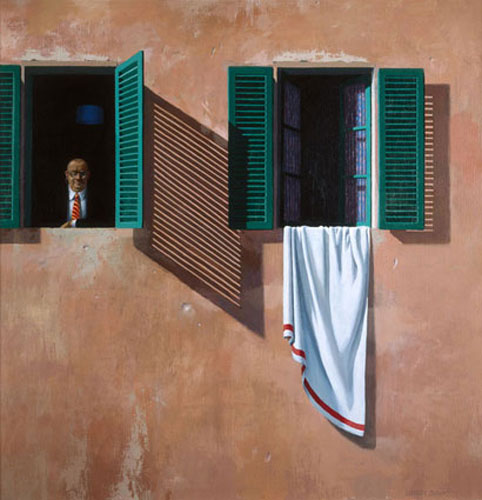
Gwyn notes that Giannuzzi’s narrators are often caught gazing through a window at the big world out there. In one case, what is observed is only an “indistinct appearance”, fragments, colours, a suffering, “tangled up in itself”. The poem imagines a million other similar windows, each framing its “failed theologian” and for Giannuzzi the adjective makes the point here; divinity is only present “by gloomy delegation”, though even that is probably too strongly put. Desertion, perhaps would be better, more truthful. Giannuzzi’s is not the best of all possible worlds, it is the “only possible” and ‘Theologian at the window’ ends by suggesting the human animal has little choice but to suffer “a corresponding headache”.

These are a great poems, short, modern, dark lyrics (that would knock most of the 2015 Forward shortlists into a cocked hat) by a poet compared by Jessica Sequeira in the Glasgow Review of Books to Montale, Auden, Pavese and T. S. Eliot. Richard Gwyn has done a magnificent job of translating him for us – the least we can do is go and buy it.

Joaquin Giannuzzi is interviewed (in Spanish) and reads his poem ‘La desaparición’:

Forward First Collections Reviewed – #1 Mona Arshi

This is the first in a series of reviews I will post over the next two months of the 5 collections chosen for the 2015 Forward Prizes Felix Dennis award for best First Collection. The £5000 prize will be decided on 28th September. The shortlist is:

Mona Arshi – Small Hands (Liverpool University Press, Pavilion Poetry) reviewed here;
Sarah Howe – Loop of Jade (Chatto & Windus); reviewed here;
Andrew McMillan – physical (Cape Poetry); reviewed here;
Matthew Siegel – Blood Work (CB Editions) reviewed here;
Karen McCarthy Woolf – An Aviary of Small Birds (Carcanet) reviewed here.

************

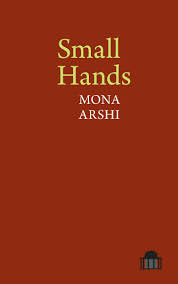
Mona Arshi – Small Hands (Liverpool University Press, Pavilion Poetry) Mona Arshi’s webpage

imgres

Despite the ironic lack of capaciousness implied by its title, Small Hands is a brimming miscellany of poems. Many of them suggest interesting growing points for the future, but Sathnam Sanghera’s claim that Arshi is “Britain’s most promising writer” and Moniza Alvi’s talk of “genius” is premature and liable to drag the reputation of blurb-writing even deeper into the mire. A trying-on of various recognisable styles or voices is expected of any first book, compiled as they usually are over years awaiting a publisher’s call, but Arshi’s arrival at a full collection has been swift. Publicity suggests she only turned from a profession in law to poetry around 2008. It’s for this reason that her influences (Alvi, Petit and Khalvati most obviously, perhaps Emily Berry) are so clear.

Two early poems in the book allude to the idea of catastrophe. ‘Practising Your Skills’ faces an accusation about a “tendency to catastrophise everything” and this also emerges in ‘Bad Day in the Office’ where the narrator is trying not to regard rainfall as “catastrophic”. These instances may be ‘character’ points but such a ramping or ratchetting up of the ordinary is often evident elsewhere in the book and tends to caricature, a dramatic arc-lighting, unexpected (literally cata-strophic) links between disparate ideas or images and hence a love of listing: in other words, forms of surrealism. This is something Arshi has spoken about, regarding and admiring poetry as a discourse utterly counter to the kind of language-use she once employed in the law. So ‘The Lion’ is out of Angela Carter’s The Bloody Chamber via Pascale Petit and evokes a strange relationship between a woman and an older man. It’s a powerfully disturbing poem because the male figure is accorded such power, language, sensuality, wisdom and a sort of droit de seigneur over the female narrator who seems disinclined to question the set up. As with several of the quasi-pornographic pieces by Sam Riviere, the critical question here is where lies the irony? Hard to tell, especially as this is the book’s opener.

imgres

Arshi’s somewhat whimsical surrealism is better seen in her portraits of female figures alone. ‘Cousin Migrant’ is a visitant “from the skies” as well as a paradox (“her arms are thin as margins yet she can lift my children / with ease”). The Cousin’s transgressive – or more accurately, indefinable qualities – are conveyed clearly, humourously, the narrator, in contrast, is nothing more than “a storm in a tea-cup”. The confines or otherwise of female lives are treated in more conventional poetic form in the object and memory piece, ‘The Gold Bangles’, evoked as a cultural inheritance of value though the narrator prefers to think of their owner’s wrists before the gift, “still unadorned and naked”. As here, there are several other poems that draw on Arshi’s background, born to Punjabi Sikh parents in West London. ‘Jesus Saves’ is also a more conventional poem of childhood memory, on this occasion hearing a racist speaker in 1979, on Hounslow High Street, “long after Enoch”. But elsewhere, Arshi prefers to construct enigmatic poems, hovering just beyond the edge of anything one might regard as a clear and present body of evidence. This is especially so in what seem to be ‘relationship’ poems like ‘Entomological Specimens’, ‘Practising Your Skills’ or ‘Insomniac’ which cryptically advises: “Never marry an insomniac. You will have / to mind yourself”.

At the centre of the book are several poems about the tragic loss of Arshi’s brother, Deepak, at the age of 41. These poems are moving and suggest contrasting aspects of her work: deep levels of tact and restraint. Moving through the experiences of learning of his death and the family’s adjustment to his loss in slant poems about a phone call, practical details of the mourning process, officialdom, the family garden, the urn, the loss still feels raw and unresolved and there will be more poems to come on this topic I’m sure.

Mona Arshi

The other prominent and enjoyable aspect of Arshi’s work is its sensuality and awareness of the body; this is a collection full of hands, feet, mouths, lips, eyes, wrists, hair and, ubiquitously, skin. In ‘Lost Poem’ she talks of “taking in language / through my skin” and there is a clear project developing here in that, at their best, these poems unfold through a language of the senses rather than the intellect. Elsewhere, Arshi writes of wanting to “sequester” and “foreignate” words, de-familiarising them, wresting them away from conventional denotation. I first heard her read aloud when she won the Magma Poetry Competition in 2011 with the ghazal-like poem, ‘Hummingbird’, here tucked away at the back of the book. I now read that poem against ‘The Lion’ and this is the one I prefer for its originality. The narrative voice (undefined) addresses the ‘you’ which is mostly the hummingbird itself, though as with ‘The Lion’ the creature is also interchangeably / metaphorically human. The tender, persuasive imperatives almost immediately carry an erotic charge, though where the “fingers” probe and slip is mostly into “spaces”, lacunae. But the hummingbird figure has none of the over-bearing masculinity of the lion; we are told it is capable of “curing”, dissolving, even pronouncing the speaker. But the speaker here is not as passive and compliant as in the earlier poem. Though she will allow him/her to open the “bone-zip of my spine”, the insistence of her voice gives her an active role in the relationship. The hummingbird is invited to “anoint” the speaker, a significant contrast to the shallowness of the lion’s crude “undressing”. (Arshi discusses this poem on the Magma website here)

black-n-white-hummingbird-tattoo-design

George Szirtes’ rather more restrained blurb observations suggest that he reads in Arshi’s work an “erotics of the spirit”. Without doubt, ‘The Hummingbird’ is a sexy, enigmatic, yet precisely expressed poem that is going to repay our re-reading of it. And if that is not the case with many other poems in Small Hands we should not be surprised. Arshi combines a liking for obliqueness, sometimes even coolness, with a desire to push what language can do and a willingness to experiment with form. Her cultural background is relatively unexplored here, yet promises much if that is the way she wishes to go. Not a winner of the 2015 Forward First Book award for me, but an intriguing writer, potentially a unique voice if she can achieve the right distance between herself and her powerful formative influences.

Gerry Cambridge’s ‘The Dark Horse’ – 20th anniversary

The 20th anniversary issue of Gerry Cambridge’s great poetry magazine, The Dark Horse, has arrived on subscribers doormats in the last week or so. In his editorial, Cambridge recalls the magazine’s beginnings in 1995: 500 copies of a slim, buff-card-covered, stapled pamphlet. It began, he tells us, “as a forum for the best writing about poetry and the best poetry (by my own lights)”. He also quotes Patrick Kavanagh on poetry as something you dabble in and then find it has become your life and how true must that be of editing a poetry magazine too. Cambridge reflects on the changes over the last 20 years, particularly in the technology of poetry submission and dissemination, in the “endless drip-feed” of social media, and the degree to which technology has shifted the power structures of contemporary poetry.

imgres

He is evidently uneasy about the influence of the turbo-charged prize culture we now live in which has “clotted and compromised” the world of poetry, alongside the “broadsheet, press-driven accolades and poetry politics that can foment discord among young writers”. It has always been a truism that the world of poetry is a cramped place and the level of attention it receives is vanishingly small. With the advent of a number of notable prizes, the urgency to be accorded such notice has upped the ante considerably so that success is ever more clearly marked, while failure is thrown into far greater contrast; though both ‘success’ and ‘failure’ are designations calculated nowadays too much in terms of immediacy.

images
20th anniversary launch with Clare Pollard, Kei Miller, Wendy Cope and Niall Campbell

So in this context especially, 20 years is very a long time in poetry and The Dark Horse seems set for an impressive further run (equine jokes are hard to avoid and Cambridge himself does not try). This new issue is 190 pages long, with an interesting essay by Dana Gioia on poetry as enchantment, critical evaluations of James Lasdun and Mark Strand, new poems from Vicki Feaver and Oxford Poetry Professorship contender, A E Stallings, as well as Sweeney, Ryan, Cope, Mort, O’Donaghue, Carruth, Brackenbury and Stevenson and loads of others.

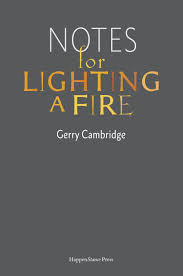
As well as an editor, of course, Cambridge is a very good poet and as my contribution to the magazine’s anniversary celebrations, I thought I’d post up my review of his last collection, Notes for Lighting a Fire (HappenStance, 2012). Wishing happy birthday to The Horse . . . 

images

In Gerry Cambridge’s fine new collection, he seeks to peel away the inessentials of history, personal life, or the natural world in the confident belief that what remains possesses truth and value. His work attends to details, revels in tracing processes (laying a fire, peeling an orange, blowing an egg). He has a fine line in self-deprecation as in ‘Exposure’ where the narrator shaves his head, reflecting a desire to “go bare”, summed up as “an attempt at honesty, a minor / variety of courage”. Actually, this identifies a major thrust of Cambridge’s poetics, aspiring to the “plainness of nouns”, a reverence for things as they are. So conjuring a flame is an apt subject and ‘Notes for Lighting a Fire’ offers a practical guide, evokes a vast universe encompassing the act, touches on the contrasting evanescence of the merely topical, parallels the kindling of flames and poems and concludes with an expansive juxtaposition of science, history, earth and outer space as Orion swings into the sky “like a spaceship / of light from behind the black burial mound of that hill”. It is quite a performance.

Writing for a local council project to light its public buildings sounds less than inspiring but the sequence ‘Light Up Lanarkshire’ quickly escapes its unpromising beginnings. Light energy is derived from coal and coal “is a terse black language” ripe for this poet’s essentialist pen. Lanarkshire’s place-names and history are evoked with “millions of years” to create the “black subterranean seams” and their mine owners’ wealth. The best part of the sequence is Cambridge’s portrait of his miner grandfather, in “necktie and suit with his strong-jawed wife”. Recognising he may not have been an easy man to live with, he still finds admiration for him, “spruce as a gentleman, stepping out for his evening shift”. Likewise, Cambridge’s elegy for his father, only partially ironises inherited values of “the dignity of work etcetera” (‘Light Leaves (1/iv)’). The son/grandson memorialises the undeveloped spark of aspiration in both men’s “stab at a perfect world” (1/x) in his father’s lovingly curated toy trains and his grandfather’s extravagant purchase of “a fancy clock for the house”, devastatingly dropped when confronted by his wife’s critical “sherricking”.

fullislandfinal_003
North Ronaldsey

In Cambridge’s other great love, the natural world, he finds further repositories of continuity. His queen wasp’s abdomen stores “Ten thousand summer wasps, wasp dynasties / Down the perpetual light of centuries” (‘The Queen’) and there is a delightful sequence of poems on a child collecting birds’ eggs. The more ecologically correct adult judges this a mere function of egotistical “possession” (‘Sacrifice’) but perhaps it more truly reflects a concern for paradoxically affirming fundamentals: the securing of the prize of a sparrowhawk egg would be “a bartered death that said I live! I live!” (‘A Sparrowhawk’s Nest’). Love of nature, stoicism and conservatism come together in ‘The Great Things’ in which details of North Ronaldsey are lovingly collected – its sense of space, inhospitable weather, a shrinking population, life clinging on, the beauty of a setting sun. The poem concludes, “Elsewhere the great things of the world will be taking place” but the irony is strong since it’s these stripped-back mundane details that form the true ground of human life and constitute the focus of this honest, profound and coherent collection.

Templar Poetry Launch: Weir and Onitskansky

On Tuesday evening last week I went to the Keats House Library in Hampstead for a reading which was both part of the on-going Keats House Festival and one of Templar Poetry’s regular slots there. Jeri Onitskansky (who I know a little via a workshop group) was launching her Iota Shot pamphlet, Call them Juneberries, alongside Tom Weir who, having had an Iota Shot last year, is already launching a full collection with Templar, All that Falling.

images
Cover image from ‘All that Falling’

Run by Alex McMillen, Templar http://www.templarpoetry.co.uk/about.html is an immensely busy and enterprising press, holding frequent competitions for full collections and Shots (small pamphlets) as well as the Iota magazine. The books all look very good and there was a good crowd at the reading. I was happy to find myself sitting between friends, Mimi Khalvati on one side and Lynne Hjelmgaard on the other. Later, I had a chat with Linda Black about both her writing (fascinating prose poems published by Shearsman) and her work in the visual arts.

All good and fine then? Well – I went away a bit disappointed actually and it was for the good reason that I wanted to hear more from the poets and their publisher, more than the bare poems themselves which I can (I am) reading at my leisure with the printed book. Perhaps there were time restrictions at Keats House but both poets read briefly (with no interval, we were out within the hour) and Weir in particular did not spend enough time introducing his poems. This art of introducing your own work is – I realised all over again – one of the key issues at a live reading (the other reason to go of course is to network and get noticed – quite different to meeting friends – but that’s just miserable). Alex MacMillan spoke economically to start with, just a basic biographical note to each poet. I thought more might be said since both these poets had ‘won’ competitions to get published. I bet there were people in the room who were keen to hear what he liked about these writers, what kind of work Templar published, even where he saw Templar in the twinkling firmament of poetry publishing.

imgres
Jeri Onitskansky

But . . . on with the show. Onitskansky started with several poems drawing on childhood memories of life in the US. ‘Minnows’ is a vivid recall of Summer Camp days though, for this graceless “fifth grader”, catching minnows from a creek was preferable to other more vigorous activities. Plus it provided imagery years later for a poem about wanting to be “filled with grace”. Rather more graceless (though still epiphanic) is ‘Friendship’ where two girls climb up a big rock and then pee down it, “watering a little pee forest” at the foot of it. Onitskansky is very good at innocence, though often a rather tilted, skewed version of it. ‘Girl with Dandelions’ has a child blowing a dandelion clock though she hasn’t yet “learned / they’re the same buttery stars that last / cheered the meadow”. Time passes in many of her poems and there are quite a few creatures too. Adulthood is a place of greater confidence mostly, though also there (in a thoroughly rat-bothered poem) “the long tail / of your mind scurries across the page”. These are interesting poems and Onitskansky is a name to watch.

If Onitskansky’s stage presence is quiet but assured, Tom Weir’s is gauche, jittery, rather apologetic, seeming younger than he really is. Acumen magazine published an interview with Christopher North a while back in which he listed annoying comments, cardinal sins committed by poets at readings. Here are 8 of them:

1) Have I got time to squeeze in a short one?
2) Now let’s see if I can find it…
3) Now if I can just get this thing to work…
4) This is one I wrote on the way here…
5) We were each asked to write a villanelle…
6) I know it’s here somewhere…yes. Oh no, erm, let me see…
7) How long have I got?
8) It’s a load of rubbish, but I’ll read it anyway…

imgres
Christopher North

Unfortunately, brief though the reading was, Weir managed most of these (OK – not 4 or 5). But his opening poem ‘Day Trippin’’ was charming, recounting dealings with a recalcitrant child: “with an ice-cream which you wore // like a glove as it melted over your hand”. That’s a great image but there were fewer of these than I’d expected. Maybe I just missed them. Weir’s delivery did not help his cause being gravelly and short of breath and losing the ends of phrases too often. I had bought the book so I could follow the poems but those listening will have missed phrases for sure. And some of these poems needed a bit more context (‘The Send Off’, for example). I don’t think I’m alone in liking to hear how poems arose, the poet’s thoughts about person, voice, form. A few moments of introduction also allow the auditors’ minds to pause, change gear ready for the next poem.

imgres
Tom Weir

Weir likes to be blunt, direct and there’s an Armitage-y feel to many of the poems, though without the catchy phrase-making and word play. A poem about a dog (apparently intent on suicide by drowning) was a curious choice, especially alongside the more powerful ‘Monsoon’ where men are caught “up to their waists in water, the children held high / above their heads like an offering to a god nobody believes in”. Weir has travelled plenty, particularly in South East Asia, and several of these poems are very interesting (a shame he do not read them on the night). Overall, the book seems a bit hit-and-miss especially as it includes two-line poems on both ‘Muscle Memory’ and seeing a woman dancing through a lit window. There are just 5 lines on ‘Closing Time’ and a 6-liner on a ghost. It’s hard not to see these as fillers and I worry the collection has been rushed out quickly and would have benefitted from editing the weaker pieces.

But it was all over quickly. And, returning to North’s complaints about poet’s reading aloud, I was certainly happy, on this occasion, not to have to suffer anything resembling sins 9 and 10:
9) So all you need to know is that a squawk-bogger is a Tasmanian newt and that ‘ramping in the dolditts’ is an expression used by Romany folk of Upper Silesia referring to their annual bean throwing festival and that Durnstadt-Terminium is a village in Bavaria where they make clay pipes – well, you’ll see what I mean when…
10) (Already 15 minutes over allotted time) …and here‘s one I simply have to read. It came about after my son’s first session in rehab – he’s out now and all seems OK Hooray! Hooray! And it’s an important poem for me because it was like a coming to terms emotionally with..blah, blah, blah.

Thanks Christopher.

Bathing in the Olt #7

Introduction to the abecedary form of this sequence: click here.

Previous installments:  #1 / #2 and #3 / #4 / #5 / #6

Bathing in the Olt

7.

The past behind its drawn curtains

the train to Slatina

their loved ones emerged from the glittering water

*

their property stood on a hill of red soil, a few hundred feet distant but facing the river Olt

they were making for the other bank

they had no thought for the tragedy that had already

*

this was Violetta now in love with Virgil

though she would have been happy to be rescued

to irresistible longing

to swim where the currents allowed

two nights of absence . . . to her that was evidence enough

urgent matters would force delay

*

Violetta seemed to have handled the short separation well enough

Violetta suddenly disappearing from sight

Violetta took her revenge

Violetta was a powerful swimmer

Virgil Trancu and his family lived close by in the neighbouring village

*

waiting for the scandal to break at any moment

waiting for what he felt sure would happen

warm sand under leafy osiers in the breath of a day drawing to a close

was meant simply to entice him

was out of danger

was wrong and she suddenly burst into tears

*

yawning, carefully, she un-

zipped her “maillot” and lay indifferently, beautiful and seductive

arcade-card-french-woman-in-head-scarf-and-wooly-bathing-suit-sitting-on-beach-leaning-on-one-arm-1920s