Laurel Prize Shortlist 2025 – My Favourite Is….!

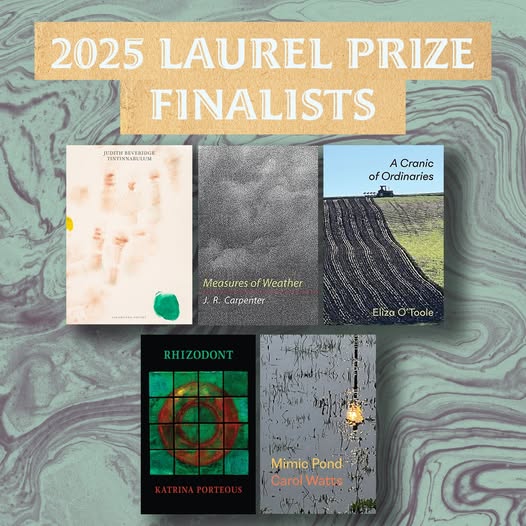
The shortlist for the eco-poetry/nature poetry Laurel Prize 2025 has just been announced. The finalists – judged this year by the poets Kathleen Jamie (Chair)Daljit Nagra, and the former leader & co-leader, Green Party of England and Wales Caroline Lucas – are (in alphabetical order):

Judith Beveridge Tintinnabulum (Giramondo Publishing)
JR Carpenter Measures of Weather (Shearsman Books)Carol Watts
Eliza O’Toole A Cranic of Ordinaries (Shearsman Books)
Katrina Porteous Rhizodont (Bloodaxe Books)
Carol Watts Mimic Pond (Shearsman Books)
It turns out I have reviewed two of these collections – one of them I have been bending the ears of anyone who will listen about how very very good it is. I reviewed Katrina Porteous’s Rhizodont (Bloodaxe Books) for Poetry Salzberg Review fairly recently and posted an extended version of the review here. I concluded that ‘The people and landscapes of ‘Carboniferous’ are far more successful as poems to be read and enjoyed, while ‘Invisible Everywhere’ is a bold, well-intentioned experiment that fails’.

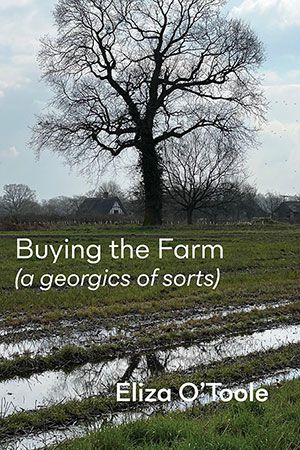
It is Eliza O’Toole’s A Cranic of Ordinaries (Shearsman Books) that I have been telling everybody about. Interestingly – and demonstrating the great enthusiasm the publisher shares for this poet – Shearsman have just published her NEXT collection: Buying the Farm (a georgics of sorts). The nominated collection was published in 2024.

I reviewed it in brief for The Times Literary Supplement recently, as follows:
The premise of Eliza O’Toole’s superb debut collection, A Cranic of Ordinaries, is unpromising: a year’s cycle of diaristic pieces in which the poet walks her dog through the Stour valley. But the result is a sublime form of ecopoetry which is visionary, yet creaturely and incarnate, and to achieve this O’Toole channels two great nineteenth century writers. Gerard Manley Hopkins’ ‘Hurrahing in Harvest’ joys in the things of Nature which are always ‘here and but the beholder / Wanting’. When self and natural world do communicate, Hopkins named that flash of true relationship ‘instress’.  O’Toole’s ‘Stour Owls’ records just such a moment, listening to the calls of a female tawny owl, the ‘slight pin-thin / hoot’ of the male, followed by a tense silence: ‘then the low slow of the barn owl as the / white slide of her glide brushes the air we / both hold & then breathe’ (12).

O’Toole also adopts Emerson’s idea of the ‘transparent eyeball’, seeing all, yet being itself ‘nothing’. The excision of the self’s perspective is systematically pursued. Seldom is the landscape ‘seen’ but is rather subject to plain statement: ‘It was a machine-gun of a morning’ (11), ‘a vixen-piss of a morning’ (13), ‘a muck spread of a morning’ (34). O’Toole has an extraordinarily observant eye, but this repeated trope counters any taint of the constructed picturesque, the human-centring of vanishing points and perspective. The observer grows ‘part or parcel’ of the world. Such a vision makes demands on language because in truth, ‘It is necessary / to write what cannot be written’ (94), and this yields one of the most exciting aspects of this collection as the poet deploys varieties of plain-speaking, scientific, ancient, and esoteric vocabularies as well as a Hopkinsesque ‘unruly syntax’. She describes ‘young buds. Just starting from / the line of life, phloem sap climbing, / a shoot apical meristem and post / zygotic. It was bud-set’ (26).

O’Toole’s choices about form are also bold, almost all the poems being both right and left justified, creating blocks (windows?) opening on each page. The realm the reader is invited into (not told about, not shown) is one where the manifold particularities of the natural world are also and at once a whole. O’Toole’s dog digs a hole: ‘In / the hole and out of it, the soil was / whole. There was a unity and no lack. / In the hole was soil. It was a / comprehensive various entirety; it / was a universe of relatings’. (38) In such ways O’Toole’s ordinaries are made ‘strange’ (33) and the toxic divide between modern humanity and the natural is momentarily, repeatedly, bridged.

Here’s one of the poems from A Cranic of Ordinaries. Apologies are due for formatting accuracy as – as we all know – WordPress is rubbish at dealing with poetry. But you’ll get the idea…..

Perpetual gravity – Box Tombs at Wiston

(the quality of appearing to recede, essential to the landscape tradition)

Now illegible, the children of John

Whitmore and Susanna his wife,

Sarah aged 11 Months,

Robert aged 2 Years,

Rebeckah aged 11 Months,

Elizabeth aged …. Weeks,

Lucy aged 1 Week,

Susanna aged 20 Years,

Thomas Aged 6 Years.

John Whitmore departed this life Jany

the ….6th 1746 Aged (6)6. He was a

good husband loving father faithful

friend and a Good Christian. Susanna

Whitmore died / Jany. 25 1789 Aged

(?8)6. To dwell until all the world

inscribed when it was still possible to

die. To lie slightly foxed, mortared in

a brick box irregularly repaired, alive

with stone-devouring lichen and

littered with dry lime, leaves and

frass. Fin* pees antimony and sees off

the squirrel, wards off unbelievers we

have no need for having no place

amongst toppling tombs. A litany

indescribable, a conjugation beyond

reach, an accent mark over a vowel,

an entire landscape made grave. It

was October, the same fields were

ditched, furrowed, carved, still dug

over and still the Stour was flowing. In

the picture’s distant plain, the sun

like other yellows, was still fading.

Generally, a history remains unsure.

*O’Toole’s dog

The Laurel Prize awards £5,000 for the winner of the prize and £1,000 for the other four finalists – so congratulations are due to all of them. The winner will be announced at the Laurel Prize Ceremony which is taking place on Friday 19 September at 5.30pm (BST), and will be aired via a free live-stream. This year’s ceremony is a part of BBC Contains Strong Language which takes place in Bradford from 18-21 September.

2016 Forward First Collections Reviewed #5: Harry Giles

This is the fifth and final installment in the series of reviews I have been posting of the collections chosen for the 2016 Forward Prizes Felix Dennis award for best First Collection. The £5000 prize will be decided on 20th September. Click here for all 5 of my reviews of the 2015 shortlisted books (eventual winner Mona Arshi).

The 2016 shortlist is:

Nancy Campbell – Disko Bay (Enitharmon Press) – click here for my review of this book

Ron Carey – Distance (Revival Press) – click here for my review of this book

Harry Giles – Tonguit (Freight Books)

Ruby Robinson – Every Little Sound (Liverpool University Press) – click here for my review of this book

Tiphanie Yanique – Wife (Peepal Tree Press) – click here for my review of this book

imgres

Thanks to Freight Books for providing a copy of Harry Giles’ book for review purposes.

I’d only come across Harry Giles’ work as a Guardian featured poem in June in response to his Forward short-listing. The chosen poem was ‘Piercings’ and suggested Giles was working the same area that Andrew McMillan did so successfully last year. What might be an autobiographical masculine narrative voice recognises a passer-by as an old encounter: “four years since / he hauled me into a lift with / Want to make out?” But the man had then been sporting various body piercings which have since been removed in order to become “employable, less obvious” whereas the narrator has continued making “more holes”, continued to accumulate the badges of a rebelliousness the other has given up on. The final question, “So what do you do now?” is therefore made poignantly redundant, each, surely, reading the tell-tale signs of the other’s body.

But ‘Piercings’ is by far the most conventional poem in Tonguit and Giles is no McMillan, nor does he want to be. On the facing page is a poem made from extracts from One Direction’s Harry Styles’ fanfiction. The title, ‘Slash poem in which Harry Giles meets Harry Styles’, gives a feel for its playfulness though the poem itself does not seem to amount to much. Perhaps it amounts to more if read in the context of Giles’ other manipulations of texts and discourses which have a more obviously seditious intent. The last poem in the collection offers ‘Further Drafts’ of a phrase often used by Alistair Gray: “work as if you live in the early days of a better nation”. Giles works various rhyming turns on the first and last words of this phrase eventually to arrive at “lurk as if you live in the early days of a better sedition”. It’s ‘Harry Styles’, manufactured pop idol and X Factor/Simon Cowell cash cow, that is the real target of Giles’ poem (though it lurks with some seditious intent, it’s still not among his best).

images

Giles is interested in the processing of texts, sampling from George R R Martin’s A Game of Thrones, or creating cut-up texts from information associated with Abu Dhabi’s artificial island and cultural centre, ‘Saadiyat’.  The satirical effects are delivered through simple repetition and disjunction, questioning the original source’s coherence and integrity, where ecological sustainability becomes “a core value integrated into the design approach / in terms of throughout the the the concept design” [sic]. ‘You Don’t Ever Have to Lose’ does something similar with advertising text from IT services company Atos. ‘Your Strengths’ is a more powerful text in its own right, this time using source material from the Department of Work and Pensions Capability Assessment, the UK Citizenship Test and other psychometric tests to make a thunderous barrage of questions ranging from the invasive, absurd, profound, squirm-inducing and piddling to the politically loaded. Giles also works textual legerdemain in ‘Sermon’, based on a speech by David Cameron in which the word “terrorism” is replaced by the word “love”:


We must make it impossible

for lovers to succeed. We need to argue

that love is wrong. To belong here

is to believe in these things.

imgres

This processing of texts, often randomly, often derived from the internet or Google searches, sometimes with editorial influence in the final result is presented as politically subversive. As the Tonguit blurb suggests, it derives from the belief that we are all warped and changed by the language/s that surround us and inhabit us. The hope of the lyric poet working towards his/her own truth is devalued, considered delusional, impossibly bound up in Blake’s socio-psycho-political “mind-forged manacles”. We liberate ourselves by breaking these, unpicking or smashing the dominating discourses around us. And if our deliberate intention is already suspect then we must achieve it randomly, perhaps via a machine. It’s a form of surrealism which profoundly questions our use of language and owes a lot to the Oulipian experiments of Raymond Queneau. Giles’ collection title, Tonguit, productively seems to hover between an urgent imperative to individual vocalisation – tongue it! – and more passive implications about the way other people’s language/s oppress the individual – we have been tongued!

images

The more imperative mood is obvious in ‘Curriculum’ which takes aim at normative education and gives it both barrels:


Mix me a metaphor of noble gases,

economic engines and avant-garde

taxonomies, with Kingdom Phylum Order

gone to bloody Dada. Get down and dirty


with transects, quadrants.


There is a Wildean element to this sort of systematic over-turning though there is no doubt about Giles’ seriousness beneath the often funny, ludic quality of these poems and there is none of Wilde’s self-regarding quality. Harry Giles himself – as a recognisable, recurring, coherent, autobiographical figure – is curiously absent from most of these poems though I don’t doubt the sincerity of a poem like ‘Waffle House Crush’:


I’ll have you smothered n covered

diced n peppered n

capped n lathered n

lustred n smoothed n

spread


Giles’ various linguistic masks don’t hide so much as free him into more liberated forms of expression. I’ve deliberately not yet mentioned his most obvious, deliberately chosen mode of expression: what he calls his own “mongrel and magpie” form of Scots. Dave Coates has pointed out that, as in Kathleen Jamie’s The Bonniest Companie, Giles provides no glosses in the book on his particular Scots, “an implicit assertion of the language’s place within the broader spectrum of Englishes”. Giles’ Scots sets itself deliberately against discourses like those of the DWP and Atos as a declaration of variousness. Nor is he averse to something like a declaration of war:


Let’s be arsonists. Let’s birn the year.

[. . .]

Let’s mak like airtists

n birn the leebrars [libraries] acause we shoudna, n birn

Pairlament acause we shoud.


What follows is an apocalyptic conflagration of all things, down to the “thocht o fire”.

But the sheer vigour of Giles’ intent means his Scots is a lot harder to follow than Jamie’s. In fact, he does provide his readers with a full gloss/translation on his website. I needed this to be honest to deal with a lot of the Scots text, though the ‘translations’ then read as somewhat awkward, watered down versions of a quite different language (rather than a form of English). But it is worth the effort to really appreciate the tour de force of national- and self-assertion that is ‘Brave’. Like some Highland Whitman, making himself and his nation through singing (I’m losing some of the lay-out here):


A sing o google Scotland

o laptop Scotland,

o a Scotland sae dowf on [dulled by] bit-torrentit HBO

drama series n DLC packs fer

paistapocalyptic RPGs

imgres

But also the Scotland “whit chacks the date o Bannockburn on Wikipaedia” and fears “o wan day findin oot / juist hou parochial aw hits cultural references mey be”. ‘The Hairdest Man in Govanhill’ takes all the clichés that phrase might suggest and instead describes a man who “has thay lang white scairs on / baith sides o his mooth fae smiling that damn wide” (my italics). This is of a piece with the Cameron subversion as we hear that the man is “that bluidy haird he’s a hairt tattoed wi Dulux on his bicep n aw hit says is A LUV YE”. There’s a risk of this getting as caricatured as the cliché it intends to subvert but Giles’ Scots is put to terrific seditious intent in ‘Tae a Cooncillor’ – a kind of one-sided flyting in which the local councillor who wants to close down a swimming pool is mocked mercilessly:


Wee glaikit, skybald, fashious bastart,

whit unco warld maks ye wir maister?

Whit glamour has ye risin fest as

projectile boak?

Hit’s time tae gie yer feechie fouster [nasty fester]

an honest soak.


This is committed, bolshie, rebel-script done with great skill and immense energy but Harry Giles is too interested in too much to settle merely for this. I was interested in his Scots (or rather specifically Orcadian) versions of a few chapters of the Laozi’s Daodejing. He astutely titles these ‘Aald rede fir biggin a kintra’ [Old advice for building a country] again recalling Alistair Gray’s dictum. The opacity of the language makes Giles’ versions a hard read but (if I may) here’s his boldly economical version of chapter 53 (some indentations lost here again) followed by my own recently published version:


53

a bit wittins

whan waakan the wey

are a rod tae dree


the wey is snod

an fock cheust fancy the ramse


govrenment divided

sheens growen-up

kists empie

but heidyins’ claes are braa

thay’ve barrie blads

are stecht wi maet

gey rowthie


caa this the darg o reivers

an no the wey


Crooked avenue

chapter 53


—perhaps you have begun well

one step after another along the way


yet you walk in fear of side-tracks

the great way running level and plain


still who can resist those side-tracks

soon as good governance is in place


we’re liable to neglect our business

too soon the tall barns lie empty


sooner wear fashionable clothes heels

daggers for glances glut on food and booze


have more than we can sensibly use—

dawn breaks on some crooked avenue


what was it happened to the way


Tonguit is a bubbling cauldron of a book, willing to take risks that don’t always come off, but guided by a belief in the need to challenge the assumptions and languages of the status quo. Harry Giles is a fascinating figure (go to his website here ) and his characterisation of his Scots as “magpie” is as much applicable to his multifaceted work in theatre, software, twitterbots and visual arts, all forms of “art about protest and protest about art”. Whether contemporary poetry, as in books like this one, will prove sufficiently interesting and flexible for his creativity remains to be seen.

imgres