Review of ‘Autumn Fire’ by Ricarda Huch, tr. Timothy Adès

This review is an extended version of the one which first appeared in Acumen Poetry Magazine in the autumn of 2025. Many thanks to the reviews editor, Andrew Geary, for commissioning it.

Considered by Thomas Mann as ‘the first lady of German letters’ and as the first woman to receive the prestigious Goethe Award (1931), Ricarda Huch (1864-1947) was a literary superstar of her time, yet remains little known in English. She was an historian who published novels, philosophy, drama and poetry. With the rise of Hitler, she made her rejection of Nazi doctrine clear, remaining in Germany as an ‘inner émigré’, but surviving the war years. Autumn Fire (Poetry Salzberg, 2024) is her last collection, published in 1944, and powerfully reflects her lifelong fascination with the Romantic movement. As Karen Leeder’s scene-setting Introduction explains, this is evidenced in the poems’ formal choices as well as imagery, ‘a repertoire of sprites, flowers, scents, birdsong, gardens, moons, fairy tales, and love’. An English poetry reader would initially place this work in parallel to the least challenging of the Georgian poets of 1914.

There is frequently a faux medievalism at work, as in ‘The trees of autumn murmur’ which tells the story of a Prince who wanders into the woods and is bewitched by ‘fairies wild’ to live a sad, unloving, unhappy life. Other poems remind us of Hardy’s folkloric, time-obsessed lyrics in similarly challenging stanza forms:

On far-off floors the dancers face the middle,

The hems swing stiffly to the threshers’ drum.

Accordion and bass and fiddle

Ethereal hum.

                                                (‘Autumn’)

Also from the stock Romantic image bank comes the isolated, tortured figure of the poet who, as spring days arrive, remains unmoved by them because mysteriously ‘troubled’ and when called upon to sing his songs (this is Huch’s own masculine gendering), finds that his creative efforts are ‘unwelcome’ to society at large (‘Morning of twittering birds’).

However, a closer reading of Huch’s poems clarifies their curiously hybrid effects, as in ‘The Old Minstrel’ in which the violent early years of the twentieth century come forward dressed in medieval garb. The narrative voice encourages the minstrel to sing and play his harp: ‘songs of golden treasure, / Times of playfulness and pleasure’. But the final lines of the poem are spoken (we must assume) by the minstrel who warns that what may come from him demands powerful trigger warnings:

Woe betide ye when I call

Forth my lions, every string,

Dumb in dusty ambuscade,

Torpid now, glistening

Thick with matted blood!

Huch boldly leaves the poem there, without any return to a possibly moderating, narrative voice. ‘The Heroes’ Tomb’ also makes use of familiar images (a tomb, a blustery November day, an old man, a passing shepherd, a youngster asking questions) to address a distanced ‘wicked war’. This poem similarly ends bloodily (though note, we are still in the era of swords rather than machine guns), as those who are inclined to stoop and listen at the tomb, can ‘make out far below the clash of swords, / And tell the drip, drip, drip, and hear the sound. / Can it be blood?’

Such lines contrast the lark’s song, the perfumed jasmine, the poplars and lime trees inhabiting so many of these pages and Huch herself seems to shuttle between a religious-based optimism and a much more modern sounding despair. In ‘Moonlit Night’, an owl flies through a wood and takes a mouse as prey. The moon seems to be portrayed as looking on, wholly indifferent, as it picks its way through the branches, ‘twinkle-toed and light’. Only the form and language here makes the poem feel less than genuinely Modern. As for the owl, it becomes proleptic of technological advances in air warfare as she sweeps off through the wood, ‘the murderess, / whose claws the victim hold, / airborne above black treetops’ emptiness’. Another predator image later provides the reader with a further shock. In ‘My heart, my lion, grasps its prey’, the latter is identified as ‘the hated’. And the passionate nature of Huch’s antagonism – though the object of her hate is never named – is startling, and she uses repetition, shortened lines and rhyme to make her point:

My heart hates yet the hated,

My heart holds fast its prey,

That none may palter or gainsay,

No liar gild the worst,

Nor lift the curse from the accursed.

Almost inevitably you feel, the elements of modern warfare seep into Huch’s poems. In the midst of another Hardyesque stanzaic poem, between the ‘honey-brown’ buds on the trees and the lark’s ‘music-making’, more familiar ‘war poem’ sounds provide the base notes: ‘The earth shakes with battle, the air with shellfire heaves’ (‘War Winter’). The ABAB quatrains of ‘The Young Fallen’ mourn those taken by war by first evoking the innocence of their childhoods, schooldays, their unfulfilled worldly ambitions. Then ‘War came’. And though much of the detail and imagery could be applied to wars fought anytime in the last few centuries, there are moments when the realities of the mid-twentieth century cannot be denied. The young men’s hands are a focus, as they ‘Not long ago reached out for toys and fun. / Those hands, conversant with the tools of murder, / Control the howitzer and grip the gun’.

In fact, Huch was living in Jena when the city was bombed by the Allies and ‘The Flying Death’ comes closer than any other poem in conveying her experiences of modern warfare. Though the Flying Death is an old-fashioned personification, its modus operandi is up to date: ‘The chimney reels, the roof-beams groan, / By distant thunder he is known’. Even as the air bombardment is imaged as approaching on ‘iron steeds’, its impact is plainly conveyed as ‘A whistling, hissing din, and more, / A jarring shriek is heard, a roar, / As if the earth would burst.’ This Poetry Salzberg publication unfortunately does not give the reader the original German, but Timothy Adès’ translations are quite brilliant in their preservation of form and rhyme, while at the same time conveying both the sweetness and the violence in Huch’s curious, powerful, under-appreciated poetry.

Excerpts from Autumn Fire, tr. Timothy Adès

Stralsund

The old grey town that blue sea girds:
The swell of rust-red sails,
The squawking, tumbling salt-sea birds,
The flash of clean fish-scales.

On this church wall the pounding wave
And tempest waste their fire:
Though organ-thunder shakes the nave,
No foe hurls down the spire.

The clouds with tender beating wing
Caress its head, that dreams
Of fierce-fought battles reddening
Its foot with gory streams.

The dead are sleeping, stone by stone,
The sounding bells request:
Eternal memory, my son,
Be thine, eternal rest!
 

Music

Melodies heal up our every smart;
Happiness,
Lost to us, they redress;
They are balsam to our ailing heart.

From the earth where we without respite
Toil enslaved,
As on wings of blessed angels saved
They transport us to a land of light.

Sound, sound forth, ye songs of mystery!
Worlds fly far;
Earth sinks down, our red and bloodstained star;
Love distils its essence from on high.

Peter Huchel in Translation – review

Marvellously thoughtful and well-informed review of my (fairly) recent translations of the poems of Peter Huchel. Also recent winner of the Society of Authors’ Schlegel-Tieck Prize for Translation 2020.

Many thanks to Rebecca DeWald and to Reading in Translation.

“Remember me, whispers the dust”: Peter Huchel’s “These Numbered Days,” translated from German by Martyn Crucefix (readingintranslation.com)

Inner Emigres – Heaney and Huchel

Googling the term ‘inner émigré’ I come up mostly with links to Seamus Heaney’s use of it in the poem ‘Exposure’, the poem with which he ended North (1975):

I am neither internee nor informer;

An inner émigré, grown long-haired

And thoughtful . . .

heany_profile

In a 1998 interview, Heaney discussed his use of the term: As far as possible, you try to remain a mystery to yourself. Living in Ireland, not being an exile, living in Ireland as a social creature, as a familiar citizen, I think there is a great danger that one’s social persona might overwhelm one’s daimon — if you’ll permit me such a grand term . . . And so what one is always trying to do is displace oneself to another place or space . . .Wicklow is where I first thought of myself as being an inner émigré. Since 1988 . . . I’ve been able to own the cottage and to think of it as my “place of writing.” When I said “inner émigré,” I meant to suggest a state of poetic stand-off, as it were, a state where you have slipped out of your usual social persona and have entered more creatively and fluently into your inner being. I think it is necessary to shed, at least to some extent, the social profile that you maintain elsewhere.

Heaney’s explanation of the term here is almost wholly personal and uncontroversial. Most of us would agree that we need to slip the moorings of our more socially tied selves in order to find the place of poetry. This is in part simply the required liberation from the way we use language to operate in (utilitarian) society though it’s also a shaking loose from the (again utilitarian) intentions and feelings of the quotidian. Having said that, Heaney does not mean a retreat into some up-dated Celtic Twilight world, soft-focused and fey, an abandonment of MacNeice’s requirement that modern poets are readers of newspapers, capable of pity and laughter, involved in personal relationships, actively interested in politics, susceptible to physical impressions.

This is more clear when Heaney acknowledges the term ‘inner émigré’ once had a specific meaning in the 1920s and 30s in Soviet Russia. It referred to someone “who had not actually gone into exile but who lived at home disaffected from the system. Well, to some extent that was true of myself. Certainly, in relation to Northern Ireland.”

seferisbio
George Seferis

Heaney goes on to talk of finding in George Seferis’ work a connected idea, developed in The Redress of Poetry (1995): Seferis is reading Greek poetry during the war in the nineteen forties and he’s trying to write an article. There is distress, uncertainty, destruction all round him, with civil war looming. And he’s reading poetry and he’s really testing it. Does this thing have any value? And at one point he says: “Reading X this morning, I found that poetry is a help.” I think that what he means is that poetry secures some final place in your being, some little redoubt in your consciousness that will not be taken over by history or the world or disaster . . . Poetry’s value is established and promulgated by people who have known that feeling or something like it.

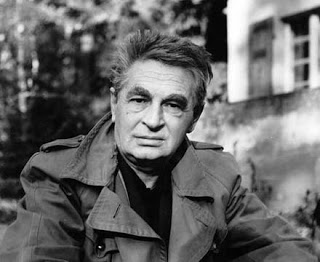
The term ‘inner émigré’ is also often used to describe Peter Huchel’s work though he was in the unusual situation of having to develop the strategy twice over.  His very early poems were linked to the sort of art fostered around 1920 by the League of Proletarian Revolutionary Writers. There’s no doubt he was on the side of the proletariat, the servants and exploited farmhands. He once said: “What did I care about in those days? I wanted to make visible in the poem a deliberately ignored, suppressed class, the class of the people, the maidservants and coachmen”. Even at this early stage his work did not include any proposals for a political solution and his concerns over social deprivation (witnessed from childhood days in the Brandenberg countryside) led him not to public proclamation but more inward to articulate a vision of a more fundamental relationship between productive human activity and the natural environment. It’s no surprise that Huchel felt close ties to the work of Robert Frost, though Huchel’s early verse (more than the American poet) is concerned with a representation of harmony and continuity, more fulfilment than frustration of fulfilment.

huchel
Peter Huchel

But with the rise of Hitler in the 1930s, Huchel began to develop the strategy of the ‘inner émigré’, publishing very little, even deciding to withhold an entire collection of poems, fearing it might be associated with the kind of blood-and-soil nature verse approved by National Socialism. His response to political changes was silence and non-cooperation.

It’s best to understand Huchel’s short-lived flash of faith in East German land reform in the immediate Soviet-Occupied post-war years in terms of his earlier social concerns. As John Flores argues, Huchel’s praise of the “law” of land reform is “not to be viewed as a sudden sacrifice in answer to official decrees, an unwilling turn to a theme totally incongruous with all his earlier poetic concerns, but as a logical continuation, in a way the culmination of his sympathy for the unprivileged classes inhabiting the countryside of his origins.” Within a few years, as the poet grew increasingly discouraged by developments in DDR society, his emphasis shifts from the praise of productive human activity in nature and the social order, to a concern for the enduring misery of men, regardless of the structure of society.

imgres

Huchel again had to adopt the role of ‘inner émigré’ being now at odds with East German politics yet still writing (and editing Sinn und Forme). His work becomes characterised “less by sympathy with those denied the privileges and rights due to them, more by meditations on the pain and uncertainty which permeates all human existence” (Flores again). Huchel’s tone becomes sombre and melancholy, poetic diction cryptic, his palette narrows, full of recurrent symbols. Poems from the 1950s are implicit statements of his ‘counterposition’ to the ‘construction of socialism’. Franz Schonauer suggests Huchel’s poems are not the expression of a direct opposition or political protest and express a loss of confidence. These poems are winter psalms. What is at stake is the human intellect and its power of resistance when reason and culture seem brutally damaged, in a frozen motionless state. This is from ‘Exile’, published in 1972:


With evening, friends close in,

the shadows of hills.

Slowly they press across the threshold,

darkening the salt,

darkening the bread

and strike up conversation with my silence.


Outside in the maple

the wind stirs:

my sister, the rainwater

in the chalky trough,

imprisoned,

gazes up at the clouds.


Huchel could still write: “The creative, even eruptive, element in lyric poetry only rarely exists without rules; it needs a container, a form, so as not to disperse. Spring water spilled on the floor has only a dim glow – but when poured into a glass it is full of light”. This is the same little redoubt that Seamus Heaney found in Seferis; each hard-won poem as a receptacle of something that will not be taken over by history or the world or by disaster.

north